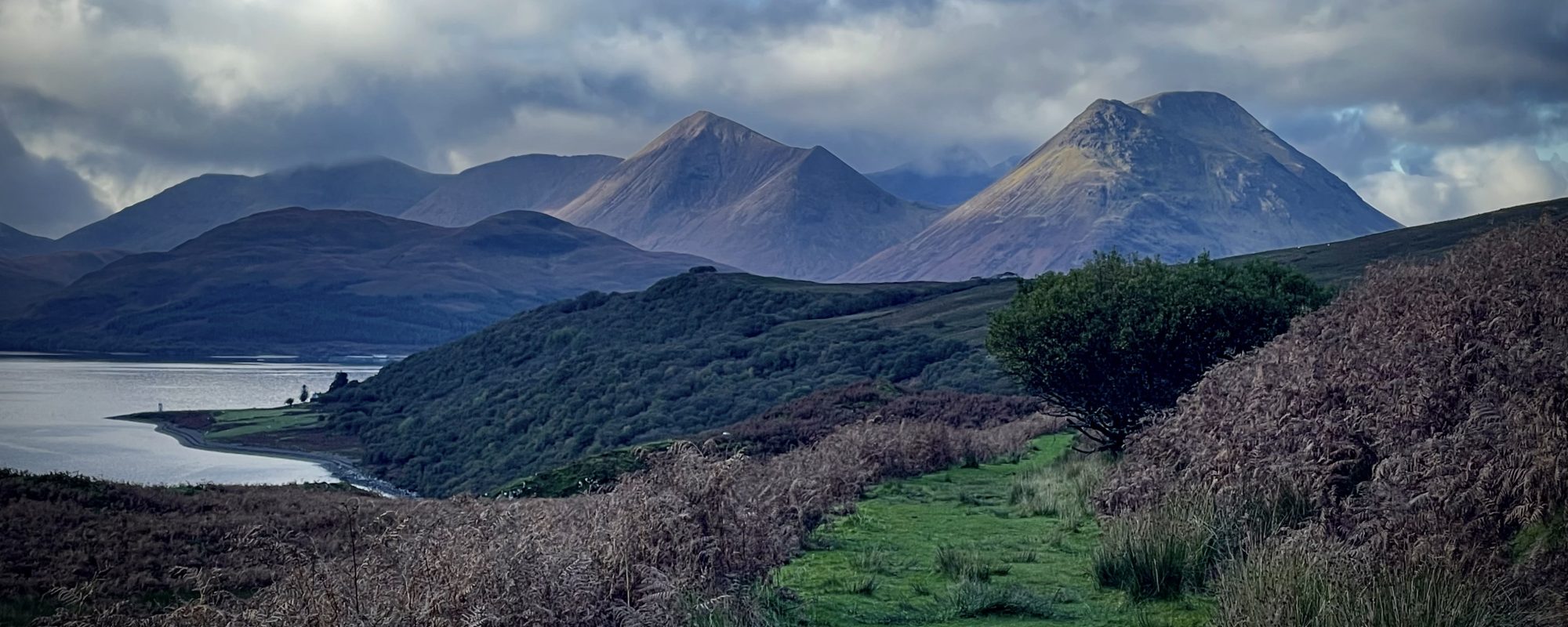
It’s quite striking how much of Scotland’s notable history over thousands of years occurred in the Isles. Back in the day, coastal routes were the country’s express lane – much quicker and easier to travel by sea than slogging overland across boggy, mountainous roadless terrain.
The other area of concentrated history is the Central Belt, the geographic center of Scotland. It’s the the lowland strip between the Firth of Forth (Edinburgh) in the east and the Firth of Clyde (Glasgow) in the west. It’s a relatively small area, the girlishly slim waist of the country, with Glasgow, on the west coast, being only 41 miles from Edinburgh, on the east. The area has been Scotland’s major population center forevs. As a result, wherever you visit in the Central Belt, chances are it has been previously frequented by Robert the Bruce, William Wallace, and/or Mary Queen of Scots as well as other long, long-ago personages.
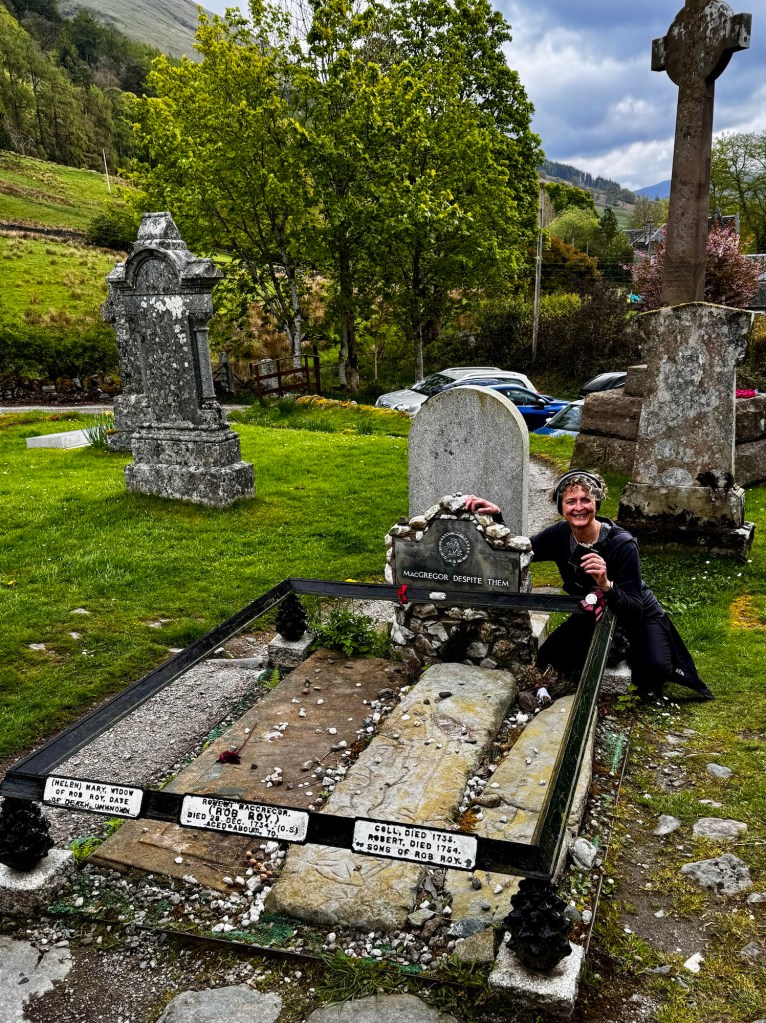
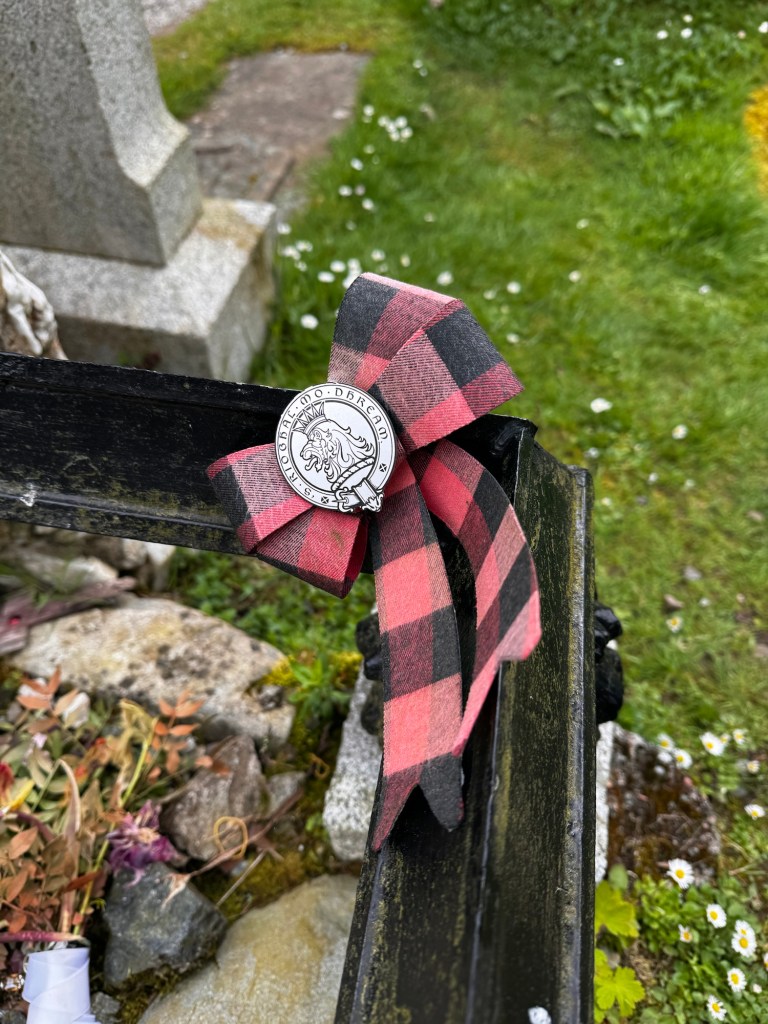
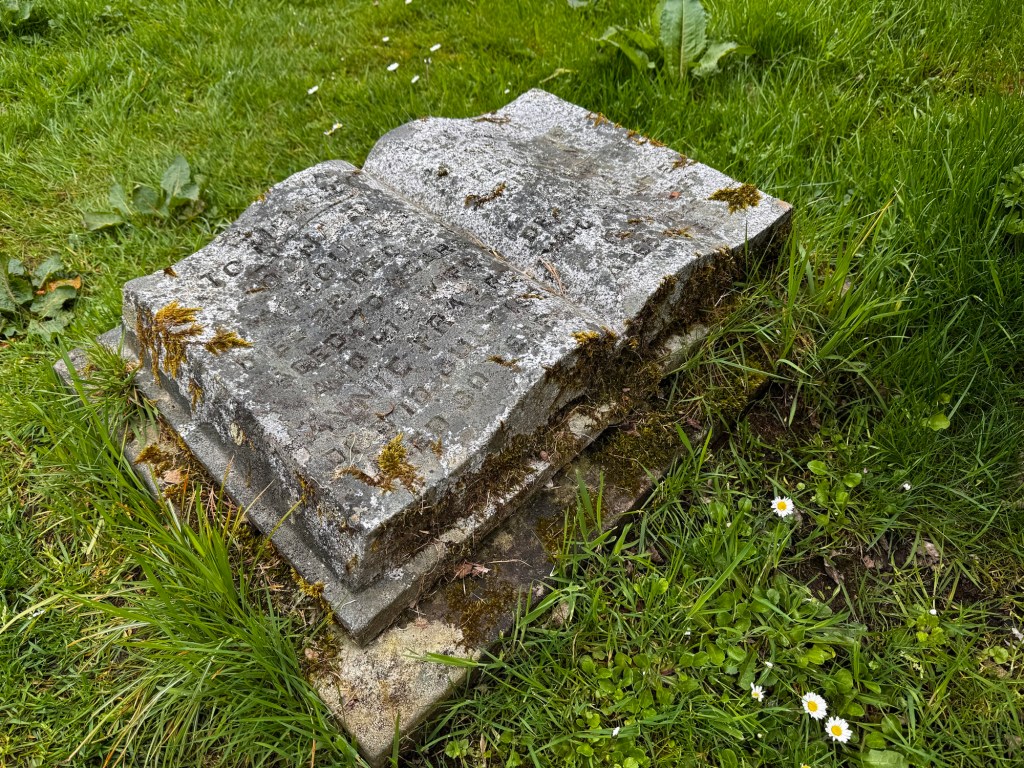
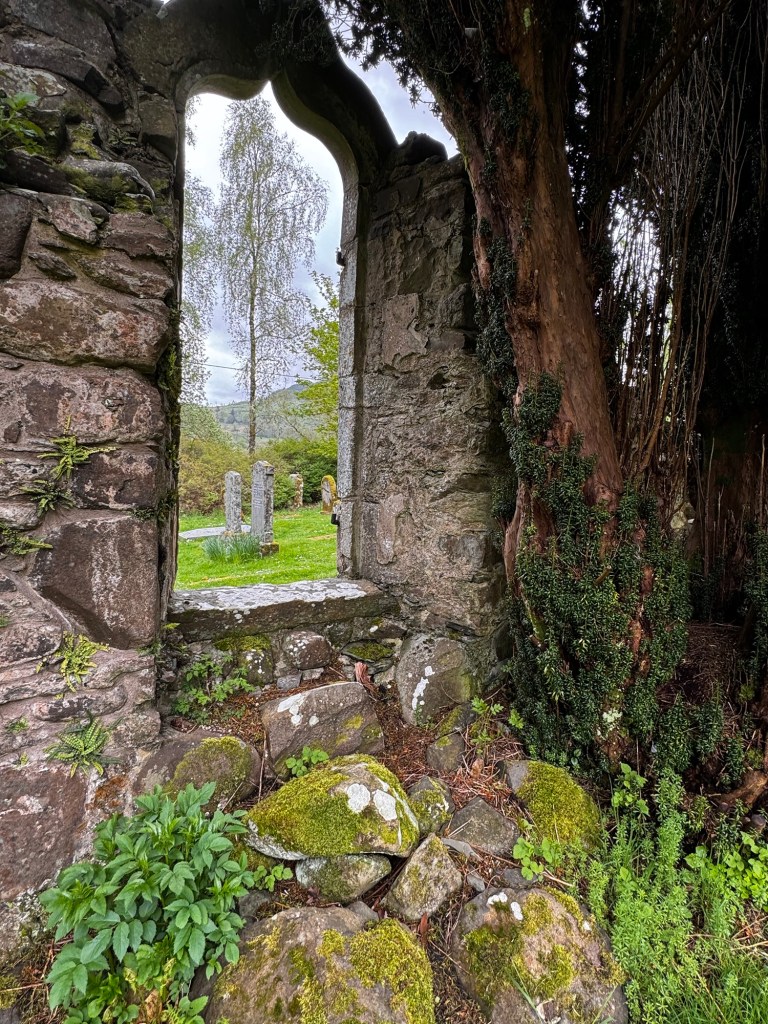
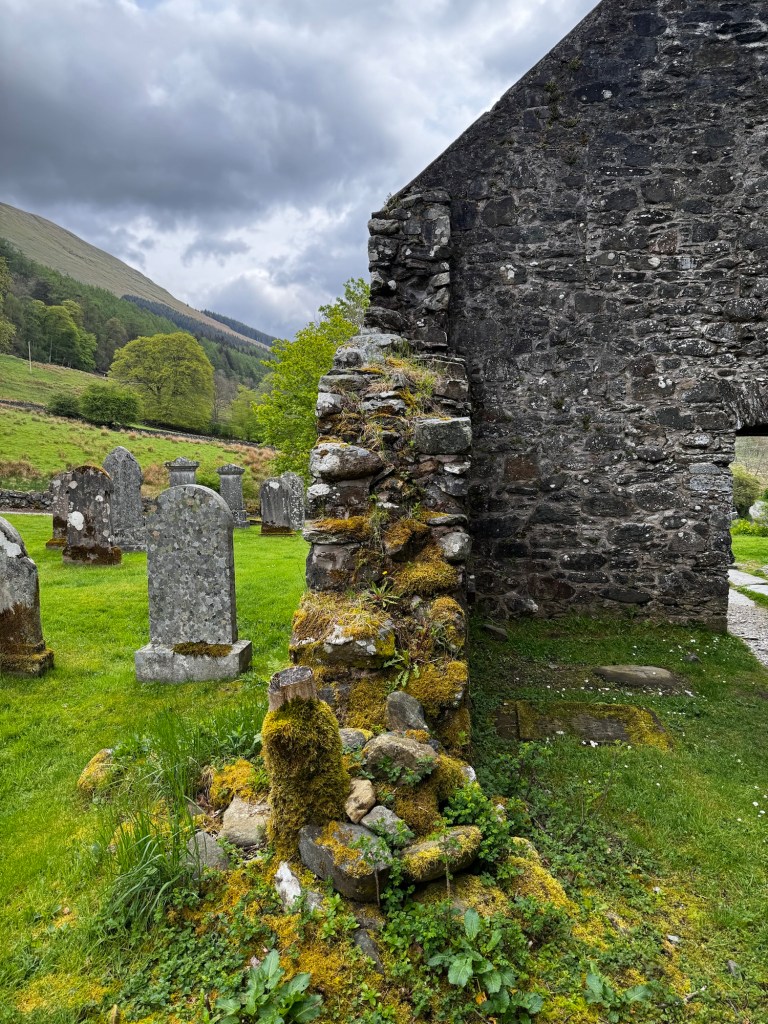
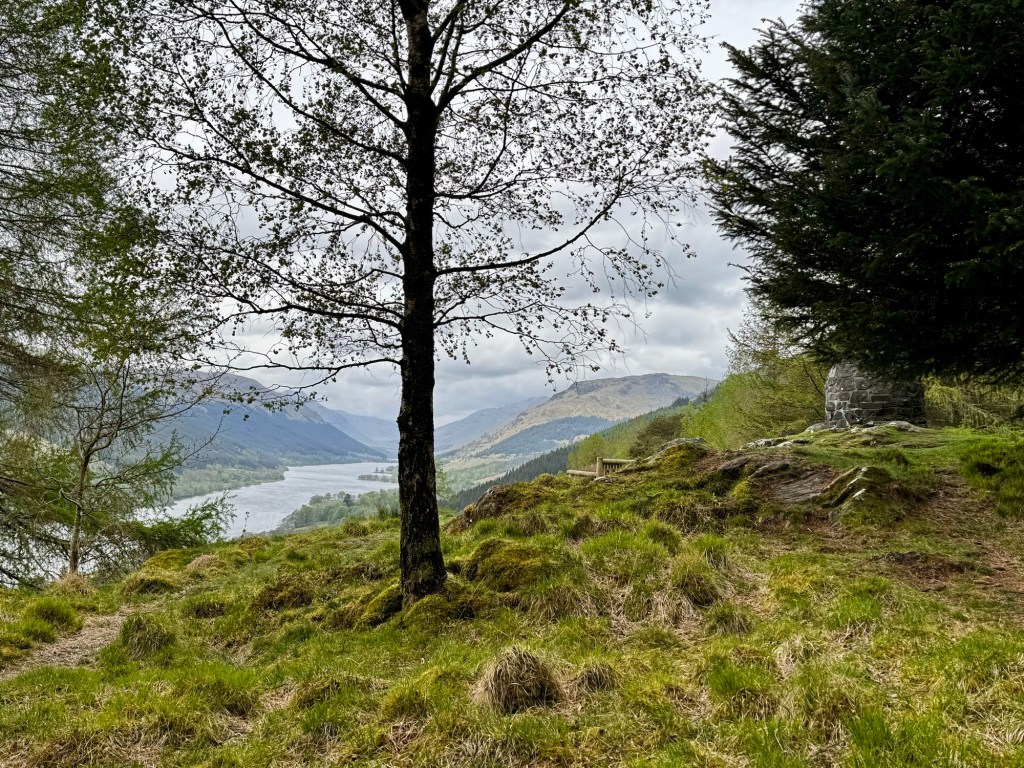
Rob Roy’s area of influence was pretty limited to the Highlands, but he’s included in this one-sided conversation of ours because he might be an ancestor (only in my mind and the invisibly slim fact that Gregory is a long-ago bastardization of MacGregor). Also because on my way to Stirling, today’s destination, I stopped to visit my great great great etc Peepaw’s grave at Balquhidder Parish Church and climb the hill behind it for one of my favorite views in Scotland, a drop dead vantage point overlooking Loch Voil. It’s a sweet, sweet spot and I’ll always check in when I’m passing, as you do with family.
Now, mind, Rob Roy was basically an outlaw who became a Robin Hood-esque folk hero during his lifetime thanks to a book written by Daniel Defoe and published in 1723 called The Highland Rogue. King George I pardoned him just as he was about to be involuntarily transported to the colonies, and the 1817 publication of Rob Roy by Walter Scott posthumously polished the sheen of his hero street cred.
Berlioz composed an overture in his name, Liam Neeson played him in a film and, the ultimate honor, in 1894 a bartender at the NYC Waldorf Hotel created a Rob Roy cocktail (whisky and vermouth garnished with a cherry which is a sad waste of whisky). He did fight in the 1689 Jacobite rising but like many other clan chiefs during the 17th and 18th centuries he also ran a protection racket, offering to safeguard cattle in exchange for cash he needed to feed his clan. This, along with cattle rustling, was common way to earn a living. He was declared an outlaw only when he defaulted on a loan because his chief herder absconded with the loan money.
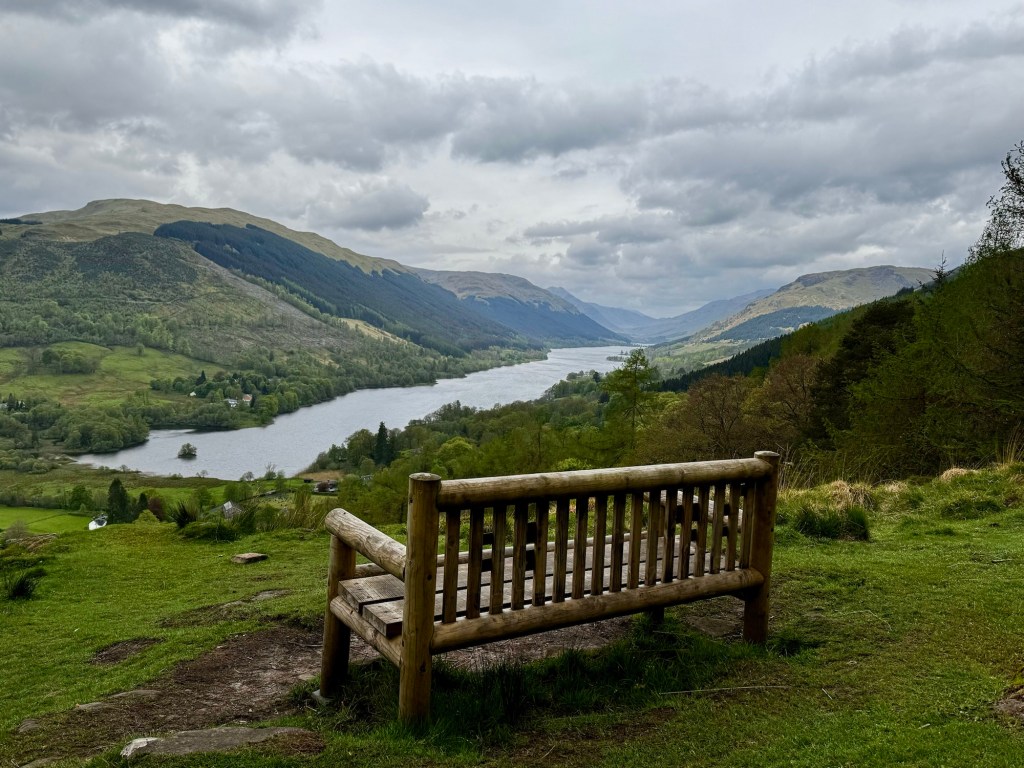
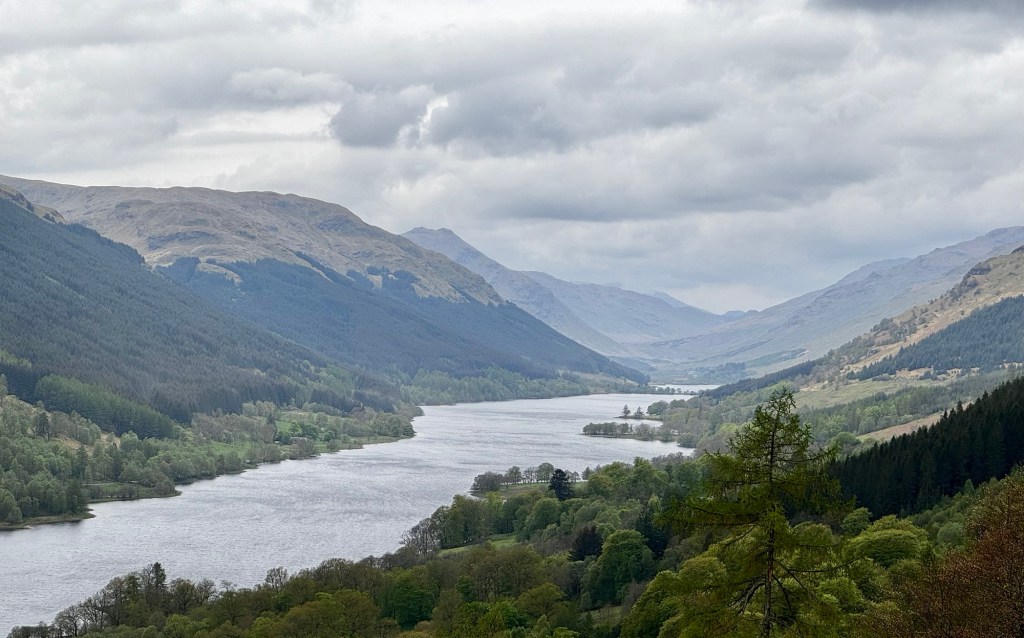
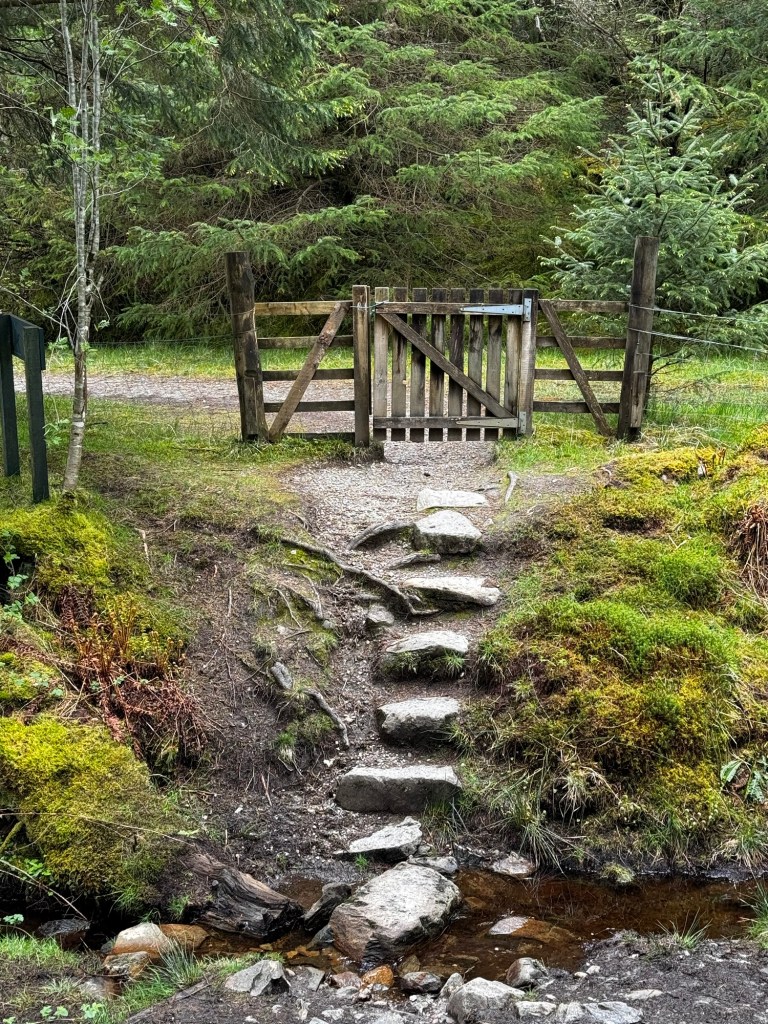

This area was known by the Celts as being a “thin place” – where boundaries between earth and, shall we say, not-earth, however you define that, are especially narrow.
When you visit, you’ll understand why.
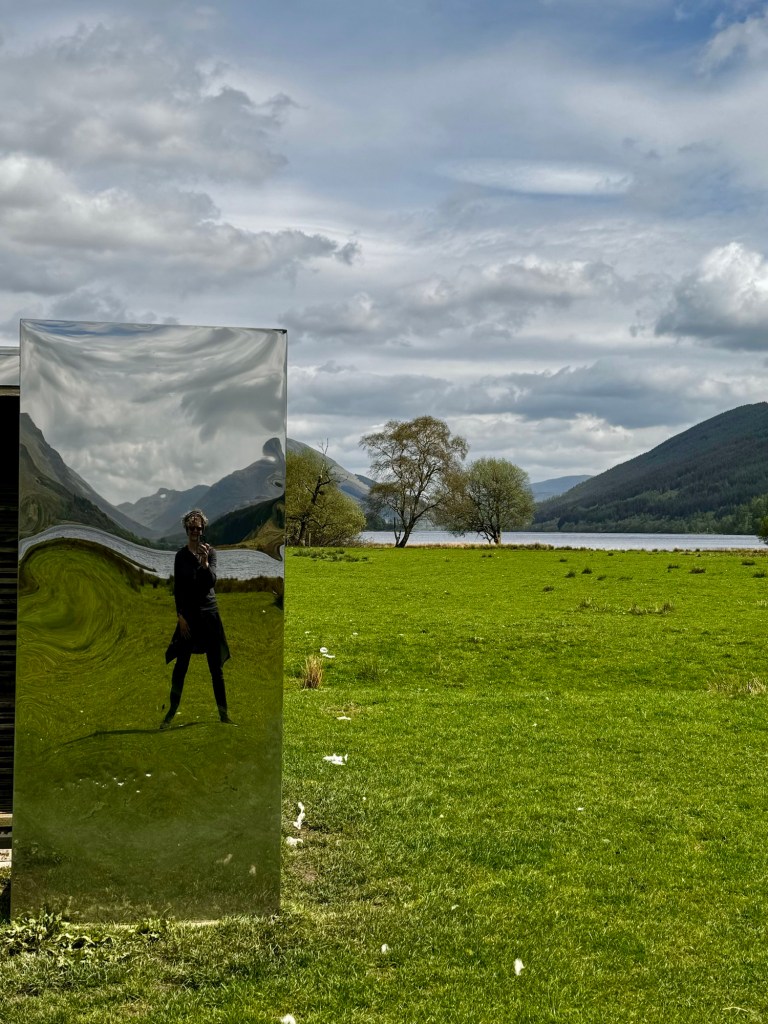
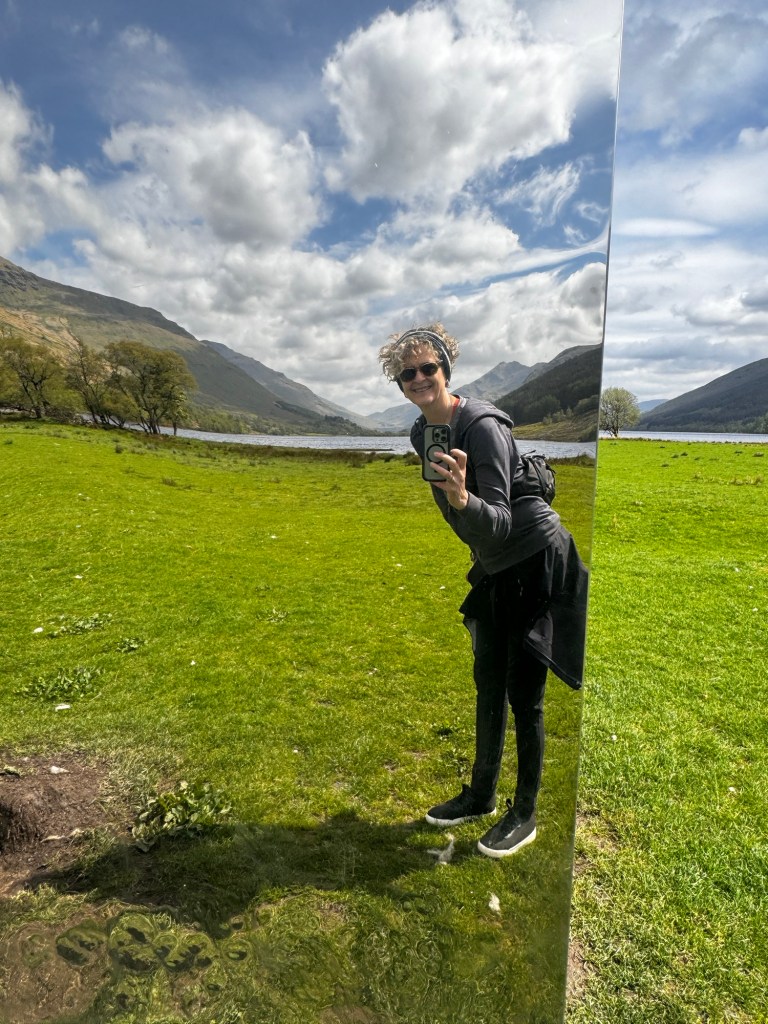
I also wanted to find a sculpture, one of many that have been installed throughout Trossachs National Park. The piece is a mirrored box called the Lookout, and it was designed, built and installed between two lochs by architecture students Angus Ritchie and Daniel Tyler. To say it’s a remote area is an understatement. Another drive down a curvy single track road on the edge of a loch, I am starting to specialize in them.
The sculpture was installed ten years ago, and I was sad to see that the elements have taken a toll over the years. But it’s still pretty cool.
Here’s what it looked like originally, so you know.
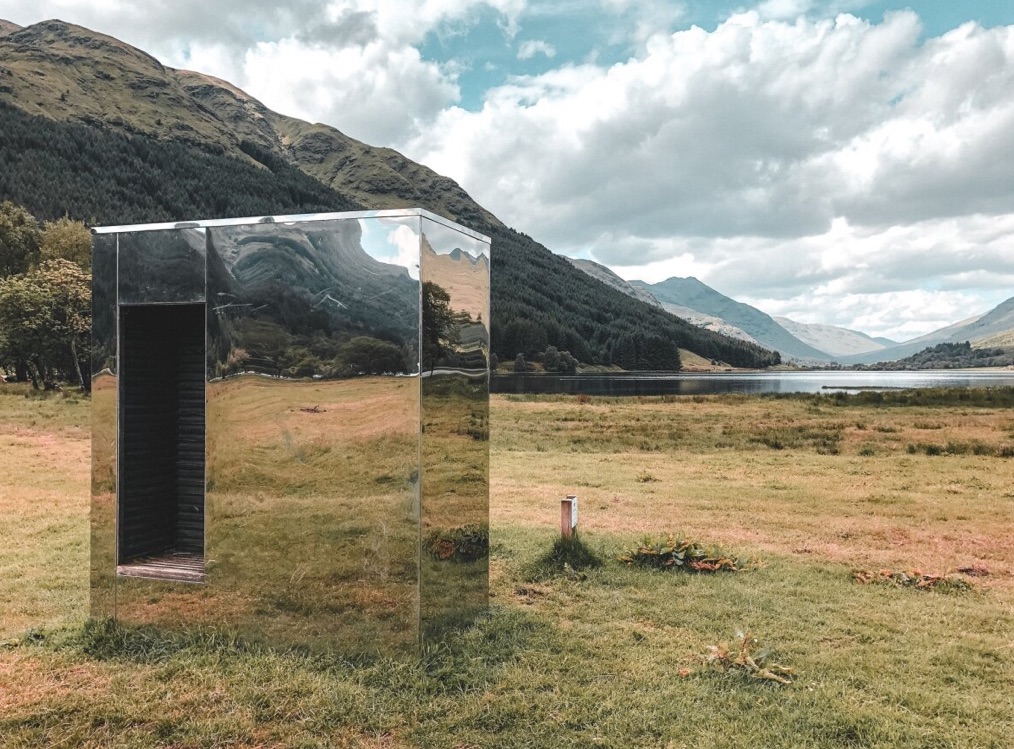
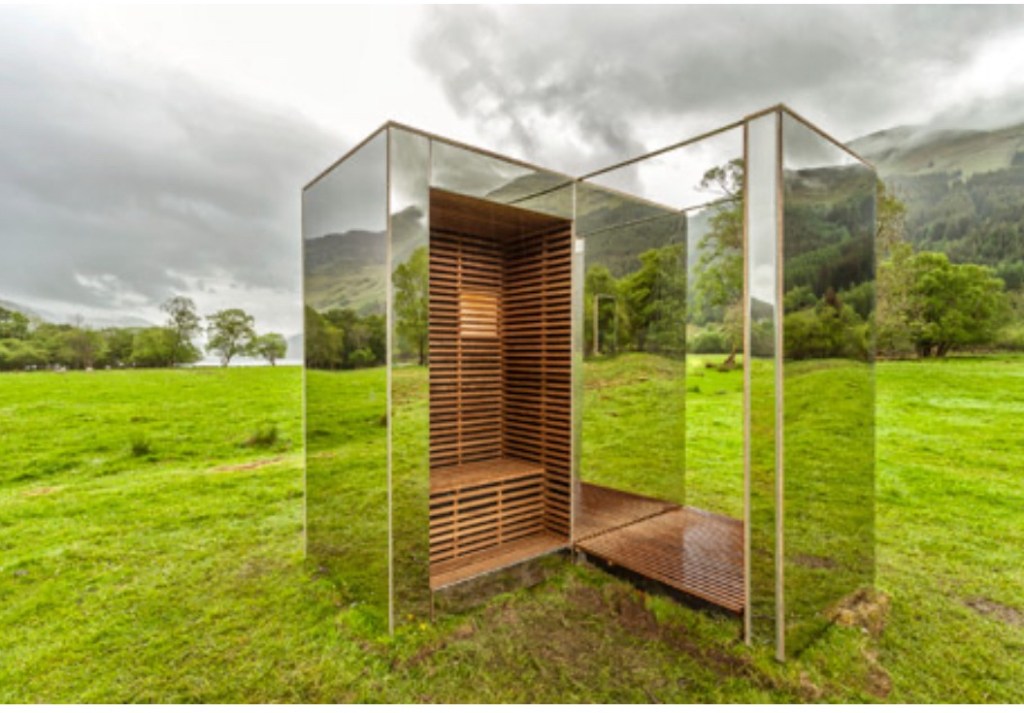
It’s gotten a wee bit rickety and downtrodden over time with many of the panels blown off. It may not be long for this world.
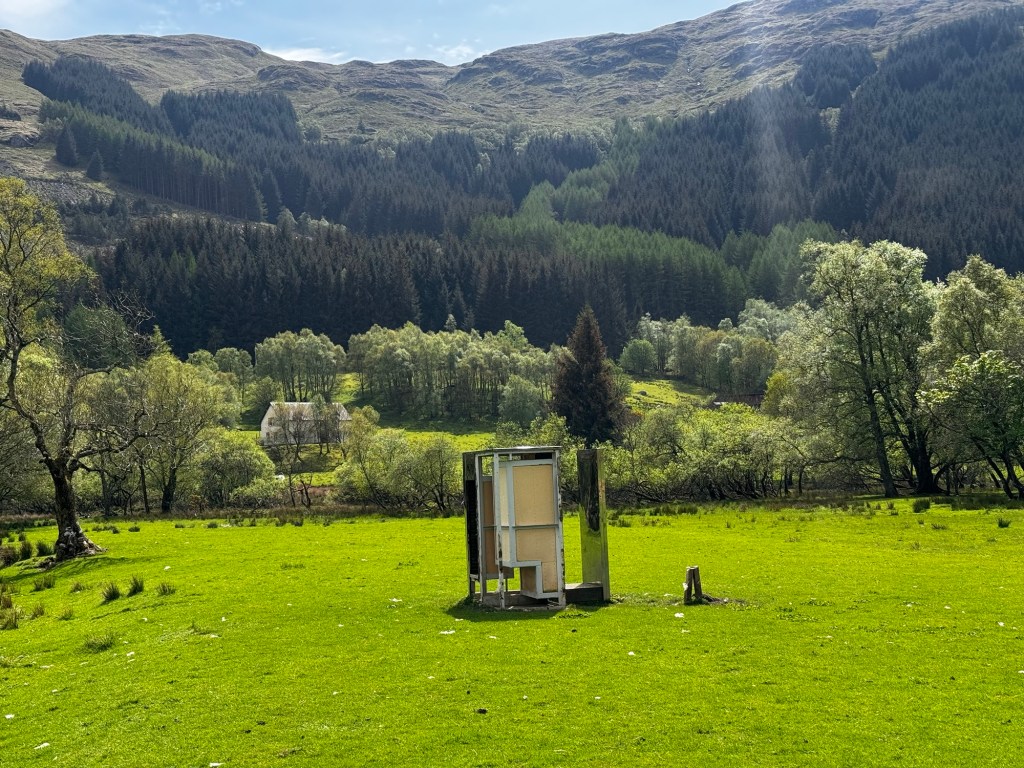
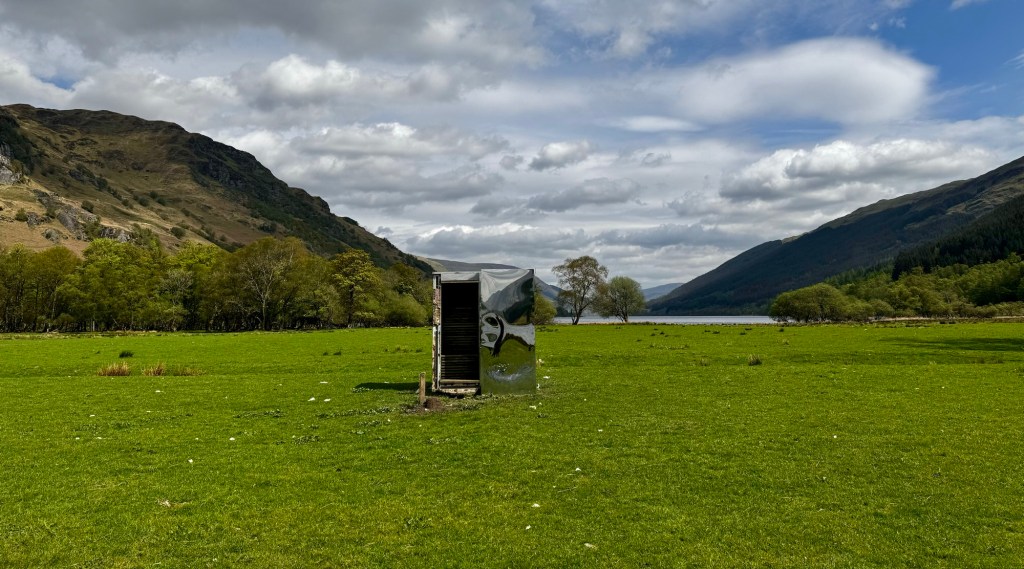
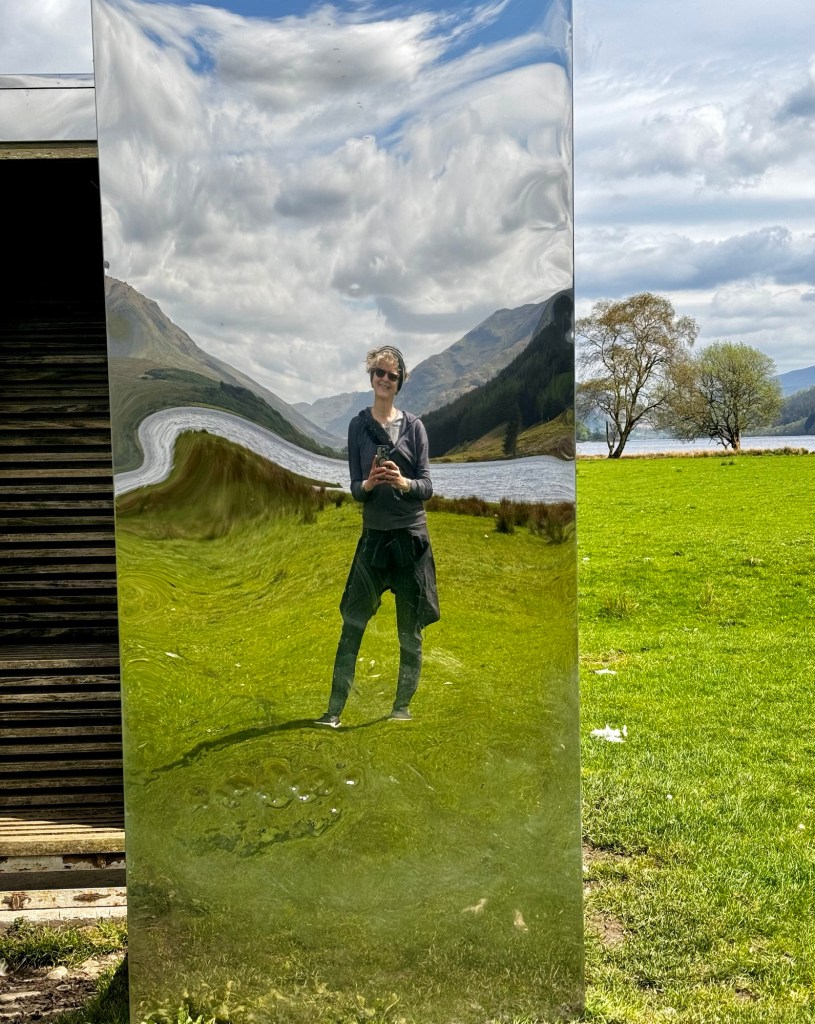
But still quite entertaining for those of us who are easily entertained.

So enough meandering, let’s go to Stirling, the Schiphol of the Central Belt.
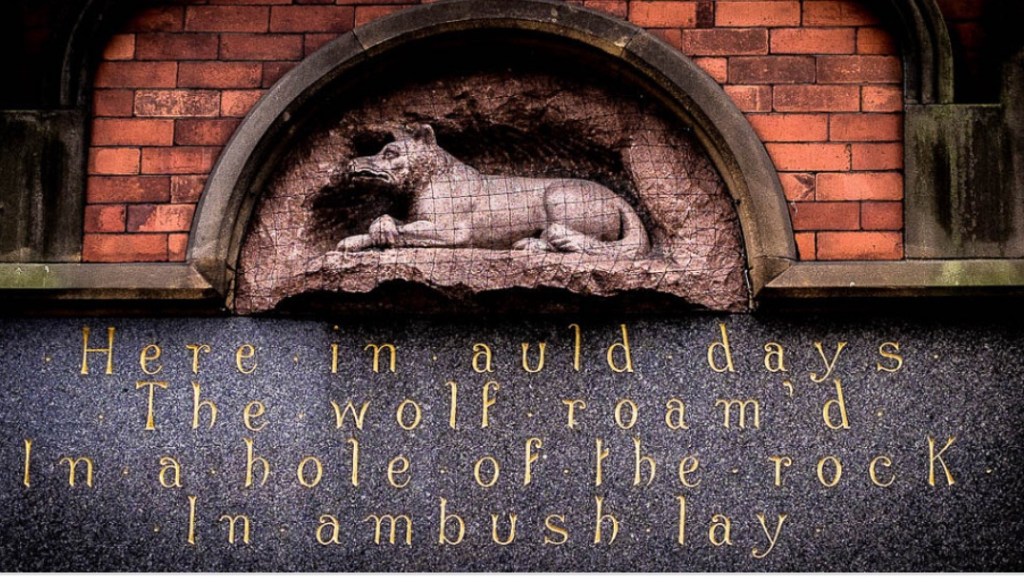
There’s the teensiest bit of history around Stirling. Its earliest catalogued artifact is a stone cist containing 4,000 year old human bones. The earliest surviving structure is a fort built by denizens of days of yore, and by that I mean the Iron Age, over 2,000 years ago. Stirling was declared a royal burgh by King David I in 1130 – and ps he’s a fascinating character but I’ll say no more. Stirling has always been of strategic importance due to its central location and control of the River Forth. The town’s mascot is the wolf because back in the 9th century, while under Anglo-Saxon rule, it was attacked by “Danish Invaders” aka Vikings. The sound of a wolf’s howl, legend has it, raised a sentry who alerted the garrison and fought the Vikings into a retreat.
There are SO many other things which I’ll spare you as you are always so patient with all the history. In keeping with our theme, though, this fine town is the location of the 1297 Battle of Stirling Bridge where William Wallace’s outnumbered forces were defeated the English army. Nearby was the 1314 Battle of Bannockburn, where Robert the Bruce did the same and ultimately became king because of it.
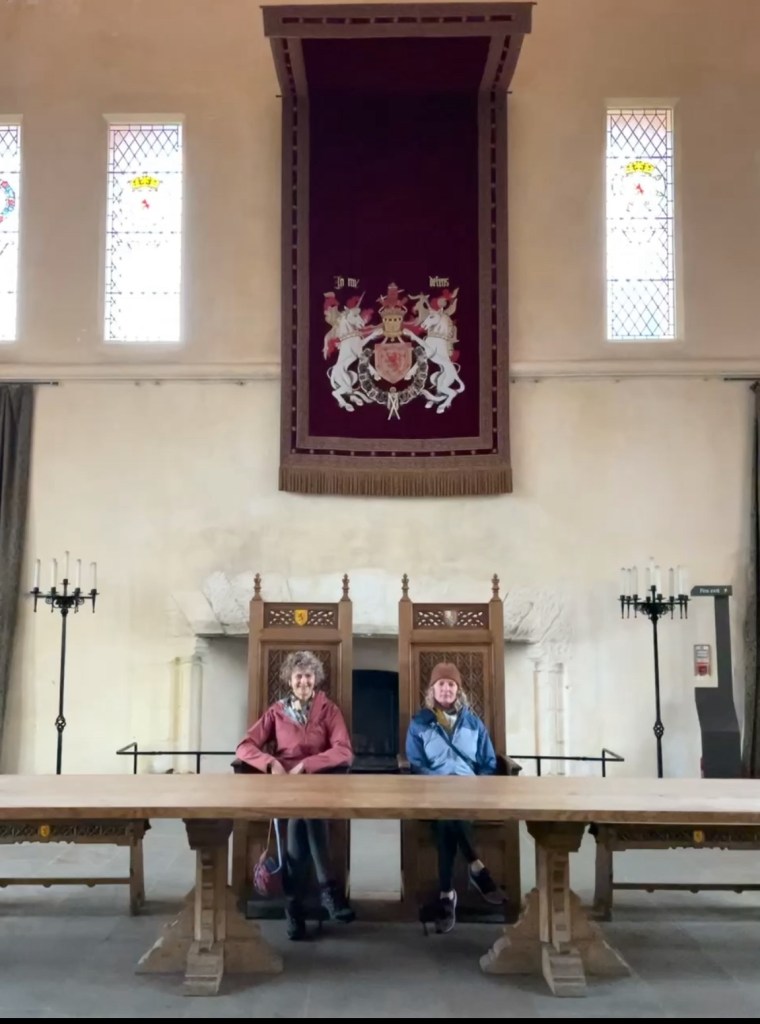
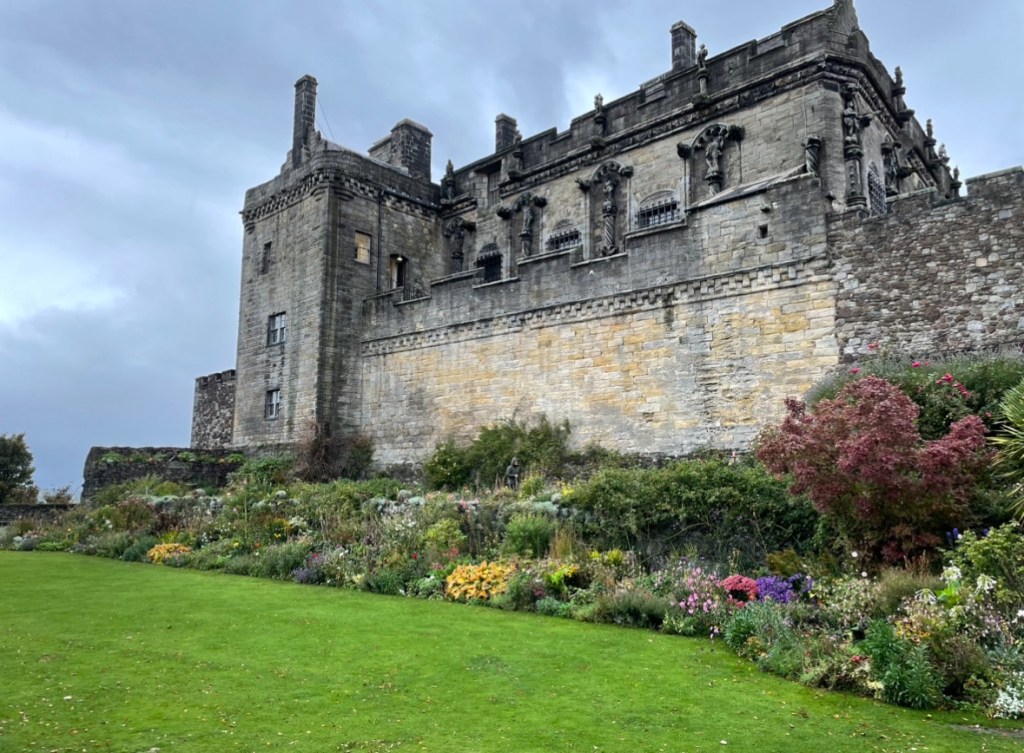
Stirling’s skyline is dominated by Stirling Castle, a more manageable version of Edinburgh castle, and if that rings your Robert the Bruce, William Wallace and Mary Queen of Scots bells, well, I am, as they say, well-chuffed. I toured the castle in October 2022 with my travel buddy Trish, and would highly recommend – although if you can, go during deep shoulder season and hire a tour guide. We pretty much had the castle to ourselves and our guide really made it come to life.
Here are a few snaps from that trip so you can see what I mean.

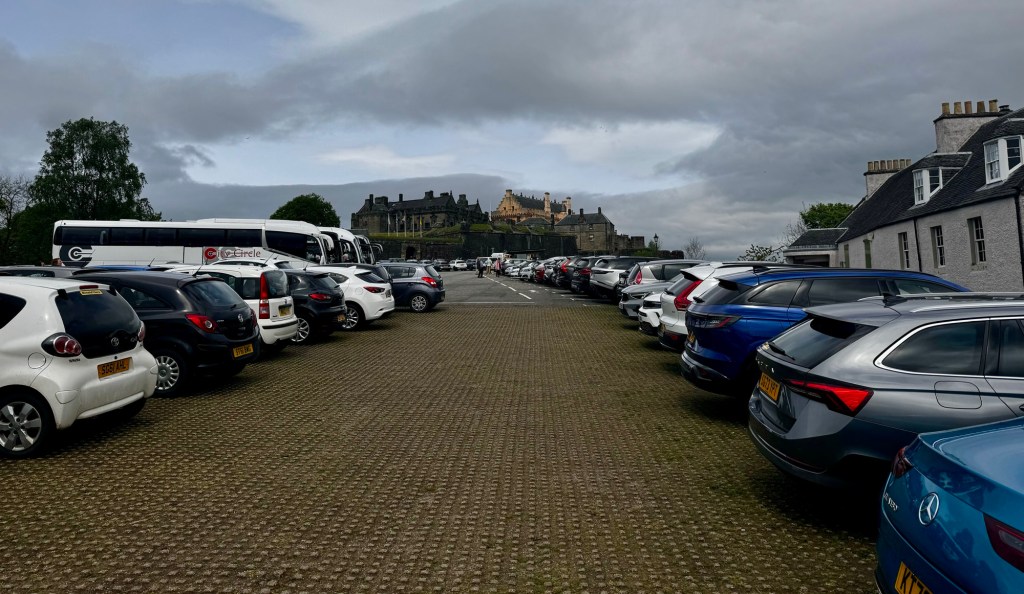
On the other hand I walked up to the castle today and discovered that it was, in a word, a zoo.
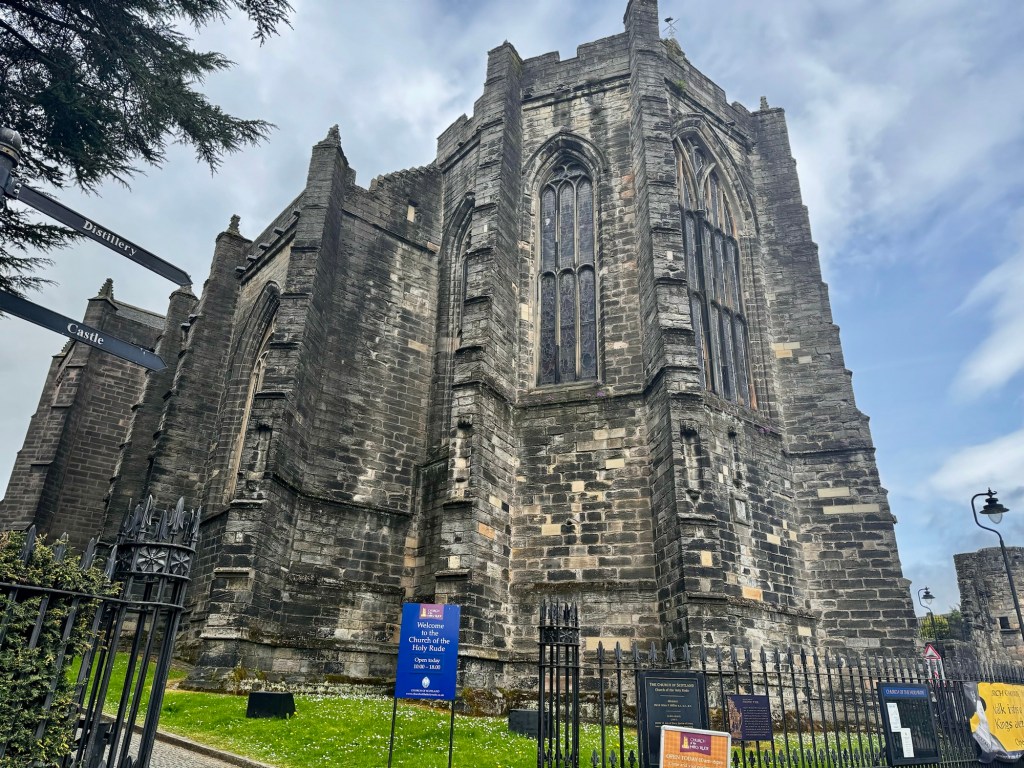
So I wandered back down the hill and popped into the nearby Church of the Holy Rude (named after the Holy Rood, a relic of the true cross), and yay it was empty. The church was founded in 1129 and rebuilt in the 15th century after a fire, and is the second oldest building in Stirling after the castle.
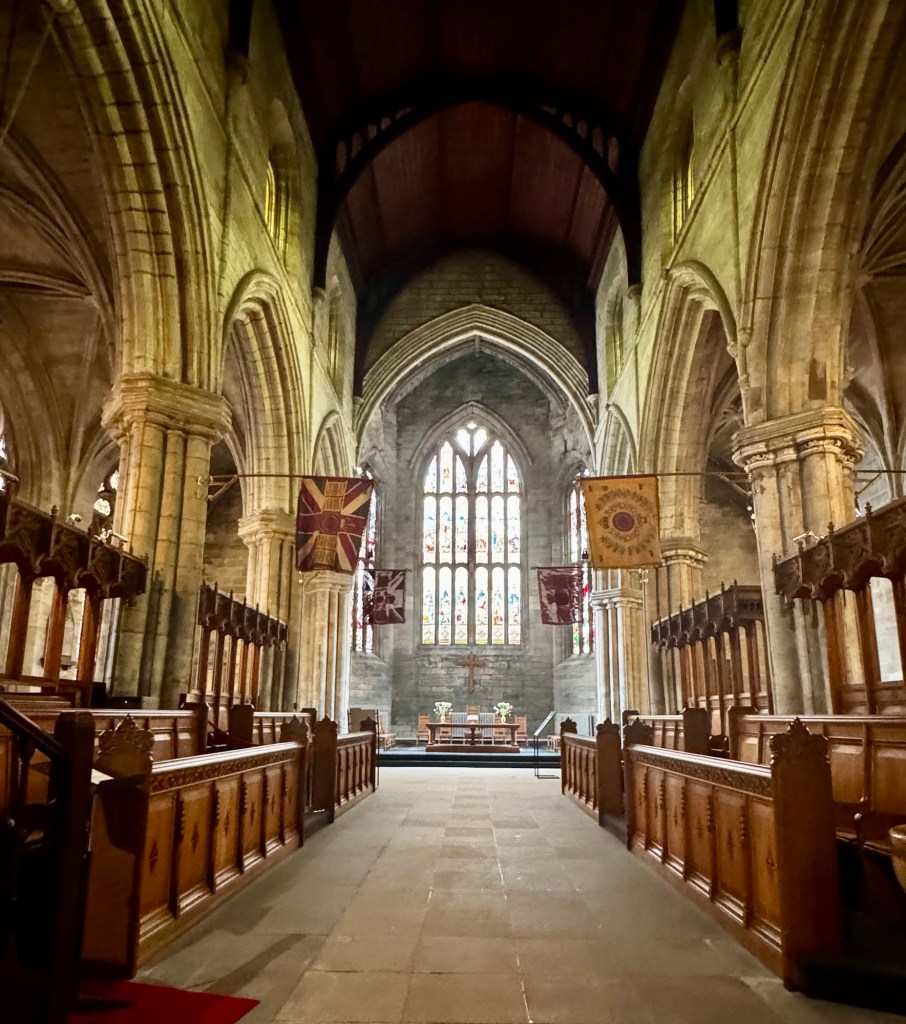
Interesting thing – it’s the only surviving church in the UK besides Westminster Abbey to have held a coronation. On July 29, 1567 the thirteen month old James VI, born in nearby Stirling Castle and whisked away (permanently) from Mary Queen of Scots (Mom), was anointed King of Scots and John Knox gave the sermon to mark the occasion. Mom wasn’t in attendance because she was imprisoned in Loch Leven Castle and had been forced to abdicate. She was allegedly invited to attend and refused which I think is an unlikely historical tidbit written by a man to make her look petty and like a bad mother. Bringing Mary to Stirling from captivity to attend the coronation of her infant son who was basically her usurper – I mean, oy, the optics! She had thousands of troops at her command. Too risky.
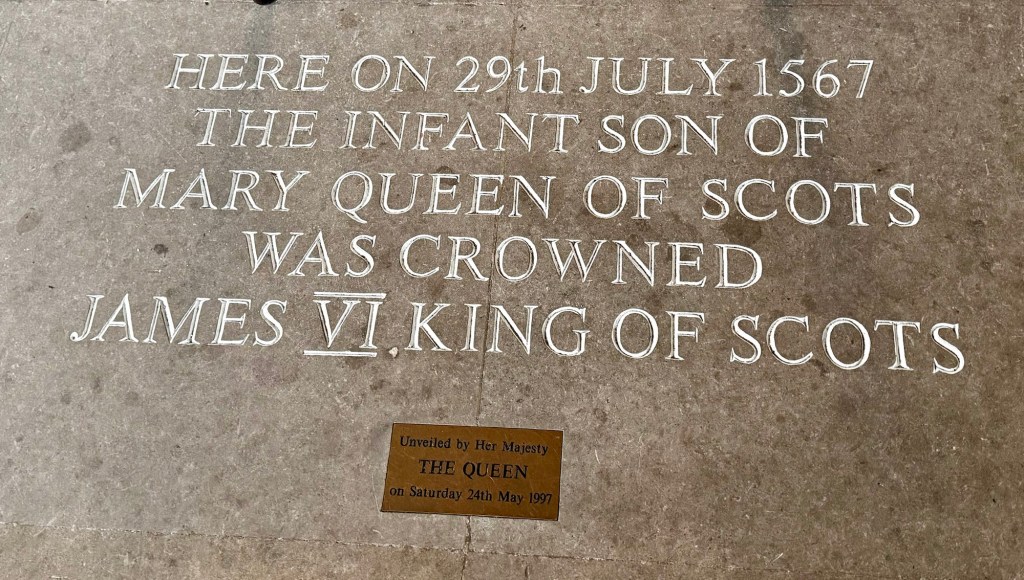
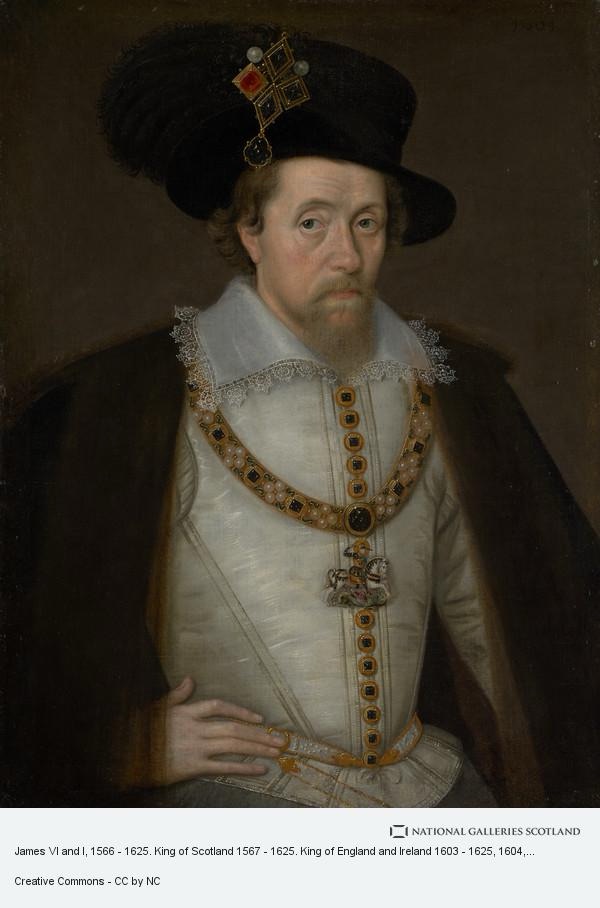
In 1603 James VI was also crowned King of England and Ireland, succeeding Elizabeth I, the last Tudor, and becoming James I. Ruling for 57 years (easier to do if you were a coronated baby), his reign in Scotland was the longest of any Scottish monarch. He wasn’t a bad king, necessarily, and did some interesting things like sponsor the first English translation of the Bible and order the refurbishment of William Wallace’s sword.
However, I think you’ll agree that we can’t forgive him for his role in ramping up witch trials to a spectacular degree for delusional personal reasons.
James VI was the worm-brained Robert F. Kennedy Jr. of the Stuart family.
Here’s the lame story. In 1589 Anne of Denmark, James’s bride to whom he was married by proxy, planned to sail to Scotland to meet her new husband. She didn’t make it because fierce storms, common in the fall, forced her to anchor in Norway. She tried again, but her boat sprung a leak and so back to Norway she went. At this point she decided to postpone the trip until spring. James was having none of this business and decided to go to Norway to pick her up. He stayed several months and eventually brought her back to Scotland even though storms again made the journey sketchy. Denmark actually prosecuted a bunch of woman for causing these storms via witchcraft, and when I say prosecuted, I mean executed.
James hears of this when he gets back to Scotland with his bride and even though everything is now FINE, he couldn’t move on and decided to copy Denmark. He decreed that witches deliberately conjured up the storms for the purpose of killing him and his queen. Regicide – a bad crime – to be avoided. So suddenly a previously unenforced law forbidding witchcraft was called back into action. Which is a lesson we still haven’t learned – if you aren’t enforcing a law anymore, repeal the damn thing to keep it from reemerging from the muck of shifting political sands.
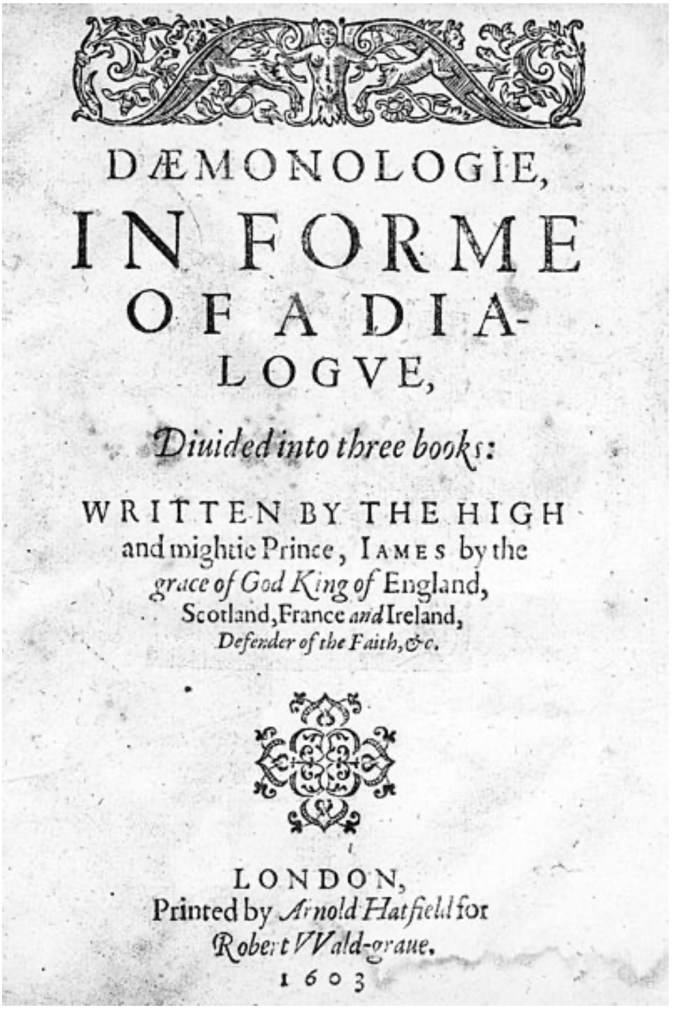
James became so witch-obsessed that in 1597 he wrote a book called Daemonologie which helpfully explained how to identify and punish a witch, using science, oh sorry I mean the Bible, as corroboration, e.g. “thou shalt not suffer a witch to live,” blah blah. Largely as a result of his efforts, thousands of women were prosecuted in Scotland and England over the next hundred years, with more than 1,500 executed.
Former Scottish First Minister Nicola Sturgeon, who probably would have been tried as a witch in those times herself, issued a formal apology to people accused of witchcraft, thus acknowledging an “egregious historic injustice.”
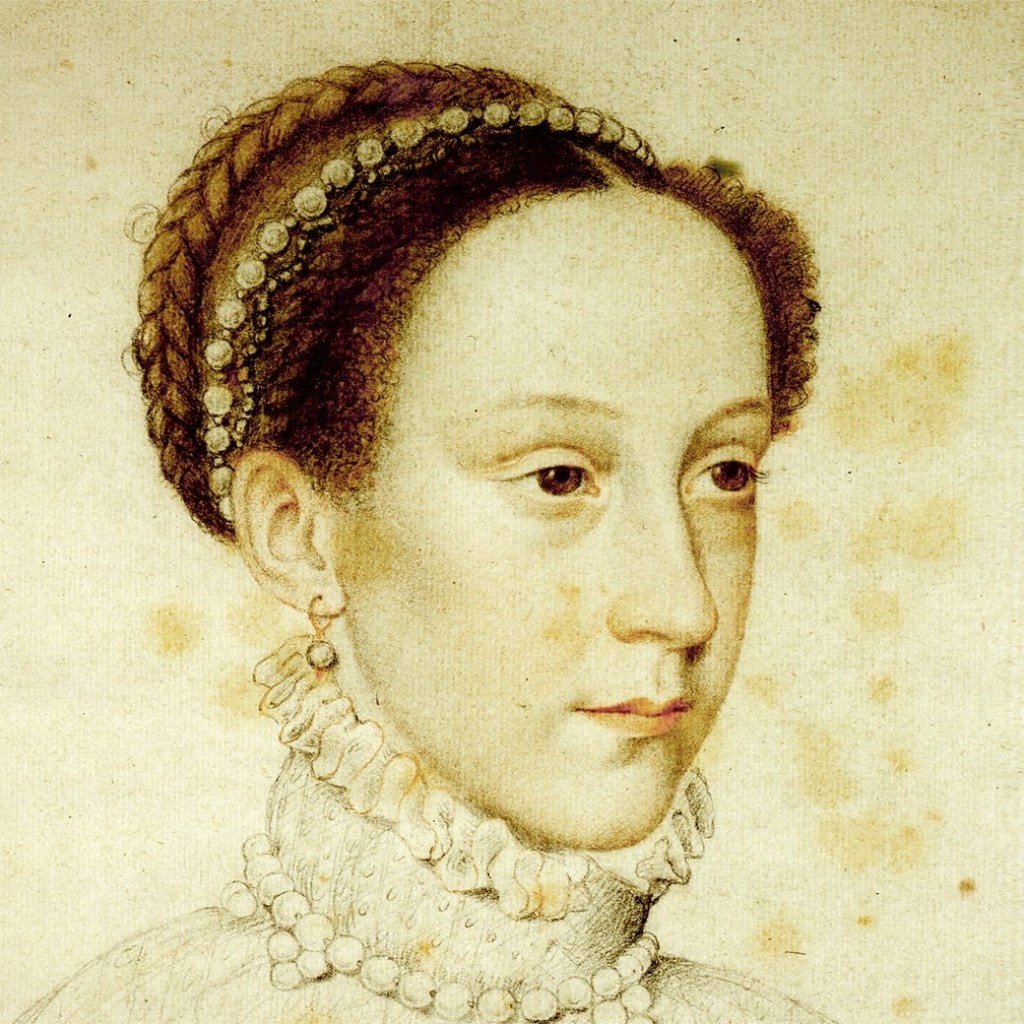
One wonders whether things would have been different if James had a maternal influence in his life. Would that have made him less dumb? Perhaps. James was 21 when his mother was executed and he had been raised to believe that she had arranged the murder of his father Henry Stuart, Lord Darnley so she could marry Lord Bothwell. What would that do to your head? What were his thoughts while his mother was imprisoned in the Tower and ultimately executed?
Speaking of which, he didn’t have a paternal influence either. Darnley’s parentage gave him a claim to both the English and Scottish thrones and so strengthened James’s ultimate ascension to both. And yet he was killed just eight months after James’s birth. What did James think of him, if anything, beyond thanks for the blood lines dad.
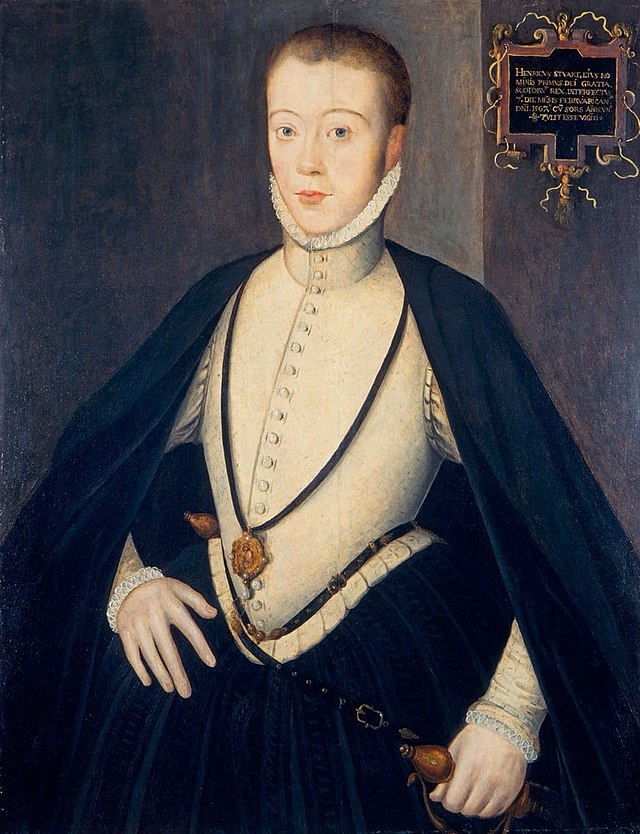
I know that royal kids not having much exposure to their parents is a long and proud UK tradition. But these are pretty extreme circumstances, James was presumably a person with feelings and one without a therapist or prescribing physician. These are the interesting what-if riddles of the human condition in history.
To mark this particular riddle, I had lunch in Stirling at a coffee shop located inside what has “traditionally” said to have been Darnley’s home. Which is a bougie word for “allegedly.”

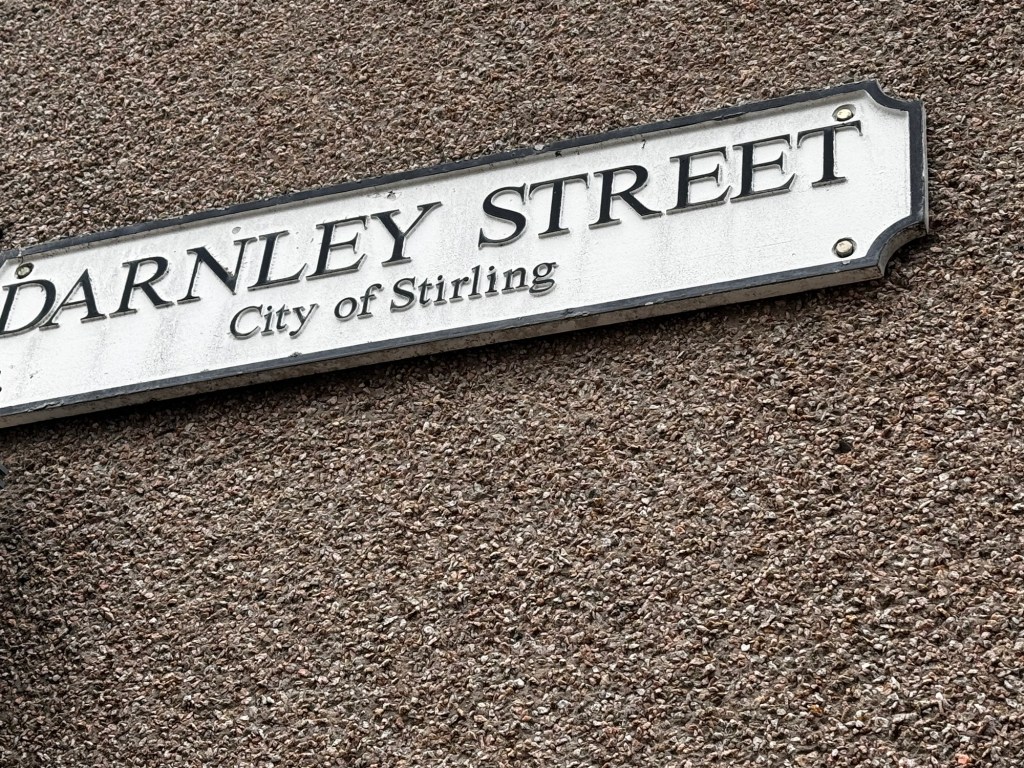
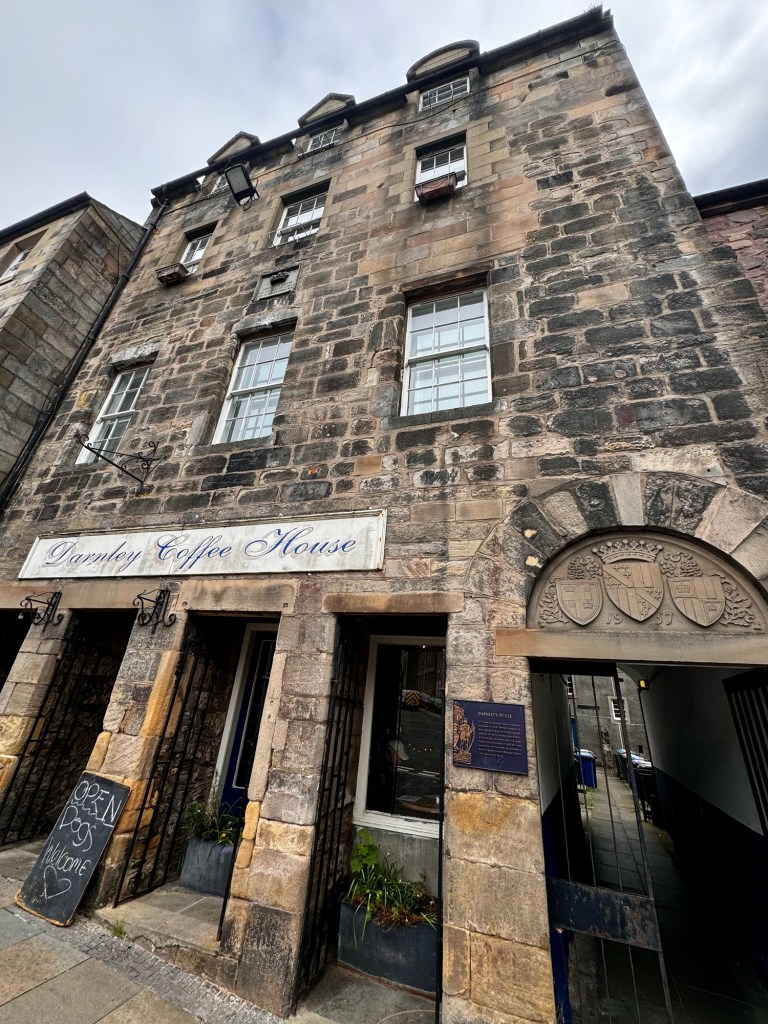
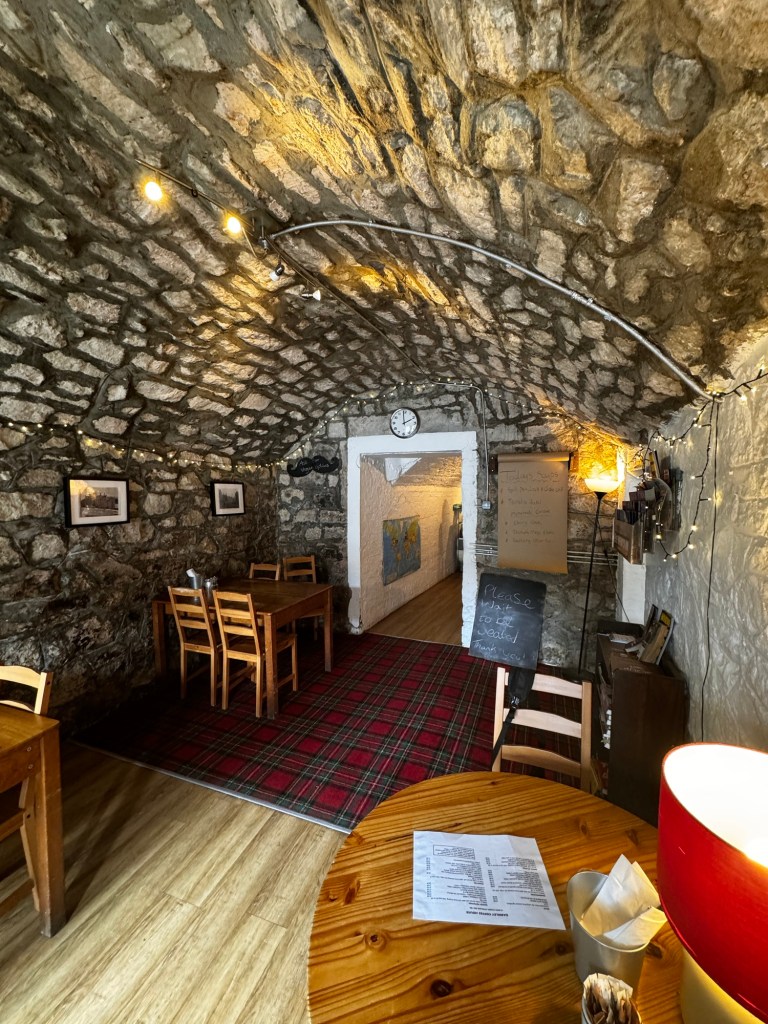
The menu explains that not only was it the home of Lord
Darnley, but also baby James’s nursery which – maybe – but it’s outside the castle and his life was pretty much in danger from the jump. More realistically, it has also been a dairy, a brothel, and a tourist office.
I wondered what these historical figures would think if they could see their former homes, prisons, battlefields and such crawling with iPhone wielding tourists.
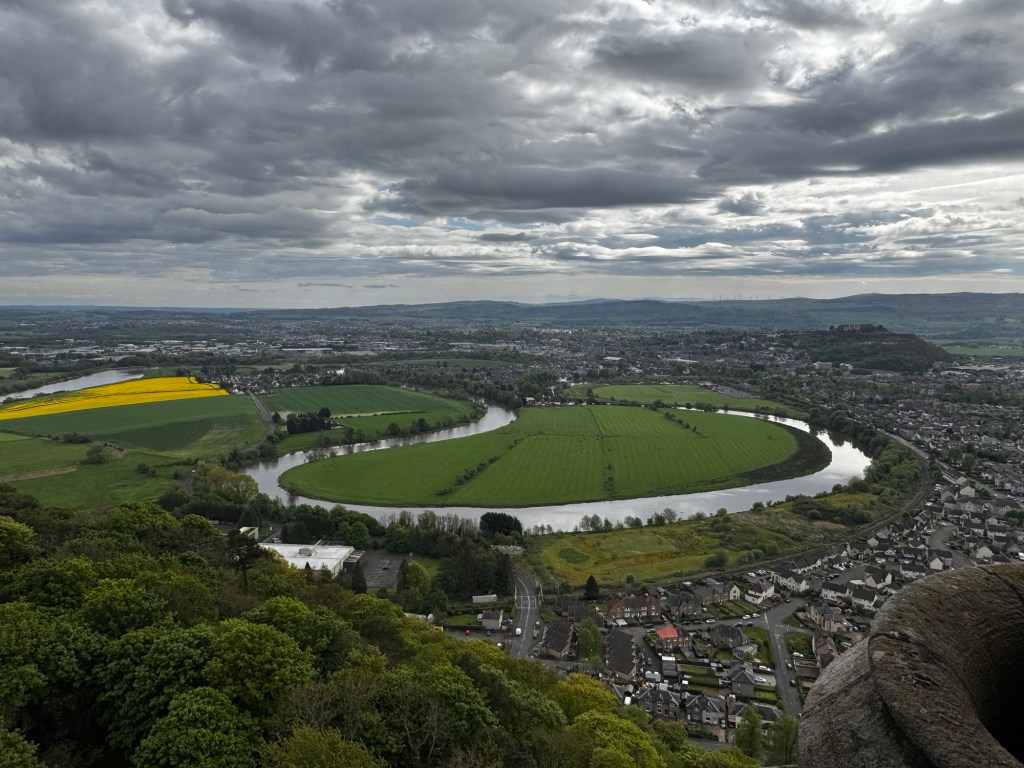
And now we sally forth to the National Wallace Monument. It was built between 1861 and 1869 and designed by Glasgow architect J.T. Rochead. It has to be one of the first examples of successful crowdsource fundraising, as it was entirely funded from contributions from the public totaling more than £15,000. This is largely due to the Victorians’ obsession with Highland culture and history.

The monument looms on a hill within view of the castle and it’s sited at the 1297 Battle of Stirling Bridge. It famously has 246 steps to the top, and I pictured a sort of Washington Monument situation, just a building filled with a relentless stuffy staircase and a killer view at the top.
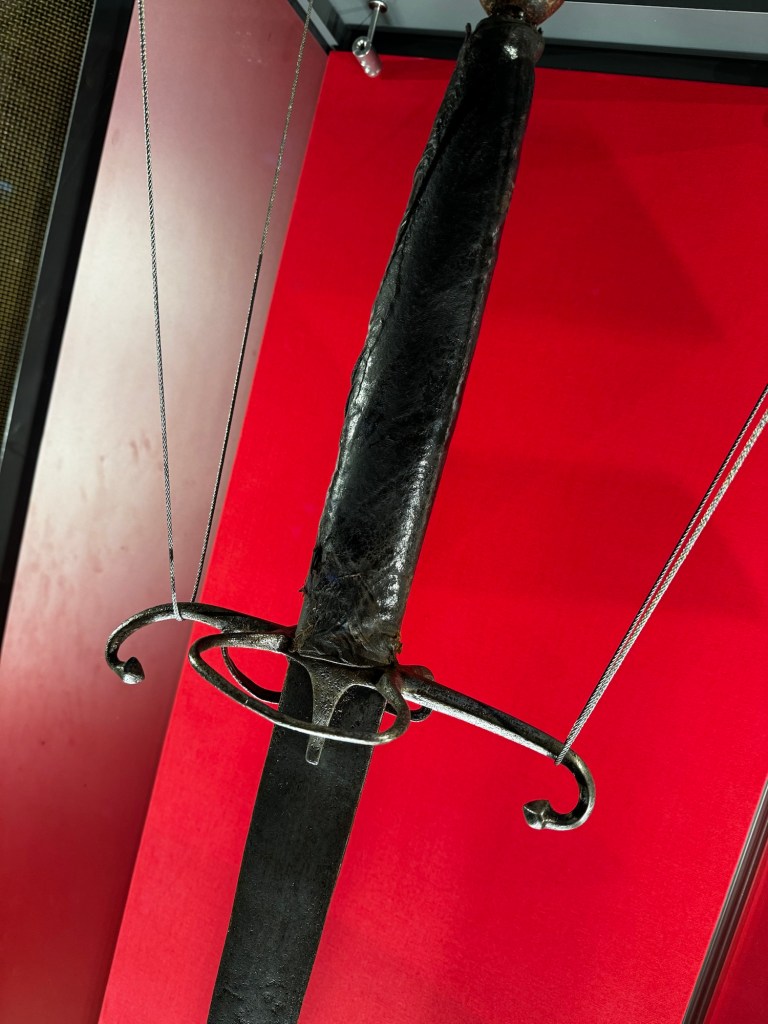
But actually there are three galleries, each with a different theme. The first, called The Hall Of Arms, is devoted exclusively to Wallace with a cool film that looks like it was animated by the same artist who did the Tale Of The Three Brothers in Harry Potter and the Deathly Hallows film. The gallery also features Wallace’s actual sword which is 5 feet 5 inches tall. He was tall. This is the sword James VI ordered to be refurbished. It’s legit.

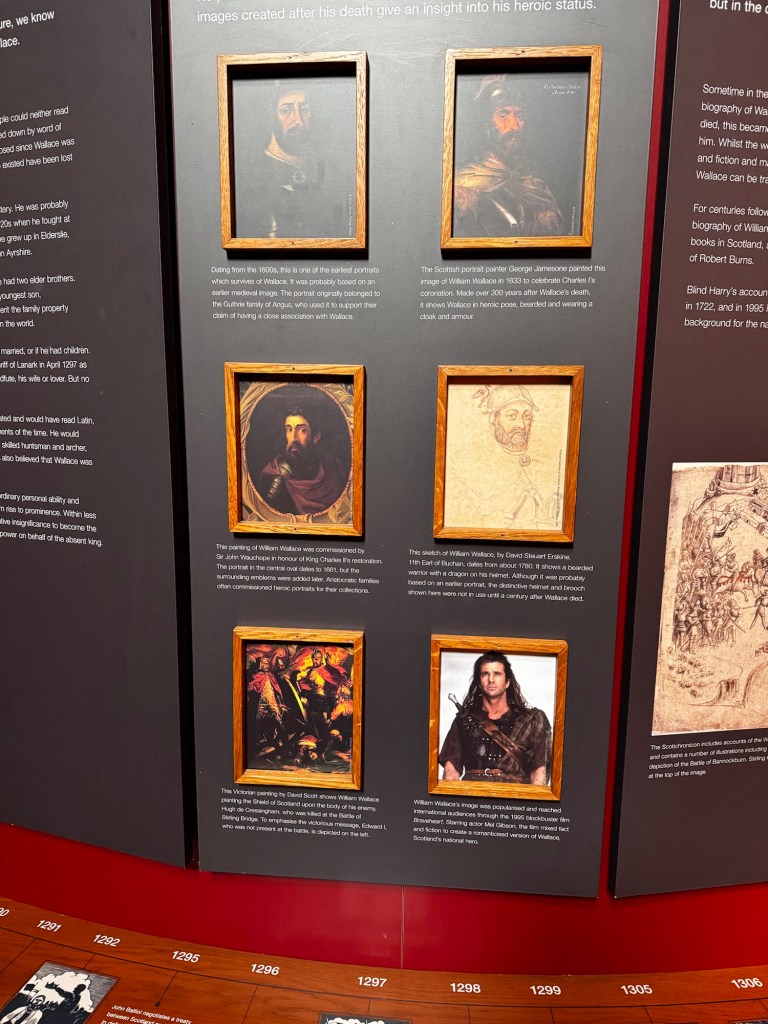
There’s also a sort of hilarious gallery of visual renderings of Wallace throughout the ages. Hilarious because it ends with a photo of Mel Gibson. I object.
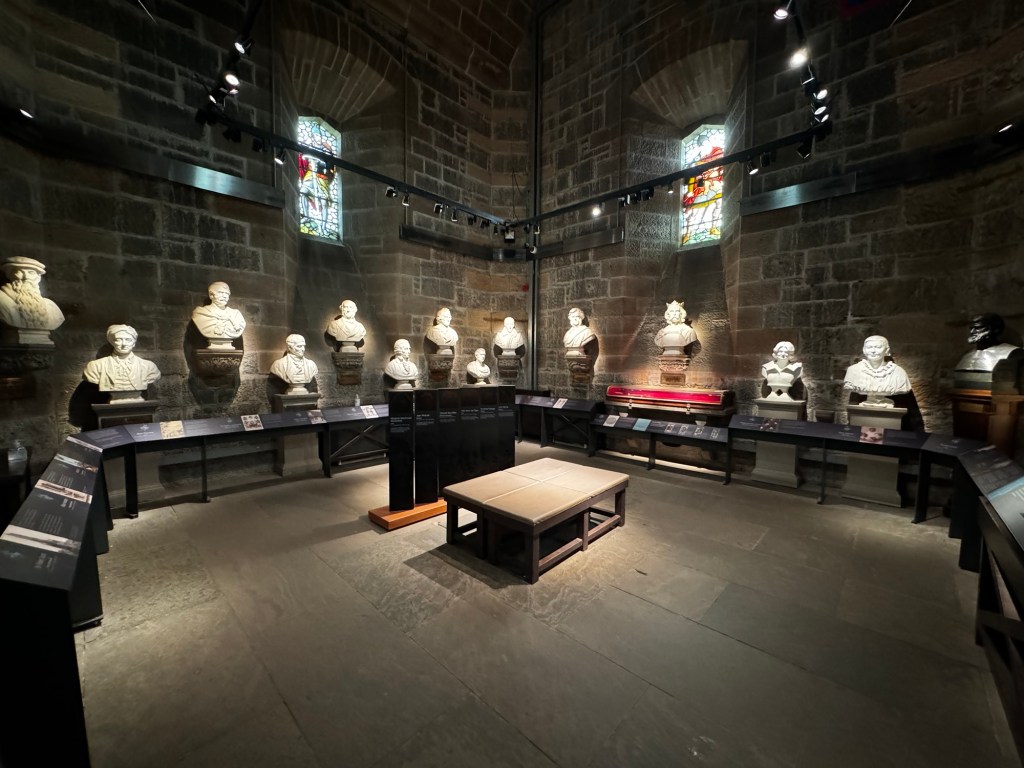
The second gallery is the Hall of Heroes and features busts of famous Scots throughout the ages who have invented everything. Seriously we might all still be living in caves but for Scots. Read “How Scots Invented the Modern World” by Arthur Herman if you don’t believe me.
The last gallery, The Royal Chamber, is not a reconstruction of Wallace’s bedroom as I had hoped but rather is devoted to the battle.
But before we chat about the battle, in between each of these galleries are definitely 246 steps. Up a narrow stone spiral staircase. The staircase is “narrow and may feel cramped,” the website tells us. There are ten billion narrow stone spiral staircases in castles, abbeys and estates all over the UK. I mean it was a popular and likely necessary design element. The steps are narrow because they were built in days when people, and their feet, were smaller – plus there often just wasn’t that much available space. In the Wallace tower, even the widest part of the stair, next to the outer wall, is too small for my size 11 feet. I gotta shift ‘em sideways. Forget about closer to the newel (I had to look that up) where the stair ultimately disappears completely. So the rule is that the coming down people “yield” to the going up people. This means descenders flatten themselves against the wall and avert their faces because the ascenders have to lean forward with their hands on either side of the wall, framing the heads of the descenders like there might be some smooching, and shimmy up sideways trying to avoid full body contact whilst hoping they don’t run out of stair under their feet because it’s just a few inches of real estate.
At least that’s how I handled it as an ascender. (Apologies to the descenders I smushed.). After that first experience I made a shit ton of stomping noise when I entered each spiral to scare people from coming the other way. It’s all I could do to not yell, “Fire in the hole!” or Gandalf it up with “You…shall…not….pass!”
Why people don’t plunge to their deaths in that stairwell every single day is a mystery. Also, in addition to being impaired by monstrous feet there were so many unsteady older folks who were gasping for breath. Good on them, though, they persevered and arrived at the top sweaty, pale and inches away from a cardiac event. For history.
So speaking of history – the battle. First of all if you’ve seen Braveheart you have no idea what happened so just let that go. The nutshell version is that The Battle of Stirling Bridge was fought during the First War of Scottish Independence when Edward I was determined to squelch the pesky Scots and their insistence on owning their own vibe.
As the troops massed around Stirling, the Scots had around 6,000 men, which included 300 cavalry at most, the English had 9,000 including 2,000 cavalry. Lopsided.
The English sent emissaries to Wallace and his compatriot Andrew Moray before the battle to parley, and Wallace reportedly responded, “We are not here to make peace but to do battle to defend ourselves and liberate our kingdom. Let them come on and we shall prove this to their very beards.”
I am adopting this turn of phrase. About proving things to beards.
The Scottish army was camped on Abbey Craig, the location of the Wallace Monument, so had a great vantage point over the river toward the government forces.
The head of the English forces rejected sage advice to send troops upstream to outflank the Scots and instead ordered a direct attack over the narrow Stirling Bridge. It was broad enough to allow only two horsemen to cross abreast, so it would have taken several hours for the entire English army to cross. I don’t know what the English thought the Scots would do during this time, just watch them cross and wait for them all to assemble on their side of the river like they were playing an organized team sport and needed an even number of players per side. I mean, I’m admittedly no military strategist, but. All the Scots had to do was hang out on the other side of the river until as many troops they believed they could overcome had crossed.
To add to the fun, the wooden bridge collapsed, whether via sabotage or natural causes no one knows for sure.
At the end of the day the English forces suffered massive losses and retreated, and Wallace was appointed, “Guardian of the Kingdom of Scotland and Commander of its Army.” And now, Edward I was super pissed and wanted to know who this William Wallace person was anyway. In retaliation, he personally led the next invasion of Scotland which ultimately led to the Battle of Falkirk which didn’t end great.
Now, as I warned, those of you who have seen Braveheart are thinking, I don’t think she’s right about any of this. There was no bridge in the battle in the film. Correct. The movie is gobsmackingly historically inaccurate and this is just one example. The battle in the film is more akin to the Battle of Bannockburn starring Robert the Bruce, although probably without the mooning scene because soldiers were not actually wearing kilts at that time so accomplishing the moon with the flair depicted in the film would have been a lot more trouble.
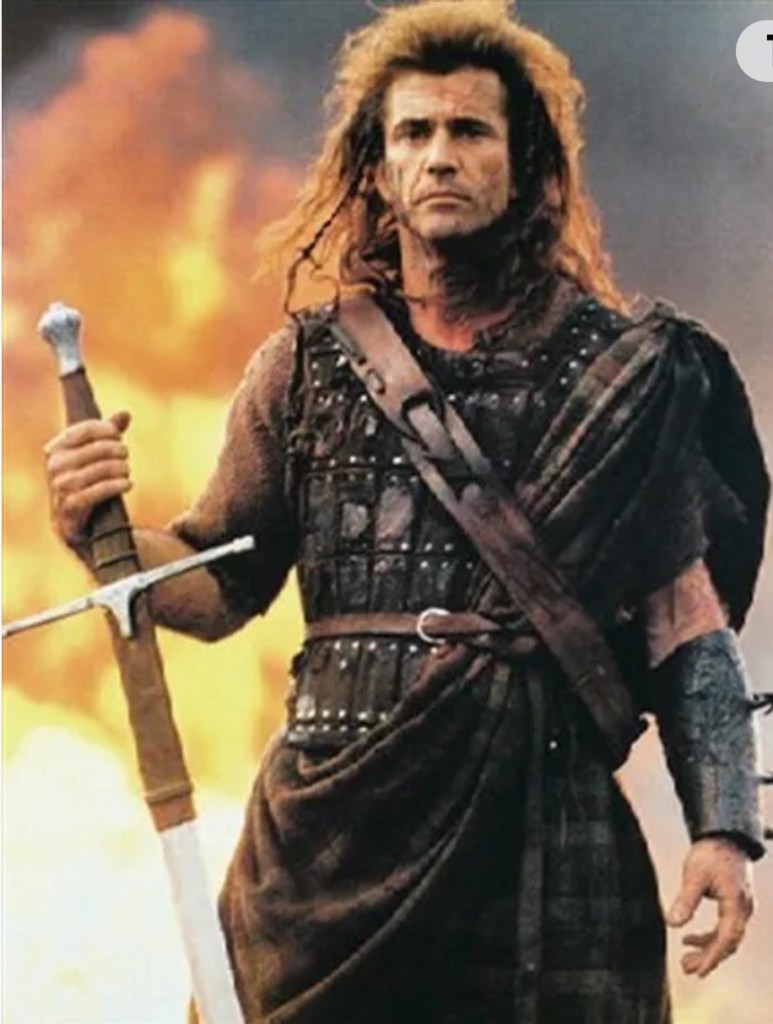
Also the Scots’ blue face make-up was based on the Picts, who were around back in AD 200 to AD 900, so a wee bit earlier. And Braveheart actually is a reference to Robert The Bruce. I’ll stop.
So we’ve talked a bit about mothers in this one – well, one mother. Which is apropos since it’s Mother’s Day. So happy Mother’s Day to my awesome Mom, from me in The Bonnie Badger.
 Wee Dram of Scotland
Hi Julie. Enjoying your blog as usual. A friend is leaving Sunday for Scotland and I wanted to share your blog with her, but I am not sure how to do that. She is: Diane Redd at reddwilson@gmail.com. She was a contractor for the Nike Fund at OCF. Be well. Kathleen
LikeLike