“It was impossible for a woman to go about alone,” Virginia Woolf wrote of Jane Austen in “A Room of One’s Own.” “She never travelled … or had luncheon in a shop by herself.”
You guys. After a mere three+ years I’m headed back to the bonnie bonnie banks, glens, cols, beinns, lochs, isles and waterways of Scotland. Last we met it was the fall of 2018 where you provided excellent company on my solo trip. In 2019 I decided to upgrade my house a bit, possibly sensing that I’d be spending quite a lot of time inside its walls in future. As 2020 loomed with its gigantic birthday, I told anyone who would listen that in celebration I’d be saying YES to All The Things. Planned a birthday trip to Paris and another Scotland hiking trip (this one). Yoga retreat in Sedona. Yes yes and yes. And then. Cancel, cancel and cancel, your silly plans matter not. We all lived through the last two years together, and there’s nothing you don’t already know. Enough said.
This trip won’t be solo, but with Danielle, a friend who has accompanied me on many Central Oregon hikes in the Cascades. We are both recovering lawyers, and I think met at a yoga studio years ago. There’s a photo of us in said studio on our backs with our ankles tucked behind our heads and our hands in namasté. Needless to say it’s hilarious and also entirely inappropriate for our purposes here today so I couldn’t possibly post it. Danielle is dating an actual Viking and I still harbor hopes of meeting a Scottish lad with a castle so we remain in men-in-kilts territory. This blog, and Scotland, will continue to abide.
As the trip is growing closer, I’m focusing mostly on driving for the first time in the UK (yikes), and looking forward to hiking in the Cairngorms, the Orkney Islands, Skye, Torridon and Glencoe – and traversing the North Coast 500. I also want to see as many puffins as possible. There will be castles, neolithic ruins, stone circles and Viking stuff. In fact there will be a distillery tour of Highland Park in Kirkwall, which includes a tasting of their “Vikings” series, with special edition, largely cask-strength drams named after Odin, Thor, Freya and Loki. To top things off, I had to postpone my trip home because my intended flight was unceremoniously cancelled, so will be in Inverness solo for an extra day (on my birthday as it happens). On that day a man named Andrew Grant McKenzie (you heard me) a historian who plays the bagpipes and worked at Culloden Battlefield for years will be squiring me on a tour somewhere, honestly it doesn’t really matter where. I believe the chances of him showing up in a kilt are very very high.
So thank you for joining me yet again to explore a wee country the size of South Carolina that somehow contains a vast Universe of history, hiking trails, dazzling terrain, culture, wildlife, wonderful food and very kind and welcoming residents with comforting accents. Scotland is basically Hermione’s bag in the form of a country.
First full day in the Cairngorms was very only-in-Scotland. Sorry to say, I was entirely expecting to share funny mishap stories about driving on the left but alas – as my boss said about his own impending trip to England, “You just drive on the left.” A left turn is like a right turn and vice versa. You certainly can’t allow your brain stem to run things, mission control must remain with the frontal lobe, but it’s surprisingly fun and easy. We rented a peppy race car Toyota named Dougal who had automatic transmission (good choice) and a new car smell.
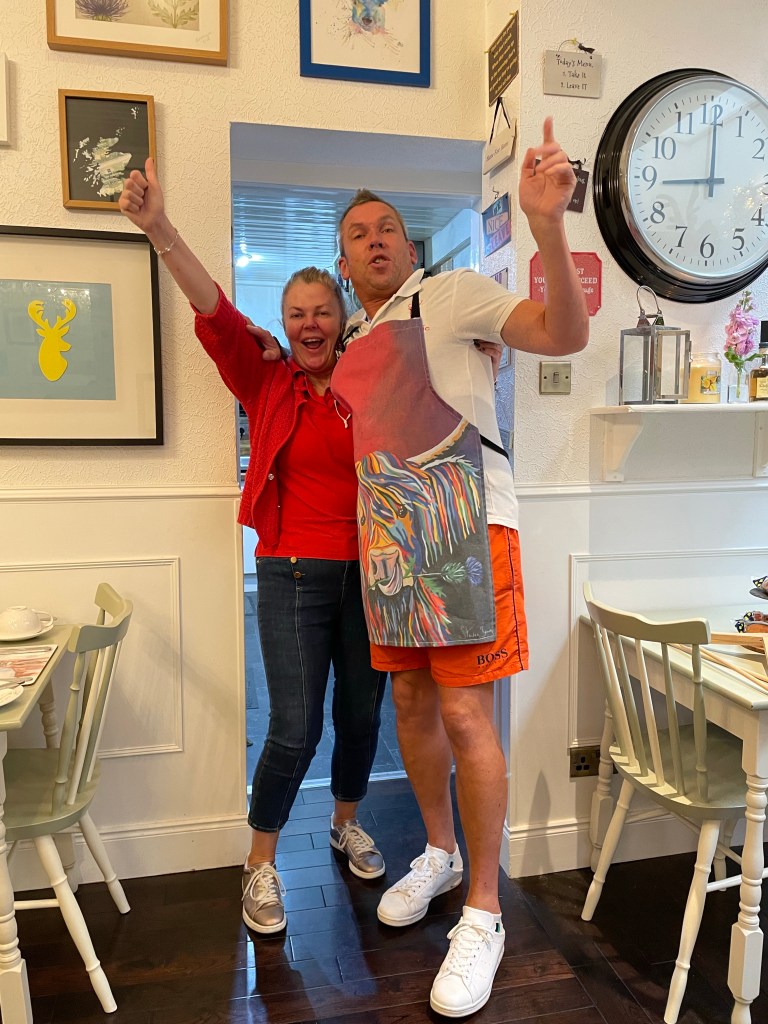
Our bed and breakfast, the Ardlogie House in Aviemore, is run by the most delightful, hilarious and kind couple you can imagine, Kirsty and Kev. I asked them to pose for a photo at breakfast and immediately this happened.
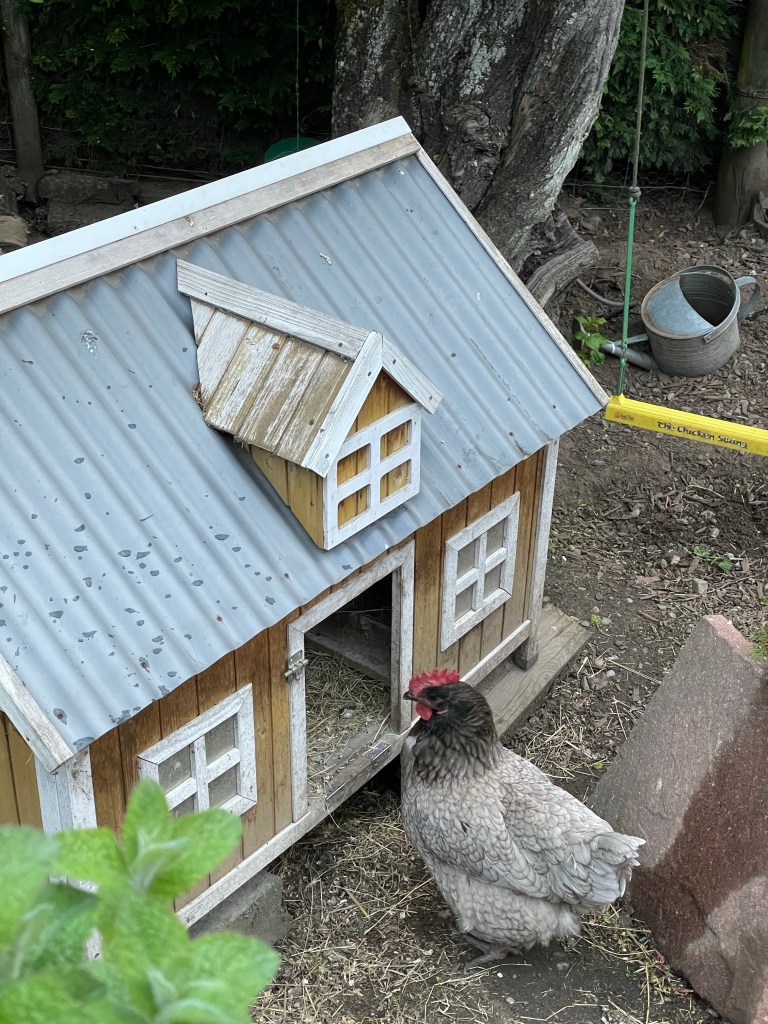
Speaking of breakfast – good heavens. Very scrumptious with a luscious pile of (local) Scottish salmon and scrambled eggs from the butts of the many chickens who wander the backyard and live in their own little houses.
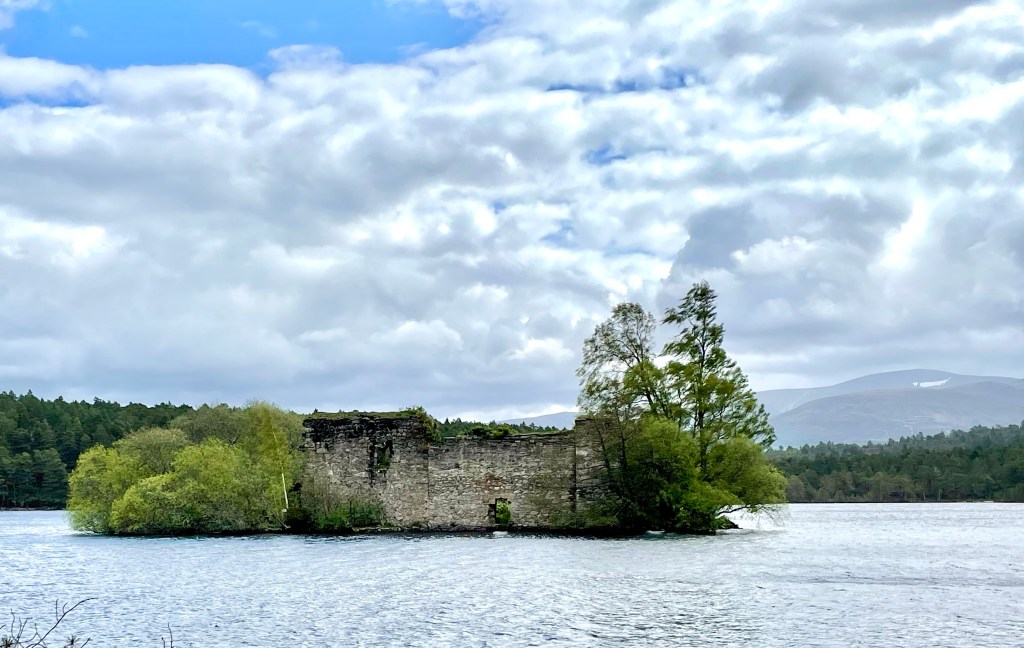
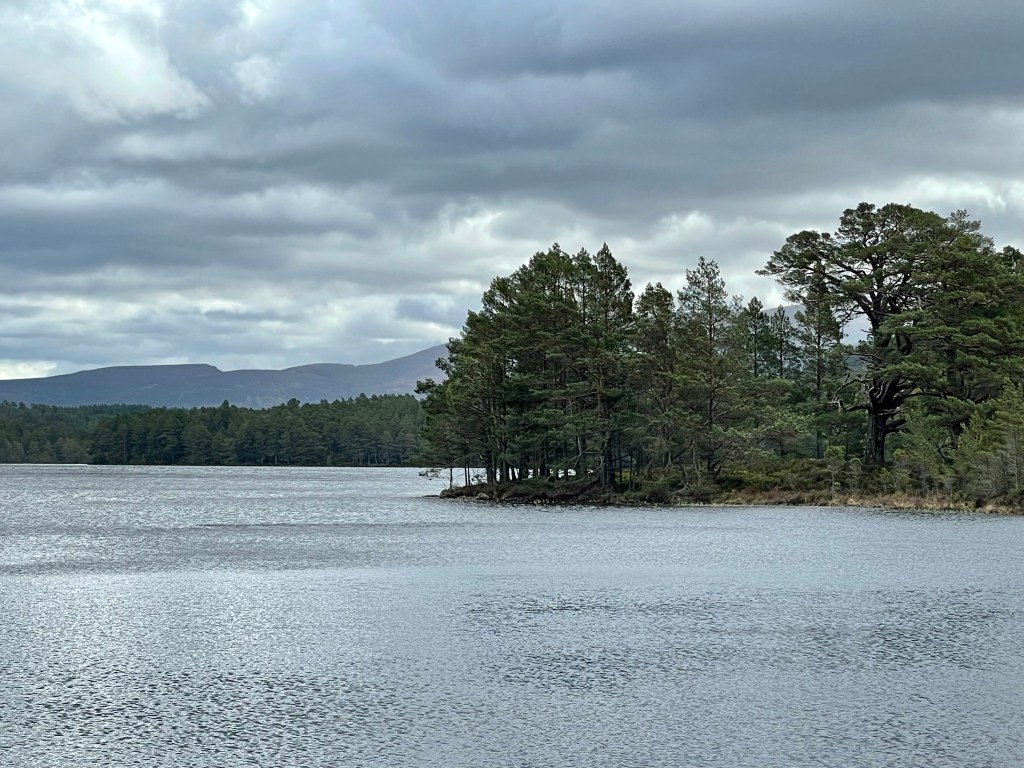
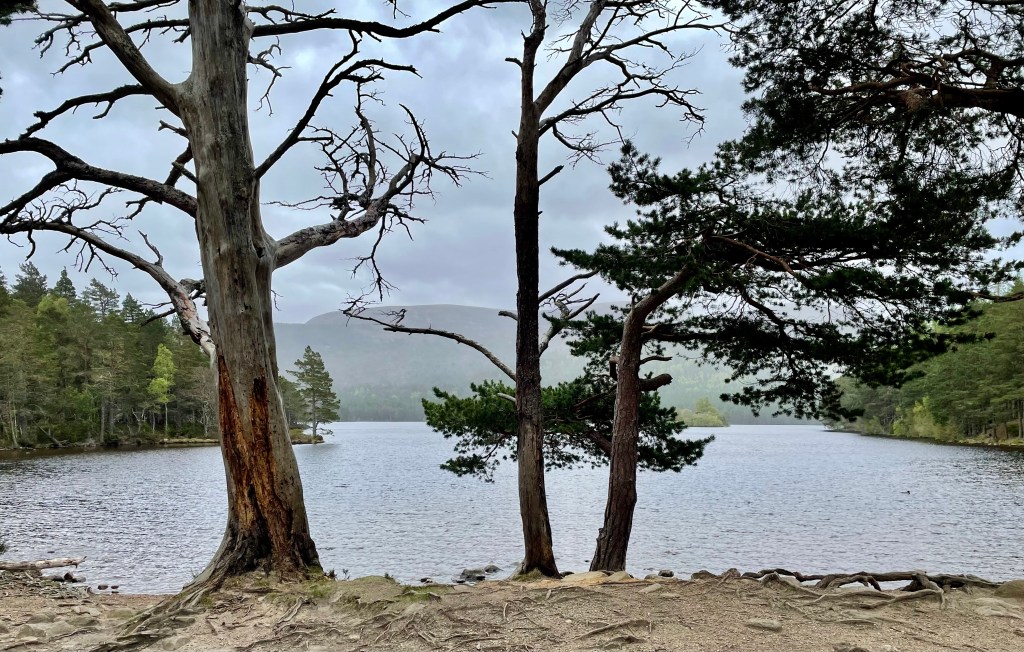
For our morning constitutional we circumnavigated nearby Loch an Eilean. There are an unbelievable 30,000 lochs in Scotland, a country roughly the size of South Carolina. If you are a completest, don’t add “visit all of the lochs” to your list of obsessions.
Loch An Eilean
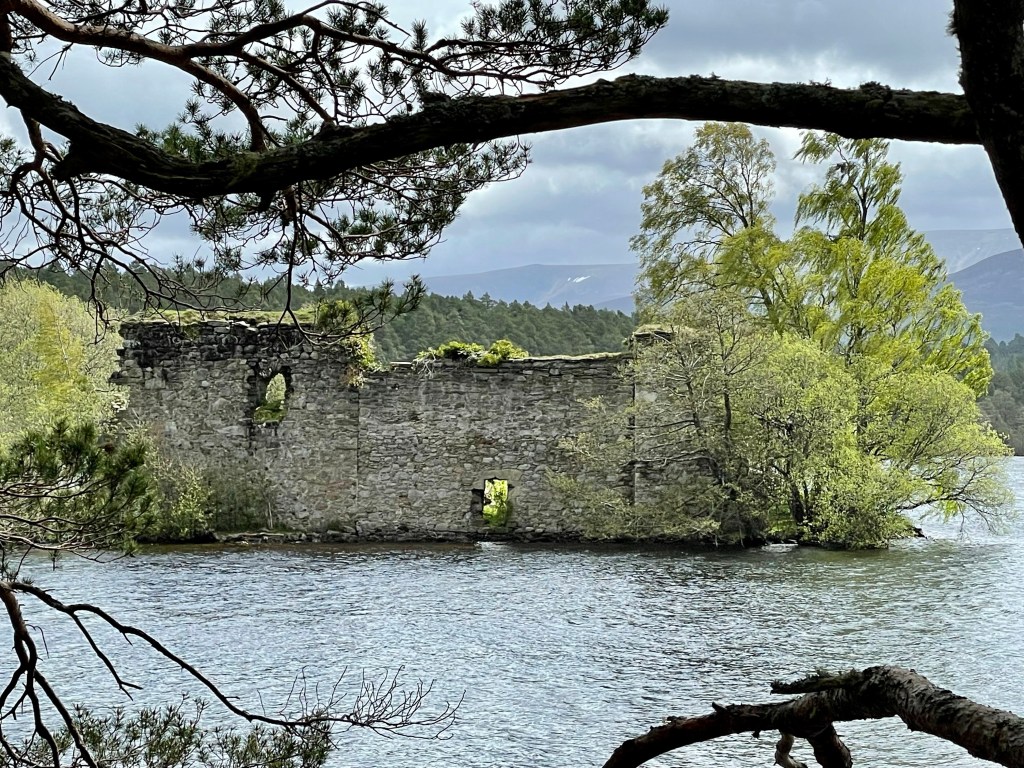
A castle floats in Loch an Eilean, built in the 14th century. A causeway led to the island but it’s now submerged as levels in the loch have risen. The island is also smaller (about the size of the foundation of the castle) for the same reason. The castle may have been built by the Bishops of Moray in the 13th century but it was rebuilt by Alexander Stewart, notoriously known as the Wolf of Badenoch or sometimes the Celtic Atilla. He was the third surviving son of King Robert II of Scotland. Not content with vast landholdings granted to him through his royal birth, he snagged the Earldom of Ross by forcing a widowed heiress named Euphemia to marry him. (Unnecessary aside: In 2020 Euphemia was the 7,477th most popular girl’s name with 14 girls unaccountably being so burdened)
The happy couple lived apart and had no children although Celtic Atilla had 40 children by other women. He was excommunicated by the Bishop of Moray after the good father failed to grant him an annulment when he acquired one of his mistresses after marrying Euphemia. In retaliation Celtic Atilla burned down a bunch of stuff, most notably Elgin Cathedral (teaser: put a pin in this). There’s a story about him in The Scotsman with the headline, “The Wolf of Badenoch – Scotland’s Vilest Man?” The castle was subsequently held by a festival of clans, the Mackintoshes, the Gordons and the Grants. After the Battle of Culloden Jacobite fugitives took shelter there.
The Home of Scotland’s Vilest Man
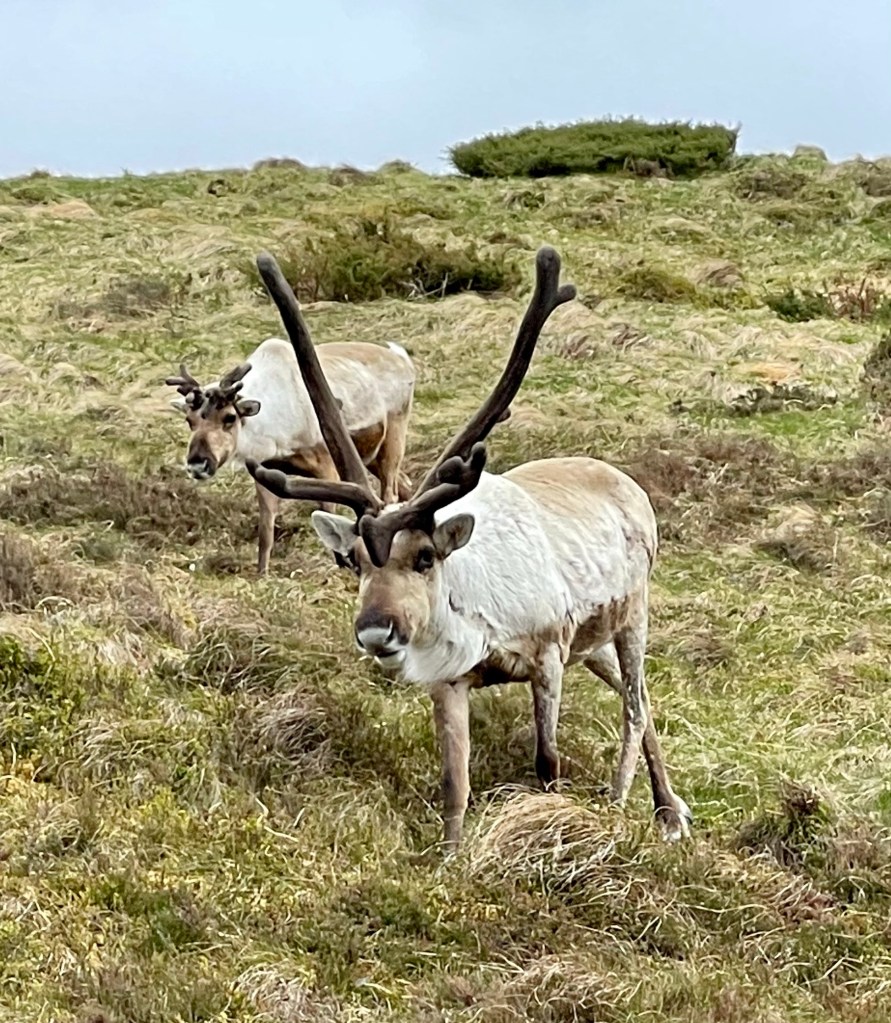
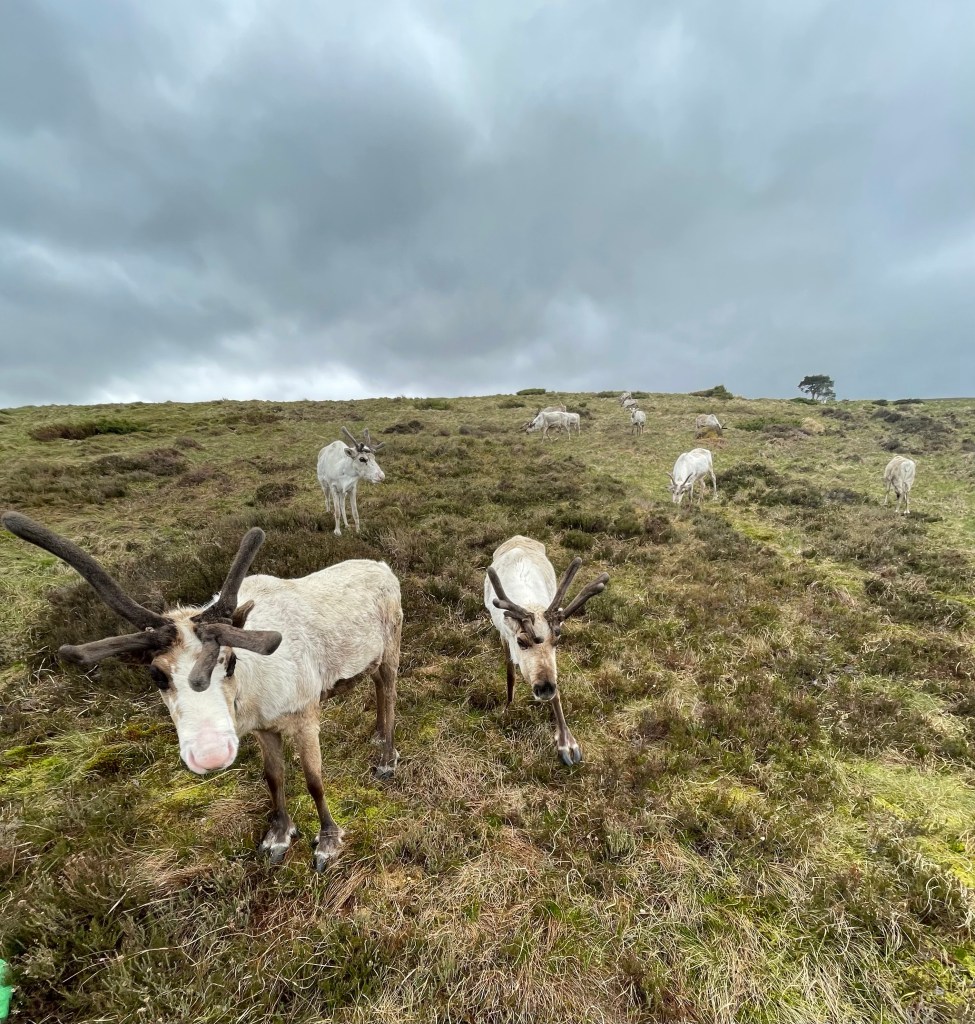
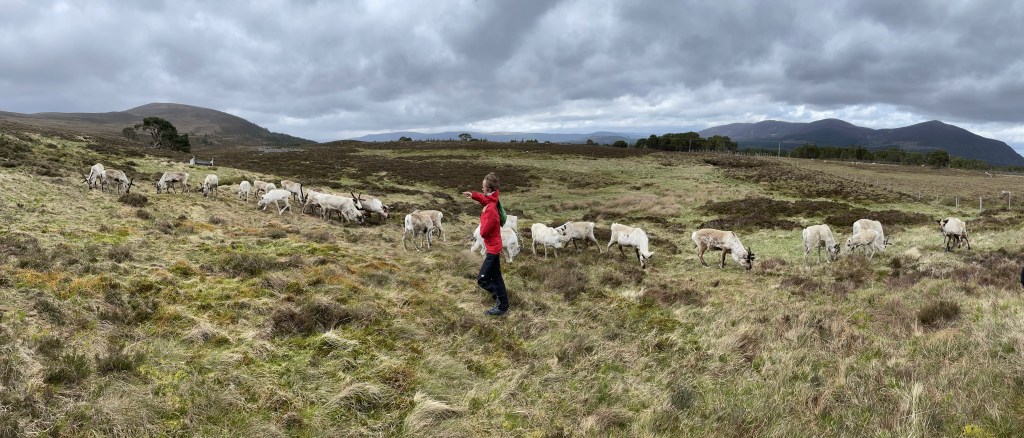
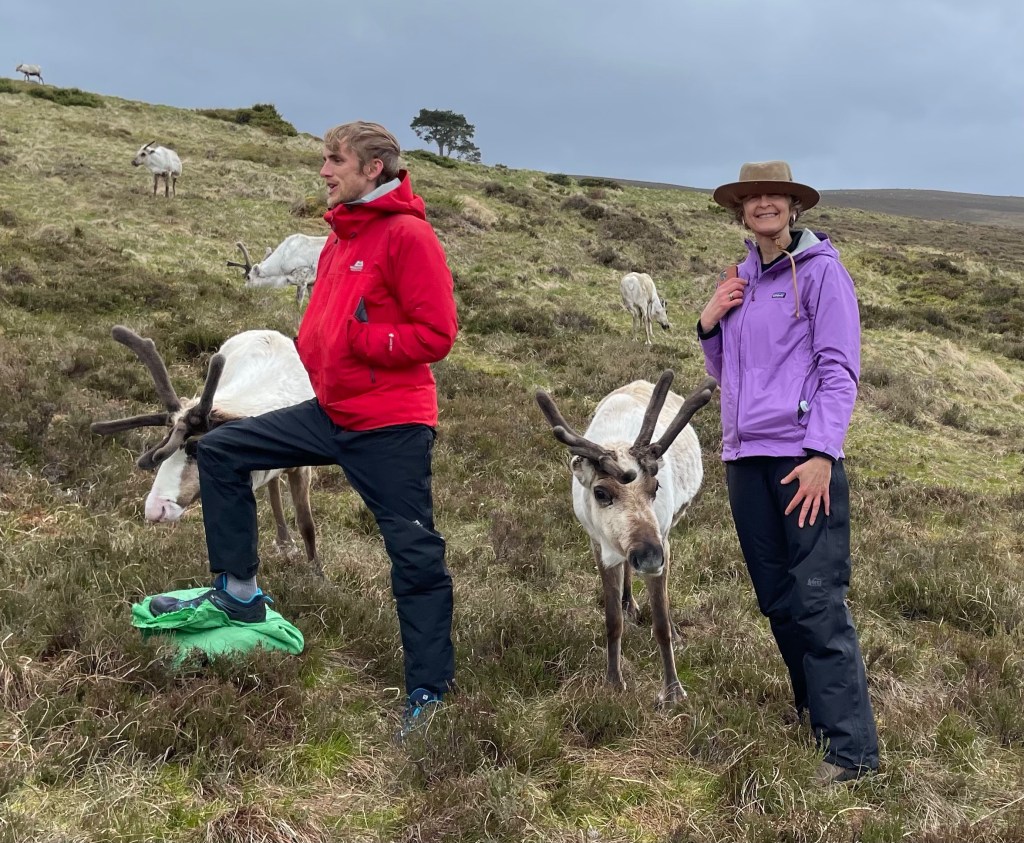
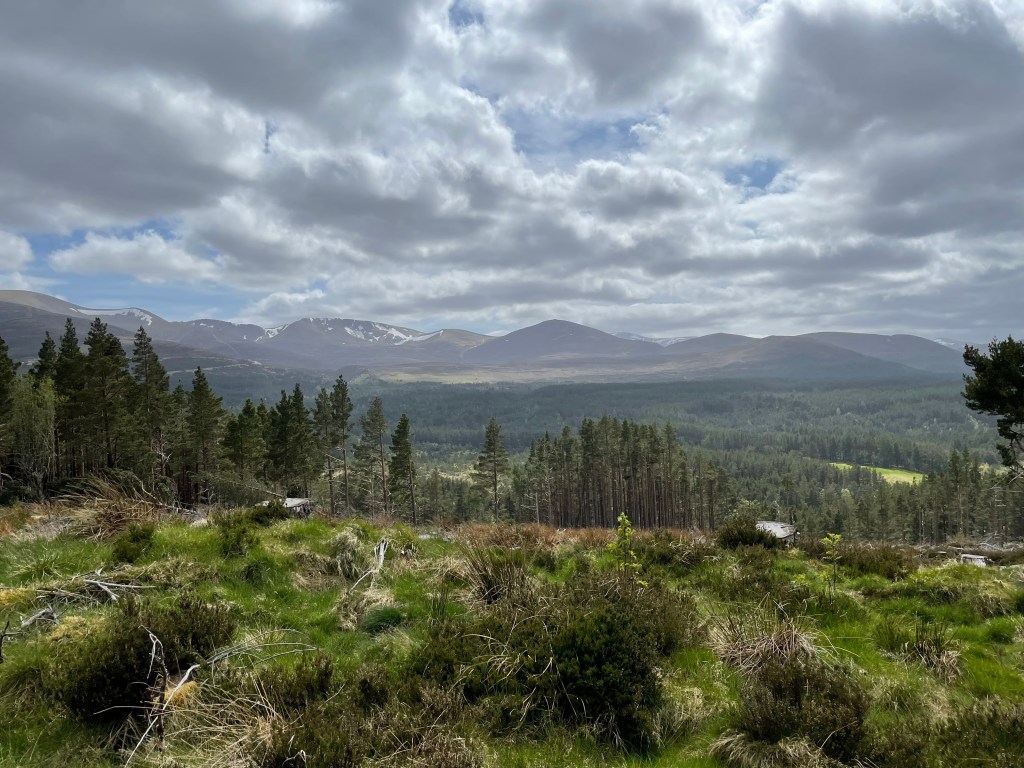
And now if I could offer a tip: if you ever are given the chance to mingle with reindeer, say yes. We left the shores of the loch to head to the Cairngorms for an afternoon spent amongst a reindeer herd. Cairngorms National Park is Britain’s largest, and features the most significant remaining swathes of the ancient Caledonian forest that once covered most of Scotland. It is the location of Balmore Castle, the vacation home and deer-stalking grounds of Her Majesty the Queen. But back to nature, the Cairngorms include four of Britain’s five highest mountains, and the park boasts the country’s only sub-arctic zone with recorded winds of up to 180 miles per hour on its peaks.
Reindeer used to roam over England and Scotland until they gradually were hunted out of existence hundreds of years ago. This particular herd of 150 are the progeny of a small group introduced into the Cairngorms in 1952. Vacationing honeymooners from Sweden decided this would be an excellent project to undertake since the Cairngorms’ muscular climate would be exceptional reindeer habitat. And so they made it happen, which is amazing but also adds fuel to my general suspicion that I haven’t really accomplished anything.
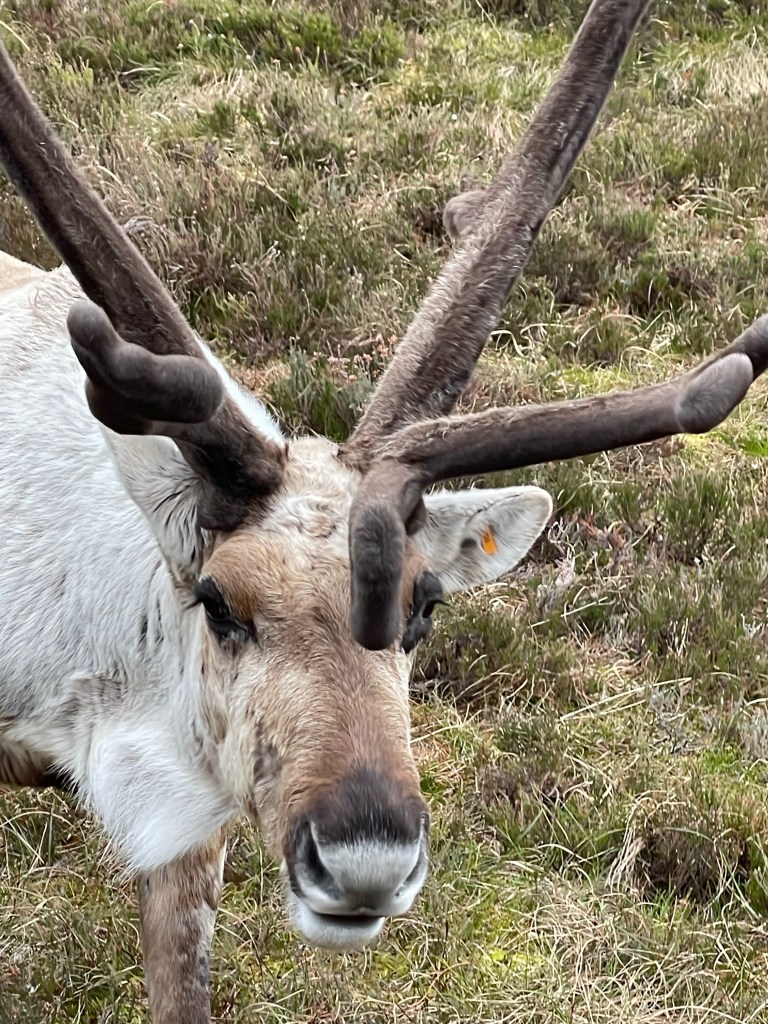
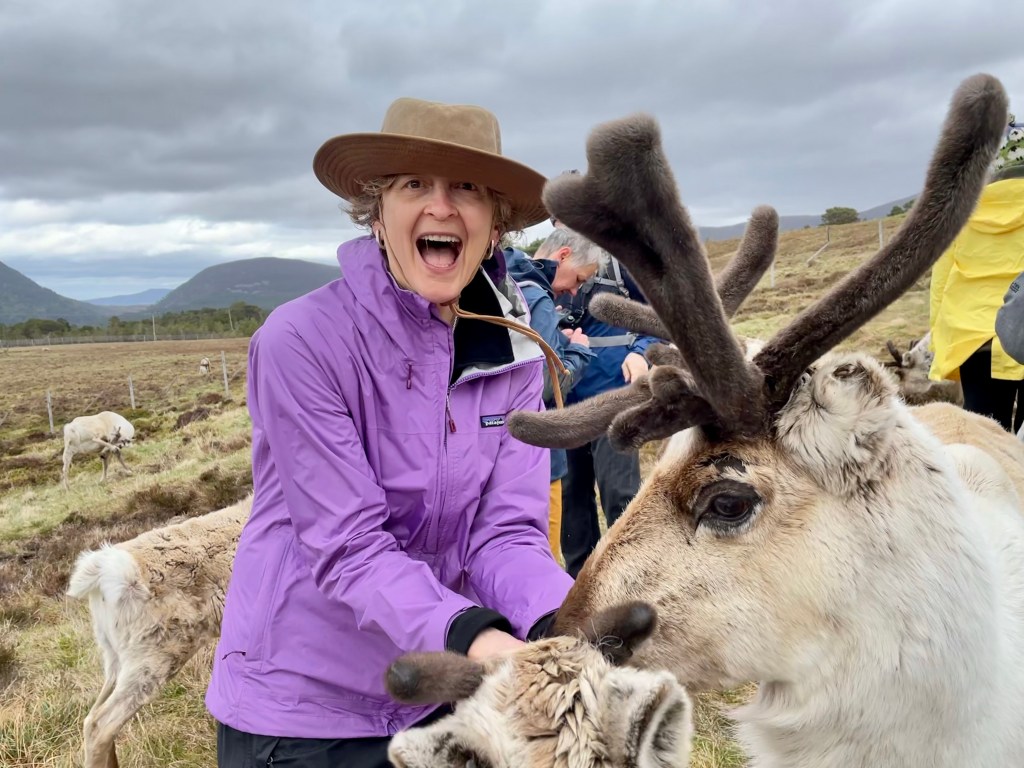
Our hardy group of 8, led by excellent tour guide Ben, hiked up into the very windy mountains to meet some of the herd. This is calving season and so there were baby reindeer (kept in a nearby fenced field with their moms) who were jumping about and playing with each other like baby goats, including one white calf who had been born overnight. Mothers are in labor for about an hour, and their calf is running around in short order after arrival, which is handy for predator avoidance. We were able to feed them but not allowed to touch, as they aren’t “tactile creatures” according to Ben. Very very challenging to restrain oneself from stroking their rich coats and velvety antlers. I actually think they would like it.
All the reindeer have names, and Ben knows them all. A purely delightful adventure, 10/10 would recommend.
Last day in the Cairngorms, we had to knock out a mountain. We chose a Corbett. The tallest of the Scotland mountains are known as Munros. To qualify as a Munro a mountain must be over 3,000 feet (remembering that we are starting at sea level, you western US mountain people). They number 282, and are named after Hugh Munro, the first person to compile a list of them in 1891. “Munro bagging” is a thing, and to date over 6,000 people claim to have bagged all 282. Corbetts are next, which are between 2500 and 3000 feet, named after John Rooke Corbett, who originally listed them – and interestingly, in 1930 he became the fourth person, and first Englishman, to bag all the Munros. Lastly are the Grahams (2000-2500 feet), named after Fiona Torbet (née Graham) who was a passionate hillwalker and, you guessed it, created a table of the most wee mountains. In a bizarre twist of fate, Fiona was gruesomely murdered in 1993 by Donald Jr, the son of the owners of the Western Highlands bed and breakfast she was staying in. The 400-hour search for her was one of the most intensive ever mounted in the Highlands as helicopters took aerial photos of the area and the Royal Navy dredged a Loch near the B&B. Nine months later, when the snow melted, some of her personal items were found under a tree on the grounds of the B&B. Finally Donald Jr confessed.
Our lovely B&B hosts, who have never murdered anyone, recommended Meall a’ Bhuachaille. Kev said that during the pandemic he walked it every day to clear his head.
We started the hike full of happy anticipation, only to be met with a very, very steep situation. Even so, we came upon (very fit and/or nuts) people running and mountain biking the vertical, switchback-free slopes. This is irritating when one is operating in drag-ass slogging mode. And by the way, I can hear you thinking that I must be exaggerating. We ascended 1600 feet in about a mile. The gnarliest hike in our neck of the woods is South Sister, where the ascent is 4,900 feet in 5.5 miles. You do the math.
Circumstances in this photo are much steeper than they appear.
From a distance, and as you can see from the photo below, our scree-trained eyeballs thought the Cairngorms quite reminiscent of the red cinder cones of Central Oregon. This being Scotland, though, of course it’s not volcanic scree, but rather – carpets of heather. Stop it, Scotland.
Our destination, blanketed with heather.
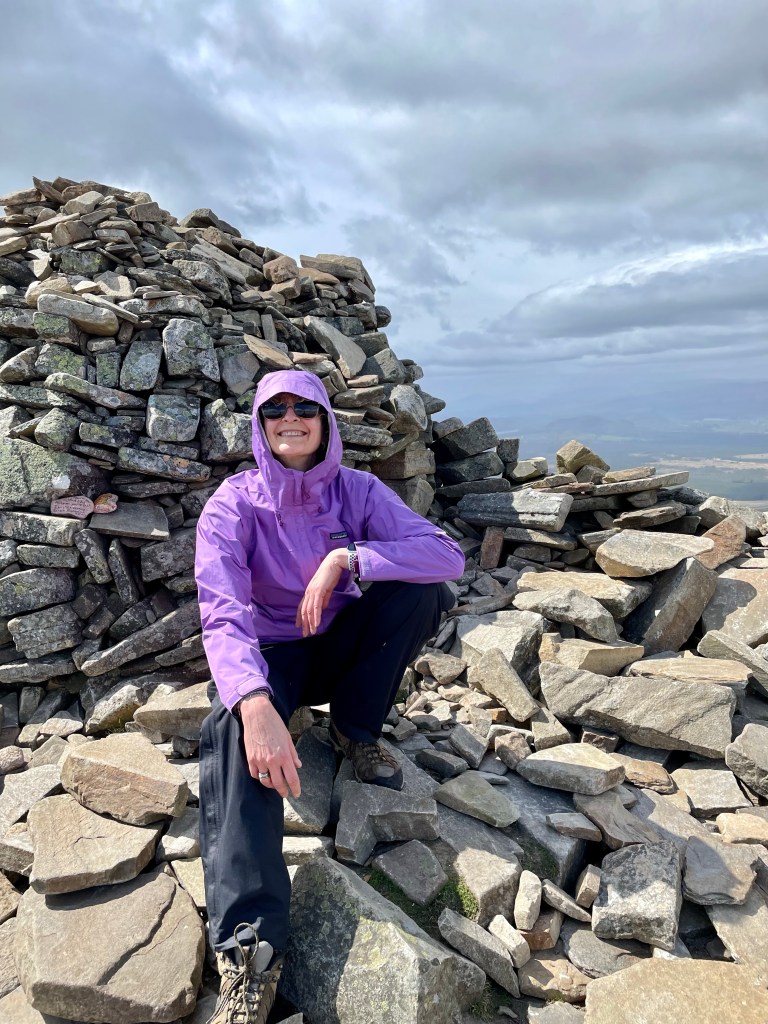
So I shall skip any further unpleasantness that may have been associated with the climb and say that the summit was reached in due course, which always makes the effort utterly worth it. The top was a windy place. A large cairn served as a shelter. The views were stupendous.
On the way down we came across a bothy in a beautiful valley. Bothies are located in remote spots throughout Scotland. They were originally rural cottages that have outlived their original purposes and now are kept unlocked for hill walkers to take shelter or stay overnight without charge. The Mountain Bothies Association, established in 1965, is the charity that maintains them.
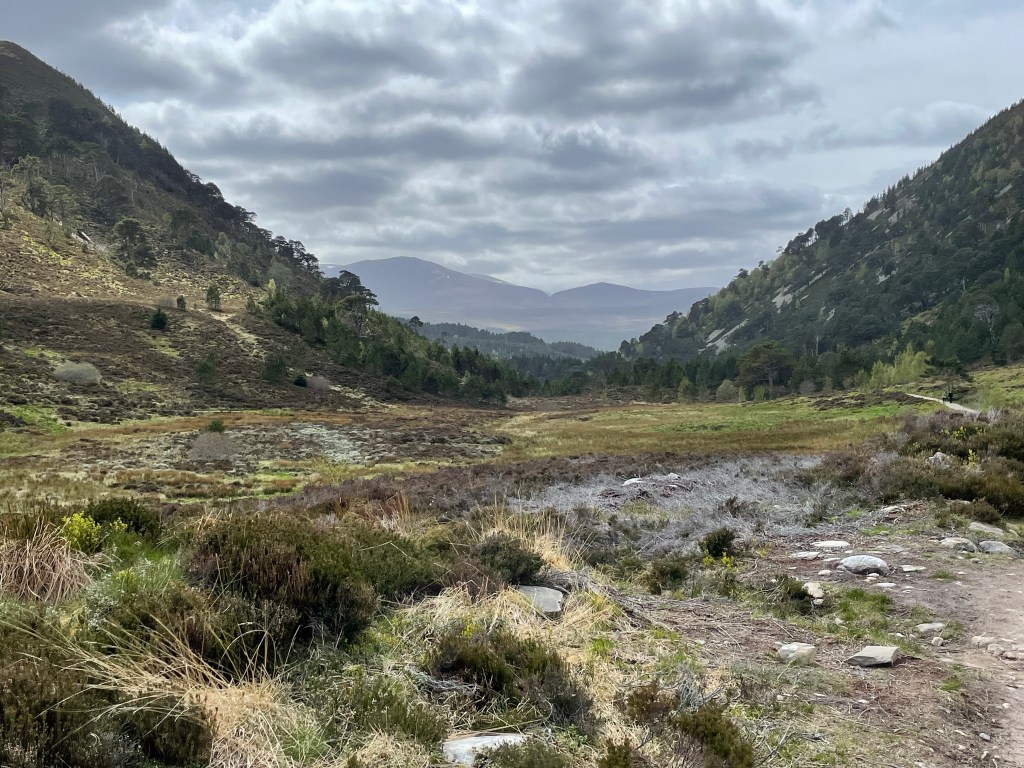
The views were lovely all the way back to the car, as we hiked through a beautiful valley to a loch, coming upon many hikers and dogs out for a Saturday adventure. Mostly Scots and some Norwegians. We might have been the only Americans on the mountain. As it should be.
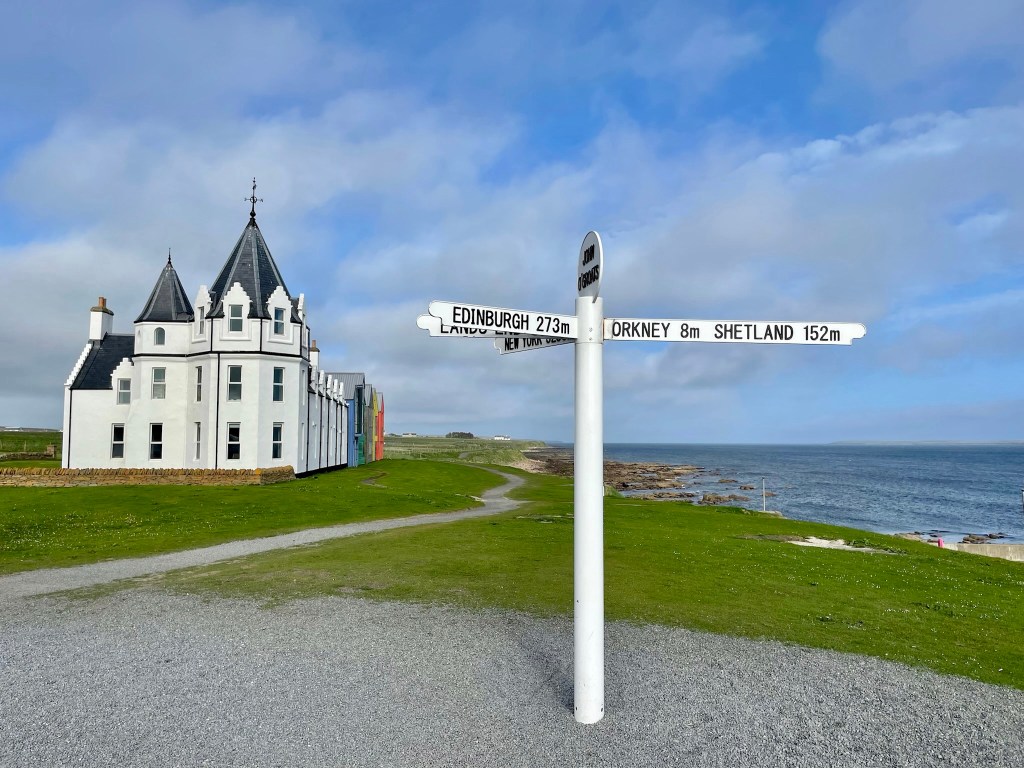
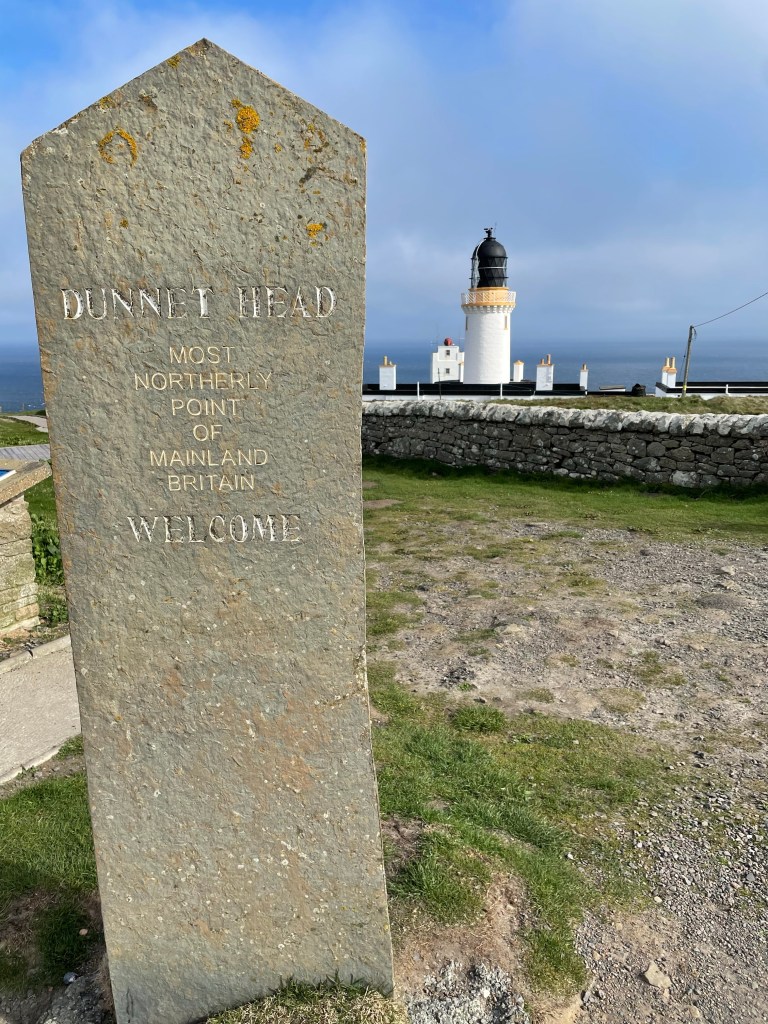
That place where you have to take a photo, John O’Groats
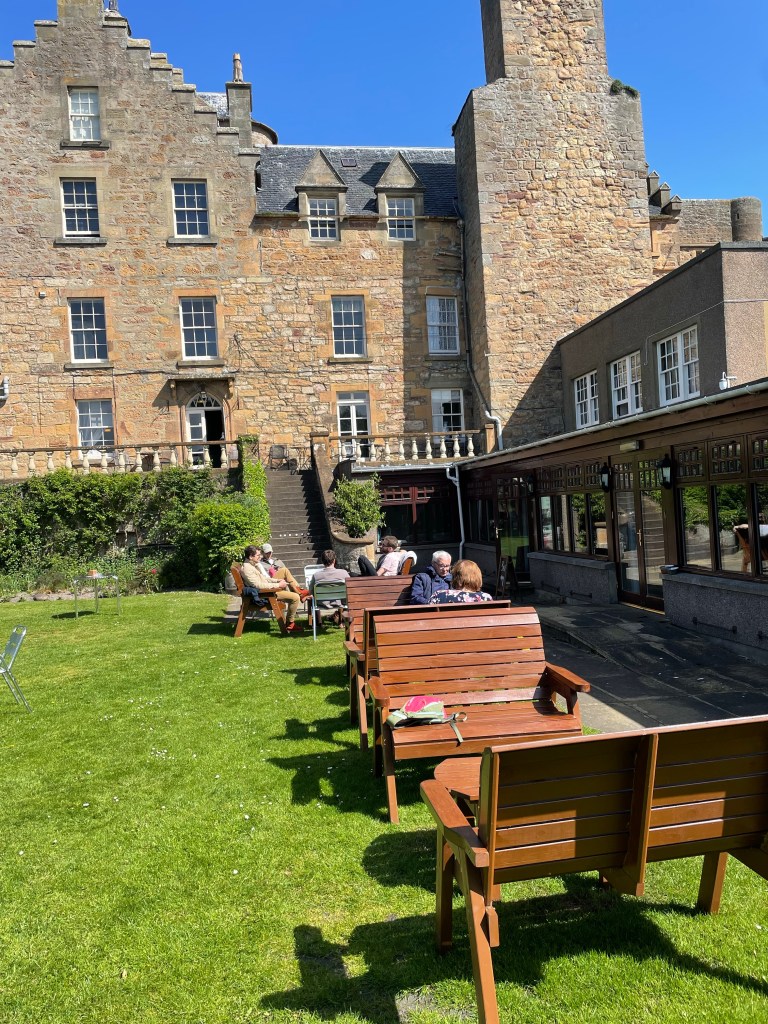
We bid a very sad farewell to our pals Kev and Kirsty in the Cairngorms and headed up the east coast, aiming for the Orkney Islands. We visited three castles along our way. Dornach Castle, which is now a 189 room hotel, was our lunch spot. It didn’t seem much like a castle any more, but it was a rare bluebird day, perfect for an outdoor lunch in the garden.
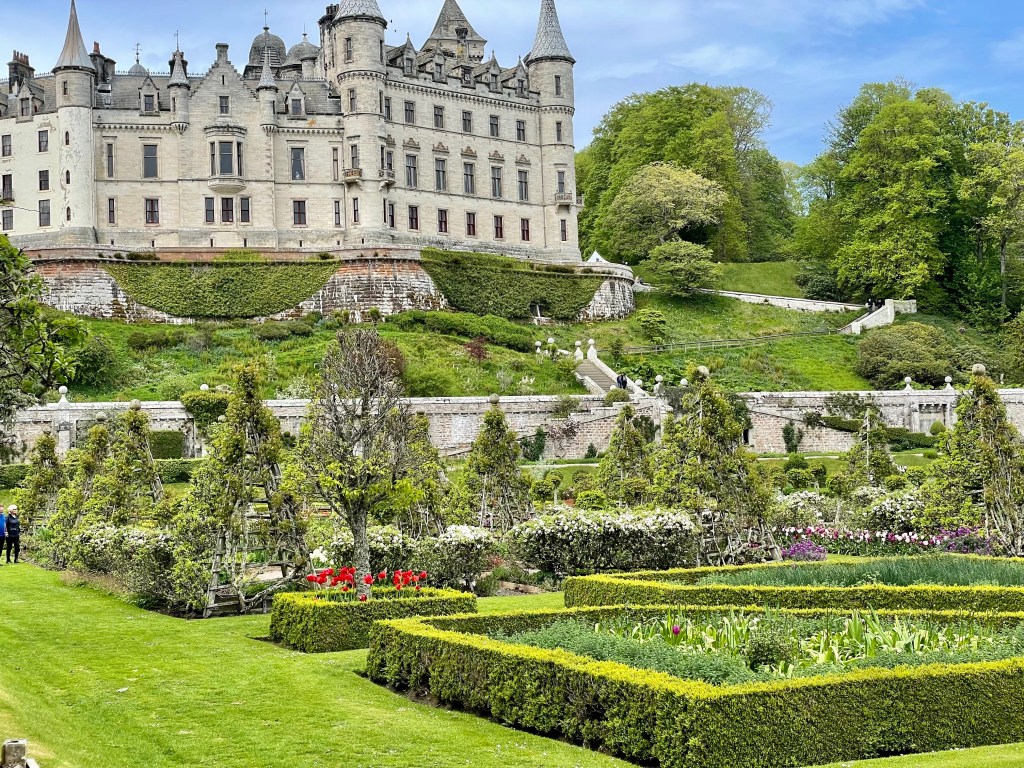
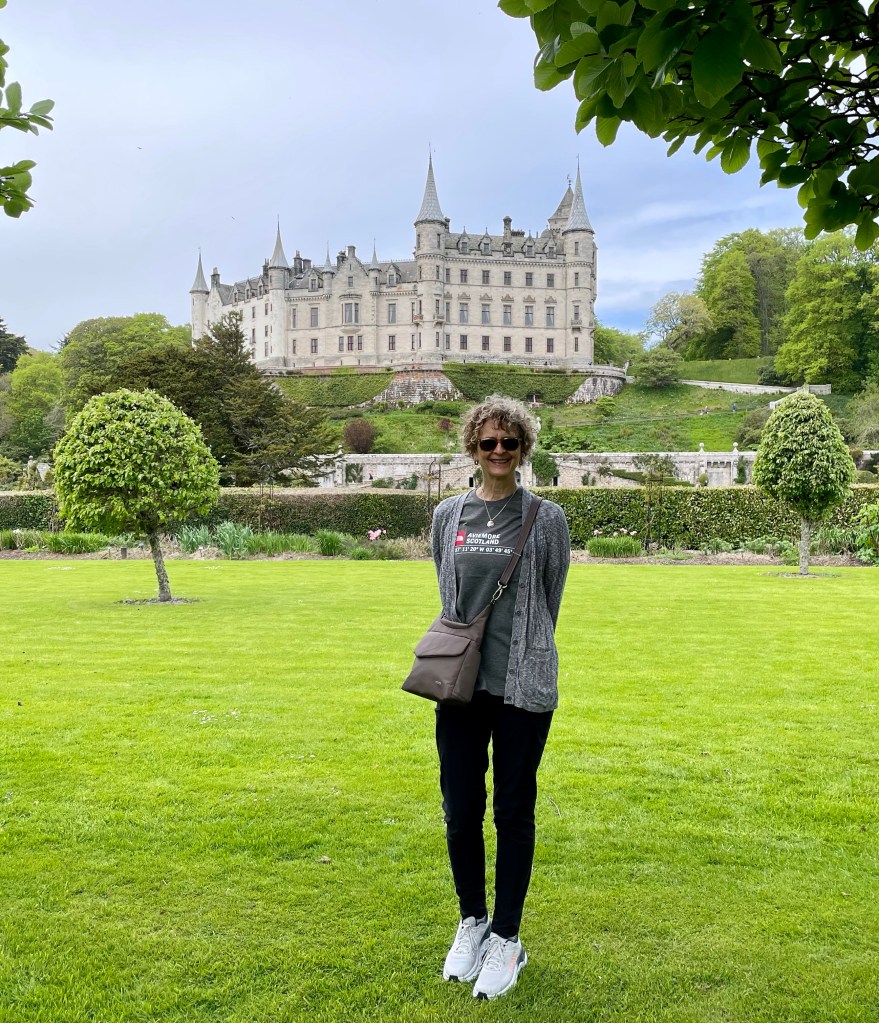
We then toured the fabulous Dunrobin Castle and Gardens, home to the Earls and Dukes of Sutherland throughout history. The earliest part of the castle was constructed in 1275. It was used as a naval hospital during World War I, and for a time, was a boys’ boarding school. The first Duke of Sutherland is sculpture-toppling notorious for his participation in the Highland Clearances, shipping off Scottish families in the late 18th century to make way for sheep since the cute fuzzy creatures made more money for wealthy landowners than crofters did.
Not our fault though.
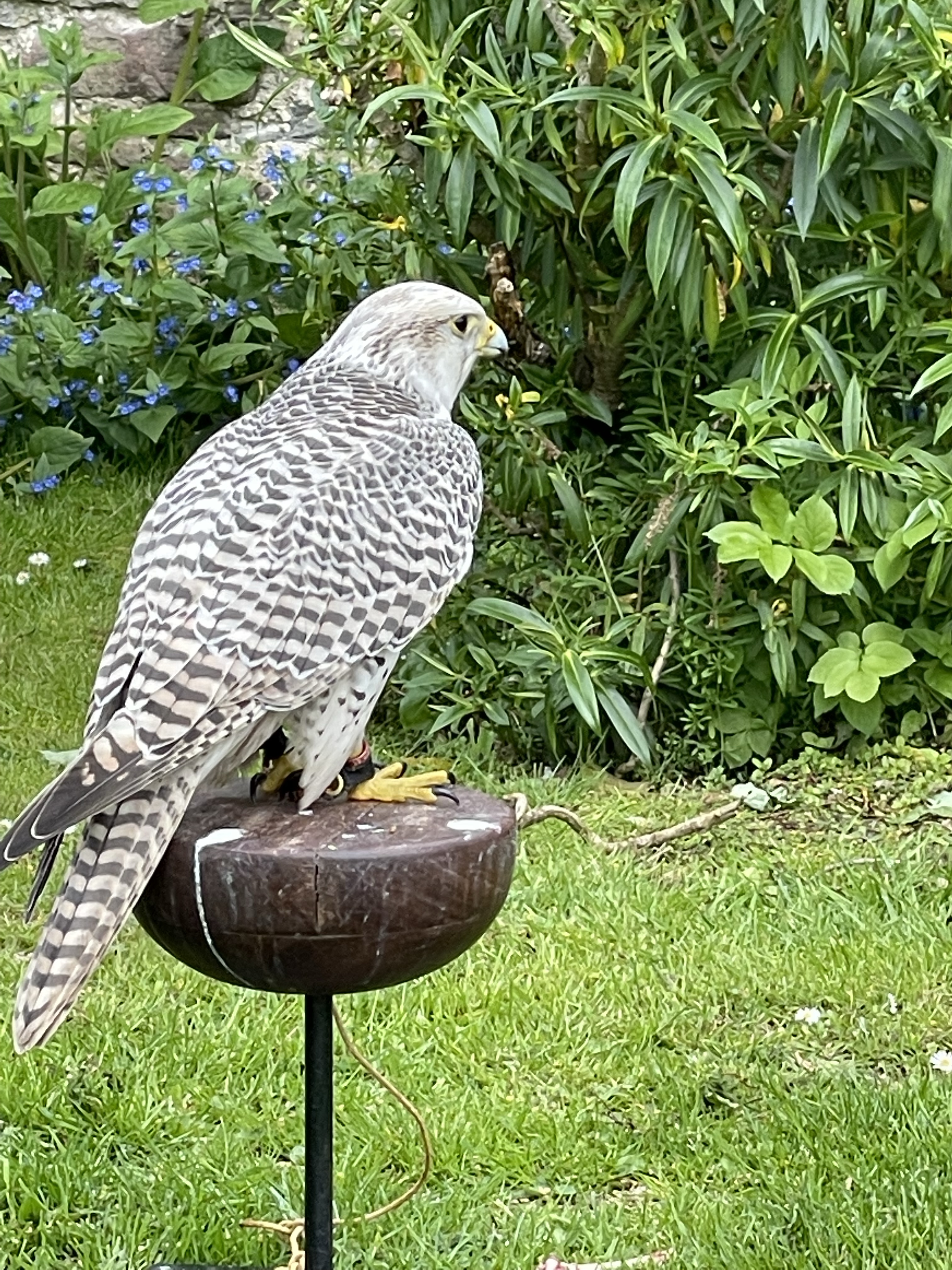
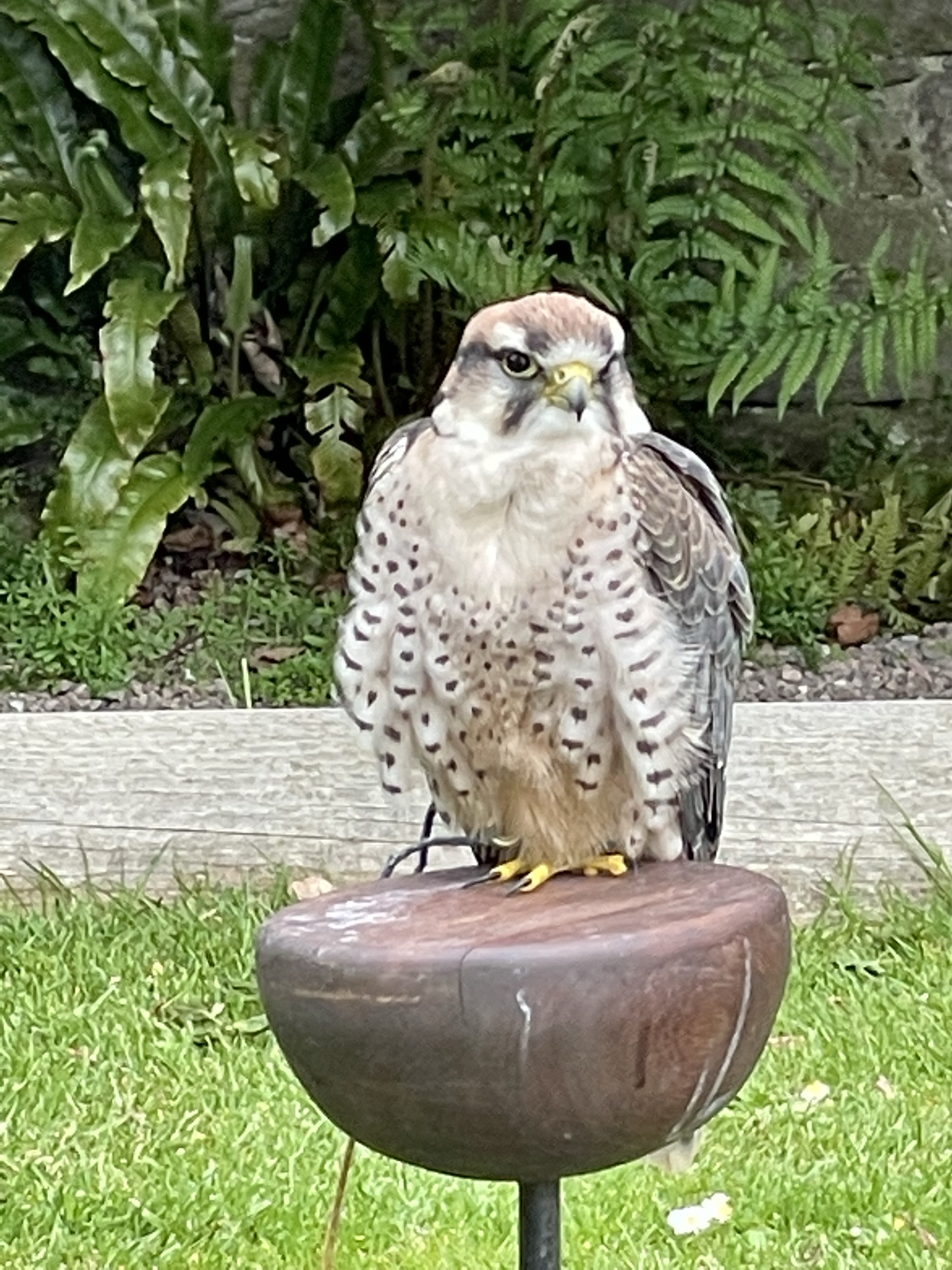
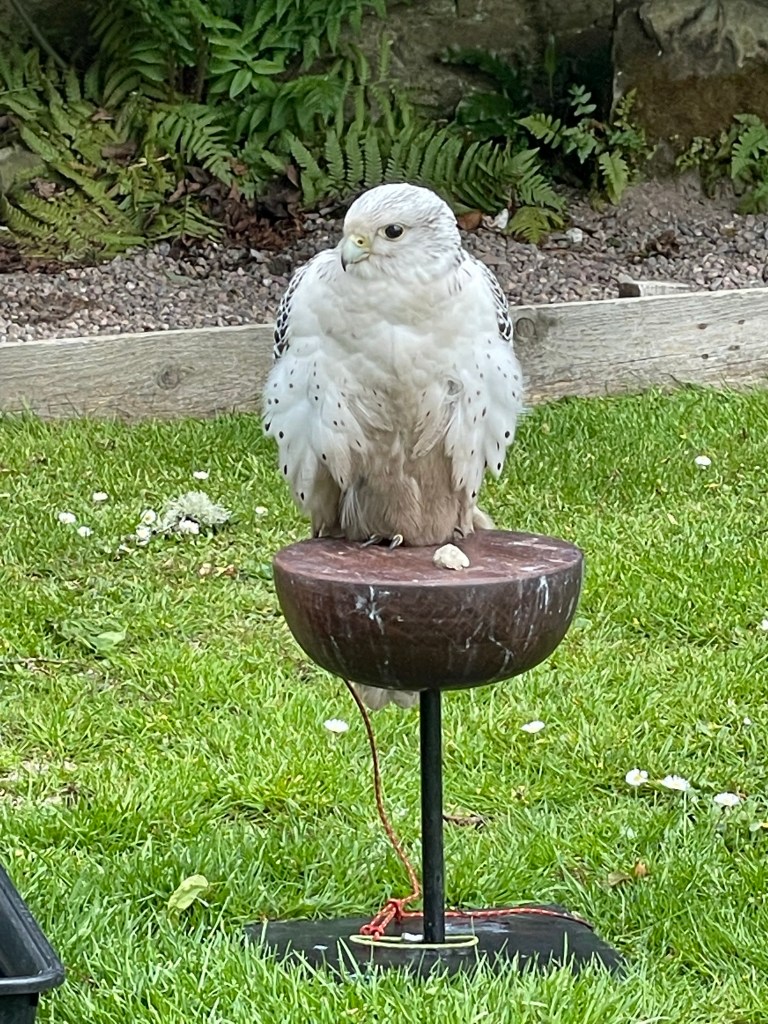
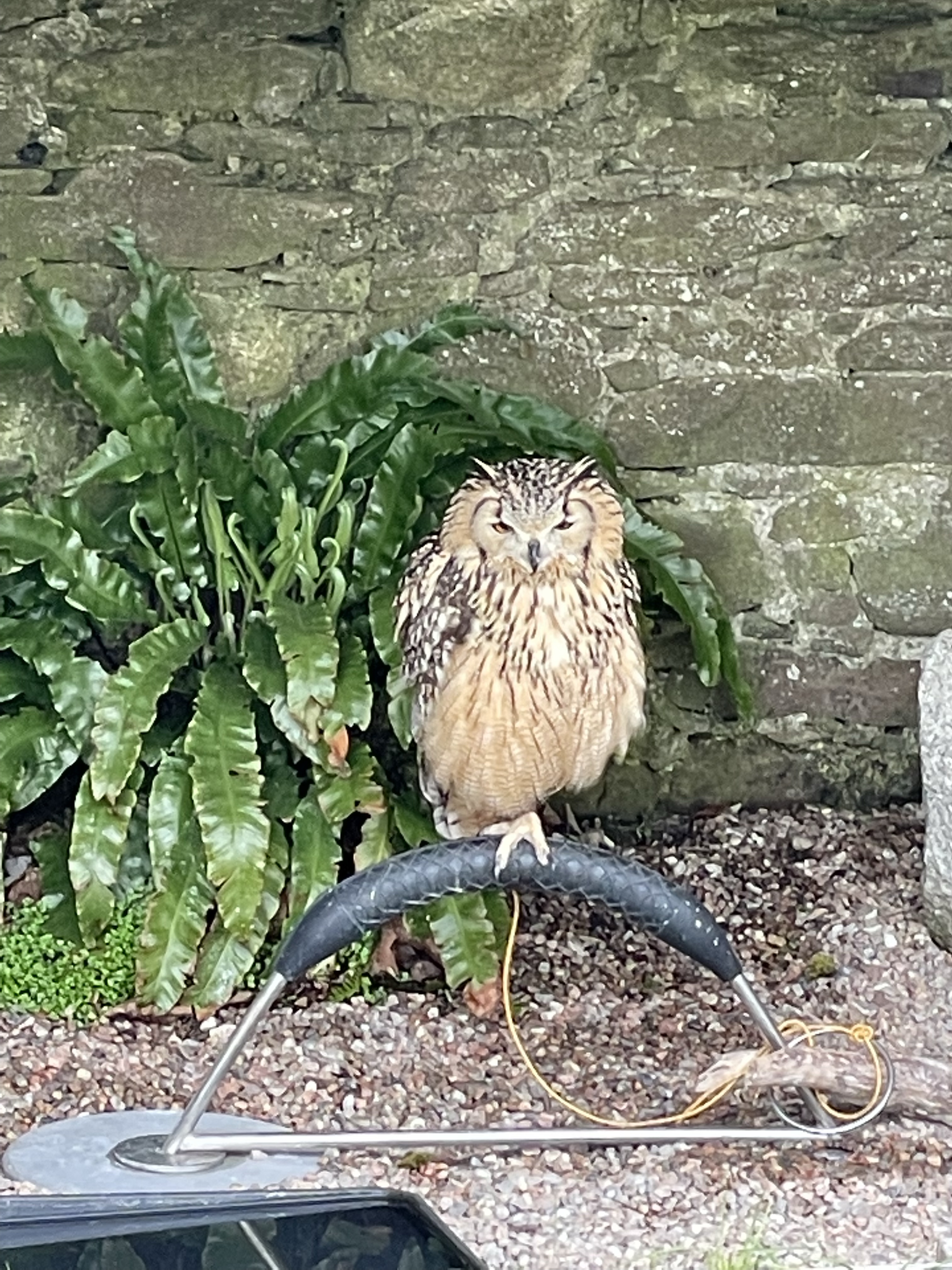
Even so, Dunrobin Castle is gorgeous with spectacular architectural gardens overlooking the North Sea, and is known for its falconry. I took an embarrassing number of photos of the resident falcons and owls.
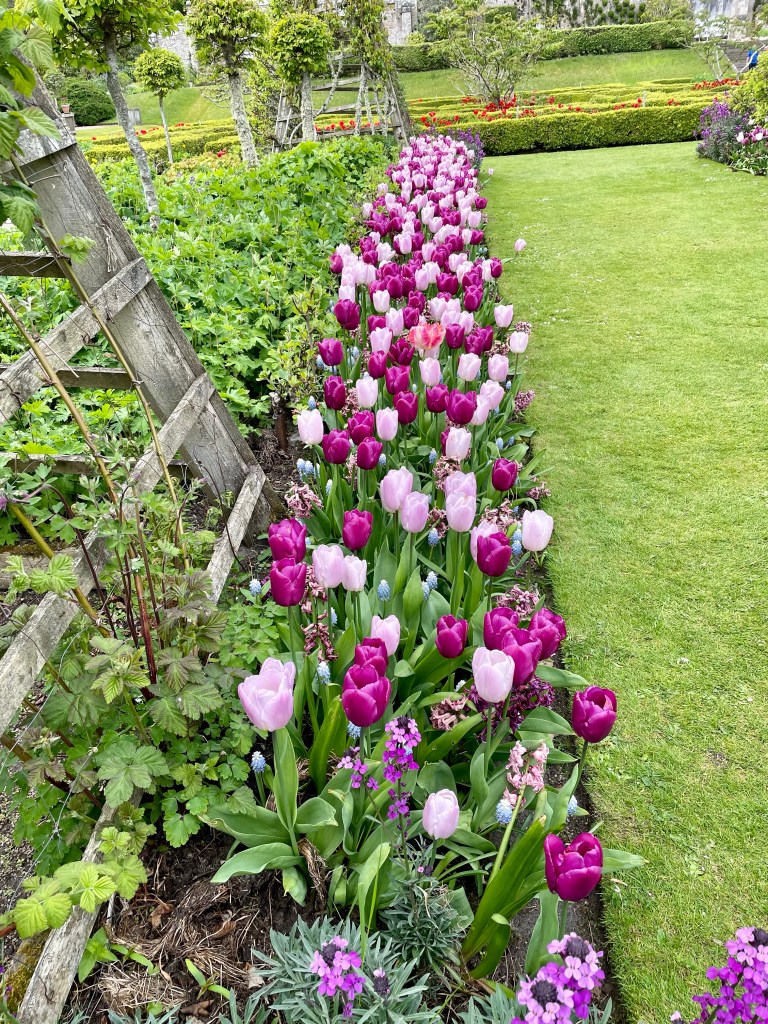
Dunrobin Castle and GardensNot the worst view?Gorgeous beds.Birdies.
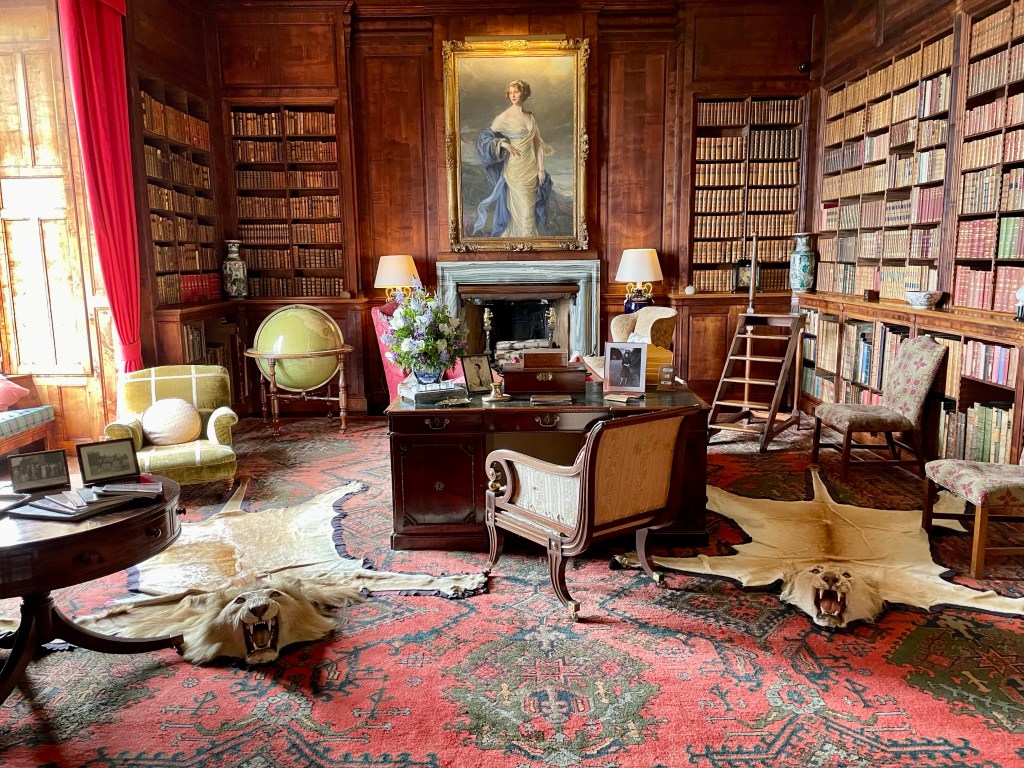
The indoor tour was quite something – so many rooms, so many paintings and photographs of Dukes, Duchesses, Earls, Kings and Queens. Check out the library – obviously the lion pair are a bridge too far on the decorating front.
Lions – no.
As with all estate-type museums, there were explanatory placards throughout. My favorite was outside the “Seamstress Room.” Why? Because it’s also known as the “Haunted Room.” Why? Because in the 15th century the Earl of Sutherland captured a young woman from the Mackay Clan after a battle and locked her up in in the seamstress room which was next to the night nursery which seems like an extraneous detail but it was on the placard. Apparently he wanted to marry her but she refused him. Earl, my dude, you need to up your wooing game. But wait, there’s more. One night he found her trying to extricate herself by climbing down a rope of sheets and I’m honestly wondering whether she invented this particular escape technique. Ego instantly bruised to the bone, the Earl whipped out his sword and cut the sheet rope, causing her to fall to her death. So obviously she became a ghost, and someone needs to turn this tale into a country song immediately.
The Sutherland boys, I fear, are the worst.
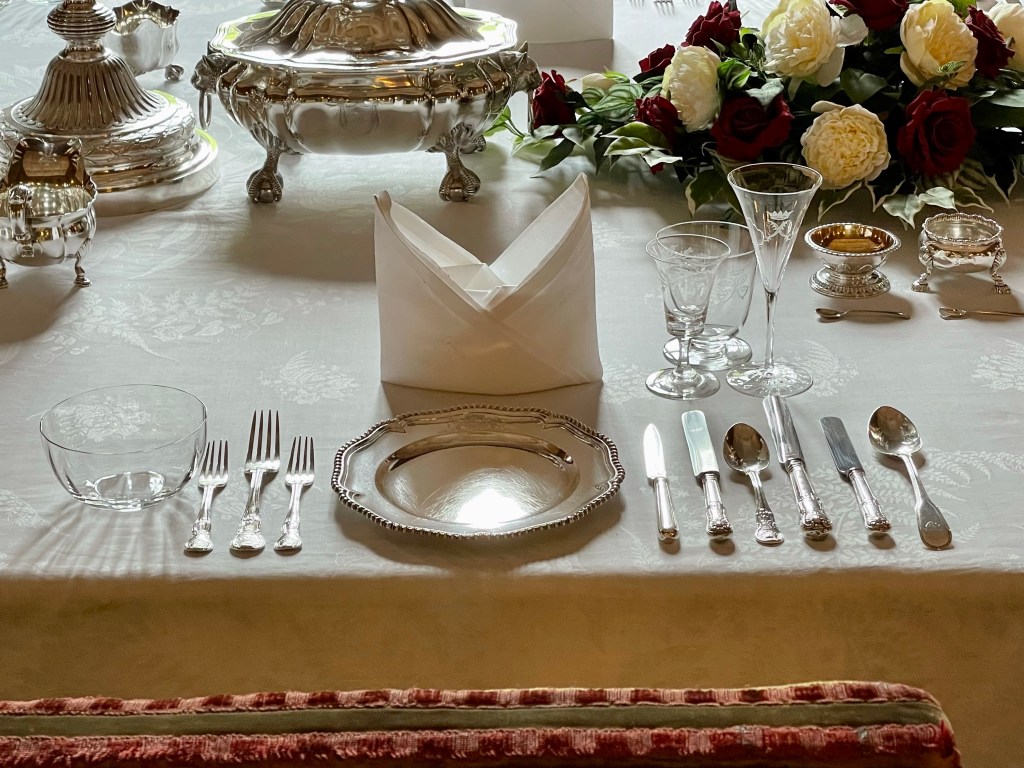
The dining room – does this make anyone else feel anxious?
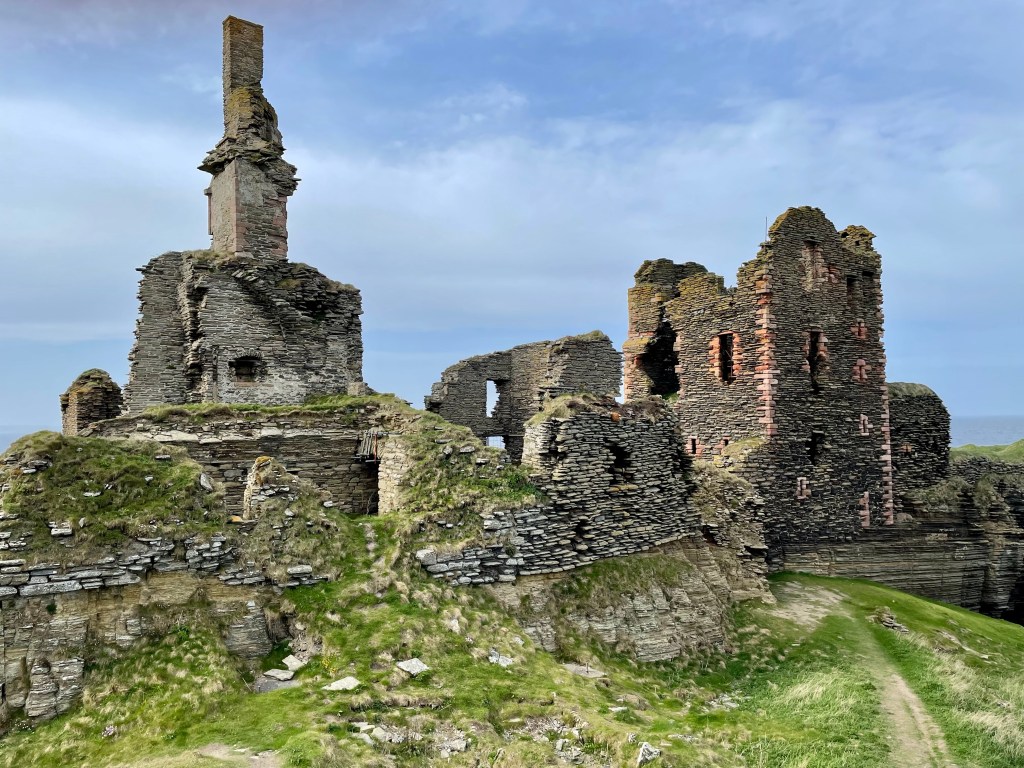
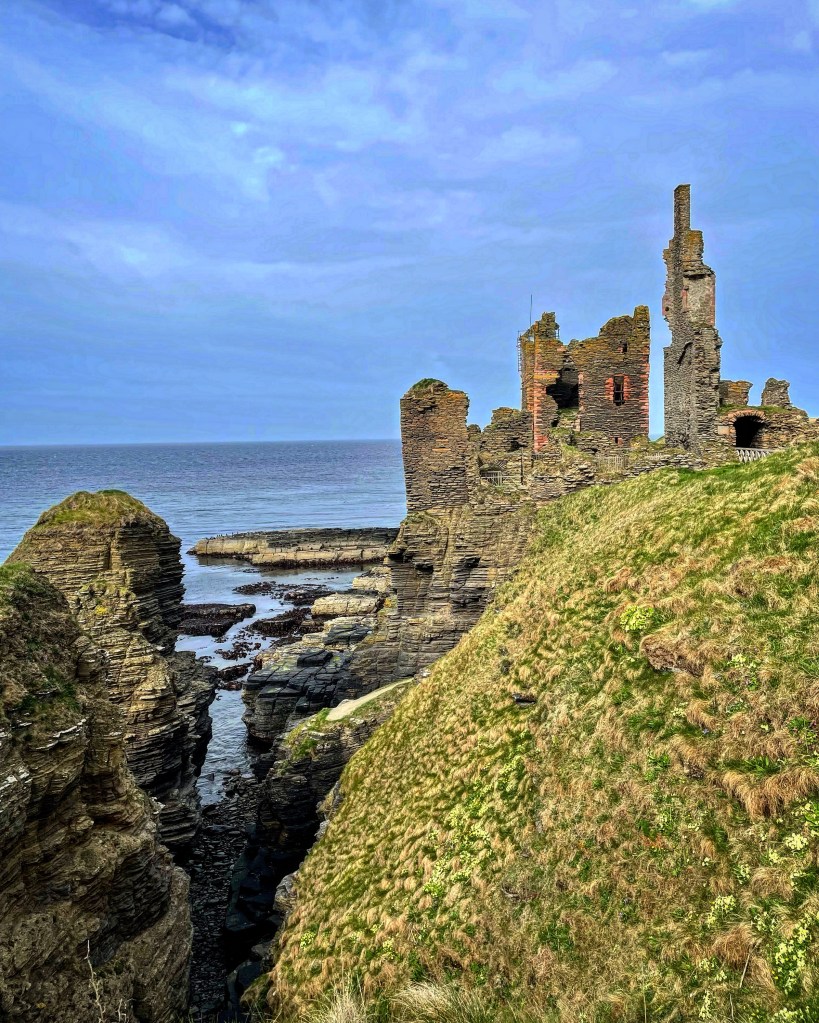
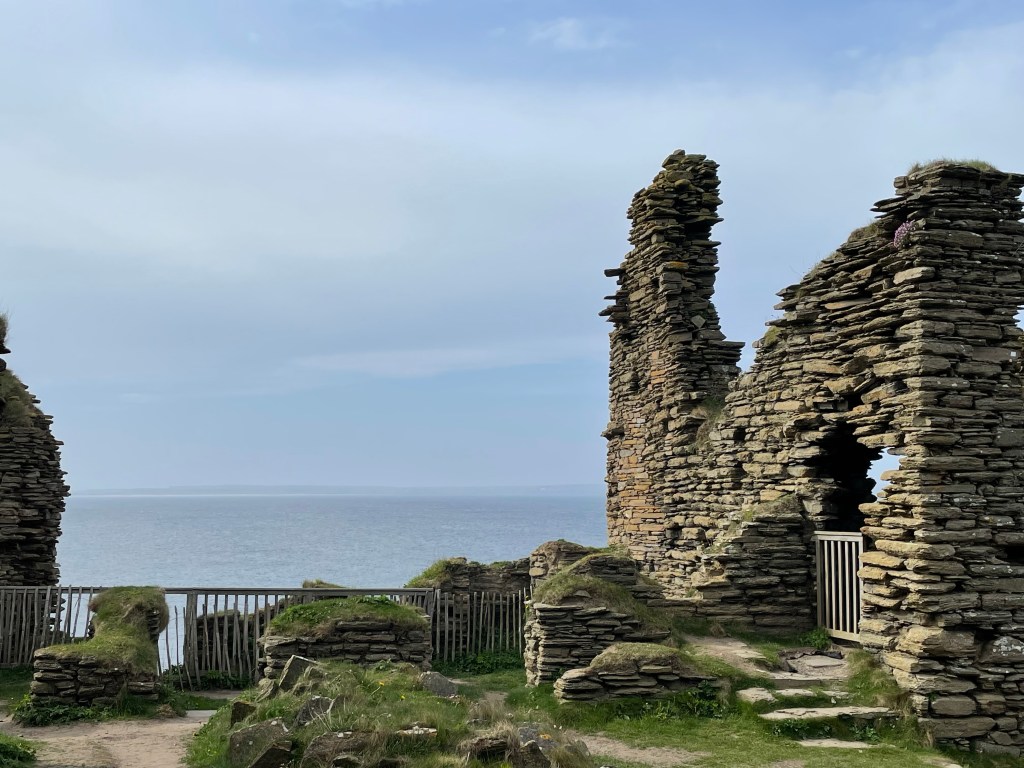
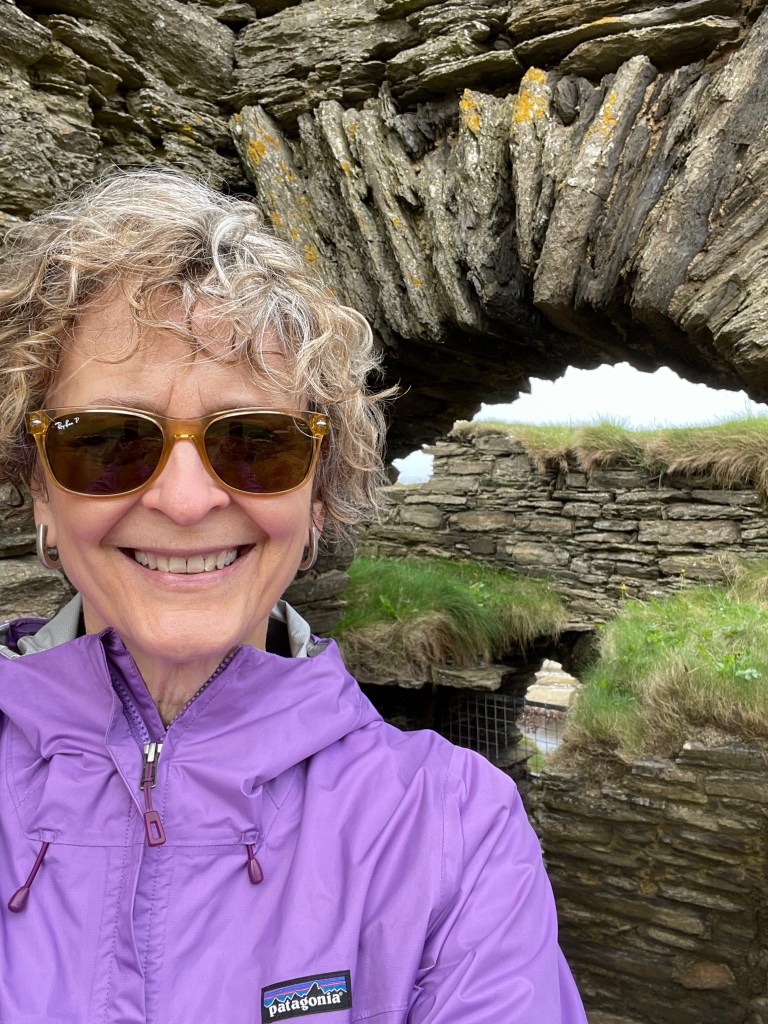
My favorite destination on our drive was a castle near Wick that very nearly fell into the sea. Thankfully it is being restored, not to its former glory, but to a ruin that will decay no more, Castle Sinclair.
Much of our route for this trip is along the NorthCoast 500, invented in 2015 by The Tourism Project Board of the North Highland Initiative to attract tourists to the less visited and economically depressed northern climes. It’s essentially a 500 mile circular driving route that begins and ends in Inverness. It has become incredibly popular rather too quickly and the locals, while benefiting from some positive economic impact, are Not Stoked. Living in a tourist town myself, I sympathize.
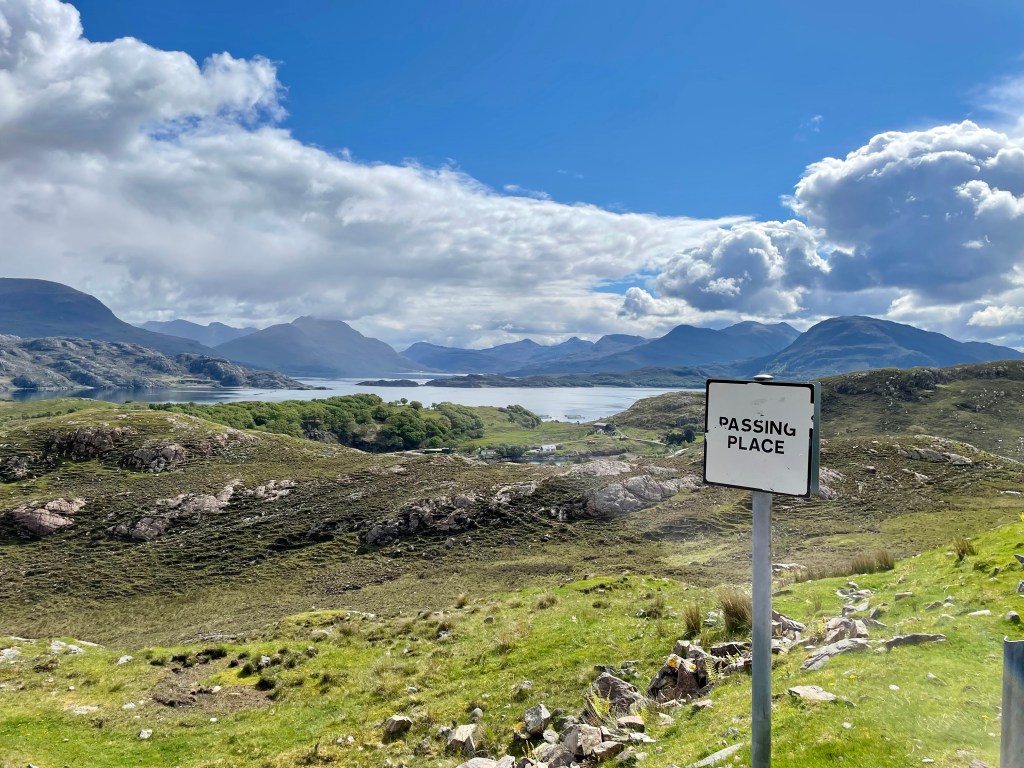
A particular enmity is reserved for all the camper vans inhabited by tourists not sleeping in B&Bs and making their own meals. These RVs are rented in Inverness by folks who have no idea how to back them up, and they are simply too big for single-track pot-holed roads. The area has also seen a huge increase in motorcycle and car traffic (especially “fancy cars” complained a group of men ruefully shaking their heads over breakfast in a Scrabster cafe). People are unfamiliar with how to navigate one-lane roads with “passing places’ where one person or another can pull over. The influx has placed a strain on infrastructure in general, particularly, ahem the delicate, often seaside, sewage system. Understandably irritating for folks living in a remote area who suddenly are facing challenges living their lives as usual. One man complained, “The tourists will stop suddenly in the road because they’ve seen a Highland cow and want to take a picture.”
Ahem. Me, circa 2018.
The route is also driven by people who go from attraction to attraction, stopping only for that Instagram moment and not really spending money or meaningfully interacting with the community. Here are a few examples.
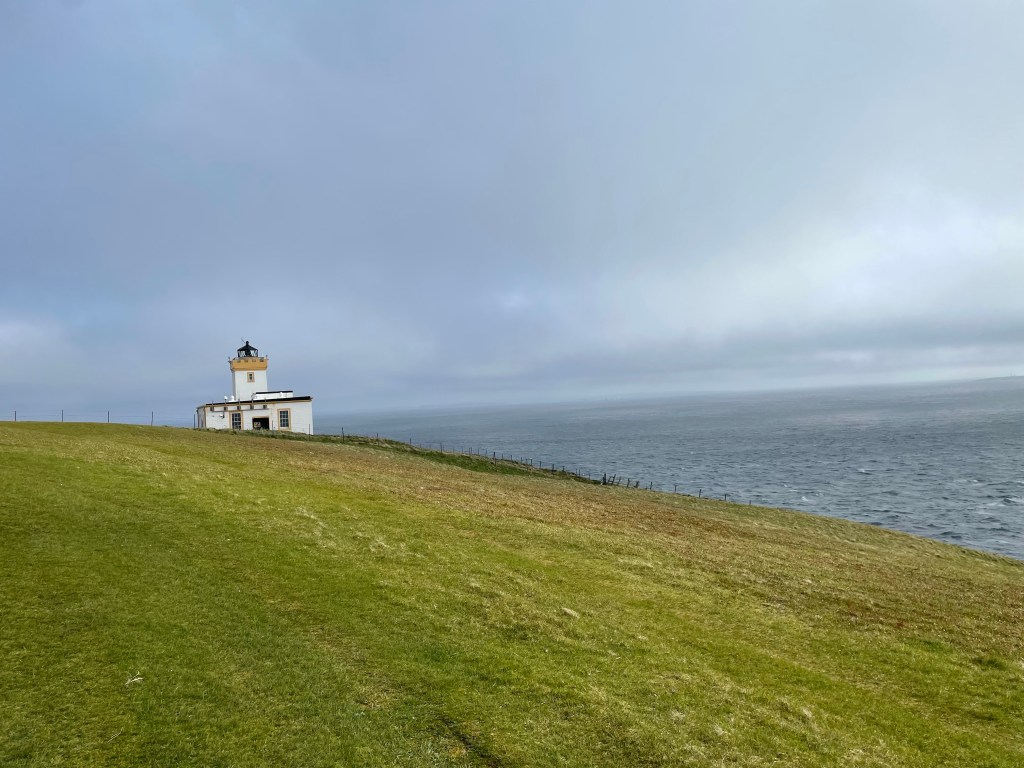
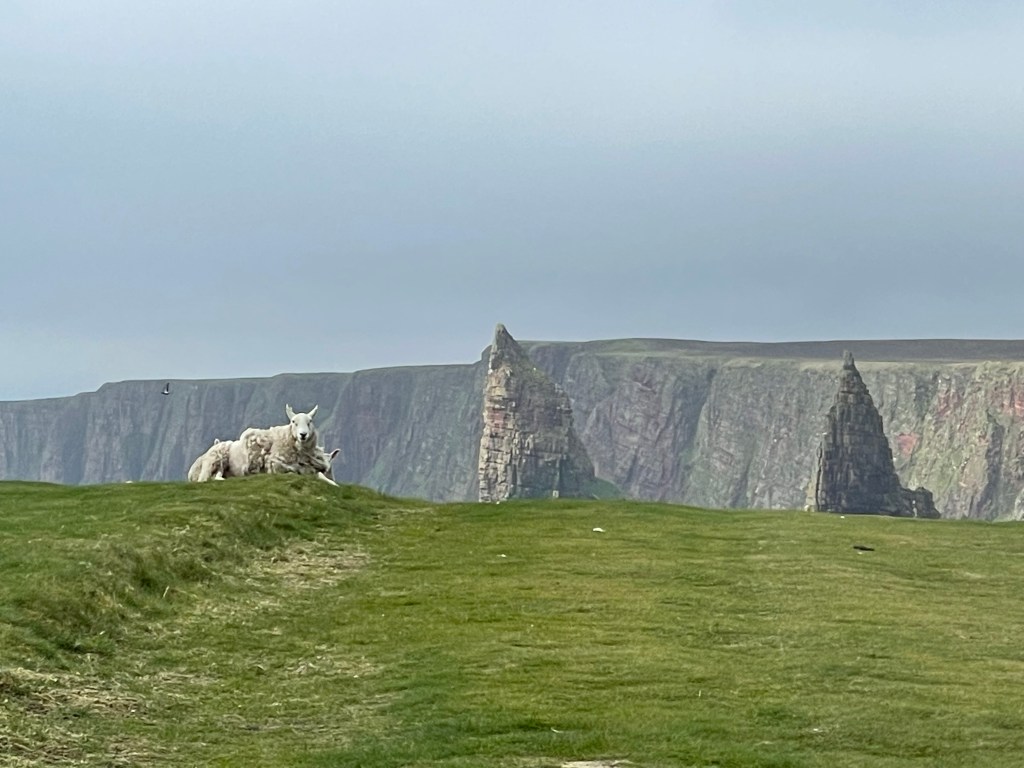
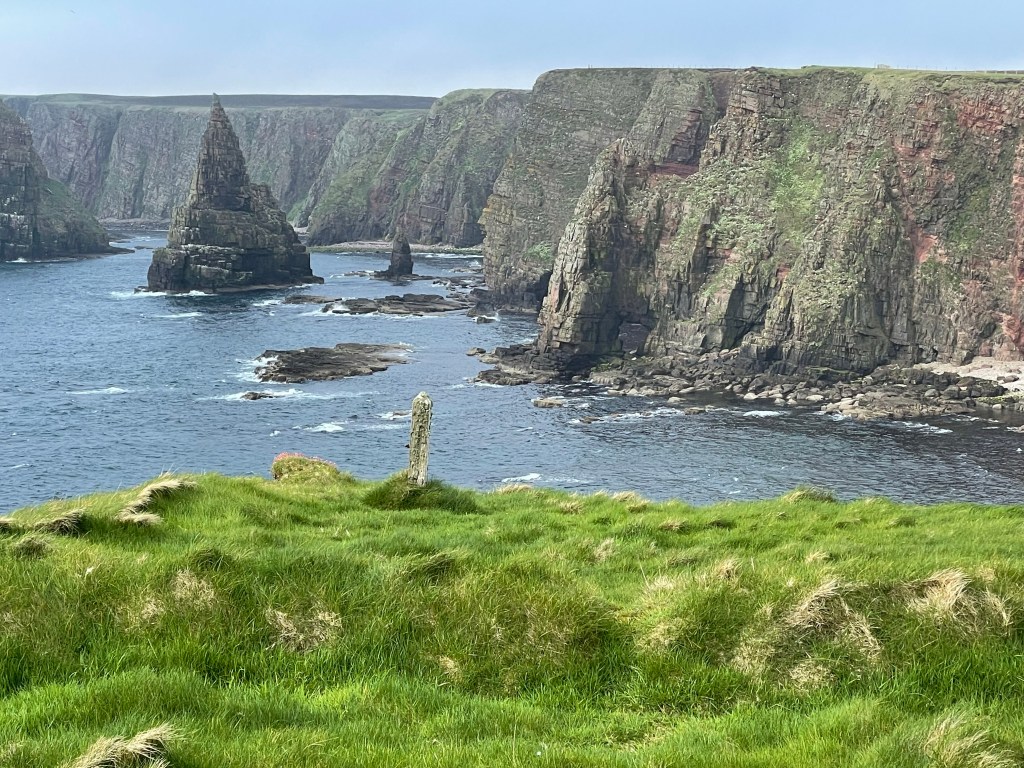
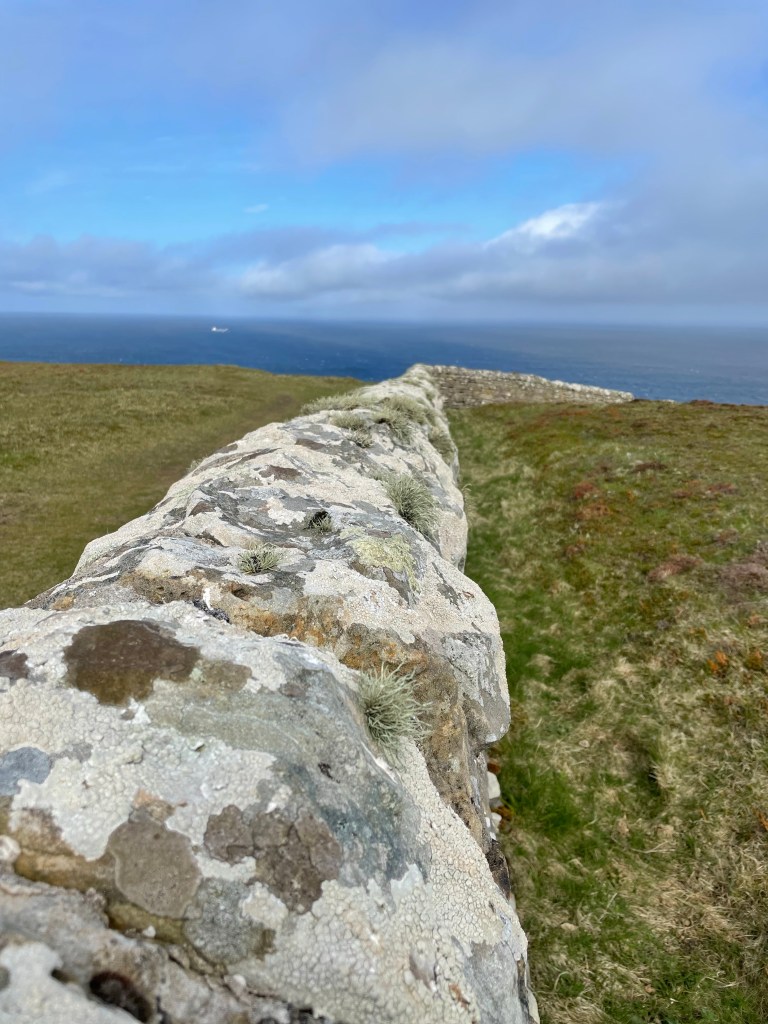
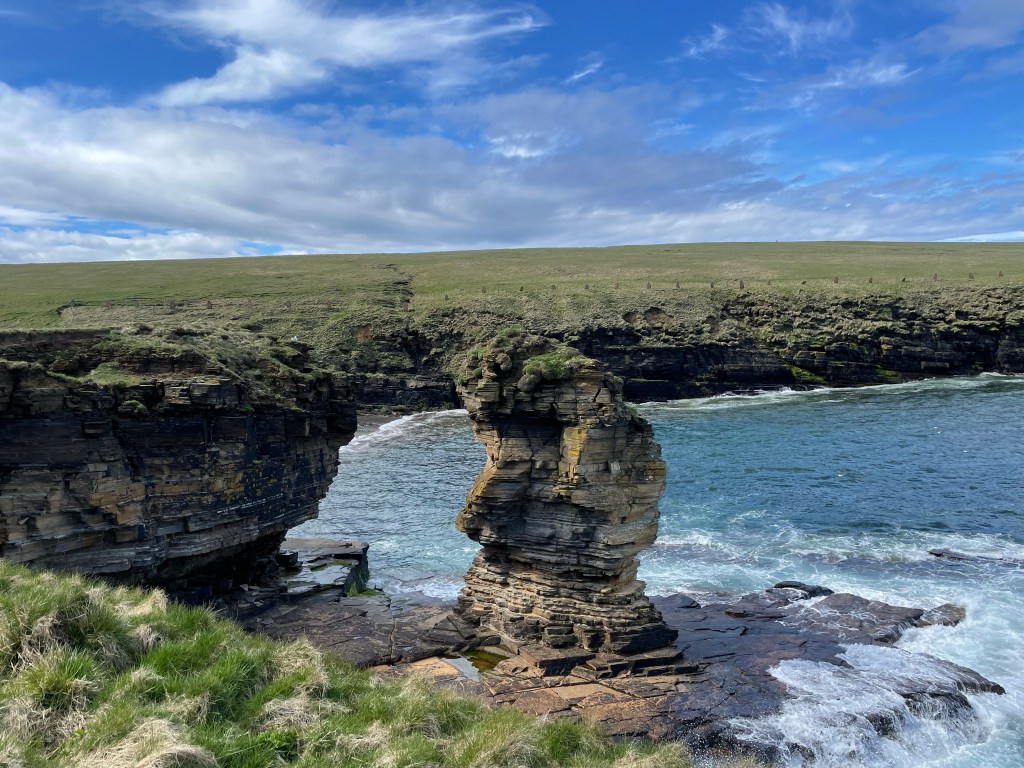
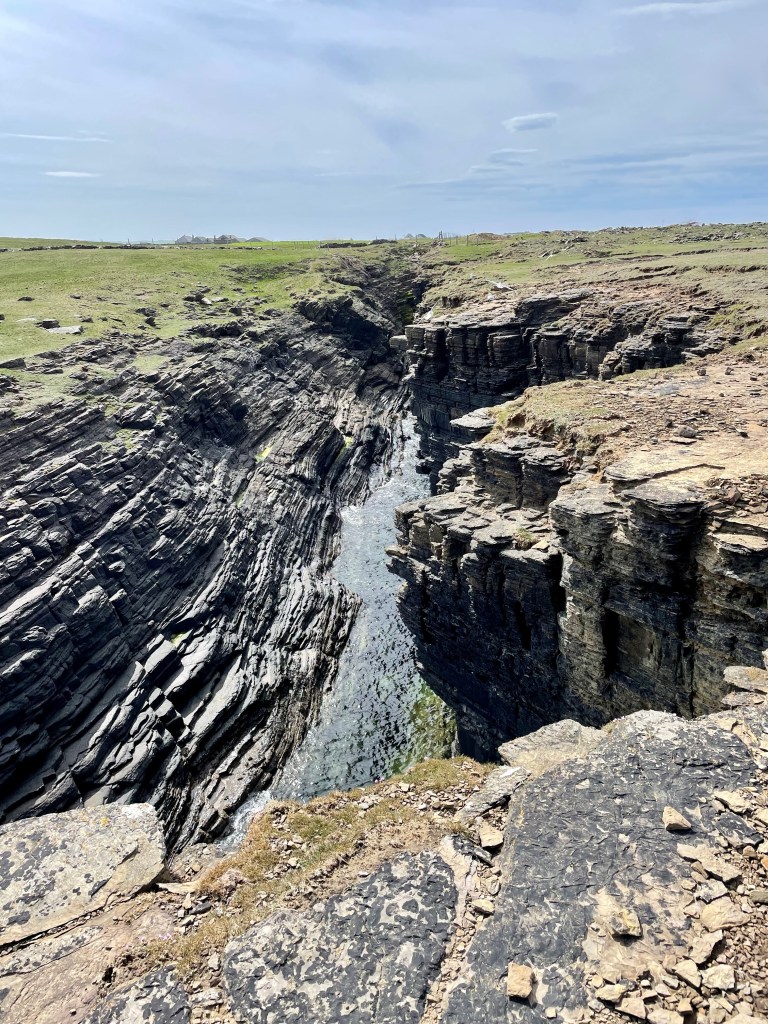
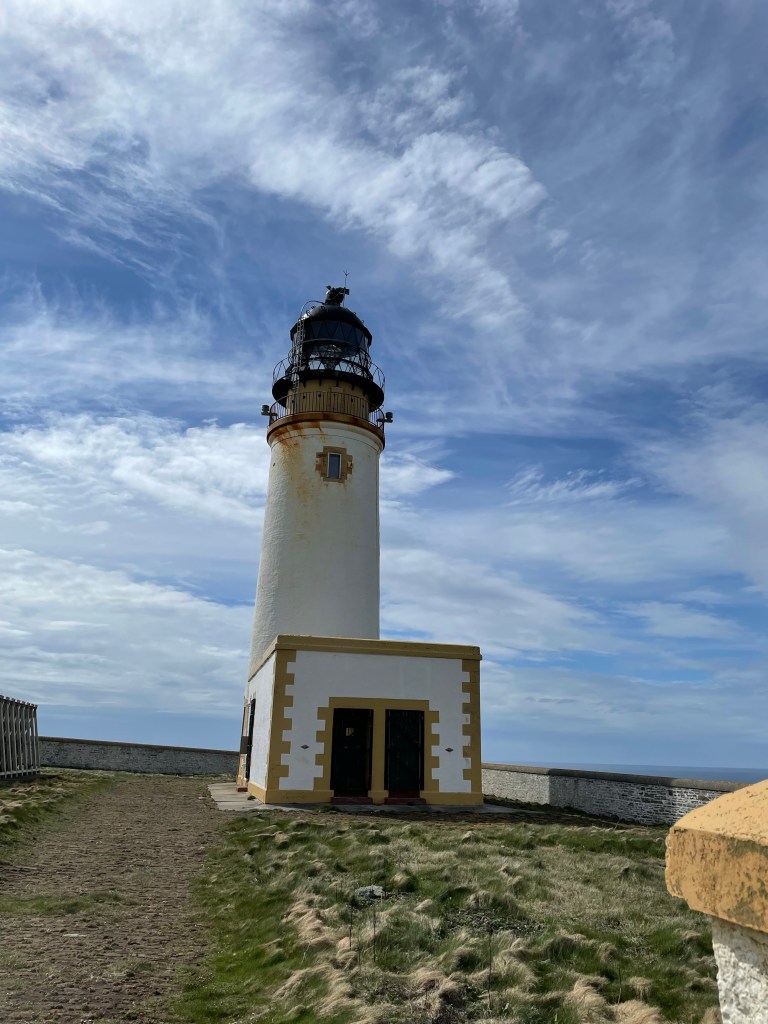
Duncansby Head Light House – the farthest northwesterly point of the mainlandDuncansby Stacks plus sheepDuncansby Stacks, no sheepThe End of the Road North no more.Wall to the sea.
The Eastern Highlands are gorgeous indeed and I apologize to everyone lucky enough to live there for stopping at a fair number of attractions listed in North Coast 500 brochures and snapping a photo. I can’t believe I am that person. At least Dougal is a small and not-fancy car.
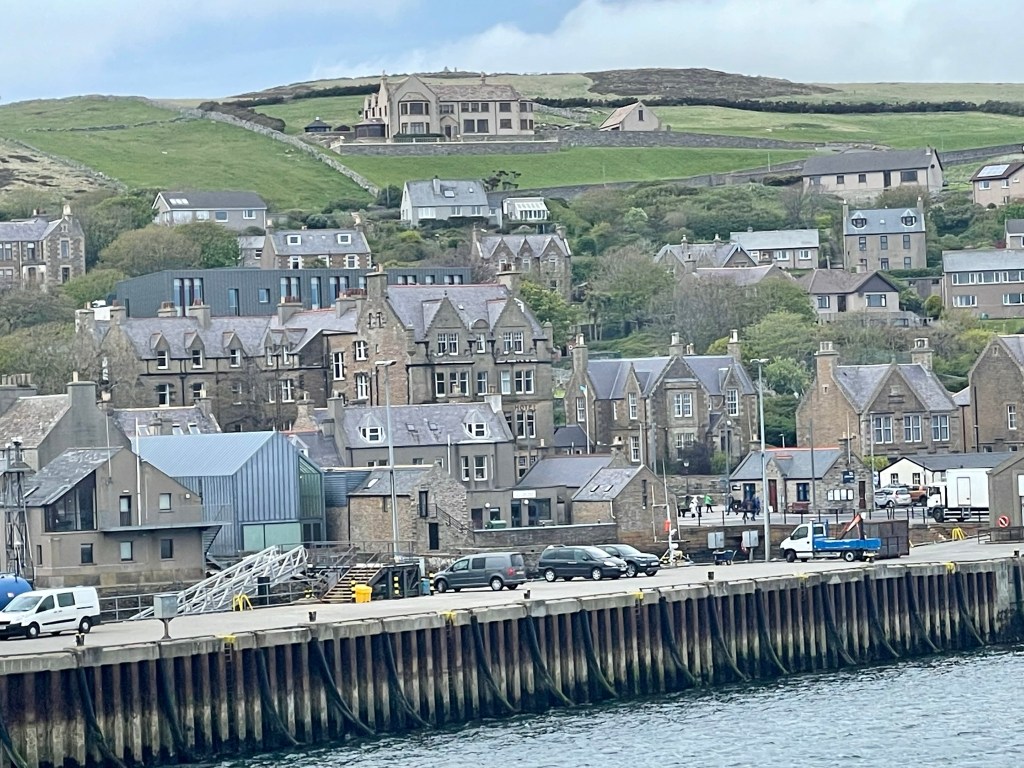
For now, it’s time for our adventure in Orkney. We are officially here in Stromness and ready for three hikes and one day-long guided tour, all planned through Macs Adventure.
Stromness
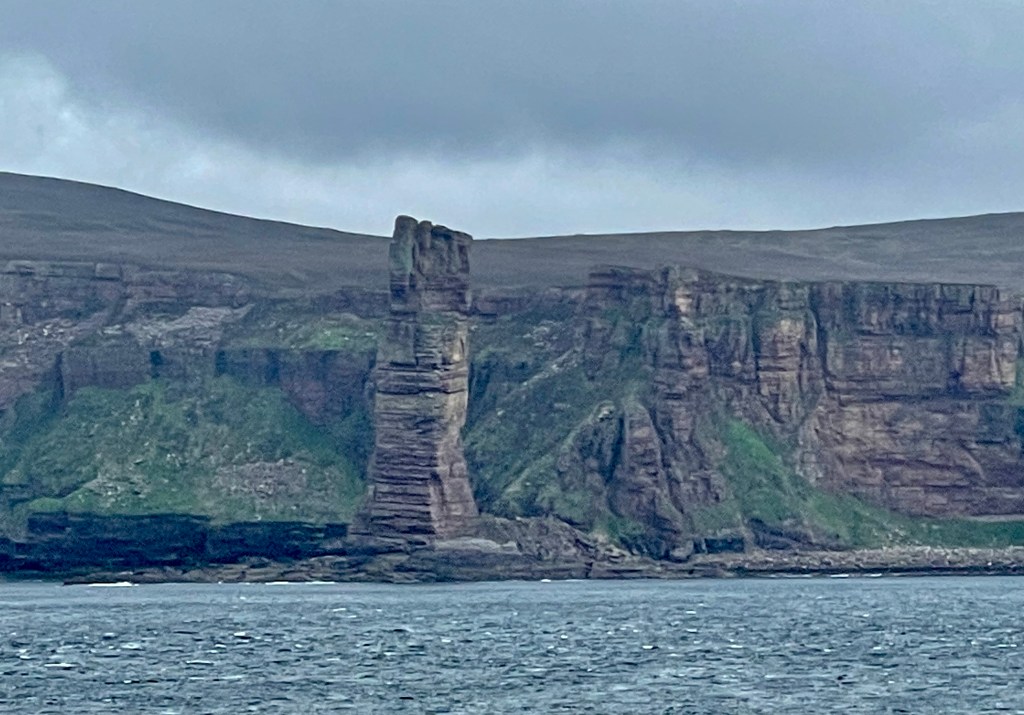
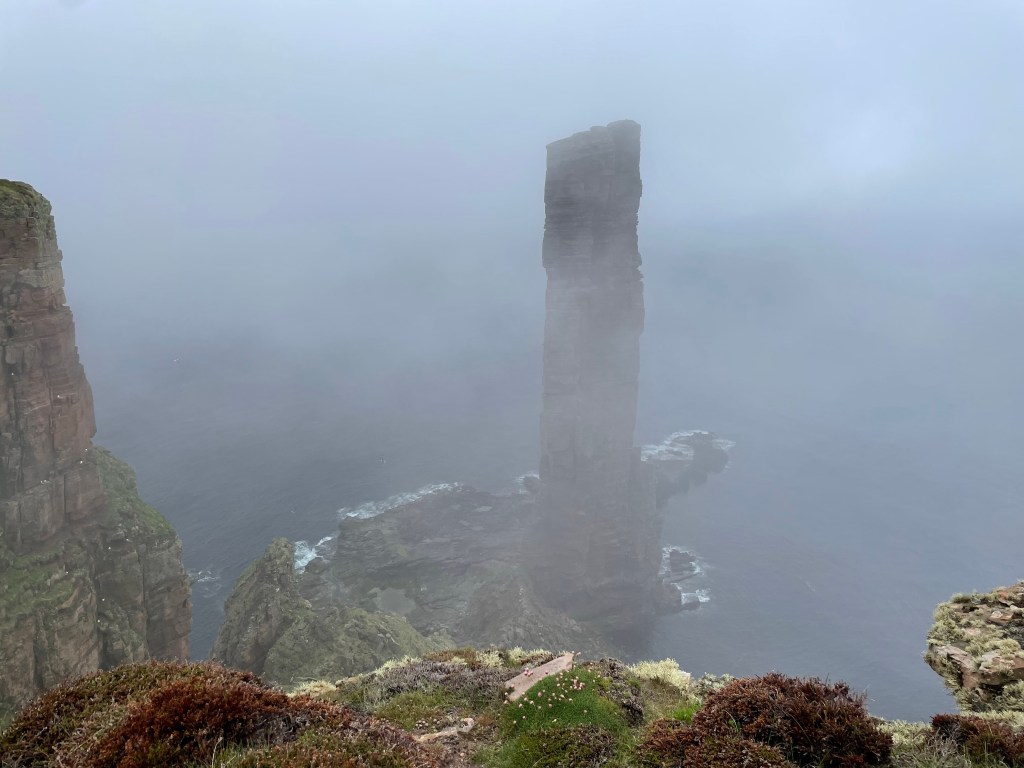
I’ll leave you with the Old Man of Hoy, which we’ll see tomorrow, lord willing and the creeks don’t rise, from land.
How this came out I have no idea as the wind was blowing so hard I could barely stand. Just look at his cute face.
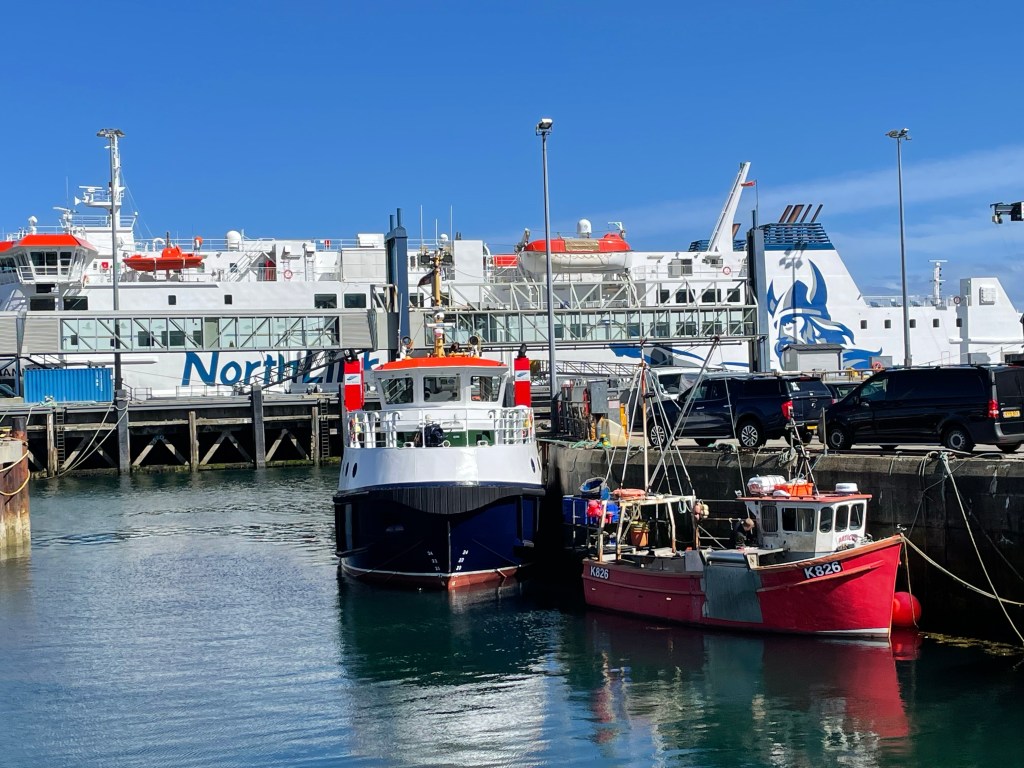
Giant serious ferry and wee inter-island ferry at Stromness pier.
As I write this a bunch of mostly blootered men are down in the hotel bar watching a football game. Panicky hyperventilating shrieks like the sound I imagine people make who are having all of their limbs slowly pulled off while being eaten alive by lions. In the States this would be irritating but I’m completely fine with it.
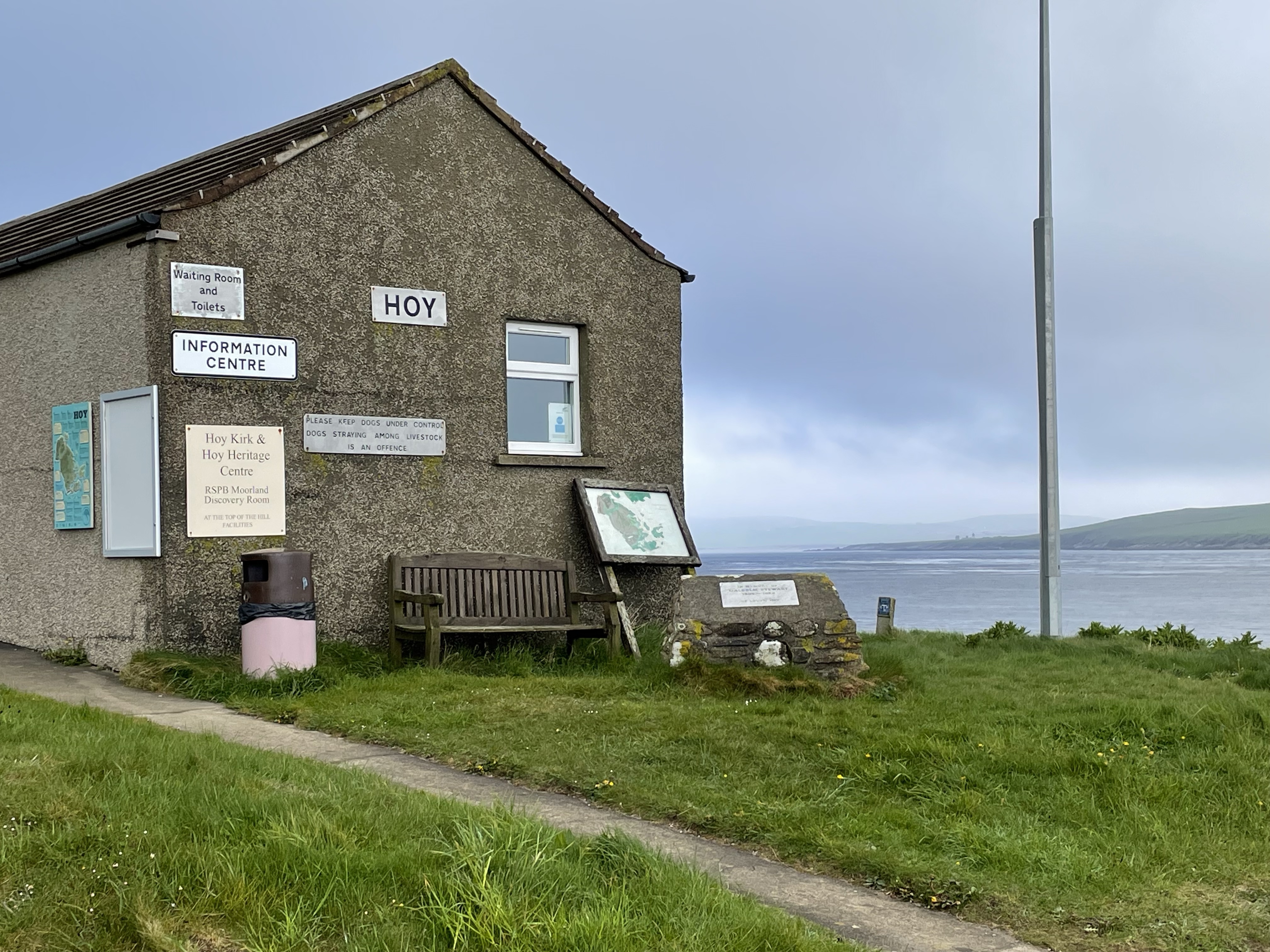
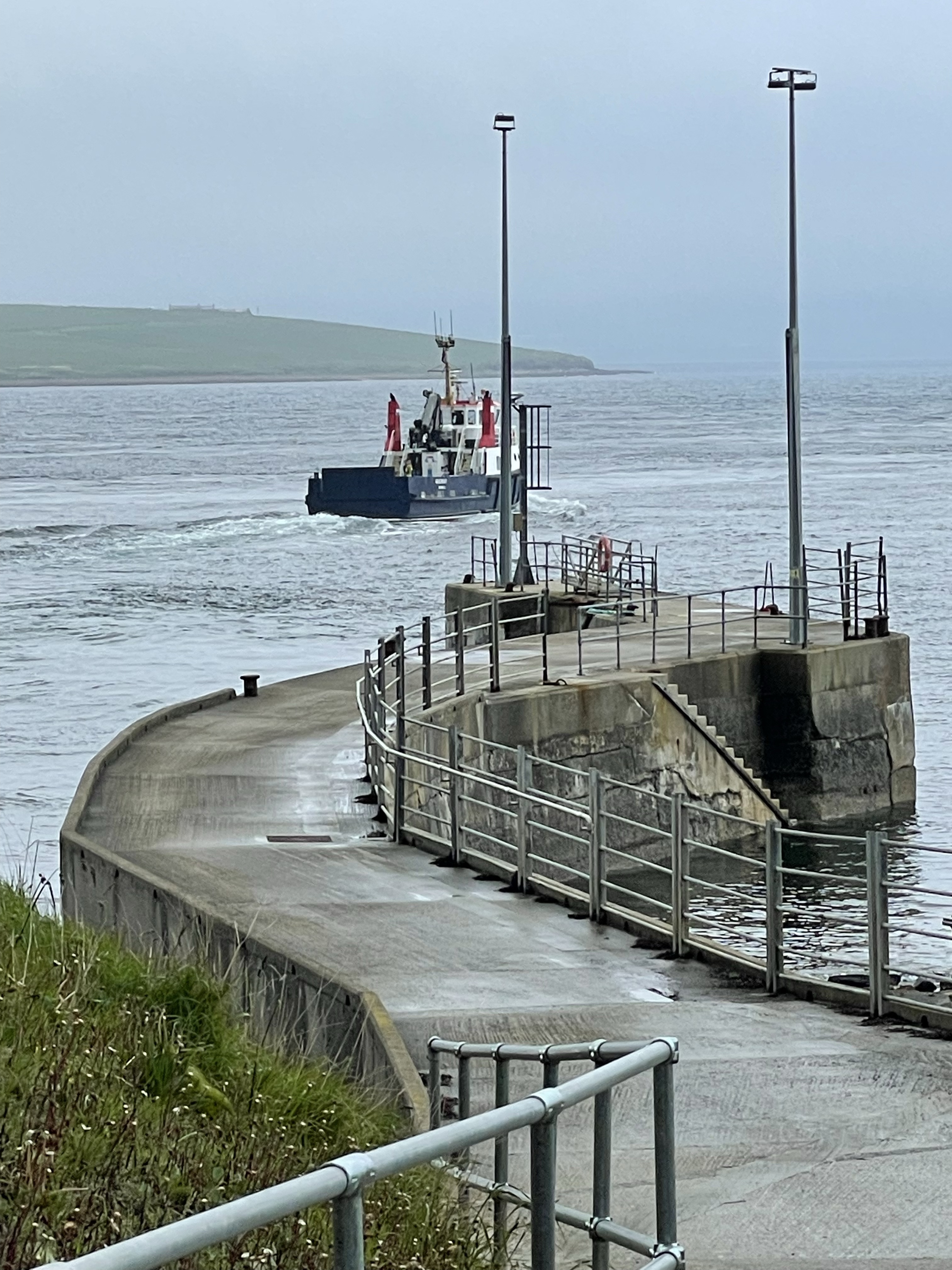
Our first hike on Orkney was to the Old Man of Hoy, one of the most spectacular seastacks in the world. He’s just off the Isle of Hoy (from the Norse “Haey” meaning high island) to which we took a tiny ferry that left at 6:30 am and dropped us off at a tiny terminal half an hour later. All the hikers on the boat, mostly older (than me) Brits plus one Aussie, took off across the island in varying directions for a day of walking.
We hiked 13 miles through rain, wind and fog with boggy conditions, slippery rocks and boot-sucking mud, all of it fabulous. We did enjoy a relatively brief period of sunny and warm weather on our way back and it was like we had been transported to an old western and were about to die of heat prostration with our bones picked clean by vultures. Don’t worry, though, chilly fogginess returned in time for our ferry ride back to Mainland, which is, by the way, what the main island is called, from the Norse “meginland.” Same deal goes for Shetland.
We first hiked through a valley with steep hills on both sides. The sun lightened things up a bit as we got closer to the sea.
Wanna see some weather? Volume on.
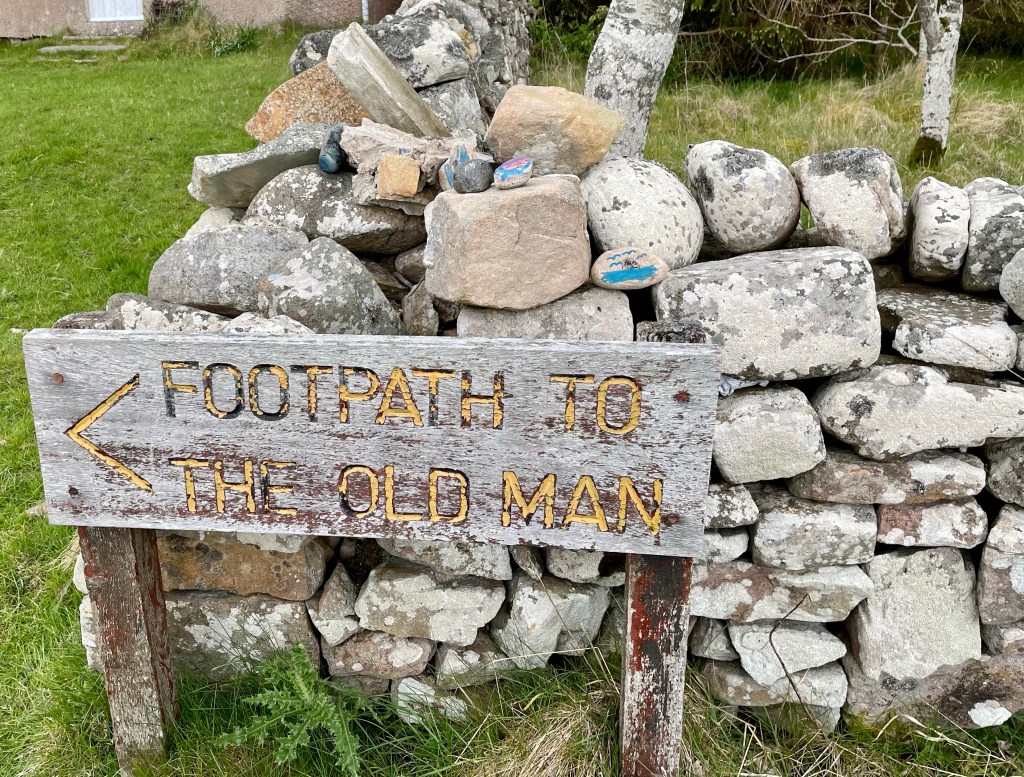
When we neared the small town of Rackwick we ducked behind someone’s house, passed through a couple of kissing gates, and started the upward climb to the fog-shrouded cliffs. As always in Scotland, colorful and weather-beaten signs marked the way, and we were even met with the iconic red phone booth, still standing but infested with flies, the phone having been removed long ago. If it was actually a back entrance to the Ministry of Magic and the flies were a protective spell, it completely worked.
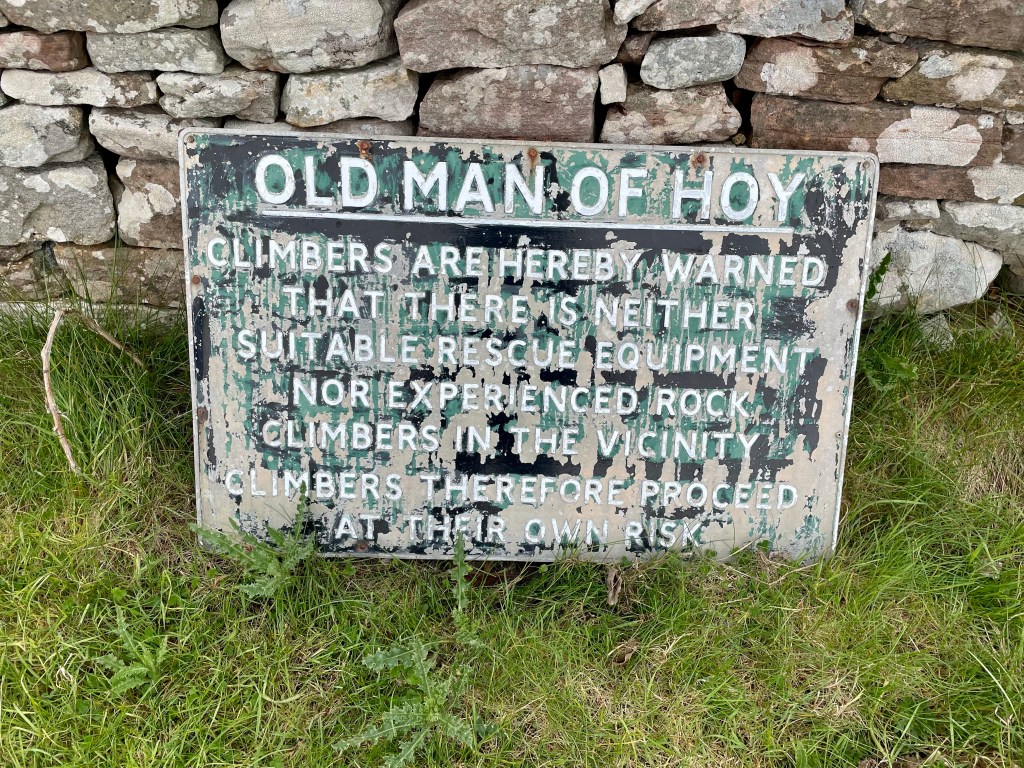
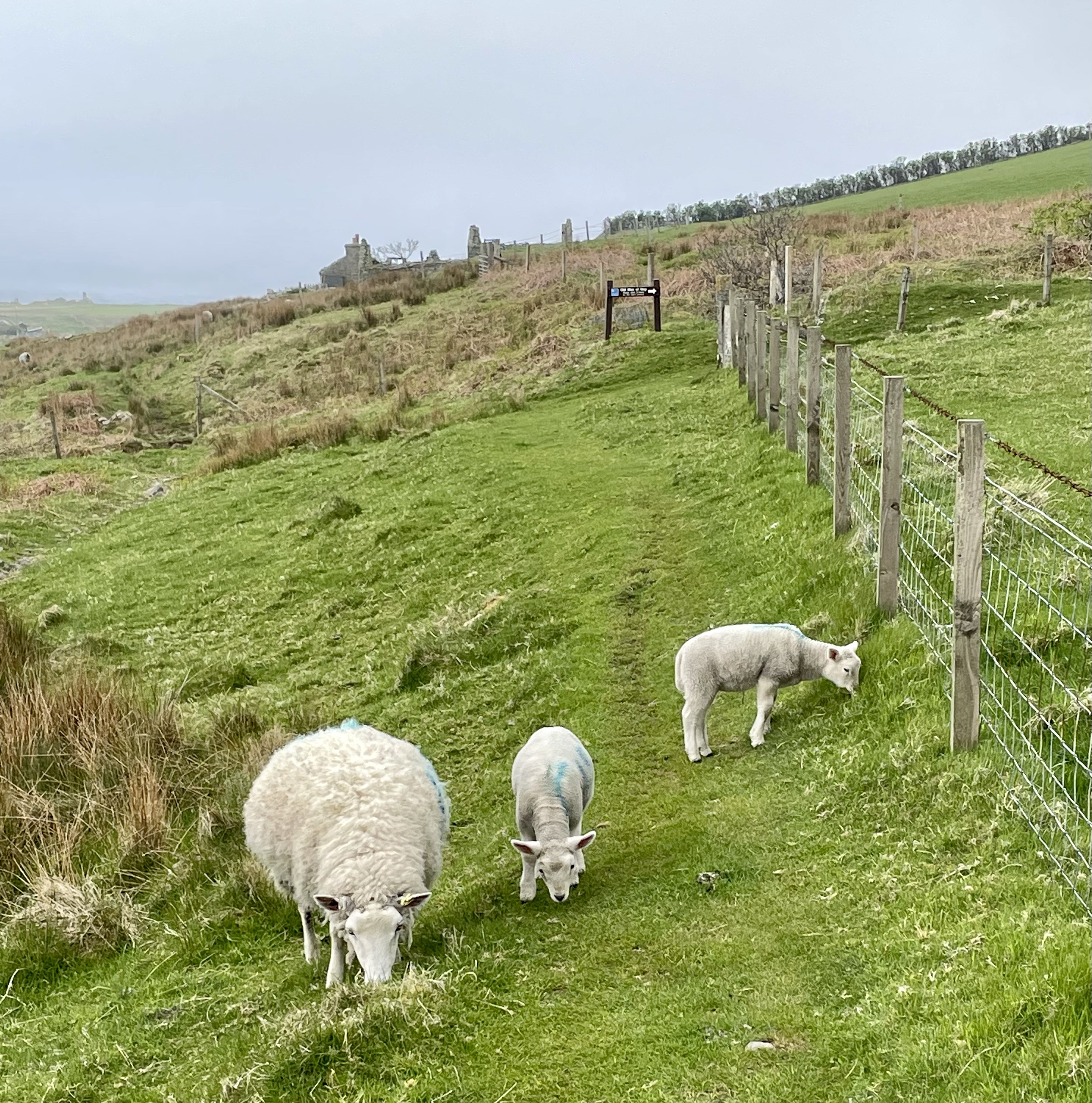
The Old Man is a climbing spot because people will climb anything. And clearly you are on your own.A sheep sampling.
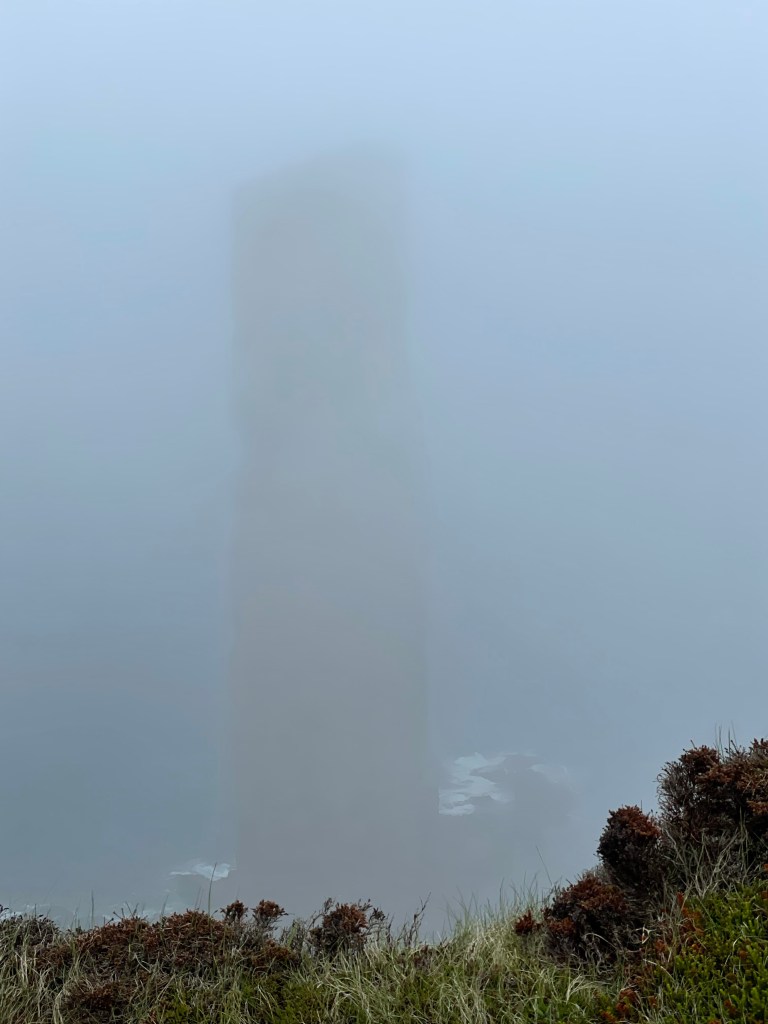
As we climbed, the wind howled and the fog rolled back in so we lost sight of the sea below (did I mention we were hiking on cliffs?). I very nearly lost my hat in all the blow. When we arrived at the long-awaited but entirely fogged in viewpoint, we waited patiently, watching all the sea birds nesting in the cliffs and eating lunch with hands that were cold and wet from our walk through clouds. All of the sudden a suggestion of an outline and then – there he was. What an entrance Old Man, what an entrance.
On the long road back, the sun.
The crinkly woman who served us breakfast every morning at the Royal Hotel had a few opinions about Hoy from the perspective of a Stromness native who has seen a few things. She announced to everyone in the room, with certitude and spot-on comic timing, “Oh, I suppose it’s nice and all but such a relief to get off it, though, aye?” and “I feel all a’ trembly when I’m there, it’s so depressin’,” and “It’s no place for women.” She speaks her mind about all the topics, and yet you can tell by the twinkle in her eye, the cock to her head and her appraising gaze that she’s still holding a few things back.
Our epic hike to the Old Man of Hoy now in the books, we have two more days of hiking plus a guided tour of Westray to look forward to during our time in Orkney.
One note – we learned that one must never say, “Orkney Islands” or “Orkneys” or “Shetland Islands” or “Isle of Skye.” It’s Orkney, Shetland and Skye, and the same can be said for all 700 of the Isles of Scotland. This mistake is as irritating to Islanders as it is to Oregonians when others pronounce our state Ore-GONE. Ugh.
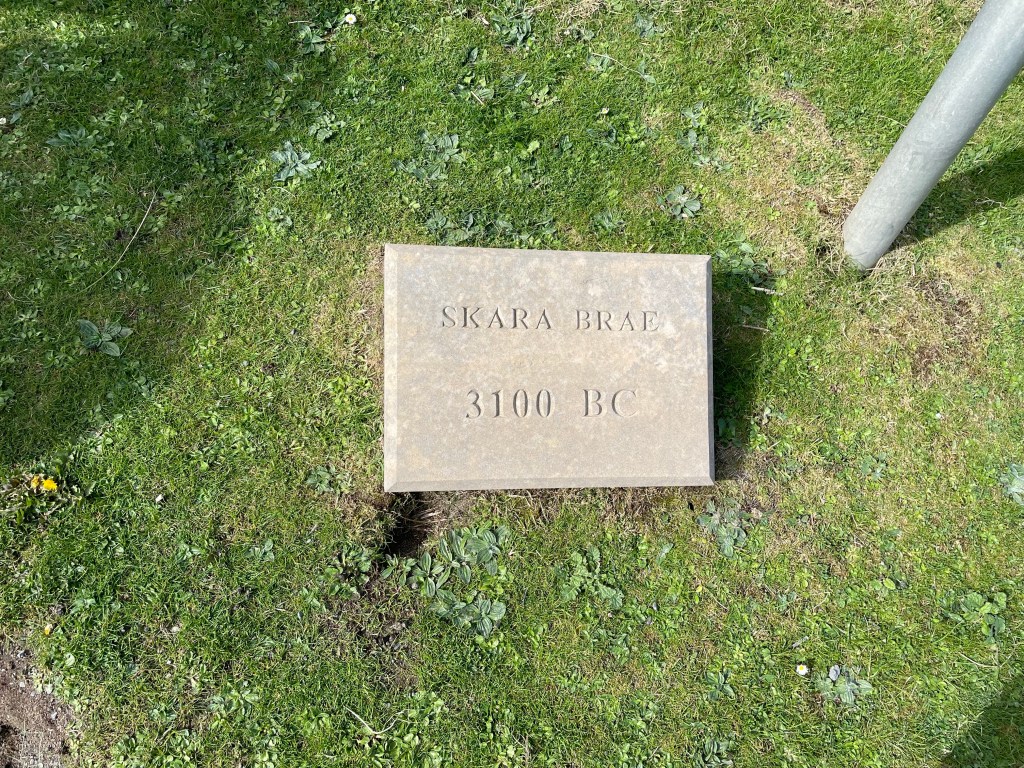
Our second day of hiking started at Skara Brae, magnificently preserved Neolithic ruins situated on a hill overlooking the Bay of Skaill. As we were en route, our cabbie Eddie told us that ancient Picts lived in harmony for thousands of years, not raising arms against anyone, “until my ancestors came over from Norway.” I accused him of being a Viking, which he completely acknowledged with a tinge of pride. When asked whether he’d lived his entire life in Orkney, he answered, “not yet.” By this time he was obviously our favorite. As he dropped us off, he intoned, “Welcome to 6,000 years ago.”
This seems like an unfathomable period of time, so to provide context, as you walk out to the ruins there are cleverly placed stones marking the progress of history such as the building of Stonehenge, the construction of the pyramids of Giza, the birth of Christ and the fall of Rome. Skara Brae was built and inhabited eons before all of these familiar markers of “ancient” history.
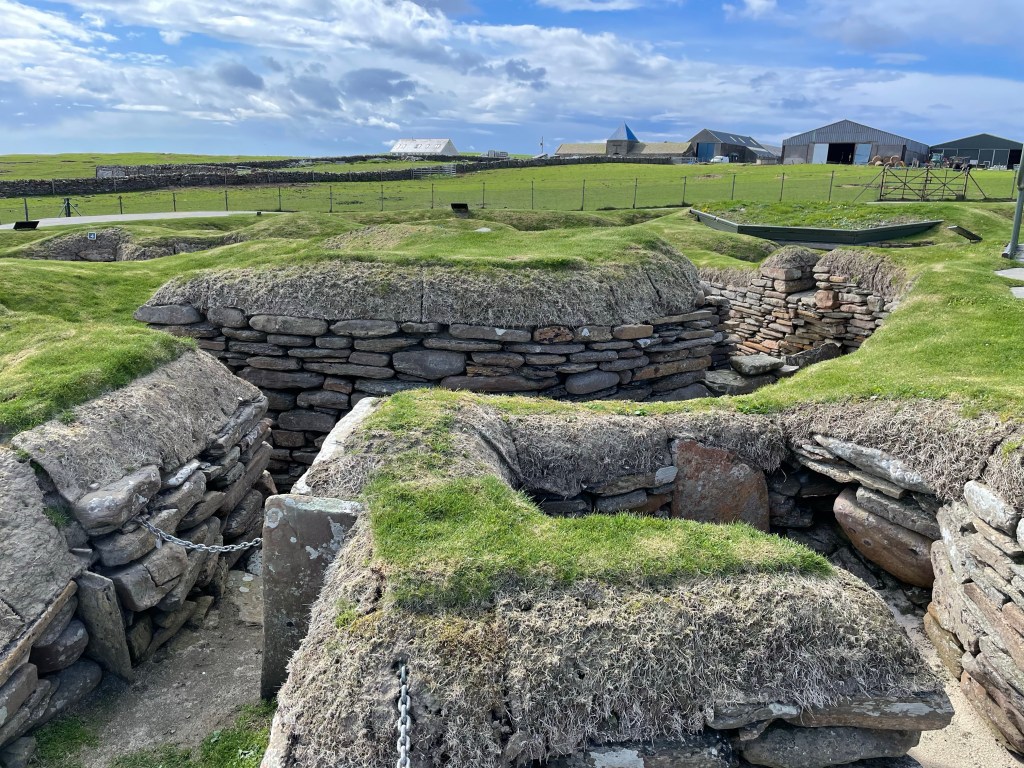
The ruin itself consists of ten clustered houses with stone hearths, beds and cupboards. There’s even a primitive sewage system, so, you know, I could have lived there. The site was occupied from 3180 BC through 2500 BC and it is Europe’s most complete Neolithic village.
The ruins were discovered in 1850 when a giant storm literally stripped the earth from the knoll, exposing the outline of the village. Incredible artifacts were discovered, including beautiful beaded necklaces fashioned from animal teeth or bone.
Lovely spot for a village.Neolithic Feng Shui
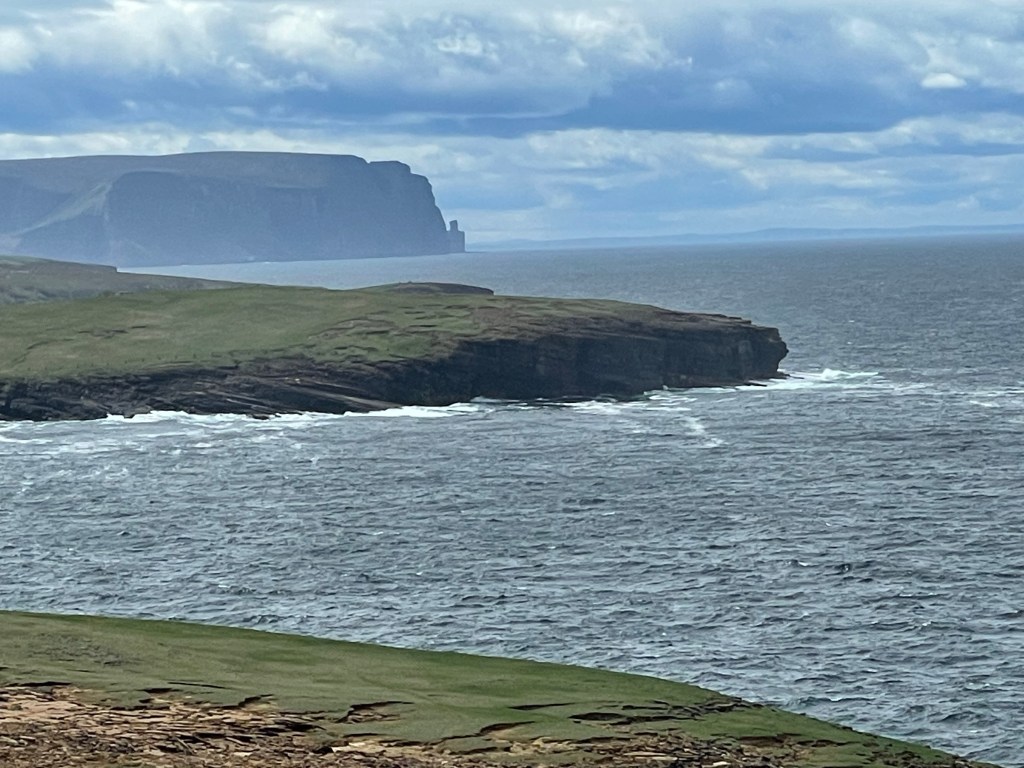
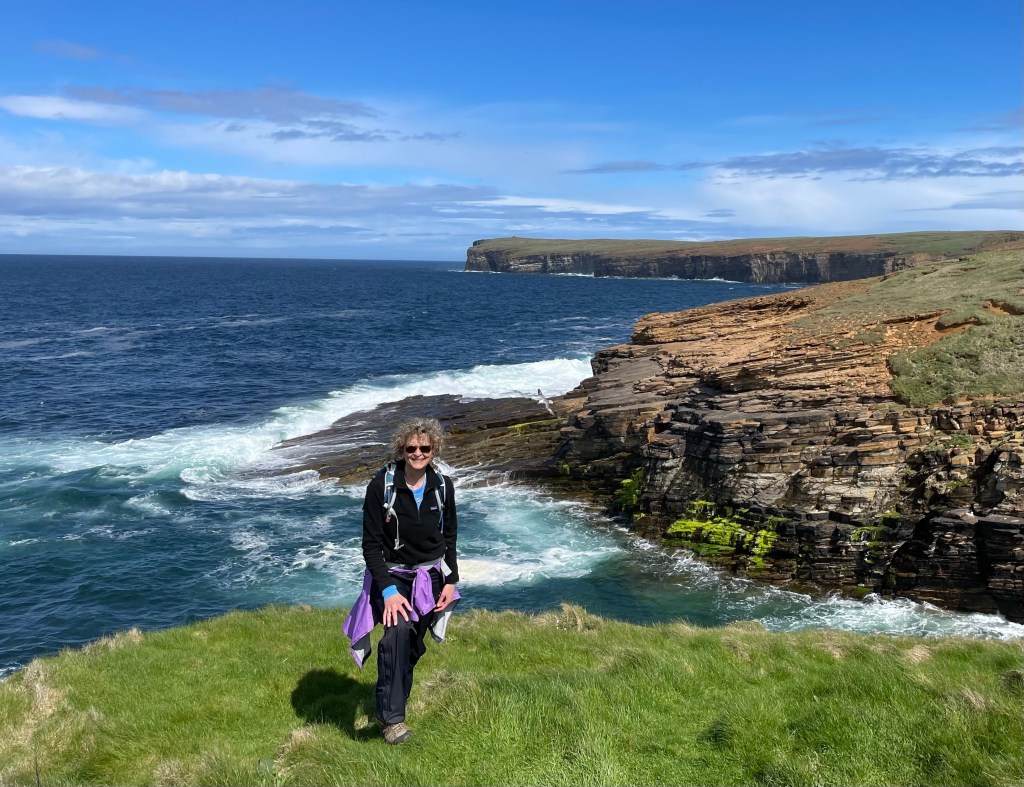
From the ruins, we joined the West Coast trail, which follows the Mainland coast all the way back to Stromness. The views were insane, the sea was azure blue, and there were more ruins along the way.
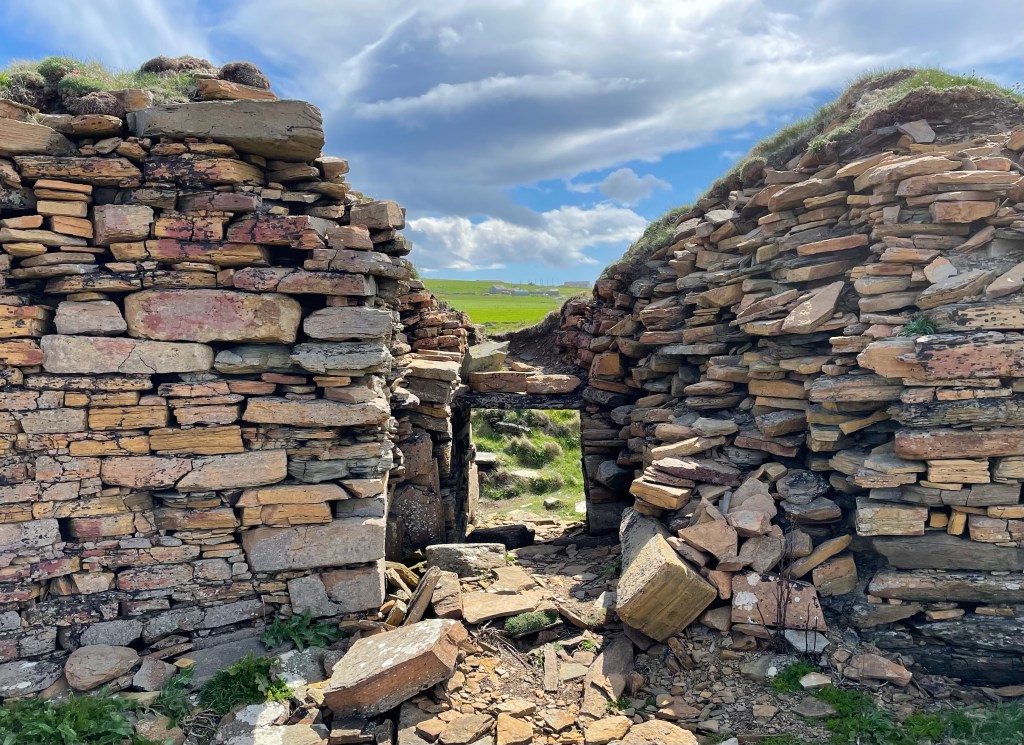
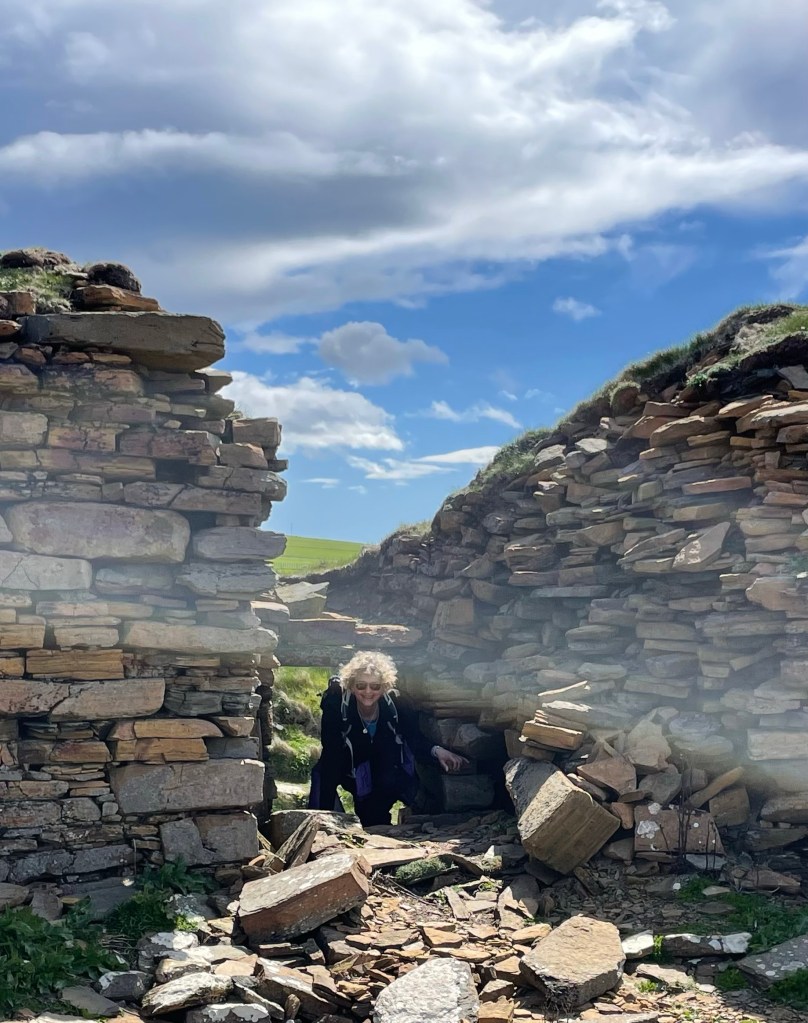
The little knob on the far island is the Old Man of Hoy. He’s always nearby.The Broch of Borwick, circa 500 BC, excavated in 1881. Someone’s wee seaside cottage back in the day.For scale. Just insane views.Scotland rocking the sea stacks.
Just as we ended our walk, the weather changed from gorgeous to blustery – as is its wont.
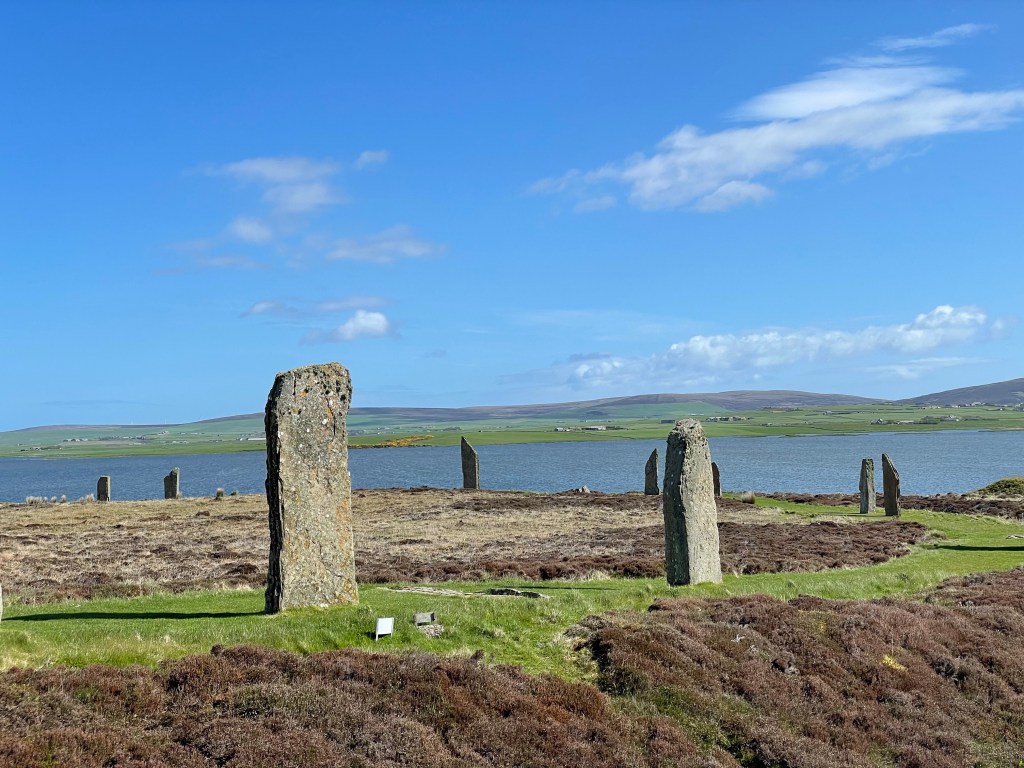
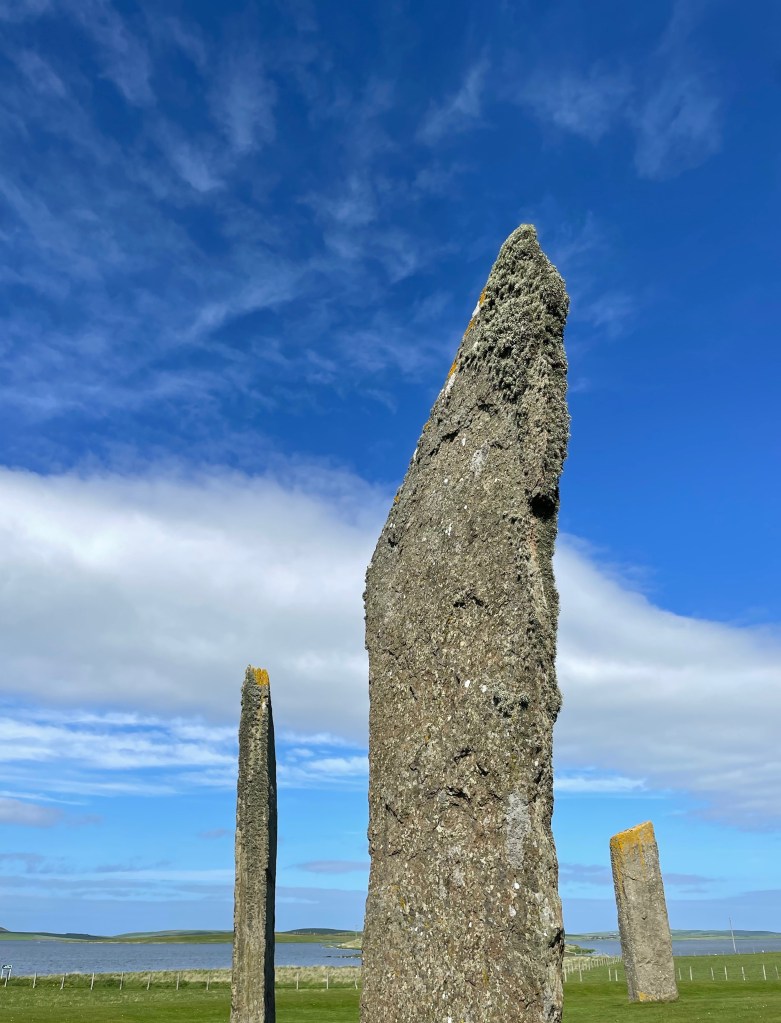
The next day we continued our passage through days of yore by hiking between two stone circles very near Skara Brae – and possibly used by its residents. As with Stonehenge, nobody really knows for certain exactly how they were incorporated into the life of the community, although theories abound. You’ve heard them all. The Ring of Brodgar was likely constructed between 2600 and 2400 BC and the Stones of Stenness, which are considered to be the oldest henge in Britain, around 3100 BC.
The Ring of Brodgar was originally comprised of 60 stones, with 36 surviving today, still a startling sight. The Stones of Stenness originally had 12 upright stones with only four surviving. My favorite was the Ring of Brodgar.
It’s miraculous really, that so many of the stones have survived for many thousands of years. Imagine! Of course, through the passage of time, random people have interrupted the flow of magic, as they do. The most heartbreaking tale was that which befell the Odin Stone. This fabulously named stone stood near Stenness Circle. Thought to have been erected around 3000 BC, it stood about 8 feet high and had a shoulder-high hole through which couples would clasp hands to provisionally marry one another until they could find a priest somewhere. Isn’t that lovely? Well, of course it is. However, in 1814 a silly man who leased the land upon which the stones stood found himself irritated by people tramping about amongst them. So he destroyed Odin’s Stone as well as a few others. Not stoked, the native Orcadians tried to burn his house down. Twice.
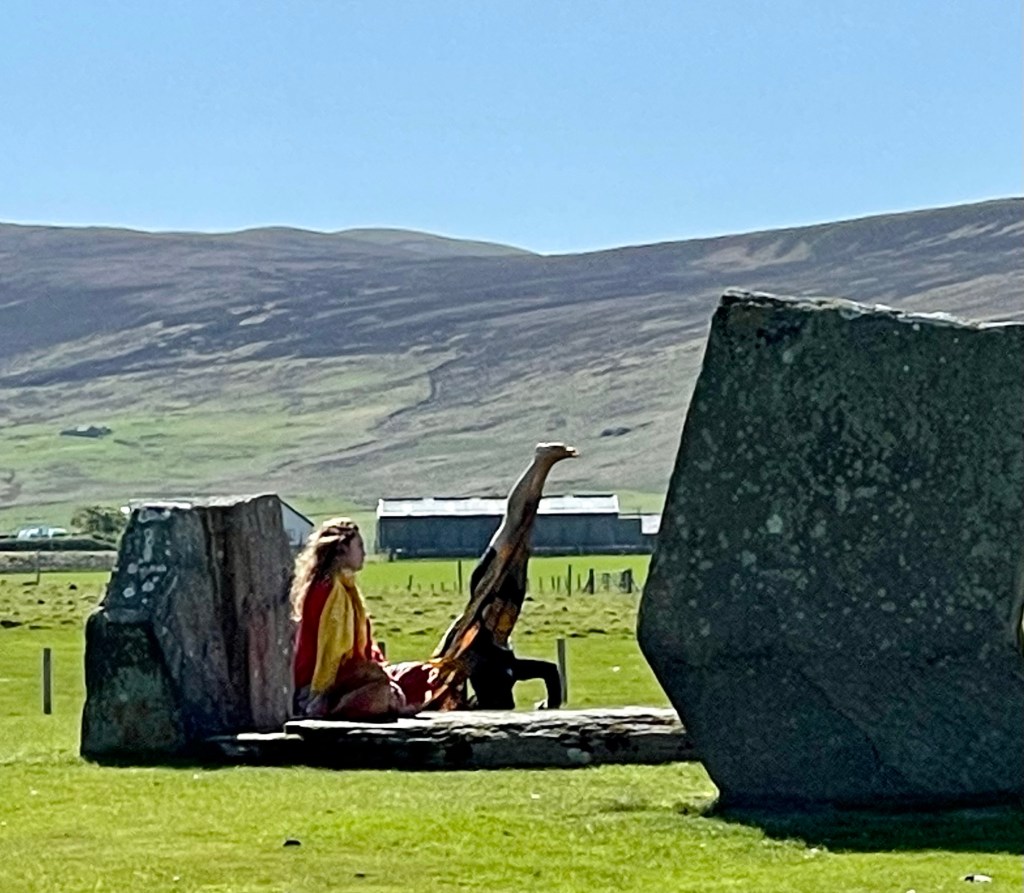
Another heartbreaking and irritating tale is the co-opting of ancient stone henges by weird barefoot hippies. We saw a pair of them during our visit to the Stenness Stones. They walked around with their eyes closed and tie-dyed garments flowing, demonstrating to all that they inhabited much higher planes of consciousness than the rest of us. Barefoot, likely days from their last shower, probably not vaccinated. They ostentatiously perched on the stones (leaving only two for others to photograph) communing with ancient spirits (I guess) and basically making horses’ patooties of themselves. Literally the dude did a headstand like an idiot. Obviously I had to take photos because – isn’t that what they want? To be noticed by lowly beings who are dazzled by their higher vibrational states and inspired by their oneness with the ancient spirits of the stones? You see, what appears to be a disrespectful act is actually the physical manifestation of advanced astral powers beyond our comprehension. I’ll stop now, but I mean seriously, the absolute worst. I suppose we should be grateful that they weren’t naked.
Ew. Fell over twice before pulling off this pathetic excuse for a headstand.Hippie-free Stones
Cabbie Eddie, when Danielle told him of these shenanigans, said that these stones had nothing to do with yoga or “flower power” but instead represented the deepest beliefs of ancient peoples. He said that if you cut open the earth – or your arm – you see stone and bone covered with layers of strata, whether it is skin and muscle or earth and ruins of civilizations. This ephemeral strata comes and go while earth and bone endure and thus are deemed significant and worthy of reverence.
Before we leave Stromness for Kirkwall, here are a few photos of a simply lovely town.
The Ferry Inn – the only restaurant in Stromness currently open for dinner. (Thanks COVID). Luckily it’s smashing and we enjoyed it all three nights.Our hotel just down the way – the Royal.Captain Cook! An Oregon connection.Black cat yellow door.
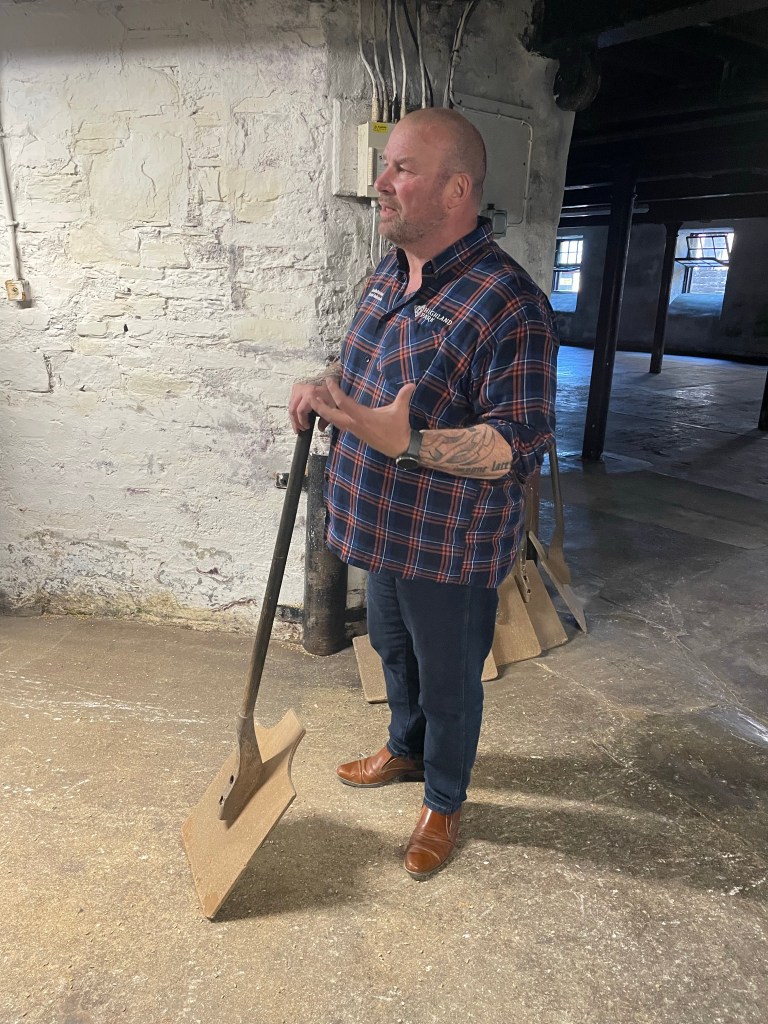
From the sublime to the whisky, I arranged a tour of Highland Park Distillery for the afternoon. I was ushered into a room with the guide and probably ten guys all standing in a circle. Some Danes, some Swedes and a Brit. The Danes had matching polo shirts with a “Prisoners of Whisky” logo which seemed rather melodramatic. I later learned it signified a posh Danish whisky appreciation group. They barely acknowledged my entrance (what?!?!) so I was determined to make them all love me and respect my whisky knowledge by the end of the tour. Spoiler alert: they did.
The guide told us of an incident that occurred a few days prior where a lorry driver who had attached a caravan to his roof drove under pipes that ran across the road and damaged them irreparably. He told us with a deeply exhausted expression that Highland Park won’t be able to resume normal operations until September. They are gradually emptying out all the washbacks, mash tuns and stills. Yikes.
Even in the face of this troubling news, the tour was fascinating as they always are. I learned that when there is the occasional “off” barrel of whisky (it happens), the contents aren’t poured down the drain because whisky has to stay in Scotland and god knows where it could end up. Rather, the bad stuff is distilled to almost 100% alcohol and sold to France for use in the making of perfume. French perfume made from bad scotch. C’est parfait.
After the tour we decamped to a lovely tasting room to have wee drams of the special edition Highland Park whiskies named after Norse gods Thor, Loki, Odin and Freya. Each dram was meant to represent the essence of its namesake god. All were cask strength and Thor was the best. I think because there were special Danes in attendance and the tour guide was also Danish, he busted out a 1968 bottle currently going for £ 5,000. It was good, yes, but in my estimation Thor prevailed. An old whisky is not necessarily the best whisky, it’s just the most expensive.
The guide told us of a time a beer company in Norway sued Highland Park because they had a beer named Thor and they thought people might be confused. This is a stretch of a legal argument even for our litigious country. Since Highland Park is owned by the same company that owns Macallan and others, their lawyers are pretty heavy duty compared to those of the small Norse brewery. Everyone got together in a room and agreed to settle if Highland Park gave each of the lawyers on the other side, and the brewery owners, a few bottles of the very rare Thor. Case dismissed.
Everyone was presented with a framed certificate with their name on it at the end of the tasting. It will be displayed next to my law school diploma.
Highland Park Tasting Room
In my cab ride home, I asked the driver what he thought the weather was going to be the next day for our trip to Westray. He said, “I’ve lived in Orkney for forty years. When it rains, it’s raining. If the sun is out, it’s sunny.” Alrighty then.
The best thing about traveling is chance encounters with fellow travelers, and meeting people lucky enough to live in the places where you have chosen to vacation. Interestingly, we’ve continued to encounter mostly other Brits, Norwegians and a few French. No Americans. Also the general age range has skewed older – many intrepid folks in their 70s and beyond, walking and biking through the Isles.
On our last day of adventure in Orkney we took the very early ferry north to Westray, known as the Queen of the Isles. Westray is eleven miles long and has 600 residents (down from over a thousand in the 1800s) and boasts the shortest scheduled flight in the world, the longest golf hole in the UK and a castle ruin steeped in history. More seabirds than anywhere I’ve ever been with a boggling range of species. Including – oh yes – the MIGHTY PUFFIN.
We were met at the ferry by Karen and Andy Penn, who run Westraak Tours. If you ever find yourself in Westray, book them. Karen was born in Orkney and Andy is an “incomer,” having moved to the island from Dumfries when they married six years ago. We swung by a local B&B and picked up Angela and Peter, a couple from Cornwall, and headed to “coffee,” which ended up being in Karen and Andy’s home, a lovely surprise. We sat around their table and got acquainted, also meeting Andy’s son Callum, who is in his twenties and has autism. It was lovely chatting with him and sharing our names and places of origin. It wasn’t long before Angela shared with the group that Peter, a retired physician, was struggling with early stages of Alzheimers. It was quite touching how he relied on Angela to fill in gaps. He looked to her and said, “do that thing you do,” and she riffed through words to help him find the right one. They were lovely and delightful, up for anything, and all-around excellent traveling companions.
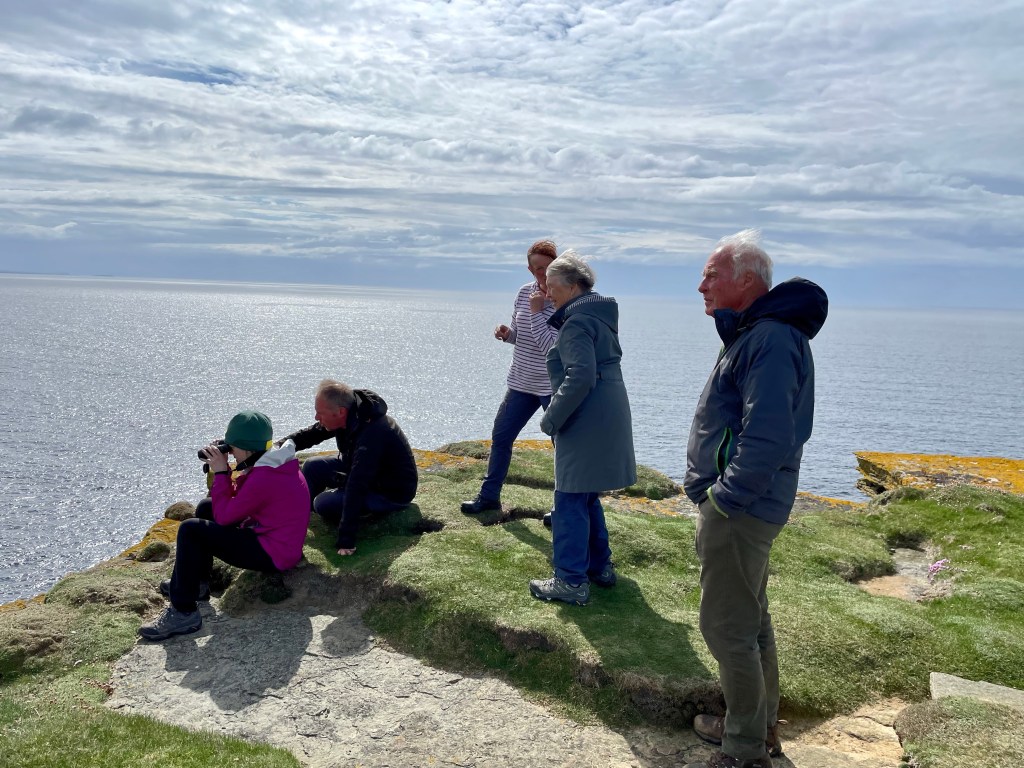
We left Callum with a shopping list for lunch, which would also be at Karen and Andy’s, and set off across the Island. Our first stop was a bird-nesting area along the coastal cliffs.
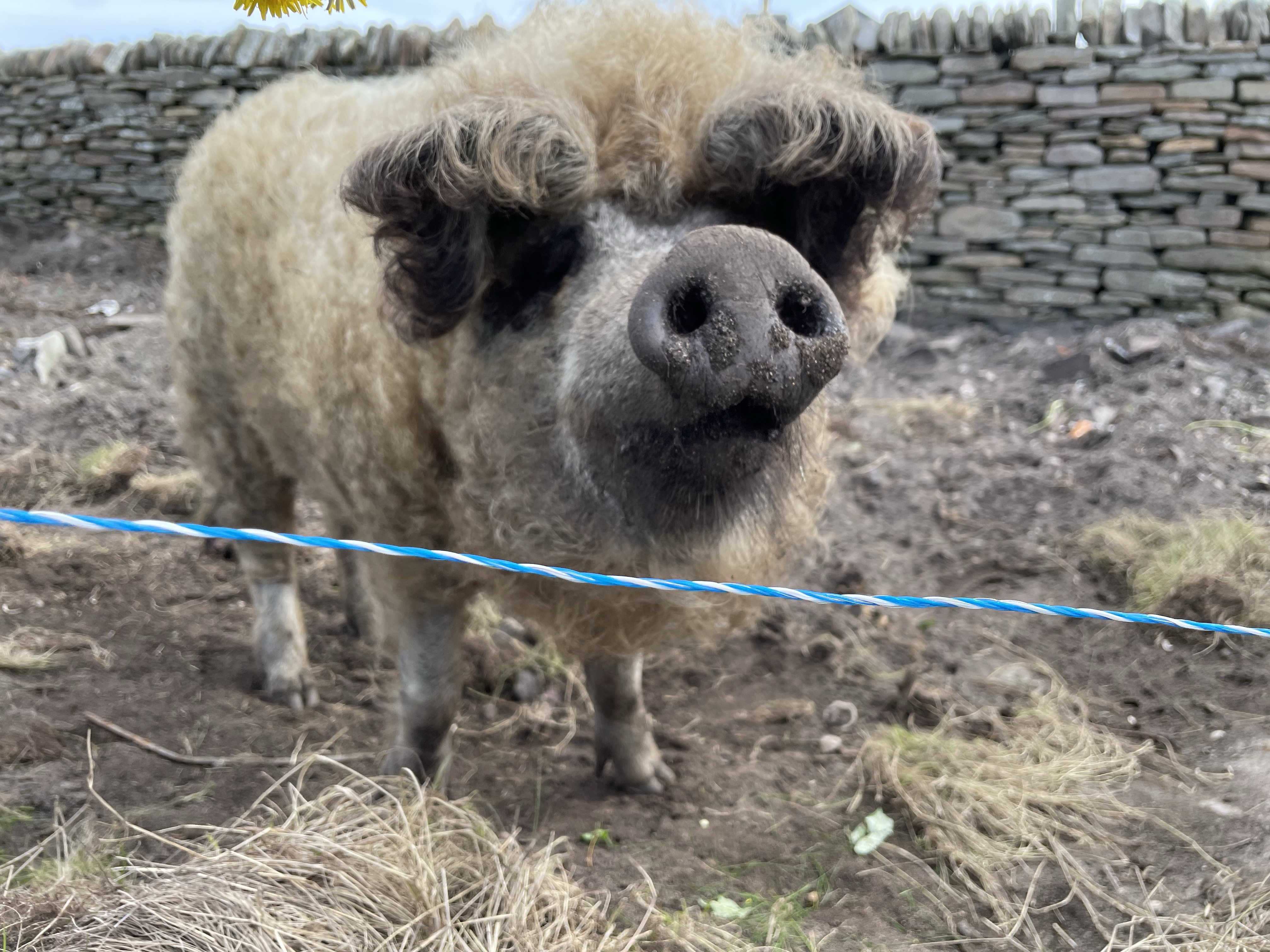
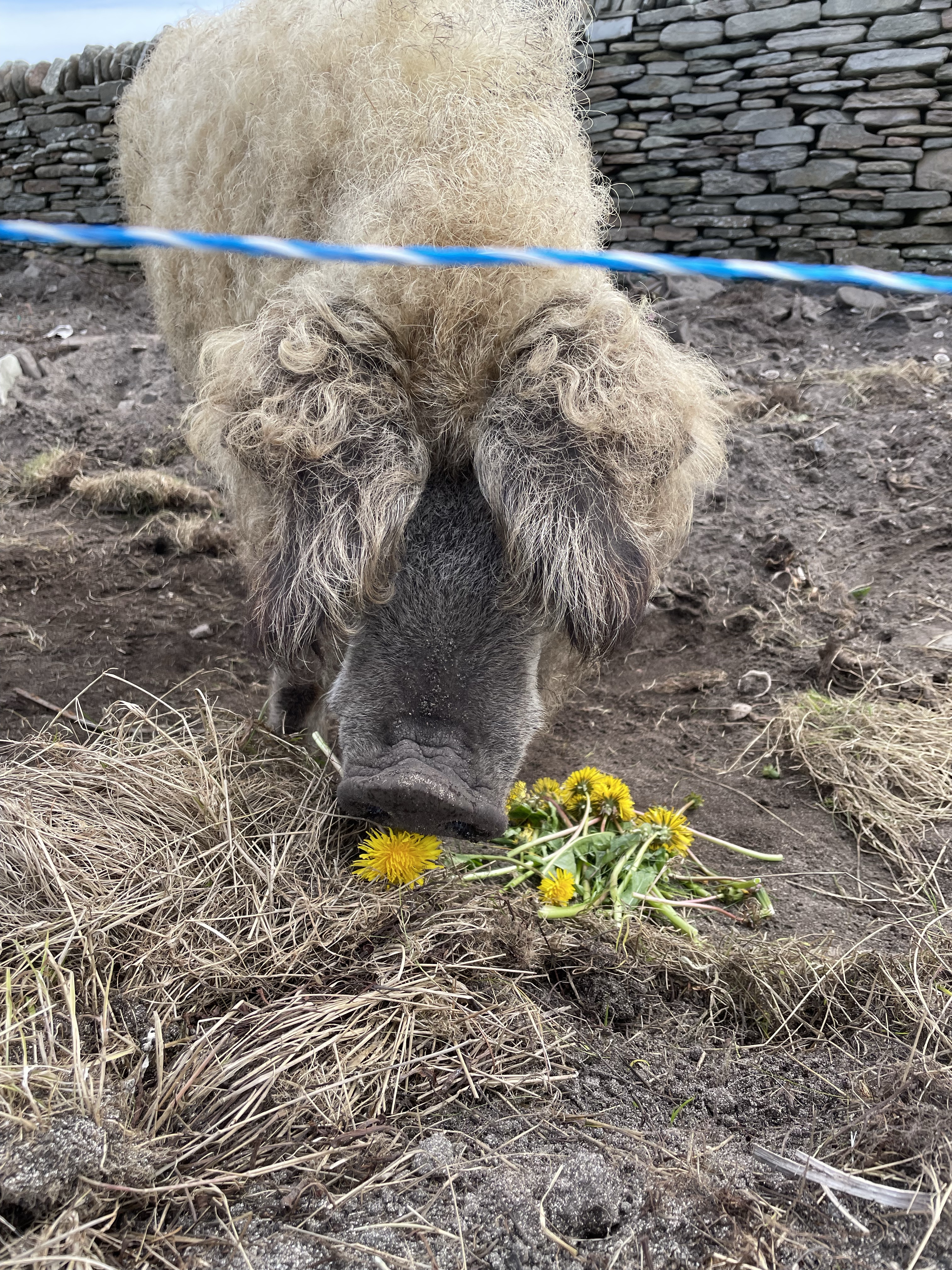
Next we headed to Quoygrew, the ruins of a Viking settlement. One of its longhouses had been excavated between 1997 and 2005. On the way, we met the charismatic Miss Piggy and fed her dandelions.
Quoygrew was a settlement of farmers and fishermen first inhabited in the 10th century and lived in as late as the 1930s.
Remains of Viking longhouse.
Our lunch at Karen and Andy’s was utterly delicious thanks to Callum’s successful shopping excursion. Karen made sweet potato soup, accompanied by egg salad from chickens just up the road, locally made cheese, locally caught and smoked mackerel, rhubarb compote and possibly the best sticky toffee pudding in the world. Lunch was accompanied by a very animated political discussion about Boris Johnson (“a dreadful buffoon”) the current Tory government (“corrupt to the bone”) anti-immigration British home secretary Priti Patel, whose family immigrated to the UK but would not be able to do so under current policy (“a terrible hypocrite” and also “appalling”) and of course Brexit (“a complete disaster”). Angela expressed admiration for the qualified and educated Labour Party leader, Keir Starmer, and wondered, “why wouldn’t people want this type of person to lead the country,” as opposed to Johnson, who won votes because he was “a laugh” and would be an entertaining pub date. Angela also talked of the ever-growing wealth discrepancy in the UK. It all sounded wearyingly familiar.
We next visited Noltland Castle which was the biggest surprise of the tour. On our way we drove by a golf course, which perked up Peter, an avid golfer. Andy said the course boasted the longest hole in the UK at 738 yards. It’s a par 6. Andy said he got a 7 once, but with the constant winds a 15 is more likely.
All the gun holes.
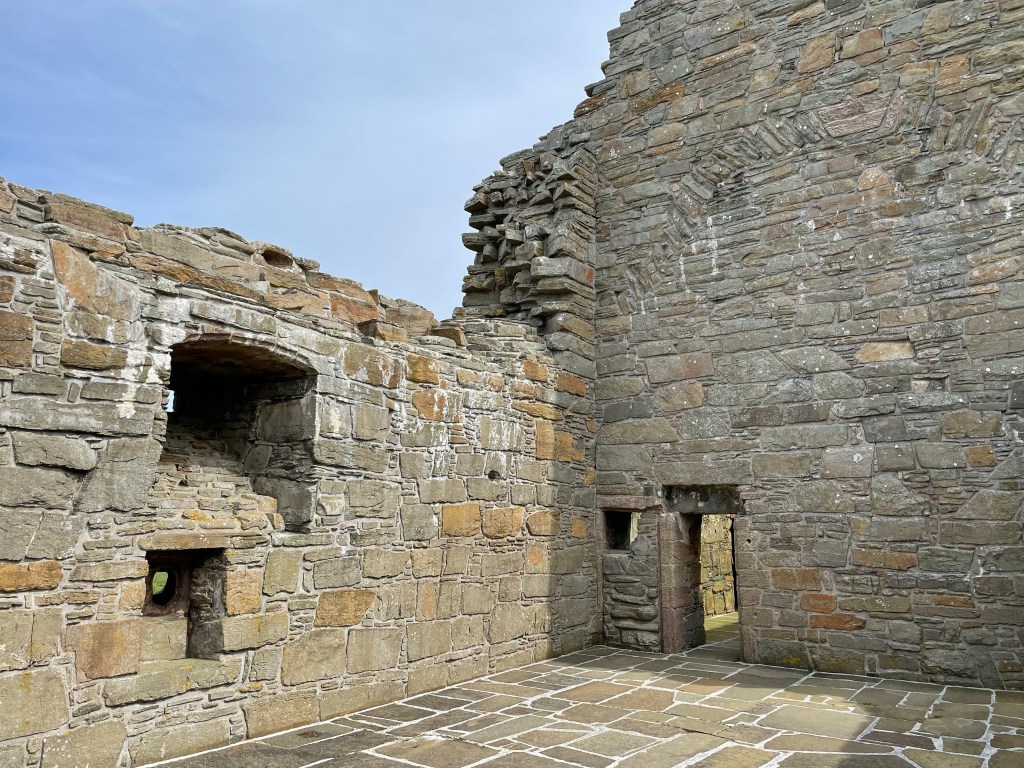
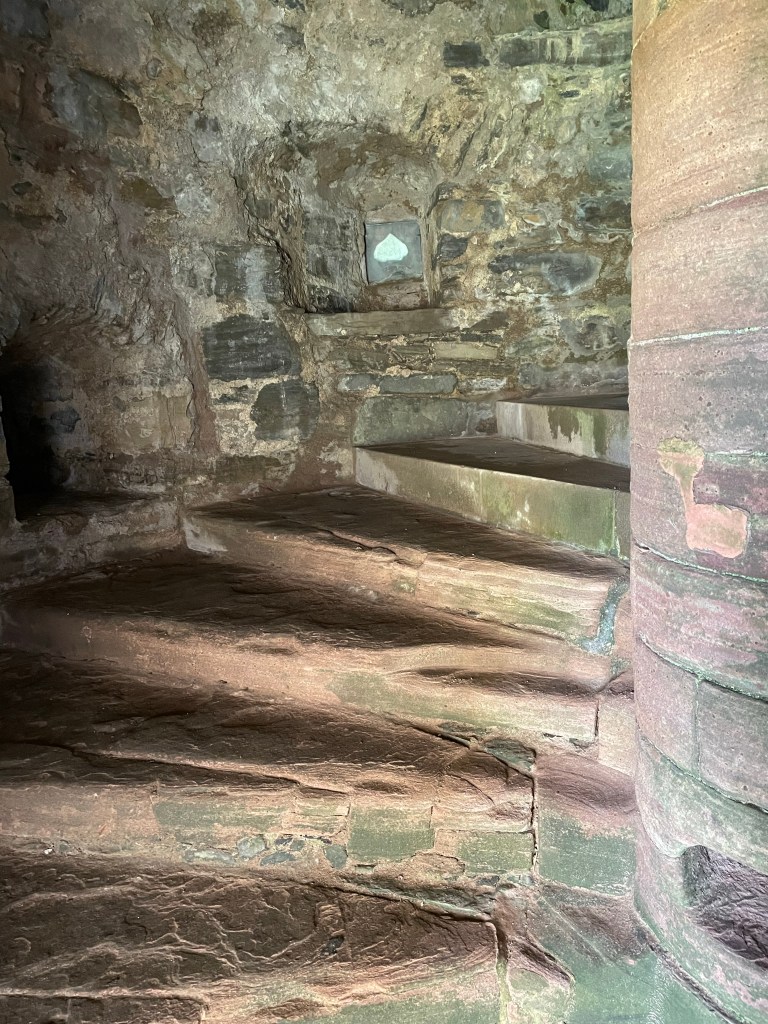
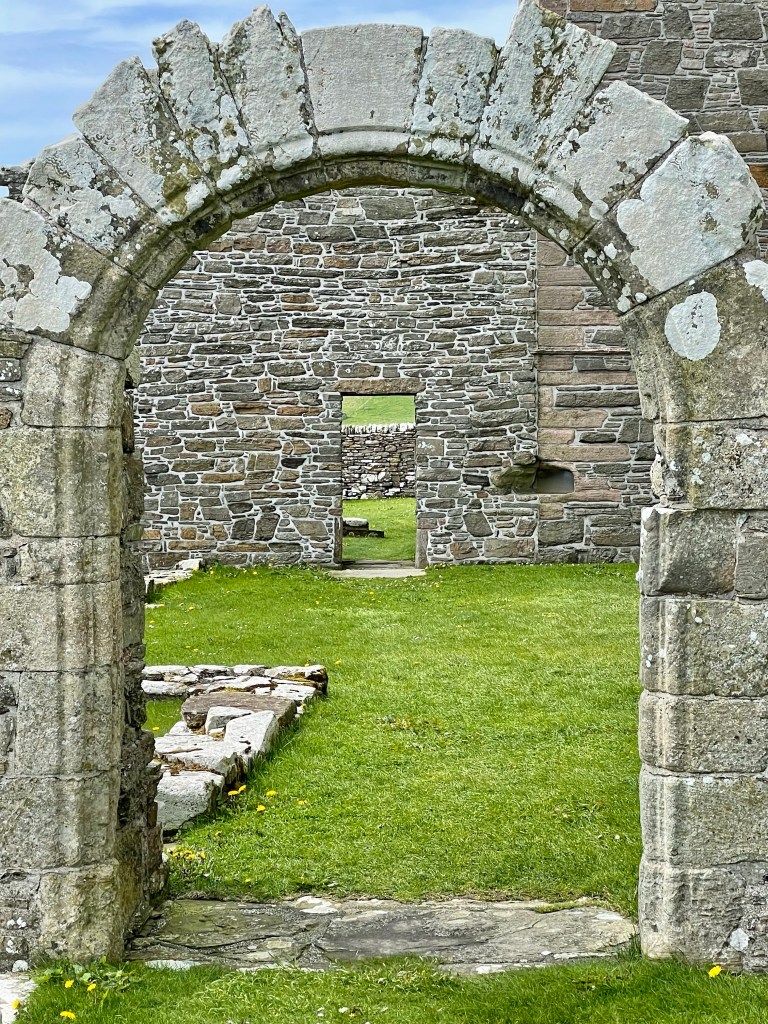
Noltland Castle was constructed in the 1500s, so a bit late in the game as far as castles go. It was built by Gilbert Balfour, who at the time owned Westray and Shapinsay, both given to him by his brother-in-law, the Bishop of Orkney. It’s odd because apparently he ran out of money or interest because he never finished the castle – the Great Hall remains open to the stars, even while Gilbert lived there. Maybe he blew his budget on the gorgeous spiral staircase, one of the UK’s grandest of the period. Roofs are kind of boring and expensive for sure – but handy to have in place nonetheless. The castle boasts an incredible 71 gun holes. There’s even one in the WC. Was Gilbert paranoid? Or were his fears justified because he moved through life cultivating mortal enemies wherever he went? You be the judge.
The acoustics are amazing, and the local Kirk holds concerts here.The never-roofed great hall.The spiral staircase.Castle grounds.
Balfour was the self-appointed Sheriff of Orkney, constable of Kirkwall Castle and master of Mary Queen of Scots’ household. Sounds good so far. But. He was also implicated in the murder of Cardinal Beaton at St. Andrews (mutilating his body and hanging it outside the window), after which he was captured by the French and condemned to be a navy galley slave for a few years. Fully not rehabilitated by that experience, he next helped murder Lord Darnley, Mary’s second husband, in Edinburgh.
You might be wondering why Mary didn’t dump Gilbert after he murdered her husband. The thing is she might have married Darnley mostly because he was also a Stuart and so would have given her a stronger claim to the English throne. Their son James did become James I of England, so that worked pretty well. Also, she had fallen in love with the Earl of Bothwell by that time and, who knows, perhaps she was in on the murder plot, as it was the only way to get rid of husbands back then.
Before Mary’s ultimate arrest, she was urged to flee to Noltland and some say that Gilbert was sweet on her and actually built the castle with her in mind. Sadly, she did not take this advice and was ultimately captured. You know the rest.
Balfour’s incurable habitual plotting continued apace, and he was implicated in the Mornay murder plot against King John III of Sweden. Karma finally caught up to him and he was executed in Stockholm.
Andy, Peter and Angela.
Next stop was Noup Head Lighthouse (one of over 200 built around the Scottish coastline). One family, the Stevensons, was responsible for designing all of Scotland’s lighthouses over a 150-year period – which explains why they all look alike. The lighthouses, not the Stephensons. The sole black sheep who rejected the family business in favor of a dodgy writing career was named Robert Louis Stevenson.
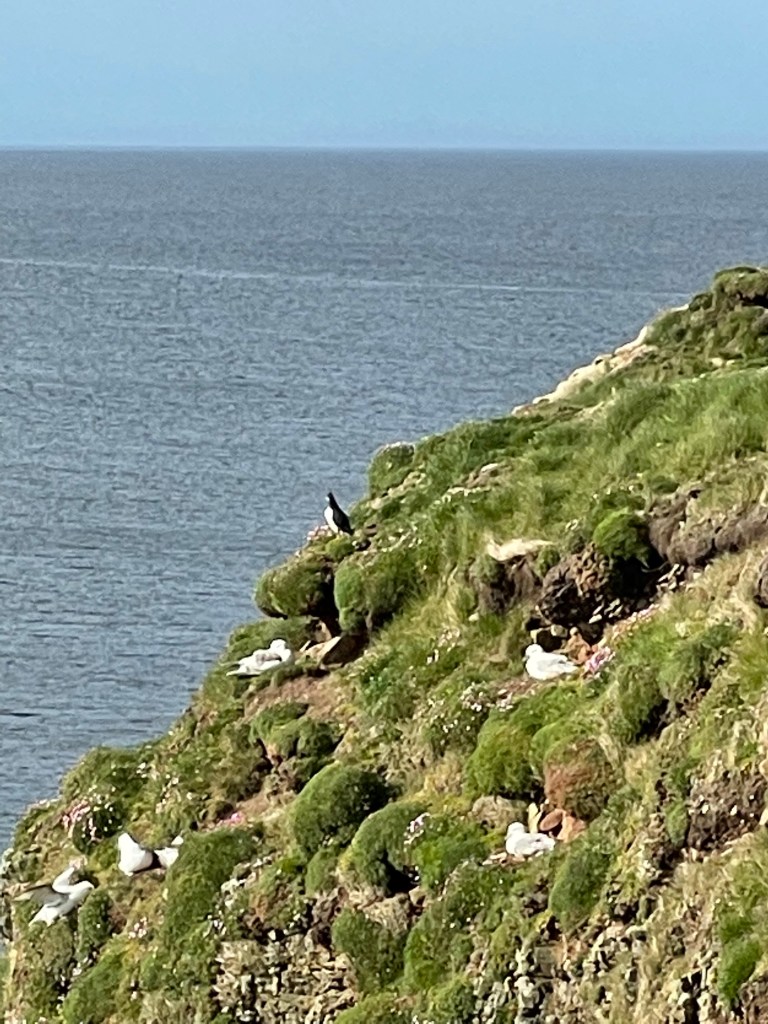
Here there were more dramatic cliffs and thousands of seabirds, transforming the cliffs into a layer cake of different types of birds, who clustered together by species in neat rows.
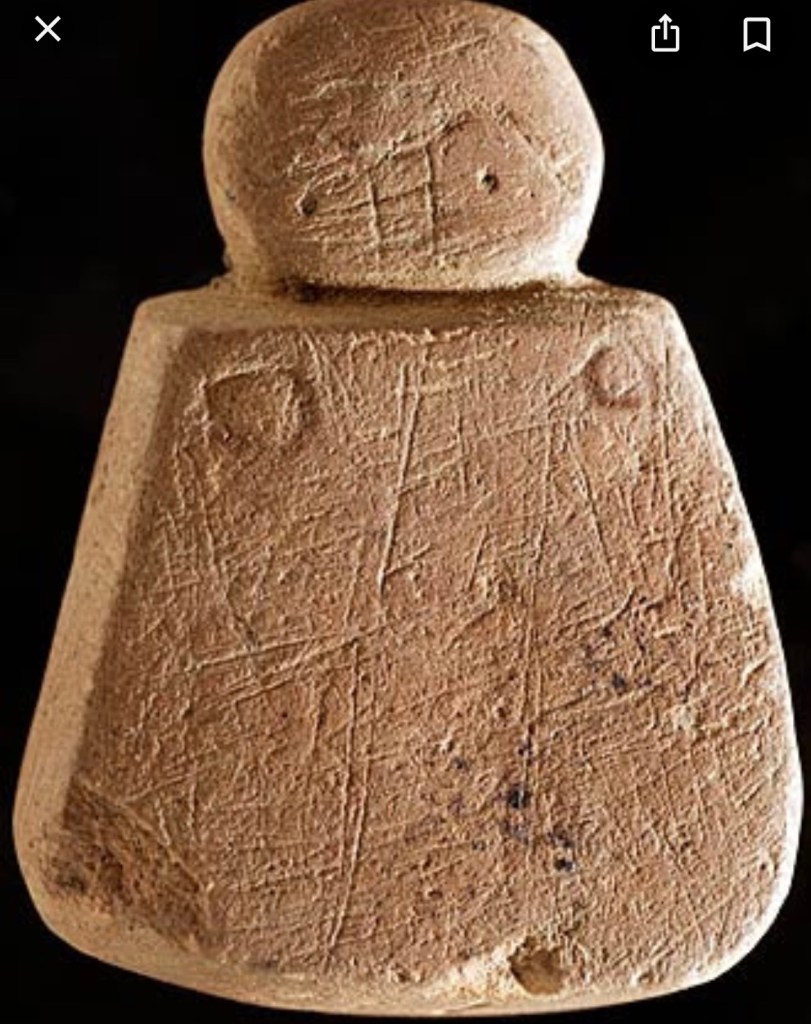
We next visited the Heritage Center, home of the Westray Wife, a small Neolithic figurine carved from sandstone, the first Neolithic carving of a human form to have been found in Scotland. It is also the earliest depiction of a face found in the UK.
Westray Wife
The center also featured rare china made for Edward VIII’s coronation. As we know, he abdicated after his ascension but before his coronation, in favor of his love Wallis Simpson. The American divorcee may have done the world a favor by removing a Nazi sympathizer from the board in favor of George VI, the beloved “Bertie,” who, along with the Queen Mum, refused to leave London during the Blitz and was photographed wandering amongst the rubble.
As we were leaving the Center, we spotted a small plane flying overhead – the shortest scheduled flight in the world from Westray to a (very) nearby island called Papa Westray. It’s scheduled for 1.5 minutes with actual flying time closer to a minute. The record for the fastest flight is 53 seconds.
Nearing the end of the day, we dropped off Angela and Peter, bidding them a very fond farewell. Angela was worried about her husband, as he had apparently been struggling more than usual during their trip, and they were headed to Shetland for another week. I hope they find that the familiarity of being back home in Cornwall will return him to form. They traveled extensively during their marriage, having many adventures around the world. Peter would smile happily, looking into the middle distance with fond remembrance as he shared some of their experiences. I dearly hope they are able to continue traveling for a bit longer before Peter’s illness makes it too challenging.
Our last stop on our way back to the ferry was the main puffin colony on the island. You know all those photos of puffins where they appear to be frolicking right underfoot? Sadly, my friends, these photos are largely due to high-powered zoom lenses and a lot of patience. Puffins nest in cliffs like the other birds, only they burrow rather than nesting on ledges. So you must wait for them to fly in and land, or perhaps pop out of their burrow to have a wee, which we witnessed and was adorable. The best time to see them is at dusk. But we still saw a good handful, and it was incredibly thrilling, and this is the best I could do with my iPhone.
The mighty puffin.
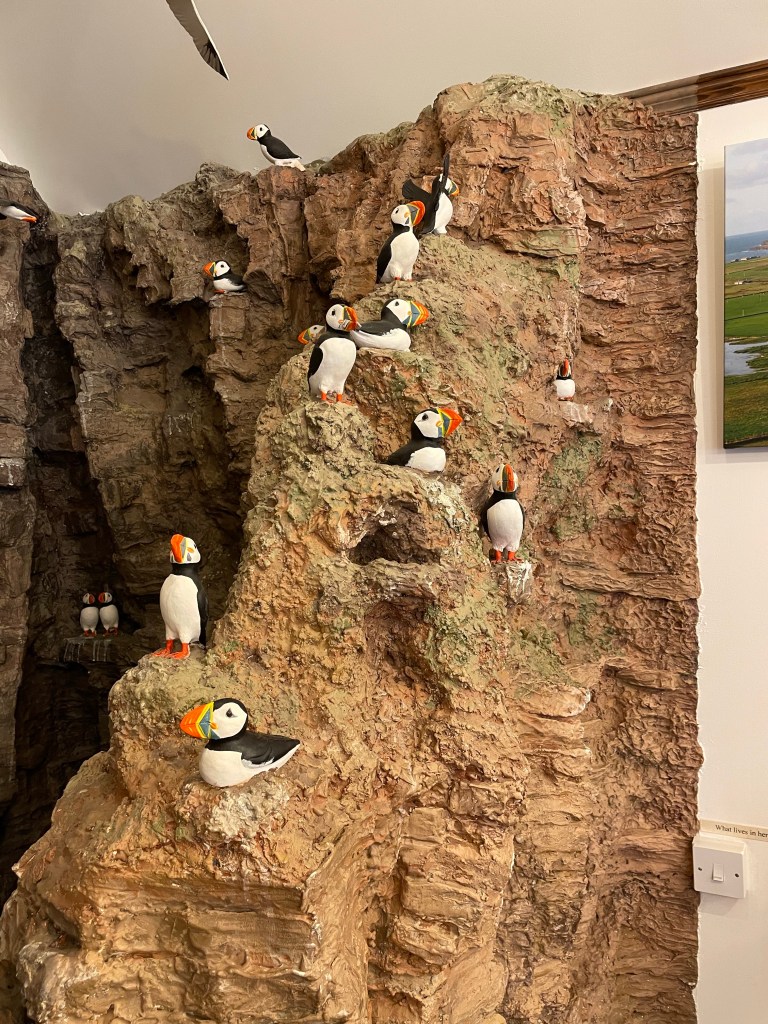
As consolation here’s a photo from an exhibit in the Heritage Center.
For illustrative purposes only.
Next morning we ordered a cab for 5:15 am to catch the ferry to the mainland. Happy to see Dougal waiting patiently for us in the car park, we drove off across the North Coast. Despite the occasional flare of irritation at campers, we mostly traveled along the single track road in complete solitude through moody landscapes, farmland and villages. We stopped at some spectacular, almost deserted beaches and visited Smoo Cave.
Farr BeachScotland you really are too much.Ceannabeine Beach – Caribbean blue waters.
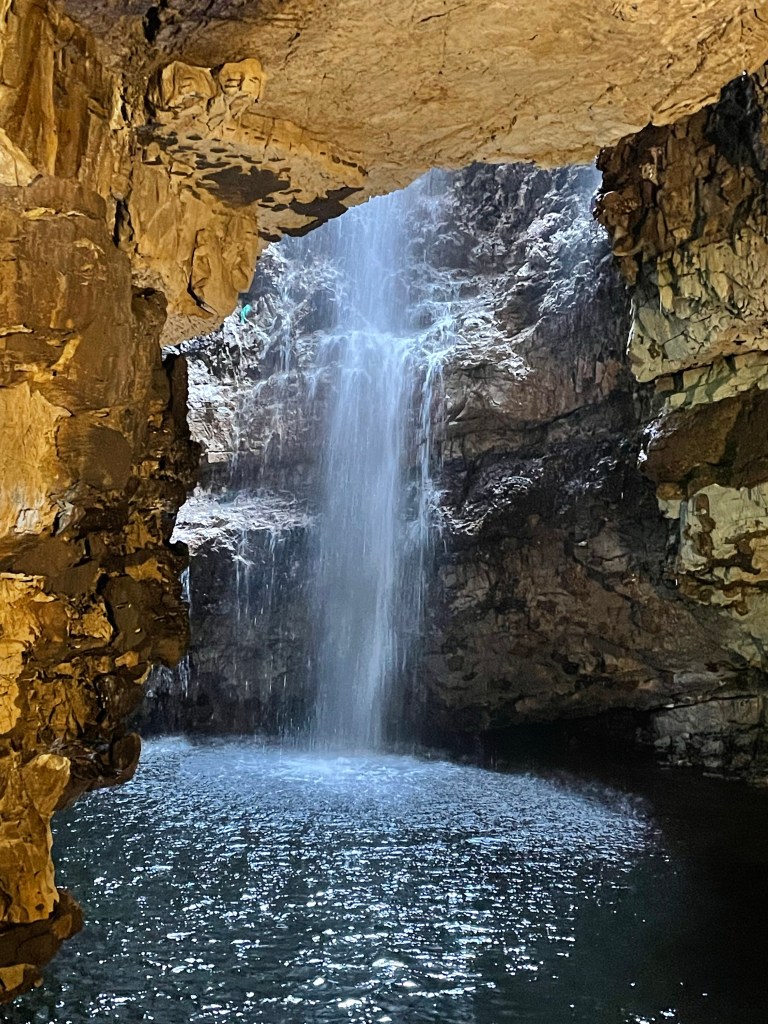
Smoo Cave was interesting although I’m not really a cave person. We opted against the hard hat tour. Lovely waterfall though.
At long last, we left the beaches of the north coast behind and dropped down into the rugged and spectacular Western Highlands I remember so fondly from my last trip.
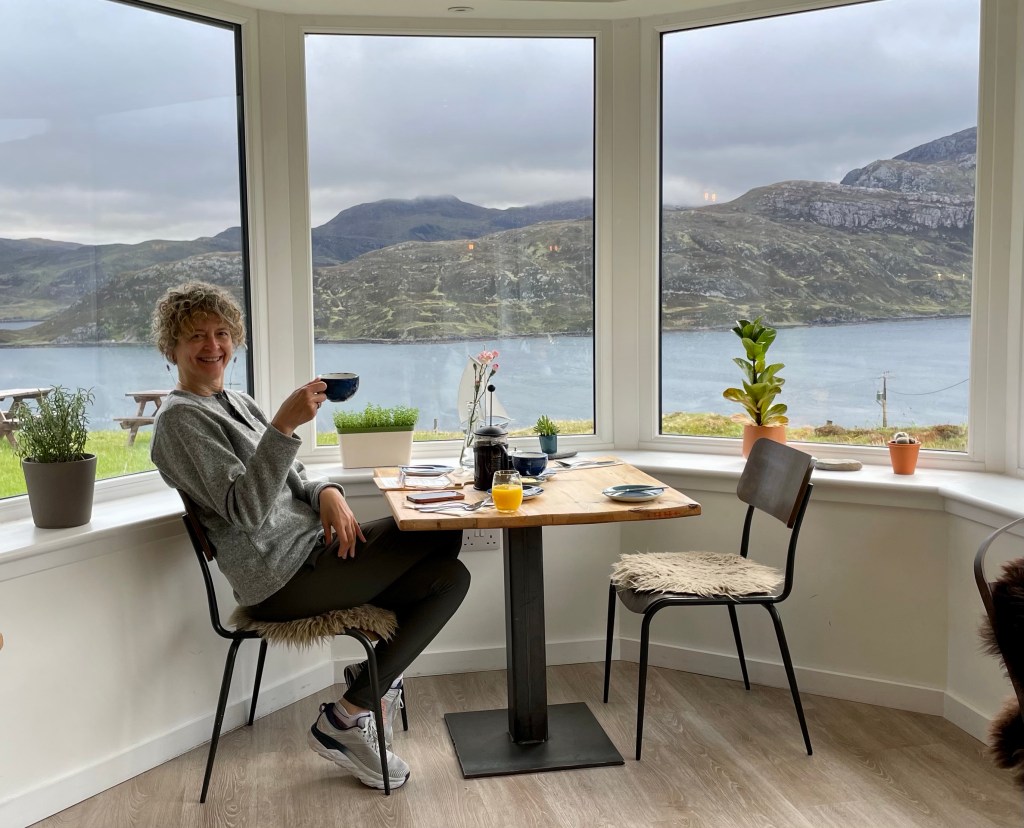
We stayed the night at Newton Lodge, which is situated in an impossibly gorgeous location on Loch Glencoul.
The view from the common room.Best breakfast spot ever.
I’ll leave you with a chance encounter we had with a cyclist we met as we arrived at Newton Lodge, John Loughran. We met him as he pulled up on his bike and tried to sort out where he had booked a room. As we were headed to nearby Kylesku Hotel for lunch, he asked for a ride. Of course we were happy to oblige, and John joined us for a lovely lunch. He is 78 years old, a retired engineer, and a Scot, although he has lived in England these past fifty years. He was riding the North Coast 500 in the opposite direction as we had done, riding valiantly through rain and wind and up and down serious hills on roads with no shoulders, or margins or verges as they are called, somewhat more descriptively than “shoulders.” John didn’t complain about any of it, just nodded and smiled, saying, “oh, it’s quite alright actually.” He told of a time when a local cyclist pedaled by who could see he was running out of steam on a climb. The guy rode alongside offering words of encouragement, and John said softly with a smile, “he got me through.”
John had planned the trip for 2020 along with a fellow cyclist. Sadly his friend bailed on the rescheduled ride, as his wife, whom John sweetly described as “a bit neurotic,” didn’t want to lose her husband for two weeks. John said proudly that his own wife, who was “very busy” and active in their community, was fine without him. He was “a bit disappointed” without his friend and his friend was “gutted” not be alongside him. I am slightly peeved by the clingy wife but like John’s wife very much. John added that he and his busy wife have five very successful children and seven grandkids spread around Scotland, England, Spain, Japan and Australia.
He showed us how he created a page for every day of his journey, carefully planning stops to recharge his electrical-assist bike. He shared many tales of his life, and how on this ride he was visiting spots in his home country that had meant a lot to his family over the years. John might be the sweetest man ever.
I’ll share one of his stories about a business trip he took to Rio in the fall of 2001. He was about to give a presentation to thirty of his colleagues when he heard someone say something bad had happened in the States. They all gathered around a television in time to watch the second plane hit the south tower. As he was telling the story, his mouth trembled and he broke down. He said he could not ever talk about that day without getting emotional, even after all this time. He said quietly, “of course, we cancelled the presentation, we simply could not go on.” When he was able to find a flight home, he remembers stepping over sleeping, marooned Americans in Schipol Airport. A reminder that the horrific 9/11 attacks took a psychic toll on humanity, even though they occurred on American soil. And the residual impact of that terrible day reverberates still, especially in empathetic souls.
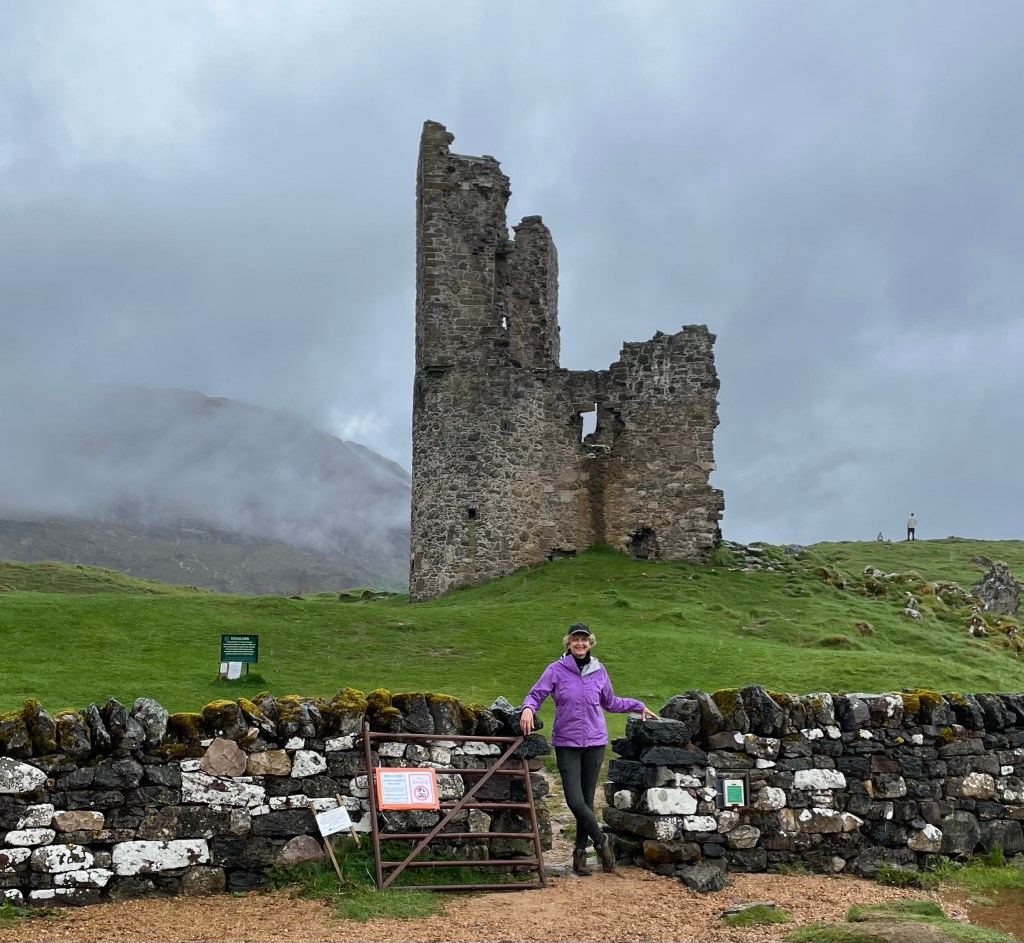
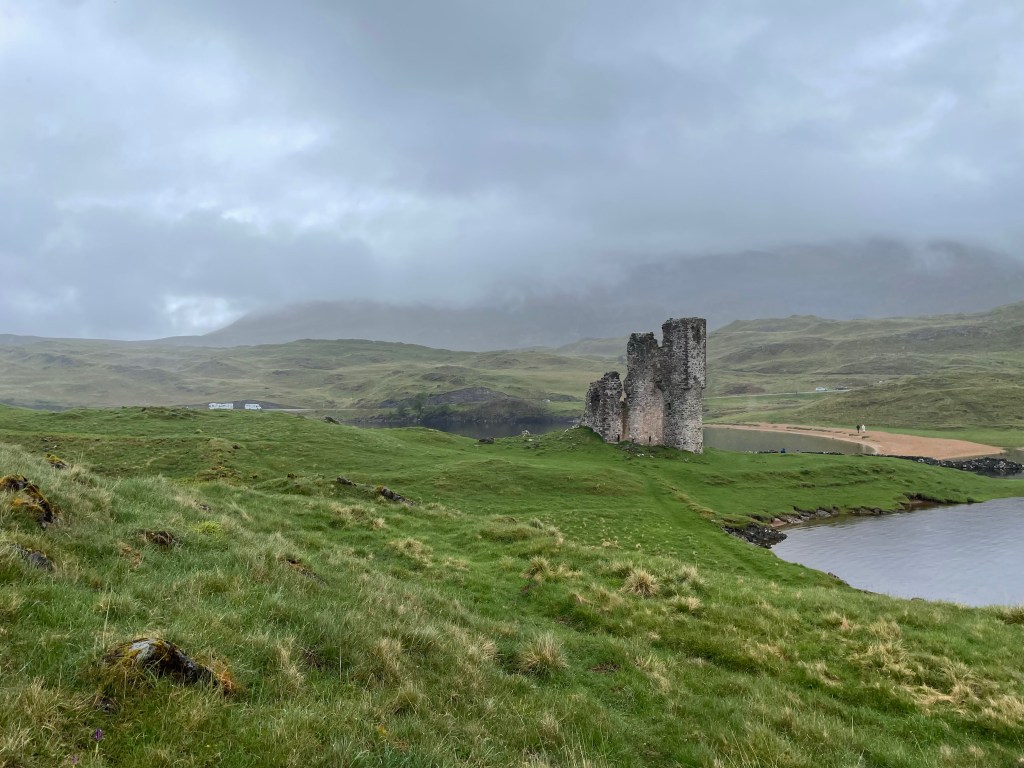
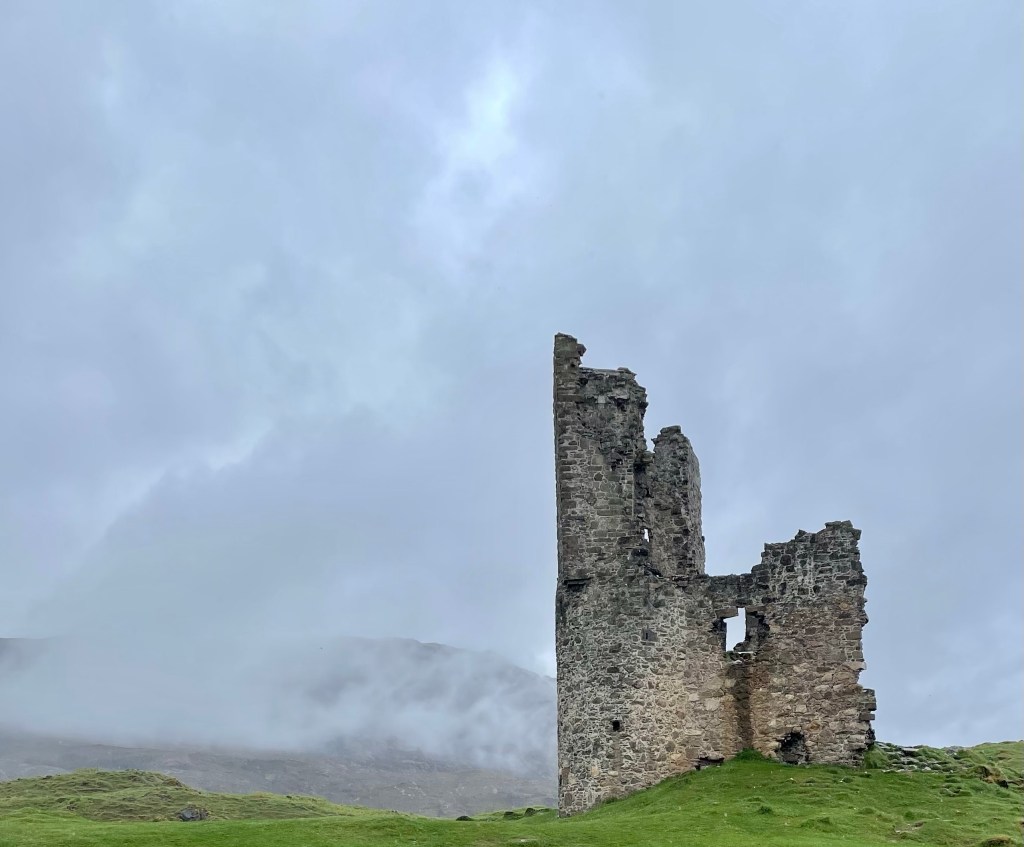
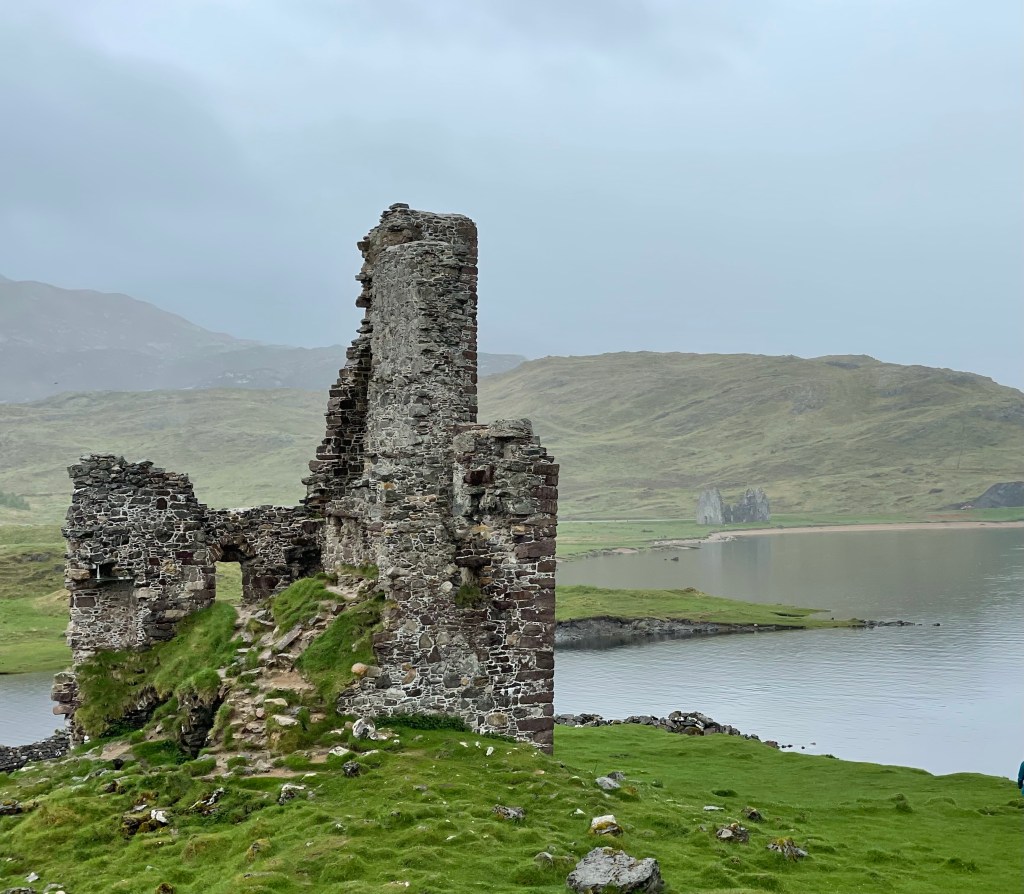
After our night in Newton Lodge, we drove through the Western Highlands, stopping at Ardvreck Castle on Loch Assynt where QUITE a few photos happened. Perhaps an embarrassing number. In all fairness, constantly changing weather causes a continuing shift of light making everything look entirely different. Especially when the subject is dramatically stark and romantic castle ruins.
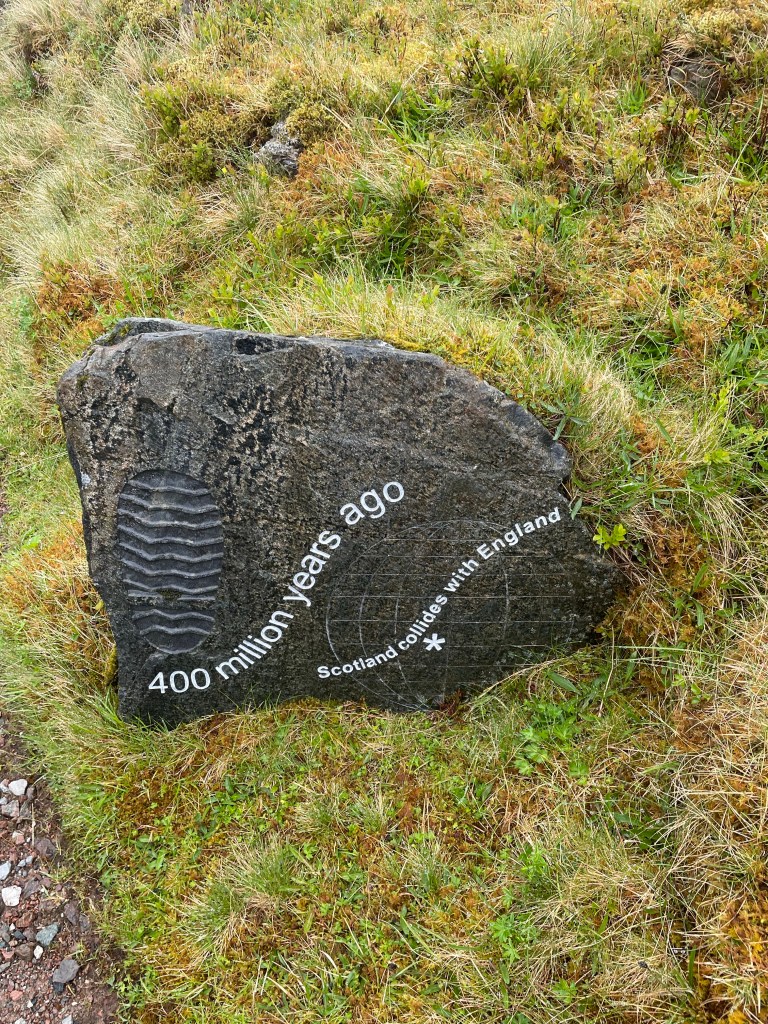
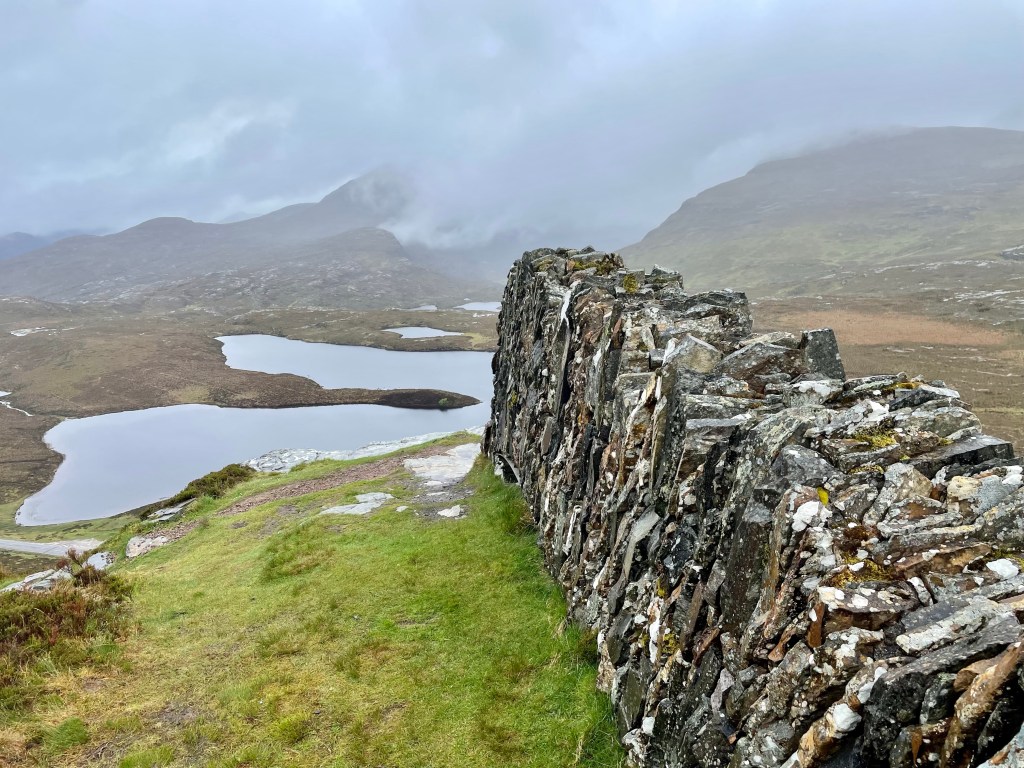
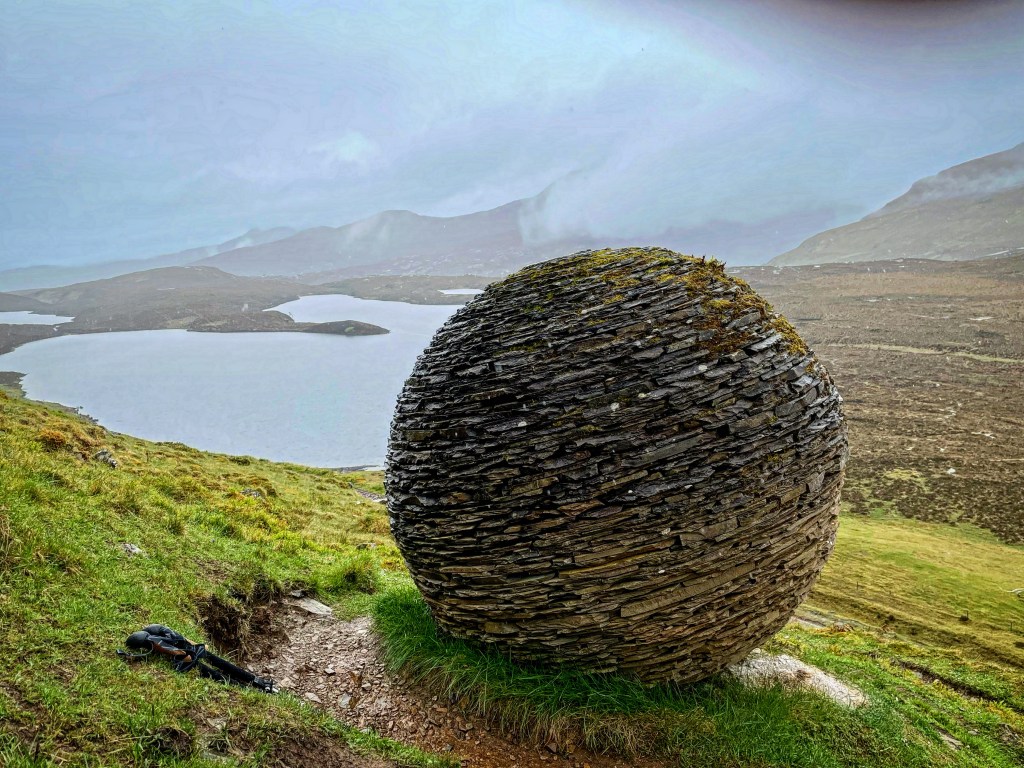
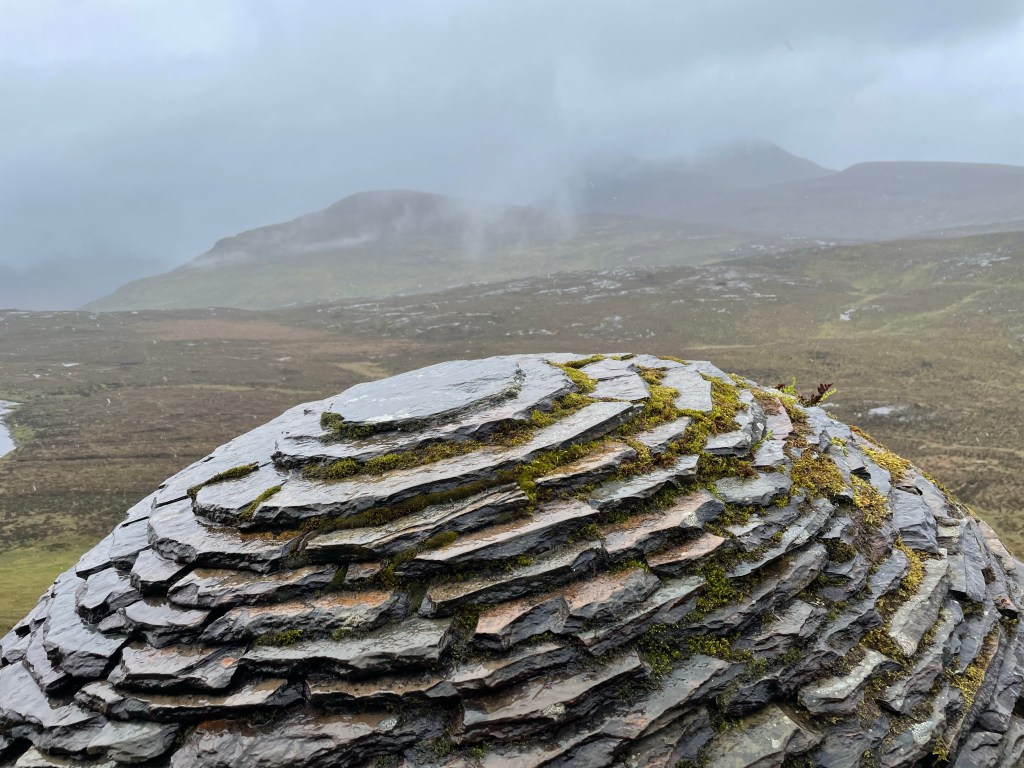
Next stop was the Knockan Crag Nature Reserve which featured a spectacular loop walk enhanced by sculptures, informative geological information and, oh yes, views. It’s largely a geological site, due to the discovery of a low cliff created when two continents crashed together millions of years ago, exposing layers of sediment and rock that told a very long story. I had particularly wanted to photograph the famous sphere sculpture along the trail but I blew right past it because I was engrossed by trailside markers detailing Scotland’s journey through time, starting 600 million years ago when it was parked in the climes of the South Pole. Just so you know, 500 million years ago Scotland was part of North America, it collided with England 400 million years ago, passed through the equator 300 million years ago, was populated with dinosaurs 200 million years ago and was submerged under the sea 100 million years ago. You’re welcome.
…..thus setting the stage for centuries of war and rebellion
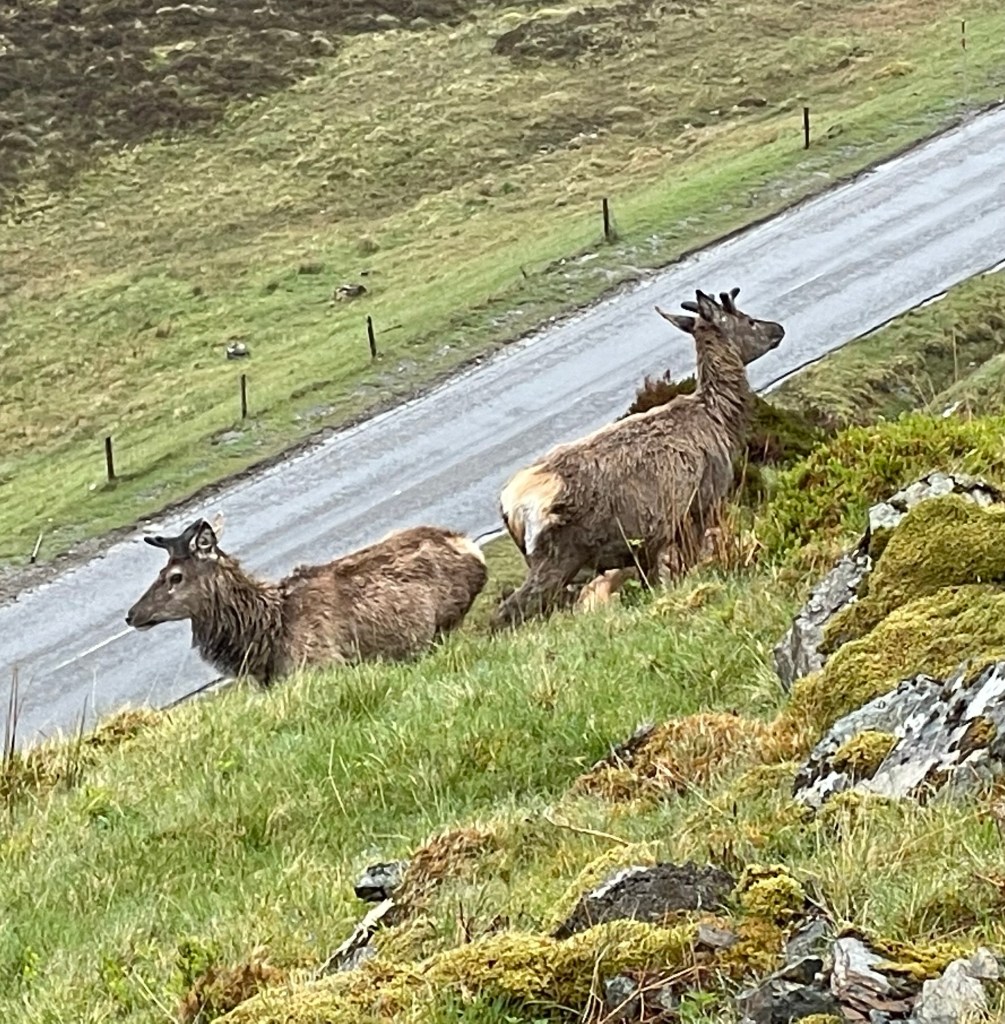
And then highland deer appeared along the trail, also very distracting.
The views from the top were – as you are tired of hearing – stupendous.
10/10 would recommend.
Being obsessive, I hiked partway around the loop again, intent on finding that dang sculpture. I think it was worth it.
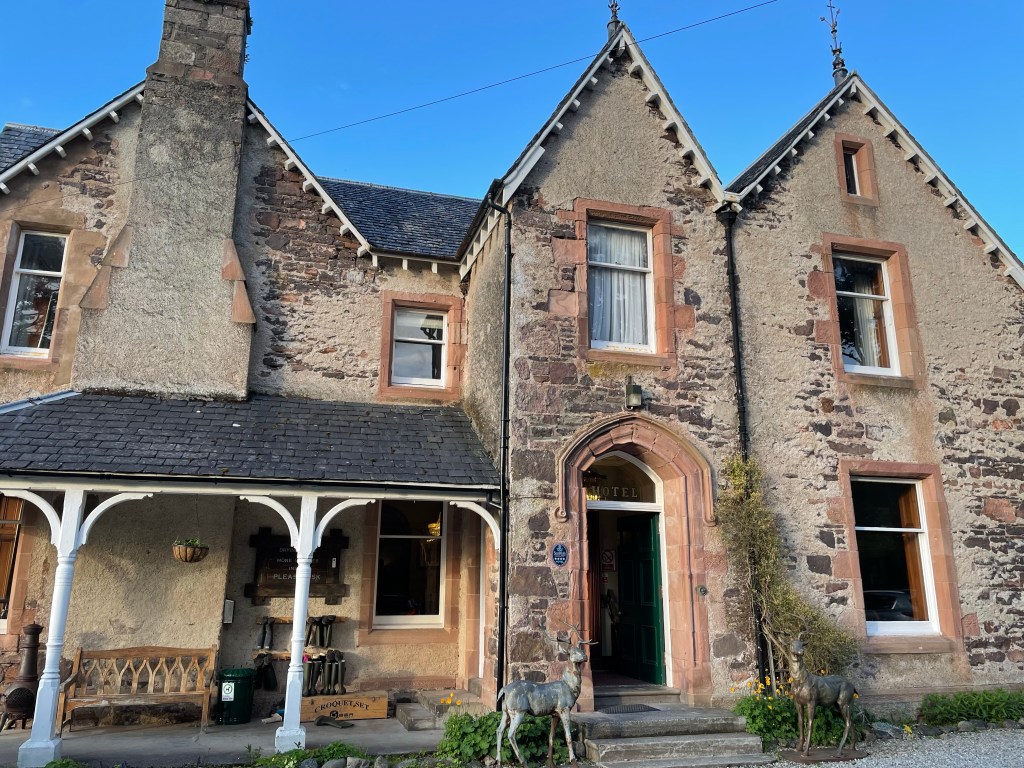
Our next lodging was a refurbished Victorian hunting lodge on a 26,000 acre estate called the Shieldaig Lodge. Our home for a couple of nights.
Complete with a Wellies Station on the front porch.
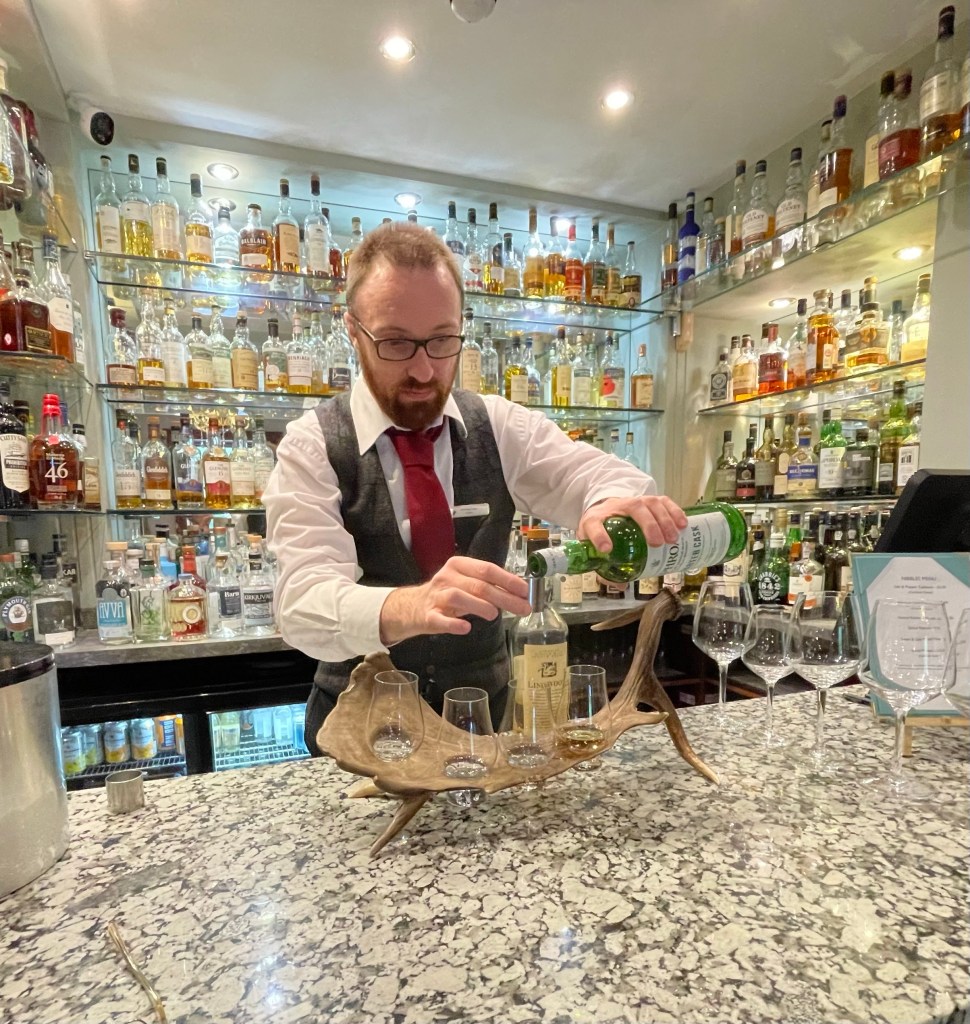
First things first, a whisky tasting curated by Alistair, who was bestowed with the exact right name.
The hotel had the most comfy beds so far and the staff tended to greet you with, “Hello there, you alright?” This made me wonder whether I looked wild-eyed or possibly about to fall over, but then realized no, it’s just what they say and it was actually very comforting.
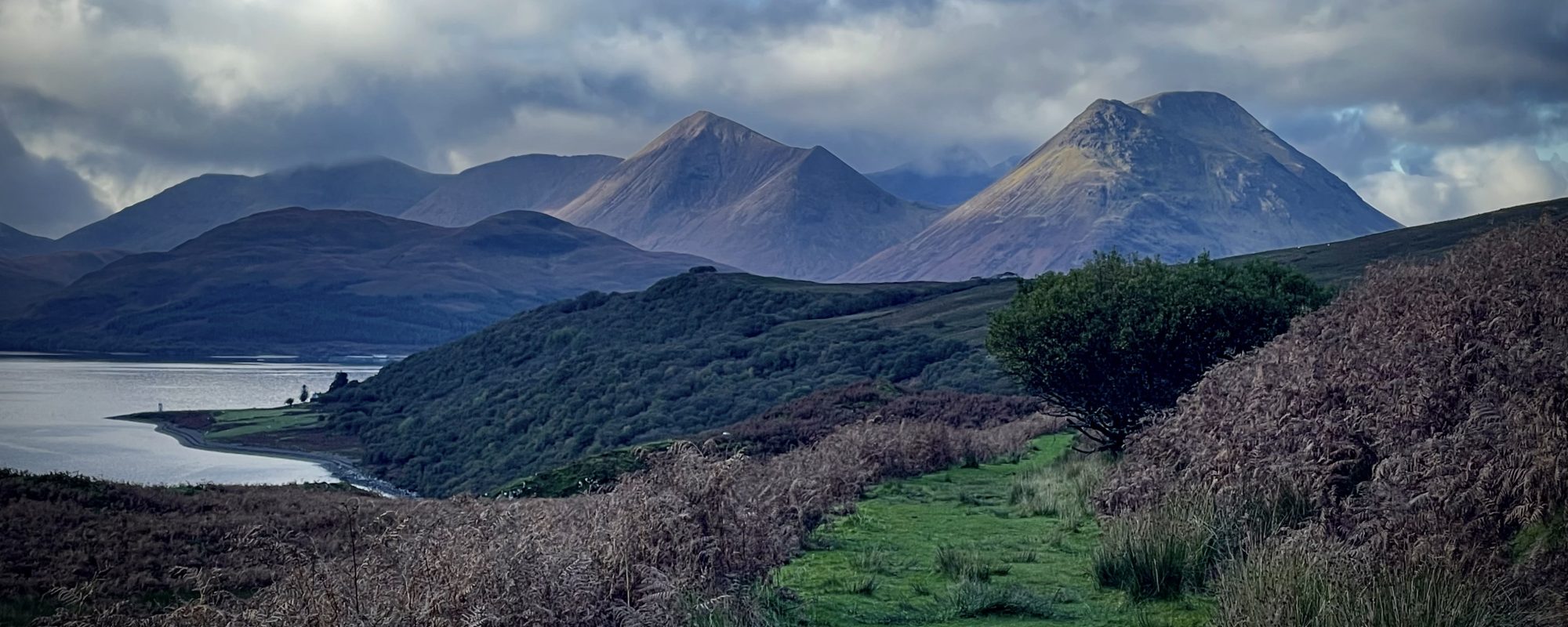
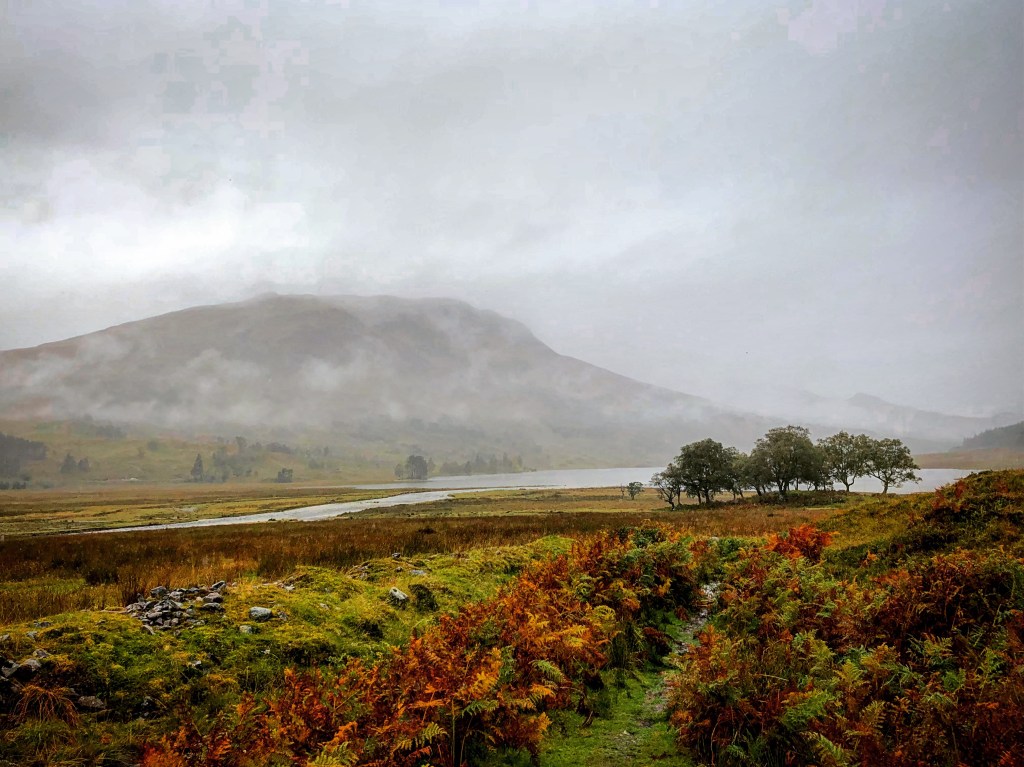
The next day was a bit gloomy so we walked around Loch Coulin and Loch Clair near the mighty Benn Eighe. Backroads welcomed our group to the Highlands with this walk back in 2018. On that day the mountains were shrouded in clouds, so it was fabulous to see them this time. An entirely different situation!
September 2018May 2022
A few more 2022 photos……
And now, my friends, comes the exciting part of the day. We drove the loop around the Applecross Peninsula. The drive west along the peninsula’s north coast featured narrow single track roads with no margins, steep cliffs, hairpin curves and freaking unbelievable views back toward the mountainous wilds of Torridon and out to sea. After stopping for lunch, we intended to complete our circumnavigation by driving the infamous Bealach Na Ba (Pass of the Cattle, aka only suitable for cows) which headed east along the peninsula’s south coast and featured even more adjectives-fail-me views – if you felt like lifting your eyes from the road and thus gloriously perishing.
After a successful navigation of the north road, we stopped in the beautiful little town of Applecross and had a delicious lunch at the Applecross Walled Garden which you all must do.
With apologies to the driver in the mirror – views toward Torridon.Another view back toward Torridon, but this time I pulled over.
Before we leave Applecross and head down the Bealach Na Ba, yet another wee word about campers. Ready? As you might have noticed, I really do dislike them intensely. Too large for most Scottish roads, driven 100% of the time by couples in their twilight years, shall we say, and the drivers (men) have no idea where any part of the camper is relative to the road and cannot back them up. My only solace was imagining the wives scolding their husbands with the old chestnut, “I told you this was a bad idea,” and wondering whatever possessed them to marry this lame dude in the first place. I also laughed at them, not with them, when they got stuck. You would too.
They are even more irritating because at the bottom of Bealach Na Ba there is a large sign plastered with warnings about large vehicles and “learner drivers” which I believe would apply to every single tourist renting a camper. Travel books warn against taking this road unless you possess the ability to back your vehicle down curvy roads with steep drop-offs for 300 yards (to get to a “passing place”). This would dissuade me if I ever rented a camper which I would never, but I’m just saying. It does, however, not discourage literally anyone else.
A few stats for you – the Bealach Na Ba boasts the greatest ascent of any road in the UK, rising from sea level to 2,054 feet in about six miles with an average gradient of 7%, reaching 20% at its steepest. It was built in 1822 with rough gravel and paved (and I use that word loosely) in 1950. And yes there were cyclists making the climb.
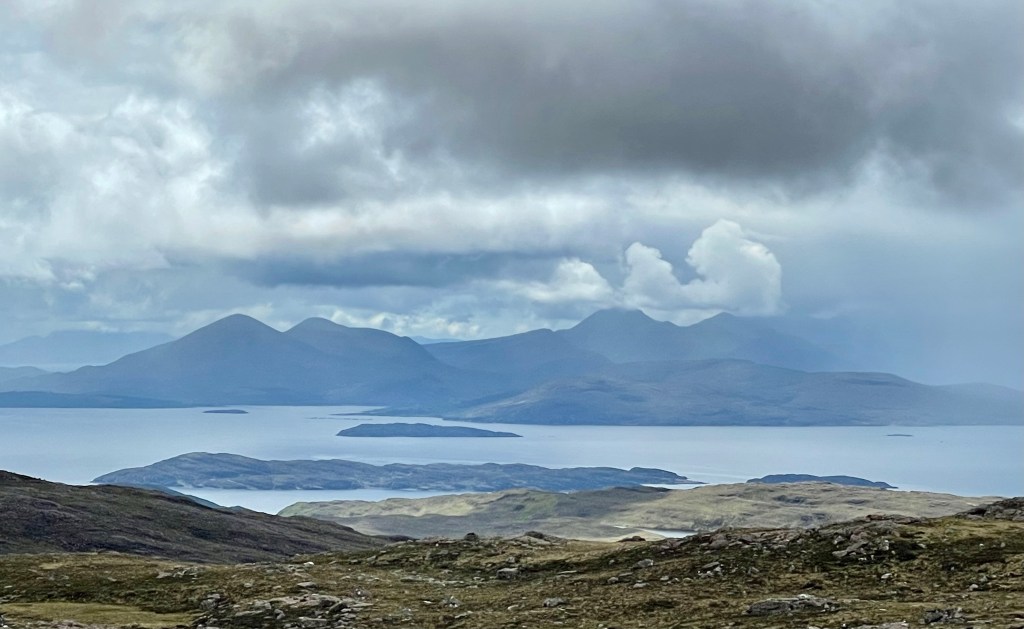
Here is the view at the top, looking out toward the mountains of Skye.
Over the sea to Skye.
And now for a couple of videos featuring live narrative commentary should you care to have a wee listen.
Yes we were listening to the Outlander soundtrack.
Even with the campers, it was the most fun I’ve ever had while driving and I’d do it again in a second, maybe early morning or later in the day after the campers had found their parking spots for the night and the roads of Scotland are empty.
After we successfully survived that harrowing but fabulous drive, we stopped in Plockton, known as the “Jewel of the Highlands,” although I might tend to disagree but big ups to the Plockton tourism people and Instagram for the valiant effort.
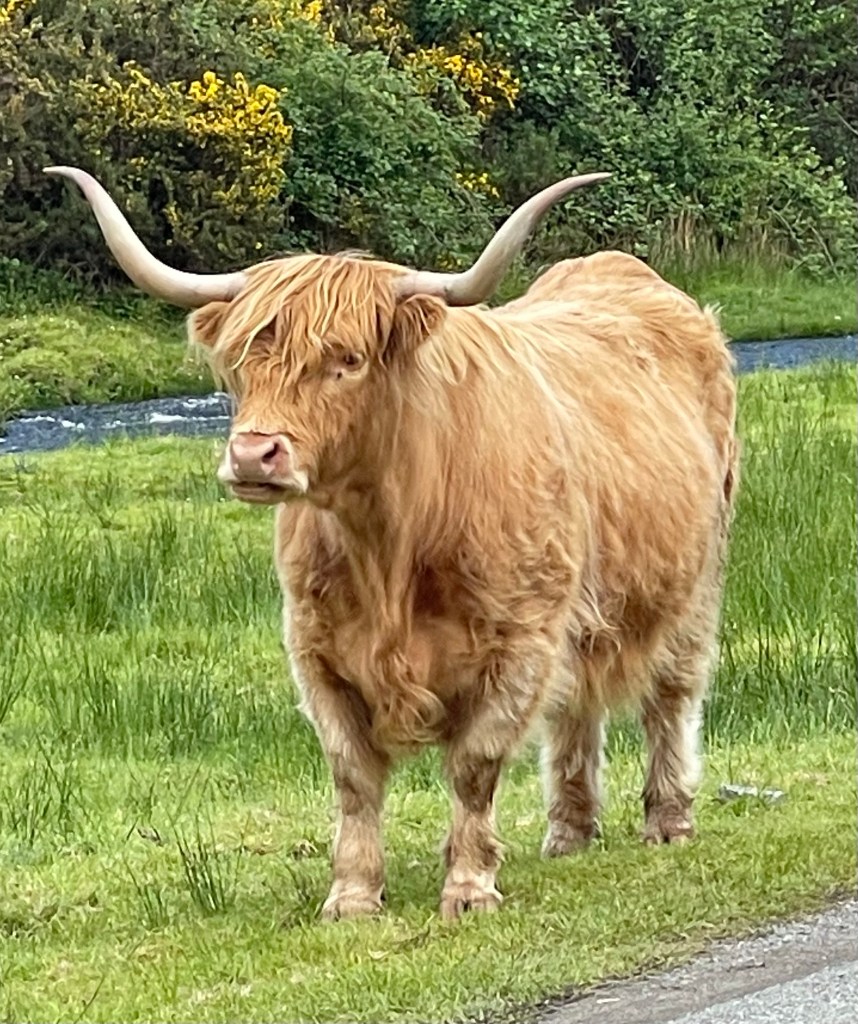
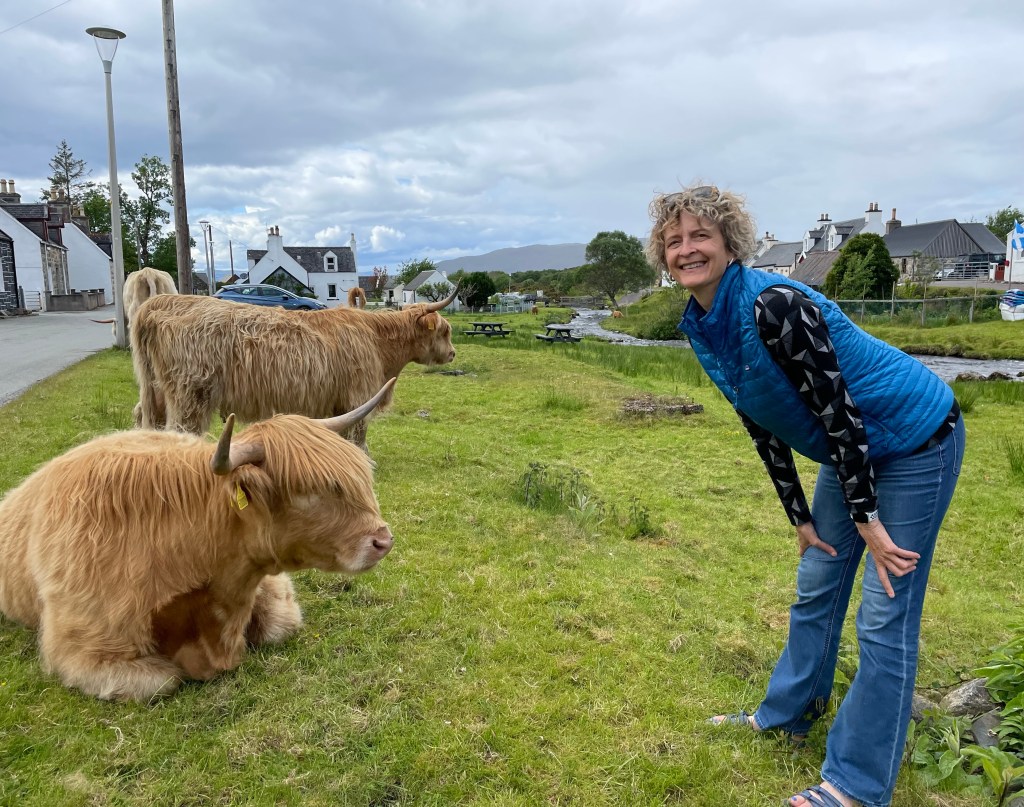
Shortly before we reached the Skye bridge, the Highlands bid us a fond farewell by offering up a big herd of fuzzy heilan coos.
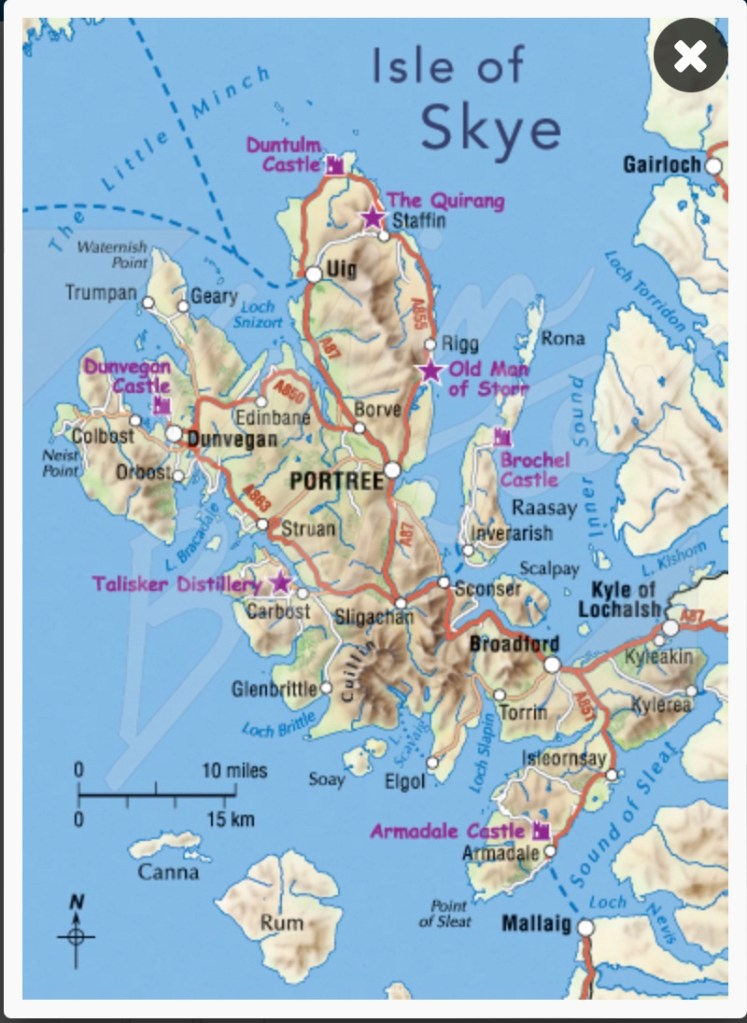
The Isle of Skye is just off the mainland, now accessible by bridge as well as ferry. It’s 50 miles long with a population of 10,000. Crofting, fishing, fish farming and tourism are its biggest economic drivers.
Tourism has increased exponentially over the past several years, making life irritating for island residents and clogging up roads, endangering delicate environmental areas, and filling up restaurants and B&Bs. Danielle said she felt slightly guilty even being here and I know what she means. Making matters worse, and I’ve heard and overheard so many conversations about this (all over Scotland), is the dire post-COVID labor shortage exacerbated by Brexit. Tourism industry employees from EU countries now need a visa to work in the UK, and these folks are critical.
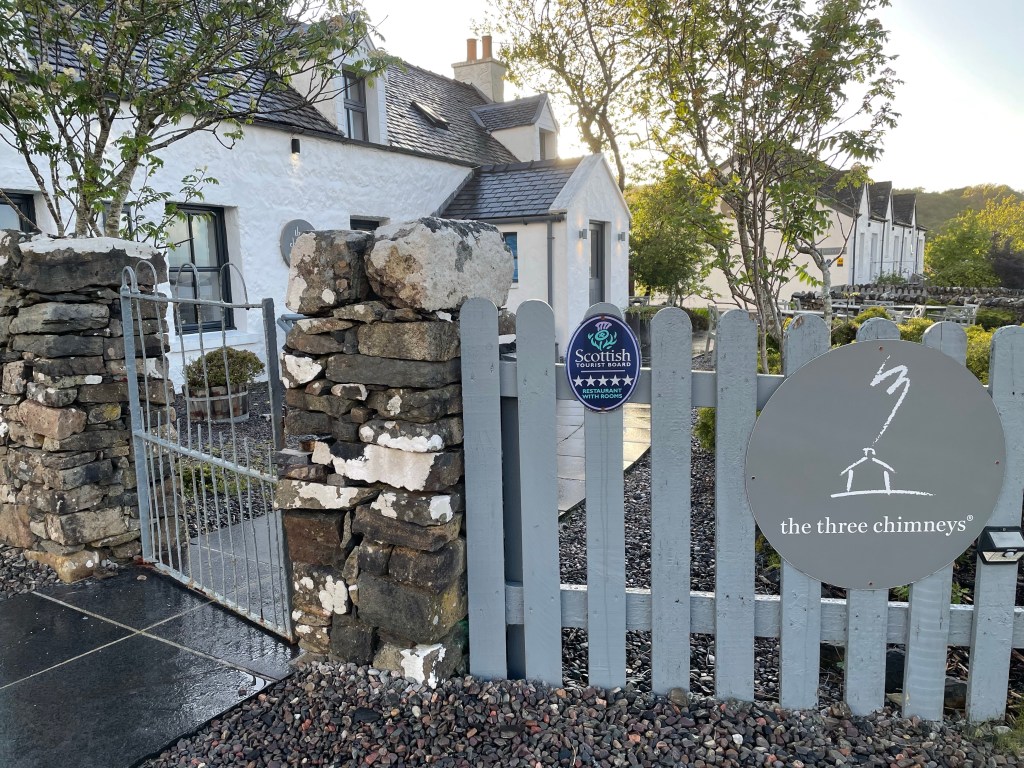
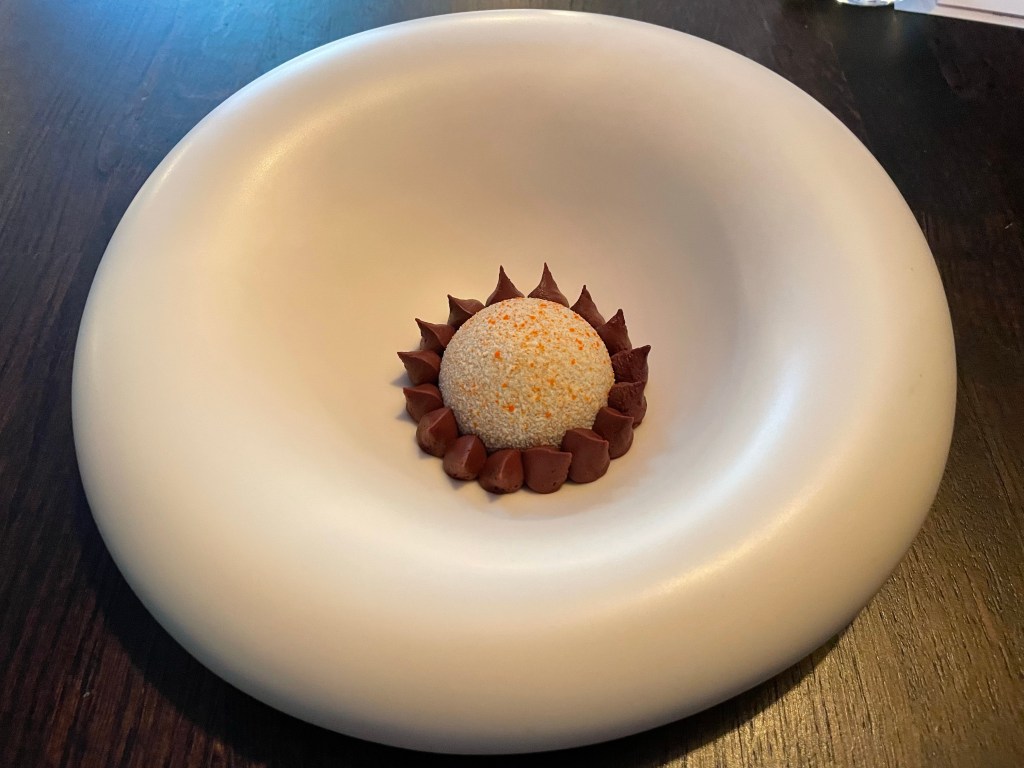
PRO TIP/RESTAURANT DIGRESSION: Speaking of which, if you are headed to the UK this summer book all of your restaurants in advance. All of them. Otherwise no dinner for you! Big bummer especially since you have traveled 4,500 miles and there are three Michelin-starred restaurants on Skye alone. I wrangled a booking for two of them – The Three Chimneys and Edinbane Lodge. Both were completely excellent. And you don’t want to miss out on the fabulous and fresh cuisine of Scotland in general. Seriously get online now and book, book and book.
The Three Chimneys. Delightful spot in a remote area of Skye. If you go, and meet a tall dark and handsome server with an Eastern European accent – he’ll ask you to guess where he’s from. The answer is Poland. His goal is to move to Shetland.A dish from the tasting menu at Edinbane Lodge – Dark Chocolate with Sea Buckthorn. What is sea buckthorn? Who cares really with this delightful presentation. FYI there were three desserts.
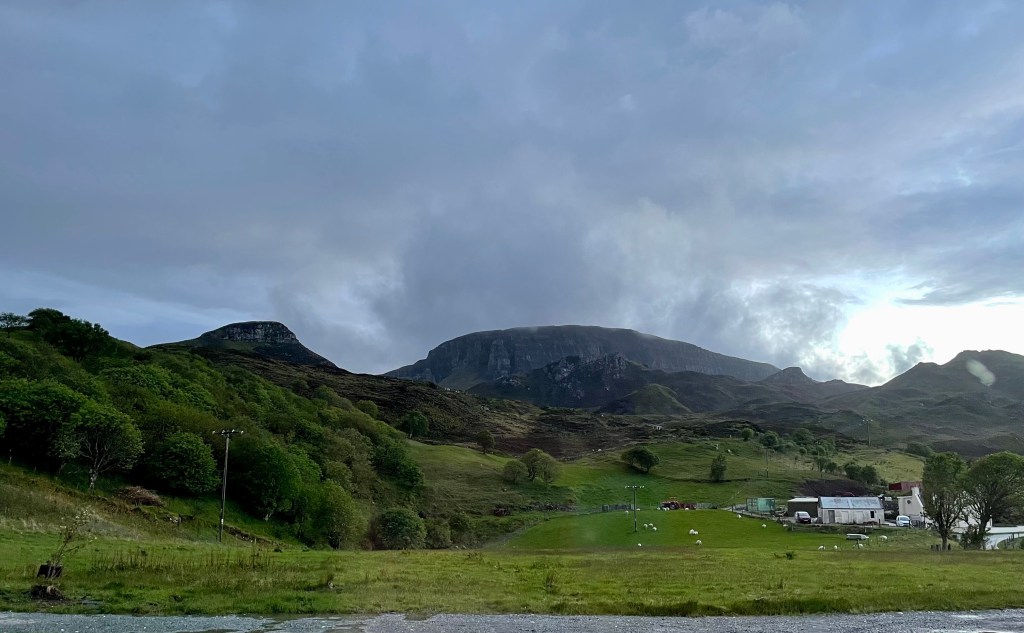
A wee word about our accommodations. We booked an Airbnb near Staffin situated between the mountains of the Quiraing and the sea from a delightful guy named Ian. He was incredibly responsive and patient with our American questions. I’m so used to Airbnbs in the states where there is a giant notebook full of detailed instructions, including a list of chores you must do at the end of your stay. You know the notebook I mean. There is not one piece of paper in Ian’s place, although there is a leprechaun in one of the kitchen drawers. We have too many rules, too many instructions and too little trust in people in the States. Much more laissez-faire here. They sell whisky in grocery stores and you can take your dog into a restaurant which all seems very advanced.
And we have a washer and dryer yay! But that situation is so different. No Tide pods. Instead, there’s spectacularly over-fragranced powdered soap that goes into a drawer just like olden times. The dryer is in the detached garage and isn’t plumbed so you have to dump out a water tray after every load. Settings include “cupboard dry” and “iron dry.” This makes sense to me. At times the weather was so aggressive that trips back and forth to the garage made us feel like frontier women, braving the elements to accomplish household chores.
Anyway, back to teeming hordes. I was pretty shocked to see that Skye’s popular sites are simply inundated with people. Those beautiful photos of iconic locations you see on Instagram? Faerie Pools, the Old Man of Storr, etc etc? Imagine those lovely photos, which must have been taken in the middle of the night, in the wee hours or in winter, only packed cheek by jowl with hordes of tourists. Cruise ships dock in Portree and disgorge thousands of people who are then loaded onto buses and taken on a whistle stop tour of the top destinations. Dreadful.
You can still easily find solitude though. Get up early, take a few steps down a trail or make after-dinner plans when the roads of Skye are empty.
VERY WEE DIGRESSION ABOUT NIGHTTIME. Speaking of getting up early, in early summer you can rise really early and, lo, it’s not dark. Or stay out late same deal. There’s only about four hours of complete darkness. Scotland’s latitude is similar to Northern Canada and Alaska. Really really cool and I never stopped marveling at it.
View from my bedroom (the Quiraing) at about 10:30 pm. No filter.View from front of house, same time.
So the weather on Skye is particularly changeable and can be kind of crappy to be honest. Wind, rain, fog, all the things you imagine and generally all in one day. Every item on your body must be waterproof. Not water-resistant – Scotland throws back its head and laughs at “resistance.”
The weather was true to form for us, but we never regretted ignoring it.
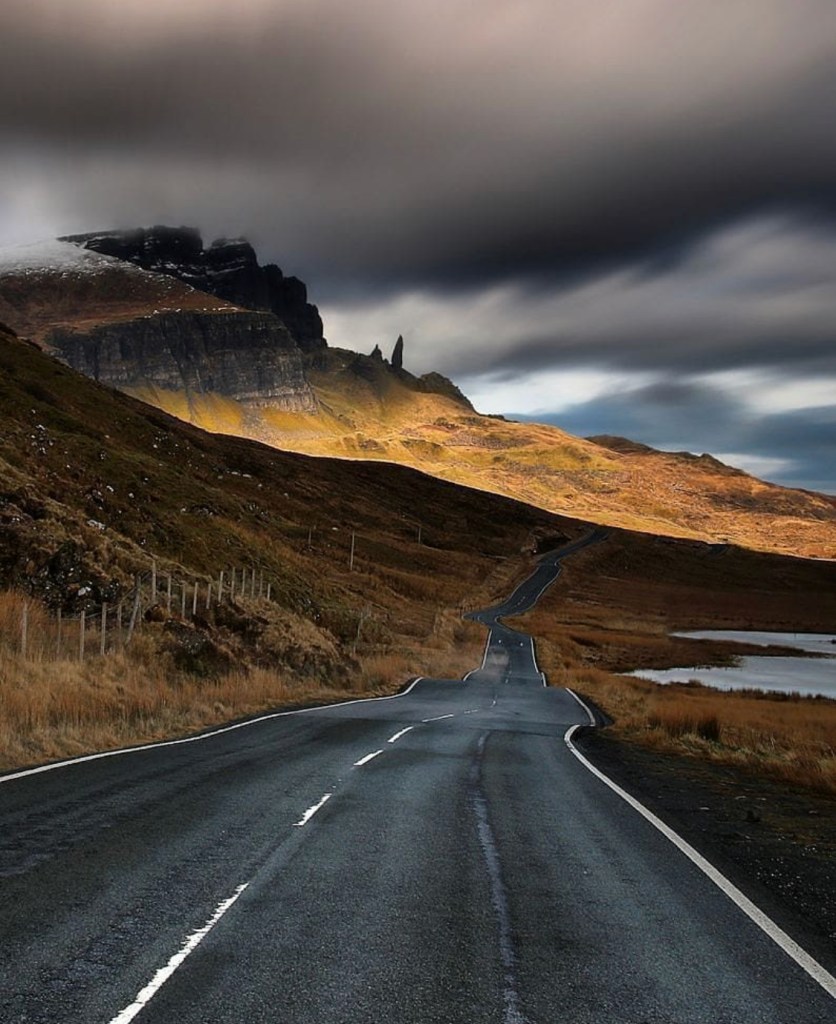
My first trip to Skye with Backroads, we stuck to the Sleat (pronounced Slate) peninsula in the southwest, which was fabulous. Ian’s place is northeast on the Trotternish peninsula. It is gorgeous, and home to many of the tourist sites on Skye, including the Old Man of Storr, Kilt Rock, the Quiraing, the Fairy Glen and the Skye Museum of Island Life, a highland folk museum near Flora MacDonald’s grave.
On our first day we drove across the north coast of Trotternish, dropped down into the Waternish penininsula and then over to Duirinish all the way to Neist Point, the most westerly part of Skye.
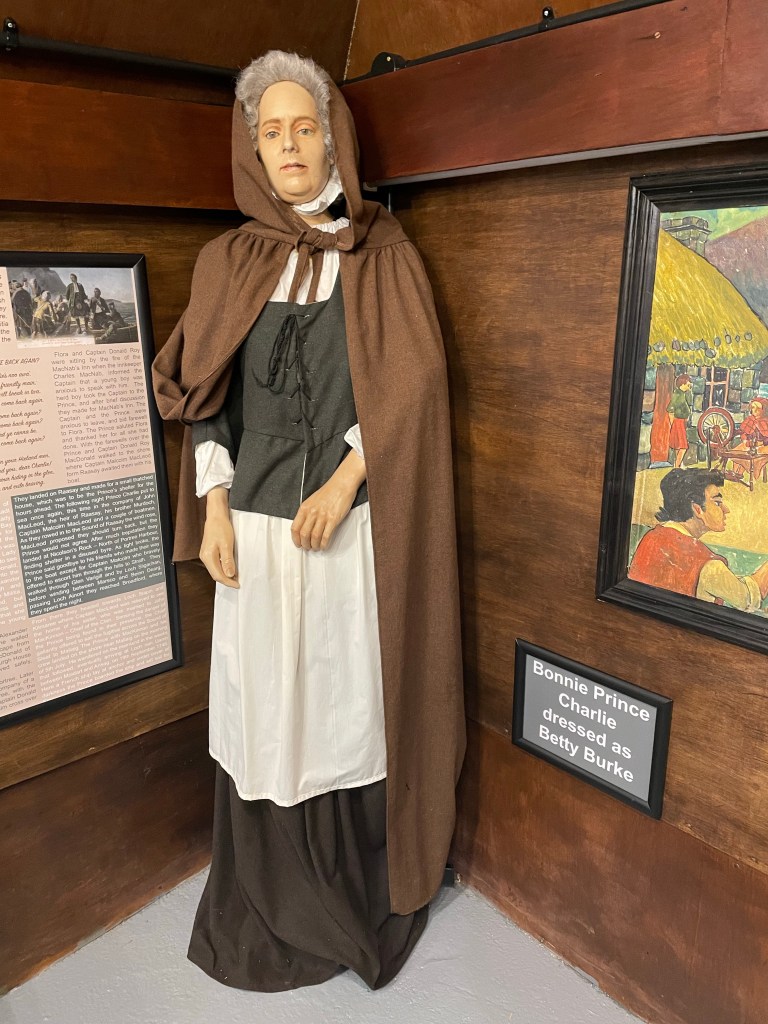
We stopped at the Skye Museum of Island Life, which is a wonderful spot. It features replicas of Croft buildings from back in the day and a lot of detailed historical information, including from the Jacobite period since Flora Macdonald is buried nearby and Skye was where the Bonnie Prince finally was able to catch a ride to France after Culloden. You have probably heard the story, but he dressed up as a woman named Betty Burke, and traveled incognito as Flora’s maid.
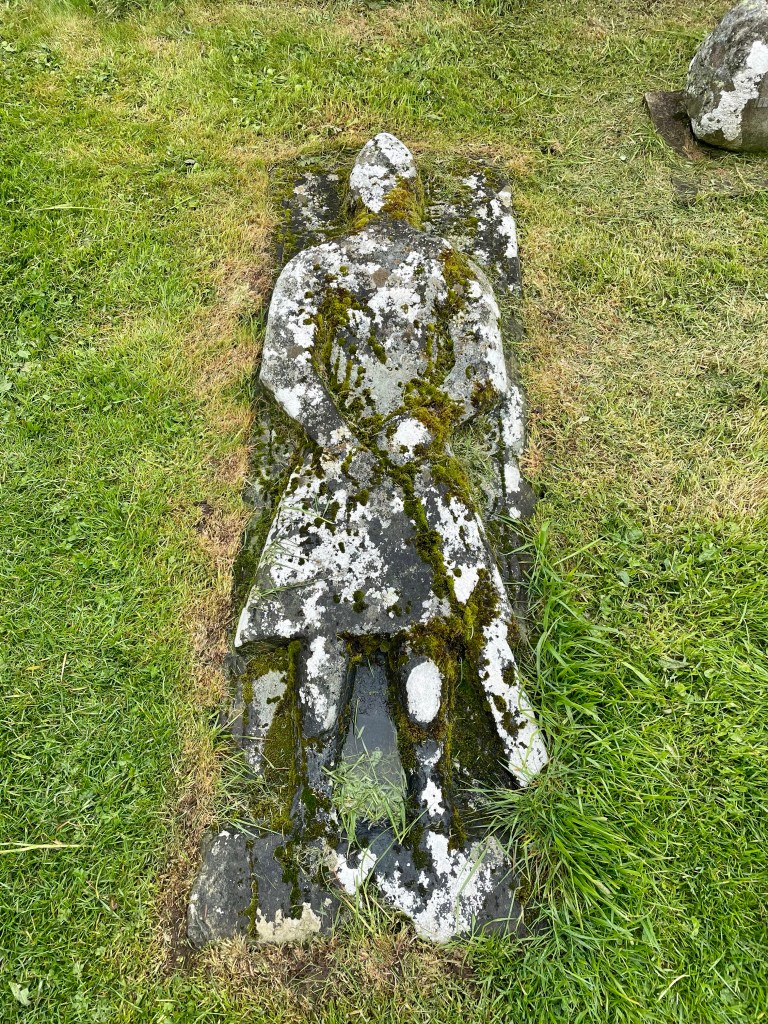
Here’s a rather alarming representation of the Bonnie Prince and his escape outfit. From the Isle of Skye Museum of Island Life.Flora’s grave. It looks newer than you might expect because her first marker was chipped away by souvenir hunters in the 1800s. After Culloden, Flora married a guy also named MacDonald (no need to change the monogram) moved to North Carolina and declared loyalty to the Crown during the American Revolution. From Jacobite to Loyalist – two losing causes in a row. Another really cool grave marker in the cemetery. Probably King Arthur.
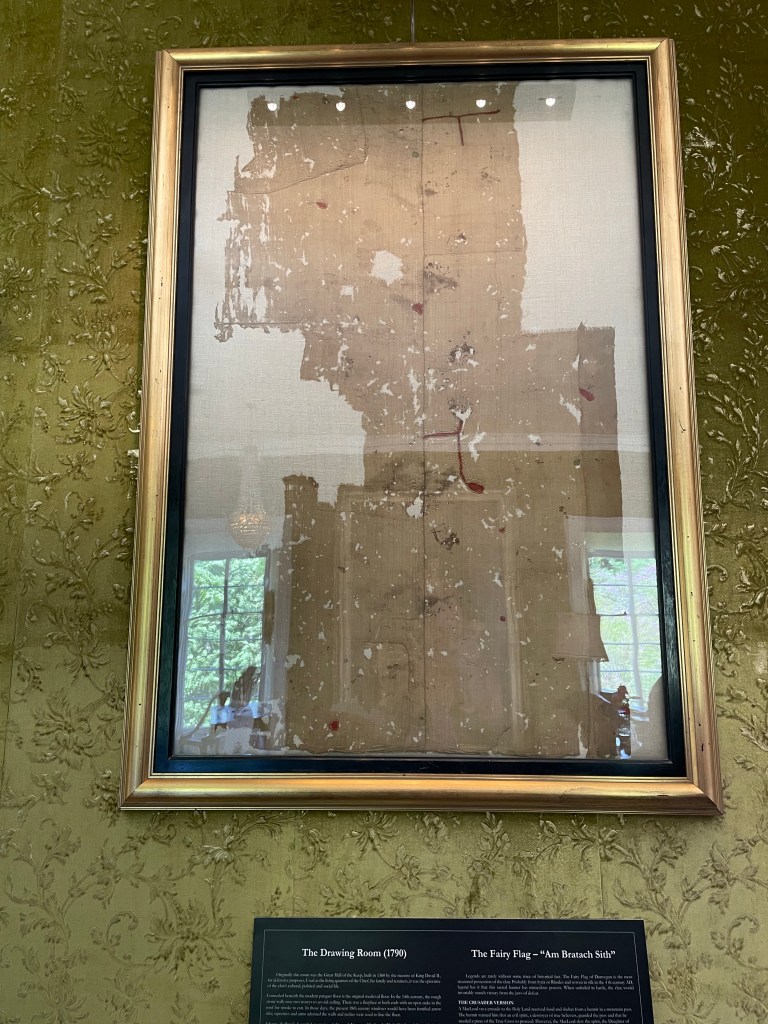
Next we visited the Fairy Bridge, slightly off the main road and sadly all alone without a single visitor. This being Scotland, there’s a legend behind the bridge. Once upon a time, a chief of the MacLeod clan married a fairy and they lived together on Skye. She was only allowed to be with him for a year, after which she had to return to her people. She bid the clan chief farewell on the bridge and left her son wrapped in a silken shawl. This is the famed Fairy Flag, which allegedly could be used three times to save and protect Clan MacLeod. Very Lord of the Rings, is it not? #AragornArwyn. That exact same flag just happens to be on display at our next stop, Dunvegan Castle, which proves that the legend is true.
Dunvegan Castle is the oldest inhabited castle in Scotland, and always by the chiefs of the MacLeod clan. The MacDonalds are the other main clan on Skye but were not so settled. In the 16th or 17th century they moved from Sleat to the tip of the Trotternish peninsula, and their castle, Duntulm, is now barely a ruin. In the 1800s they moved south and built Armadale Castle, now a tourist attraction for its gardens with the castle ruin (in better shape than Duntulm) as its centerpiece.
I would be remiss in not mentioning the bitter feud between these two clans. There were tit-for-tat massacres and suchlike. Worth a google.
Dunvegan Castle – nice work clan MacLeod.
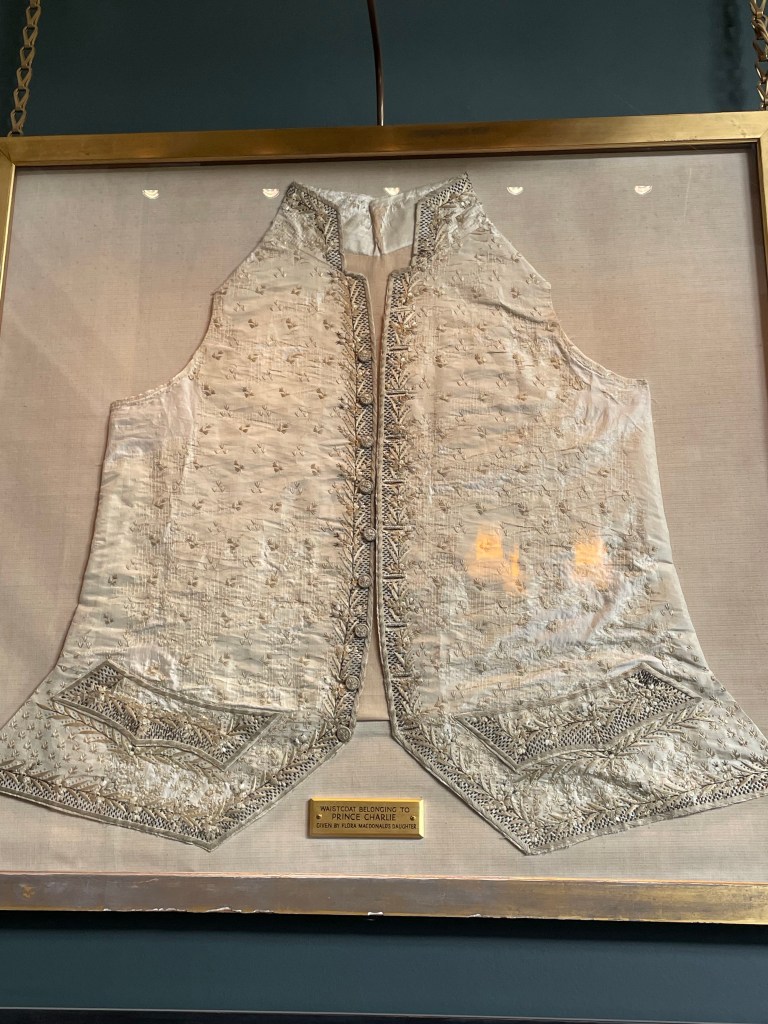
The castle has been visited by many luminaries over time, including Samuel Johnson, James Boswell and Sir Walter Scott. It also boasts a fun Jacobite collection including a lock of hair plucked from the head of the Bonnie Prince which he bestowed on Flora MacDonald. Her daughters also donated a vest of his.
Kinda weird but also OMG.Prince Charlie’s blingy vest
And of course, the Fairy Flag is displayed within the castle. It’s pretty threadbare, but no doubt still quite powerful even though Clan MacLeod has long since called upon it the allotted three times to protect the clan.
Another fun item on display is Sir Rory Mor’s Drinking Horn. Successive clan chiefs throughout history have proved their worthiness/manliness by drinking a full measure. You can buy a replica in the gift shop for only £150 but it’s for ornamental purposes only which seems pointless.
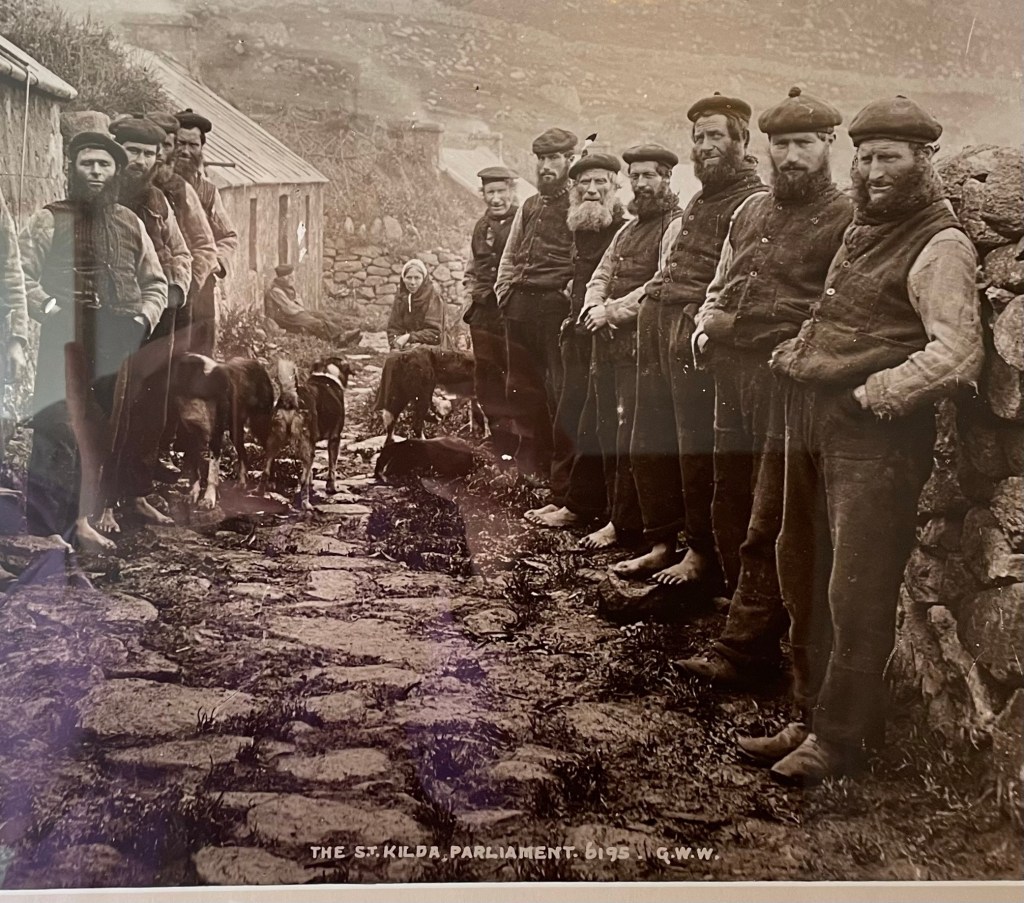
A display in the castle showing a back stair used by servants. I’m including it here because it’s just spectacularly lit. And it scares the crap out of people.Including this in honor of the St. Kilda parliament because look at them. Amazing.
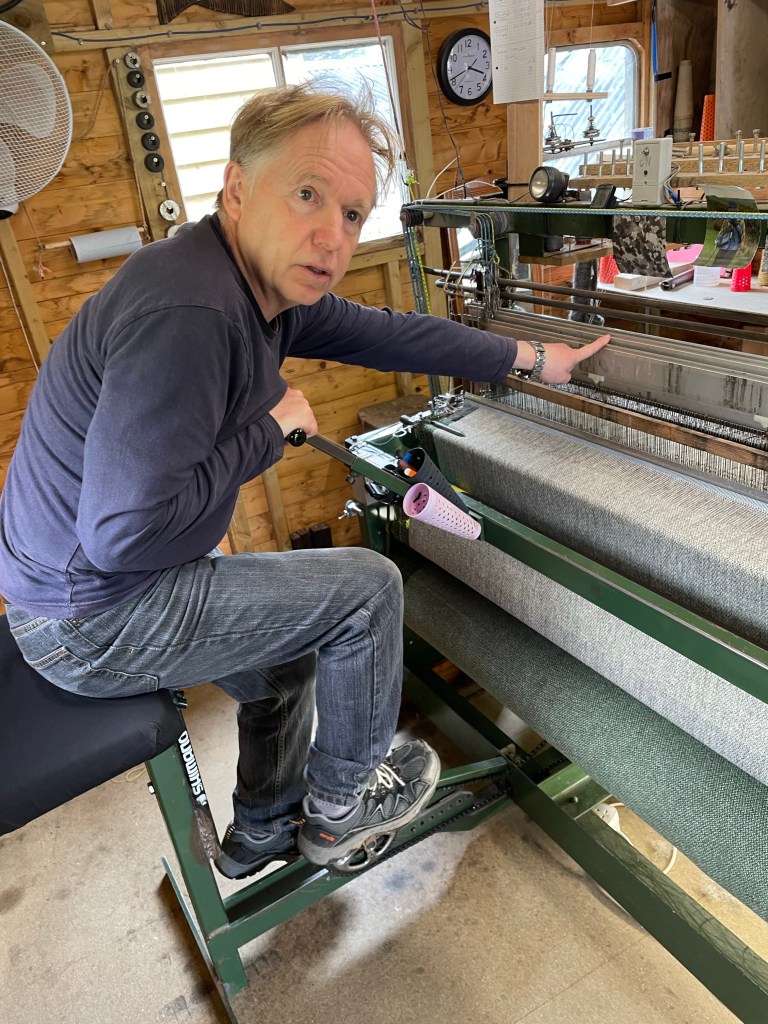
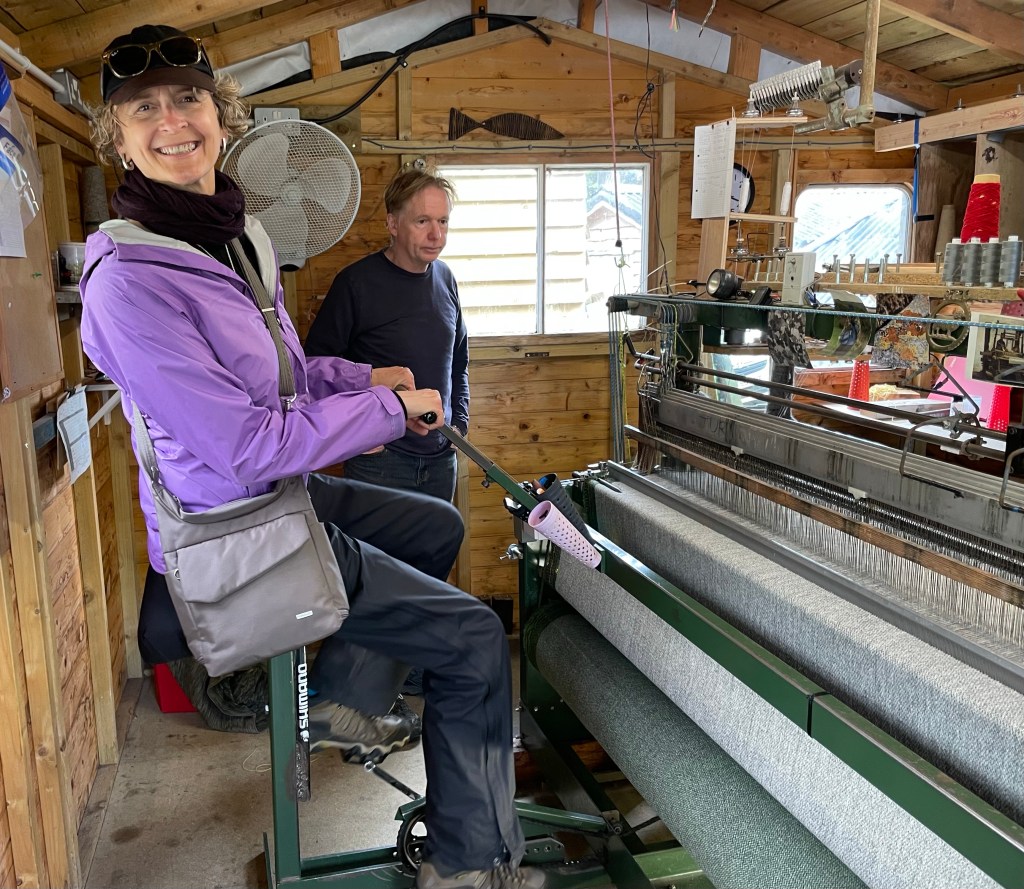
Next we visited Skye Weavers. There are craft artists all over Skye but this particular weaver was called out in travel books. Their looms are bicycle powered. We met Paul, who showed us how it all works and gave us a go. I hope he didn’t have to undo what I did. Also it must be hard to be trying to work while constantly being interrupted.
Paul looks less than impressed with my weaving prowess. Hopefully made up for it by buying a scarf and flat cap.
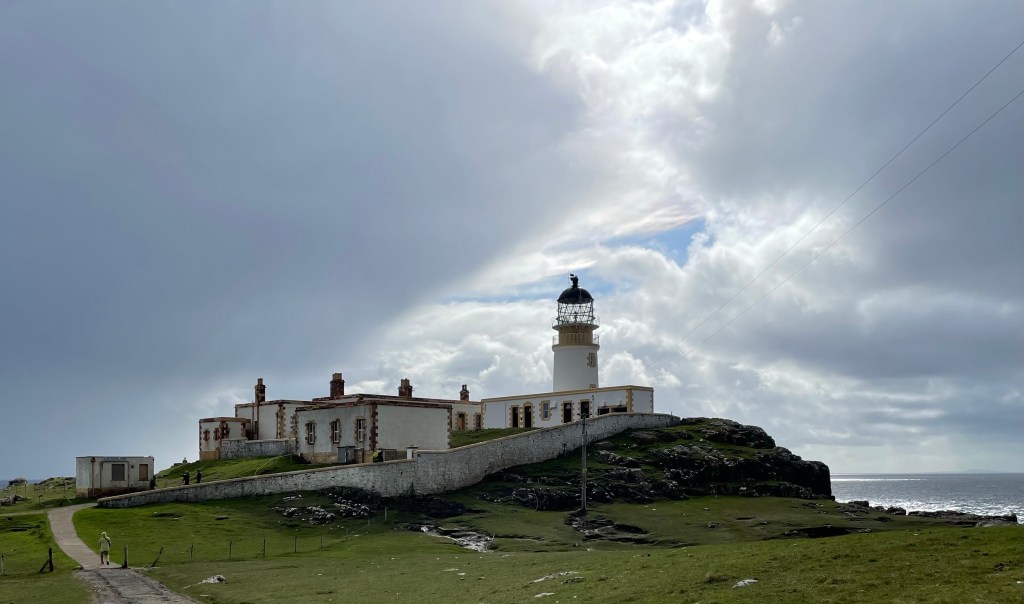
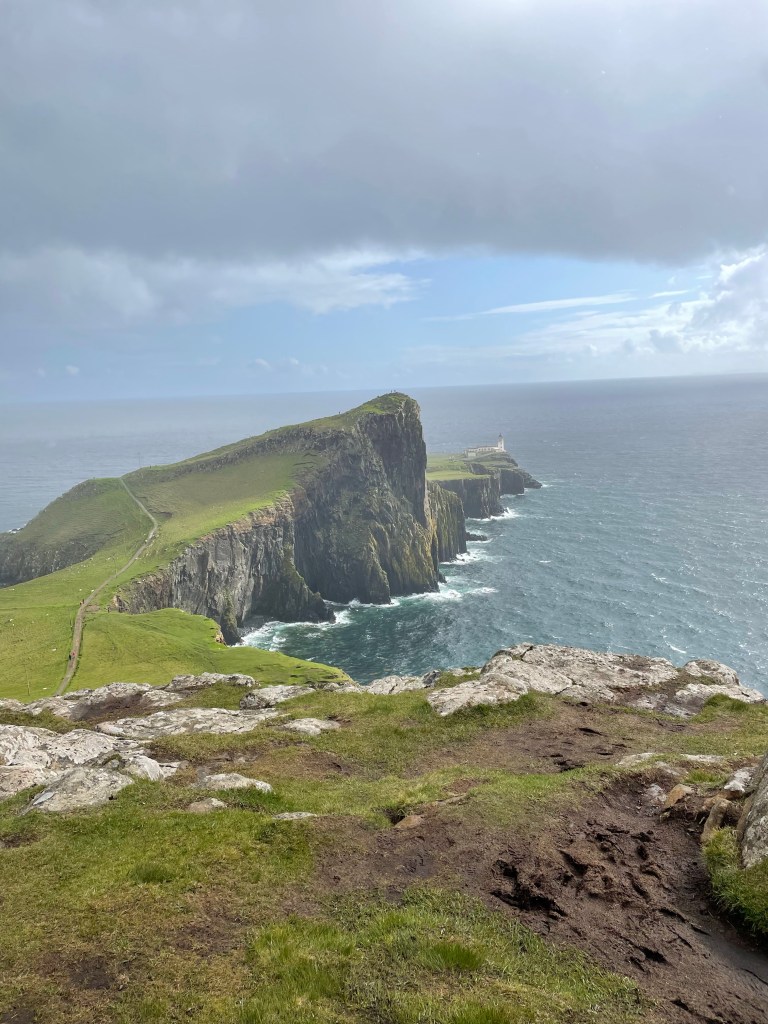
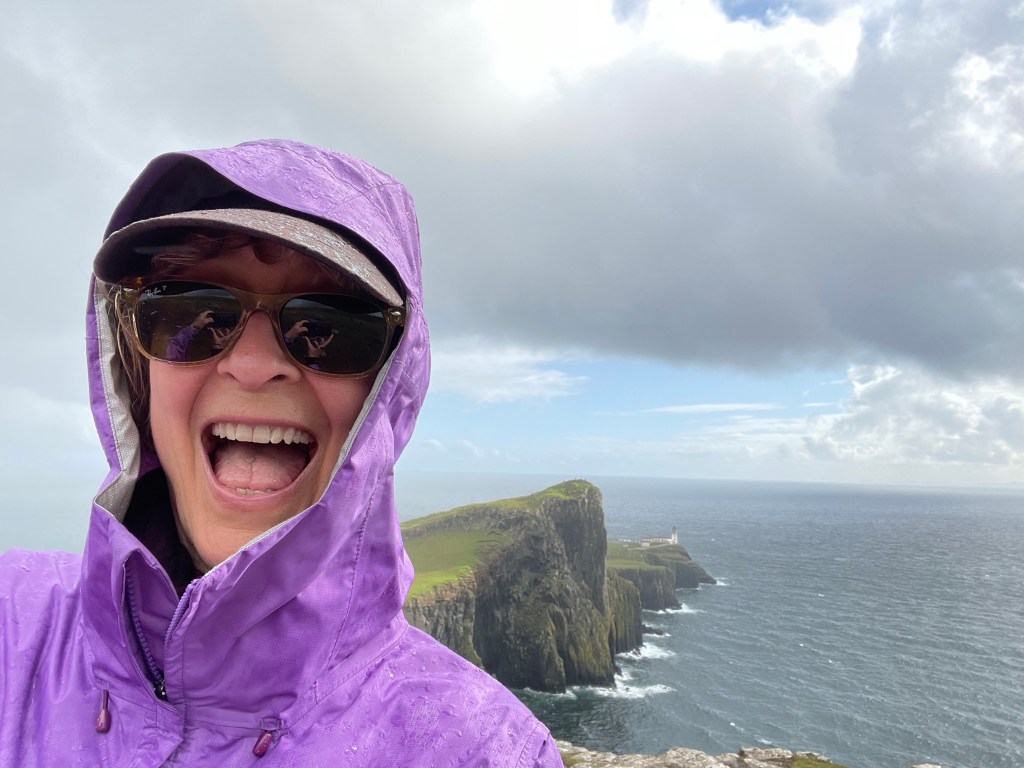
Finally we did a cracking hike to Neist Point Lighthouse in spectacularly crazy weather. (Dipping into British adjectives because running out of American ones). At one point my foot got sucked into a bog up to my ankle. I fell to all fours, afraid I’d never see my boot – or perhaps even my foot – again. I was able to yank it free with a supremely satisfying sucking sound. Best thing is that nobody witnessed it. At this point I was laughing rather maniacally, but the crazy lady got some superb photos.
Ah, the Stevensons have been at it again.See the lighthouse way out on the point?Whatever crazy lady.This might be my favorite shot from Neist Point. If you squint you can see the Outer Hebrides.
I arrived back at the car covered in mud after walking through a torrential downpour. Just half an hour later after a change of shoes and using my hiking socks to wipe away visible mud, we were sweeping into The Three Chimneys, Michelin stars notwithstanding.
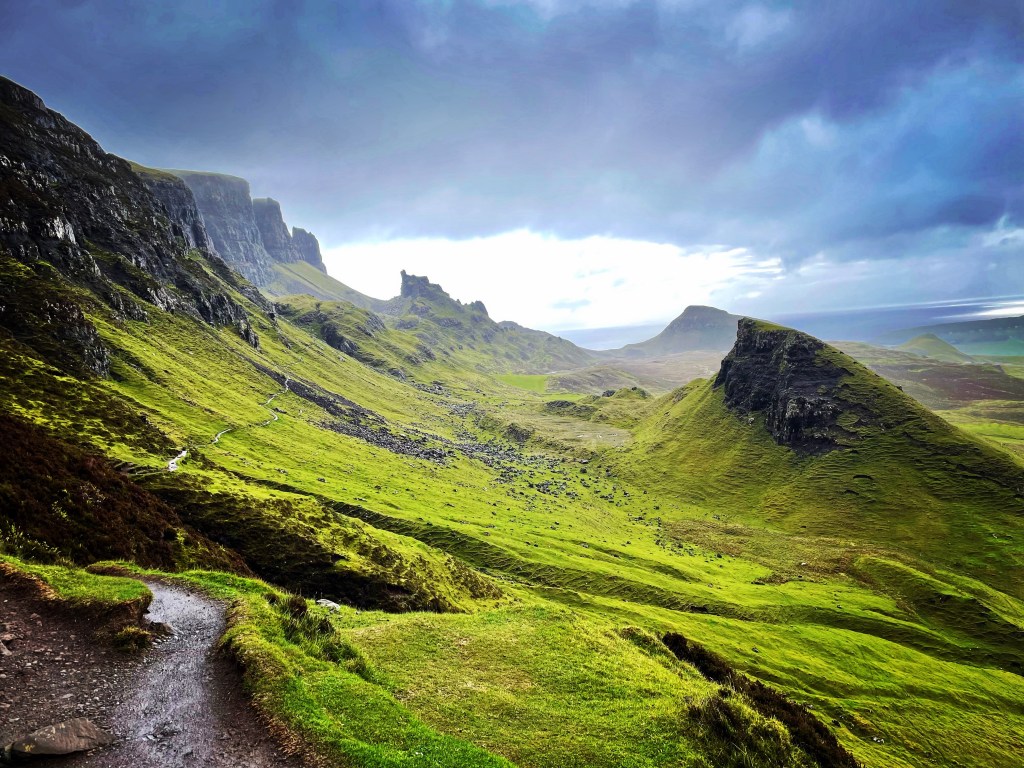
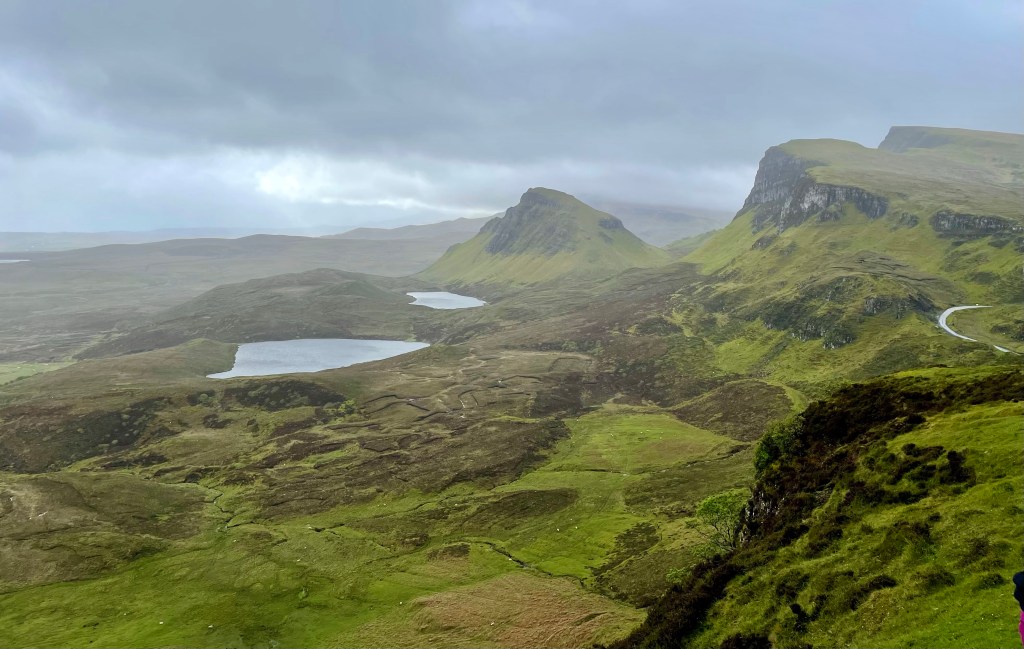
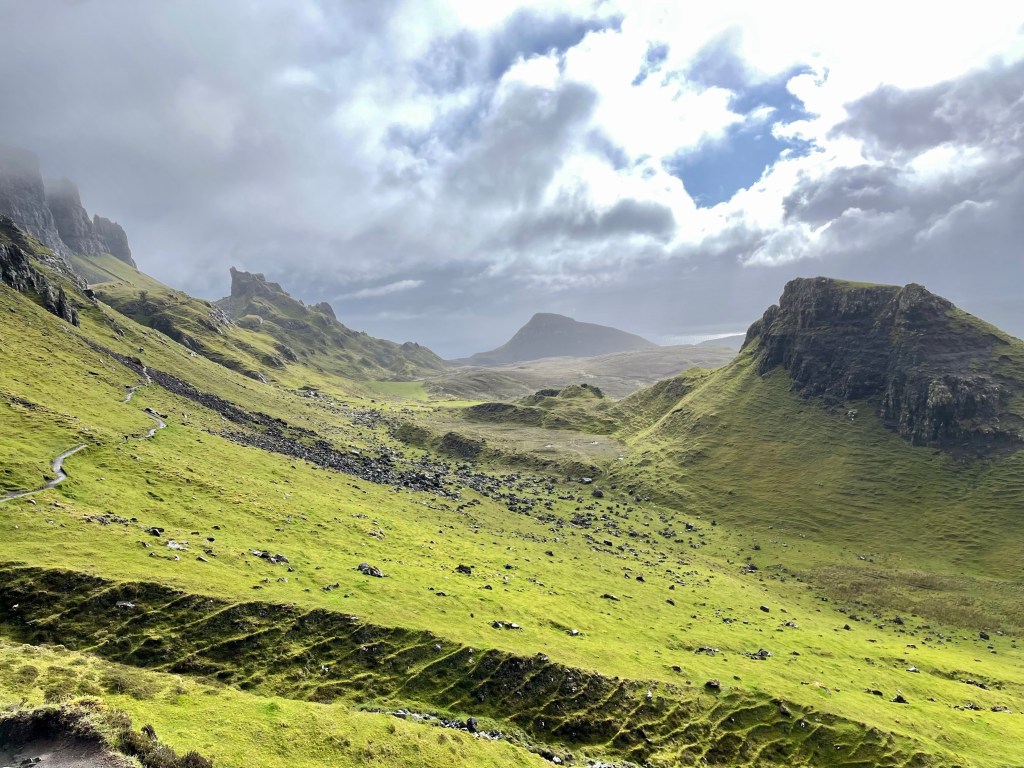
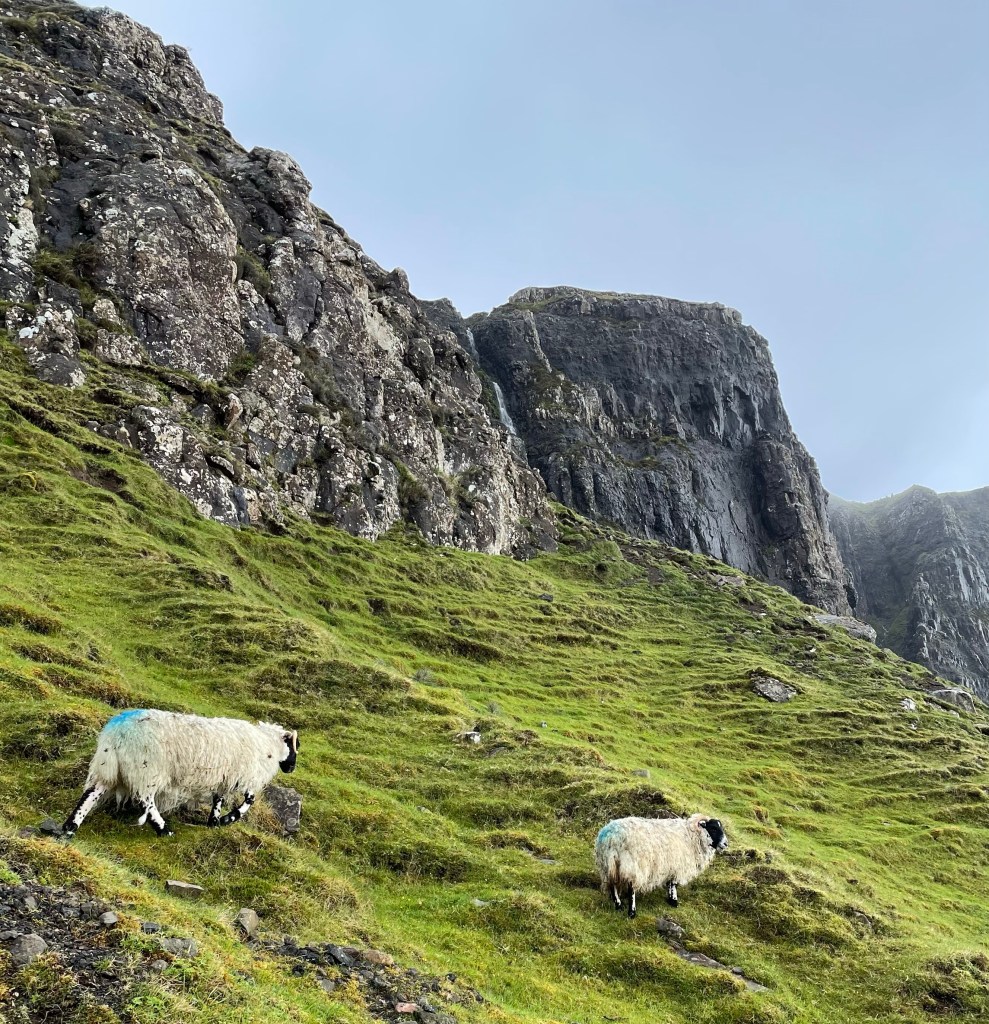
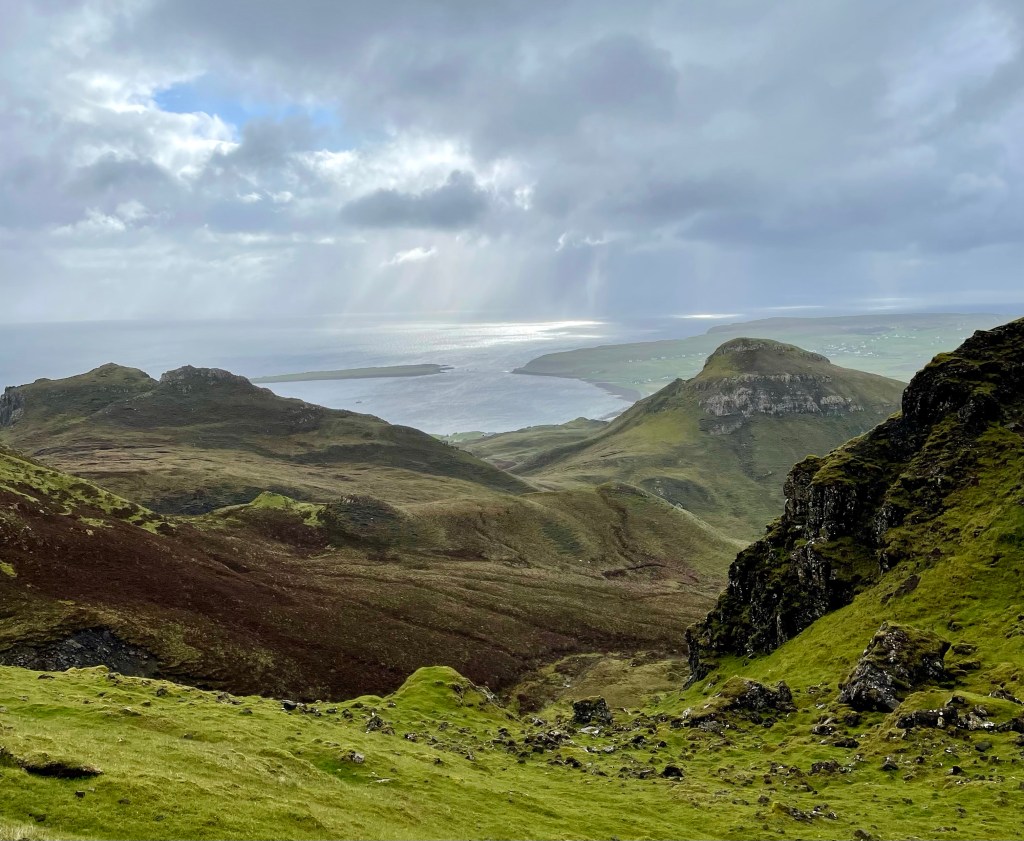
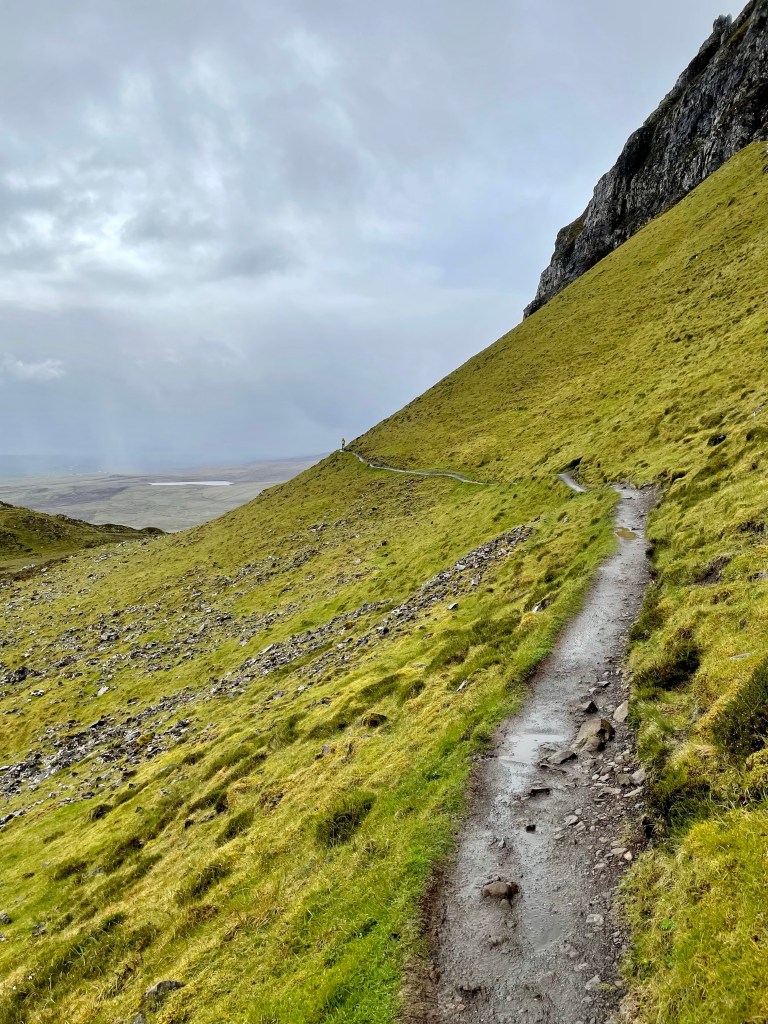
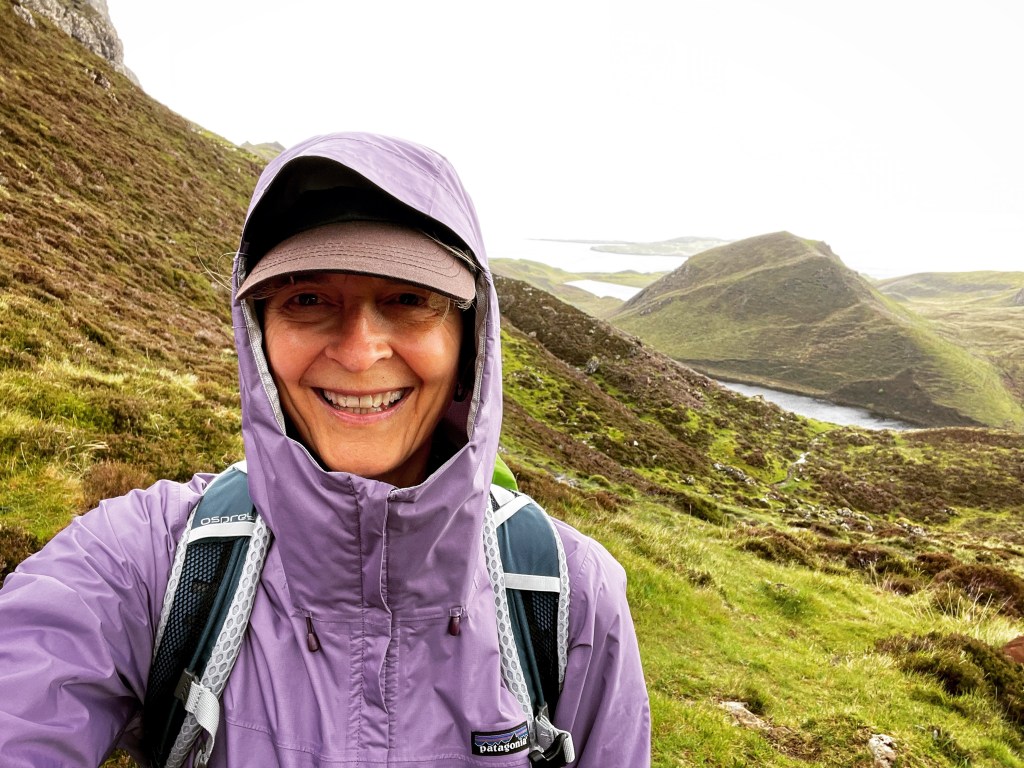
For our last full day on Skye we decided to tackle the Quiraing. Weather be damned. And the weather was indeed damnable. To avoid crowds we arrived at the car park around 7:45, joining just one other crazy person. It was raining sideways, windy and foggy. We communed with our inner intrepid selves and just did it, as the shoe says. The weather changed about 100,000 times during our three hour hike through rivers, waterfalls, mud, along the cliff edges, all the things one’s mother would rather not know about. (Hi, Mom). And it was SO glorious and only occasionally miserable.
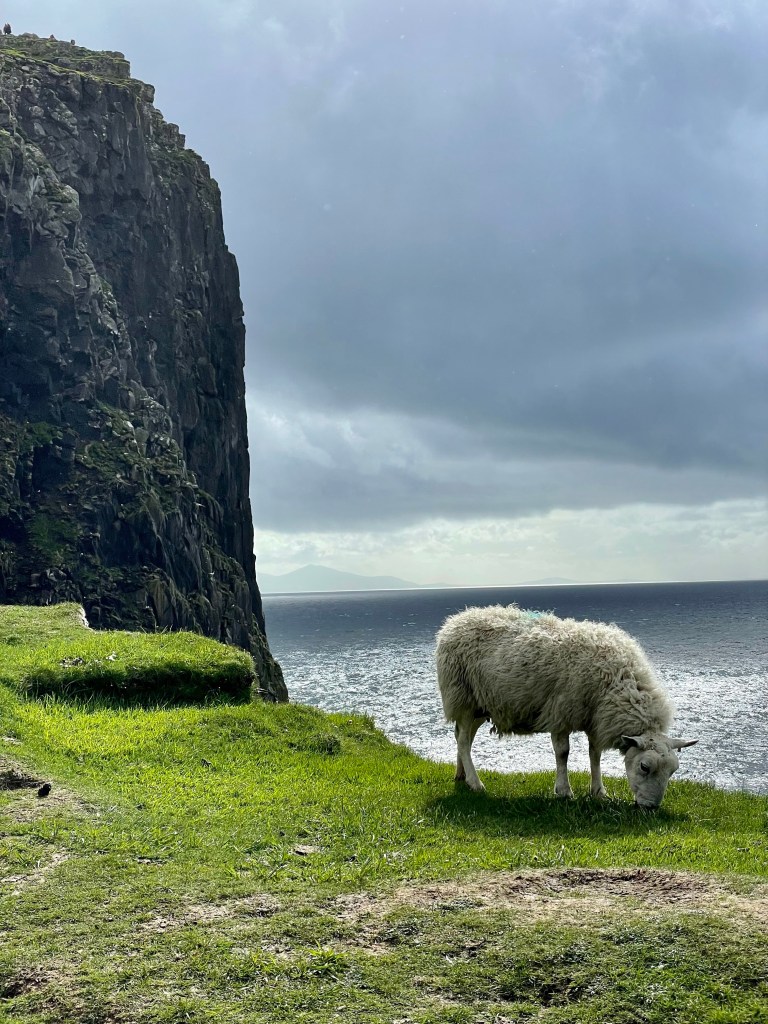
There must always be a sheep photo.Yikes don’t look Mom. Also note the person coming our way. Happiness.
Tomorrow, we’re hitting the Fairy Pools early and then heading to Glencoe. We are nearing the end of our trip and how can that be?
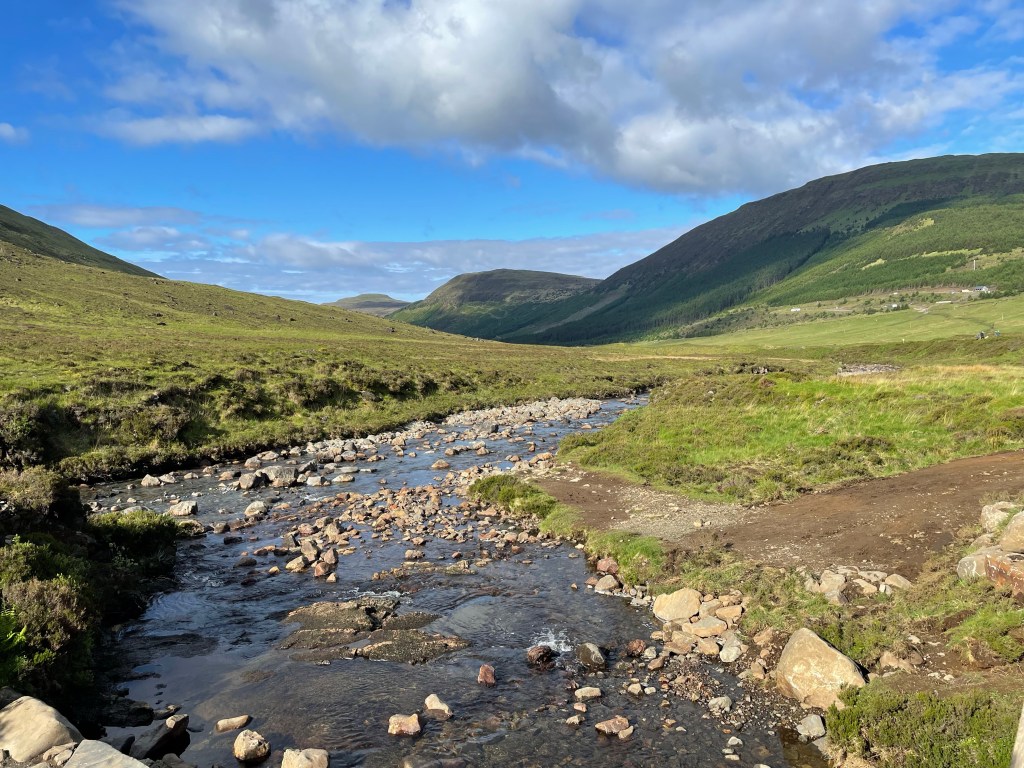
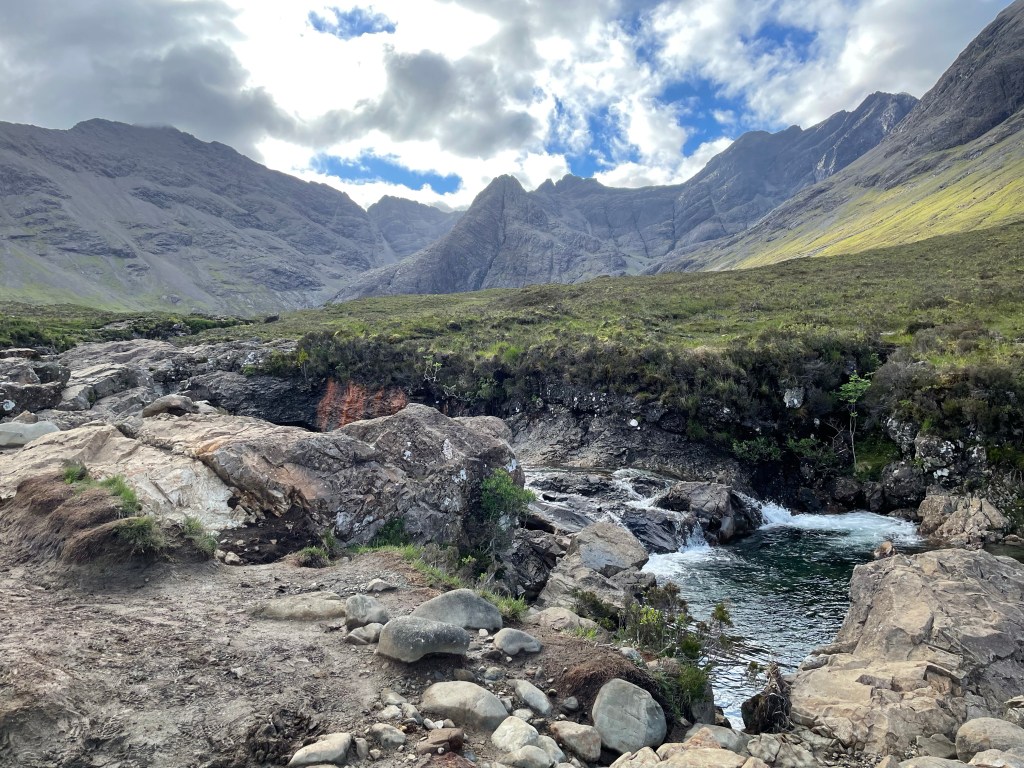
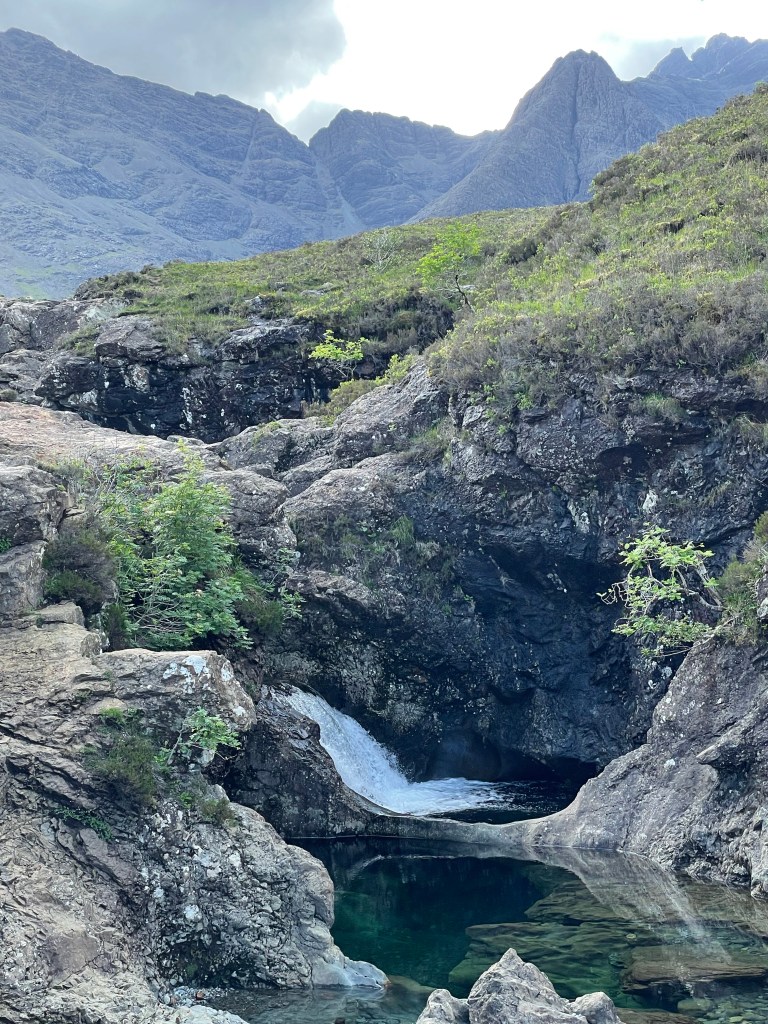
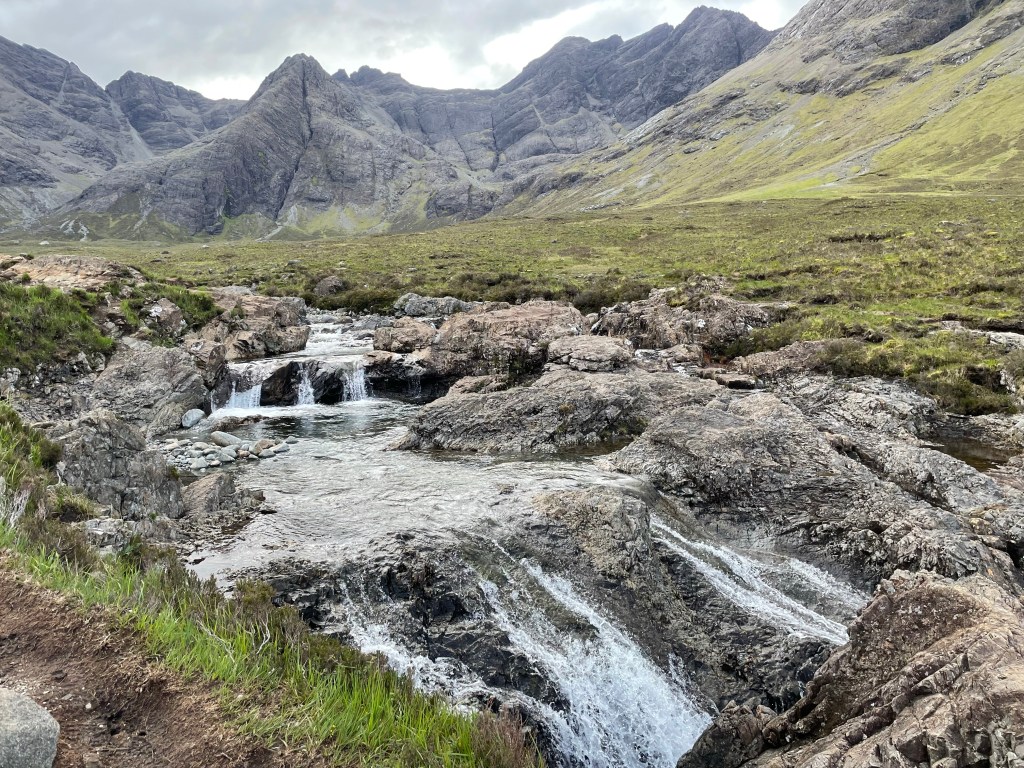
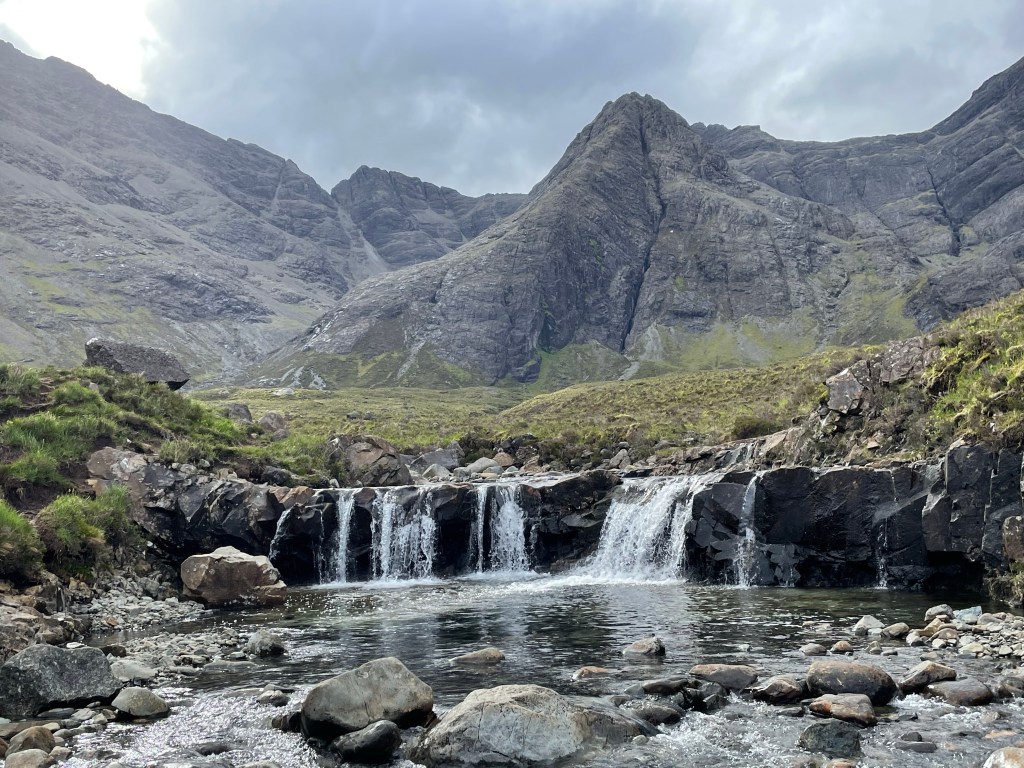
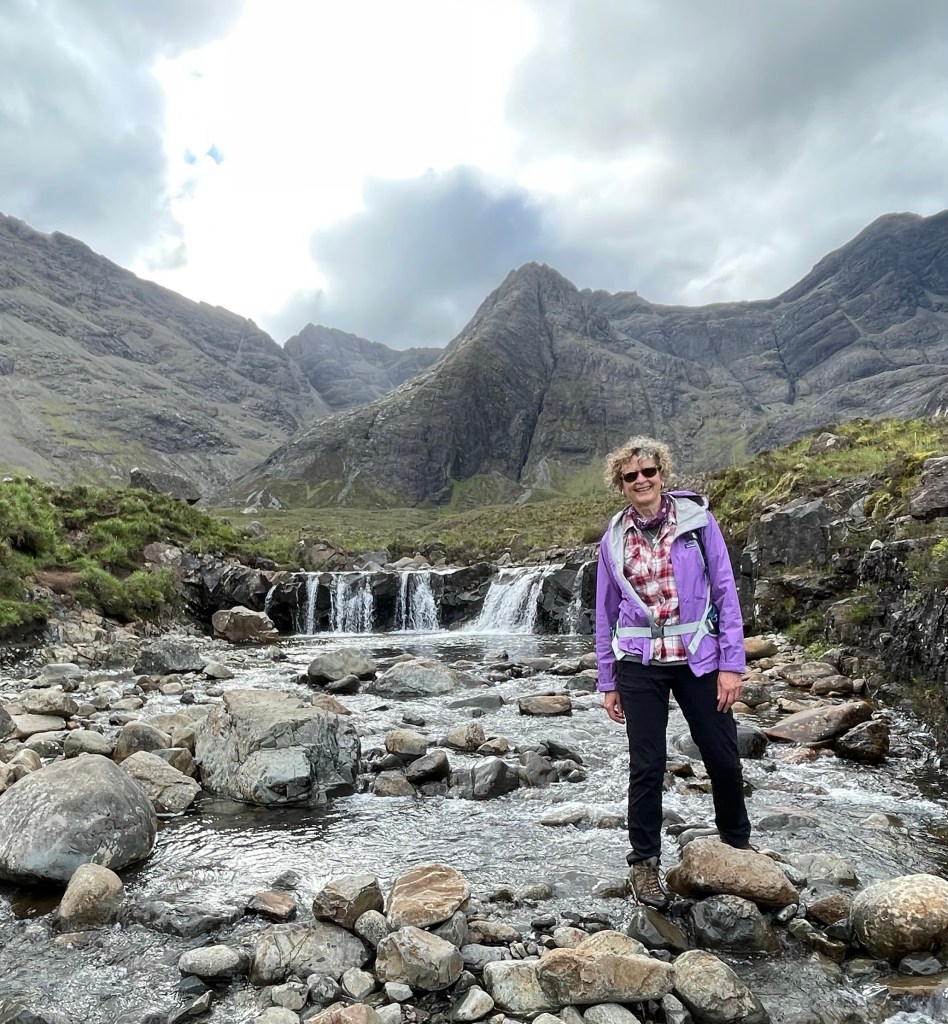
We planned an early launch from our AirBnb to beat the crowds to the famed Fairy Pools of Instagram, our last official stop on our Skye Grand Tour. We arrived at the car park around the sweet spot of 8:00, finding official flourescent-vested guys already directing folks where to park. We crossed the road and hit the trail, walking along a clear glass river with multiple waterfalls and translucent pools, surrounded, as ever, by mountains.
Apparently during summer months, the trail is very crowded with nary an unpopulated pool. On our way up, a single naked couple was taking a tentative dip in one of them. In full view of the trail, but sure. Also brr chilly. Other than this nudie tourist sighting, we had the place to ourselves.
We at last came to the most popular spot of the journey – for good reason.
On our return, many people were venturing up the trail clad in all manner of clothing and footwear, bringing along dogs, kids and so on. It’s hard not be feel concerned about the beating this magical place takes every single day.
Honestly the struggle against going full misanthrope is real.
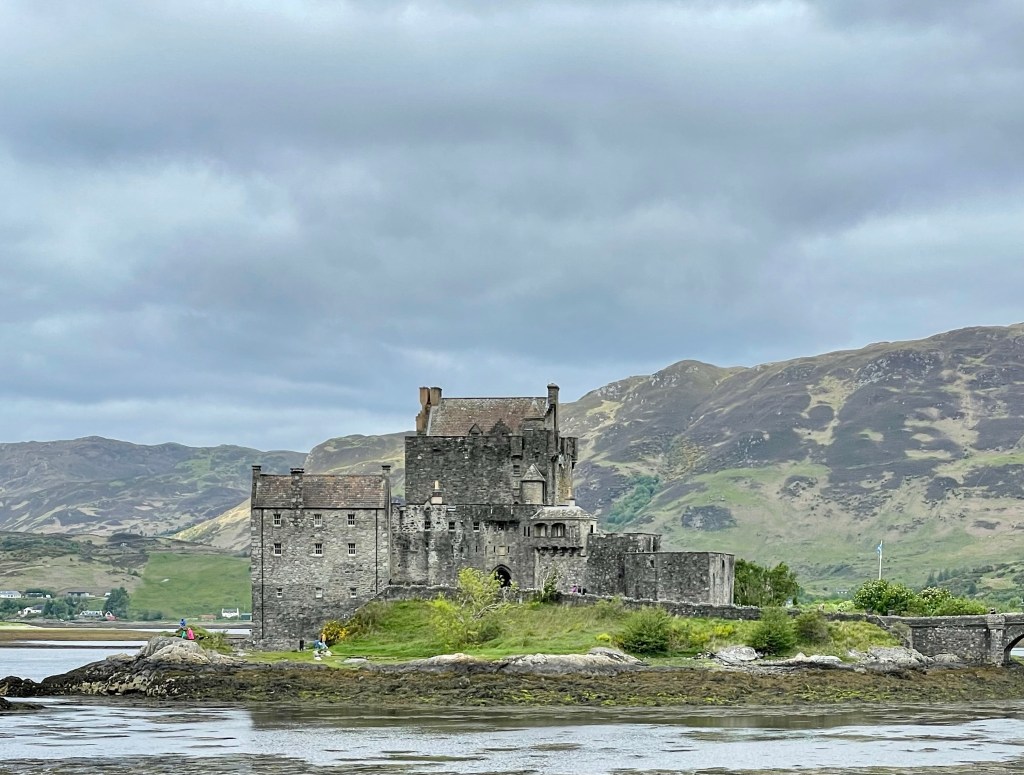
To add grist to the argument in favor, our next stop was Eilean Donan Castle, another star of stage, screen and Instagram. I had thought it was a ruin. I had never seen shots of the inside of the castle, and generally exterior photos are entirely bereft of people, incredibly romantic, secluded and mysterious. Well. It’s a beautiful castle to be sure, but it has the honor of being the only thing in Scotland that hasn’t entirely exceeded my expectations.
The original castle was built in the thirteenth century. A founding legend tells us that the son of a chief of the Mathesons had the ability to communicate with birds, and as a result, after many adventures overseas, he gained wealth, power, and the respect of Alexander II, who asked him to build the castle to defend his realm. The castle later ended up in the hands of the MacKenzie and McRae clans. The MacKenzies claim that Robert the Bruce sought shelter there. Even though there is zero evidence of this, I’ll allow it.
At last, after hundreds of years of defending the realm, Eilean Donan’s story came to a close. In response to the MacKenzies’ involvement in the early Jacobite risings, government ships destroyed the castle in 1719. It was gone.
Or was it. Incredibly, the castle was rebuilt in the early 1900s. While the Edinburgh-based architect followed the extant ground plan, the details are different, as many of the original plans weren’t discovered until after the reconstruction. It looks cool, no doubt, and as such is one of the most visited castles in Scotland. It has also been a shooting location for a bunch of movies, including a stint as the Scottish headquarters of the MI6 in The World is Not Enough, filmed during James Bond’s unfortunate Pierce Brosnan period.
You guys. It’s like Disneyland and I mean that in the worst possible way. Besides the fact that the castle was recently entirely reconstructed, and so is pretty much fake, it’s flanked to the south by a giant car park. Giant. Packed to the gills with cars and buses. Directly in front of it is a visitor center campus, including a cafe and gift shop. Yuck.
Even so, since we were there and all, we toured the castle. Yet another lock of the Bonnie Prince’s hair is on display, even though Charles could not have had any connection to the castle since it didn’t exist during his lifetime. Unlike Flora MacDonald’s specimen, this one is substantial enough that I wondered whether someone had to hold the Prince down to get it. I suspected that it could be a prop for the tourists. Finally, in all fairness to me for my very mistaken impression of this place, the reason I’ve never seen photos of the inside of the castle is that you are strictly speaking NOT ALLOWED to take inside photos. This is the first such warning I’ve seen in laissez-faire Scotland.
So at last, after all the build-up, here are my pics. Note the absence of people. These photos might accurately reflect a brief moment in time, but they are, in their overall essence, a lie.
Eilean Disney Castle
A side note: my apologies for complaining about tourists. After all, I am one. And don’t get me wrong, the vast (seriously, vast) majority of our time in Scotland has been a marvel of existence in a remote, wild and magical place with very few people. All of my other photos are accurate representations of the solitude we experienced. It is this sense that you are the only person in the world which makes it so jarring and mellow-harshing to encounter other humans. The fact that there are tourists at tourist spots should be a surprise to nobody, including me. But it’s fun to rant.
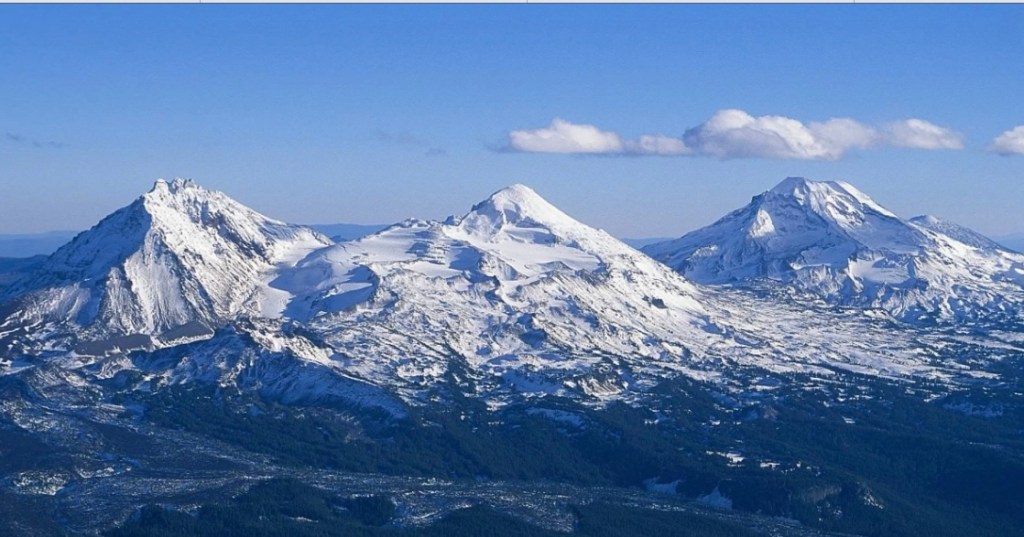
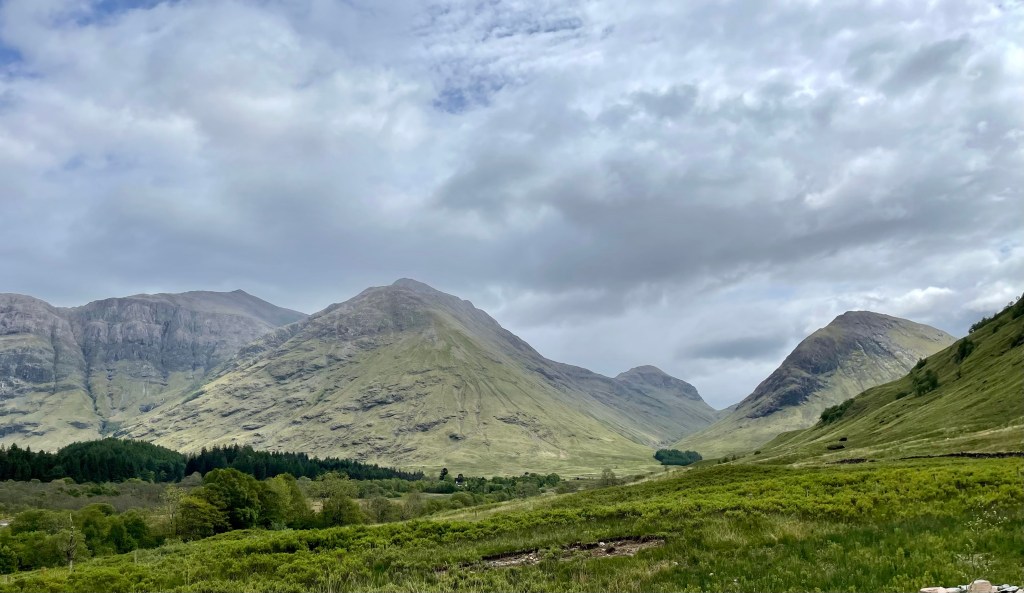
We bailed from Eilean Disney Donan and fled toward Glencoe, our next destination. We drove down the stunning, impossibly green valley surrounded by towering mountains, completely in awe. And I would be remiss if I didn’t give a shout-out to the “Three Sisters” which I love because we have mountains by the same name in the Central Oregon Cascades.
Glencoe’s version of the Three Sisters.Central Oregon Cascades version.
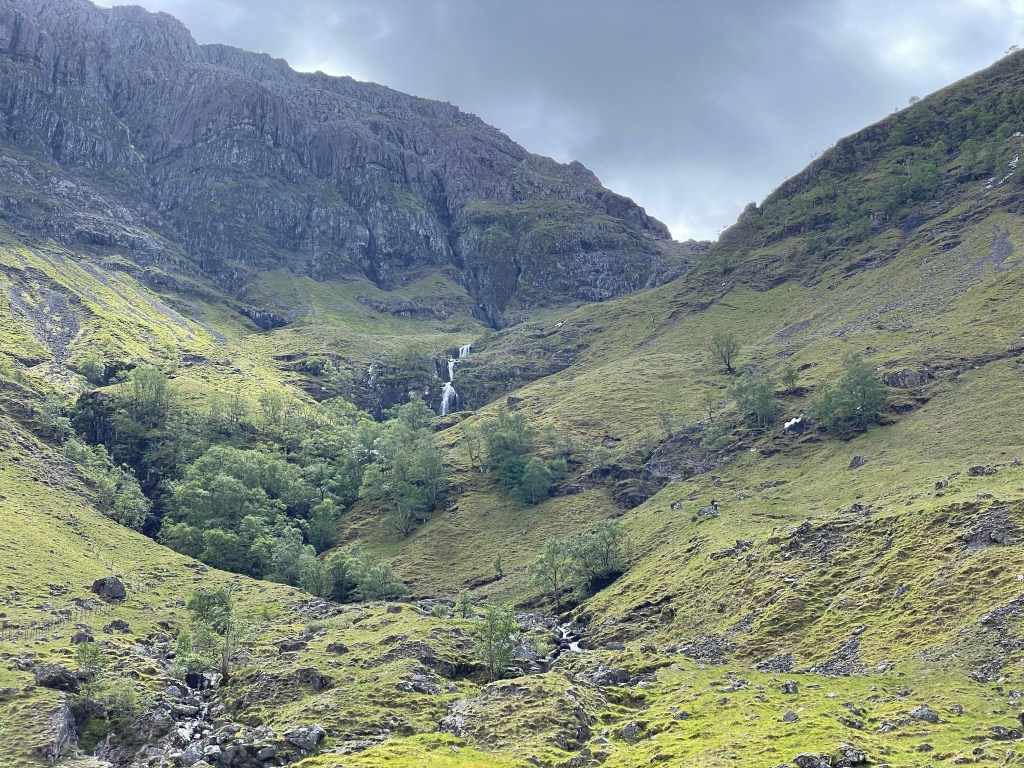
The glen holds eight of Scotland’s munros and thus is a haven for mountain-baggers. As you can see, the terrain is incredibly steep and the trails are vertical, none of this switchback nonsense.
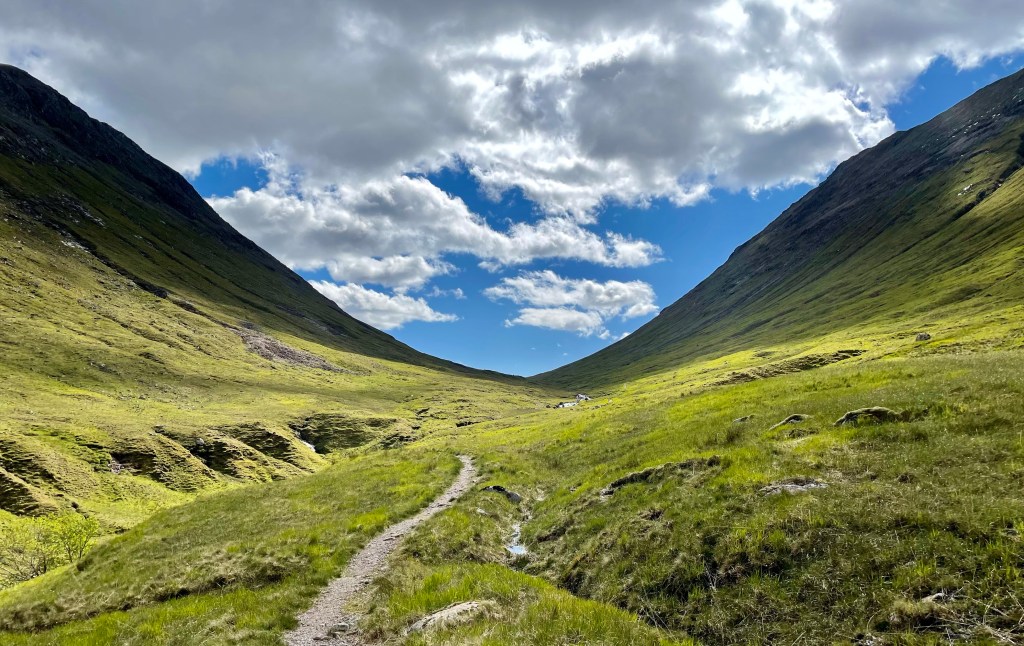
Glencoe is beautiful, unreal and unspoiled even with tourists. It’s a wonder how so many of them pull over into the car park, snap a photo, and bounce. They can easily be ditched simply by taking a few steps down a trail. We hiked along one that borders the River Coupall (thanks for the recommendation Paul and Melisse!) which was otherworldly. I honestly don’t even know what to say about it.
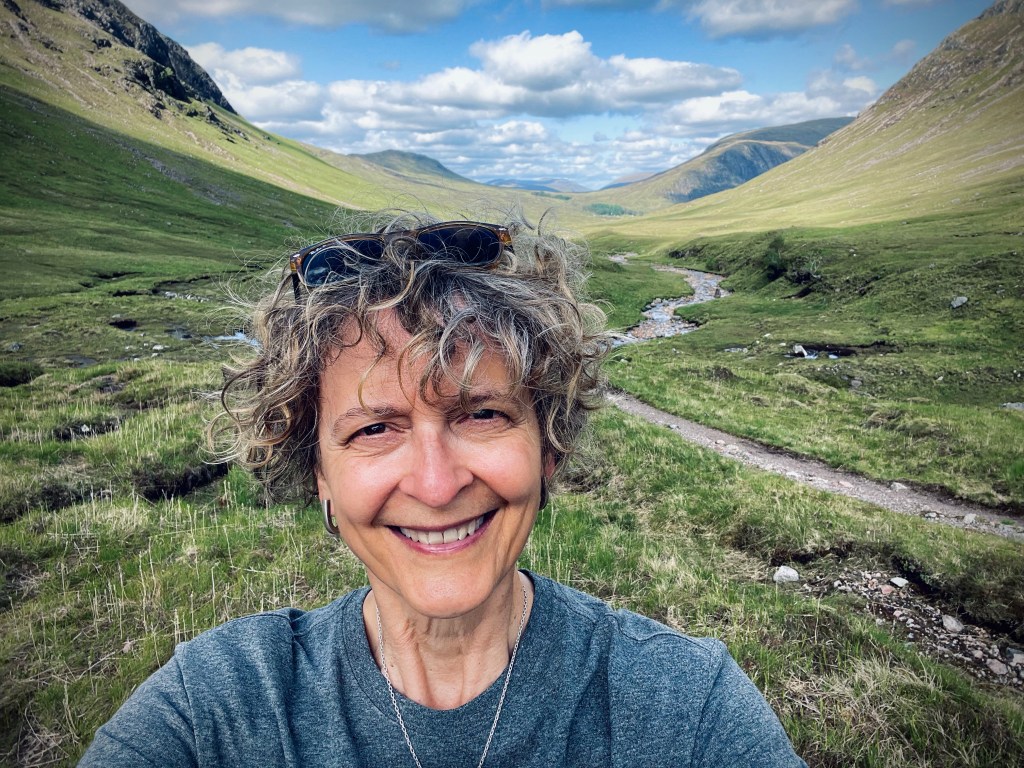
After a couple of miles I continued on alone and Scotland was giving me all the magic. I kept thinking if I kept going I’d reach the notch of the valley, but the longer I walked, the more it retreated into the distance. Metaphor alert. Some things you can never reach because the journey is the thing.
Which brings to mind – and I haven’t yet mentioned this – my dad died in January of this year a few days after I lost a dear friend and it has all been extremely difficult. Sometimes I wonder whether I have fully processed their departures or what that even means really. Anyway, my dad has taken to showing up at random times, and he joined me as I finally abandoned my quest to reach the end of the valley, turned and headed back. Dad never expressed an interest in Scotland, but I think he would have loved it and I did miss telling him about Dougal and driving on the wrong side of the road. The loss hit me anew right there in the middle of one of the most beautiful spots on the planet. I know this will continue to happen forever and that’s okay. I have graduated from nearly debilitating grief to a sadness that dances near the edge of being comforting. The odd thing is that I’m still so surprised that he left. I knew he wouldn’t live forever but I also thought he would somehow.
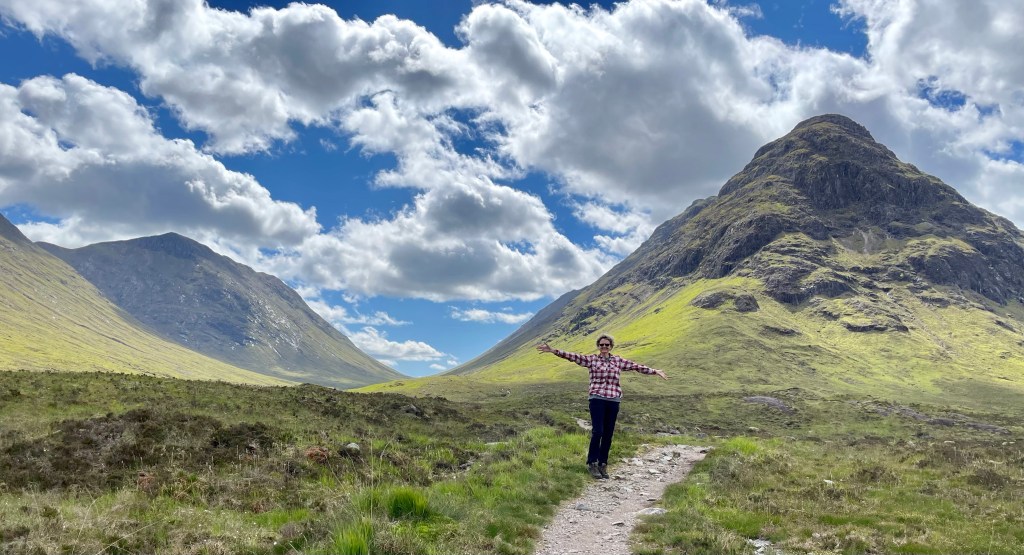
Being in this place I love has brought me a lot of peace and maybe a smidge of healing. My patronus charm is easily cast here. I have no idea why, but I feel stronger, more connected and more fulfilled moving through these hills. And completely happy. When I see myself in photos the difference in my face is remarkable. A reminder to stop making life about moving from one thing to the next, errand after errand, accomplishment after accomplishment, dealing with thing after thing after yet another thing. It takes a toll to live like that. Much better to move through the hills and accept the solace they offer.
And so. Speaking of the patronus charm, here is your segue alert.
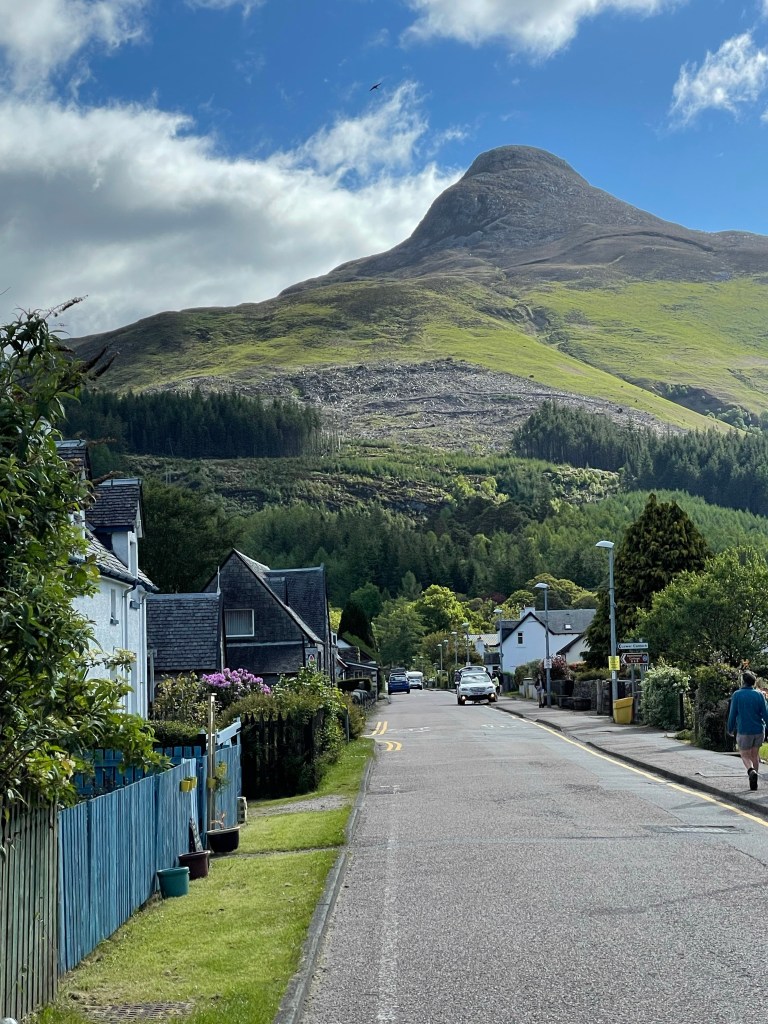
The next day we walked an embellished version of the Glencoe Orbital Track, which launches from the charming town itself and features fabulous stops and points of interest, including (spoiler alert) Hagrid’s Hut. You heard me. The track is billed as an hour-long walk but of course somehow we extended it to about eight miles. YES.
Main Street, Glencoe. The Pap of Glencoe overlooks the town.
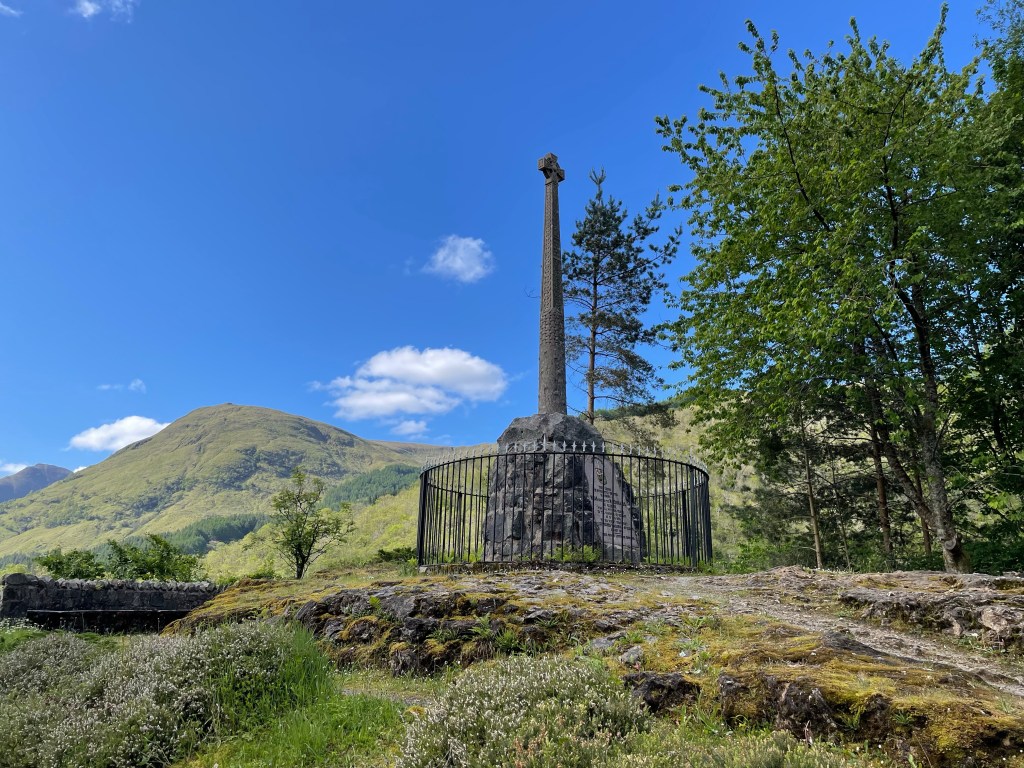
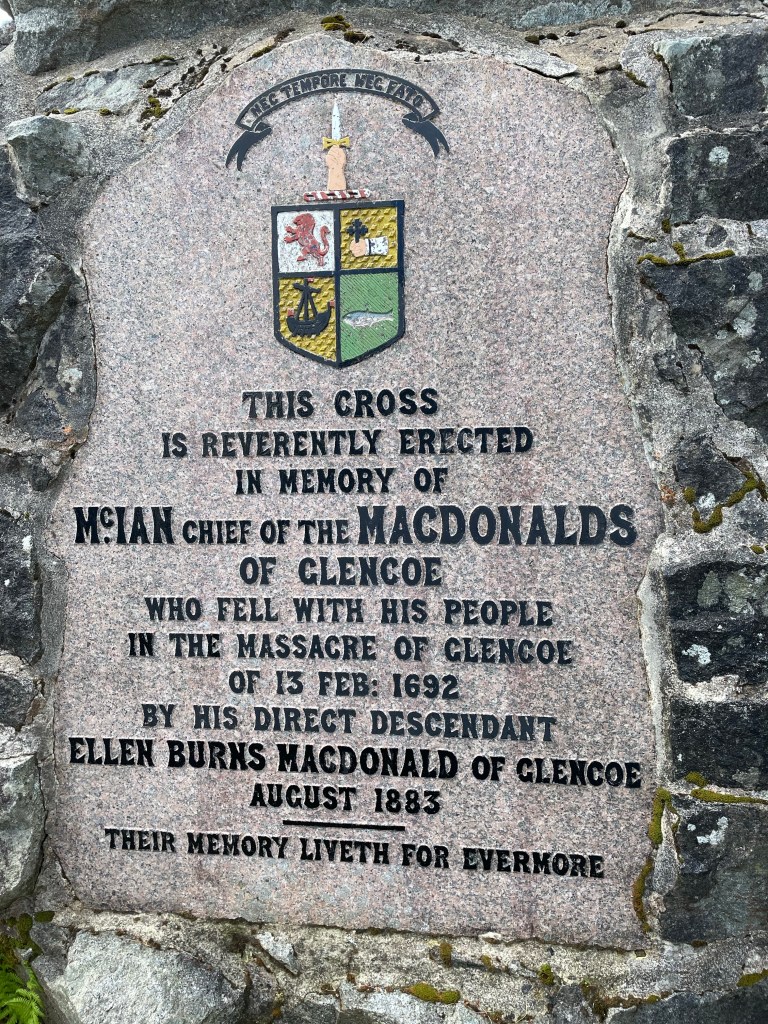
Along our way, we stopped to pay our respects at the Glencoe Massacre Memorial. At this point I wonder whether you have grown weary of history. Too bad, it’s not your blog. Glencoe is perhaps most well-known, from a historical perspective, as the site of the infamous Glencoe Massacre of 1692. The story, stripped to its bones, is that the MacDonald clan, settled within the glen, was delayed in affirming its allegiance to the crown of William and Mary, demanded in the face of rising Jacobite sentiment around the Highlands. There was actually a massive misunderstanding about whether the clan had timely made the oath. The crown, nevertheless affronted, decided to make an example and ordered the 128 Scottish government forces who had been quartering there for 12 days – taking advantage of the legendary Highland hospitality – to kill everyone. While some soldiers refused, and others tried to warn the MacDonalds in preceding days, enough remained to do the job. The soldiers turned on their hosts in the early morning hours and butchered them, men, women and children up and down the glen. Many of those who made their escape froze to death. The leader of the massacre was one Archibald Campbell, 10th Earl of Argyll. The Campbells and the MacDonalds had been feuding since the days of Robert the Bruce, but the massacre was a bridge too far and the Campbells have not been forgiven to this very day.
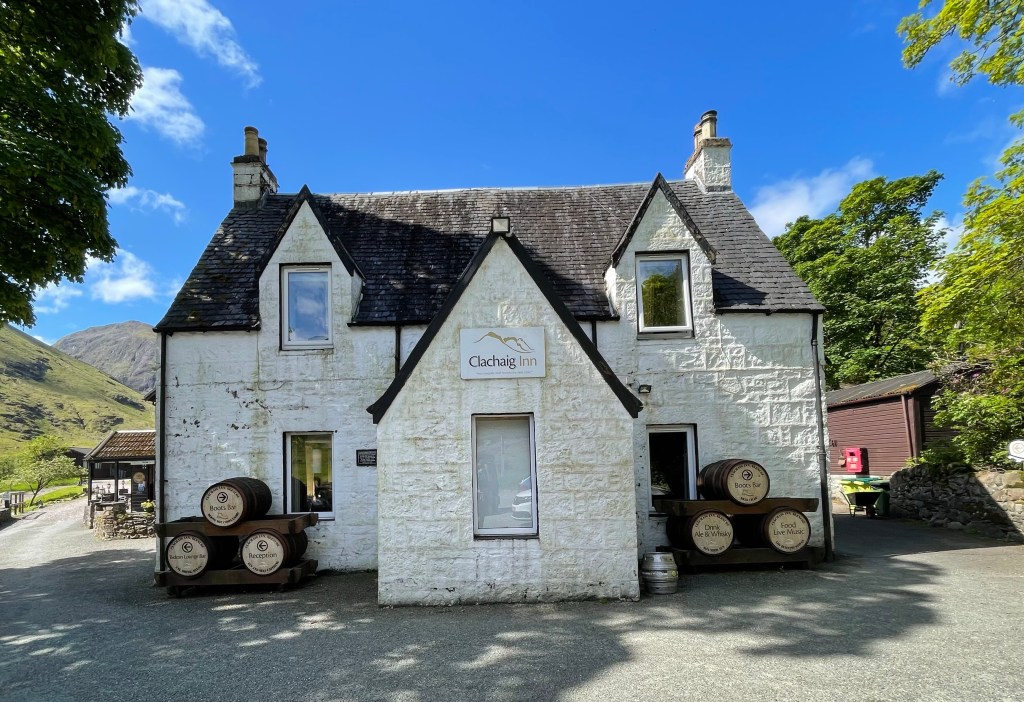
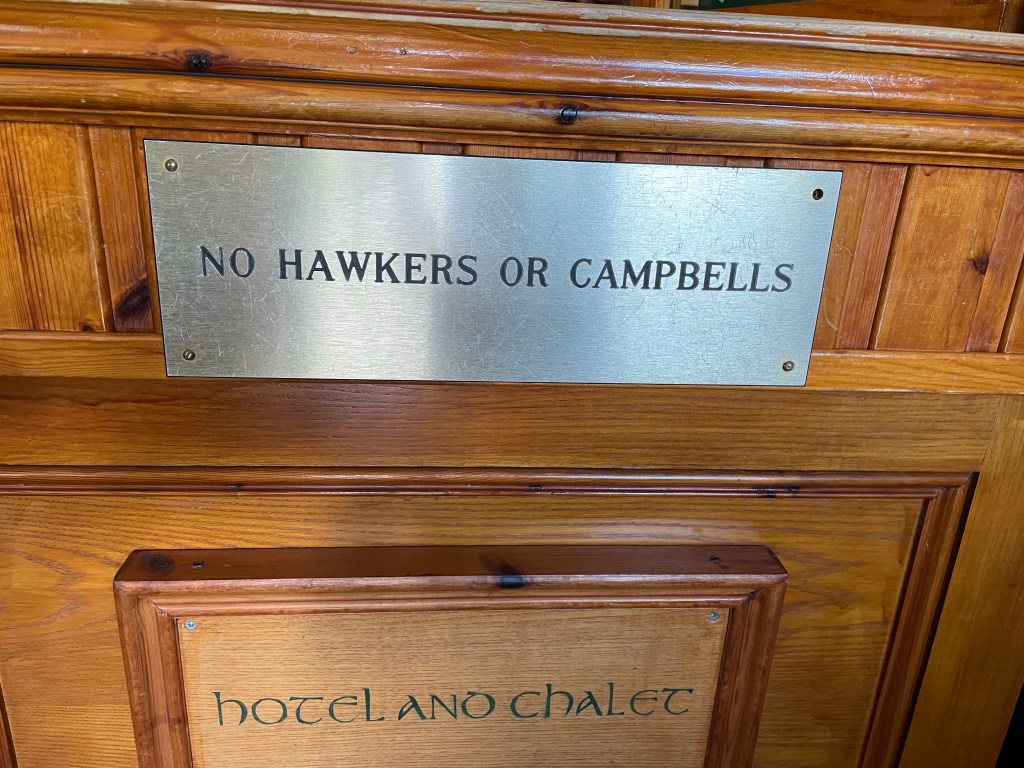
Our trail passed the legendary 300 year-old Clachaig Inn, a favorite lodge for hikers and climbers. We enjoyed a lovely lunch after snapping a photo of the notorious “No Camerons” sign posted at check-in, much to the annoyance of the woman behind the desk who I fear would liked to have massacred me in the wee hours.
The Clachaig Inn
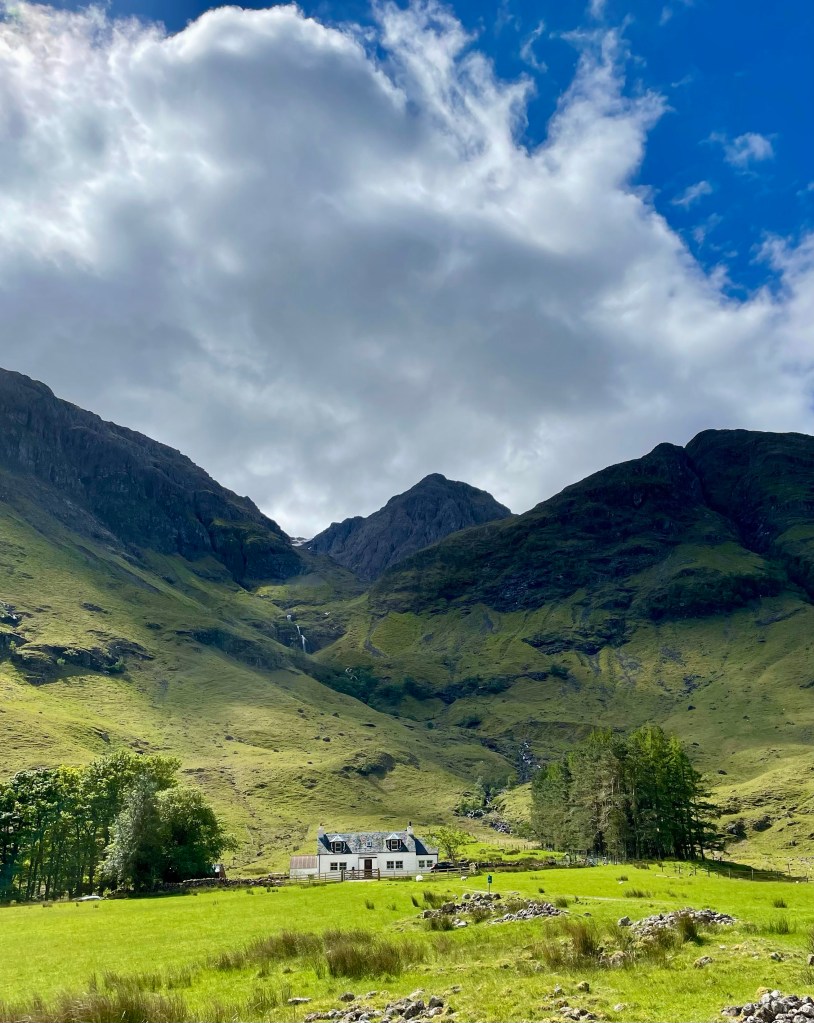
Next we walked to one of the iconic white houses in the glen, much photographed for obvious reasons, and then up to a waterfall.
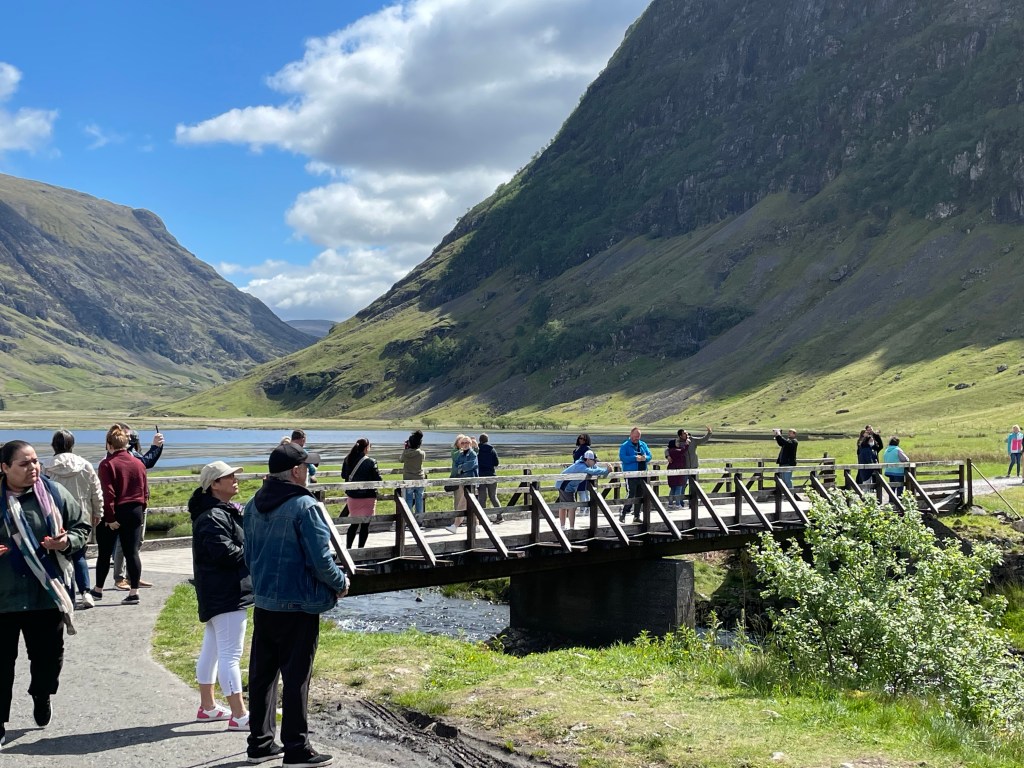
One more parting shot (I swear) re: tourists on buses. Here they are piled up on the bridge leading to the house. Which, by the way, is privately owned and occupied.
Photo only shows only a fraction of the humans disgorged from two large buses. Query: why is this a fun way to travel?Lovely waterfall just above the white house.
And shall we end with Hogwarts? As you probably know, many of the later Harry Potter movies were filmed in Scotland. Because obviously that is where Hogwarts would be. Along the trail we swung by the very spot where the set of Hagrid’s Hut was constructed. Most notably the location where Buckbeak almost lost his head in Prisoner of Azkaban. What I love the most is that “Hagrid’s Hut” is literally marked on Gaia, my hiking app.
Visiting Hagrid to inquire into the whereabouts of my Hogwarts letter.
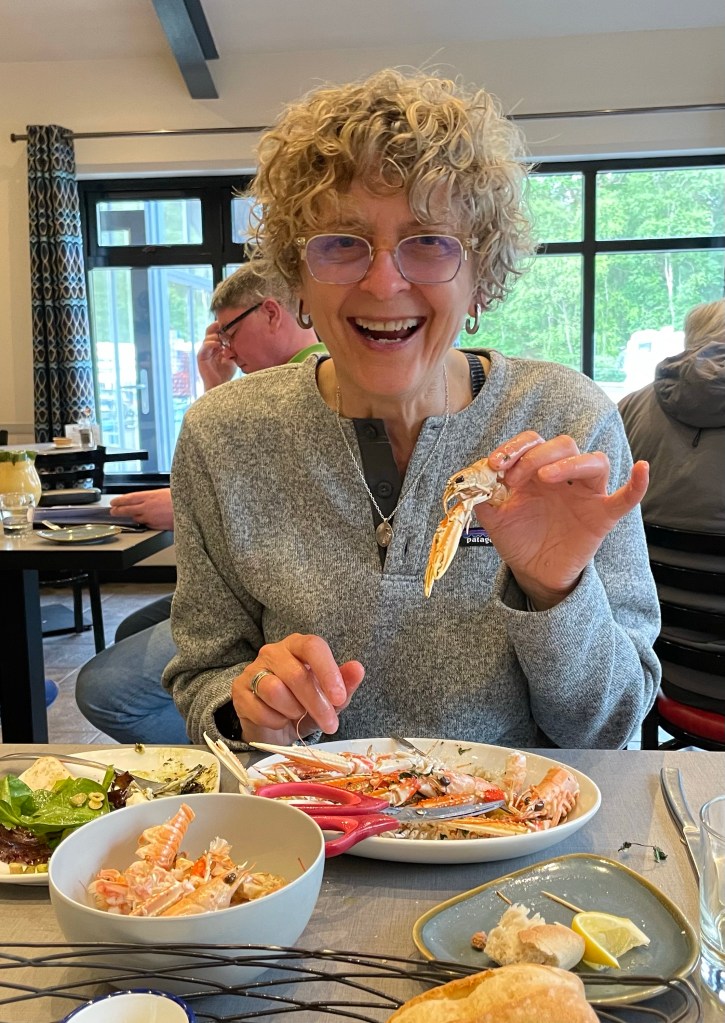
That evening we had dinner at my favorite restaurant since the Michelins, Lochleven Seafood Cafe. The company started as supplier of shellfish to restaurants and gradually morphed into a fabulous restaurant in its own right. They mostly offer shellfish with some sides. It’s brilliant. The fresh langoustines were out of this world.
Looking ahead to the final days of our trip, I’m excited about my Inverness birthday plans but a little leery about having to test negative for COVID to return to the states. It’s actually the Binax home antigen test that we all have stockpiled in a bathroom drawer, but it’s five times more expensive and you take it on video with a medtech person verifying results. There’s a bar code so you can’t cheat. If you test positive you have to quarantine in your location for ten days, which wouldn’t be bad if there were any hotels rooms to be had and if you weren’t entirely sick of your clothes. This is out of whack with current science so is mostly performative, and we’re the only country that retains this requirement, but the CDC is standing firm. Even if that hurdle is cleared, my only-an-hour layover in Amsterdam is looming around the edges of my travel anxiety as well. But no time for that. It’s time to head back to Inverness.















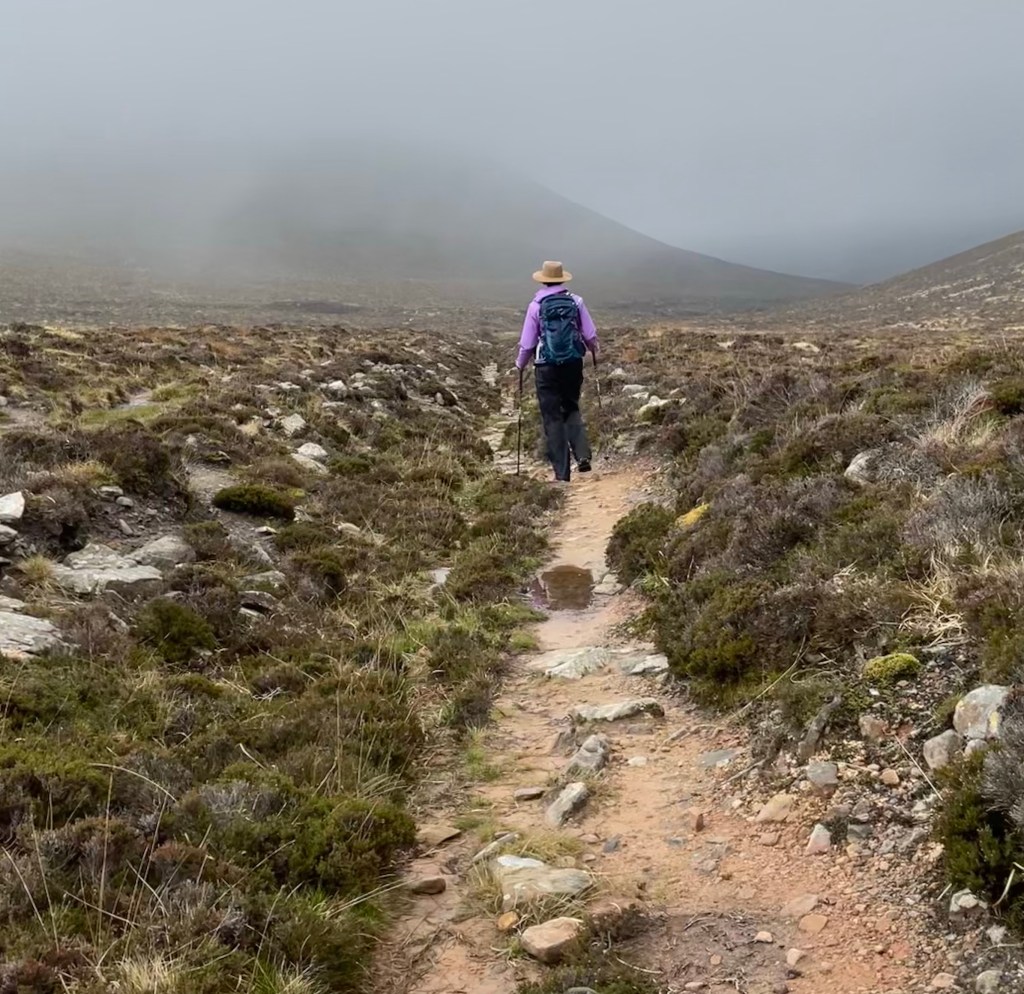
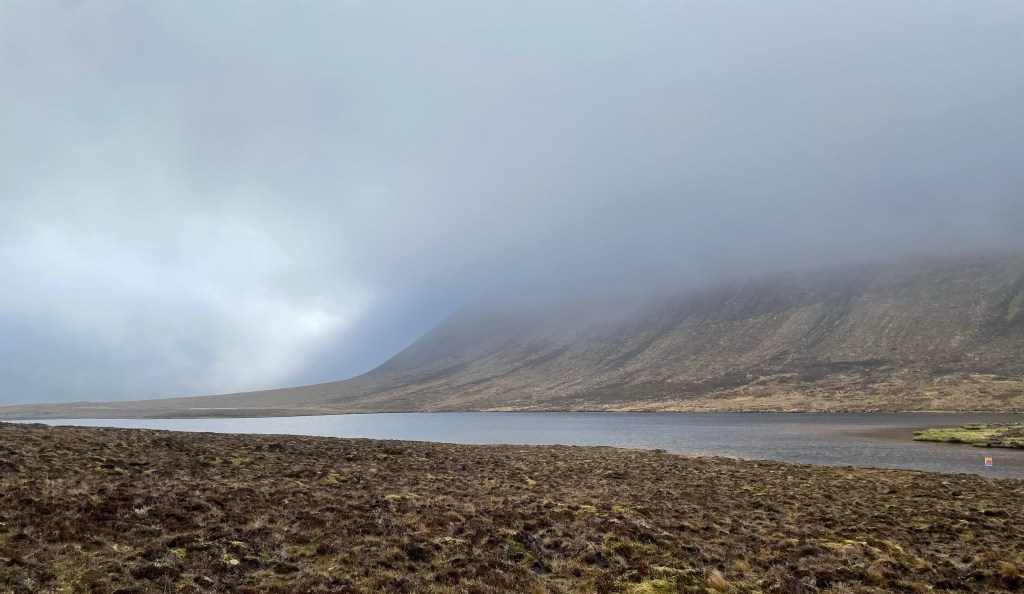
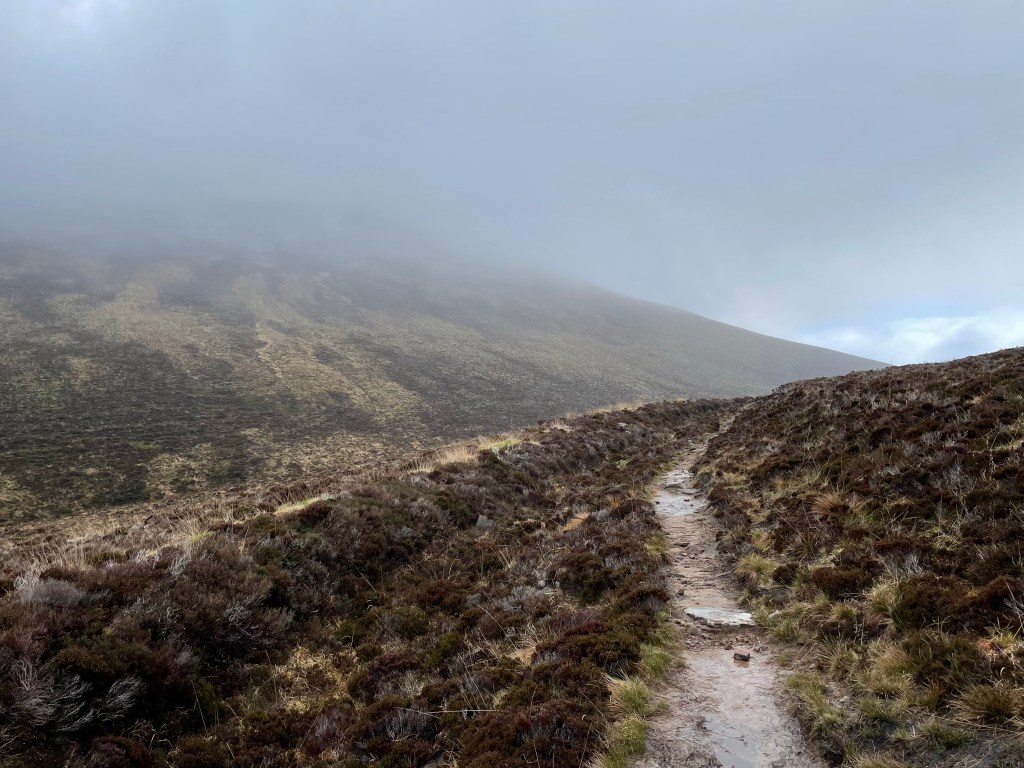
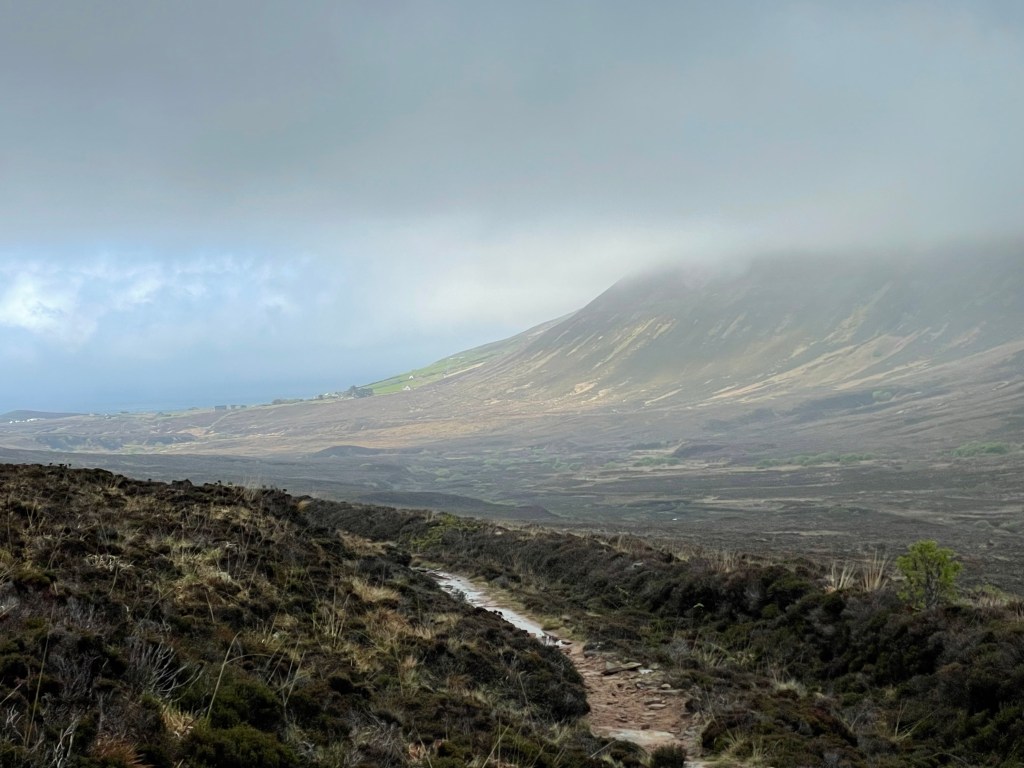


















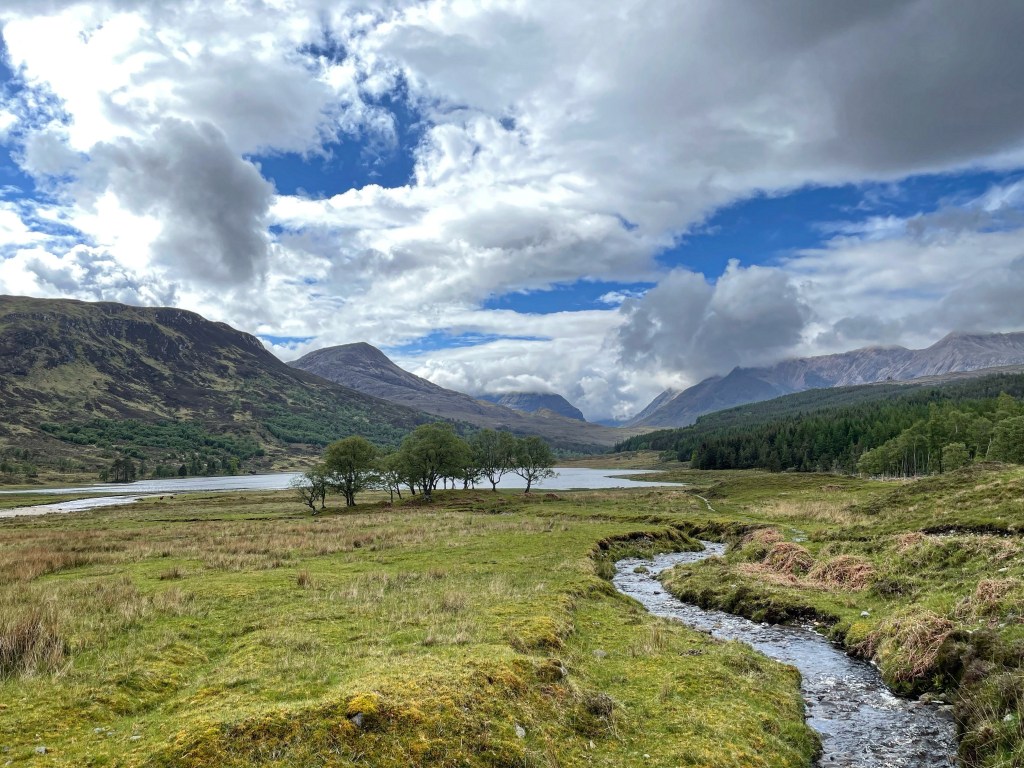

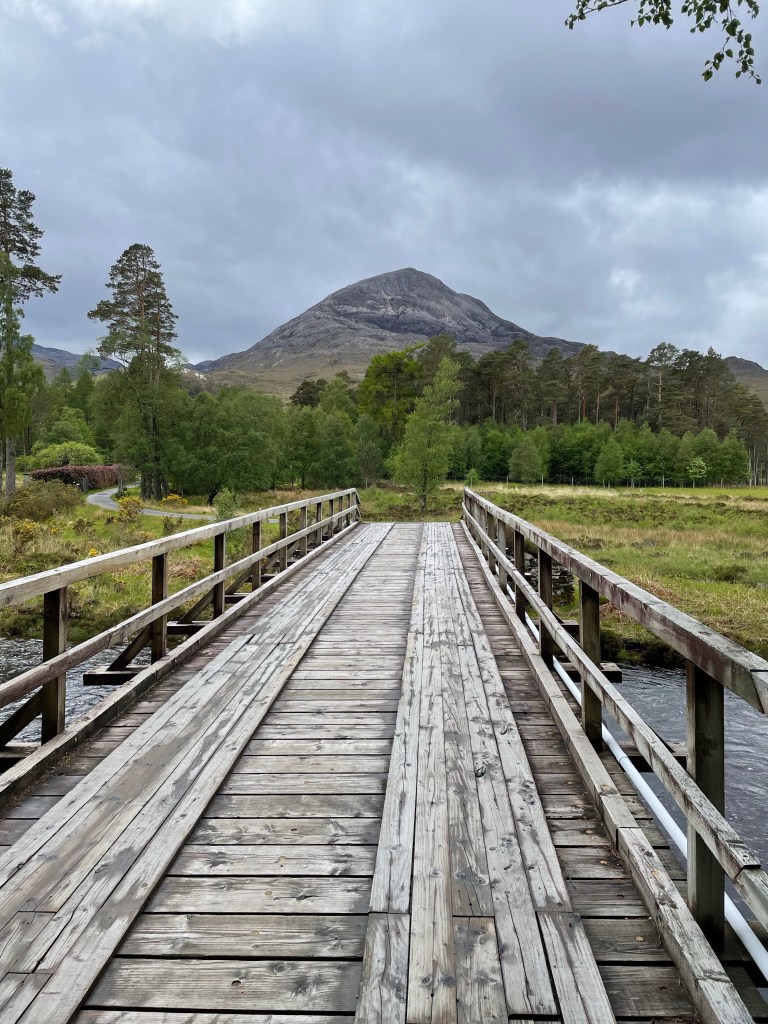

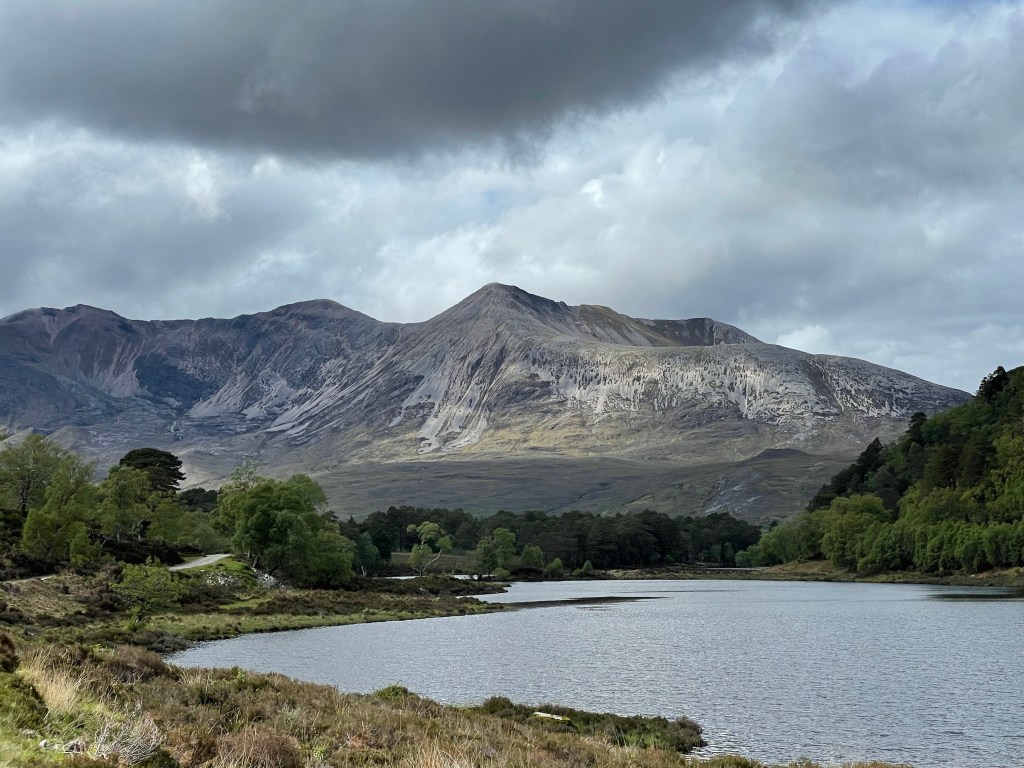
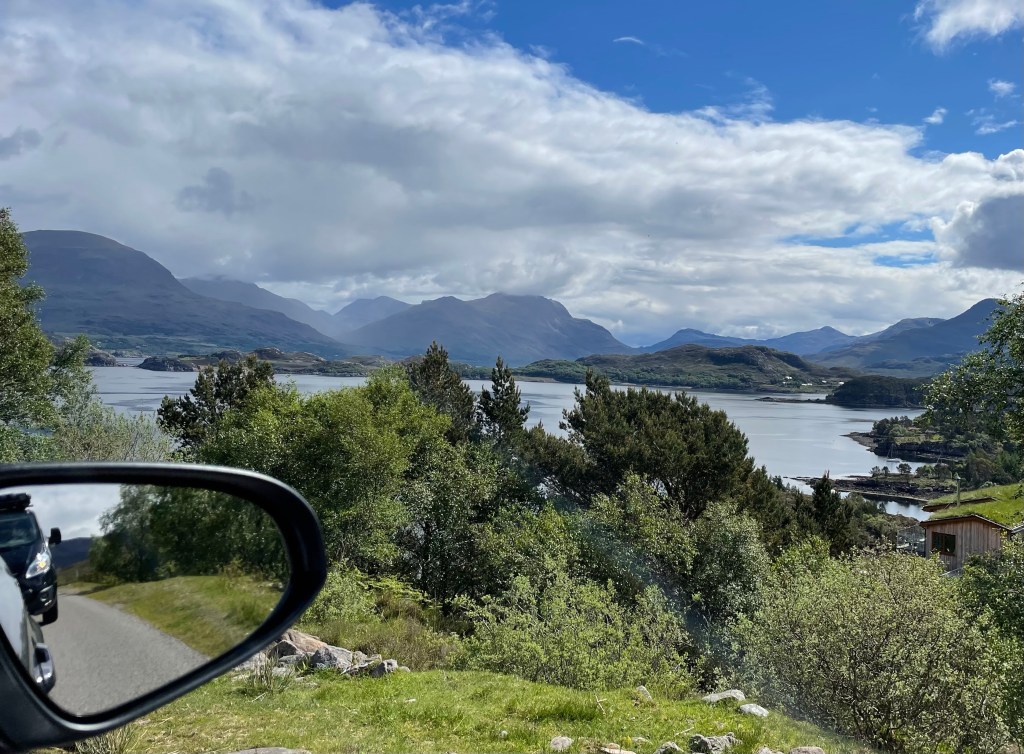










 Wee Dram of Scotland