The Last Post: Peat, Standing Stones, Snow, Whisky and Back to Skye

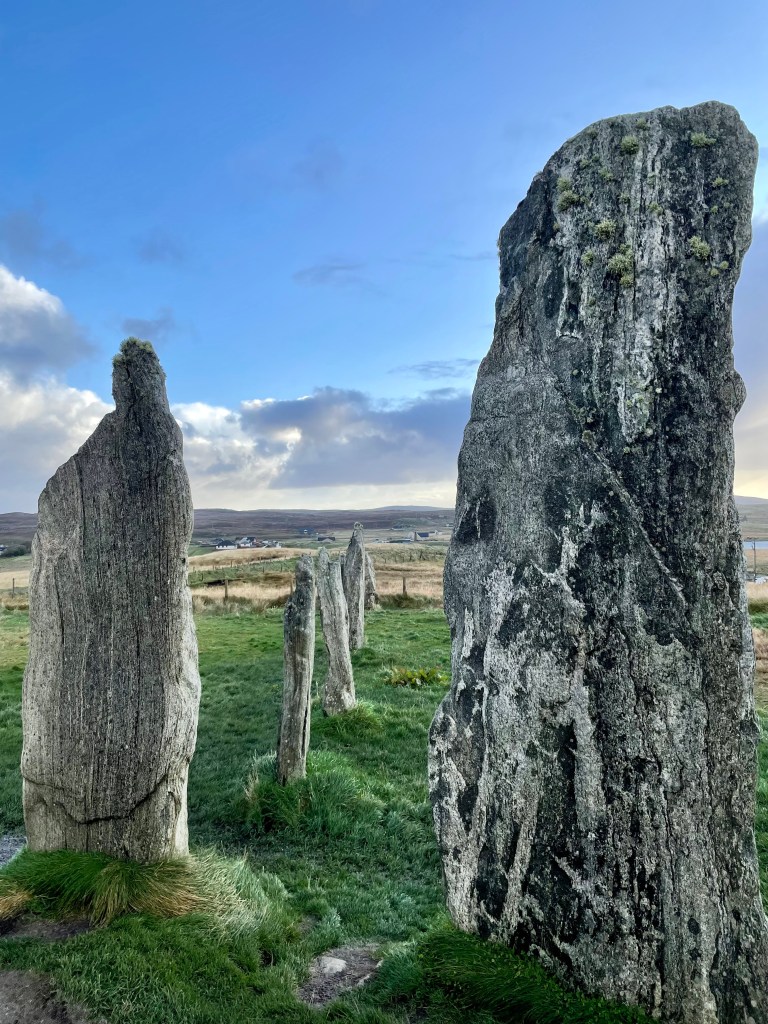
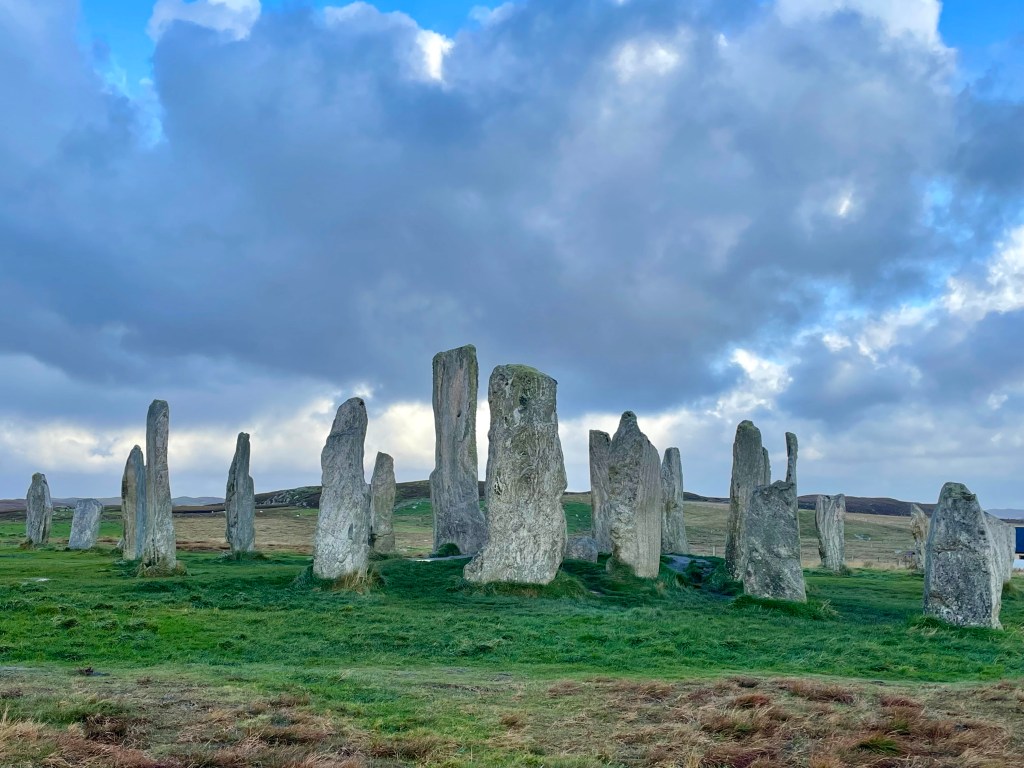
Callanais Stones, Isle of Lewis

Our last full day in the Outer Hebrides dawned with a bittersweet tinge. Wind-swept, isolated and bewitching Harris had started to seep into my bones and I felt strangely reluctant to leave. We had one more walk before us, followed by a drive down the Golden Road and a fancy farewell dinner.

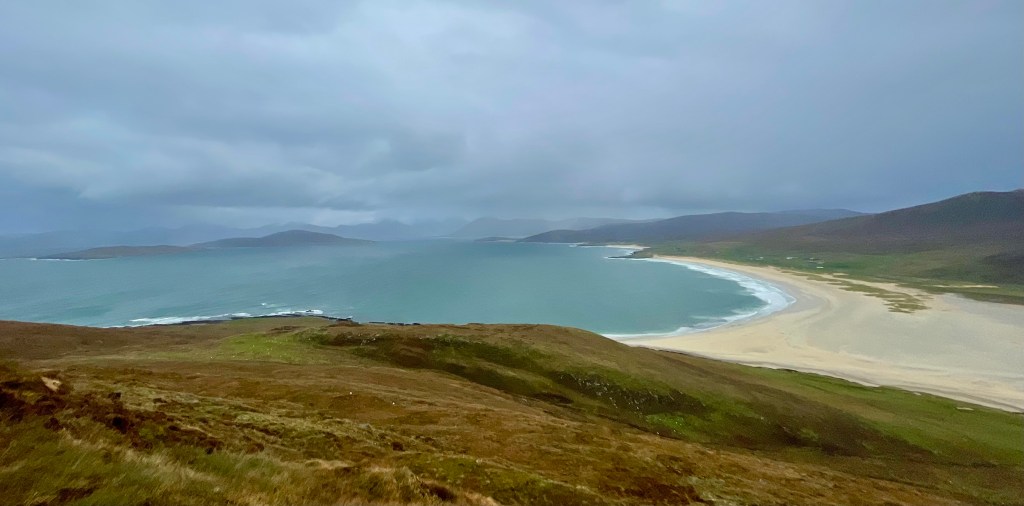
We headed to the southwestern corner of Harris, our destination an uninhabited peninsula connected to the rest of the island via a sandy machair in between two bays. A machair (pronounced “mach’ – like loch – er”) is fertile, well-drained grassland found in Scotland and Ireland which is formed by sand being blown over peat. It creates a unique habitat with diverse bird life and blankets of meadow flowers in early summer. However, with winter approaching, the flowers and birdies were long gone.

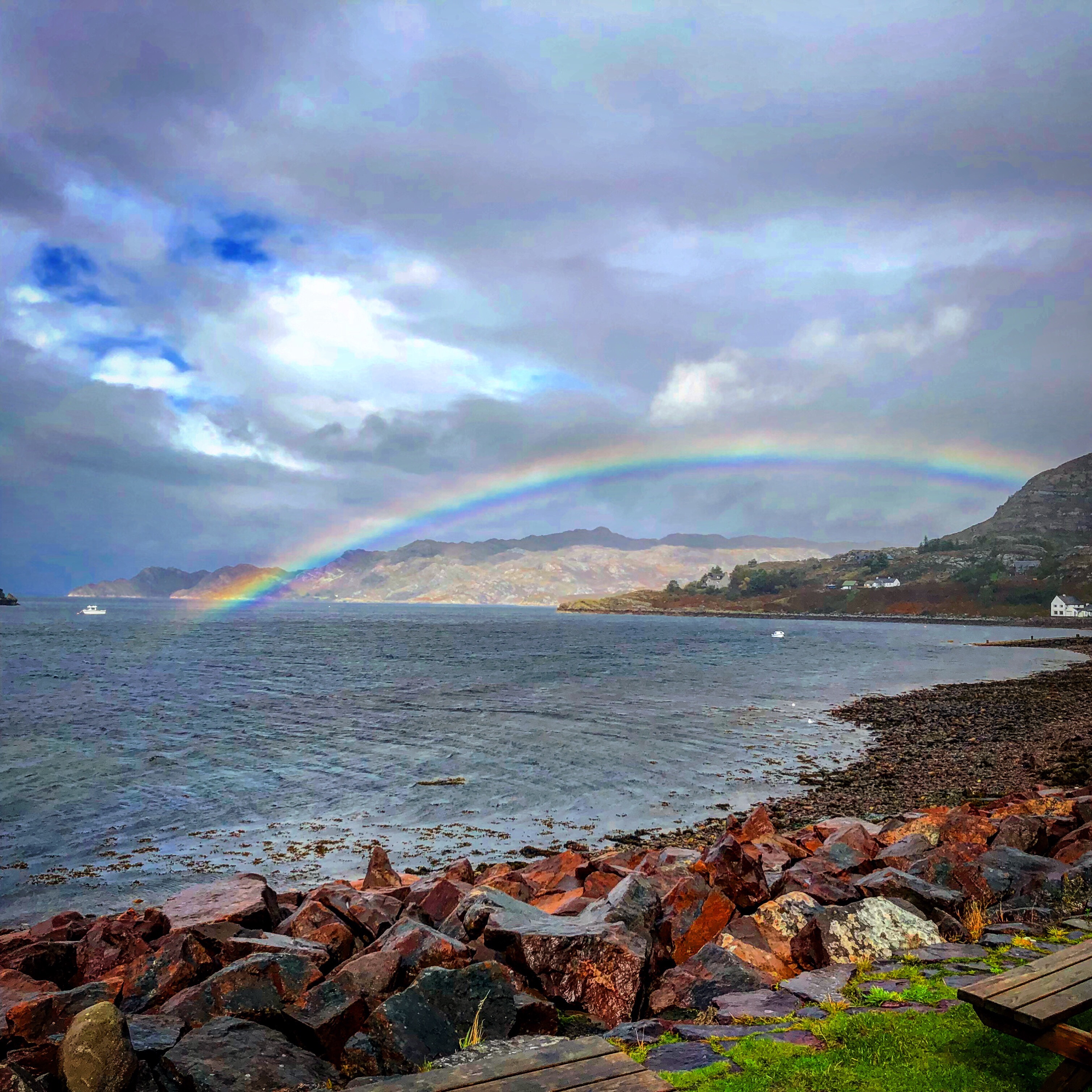
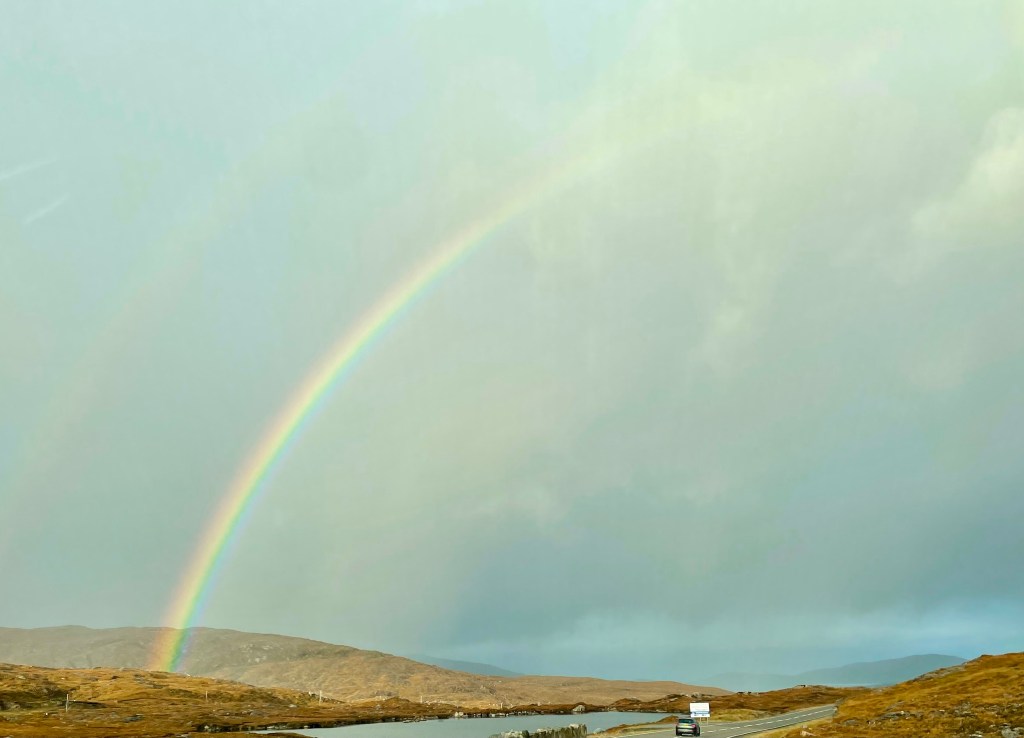
A double rainbow arched over the road on our drive there.
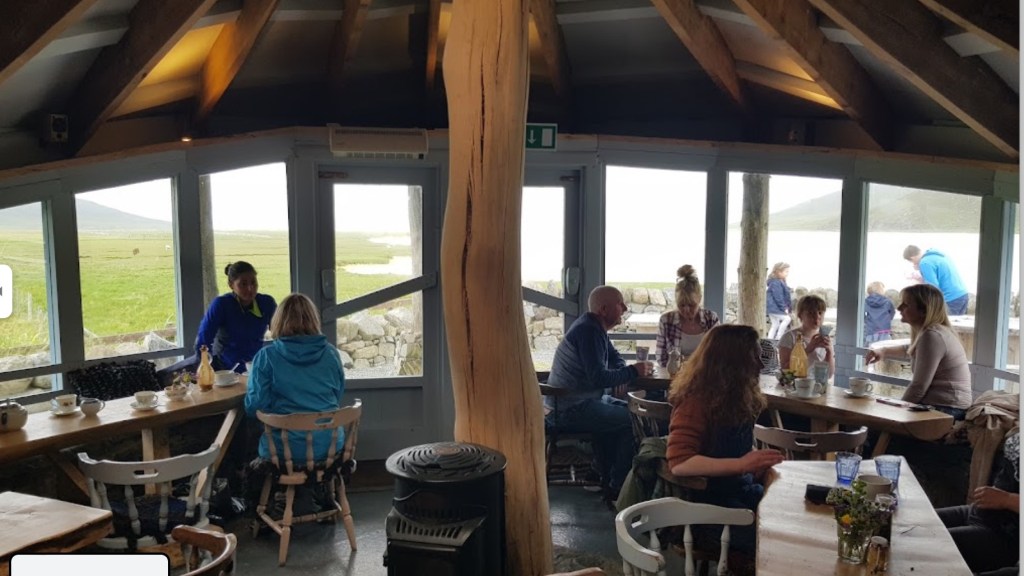
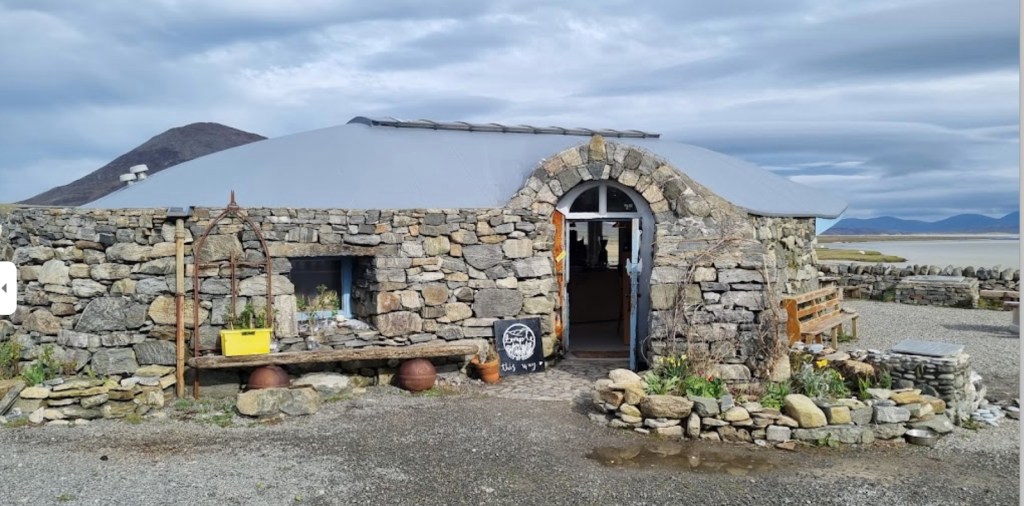
We parked the van next to a charming and quirky cafe snuggled in the middle of nowhere called Temple Harris, featuring a spectacular array of pastries and killer views over a sandy bay ringed with hills. We strolled down a road toward the westernmost summit of Harris and our climb of the day, Ceopabhal (pronounced Chaipaval – p.s., sorry for all these pronunciation tips but I want you to be the hit of your next cocktail party).
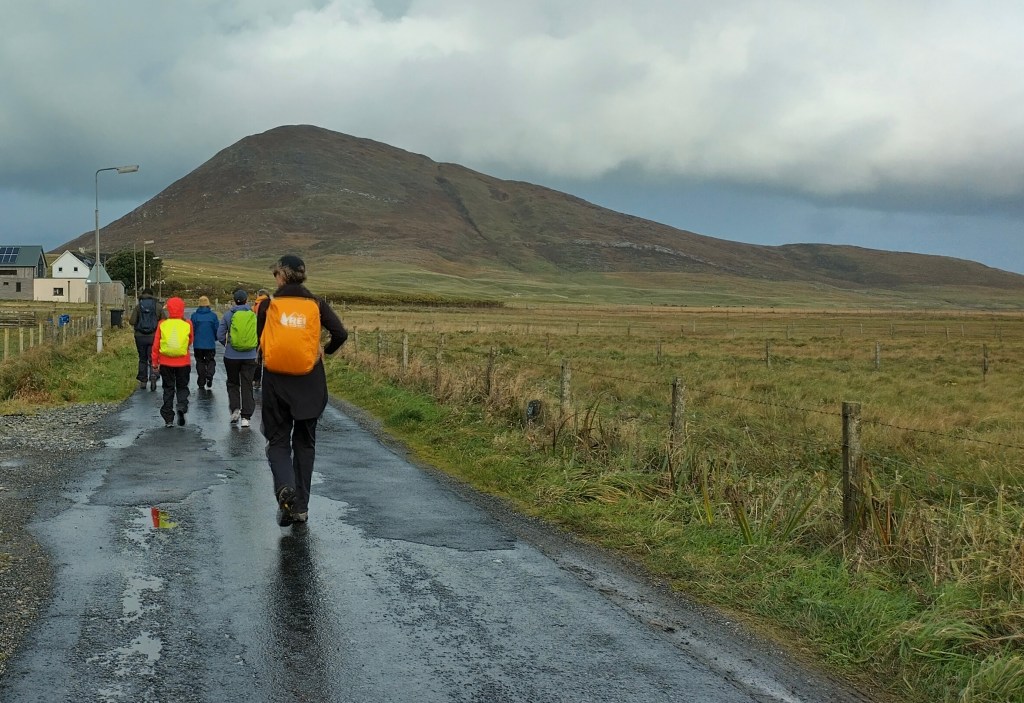
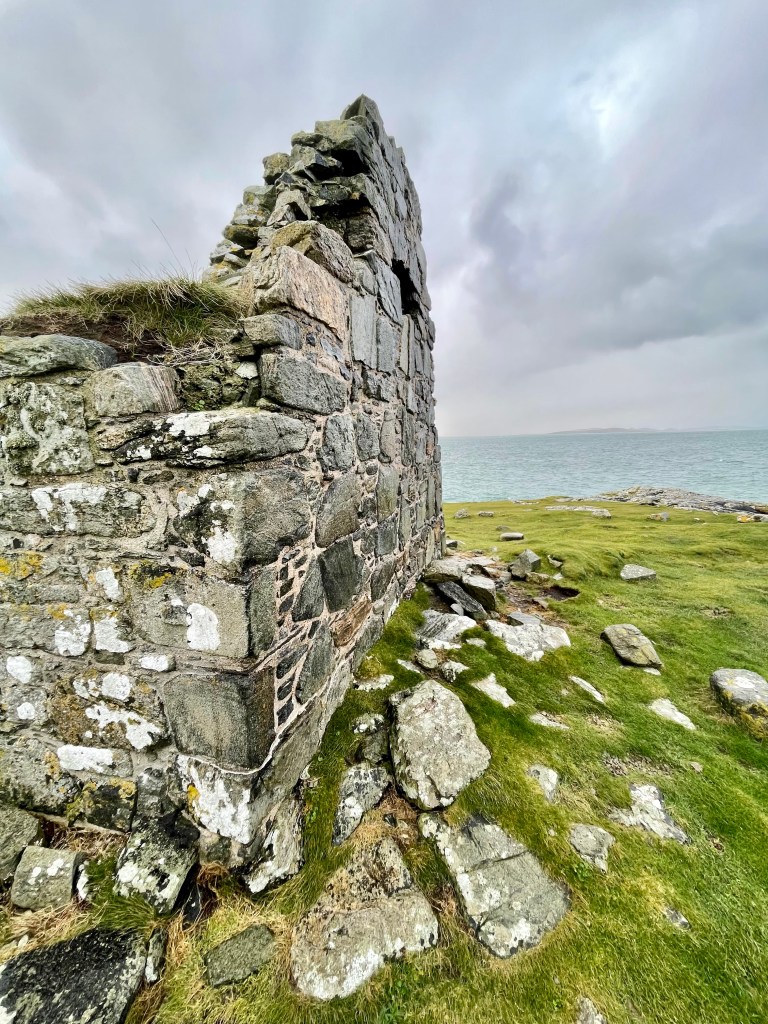
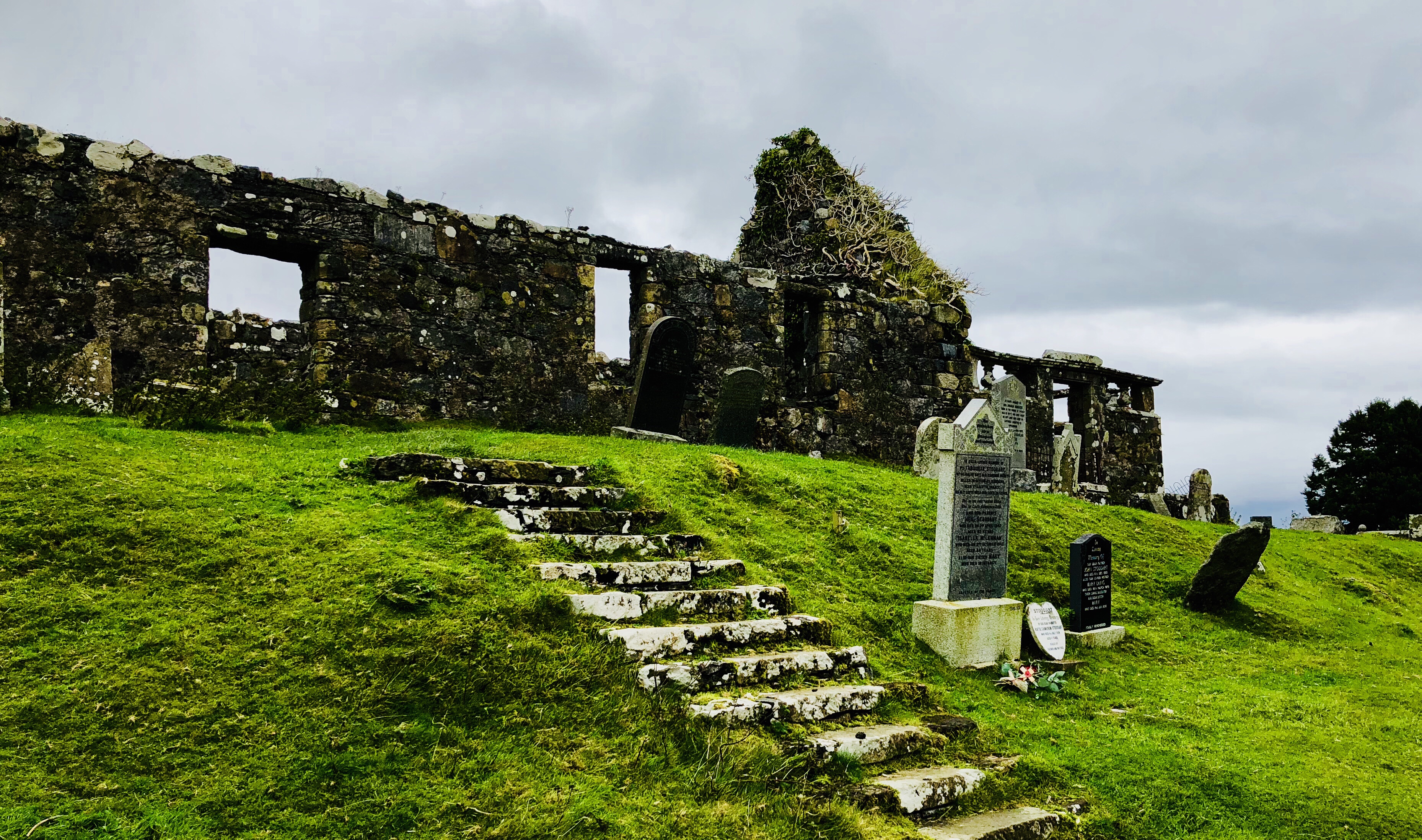
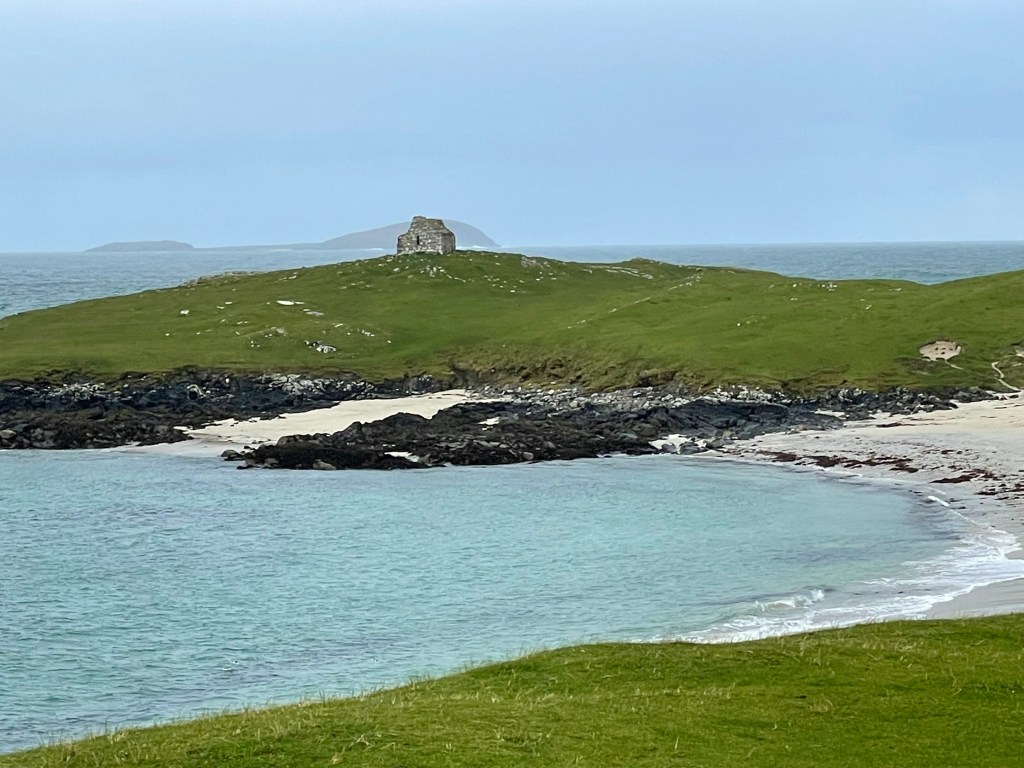
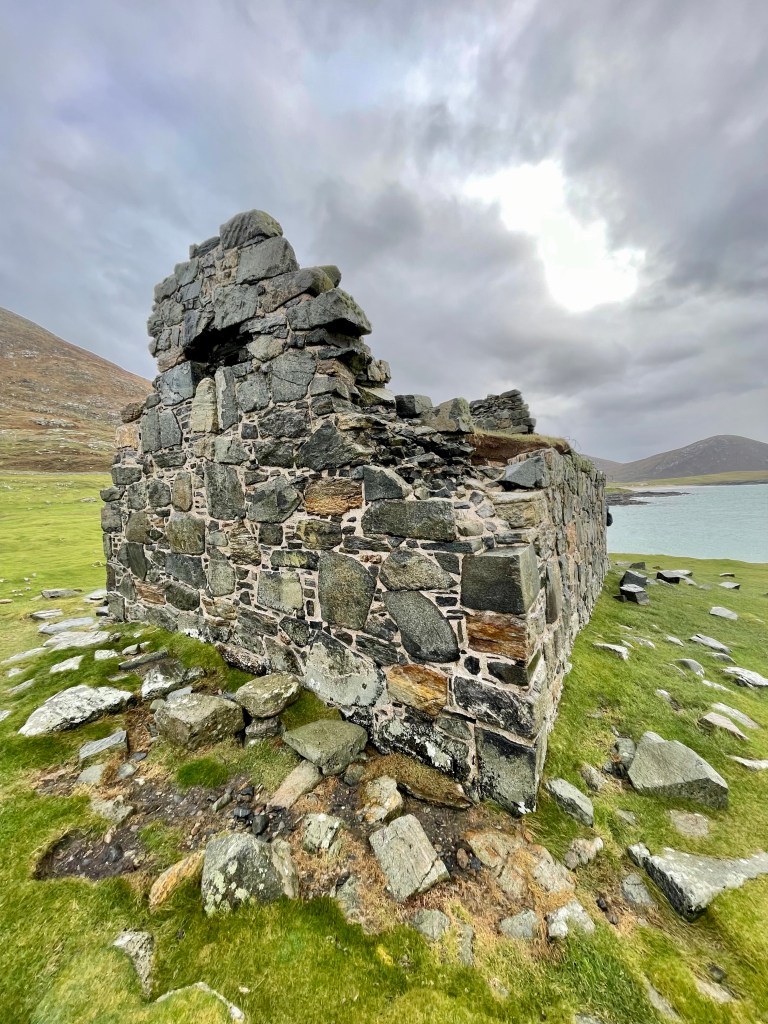
We walked across the machair in capriciously changing weather and made our way through a herd of colorful shaggy cows that appeared to be Highland Cattle/Belted Galloway crosses, which I am totally here for. Fighting our way through a sudden gusty squall, we crested a hill and Traig na Cleavag magically came into view, yet another pristine and deserted Harris beach. This one was guarded by an ancient sentinel – a ruined medieval chapel known as Rubh’ an Teampaill aka Northton Temple. It was built on the site where an Iron Age broch once stood, on land which has been continuously occupied since the Mesolithic era (as this particular era often comes up at cocktail parties, along with Gaelic pronunciation opportunities, a wee reminder this was 10,000 to 8,000 BCE, so very much olden times, or dare I say, days of yore).
Ceopabhal loomed over us for the entirety of our walk, and I eyed the hill with a slight amount of trepidation, mostly because I made the mistake of reading about it in advance on the Walkhighlands website (the bible of Scottish hillwalking).

The climb featured a 1,200 foot elevation gain over 6/10 of a mile. This is indisputably a bit on the steepish side, in fact Walkhighlands mentioned in passing that a “great amount of effort” was necessary to reach its summit. Also Liam made us stop and eat a protein bar just before the steep bit for “fortification.” Yikes. So once again the ascent was trail-free – we just zig-zagged our way up through clumps of heather. My main pro tip would be to make sure you lean forward into the hill. At least it was so rainy and windy that trying not to get blown off the trail to our deaths (only slightly exaggerating) served as an excellent distraction from the aggressive angle of the climb.

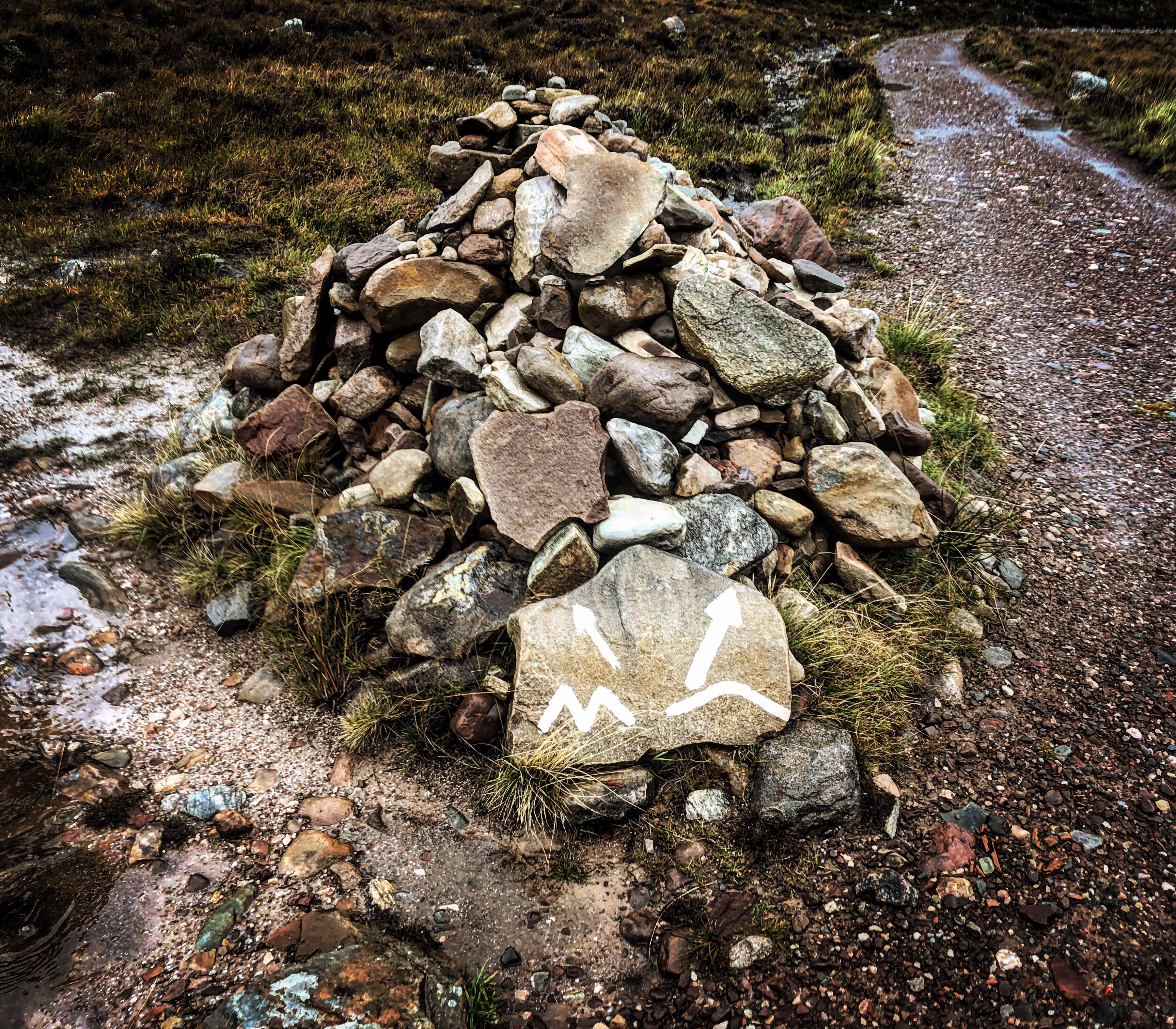
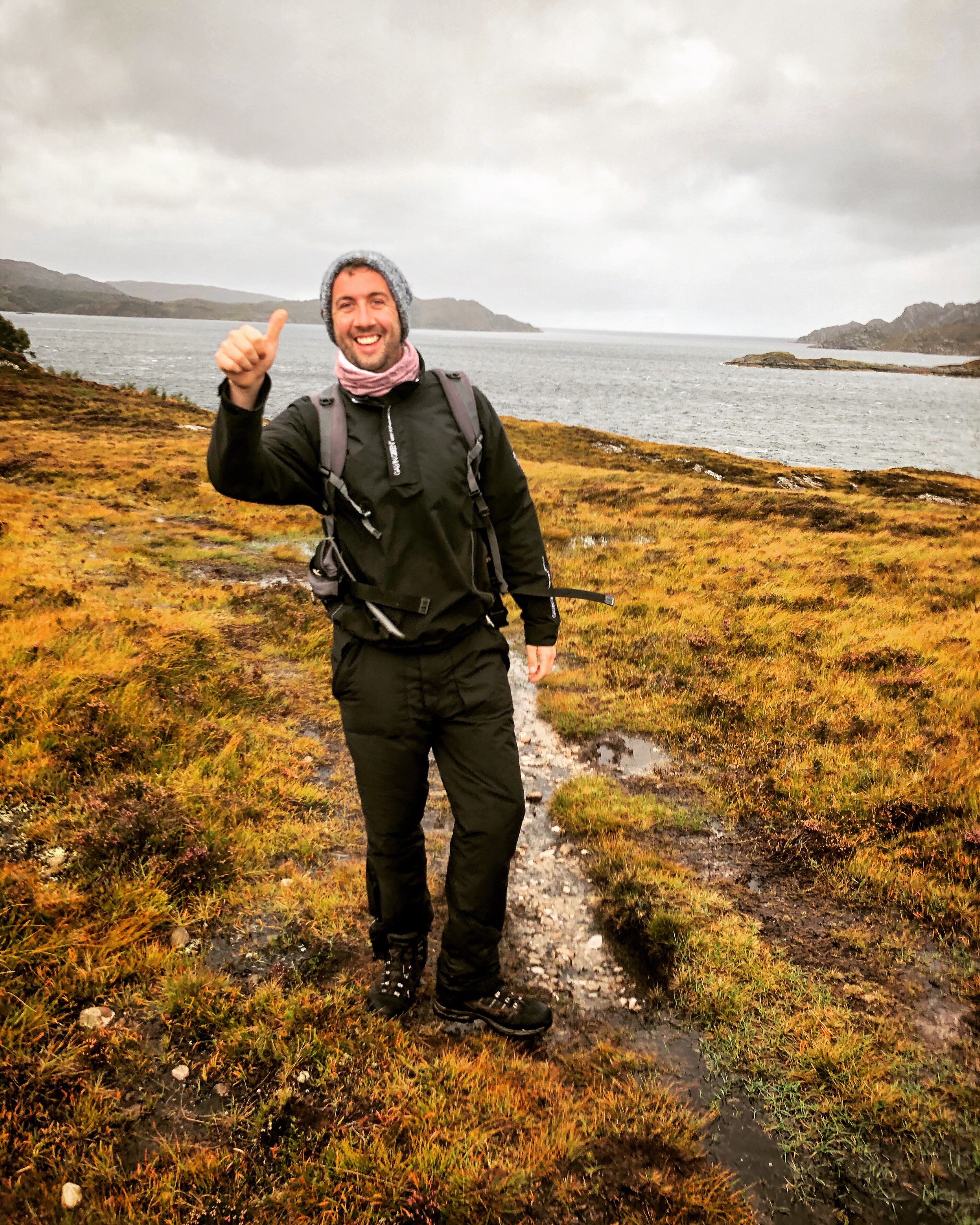
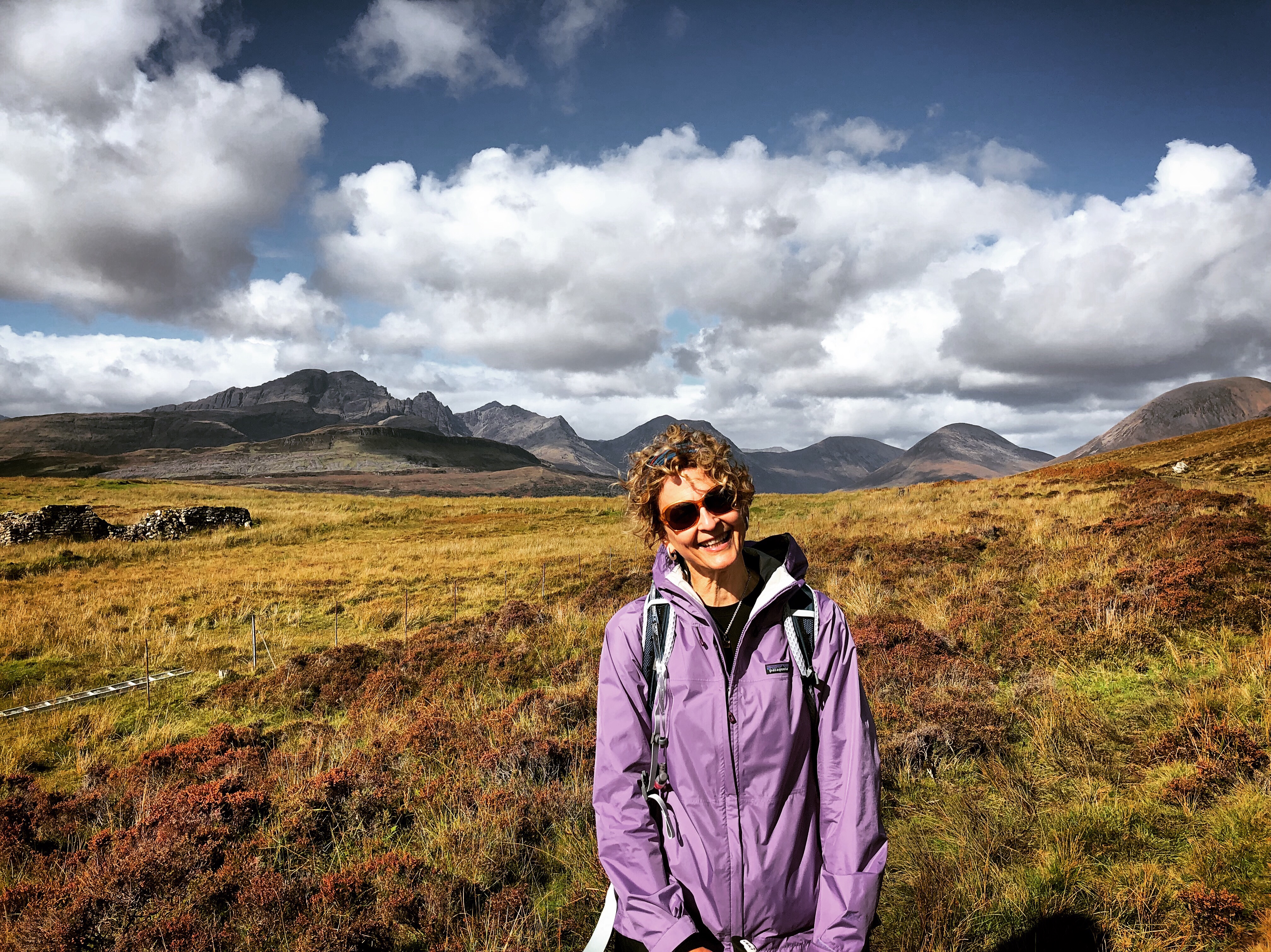
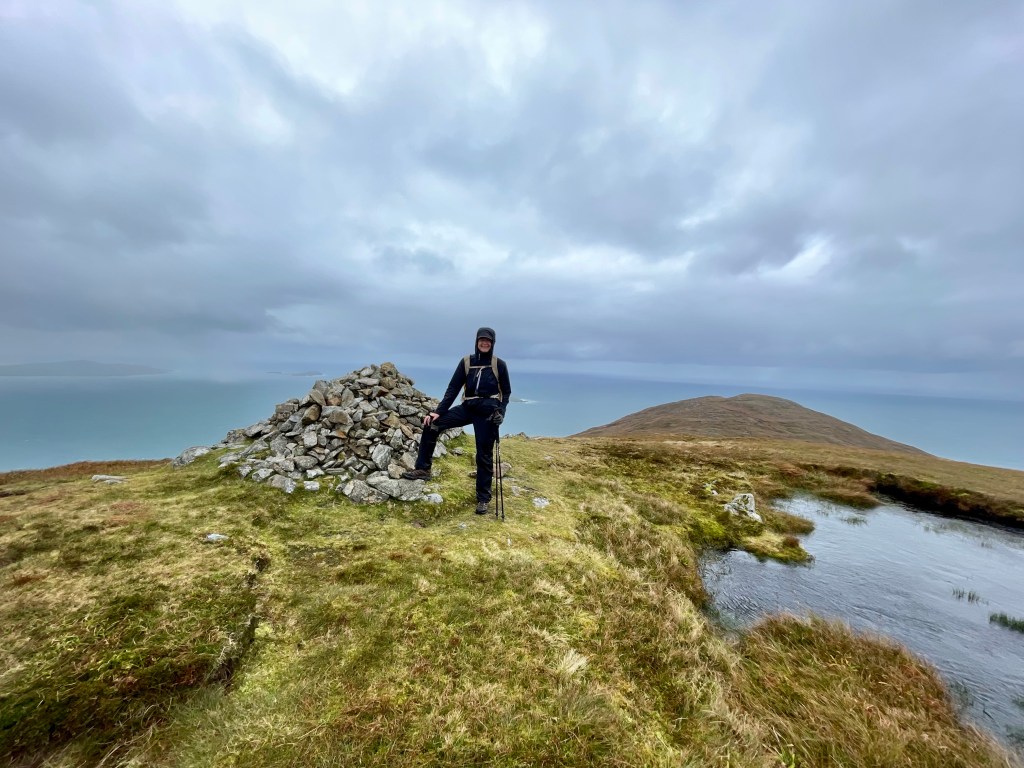
At the summit (yay!), the views were 360 degrees (largely into fantastic storms, but you could see the mountains of Skye). The wind had truly become a biblical sort of tempest, known in these parts as “blowing a hoolie,” although I did valiantly manage a few snaps and a cairn photo.
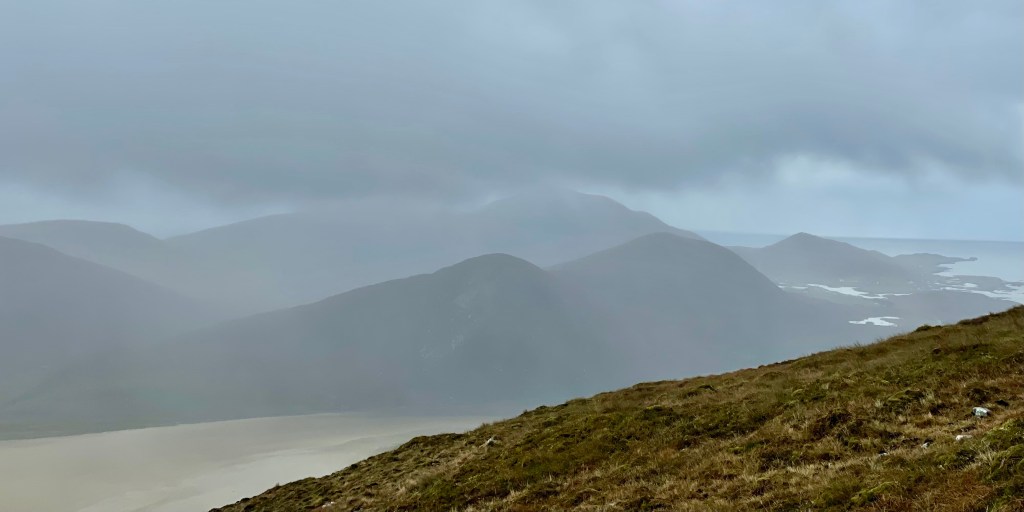
We walked to the lee side of the hill, mercifully sheltered from the hoolie, and sat in some soft comfy moss to enjoy a picnic looking out over a gorgeous bay.
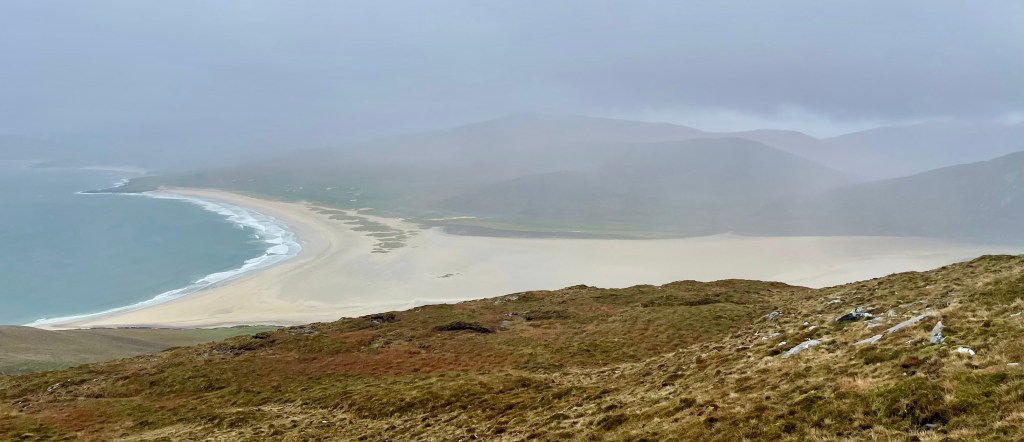
The fine folks at Walkhighlands.com recommended retracing one’s steps back down the hill. My knees were entirely dreading this prospect because going up a steep slope is one thing, going down (while being blown about by a hoolie) is an entirely different situation. This advice was based on their view that walking down the hill on its lee side would take one through “deep heather” and thus should be avoided. Mercifully, Liam had other ideas.  We indeed took the more gradual route toward the bay, winding our way through heather and floating across fluffy, deep mounds of sweet, sweet sphagnum moss. Let me tell you it was delightful. Imagine traipsing down a hill on living, breathing sponges of memory foam. That’s what it was like. I put my hiking sticks away.

Speaking of moss, you can’t go to Scotland without considering peat. No seriously. Peat is formed from plant material throughout the ages that does not fully decompose, and sphagnum moss is one of its main ingredients.  Peatlands cover about 20% of Scotland and yet 80% has been degraded over time. It has been hacked away and drained since the 1800s to make room for agriculture. For centuries it has also been cut, dried, and used in fireplaces for heating homes. It still is. 
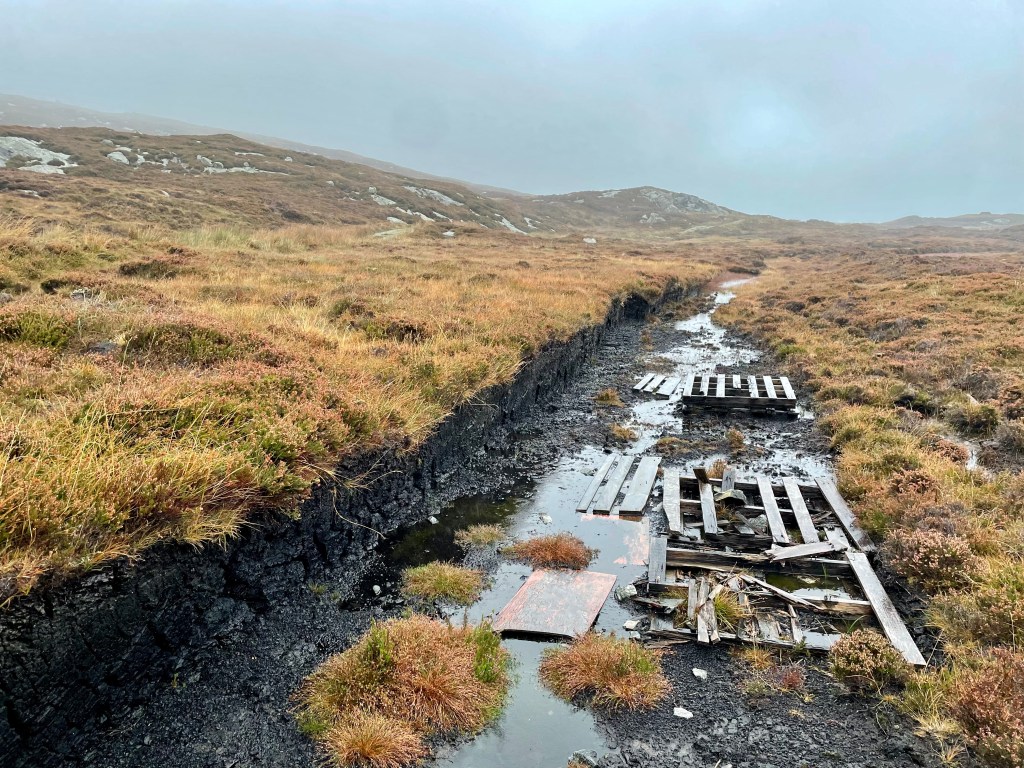
Peat harvesting on Harris.

Peatlands are among the most carbon-rich ecosystems on Earth and have a net cooling effect on climate.  Healthy peatlands can also reduce flood risk by slowing the flow of water from the uplands. If you hold a small handful of sphagnum moss and give it a squeeze, enough water will run out to fill a juice glass. Without peat, one is left with completely nonabsorbent bedrock which isn’t great in a country where it is usually raining. Peatlands also promote biodiversity by providing vital habitat for birds, insects and plants. Peat bogs are sometimes referred to as the rainforests of the UK.

A few more cool things about peat. You may have seen an episode of the BBC mystery Shetland where a decades-old body was found perfectly preserved in a peat bog and wondered why.  (Fun fact: There have been only two murders in Shetland over the last 50 years, rather than the 1-2 murders per week as depicted in the show. This aside provides an excuse for a Douglas Henshall call out for a lot of reasons).
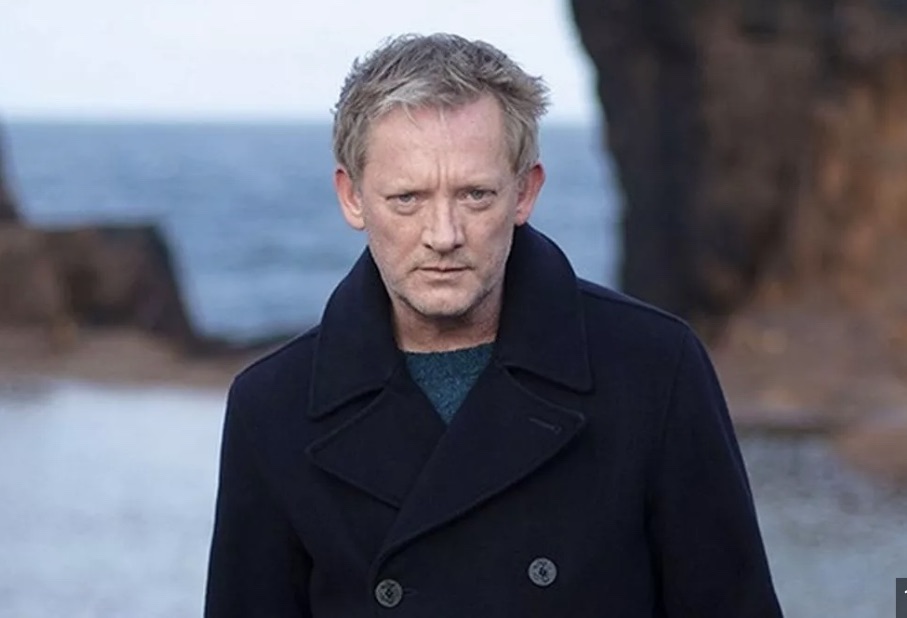
Doug Henshall as Jimmy Perez in Shetland.

The explanation for peat’s ability to preserve (ahem) organic matter is this. As a bog grows, and new peat replaces old peat, the older material underneath rots and releases humic acid, also known as bog acid, with pH levels similar to vinegar. Not to put too fine a point on it, but bog acid preserves human bodies in the same way fruit is preserved by pickling. And of course not just humans – a wooly mammoth was once discovered buried in peat that still had its fur and food in its mouth.

Peat also creates and stores iodine. The iodine causes sphagnum moss to look very yellow and even red when it’s waterlogged. This is why many Scottish rivers appear golden in color – it’s not tea, or (sadly) whisky – it’s iodine-laced runoff.  Also, iodine’s antiseptic properties mean that sphagnum moss acts as a water filtration system so in a pinch you can use water squeezed from moss for hydration – and even more interesting, it was used to pack wounds during wartime since it’s both sterile and absorbent.
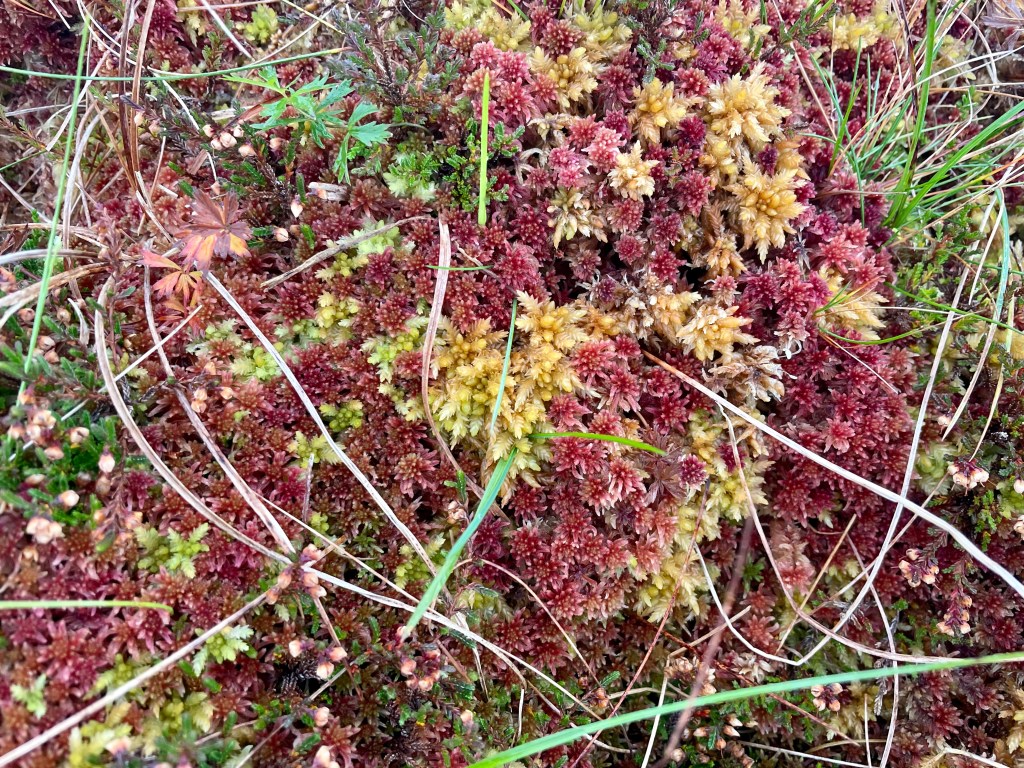
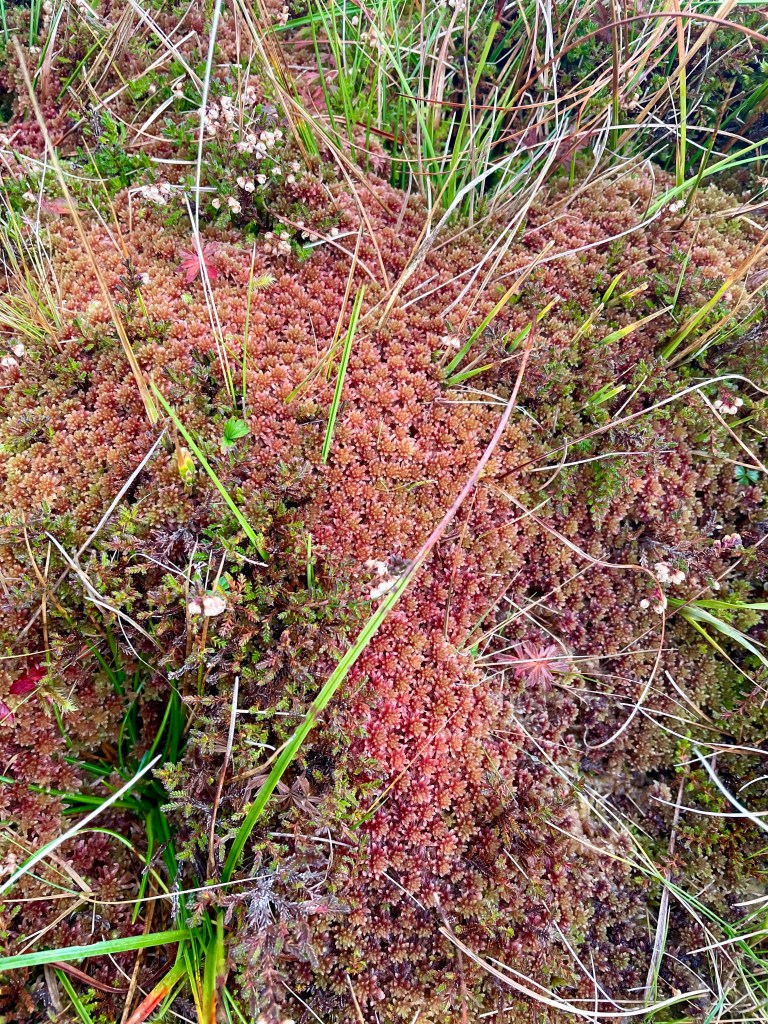
Most crucially from a climate change perspective, Scotland’s peatlands store 16 million tonnes of carbon (one tonne is 9% larger than a metric ton) and possibly shouldn’t be released into the atmosphere at this particular juncture. Draining water away from peat bogs to support agriculture causes the peat to dry, resulting in the vegetation decomposing much faster – and the release of carbon. Similarly, burning peat has the potential to release hundreds of years of stored carbon back into the atmosphere. Ultimately it’s quite beneficial to have large land masses that actually capture and store carbon.

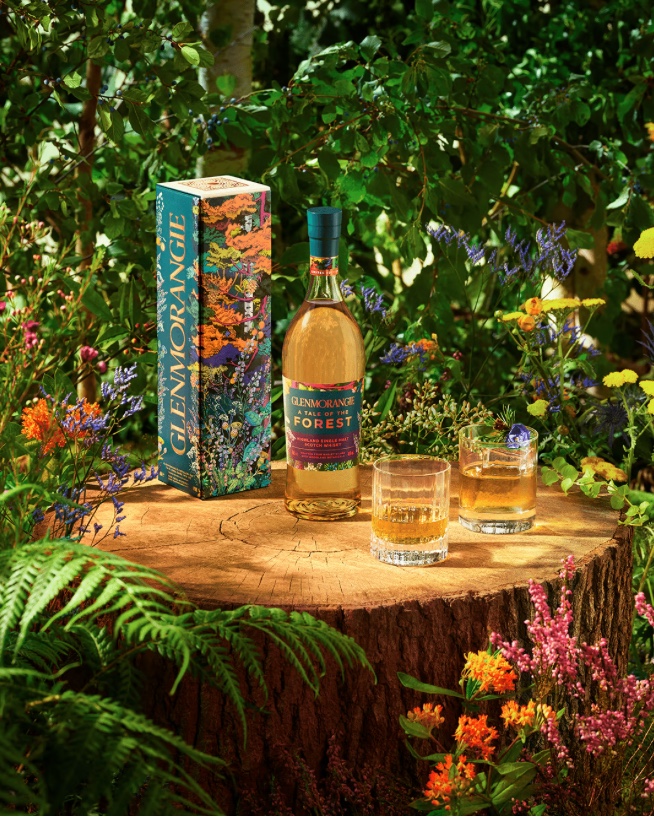
I know what you are thinking – what about (gulp) whisky? Much of Scotland’s whisky is made from sprouted barley that has been dried by peat fire. It imparts a lovely campfire vibe to the golden liquid which causes people to either fall in love or cough with watering eyes and an alarmed expression. An iconic flavor either way, especially with Islay whiskies. As it turns out, whisky accounts for only about 1% of the UK’s peat use and as you can imagine defending the cultural significance of Scotland’s whisky-making tradition has been the central pillar of the industry’s case during the government’s development of its peat policy. Distilleries have pledged to make peat use more sustainable, although given its glacial pace of regeneration (1mm a year) this is a matter of debate. Distilleries are also experimenting with using different botanicals to light on fire for barley drying. Glenmorangie has just released a “Taste of the Forest” expression where they used pine, juniper, woodland moss and eucalyptus as fuel.
The good news is that peatland restoration and preservation is very very big in the UK and heroic efforts are underway to preserve and increase the resource – with some measurable success.  So fingers crossed.

Thank you for coming to my Ted Talk.

So let’s rejoin our merry band of descending walkers as they bounce down Ceopabhal on cushions of sphagnum moss. Before I share a few photos, after hearing all this peat talk from Liam we were sensitive about trodding on this precious resource, but he assured us that it quite literally bounces right back due to its buoyant density. Phew.
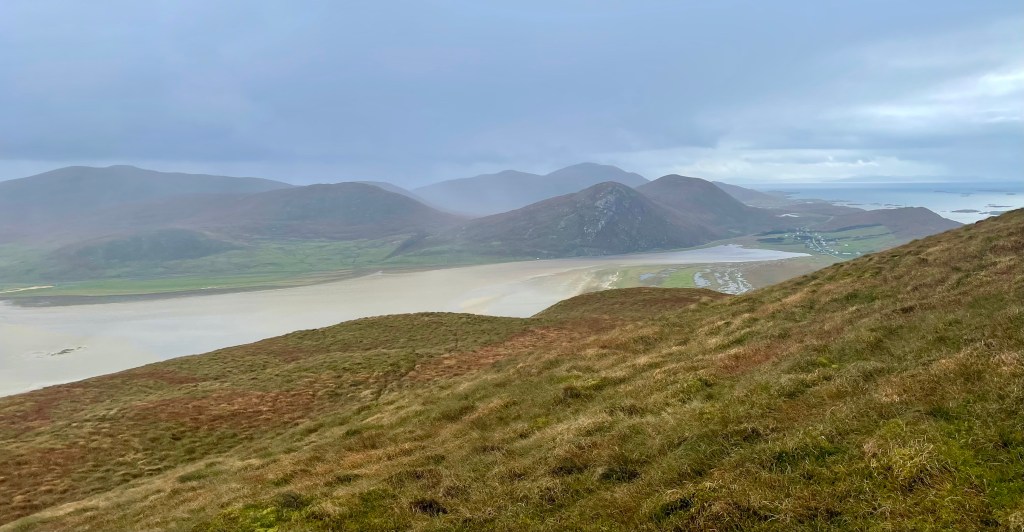
Upon our triumphant return to the van, we snagged a coffee and pastry (and a wee bit of shopping) at Temple Harris.  Everyone leaves their packs outside on the wooden bench without worry of misadventure.
Duly fortified, we struck off down the Golden Road, a spectacularly winding single track route along Harris’s rocky east coast. It’s widely assumed it got its name due to its eye-wateringly spendy construction cost.   After Liam cheerfully told us that if anyone was going to barf in the van, this would likely be the time, he offered distraction from the terrifying prospect of public motion sickness by launching into storytelling mode. He regaled us with mystical tales of dubious provenance featuring two dangerous and wily Scottish creatures.

First on the agenda – kelpies. Typically residing in and lurking about black lochs, they take the form of a horse, appearing to unwary humans as being a helpful sort of creature. They entice travelers to ride them over the loch, seemingly a more expeditious route than walking around them. It’s a trap! Once a person mounts the horse, it gallops to the deepest end of the loch, dragging its hapless rider below the water to their death and, ultimately, consumption (yikes). This legend was used to keep children away from lochs and also provided therapy fodder for later in life.

You may have seen this gorgeous sculpture by Andy Scott. The Kelpies were installed in 2013 near Falkirk and are a ginormous 98 feet high. It’s beautifully lit at night, and even if you don’t have time to stop, the giant kelpies loom over the M9 between Edinburgh and Stirling.

Next we turned to tales of the more benign selkies. They are also water-dwelling shapeshifters, but transform between seal and human by shedding and replacing their skin. As humans, selkies are incredibly attractive, graceful, kind natured and (avert your eyes) seductive, and so humans tend to fall desperately in love with them.  Selkies have also been tricked into marrying humans, usually by a nefarious person who steals and hides their seal skin, preventing them from returning to the sea. Not cool. Selkies are known for their benevolence, saving the lives of children or fishermen who have fallen into the sea.

There you have it. Keep up your guard if you visit Scotland – as these mythical beings pose more danger than any other resident creatures other than – dreaded midges.

We took a break from the Golden Road at Clo Mor, the charming Harris Tweed Exhibition. I will admit to you that prior to my visit to Harris, I had presumed that Harris tweed, since it’s pretty ubiquitous, was mass-produced, probably in China. Luckily I didn’t say that out loud to anyone. In actual fact, to qualify as Harris tweed, the textile must be “handwoven by the islanders at their homes in the Outer Hebrides, finished in the Outer Hebrides, and made from pure virgin wool dyed and spun in the Outer Hebrides,” according to an actual Act of Parliament.  Approximately 400 islanders were working in this industry as of late 2017, and you can visit them in their home, see their looms and watch them work. Consider my eyes opened.

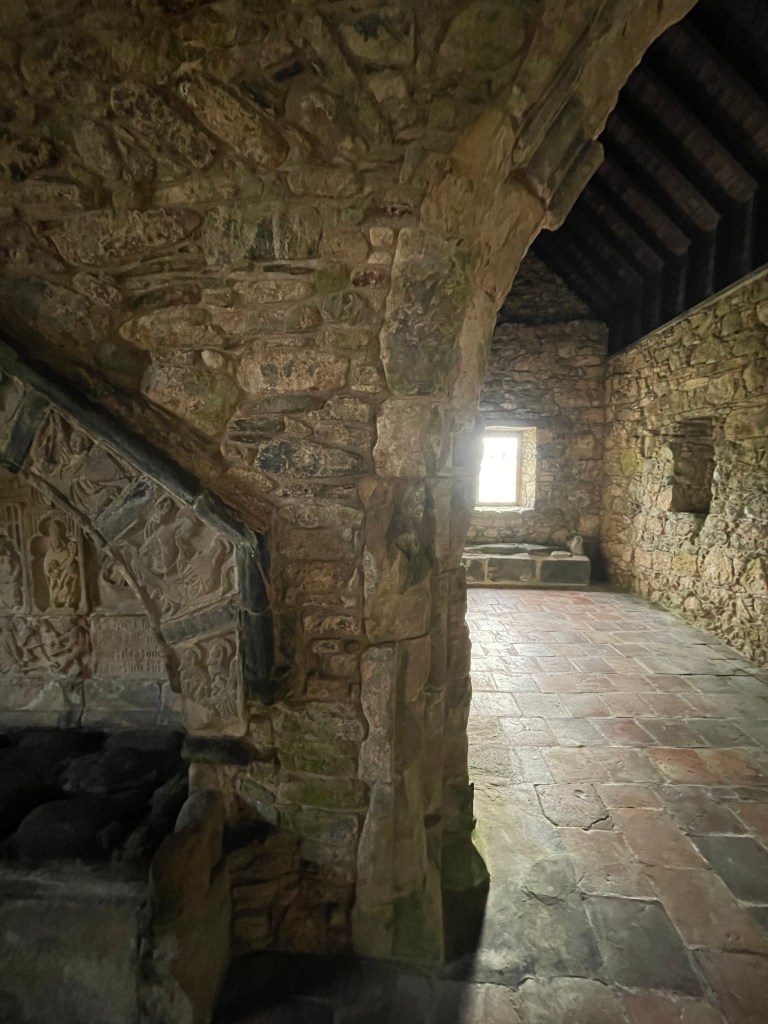
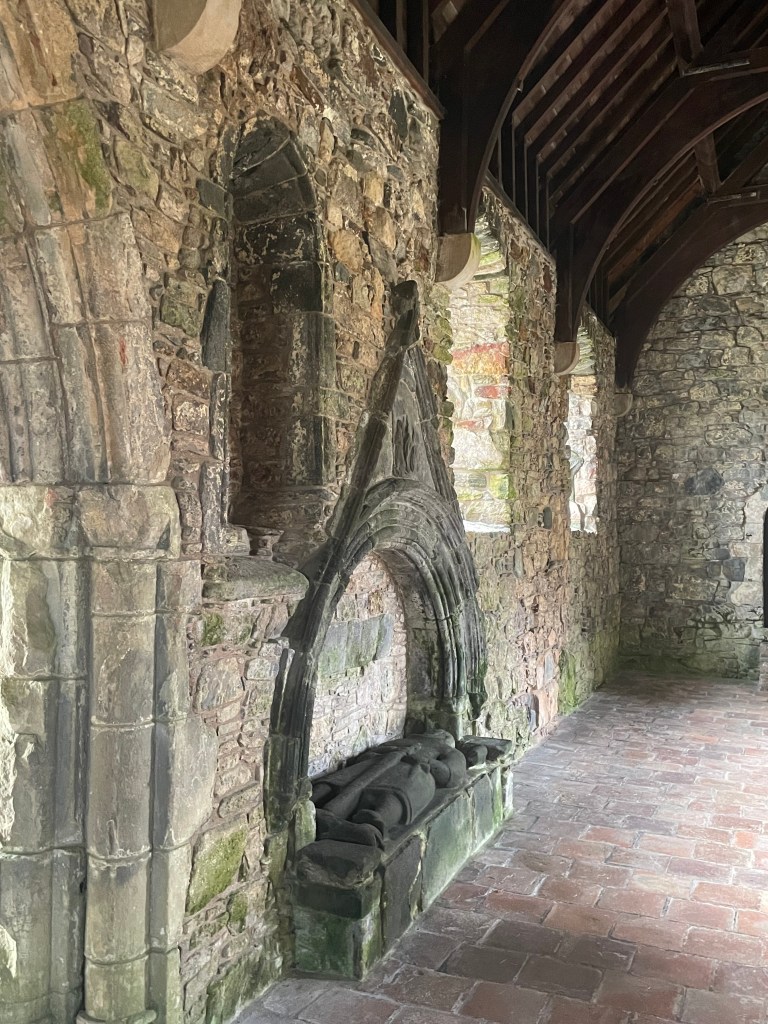
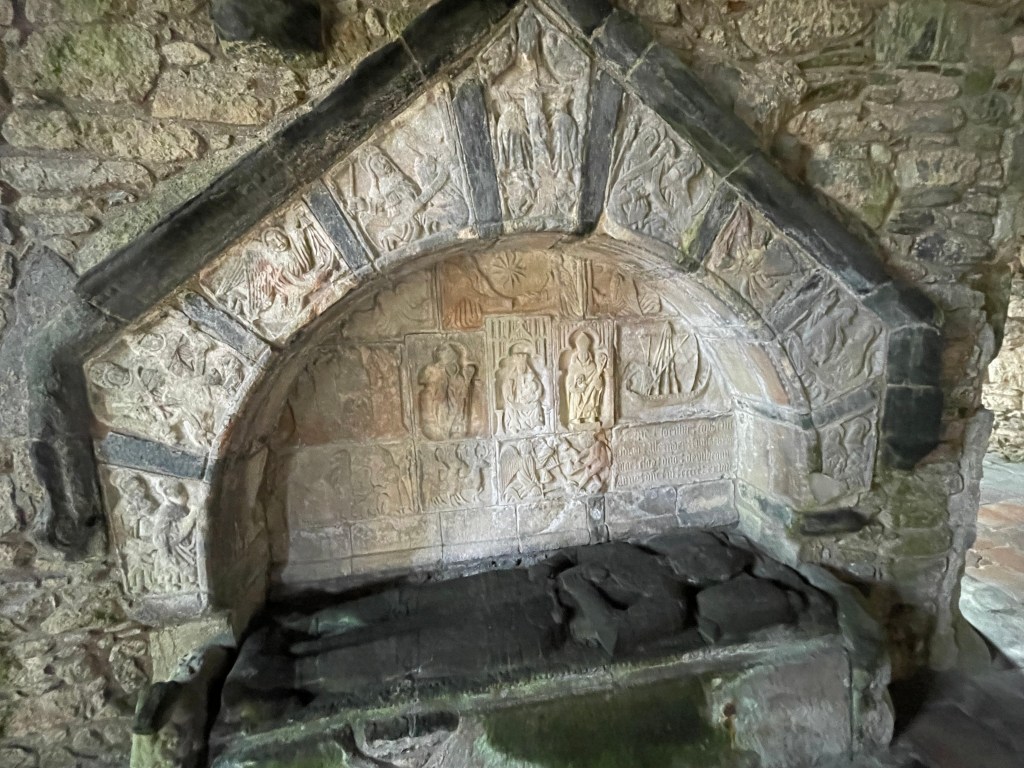
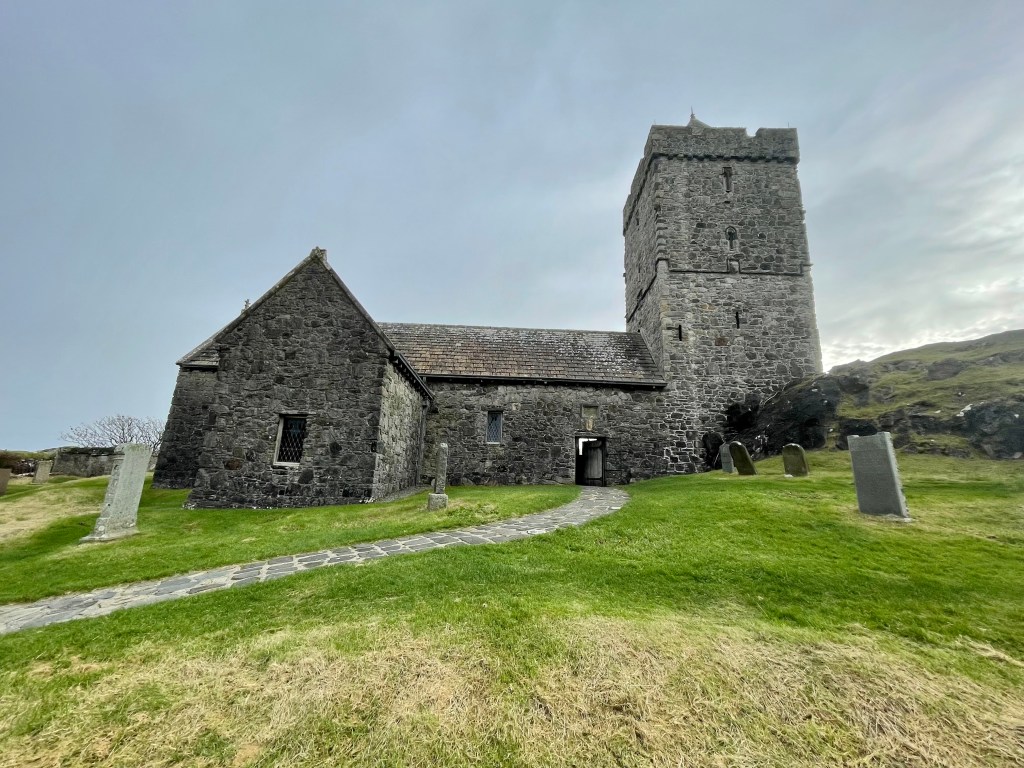
We next stopped at Hebrides People Visitors Center in Northton, a genealogical resource for folks researching their ancestry that tells the history of the people and landscapes of Harris and the Western Isles. Our last stop on the Golden Road was St. Clemens, a medieval church founded by Alasdair MacLeod, 8th chief of Clan MacLeod. He died in 1547, and his tomb is in the church, along with a passle of other ancient MacLeods.  One wonders where the 1st – 7th MacLeod clan chiefs are buried.
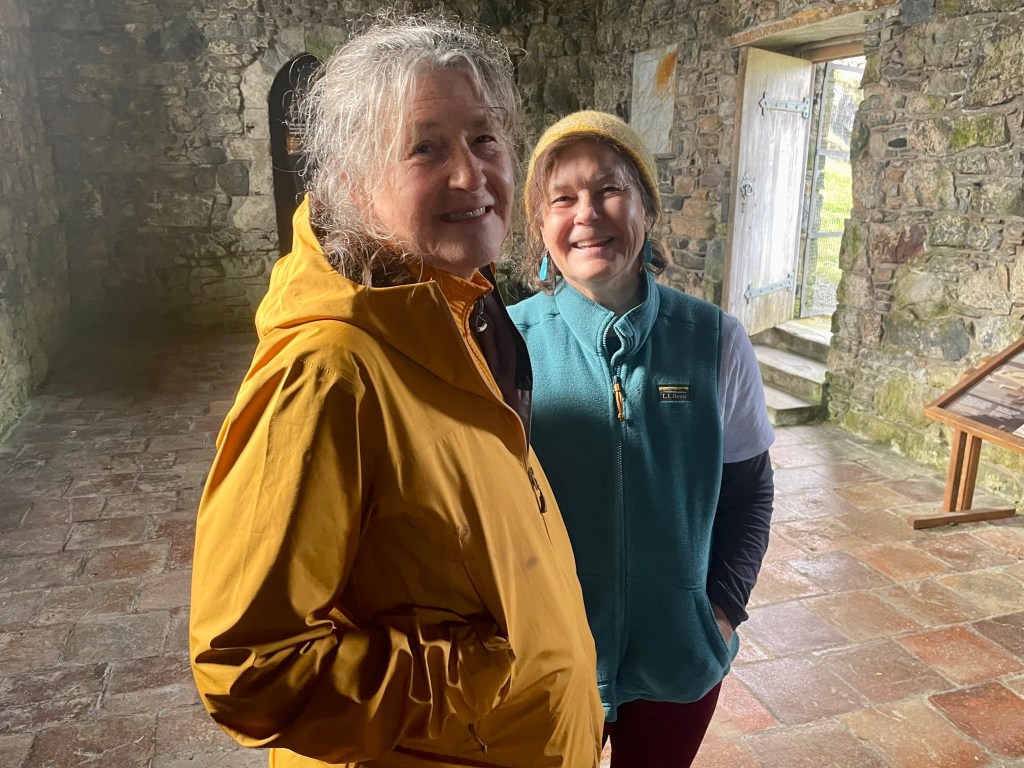
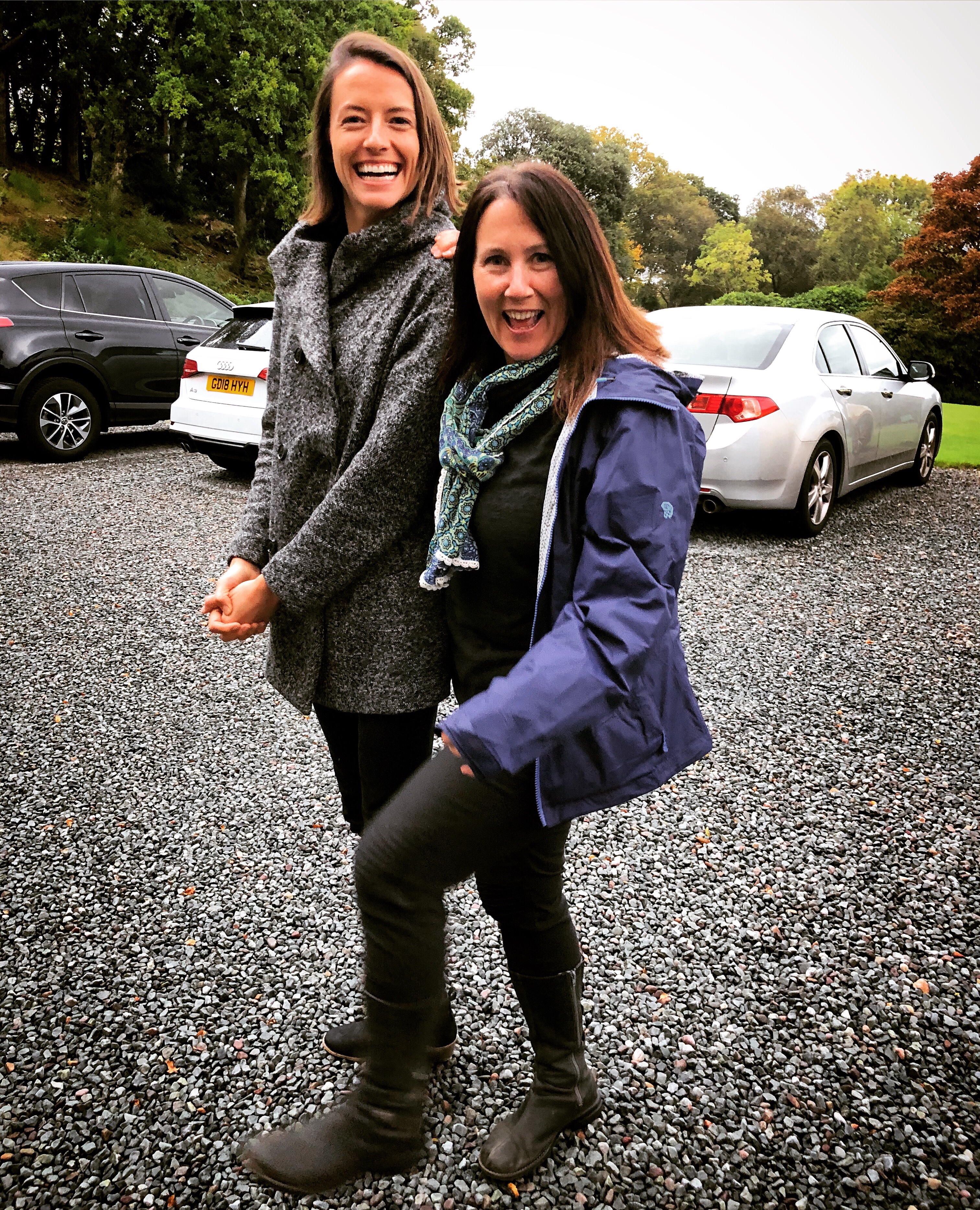
My favorite peeps – sisters Victoria and Margaret

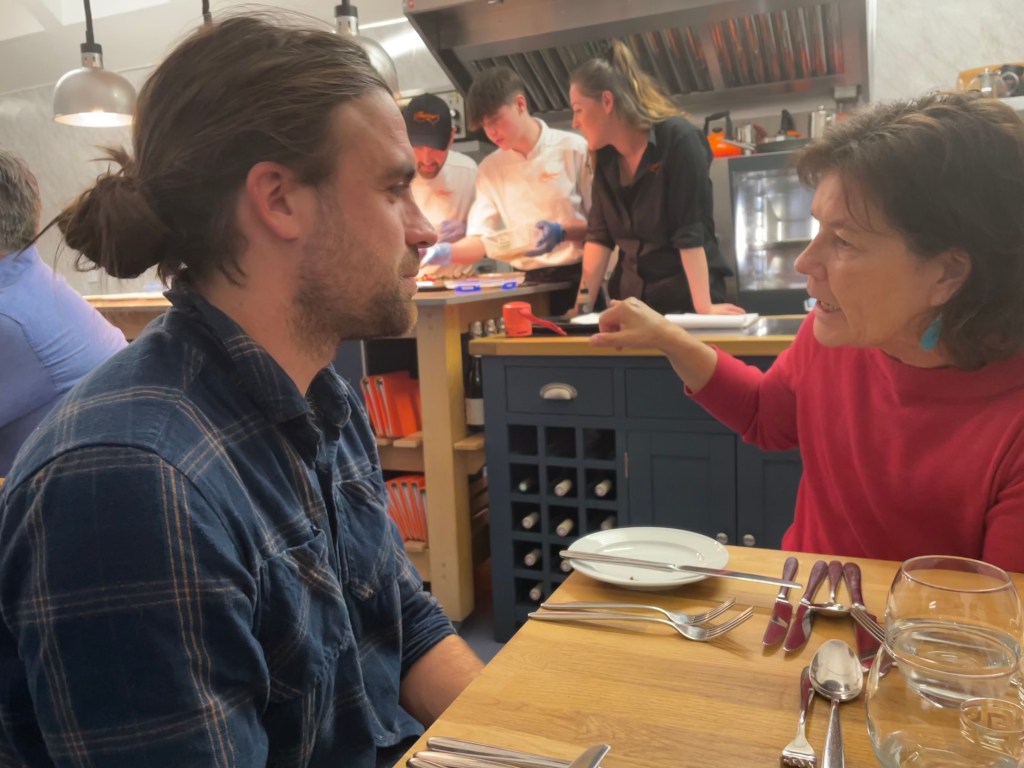
Our day ended in grand style with dinner at Flavour, an intimate restaurant on Harris with one seating and a chef, Chris Loye, who talked us through every beautiful and scrumptious dish on his tasting menu.  That night each dish incorporated, with pride, the newly released Heurach whisky from Harris Distillery. A woman from the distillery lovingly shared its story at the conclusion of our meal. She poured everyone a complimentary dram, clocking with a wry smile that I had been accidentally drinking a Talisker (from Skye).  Dang. As it turns out, she had been sitting at the table next to us with a couple who were right out of central casting for a show about a boring and very very rich English couple with plummy accents and unfortunate and ostentatious sartorial taste. I only wish I had been able to photograph the man’s pointy and aggressively shiny brown shoes.   We decided he was probably an investor in the distillery and so may be forgiven for his wardrobe choices.

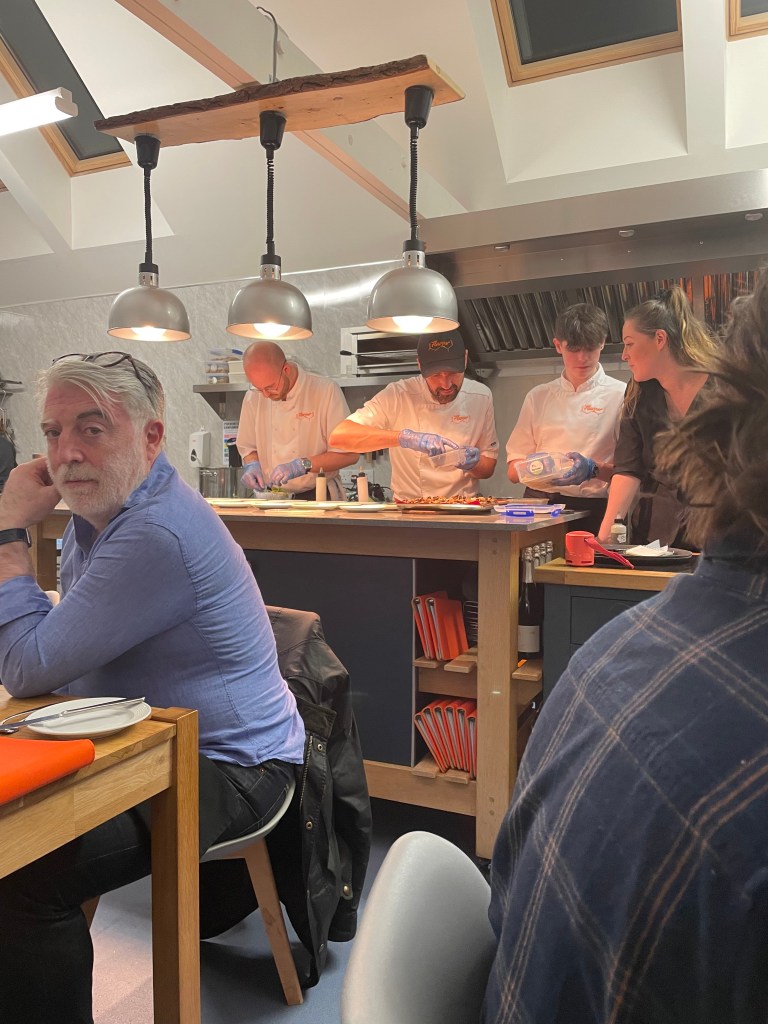
Chris telling us All The Things about each course.  He and his wife spent four years on the road traveling to more than 30 countries learning about food. Back in Scotland, they started with a pop-up restaurant in their home and catering private dinners, finally securing a lease for this restaurant from the North Harris Trust. They built it during the pandemic and it opened in 2021. Now they are written up all over the place. They have Michelin dreams and I wouldn’t doubt it for a second.
The fabulous kitchen staff and obviously the dude busting me on the left is the English guy. Note the tight tight tight shirt which isn’t doing him any favors and I am terrible.

My friends, we have finally arrived on the last day of our fabulous Wilderness Scotland trip. We set off toward Stornaway, on Lewis, to catch the ferry to Ullapool on the mainland.  On our way we stopped at, in my humble opinion, the most magnificent stone circle in a country chocked full of them, the Calanais (Callanish) Stones.  Yes, yes, yes, replicas were made of these stones and then installed on the mainland at the fictitious site of Craig Na Dun for Outlander. Needless to say, they are so much more than that. Our little merry group had them to ourselves and they did not disappoint.

The stones are installed in the shape of a cross with an inner circle. They were erected 5,000 years ago and predate Stonehenge. It is thought that they were an important place of ritual activity for at least 2,000 years and possibly a kind of astronomical observatory.  They are incredibly photogenic, even in the (again) driving rain and wind.

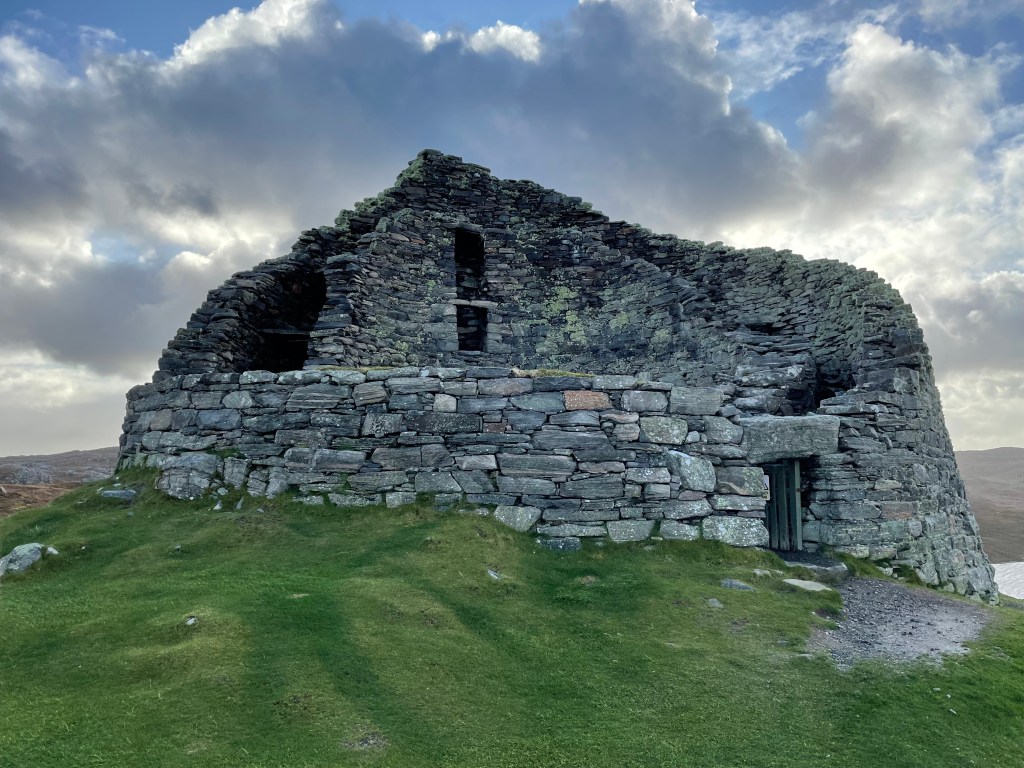
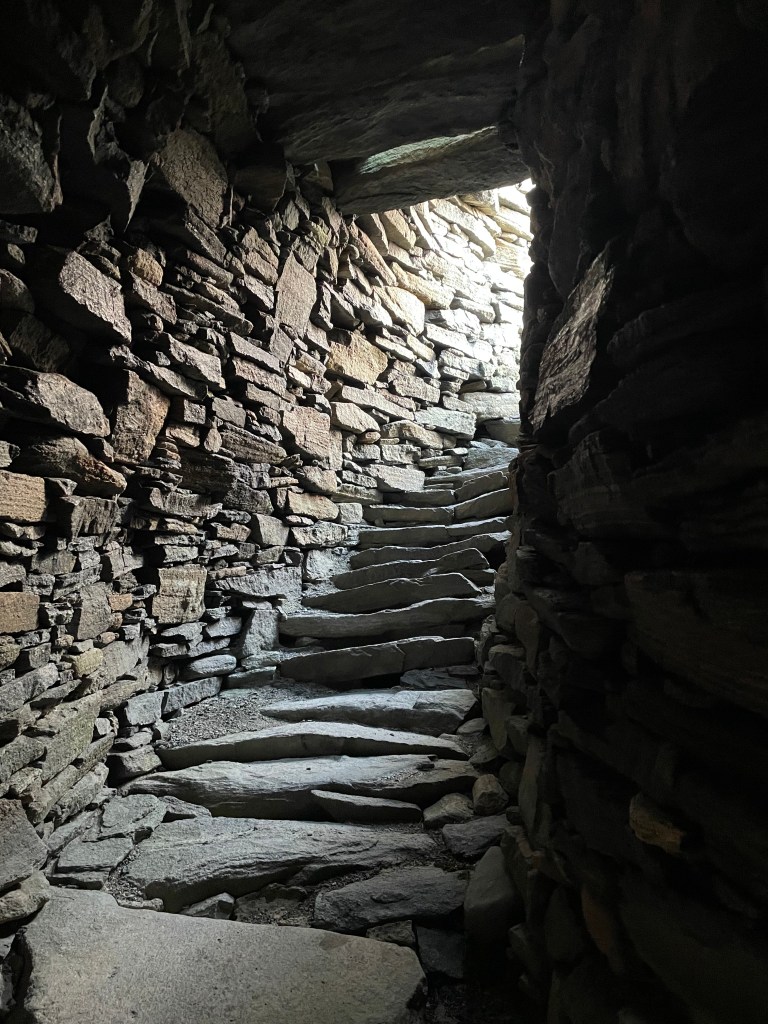
Our last official Outer Hebrides site was Dun Carloway Broch, one of the best preserved brochs in Scotland. These mysterious Iron Age monuments exist nowhere else but here. While these circular structures are as symbolic a feature as any in the highlands, their purpose remains unknown, although it is thought that they were residential structures for fancy people.
On the ferry back to the mainland, as we sailed through calm waters surrounded by hills on various land masses, Jacq, daughter of Margaret and niece of Victoria and awesome human being, turned to me and said incredulously, “There are mountains everywhere here.” I have told so many people about that comment because – I mean it’s true, yes there are. And that is one of the crazy unique Scotland things that for some reason I had never articulated. It doesn’t matter if you are on an island, in the middle of the mainland or on a ferry – there are indeed mountains everywhere. And as a person who needs mountains – that is a plus.

As all things do, the tour at last came to an end and we all bid a fond farewell in Inverness. I snagged dinner at Hootenanny’s, listening to some live music, and spent the night in my favorite B&B in Inverness, Castleview Guest House, run by the wonderful Eleanor and her 14 year old Jack Russell, Mia. I found the place back in 2018 because Rick Steves recommended it, and Eleanor said on his visit years ago he was most enamored of her hand-written, nearly illegible guest reservation book.
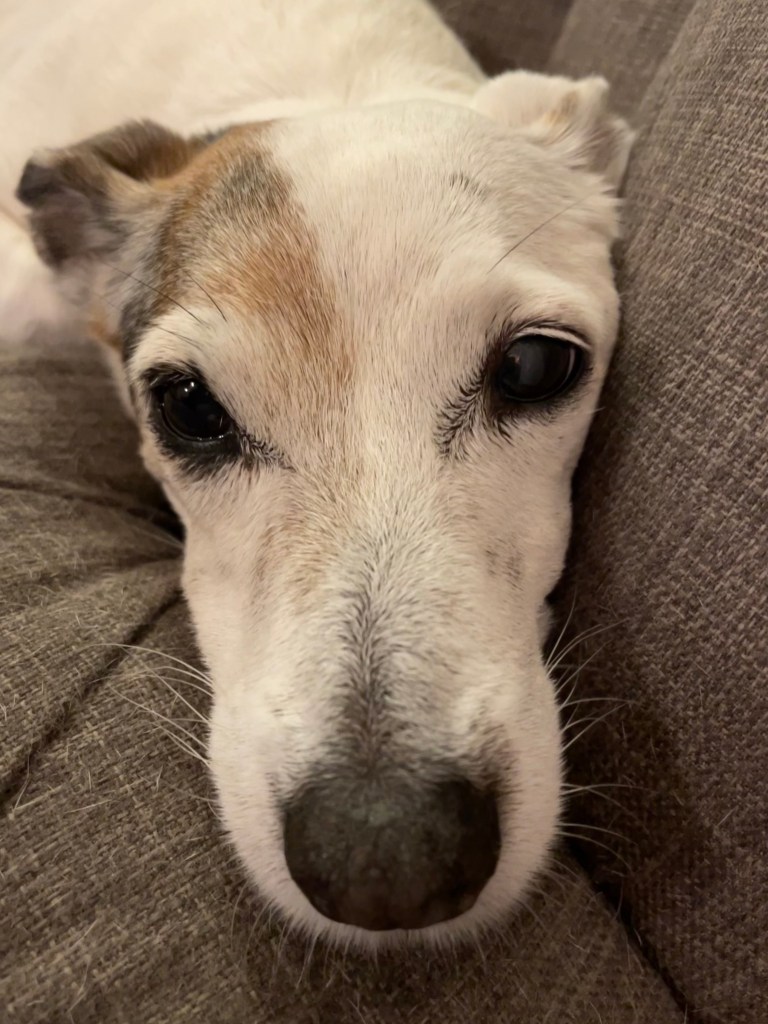
Sweet Mia

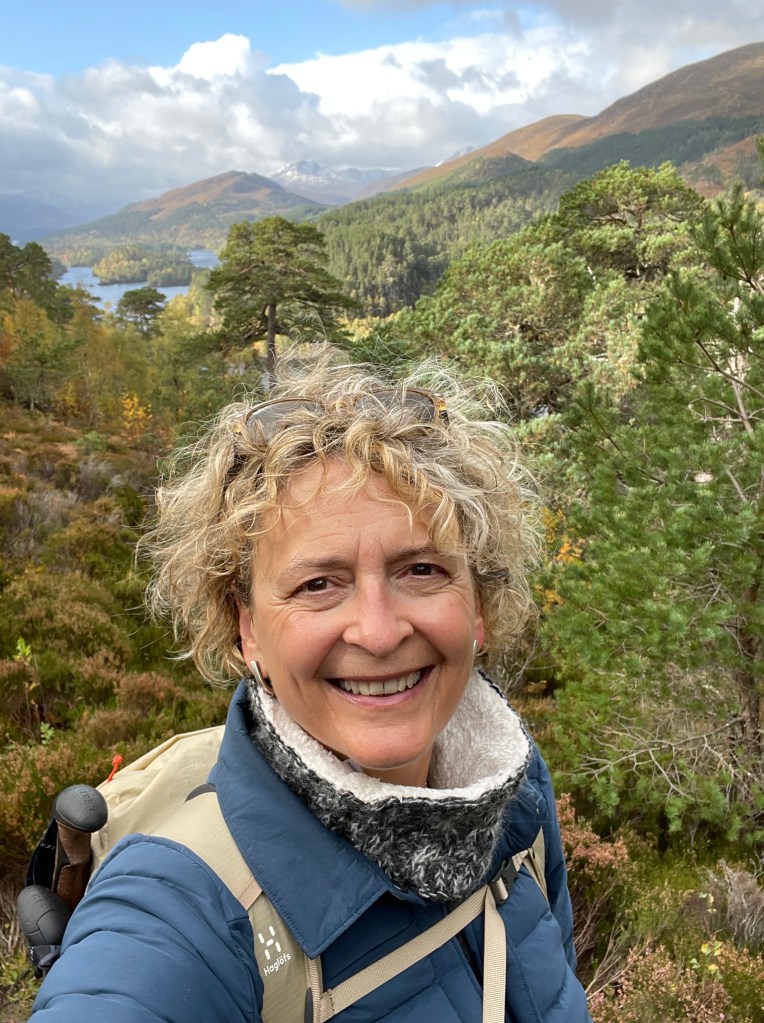
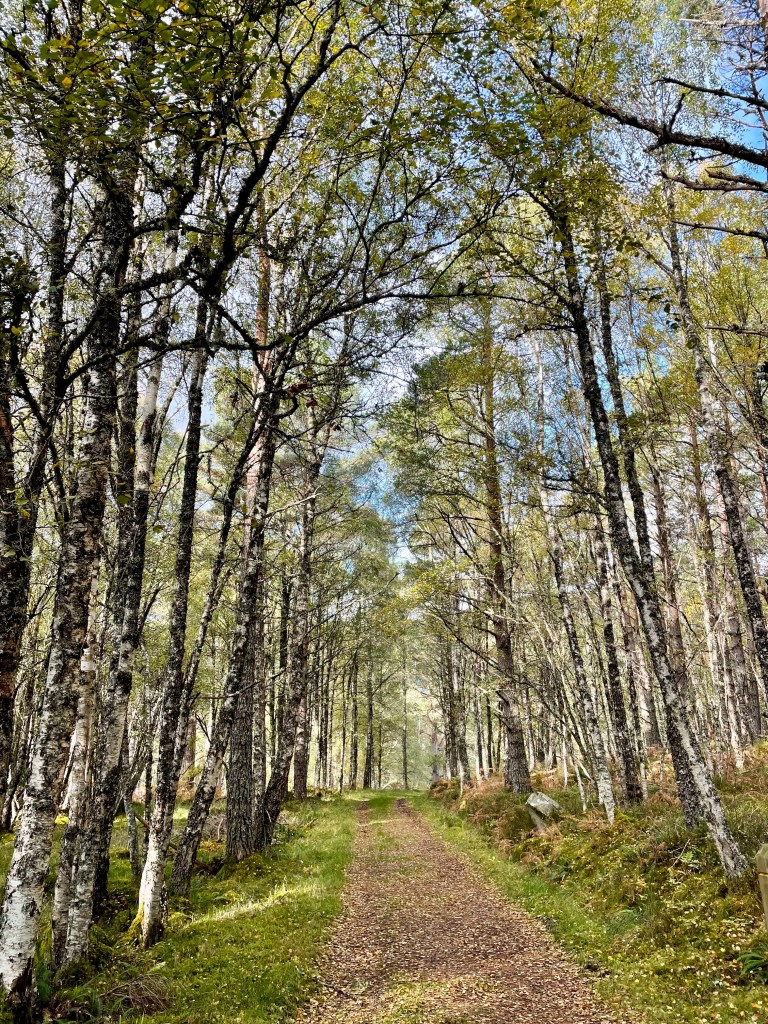
I know this sounds insane but the next day I rented a car and drove back to Skye. It’s actually not that far and Skye is Skye, so maybe not insane but only slightly eccentric. I stopped at Glen Affric, another splendid nature reserve on the mainland. And, best of all, there was snow on them thar hills.
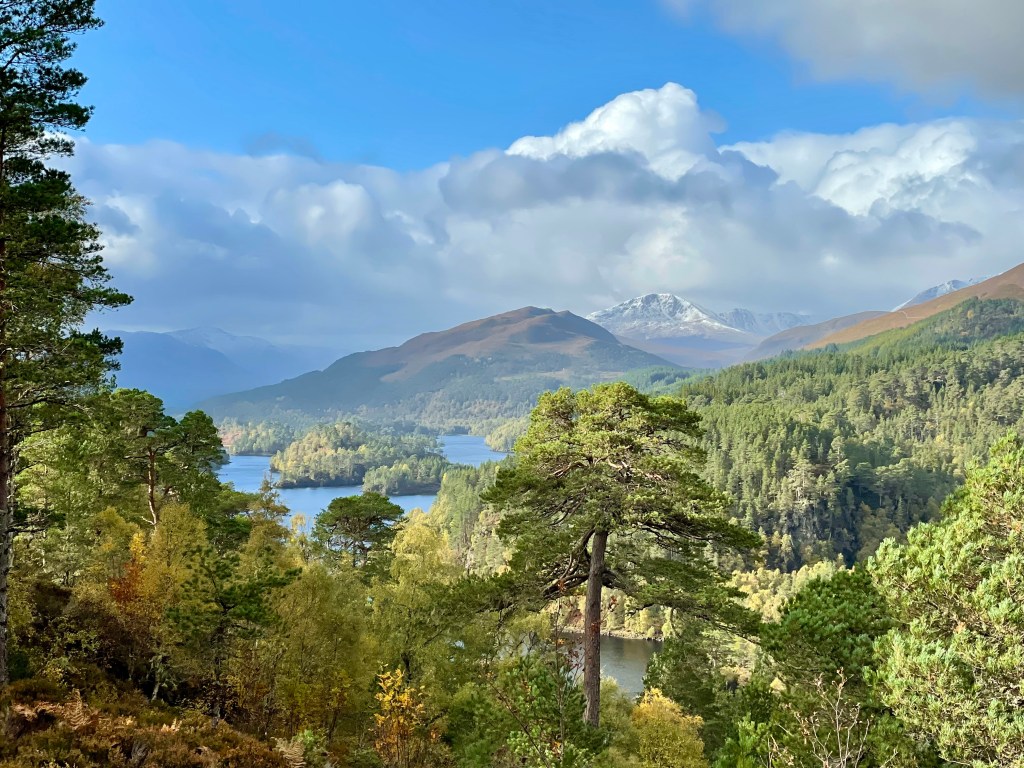
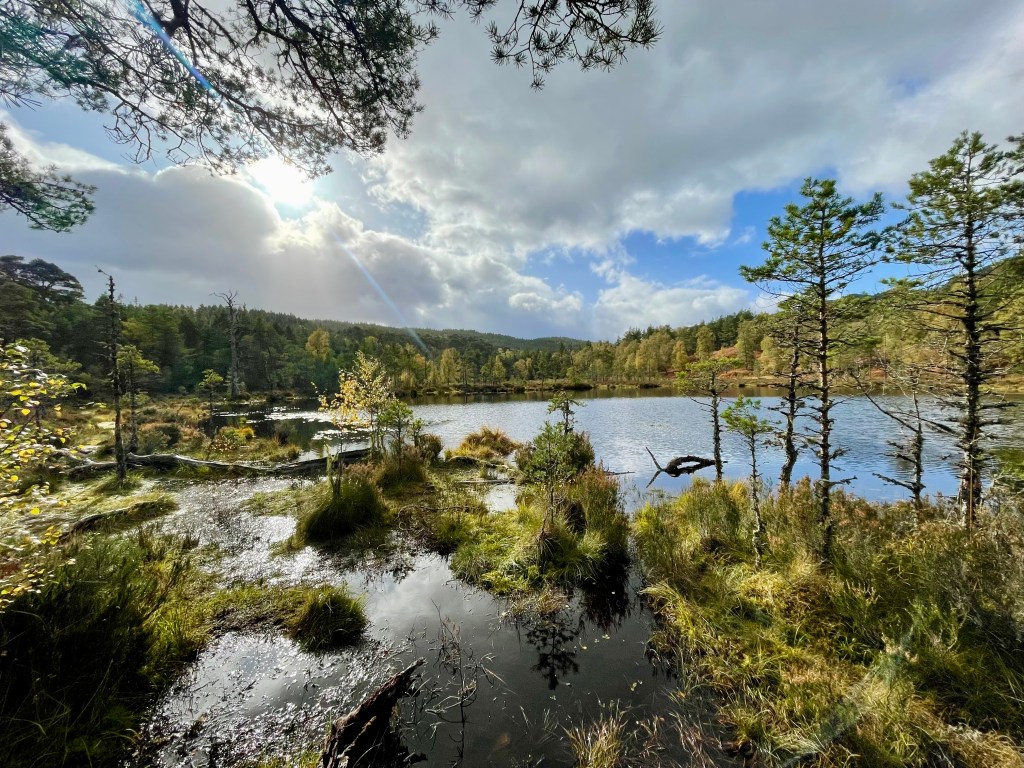
Glen Affric, along with many other reserves I had visited over the past few weeks, is one of rewilding zones of Scotland. This restoration and conservation effort had become rather an unintended but very much appreciated mantra of my trip and thankfully is a government priority. Trees and other vegetation are planted in these areas with the goal of creating a landscape that more closely resembles the Scotland of thousands of years ago, which is not the bare hills of the highlands that we are accustomed to seeing, but rather a more forested landscape providing a more diverse habitat for a greater variety of flora and fauna. For example, trees are often planted along rivers to provide shade and cool the water so salmon can thrive.

Some in the countryside advocate passionately for rewilding, others see it as an existential threat to their culture, history, and way of life. Farmers, deer stalkers, ghillies and gamekeepers are quite anxious about the impact these plans will have on their jobs. For example, Scotland is teeming with too many deer which denude the landscape – contributing to the problem – by eating foliage from the roots (as opposed to sheep whose style is more like a lawnmower) yet efforts to cull the herd have run into resistance from landowners and staff whose income is wedded to the deer stalking business.

Be that as it may, rewilding efforts are grounded in the belief that land is not primarily for generating income from sporting activities, forestry or commercial agriculture, it’s for, you know, life writ large. Creating, nurturing and protecting wild land produces the oxygen and the biodiversity we need to survive and offers solace and inspiration for our imaginations and our souls. So there.

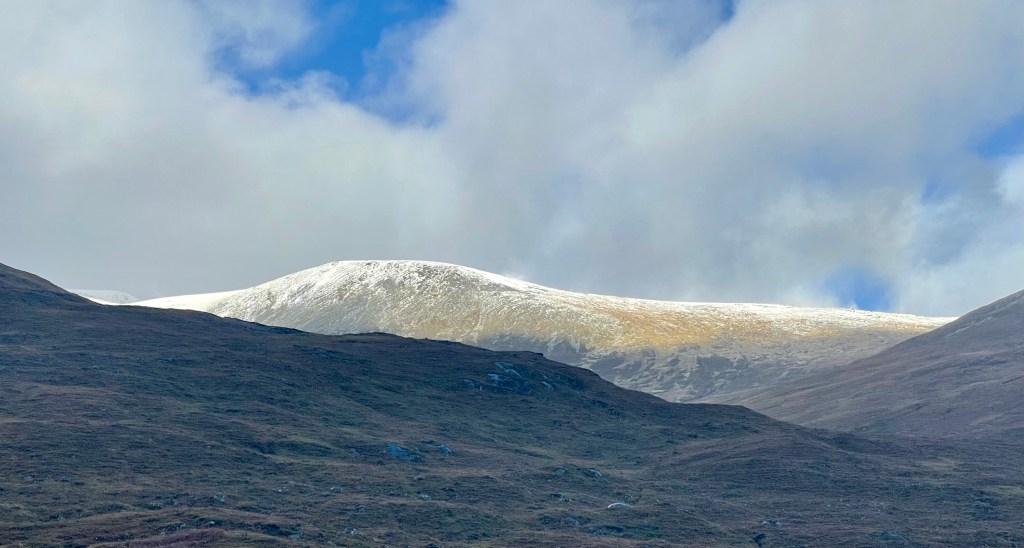
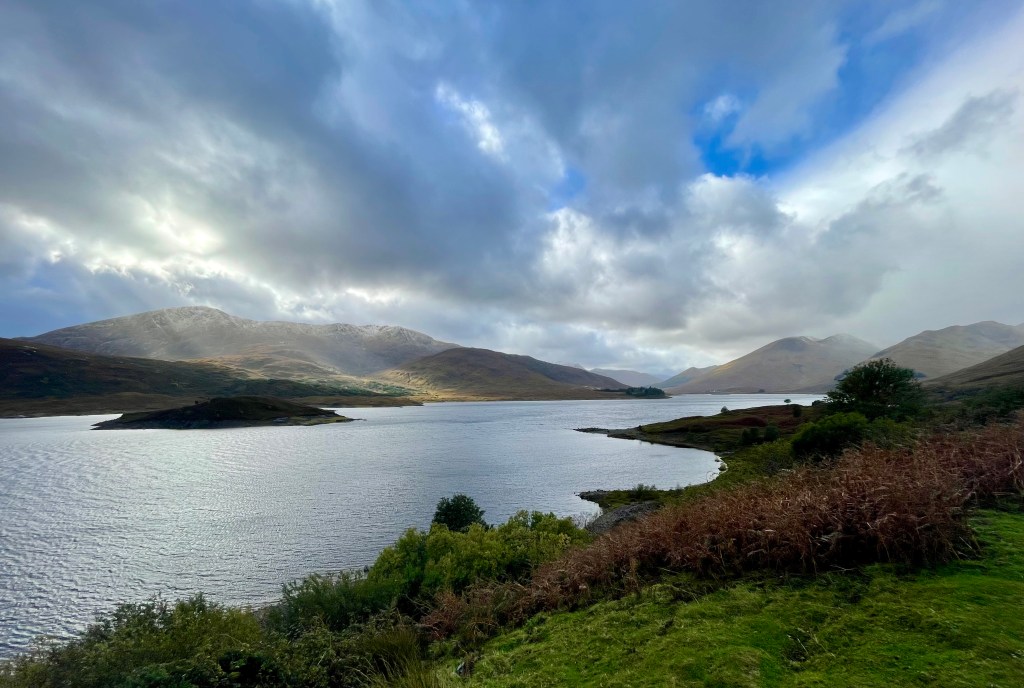
Returning to our beautiful drive back to Skye, there was also a sprinkling of snow on the peaks surrounding Glen Shiel. No matter how old I get, there is always something magical about the first snow of the year.
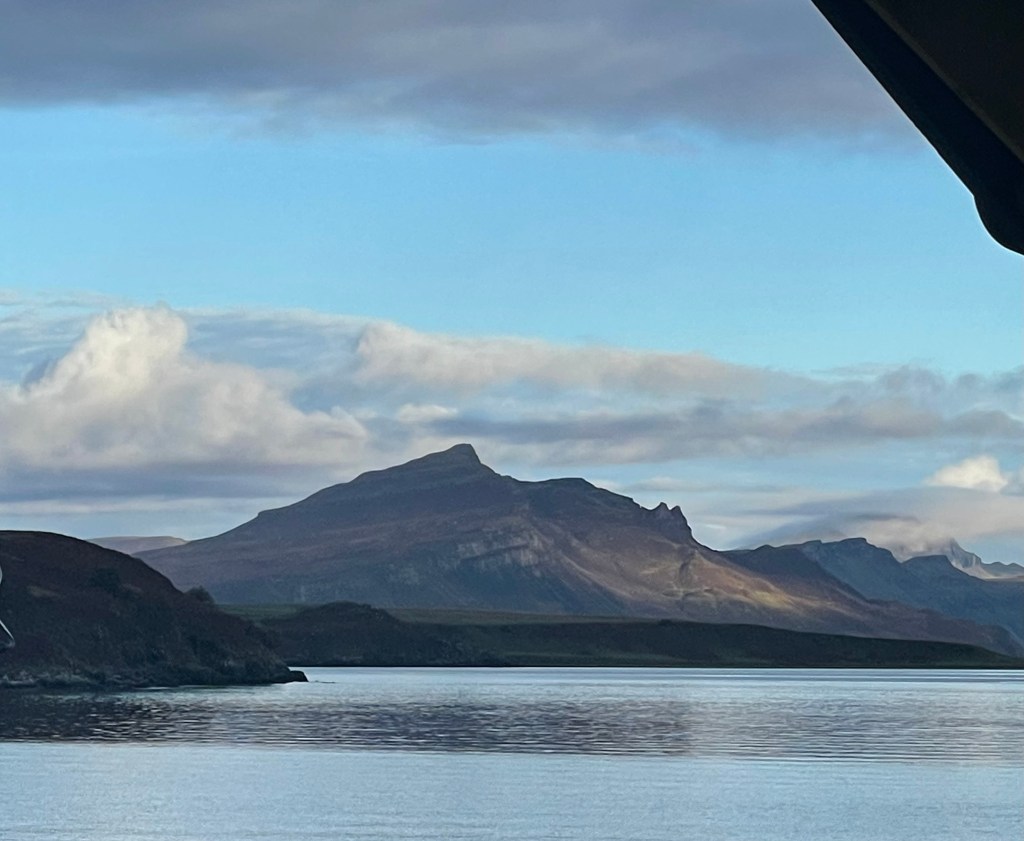
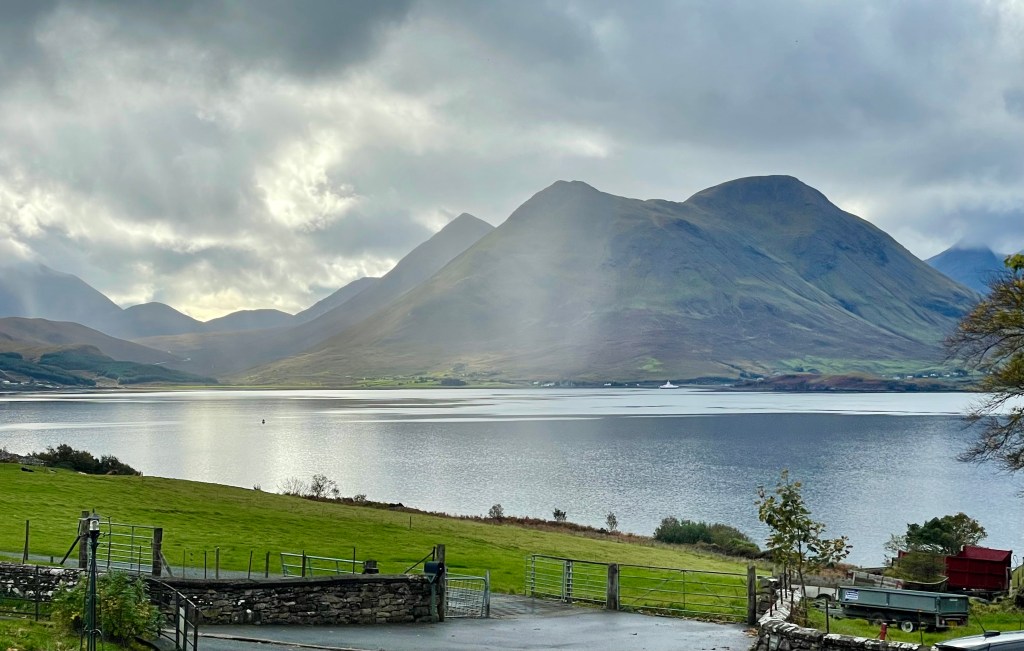
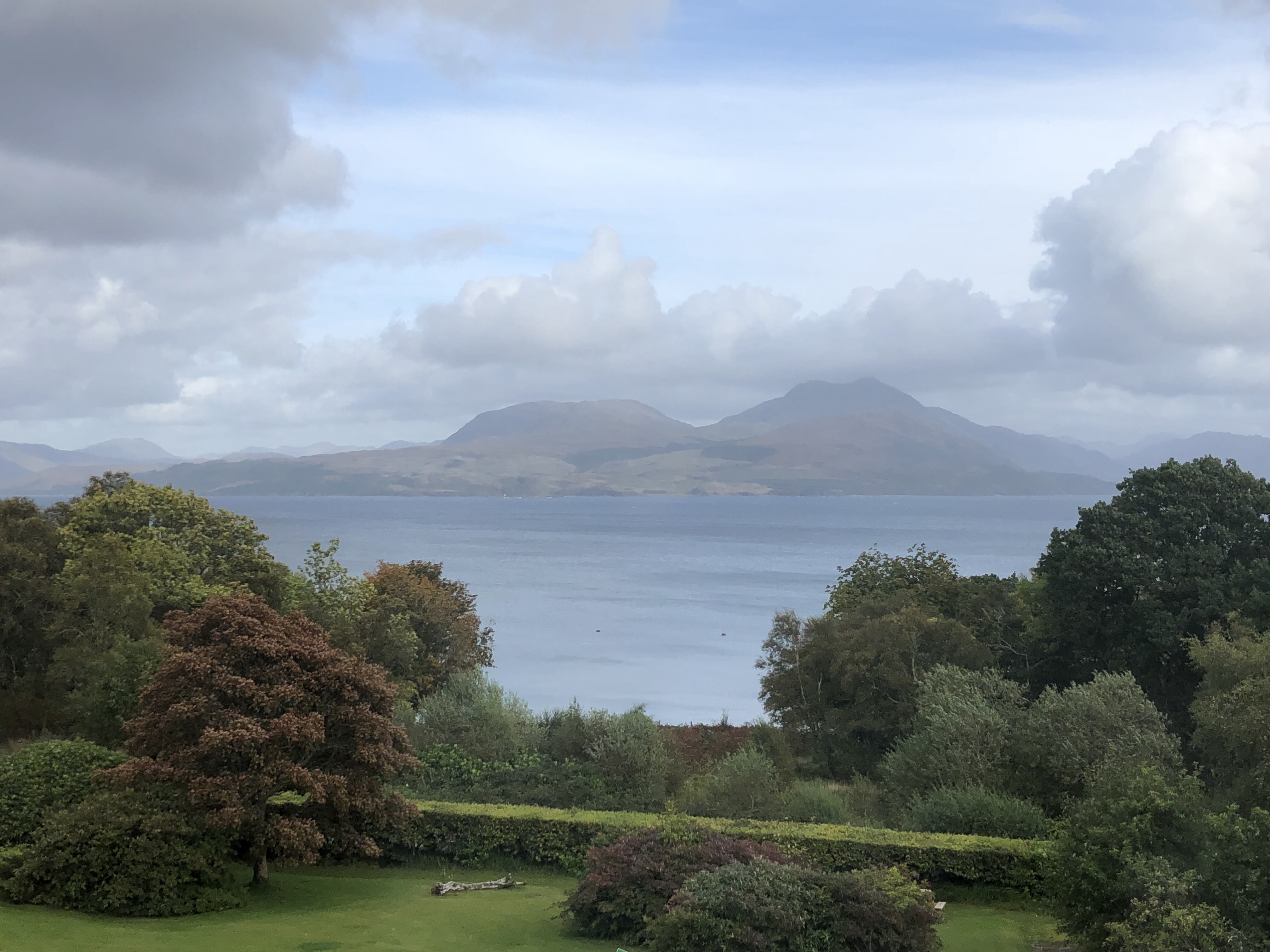
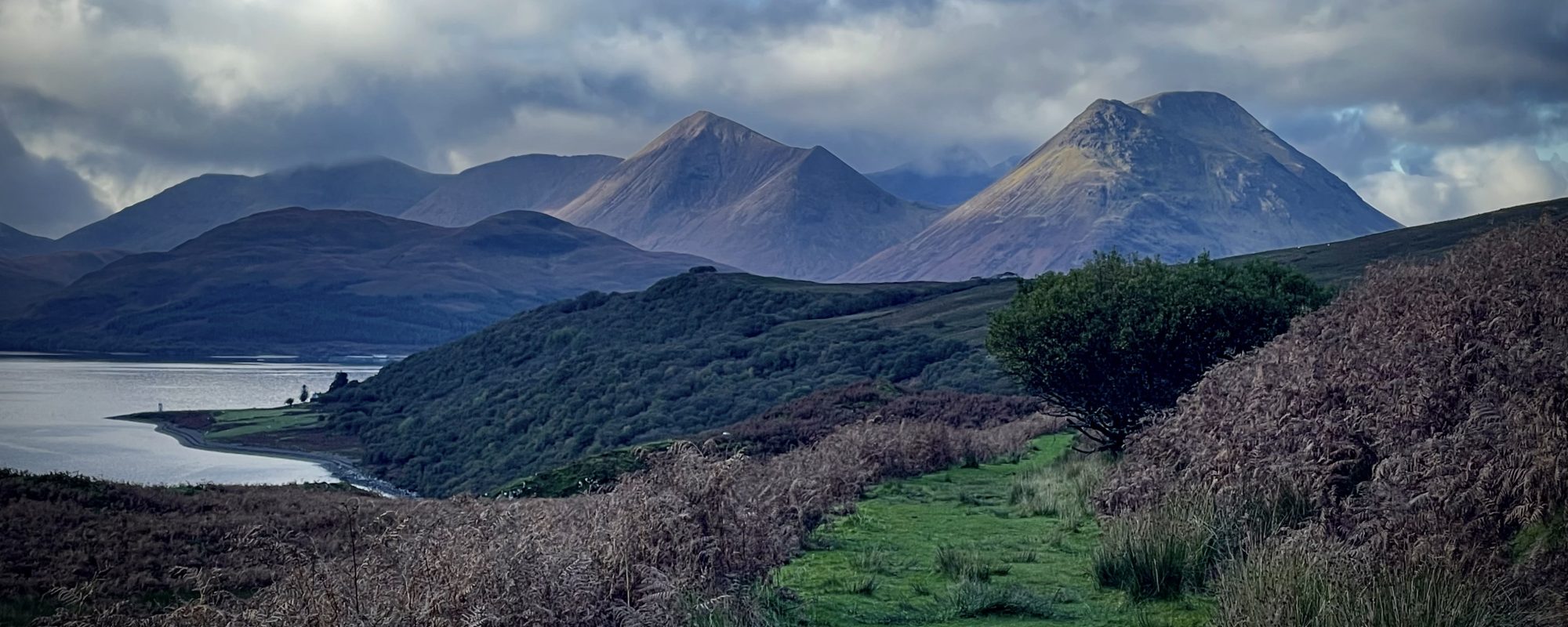
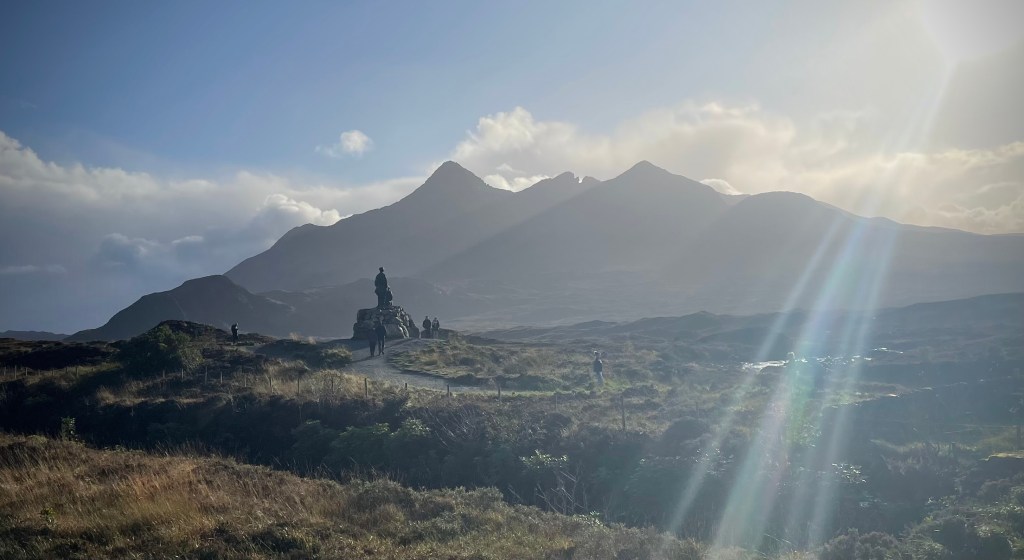
Once over the Skye Bridge, I drove through Glen Sligichan, this time in gorgeous weather and so stopped for a photo of the wily Black and Red Cuillins, since as you’ll remember they were shrouded in mist and dreich the week before.
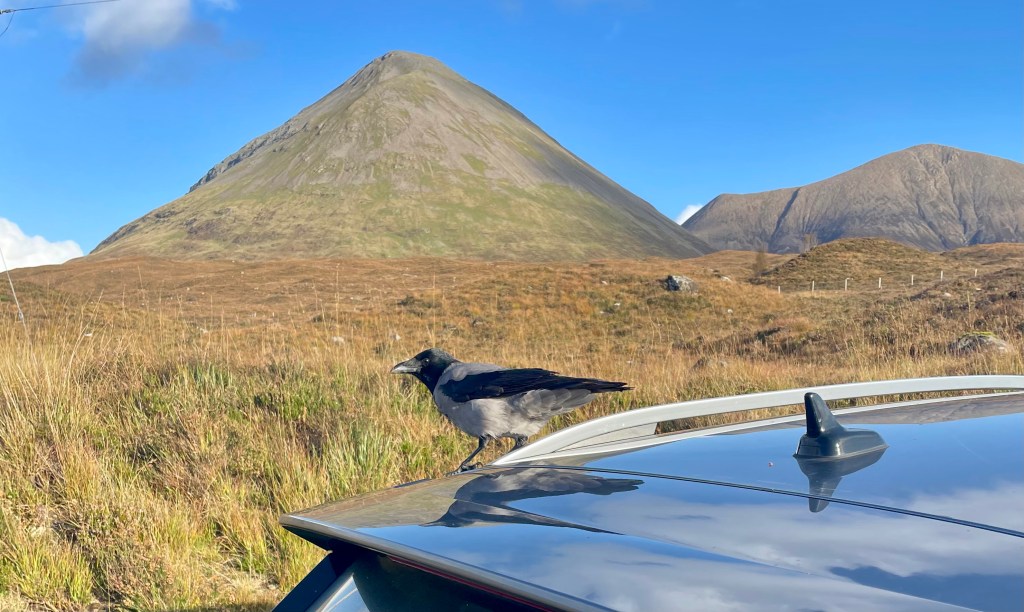
Full circle: a hooded crow on the car once again, this time in better conditions.

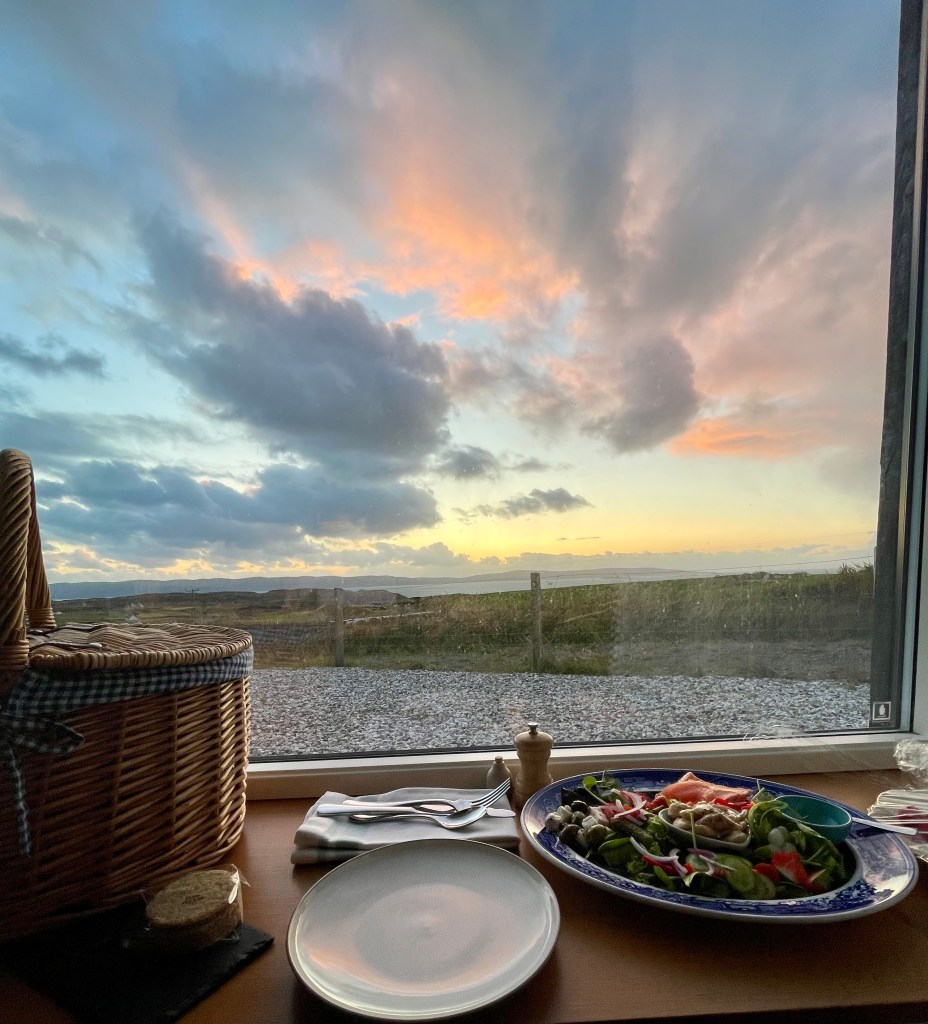
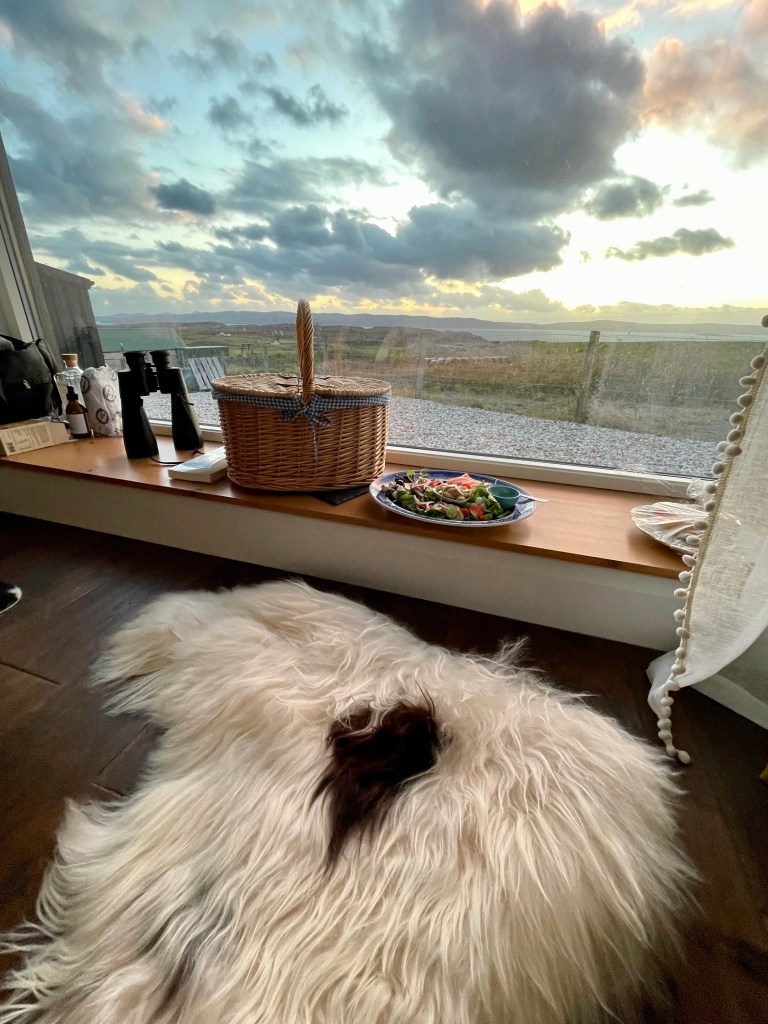
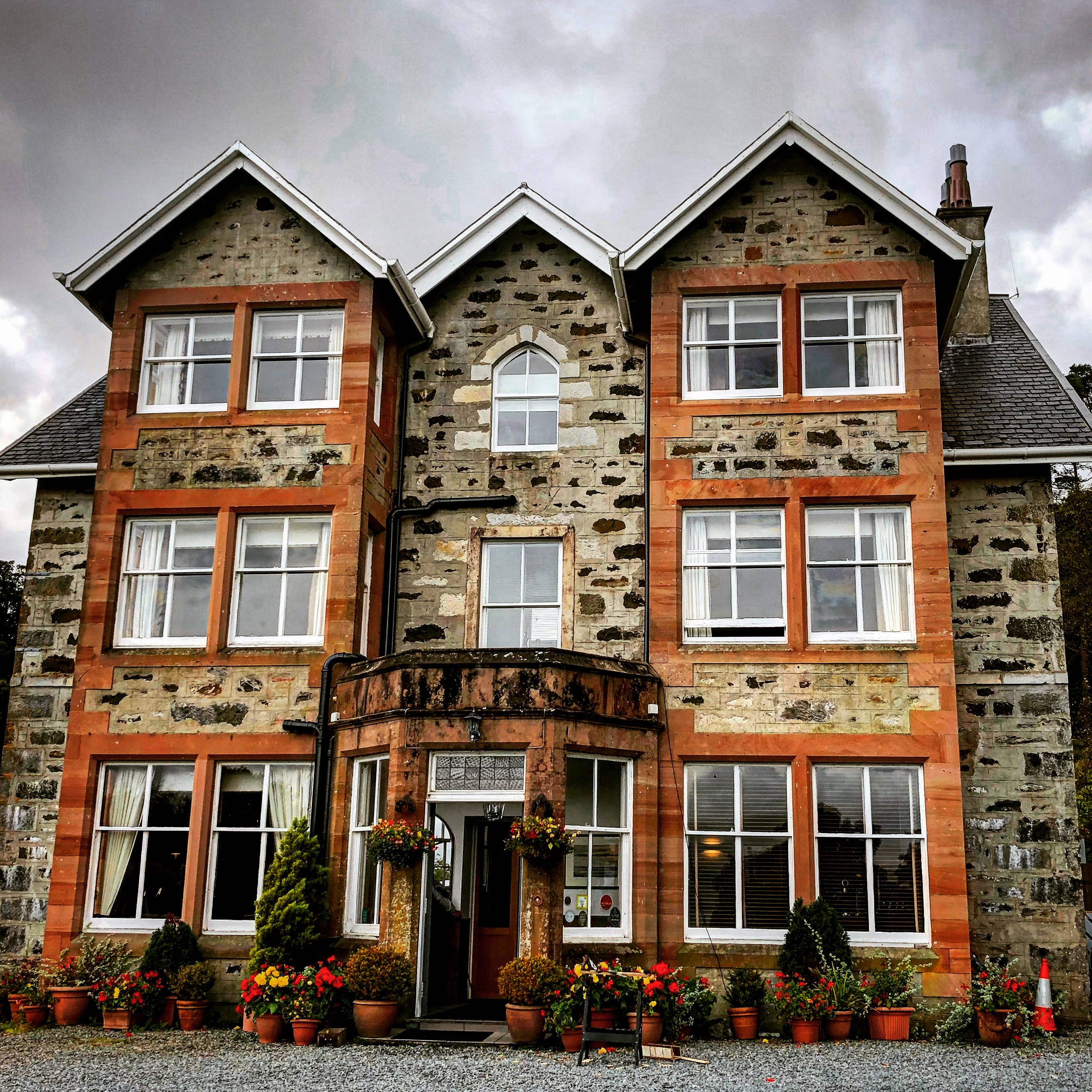
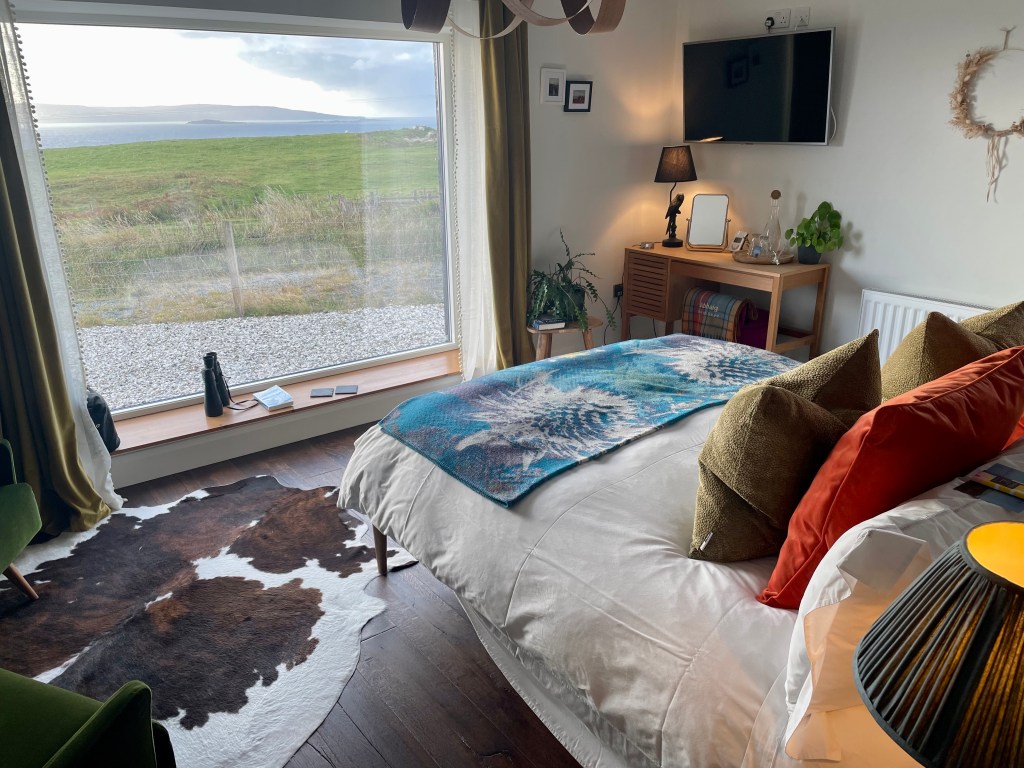
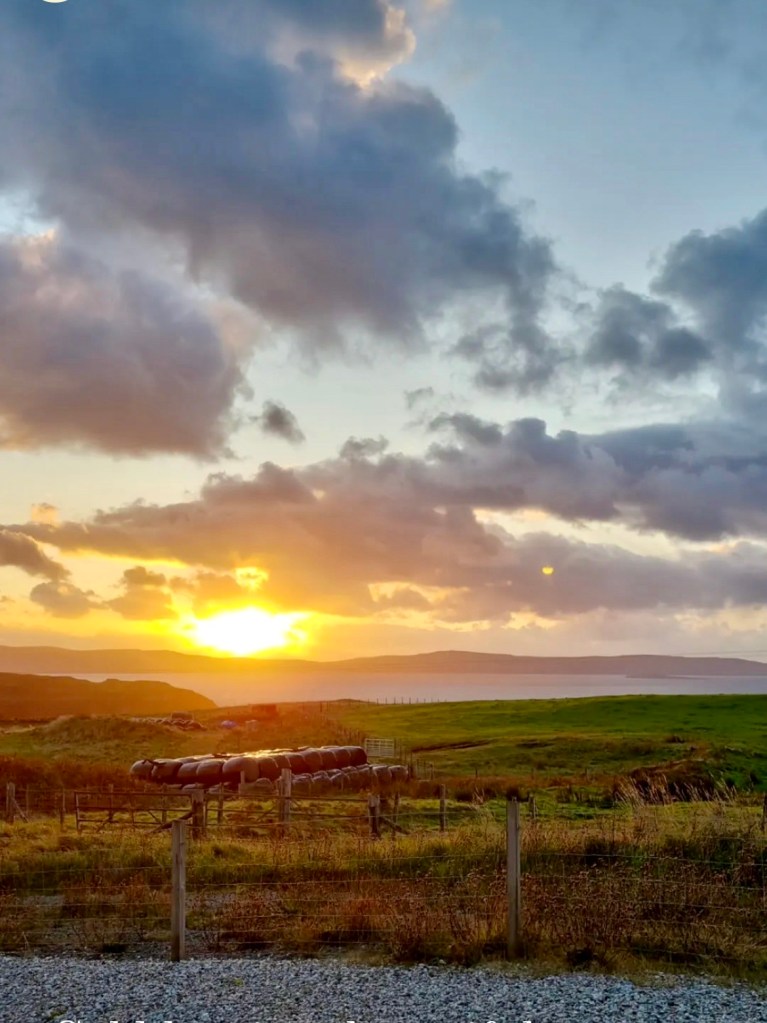
In Skye, I stayed in Uig, where we also stayed during the Wilderness Scotland trip, which I swear I didn’t realize in advance. I knew we were staying somewhere on Skye but no idea where. Crazy.  Clearly meant to be, yeah? Anyway, I stayed at a fabulous B&B, Abhaig House, run by an even more fabulous couple, Viv and Steve, who brought me a piece of a home-baked cake every single day. The view from my room was unbelievable, and I arrived to a charcuterie board with fresh salmon prepared by my hosts for a most delectable dinner, complete with a jaw-dropping sunset view.
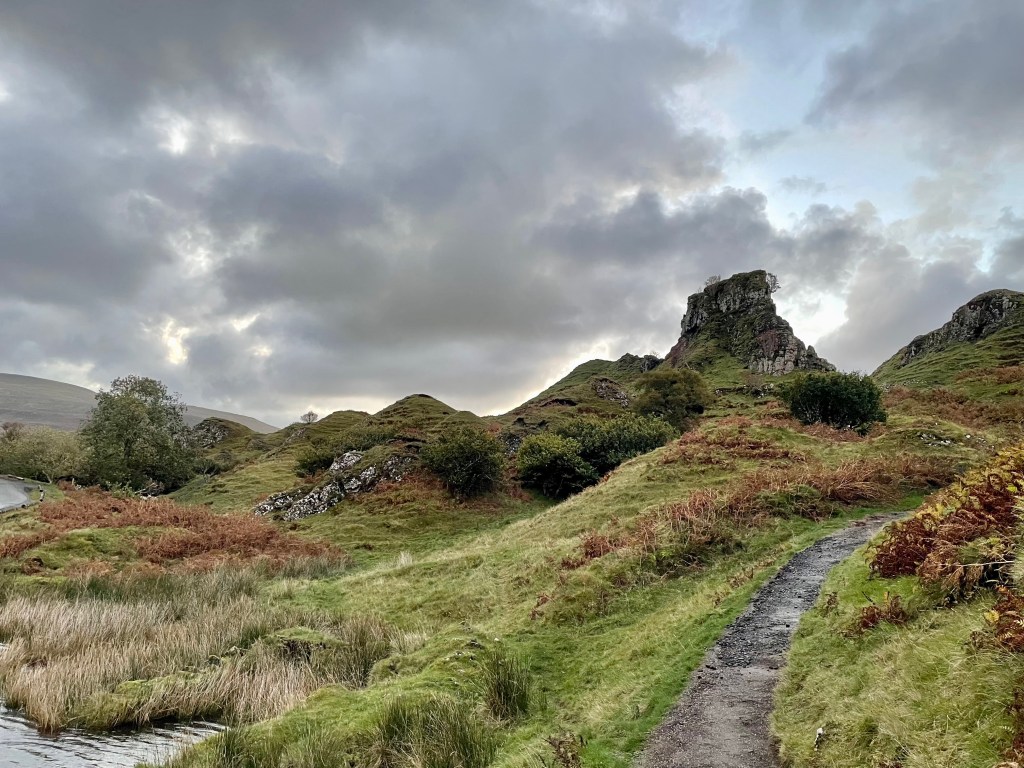
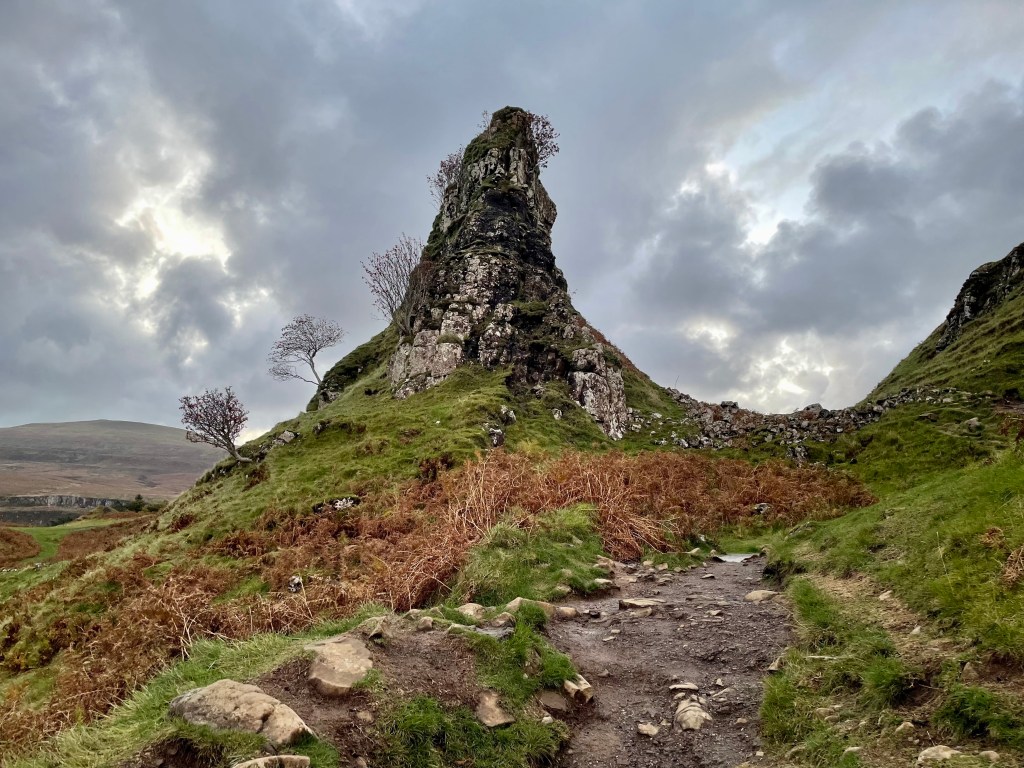
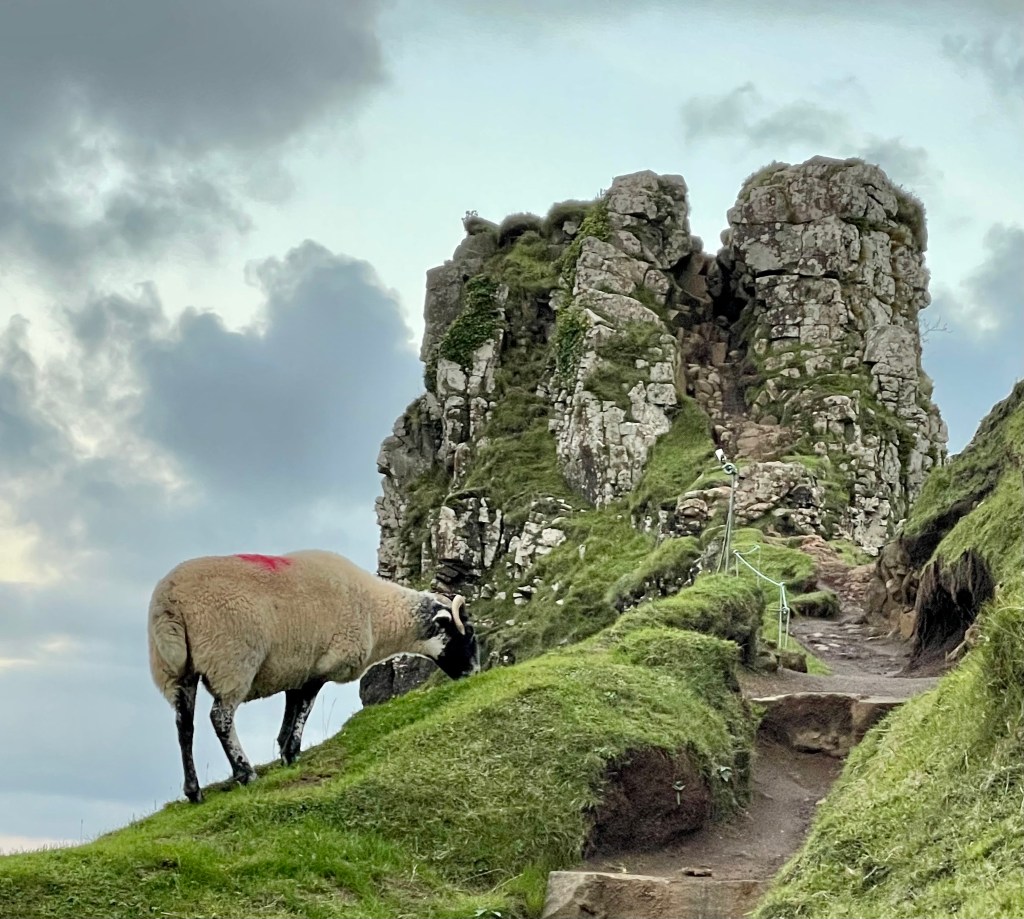
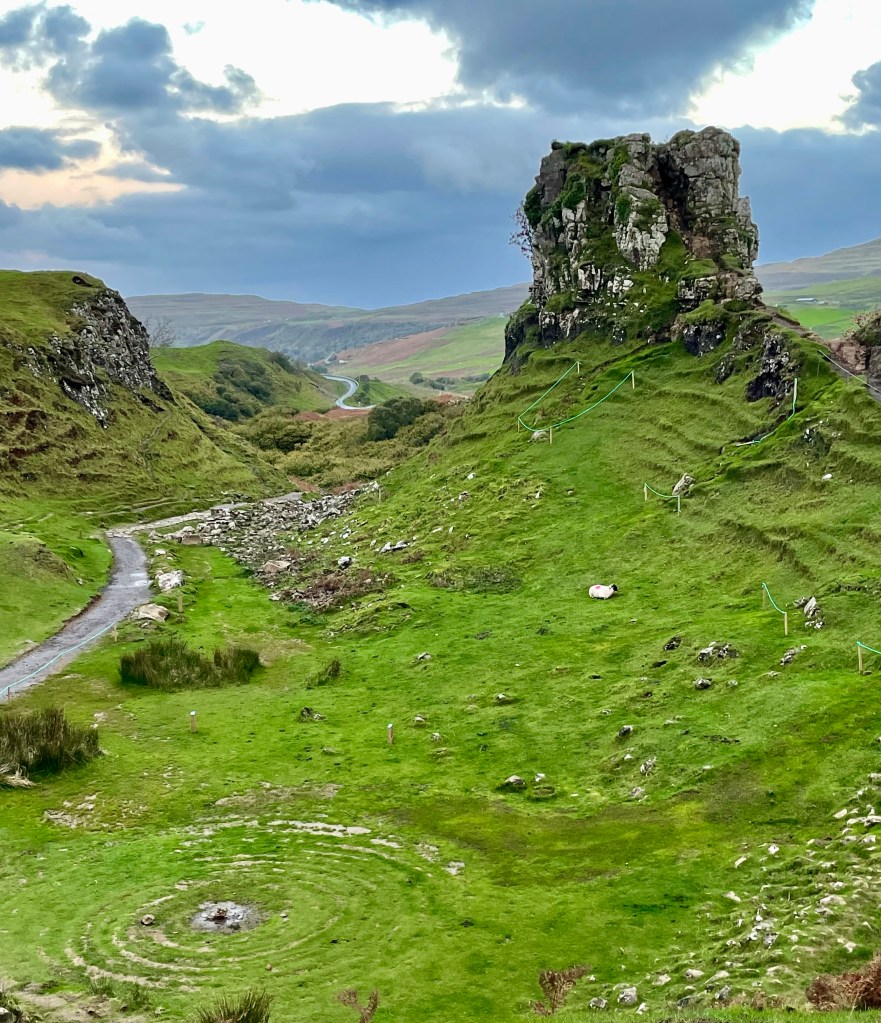
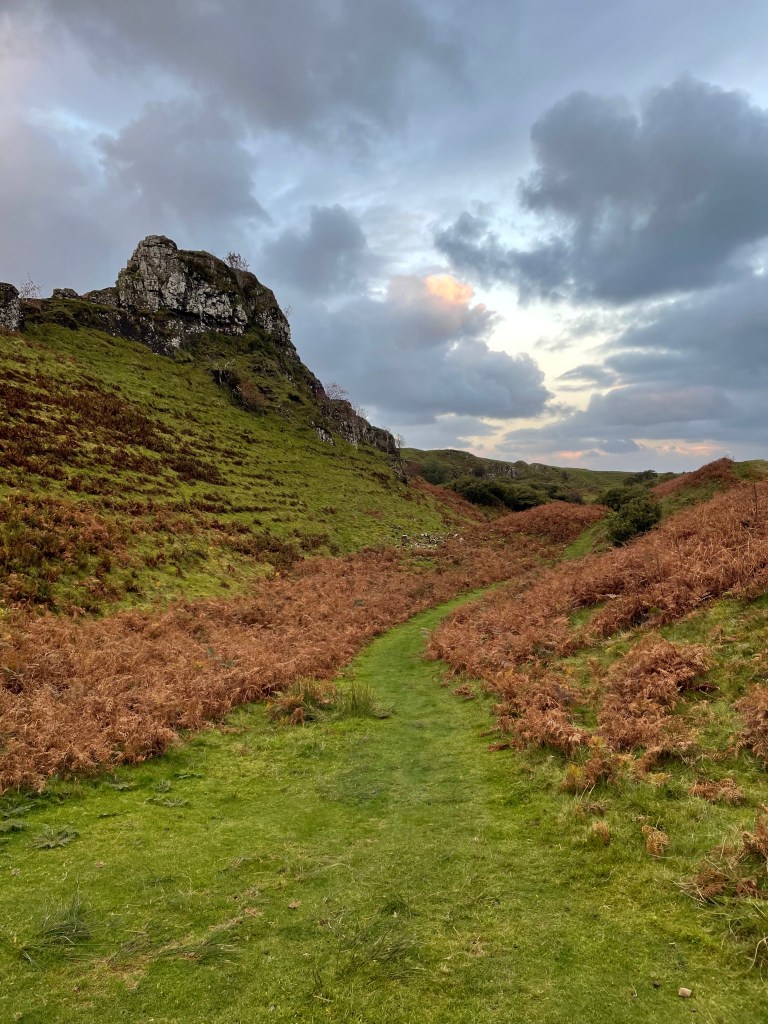
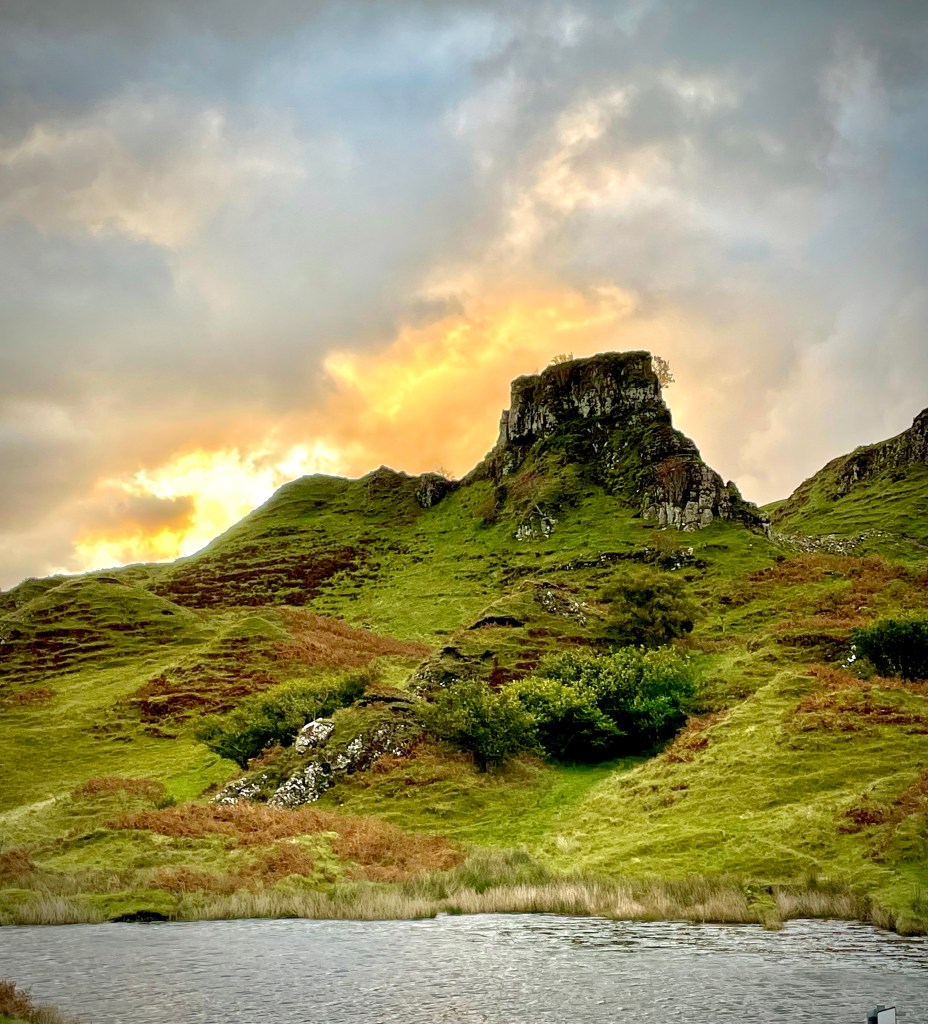
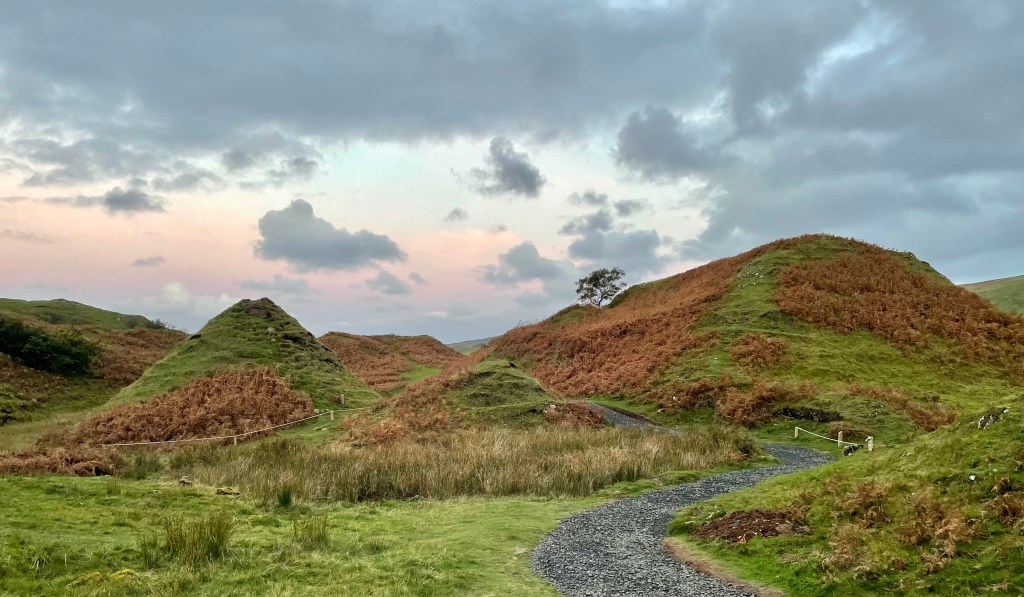
The next morning I woke up early and drove just a few minutes to one of Skye’s honeypots, the Fairy Glen. It’s usually crawling with ugh tourists but we are now in late October, and I arrived at sunrise so it was mine all mine.  Just a crazy beautiful and singular area on the backside of the Quiraing. Geology, my friend. Geology. I mean what IS this place.
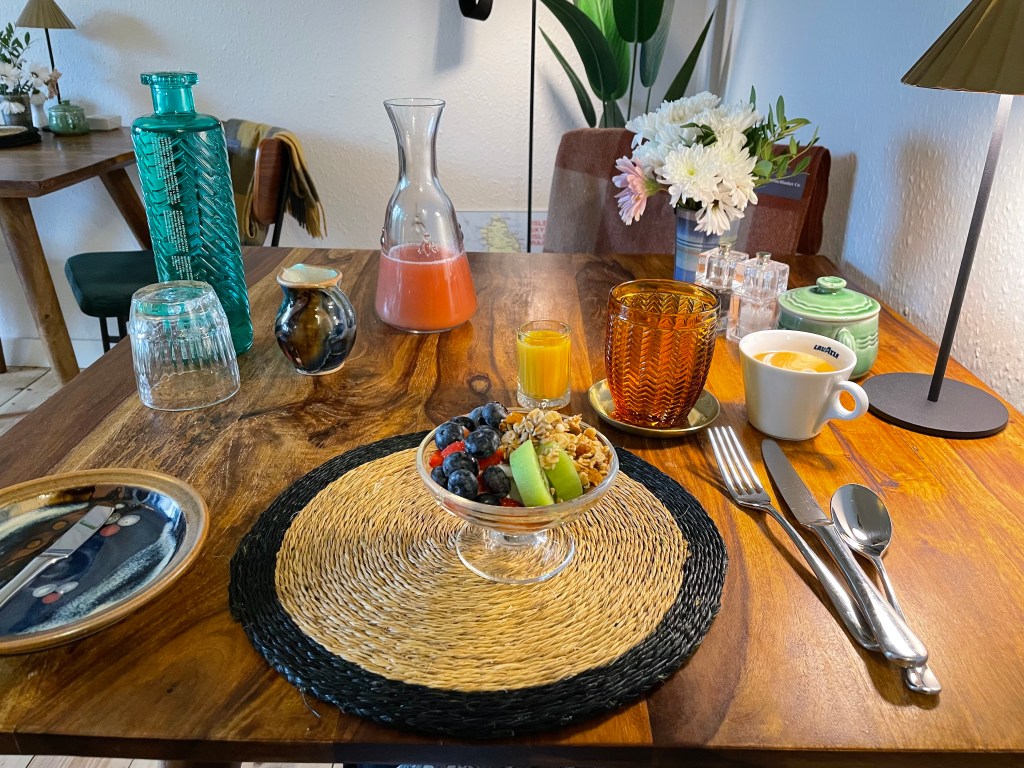
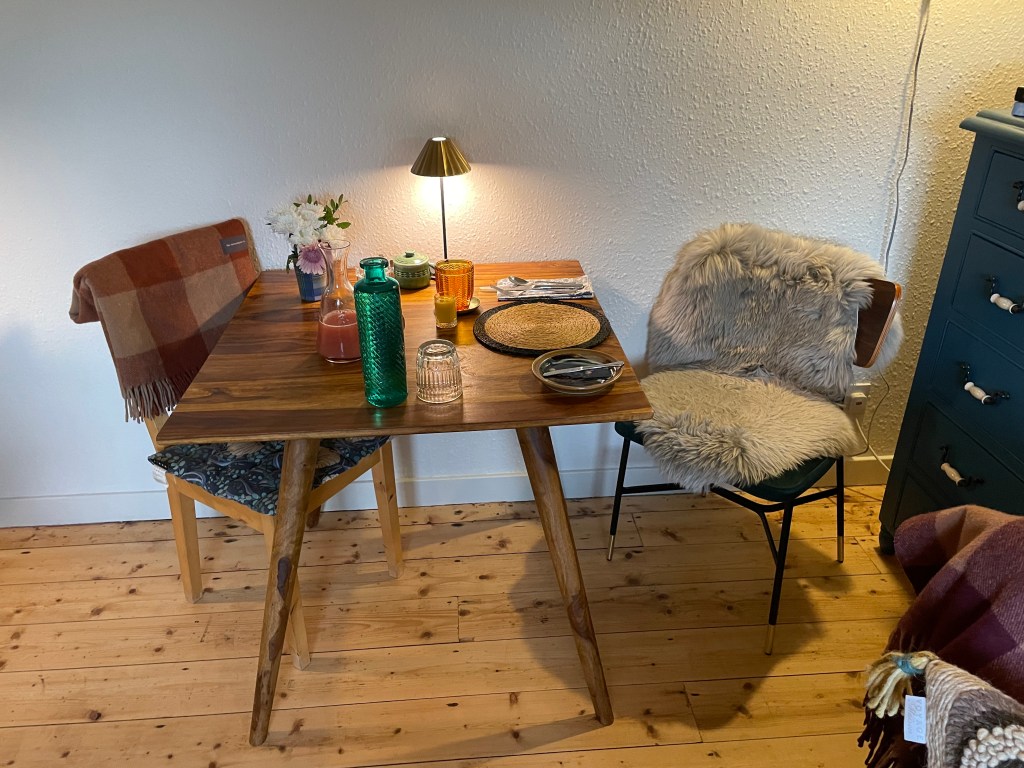
After my little walk, a delightful breakfast at Abhaig.
I then drove southwest to Glenbrittle beach, where I thought I’d head partway up the hike to Coire Laggan in the Black Cuillins. I knew I didn’t have enough time to do the entire walk, sadly. I kept going a little bit further and a little bit further still – just to that ridge there, then I’ll turn around, oh wait there’s another little bit…..  And lo there came a time when I needed to pull slightly off the trail to drop trou and do a wee pee – and as looked up from my undignified squat toward the Cuillin ridge, to my horror descending walkers appeared in the distance WHO PROBABLY SAW ME and so I took that as my sign and scarpered back down to the car in giggly horror.
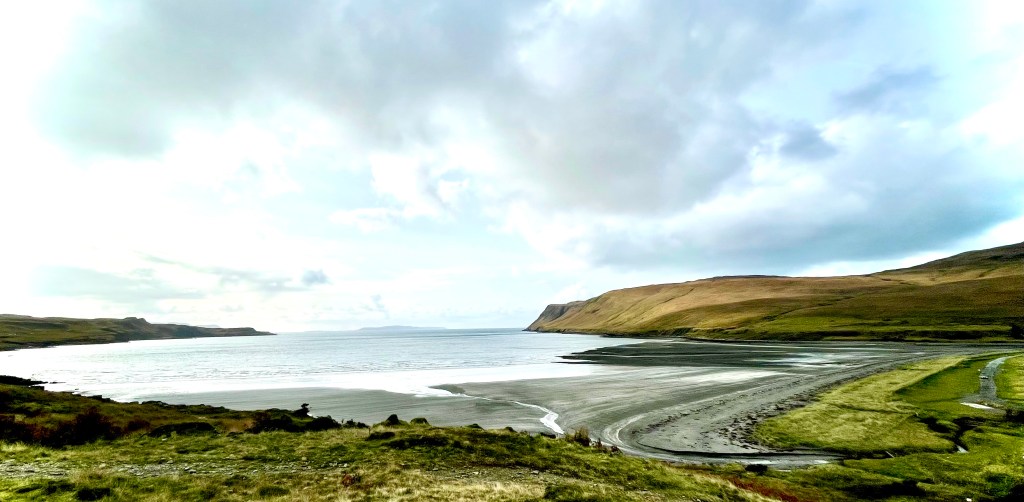
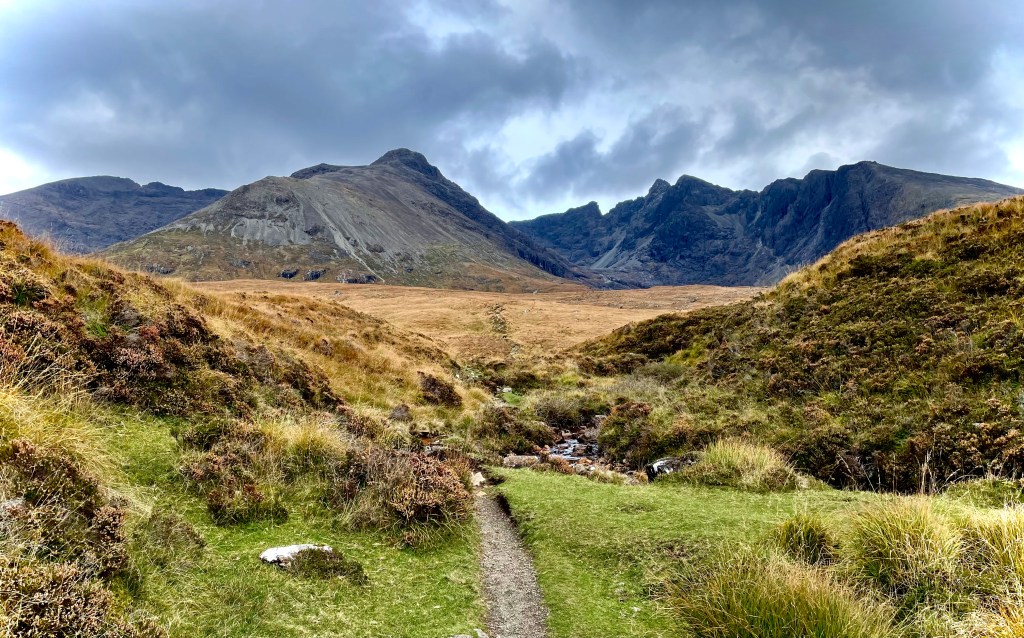
The black sands of Glenbrittle Beach

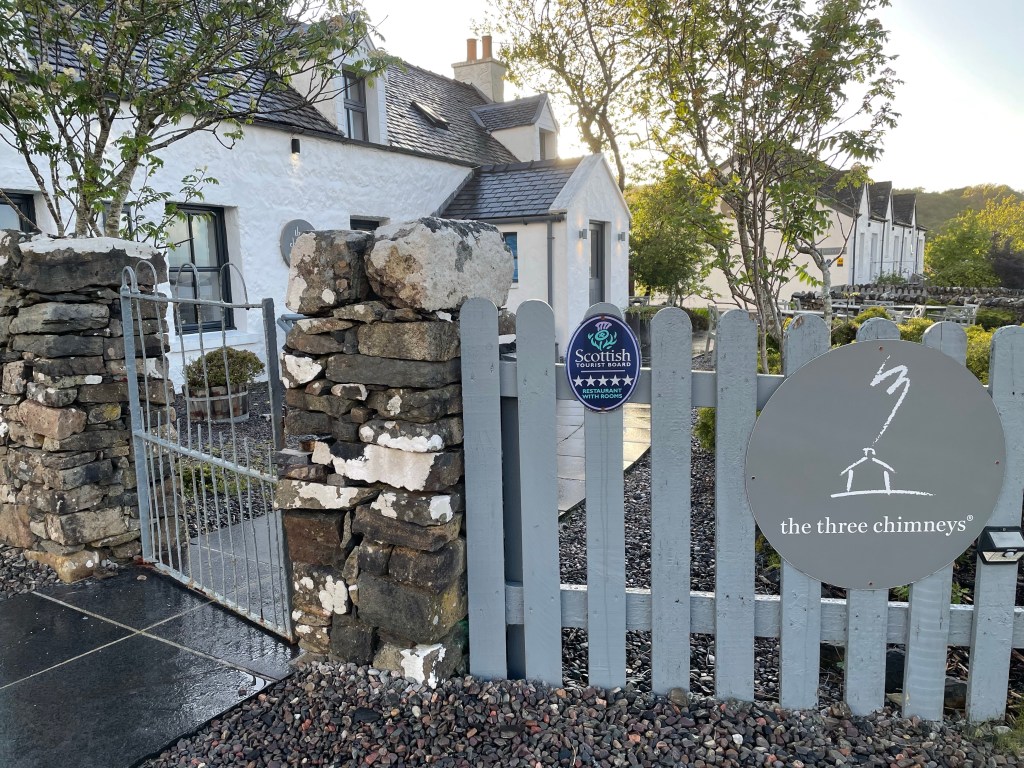
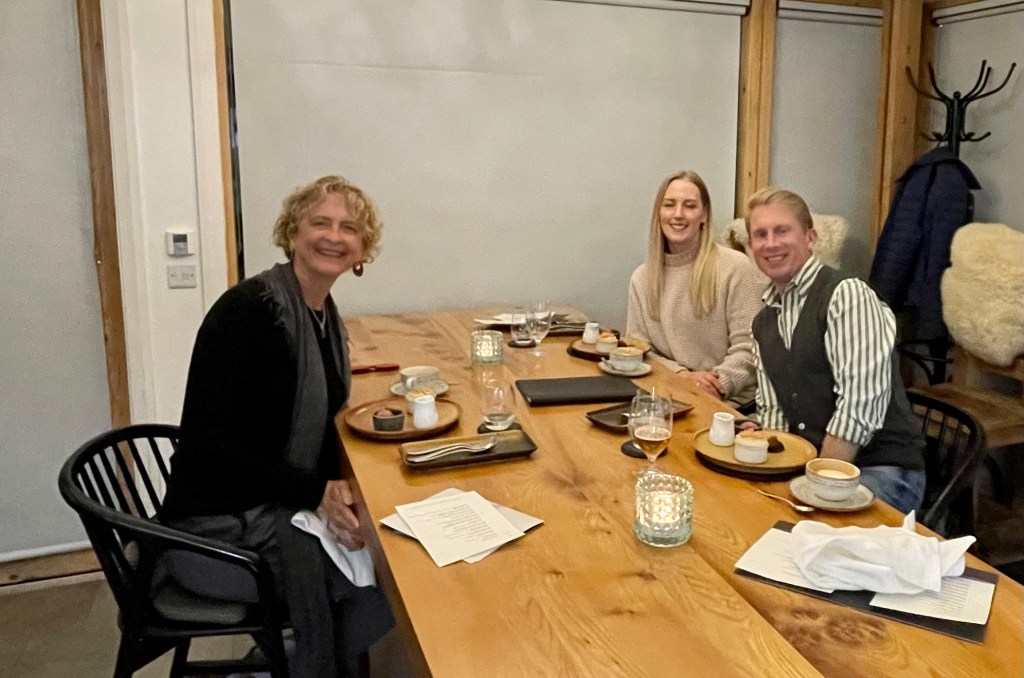
The reason I didn’t have enough time is because I had booked a reservation at the chef’s kitchen table at the renowned Three Chimneys restaurant, where I had enjoyed a wonderful meal with Danielle the previous spring. It was super fun sitting in the kitchen and the only other guests were a very blonde and adorable couple from London on their honeymoon. Both lawyers! Both liberal!  Brexit is terrible! Trump is terrible! Yay! A chef’s table can be risky, god knows, but we hit the jackpot and had a lively and interesting conversation for the entire meal. They were staying in the lovely rooms at the Three Chimneys, whereas I had a half hour drive back across Skye on single track roads in the pitch dark with silly sheepies snoozing like RIGHT there on the edge of the road like fuzzy doofuses.  But seriously – what a great night.
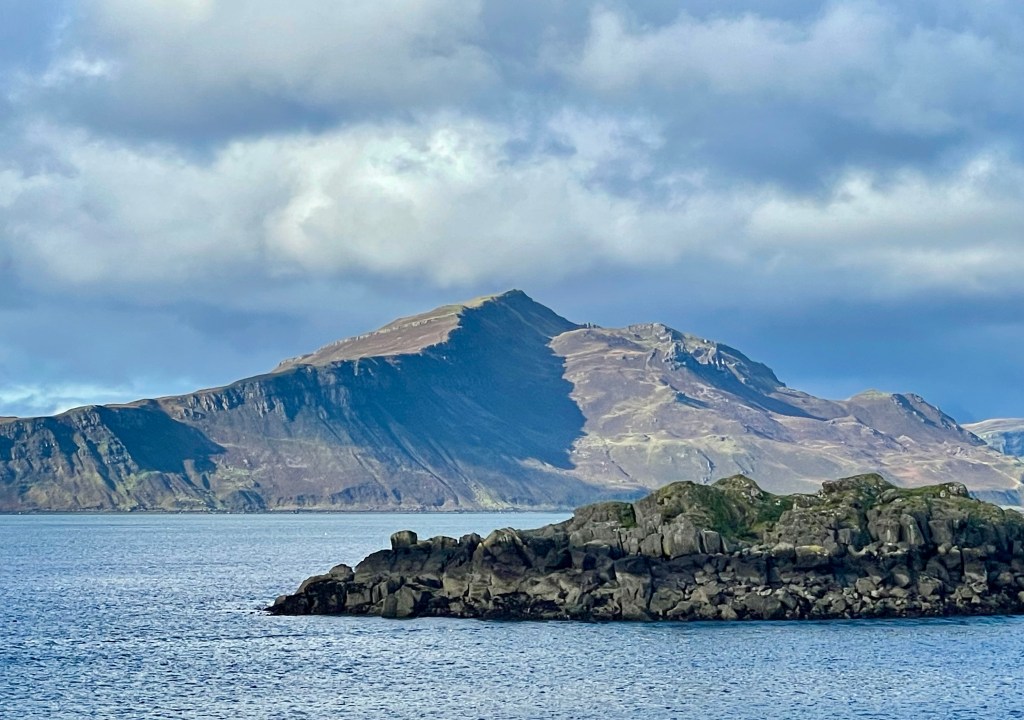
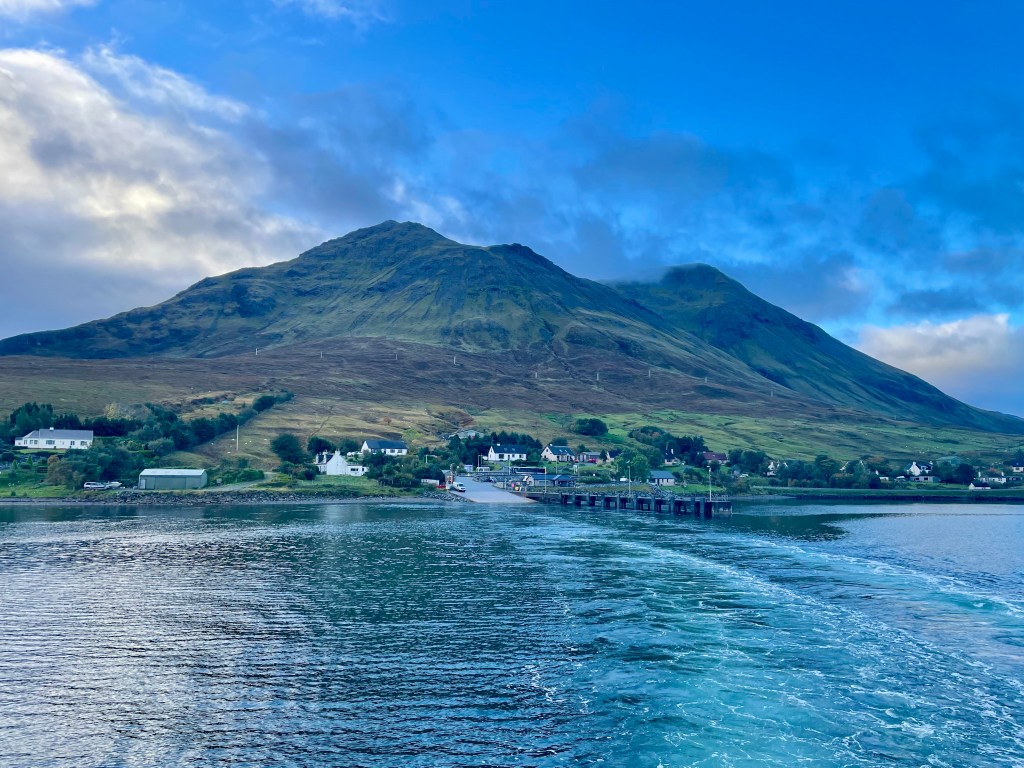
The next day I caught the ferry to Raasay, a small island with 192 denizens just to the east of Skye.  It’s a very short and very beautiful ferry ride.
When we disembarked I set off down a crumbly wee road toward a short hike that looked pretty cool. I did not see another car or another person.
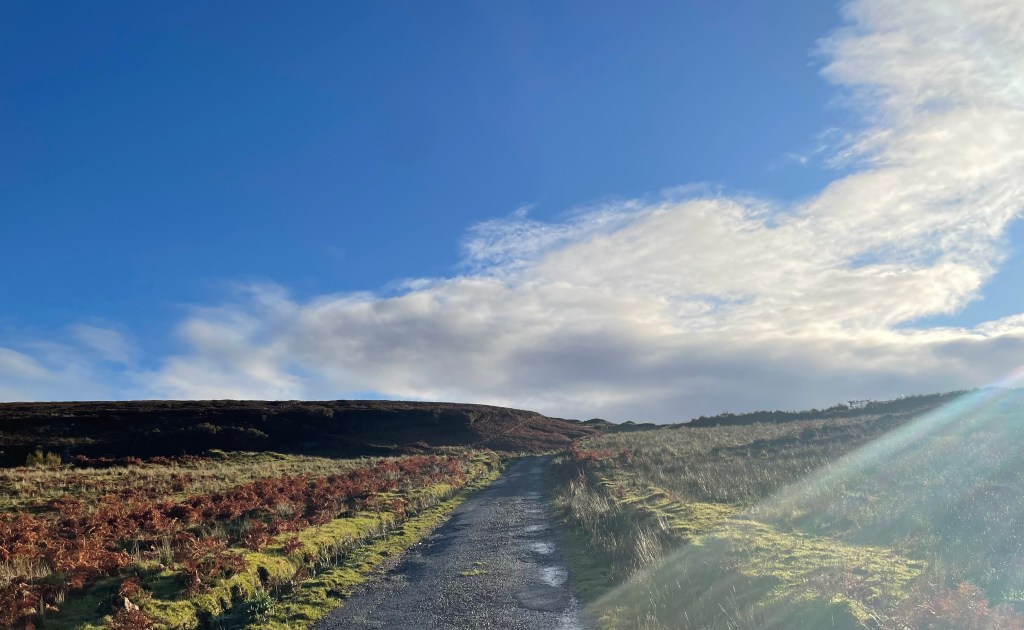
There was a tiny parking area at the end of the road, thus:
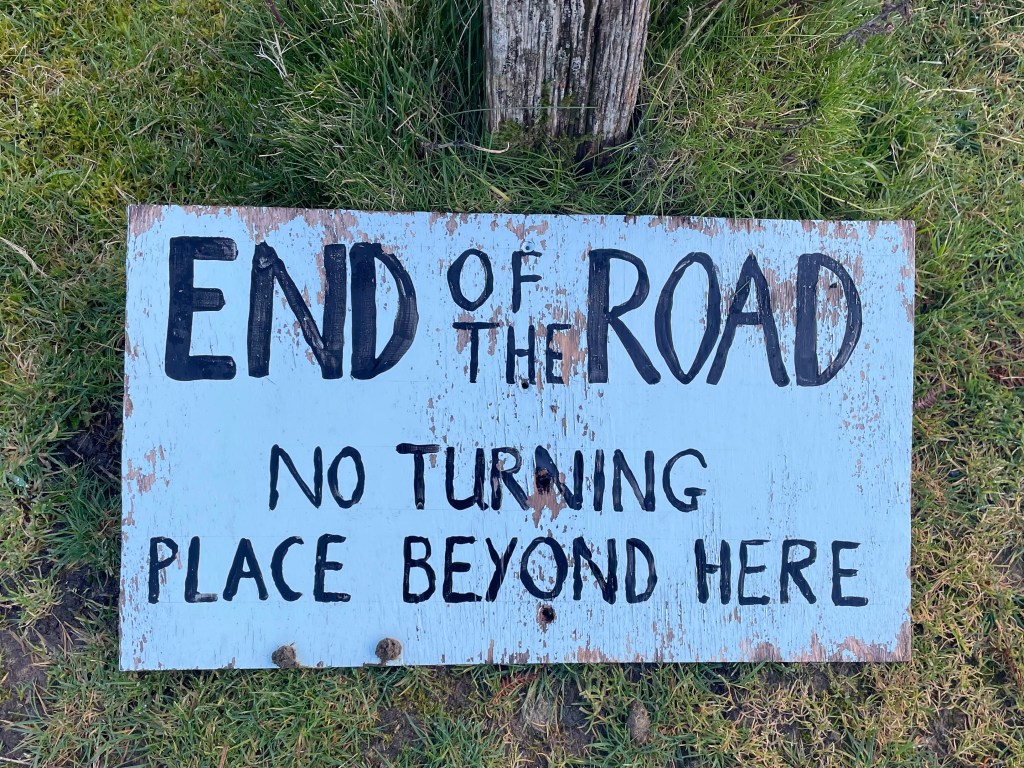
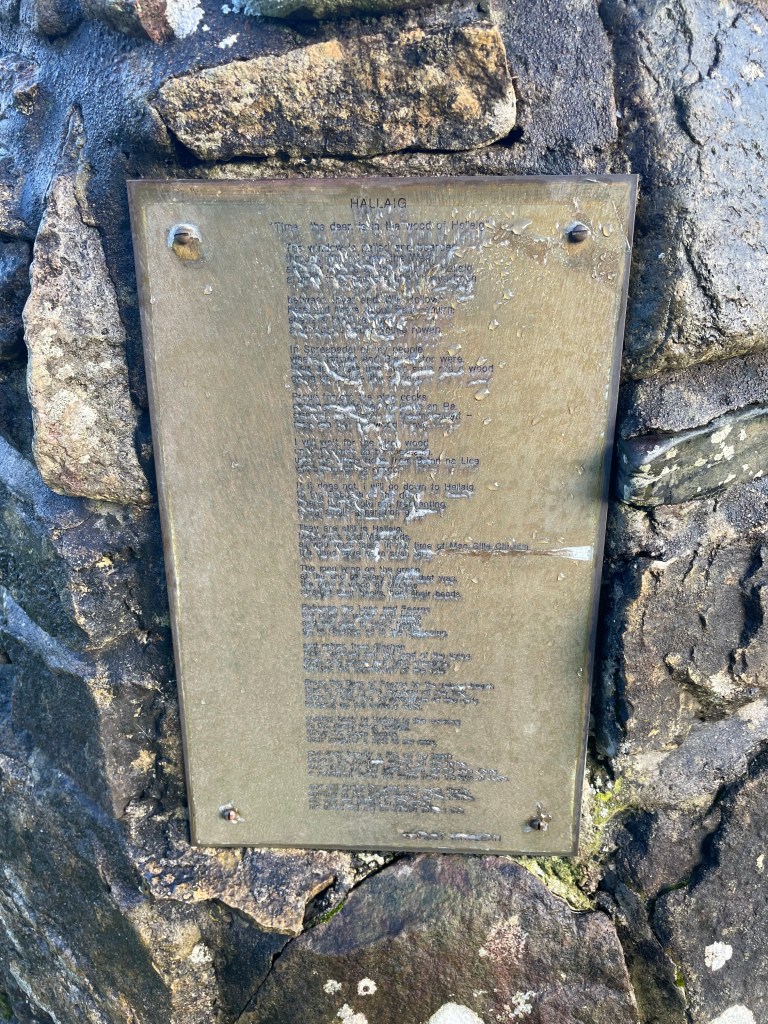
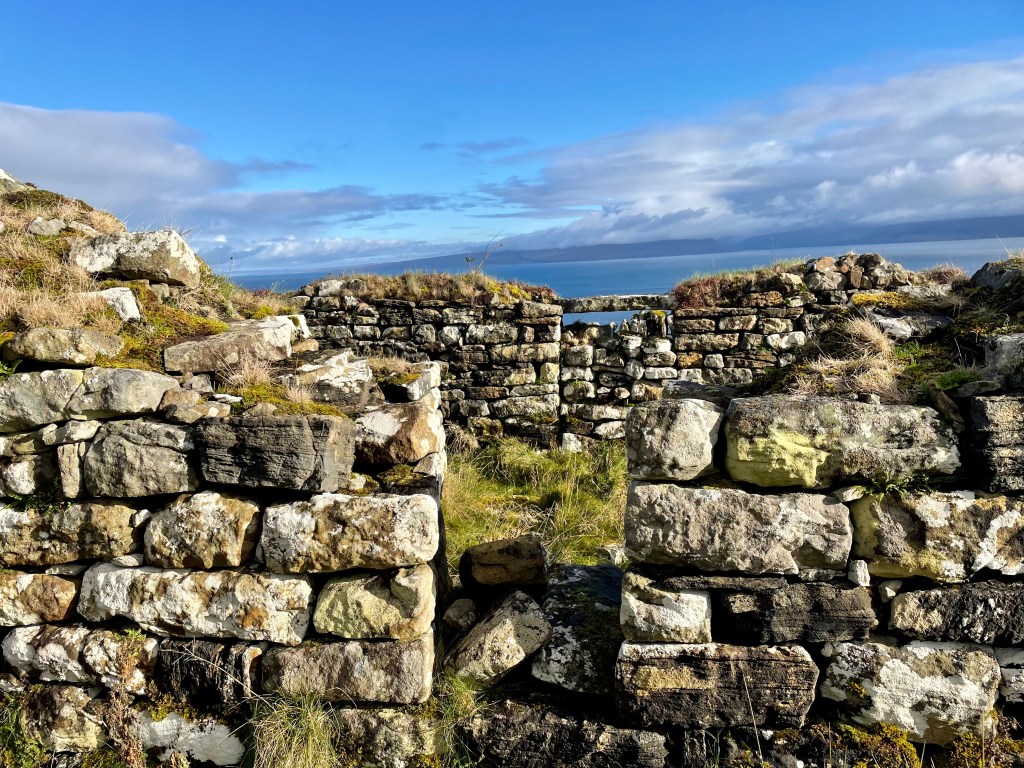
I embarked on yet another gobsmackingly gorgeous coastal hike to the ruins of Hallaig, a clearance village, one of several cleared communities on Raasay, where the residents were forcibly evicted or encouraged to move to make way for sheep grazing on the island in the 1800s.  There’s a monument along the trail that includes a poem about the ruins called “Hallaig,”by Sorley Maclean.

Back through the gloaming to Hallaig

Through the vivid speechless air,

Pouring down the steep slopes,

Their laughter misting my ear

And their beauty a glaze on my heart.

Then as the kyles go dim

And the sun sets behind Dun Cana

Love’s loaded gun will take aim.

A few photos of the ruins.

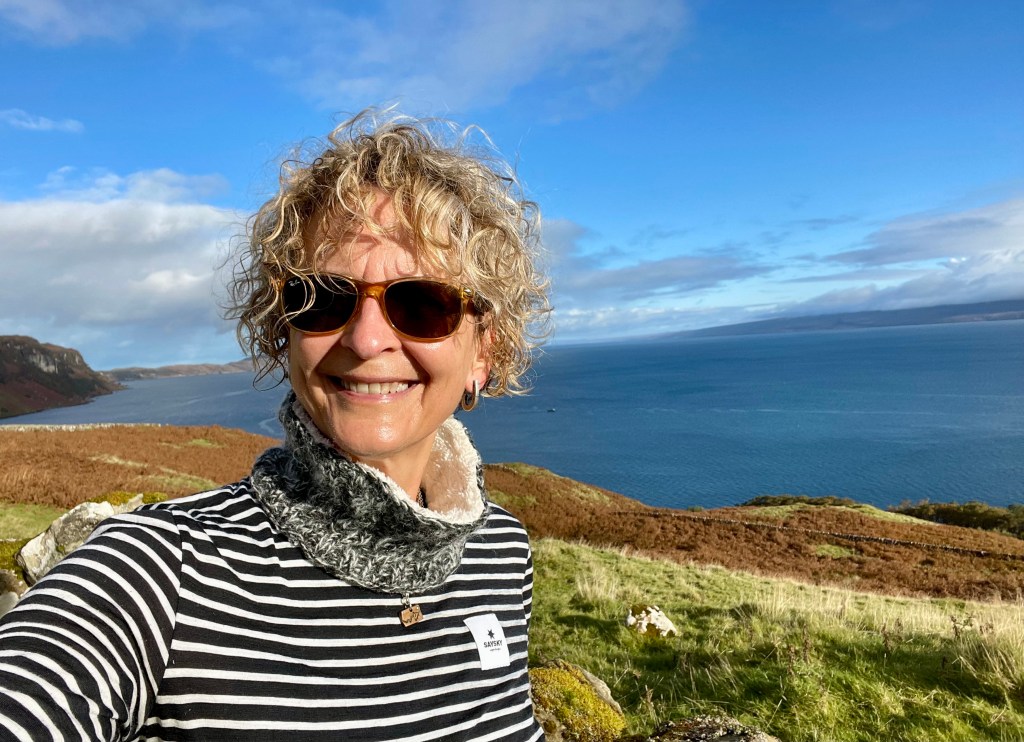
Could not resist a few smiley selfies in that sad and somber place because good god IT WAS SUNNY.
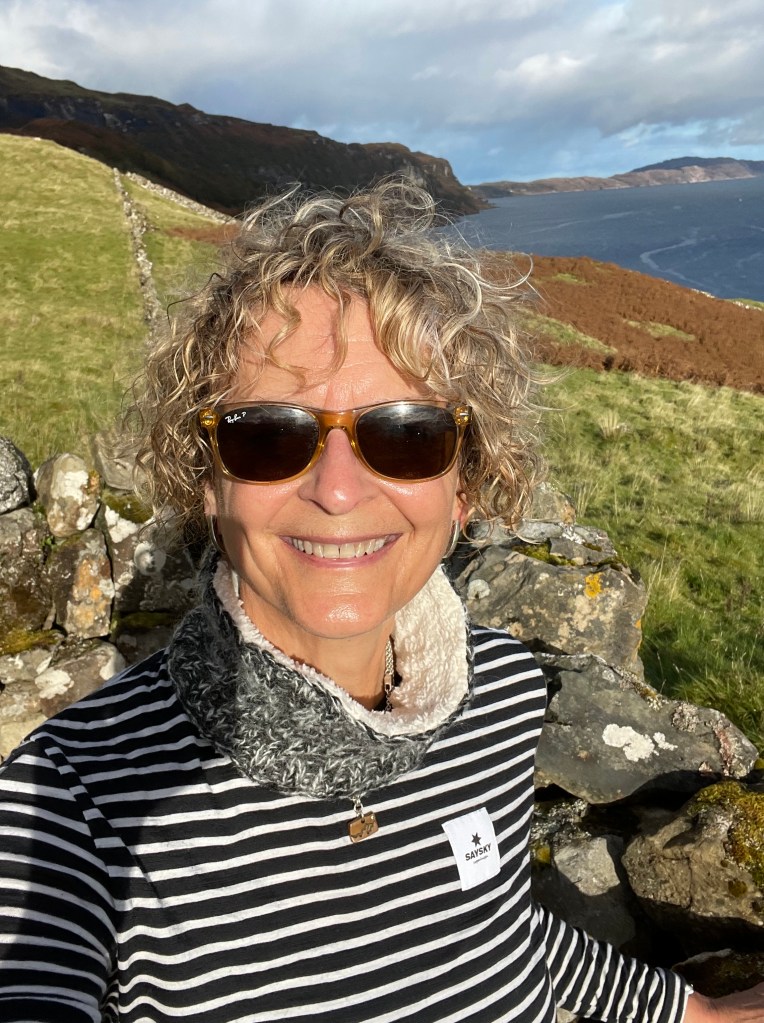
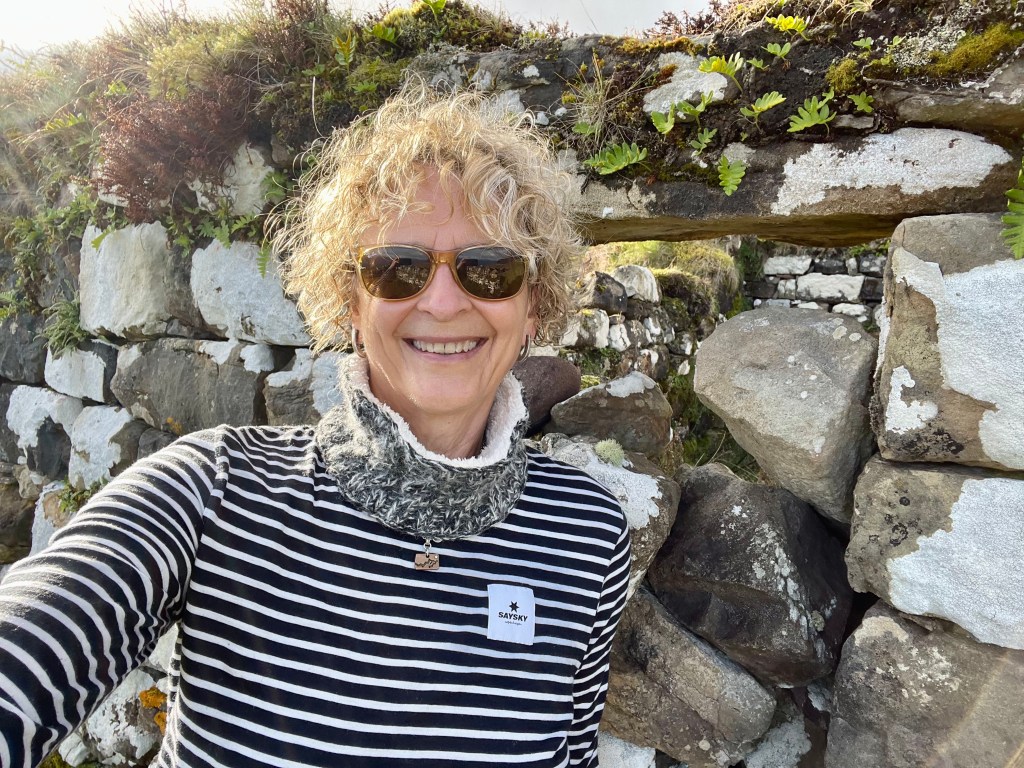
I think this walk resulted in some of the most incredible photos from my entire trip – the light, the location, the mountains, the ocean.
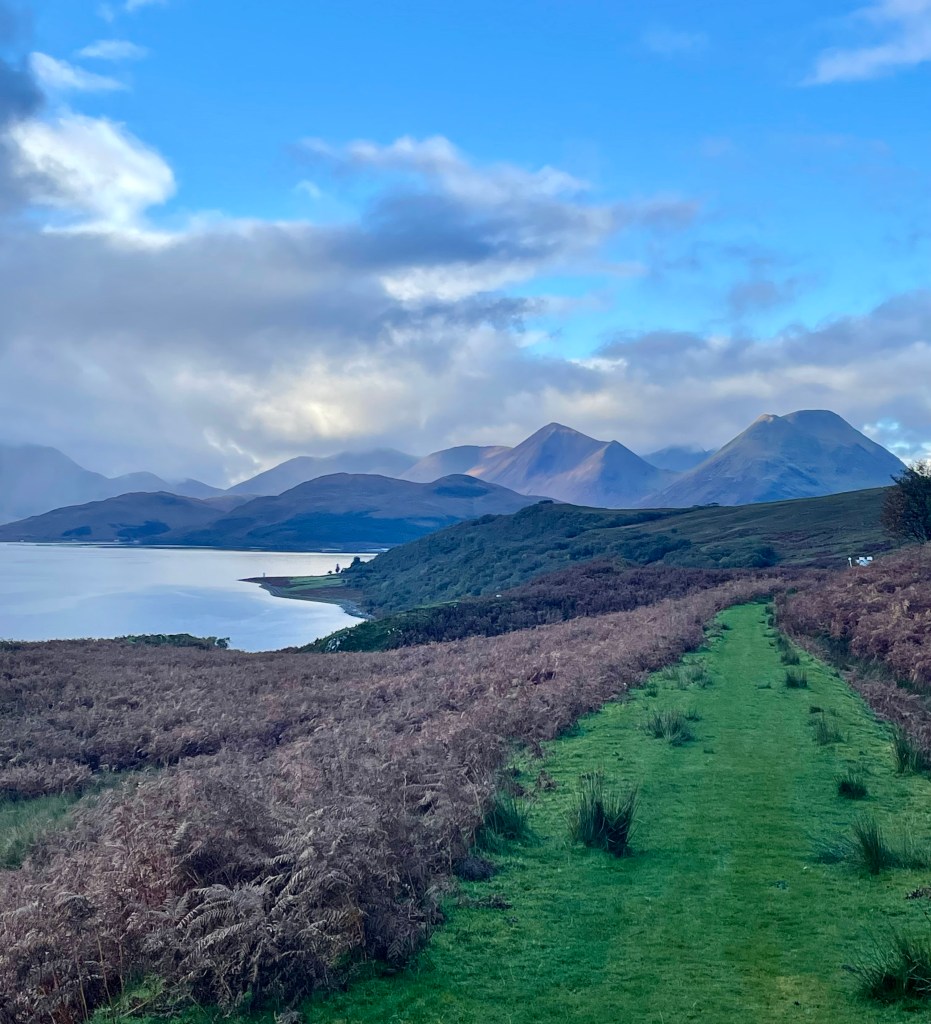
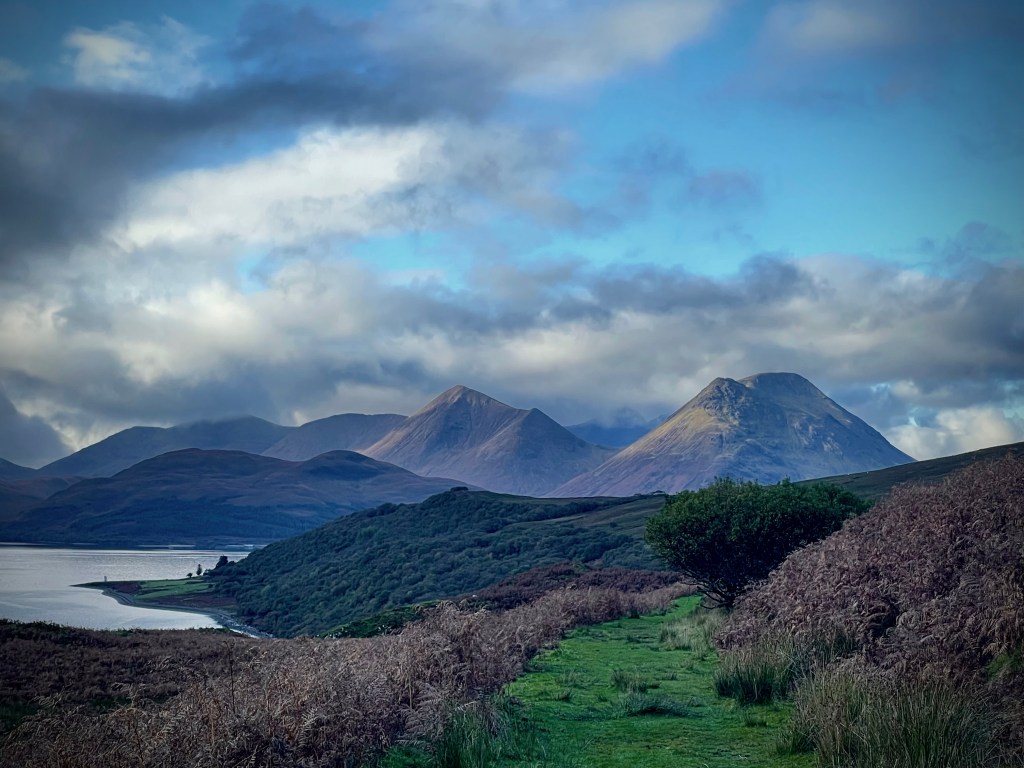
As you can see, this was another walk where I didn’t see another human being, which is absolutely my preference to be honest. My mom asked me to write about what it was like to hike alone in remote areas in a foreign country.  The answer is that it’s awesome and makes me blissfully happy and at peace.  An adventure in the best possible way because the risk level is very, very low and yet you are out in the wild! On the moors! Gazing across oceans and up mountains!  So many wild coos and sheepies! And I’m not naive, I know full well that folks have often found themselves in trouble hiking in the UK, involving mountain rescue teams, helicopter evacs, injury and even death. I don’t know what to say except that the thought never crosses my mind that something bad might happen because a) I’m in Scotland and b) there’s so much joyful zen in my brain. I’m so completely present in the moment as they say, that all thoughts of worry have nowhere to grab hold. For what it’s worth, my mom doesn’t worry about me either, which is quite literally unheard of. So ¯\_(ツ)_/¯
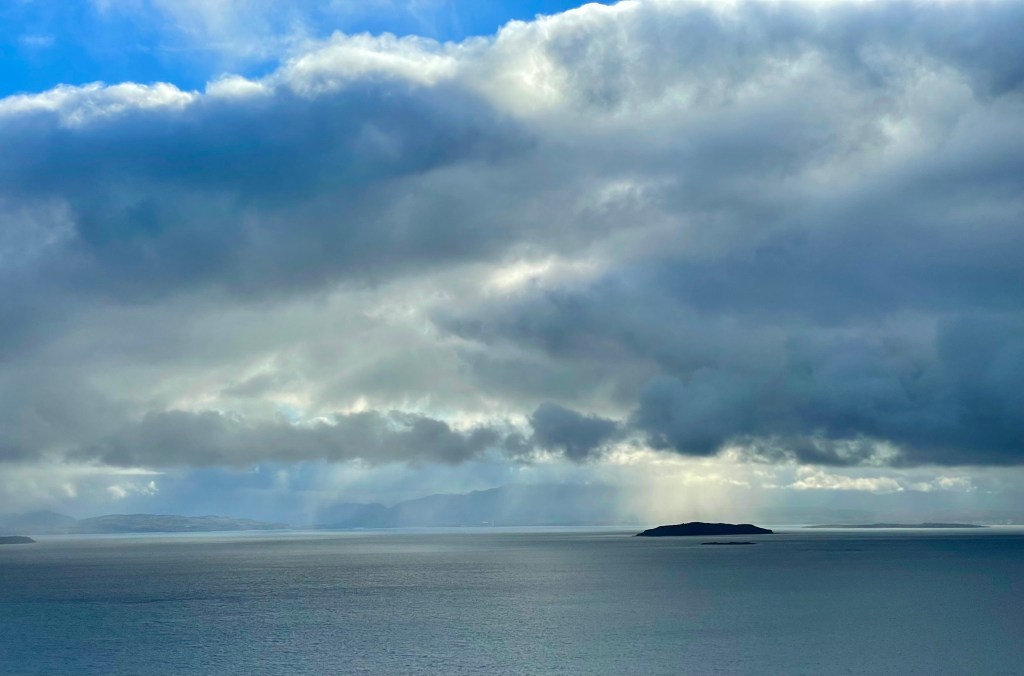
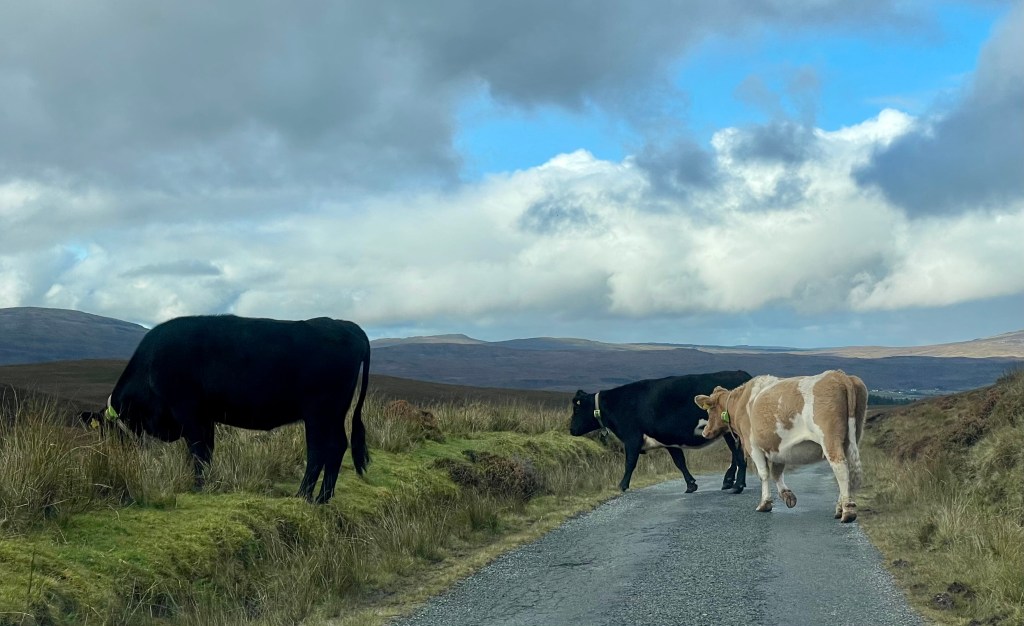
I sat in the car for a few minutes enjoying the bag lunch of a fresh salmon salad Viv and Steve prepared, and then started the short drive back toward the ferry so I’d make it to Raasay Distillery in time for my tour.  Along the way I came upon a Scottish traffic jam, but not to worry, I made it.
Opened in 2017, Raasay released its first whisky in 2020. The 2022 Scottish Whisky Awards named Rassay Distillery of the Year, and it’s a beautiful facility with drop-dead views. They released their first whisky in 2021 and their single malt combines six signature casks – maturing peated and unpeated spirit separately in ex-rye whisky, virgin Chinkapin oak and Bordeaux red wine casks. The first of this cask combination in Scotch whisky history. The exact proportions are, of course, top secret.

A lovely, sophisticated English woman with a dry wit was our tour guide. She had retired to Raasay a few years prior with her French husband and was obviously enjoying her retirement gig at the distillery. I talked with her afterward about what it was like, and how her Parisien husband was enjoying living on a remote barely populated island in the Hebrides. I shared that I was feeling a similar pull toward Scotland in general.  She immediately engaged an eye-lock and encouraged me to start doing something – taking actual measurable steps toward this goal. I don’t know, I got the tingles. Message received.

So the Raasay “Hebridean” is a very very good whisky and I fell in love with the distillery and with Raasay itself. As I had enough space in my luggage to bring one bottle home, I decided this would be The Chosen One. I did a quick search on my phone – without my glasses – to make sure you couldn’t buy Raasay in Oregon. Well. When I got home I looked it up again and sure enough, found that you could acquire a bottle in two local liquor stores.  Not only that but one of the liquor stores carried bottles of the single cask versions from the pleated bordeaux and rye casks. Good god. Coals to Newcastle. In retrospect, it’s almost a certainty that I misspelled Raasay as I was standing in line at the distillery on my phone with no glasses. I mean, there are a lot of “a’s” in fairness.
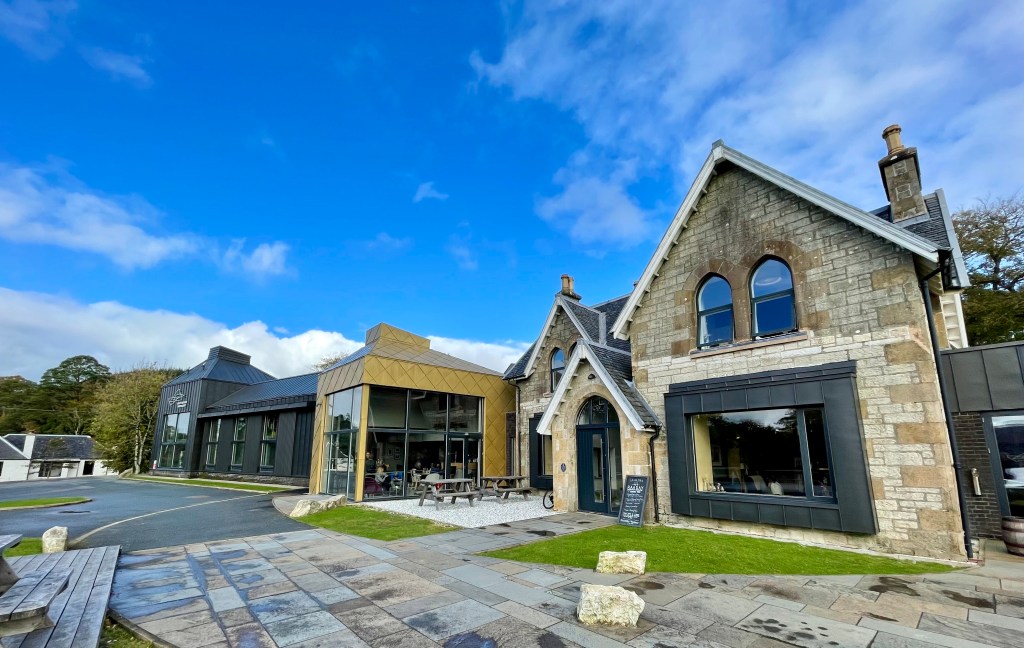
The view from Raasay Distillery. Literally. I can’t even.

The ferry back to Skye.

My car and I alighted from the ferry and drove to Portree where I had booked a table at Dulse & Brose, a lovely restaurant of past acquaintance.  I was there a bit early and so wandered around Portree seeking a pub.  The thing about shoulder season is that places are sometimes closed for the winter – rude! I finally walked along Quay Street, where the lovely painted buildings are, and found a teensy weensy pub inside the Pier Hotel. (The baby blue building below).
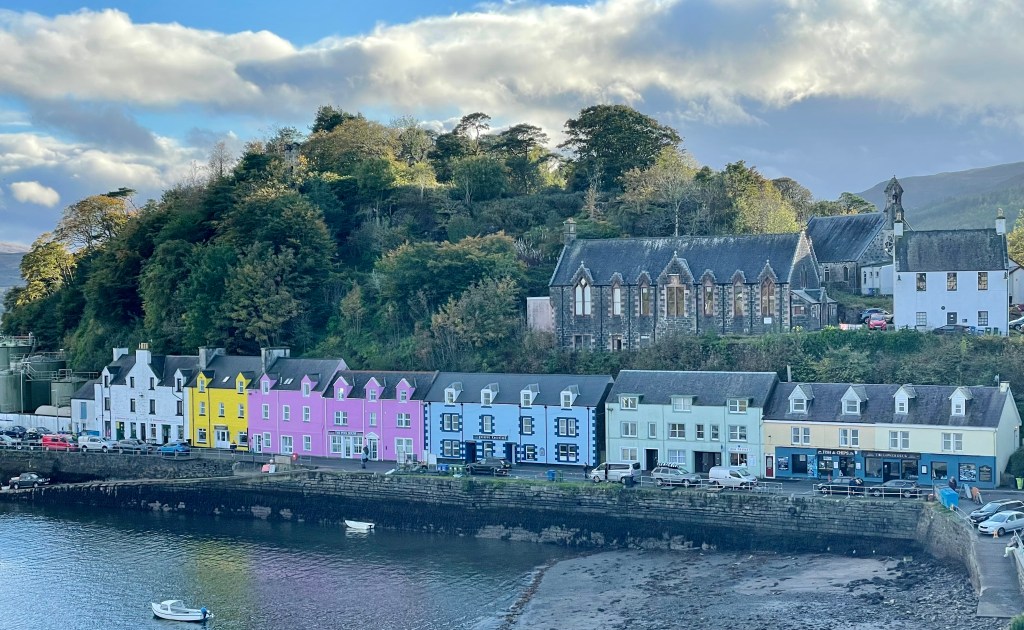
I sat at the bar and had a dram, eavesdropping on a hilarious conversation between a couple of older Scottish men with a fisherman vibe and a small family group from, of all places, Texas. The Texans were trying to explain to the Scots why the phrase, “bless your heart,” (which the Scots had never before heard) could, and often did, actually have a negative connotation. It’s one of those southern idioms that sound polite but are really a highly judgmental put-down. The Scots literally could not understand why we’d take something that sounded like a blessing and turn it into a smug slam.  The other conversation I enjoyed was between the bartender and his girlfriend about how amazing Peaky Blinders was.  Speaking of which,
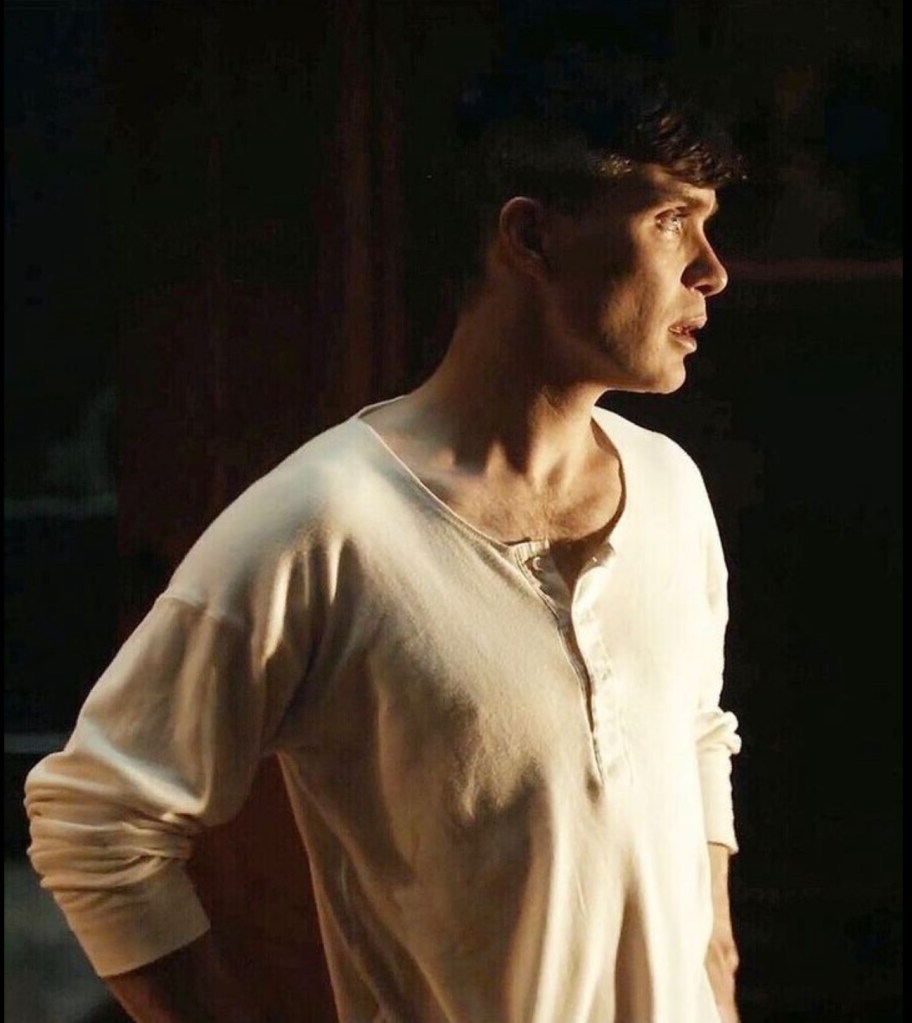
Tommy Fookin’ Shelby makes the blog.

And now I think it’s high time to wrap this installment of The Wee Dram. My last full day had finally arrived, so I bid a sad farewell to Viv and Steve and the cute pups they were dog-sitting.
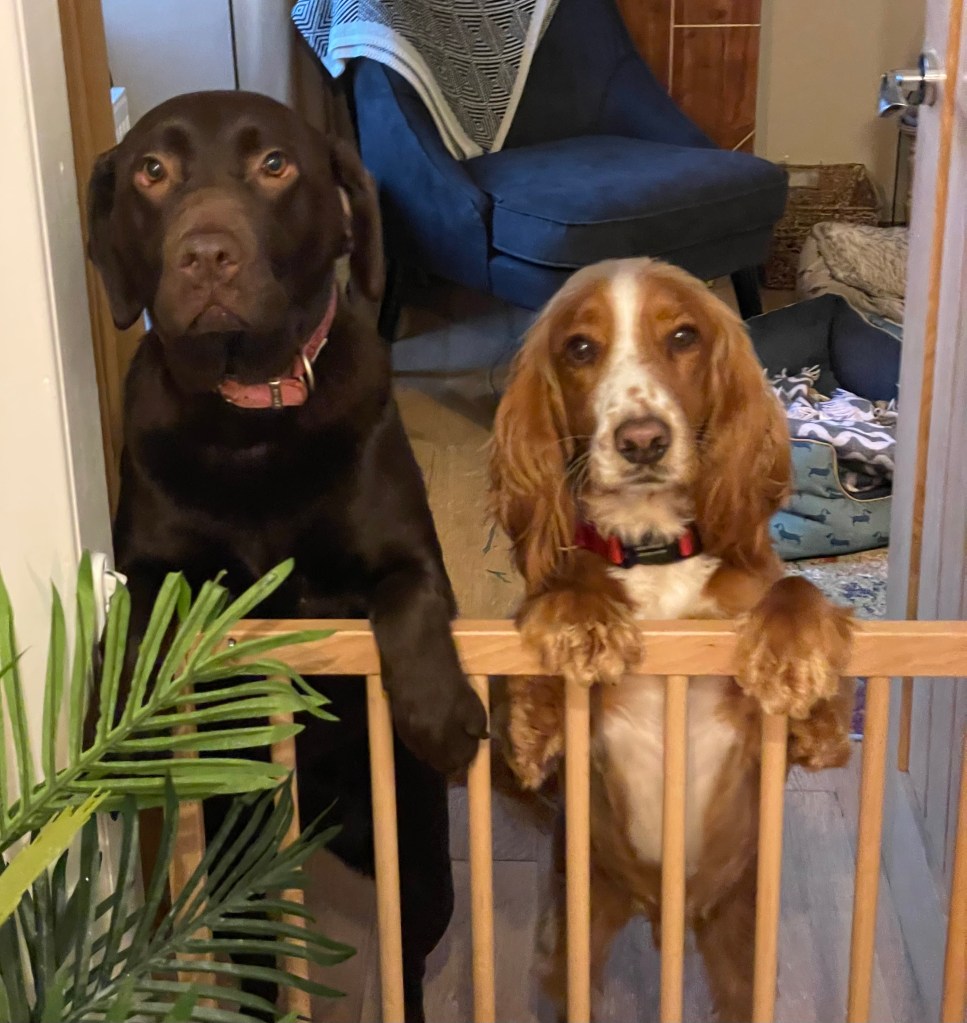
I then had the dumb idea of stopping by the Old Man of Storr on a gorgeous sunny day at 10:30, thinking I could just bound up the trail of the last Skye honeypot I hadn’t yet done. It was a sh*tshow. Could not believe the huge parking lot packed to the gills with humanity. Nooooooo.  No thanks. KThxBai. Next time. I pulled off the road across from the bulging parking lot, grabbed a coffee and had a final wee look across to the mainland where I was headed – and said goodbye to Skye for the fourth time in my life. I also said see ya next year.
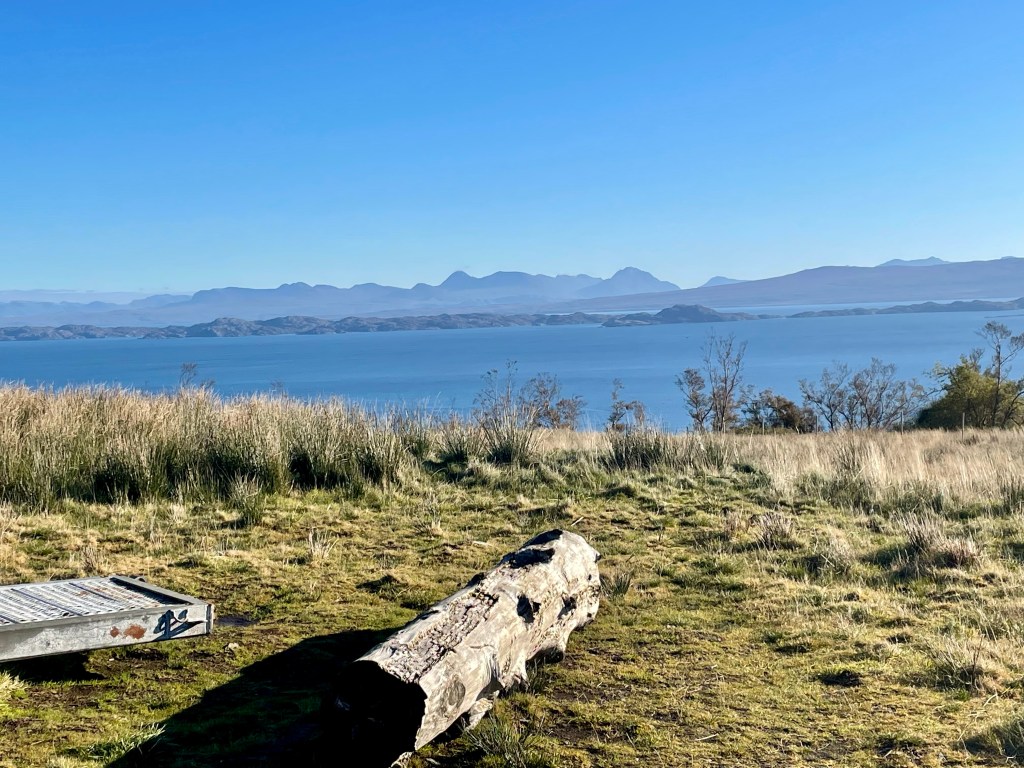
I drove through a bluebird day back to Inverness. It was honestly sort of weird seeing Scotland during a baldly sunny day. It didn’t look like itself.

My last night in Inverness I once again stayed with Eleanor and Mia, enjoying a lovely supper at the Mustard Seed. It was a gorgeous final night of my nearly month-long trip.
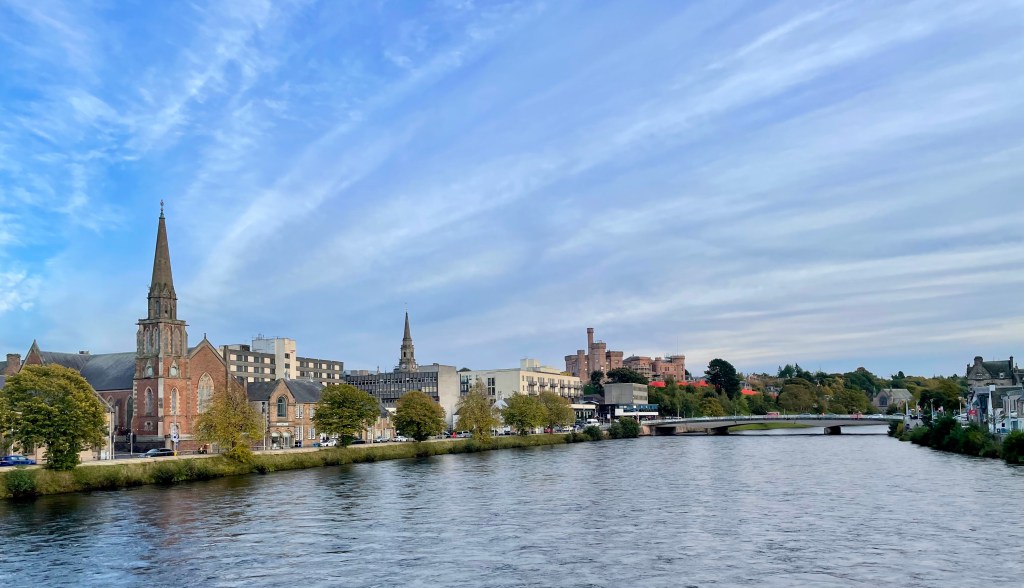
So, dear friend, thank you for reading this blog, for being patient with my many diversions down historical, geological, ecological, cultural, Gaelic pronunciation and whisky-related rabbit holes.  I’ll just end by saying that I’m headed back next May to Glencoe (have never missed), the Pentland Hills south of Edinburgh, and……(drum roll) Shetland. And next fall I’m returning with my pal Trish, mostly to visit Arran, Islay and Jura, since our last trip we were stymied by weather, and then back to Skye where I will probably feel drawn to the ferry to sail to the Outer Hebrides again, maybe this time to the Uists.

Because why would I go anywhere else.
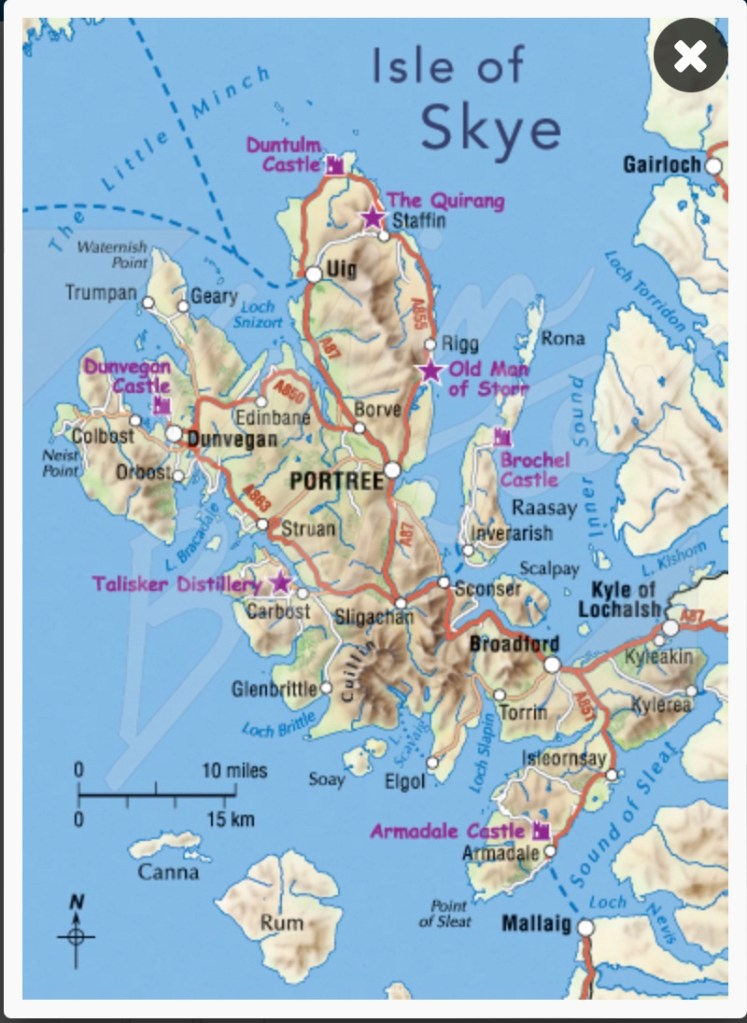
Skye

The Isle of Skye is just off the mainland, now accessible by bridge as well as ferry. It’s 50 miles long with a population of 10,000. Crofting, fishing, fish farming and tourism are its biggest economic drivers.

Tourism has increased exponentially over the past several years, making life irritating for island residents and clogging up roads, endangering delicate environmental areas, and filling up restaurants and B&Bs. Danielle said she felt slightly guilty even being here and I know what she means. Making matters worse, and I’ve heard and overheard so many conversations about this (all over Scotland), is the dire post-COVID labor shortage exacerbated by Brexit. Tourism industry employees from EU countries now need a visa to work in the UK, and these folks are critical.

PRO TIP/RESTAURANT DIGRESSION: Speaking of which, if you are headed to the UK this summer book all of your restaurants in advance. All of them. Otherwise no dinner for you! Big bummer especially since you have traveled 4,500 miles and there are three Michelin-starred restaurants on Skye alone. I wrangled a booking for two of them – The Three Chimneys and Edinbane Lodge. Both were completely excellent. And you don’t want to miss out on the fabulous and fresh cuisine of Scotland in general. Seriously get online now and book, book and book.

The Three Chimneys. Delightful spot in a remote area of Skye. If you go, and meet a tall dark and handsome server with an Eastern European accent – he’ll ask you to guess where he’s from. The answer is Poland. His goal is to move to Shetland.
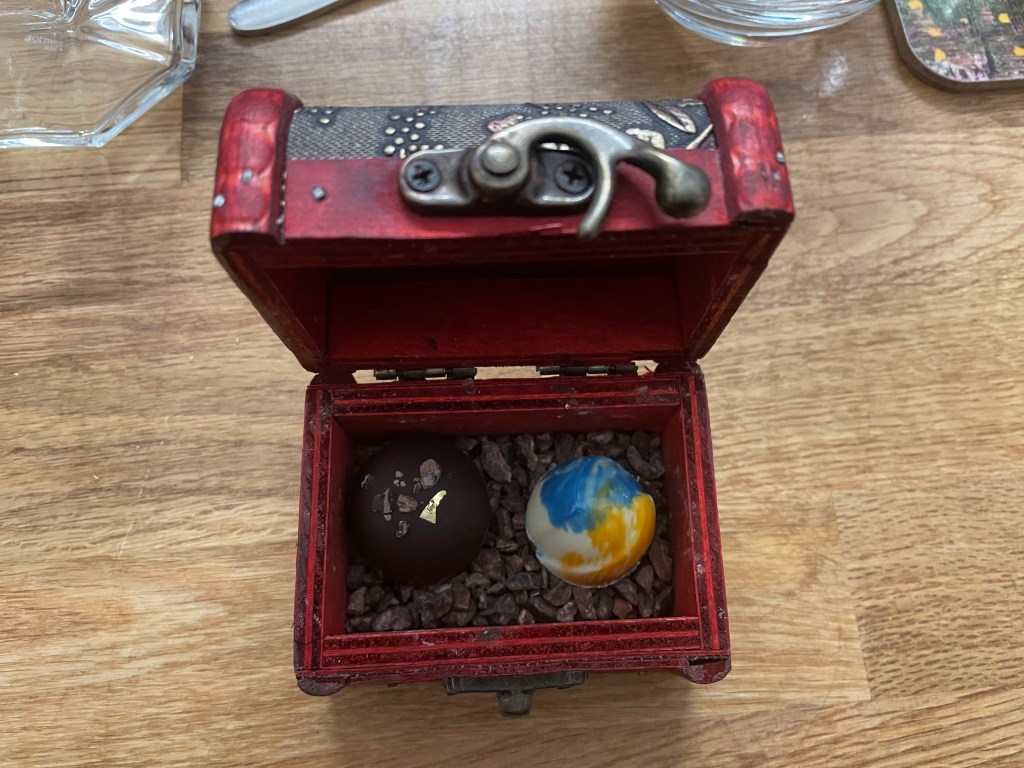
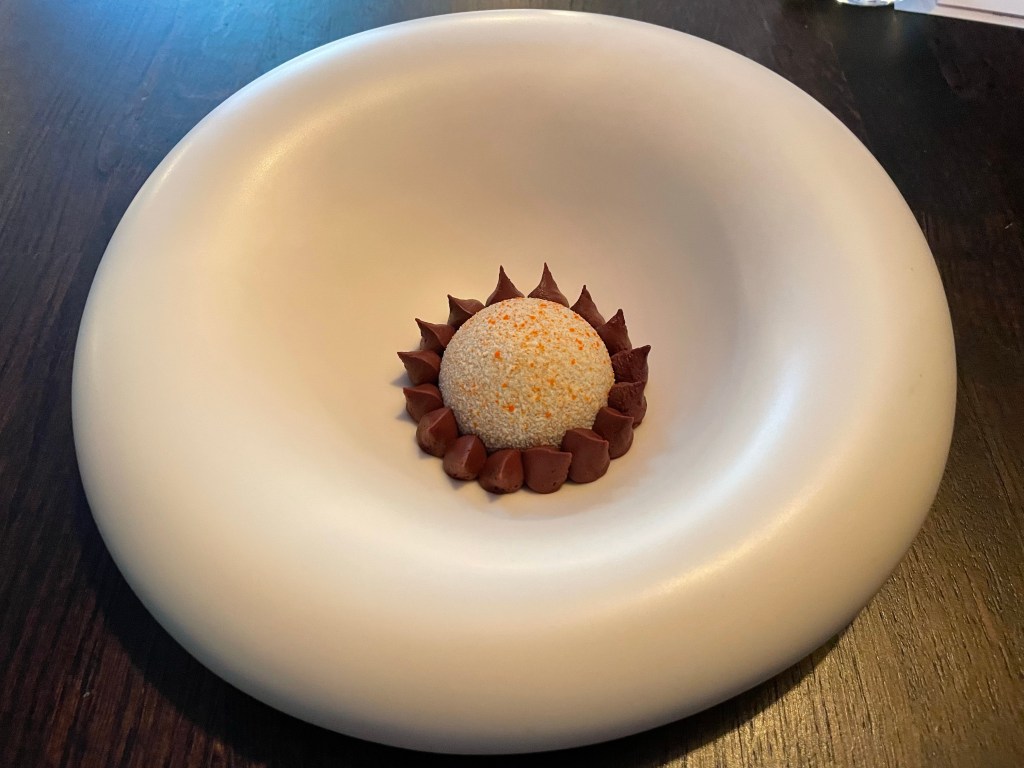
A dish from the tasting menu at Edinbane Lodge – Dark Chocolate with Sea Buckthorn. What is sea buckthorn? Who cares really with this delightful presentation. FYI there were three desserts.

A wee word about our accommodations. We booked an Airbnb near Staffin situated between the mountains of the Quiraing and the sea from a delightful guy named Ian. He was incredibly responsive and patient with our American questions. I’m so used to Airbnbs in the states where there is a giant notebook full of detailed instructions, including a list of chores you must do at the end of your stay. You know the notebook I mean. There is not one piece of paper in Ian’s place, although there is a leprechaun in one of the kitchen drawers. We have too many rules, too many instructions and too little trust in people in the States. Much more laissez-faire here. They sell whisky in grocery stores and you can take your dog into a restaurant which all seems very advanced.

And we have a washer and dryer yay! But that situation is so different. No Tide pods. Instead, there’s spectacularly over-fragranced powdered soap that goes into a drawer just like olden times. The dryer is in the detached garage and isn’t plumbed so you have to dump out a water tray after every load. Settings include “cupboard dry” and “iron dry.” This makes sense to me. At times the weather was so aggressive that trips back and forth to the garage made us feel like frontier women, braving the elements to accomplish household chores.

Anyway, back to teeming hordes. I was pretty shocked to see that Skye’s popular sites are simply inundated with people. Those beautiful photos of iconic locations you see on Instagram? Faerie Pools, the Old Man of Storr, etc etc? Imagine those lovely photos, which must have been taken in the middle of the night, in the wee hours or in winter, only packed cheek by jowl with hordes of tourists. Cruise ships dock in Portree and disgorge thousands of people who are then loaded onto buses and taken on a whistle stop tour of the top destinations. Dreadful.

You can still easily find solitude though. Get up early, take a few steps down a trail or make after-dinner plans when the roads of Skye are empty.

VERY WEE DIGRESSION ABOUT NIGHTTIME. Speaking of getting up early, in early summer you can rise really early and, lo, it’s not dark. Or stay out late same deal. There’s only about four hours of complete darkness. Scotland’s latitude is similar to Northern Canada and Alaska. Really really cool and I never stopped marveling at it.

View from my bedroom (the Quiraing) at about 10:30 pm. No filter.
View from front of house, same time.

So the weather on Skye is particularly changeable and can be kind of crappy to be honest. Wind, rain, fog, all the things you imagine and generally all in one day. Every item on your body must be waterproof. Not water-resistant – Scotland throws back its head and laughs at “resistance.”

The weather was true to form for us, but we never regretted ignoring it.

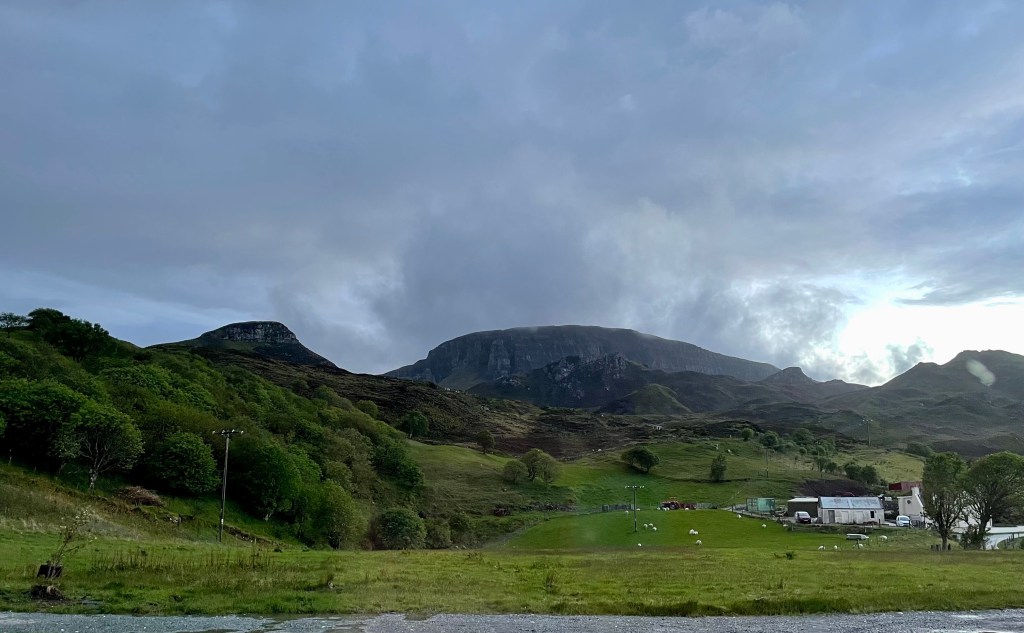
My first trip to Skye with Backroads, we stuck to the Sleat (pronounced Slate) peninsula in the southwest, which was fabulous. Ian’s place is northeast on the Trotternish peninsula. It is gorgeous, and home to many of the tourist sites on Skye, including the Old Man of Storr, Kilt Rock, the Quiraing, the Fairy Glen and the Skye Museum of Island Life, a highland folk museum near Flora MacDonald’s grave.

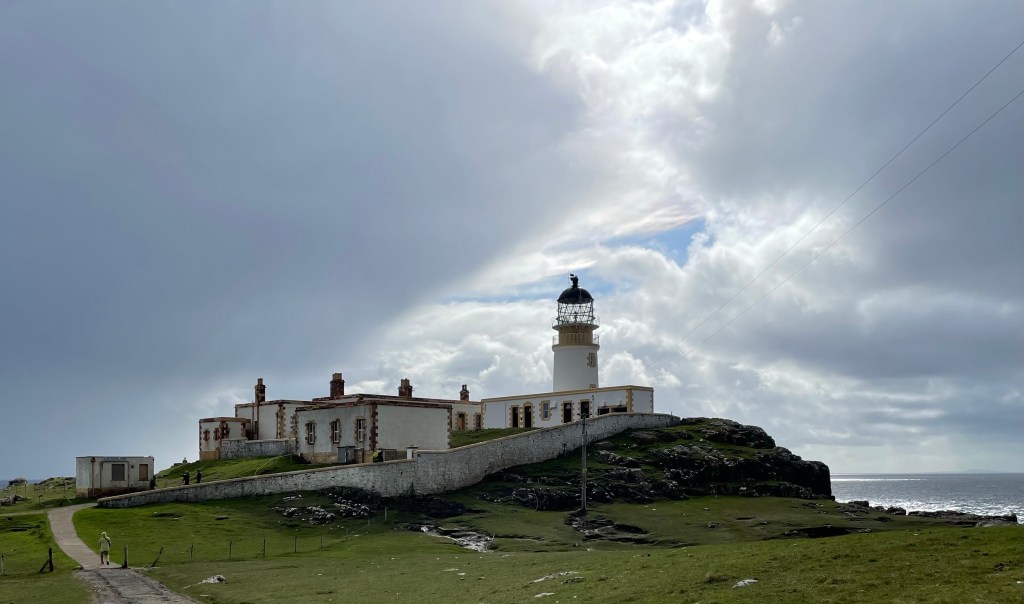
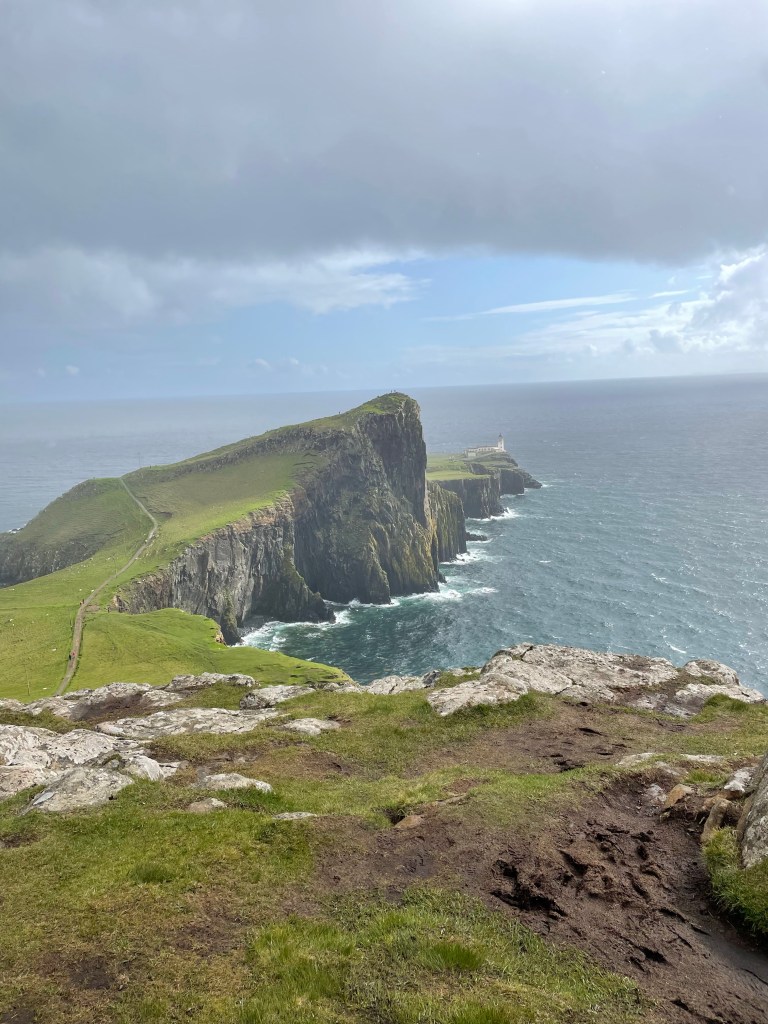
On our first day we drove across the north coast of Trotternish, dropped down into the Waternish penininsula and then over to Duirinish all the way to Neist Point, the most westerly part of Skye.

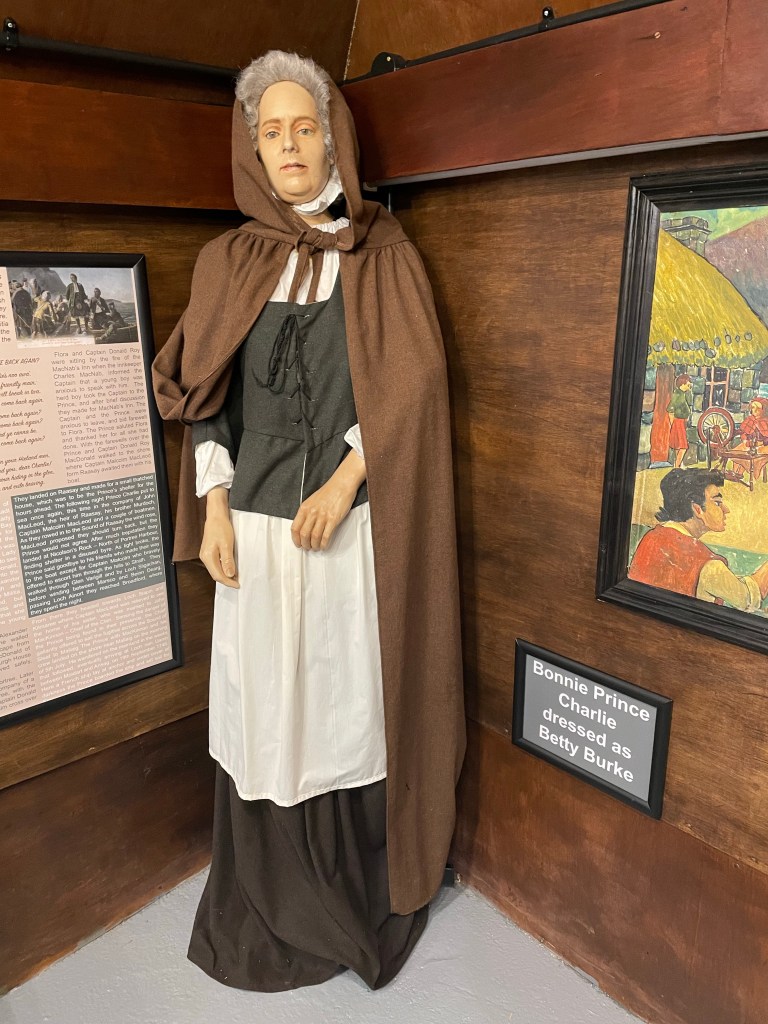
We stopped at the Skye Museum of Island Life, which is a wonderful spot. It features replicas of Croft buildings from back in the day and a lot of detailed historical information, including from the Jacobite period since Flora Macdonald is buried nearby and Skye was where the Bonnie Prince finally was able to catch a ride to France after Culloden. You have probably heard the story, but he dressed up as a woman named Betty Burke, and traveled incognito as Flora’s maid.

Here’s a rather alarming representation of the Bonnie Prince and his escape outfit. From the Isle of Skye Museum of Island Life.
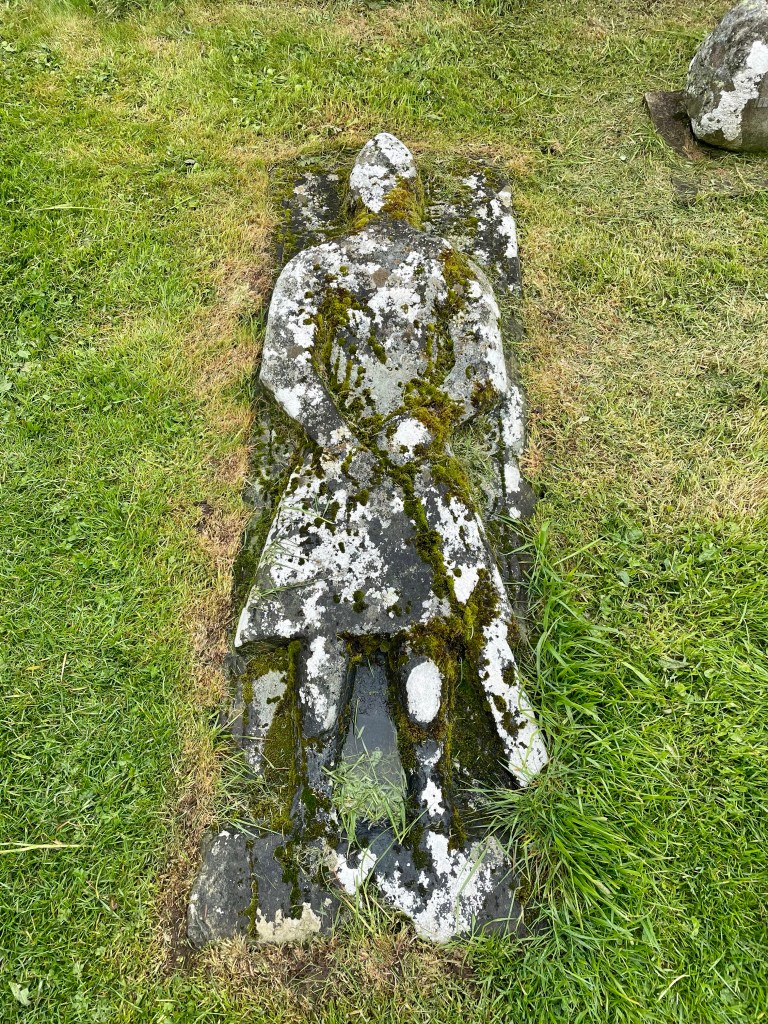
Flora’s grave. It looks newer than you might expect because her first marker was chipped away by souvenir hunters in the 1800s. After Culloden, Flora married a guy also named MacDonald (no need to change the monogram) moved to North Carolina and declared loyalty to the Crown during the American Revolution. From Jacobite to Loyalist – two losing causes in a row.
Another really cool grave marker in the cemetery. Probably King Arthur.

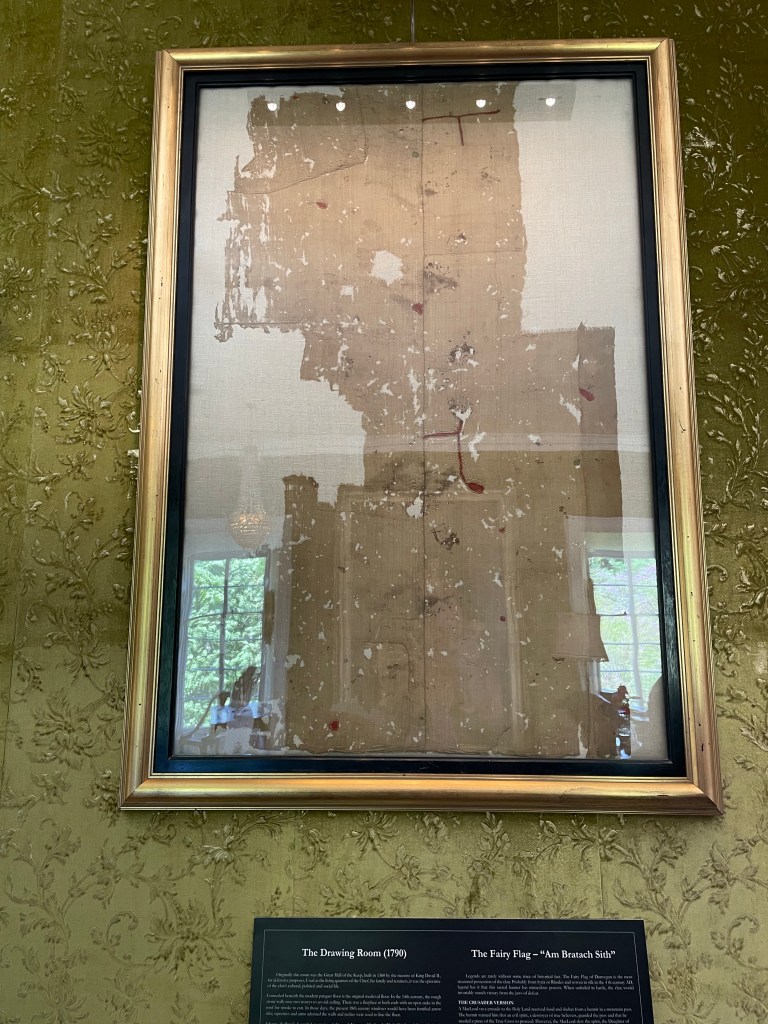
Next we visited the Fairy Bridge, slightly off the main road and sadly all alone without a single visitor. This being Scotland, there’s a legend behind the bridge. Once upon a time, a chief of the MacLeod clan married a fairy and they lived together on Skye. She was only allowed to be with him for a year, after which she had to return to her people. She bid the clan chief farewell on the bridge and left her son wrapped in a silken shawl. This is the famed Fairy Flag, which allegedly could be used three times to save and protect Clan MacLeod. Very Lord of the Rings, is it not? #AragornArwyn. That exact same flag just happens to be on display at our next stop, Dunvegan Castle, which proves that the legend is true.

Dunvegan Castle is the oldest inhabited castle in Scotland, and always by the chiefs of the MacLeod clan. The MacDonalds are the other main clan on Skye but were not so settled. In the 16th or 17th century they moved from Sleat to the tip of the Trotternish peninsula, and their castle, Duntulm, is now barely a ruin. In the 1800s they moved south and built Armadale Castle, now a tourist attraction for its gardens with the castle ruin (in better shape than Duntulm) as its centerpiece.

I would be remiss in not mentioning the bitter feud between these two clans. There were tit-for-tat massacres and suchlike. Worth a google.

Dunvegan Castle – nice work clan MacLeod.

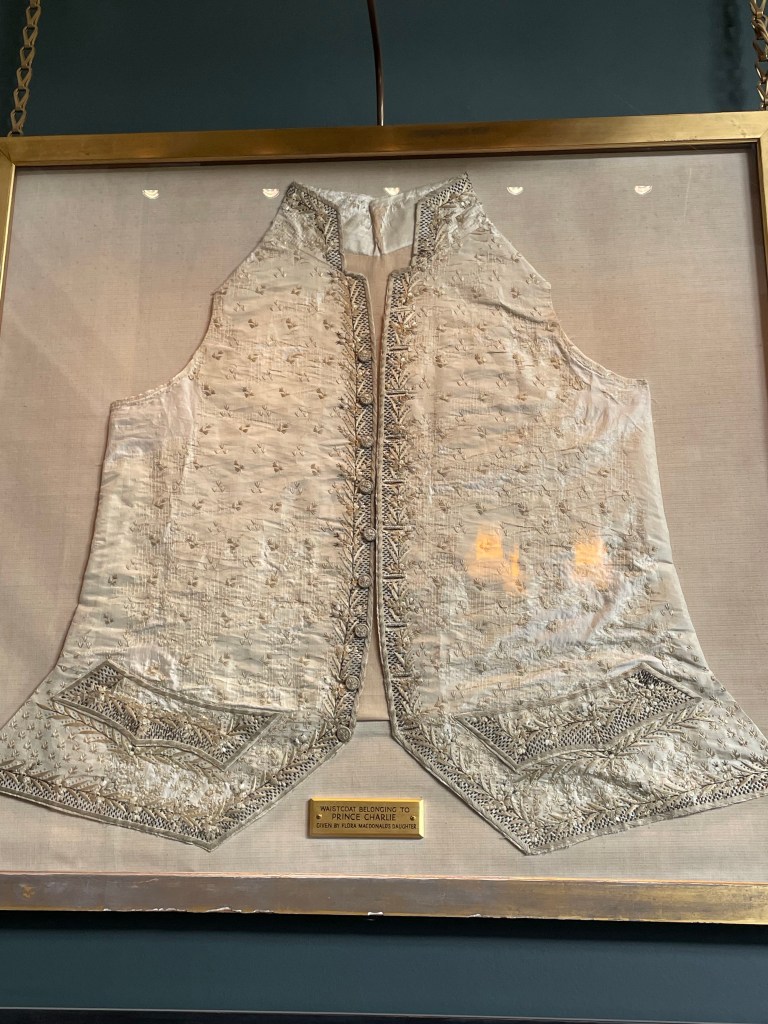
The castle has been visited by many luminaries over time, including Samuel Johnson, James Boswell and Sir Walter Scott. It also boasts a fun Jacobite collection including a lock of hair plucked from the head of the Bonnie Prince which he bestowed on Flora MacDonald. Her daughters also donated a vest of his.

Kinda weird but also OMG.
Prince Charlie’s blingy vest

And of course, the Fairy Flag is displayed within the castle. It’s pretty threadbare, but no doubt still quite powerful even though Clan MacLeod has long since called upon it the allotted three times to protect the clan.

Another fun item on display is Sir Rory Mor’s Drinking Horn. Successive clan chiefs throughout history have proved their worthiness/manliness by drinking a full measure. You can buy a replica in the gift shop for only £150 but it’s for ornamental purposes only which seems pointless.

A display in the castle showing a back stair used by servants. I’m including it here because it’s just spectacularly lit. And it scares the crap out of people.
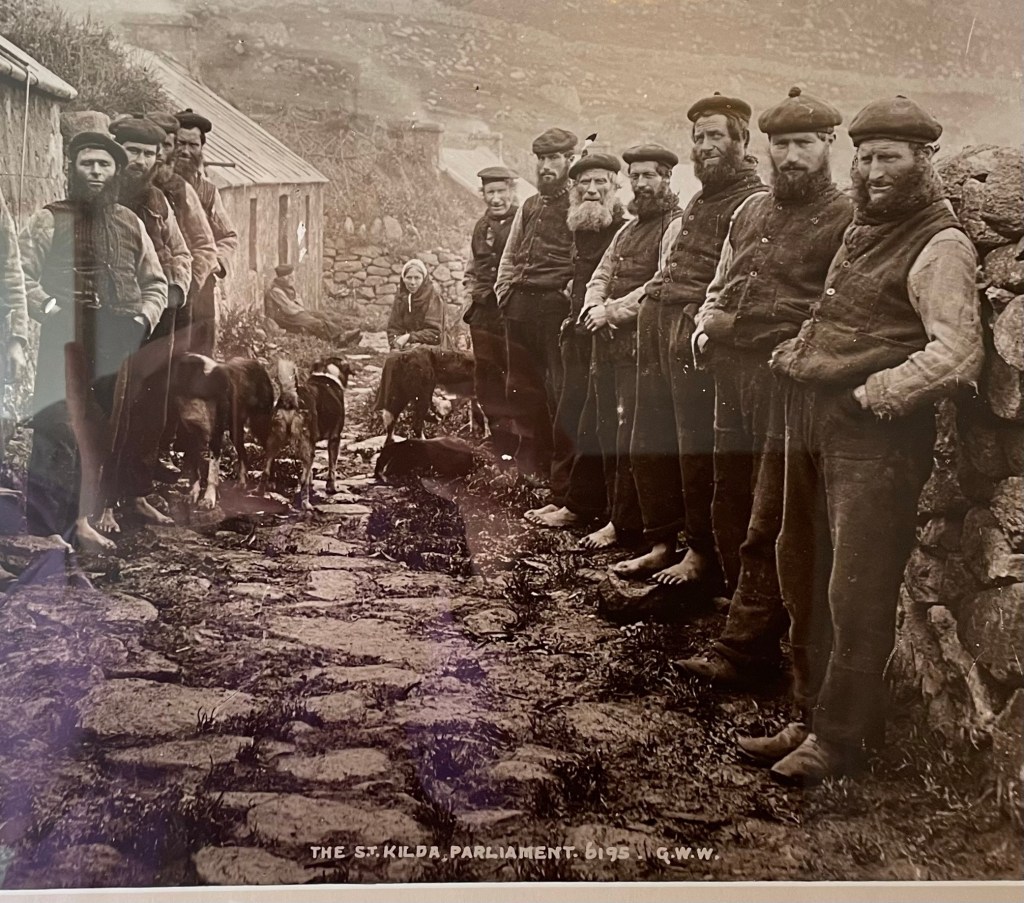
Including this in honor of the St. Kilda parliament because look at them. Amazing.

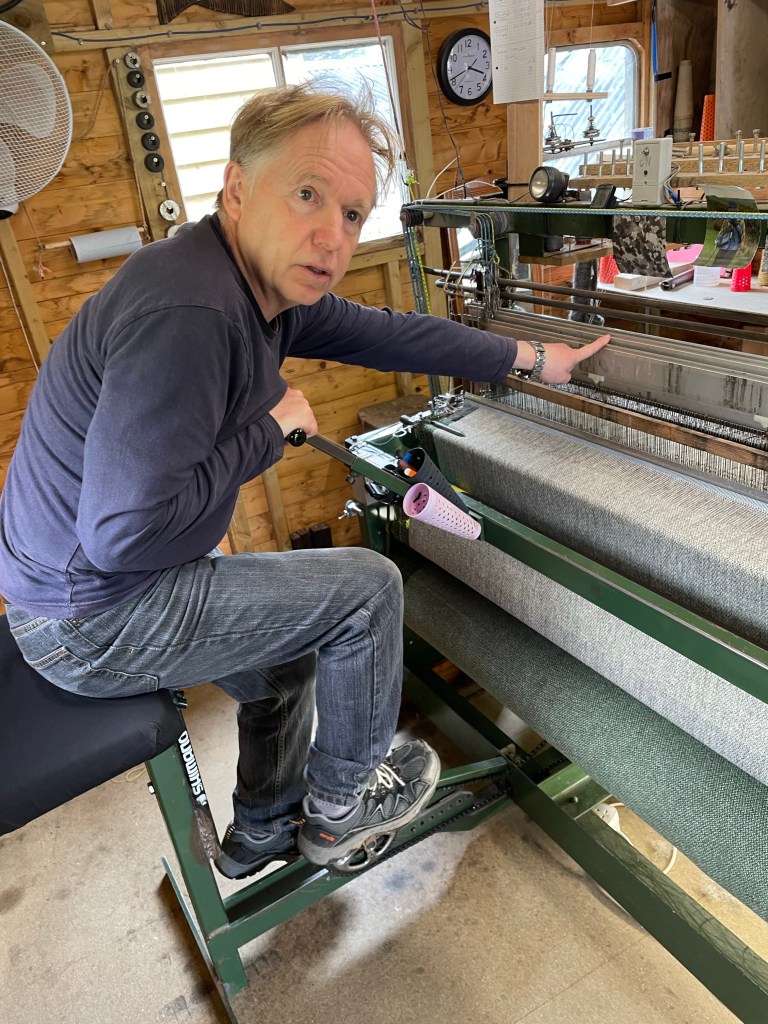
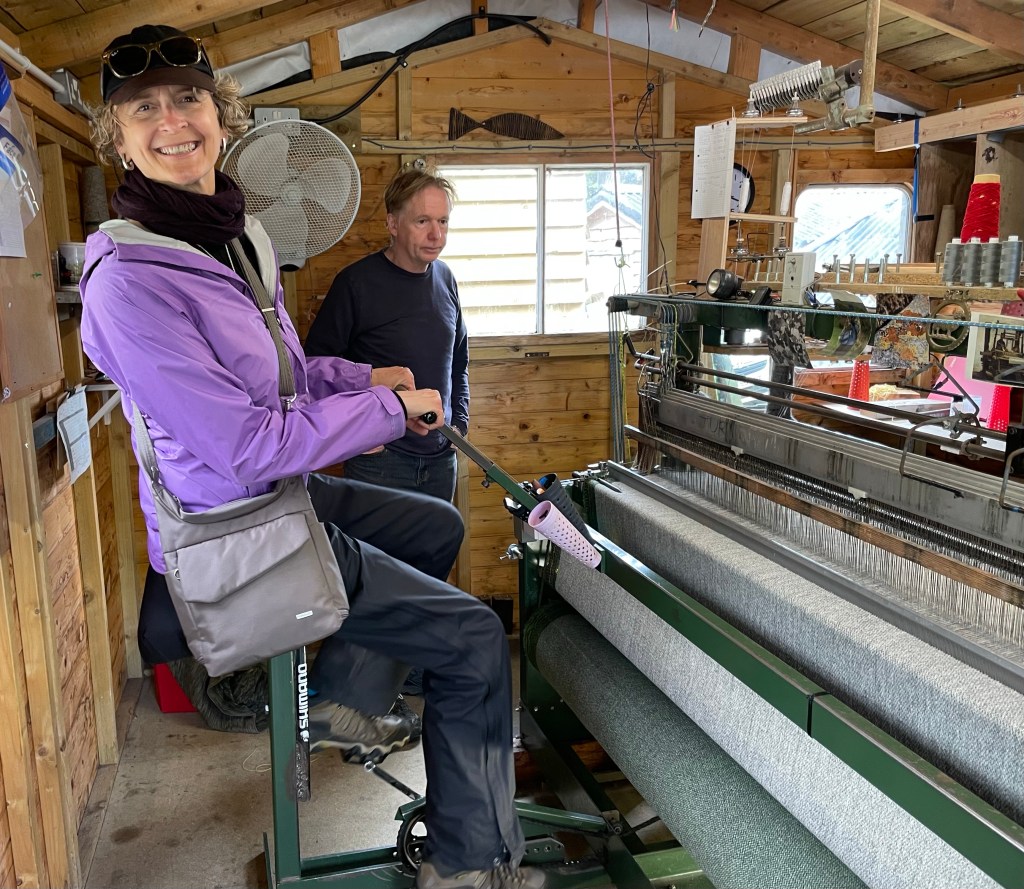
Next we visited Skye Weavers. There are craft artists all over Skye but this particular weaver was called out in travel books. Their looms are bicycle powered. We met Paul, who showed us how it all works and gave us a go. I hope he didn’t have to undo what I did. Also it must be hard to be trying to work while constantly being interrupted.

Paul looks less than impressed with my weaving prowess. Hopefully made up for it by buying a scarf and flat cap.

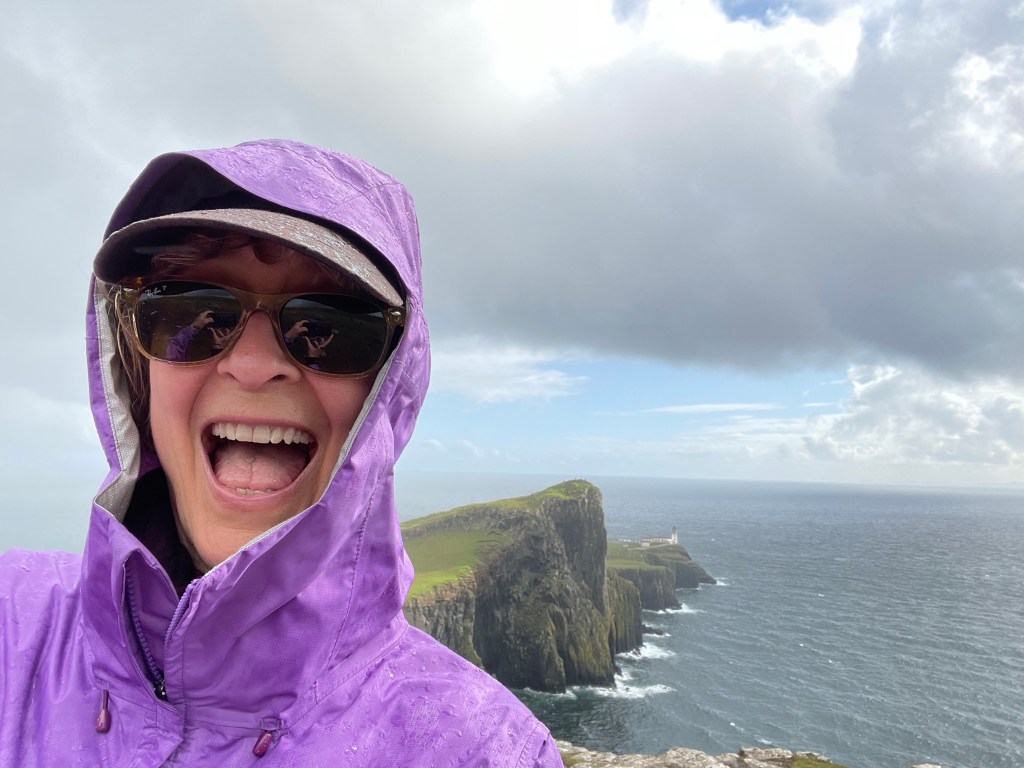
Finally we did a cracking hike to Neist Point Lighthouse in spectacularly crazy weather. (Dipping into British adjectives because running out of American ones). At one point my foot got sucked into a bog up to my ankle. I fell to all fours, afraid I’d never see my boot – or perhaps even my foot – again. I was able to yank it free with a supremely satisfying sucking sound. Best thing is that nobody witnessed it. At this point I was laughing rather maniacally, but the crazy lady got some superb photos.

Ah, the Stevensons have been at it again.
See the lighthouse way out on the point?
Whatever crazy lady.
This might be my favorite shot from Neist Point. If you squint you can see the Outer Hebrides.

I arrived back at the car covered in mud after walking through a torrential downpour. Just half an hour later after a change of shoes and using my hiking socks to wipe away visible mud, we were sweeping into The Three Chimneys, Michelin stars notwithstanding.

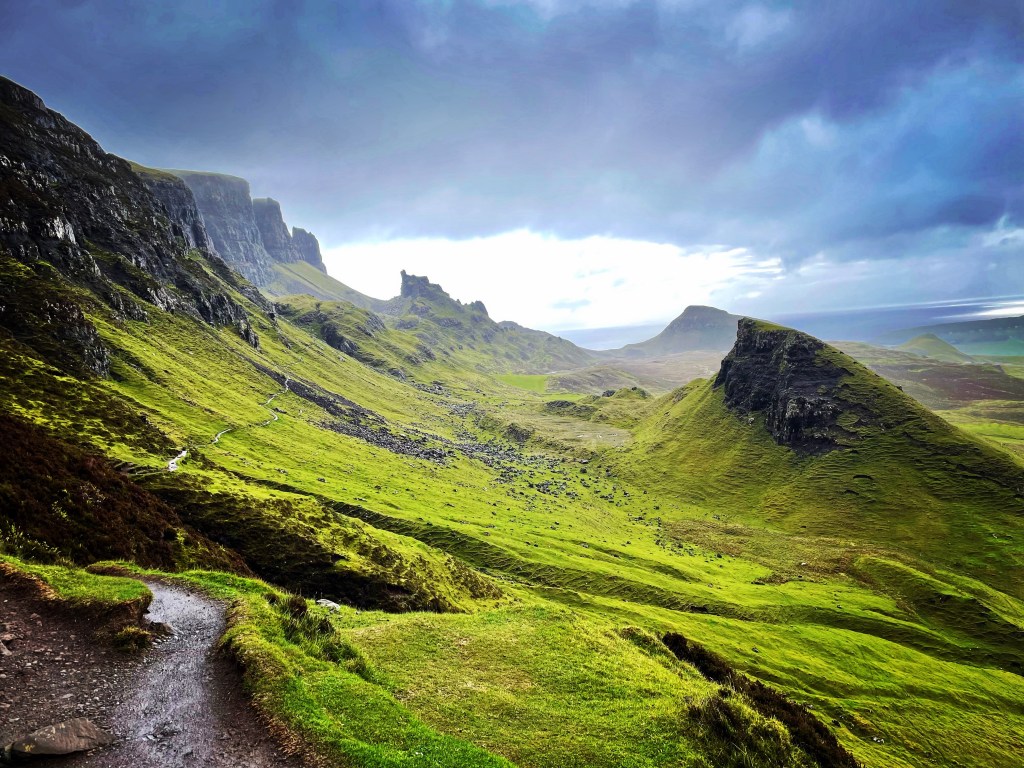
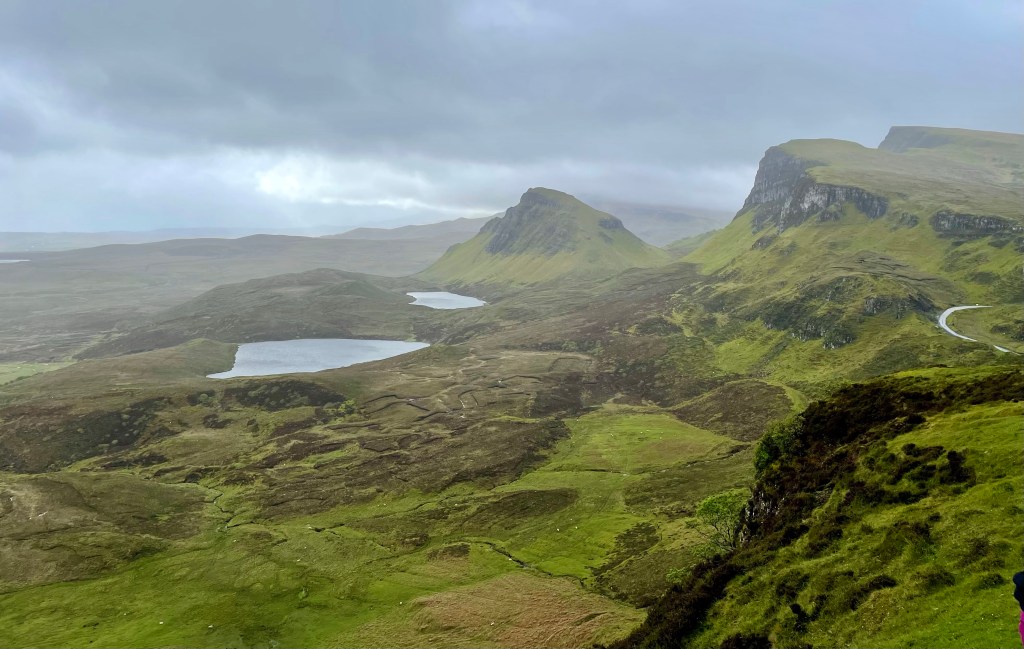
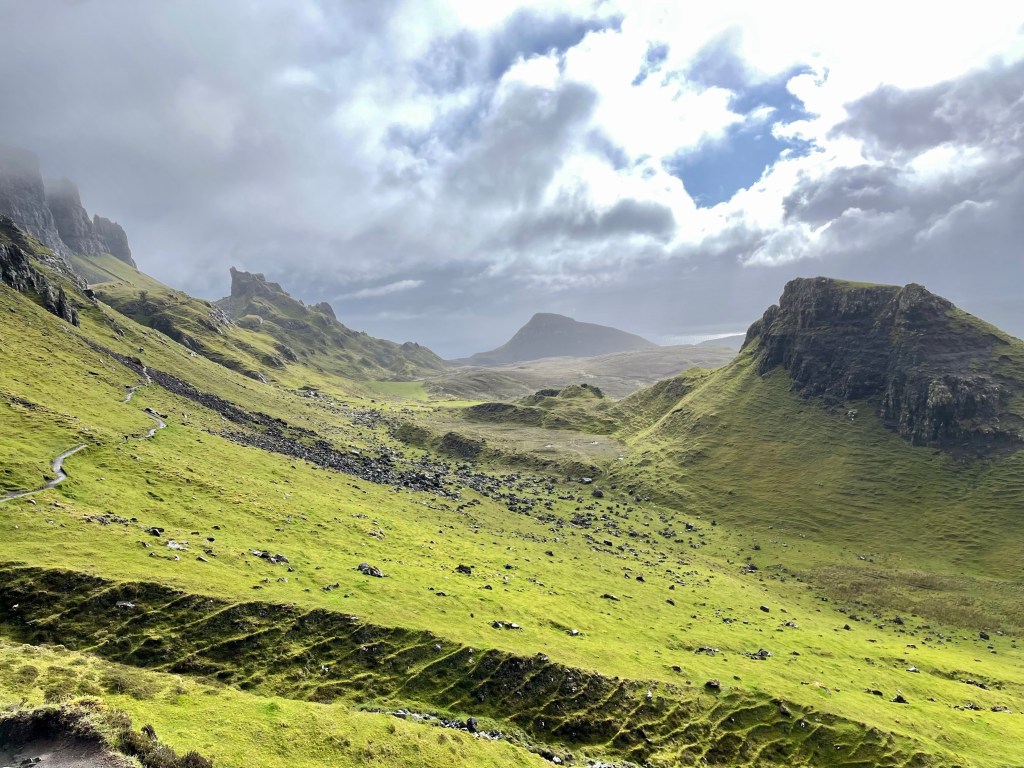
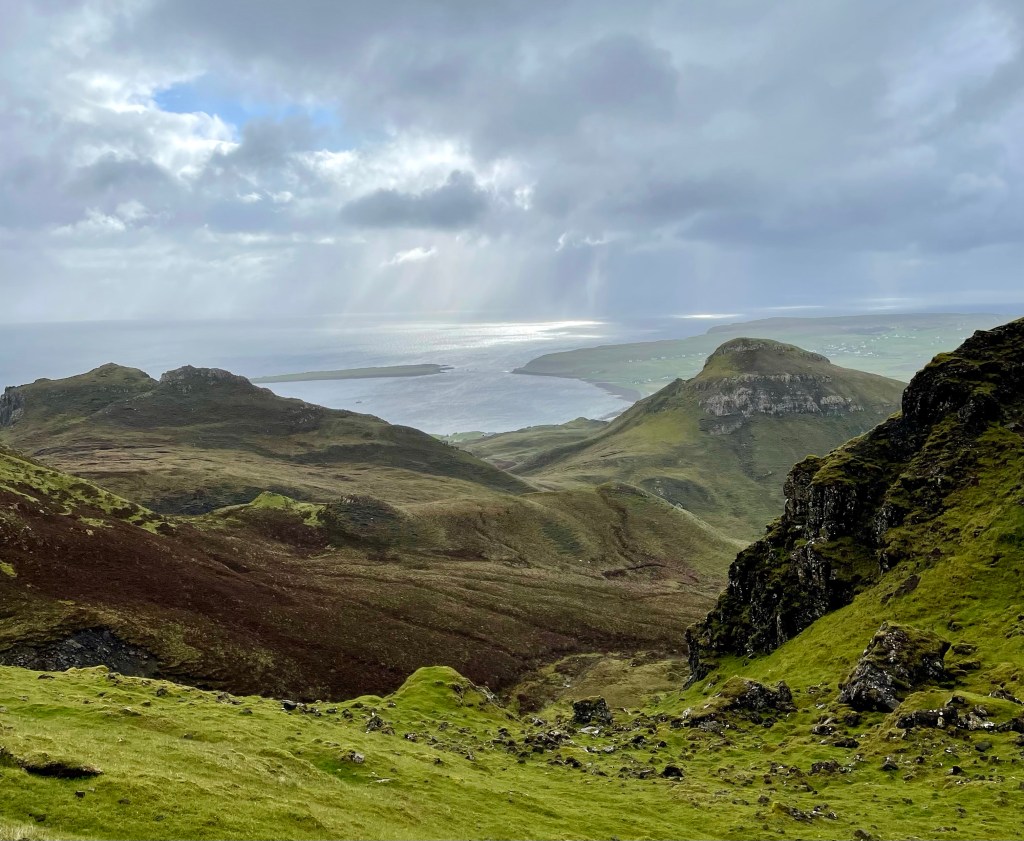
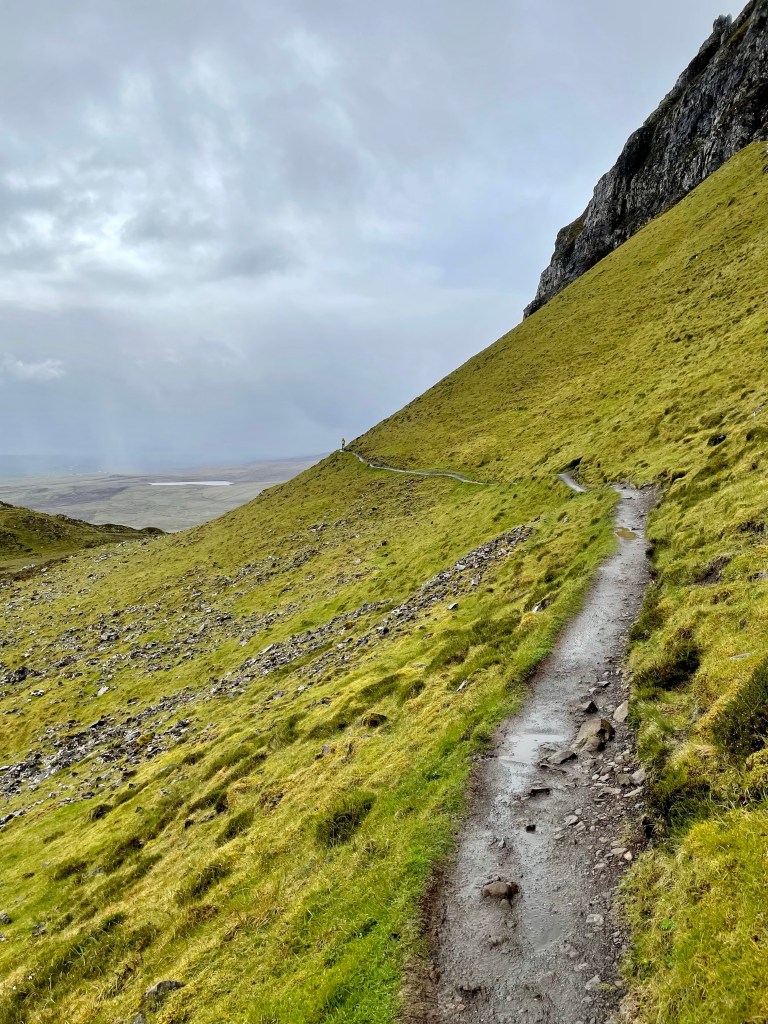
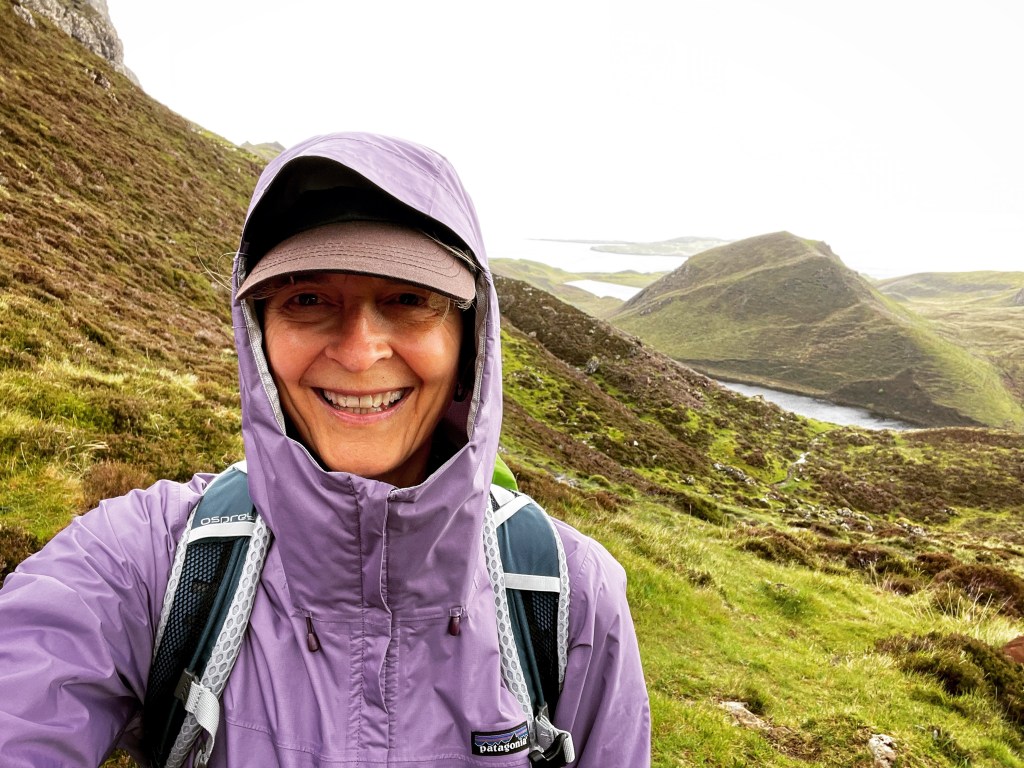
For our last full day on Skye we decided to tackle the Quiraing. Weather be damned. And the weather was indeed damnable. To avoid crowds we arrived at the car park around 7:45, joining just one other crazy person. It was raining sideways, windy and foggy. We communed with our inner intrepid selves and just did it, as the shoe says. The weather changed about 100,000 times during our three hour hike through rivers, waterfalls, mud, along the cliff edges, all the things one’s mother would rather not know about. (Hi, Mom). And it was SO glorious and only occasionally miserable.

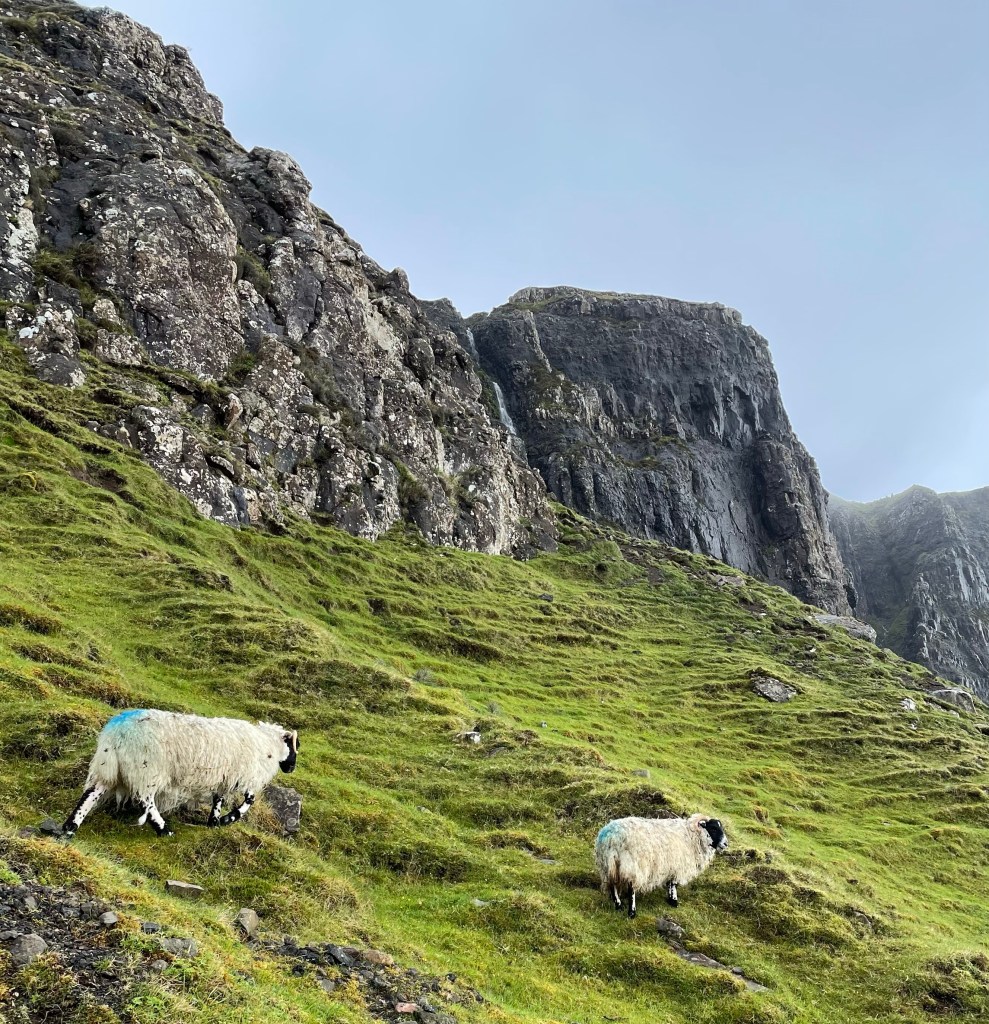
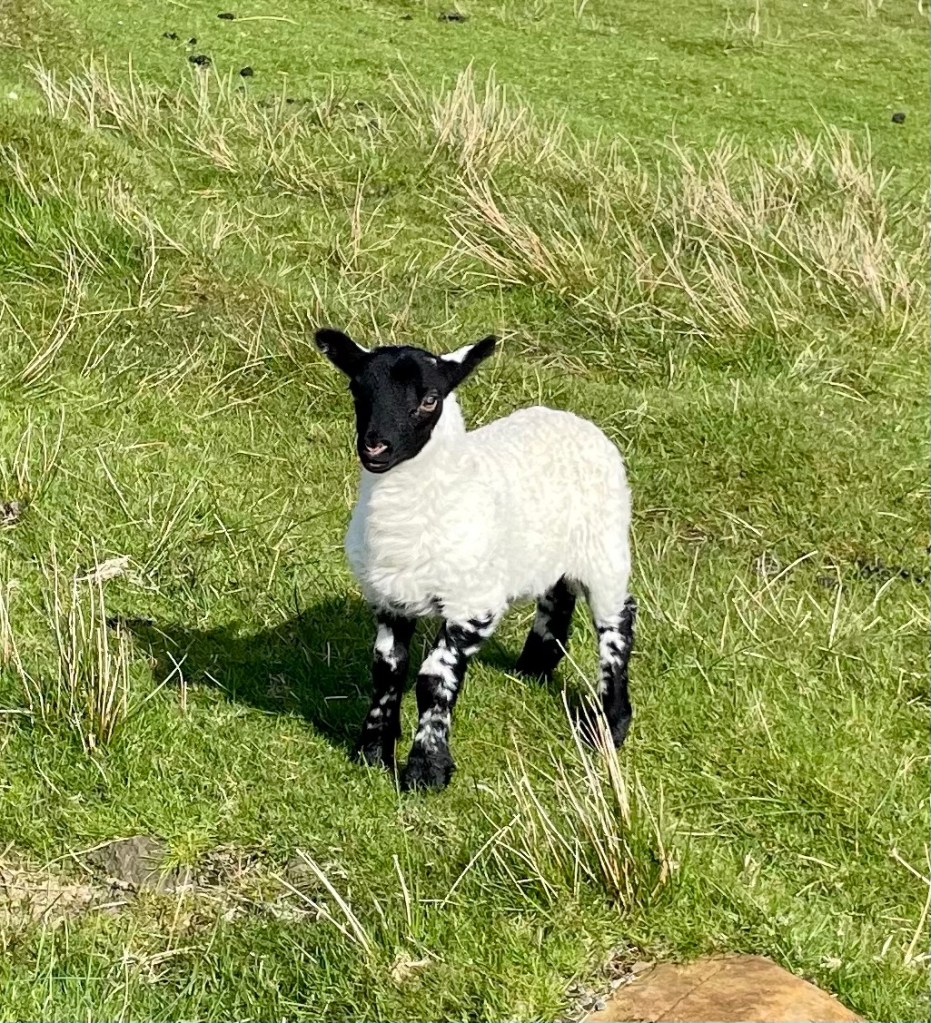
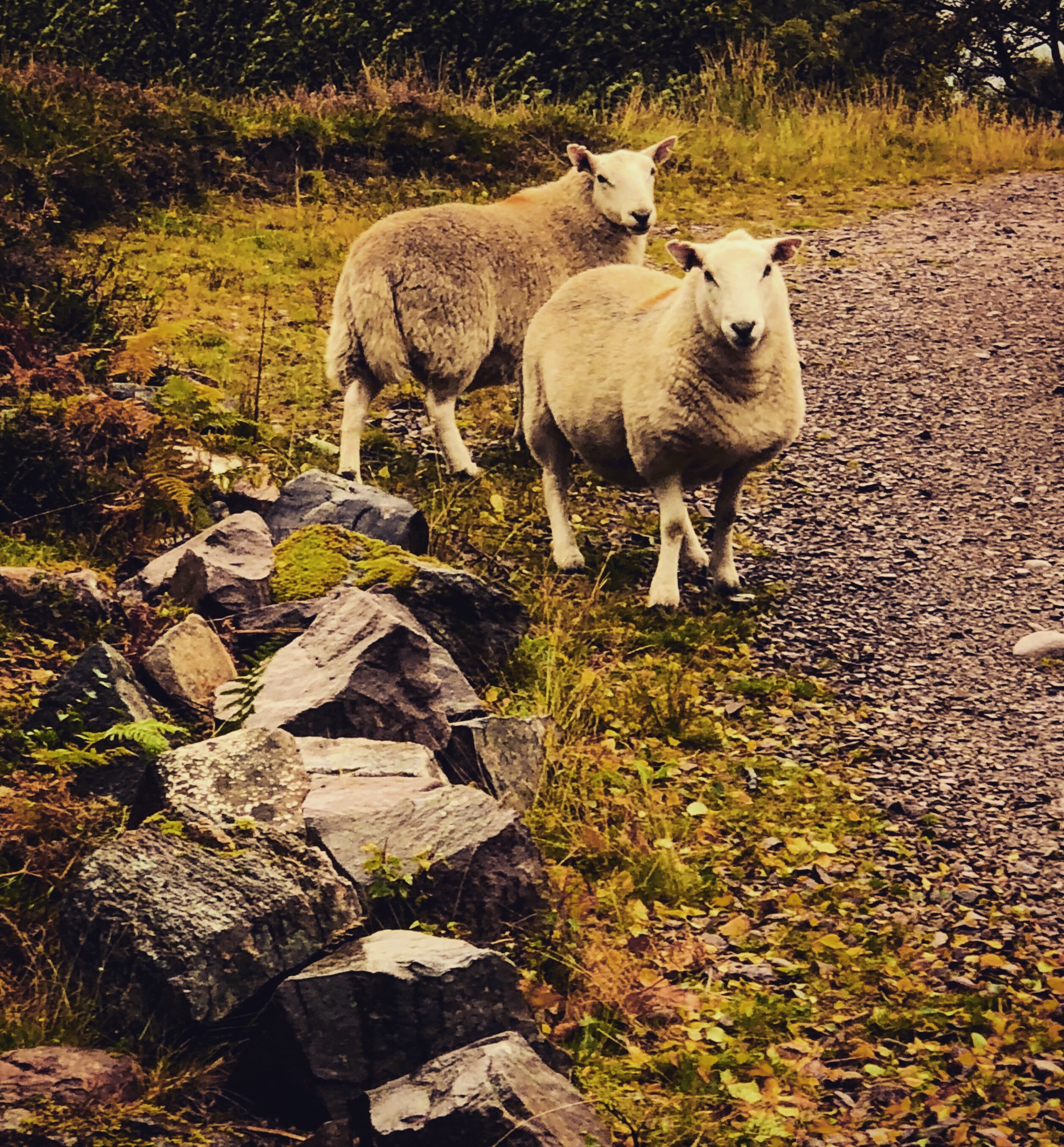
There must always be a sheep photo.
Yikes don’t look Mom. Also note the person coming our way.
Happiness.

Tomorrow, we’re hitting the Fairy Pools early and then heading to Glencoe. We are nearing the end of our trip and how can that be?

Inverness, Birthday Bagpipes and My Drunk Dude Angel

Inverness.

Back in Inverness, the first order of business was to bid a fond farewell to our faithful Dougal. I had grown quite fond of him despite the flaws he was born with – the back seat is worthless for anyone with legs, the hyper-annoying beepy lane monitor warning system, the cheaply finished interior etc. But I loved driving Dougal all over Scotland. I loved the entire experience, driving on the left, single track roads, no shoulders, glorious teeth-rattling potholes, all of it. Maintaining awareness of passing places, sorting out who should pull into one either by driving forward or backing up, and the subsequent mandatory wave to the other driver after you execute whatever you both silently agreed upon – it all makes navigating Scotland’s roads a delightfully communal experience. A very different situation than in the States where one’s car creates a bubble of isolation and basically drives itself.

Another driving-related thing I wish I could have shared with dad is the UK experience of getting gas. The pumps appear to be super-charged and sound like a jet engine when engaged – and they fill up your tank in literally ten seconds. Life-changer. Why can’t we have jet engine gas pumps? You can get your nails done while waiting for your gas tank to fill in the States.

Dougal. He’s been through a lot. Farewell my friend.

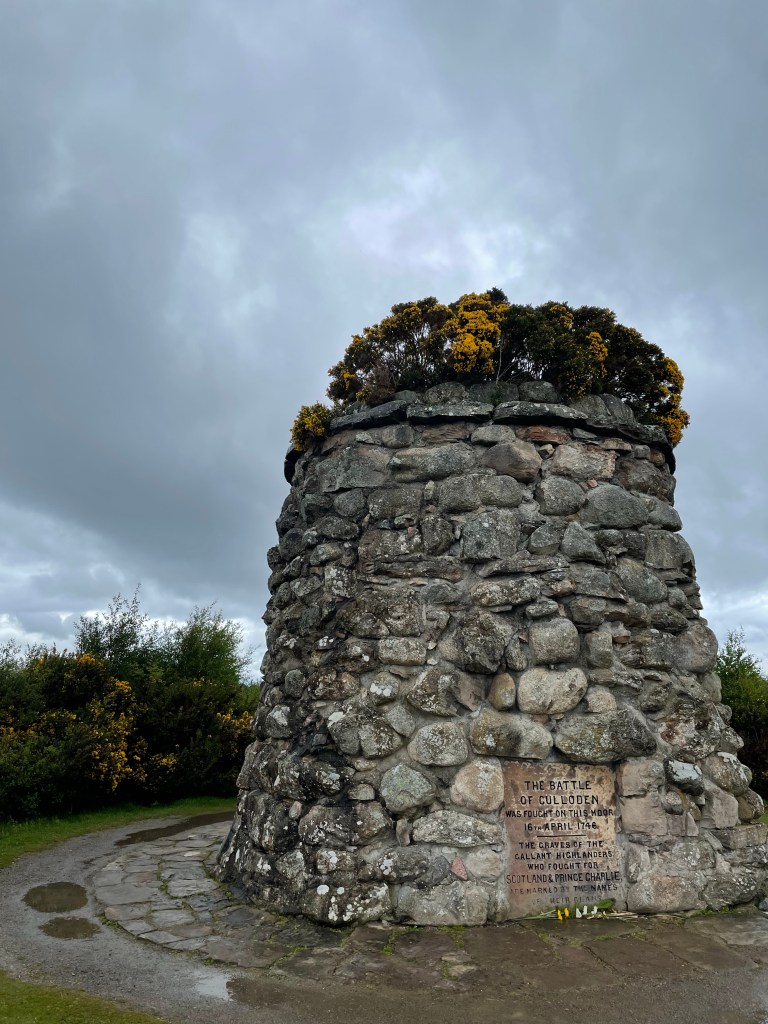
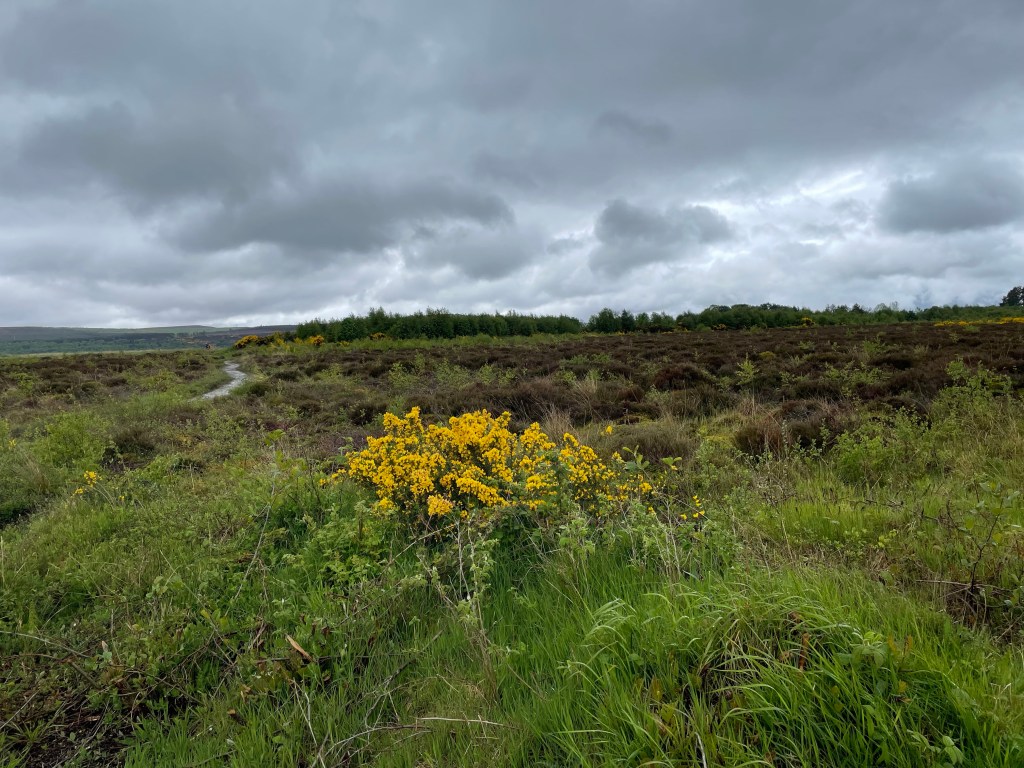
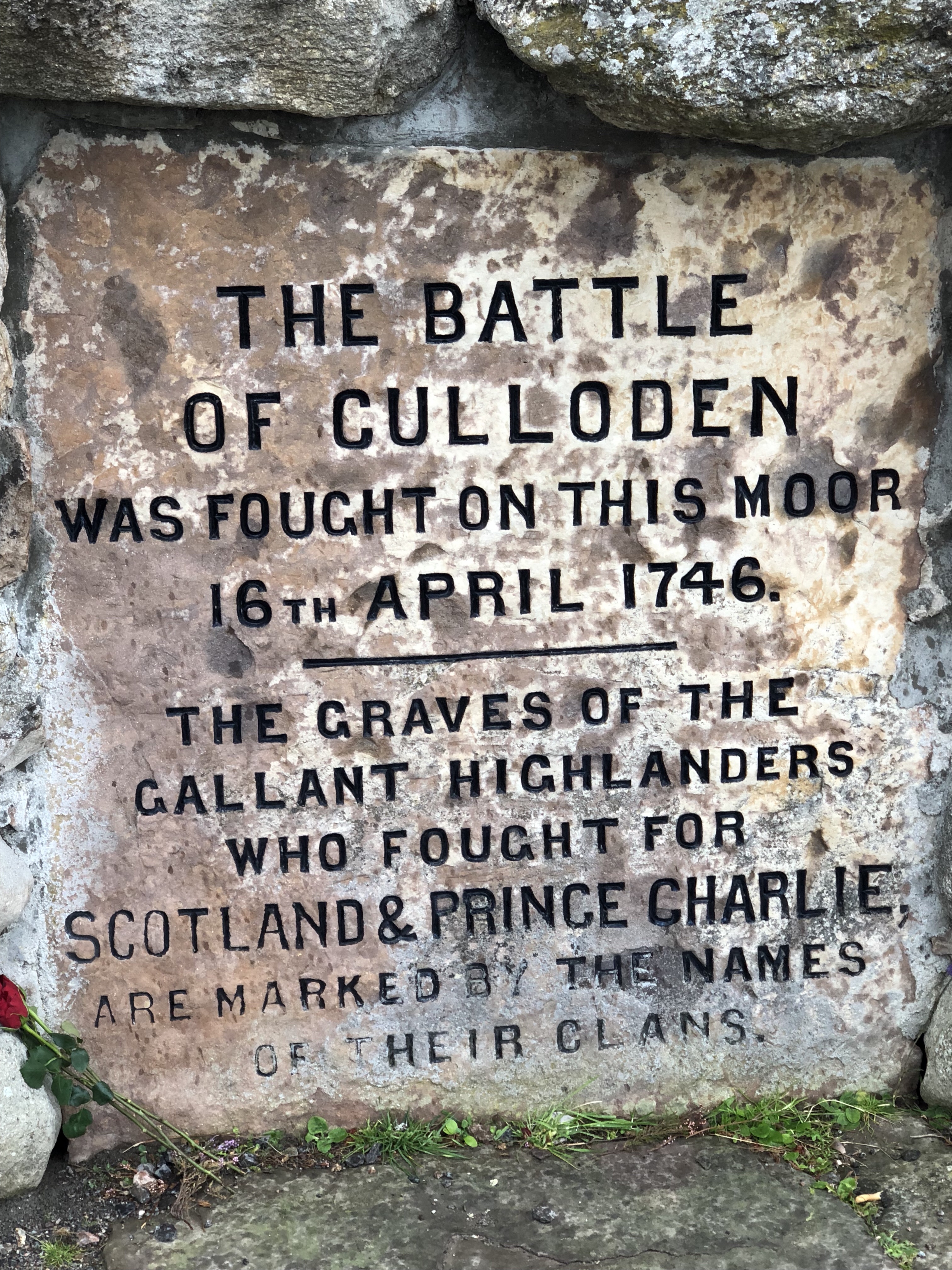
Before we relinquished Dougal, we visited Culloden Battlefield. This somber place is an incredibly rich and fascinating site. Since I wrote about it extensively during my last trip, I’ll simply leave you with a couple of photos.

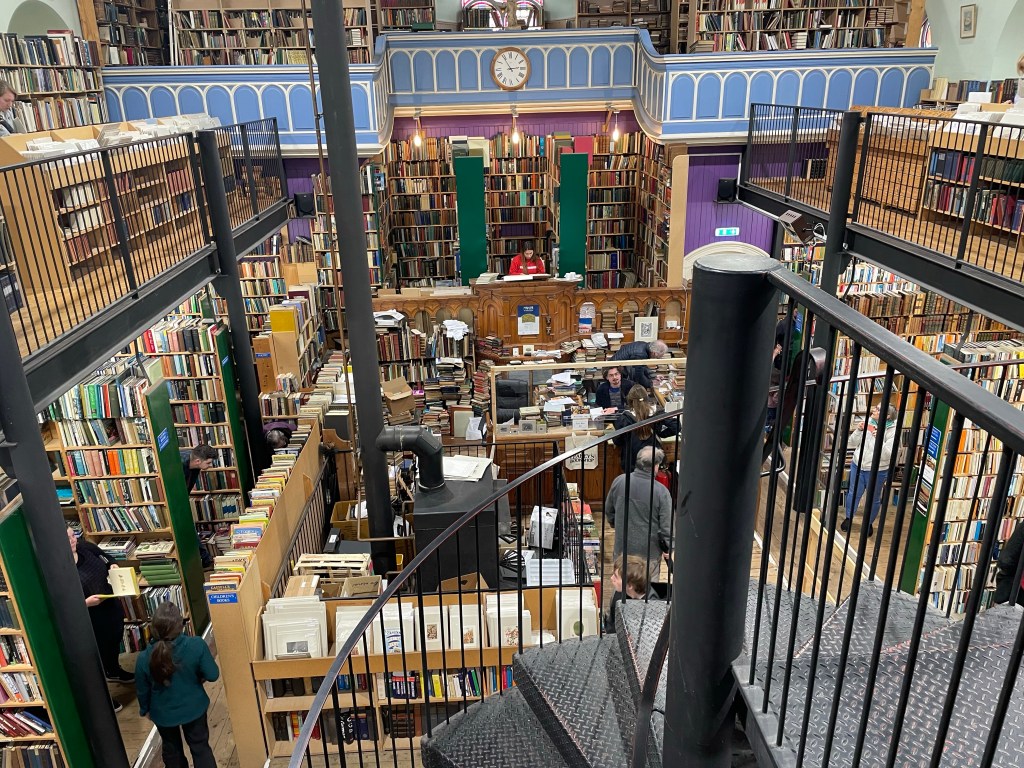
We spent the afternoon puttering around Inverness in the rain, visiting Leakeys, its famous used bookstore. In addition to books they have bins and bins of prints and old maps, all “guaranteed” to be over 100 years old. OK maybe but does it matter really? I bought three.

Leakeys

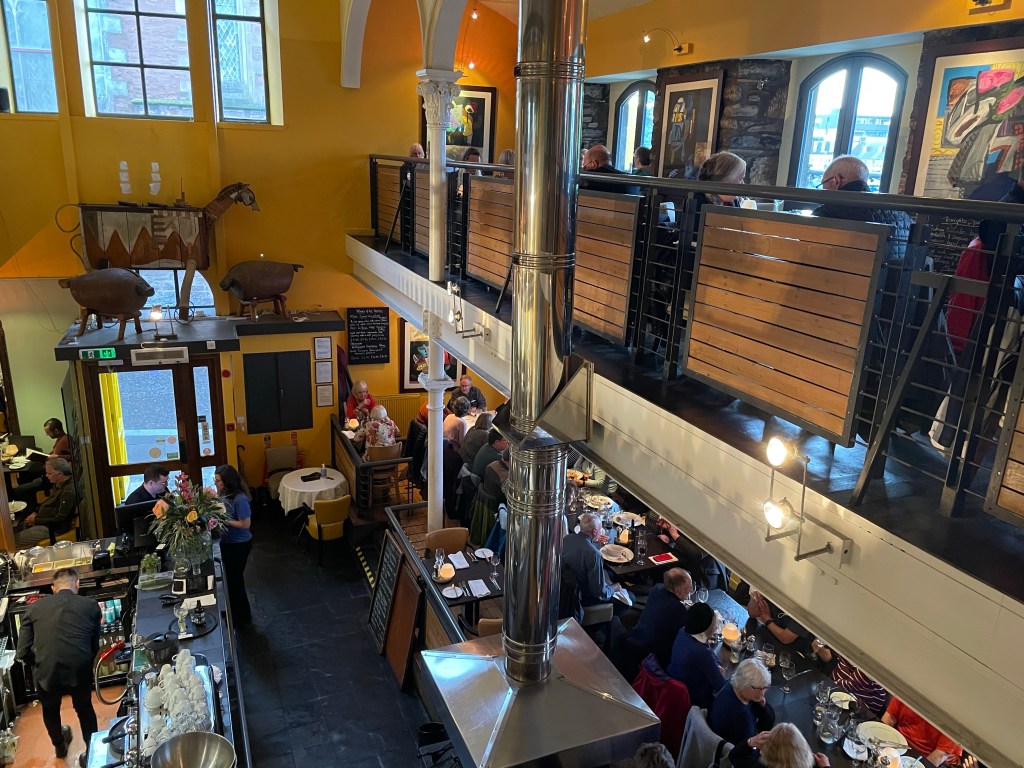
I was excited to have a birthday-eve dinner at Mustard Seed, my favorite Inverness restaurant. Apparently I have my own table there, as they seated me exactly where I enjoyed a lovely meal in 2018. Maybe it’s the designated Mysterious Woman Eating Alone table. It has a nice view of all of the proceedings.

Mustard Seed Cafe, Inverness

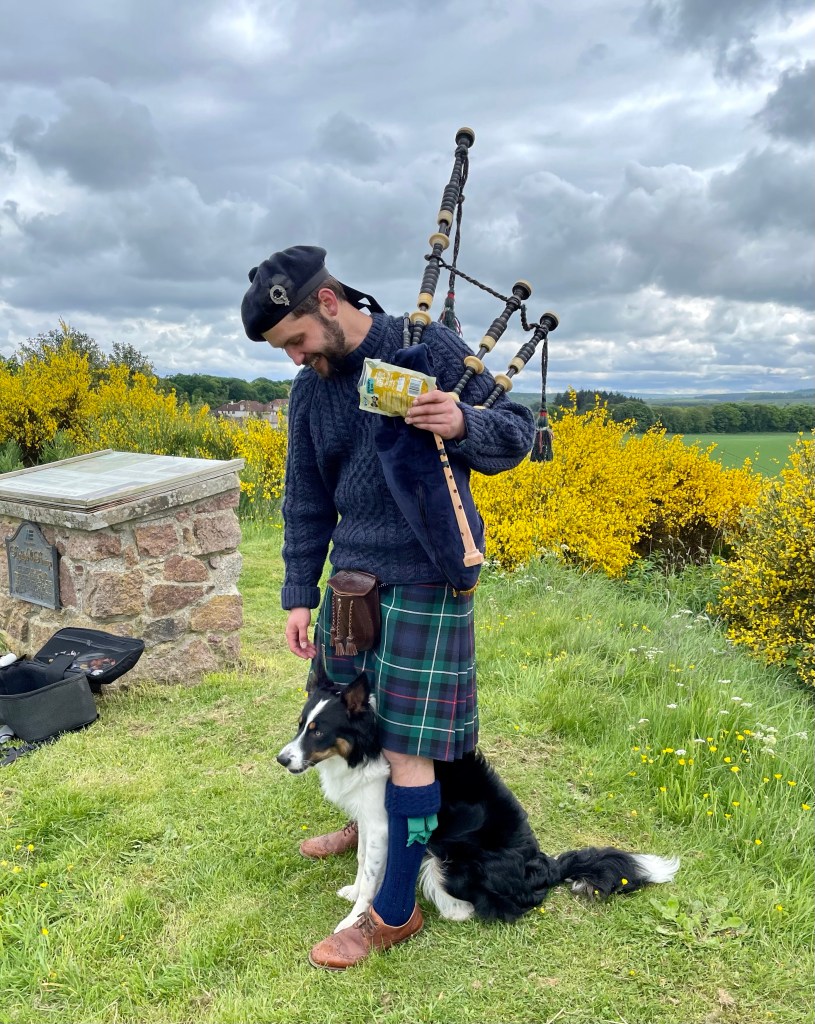
And last but certainly not least, for my last full day in town I booked a tour with one Andrew Grant MacKenzie, who arrived to collect me with a kilt, a border collie named Sonas and bagpipes. Andrew is a legit historian and archaeologist, so he’s basically Indiana Jones. He’s also fluent in Gaelic (pronounced gallic, not gay-lic as it is in Ireland, similar to the whisky/whiskey thing). We had arranged a tour along the Moray Coast, east of Inverness, which Andrew dubbed, “Picts, a Wolf and the Covenanters.”

Andrew and Sonas

Andrew managed Culloden Battlefield for years for the National Trust of Scotland. He actually met with Diana Gabaldon as she was doing research for Outlander. (Segue: I eventually admitted to him that I had partaken of a Rabbies Outlander tour during my last trip which was a super embarrassing thing to disclose to a historian but he didn’t seem to judge.) He said that Culloden staff were the first people in the UK to see Outlander – it was released in the US first and Americans started visiting with particular questions about a fictionalized version of the ‘45 rising which the staff couldn’t answer, not having seen the series. I’m imagining fans asking to be shown the spot where Jamie and Black Jack Randall engaged in fatal hand-to-hand combat. Hopefully not, as both characters are 100% fictional but people are weird. Anyway, STARZ sent over the first two seasons and all employees had to watch it. Of course Diana’s tale is mostly about the love story, not a historically accurate depiction of events sufficient to pass muster with folks who live and breathe Culloden. Still I would have paid a lot of money to watch them watch Outlander.

Andrew also seemed to know everyone in Scotland – he knew the crazy guide we encountered on the aforementioned Outlander tour who had armed his little old lady passengers with plastic swords and reenacted various scenes (see previous blog), he knew the bagpiper Backroads arranged for us during that tour (ditto), he’s talked to the head of Visit Scotland about infrastructure issues related to the North Coast 500, and he has been invited to ceilidhs attended by members of the Peatbog Faeries. He also worked at Cawdor Castle for a while and so of course knew Lady Cawdor.

By now you are getting Andrew’s general awesomeness. And so onto the tour we go. He first drove us to Sueno’s Stone, the largest and most spectacular of the many carved stones that have survived from Scotland’s early medieval period. It stands about 21 feet high and is encased in a giant protective display case. Continuing in the Pictish vein we next traveled to Burghead, a quaint little town located on a spur of the Moray peninsula where a Pictish fort was located. You could see Orkney from the site.
Suenos Stone

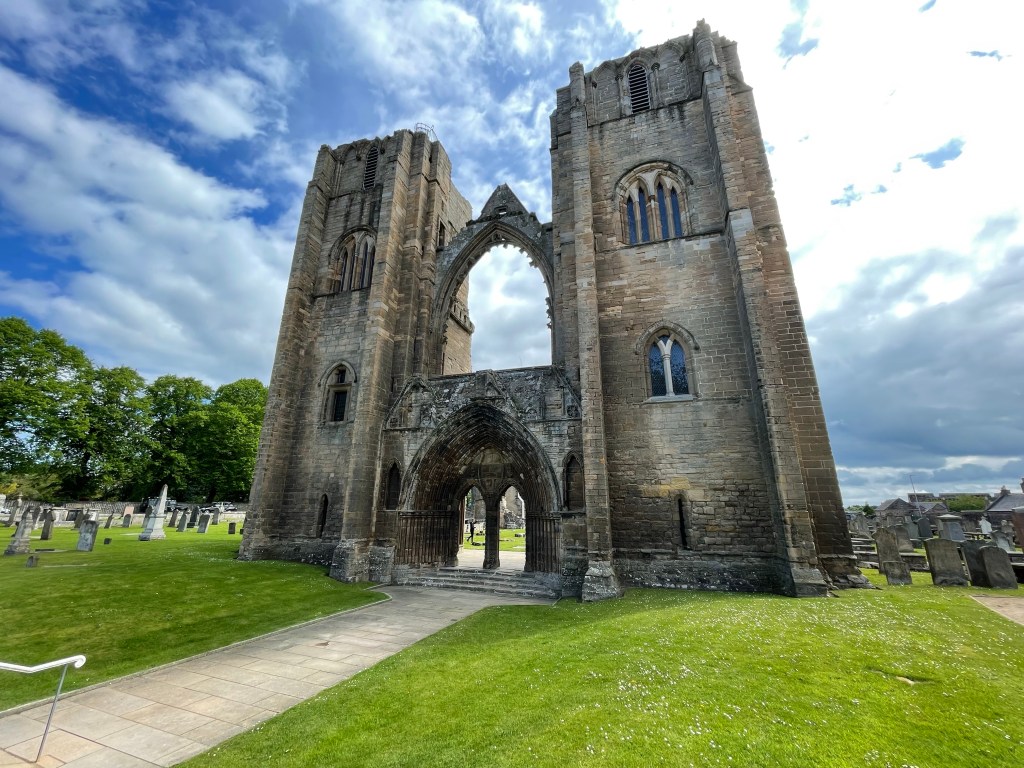
Our next destination was the ruins of Elgin Cathedral, the place that our friend the Wolf of Badenoch (remember him?) burned down. I was picturing a quaint medieval chapel when it was actually more akin to Westminster Abbey.
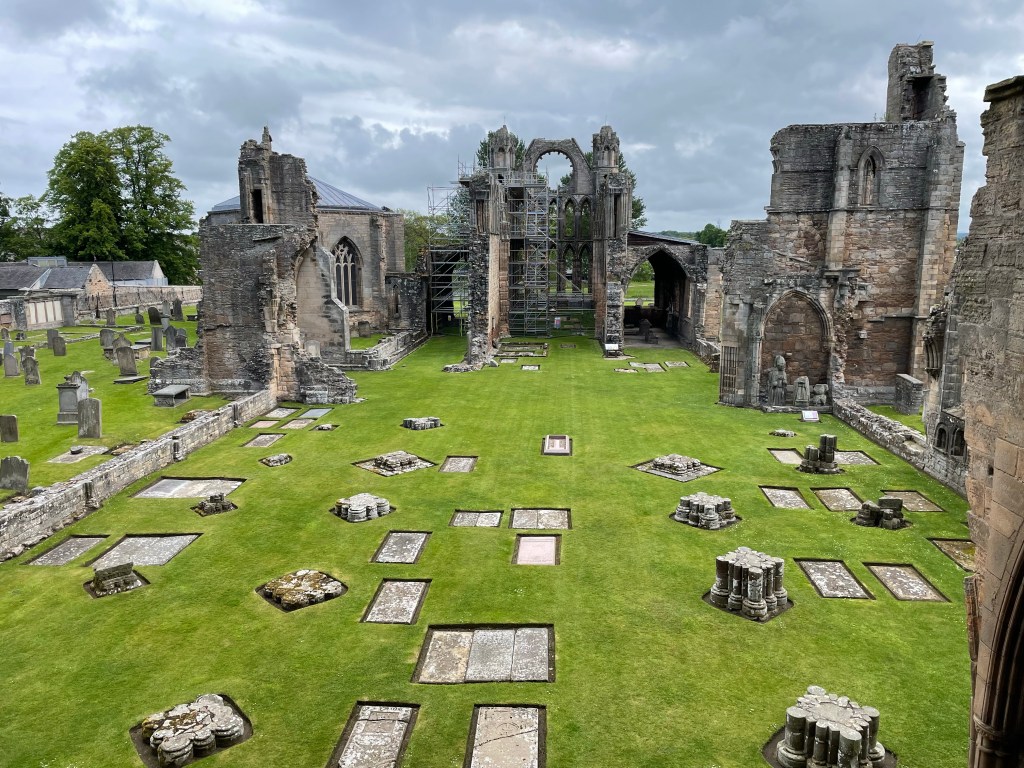
The cathedral is a massive and gorgeous site. There’s one room with a domed ceiling, glass windows and perfect accoustics, which Andrew demonstrated via the dulcet tones of his singing voice.
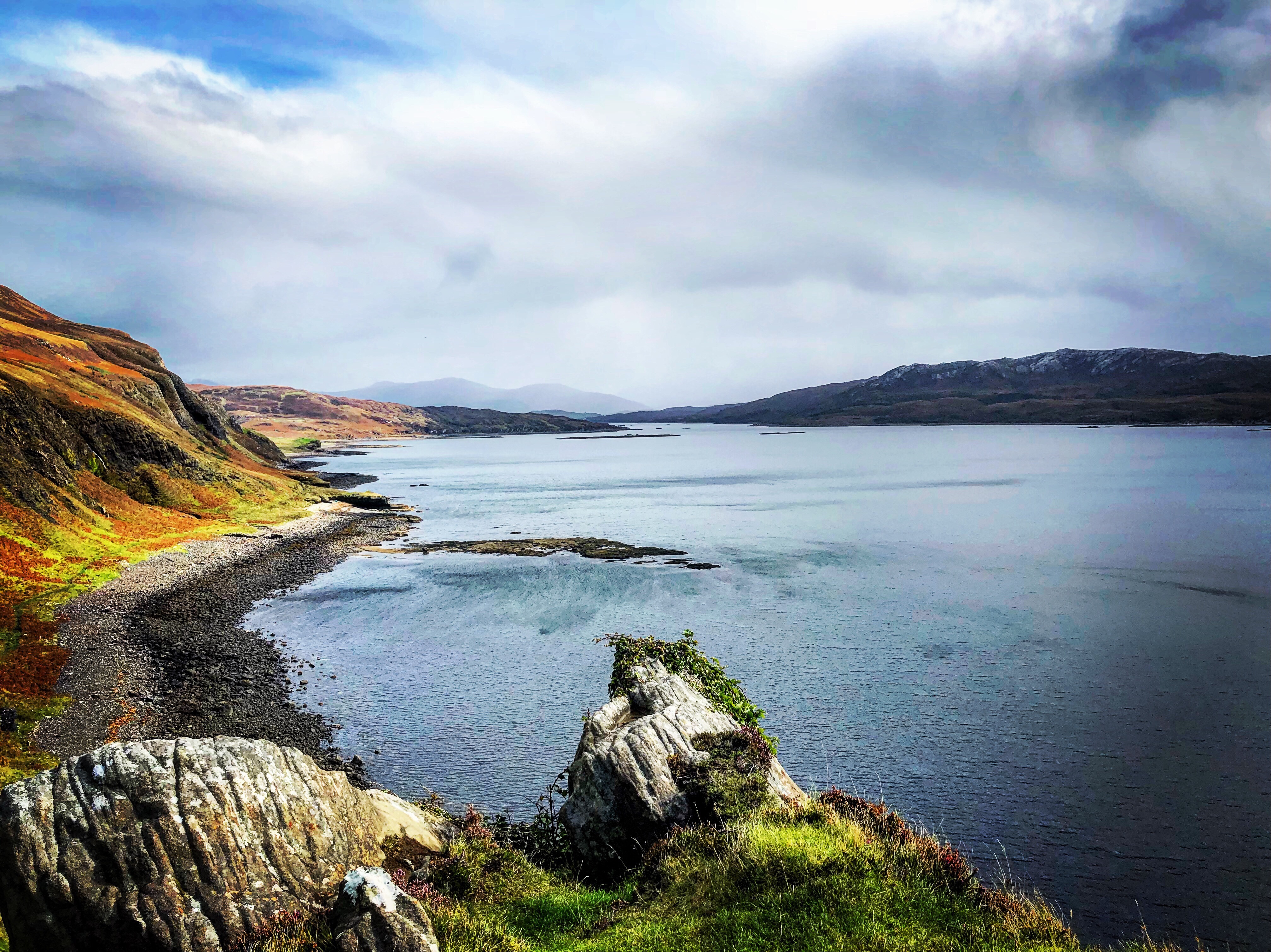
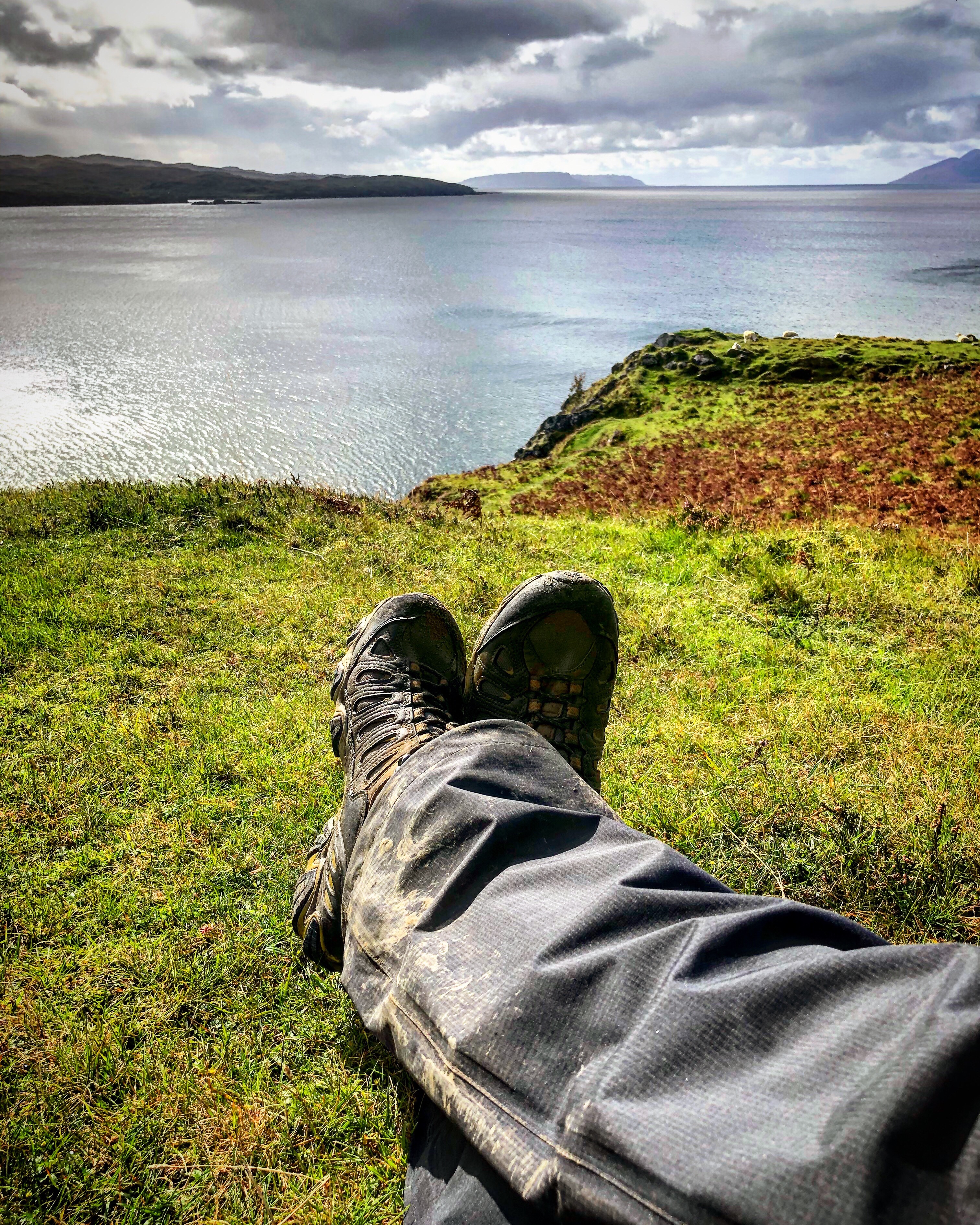
After having lunch at Cawdor Castle Cafe, we finished the tour at the Auldearn battlesite. As a historian, Andrew cares a lot about this battle and doesn’t understand why more people don’t visit the site. Perhaps our friend Diana could do something about that although be careful what you wish for. The 1645 battle was fought between a Scottish Covenanter army allied with the English Parliament and the Royalist forces of Charles I. Covenanters were folks who signed the National Covenant in 1638 to confirm their opposition to the interference by the Stuart kings in the affairs of the Presbyterian Church of Scotland. The Stuarts believed all of that divine right of kings stuff and that monarchs were meant by God to be the spiritual heads of the Church of Scotland instead of that other guy Jesus. This was a sticking point even for Scots who supported the Stuarts. Andrew said it was the first time a battle had been fought between Gaels over an idea rather than land and resources.

In the peace and solitude of the ancient battlefield, Andrew liberated his bagpipes from their case and played an evocative and mournful tune about the battle itself. It was achingly lovely and sad. From the sublime to the you-know-what, his encore was a song you might recognize in honor ME GETTING EVEN OLDER.

Best rendition ever.

Over the course of the day we had some great conversations about history – and even delved into politics. Andrew said that most Scots struggle to comprehend what is happening in the States currently with MAGA, the insurrection, guns, individual rights and so on. Yeah same same.

We talked about the horrific 1996 Dunblane massacre, the deadliest mass shooting in British history. Sixteen students and one teacher were killed, with fifteen others injured. Directly afterward, Parliament passed two new firearms acts which outlawed the private ownership of most handguns within the UK, together with a buyback program. Thousands of weapons were incinerated. As we know, there have been no further mass shootings with a handgun in the UK since, even though we are told by NRA experts that guns don’t cause these horrific things. UK residents can still own hunting rifles, of course, but they are registered and owners must keep track of their shots. The guns are inspected every year to make sure the owners’ reported number of shots match the number of times the gun was actually fired. Can you imagine the cascading exploding heads in the States if something that restrictive were enacted? I guess in some countries the bother and inconvenience is worth not having people and children regularly mowed down by military-grade weapons. Imagine.

Andrew also talked about a few Gaelic concepts that inform his life and business. The words are about the sense of belonging to a place and to a people. There is no English translation. They resonated with some of the things I’d been thinking about and experiencing on this trip around why I feel so in sync with the hills of Scotland while lately feeling less connected to my home in Oregon.

Dùthchas is the connection to one’s ancestors, their lives, stories, the ground they lived on and one’s physical and emotional connection to that ground. I think ancestors can mean either a spiritual or blood lineage. Cianalas is the longing for dùthchas when you aren’t there. It’s a mournful longing but it’s not sad. Caim is the belief that wherever you are and whatever your current situation you can gain strength from encircling yourself in that longing and that connection to your dùthchas. Sonas is the sense of completeness and comfort you feel when you drop into dùthchas, cianalas and caim. These concepts echo throughout yogic/eastern spiritual traditions as well. My yoga teacher talks about his own spiritual lineage in the same way. I can’t explain why, but I feel and experience the truth of it.

Sonas.

If you find yourself in Scotland, consider Andrew and Sonas as guides. You can find more information about them at http://www.highlandhistorian.com.

I capped off this perfect day with a birthday dinner at Rocpool. After dinner I ordered an affogato because it’s unquestionably the perfect dessert. It arrived with a road flare in celebration of ME GETTING EVEN OLDER.

By all means let’s celebrate this fracking thing.

And now for the journey home. Let’s dispense with COVID. For the first time since the pandemic started, I let down my guard during this trip and didn’t don a mask the entire time I was in Scotland, throwing caution to the winds as it were. With bated breath, I took the test with the tele-health person monitoring. Negative. Never been happier to see a single red stripe.

And now for my dicey short layover in Schipol. I had an hour between my Inverness flight landing at Schipol and my flight to Salt Lake taking off. Not boarding, mind you. Flying away. As we sat on the runway in Inverness, I was feeling all the appreciation for how quickly Europeans get their asses settled onto airplanes. Everything was proceeding apace until, of all things, they couldn’t get a cargo door to latch properly. As time ticked by, inexorably shortening my layover like slow drips from the faucet of doom, I was about to volunteer to sit in the hold during the flight so I could keep the door closed with my body. Then, behold, the pilot took matters into his own hands and asked for the ladder to be brought back to the airplane so he could descend to the tarmac and “take a look.” He emerged from the cockpit, a burly central casting Viking with red hair, marched down the steps and totally took care of it. I need someone like that around me at all times.

So we arrived in Amsterdam a half an hour before my next flight. I was surprised to hear as we landed that only one connection was blown, a flight to Boston. I was instructed to “go right to the gate” for my Salt Lake flight. YES BY HELL I CAN DO THAT. The airplane landed in the “curtain” area of Schipol which is basically New Jersey, with a stinky bus that takes you to the terminal. I hit the ground running and arrived at the empty gate panting in a most unladylike manner and entirely disheveled and having to pee but I had apparently made it in time.

Ah but not so fast. The gate agent looked at my flight information in the system and reacted with a puzzled expression. She showed it to all of her gate agent friends and they were also visibly taken aback, shrugging their shoulders and saying things to one another in Dutch. What what what? I found out later that KLM, in its infinite wisdom, had decided that since my flight was delayed I ergo missed my connection and so they had rebooked me on the same flight the following day. Before my feet had even hit the tarmac. Like declaring someone dead when their heart is still beating.

So the lead gate agent (I presume) was summoned and he started calmly typing into his computer and talking on the phone. In Dutch. I still had zero idea what was happening. He finally looked at me and said, “Don’t worry, that plane is not going anywhere.” OK phew. Bless you sir.

Relaxing, it was then that I fully noticed the short t-shirted paunchy drunk dude standing several feet away and surrounded by no less than four tall, fit and woah quite handsome security agents. I gleaned that the drunk dude had been tossed from the plane due to stupid drunken behavior and it wasn’t the first time. And sad to say he was an American. Well of course he was.

He was doing that thing hammered people do, which is moving and gesturing very slowly while intoning super dumb things in an exaggerated rational-sounding tone. He of course had had two beers. From my years of lawyering, this exact quantity of alcohol is noted in every accident report. It’s a phenomenon really, that every single person who has ever caused a motor vehicle accident tells the cops that they have imbibed exactly two beers. Someone should do a study.

Anyway the dude was carefully explaining that he knew his own limits, that he was fine, that he hadn’t done anything wrong, that he would miss his daughter’s birthday party, and that he had had ONLY TWO BEERS. He also periodically dramatically extended his arm straight out in front of him and scolded the various security guys for not social distancing. For their part, the security guys appeared to be employing de-escalation techniques while at the same time trading spectacular insults with drunk dude. I literally think someone’s mother was mentioned at one point. The dude once tried to “get in line” behind me and I almost bodily moved the tallest and most woah handsome security guard so that he was more solidly between me and the dude.

Of course the dude was filming the whole interaction with his phone because obviously he’s going to file a complaint, so I might become famous as a background extra on social media.

Meanwhile the formerly calm senior gate agent finally exploded and yelled at the top of his voice, gesturing dramatically, spittle flying everywhere, for security to move the dude away because the whole drama was distracting him from getting me on the freaking plane. There was a spectacular amount of swearing. I was with him on this, and actually hoping the dude would be thrown into a Schipol holding cell where his fingernails would be slowly pulled out one by one. Do they have those? Do they do that? Hard to tell with those stoic Nederlanders.

Finally the dim light dawned and the dude managed to accurately assess the situation. He simply was not going to prevail either by his wits or physical prowess and so he wandered off down a moving walkway, throwing muddled parting threats over his shoulder. I said to my gate agent, “Americans are the worst.” He agreed so enthusiastically that I felt the need to add, as I hadn’t yet been given my boarding pass, “not me though.”

Anyway, once I triumphantly boarded the plane at last, the senior gate agent suddenly appeared onboard and high-fived me, saying none of it was my fault and asking whether I was happy. Don’t worry, why would I file a complaint about what ended up being a funny story I could share with you guys – and besides I AM ON THE PLANE.

Also, the thing is, the drunk guy was the reason the flight was delayed long enough for me to make it. They had to excavate and remove his bag. So, and I mean this from the bottom of my heart, thank you my dude. And I hope you find the help you need, for your daughter’s sake.

So after that wee bit of drama, I made it home with no further incident except my checked bag decided to remain in Amsterdam for a few extra days to see the sights. And except for the fact that I am no longer in Scotland, all is well. Best thing is getting to see this face.

I so enjoyed writing about my long-postponed trip and sharing it with you. Thanks for reading. I hope it inspires you to travel to Scotland or anywhere you feel dùthchas. Just don’t be a tourist.

And gird your loins, my friends, because I’m headed back to the UK in September.

Til we meet again.
Sláinte

Inverness, Jacobites and Culloden

Bidding farewell to Edinburgh, it was time to catch a train to Inverness, known as the gateway to the Highlands.

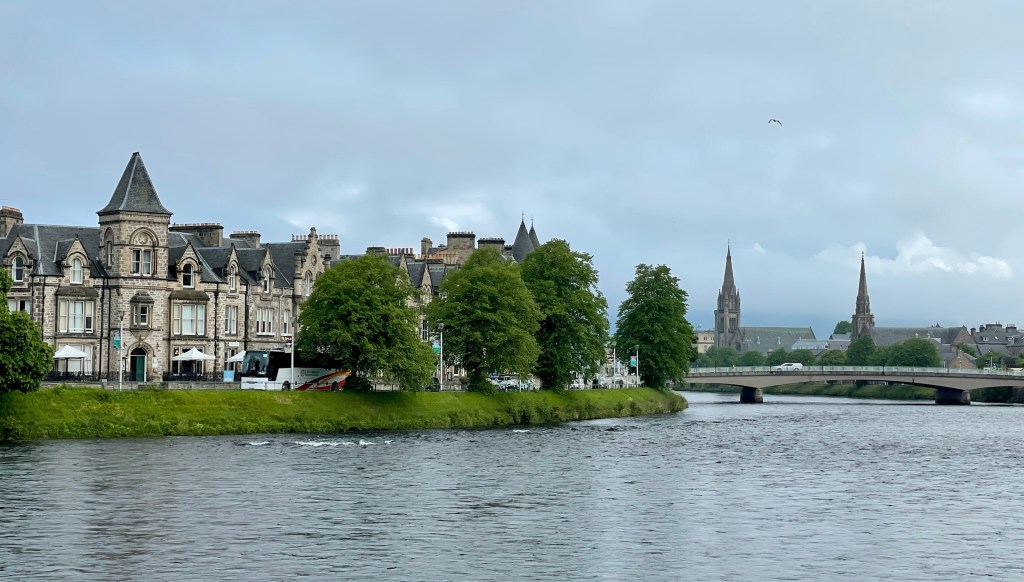
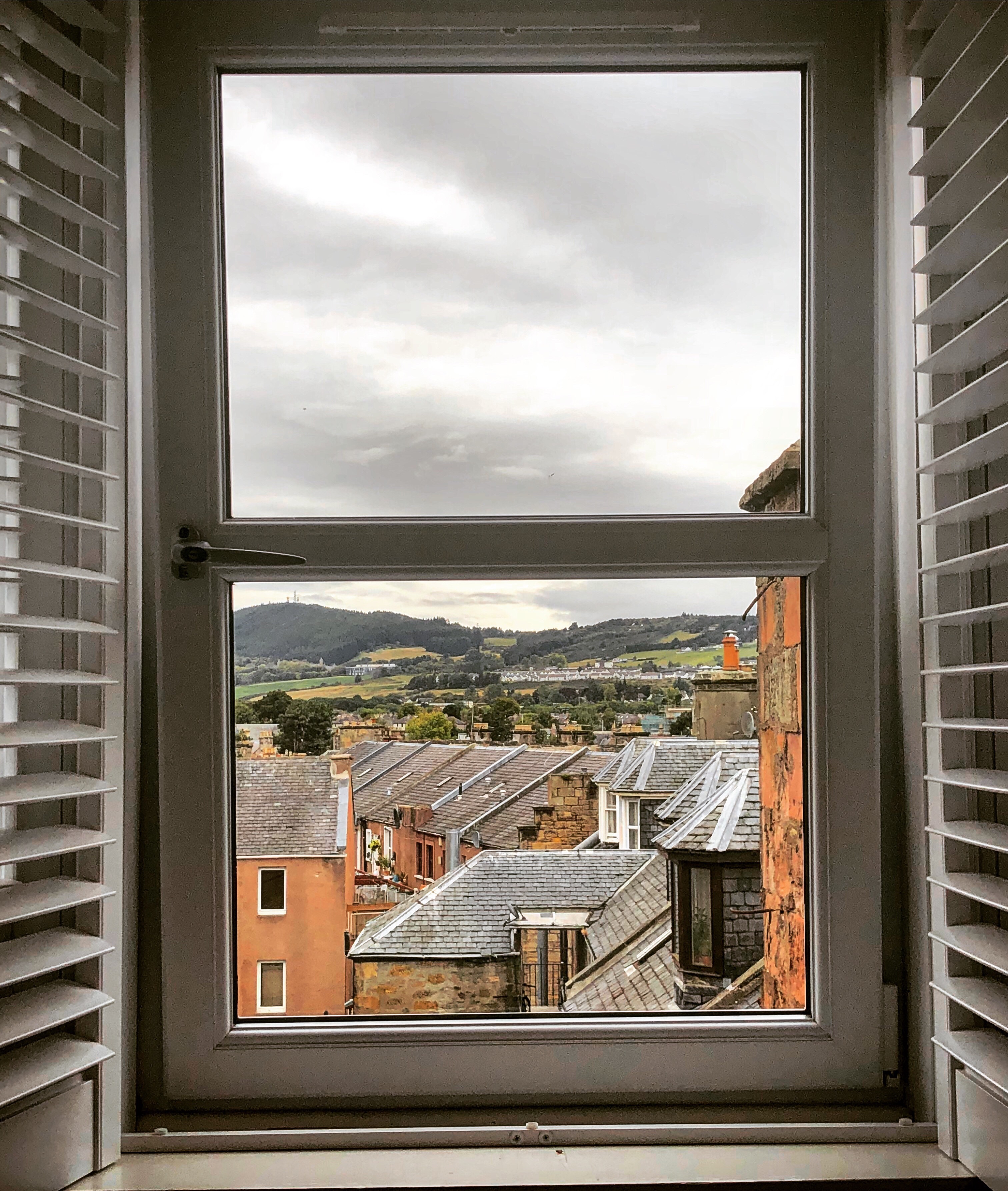
Arrived around supper-time and checked into the Castle View Hotel, run by the lovely Eleanor and her Jack Russell, Mia. The hotel is on the River Ness and pretty much everywhere was walkable. My room was on the top floor, with no lift. (PS same deal at the Inn on the Mile, just not a thing here).

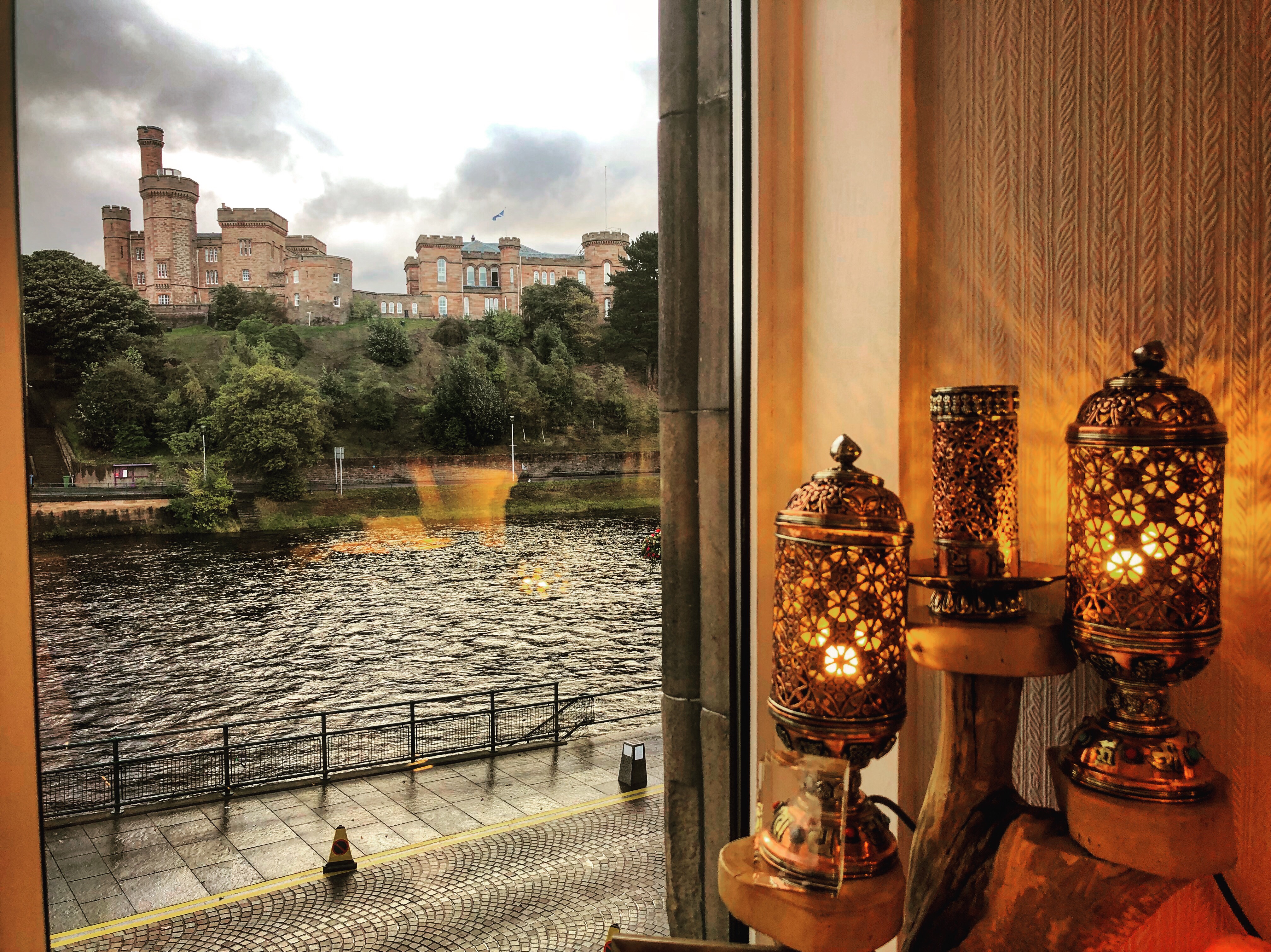
The hotel boasted a lovely view of Inverness Castle, which houses the local courthouse and other offices. There are plans to build a new facility for the Courts so the castle can be opened to visitors. Fabulous rooftop views from my room, and gazing over the River Ness at the castle while enjoying a full and fabulous breakfast was perfection.

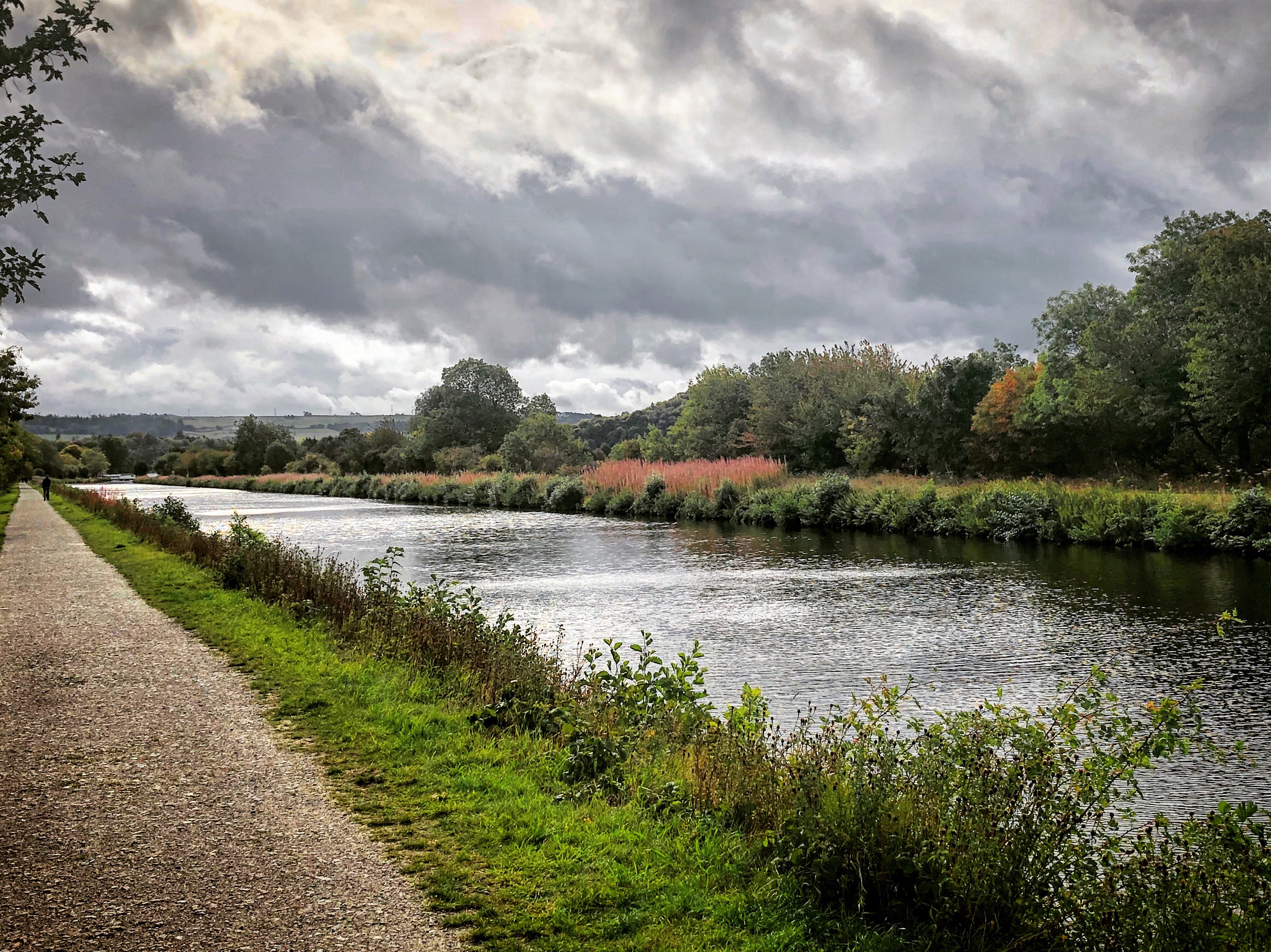
My first morning I walked about eight miles of the famed Great Glen Way, a lovely stroll along the River Ness to the park-like Ness Islands and then up the Caledonian Canal. The Way is a walking path that runs 78 miles, bisecting Scotland from Inverness to Ft. William. People in Scotland walk. And walk and walk. Trails go on for miles, and are so scenic you could die.

All the walking gives one time to ponder many things. For example, you know all the rules we have in the States, to protect us from one another’s presumed and inevitable bad behavior? In Europe, there are fewer rules, and amazingly, unregulated people actually rise to the occasion given the chance. For example, only a few dogs were on leash during my walk. Rather than being a catastrophe with dogs running wild and eating babies, every dog was on voice command. Dogs didn’t interact with other humans or with one another because they were looking at their owners. When they did have a bit of a run, the instant their owners whistled, they hit the brakes and ran back. Maybe Americans are boorish uncivilized barbarians and can’t be trusted to behave properly. We will never know.

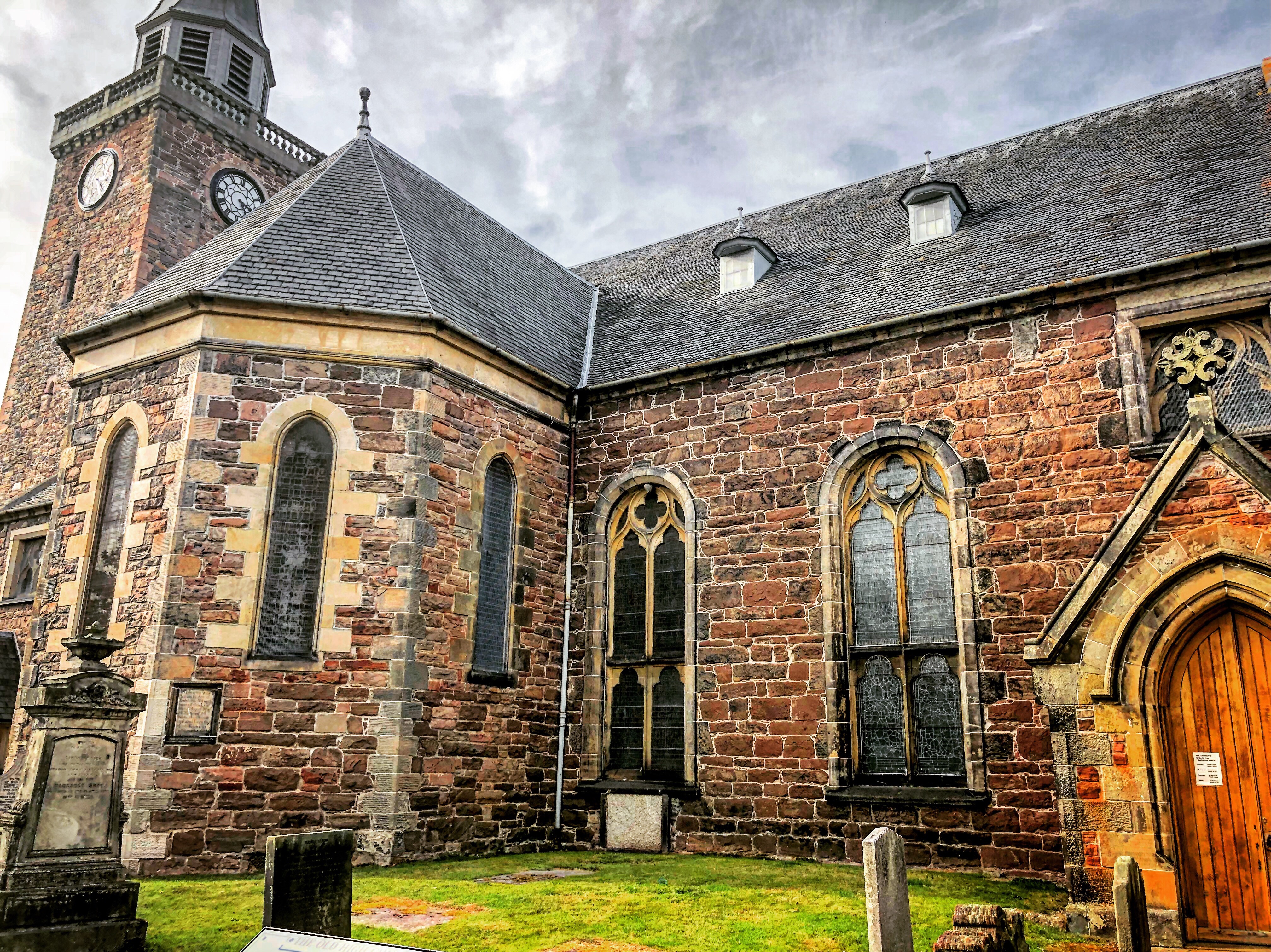
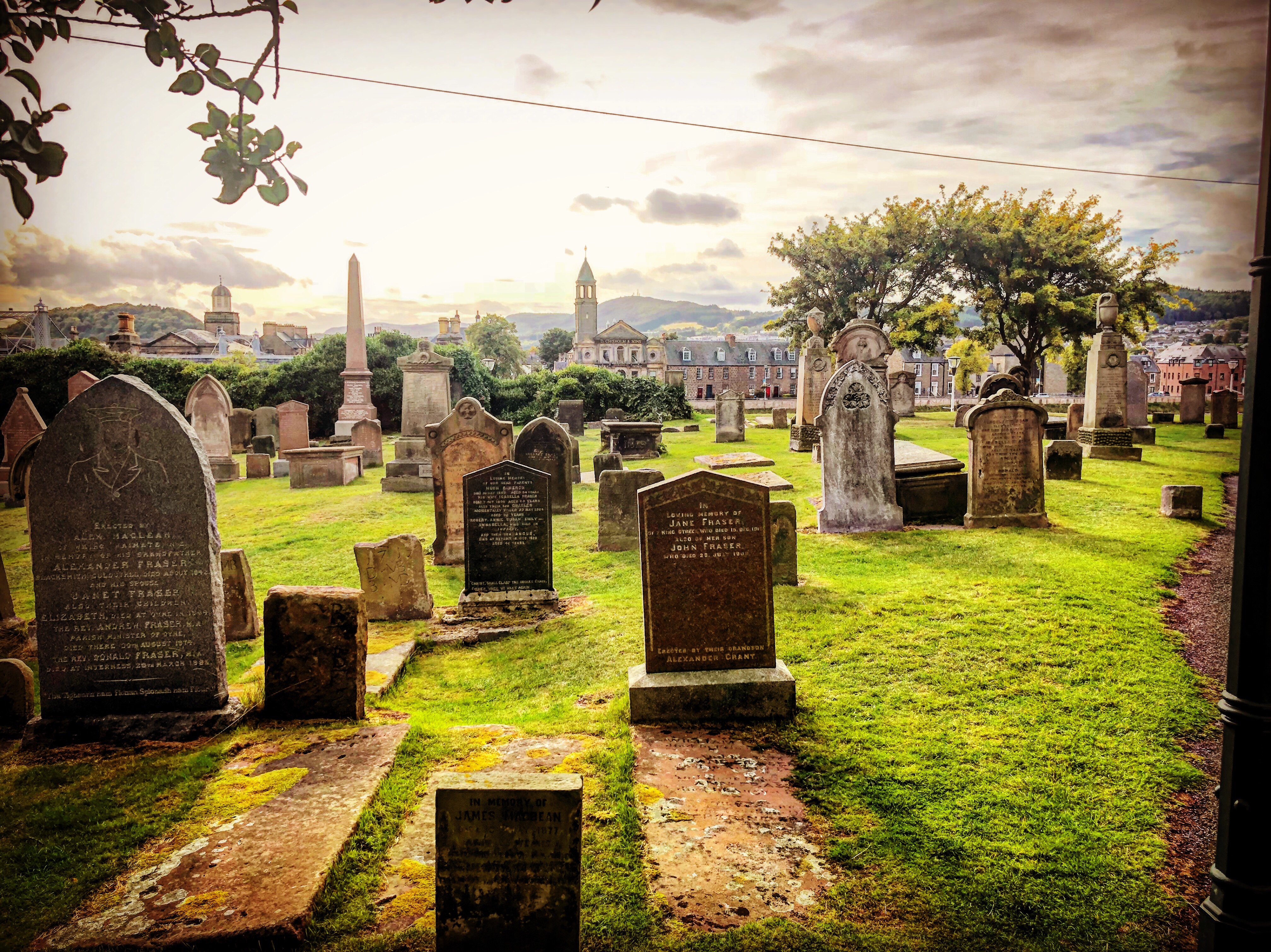
I then walked around Inverness, which unfortunately is pretty closed on Sunday because of God. This is too bad, mostly because there’s an amazing bookstore called Leakeys, located in a former church with floor to ceiling bookshelves and a wood stove. Next time. Visited the Old High Church, where Jacobites who survived the slaughter of Culloden were held before being executed in the churchyard. Because of God.

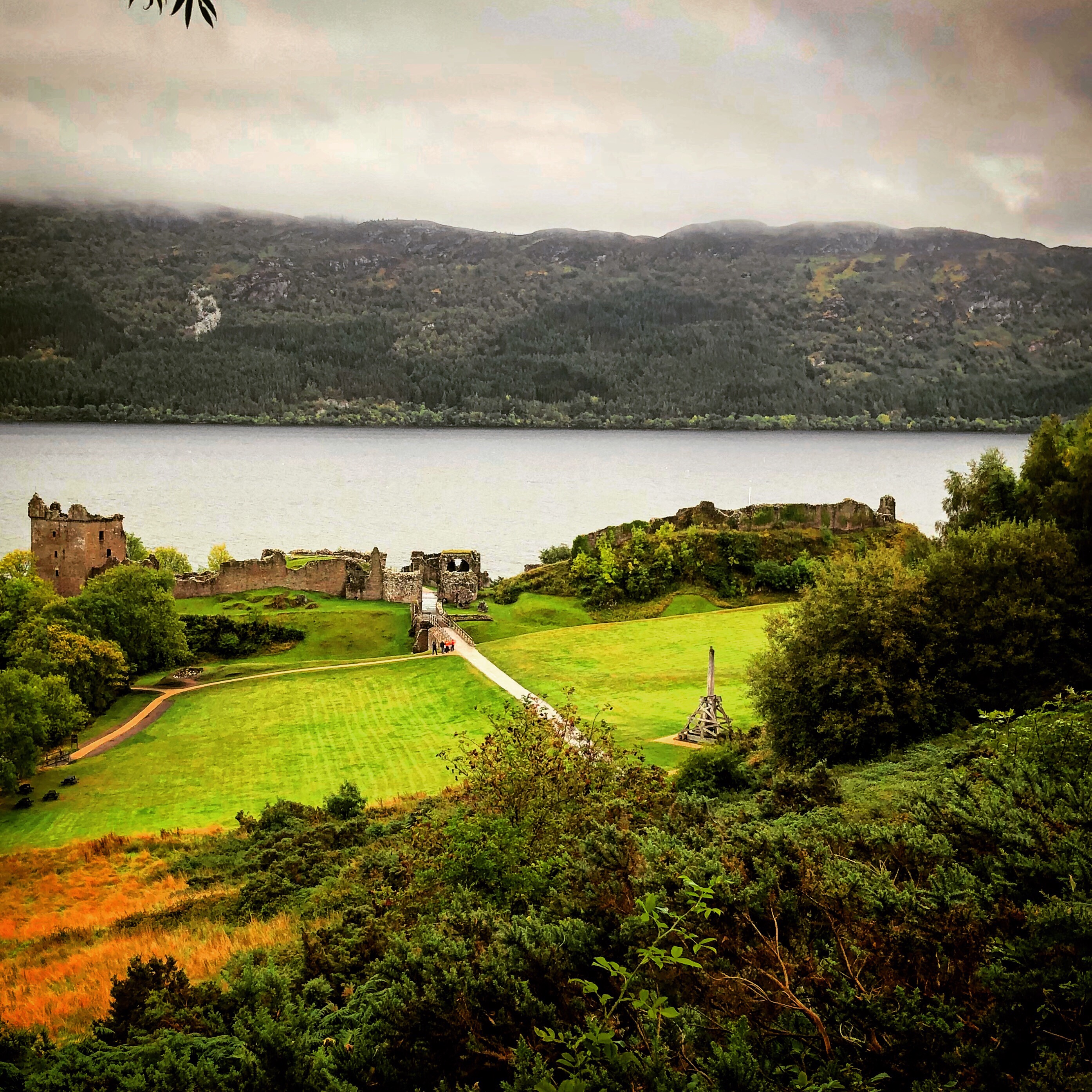
Next day I met George, a local guide, for a tour around the area. He arrived with coffee and croissants, so I liked him immediately. As we were emailing back and forth about logistics prior to my trip, I expressed a bit of ambivalence about visiting Loch Ness and Urquhart Castle because of all the tourists. George convinced me that it would be a shame if we didn’t at least do a drive-by before it opened. Even so, there were still a few tour buses, filled with loads of people who appeared to be checking sites off their lists, snapping photos and moving on, rather than really engaging, not that I’m being judgmental. The castle has 1,000 years of history under its belt. It’s the largest medieval castle in Scotland and the most important in the Highlands. Sadly, its owners blew it up in 1692 to keep the Jacobites from taking it. There’s a very cool old catapult on the grounds. Loch Ness is beautiful but so are many of the other 31,000-plus lochs in Scotland. No I’m serious. Scotland is a very watery land.

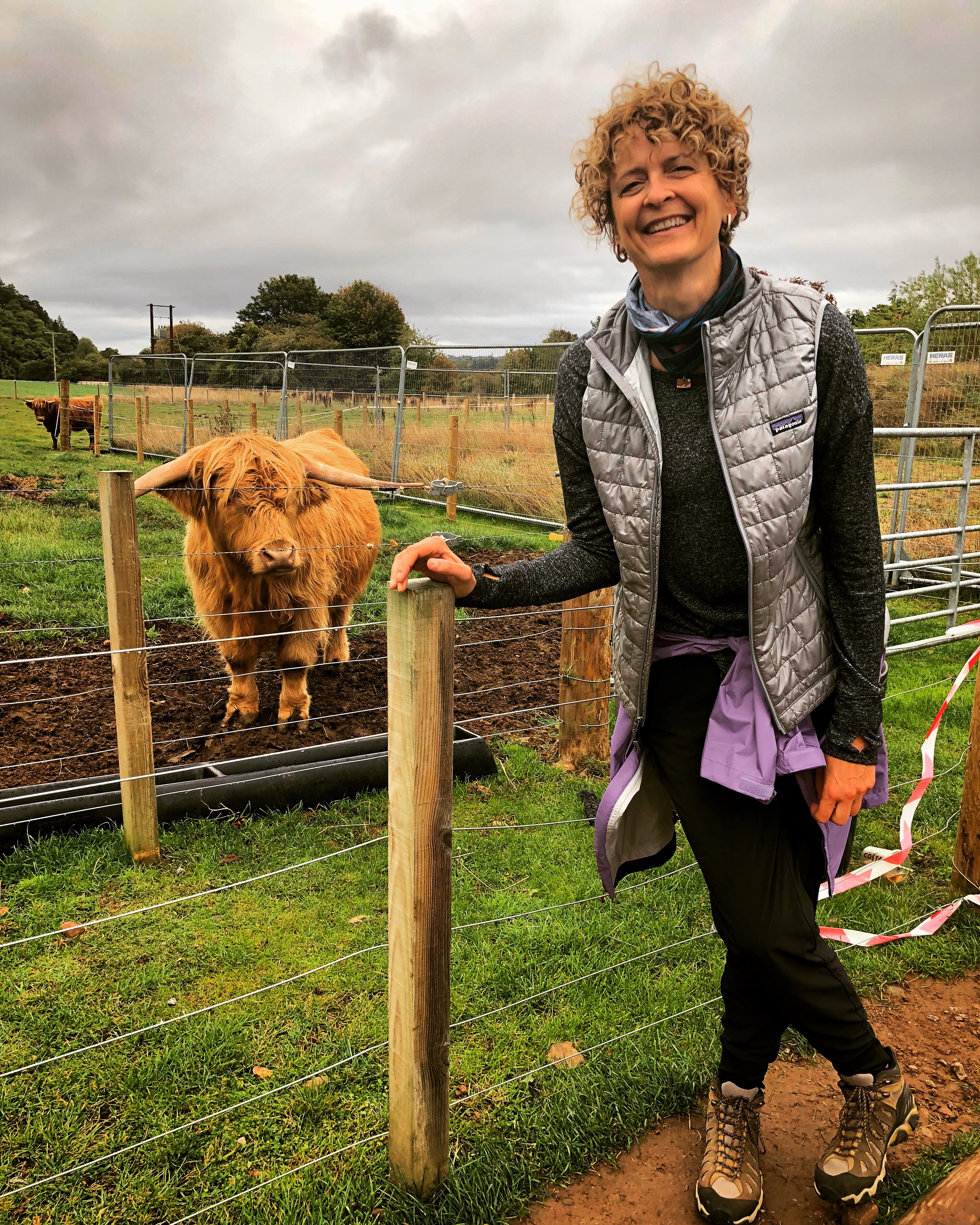
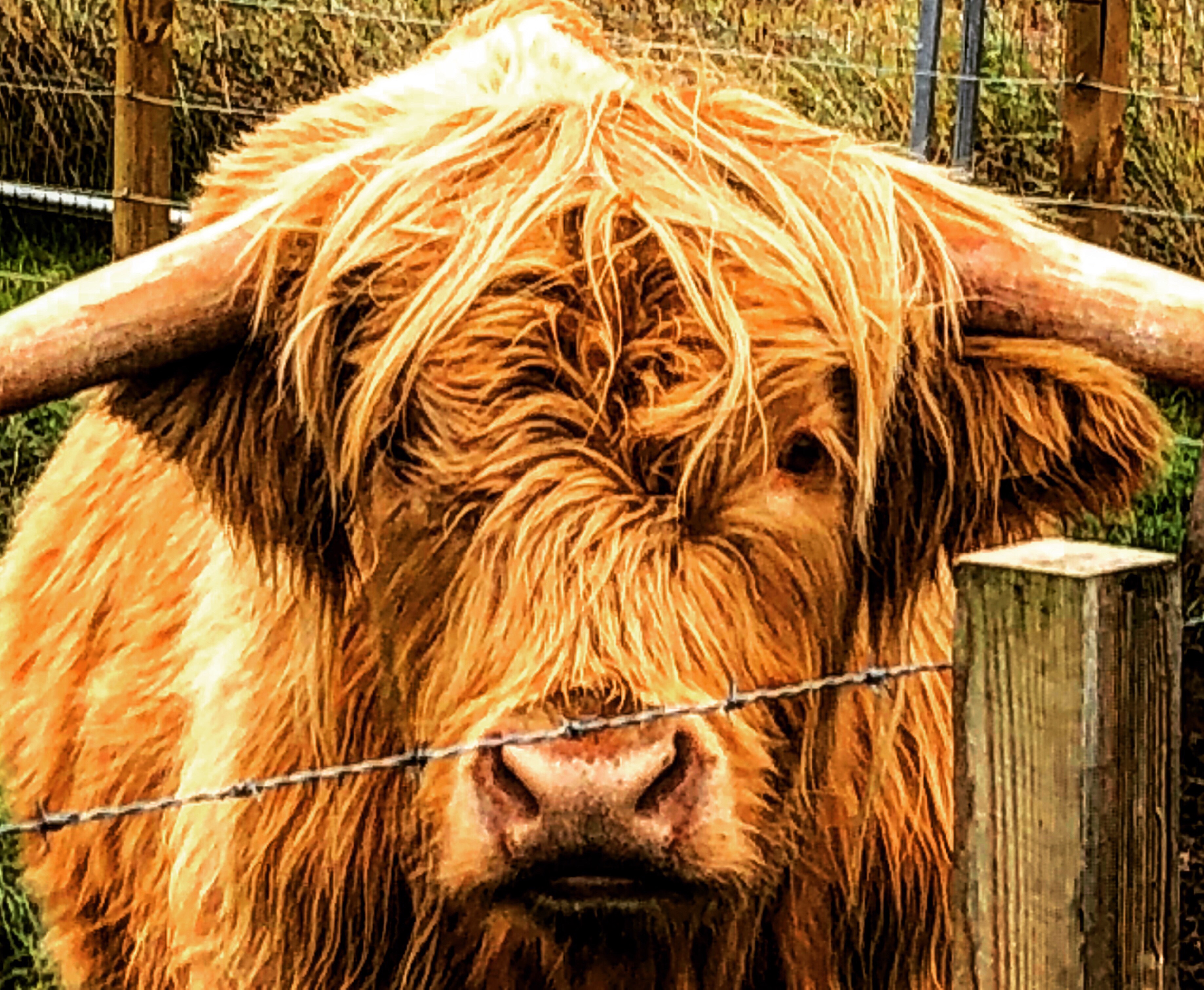
Like many visitors to Scotland, I was hoping to run across some Heilan coos, a.k.a Highland cattle. And they do not disappoint. Scotland’s animal population is full of extra-adorable creatures who seem to have been sprinkled with faerie dust. The hairy Coos originated in the Highlands and Outer Hebrides and were first mentioned in the 6th century AD. They are primarily bred for their meat, which is very lean, as they are largely insulated by their shaggy hair rather than by subcutaneous fat. Scotland does not appear to have industrialized its meat supply, so the coos have a pretty nice life until the end, grazing on the plentiful green grass and rounded bales of hay. Also posing for pictures.

Continuing my morning whisky tradition, we drove to Tomatin Distillery for a 10:00 a.m. tour and tasting. It was fascinating learning more about the making of Scotland’s national drink. Very complicated, time-consuming, lengthy and totally worth it. By law, Scottish whiskey must be made from water from Scotland and aged in oak barrels for at least three years. Of course, most whisky is aged much longer. There are lots of superstitions, for example, when the copper pot stills need to be replaced, if the old one is dented, the replacement must have a dent in exactly the same spot.

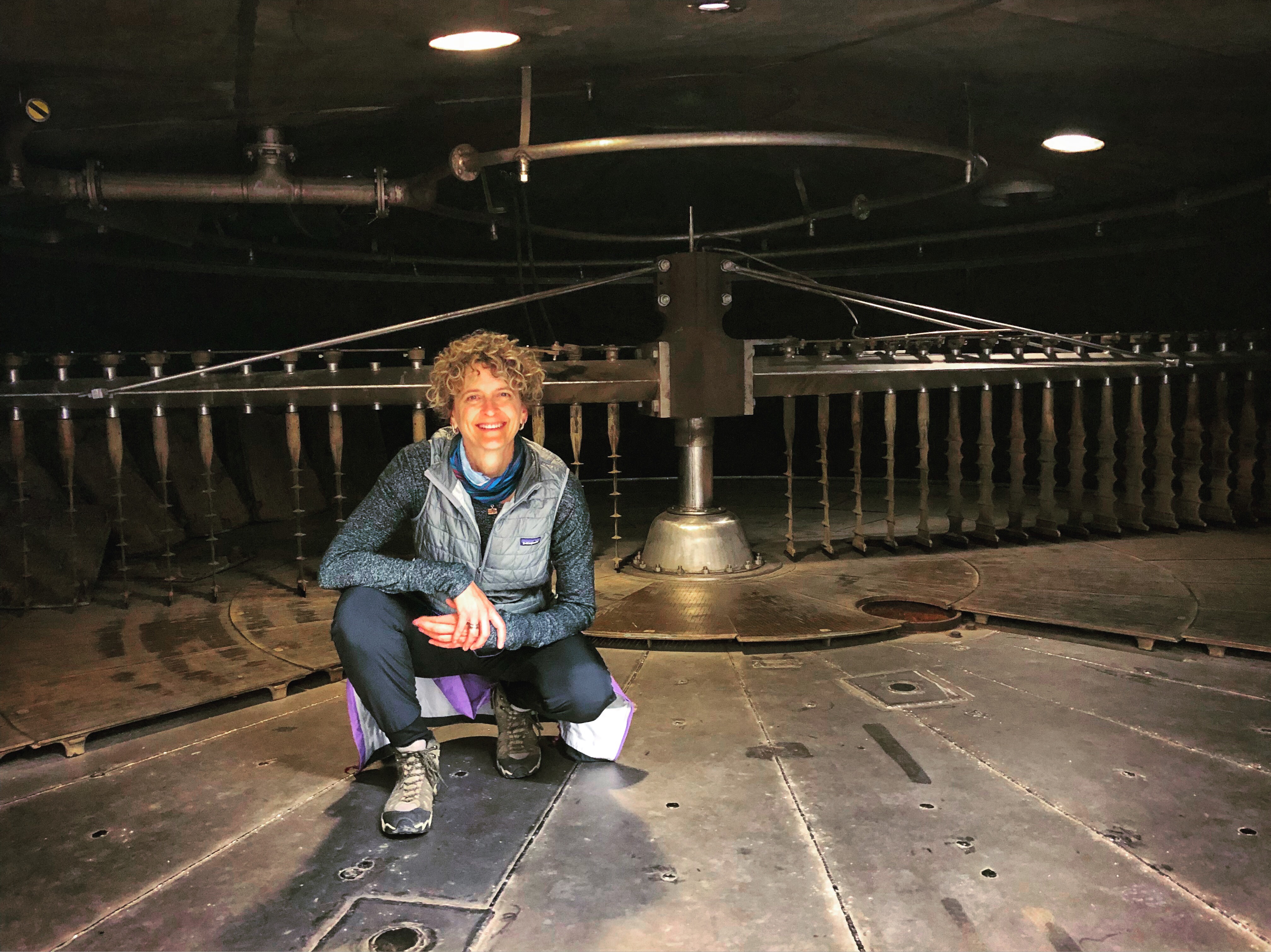
Tomatin has an old mash tun that you can climb inside. I was touring with a fellow from Germany who was very stoic about life and had no interest in getting his picture taken squatting inside a large tub. So what the heck is it? Ground down malted barley is fed into the mash tun with heated water. The temperature is high enough to dissolve many of the sugars in the grist but low enough to allow the enzymes to continue doing their thing. The liquid is collected and taken away to become whisky. The solid left over residue is given to local farmers for feed.

Since we did a fair bit of driving on this tour, a word about road signs. Of course, they are better than ours. They are gentler with more humor. Some examples: Instead of “travel time,” it’s “journey time.” Instead of detour, it’s diversion, which sounds way less annoying. Instead of “yield,” it’s “give way.” Instead of passing lane, it’s overtaking lane. We drove over several “weak bridges,” which means simply that it’s a one-way bridge. So drivers have to give way. But my favorite is this one.

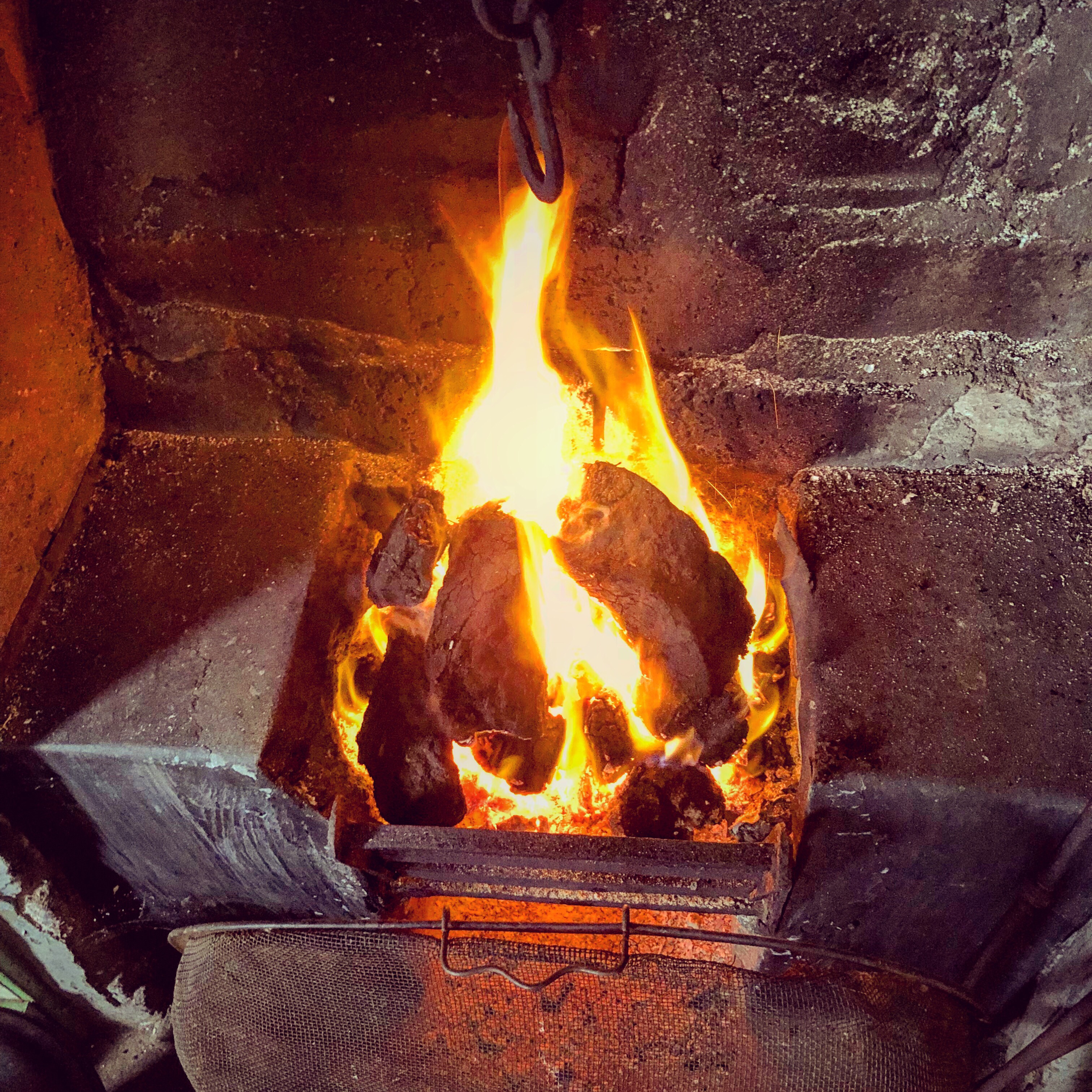
Our next stop was the Highland Folk Museum, Britain’s first open air museum. The museum gives a flavor of how Highland people lived and worked from the 1700’s through the 1950’s. Over 30 historical buildings are on the property, all furnished with items appropriate to their time period. Some have been built from scratch and some have been moved from other sites. It was fascinating looking inside these dwellings from throughout Scottish history, but my favorite was seeing an actual peat fire. It smells lovely, and it generates heat like you wouldn’t believe.

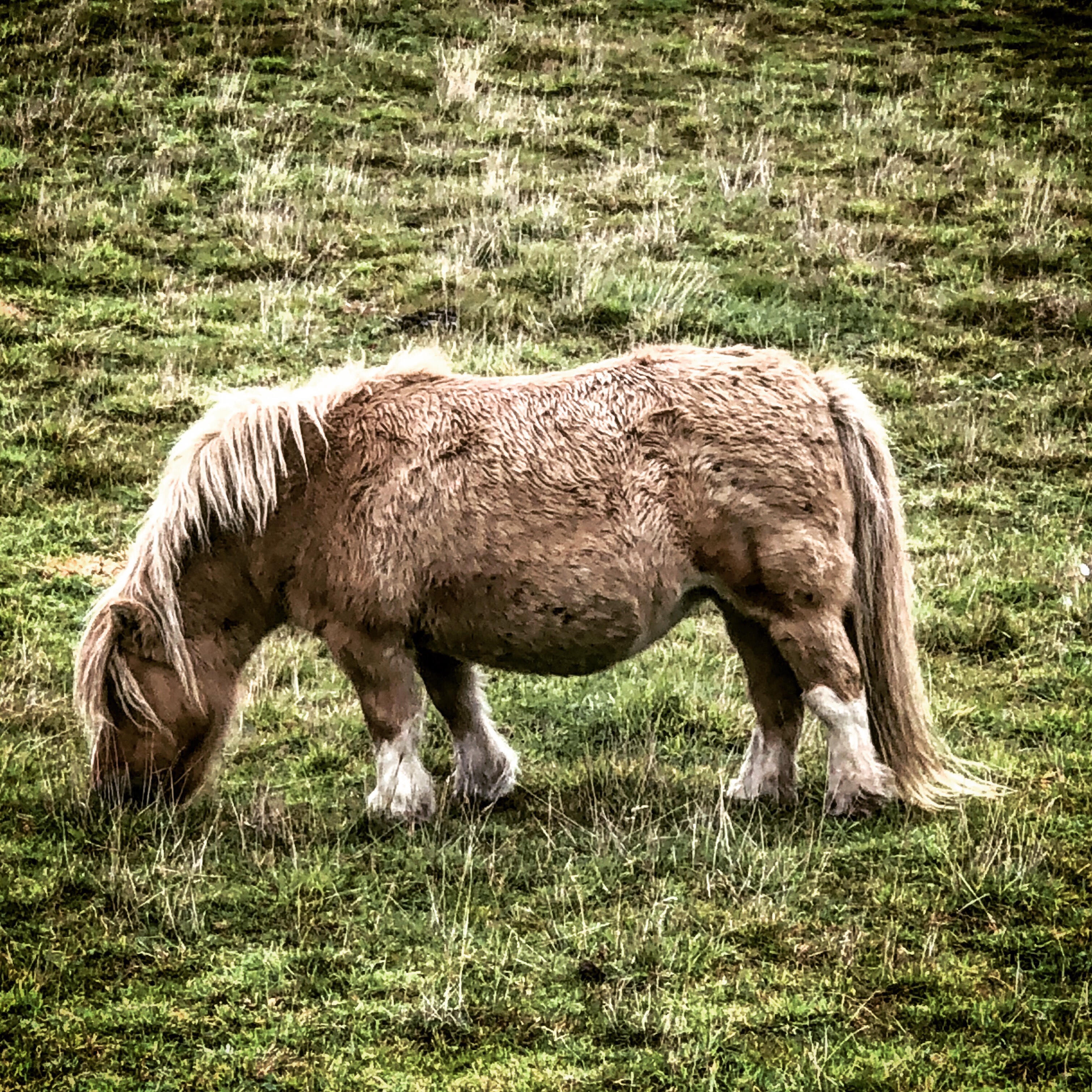
Also, there were Shetland ponies.

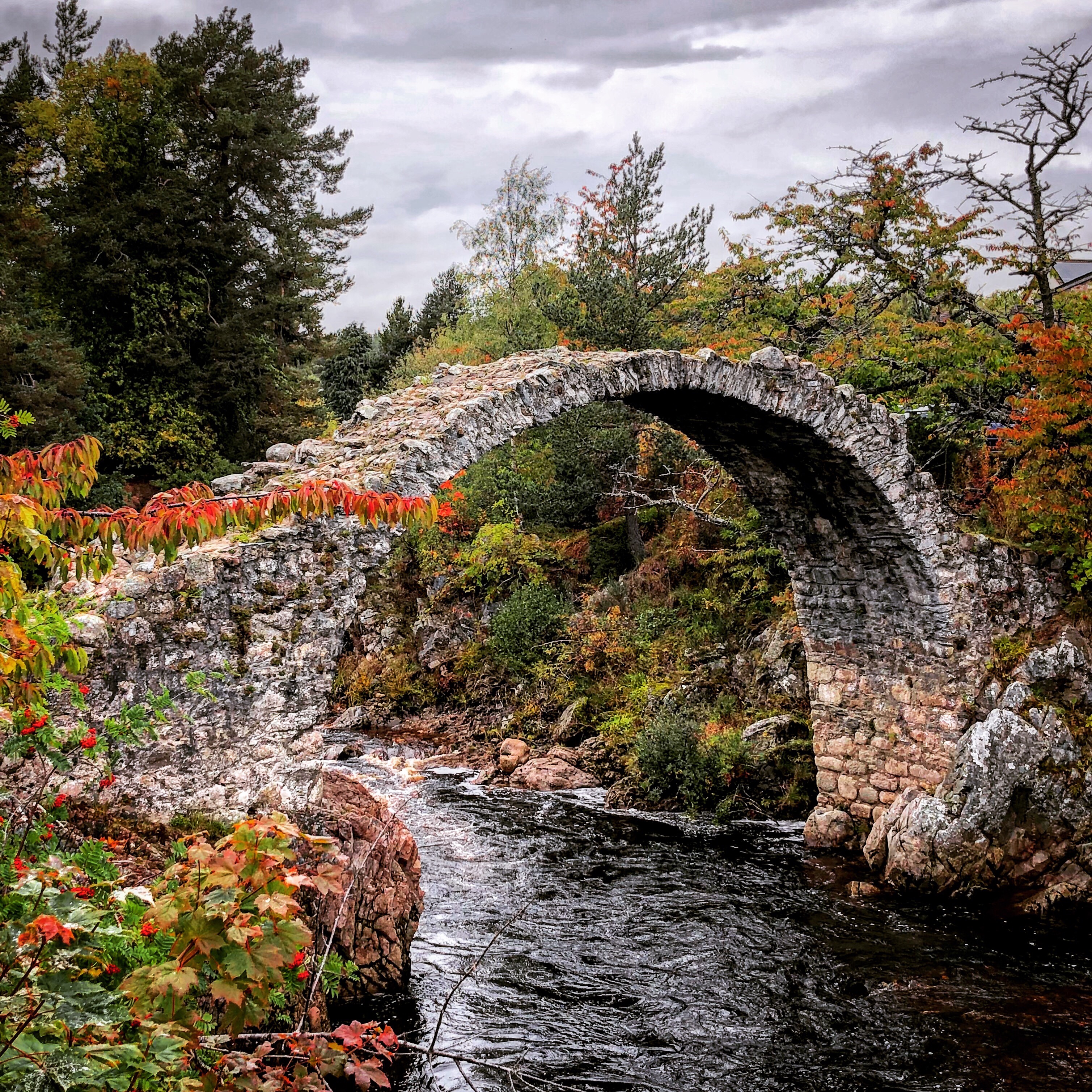
We next drove by Coffin Bridge, the oldest surviving packhorse bridge in the Highlands. It was built in 1717. Before the 18th century it was impossible to carry the deceased from the town of Carrbridge to the local cemetery when the river was high. So this bridge was constructed by one of the earliest Scottish members of Parliament, Alexander Grant of Grant.

George and I enjoyed a yummy lunch in a semi-fancy pub and now for another observation about rules and dogs. In Scotland, people can bring their dogs into restaurants. Not just little dogs. During lunch we were surrounded by a yellow lab, a sheep dog and a standard schnauzer. All perfectly well-behaved. Amazingly, I did not feel my health was in danger.

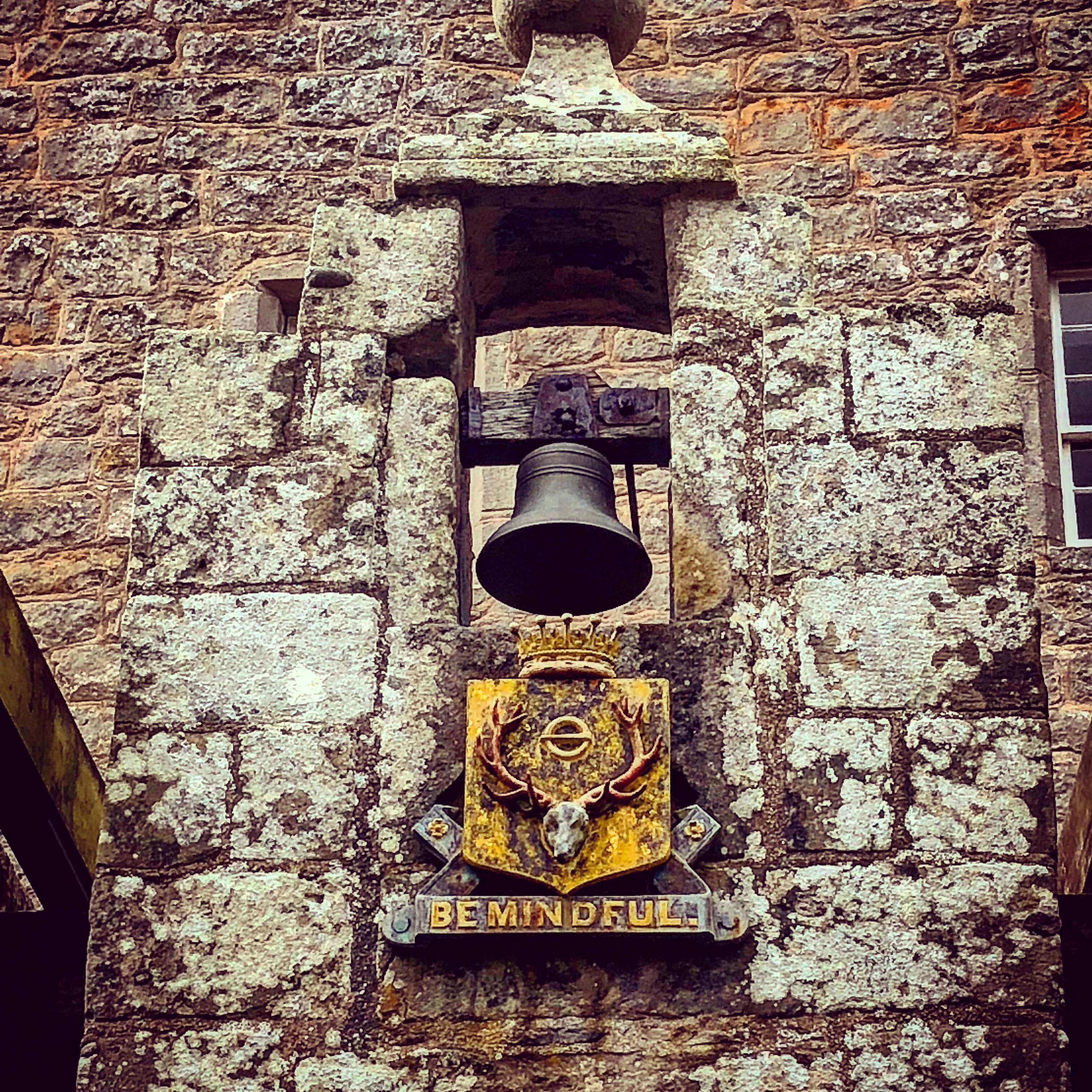
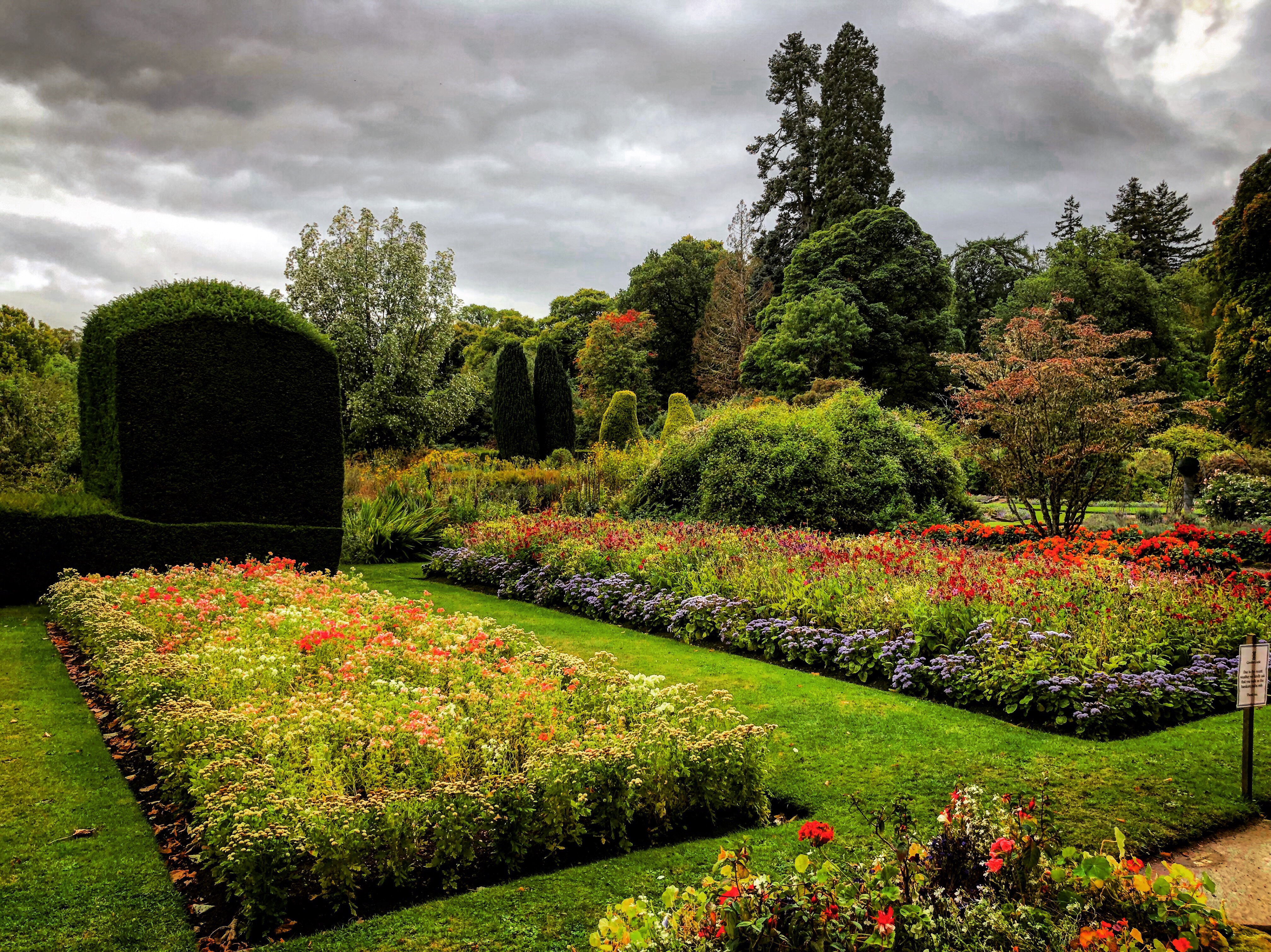
Next we were off to Cawdor Castle, currently owned by the Dowager Countess Cawdor, a woman in her 70’s who retires to another home on her estate during the summer months so she can charge tourists ten pounds each to enter. It’s fun to see a castle that is not in ruins and has never been attacked by Jacobites or redcoats, just a beautiful lived-in place with amazing gardens. Its other claim to fame is that Shakespeare refers to Macbeth as being the Thane of Cawdor in the Scottish play. However, the castle was built many years after the life of 11th century King Macbeth, so never mind. George told me he’s heard staff complain about the Dowager Countess and how difficult she is to work for, but I’m inclined to give her the benefit of the doubt because she installed a “be mindful” sign over the entryway.

Finally, we headed to Culloden Moor to visit the memorial to those who perished in the devastating battle that raged there. The Jacobite army was devastated, and their defeat marked the beginning of the end of Highland culture in the 1700’s. The Jacobite Forces (supporters of installing Charles Edward Stuart, aka Bonnie Prince Charlie, to the thrones of Scotland and England) were handily defeated by the Hanoverian English in under an hour. This was the last of five Jacobite rebellions that occurred in 17th and 18th century Scotland. It was a bloody battle. The Scots lost between 1,500 and 2,000 men and the English only lost 50. This after the Bonnie Prince’s forces had swept through Scotland and almost made it to London. At this point, though, a decision was made to retreat back to Inverness, even though Charles II had his bags packed and was ready to head into exile. One of those many moments in history easy to second-guess.

Over the years after the battle the Brits decided to deal with the Highlanders once and for all. The infamous Highland clearances were implemented, where Scottish crofters were cleared from their lands to make room for more lucrative sheep farming. Laws were passed preventing all Scots from owning weapons, wearing the plaid of their clans, speaking Gaelic, effectively wiping out the Highland culture. Many, many of them emigrated to the United States. It was essentially ethnic cleansing – George told me that there were discussions in Parliament about requiring the mandatory sterilization of Highland women.

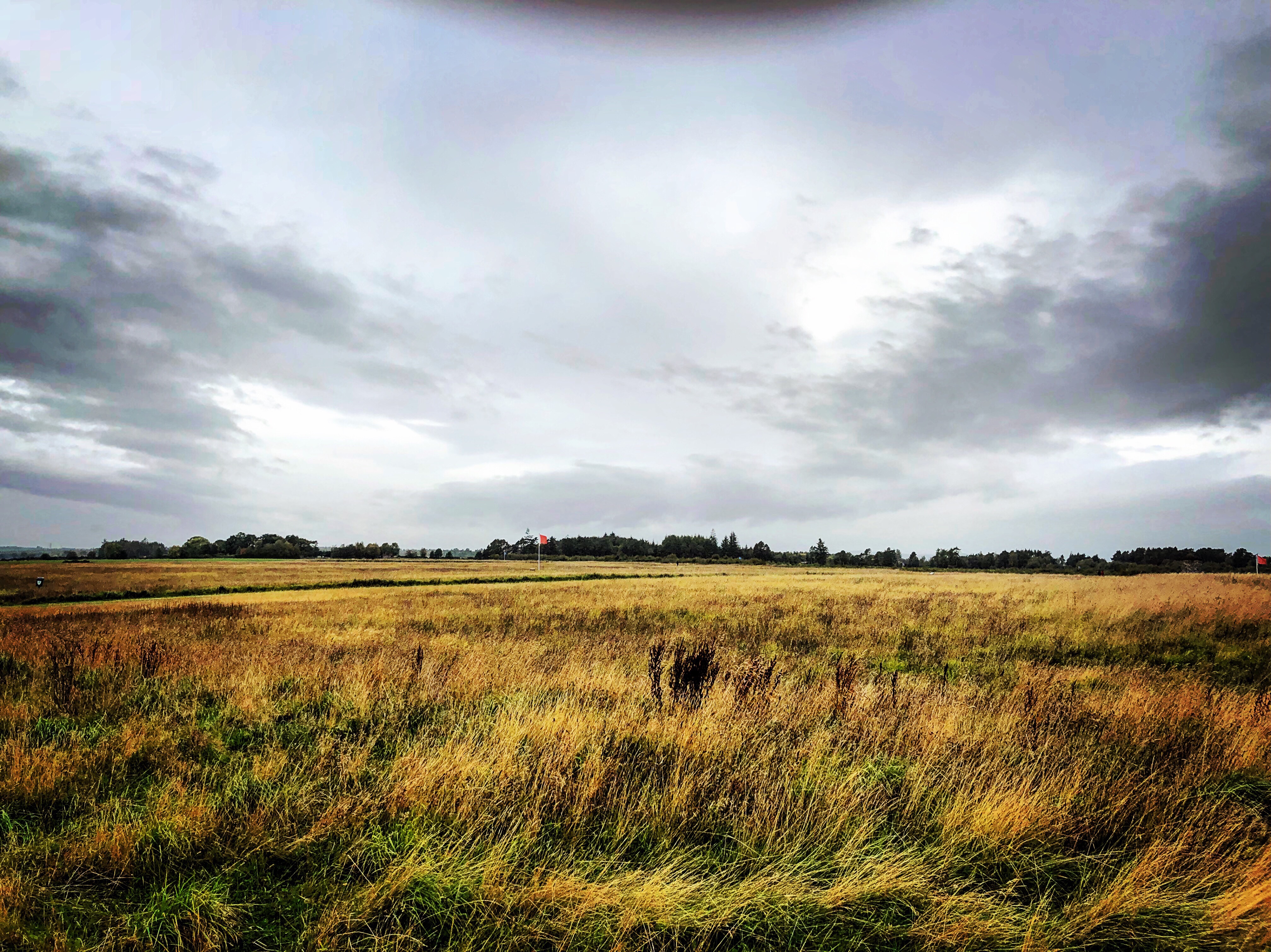
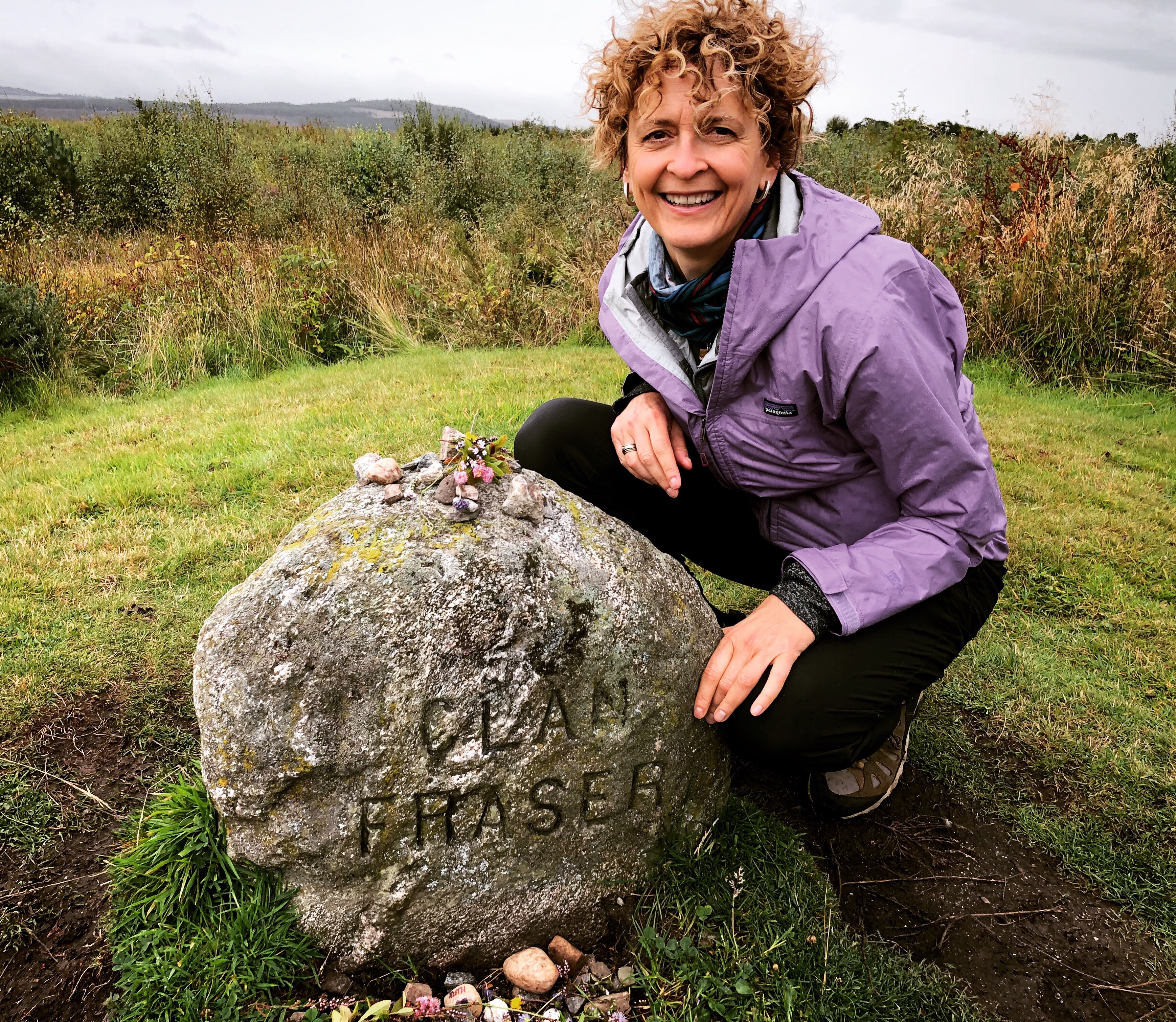
It is a somber place. Victorians installed a memorial, along with stones representing all the clans which were set about over the spot of mass graves. Thanks to the massive appeal of Outlander, the earth around the Fraser clan’s marker is denuded of grass, with little stones and flowers strewn over it. You’ll see my own disrespectful and inappropriate photograph below. The battlefield is very simple – a line of blue flags marking the spot where the Scots lined up, and a line of red flags marking the position of the British. It’s worth noting that the Bonnie Prince and the Duke of Cumberland, the commander of the British forces, were both just 25 years old. These days they would still be in college or back living with their parents while they found themselves. Hard to imagine.

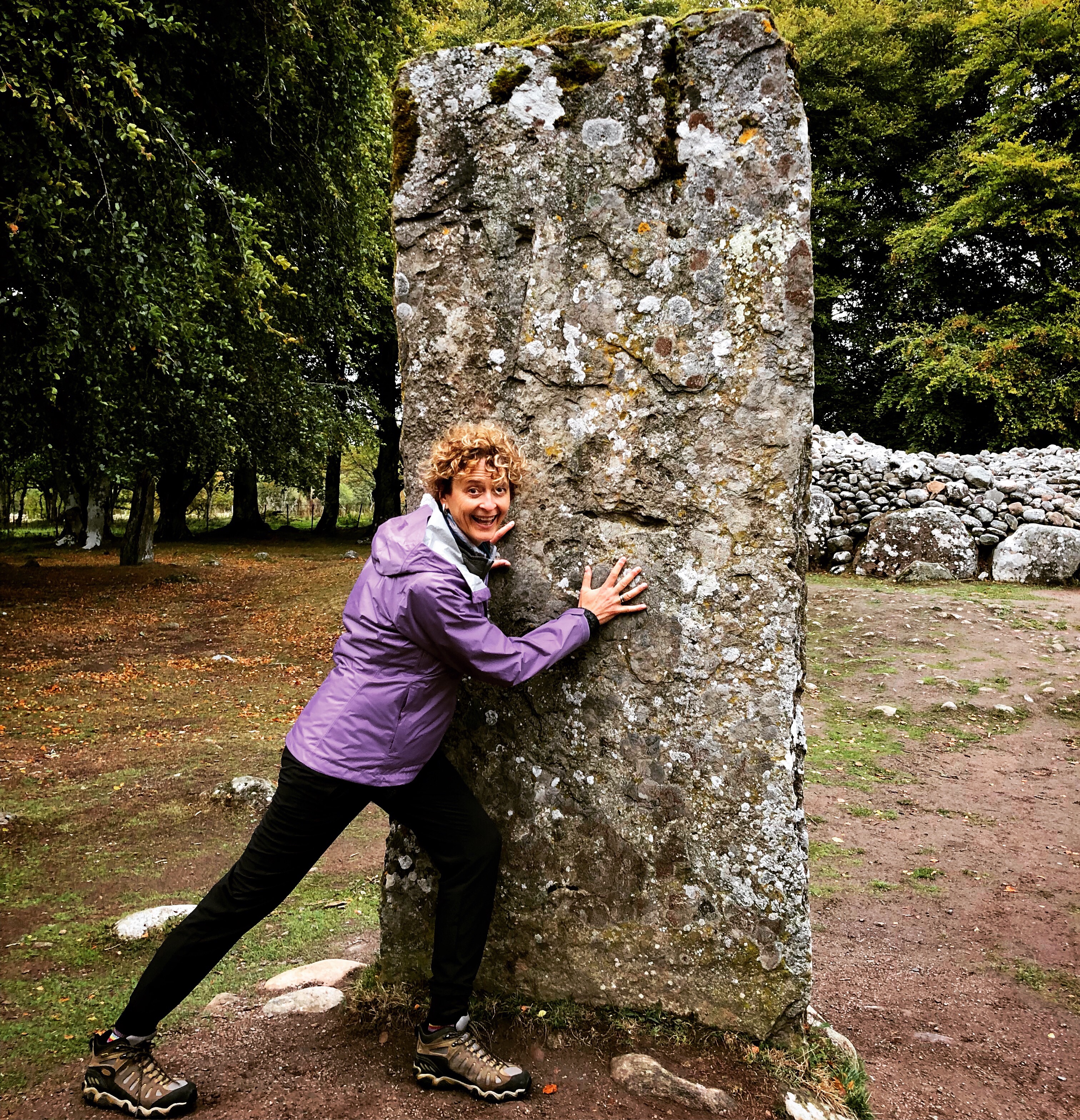
We ended the day at the 4,000 year old Clava Cairns just down the road. A clava cairn is a type of Bronze Age circular chamber made of stones. They are typically surrounded by standing stones, and their history is very murky. This area was the inspiration for Diana Galbadon’s books. So again, me with the dumb Outlander photo. (PS the stones don’t work at all). George said that local witches, wiccans and druids still gather here for dances and mystical ceremonies. A couple of local Scottish women talked to us for a while, and they were dead serious about the magic of the place. The veil between Druid magic and faeries of old and the 21st century is very thin in Scotland.

George dropped me at my hotel after 7:00 and I had a quick dinner and stopped in a local pub for literally 5 minutes to check out the nightly traditional Scottish folk music. It was pouring down rain and honestly George had slightly exhausted me with all the facts and history, as much as I loved it.

Next day, I was onto my Backroads hiking tour of the Highlands!

Backroads Days 3 and 4: Over the Sea to Skye

Day three dawned a wee bit rainy, and our planned hike was officially scuppered due to wind, flooding and danger of being blown off a cliff into the sea.  Very disappointed, as we were heading to the famed Coulags.  Next trip.

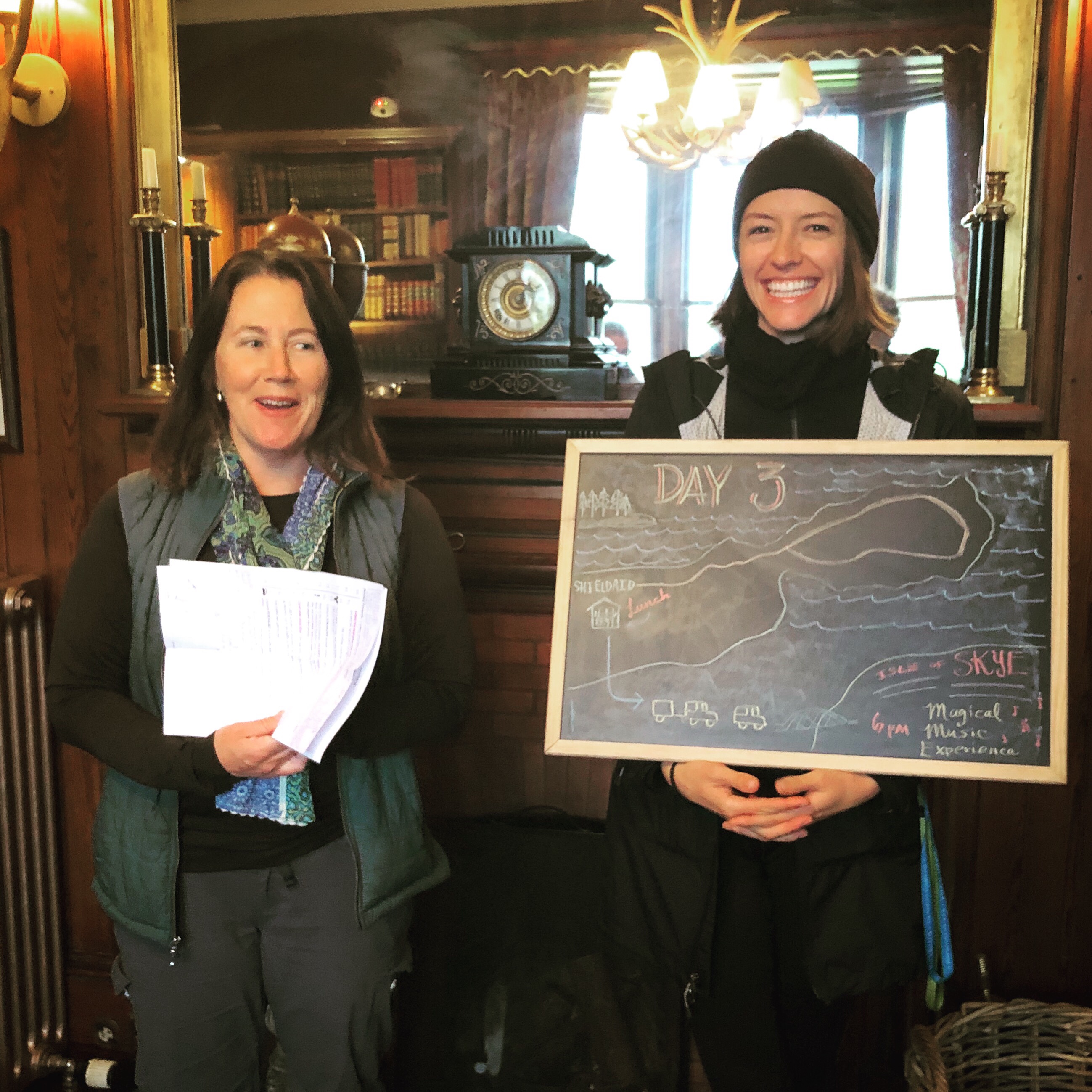
Jenny, Eileen and Keith had another hike in their back pockets, followed by lunch in a little village.  Then we would head to the Isle of Skye. Jenny sketched out the day on a chalkboard.

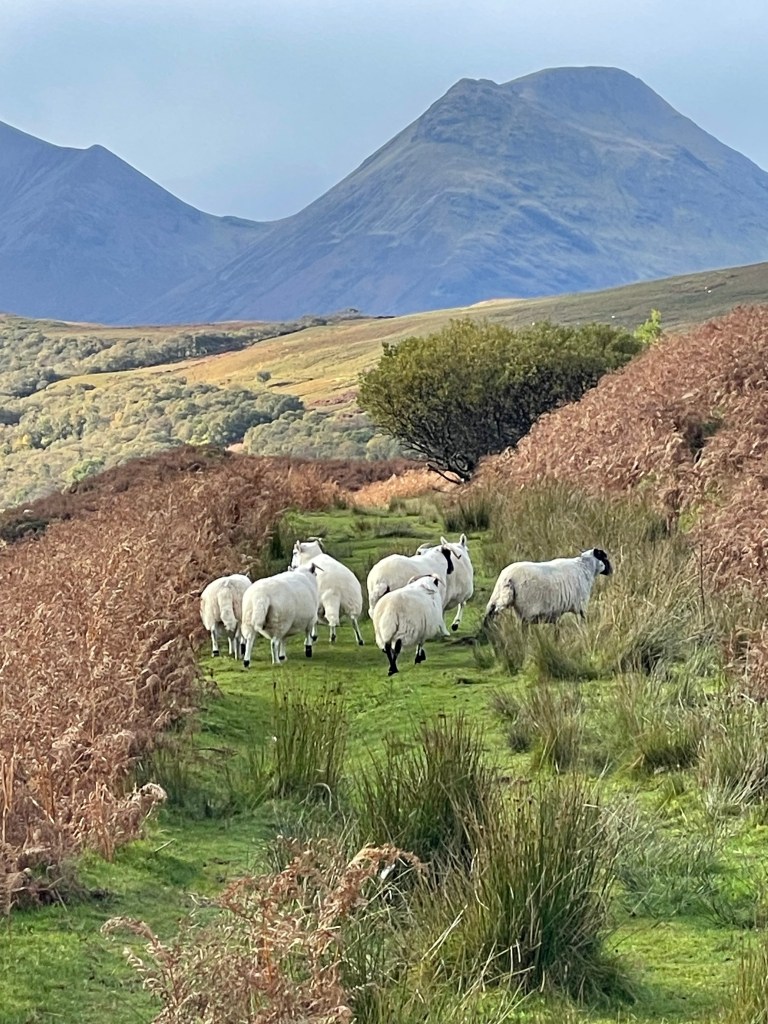
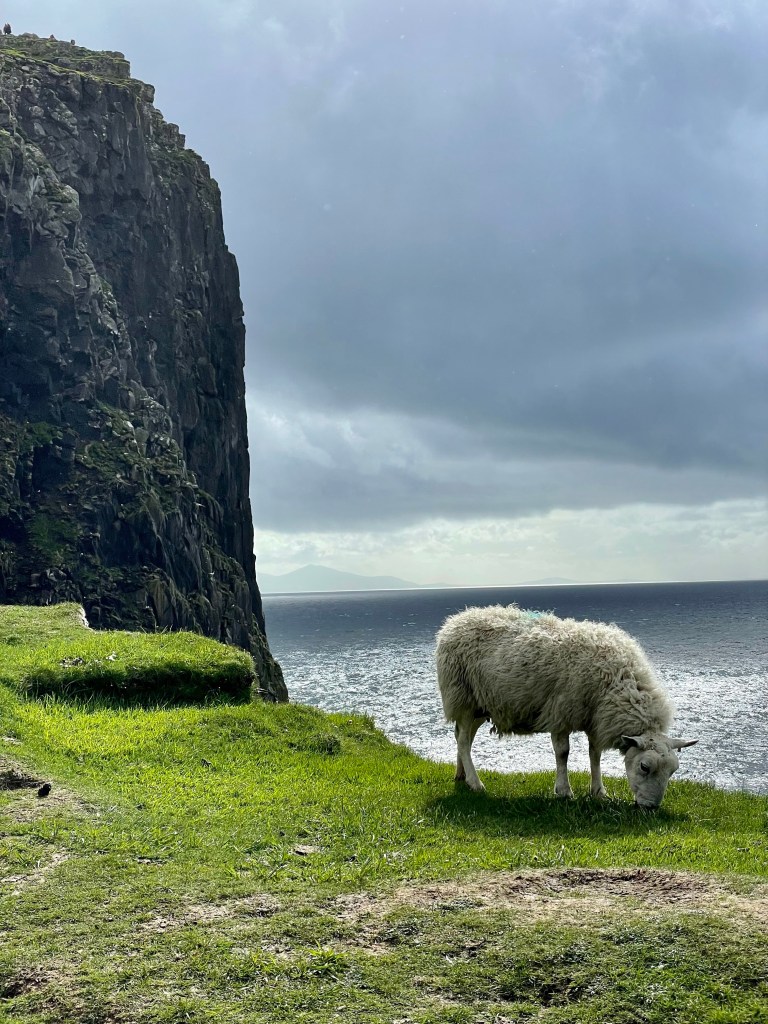
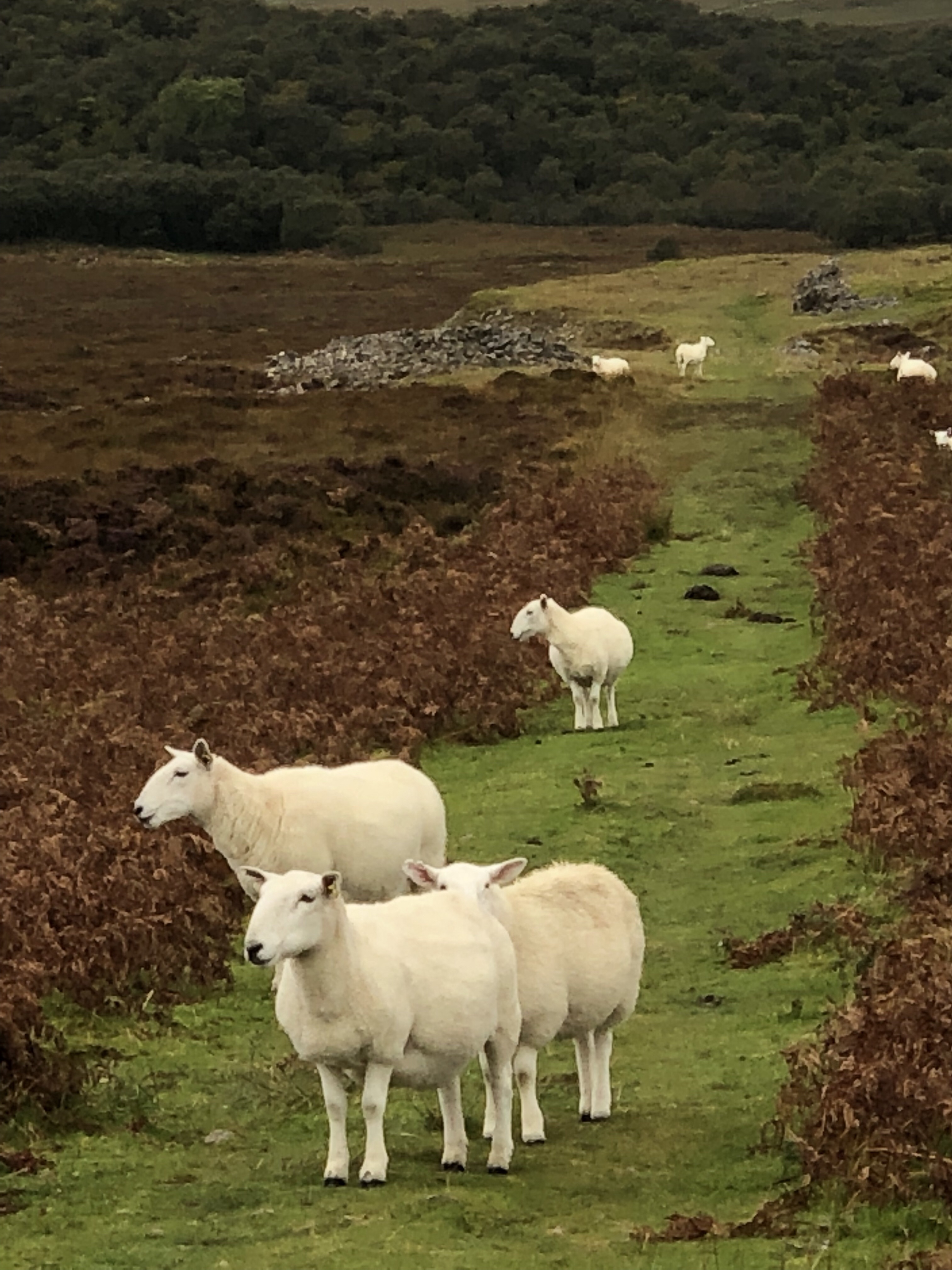
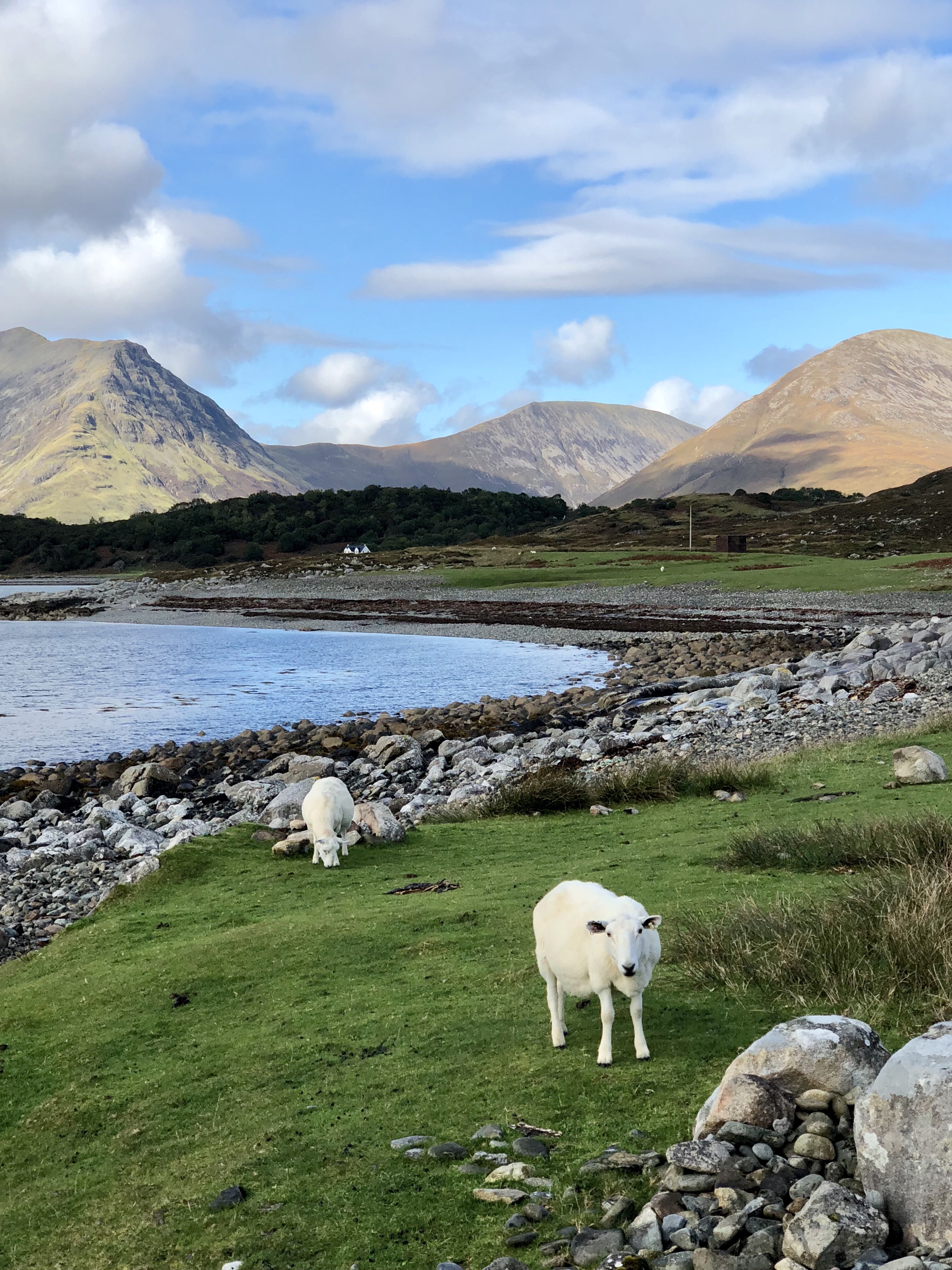
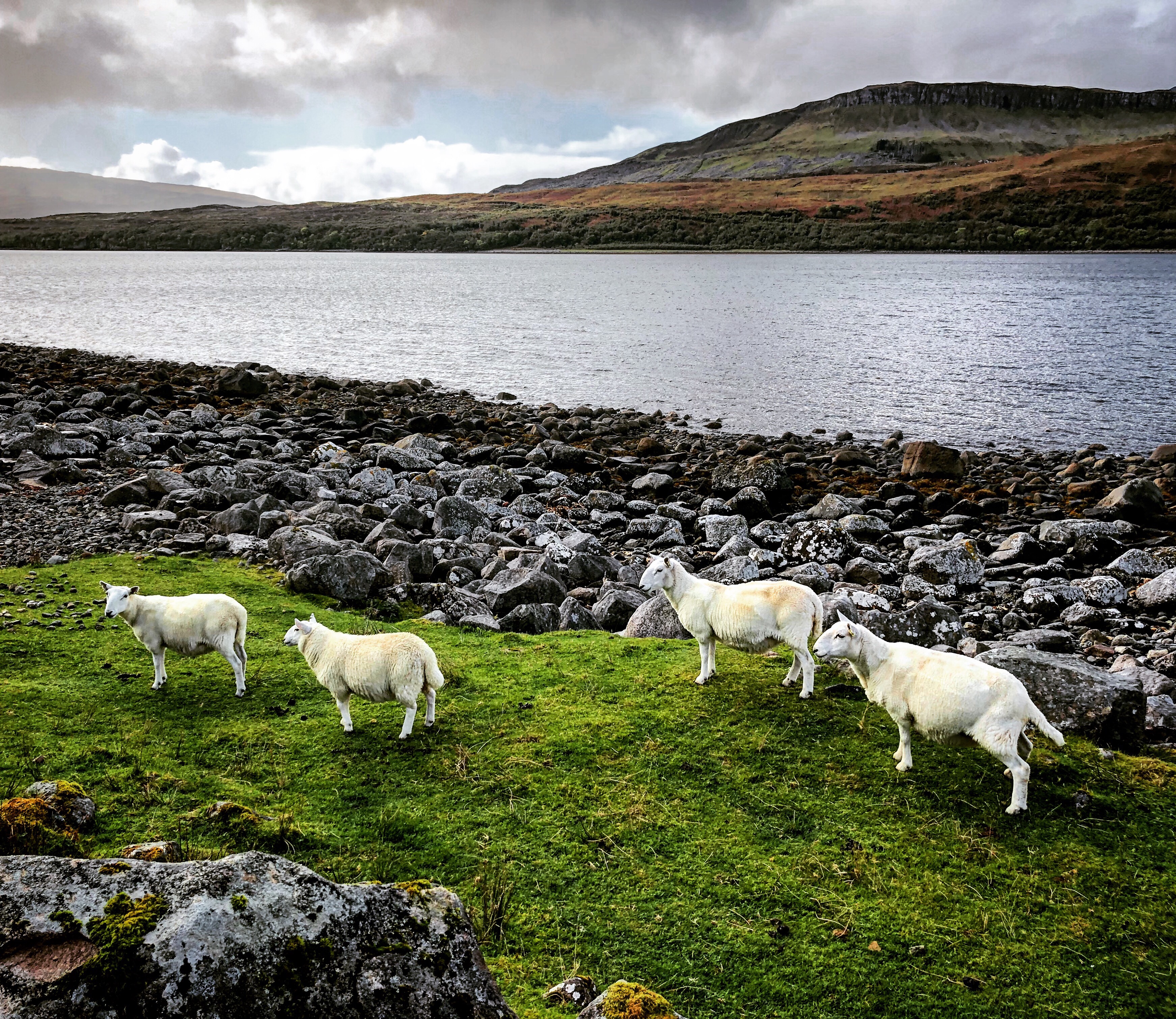
The hike was completely beautiful.  Our love of sheep officially began on this day.  Adorable Scottish sheep were everywhere.  Scotland doesn’t seem to have industrialized its meat production.  Unsupervised sheep, cows and chickens are wandering around all over the place completely left to their own devices.   Sheep are marked with a splash of color which identifies to whom they belong.  Otherwise, they are free to wander, eat grass, and perch picturesquely on the edges of cliffs, gazing out at the ocean.

I kept asking people if the cows and sheep were used for milk and cheese and the people kept raising an eyebrow and shaking their heads. Make no mistake, we are talking about meat here. But at least until their day of doom, Scottish livestock have the world’s most fabulous life.

A few pictures of our hike follow, but sadly the most exciting bit went unphotographed. Just after passing someone’s lovely farmhouse (they have a black dog named Merlin who enthusiastically greets ramblers), we needed to haul ourselves up a tall boulder cropping.  And to help, there was a rusted chain that had been set into the boulders.   Completely awesome. I felt like Tom Cruise in Mission:  Impossible as I pulled myself up the outcropping, hand over hand.  Which I shared with Keith after triumphantly reaching the top. In response, he cocked his head and asked, “you felt like a Scientologist?”

We returned to the little town where we began, and walked to our lunch place, a fabulous little pizza spot on a loch. Keith removed a giant chalkboard from a wall and presented it to the table.  He asked the server permission first, and interpreted a disapproving pause as assent.  Note to self:  adopt this strategy immediately.

As we left the restaurant, we were greeted with a magical rainbow over the loch. While we pretty much had daily rainbows, this one was the most rainbowish one of all.

We set off in the vans for a bit, finally driving over a lovely bridge to the Isle of Skye. It has been hit pretty hard by tourism over recent years, but Backroads always finds more solitary spots. We stayed at the Duisdale Hotel, on the edge of the water with beautiful views.

07E2BCE6-BBD2-4F68-AFCD-22CE10F036EF

On tap for the evening was a musical performance by a local bagpiper and accordionist who teach music at the Gaelic College on Skye, called Sabhal Mòr Ostaig. The college is dedicated to providing education for Gaelic speakers with the goal of widening access to the Gaelic language and culture.

Bagpipe music used to make me cringe and then run out of the room. Maybe one of the things that happens after menopause is that suddenly bagpipes become majestic instruments that make you shiver and then cry.

In the middle of the show, our bagpiper challenged us to a bit of Scottish dancing in the parking lot, and so out we went. A documentary of our dance lesson experience is currently being edited for Netflix. The reviews will say, “Stunningly talented Americans and two Canadians change the face of traditional Scottish dance forever.”

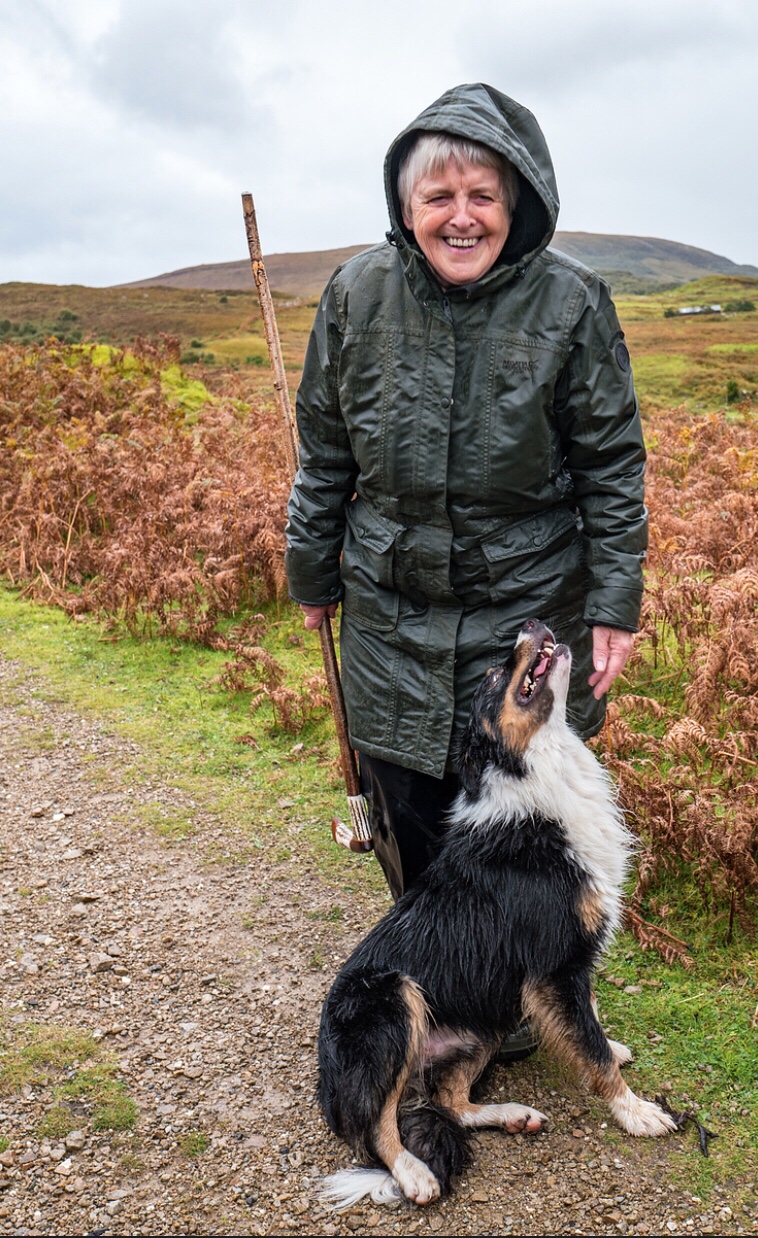
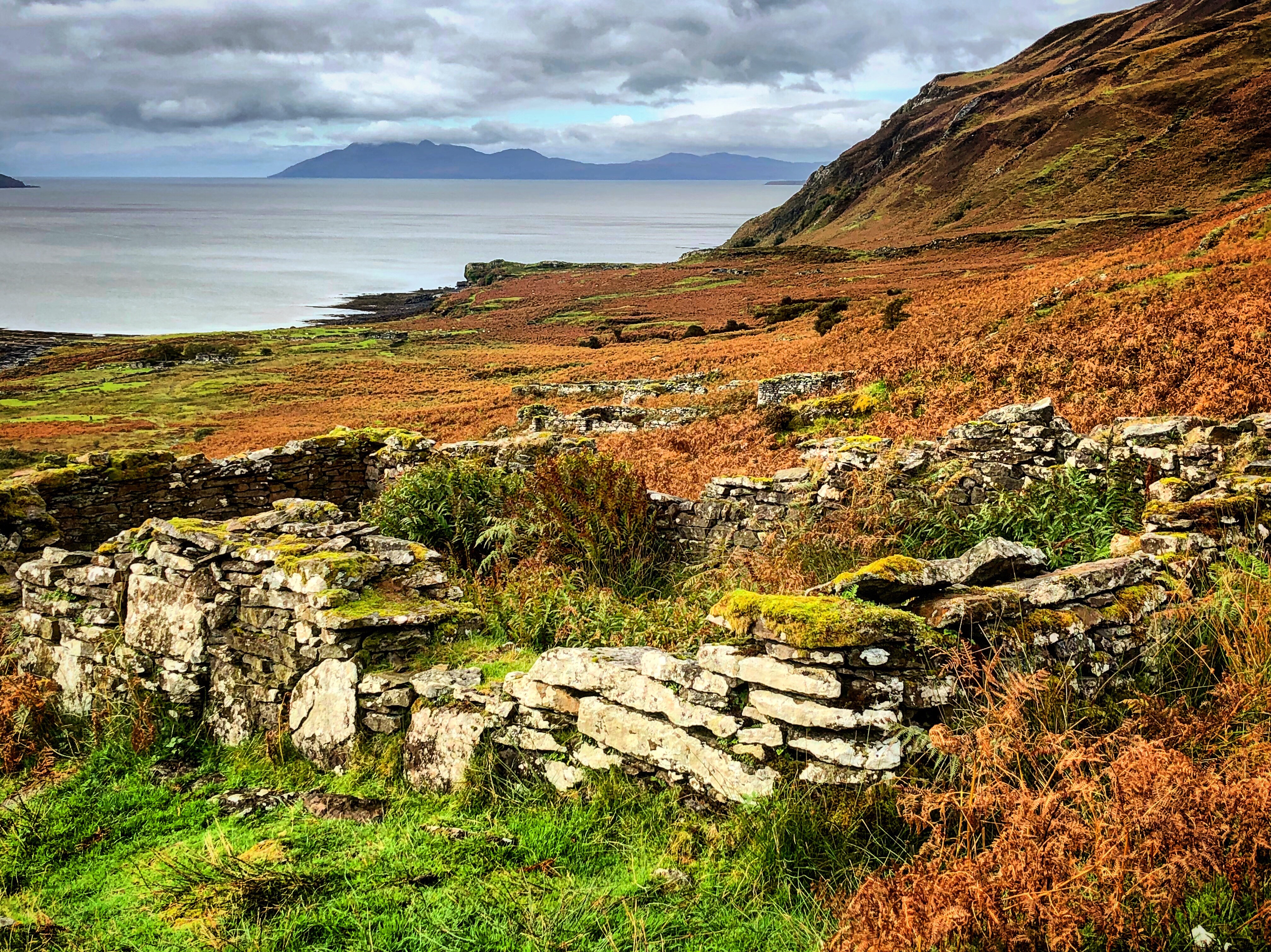
The next day dawned slightly brighter with strange blue areas in the sky. Now old hands at divining Scottish weather, we thumbed our noses at the blue and donned our rain pants. Today we met Sarah, a Scotland ranger, who would accompany us on our hike and tell us about birds, plants and the Highland Clearances. Our trail started at a ruined church (see below) and took us past some old granite mines where we came across a lovely woman out for a walk with her border collie. We then dipped down to a large and desolate ruin of a village that was abandoned as a result of the clearances.

The Highland clearances are an infamous chapter in Scottish history. They were the forced eviction of inhabitants of the Highlands and western Islands, and basically cleared the land of people to allow for the introduction of sheep. For hundreds of years prior to the clearances, the Highlands followed the clan system. The clan was ruled by one family, and others lived together in agricultural townships that functioned like collectives. The land was controlled by the chief but leased by tenant farmers. Very feudal. All the men who worked on the land also owed allegiance and their military service to the clan chief. The clearances, which took place over a century, resulted in the destruction of the traditional clan society and began a pattern of rural depopulation and mass emigration from Scotland to the Americas and elsewhere.

So why? After the Battle of Culloden, the British government (aka evil redcoats) passed repressive legislation designed to compromise the power of the clan chief and Gaelic culture. The 1746 Act of Proscription required all swords to be surrendered, prohibited the wearing of clan tartans, forbade the speaking of Gaelic and the playing of bagpipes (because they were deemed instruments of war). Another act removed the sovereign power which the chiefs held over their clans. The clearances began thereafter, waxing and waning through the collapse of wartime industries after the Napoleonic Wars, a rise in population, famine, and a decline in the economy. Landlords were deeply in debt and were looking for more lucrative uses for their land. Replacement of the old style of peasant farming with well-capitalized sheep farmers allowed the charging of higher rents and required much less manpower.

Nobody knows for sure, but possibly up to 150,000 Scots emigrated during the clearances, and the effect still resonates today. In 1755 it is estimated that 51% of Scotland’s population lived in the Highlands, but by 1981 only 21% were.

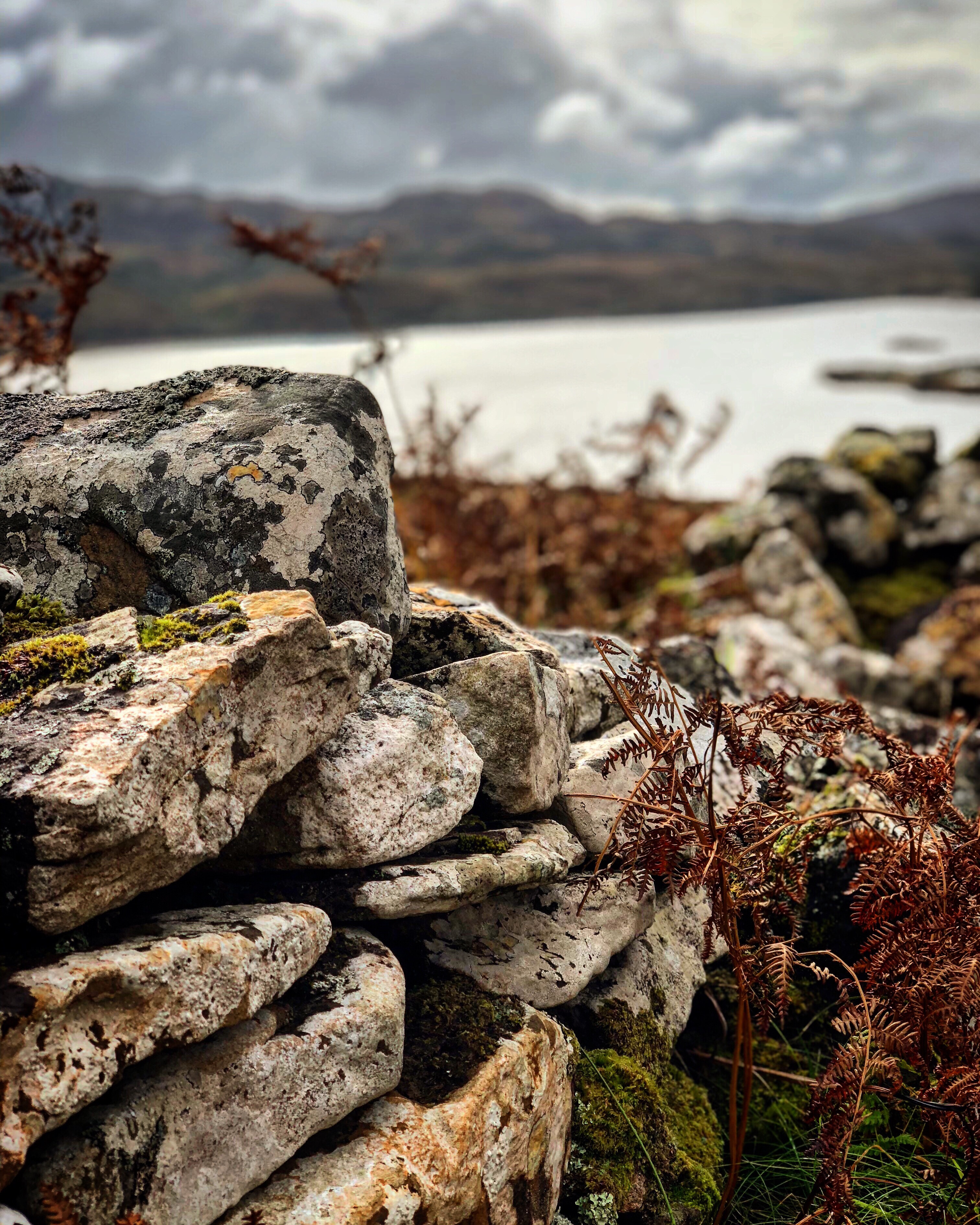
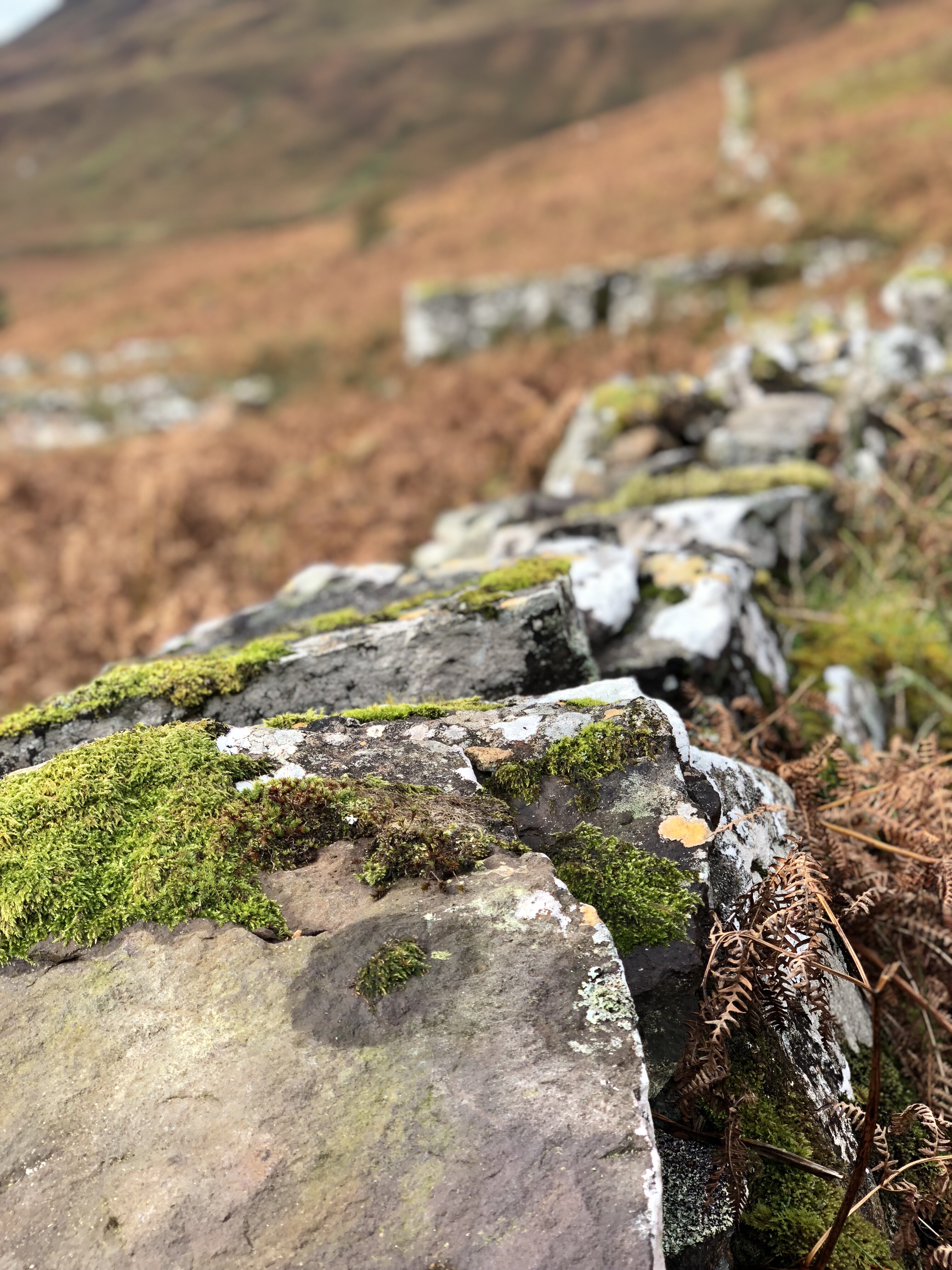
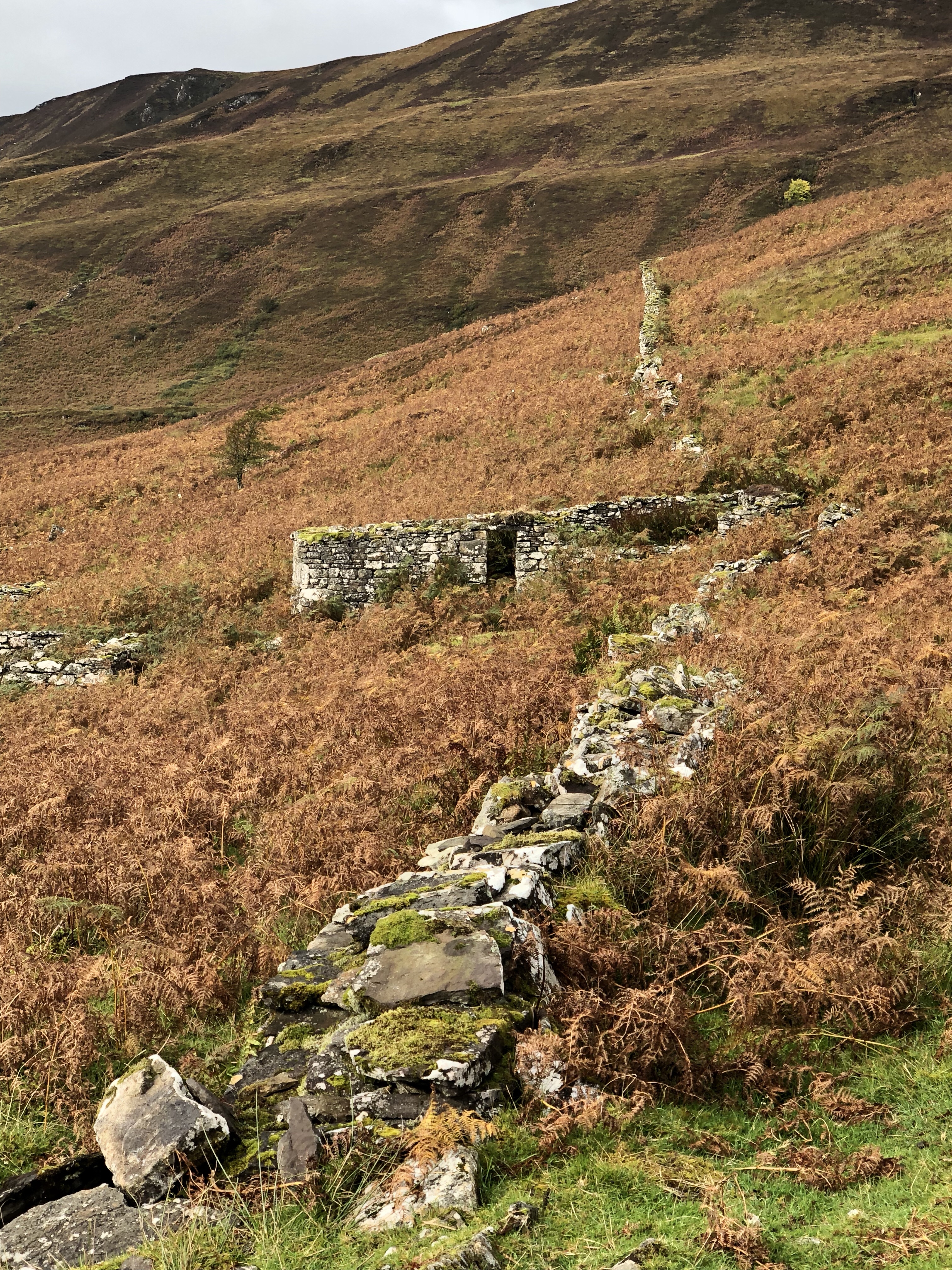
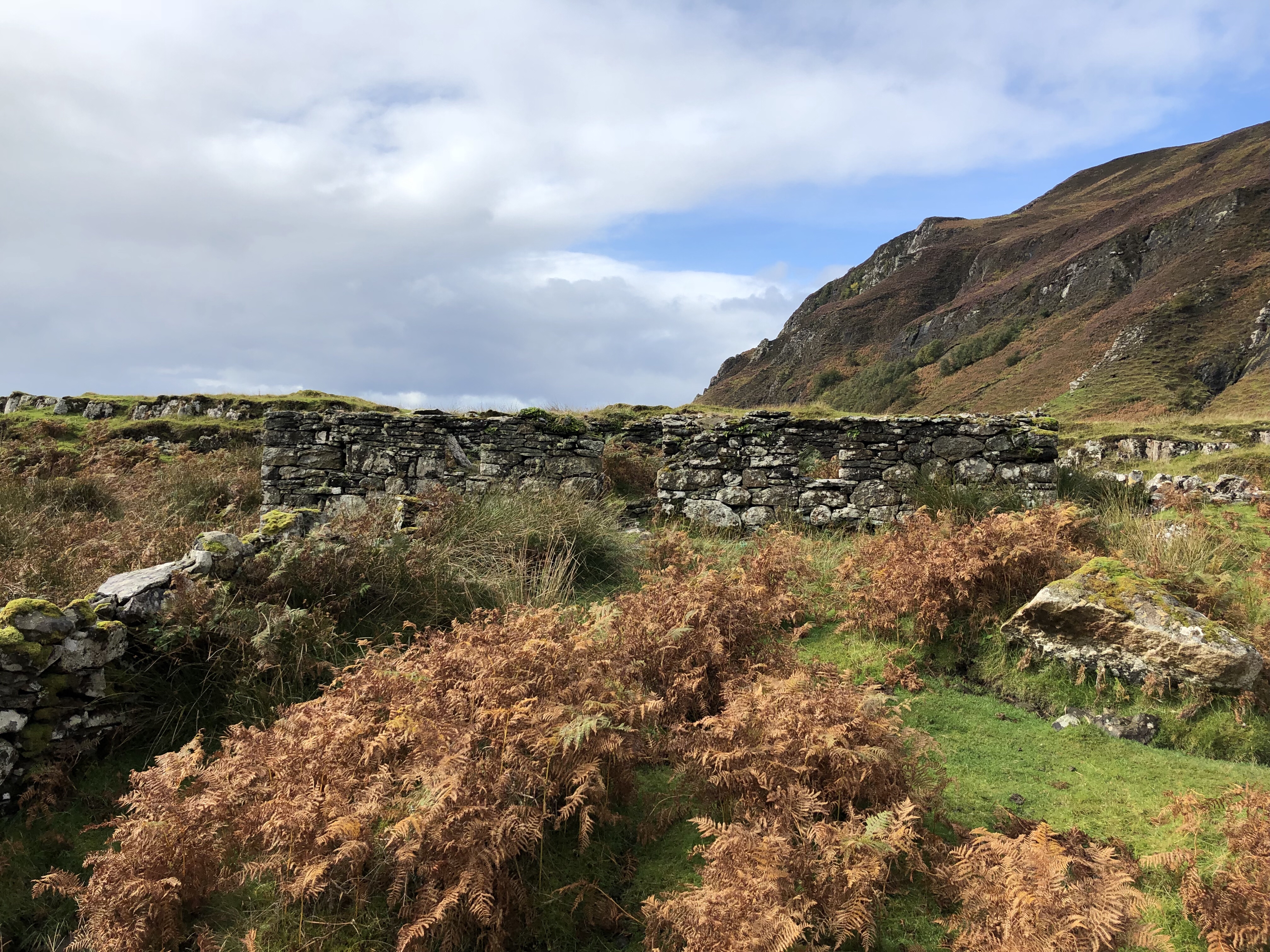
Here are some photos of just one such village left in ruins.

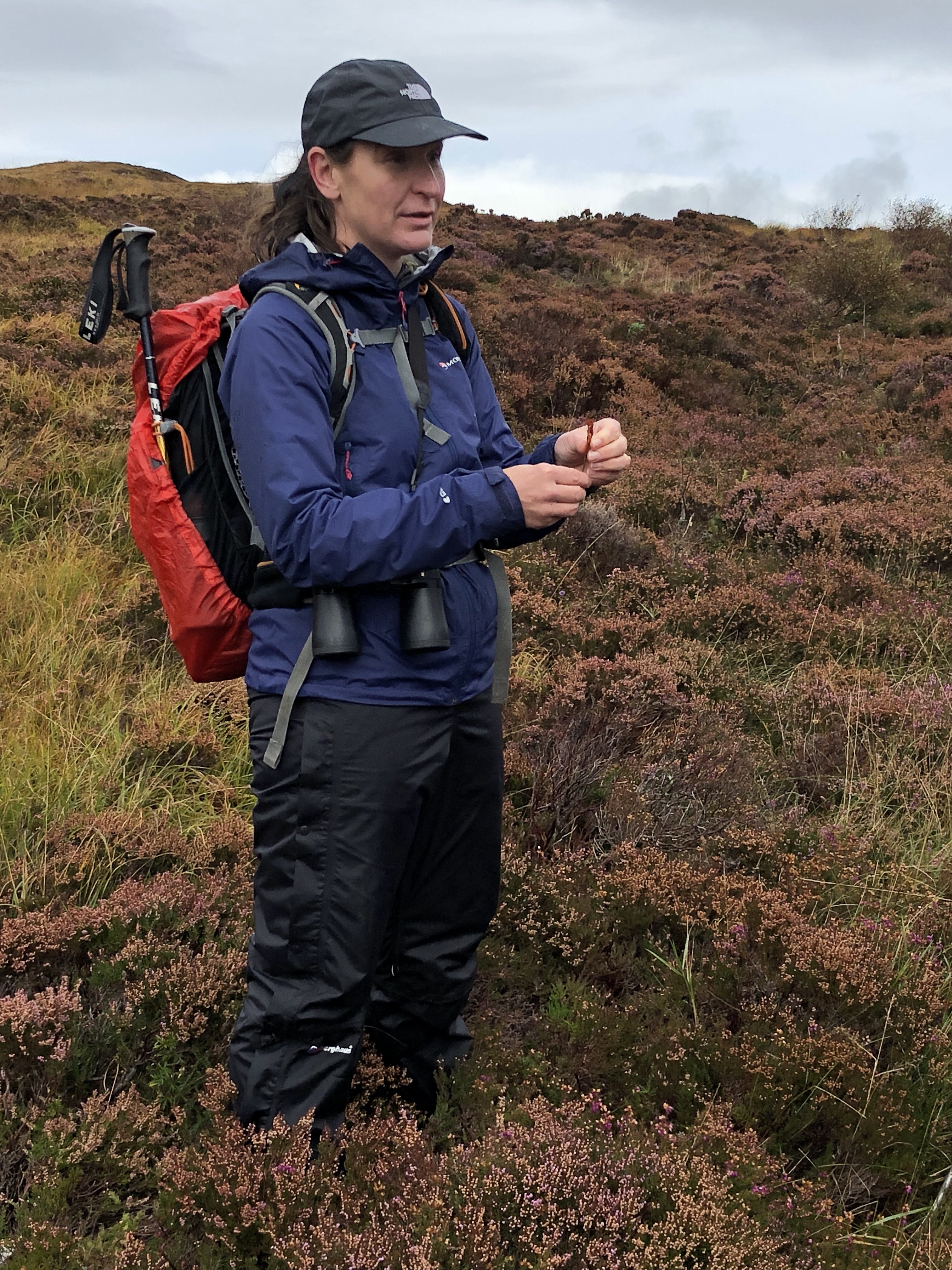
Stop it with the history!! Please may we talk about peat instead. Scotland is covered with peat bogs, and over history Scots have used peat to heat homes, make whisky and so much more. Peat bogs have very low rates of decay and can even preserve food (up to 2,000 year old containers of butter have been found) and dead bodies (watch the BBC’s Shetland on Netflix because Douglas Henshall is gorg – I mean a great actor). Peat’s official name is sphagnum moss. I can go on and on, but since you have already been subjected to background info you can look up yourselves on the internet, suffice it to say that it can hold an amazing amount of water. Sarah stood knee-deep in heather and gave us a very interesting peat talk. She was holding in her hand a tiny bit of sphagnum moss. I mean tiny. When she squeezed it, enough water poured out to fill a juice glass. Magic.

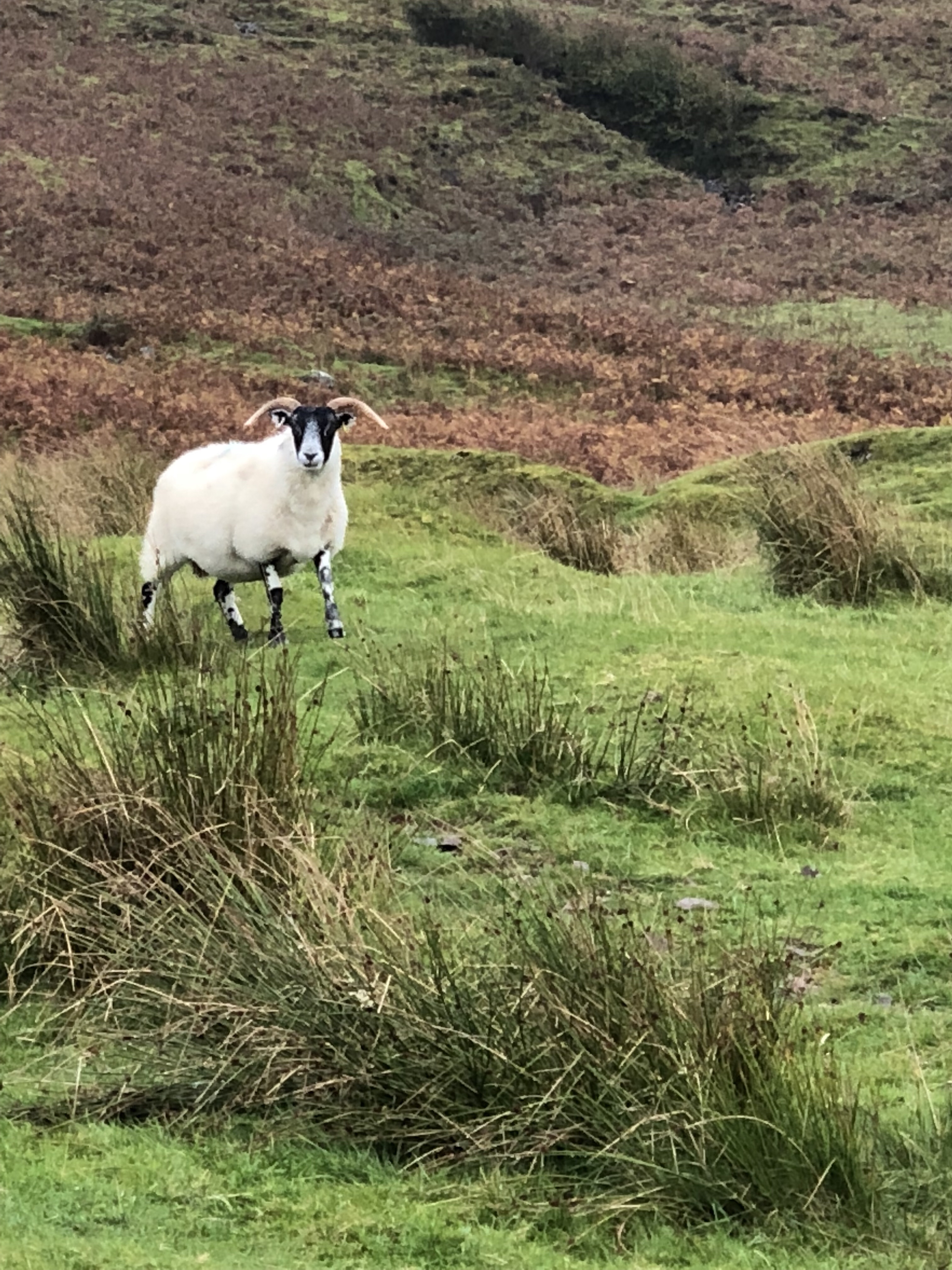
Before I share the next few pictures, allow me to issue a disclaimer. Having learned the devastating story of the clearances, I feel slightly guilty being so enamored of the sheep. I mean, I love them. There are 7 million sheep in Scotland and I love each and every one. My thinking is, though, that those initial displacing sheep are long gone, and the current sheeply inhabitants had nothing to do with the clearances. You are free to judge their culpability for yourself.

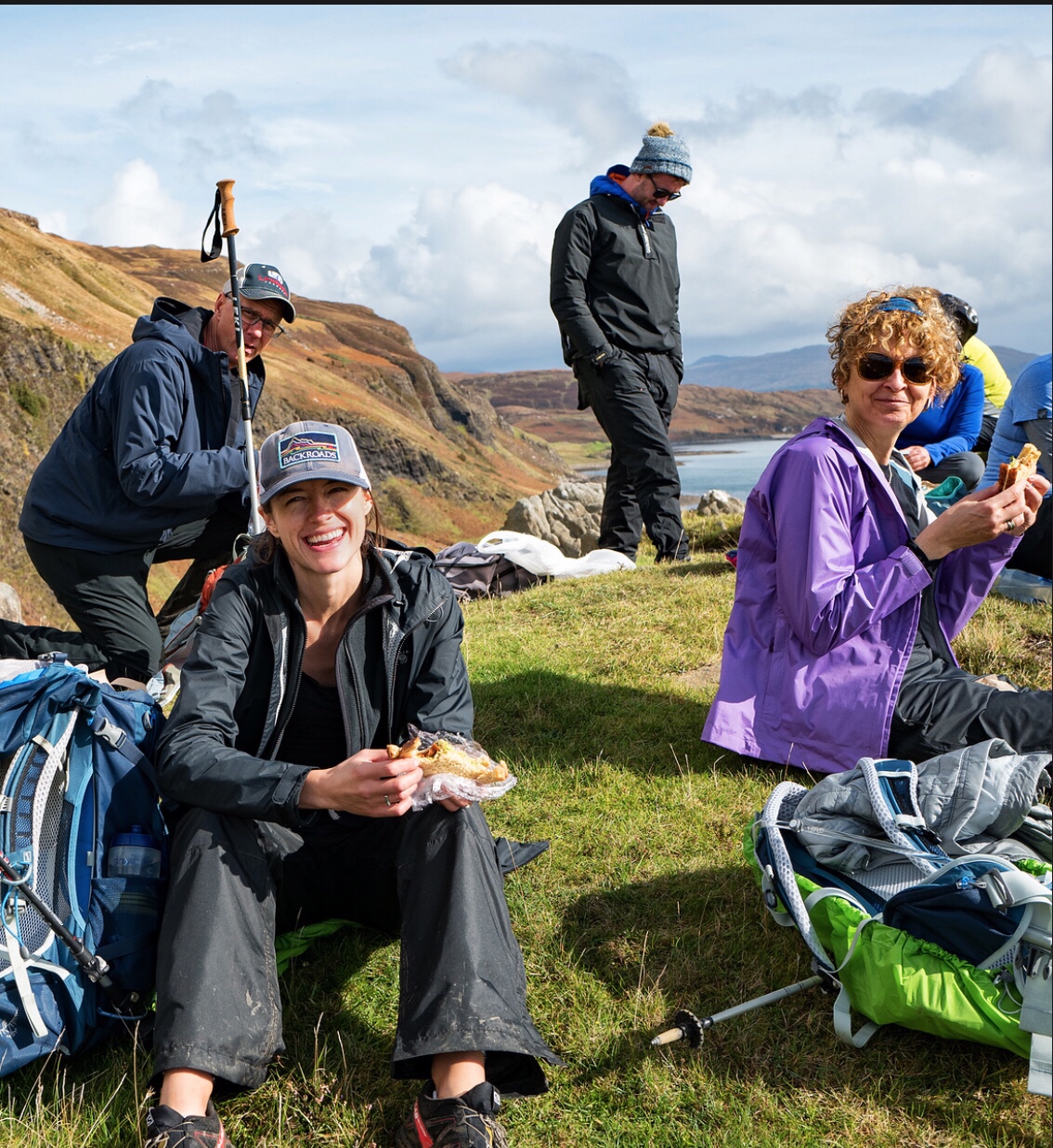
After our visit to the ruined villages, we hiked down to a rocky shore and up the side of a cliff to our dramatic lunch spot overlooking the sea. Keith awaited us with the lunches we ordered on Day 1.

That evening we visited a brand new distillery on Skye, called Torabhaig. It’s so new that they haven’t yet produced a whisky because there hasn’t been enough time to age it the requisite number of years (3) in oak barrels. After the tour, as we were tasting another distillery’s whisky, we chatted with two employees. One shared that he was an extra in the iconic Hardhome episode in Season 5 of Game of Thrones. He also gathers with his mates every week for Dungeons & Dragons – and you got the sense that he is quite the appreciative drinker. The other has exactly one drink every year, a whisky, on Christmas Day. He works in a distillery, he lives and breathes whisky, and yet only one drink per year. He told us in foreboding tones about Scotland’s relatively new zero tolerance policy on drinking and driving, and said that we were all legally drunk after sampling our first wee dram. Scottish authorities warn that the only way to ensure you stay within the limit is to have no alcohol at all. It’s actually had a negative impact on Scotland’s economy and critics say it amounts to a form of prohibition. Dinna fash, though, if you are a non-driving tourist sort of person.

We were amazed by the huge investment it took to start a distillery, especially when you aren’t making gin or vodka (which one can whip up in a matter of days, we were told dismissively). Huge up front expense and a long wait before anything hits the market. A labor of love, to be sure. I bought a tshirt to help things along.

And a last word about whisky. When I first arrived in Scotland, I couldn’t believe how cheap a dram was. Well….it is much cheaper, but it’s also more wee. A pour is about one ounce of liquid, whereas in the States, it is more like 1.5 ounces and maybe even 2 if the bartender is clueless. I never once saw a server eyeball a pour, either, it’s very carefully measured in a jigger, which means that your glass is inevitably sticky from the awkwardness of the transfer. I generally favor the smaller food portions you are served in European restaurants. But with whisky, I say, supersize me.