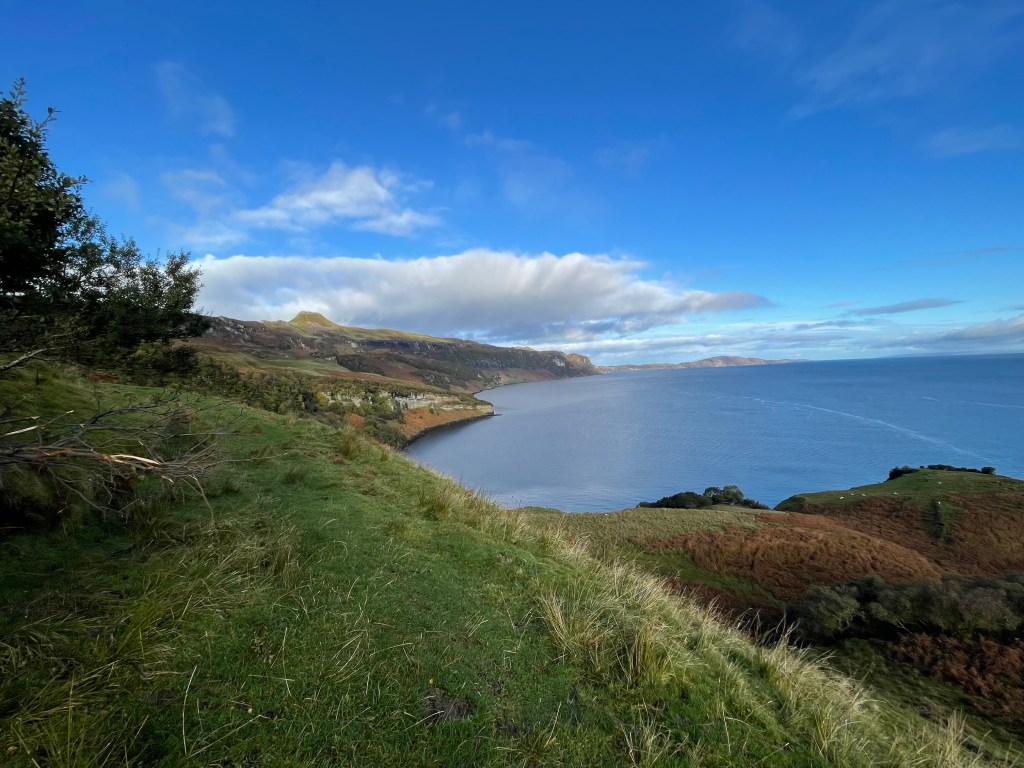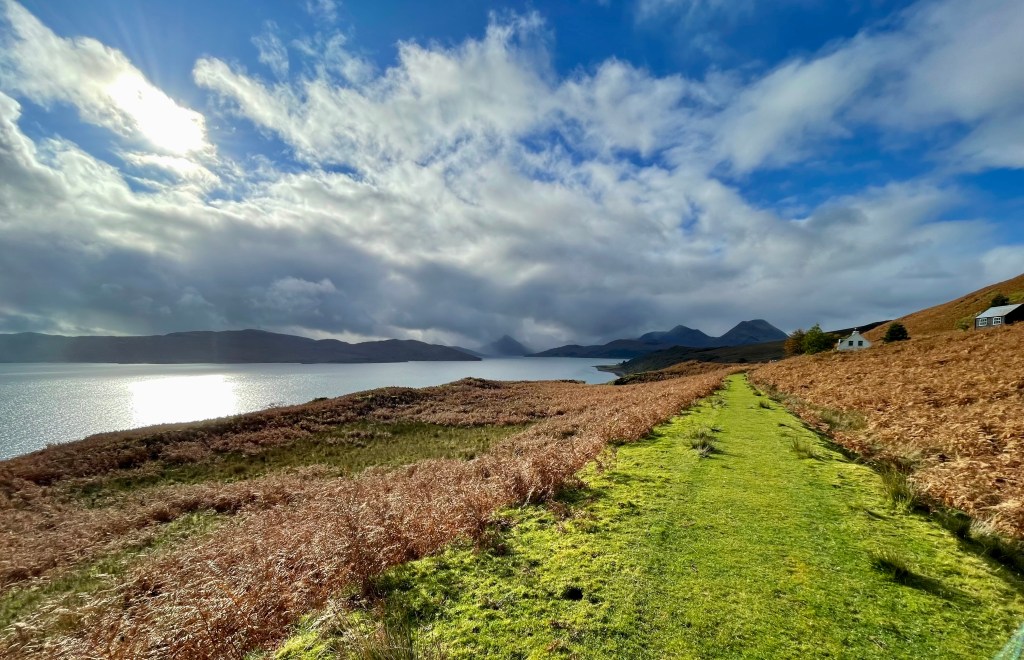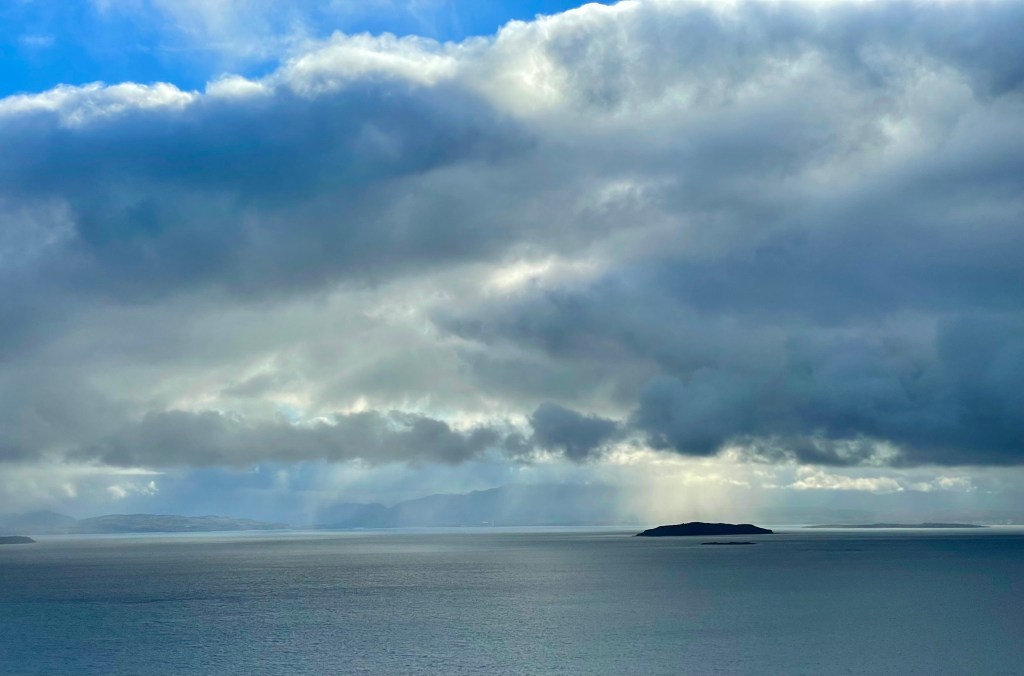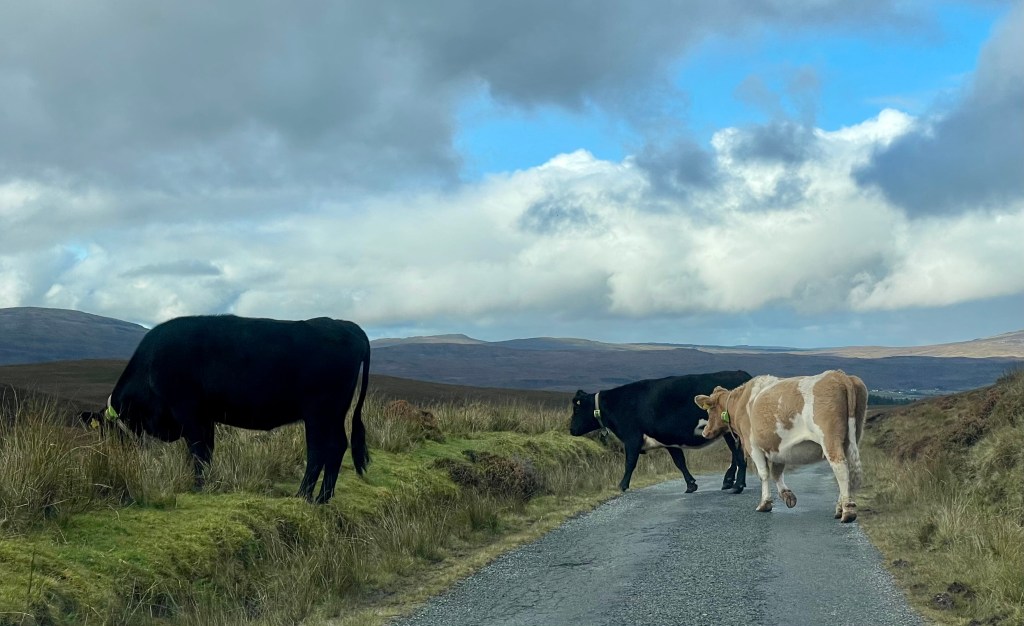
In Which We Meet the Hebridean Baker, Sample a New Whisky, Visit a Lighthouse, and Learn About Rocket Mail

I’ve been back from Scotland for way too long. Almost six weeks. Don’t get me wrong, I am fortunate to have great friends, a home I love and fulfilling work. I live in a beautiful mountainous place steeped in outdoor culture. Literally everyone is moving here (looking at you Californians). For the record, I’m extremely lucky. Even so, I feel the gentle pull of a Scottish tractor beam (sorry, reading Patrick Stewart’s delightful bio) and it feels sustaining, like a program running in the background. I’m returning in May but honestly this seems like an age away. And as it happens there’s a Scottish Gaelic word expressing this feeling exactly. There is no English translation.

The word is cianalas, something I’ve written about before. It is a deep-seated sense of belonging to the place where your roots lie, or where you feel profoundly at home. It’s a feeling that you are exactly where you need to be in the world, a feeling that runs right down to your toes and causes you to smile idiotically while hiking across a moor alone in the fog, wind and driving rain. It’s a place that dampens anxiety and worry and offers more zen than an hour of meditation. Cianalas is longing for the place you belong. At the (very high) risk of sounding impossibly cheesy and naive, there it is.

(Tonal shift warning for a brief PSA: to avoid annoying Scots, Gaelic is pronounced with a short “a” like “apple” – the perhaps more familiar pronunciation with a long “a” like “table” refers to Irish Gaelic – same roots, different language.)

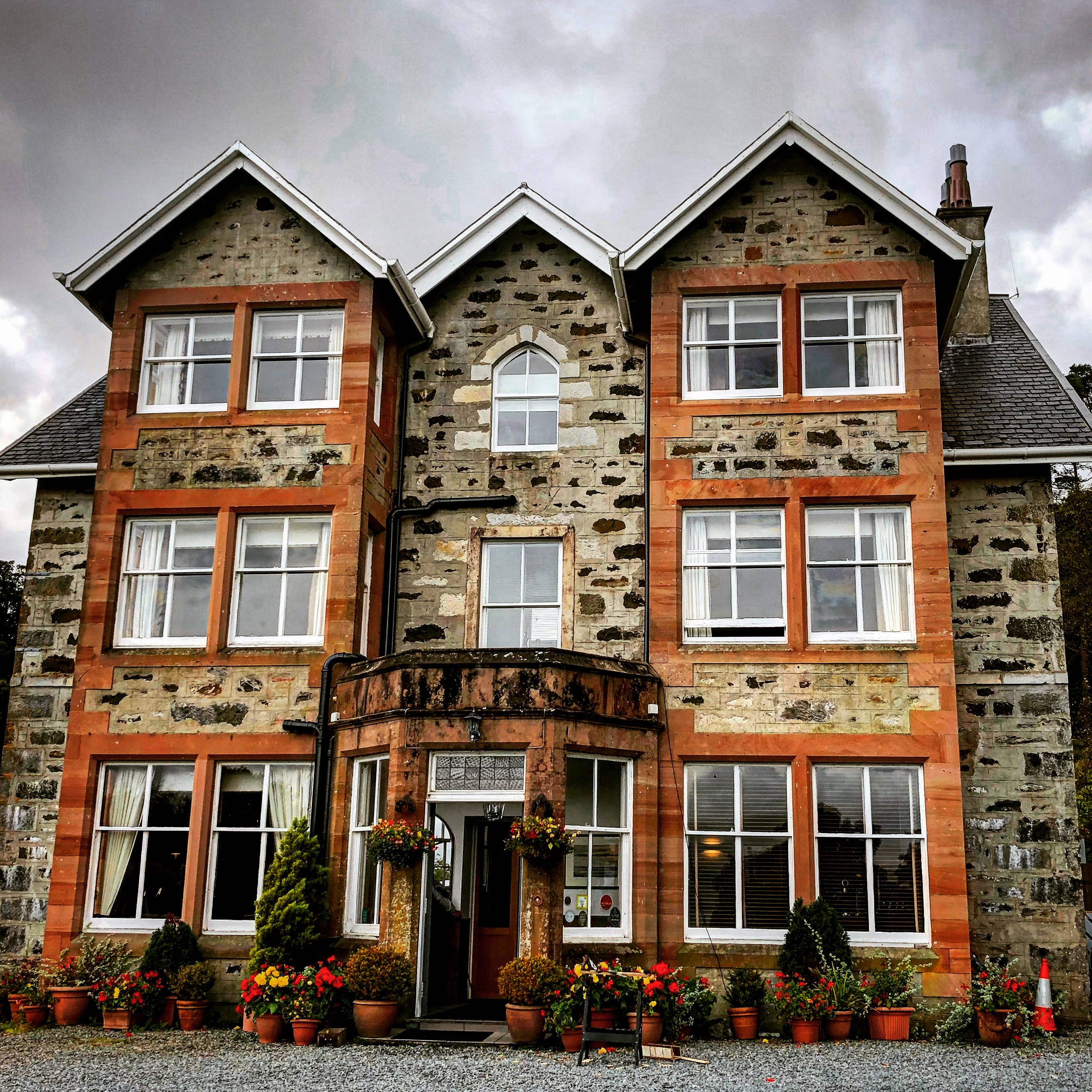
So after that bit of schmaltzy waxing poetical, let’s rejoin our regularly scheduled programming and return to the Outer Hebrides, which is where the word cianalas actually originated. Our merry band of Wilderness Scotland travelers stayed at the lovely Harris Hotel in Tarbert. As Harris is the most mountainous area of the single landmass of Harris and Lewis, we planned to spend most of our hiking time there. Harris and Lewis combined are the largest island in Scotland with a population of about 21,000, and the important thing to remember is that most of them are MacLeods.

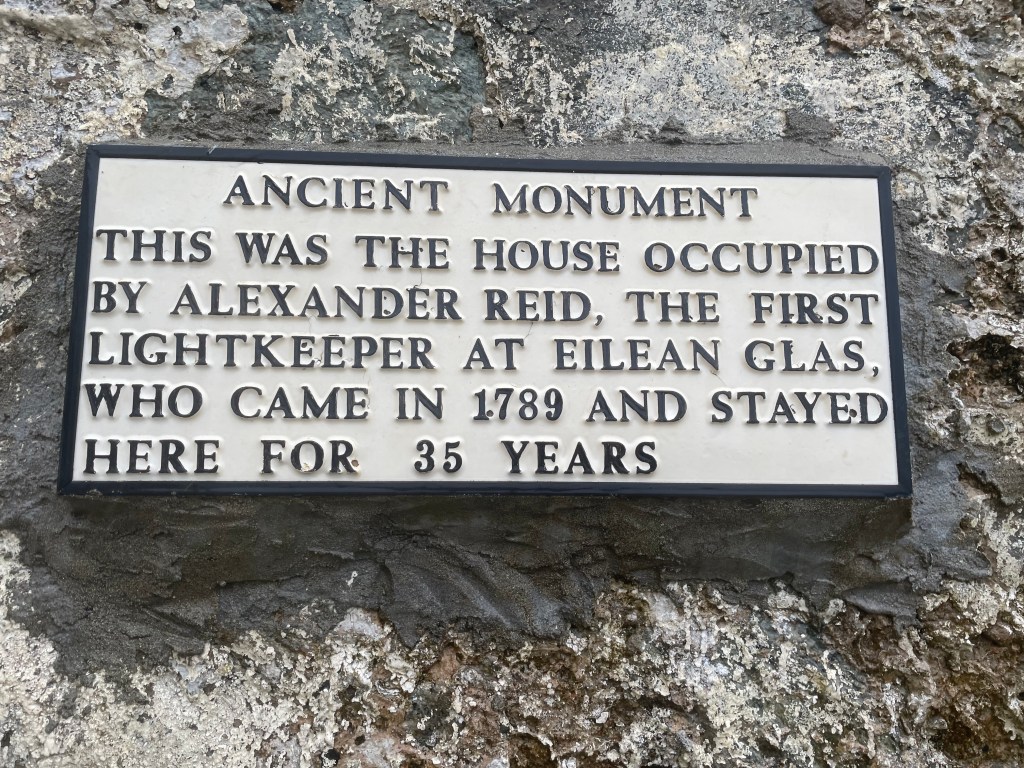
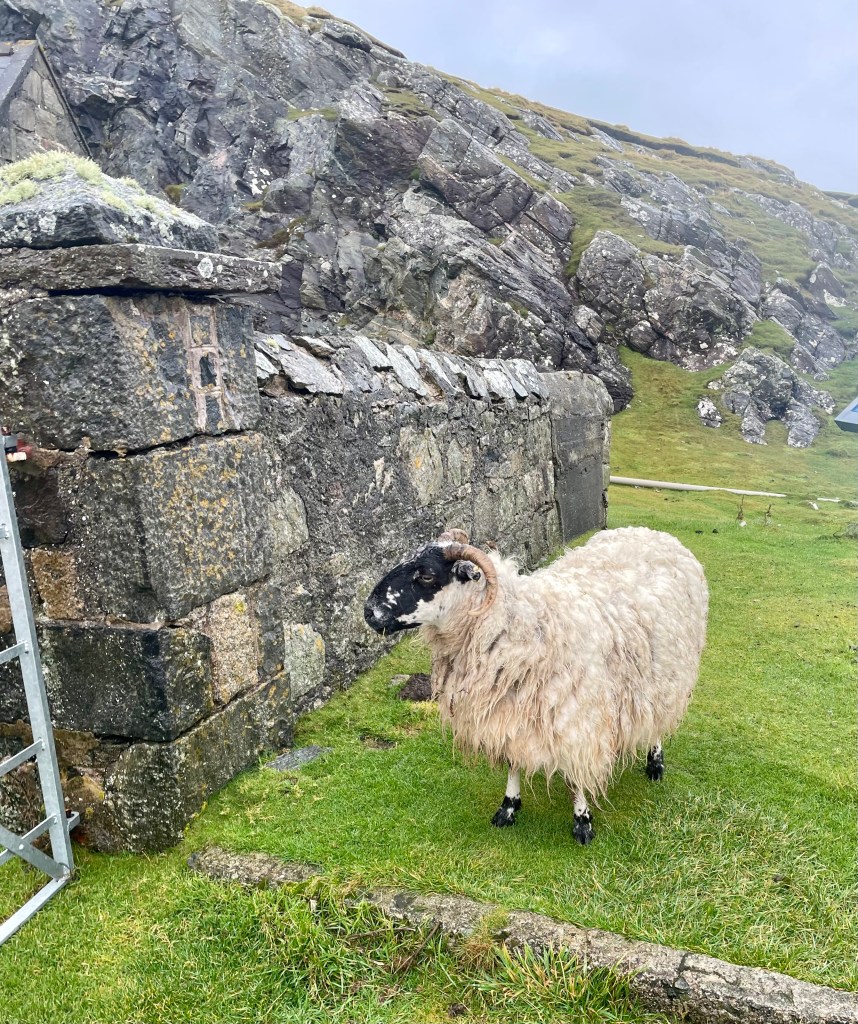
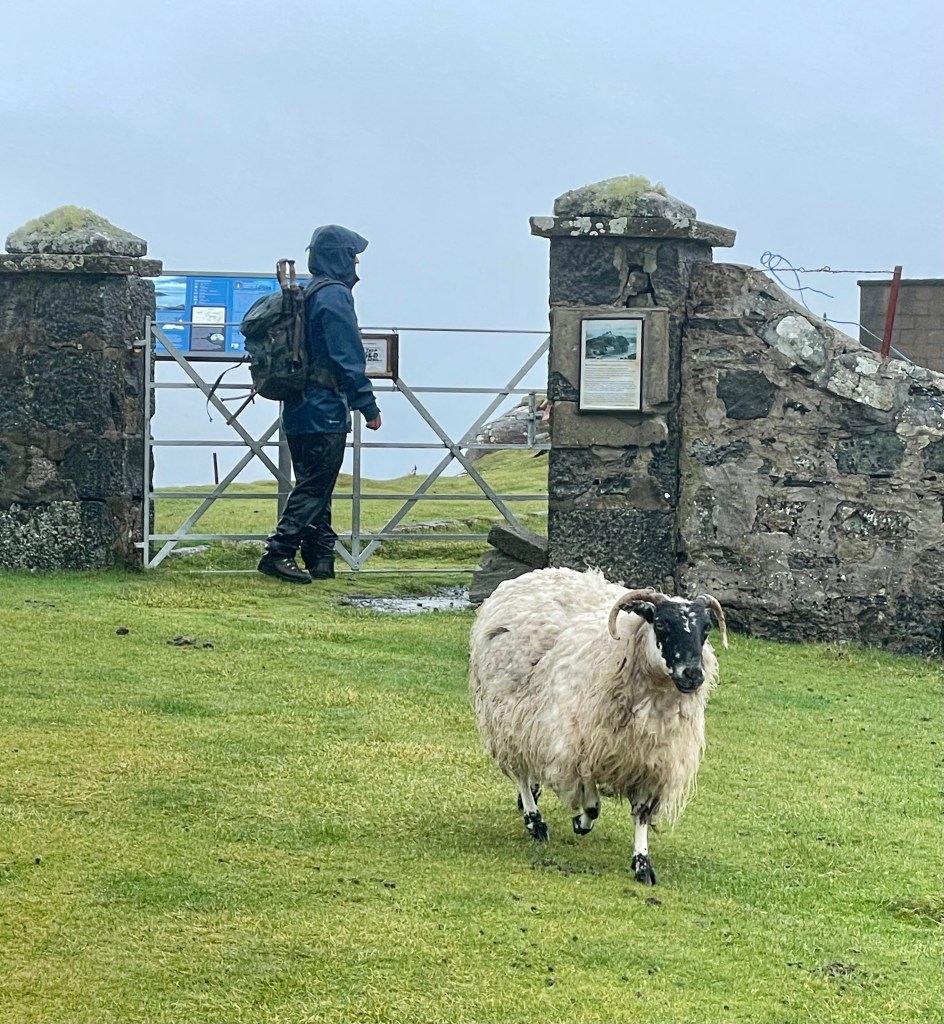
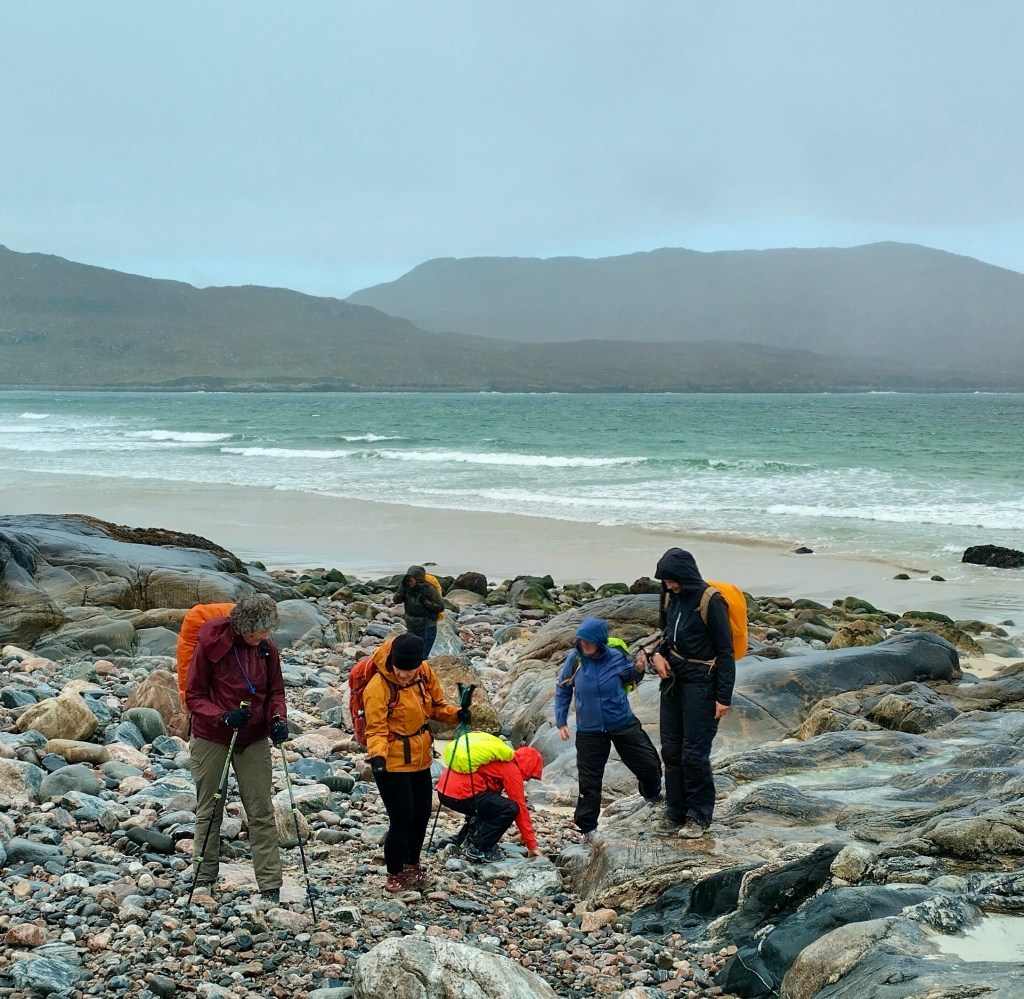
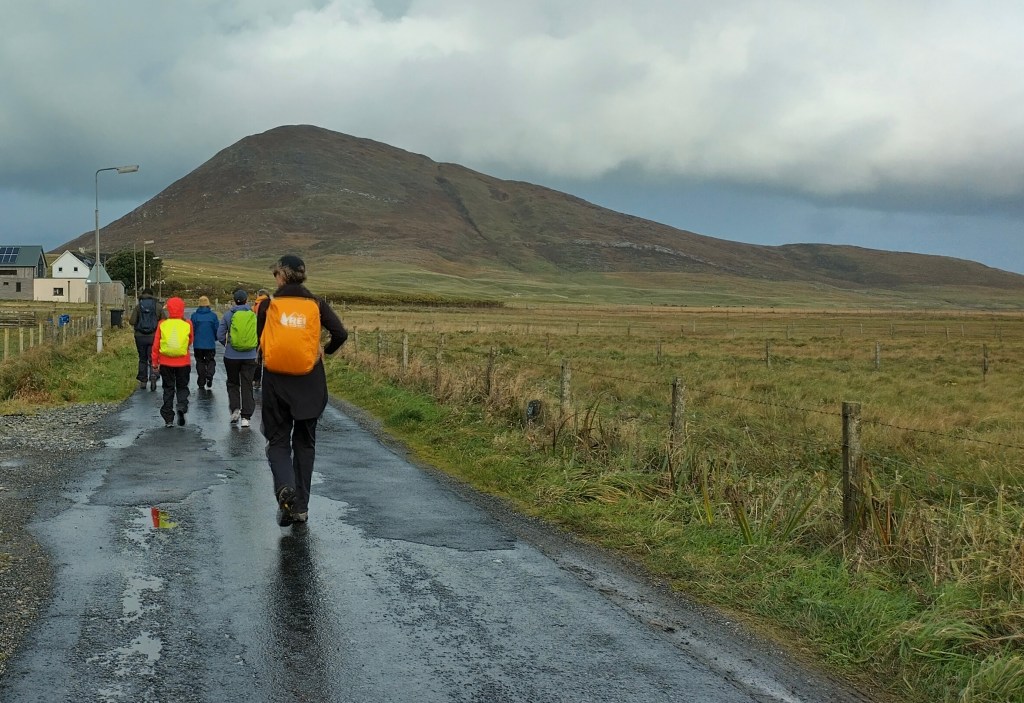
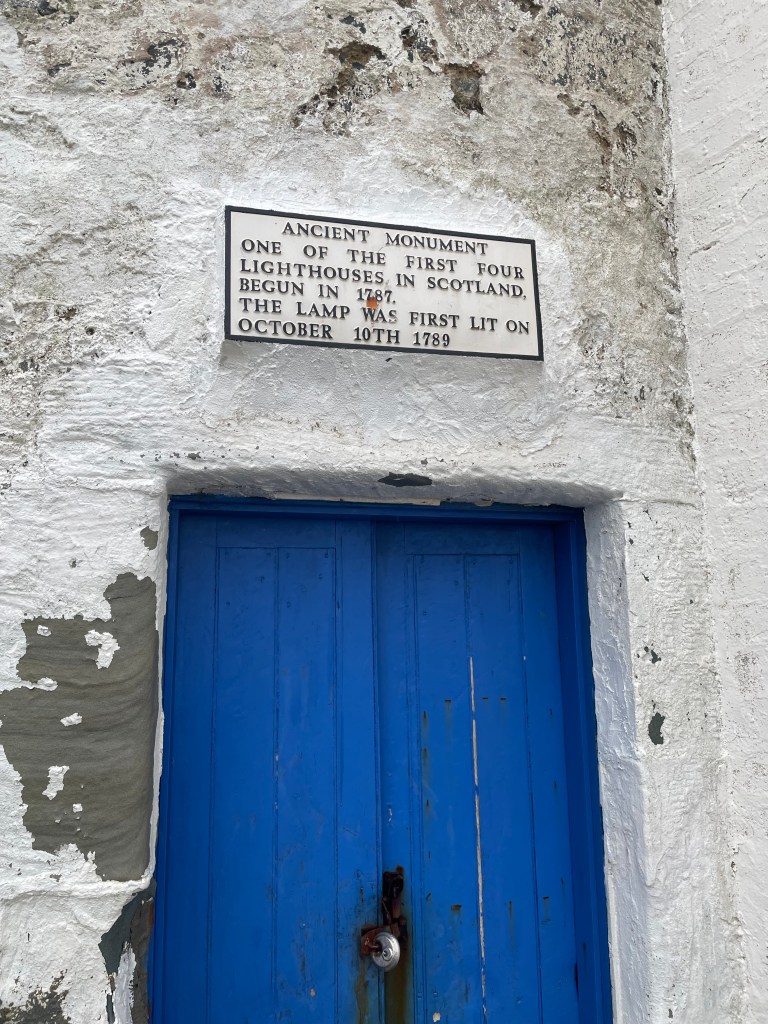
Our first day of walking featured more awesomely bad weather! We drove across a little bridge to another island southeast of Harris called Scalpay, and enjoyed a very rainy walk to Eilean Gas, one of the first four lighthouses to be built in Scotland. It looks back across the Minch toward Skye, so awesome views when it’s not all fogged in. It was built by Robert Stevenson in 1789 and became fully automated in 1978. Robert and his descendants designed and built basically all of Scotland’s lighthouses over a 150-year period. As we know, the black sheep of that family happened to be Robert Louis Stevenson, and our guide Liam shared how much he enjoyed imagining young Robert sitting off to one side, completely bored by all this tedious lighthouse whatever business, scribbling in a notebook and generally being a terrible disappointment to his family. Liam clearly saw RLS as a kindred spirit.
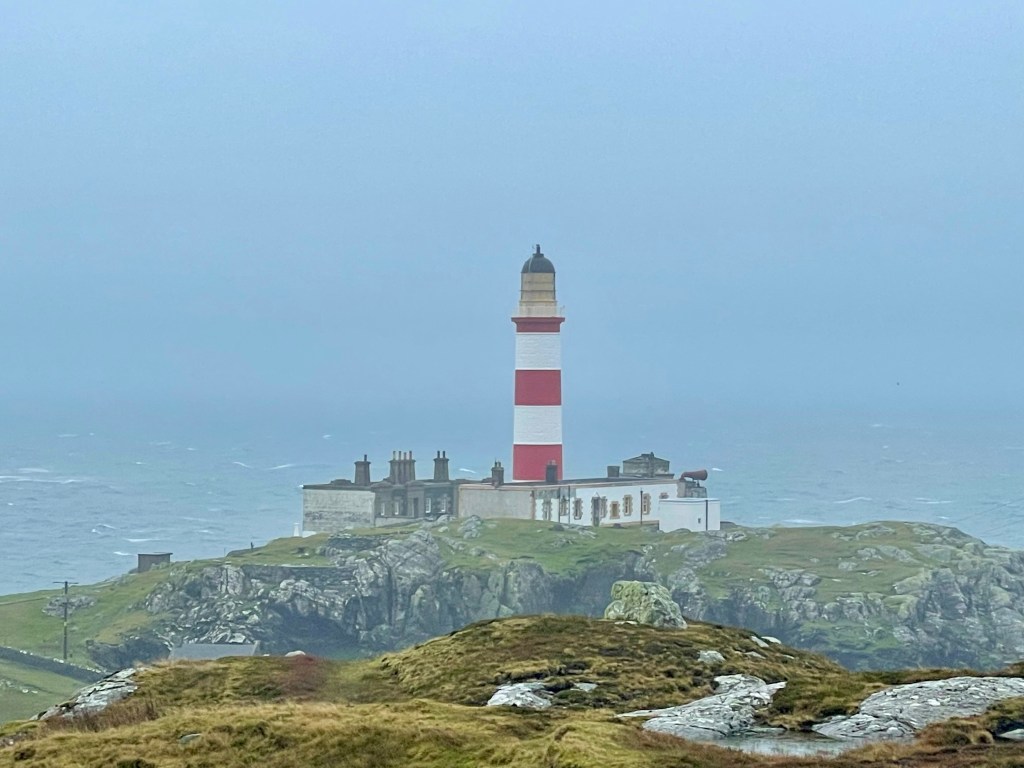
The grounds are pretty cool to wander about, with barracks and other associated buildings. If you happen to be there during high season, there’s even a coffee shop with views over the sea. I stared longingly through the windows at the espresso machine as a wee shot would have been just the thing on the cold wet day. “There’s an espresso machine in there, ” I told everyone, alas, to no avail.
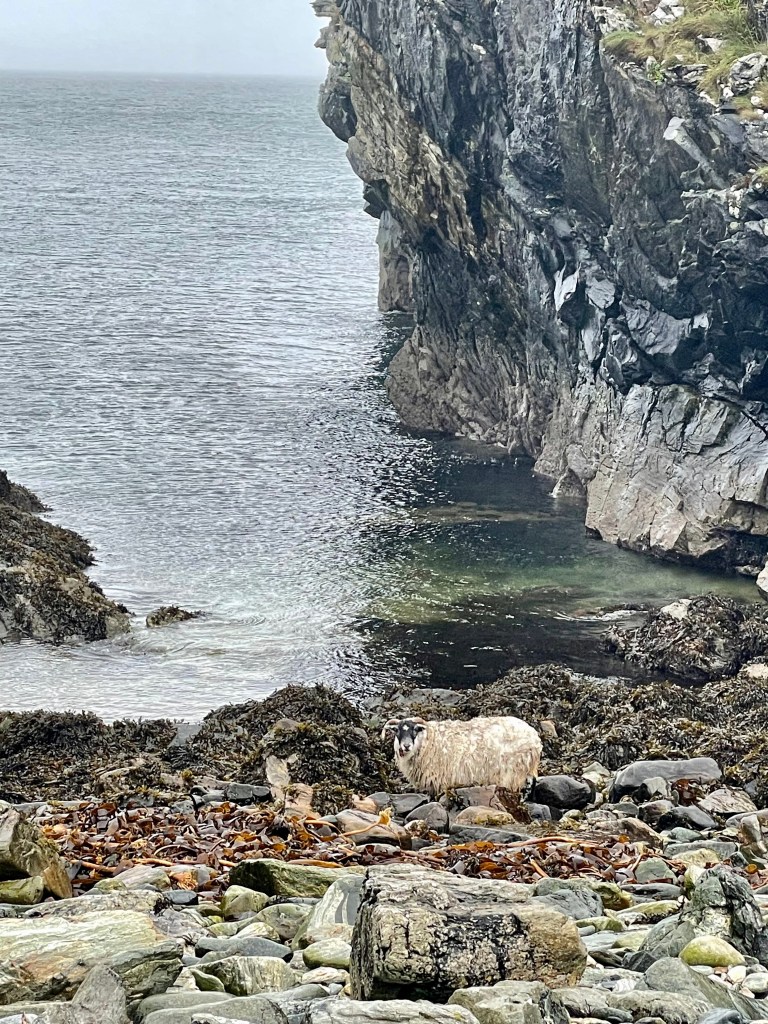
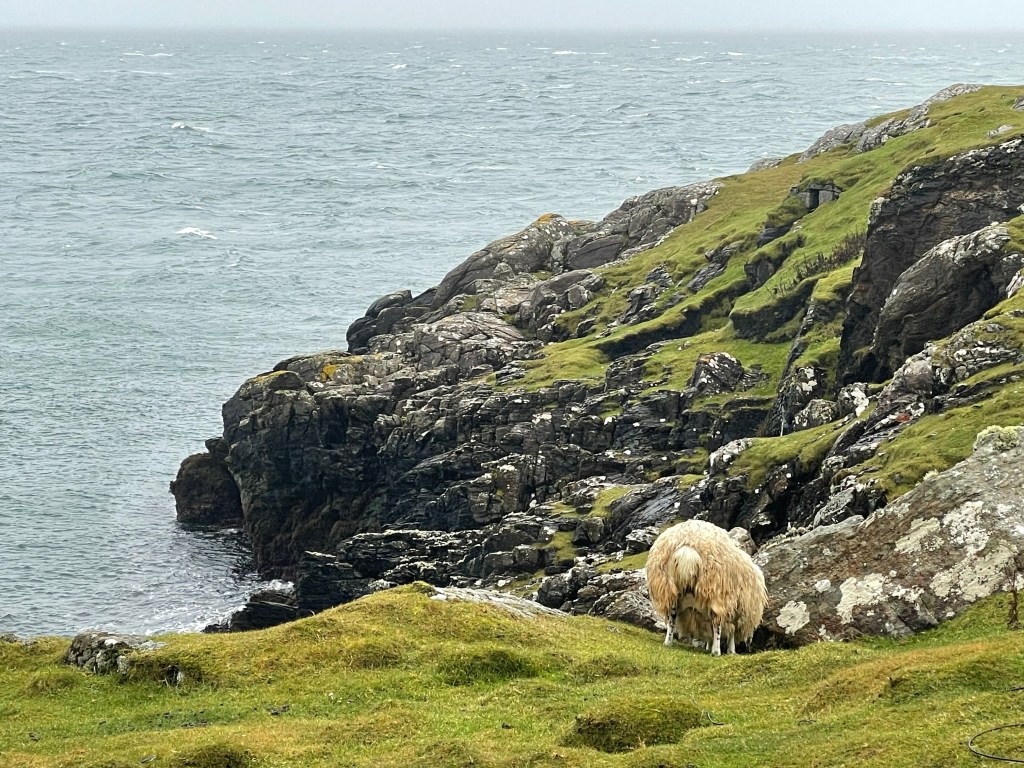
Here’s a cool thing. We happened to be visiting on the 234th anniversary of the original lighting of the lamp.
Liam told a story that I haven’t been able to confirm and that he might have conflated with another tale of a different Hebridean lighthouse, and so I’m going to share both as they are equally creepily awesome. He explained that two families once lived at Eilean Glas and their job was to operate the lighthouse – it was very remote, no roads, and so the families had to be self-sustaining by growing their own food and so on. Apparently there were reports that the lamp hadn’t been lit for a few days, and so a crew was dispatched to investigate. They found food on the table and other signs of a sudden disappearance – and not a single family member remained, nor was anyone ever found. This got my mind spinning about writing a novel based on this unsolved mystery – I mean c’mon it’s basically an X-File and practically writes itself. So, when I got home, I did some googling.

The (rather well-known, actually) story I found involved the sudden disappearance of three men at the Eilean Mor lighthouse in the Flannen Islands about 32 miles west of Lewis. On December 26, 1900, a small ship arrived on shore, bringing a replacement lighthouse keeper, Joseph Moore. Strangely, nobody was at the landing platform to greet them, so Moore walked up the hill to the lighthouse. He noticed something was immediately sketchy as its door was unlocked and two of the three oilskin coats were missing from the entrance hall. In the kitchen Moore found half-eaten food and an overturned chair as if someone had jumped from their seat. And (whispers) the kitchen clock had stopped.

The men were never found, although there were some strange recent log entries. On December 12, Thomas Marshall, the second assistant, wrote of “severe winds the likes of which I have never seen before in twenty years.” Marshall also noted that James Ducat, the Principal Keeper, had been “very quiet” (serial killer alert!) and that the third assistant, William McArthur, a seasoned mariner and known as a “tough brawler,” had been crying. So maybe the quiet one lost his mind due to the alleged high winds and maybe the crying, killed the other two and tossed them into the ocean, and wandered off into the mist and over a cliff.

I say “alleged” because a later investigation by British authorities revealed that there were no reported storms in the area at that time. The weather was calm.

Maybe all three of them got drunk, went for a walk and took a pratfall into the sea at the same time, maybe it was a sea monster (amateur sleuths at the time really considered this), or it could have had something to do with the islands’ namesake St. Flannen. He was a 6th century Irish Bishop who later became a saint. He built a chapel on the island (the lighthouse keepers called it the “dog kennel” due to its size which possibly wasn’t great karma) and for centuries shepherds used to bring sheep to graze nearby but refused to sleep over due to reported haunty spirits.

Nobody has lived on the Flannen Islands since 1971, when the lighthouse became automated. I wonder if Moore stayed behind to operate the place or if he suffered a debilitating case of the willies and retired.

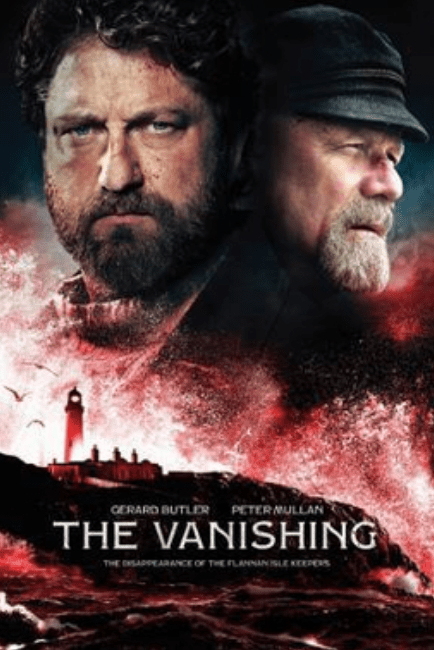
As for my plan to write a mystery, well, it’s been done and done again as far as Eilean Mor is concerned. The disappearances were included in episodes of Dr. Who, Genesis wrote an entire freaking song about it and there’s even a 2018 movie called The Vanishing with Gerard Butler.
So I might write a mystery about Liam’s story at Eilean Glas instead. A psychological thriller with lots of family drama and insanity from being trapped in a remote location with scarce resources, but also there is a sea monster and the ghost of a crazy saint and a chapel with a dog in it.

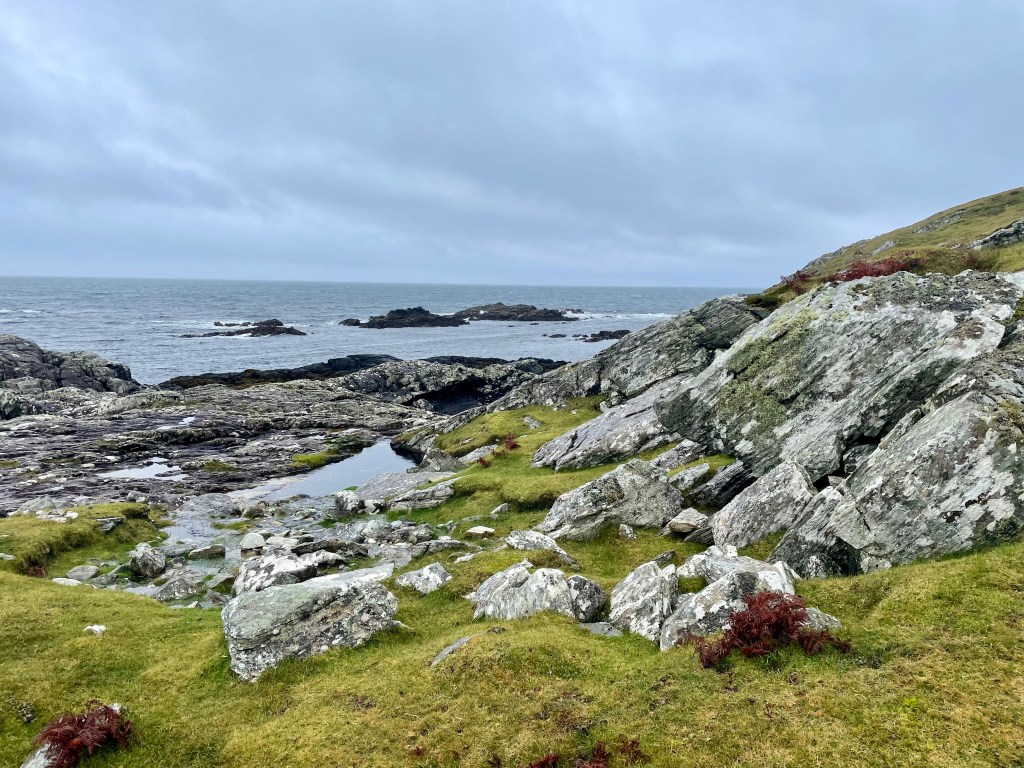
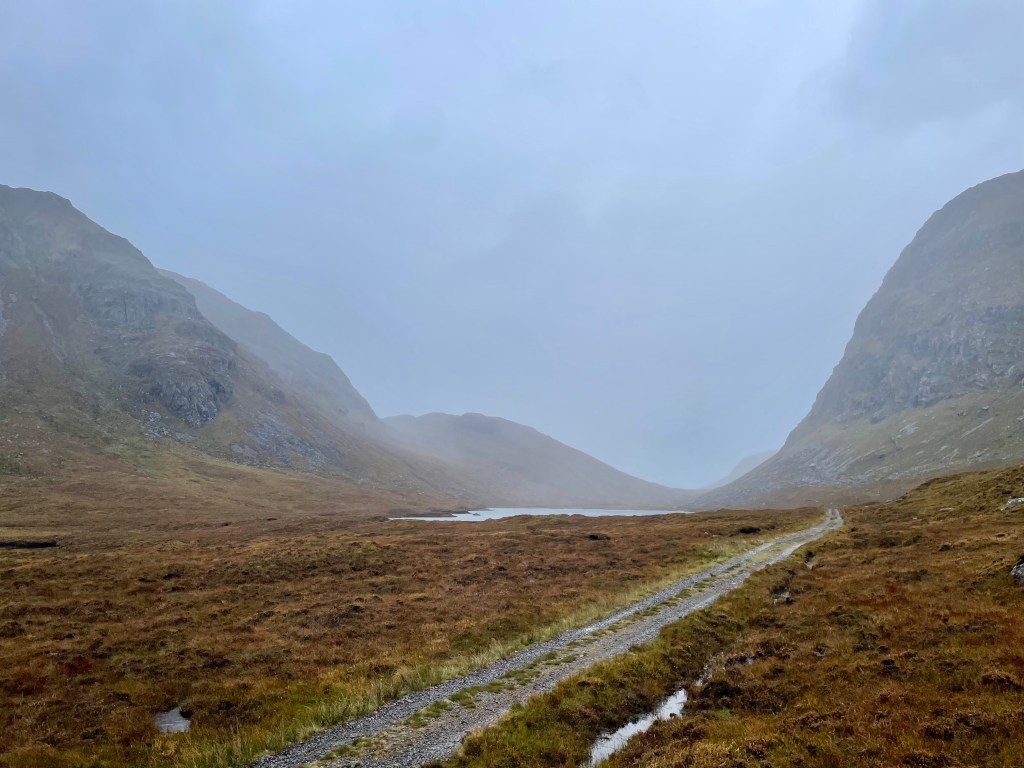
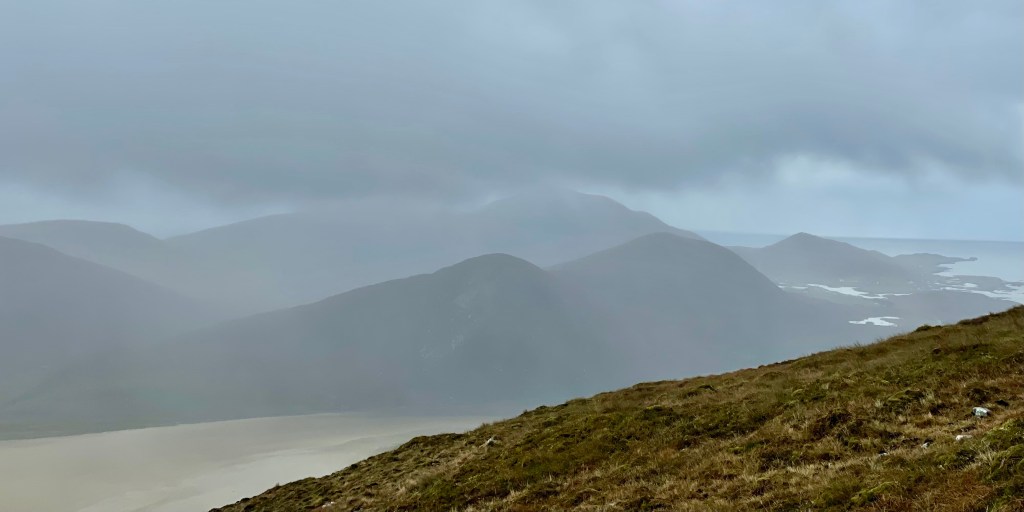
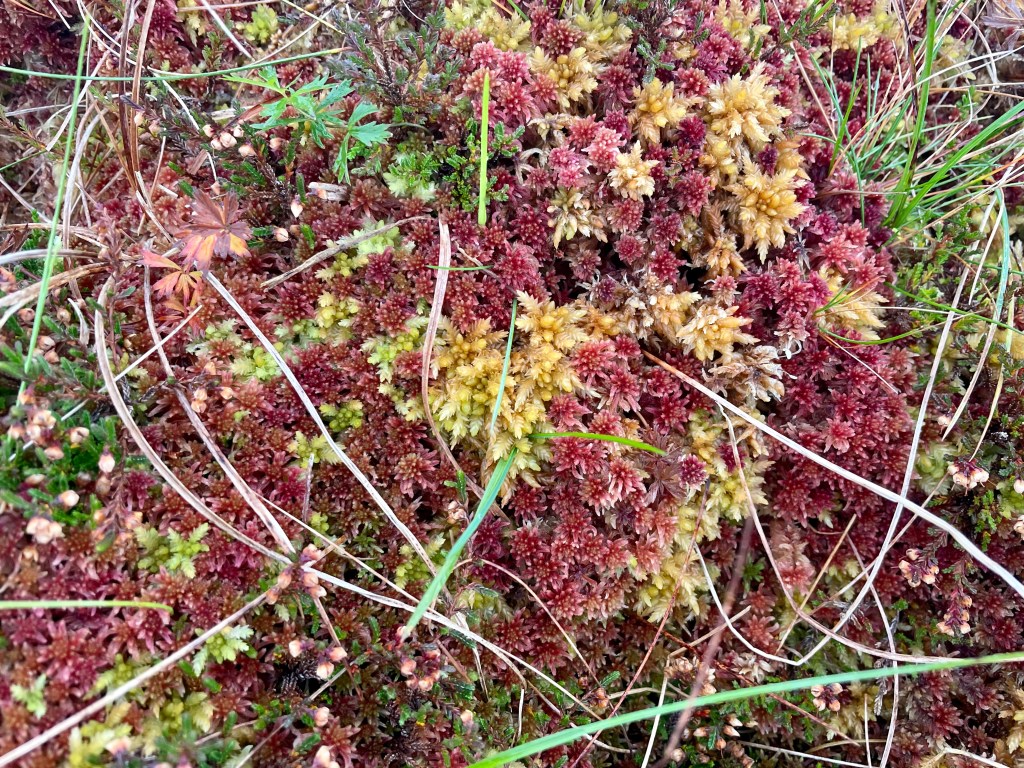
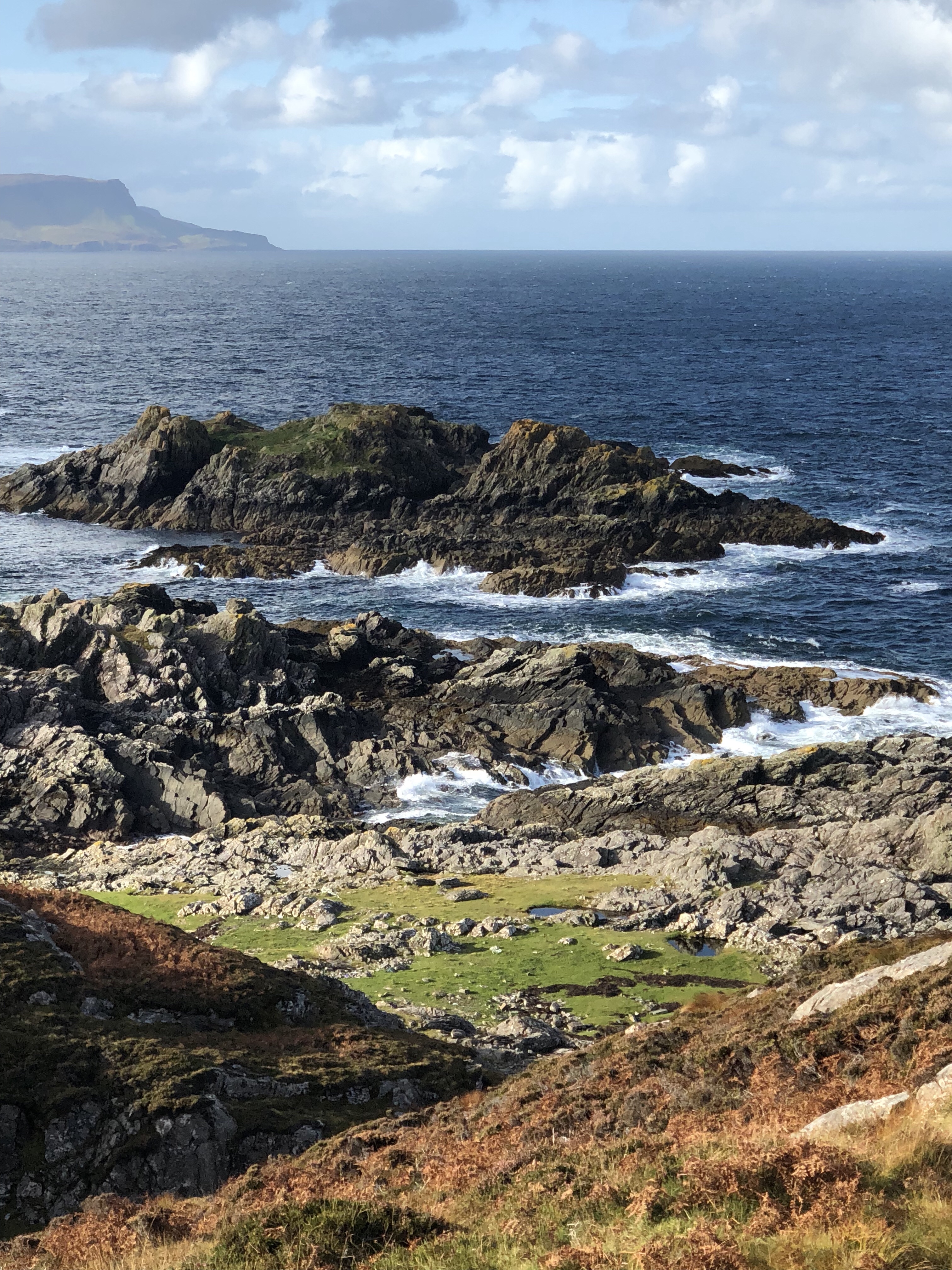
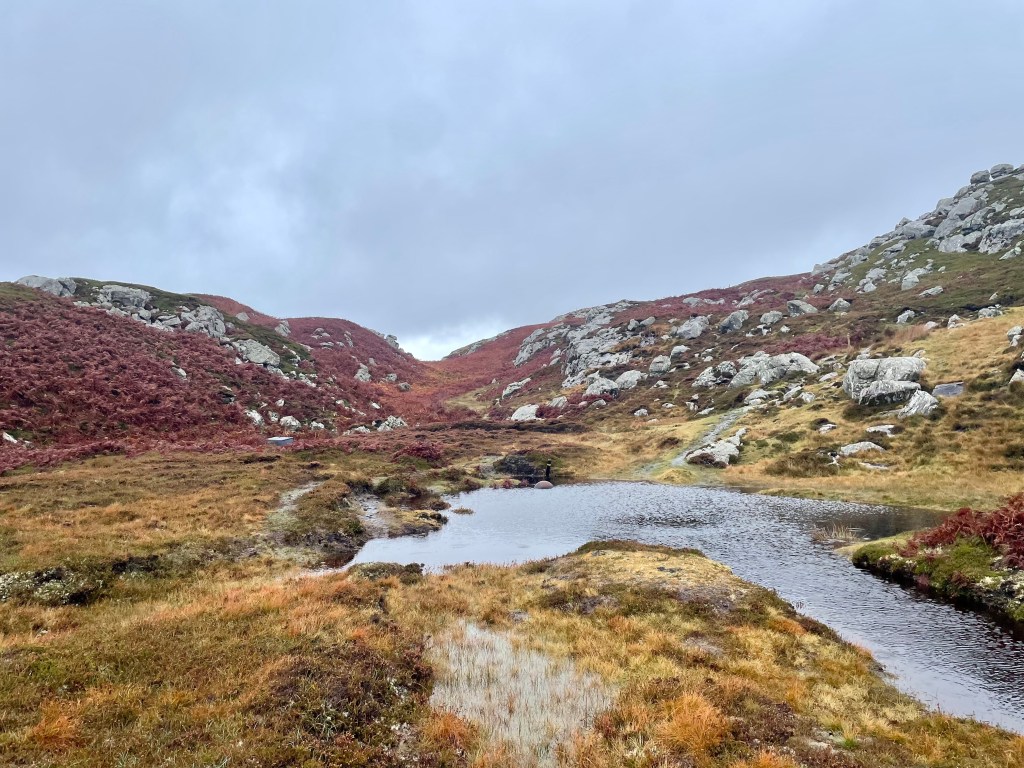
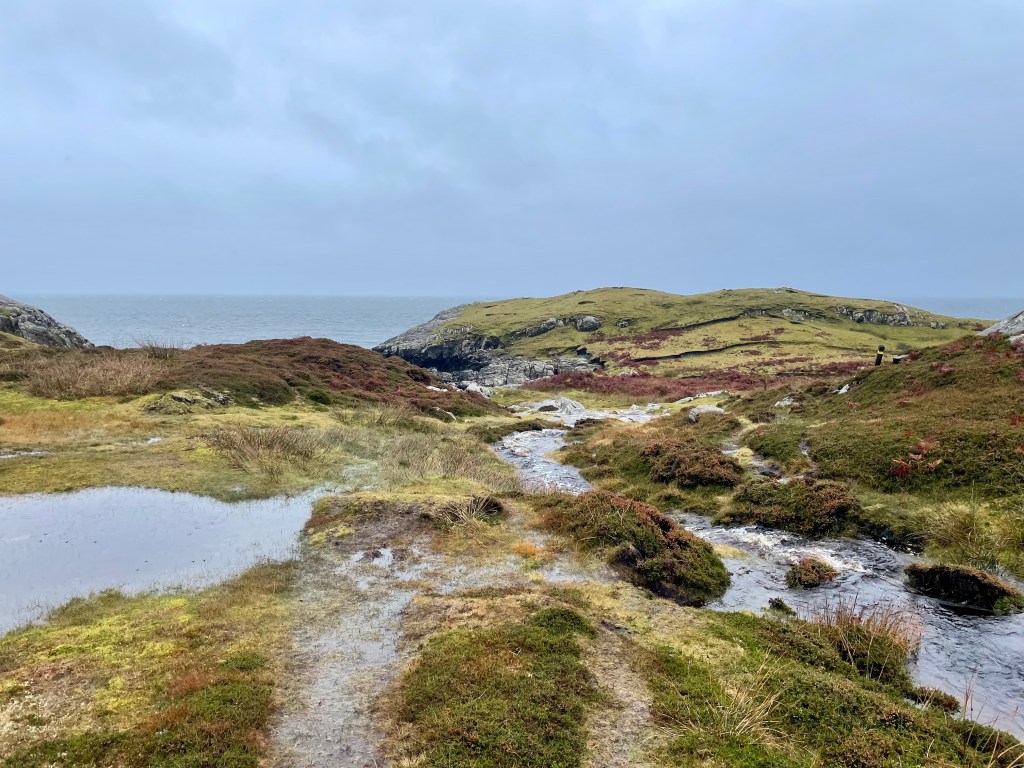
After story time at the lighthouse (Scots truly are natural storytellers), half of us headed back to the van and the rest completed the loop hike along the coast – the bog factor was off the charts which reminded Liam about that one time he had to pull a guest out of a sucking bog that was basically Scottish quicksand. We also happened upon the skeletal remains of a sheep. Don’t worry, it was all fine. As was the remarkable scenery. The red you see is water-logged sphagnum moss. More about that later.
Liam was a master at identifying plants and mushrooms along the trail, and on this hike he showed us some white spidery reindeer moss (which is actually a lichen). Pro-tip: if you ever find yourself walking for days across a frozen Norwegian tundra whilst on a secret mission to stop Hitler from gaining access to heavy water (a byproduct of fertilizer production that could be used to develop nuclear weapons), you must locate a reindeer. Of course, you need to kill the reindeer (sorry) for the meat and maybe to crawl inside the carcass for warmth, but also you can eat the reindeer moss in their stomachs as it is partially digested and thus more palatable for humans – and happens to be a vital source of vitamin C.
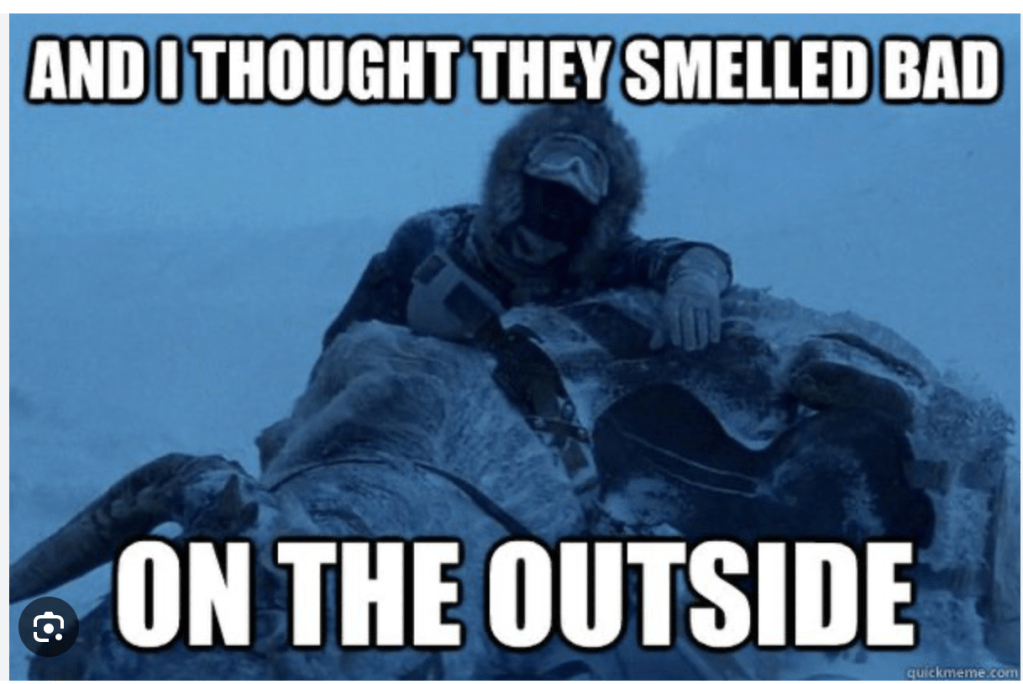
It is perhaps understatement to say that a mind-boggling set of circumstances had to exist to prevent Germany from developing and deploying a nuclear weapon before we did, and the seemingly innocuous hero known as reindeer moss could have been one of them.

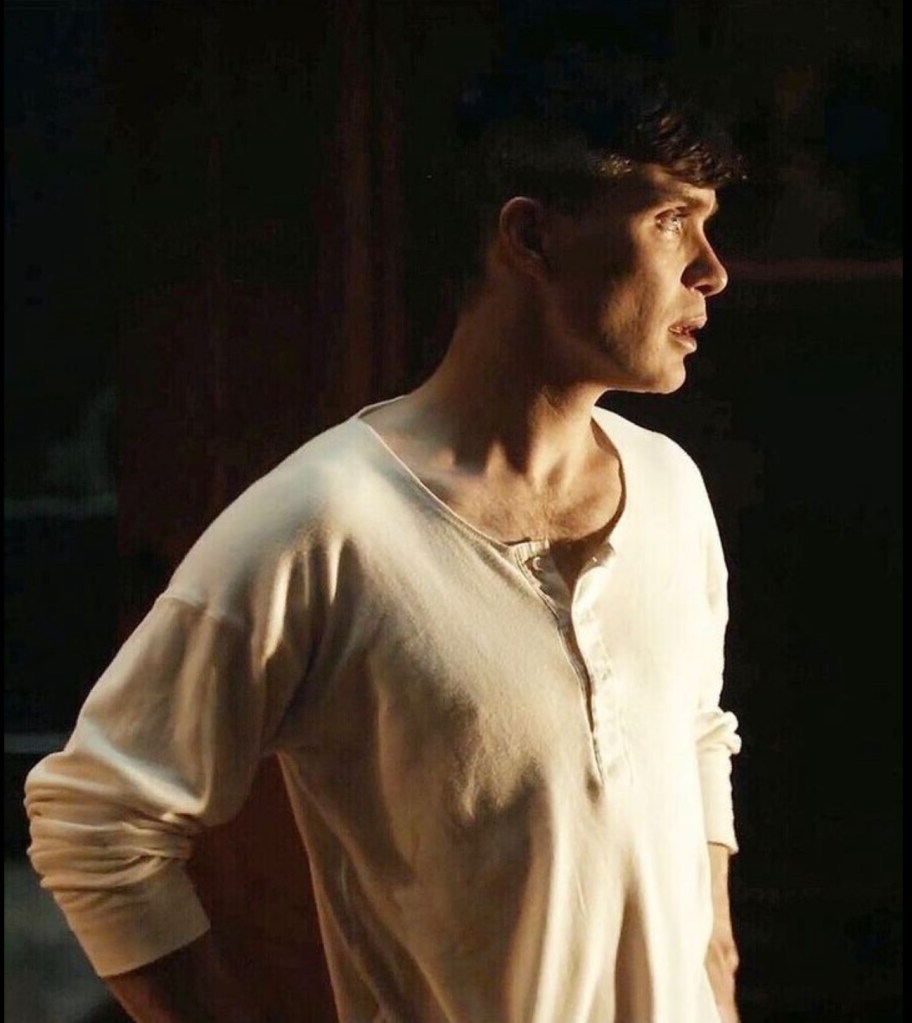
Speaking of Nazis and nuclear weapons, I’ll just take a moment to drop a plug for Oppenheimer and this Oscar-worthy brilliant performance.
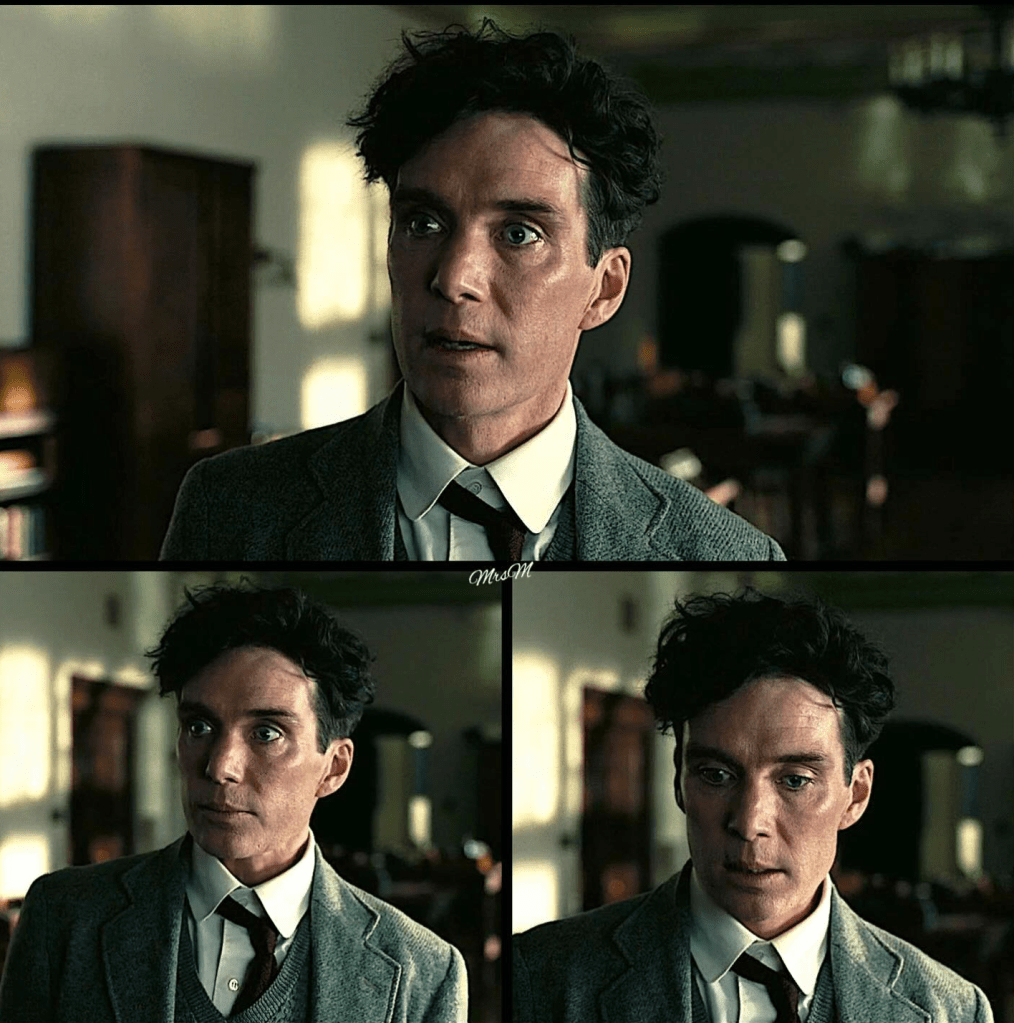
The singular Cillian Murphy

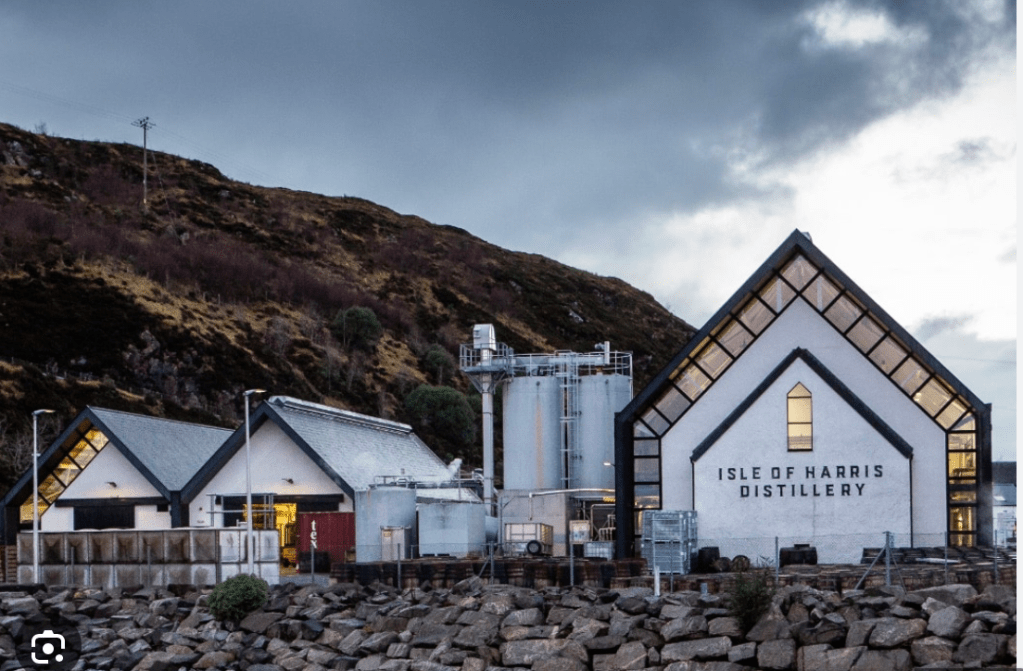
We ended our rather splendid, if water-logged day with a tour of Harris Distillery, the first (legal, ahem) distillery in Harris. It was opened and commenced production in 2015. Considering how long it takes to make and release whisky, the distillery did an excellent marketing job during what ended up being an eight-year interim period that included COVID. The BBC produced a documentary about their story, they held local and virtual ceilidhs and turned the distillery into a community gathering space. By 2017, the distillery had welcomed 144,000 visitors, including Prince Charles.

Also, like many Scottish distilleries, Harris makes a gin which provided income to hold them over since whipping up gin is a snap. While Botanist is probably the most well-known artisanal whisky-distillery crafted Scottish gin in the States, made by Bruichladdich on Islay, the behemoths, Hendrick’s, Gordon’s and Tanqueray – are also made in Scotland. The Harris gin is very, very tasty and was a smashing success from the jump. Its botanical of note is local sugar kelp seaweed (two tons collected by 2017) along with juniper, coriander, angelica root and cassia bark. It’s sold in a beautiful and distinctive ridged blue tinged bottle which won a Gold Award at the World Gin Awards in 2021 and is used as a table water bottle everywhere you look.

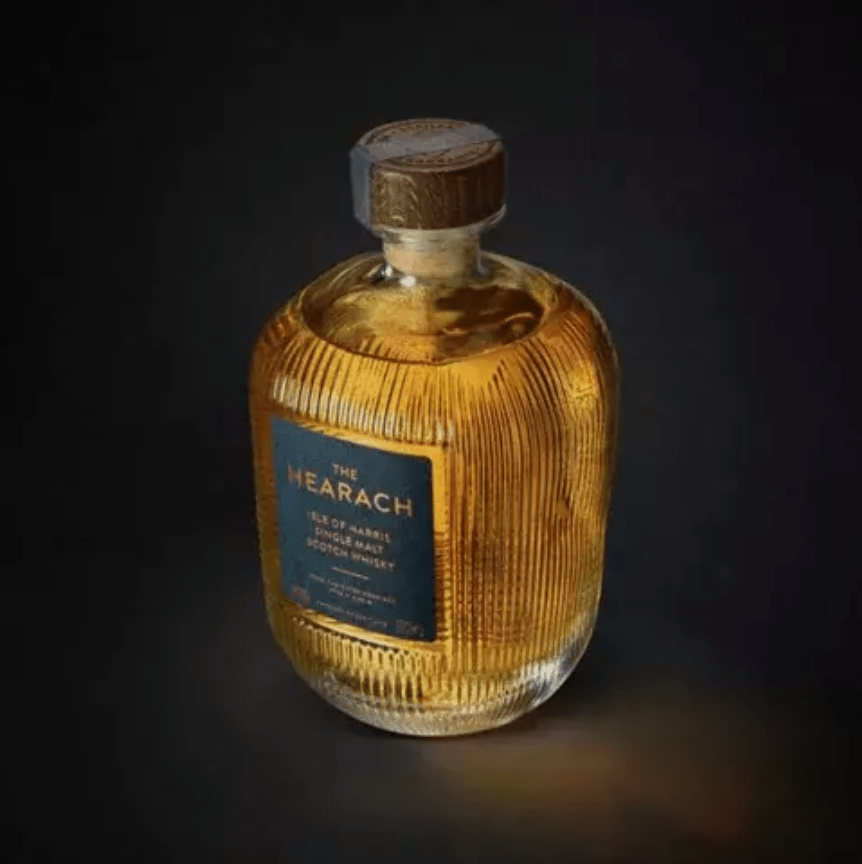
In yet another fun coincidence – Harris at last released its first whisky while we were there, the Hearach, which is Gaelic for a resident of Harris. And let me tell you, the entire island was utterly and completely stoked. We didn’t go anywhere the Hearach wasn’t offered up with a tinge of pride and excitement. The restaurant we had dinner on our final night, Flavour, which features just one seating, a tasting menu and an open kitchen, included the whisky in every single course and someone from the distillery was there to chat with us. The distillery has had a positive impact on the island economy, both in terms of tourism and its employment of local young people. It was created from the ground up as an integrated member of the Harris community. You love to see it, and you can definitely feel it.

The whisky is good, selling like hotcakes (I love that the first whisky release was 1,916 bottles, one for each resident of Harris), and the tour was fascinating. Every aspect of the distillery, the design, the materials, all of it – was carefully thought out and is related to Harris and its people. Many family members are involved with the company – and many women. And it’s the first distillery in my experience where they offer guests a taste of “pure spirit,” the clear liquid you see in the spirit safe – baby whisky before it’s casked and aged. Let me just say the alcohol content is hiiiigh.
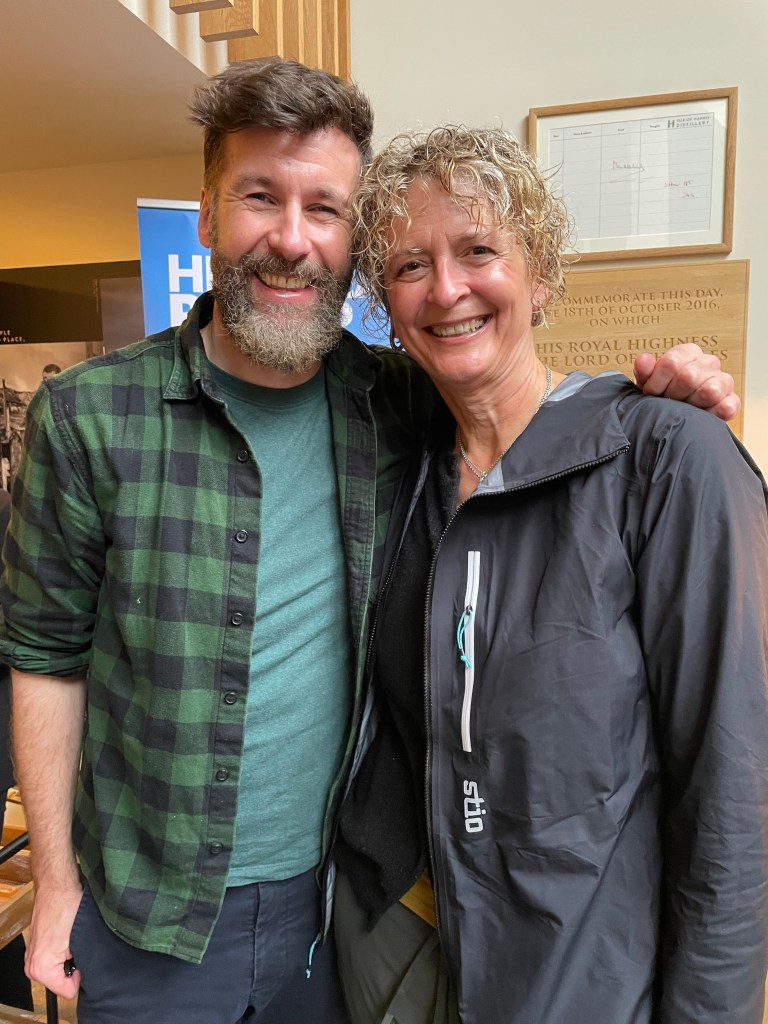
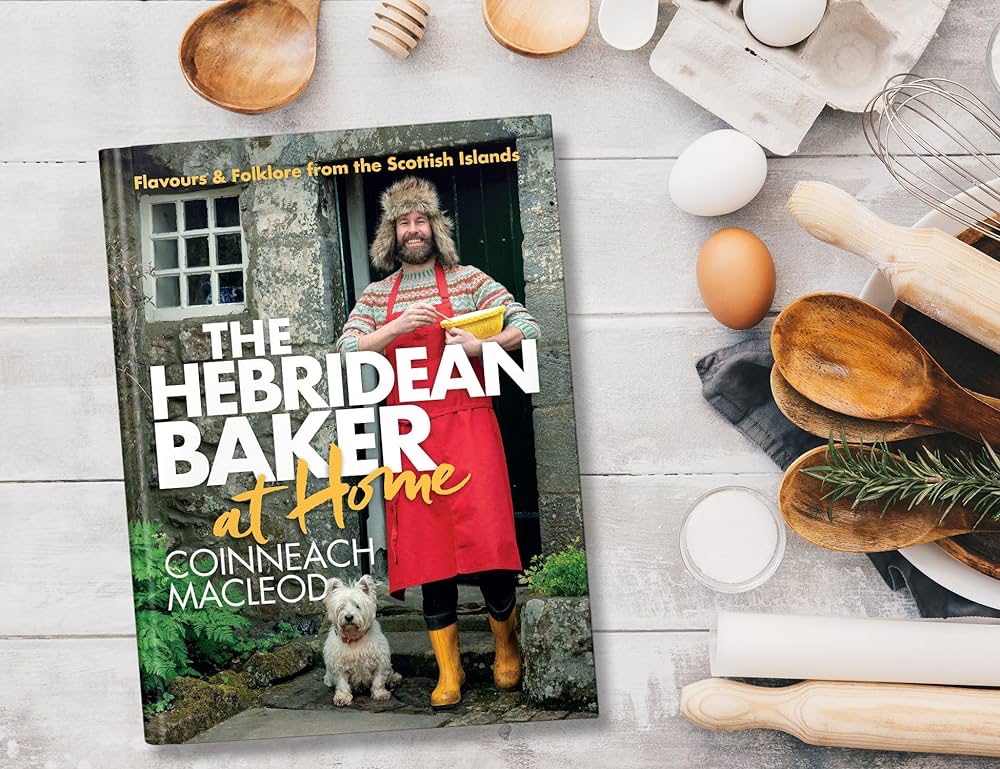
Are we tired of fabulous coincidences? No? Well – as it turns out the world-renowned, gorgeous and utterly charming Hebridean Baker happened to be at the distillery that day (actually Liam rearranged our schedule to accommodate this) signing his new cookbook, his third, which hasn’t yet been released in the States. His name is Coinneach MacLeod (told you) and he had recently returned from a tour of the States and is heading out again next year. Two of my travel companions met him recently at the Grandfather Mountain Highland Games in North Carolina, and he was genuinely delighted to see them again. His cookbooks are not only filled with scrumptious recipes with a Scottish flair, but lots of stories and tales, many wonderful photographs of the Hebrides, its residents, his west highland terrier Sonnach and his partner Peter.
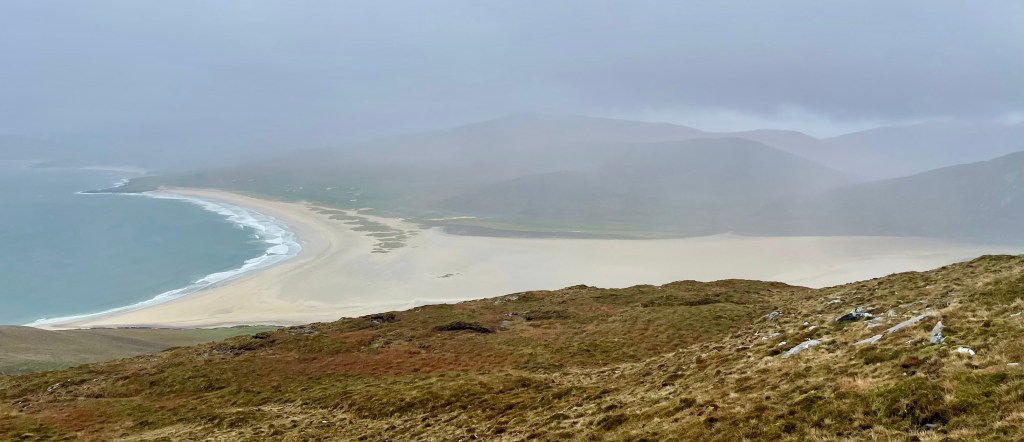
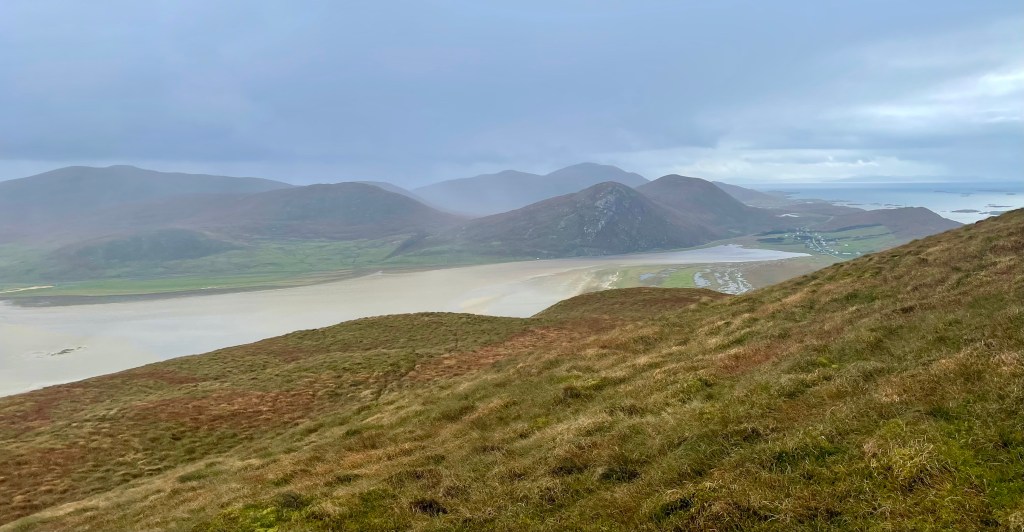
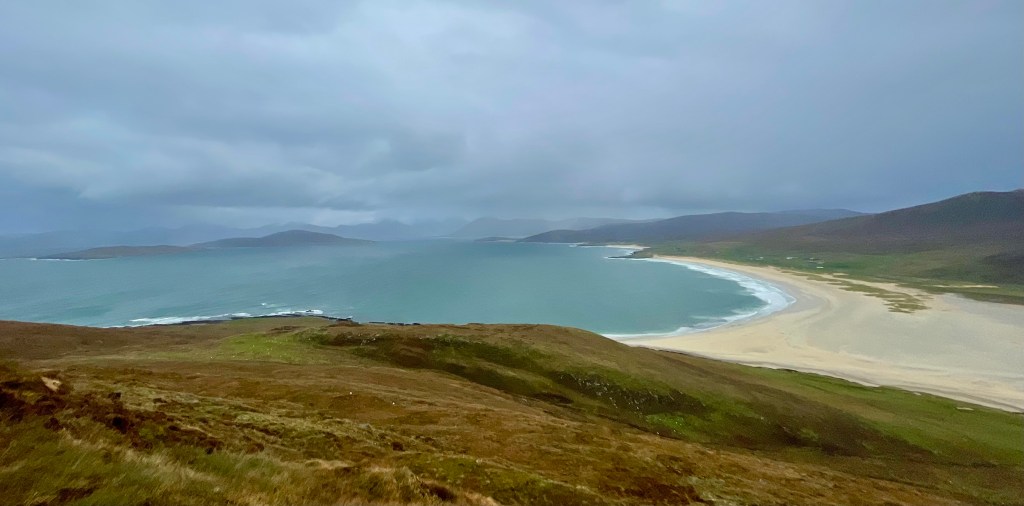
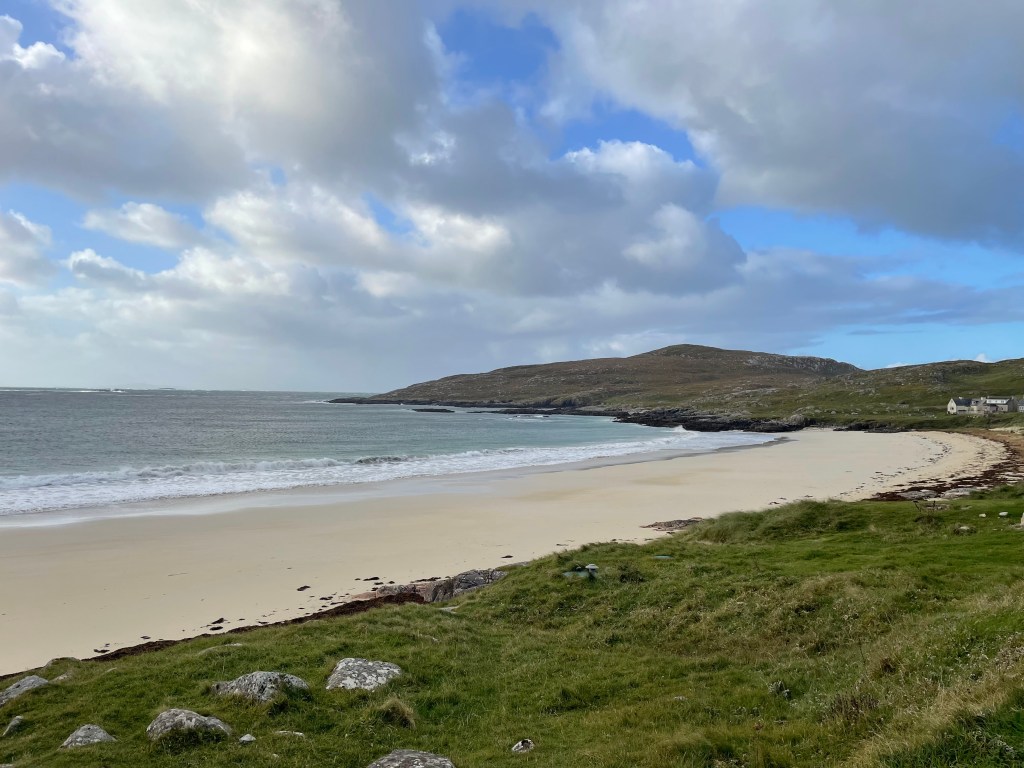
The following day was probably my favorite, Hebridean Baker notwithstanding, mostly because it was like a fantasy novel crossed with a Disney film, where our intrepid group were the only souls in existence – so maybe also a dash of post-apocalyptic adventure. We drove to one of the most well-known beaches on the west coast of Harris called Hùisinis, where a person could easily spend the entire day staring out to sea and pondering life’s big questions.

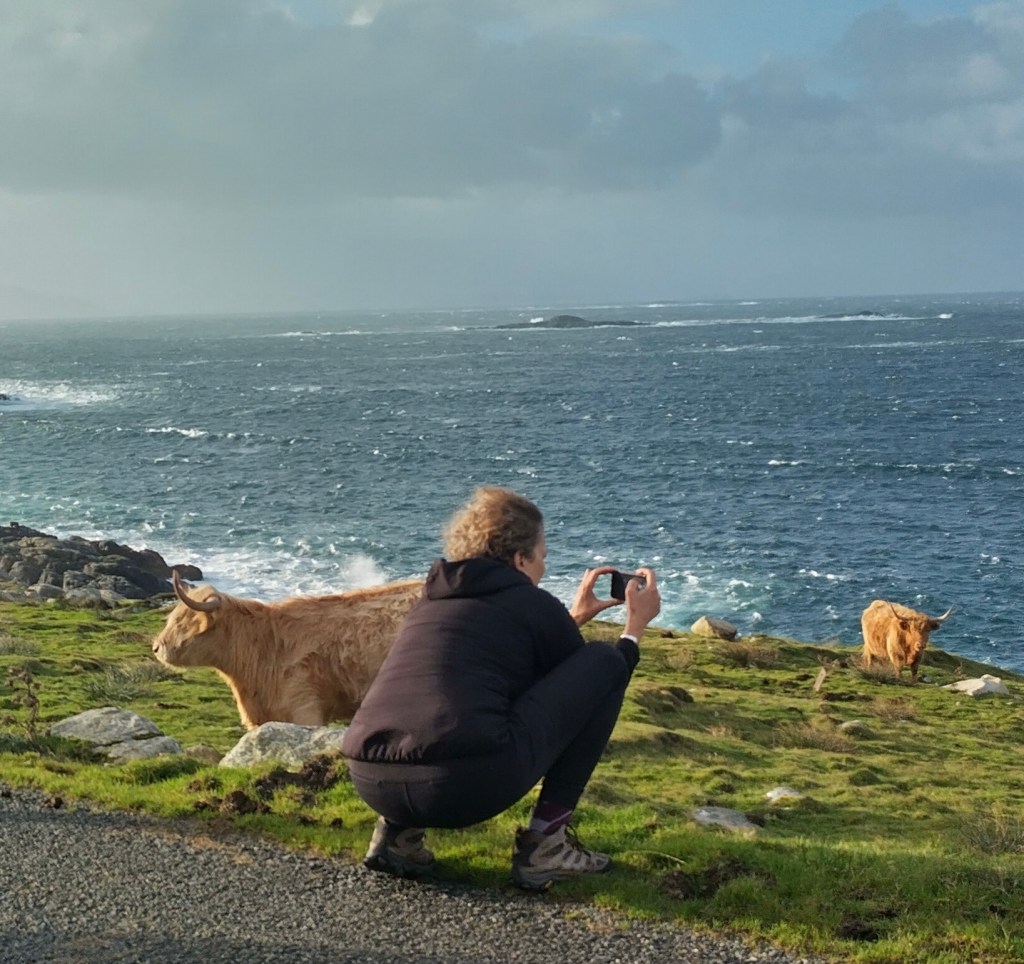
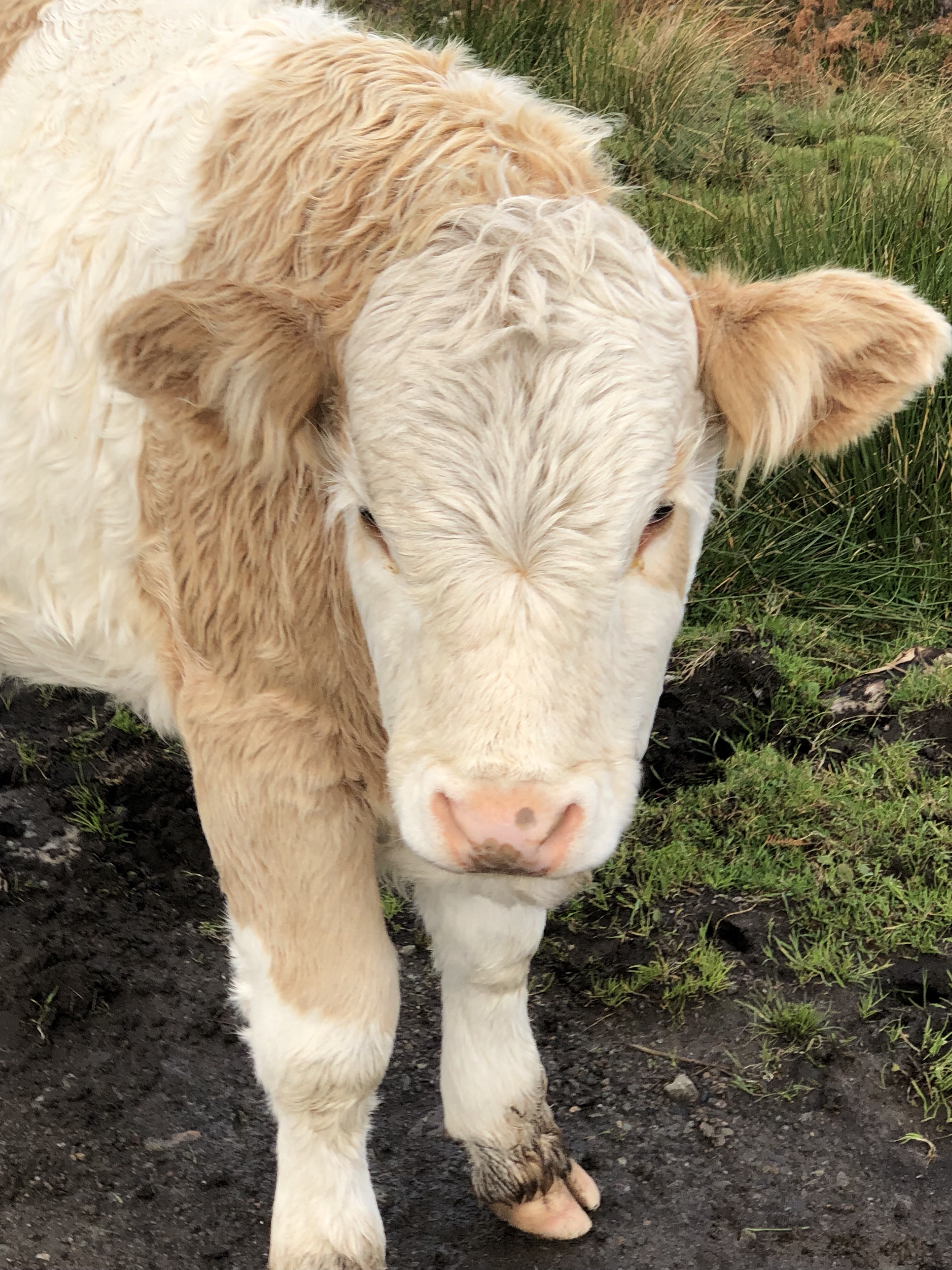
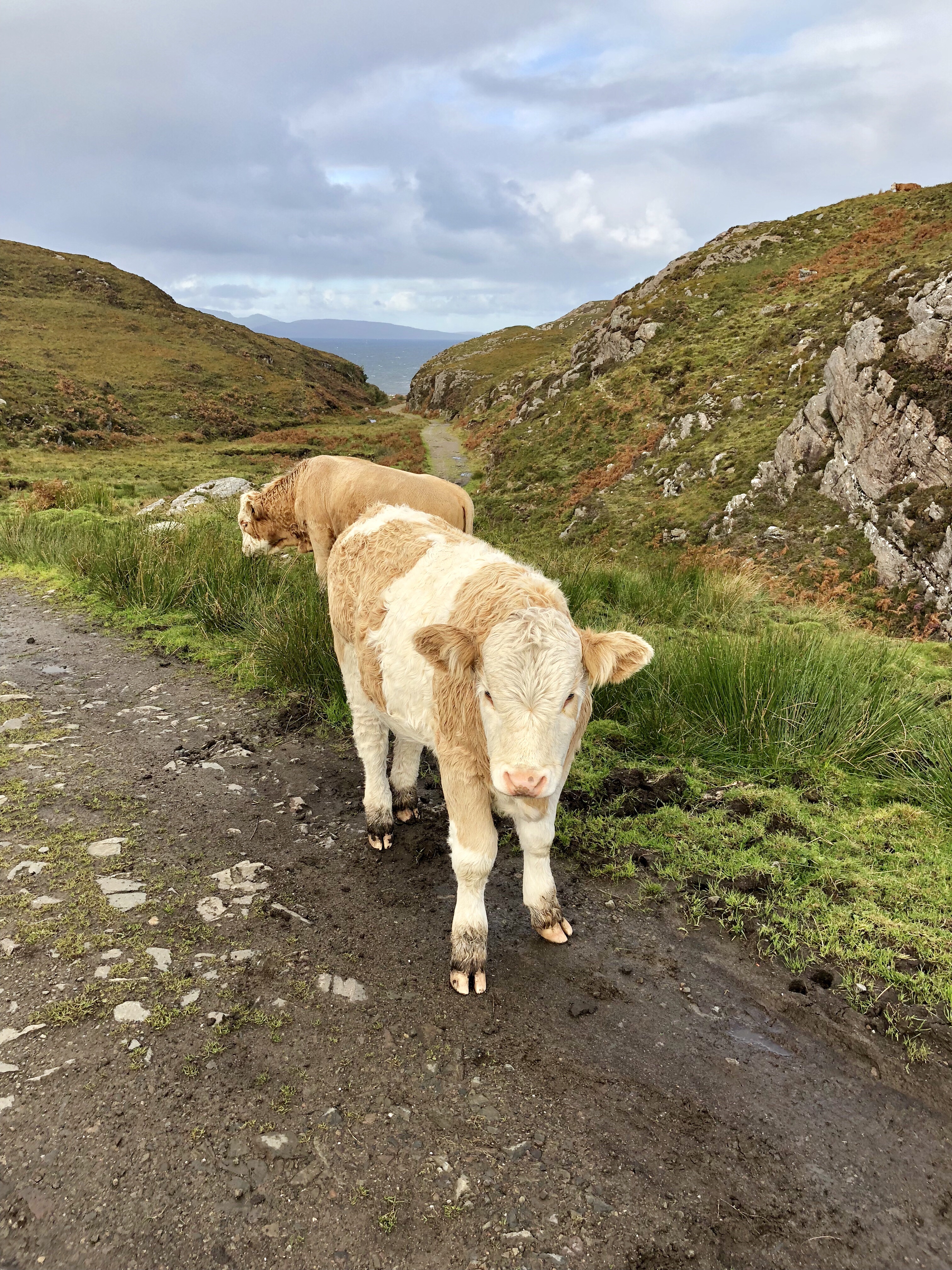
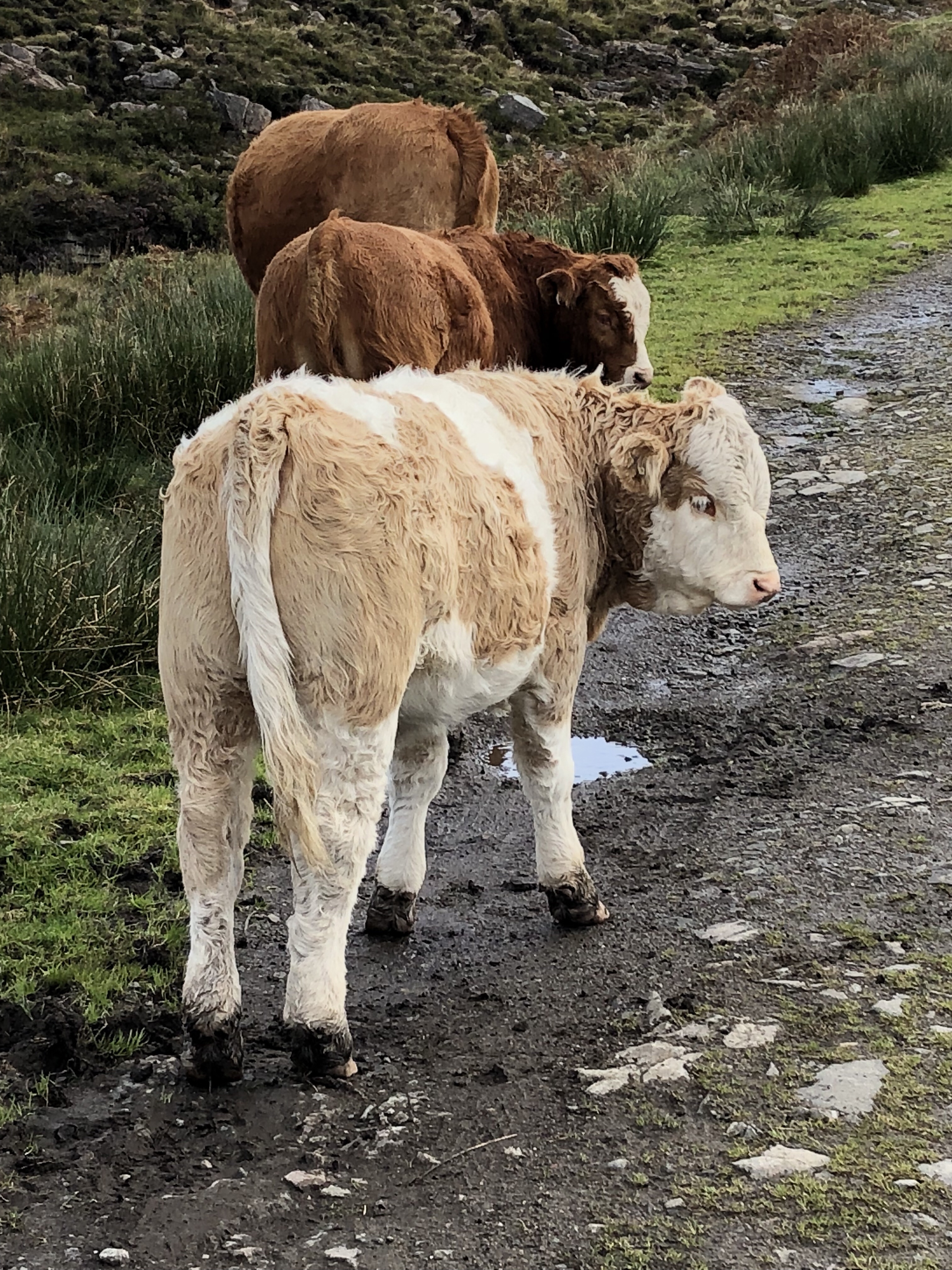
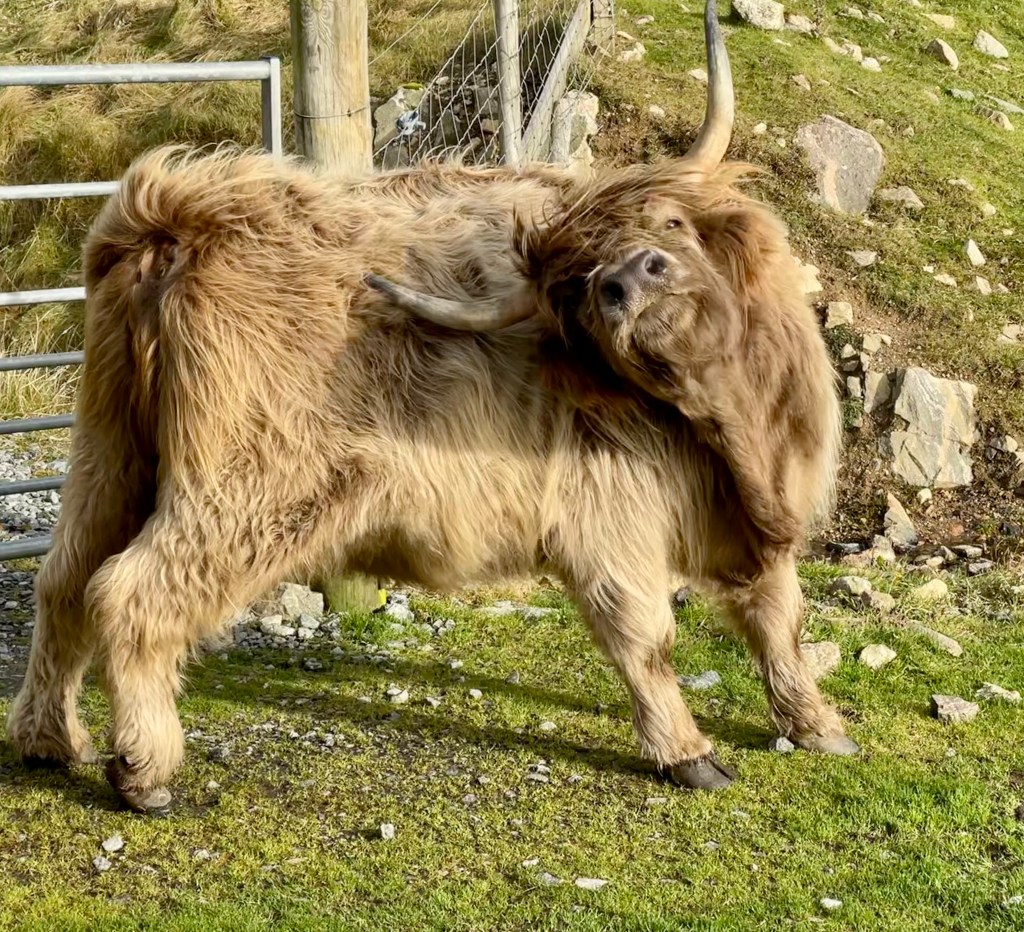
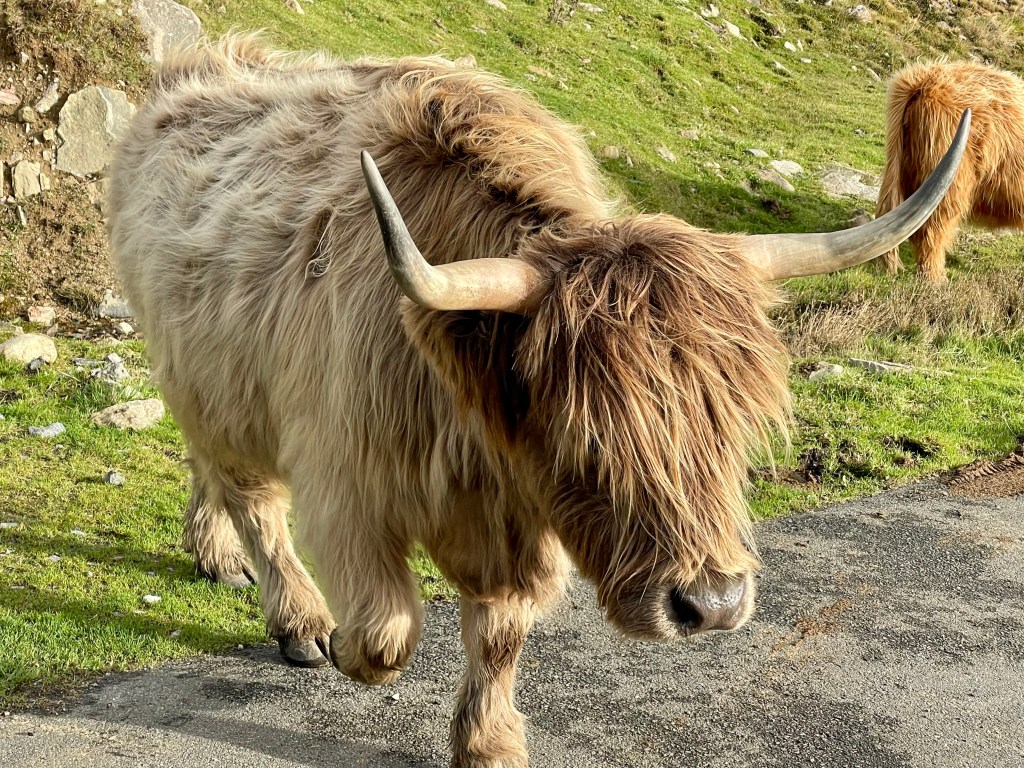
And we happened to run into some highland cattle on the drive there. These iconic beasts make tourists completely lose their minds. By this point I’ve seen a fair few of these lovely creatures during my travels but I will never fail to pull over when I come across a sacred Heilan Coo Gathering. In defense of tourists (which I rarely do) Liam, born and raised in Scotland, also loves them and kept remarking on their staggeringly high cuteness level. Coos are also extremely friendly and curious and seem to know they are being photographed because I swear they pose. They do not turn tail and skedaddle like sheep or other types of cattle. They must realize that they are a four-legged embodiment of Scotland and accept their lot with grace.
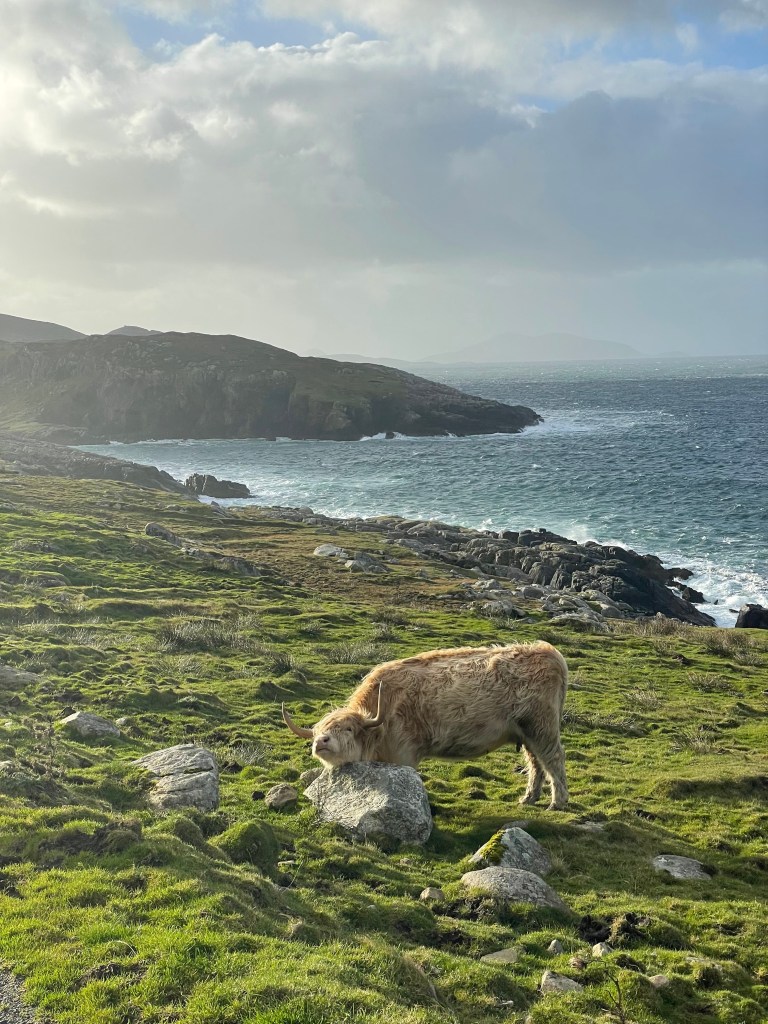
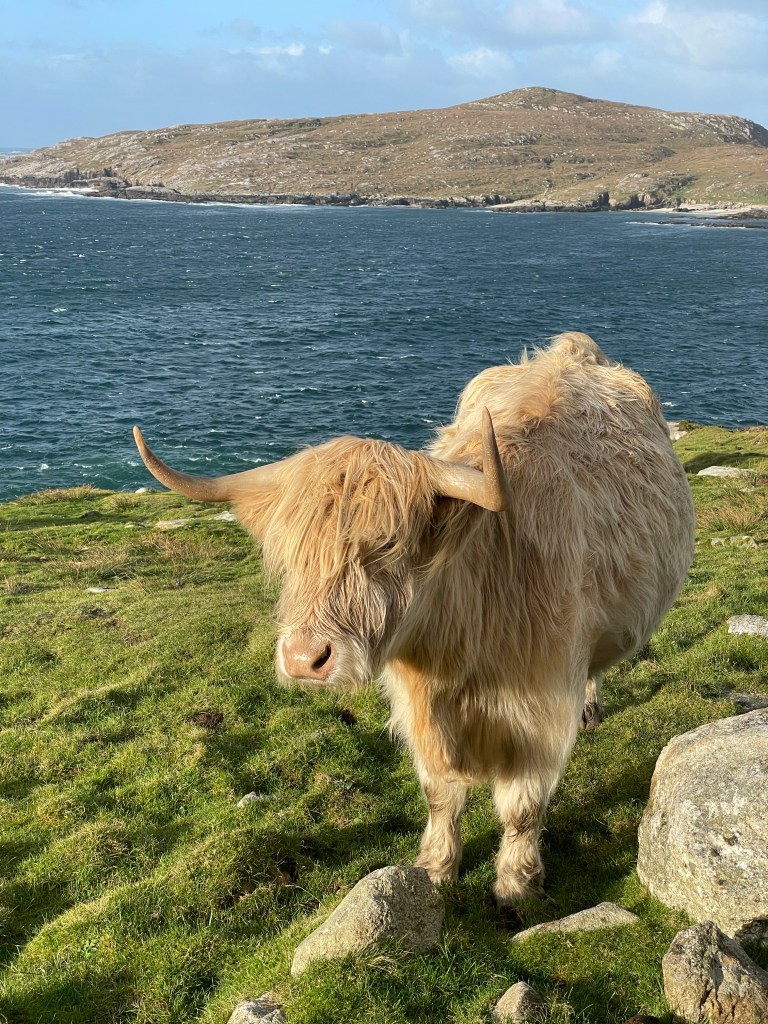
Yes, on an intellectual level, I know they are just cows.

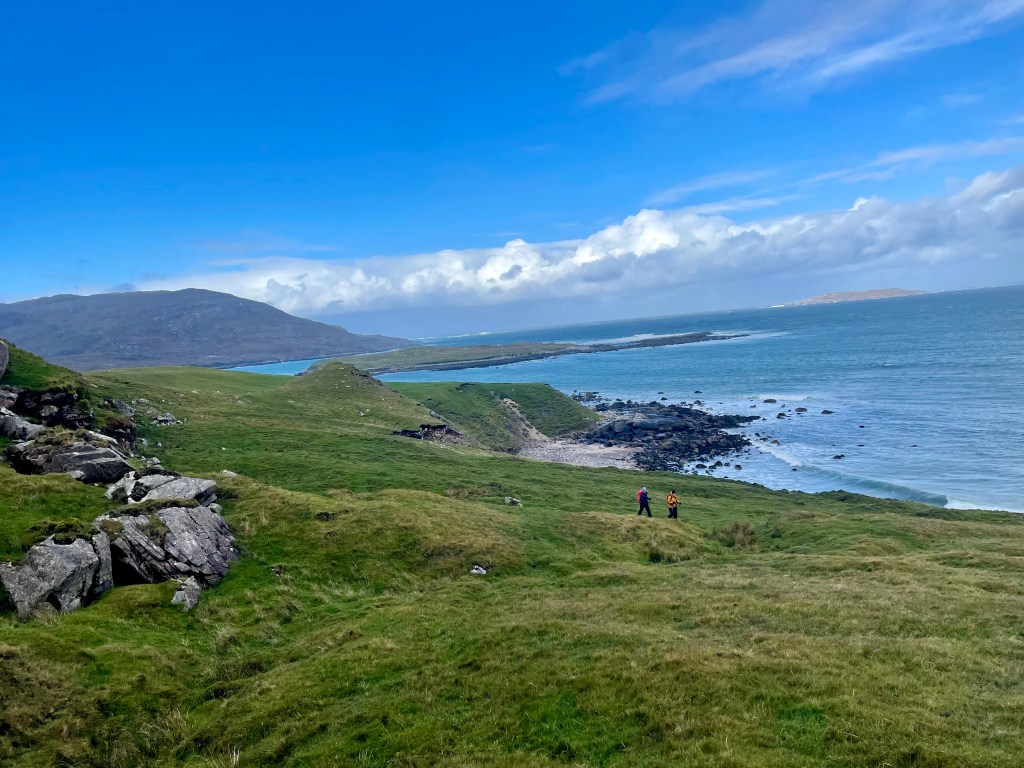
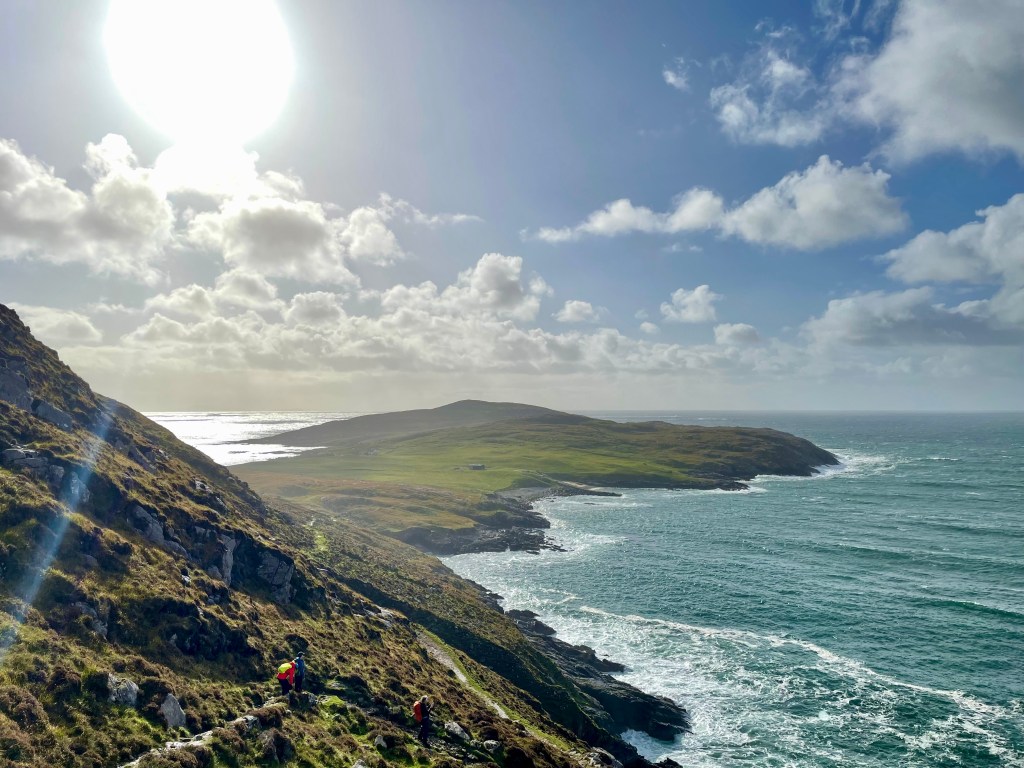
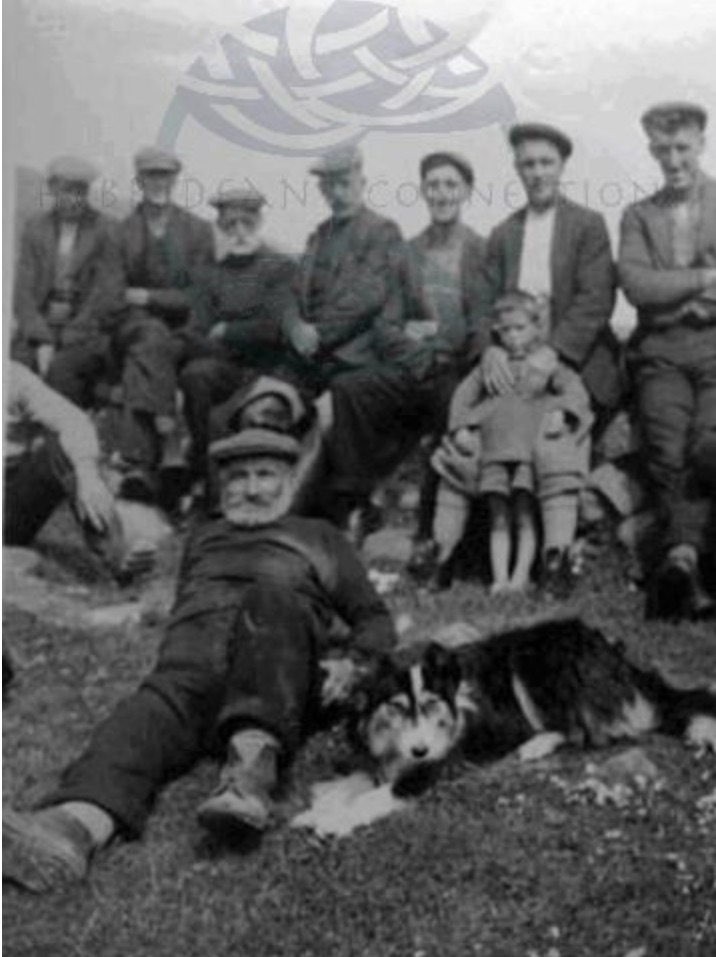
And so after taking in the sands of Hùisinis our merry band of walkers headed up a cliff over the sea. We had a view of Scarp, a now uninhabited island that of course has an interesting and quirky history, this being Scotland and all. In the late 19th century the four square mile island boasted 213 residents. Fun fact, it was one of several Scottish islands where all the men gathered every morning in a so-called ‘parliament,’ to agree upon the work to be done that day. Sometimes these meetings could last several hours and this provides yet another example of why women should be in charge. The last family standing, Mr. and Mrs. Angus MacInnes and their two sons, left in 1971 on a boat. They landed at Hùisinis, their cattle swimming behind them. I like to think that they were highland cows.

Below is an undated photo of hardy Scarpians.
The remaining residents were Andrew Miller Mundy and his school friend Andrew Cox, who had moved to the island earlier that same year with his wife and baby. Several weeks after the MacInnes family left, a huge storm cut off the island and provisions ran low. Even though Scarp is only half a mile from Harris a storm can whip through that strait like nobody’s business, rendering it unnavigable due to swell and current. Mundy, in London at the time, sent a helicopter to rescue his girlfriend (romantic), a model who he later married (also romantic). And thus Scarp became a deserted island.

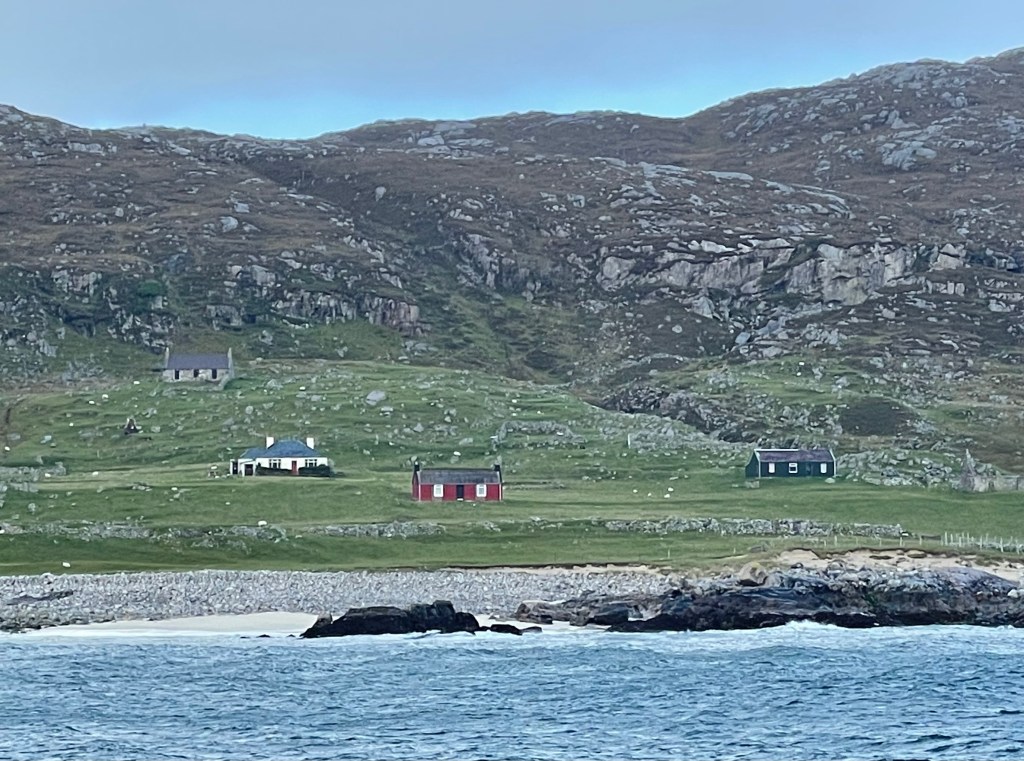
A handful of picturesque holiday homes remain that you’ll see in a minute, keeping in mind that they are only accessible via sea kayak. The island is owned by American musicologist Andrew Burr Bakewell, the founder of Harris Distillery. And I should see if he’s single.

I found a recent expired listing for a home on Scarp called The Primrose Cottage. A few tidbits: “There is no doubt the property requires significant upgrading,” and “we understand” the building had a new roof installed six years ago. There’s no septic, spring water is “available year-round” (bonus) and electricity is provided by a generator, although thankfully there is internet so what more do you need. The listing ends with “Brace yourself, Scarp is not for the faint-hearted.” There’s a restriction against using the property for “tourism/holidaymakers.” The realtors were accepting offers over £100,000. I wonder if it sold.

Liam also told us about another singular event for which Scarp is reknowned. In 1934 it became the setting of an exciting, if dubious, trial of the Western Isles Rocket Post (I swear). German scientist Gerhard Zucker, apparently filled with a desire to “bring the world together” via a postal-delivery system tried to send a literal rocket packed with 4,000 letters (some addressed to the King) over to Harris.

The mission failed with a dull explosion and a puff of smoke with smoldering letters scattered everywhere.
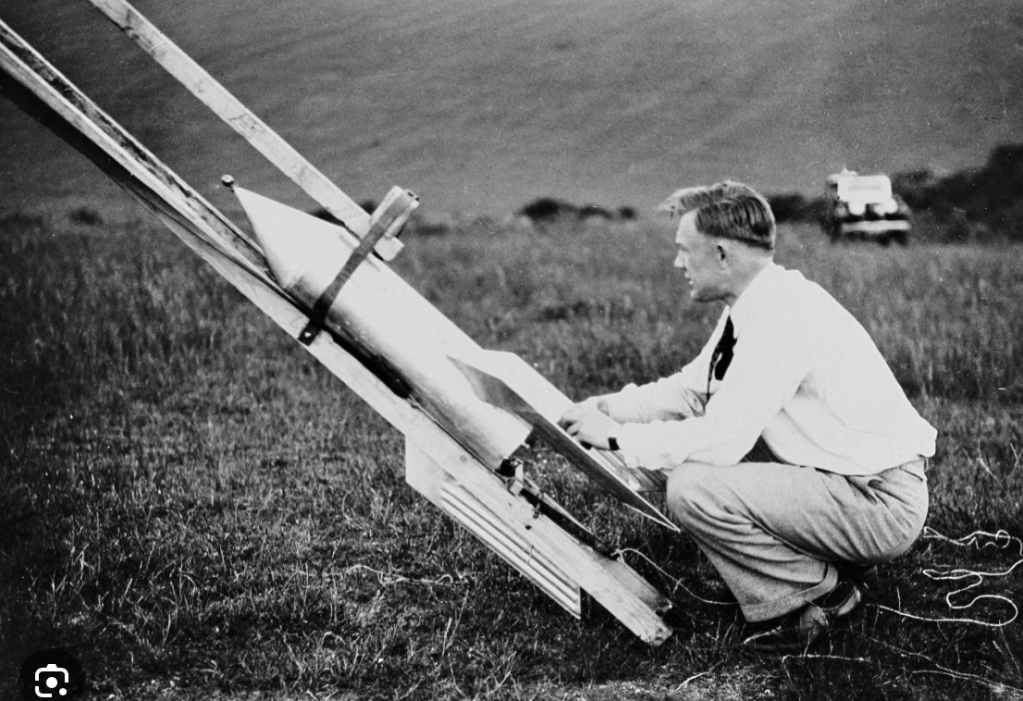
The day the rocket was launched, 28 July 1934, became known as Latha na Rocait. There’s a film about the whole affair named The Rocket Post that won the grand prize at the Stony Brook Film Festival. A play by the same name was produced in 2017 by the National Theatre of Scotland. The publicity materials state that it’s “part-play, part-gig and part-hoedown,” and is “full of humour, heart and hope for the future, it’s a tale of miscommunication, vaulting ambition and the joyous discoveries that can happen when everything goes wrong.” Indeed.

So what ever happened to Gerhard? Online sources suggest that he was deported back to Germany for postal fraud which is sort of hilarious, only to be detained by the German government for having cooperated with the British, which is more on the perilous side. Apparently Gerhard had pitched his rocket mail idea to the Germans before his Hebridean experiment. He joined the Luftwaffe, was badly wounded in 1944, and ended up working as a furniture dealer in West Germany and thus his wish to bring the world together ultimately fizzled out just like his rocket.
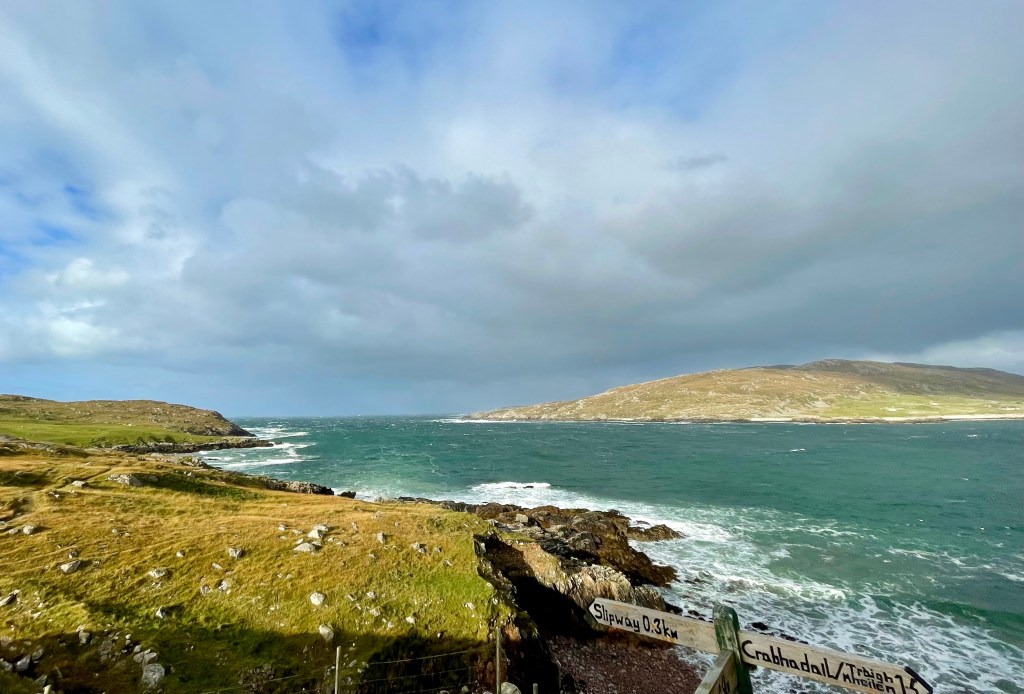
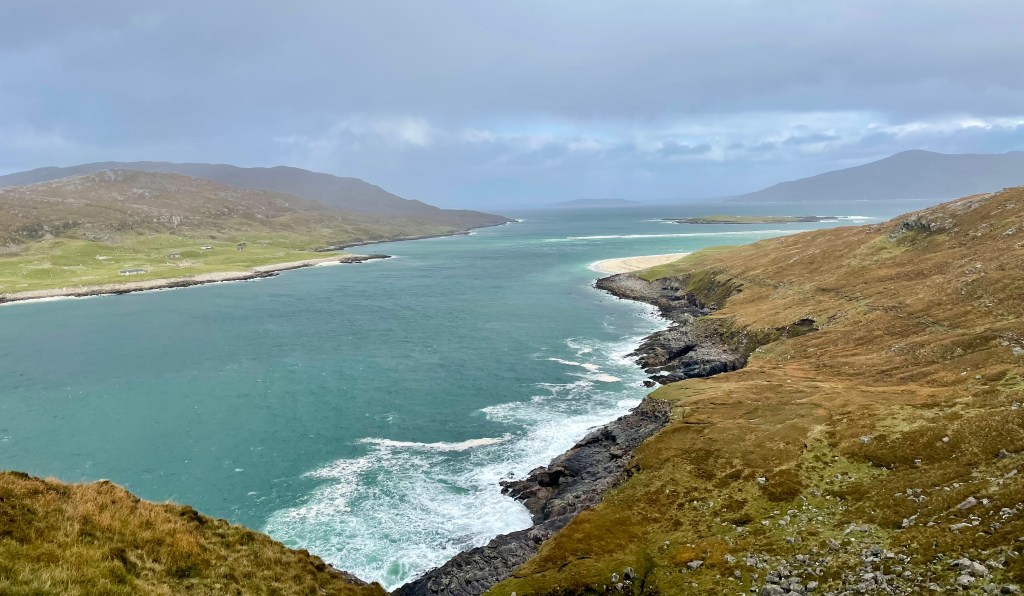
The Strait of Scarp, or Caolas an Scarp
Magic mushroom
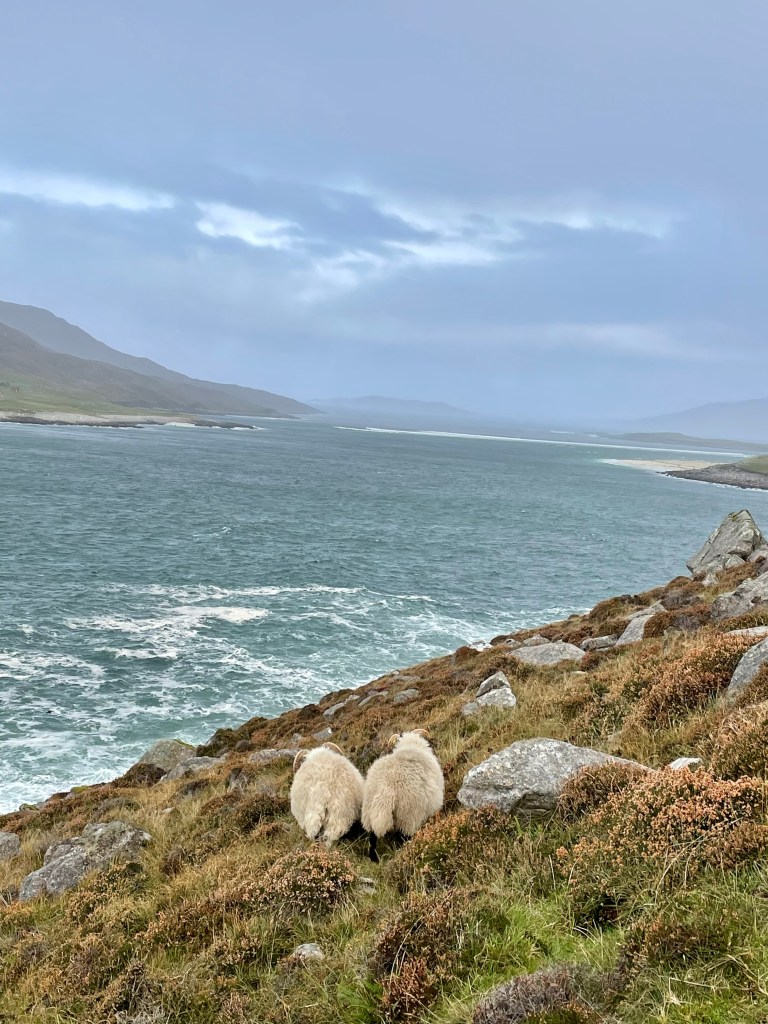
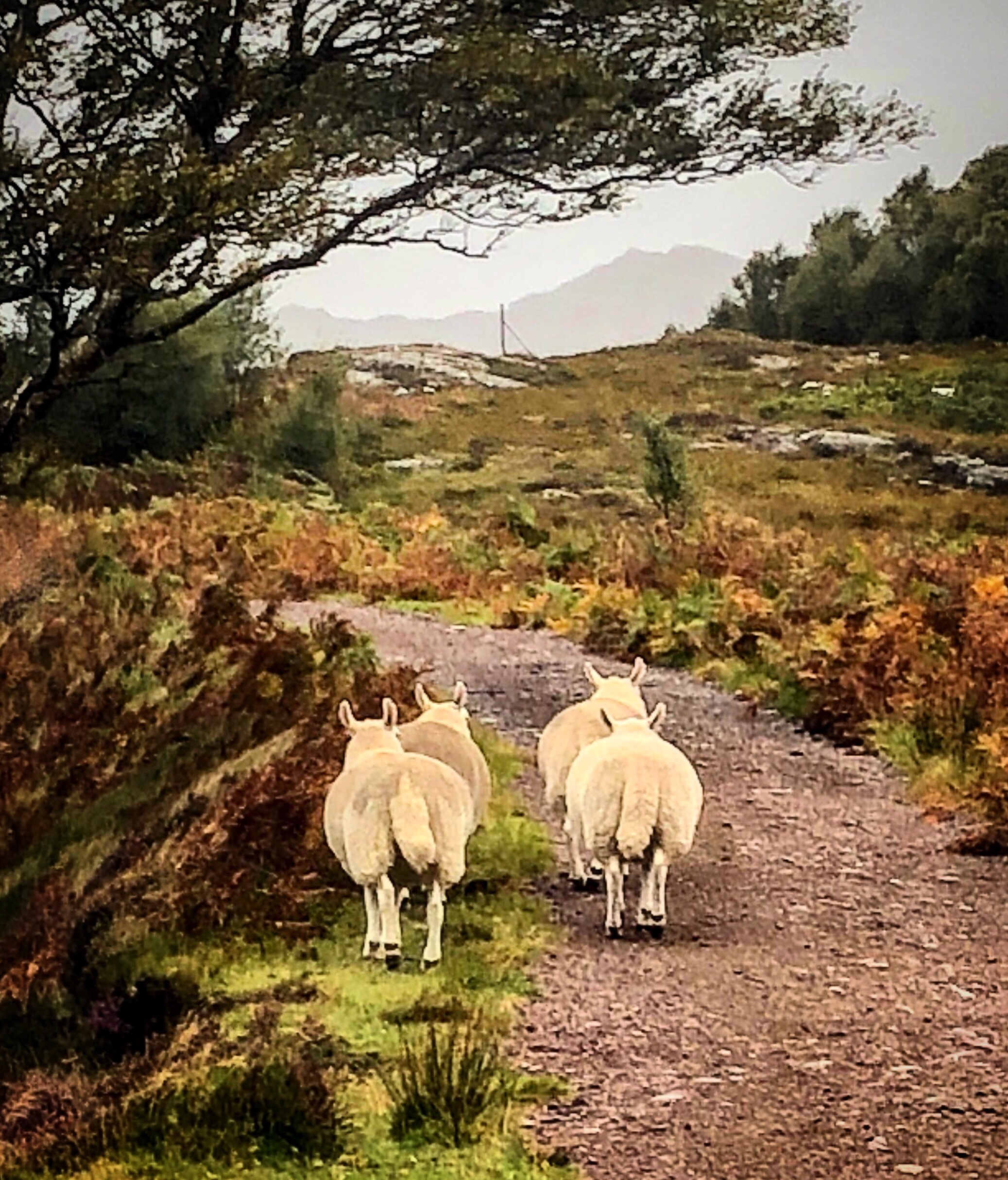
Sheepie butts

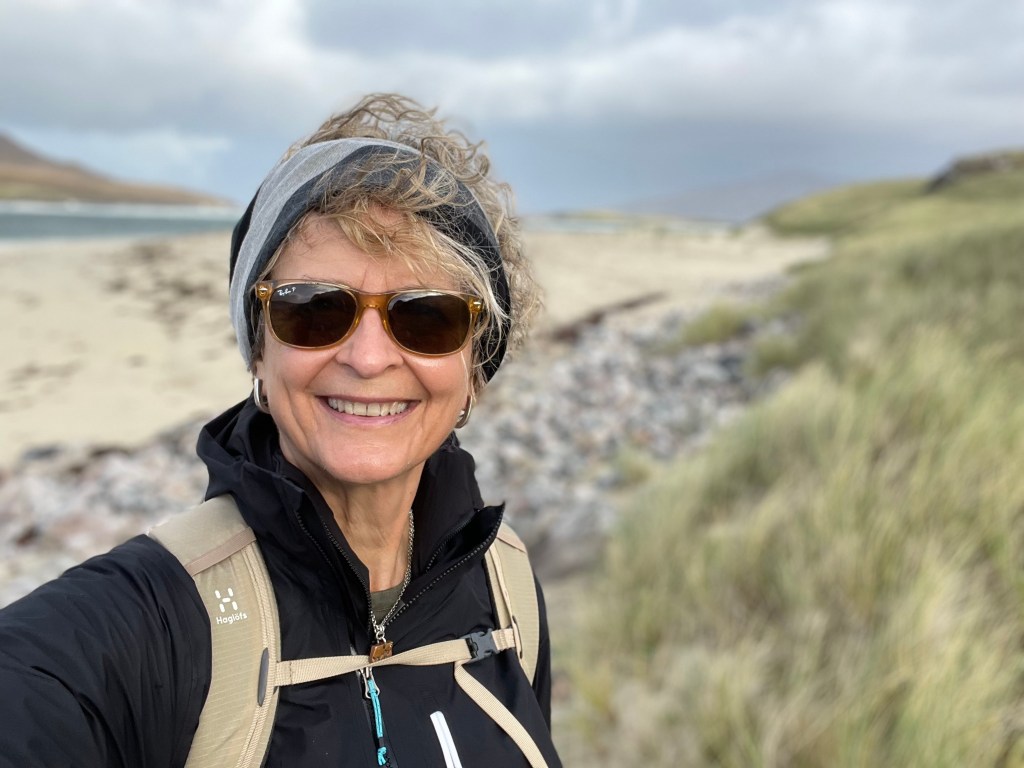
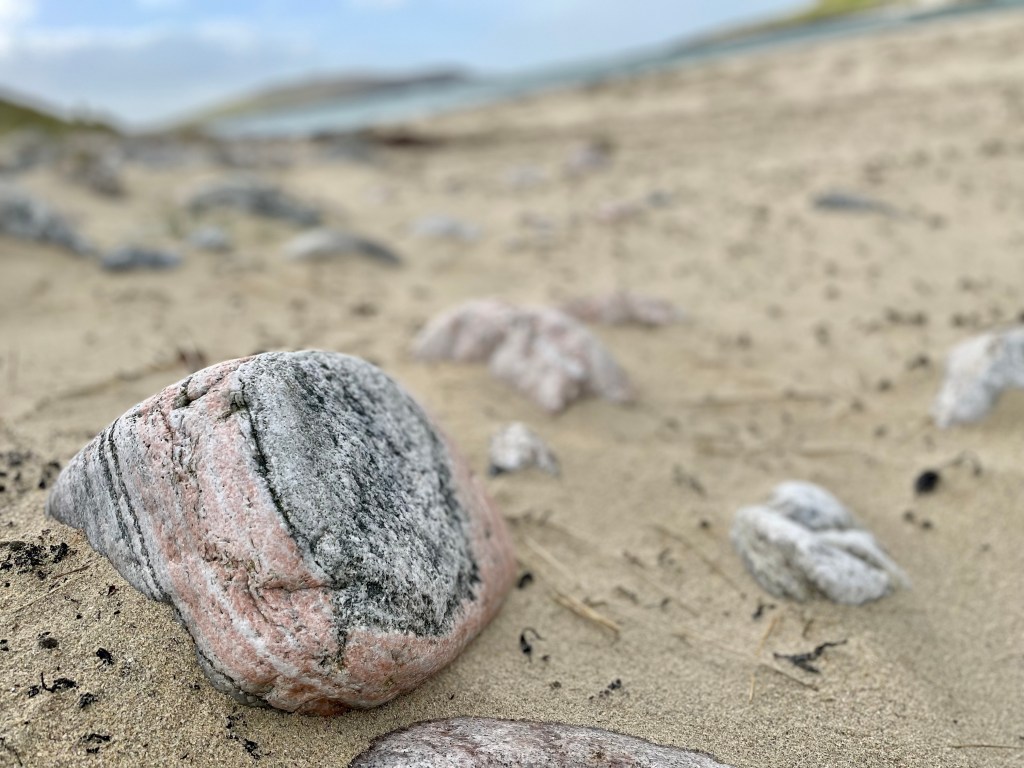
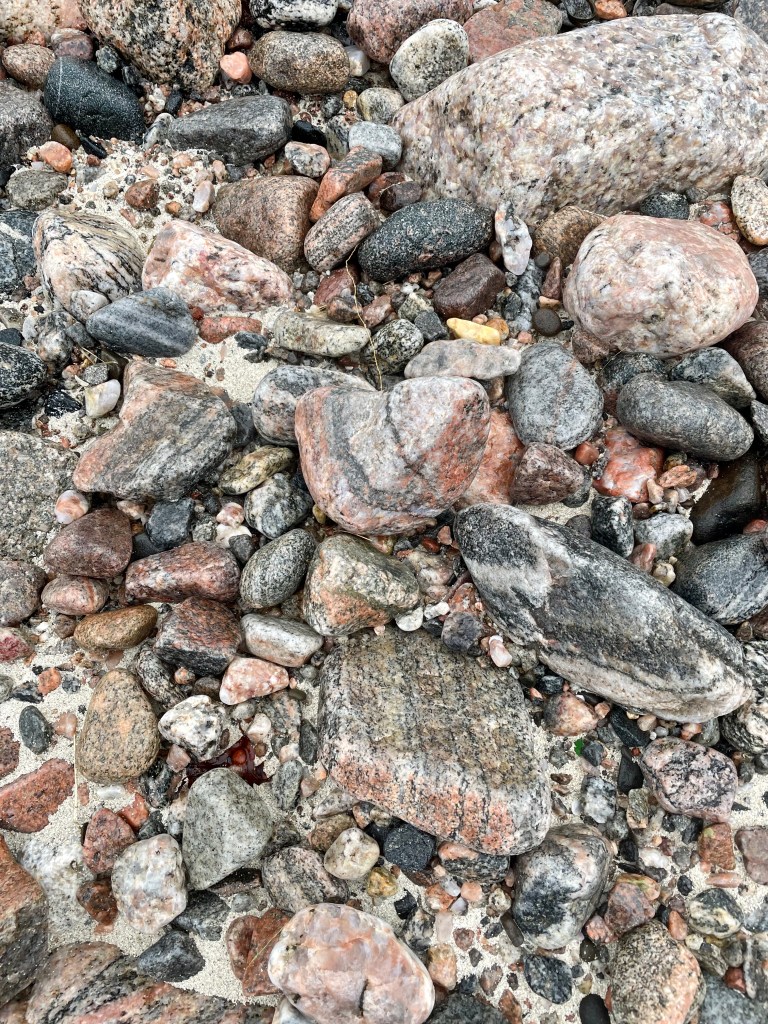
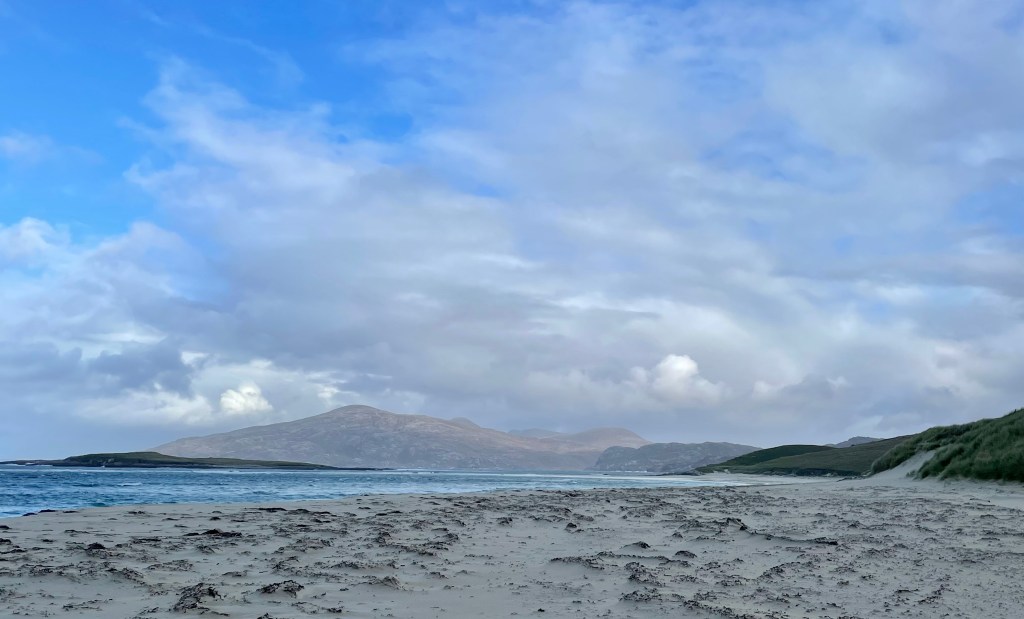
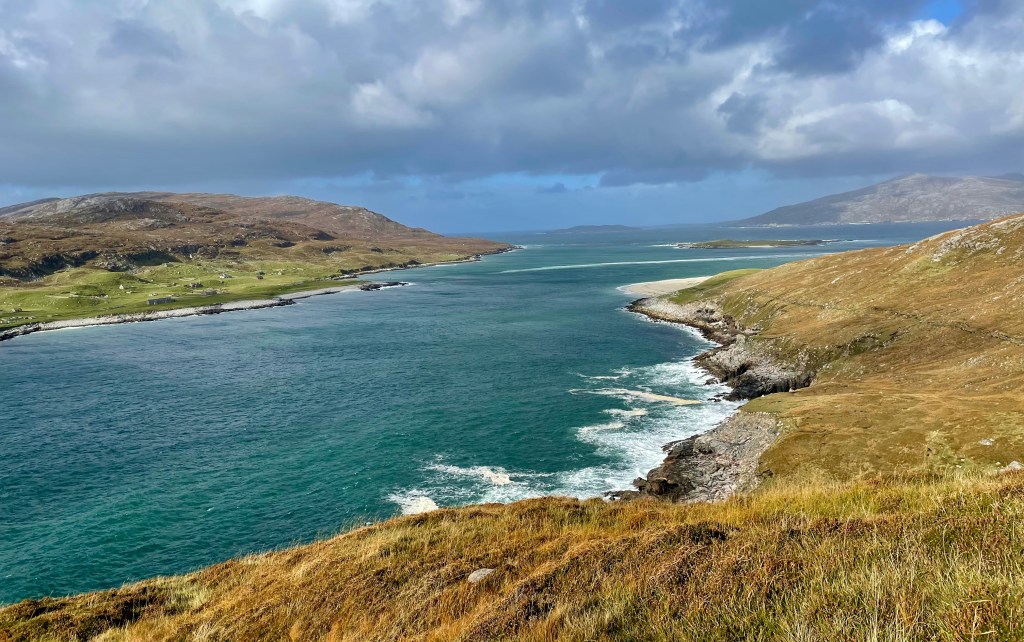
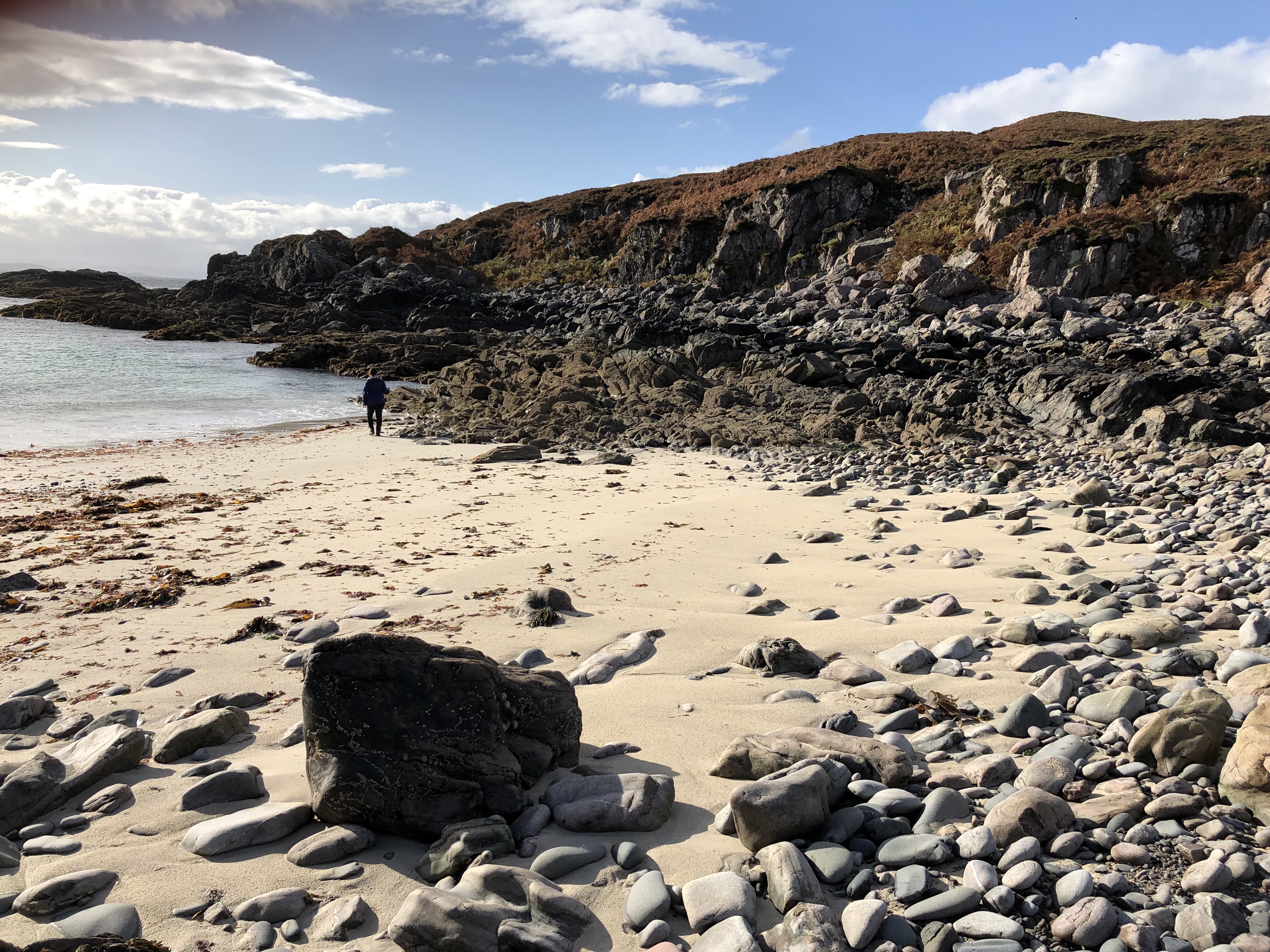
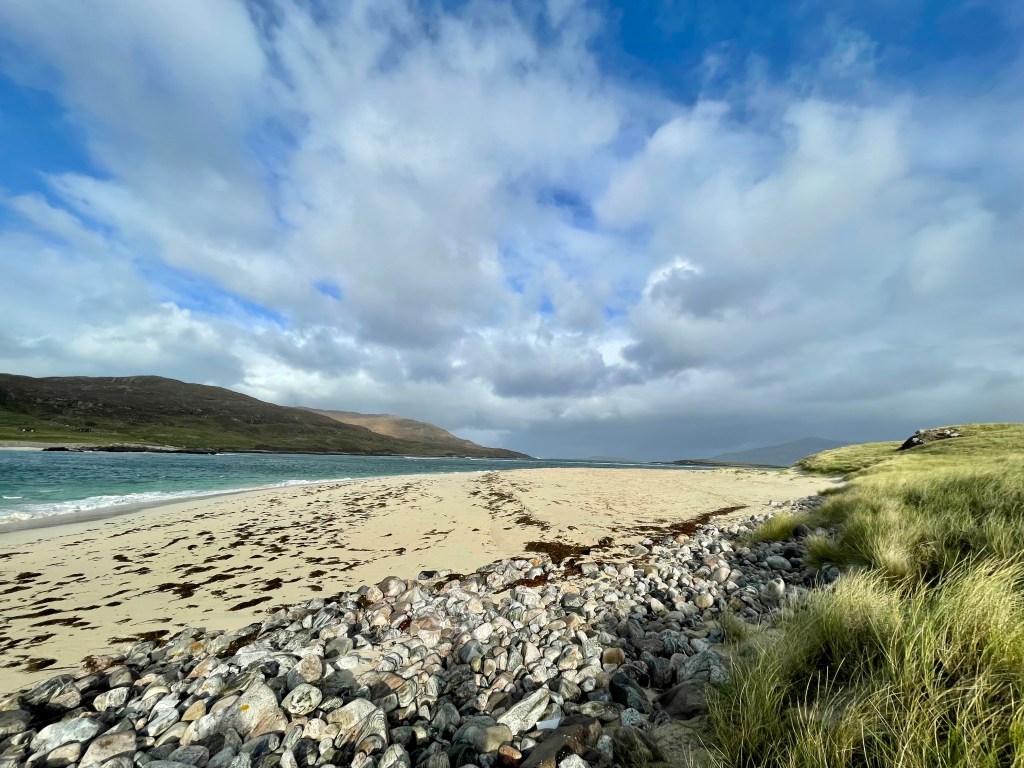
So, after our beautiful cliffside walk, we dropped down to another impossibly white beach, Tràigh Mheilein, only accessible via this walk. Spectacularly beautiful, deserted, and seemingly stretching on into forever. Gorgeous multi-colored rounded stones were everywhere, evidence of the complicated geographical history of the island. The weather changed approximately five million times as we meandered down the beach. Rain pants off, rain pants on, sand everywhere. Rainbows, dark clouds, blue sky, wind, no wind. The beach was framed by the Strait of Scarp with distant Atlantic views on one side and green rocky hills on the other. The water constantly changed color and character along with the weather. A few quintessentially Hebridean houses sat like lonely sentinels across the water on Scarp.
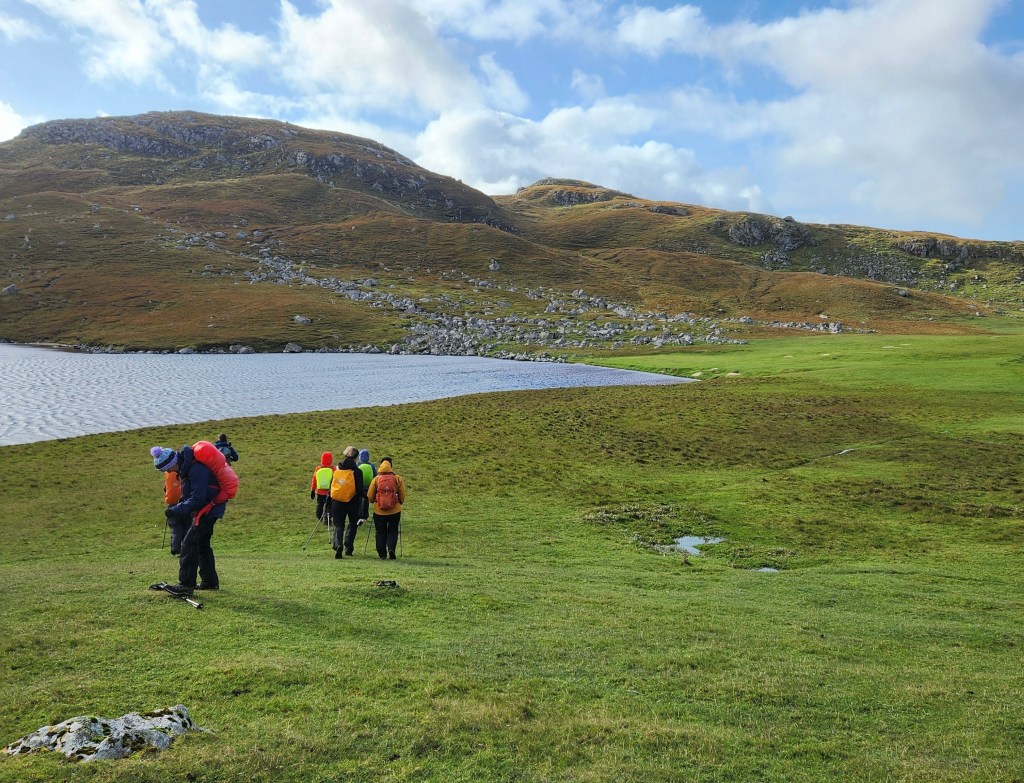
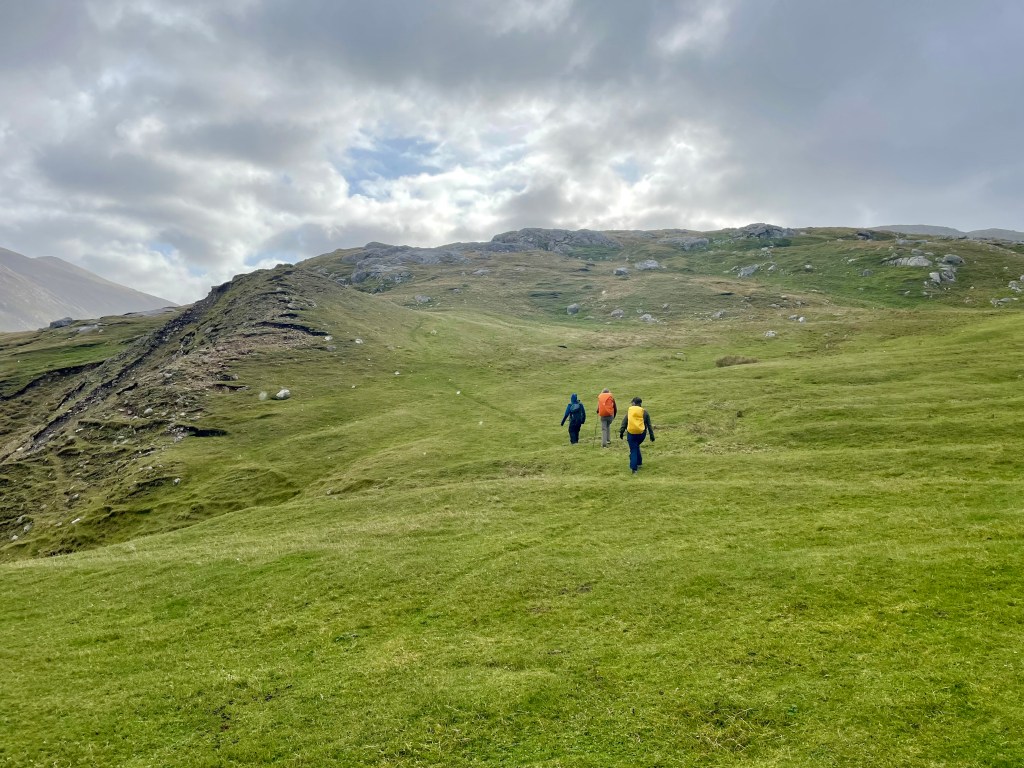
After a hasty picnic lunch in a sheltered area behind some rocks, we turned away from the water and climbed up onto a ledge where a huge expanse of bright green stretched out before us. It was like stepping through a portal into another world. There was no trail per se, we just traversed its expanse like we were in the Sound of freaking Music, only with the ocean behind us and below and mountains and lochs ahead. Each of us exclaimed something along the lines of holy crap how is this a place that exists. The well-traveled Liam shared that it was his favorite spot, maybe in the world.
Could only convince one of our crew to do the traditional model pose with me.
Liam in his favorite place.

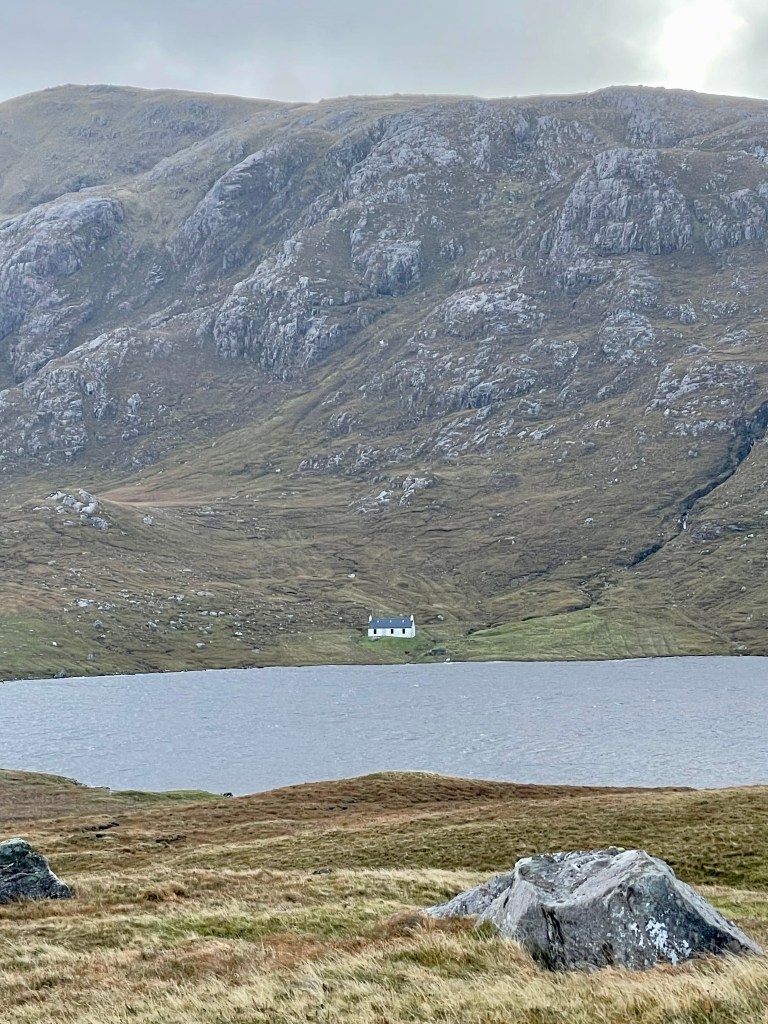
We walked along this loch, marveling at the lonely white house on the other side (a deer stalking cottage leased by a nearby estate) when suddenly a green field studded with white rocks opened before us – and hundreds of bunnies scampered in a flurry, disappearing down into their warrens. It was – ridiculously magical. Of course I couldn’t snap a photo in time, but they were just here:

We walked a bit farther and then spotted a huge herd of red deer up on the ridge – and they kept a steady eye on us as we climbed up toward them, finally dispersing as we grew too close.
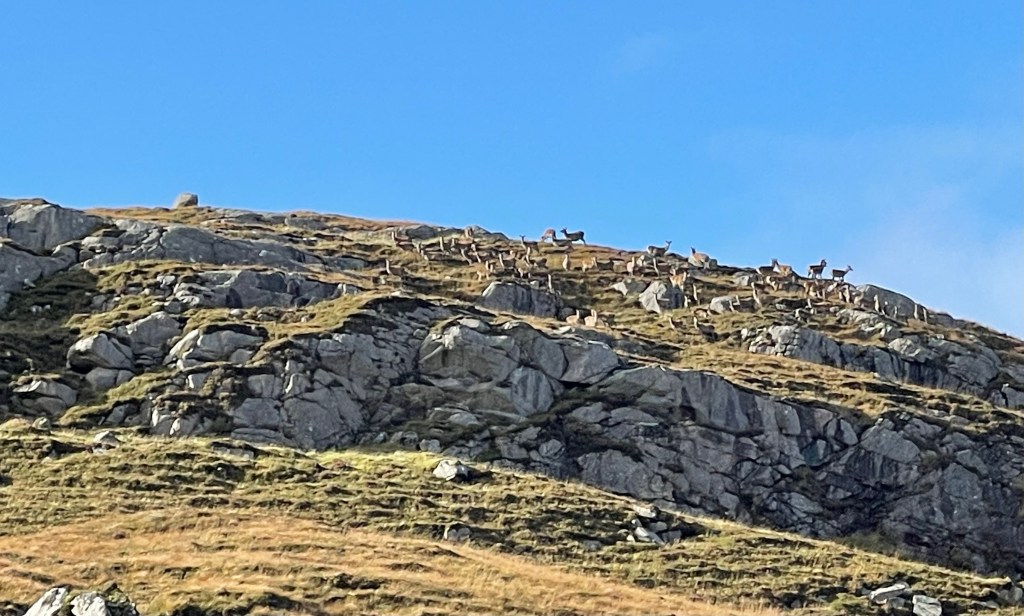
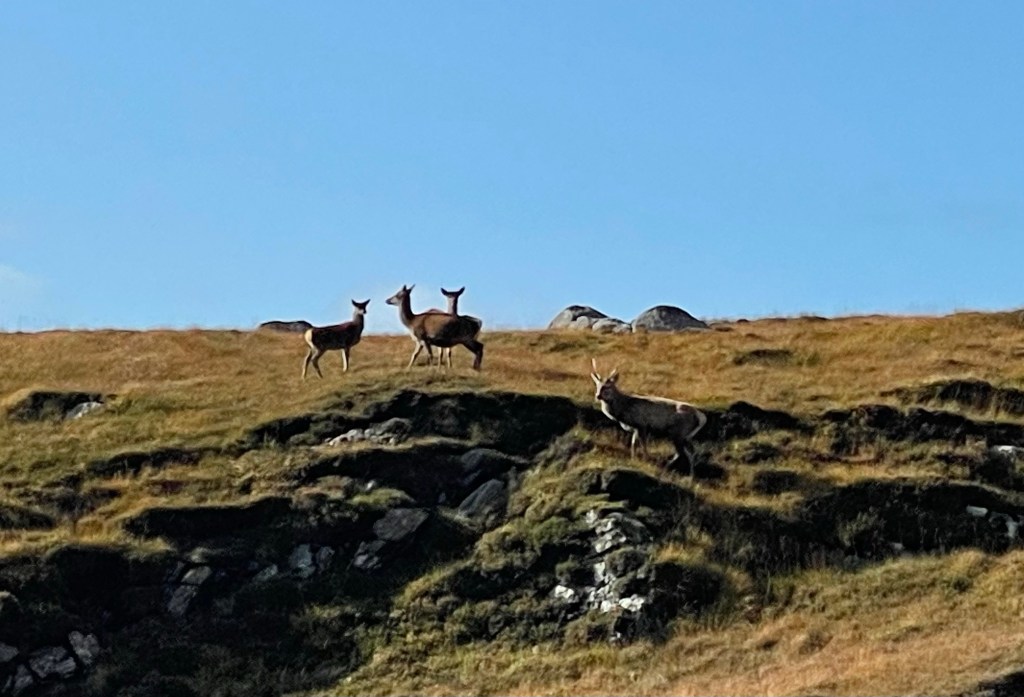
The views back over the loch and bunnyville were fab.

As we crested the ridge and headed back to the sea a juvenile sea eagle soared overhead, tracing giant, graceful circles in the sky. While commonly referred to sea eagles, they are officially called white tailed eagles. They boast a seven foot wing span and are the largest bird of prey in UK. They almost became extinct in early 20th century, mostly due to death-by-landowner. These were wealthy owners of vast estates who were protecting their game birds, which they keep stocked for shooting parties of hunter types who have paid massive sums for the experience. I mean seriously this is not at all vital or even interesting and why is this even a debate. Anyway thanks to modern conservation efforts and breeding programs in Scotland and England, the sea eagles have been making a comeback. Unfortunately they remain endangered as gamekeepers who work on these aforementioned estates are still poisoning them. In response, the Scottish government has pulled shooting licenses in the hope that this would reduce these crimes. Unfortunately cases are hard to prove unless one finds the bird and runs a tox screen within a certain period of time and can pinpoint the culprits. Surely, the majestic sea eagles must prevail over such waste and stupidity.
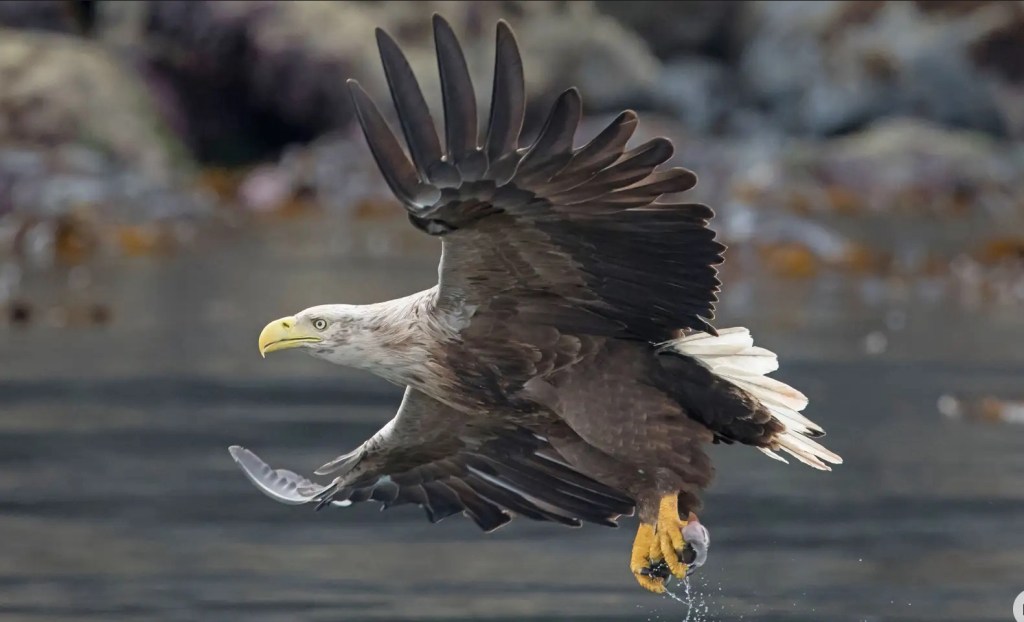
A few snaps from our walk down the ridge:

We had a lovely afternoon tea on Hùisinis beach before hopping back in the van. As we drove away we passed the coos again and Liam obligingly stopped in the middle of the road so we could bid them a fond adieu. One of them walked over to my window in greeting, politely requesting a head scratch, which I gladly obliged. His/her horns banged against the side of the van, so apologies to Wilderness Scotland.
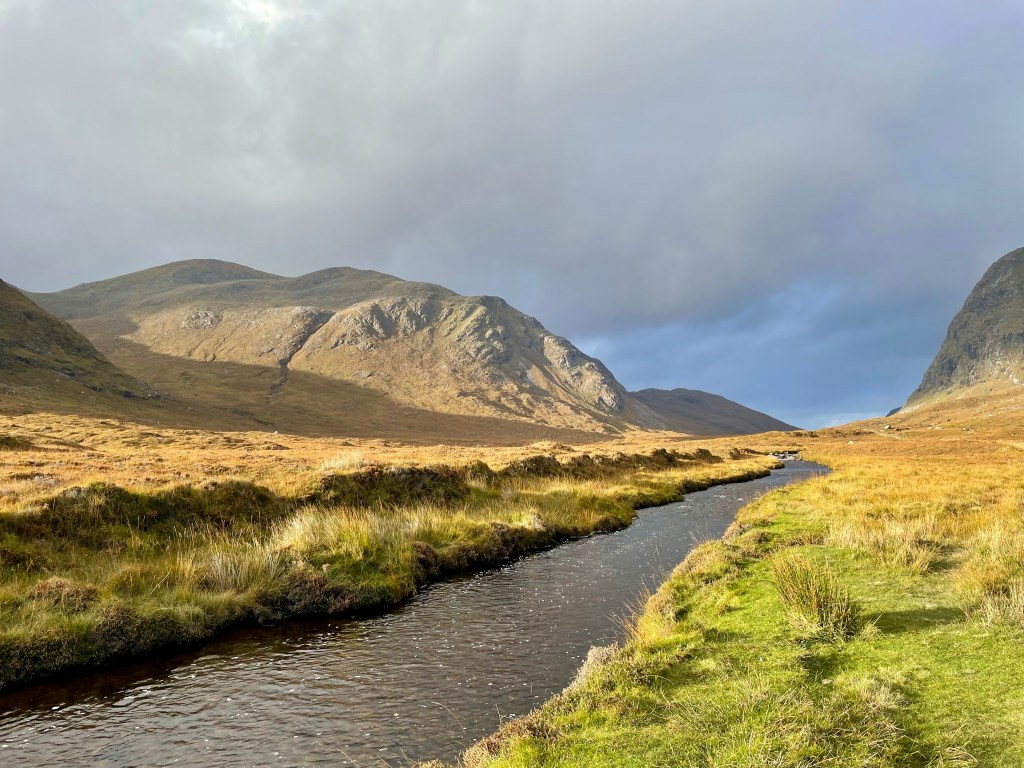
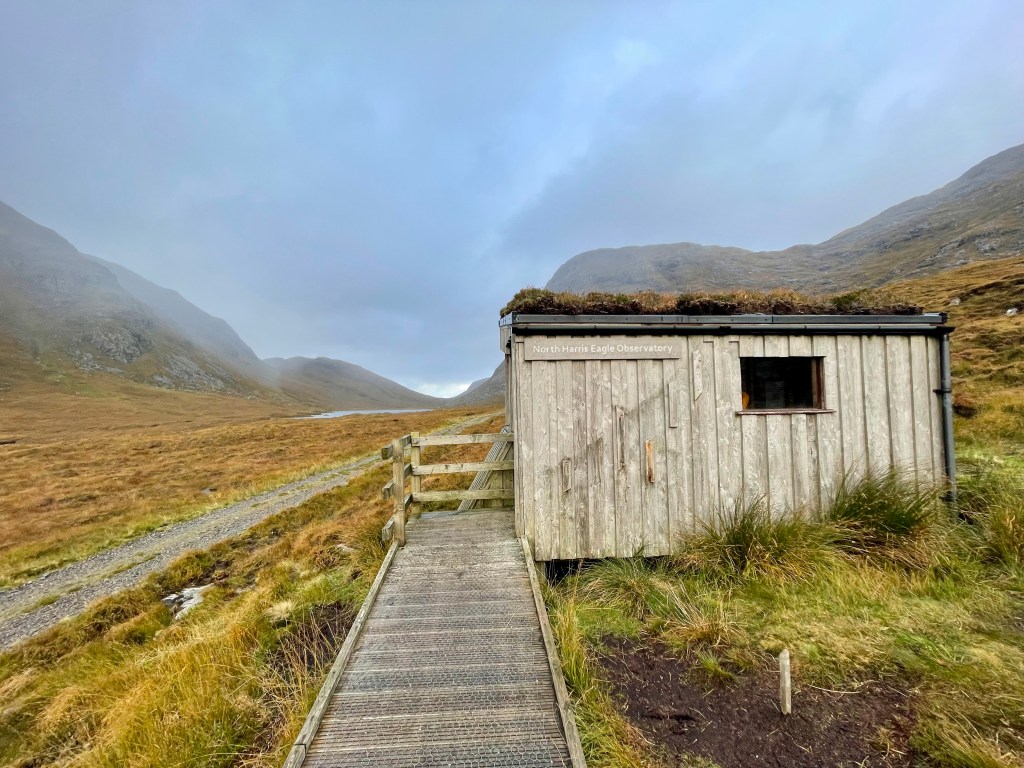
We finished our day by hiking down Glen Meavaig, a wildlife refuge featuring the North Harris Eagle Observatory, built to provide a sheltered spot for viewing a resident nesting pair of golden eagles. Sadly we did not see them. Apparently the Universe felt that we had seen enough magical creatures for one day.
I’ll leave you with a very cool fact about North Harris. It was purchased by the community in 2003, and its 25,900 acres make up one of the largest community owned estates in Scotland. The North Harris Trust, which manages the land on behalf of the community, has an open membership to all residents and is run by a board of locally elected volunteer directors. Very cool.
The Last Post: Peat, Standing Stones, Snow, Whisky and Back to Skye

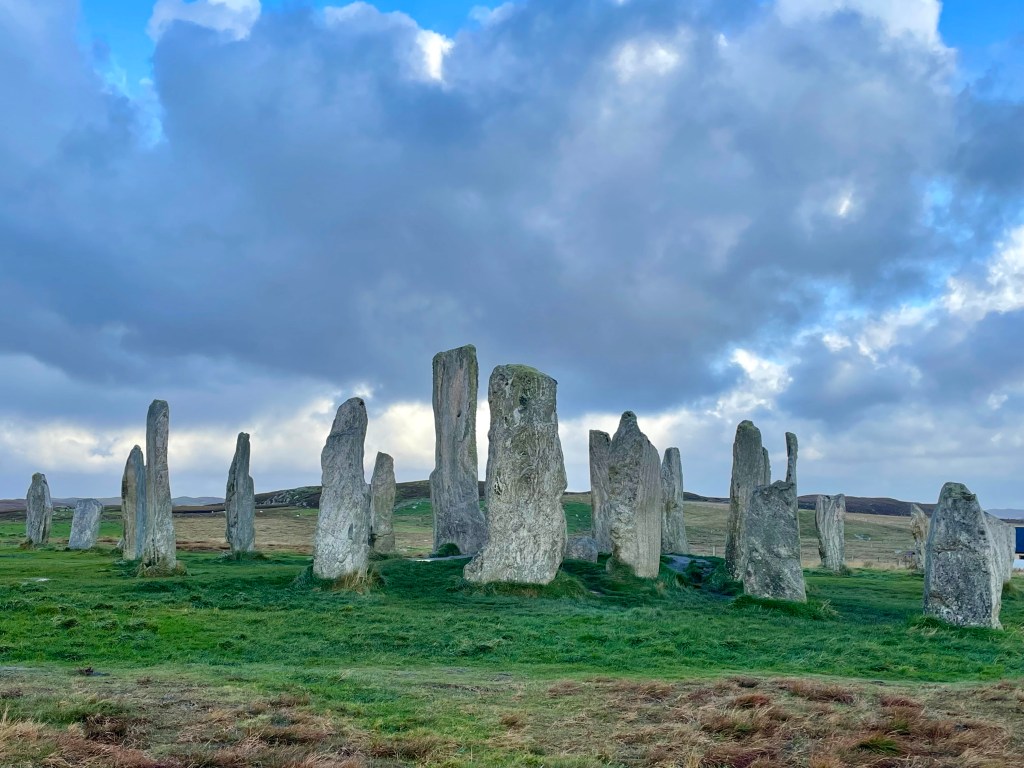
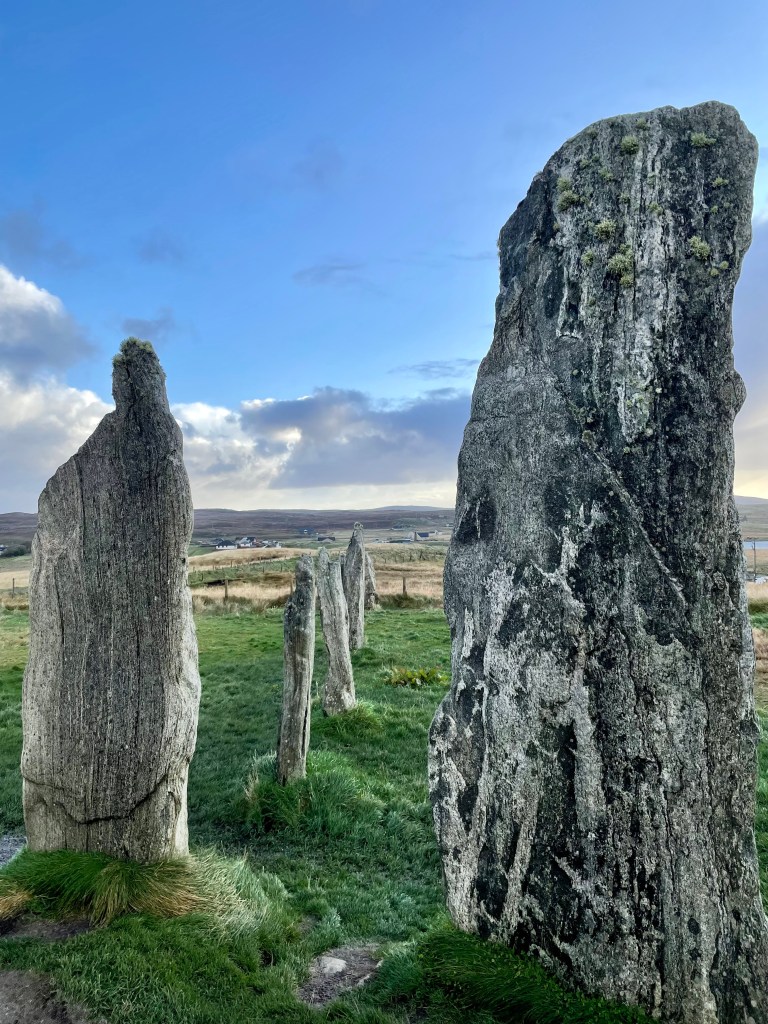
Callanais Stones, Isle of Lewis

Our last full day in the Outer Hebrides dawned with a bittersweet tinge. Wind-swept, isolated and bewitching Harris had started to seep into my bones and I felt strangely reluctant to leave. We had one more walk before us, followed by a drive down the Golden Road and a fancy farewell dinner.

We headed to the southwestern corner of Harris, our destination an uninhabited peninsula connected to the rest of the island via a sandy machair in between two bays. A machair (pronounced “mach’ – like loch – er”) is fertile, well-drained grassland found in Scotland and Ireland which is formed by sand being blown over peat. It creates a unique habitat with diverse bird life and blankets of meadow flowers in early summer. However, with winter approaching, the flowers and birdies were long gone.

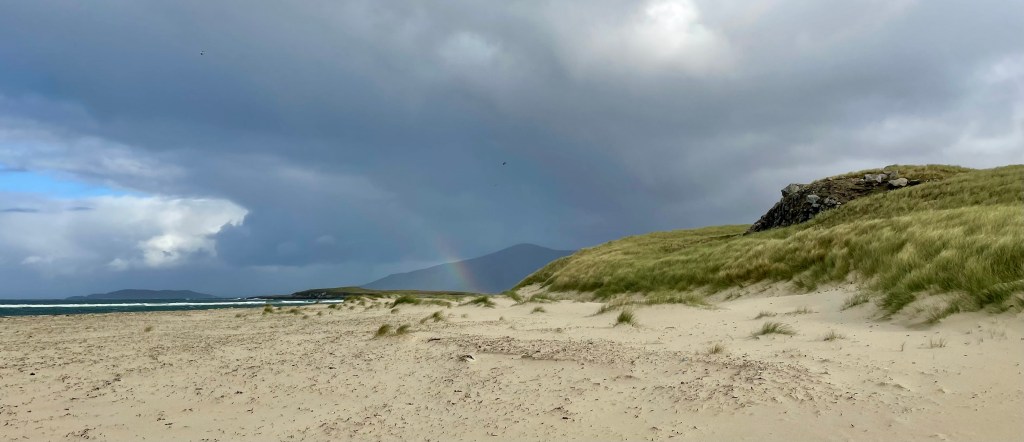
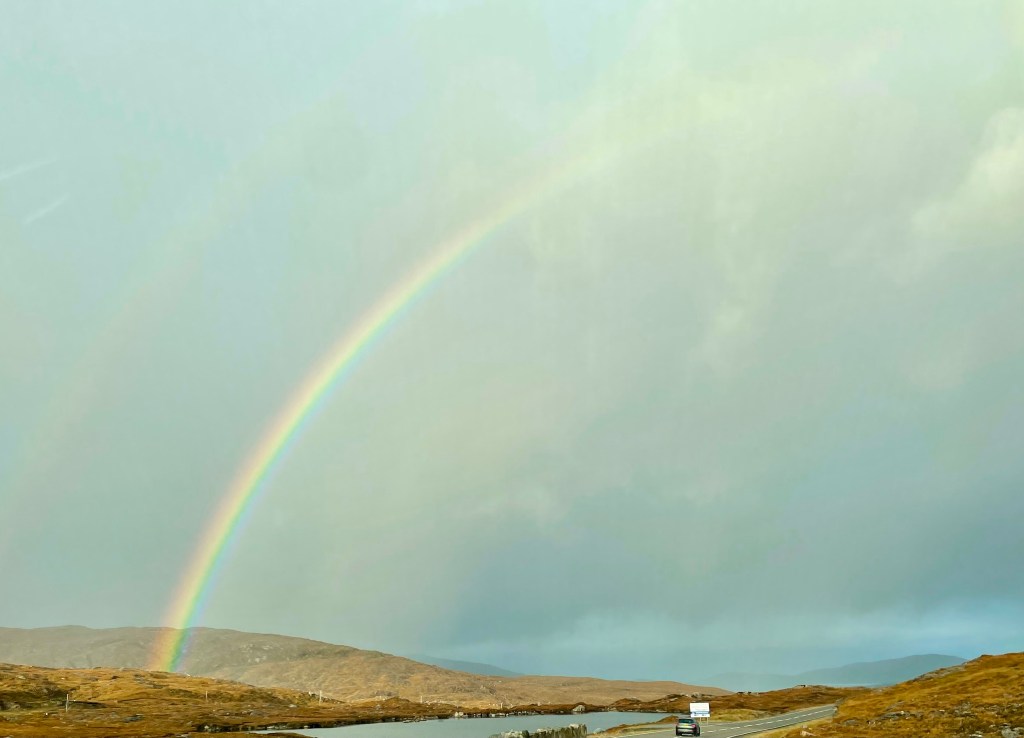
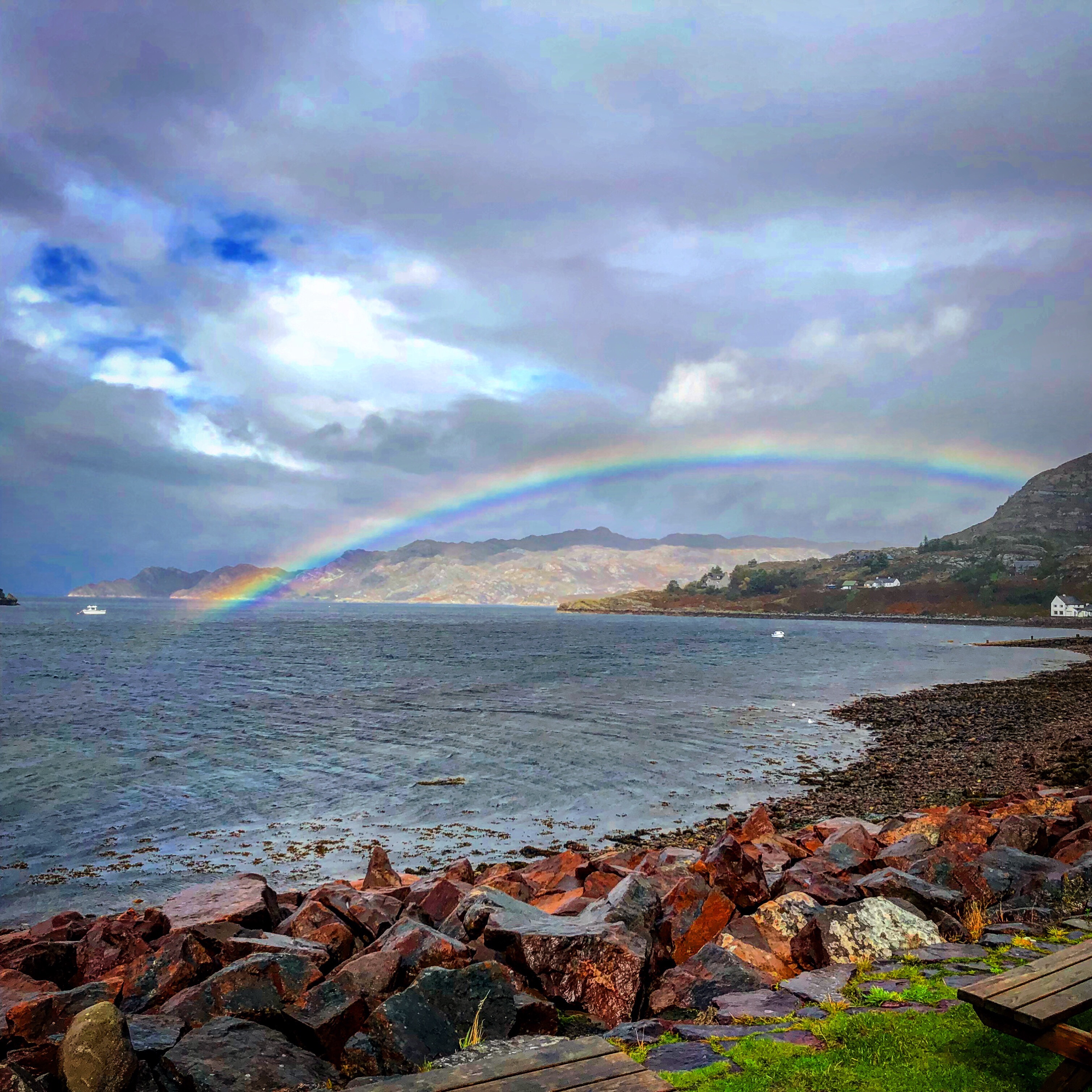
A double rainbow arched over the road on our drive there.

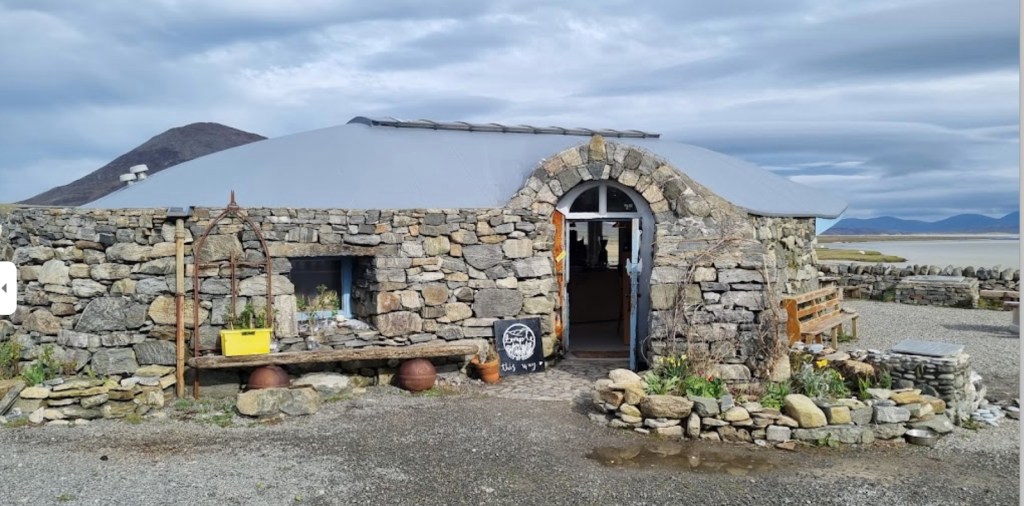
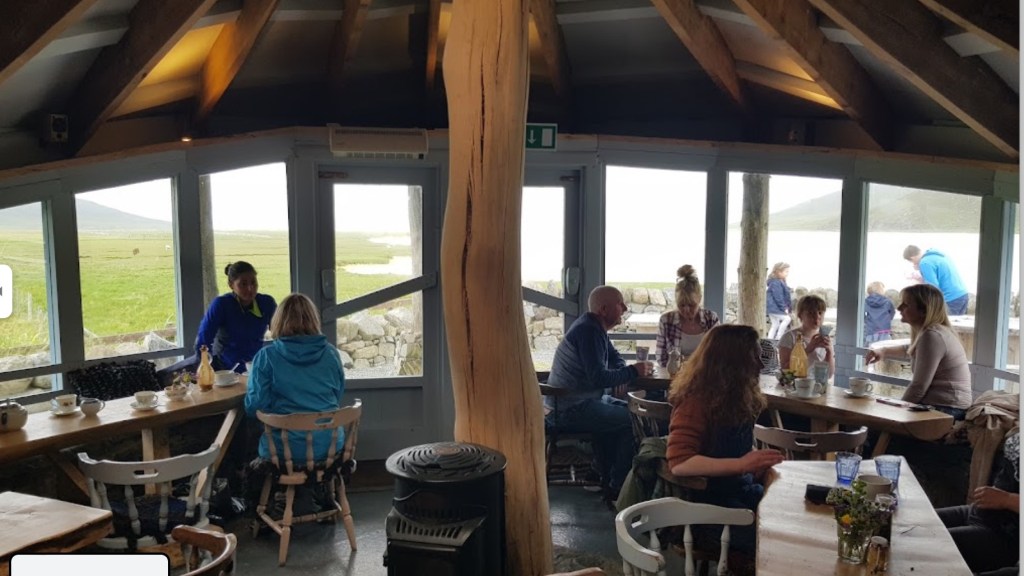
We parked the van next to a charming and quirky cafe snuggled in the middle of nowhere called Temple Harris, featuring a spectacular array of pastries and killer views over a sandy bay ringed with hills. We strolled down a road toward the westernmost summit of Harris and our climb of the day, Ceopabhal (pronounced Chaipaval – p.s., sorry for all these pronunciation tips but I want you to be the hit of your next cocktail party).

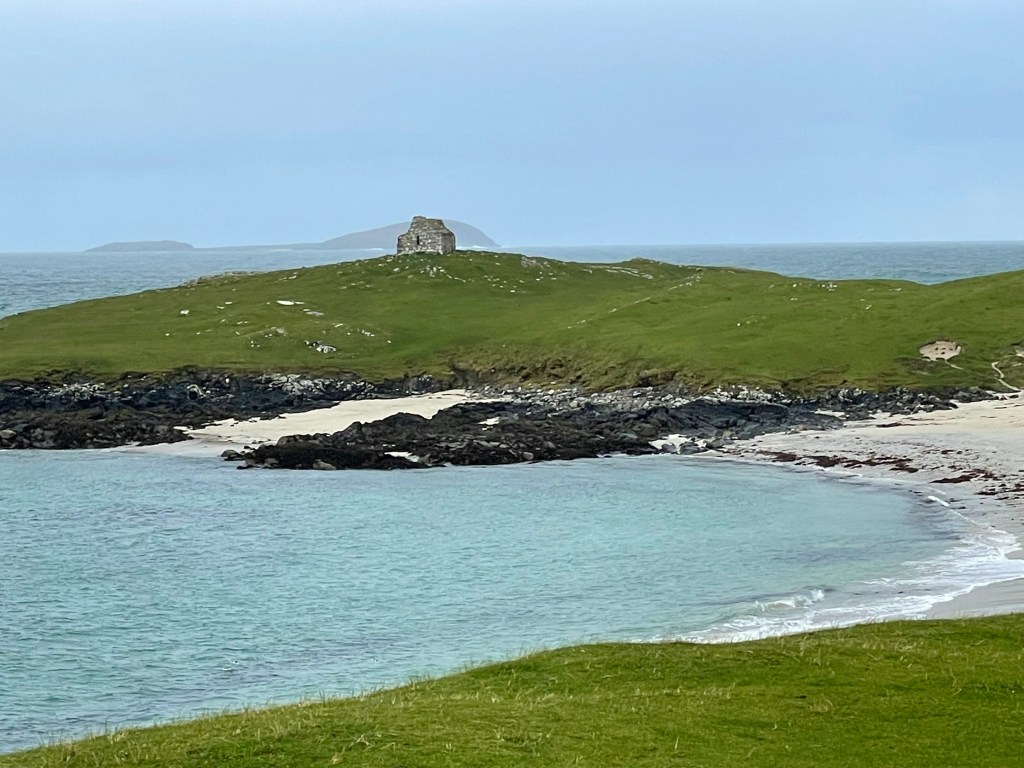
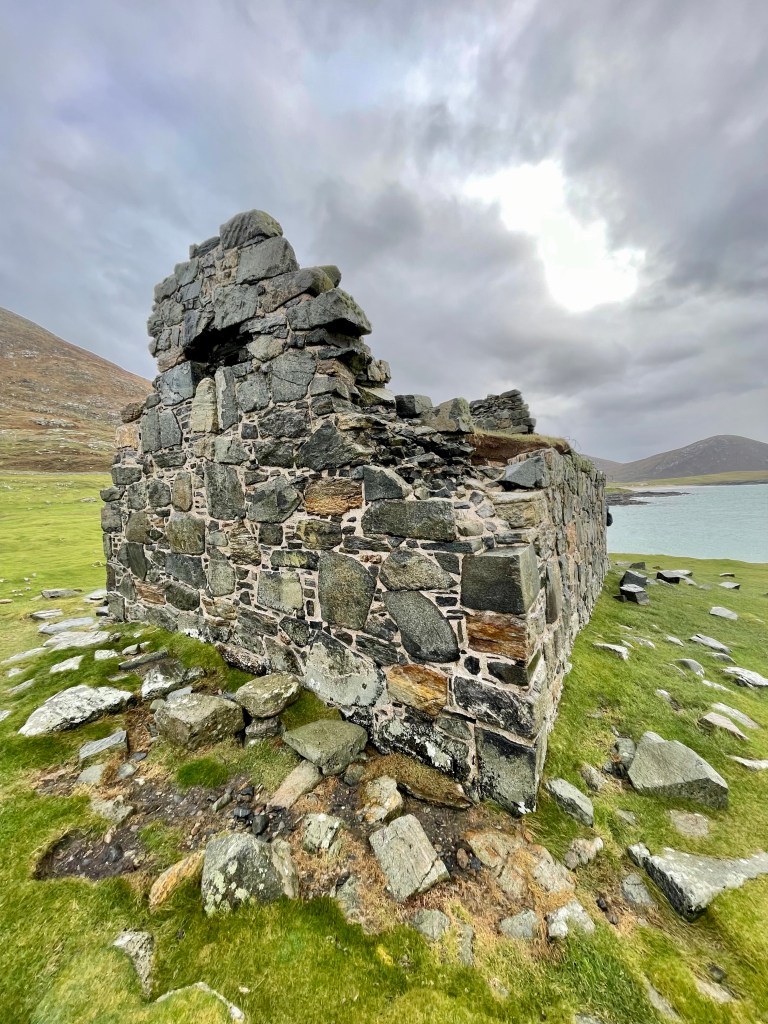
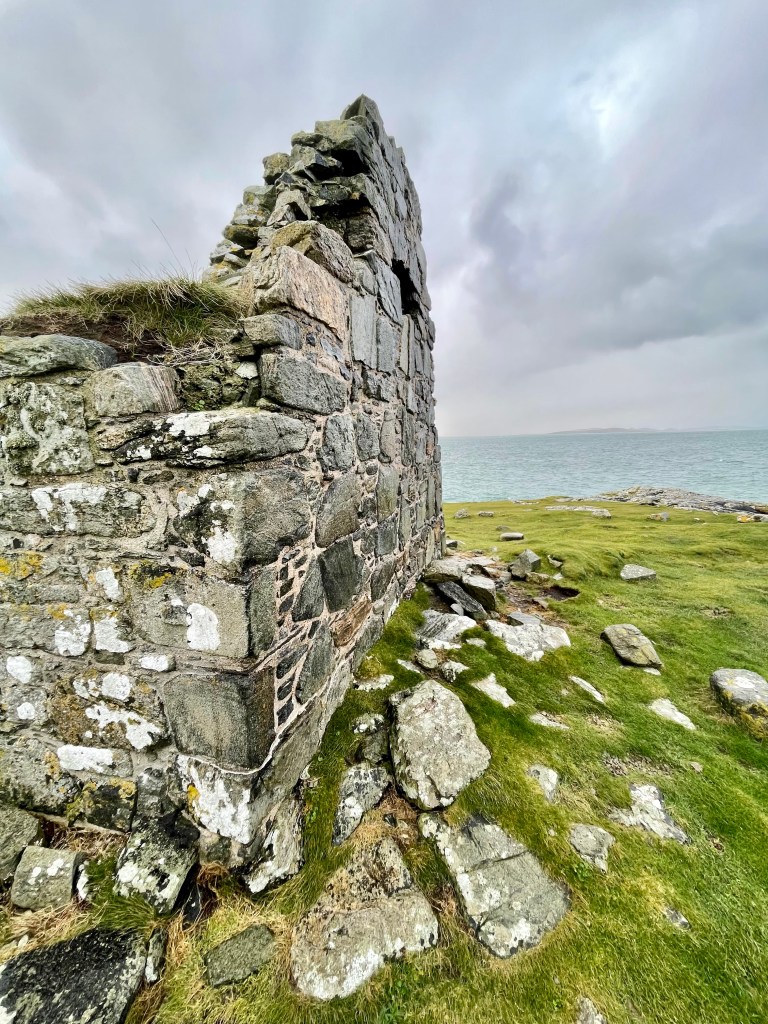
We walked across the machair in capriciously changing weather and made our way through a herd of colorful shaggy cows that appeared to be Highland Cattle/Belted Galloway crosses, which I am totally here for. Fighting our way through a sudden gusty squall, we crested a hill and Traig na Cleavag magically came into view, yet another pristine and deserted Harris beach. This one was guarded by an ancient sentinel – a ruined medieval chapel known as Rubh’ an Teampaill aka Northton Temple. It was built on the site where an Iron Age broch once stood, on land which has been continuously occupied since the Mesolithic era (as this particular era often comes up at cocktail parties, along with Gaelic pronunciation opportunities, a wee reminder this was 10,000 to 8,000 BCE, so very much olden times, or dare I say, days of yore).

Ceopabhal loomed over us for the entirety of our walk, and I eyed the hill with a slight amount of trepidation, mostly because I made the mistake of reading about it in advance on the Walkhighlands website (the bible of Scottish hillwalking).

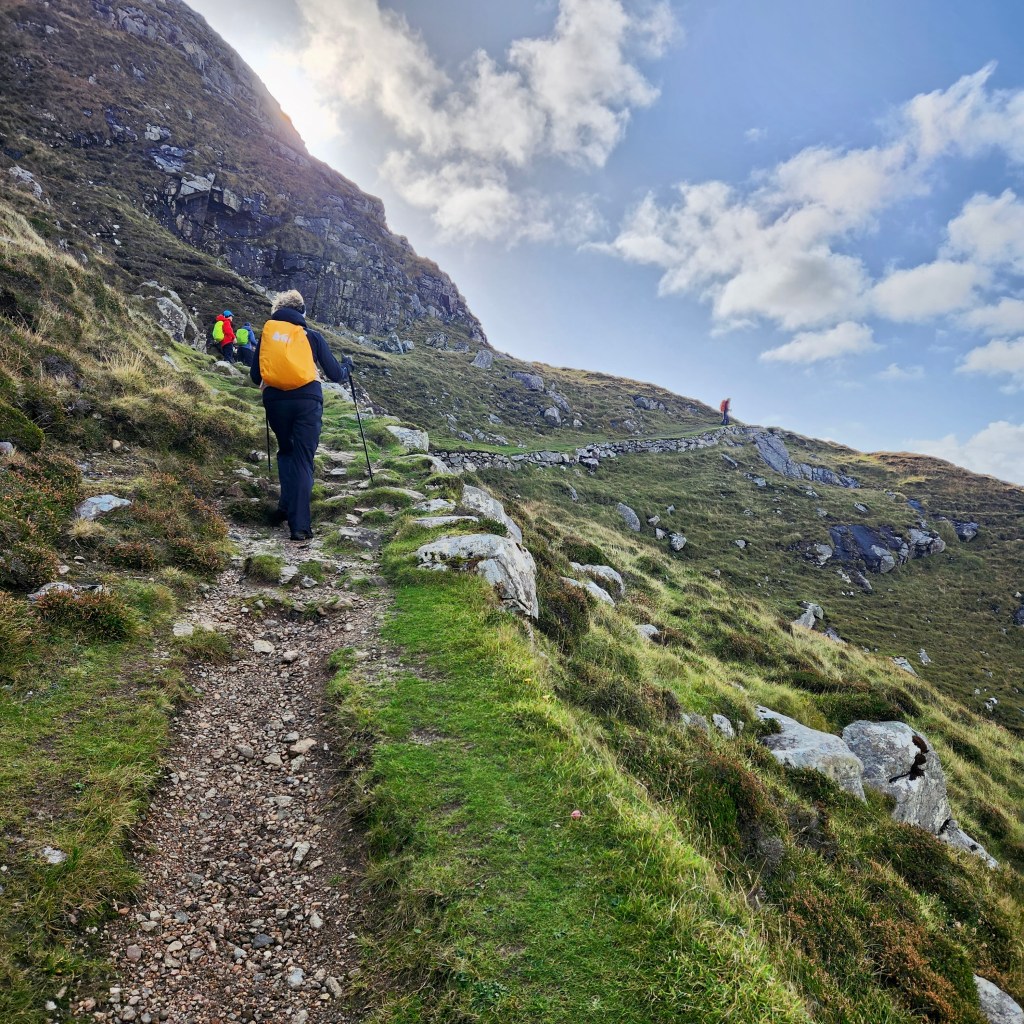
The climb featured a 1,200 foot elevation gain over 6/10 of a mile. This is indisputably a bit on the steepish side, in fact Walkhighlands mentioned in passing that a “great amount of effort” was necessary to reach its summit. Also Liam made us stop and eat a protein bar just before the steep bit for “fortification.” Yikes. So once again the ascent was trail-free – we just zig-zagged our way up through clumps of heather. My main pro tip would be to make sure you lean forward into the hill. At least it was so rainy and windy that trying not to get blown off the trail to our deaths (only slightly exaggerating) served as an excellent distraction from the aggressive angle of the climb.

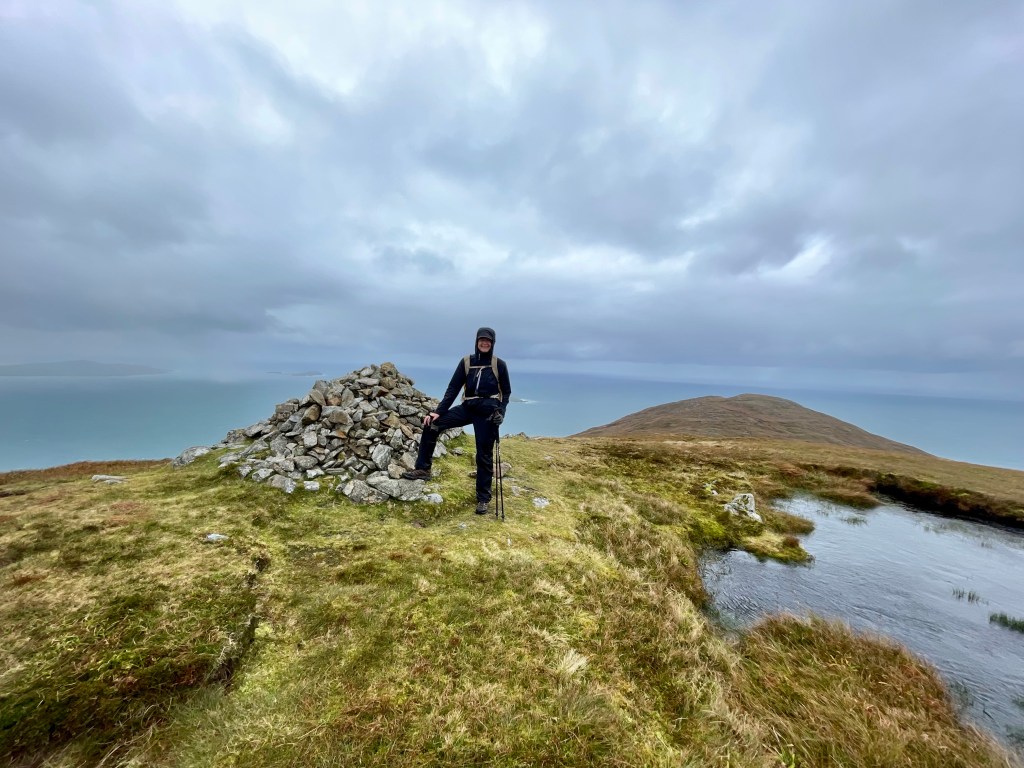
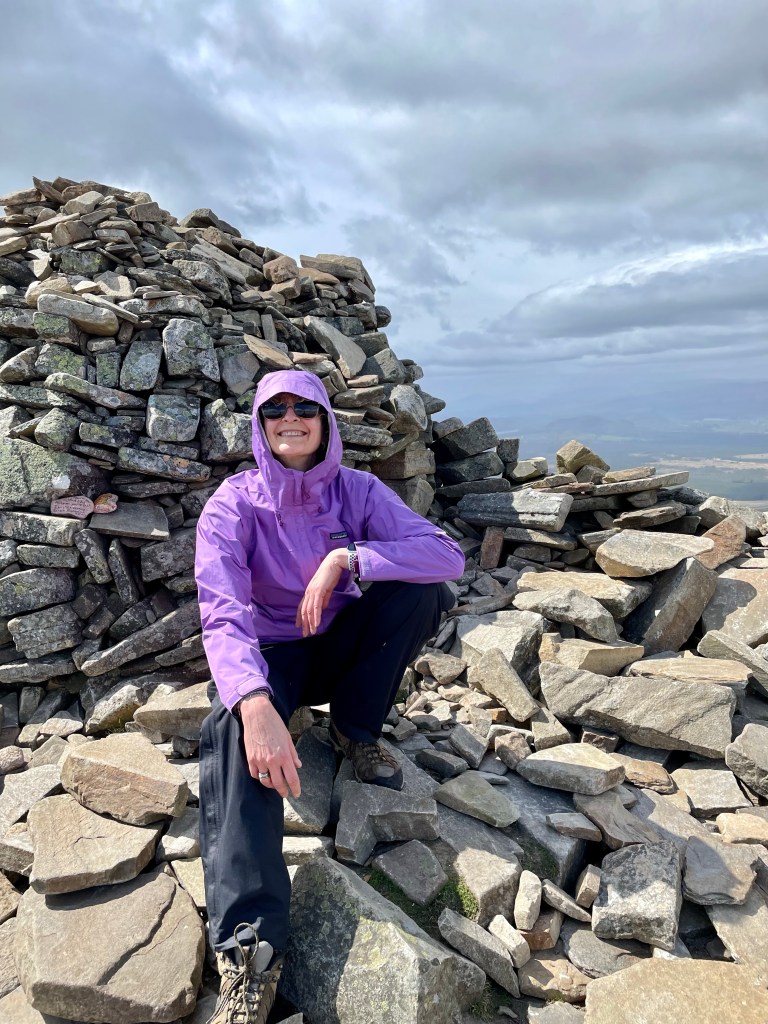
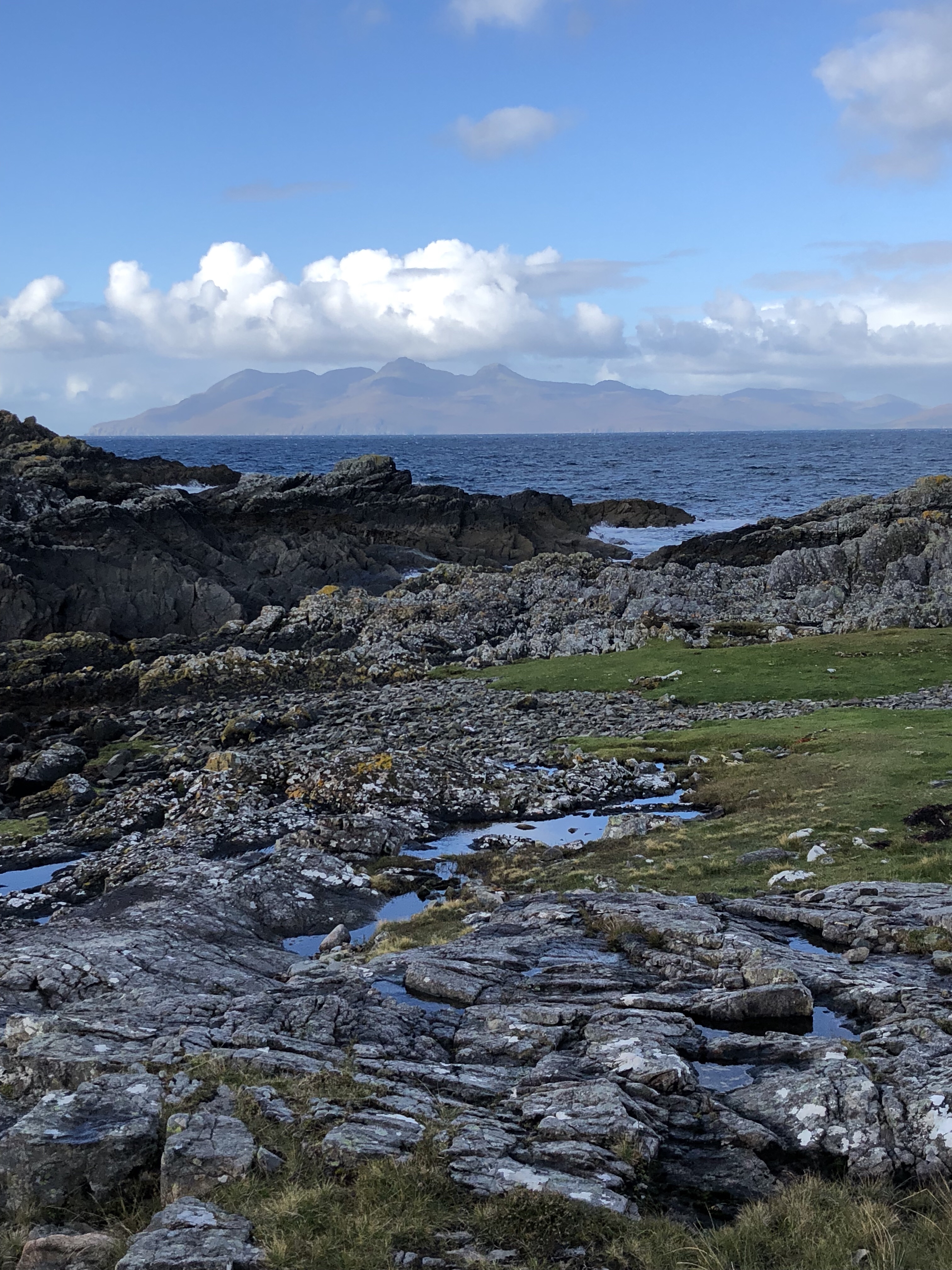
At the summit (yay!), the views were 360 degrees (largely into fantastic storms, but you could see the mountains of Skye). The wind had truly become a biblical sort of tempest, known in these parts as “blowing a hoolie,” although I did valiantly manage a few snaps and a cairn photo.

We walked to the lee side of the hill, mercifully sheltered from the hoolie, and sat in some soft comfy moss to enjoy a picnic looking out over a gorgeous bay.

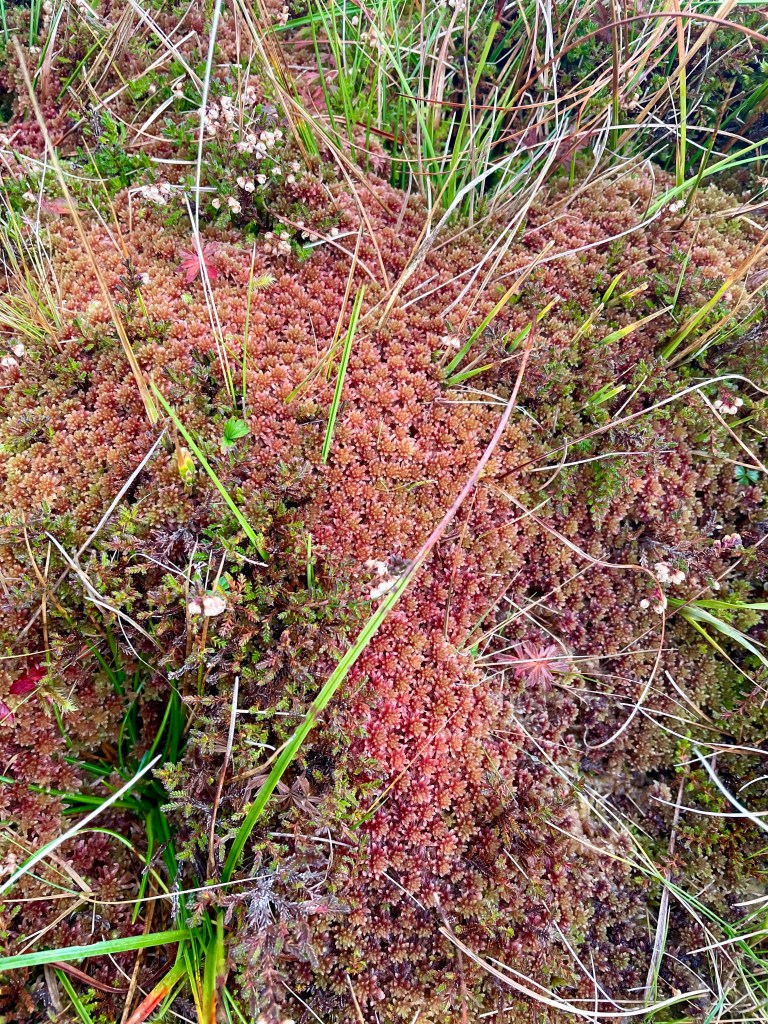
The fine folks at Walkhighlands.com recommended retracing one’s steps back down the hill. My knees were entirely dreading this prospect because going up a steep slope is one thing, going down (while being blown about by a hoolie) is an entirely different situation. This advice was based on their view that walking down the hill on its lee side would take one through “deep heather” and thus should be avoided. Mercifully, Liam had other ideas.  We indeed took the more gradual route toward the bay, winding our way through heather and floating across fluffy, deep mounds of sweet, sweet sphagnum moss. Let me tell you it was delightful. Imagine traipsing down a hill on living, breathing sponges of memory foam. That’s what it was like. I put my hiking sticks away.

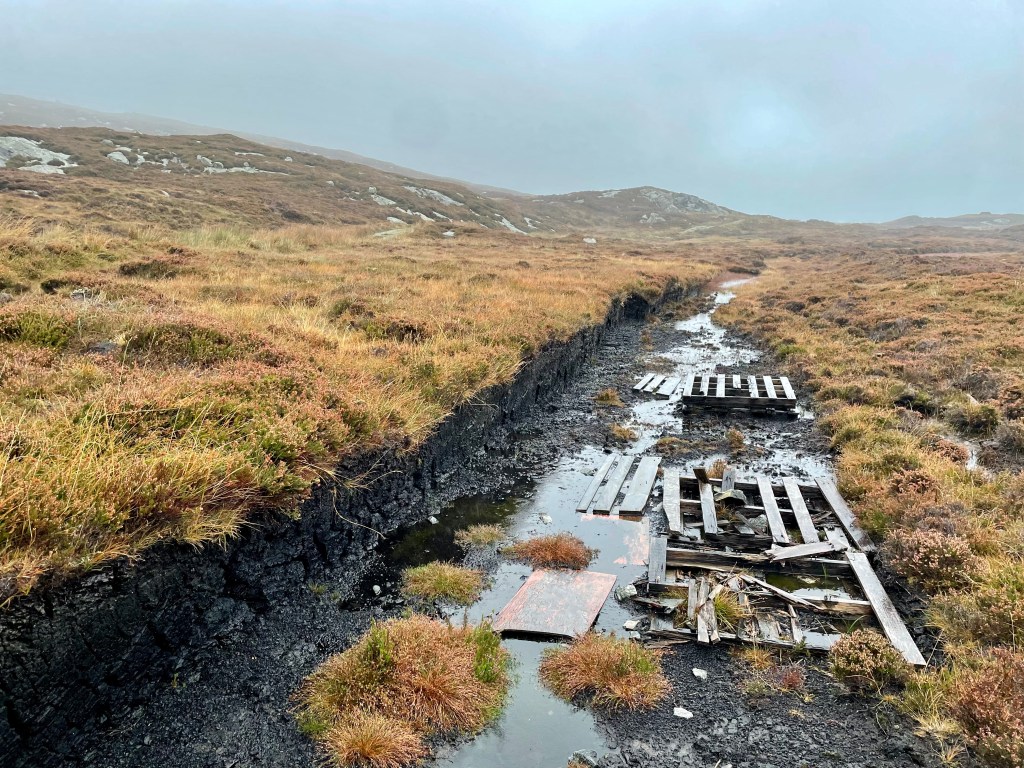
Speaking of moss, you can’t go to Scotland without considering peat. No seriously. Peat is formed from plant material throughout the ages that does not fully decompose, and sphagnum moss is one of its main ingredients.  Peatlands cover about 20% of Scotland and yet 80% has been degraded over time. It has been hacked away and drained since the 1800s to make room for agriculture. For centuries it has also been cut, dried, and used in fireplaces for heating homes. It still is. 

Peat harvesting on Harris.

Peatlands are among the most carbon-rich ecosystems on Earth and have a net cooling effect on climate.  Healthy peatlands can also reduce flood risk by slowing the flow of water from the uplands. If you hold a small handful of sphagnum moss and give it a squeeze, enough water will run out to fill a juice glass. Without peat, one is left with completely nonabsorbent bedrock which isn’t great in a country where it is usually raining. Peatlands also promote biodiversity by providing vital habitat for birds, insects and plants. Peat bogs are sometimes referred to as the rainforests of the UK.

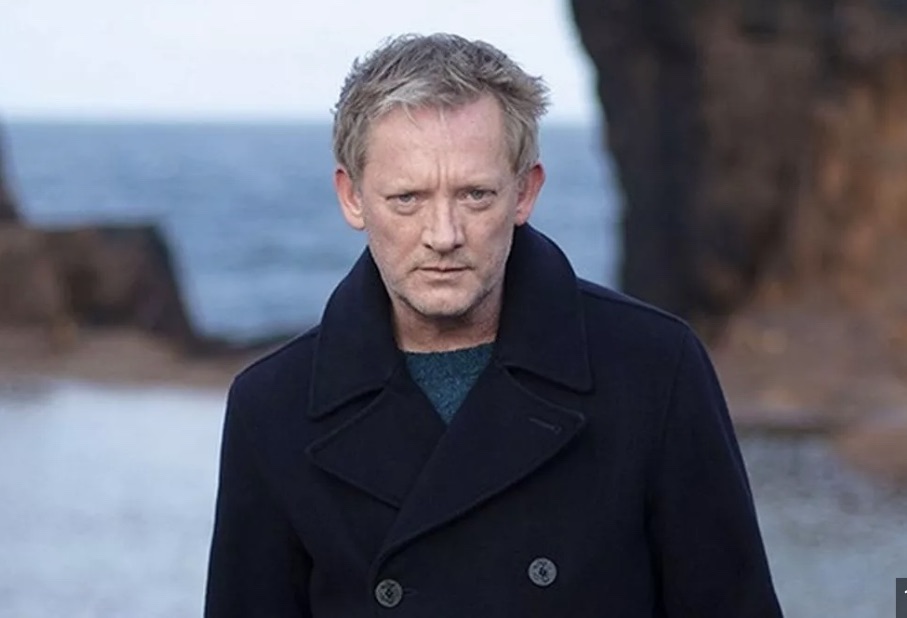
A few more cool things about peat. You may have seen an episode of the BBC mystery Shetland where a decades-old body was found perfectly preserved in a peat bog and wondered why.  (Fun fact: There have been only two murders in Shetland over the last 50 years, rather than the 1-2 murders per week as depicted in the show. This aside provides an excuse for a Douglas Henshall call out for a lot of reasons).

Doug Henshall as Jimmy Perez in Shetland.

The explanation for peat’s ability to preserve (ahem) organic matter is this. As a bog grows, and new peat replaces old peat, the older material underneath rots and releases humic acid, also known as bog acid, with pH levels similar to vinegar. Not to put too fine a point on it, but bog acid preserves human bodies in the same way fruit is preserved by pickling. And of course not just humans – a wooly mammoth was once discovered buried in peat that still had its fur and food in its mouth.

Peat also creates and stores iodine. The iodine causes sphagnum moss to look very yellow and even red when it’s waterlogged. This is why many Scottish rivers appear golden in color – it’s not tea, or (sadly) whisky – it’s iodine-laced runoff.  Also, iodine’s antiseptic properties mean that sphagnum moss acts as a water filtration system so in a pinch you can use water squeezed from moss for hydration – and even more interesting, it was used to pack wounds during wartime since it’s both sterile and absorbent.

Most crucially from a climate change perspective, Scotland’s peatlands store 16 million tonnes of carbon (one tonne is 9% larger than a metric ton) and possibly shouldn’t be released into the atmosphere at this particular juncture. Draining water away from peat bogs to support agriculture causes the peat to dry, resulting in the vegetation decomposing much faster – and the release of carbon. Similarly, burning peat has the potential to release hundreds of years of stored carbon back into the atmosphere. Ultimately it’s quite beneficial to have large land masses that actually capture and store carbon.

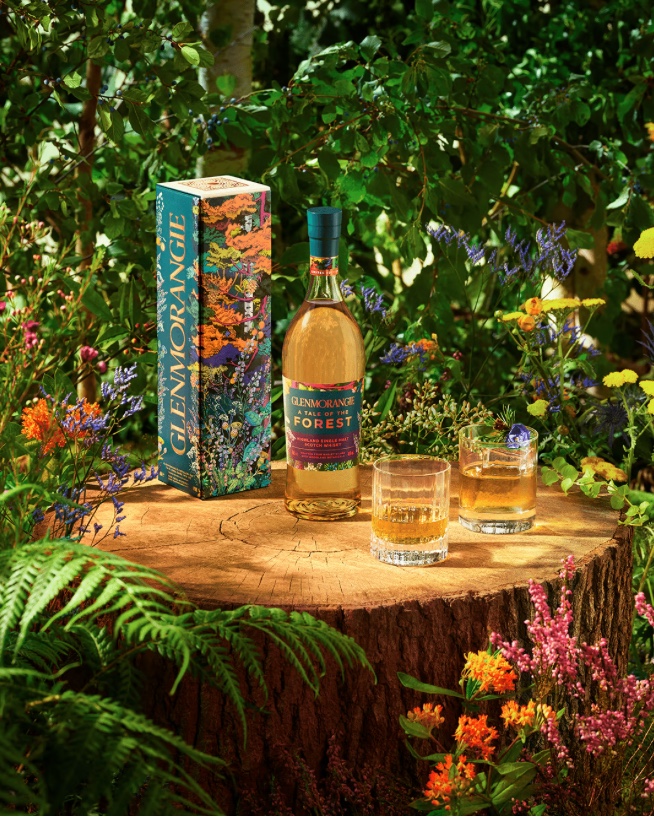
I know what you are thinking – what about (gulp) whisky? Much of Scotland’s whisky is made from sprouted barley that has been dried by peat fire. It imparts a lovely campfire vibe to the golden liquid which causes people to either fall in love or cough with watering eyes and an alarmed expression. An iconic flavor either way, especially with Islay whiskies. As it turns out, whisky accounts for only about 1% of the UK’s peat use and as you can imagine defending the cultural significance of Scotland’s whisky-making tradition has been the central pillar of the industry’s case during the government’s development of its peat policy. Distilleries have pledged to make peat use more sustainable, although given its glacial pace of regeneration (1mm a year) this is a matter of debate. Distilleries are also experimenting with using different botanicals to light on fire for barley drying. Glenmorangie has just released a “Taste of the Forest” expression where they used pine, juniper, woodland moss and eucalyptus as fuel.

The good news is that peatland restoration and preservation is very very big in the UK and heroic efforts are underway to preserve and increase the resource – with some measurable success.  So fingers crossed.

Thank you for coming to my Ted Talk.

So let’s rejoin our merry band of descending walkers as they bounce down Ceopabhal on cushions of sphagnum moss. Before I share a few photos, after hearing all this peat talk from Liam we were sensitive about trodding on this precious resource, but he assured us that it quite literally bounces right back due to its buoyant density. Phew.

Upon our triumphant return to the van, we snagged a coffee and pastry (and a wee bit of shopping) at Temple Harris.  Everyone leaves their packs outside on the wooden bench without worry of misadventure.

Duly fortified, we struck off down the Golden Road, a spectacularly winding single track route along Harris’s rocky east coast. It’s widely assumed it got its name due to its eye-wateringly spendy construction cost.   After Liam cheerfully told us that if anyone was going to barf in the van, this would likely be the time, he offered distraction from the terrifying prospect of public motion sickness by launching into storytelling mode. He regaled us with mystical tales of dubious provenance featuring two dangerous and wily Scottish creatures.

First on the agenda – kelpies. Typically residing in and lurking about black lochs, they take the form of a horse, appearing to unwary humans as being a helpful sort of creature. They entice travelers to ride them over the loch, seemingly a more expeditious route than walking around them. It’s a trap! Once a person mounts the horse, it gallops to the deepest end of the loch, dragging its hapless rider below the water to their death and, ultimately, consumption (yikes). This legend was used to keep children away from lochs and also provided therapy fodder for later in life.

You may have seen this gorgeous sculpture by Andy Scott. The Kelpies were installed in 2013 near Falkirk and are a ginormous 98 feet high. It’s beautifully lit at night, and even if you don’t have time to stop, the giant kelpies loom over the M9 between Edinburgh and Stirling.

Next we turned to tales of the more benign selkies. They are also water-dwelling shapeshifters, but transform between seal and human by shedding and replacing their skin. As humans, selkies are incredibly attractive, graceful, kind natured and (avert your eyes) seductive, and so humans tend to fall desperately in love with them.  Selkies have also been tricked into marrying humans, usually by a nefarious person who steals and hides their seal skin, preventing them from returning to the sea. Not cool. Selkies are known for their benevolence, saving the lives of children or fishermen who have fallen into the sea.

There you have it. Keep up your guard if you visit Scotland – as these mythical beings pose more danger than any other resident creatures other than – dreaded midges.

We took a break from the Golden Road at Clo Mor, the charming Harris Tweed Exhibition. I will admit to you that prior to my visit to Harris, I had presumed that Harris tweed, since it’s pretty ubiquitous, was mass-produced, probably in China. Luckily I didn’t say that out loud to anyone. In actual fact, to qualify as Harris tweed, the textile must be “handwoven by the islanders at their homes in the Outer Hebrides, finished in the Outer Hebrides, and made from pure virgin wool dyed and spun in the Outer Hebrides,” according to an actual Act of Parliament.  Approximately 400 islanders were working in this industry as of late 2017, and you can visit them in their home, see their looms and watch them work. Consider my eyes opened.

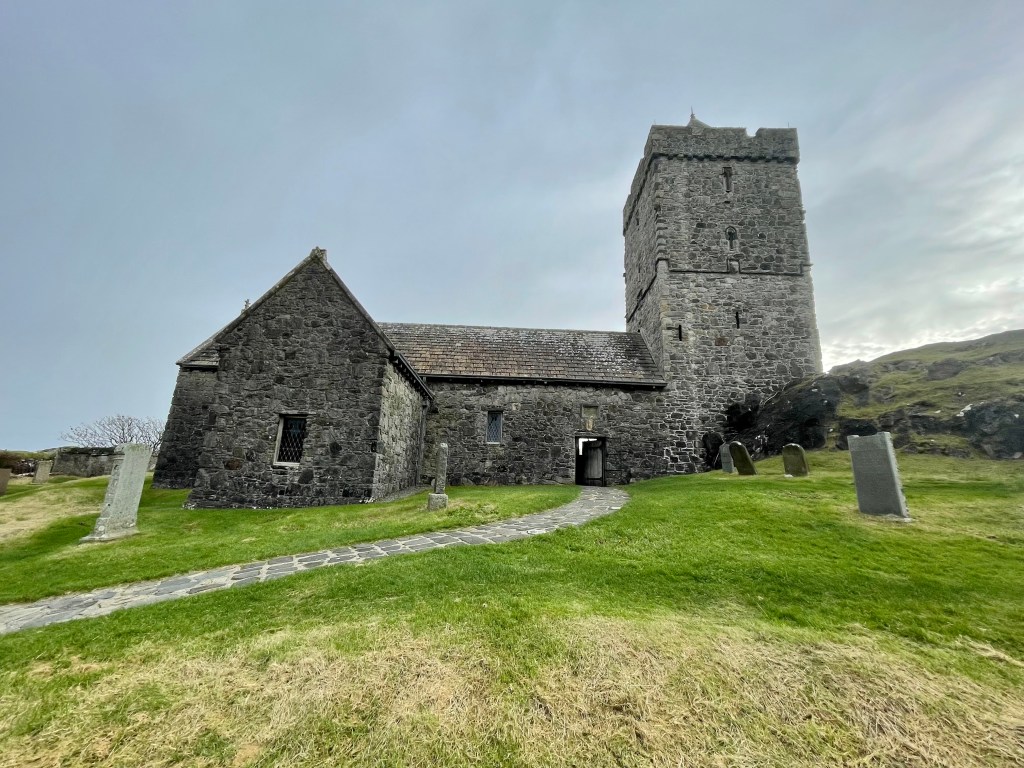
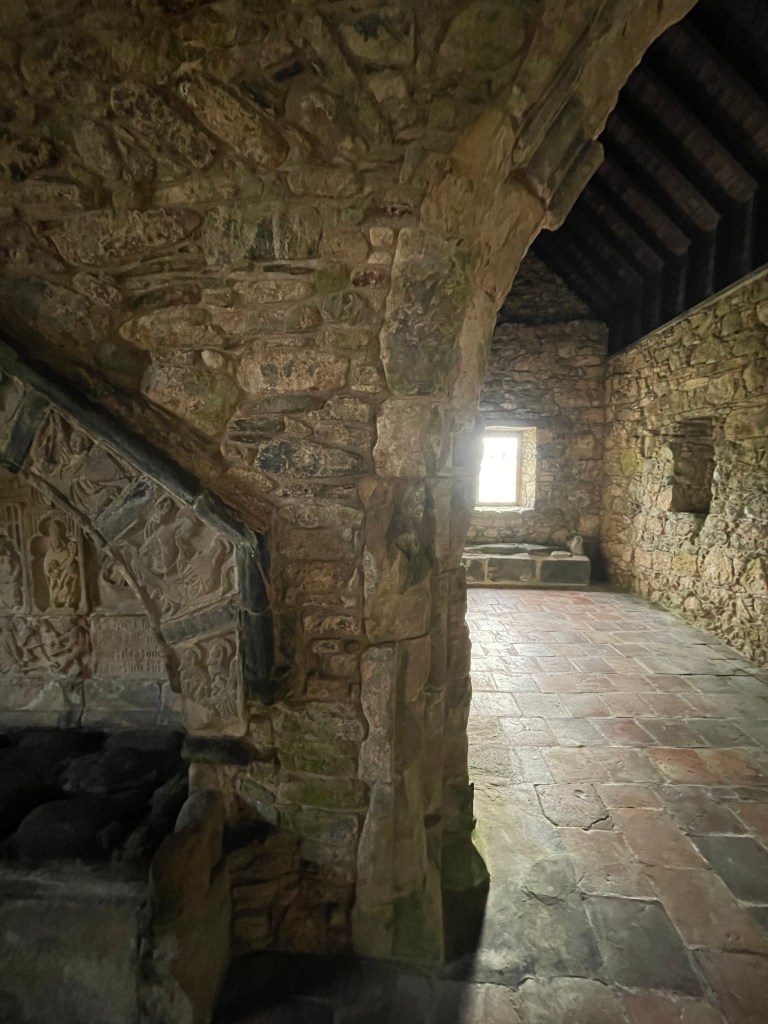
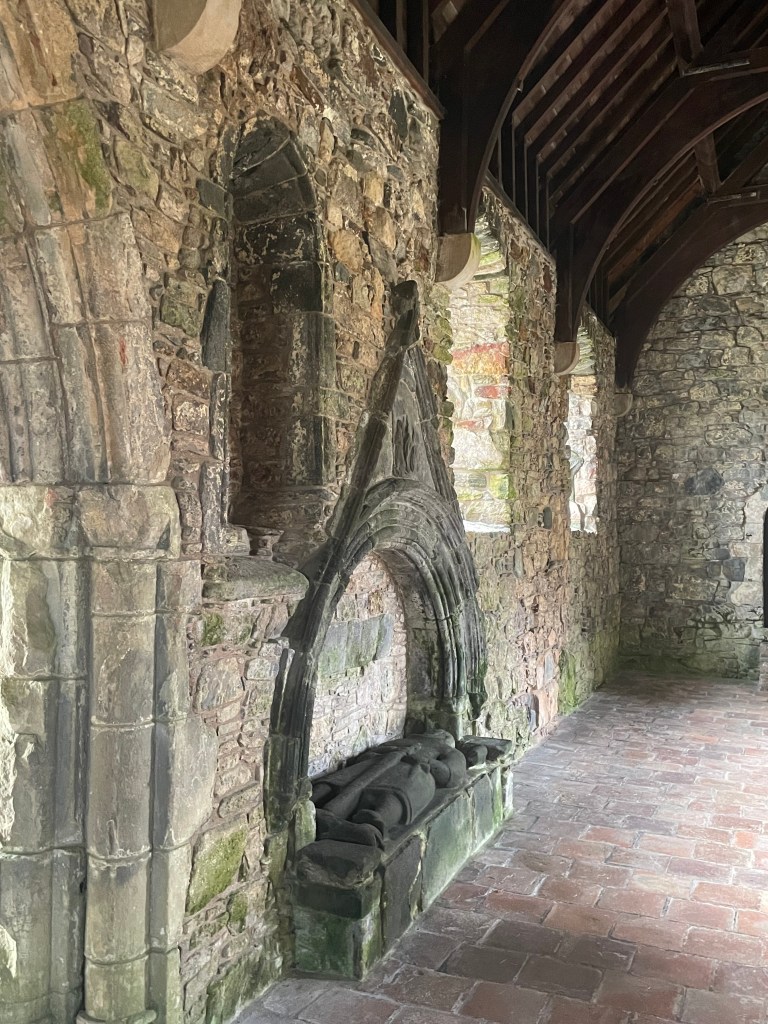
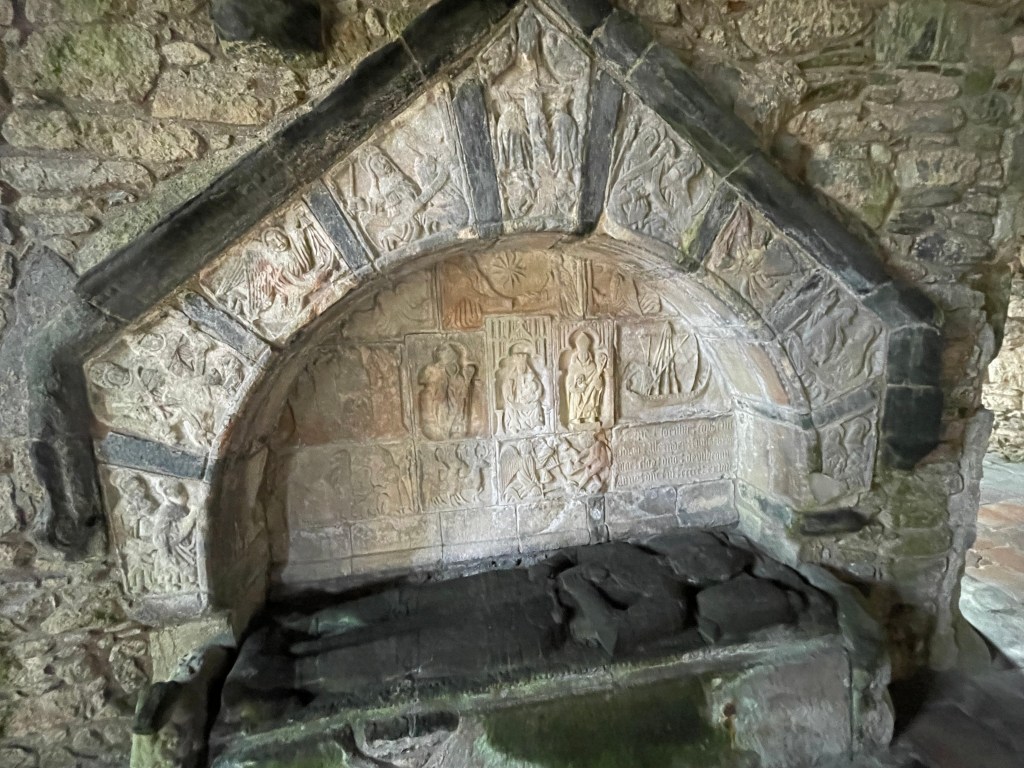
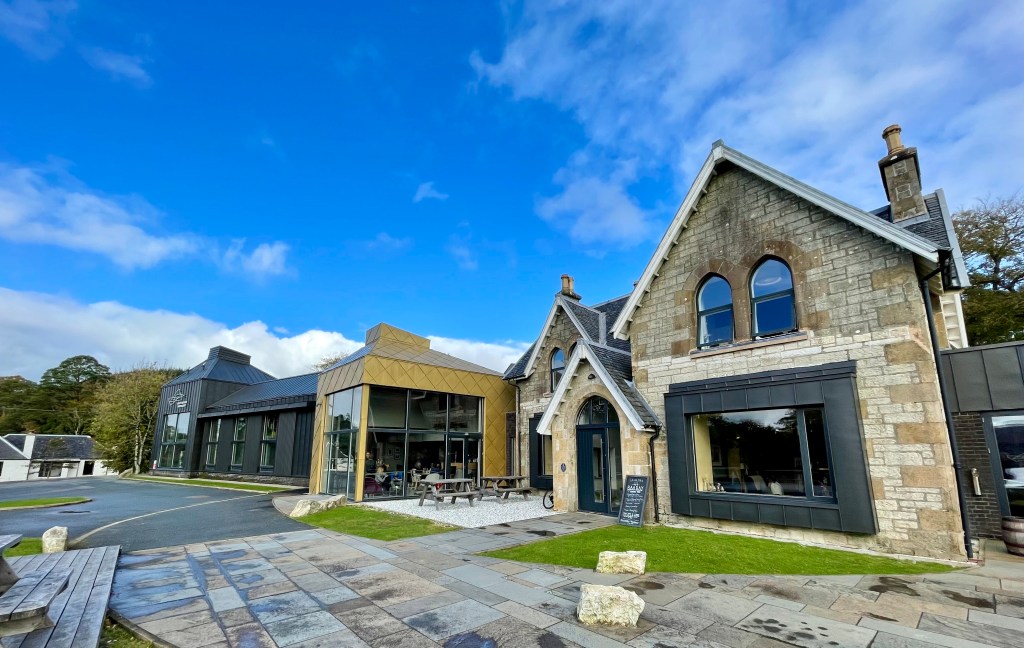
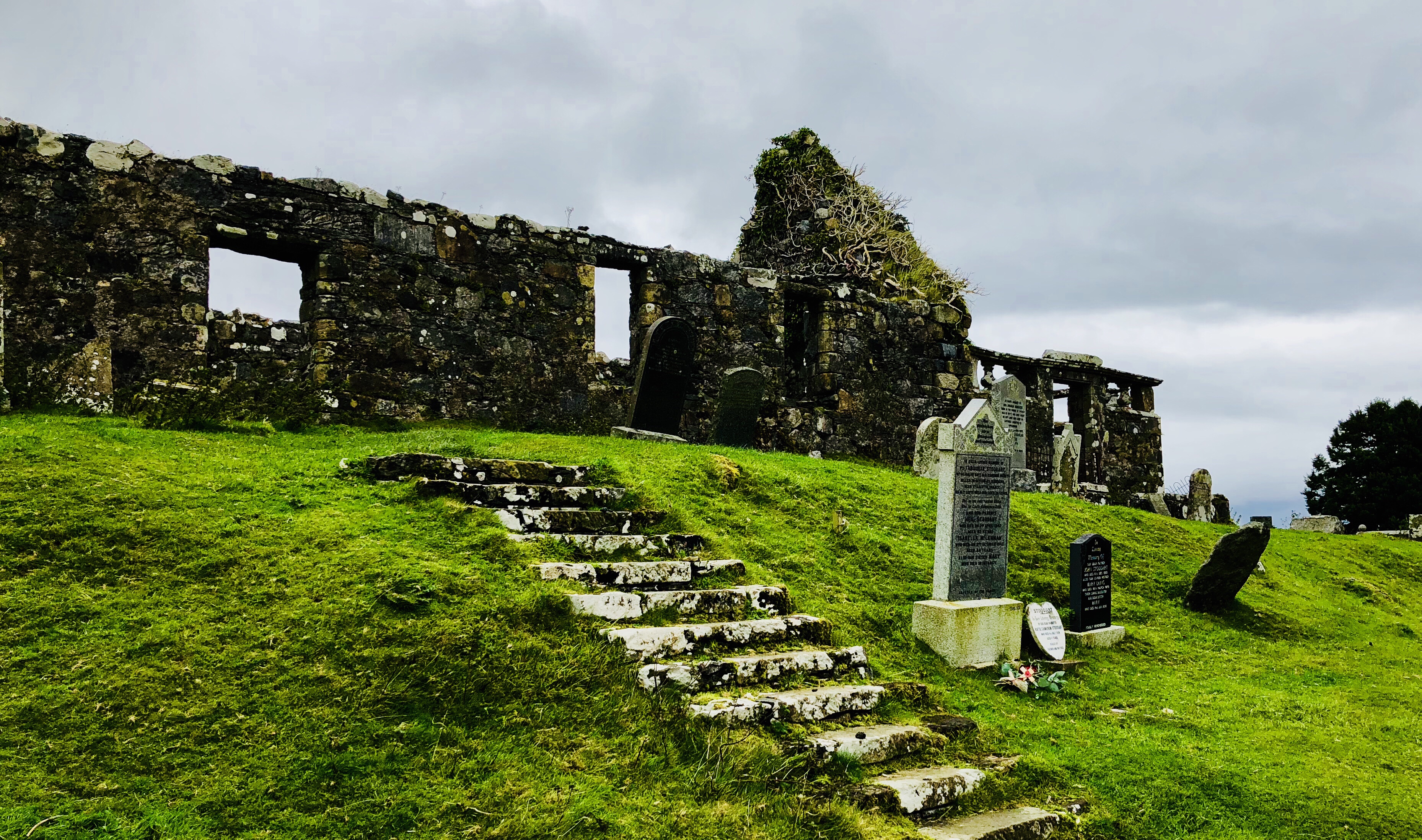
We next stopped at Hebrides People Visitors Center in Northton, a genealogical resource for folks researching their ancestry that tells the history of the people and landscapes of Harris and the Western Isles. Our last stop on the Golden Road was St. Clemens, a medieval church founded by Alasdair MacLeod, 8th chief of Clan MacLeod. He died in 1547, and his tomb is in the church, along with a passle of other ancient MacLeods.  One wonders where the 1st – 7th MacLeod clan chiefs are buried.

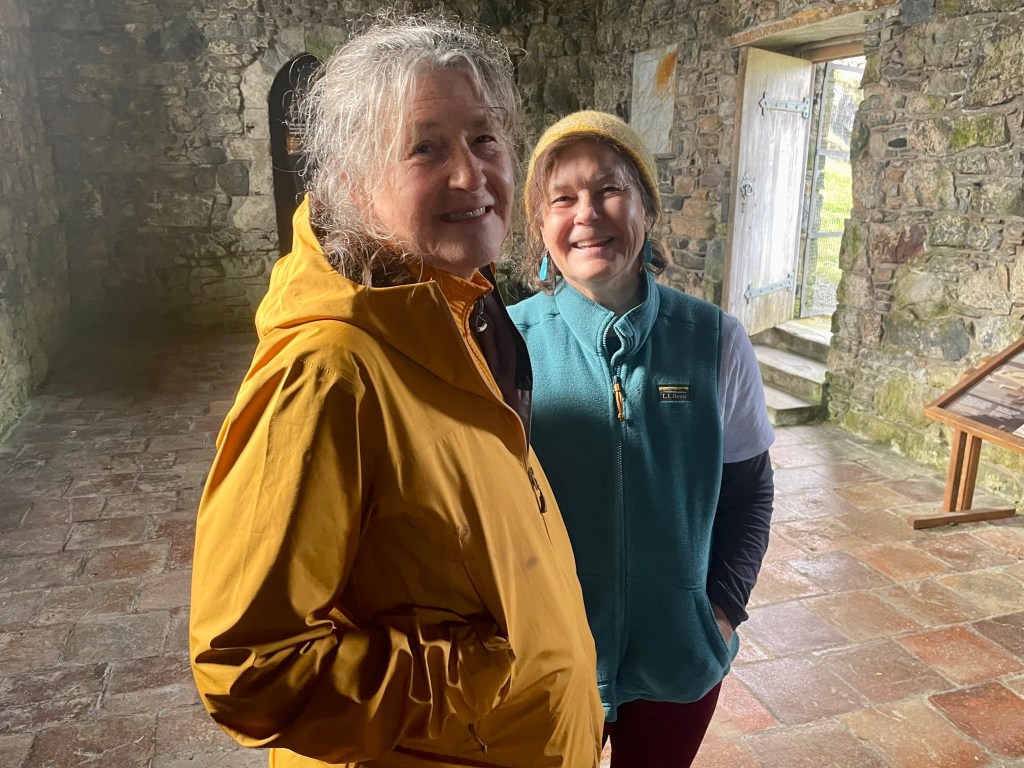
My favorite peeps – sisters Victoria and Margaret

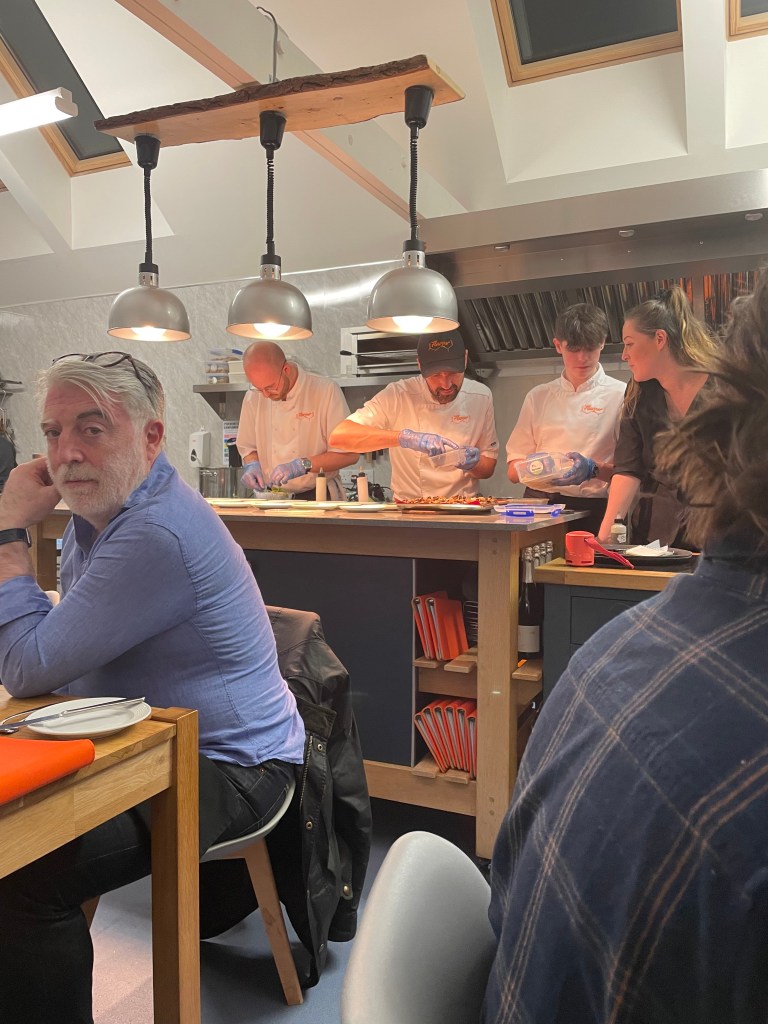
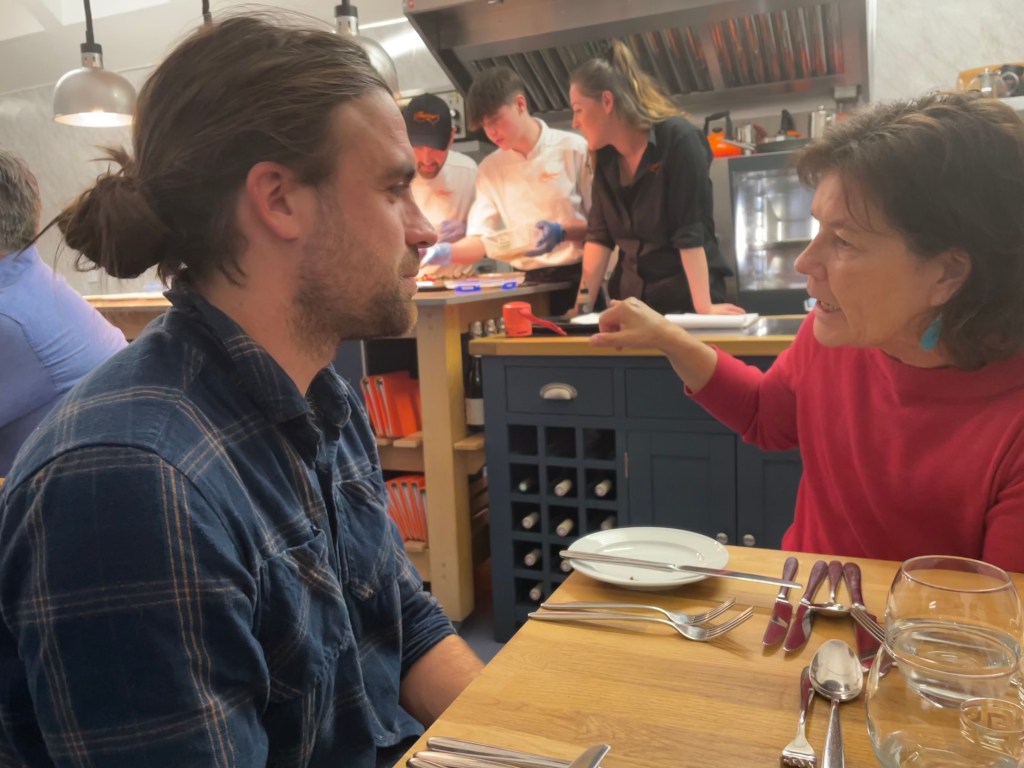
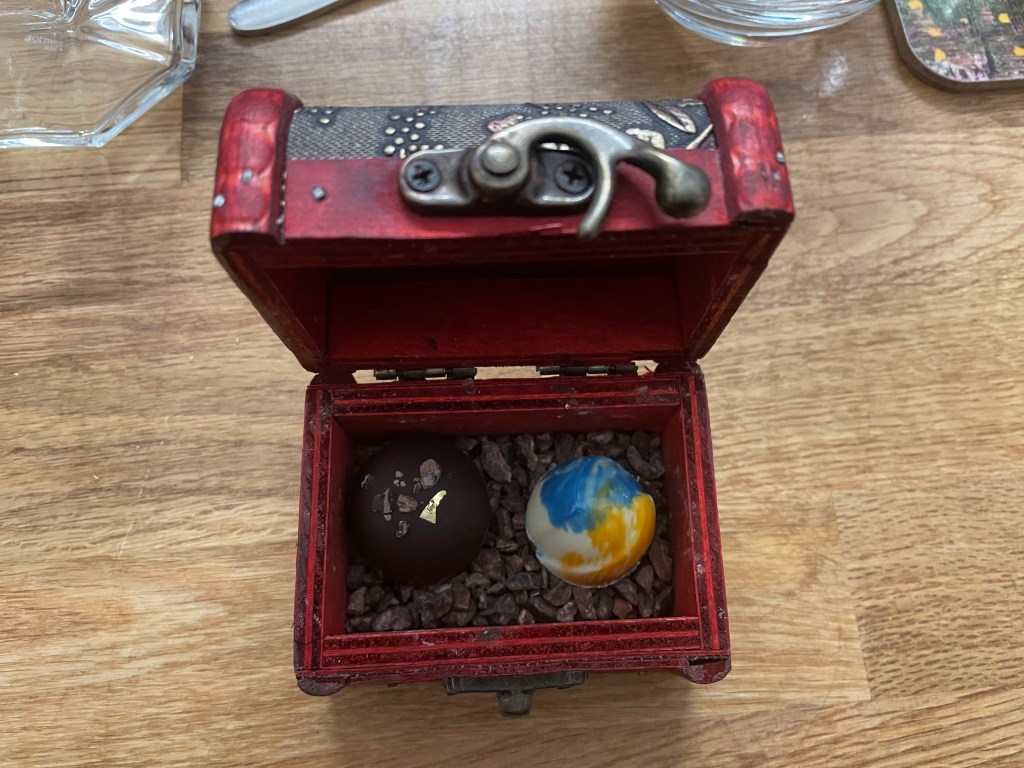
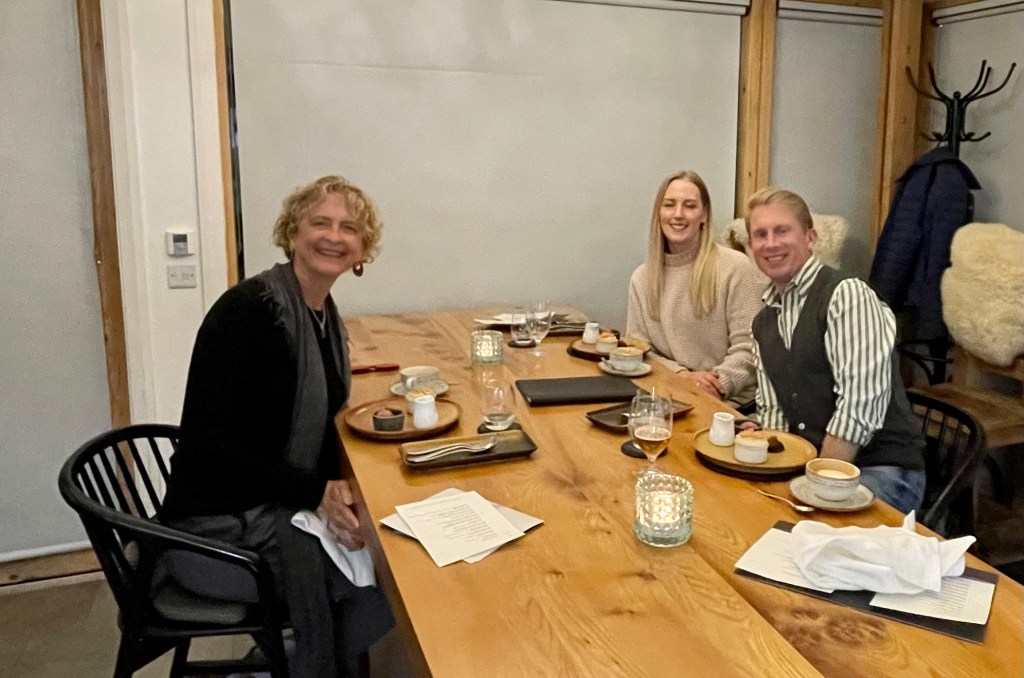
Our day ended in grand style with dinner at Flavour, an intimate restaurant on Harris with one seating and a chef, Chris Loye, who talked us through every beautiful and scrumptious dish on his tasting menu.  That night each dish incorporated, with pride, the newly released Heurach whisky from Harris Distillery. A woman from the distillery lovingly shared its story at the conclusion of our meal. She poured everyone a complimentary dram, clocking with a wry smile that I had been accidentally drinking a Talisker (from Skye).  Dang. As it turns out, she had been sitting at the table next to us with a couple who were right out of central casting for a show about a boring and very very rich English couple with plummy accents and unfortunate and ostentatious sartorial taste. I only wish I had been able to photograph the man’s pointy and aggressively shiny brown shoes.   We decided he was probably an investor in the distillery and so may be forgiven for his wardrobe choices.

Chris telling us All The Things about each course.  He and his wife spent four years on the road traveling to more than 30 countries learning about food. Back in Scotland, they started with a pop-up restaurant in their home and catering private dinners, finally securing a lease for this restaurant from the North Harris Trust. They built it during the pandemic and it opened in 2021. Now they are written up all over the place. They have Michelin dreams and I wouldn’t doubt it for a second.
The fabulous kitchen staff and obviously the dude busting me on the left is the English guy. Note the tight tight tight shirt which isn’t doing him any favors and I am terrible.

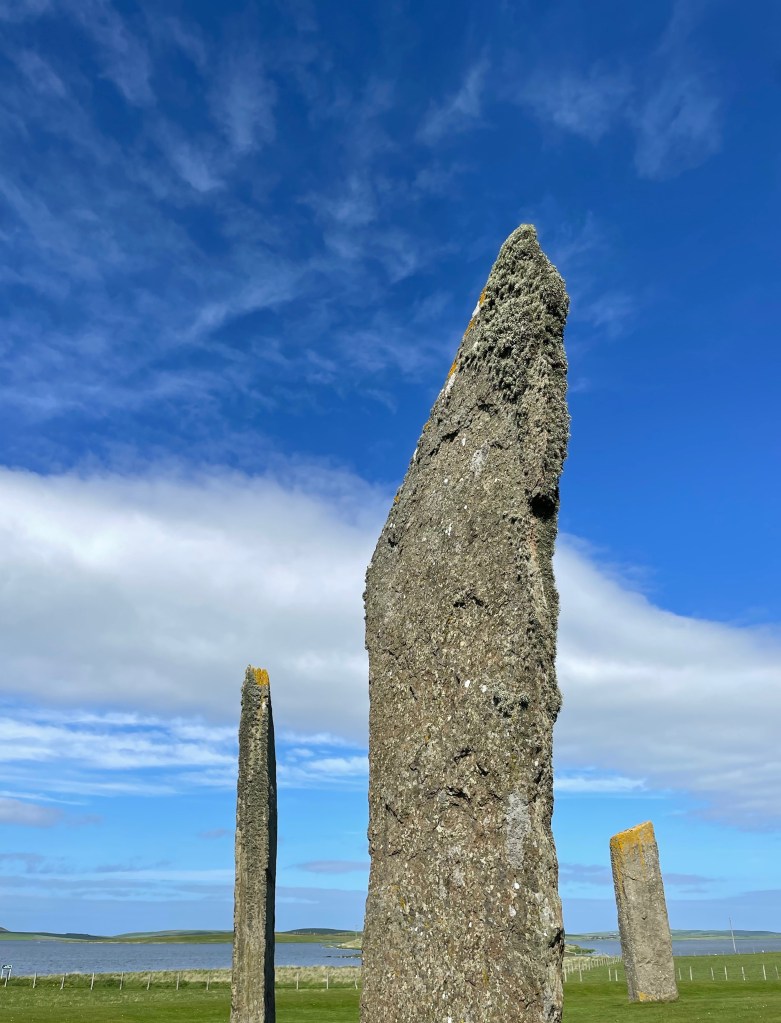
My friends, we have finally arrived on the last day of our fabulous Wilderness Scotland trip. We set off toward Stornaway, on Lewis, to catch the ferry to Ullapool on the mainland.  On our way we stopped at, in my humble opinion, the most magnificent stone circle in a country chocked full of them, the Calanais (Callanish) Stones.  Yes, yes, yes, replicas were made of these stones and then installed on the mainland at the fictitious site of Craig Na Dun for Outlander. Needless to say, they are so much more than that. Our little merry group had them to ourselves and they did not disappoint.

The stones are installed in the shape of a cross with an inner circle. They were erected 5,000 years ago and predate Stonehenge. It is thought that they were an important place of ritual activity for at least 2,000 years and possibly a kind of astronomical observatory.  They are incredibly photogenic, even in the (again) driving rain and wind.

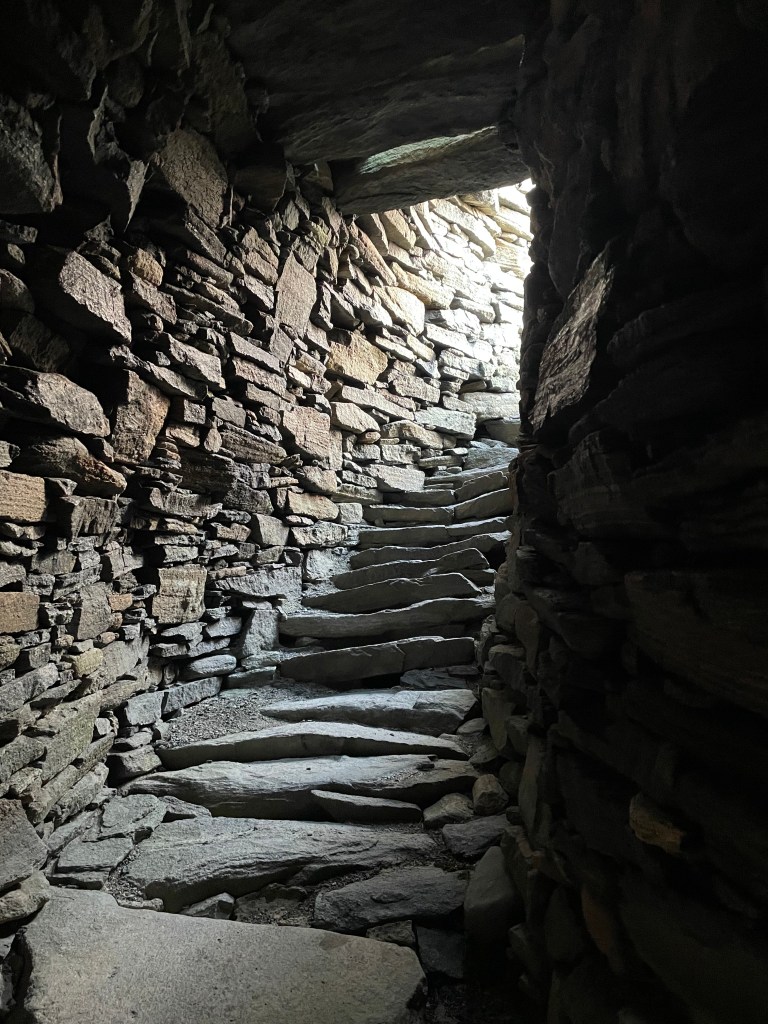
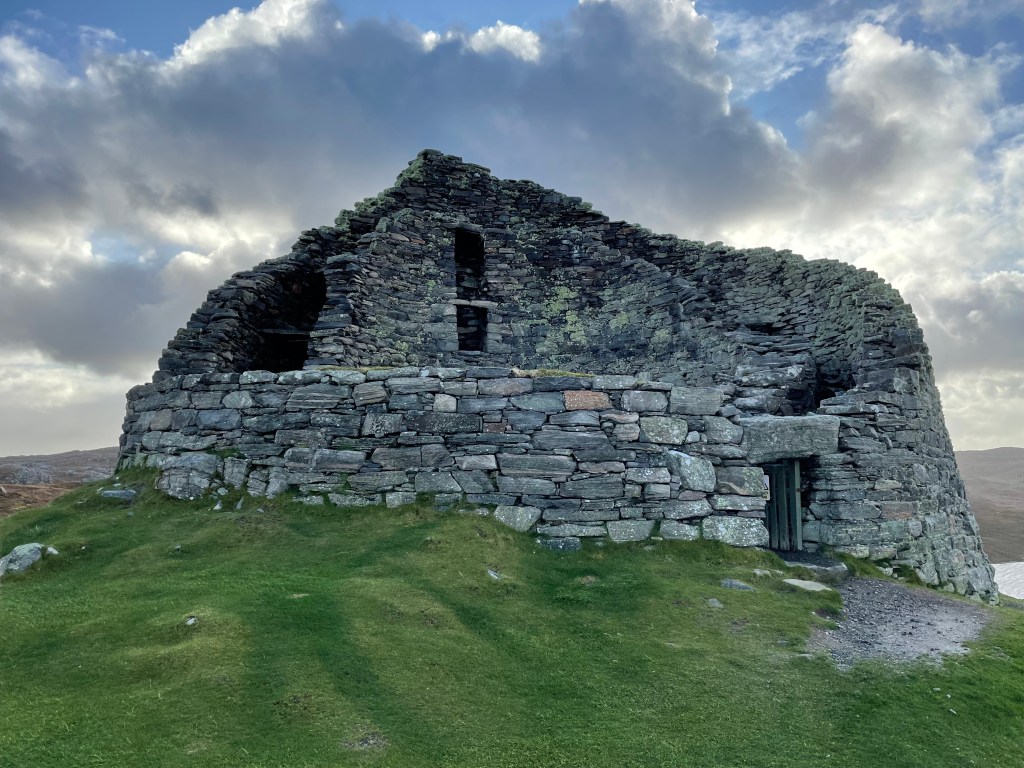
Our last official Outer Hebrides site was Dun Carloway Broch, one of the best preserved brochs in Scotland. These mysterious Iron Age monuments exist nowhere else but here. While these circular structures are as symbolic a feature as any in the highlands, their purpose remains unknown, although it is thought that they were residential structures for fancy people.

On the ferry back to the mainland, as we sailed through calm waters surrounded by hills on various land masses, Jacq, daughter of Margaret and niece of Victoria and awesome human being, turned to me and said incredulously, “There are mountains everywhere here.” I have told so many people about that comment because – I mean it’s true, yes there are. And that is one of the crazy unique Scotland things that for some reason I had never articulated. It doesn’t matter if you are on an island, in the middle of the mainland or on a ferry – there are indeed mountains everywhere. And as a person who needs mountains – that is a plus.

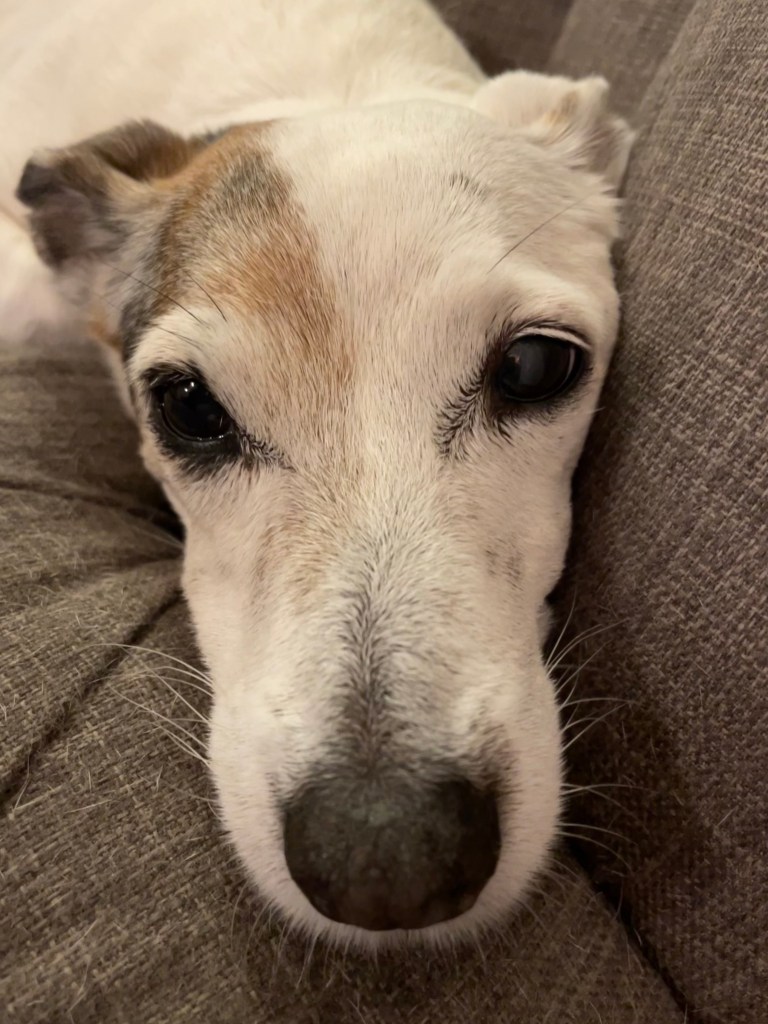
As all things do, the tour at last came to an end and we all bid a fond farewell in Inverness. I snagged dinner at Hootenanny’s, listening to some live music, and spent the night in my favorite B&B in Inverness, Castleview Guest House, run by the wonderful Eleanor and her 14 year old Jack Russell, Mia. I found the place back in 2018 because Rick Steves recommended it, and Eleanor said on his visit years ago he was most enamored of her hand-written, nearly illegible guest reservation book.

Sweet Mia

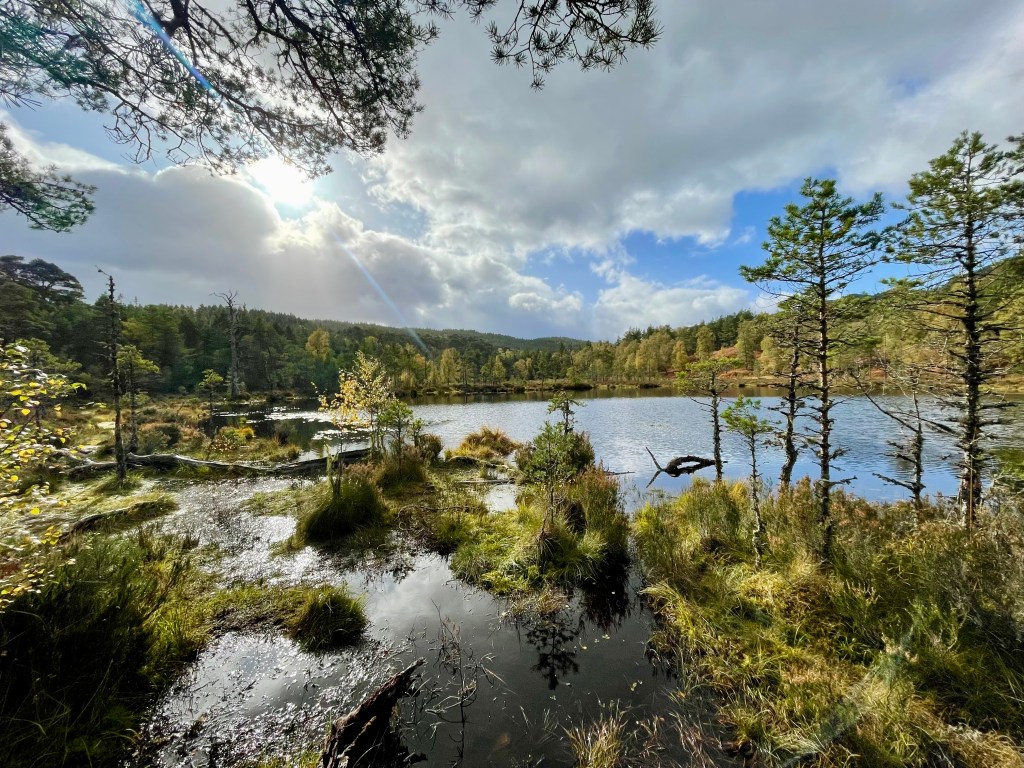
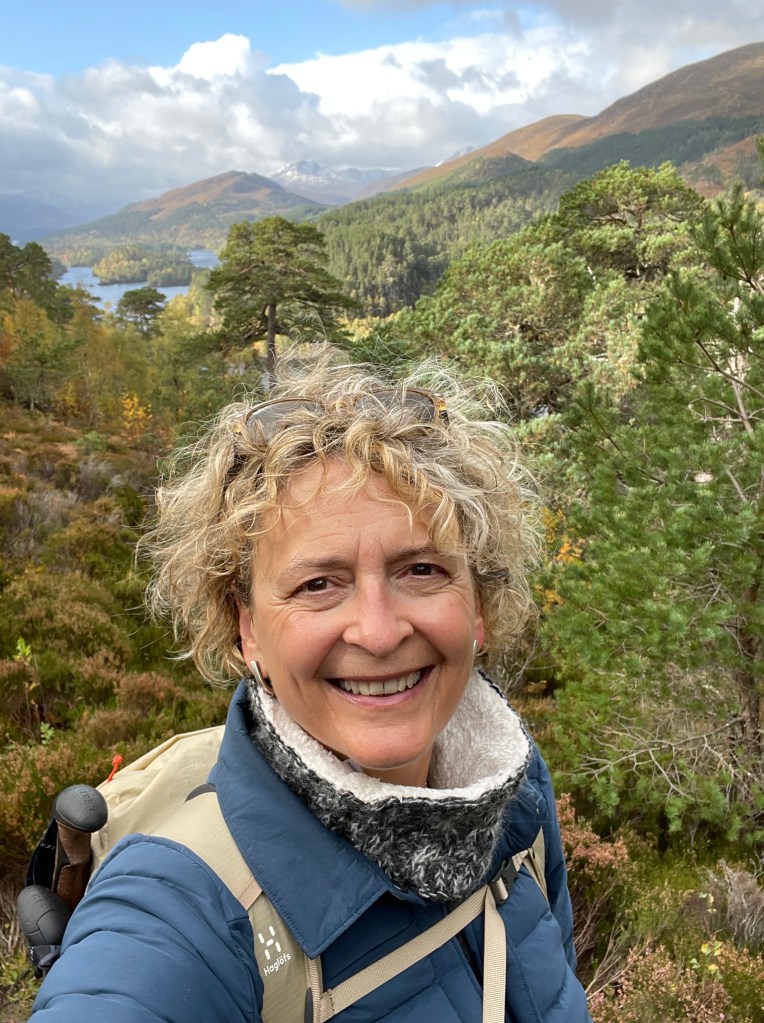
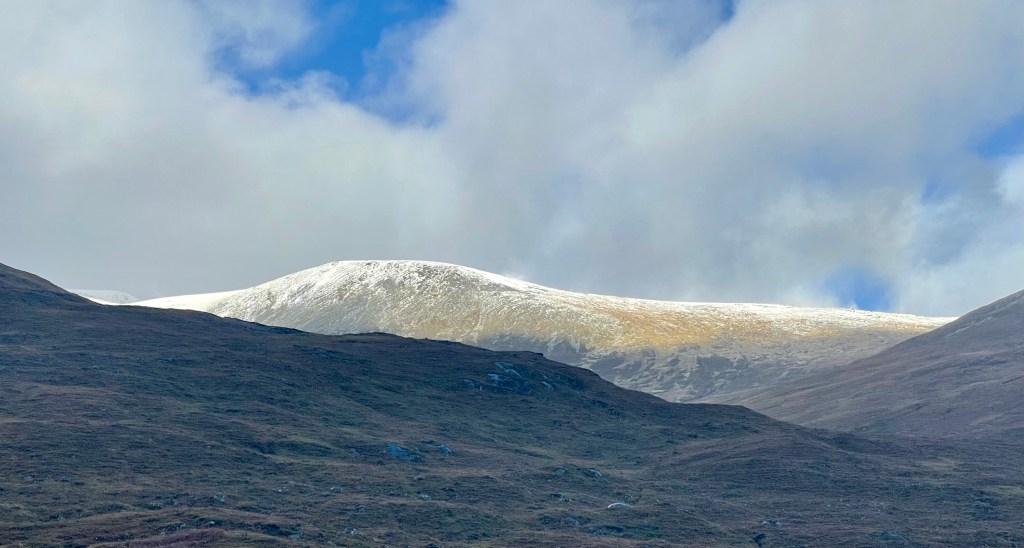
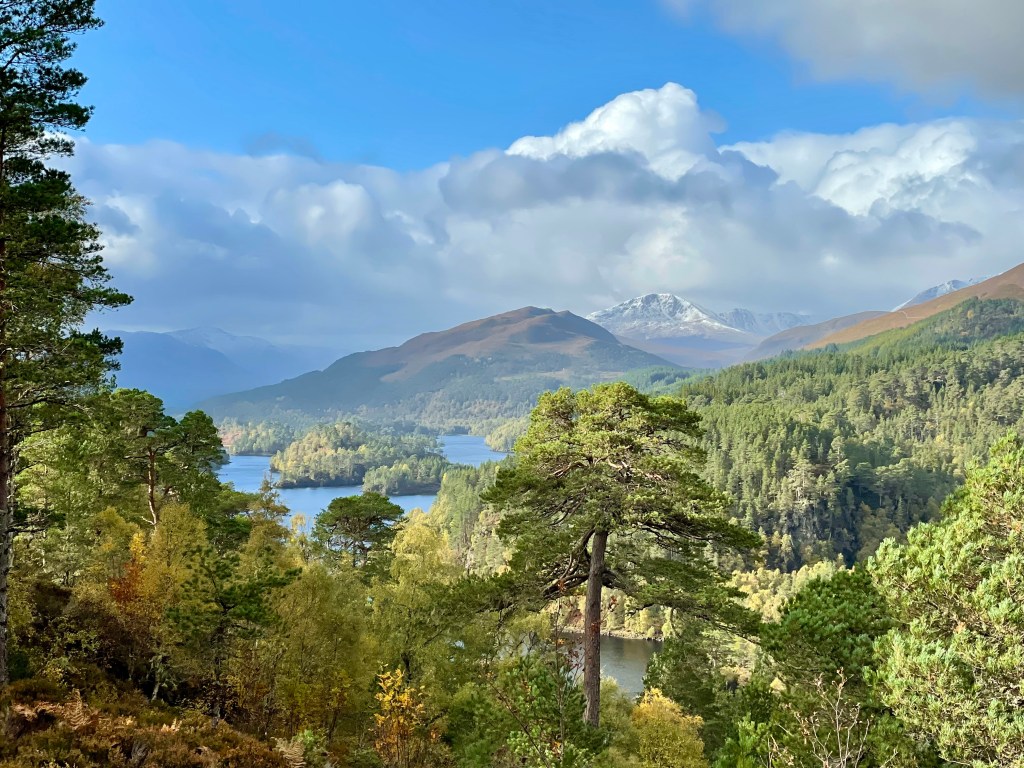
I know this sounds insane but the next day I rented a car and drove back to Skye. It’s actually not that far and Skye is Skye, so maybe not insane but only slightly eccentric. I stopped at Glen Affric, another splendid nature reserve on the mainland. And, best of all, there was snow on them thar hills.

Glen Affric, along with many other reserves I had visited over the past few weeks, is one of rewilding zones of Scotland. This restoration and conservation effort had become rather an unintended but very much appreciated mantra of my trip and thankfully is a government priority. Trees and other vegetation are planted in these areas with the goal of creating a landscape that more closely resembles the Scotland of thousands of years ago, which is not the bare hills of the highlands that we are accustomed to seeing, but rather a more forested landscape providing a more diverse habitat for a greater variety of flora and fauna. For example, trees are often planted along rivers to provide shade and cool the water so salmon can thrive.

Some in the countryside advocate passionately for rewilding, others see it as an existential threat to their culture, history, and way of life. Farmers, deer stalkers, ghillies and gamekeepers are quite anxious about the impact these plans will have on their jobs. For example, Scotland is teeming with too many deer which denude the landscape – contributing to the problem – by eating foliage from the roots (as opposed to sheep whose style is more like a lawnmower) yet efforts to cull the herd have run into resistance from landowners and staff whose income is wedded to the deer stalking business.

Be that as it may, rewilding efforts are grounded in the belief that land is not primarily for generating income from sporting activities, forestry or commercial agriculture, it’s for, you know, life writ large. Creating, nurturing and protecting wild land produces the oxygen and the biodiversity we need to survive and offers solace and inspiration for our imaginations and our souls. So there.

Returning to our beautiful drive back to Skye, there was also a sprinkling of snow on the peaks surrounding Glen Shiel. No matter how old I get, there is always something magical about the first snow of the year.

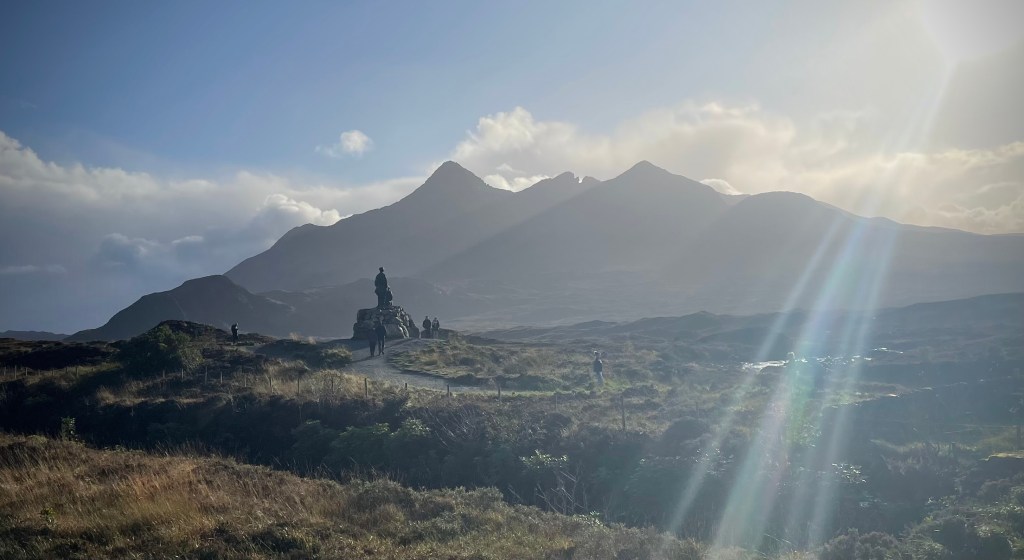
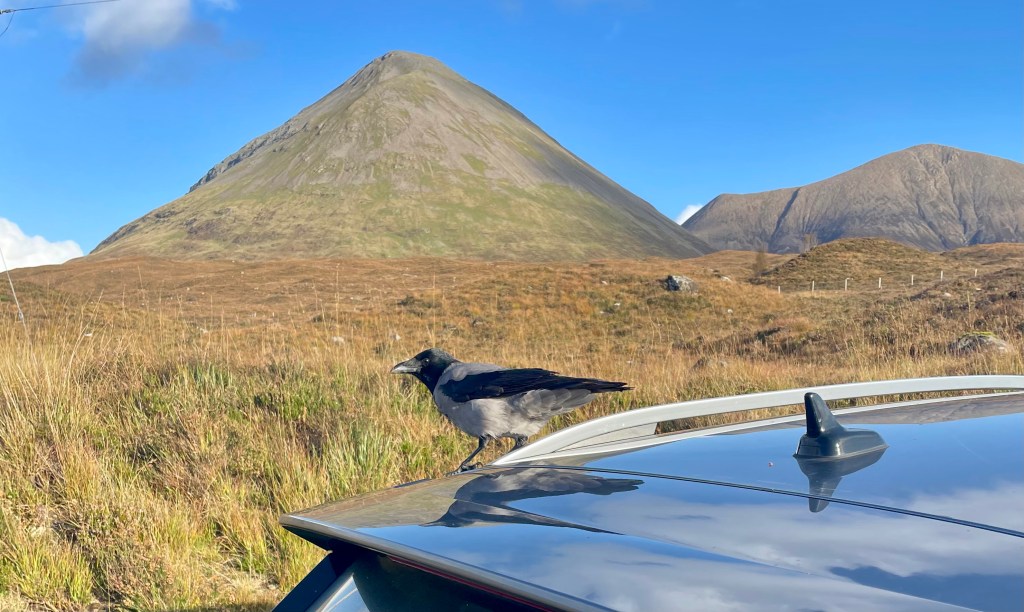
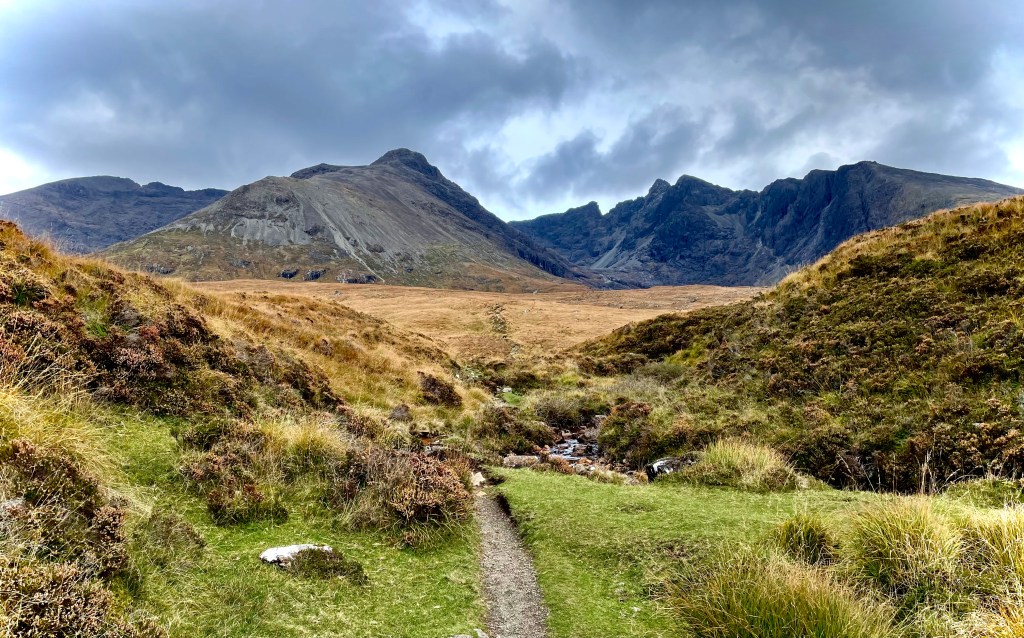
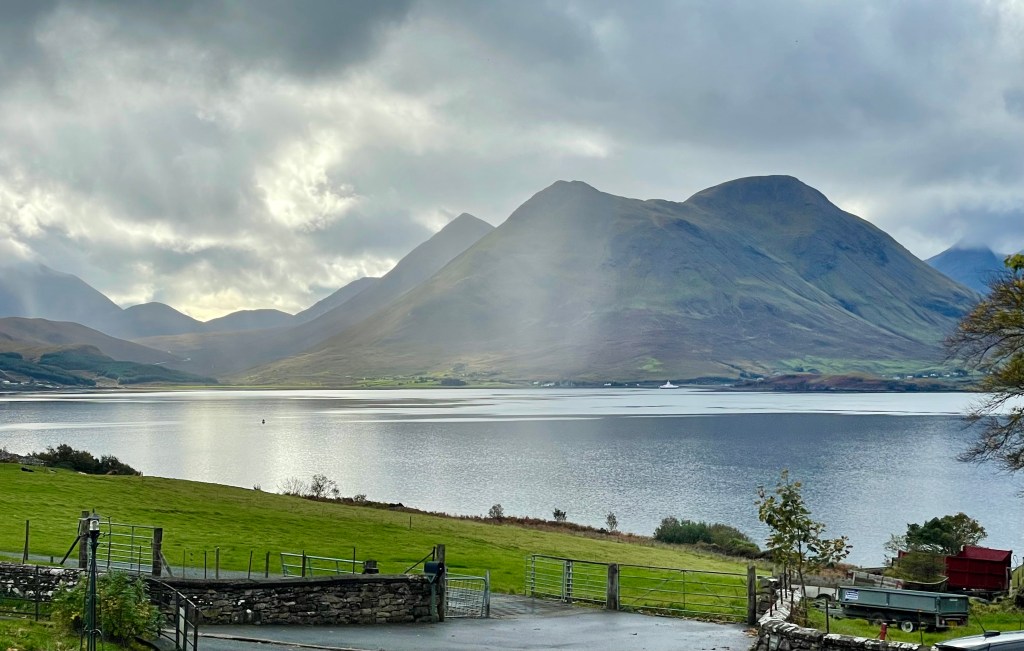
Once over the Skye Bridge, I drove through Glen Sligichan, this time in gorgeous weather and so stopped for a photo of the wily Black and Red Cuillins, since as you’ll remember they were shrouded in mist and dreich the week before.

Full circle: a hooded crow on the car once again, this time in better conditions.

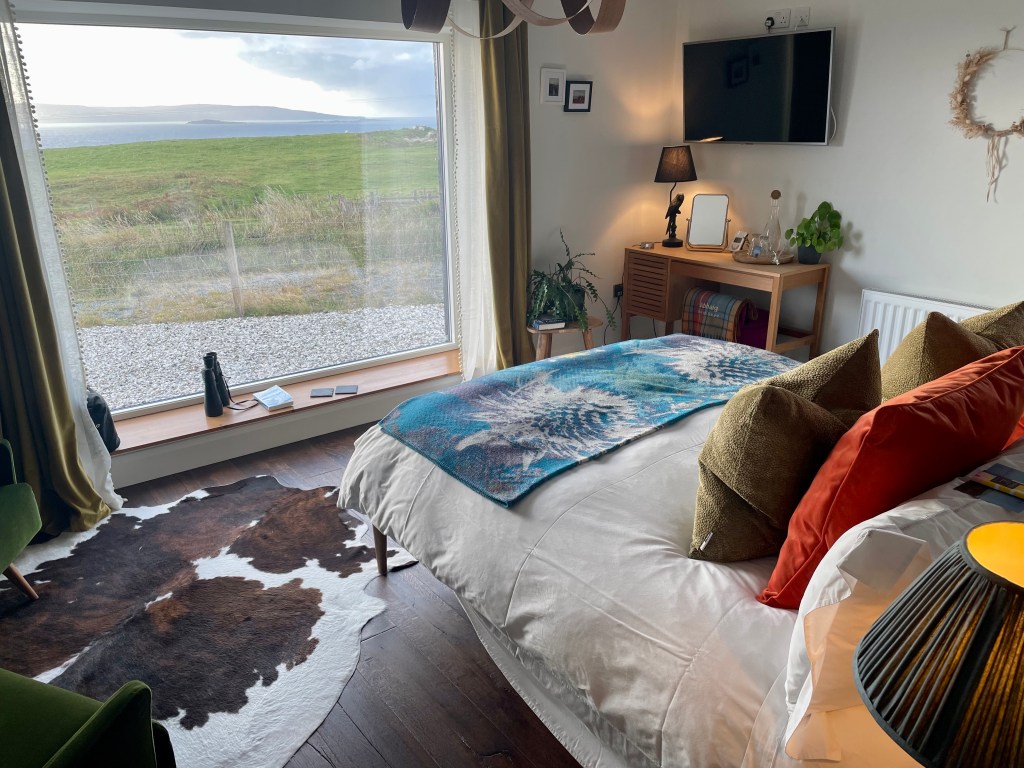
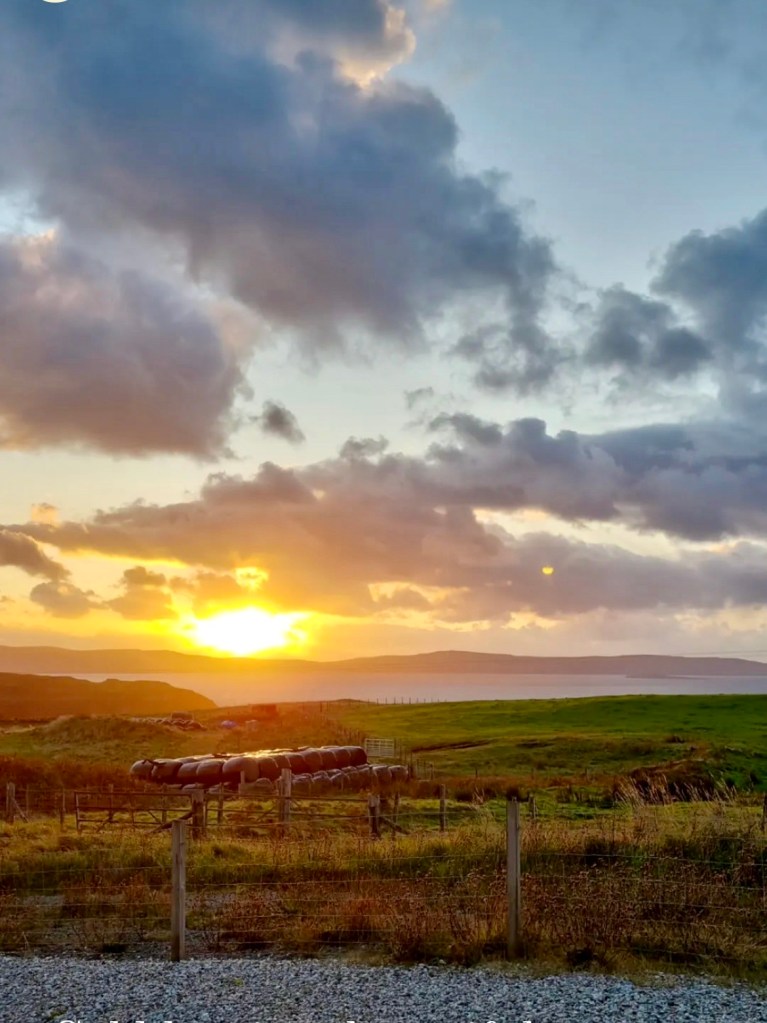
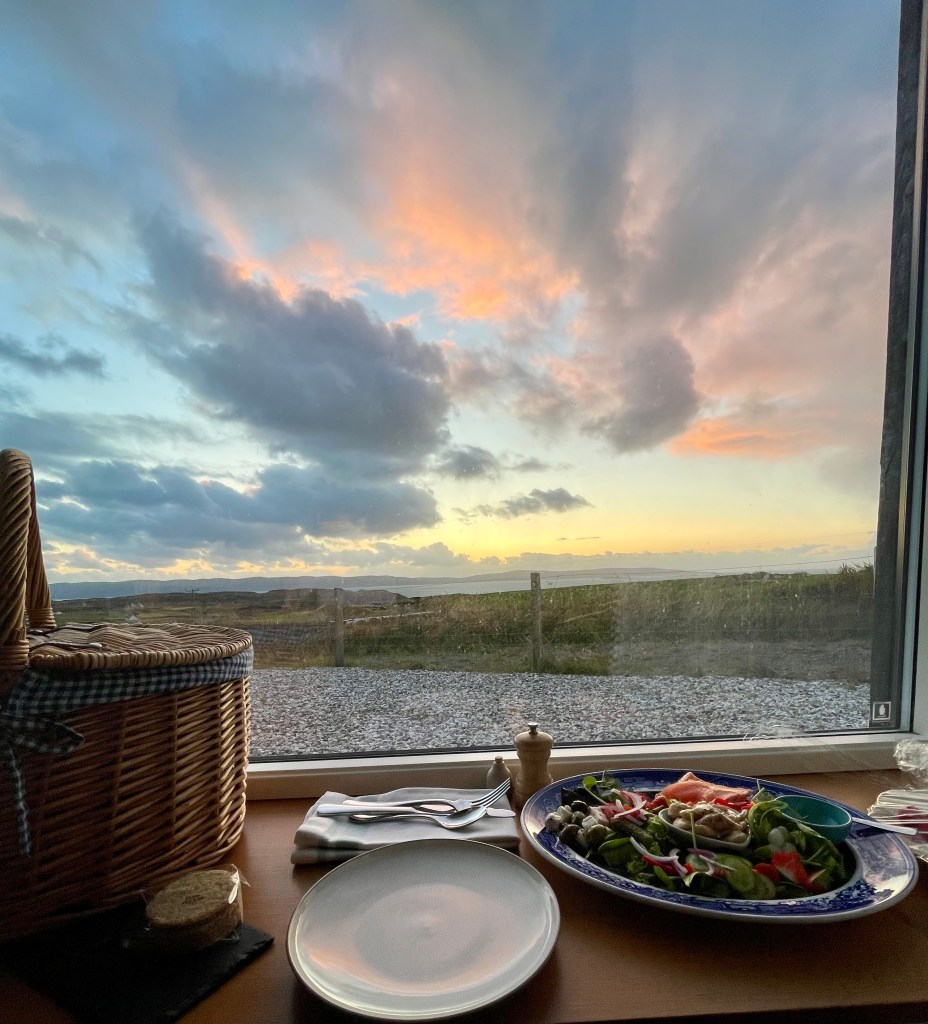
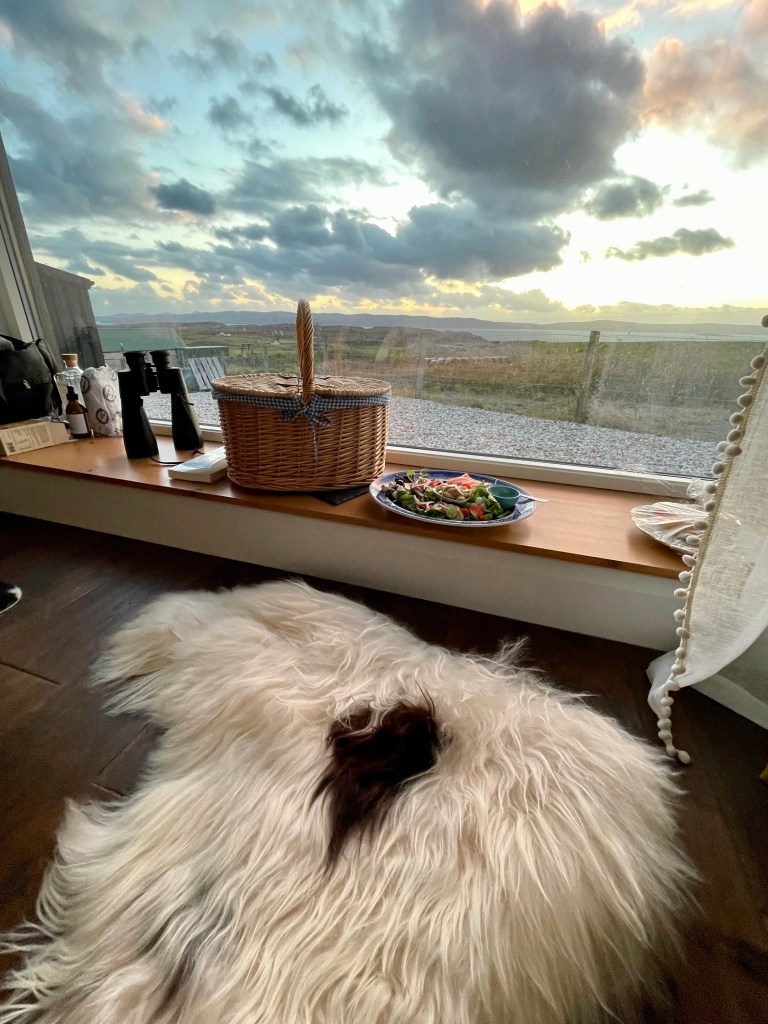
In Skye, I stayed in Uig, where we also stayed during the Wilderness Scotland trip, which I swear I didn’t realize in advance. I knew we were staying somewhere on Skye but no idea where. Crazy.  Clearly meant to be, yeah? Anyway, I stayed at a fabulous B&B, Abhaig House, run by an even more fabulous couple, Viv and Steve, who brought me a piece of a home-baked cake every single day. The view from my room was unbelievable, and I arrived to a charcuterie board with fresh salmon prepared by my hosts for a most delectable dinner, complete with a jaw-dropping sunset view.

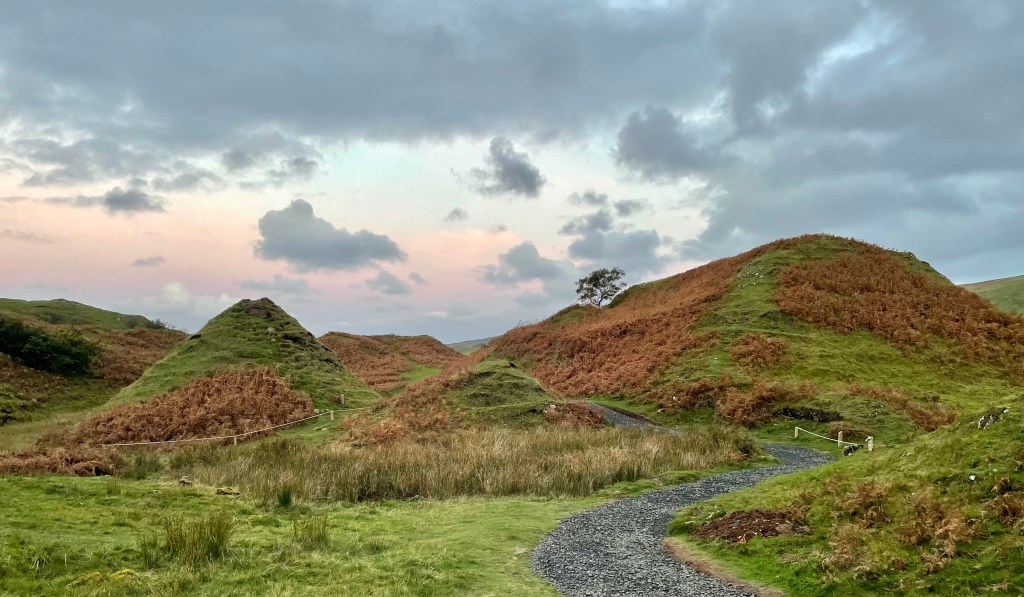
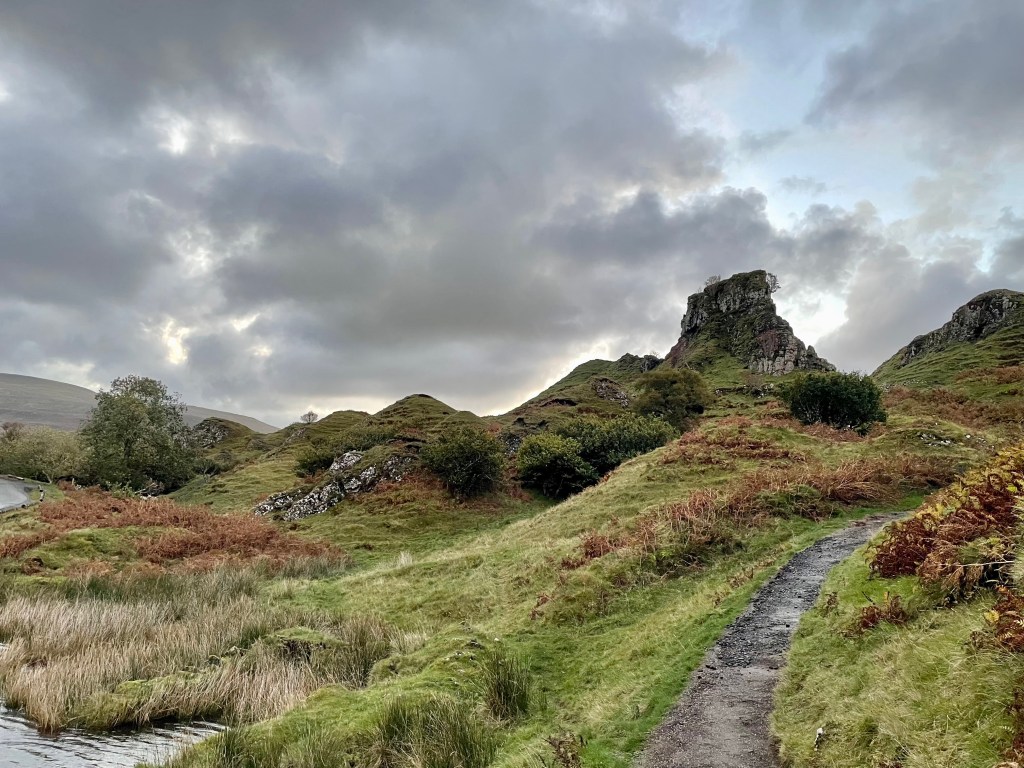
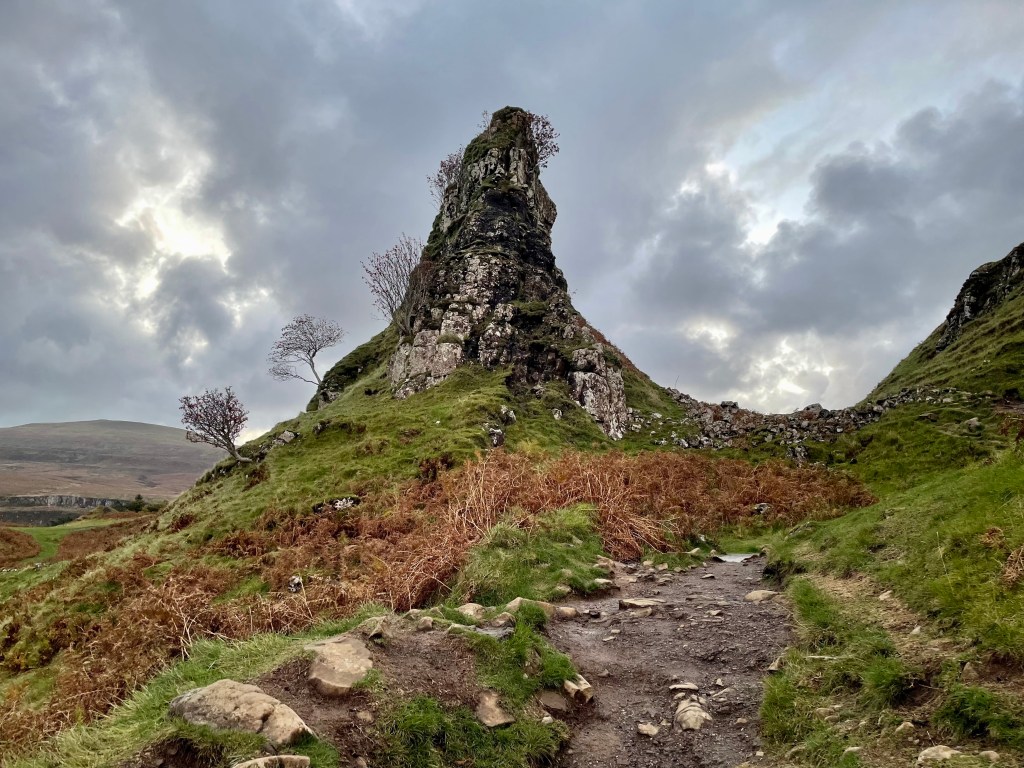
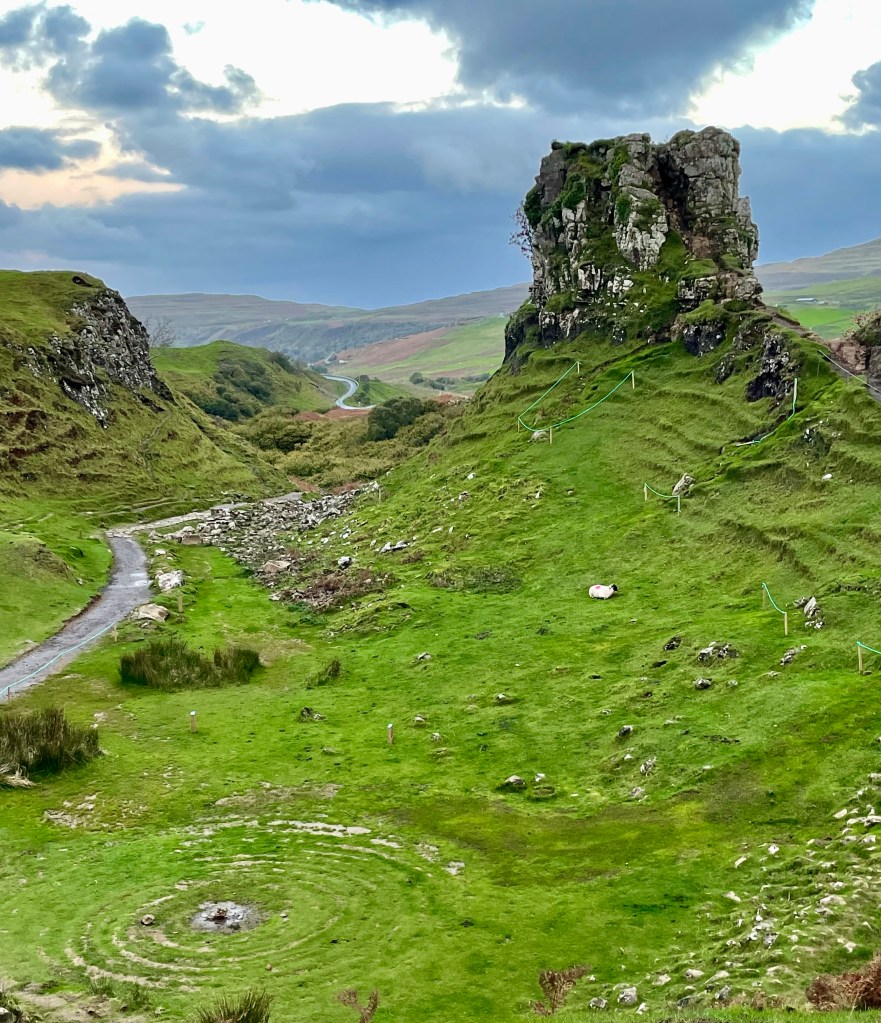
The next morning I woke up early and drove just a few minutes to one of Skye’s honeypots, the Fairy Glen. It’s usually crawling with ugh tourists but we are now in late October, and I arrived at sunrise so it was mine all mine.  Just a crazy beautiful and singular area on the backside of the Quiraing. Geology, my friend. Geology. I mean what IS this place.

After my little walk, a delightful breakfast at Abhaig.

I then drove southwest to Glenbrittle beach, where I thought I’d head partway up the hike to Coire Laggan in the Black Cuillins. I knew I didn’t have enough time to do the entire walk, sadly. I kept going a little bit further and a little bit further still – just to that ridge there, then I’ll turn around, oh wait there’s another little bit…..  And lo there came a time when I needed to pull slightly off the trail to drop trou and do a wee pee – and as looked up from my undignified squat toward the Cuillin ridge, to my horror descending walkers appeared in the distance WHO PROBABLY SAW ME and so I took that as my sign and scarpered back down to the car in giggly horror.

The black sands of Glenbrittle Beach

The reason I didn’t have enough time is because I had booked a reservation at the chef’s kitchen table at the renowned Three Chimneys restaurant, where I had enjoyed a wonderful meal with Danielle the previous spring. It was super fun sitting in the kitchen and the only other guests were a very blonde and adorable couple from London on their honeymoon. Both lawyers! Both liberal!  Brexit is terrible! Trump is terrible! Yay! A chef’s table can be risky, god knows, but we hit the jackpot and had a lively and interesting conversation for the entire meal. They were staying in the lovely rooms at the Three Chimneys, whereas I had a half hour drive back across Skye on single track roads in the pitch dark with silly sheepies snoozing like RIGHT there on the edge of the road like fuzzy doofuses.  But seriously – what a great night.

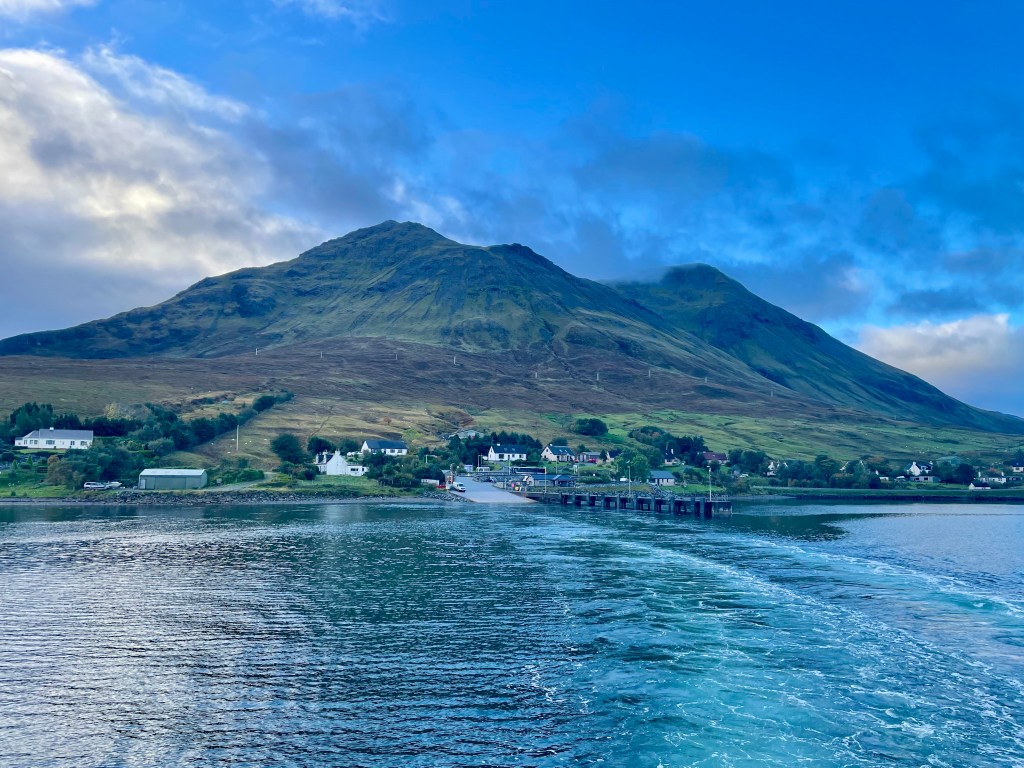
The next day I caught the ferry to Raasay, a small island with 192 denizens just to the east of Skye.  It’s a very short and very beautiful ferry ride.

When we disembarked I set off down a crumbly wee road toward a short hike that looked pretty cool. I did not see another car or another person.

There was a tiny parking area at the end of the road, thus:

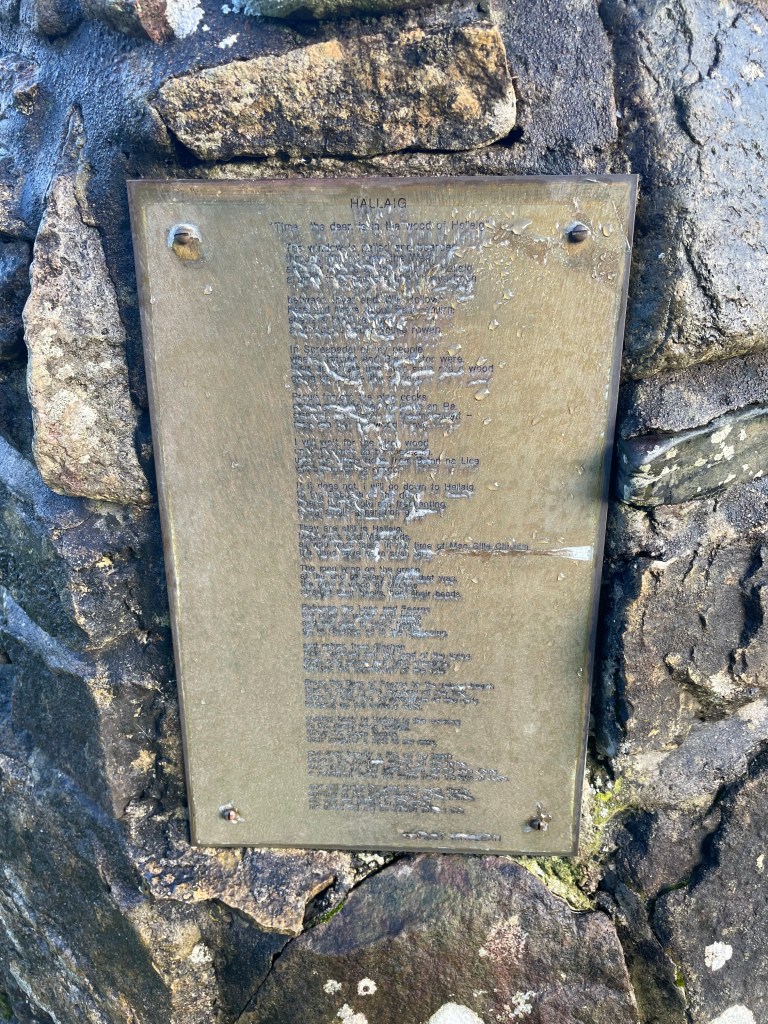
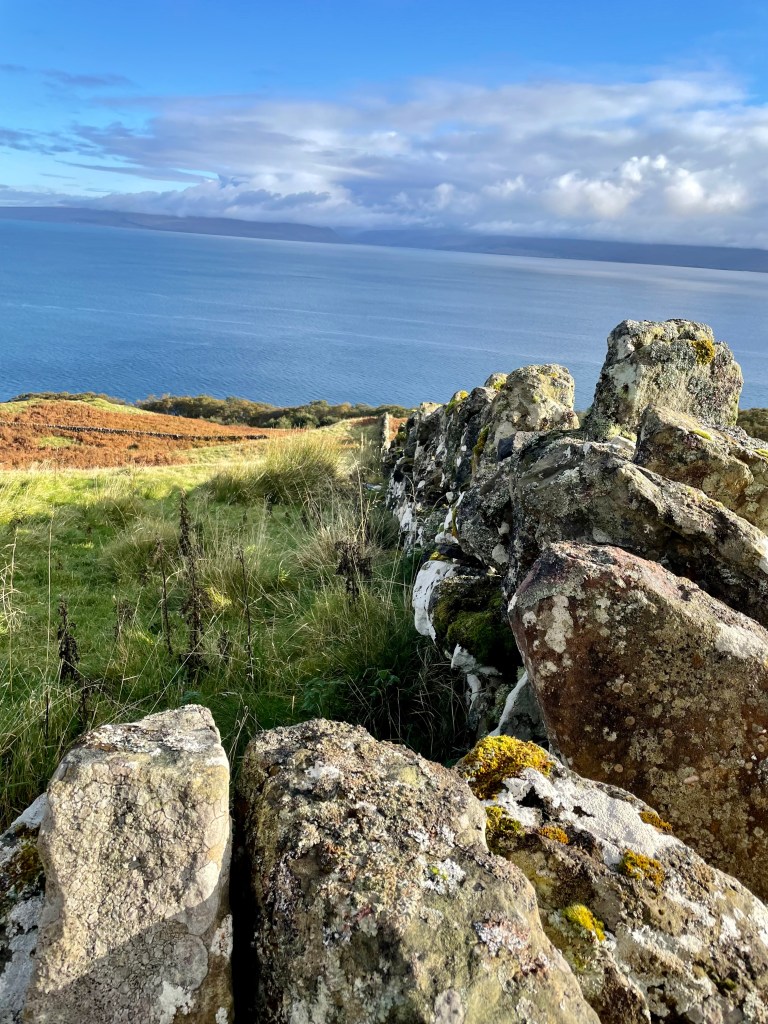
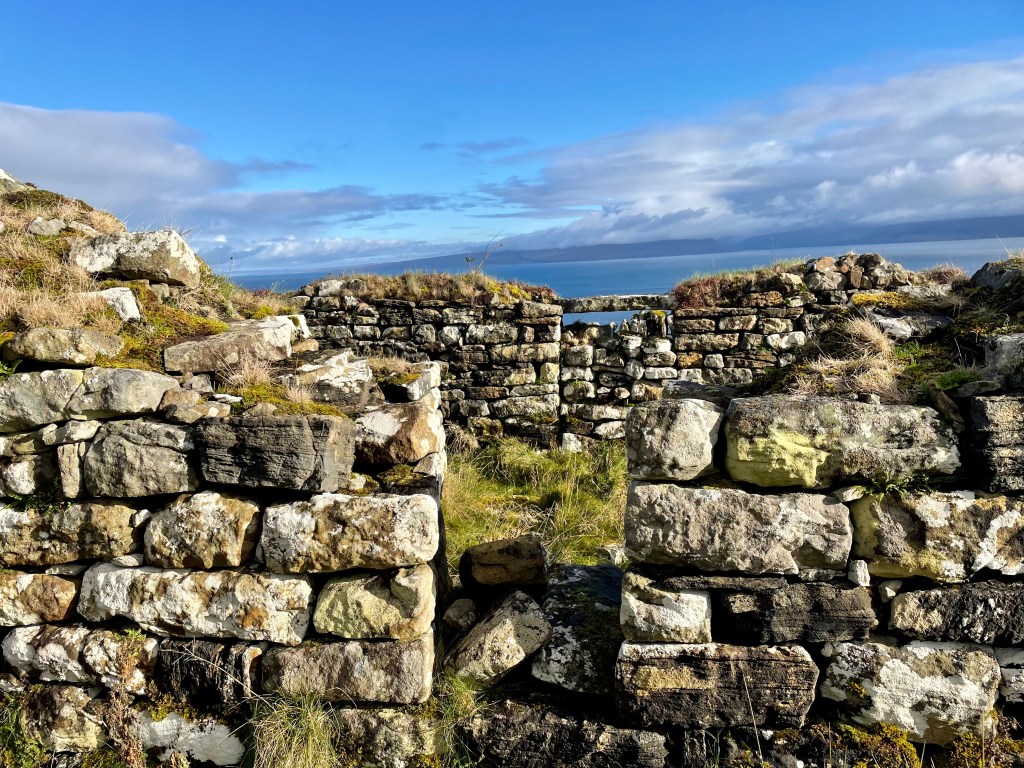
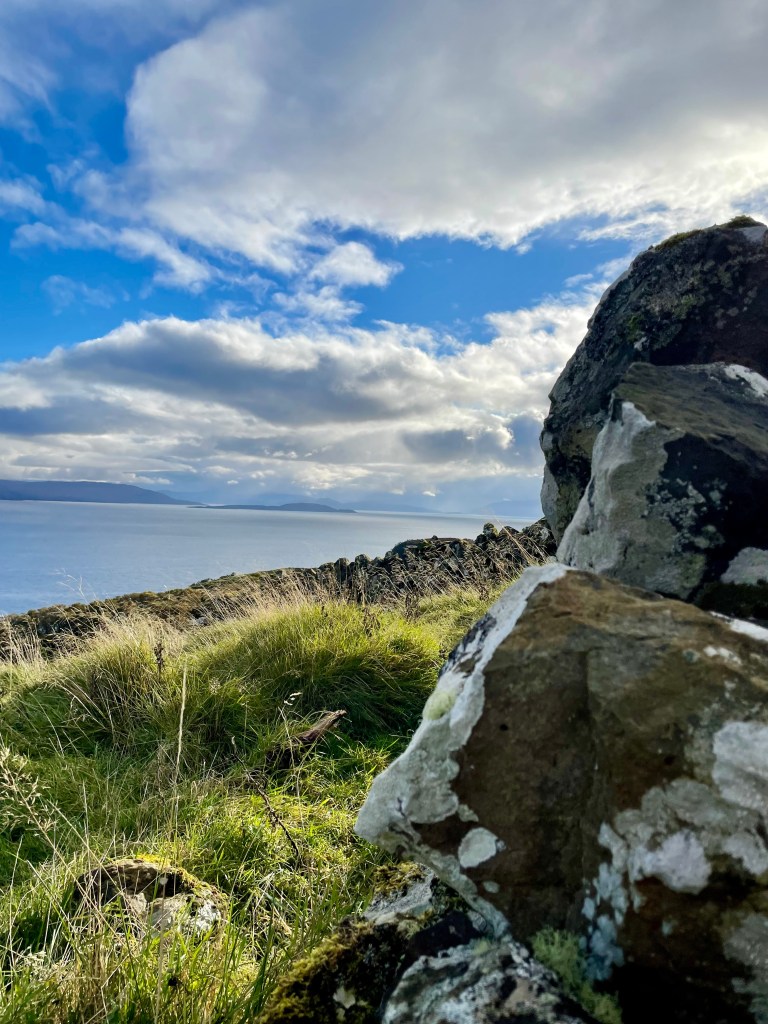
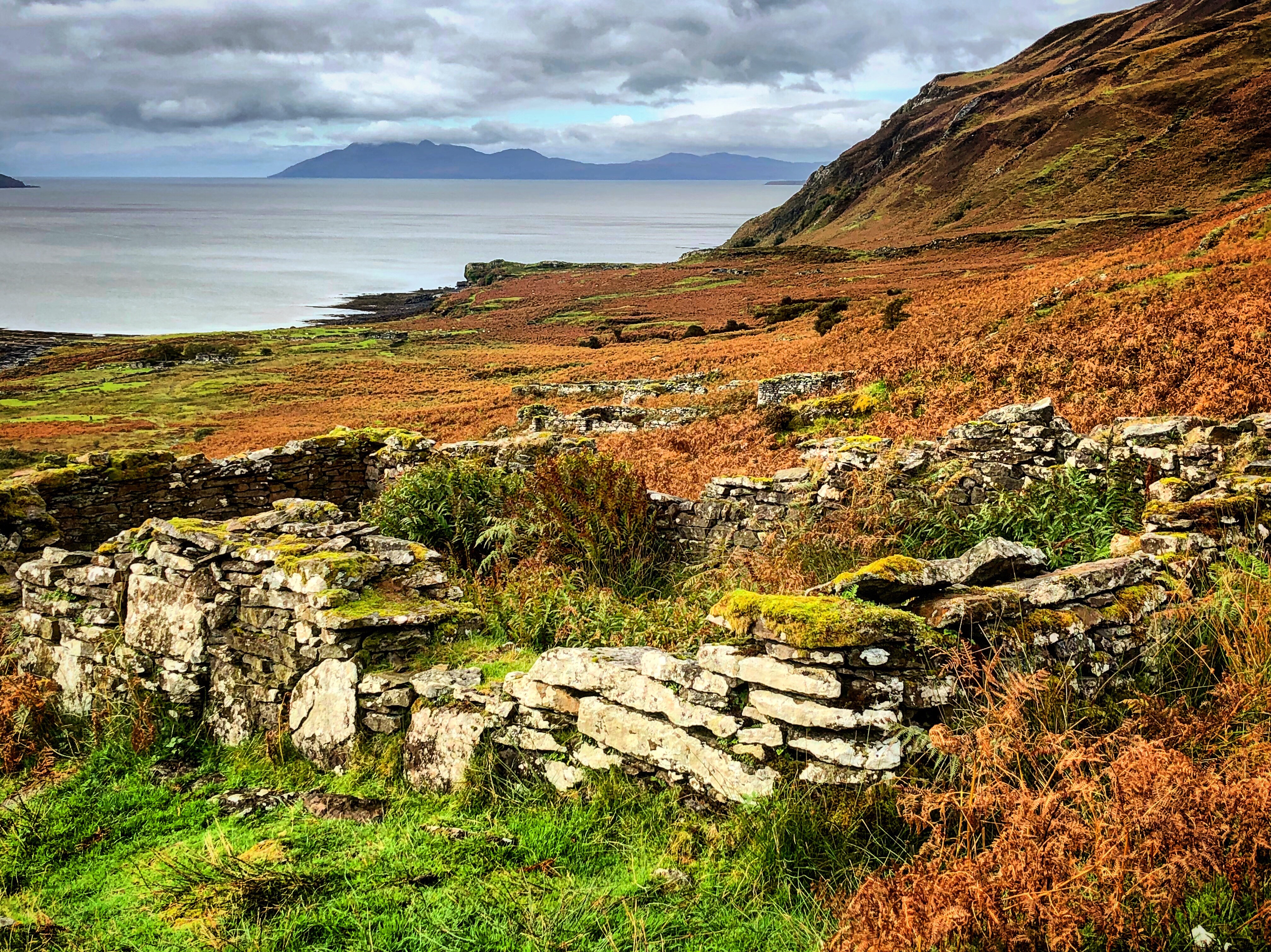
I embarked on yet another gobsmackingly gorgeous coastal hike to the ruins of Hallaig, a clearance village, one of several cleared communities on Raasay, where the residents were forcibly evicted or encouraged to move to make way for sheep grazing on the island in the 1800s.  There’s a monument along the trail that includes a poem about the ruins called “Hallaig,”by Sorley Maclean.

Back through the gloaming to Hallaig

Through the vivid speechless air,

Pouring down the steep slopes,

Their laughter misting my ear

And their beauty a glaze on my heart.

Then as the kyles go dim

And the sun sets behind Dun Cana

Love’s loaded gun will take aim.

A few photos of the ruins.

Could not resist a few smiley selfies in that sad and somber place because good god IT WAS SUNNY.

I think this walk resulted in some of the most incredible photos from my entire trip – the light, the location, the mountains, the ocean.

As you can see, this was another walk where I didn’t see another human being, which is absolutely my preference to be honest. My mom asked me to write about what it was like to hike alone in remote areas in a foreign country.  The answer is that it’s awesome and makes me blissfully happy and at peace.  An adventure in the best possible way because the risk level is very, very low and yet you are out in the wild! On the moors! Gazing across oceans and up mountains!  So many wild coos and sheepies! And I’m not naive, I know full well that folks have often found themselves in trouble hiking in the UK, involving mountain rescue teams, helicopter evacs, injury and even death. I don’t know what to say except that the thought never crosses my mind that something bad might happen because a) I’m in Scotland and b) there’s so much joyful zen in my brain. I’m so completely present in the moment as they say, that all thoughts of worry have nowhere to grab hold. For what it’s worth, my mom doesn’t worry about me either, which is quite literally unheard of. So ¯\_(ツ)_/¯

I sat in the car for a few minutes enjoying the bag lunch of a fresh salmon salad Viv and Steve prepared, and then started the short drive back toward the ferry so I’d make it to Raasay Distillery in time for my tour.  Along the way I came upon a Scottish traffic jam, but not to worry, I made it.

Opened in 2017, Raasay released its first whisky in 2020. The 2022 Scottish Whisky Awards named Rassay Distillery of the Year, and it’s a beautiful facility with drop-dead views. They released their first whisky in 2021 and their single malt combines six signature casks – maturing peated and unpeated spirit separately in ex-rye whisky, virgin Chinkapin oak and Bordeaux red wine casks. The first of this cask combination in Scotch whisky history. The exact proportions are, of course, top secret.

A lovely, sophisticated English woman with a dry wit was our tour guide. She had retired to Raasay a few years prior with her French husband and was obviously enjoying her retirement gig at the distillery. I talked with her afterward about what it was like, and how her Parisien husband was enjoying living on a remote barely populated island in the Hebrides. I shared that I was feeling a similar pull toward Scotland in general.  She immediately engaged an eye-lock and encouraged me to start doing something – taking actual measurable steps toward this goal. I don’t know, I got the tingles. Message received.

So the Raasay “Hebridean” is a very very good whisky and I fell in love with the distillery and with Raasay itself. As I had enough space in my luggage to bring one bottle home, I decided this would be The Chosen One. I did a quick search on my phone – without my glasses – to make sure you couldn’t buy Raasay in Oregon. Well. When I got home I looked it up again and sure enough, found that you could acquire a bottle in two local liquor stores.  Not only that but one of the liquor stores carried bottles of the single cask versions from the pleated bordeaux and rye casks. Good god. Coals to Newcastle. In retrospect, it’s almost a certainty that I misspelled Raasay as I was standing in line at the distillery on my phone with no glasses. I mean, there are a lot of “a’s” in fairness.

The view from Raasay Distillery. Literally. I can’t even.

The ferry back to Skye.

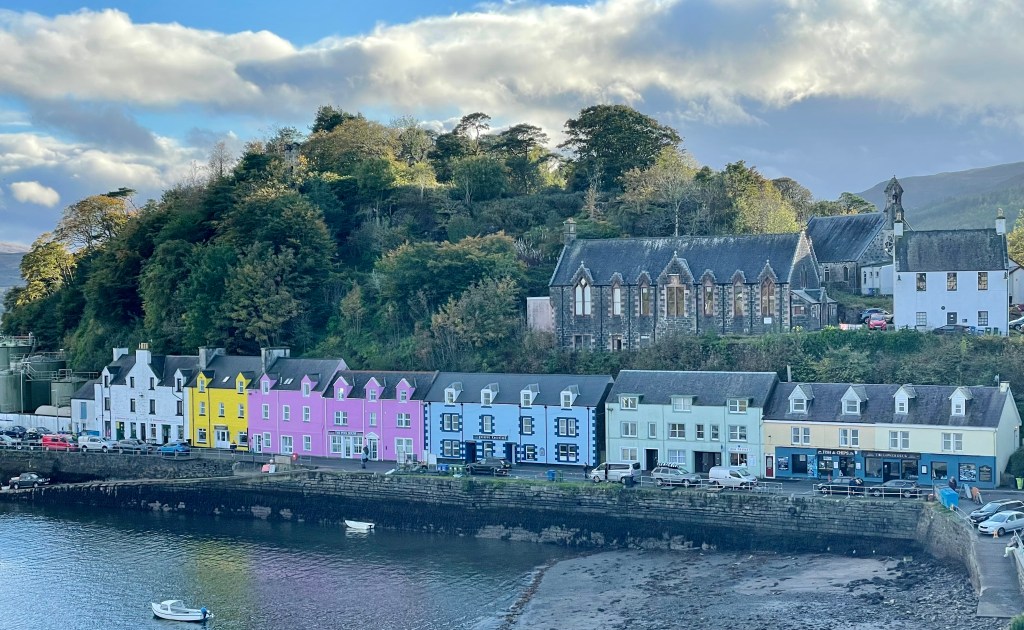
My car and I alighted from the ferry and drove to Portree where I had booked a table at Dulse & Brose, a lovely restaurant of past acquaintance.  I was there a bit early and so wandered around Portree seeking a pub.  The thing about shoulder season is that places are sometimes closed for the winter – rude! I finally walked along Quay Street, where the lovely painted buildings are, and found a teensy weensy pub inside the Pier Hotel. (The baby blue building below).

I sat at the bar and had a dram, eavesdropping on a hilarious conversation between a couple of older Scottish men with a fisherman vibe and a small family group from, of all places, Texas. The Texans were trying to explain to the Scots why the phrase, “bless your heart,” (which the Scots had never before heard) could, and often did, actually have a negative connotation. It’s one of those southern idioms that sound polite but are really a highly judgmental put-down. The Scots literally could not understand why we’d take something that sounded like a blessing and turn it into a smug slam.  The other conversation I enjoyed was between the bartender and his girlfriend about how amazing Peaky Blinders was.  Speaking of which,

Tommy Fookin’ Shelby makes the blog.

And now I think it’s high time to wrap this installment of The Wee Dram. My last full day had finally arrived, so I bid a sad farewell to Viv and Steve and the cute pups they were dog-sitting.

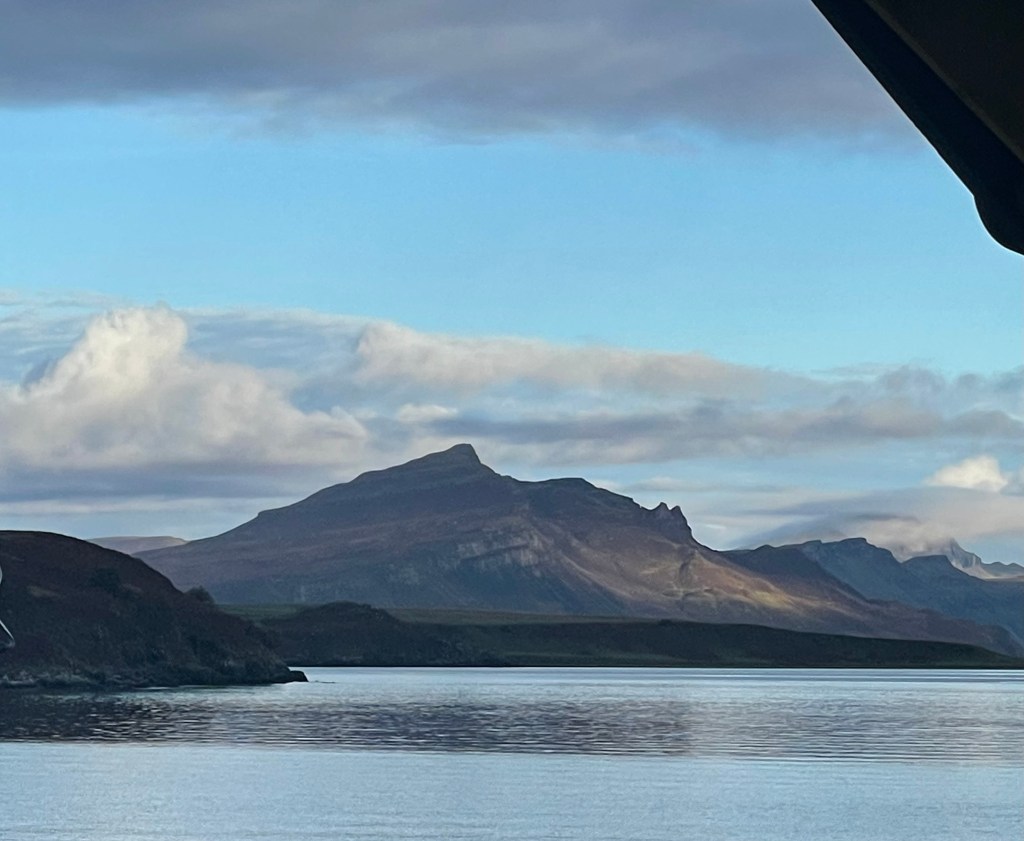
I then had the dumb idea of stopping by the Old Man of Storr on a gorgeous sunny day at 10:30, thinking I could just bound up the trail of the last Skye honeypot I hadn’t yet done. It was a sh*tshow. Could not believe the huge parking lot packed to the gills with humanity. Nooooooo.  No thanks. KThxBai. Next time. I pulled off the road across from the bulging parking lot, grabbed a coffee and had a final wee look across to the mainland where I was headed – and said goodbye to Skye for the fourth time in my life. I also said see ya next year.

I drove through a bluebird day back to Inverness. It was honestly sort of weird seeing Scotland during a baldly sunny day. It didn’t look like itself.

My last night in Inverness I once again stayed with Eleanor and Mia, enjoying a lovely supper at the Mustard Seed. It was a gorgeous final night of my nearly month-long trip.

So, dear friend, thank you for reading this blog, for being patient with my many diversions down historical, geological, ecological, cultural, Gaelic pronunciation and whisky-related rabbit holes.  I’ll just end by saying that I’m headed back next May to Glencoe (have never missed), the Pentland Hills south of Edinburgh, and……(drum roll) Shetland. And next fall I’m returning with my pal Trish, mostly to visit Arran, Islay and Jura, since our last trip we were stymied by weather, and then back to Skye where I will probably feel drawn to the ferry to sail to the Outer Hebrides again, maybe this time to the Uists.

Because why would I go anywhere else.

Caledonia Calls Again

You guys. After a mere three+ years I’m headed back to the bonnie bonnie banks, glens, cols, beinns, lochs, isles and waterways of Scotland. Last we met it was the fall of 2018 where you provided excellent company on my solo trip. In 2019 I decided to upgrade my house a bit, possibly sensing that I’d be spending quite a lot of time inside its walls in future. As 2020 loomed with its gigantic birthday, I told anyone who would listen that in celebration I’d be saying YES to All The Things. Planned a birthday trip to Paris and another Scotland hiking trip (this one). Yoga retreat in Sedona. Yes yes and yes. And then. Cancel, cancel and cancel, your silly plans matter not. We all lived through the last two years together, and there’s nothing you don’t already know. Enough said.

This trip won’t be solo, but with Danielle, a friend who has accompanied me on many Central Oregon hikes in the Cascades. We are both recovering lawyers, and I think met at a yoga studio years ago. There’s a photo of us in said studio on our backs with our ankles tucked behind our heads and our hands in namasté. Needless to say it’s hilarious and also entirely inappropriate for our purposes here today so I couldn’t possibly post it. Danielle is dating an actual Viking and I still harbor hopes of meeting a Scottish lad with a castle so we remain in men-in-kilts territory. This blog, and Scotland, will continue to abide.

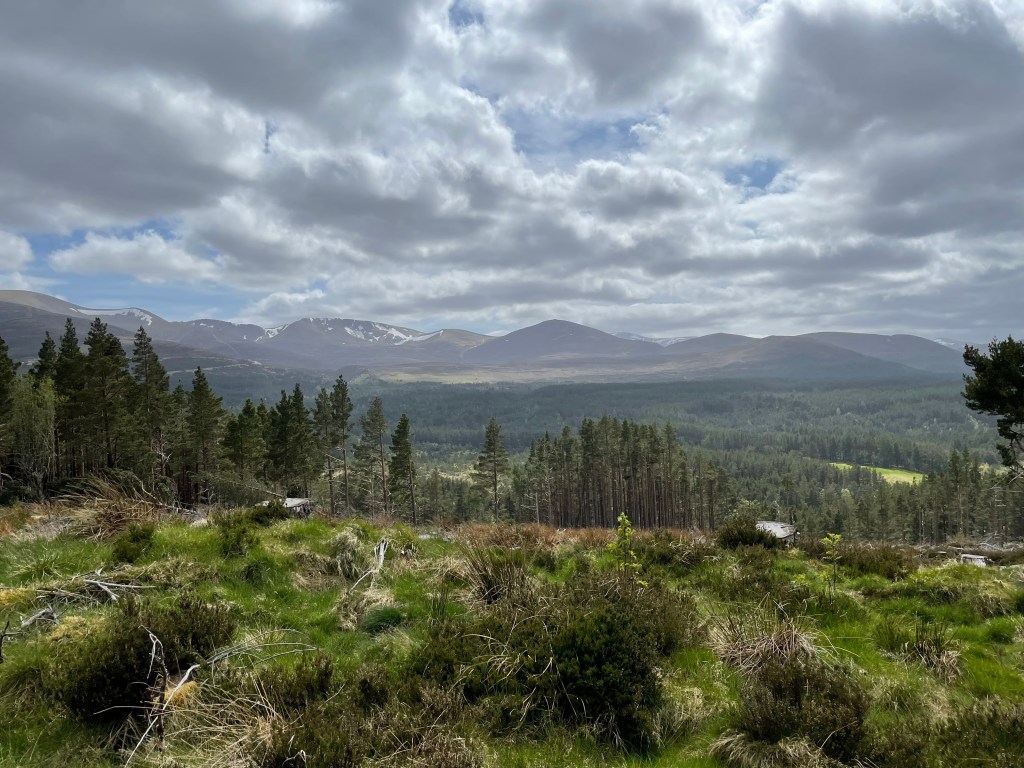
As the trip is growing closer, I’m focusing mostly on driving for the first time in the UK (yikes), and looking forward to hiking in the Cairngorms, the Orkney Islands, Skye, Torridon and Glencoe – and traversing the North Coast 500. I also want to see as many puffins as possible. There will be castles, neolithic ruins, stone circles and Viking stuff. In fact there will be a distillery tour of Highland Park in Kirkwall, which includes a tasting of their “Vikings” series, with special edition, largely cask-strength drams named after Odin, Thor, Freya and Loki. To top things off, I had to postpone my trip home because my intended flight was unceremoniously cancelled, so will be in Inverness solo for an extra day (on my birthday as it happens). On that day a man named Andrew Grant McKenzie (you heard me) a historian who plays the bagpipes and worked at Culloden Battlefield for years will be squiring me on a tour somewhere, honestly it doesn’t really matter where. I believe the chances of him showing up in a kilt are very very high.

So thank you for joining me yet again to explore a wee country the size of South Carolina that somehow contains a vast Universe of history, hiking trails, dazzling terrain, culture, wildlife, wonderful food and very kind and welcoming residents with comforting accents. Scotland is basically Hermione’s bag in the form of a country.

Meall a’ Bhuachaille

Last day in the Cairngorms, we had to knock out a mountain. We chose a Corbett. The tallest of the Scotland mountains are known as Munros. To qualify as a Munro a mountain must be over 3,000 feet (remembering that we are starting at sea level, you western US mountain people). They number 282, and are named after Hugh Munro, the first person to compile a list of them in 1891. “Munro bagging” is a thing, and to date over 6,000 people claim to have bagged all 282. Corbetts are next, which are between 2500 and 3000 feet, named after John Rooke Corbett, who originally listed them – and interestingly, in 1930 he became the fourth person, and first Englishman, to bag all the Munros. Lastly are the Grahams (2000-2500 feet), named after Fiona Torbet (née Graham) who was a passionate hillwalker and, you guessed it, created a table of the most wee mountains. In a bizarre twist of fate, Fiona was gruesomely murdered in 1993 by Donald Jr, the son of the owners of the Western Highlands bed and breakfast she was staying in. The 400-hour search for her was one of the most intensive ever mounted in the Highlands as helicopters took aerial photos of the area and the Royal Navy dredged a Loch near the B&B. Nine months later, when the snow melted, some of her personal items were found under a tree on the grounds of the B&B. Finally Donald Jr confessed.

Our lovely B&B hosts, who have never murdered anyone, recommended Meall a’ Bhuachaille. Kev said that during the pandemic he walked it every day to clear his head.

We started the hike full of happy anticipation, only to be met with a very, very steep situation. Even so, we came upon (very fit and/or nuts) people running and mountain biking the vertical, switchback-free slopes. This is irritating when one is operating in drag-ass slogging mode. And by the way, I can hear you thinking that I must be exaggerating. We ascended 1600 feet in about a mile. The gnarliest hike in our neck of the woods is South Sister, where the ascent is 4,900 feet in 5.5 miles. You do the math.

Circumstances in this photo are much steeper than they appear.

From a distance, and as you can see from the photo below, our scree-trained eyeballs thought the Cairngorms quite reminiscent of the red cinder cones of Central Oregon. This being Scotland, though, of course it’s not volcanic scree, but rather – carpets of heather. Stop it, Scotland.

Our destination, blanketed with heather.

So I shall skip any further unpleasantness that may have been associated with the climb and say that the summit was reached in due course, which always makes the effort utterly worth it. The top was a windy place. A large cairn served as a shelter. The views were stupendous.

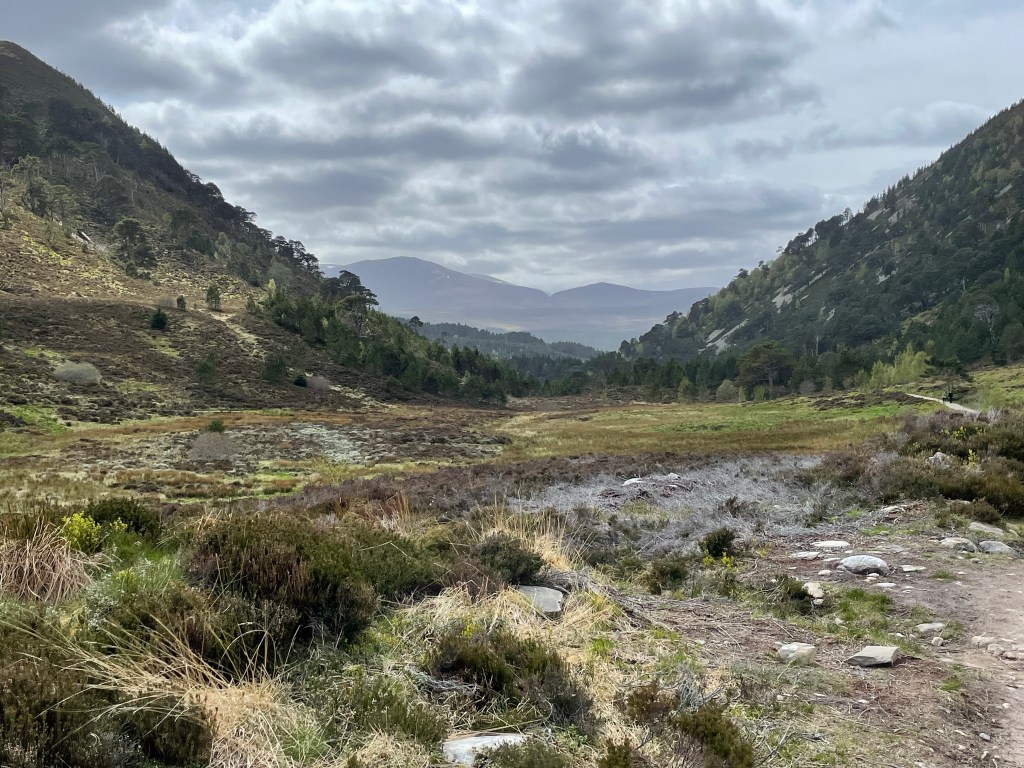
On the way down we came across a bothy in a beautiful valley. Bothies are located in remote spots throughout Scotland. They were originally rural cottages that have outlived their original purposes and now are kept unlocked for hill walkers to take shelter or stay overnight without charge. The Mountain Bothies Association, established in 1965, is the charity that maintains them.

The views were lovely all the way back to the car, as we hiked through a beautiful valley to a loch, coming upon many hikers and dogs out for a Saturday adventure. Mostly Scots and some Norwegians. We might have been the only Americans on the mountain. As it should be.

Hiking on Orkney: Neolithic Ruins, Stone Circles, Hippies and Whisky

Ring of Brodgar, Mainland

Our epic hike to the Old Man of Hoy now in the books, we have two more days of hiking plus a guided tour of Westray to look forward to during our time in Orkney.

One note – we learned that one must never say, “Orkney Islands” or “Orkneys” or “Shetland Islands” or “Isle of Skye.” It’s Orkney, Shetland and Skye, and the same can be said for all 700 of the Isles of Scotland. This mistake is as irritating to Islanders as it is to Oregonians when others pronounce our state Ore-GONE. Ugh.

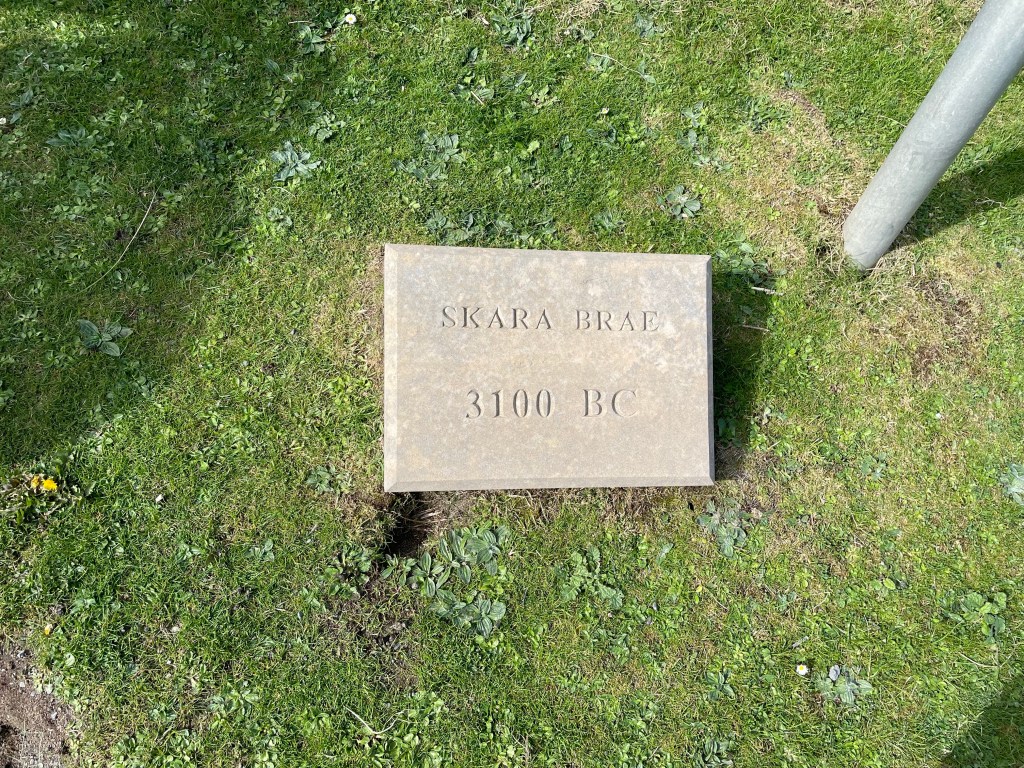
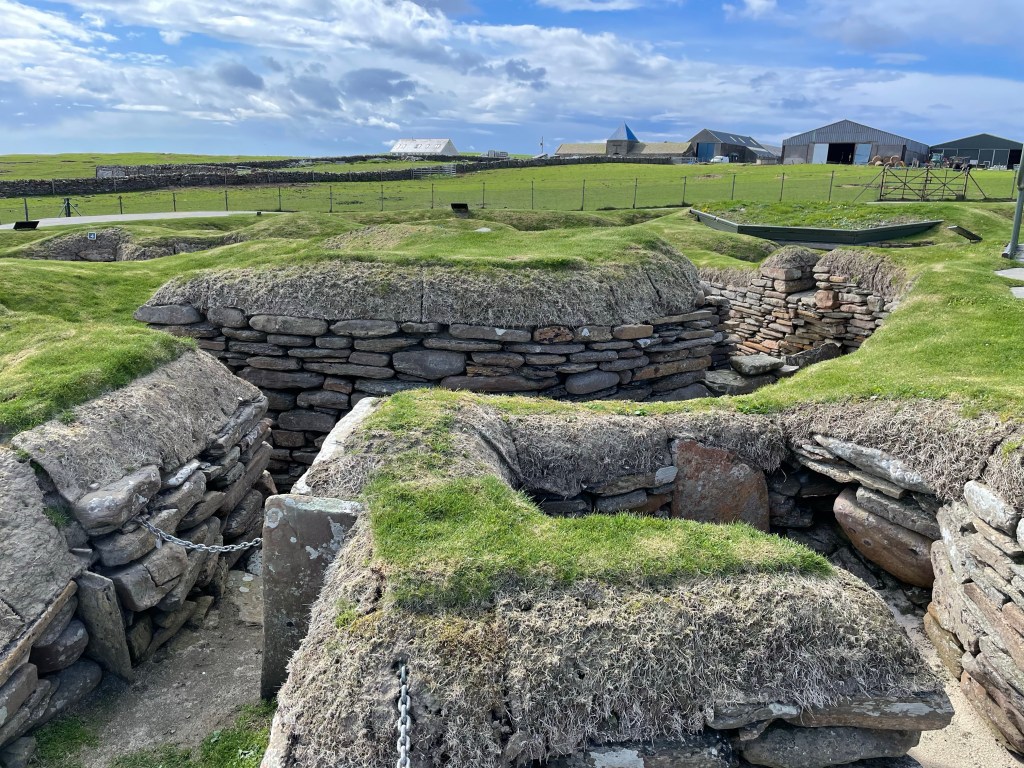
Our second day of hiking started at Skara Brae, magnificently preserved Neolithic ruins situated on a hill overlooking the Bay of Skaill. As we were en route, our cabbie Eddie told us that ancient Picts lived in harmony for thousands of years, not raising arms against anyone, “until my ancestors came over from Norway.” I accused him of being a Viking, which he completely acknowledged with a tinge of pride. When asked whether he’d lived his entire life in Orkney, he answered, “not yet.” By this time he was obviously our favorite. As he dropped us off, he intoned, “Welcome to 6,000 years ago.”

This seems like an unfathomable period of time, so to provide context, as you walk out to the ruins there are cleverly placed stones marking the progress of history such as the building of Stonehenge, the construction of the pyramids of Giza, the birth of Christ and the fall of Rome. Skara Brae was built and inhabited eons before all of these familiar markers of “ancient” history.

The ruin itself consists of ten clustered houses with stone hearths, beds and cupboards. There’s even a primitive sewage system, so, you know, I could have lived there. The site was occupied from 3180 BC through 2500 BC and it is Europe’s most complete Neolithic village.

The ruins were discovered in 1850 when a giant storm literally stripped the earth from the knoll, exposing the outline of the village. Incredible artifacts were discovered, including beautiful beaded necklaces fashioned from animal teeth or bone.

Lovely spot for a village.
Neolithic Feng Shui

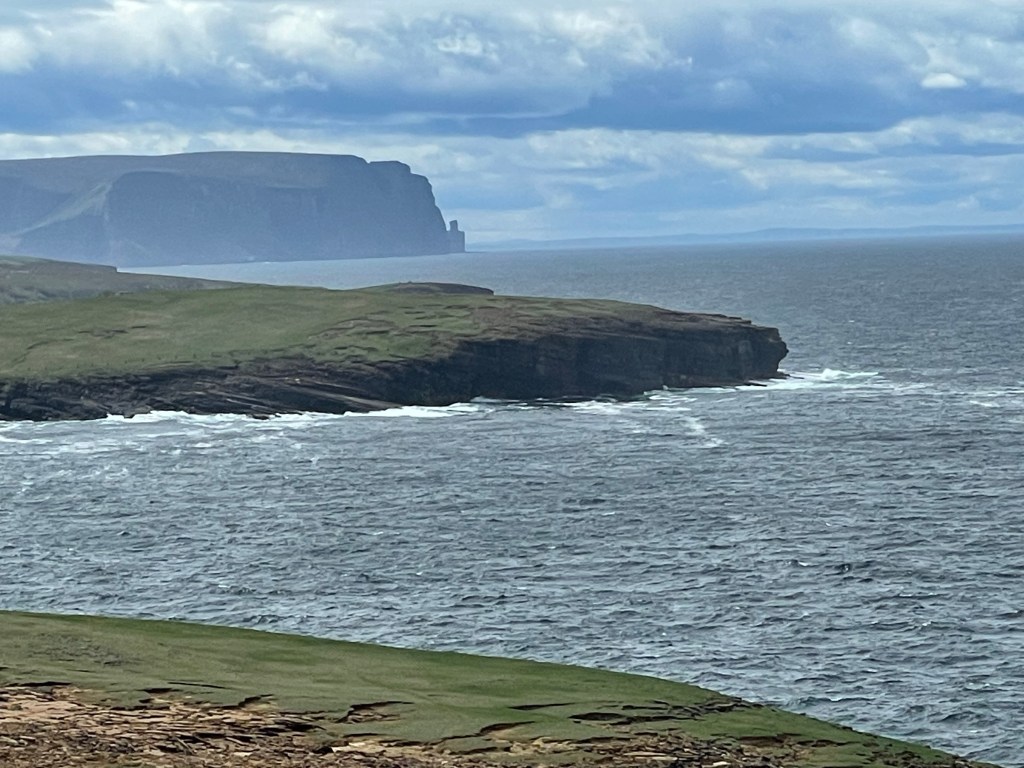
From the ruins, we joined the West Coast trail, which follows the Mainland coast all the way back to Stromness. The views were insane, the sea was azure blue, and there were more ruins along the way.

The little knob on the far island is the Old Man of Hoy. He’s always nearby.
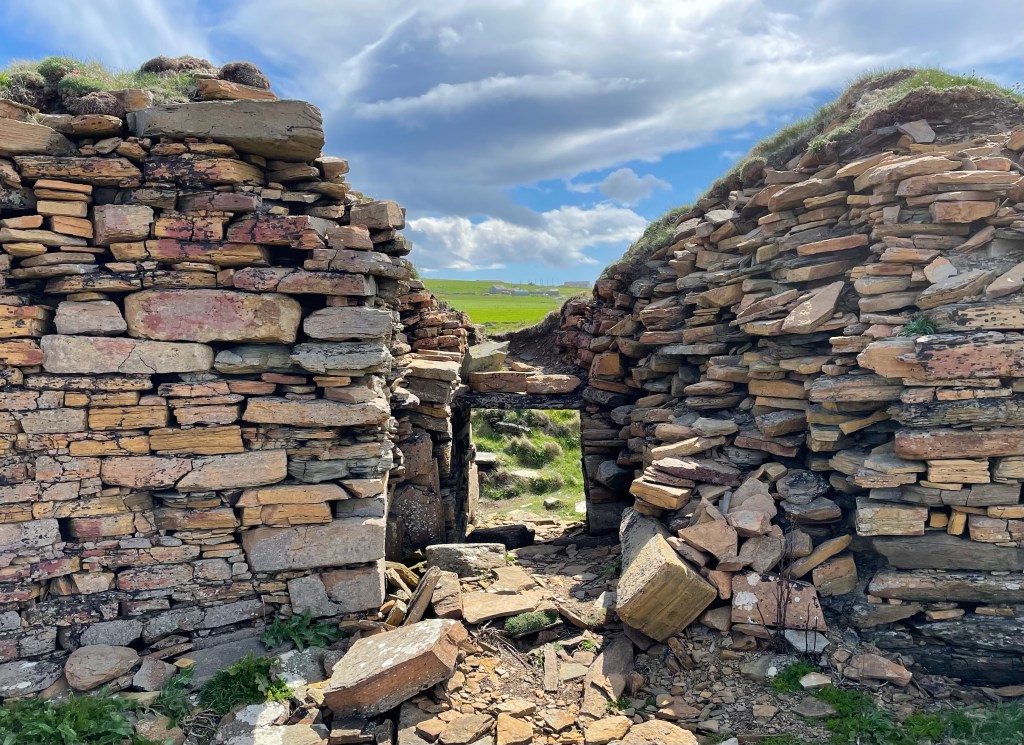
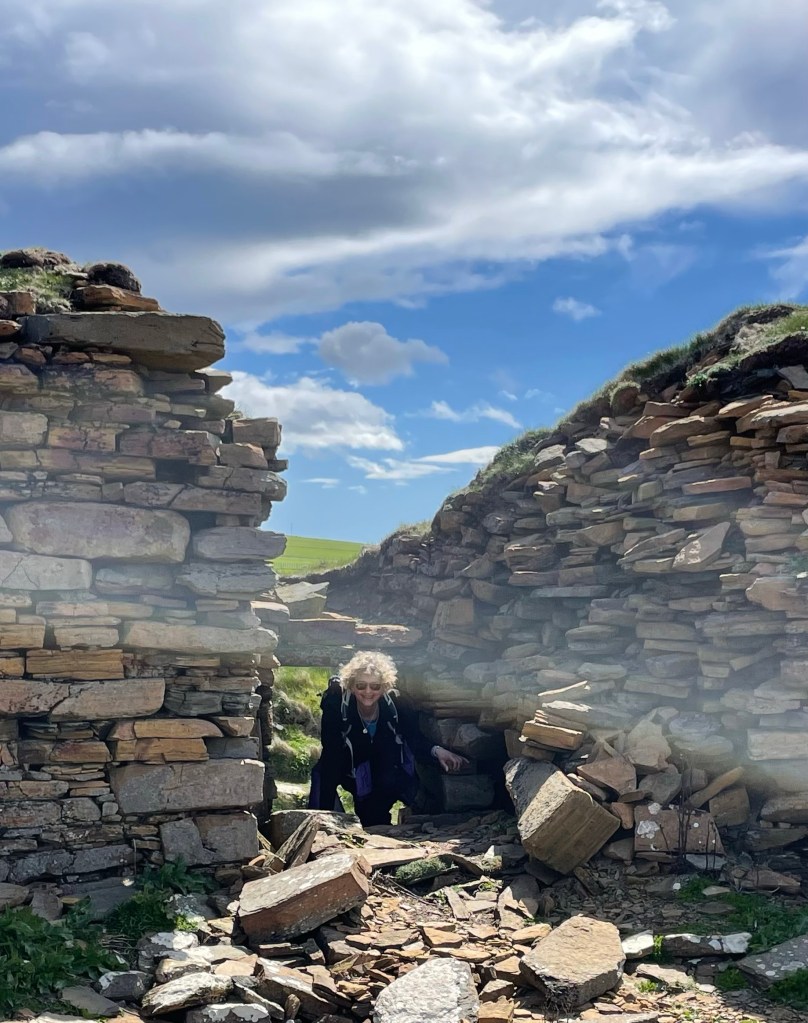
The Broch of Borwick, circa 500 BC, excavated in 1881. Someone’s wee seaside cottage back in the day.
For scale.
Just insane views.
Scotland rocking the sea stacks.

Just as we ended our walk, the weather changed from gorgeous to blustery – as is its wont.

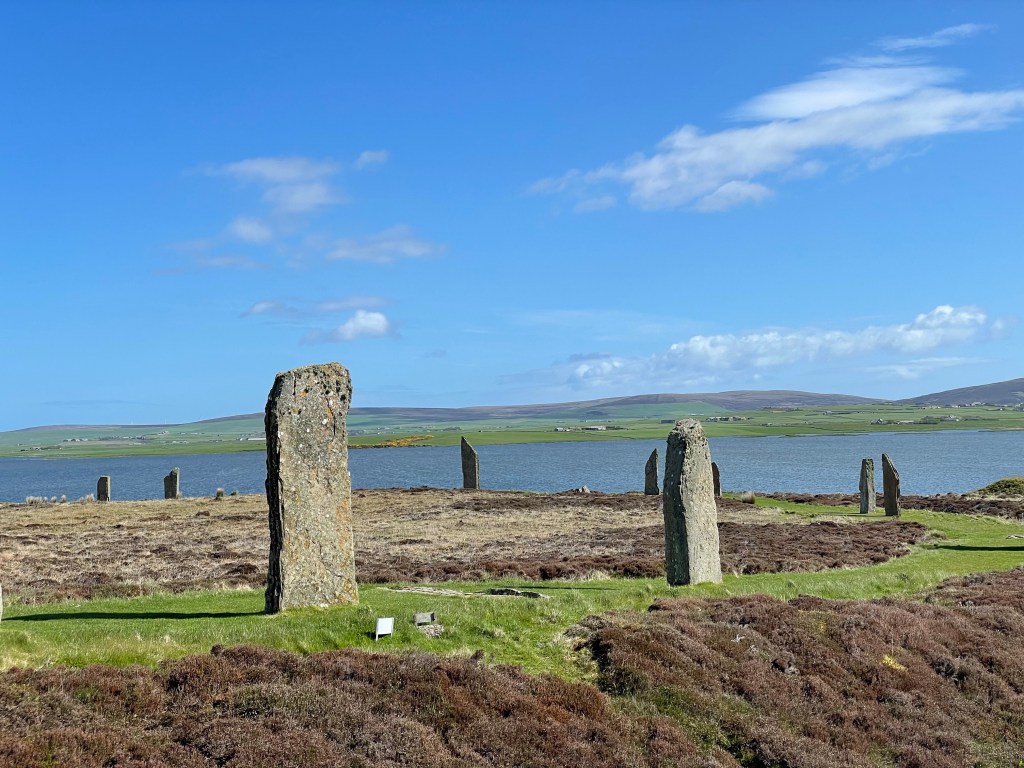
The next day we continued our passage through days of yore by hiking between two stone circles very near Skara Brae – and possibly used by its residents. As with Stonehenge, nobody really knows for certain exactly how they were incorporated into the life of the community, although theories abound. You’ve heard them all. The Ring of Brodgar was likely constructed between 2600 and 2400 BC and the Stones of Stenness, which are considered to be the oldest henge in Britain, around 3100 BC.

The Ring of Brodgar was originally comprised of 60 stones, with 36 surviving today, still a startling sight. The Stones of Stenness originally had 12 upright stones with only four surviving. My favorite was the Ring of Brodgar.

It’s miraculous really, that so many of the stones have survived for many thousands of years. Imagine! Of course, through the passage of time, random people have interrupted the flow of magic, as they do. The most heartbreaking tale was that which befell the Odin Stone. This fabulously named stone stood near Stenness Circle. Thought to have been erected around 3000 BC, it stood about 8 feet high and had a shoulder-high hole through which couples would clasp hands to provisionally marry one another until they could find a priest somewhere. Isn’t that lovely? Well, of course it is. However, in 1814 a silly man who leased the land upon which the stones stood found himself irritated by people tramping about amongst them. So he destroyed Odin’s Stone as well as a few others. Not stoked, the native Orcadians tried to burn his house down. Twice.

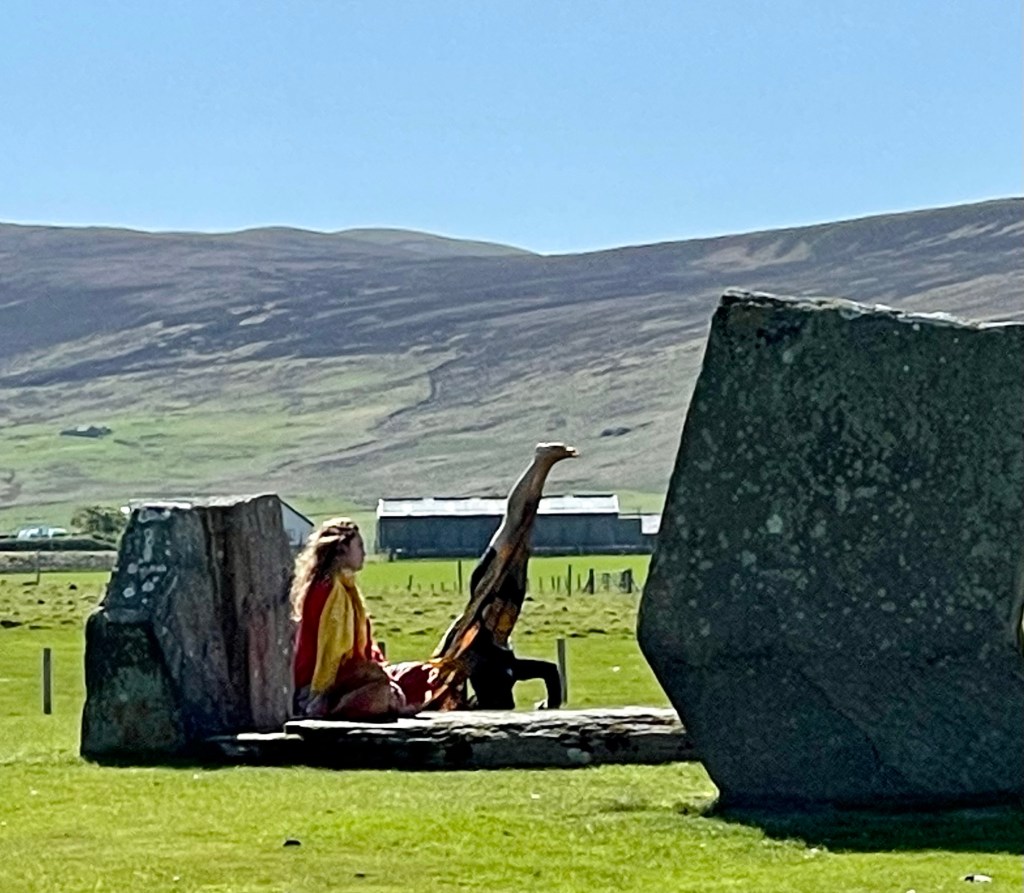
Another heartbreaking and irritating tale is the co-opting of ancient stone henges by weird barefoot hippies. We saw a pair of them during our visit to the Stenness Stones. They walked around with their eyes closed and tie-dyed garments flowing, demonstrating to all that they inhabited much higher planes of consciousness than the rest of us. Barefoot, likely days from their last shower, probably not vaccinated. They ostentatiously perched on the stones (leaving only two for others to photograph) communing with ancient spirits (I guess) and basically making horses’ patooties of themselves. Literally the dude did a headstand like an idiot. Obviously I had to take photos because – isn’t that what they want? To be noticed by lowly beings who are dazzled by their higher vibrational states and inspired by their oneness with the ancient spirits of the stones? You see, what appears to be a disrespectful act is actually the physical manifestation of advanced astral powers beyond our comprehension. I’ll stop now, but I mean seriously, the absolute worst. I suppose we should be grateful that they weren’t naked.

Ew.
Fell over twice before pulling off this pathetic excuse for a headstand.
Hippie-free Stones

Cabbie Eddie, when Danielle told him of these shenanigans, said that these stones had nothing to do with yoga or “flower power” but instead represented the deepest beliefs of ancient peoples. He said that if you cut open the earth – or your arm – you see stone and bone covered with layers of strata, whether it is skin and muscle or earth and ruins of civilizations. This ephemeral strata comes and go while earth and bone endure and thus are deemed significant and worthy of reverence.

Before we leave Stromness for Kirkwall, here are a few photos of a simply lovely town.

The Ferry Inn – the only restaurant in Stromness currently open for dinner. (Thanks COVID). Luckily it’s smashing and we enjoyed it all three nights.

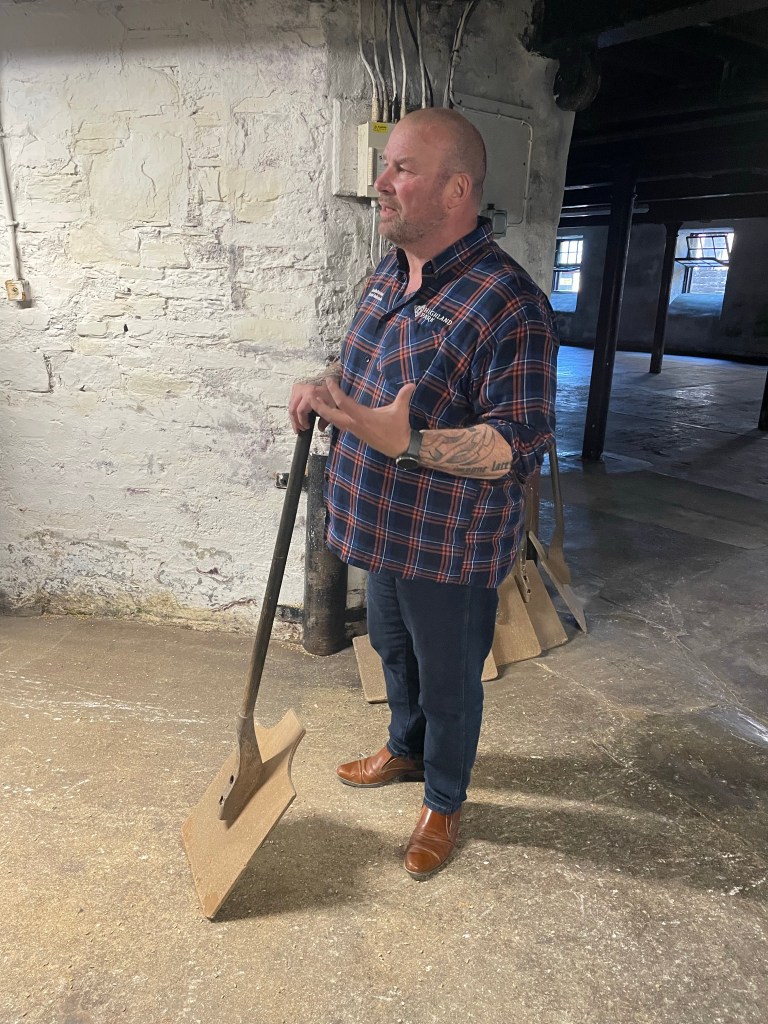
From the sublime to the whisky, I arranged a tour of Highland Park Distillery for the afternoon. I was ushered into a room with the guide and probably ten guys all standing in a circle. Some Danes, some Swedes and a Brit. The Danes had matching polo shirts with a “Prisoners of Whisky” logo which seemed rather melodramatic. I later learned it signified a posh Danish whisky appreciation group. They barely acknowledged my entrance (what?!?!) so I was determined to make them all love me and respect my whisky knowledge by the end of the tour. Spoiler alert: they did.

The guide told us of an incident that occurred a few days prior where a lorry driver who had attached a caravan to his roof drove under pipes that ran across the road and damaged them irreparably. He told us with a deeply exhausted expression that Highland Park won’t be able to resume normal operations until September. They are gradually emptying out all the washbacks, mash tuns and stills. Yikes.

Even in the face of this troubling news, the tour was fascinating as they always are. I learned that when there is the occasional “off” barrel of whisky (it happens), the contents aren’t poured down the drain because whisky has to stay in Scotland and god knows where it could end up. Rather, the bad stuff is distilled to almost 100% alcohol and sold to France for use in the making of perfume. French perfume made from bad scotch. C’est parfait.

After the tour we decamped to a lovely tasting room to have wee drams of the special edition Highland Park whiskies named after Norse gods Thor, Loki, Odin and Freya. Each dram was meant to represent the essence of its namesake god. All were cask strength and Thor was the best. I think because there were special Danes in attendance and the tour guide was also Danish, he busted out a 1968 bottle currently going for £ 5,000. It was good, yes, but in my estimation Thor prevailed. An old whisky is not necessarily the best whisky, it’s just the most expensive.

The guide told us of a time a beer company in Norway sued Highland Park because they had a beer named Thor and they thought people might be confused. This is a stretch of a legal argument even for our litigious country. Since Highland Park is owned by the same company that owns Macallan and others, their lawyers are pretty heavy duty compared to those of the small Norse brewery. Everyone got together in a room and agreed to settle if Highland Park gave each of the lawyers on the other side, and the brewery owners, a few bottles of the very rare Thor. Case dismissed.

Everyone was presented with a framed certificate with their name on it at the end of the tasting. It will be displayed next to my law school diploma.

Highland Park Tasting Room

In my cab ride home, I asked the driver what he thought the weather was going to be the next day for our trip to Westray. He said, “I’ve lived in Orkney for forty years. When it rains, it’s raining. If the sun is out, it’s sunny.” Alrighty then.

Fairy Pools, Glencoe and Hagrid

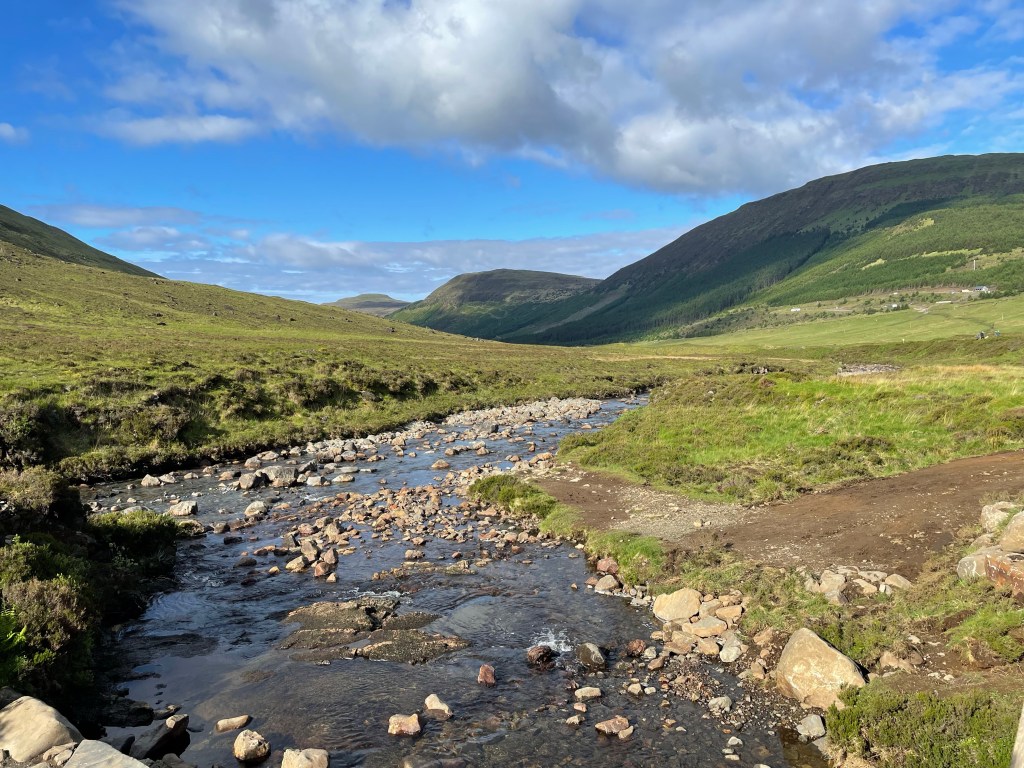
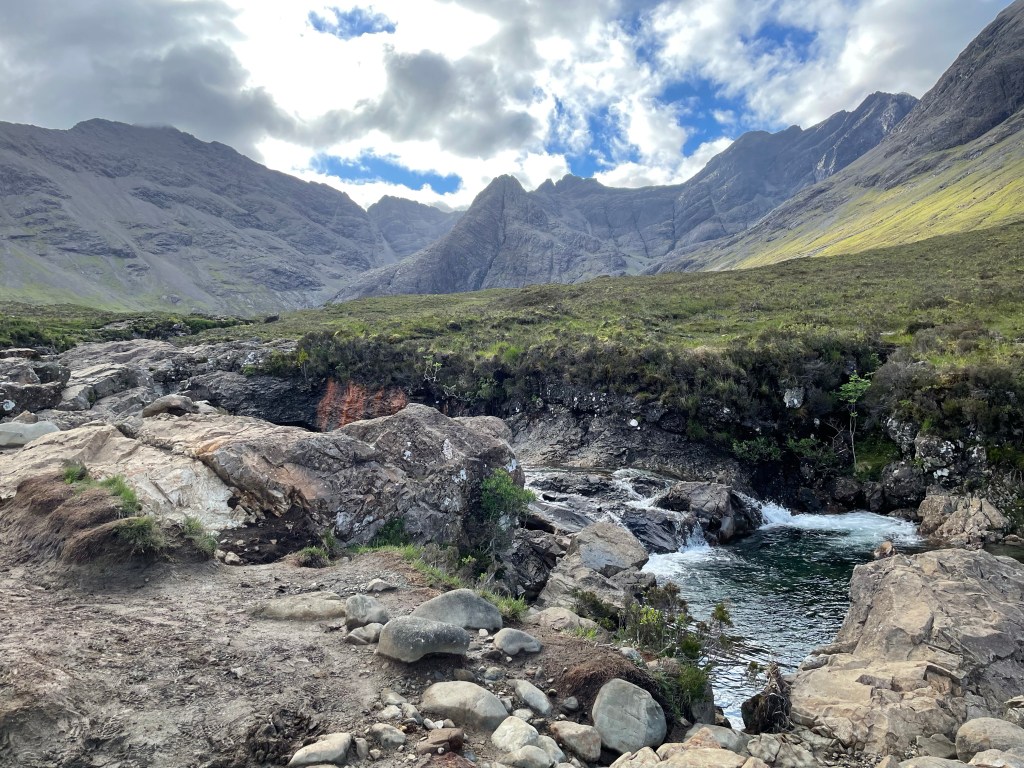
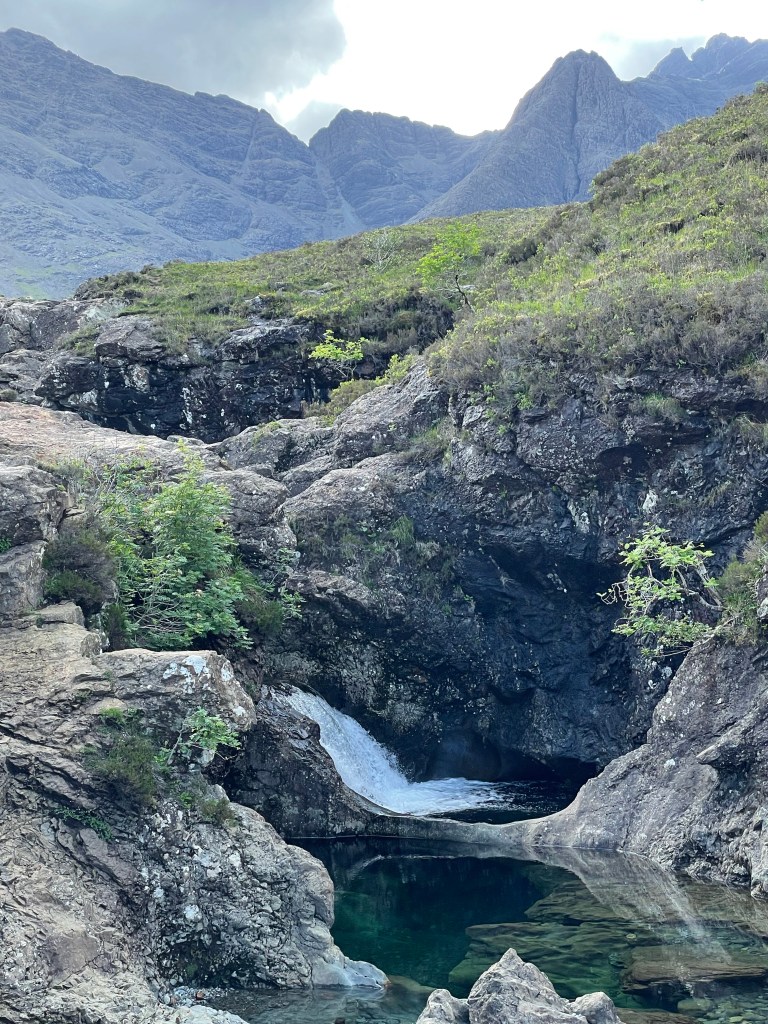
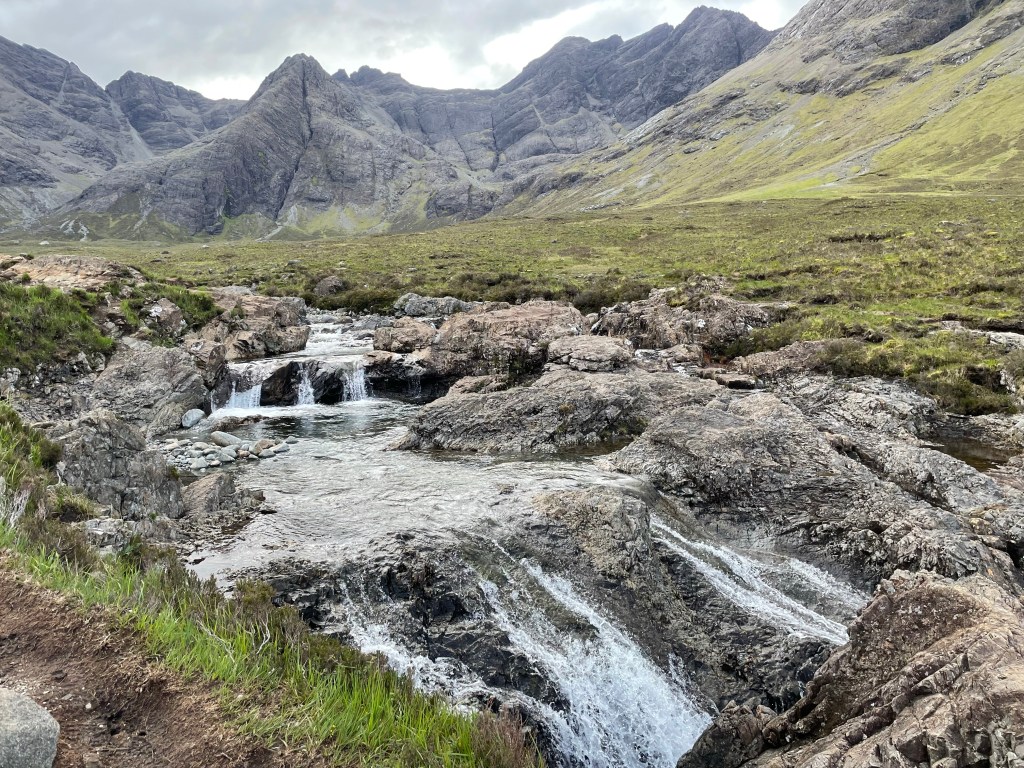
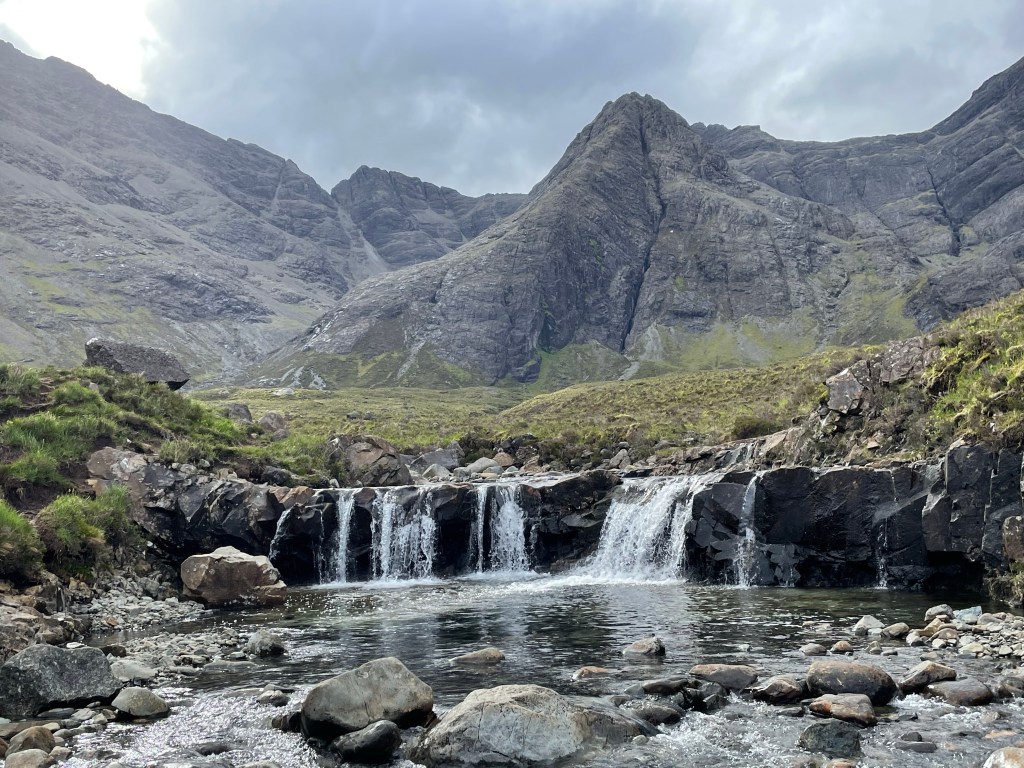
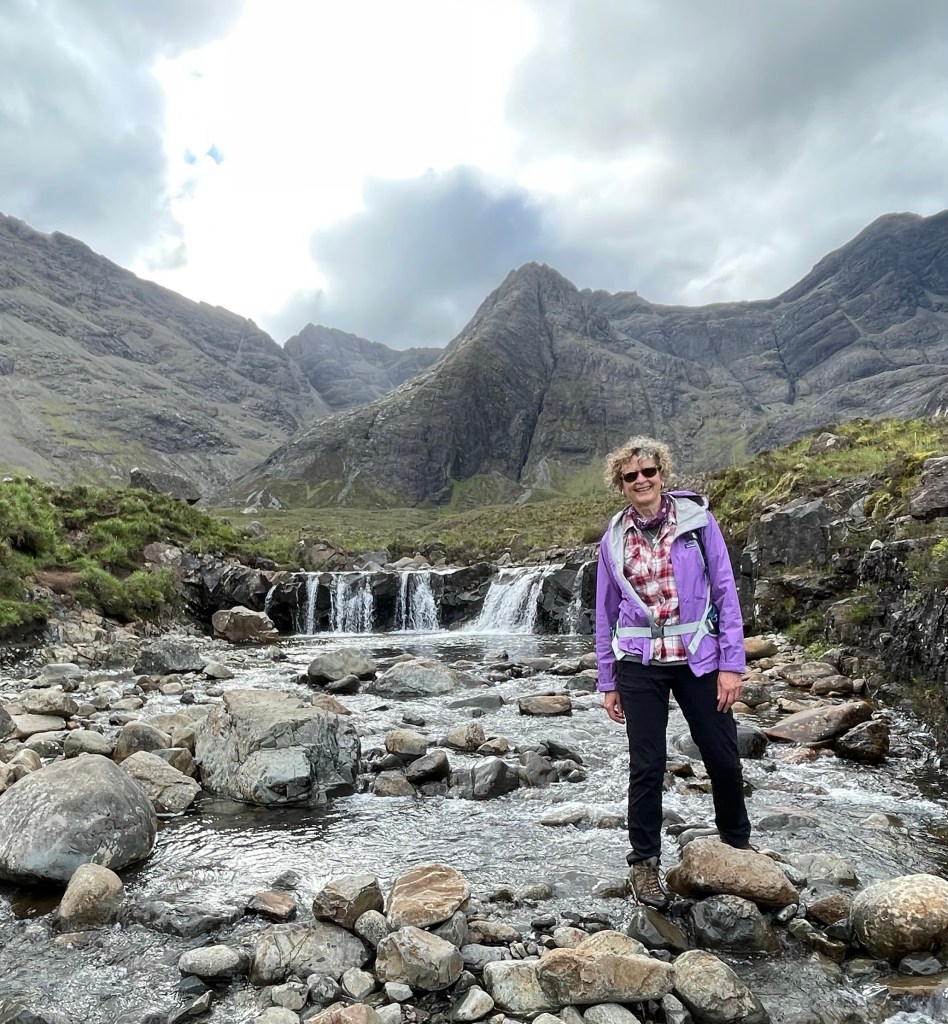
We planned an early launch from our AirBnb to beat the crowds to the famed Fairy Pools of Instagram, our last official stop on our Skye Grand Tour. We arrived at the car park around the sweet spot of 8:00, finding official flourescent-vested guys already directing folks where to park. We crossed the road and hit the trail, walking along a clear glass river with multiple waterfalls and translucent pools, surrounded, as ever, by mountains.

Apparently during summer months, the trail is very crowded with nary an unpopulated pool. On our way up, a single naked couple was taking a tentative dip in one of them. In full view of the trail, but sure. Also brr chilly. Other than this nudie tourist sighting, we had the place to ourselves.
We at last came to the most popular spot of the journey – for good reason.

On our return, many people were venturing up the trail clad in all manner of clothing and footwear, bringing along dogs, kids and so on. It’s hard not be feel concerned about the beating this magical place takes every single day.

Honestly the struggle against going full misanthrope is real.
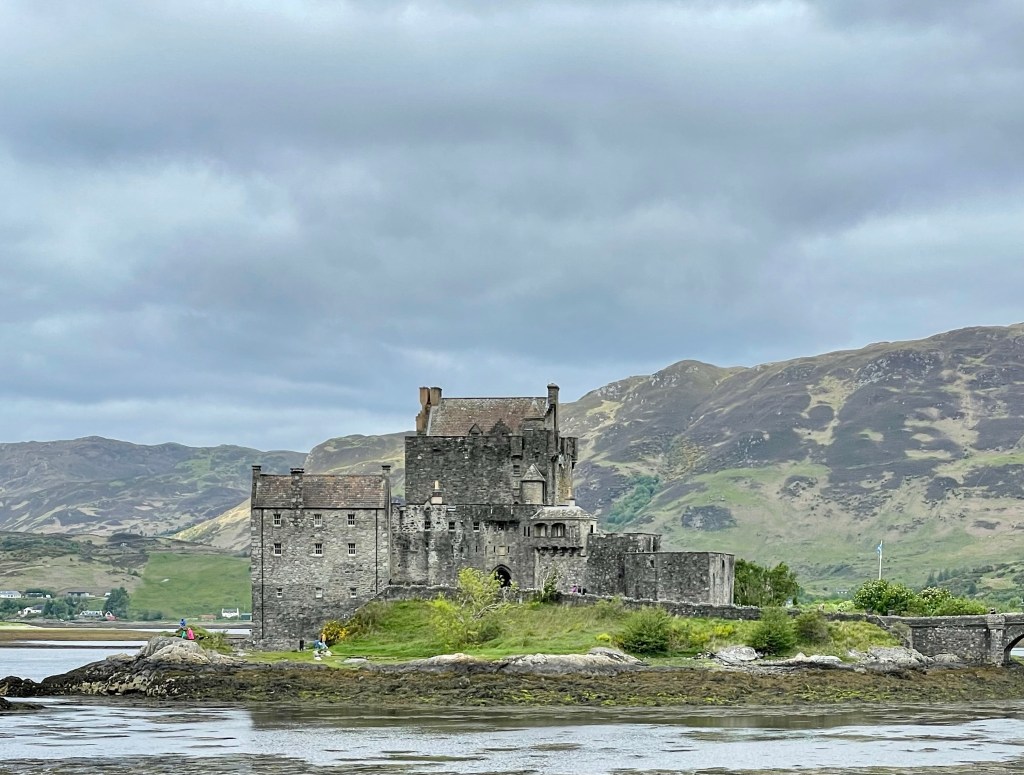
To add grist to the argument in favor, our next stop was Eilean Donan Castle, another star of stage, screen and Instagram. I had thought it was a ruin. I had never seen shots of the inside of the castle, and generally exterior photos are entirely bereft of people, incredibly romantic, secluded and mysterious. Well. It’s a beautiful castle to be sure, but it has the honor of being the only thing in Scotland that hasn’t entirely exceeded my expectations.
The original castle was built in the thirteenth century. A founding legend tells us that the son of a chief of the Mathesons had the ability to communicate with birds, and as a result, after many adventures overseas, he gained wealth, power, and the respect of Alexander II, who asked him to build the castle to defend his realm. The castle later ended up in the hands of the MacKenzie and McRae clans. The MacKenzies claim that Robert the Bruce sought shelter there. Even though there is zero evidence of this, I’ll allow it.

At last, after hundreds of years of defending the realm, Eilean Donan’s story came to a close. In response to the MacKenzies’ involvement in the early Jacobite risings, government ships destroyed the castle in 1719. It was gone.

Or was it. Incredibly, the castle was rebuilt in the early 1900s. While the Edinburgh-based architect followed the extant ground plan, the details are different, as many of the original plans weren’t discovered until after the reconstruction. It looks cool, no doubt, and as such is one of the most visited castles in Scotland. It has also been a shooting location for a bunch of movies, including a stint as the Scottish headquarters of the MI6 in The World is Not Enough, filmed during James Bond’s unfortunate Pierce Brosnan period.

You guys. It’s like Disneyland and I mean that in the worst possible way. Besides the fact that the castle was recently entirely reconstructed, and so is pretty much fake, it’s flanked to the south by a giant car park. Giant. Packed to the gills with cars and buses. Directly in front of it is a visitor center campus, including a cafe and gift shop. Yuck.

Even so, since we were there and all, we toured the castle. Yet another lock of the Bonnie Prince’s hair is on display, even though Charles could not have had any connection to the castle since it didn’t exist during his lifetime. Unlike Flora MacDonald’s specimen, this one is substantial enough that I wondered whether someone had to hold the Prince down to get it. I suspected that it could be a prop for the tourists. Finally, in all fairness to me for my very mistaken impression of this place, the reason I’ve never seen photos of the inside of the castle is that you are strictly speaking NOT ALLOWED to take inside photos. This is the first such warning I’ve seen in laissez-faire Scotland.

So at last, after all the build-up, here are my pics. Note the absence of people. These photos might accurately reflect a brief moment in time, but they are, in their overall essence, a lie.

Eilean Disney Castle

A side note: my apologies for complaining about tourists. After all, I am one. And don’t get me wrong, the vast (seriously, vast) majority of our time in Scotland has been a marvel of existence in a remote, wild and magical place with very few people. All of my other photos are accurate representations of the solitude we experienced. It is this sense that you are the only person in the world which makes it so jarring and mellow-harshing to encounter other humans. The fact that there are tourists at tourist spots should be a surprise to nobody, including me. But it’s fun to rant.

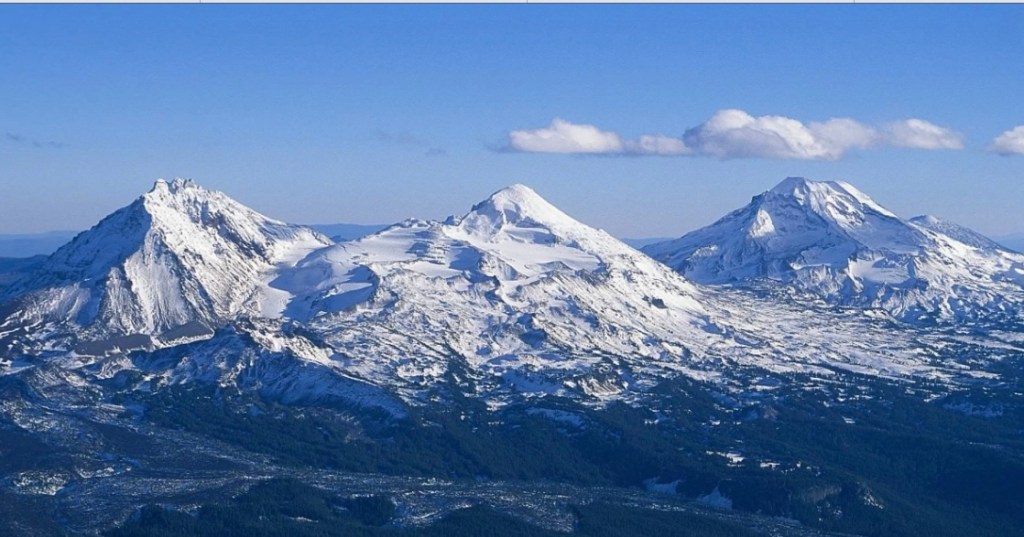
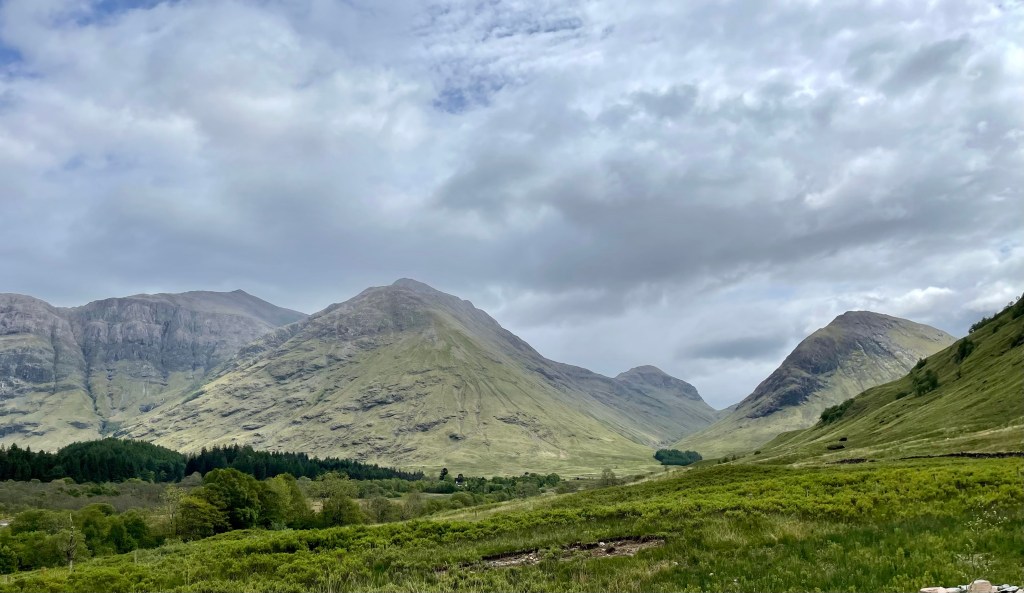
We bailed from Eilean Disney Donan and fled toward Glencoe, our next destination. We drove down the stunning, impossibly green valley surrounded by towering mountains, completely in awe. And I would be remiss if I didn’t give a shout-out to the “Three Sisters” which I love because we have mountains by the same name in the Central Oregon Cascades.

Glencoe’s version of the Three Sisters.
Central Oregon Cascades version.

The glen holds eight of Scotland’s munros and thus is a haven for mountain-baggers. As you can see, the terrain is incredibly steep and the trails are vertical, none of this switchback nonsense.

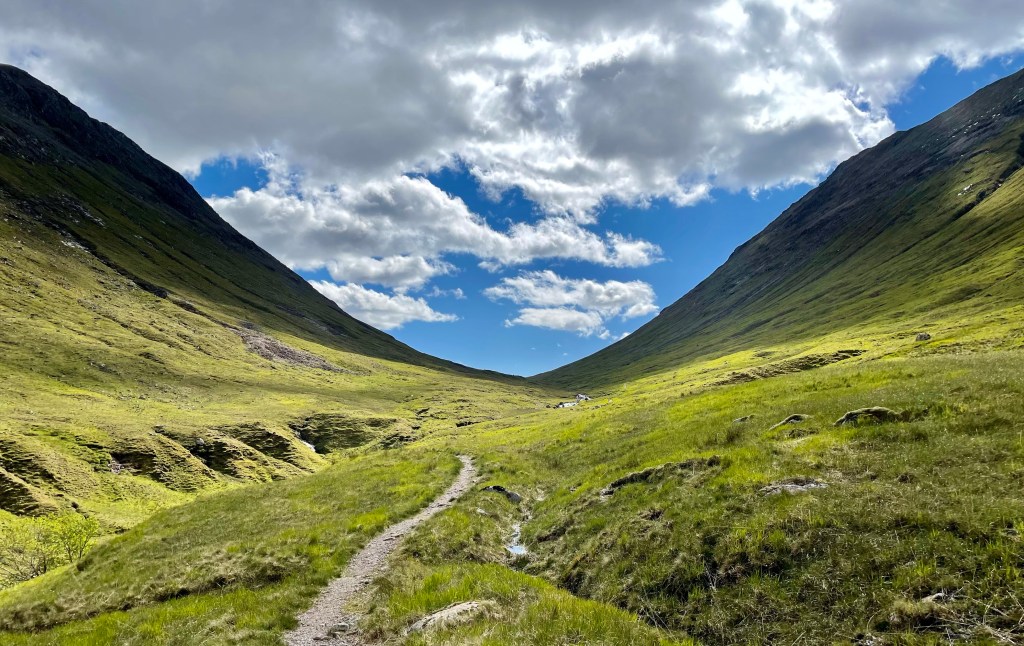
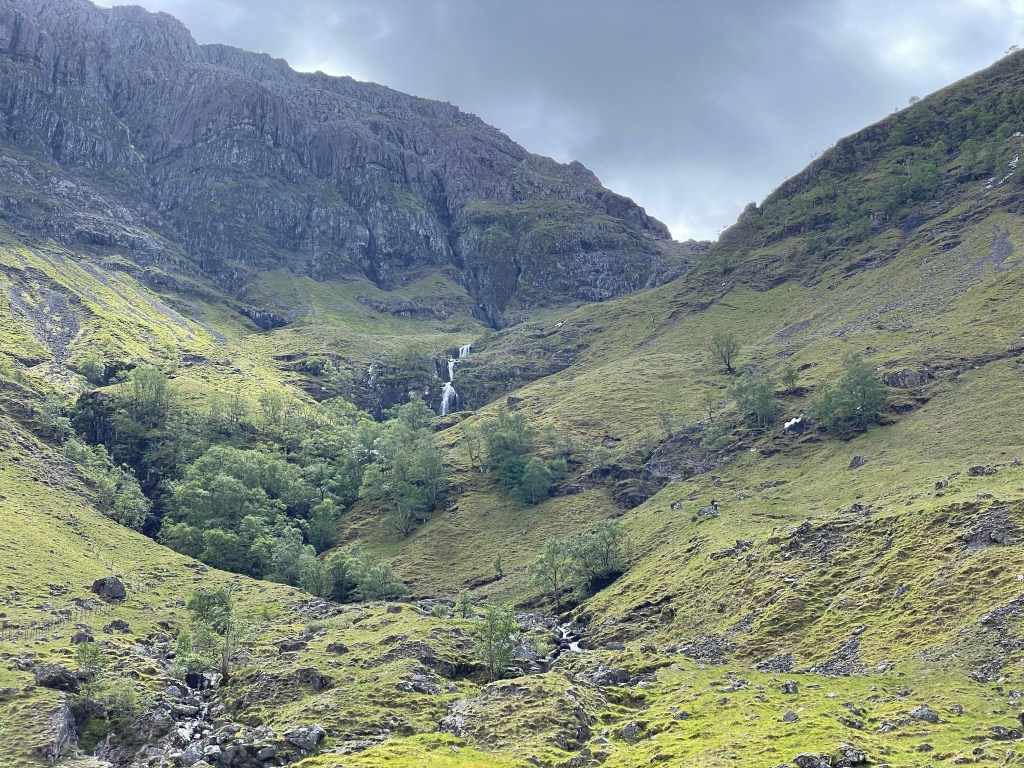
Glencoe is beautiful, unreal and unspoiled even with tourists. It’s a wonder how so many of them pull over into the car park, snap a photo, and bounce. They can easily be ditched simply by taking a few steps down a trail. We hiked along one that borders the River Coupall (thanks for the recommendation Paul and Melisse!) which was otherworldly. I honestly don’t even know what to say about it.

After a couple of miles I continued on alone and Scotland was giving me all the magic. I kept thinking if I kept going I’d reach the notch of the valley, but the longer I walked, the more it retreated into the distance. Metaphor alert. Some things you can never reach because the journey is the thing.

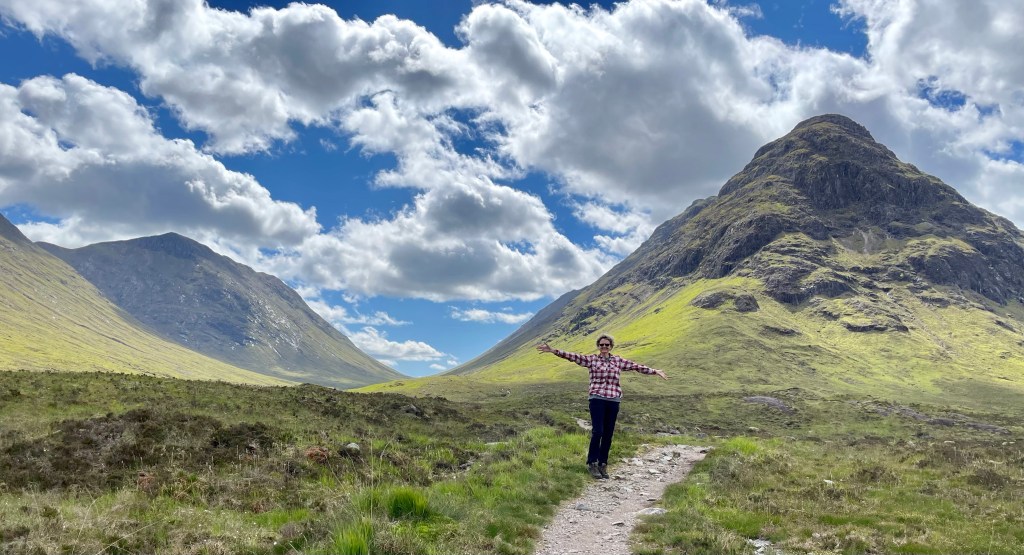
Which brings to mind – and I haven’t yet mentioned this – my dad died in January of this year a few days after I lost a dear friend and it has all been extremely difficult. Sometimes I wonder whether I have fully processed their departures or what that even means really. Anyway, my dad has taken to showing up at random times, and he joined me as I finally abandoned my quest to reach the end of the valley, turned and headed back. Dad never expressed an interest in Scotland, but I think he would have loved it and I did miss telling him about Dougal and driving on the wrong side of the road. The loss hit me anew right there in the middle of one of the most beautiful spots on the planet. I know this will continue to happen forever and that’s okay. I have graduated from nearly debilitating grief to a sadness that dances near the edge of being comforting. The odd thing is that I’m still so surprised that he left. I knew he wouldn’t live forever but I also thought he would somehow.

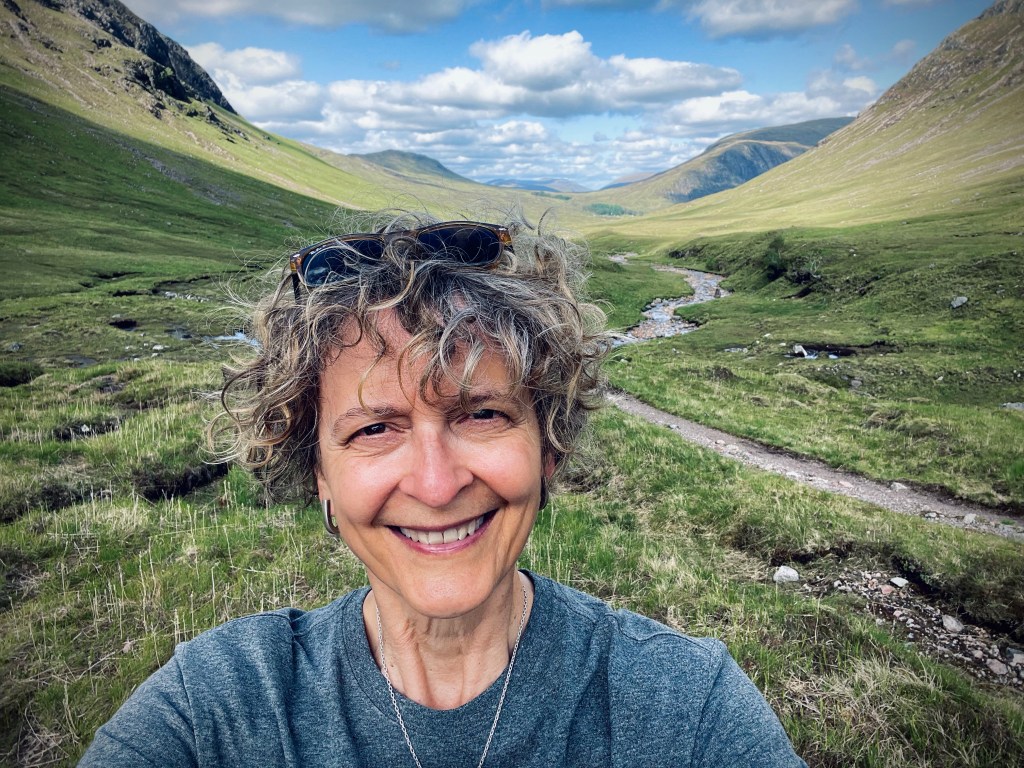
Being in this place I love has brought me a lot of peace and maybe a smidge of healing. My patronus charm is easily cast here. I have no idea why, but I feel stronger, more connected and more fulfilled moving through these hills. And completely happy. When I see myself in photos the difference in my face is remarkable. A reminder to stop making life about moving from one thing to the next, errand after errand, accomplishment after accomplishment, dealing with thing after thing after yet another thing. It takes a toll to live like that. Much better to move through the hills and accept the solace they offer.

And so. Speaking of the patronus charm, here is your segue alert.

The next day we walked an embellished version of the Glencoe Orbital Track, which launches from the charming town itself and features fabulous stops and points of interest, including (spoiler alert) Hagrid’s Hut. You heard me. The track is billed as an hour-long walk but of course somehow we extended it to about eight miles. YES.

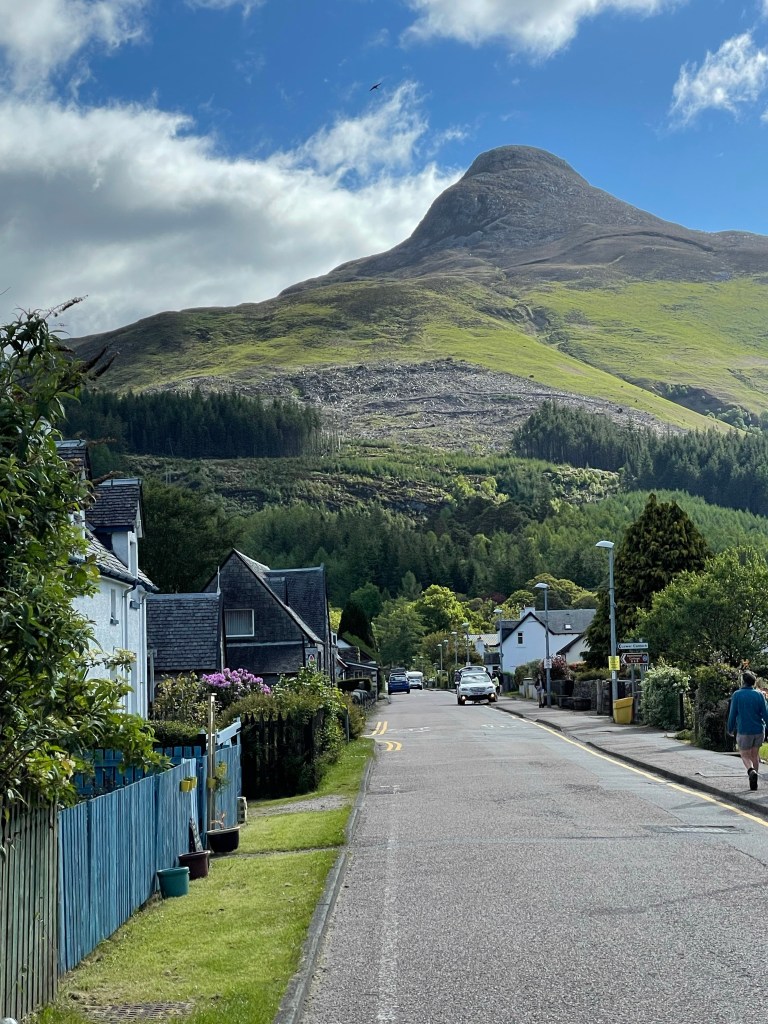
Main Street, Glencoe. The Pap of Glencoe overlooks the town.

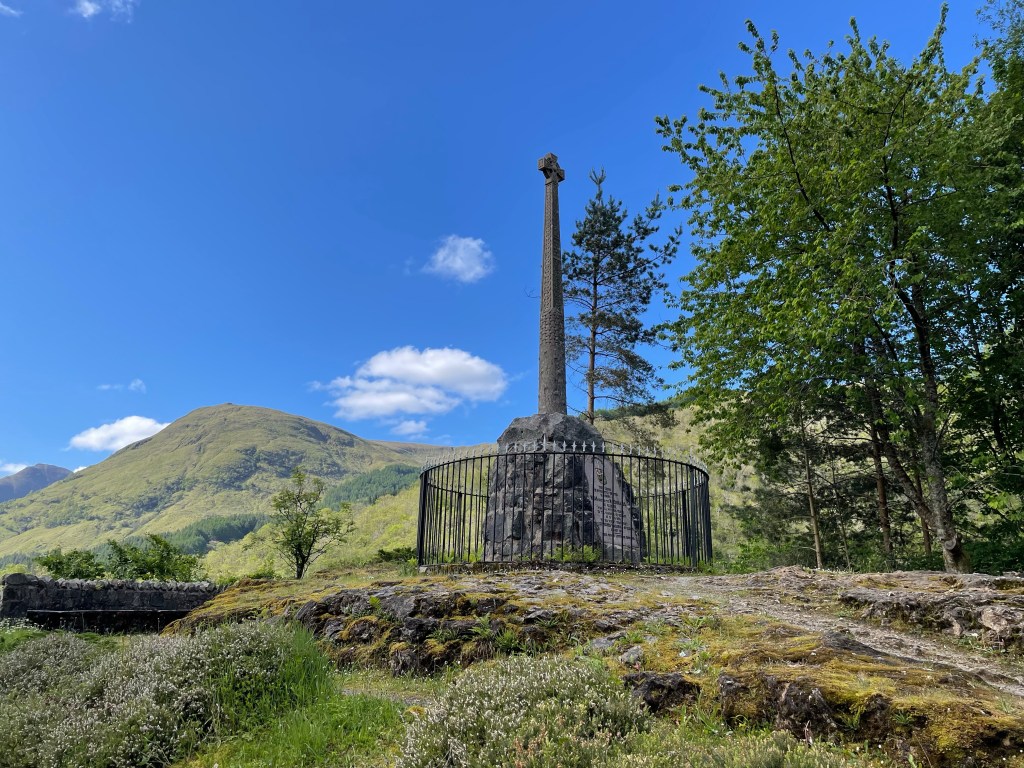
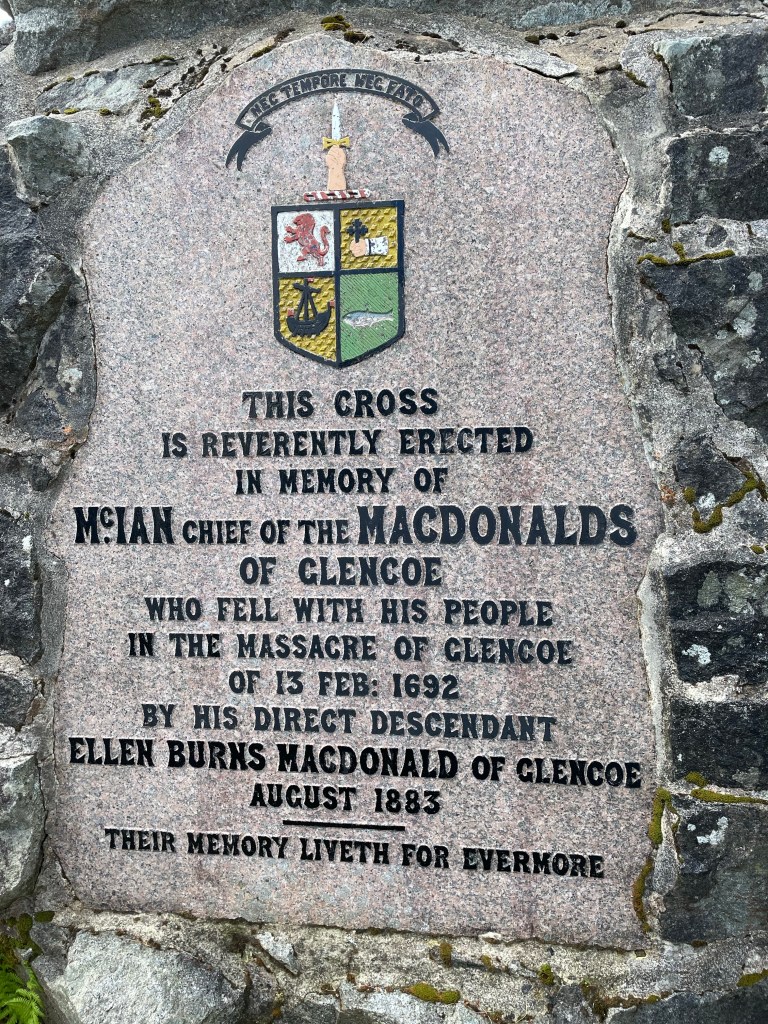
Along our way, we stopped to pay our respects at the Glencoe Massacre Memorial. At this point I wonder whether you have grown weary of history. Too bad, it’s not your blog. Glencoe is perhaps most well-known, from a historical perspective, as the site of the infamous Glencoe Massacre of 1692. The story, stripped to its bones, is that the MacDonald clan, settled within the glen, was delayed in affirming its allegiance to the crown of William and Mary, demanded in the face of rising Jacobite sentiment around the Highlands. There was actually a massive misunderstanding about whether the clan had timely made the oath. The crown, nevertheless affronted, decided to make an example and ordered the 128 Scottish government forces who had been quartering there for 12 days – taking advantage of the legendary Highland hospitality – to kill everyone. While some soldiers refused, and others tried to warn the MacDonalds in preceding days, enough remained to do the job. The soldiers turned on their hosts in the early morning hours and butchered them, men, women and children up and down the glen. Many of those who made their escape froze to death. The leader of the massacre was one Archibald Campbell, 10th Earl of Argyll. The Campbells and the MacDonalds had been feuding since the days of Robert the Bruce, but the massacre was a bridge too far and the Campbells have not been forgiven to this very day.

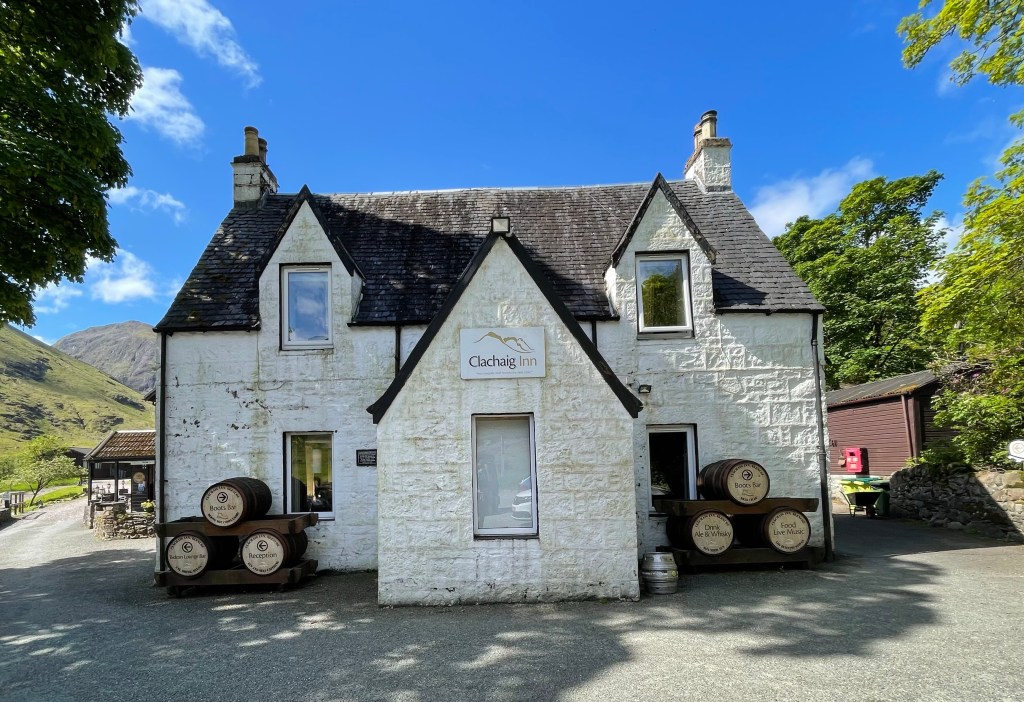
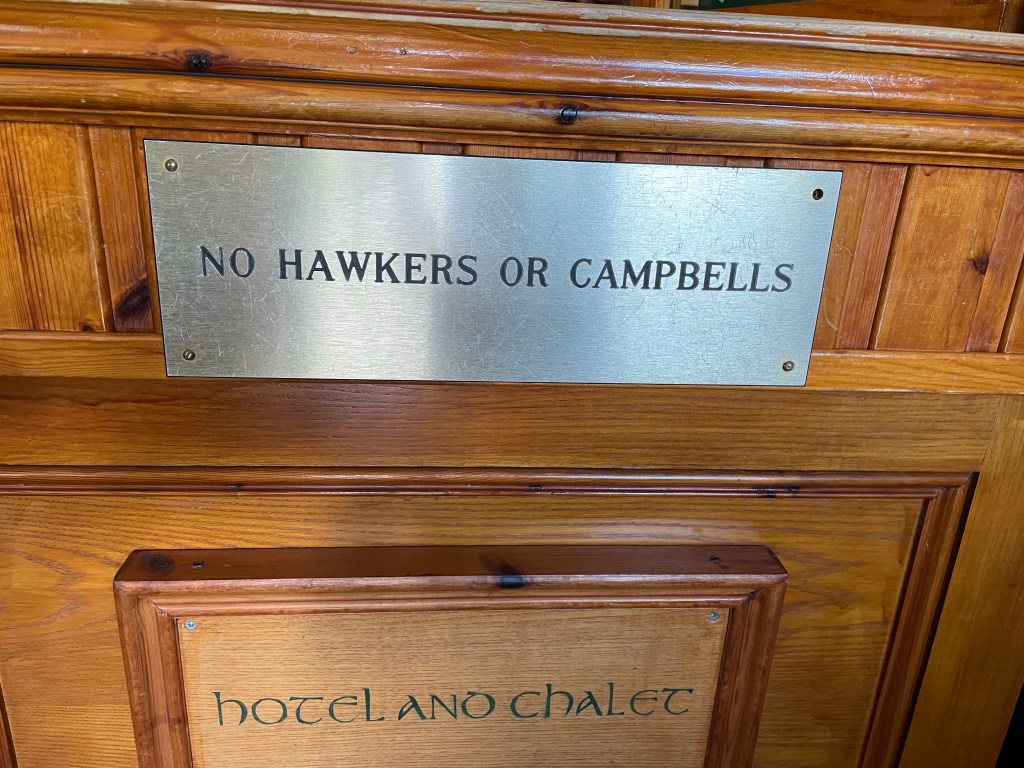
Our trail passed the legendary 300 year-old Clachaig Inn, a favorite lodge for hikers and climbers. We enjoyed a lovely lunch after snapping a photo of the notorious “No Camerons” sign posted at check-in, much to the annoyance of the woman behind the desk who I fear would liked to have massacred me in the wee hours.

The Clachaig Inn

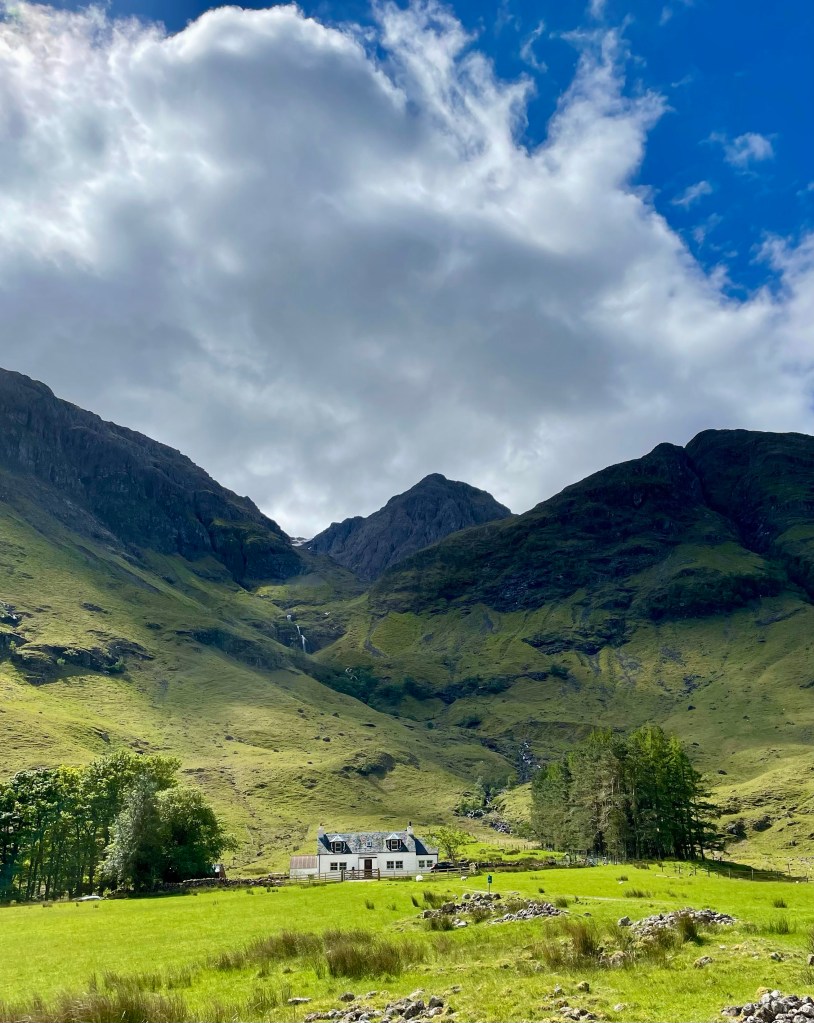
Next we walked to one of the iconic white houses in the glen, much photographed for obvious reasons, and then up to a waterfall.

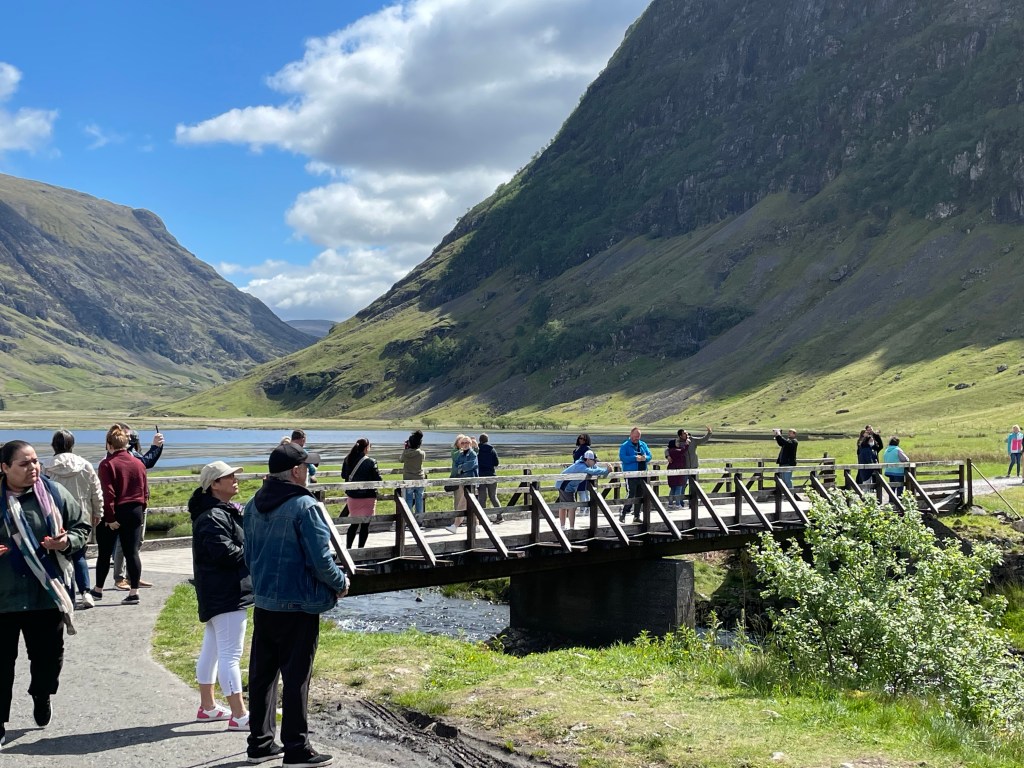
One more parting shot (I swear) re: tourists on buses. Here they are piled up on the bridge leading to the house. Which, by the way, is privately owned and occupied.

Photo only shows only a fraction of the humans disgorged from two large buses. Query: why is this a fun way to travel?
Lovely waterfall just above the white house.

And shall we end with Hogwarts? As you probably know, many of the later Harry Potter movies were filmed in Scotland. Because obviously that is where Hogwarts would be. Along the trail we swung by the very spot where the set of Hagrid’s Hut was constructed. Most notably the location where Buckbeak almost lost his head in Prisoner of Azkaban. What I love the most is that “Hagrid’s Hut” is literally marked on Gaia, my hiking app.

Visiting Hagrid to inquire into the whereabouts of my Hogwarts letter.

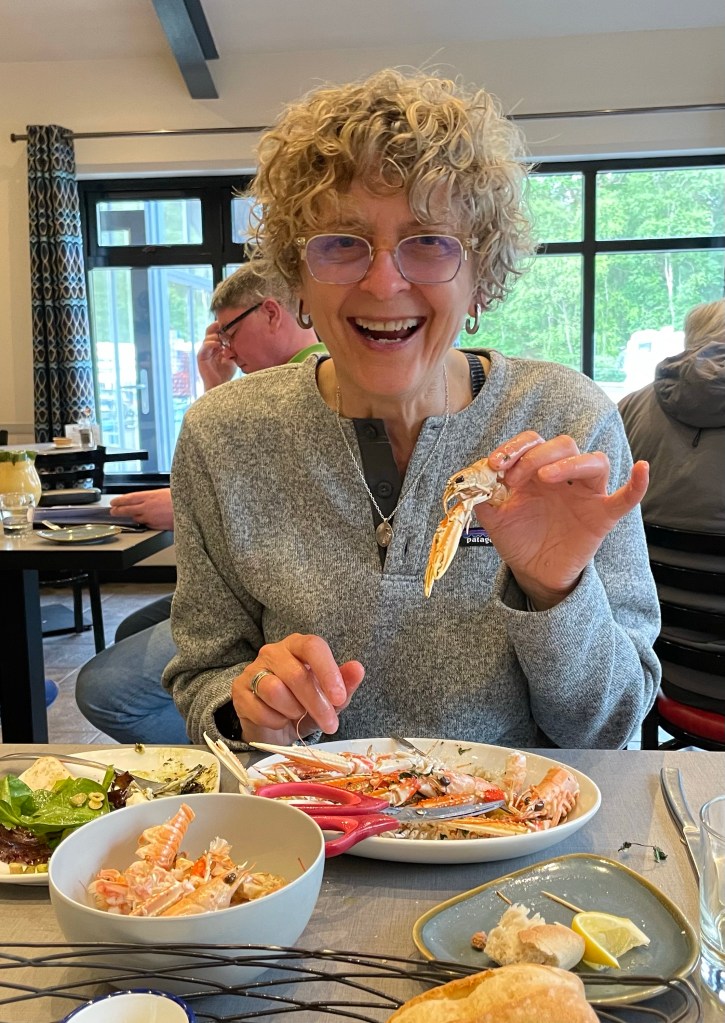
That evening we had dinner at my favorite restaurant since the Michelins, Lochleven Seafood Cafe. The company started as supplier of shellfish to restaurants and gradually morphed into a fabulous restaurant in its own right. They mostly offer shellfish with some sides. It’s brilliant. The fresh langoustines were out of this world.

Looking ahead to the final days of our trip, I’m excited about my Inverness birthday plans but a little leery about having to test negative for COVID to return to the states. It’s actually the Binax home antigen test that we all have stockpiled in a bathroom drawer, but it’s five times more expensive and you take it on video with a medtech person verifying results. There’s a bar code so you can’t cheat. If you test positive you have to quarantine in your location for ten days, which wouldn’t be bad if there were any hotels rooms to be had and if you weren’t entirely sick of your clothes. This is out of whack with current science so is mostly performative, and we’re the only country that retains this requirement, but the CDC is standing firm. Even if that hurdle is cleared, my only-an-hour layover in Amsterdam is looming around the edges of my travel anxiety as well. But no time for that. It’s time to head back to Inverness.

Until next time Glencoe.

Backroads Day 2 – In Which We Hike Into Storm Ali

Day Two dawned cloudy, windy and rainy. Today’s hike had three options, and one of them was nixed by our fearless leaders as being too dangerous because of the weather. It included some ledge hiking and the winds were too strong. Disappointed, but also, woah.

The trail winds through a long valley (or glen if we are being Scottish) between Beinn Eighe and Liathach. We were told there was a spot about 2.5 miles in from which you could turn around and call it a day, or you could do a through hike. Through hikes are the best, especially when someone else is coordinating the transportation, so I was inclined in that direction.

The route description said, “you may encounter a bit of mud or wet patches as you meander down through the glens.” There was also a mention of stopping for lunch. Jenny and Eileen told us that there would be an exciting opportunity to ford a river with some potentially high water due to all the recent rains. An interesting end to the Backroads Scotland season, as the U.K. summer had been marked by a heatwave and dry weather so unusual that it made the news in the states. Guests on those trips complained that it didn’t “seem like Scotland.”

On the short drive to the trailhead we mulled over the two options and searched the sky for any sign of a break. At least the mist wasn’t obscuring the hills – we might get wet, but there would be views. As we pulled into the parking lot, Keith ho-ho’d, saying in his jolly tone, “I’ve never seen this parking lot so empty before! Awesome!” As we were cinching up our rain gear in the deserted parking lot, Jenny and Eileen opened a big bag of hiking sticks. Some eyebrows were raised and doubt was expressed about whether we really needed them, being the badasses that we were. Our leaders regarded us patiently and gently recommended the sticks, mentioning again the fording of the high waters and the muddy slipperiness of the hike. We each took one.

The trail started off uphill in the pouring rain. And was gorgeous. And empty. Spirits were high.

We soldiered upward, finally arriving at the river. The stepping stones were exposed and not under water, which was by no means a sure thing. Suddenly, everyone got the whole stick thing. Apparently, Jenny and Eileen know what they are talking about.

We hiked a little further, reaching the 2.5 mile mark at a stone cairn, which was the moment of no return. Jenny, Eileen and Keith convened a trail meeting over some wee drams of whisky. It’s hard to understate how miserable the weather was. There was a definitely a heightened sense of camaraderie, souls bound together by adversity, etcetera. Here’s the deal though. Had anyone turned around they would have been faced with piercing, stinging sidewise rain and face-buffing gale force winds. It’s one thing having that at your back. It’s quite another having it in your face. Onward seemed the much saner option, and, hey, it was only 5 more miles. Keith, who would have accompanied any who wished to bail had to make the journey back to the vans alone. Next time we saw him he looked 20 years younger from his Scottish facial.

Here we are agreeing to go forward, sealing our resolve with a team cheer.

The rest of the hike was by turns raining, not raining, cloudy, misty, sun breaks, windy, not windy. All the weathers. And when I say windy, I mean we needed to stop and brace. I was up front following Jenny, and at one point I looked up and she was six feet off the trail. The wind had blown her toward a steep gully but thanks to her ninja reflexes, she was able to jump sideways onto a bank. She had a big grin on her face.

We hiked along in a spread-out train, with people speeding up and hiking with one another and then slowing down to take a picture and walking alone for a while. I took lots of photos, actually, testing the water-resistance of my iPhone. I managed to get one extra amazing one during a moment when the sun broke through and illuminated a ridge. The weather changed very quickly, so by the time you took your pole strap off your hand, took off your glove, dropped it in a puddle, picked it up again and stuck it in your teeth, unzipped the pocket of your rain pants, took out your phone, turned it on, allowed it to scan your face and open, things would have likely changed completely. There was a lot of fate involved.

One of my favorite moments was listening to Irwin and Bob talk about Star Trek, and by that I mean the original series. I started to participate but then realized that these guys could name episodes and quote a lot of dialogue. Bowing to the masters, I listened appreciatively to their pro-level geekiness until the trail spread us apart again.

Throughout most of the hike, even in those conditions, I either had a smile on my face or was smiling internally to avoid a weather-related dental procedure. I never felt whiny or scared or worried or that it sucked. You simply could not believe that you were outside in this weather at all, much less the middle of nowhere, and the whole concept was fabulous. And with every step you marveled at the wild, remote Highlands beauty. It was exhilarating and emotional and hilarious. Even though there was no “stopping for lunch.” We came across only two other walkers on the entire hike, one of whom had one leg. I mean. It’s really hard to complain.

Thinking about it now, I wondered if I should have been having some deep thoughts about the meaning of life as I traversed the glen in the storm with my stick. Actually, my mind was completely blank. It wasn’t churning over anything, or narrating my experience. I was just walking. Taking it all in. Being in the moment, as they say. It was marvelous and quiet and wild. I felt happy and at peace.

Finally, as we hiked down toward the vans, along a river, a waterfall and surrounded by reddish-brown ferns, the sun came out for real. As we had spread out quit a bit over the hours of walking, Jenny and Keith took me and Bob (those Canadians are not only super nice, but also highly intrepid) back to the hotel for tea and a hot shower.

Back in my room, I managed to get enough internet to briefly check the news. As it turns out, the storm we had just hiked 8 miles through had been given a name by the British government, which meant that it was “deemed to have a substantial impact” on the UK. Storm Ali packed a punch. Winds of 100 mph had been clocked somewhere in the Highlands. Train service had been halted completely from both Edinburgh and Glasgow. Roads were closed due to downed trees. Edinburgh Castle was closed. Ferry service was disrupted. 70,000 people were without power.

And twelve of us were out hiking in the Highlands. And I wouldn’t trade the experience for anything.

Backroads Days 3 and 4: Over the Sea to Skye

Day three dawned a wee bit rainy, and our planned hike was officially scuppered due to wind, flooding and danger of being blown off a cliff into the sea.  Very disappointed, as we were heading to the famed Coulags.  Next trip.

Jenny, Eileen and Keith had another hike in their back pockets, followed by lunch in a little village.  Then we would head to the Isle of Skye. Jenny sketched out the day on a chalkboard.

The hike was completely beautiful.  Our love of sheep officially began on this day.  Adorable Scottish sheep were everywhere.  Scotland doesn’t seem to have industrialized its meat production.  Unsupervised sheep, cows and chickens are wandering around all over the place completely left to their own devices.   Sheep are marked with a splash of color which identifies to whom they belong.  Otherwise, they are free to wander, eat grass, and perch picturesquely on the edges of cliffs, gazing out at the ocean.

I kept asking people if the cows and sheep were used for milk and cheese and the people kept raising an eyebrow and shaking their heads. Make no mistake, we are talking about meat here. But at least until their day of doom, Scottish livestock have the world’s most fabulous life.

A few pictures of our hike follow, but sadly the most exciting bit went unphotographed. Just after passing someone’s lovely farmhouse (they have a black dog named Merlin who enthusiastically greets ramblers), we needed to haul ourselves up a tall boulder cropping.  And to help, there was a rusted chain that had been set into the boulders.   Completely awesome. I felt like Tom Cruise in Mission:  Impossible as I pulled myself up the outcropping, hand over hand.  Which I shared with Keith after triumphantly reaching the top. In response, he cocked his head and asked, “you felt like a Scientologist?”

We returned to the little town where we began, and walked to our lunch place, a fabulous little pizza spot on a loch. Keith removed a giant chalkboard from a wall and presented it to the table.  He asked the server permission first, and interpreted a disapproving pause as assent.  Note to self:  adopt this strategy immediately.

As we left the restaurant, we were greeted with a magical rainbow over the loch. While we pretty much had daily rainbows, this one was the most rainbowish one of all.

We set off in the vans for a bit, finally driving over a lovely bridge to the Isle of Skye. It has been hit pretty hard by tourism over recent years, but Backroads always finds more solitary spots. We stayed at the Duisdale Hotel, on the edge of the water with beautiful views.

07E2BCE6-BBD2-4F68-AFCD-22CE10F036EF

On tap for the evening was a musical performance by a local bagpiper and accordionist who teach music at the Gaelic College on Skye, called Sabhal Mòr Ostaig. The college is dedicated to providing education for Gaelic speakers with the goal of widening access to the Gaelic language and culture.

Bagpipe music used to make me cringe and then run out of the room. Maybe one of the things that happens after menopause is that suddenly bagpipes become majestic instruments that make you shiver and then cry.

In the middle of the show, our bagpiper challenged us to a bit of Scottish dancing in the parking lot, and so out we went. A documentary of our dance lesson experience is currently being edited for Netflix. The reviews will say, “Stunningly talented Americans and two Canadians change the face of traditional Scottish dance forever.”

The next day dawned slightly brighter with strange blue areas in the sky. Now old hands at divining Scottish weather, we thumbed our noses at the blue and donned our rain pants. Today we met Sarah, a Scotland ranger, who would accompany us on our hike and tell us about birds, plants and the Highland Clearances. Our trail started at a ruined church (see below) and took us past some old granite mines where we came across a lovely woman out for a walk with her border collie. We then dipped down to a large and desolate ruin of a village that was abandoned as a result of the clearances.

The Highland clearances are an infamous chapter in Scottish history. They were the forced eviction of inhabitants of the Highlands and western Islands, and basically cleared the land of people to allow for the introduction of sheep. For hundreds of years prior to the clearances, the Highlands followed the clan system. The clan was ruled by one family, and others lived together in agricultural townships that functioned like collectives. The land was controlled by the chief but leased by tenant farmers. Very feudal. All the men who worked on the land also owed allegiance and their military service to the clan chief. The clearances, which took place over a century, resulted in the destruction of the traditional clan society and began a pattern of rural depopulation and mass emigration from Scotland to the Americas and elsewhere.

So why? After the Battle of Culloden, the British government (aka evil redcoats) passed repressive legislation designed to compromise the power of the clan chief and Gaelic culture. The 1746 Act of Proscription required all swords to be surrendered, prohibited the wearing of clan tartans, forbade the speaking of Gaelic and the playing of bagpipes (because they were deemed instruments of war). Another act removed the sovereign power which the chiefs held over their clans. The clearances began thereafter, waxing and waning through the collapse of wartime industries after the Napoleonic Wars, a rise in population, famine, and a decline in the economy. Landlords were deeply in debt and were looking for more lucrative uses for their land. Replacement of the old style of peasant farming with well-capitalized sheep farmers allowed the charging of higher rents and required much less manpower.

Nobody knows for sure, but possibly up to 150,000 Scots emigrated during the clearances, and the effect still resonates today. In 1755 it is estimated that 51% of Scotland’s population lived in the Highlands, but by 1981 only 21% were.

Here are some photos of just one such village left in ruins.

Stop it with the history!! Please may we talk about peat instead. Scotland is covered with peat bogs, and over history Scots have used peat to heat homes, make whisky and so much more. Peat bogs have very low rates of decay and can even preserve food (up to 2,000 year old containers of butter have been found) and dead bodies (watch the BBC’s Shetland on Netflix because Douglas Henshall is gorg – I mean a great actor). Peat’s official name is sphagnum moss. I can go on and on, but since you have already been subjected to background info you can look up yourselves on the internet, suffice it to say that it can hold an amazing amount of water. Sarah stood knee-deep in heather and gave us a very interesting peat talk. She was holding in her hand a tiny bit of sphagnum moss. I mean tiny. When she squeezed it, enough water poured out to fill a juice glass. Magic.

Before I share the next few pictures, allow me to issue a disclaimer. Having learned the devastating story of the clearances, I feel slightly guilty being so enamored of the sheep. I mean, I love them. There are 7 million sheep in Scotland and I love each and every one. My thinking is, though, that those initial displacing sheep are long gone, and the current sheeply inhabitants had nothing to do with the clearances. You are free to judge their culpability for yourself.

After our visit to the ruined villages, we hiked down to a rocky shore and up the side of a cliff to our dramatic lunch spot overlooking the sea. Keith awaited us with the lunches we ordered on Day 1.

That evening we visited a brand new distillery on Skye, called Torabhaig. It’s so new that they haven’t yet produced a whisky because there hasn’t been enough time to age it the requisite number of years (3) in oak barrels. After the tour, as we were tasting another distillery’s whisky, we chatted with two employees. One shared that he was an extra in the iconic Hardhome episode in Season 5 of Game of Thrones. He also gathers with his mates every week for Dungeons & Dragons – and you got the sense that he is quite the appreciative drinker. The other has exactly one drink every year, a whisky, on Christmas Day. He works in a distillery, he lives and breathes whisky, and yet only one drink per year. He told us in foreboding tones about Scotland’s relatively new zero tolerance policy on drinking and driving, and said that we were all legally drunk after sampling our first wee dram. Scottish authorities warn that the only way to ensure you stay within the limit is to have no alcohol at all. It’s actually had a negative impact on Scotland’s economy and critics say it amounts to a form of prohibition. Dinna fash, though, if you are a non-driving tourist sort of person.

We were amazed by the huge investment it took to start a distillery, especially when you aren’t making gin or vodka (which one can whip up in a matter of days, we were told dismissively). Huge up front expense and a long wait before anything hits the market. A labor of love, to be sure. I bought a tshirt to help things along.

And a last word about whisky. When I first arrived in Scotland, I couldn’t believe how cheap a dram was. Well….it is much cheaper, but it’s also more wee. A pour is about one ounce of liquid, whereas in the States, it is more like 1.5 ounces and maybe even 2 if the bartender is clueless. I never once saw a server eyeball a pour, either, it’s very carefully measured in a jigger, which means that your glass is inevitably sticky from the awkwardness of the transfer. I generally favor the smaller food portions you are served in European restaurants. But with whisky, I say, supersize me.

Backroads Days 5 and 6: Cows, Beaches, Ferries and Harry

On this last full day of our hiking trip through the Highlands, cows were the stars.   Cows, seriously?  Ah, but they are free-roaming Scottish faerie cows.

Our final hike, while just as beautiful as the ones before, was bittersweet.  You realize how much you will miss your daily routine of getting up early, greeting your fellow guests with whom you have totally bonded, having breakfast, pulling on unflattering rain pants, going for a drop-dead gorgeous hike with weather that changes every five seconds, heading to a beautiful hotel, engaging in some sort of educational, cultural or whisky-related activity, enjoying a gourmet dinner over interesting conversation, and then retiring to a comfy bed in a beautiful room.   It bears mentioning that for days you have exactly zero responsibilities because everything is all dialed for you. It’s a very civilized schedule, with just a touch of adventure, to which you quickly grow accustomed, like okay, this is my life now.  It’s surprisingly emotional when it comes to an end and you know you’ll soon be required to make decisions and do laundry. While most Backroads trips are only six days, because of the pace and the fact that you tend to live in and notice every moment, time passes slowly and the trip seems longer, in the best possible way.

This final day dawned unmistakably bright. Our hike took us from the edge of a village over some rolling hills toward the sea, and into the paths of the cutest, muddy-ankled cows who have ever walked the face of the earth. One sweet little face in particular.

Obviously my spirit animal.

After we bid farewell to our cows, we came across the most brilliant handmade sign ever, imparting a few gentle suggestions about how to behave as we hiked through the owner’s property.  Keep the faries safe.

Our path ended at the water’s edge and our first white sand beach, completely deserted.

After spending some time walking about and gazing out to sea, we reluctantly turned around and made our way back.  But there’s always time for a wee stop at a pop-up cafe.  We soon came upon Jenny, who had opened the Highland Cafe, stocking it with cookies, fruit, hot chocolate and Baileys and Cream – best ever. My pal Irwin declared his Baileys and hot chocolate to be the best drink he had ever tasted.  Again, we would have lingered, but alas, the rains came, a ferry awaited, and so we skedaddled.

I love ferries, I don’t know why. I’m not generally a huge fan of being on the water in some sort of tippy vessel, but I’m all about an hour ferry ride in the Scottish Highlands, especially when you can see your destination, Mallaig, across the water from the dock. It was sad to bid farewell to Skye, but we had Hogwarts in our future, and best not to keep Dumbledore waiting.

In Mallaig, a charming coastal town, we walked a few blocks to catch the Jacobite steam train to Fort William.  This train has been operating under various names and with different operators every summer since 1984 and its route is incredibly scenic and has always been popular with tourists.  The company running the show provided Warner Brothers with the train used as the Hogwarts Express in all the Harry Potter movies and allowed them use of the Jacobite’s route for filming, particularly the famous Glenfinnan viaduct.  So you’ve all seen it.   I mean, you should have if you are my friend.  Not to miss an opportunity, as if riding on an actual steam train in the Highlands were not enough, the train now completely traffics in Harry Potter.  There’s even a Potter-themed gift shop in one of the cars.  And there are children everywhere, in costume, having the time of their lives.  One German boy dressed as Harry ran up and down the aisle in our car, followed by a trotting, indulgent father wielding an iPad in front of his face to capture every moment on video.  We snagged the boy during one of his passes and invited him into our car.  He spoke no English but knew exactly what we were hankering for. He promptly sat down and wielded his wand for photos.

All along the route, tourists were standing about on country roads with cameras at the ready, to photograph the train as it rumbled past, belching steam.  Pretty remarkable.

After arriving in Fort William, we found the vans in the train station parking lot.  How they got there, I have no idea. We climbed aboard and headed to a private Island called Eriska, and the beautiful Isle of Eriska Hotel.  Maybe the swankiest hotel of our trip – I had a suite of rooms the size of many apartments I’ve lived in.  Goodness.

We convened for our final cocktail party and dinner, all dressed up and fancy-like.  We unanimously decided to forgo the planned hour-long walk around the grounds the following morning, advertised as being “probably really muddy,” in favor of enjoying the beautiful hotel and bidding a fond and leisurely farewell to one another.

Fittingly, our final sunset was a doozy.

We shared one last van ride as the leaders dropped me at my hotel in Fort William and took the rest of the guests to the Inverness Airport to continue their journeys away from this magical country.

Thanks, Backroads, and especially Jenny, Eileen and Keith.  You guys rock.