“It was impossible for a woman to go about alone,” Virginia Woolf wrote of Jane Austen in “A Room of One’s Own.” “She never travelled … or had luncheon in a shop by herself.”
You guys. After a mere three+ years I’m headed back to the bonnie bonnie banks, glens, cols, beinns, lochs, isles and waterways of Scotland. Last we met it was the fall of 2018 where you provided excellent company on my solo trip. In 2019 I decided to upgrade my house a bit, possibly sensing that I’d be spending quite a lot of time inside its walls in future. As 2020 loomed with its gigantic birthday, I told anyone who would listen that in celebration I’d be saying YES to All The Things. Planned a birthday trip to Paris and another Scotland hiking trip (this one). Yoga retreat in Sedona. Yes yes and yes. And then. Cancel, cancel and cancel, your silly plans matter not. We all lived through the last two years together, and there’s nothing you don’t already know. Enough said.
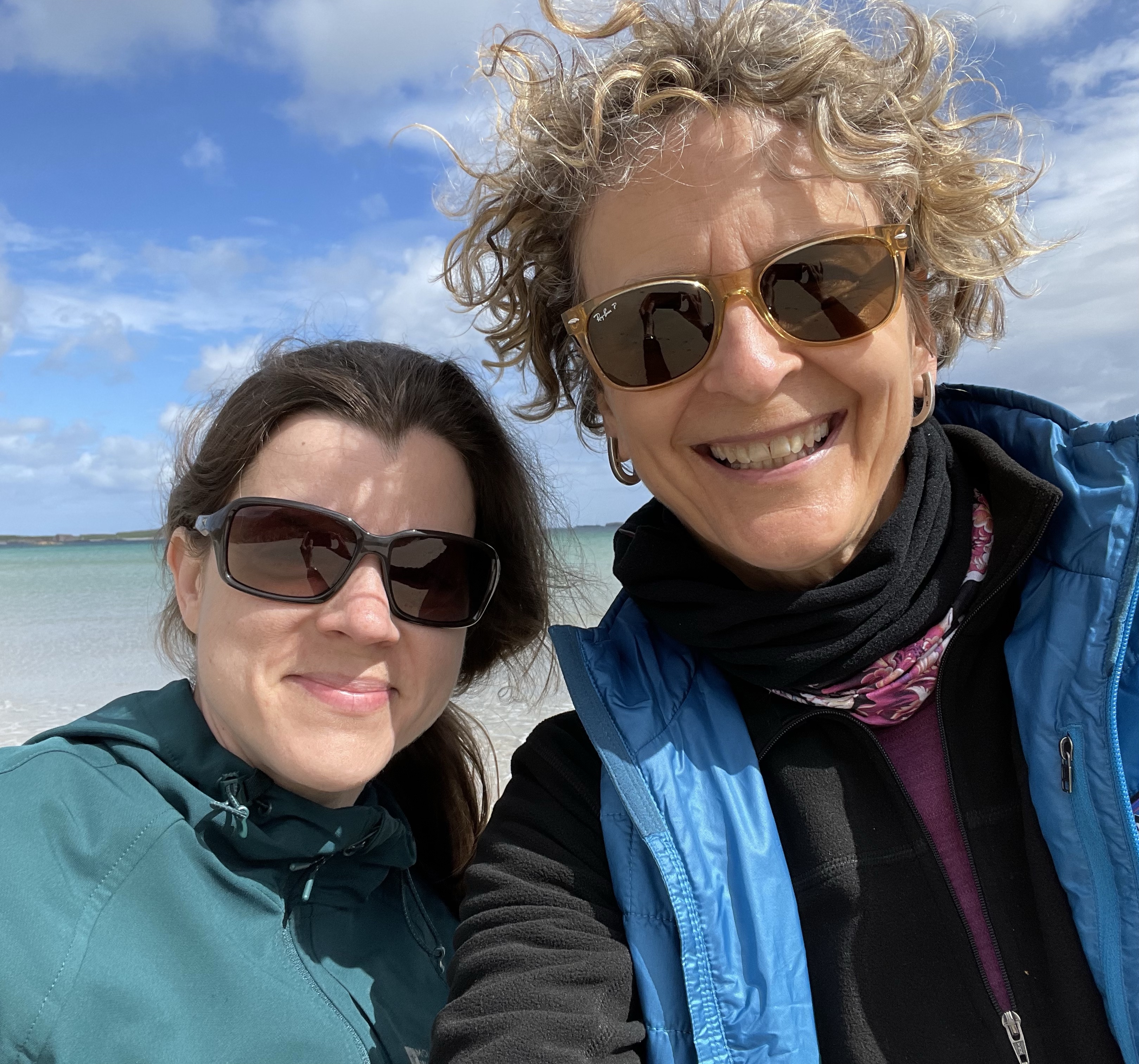
This trip won’t be solo, but with Danielle, a friend who has accompanied me on many Central Oregon hikes in the Cascades. We are both recovering lawyers, and I think met at a yoga studio years ago. There’s a photo of us in said studio on our backs with our ankles tucked behind our heads and our hands in namasté. Needless to say it’s hilarious and also entirely inappropriate for our purposes here today so I couldn’t possibly post it. Danielle is dating an actual Viking and I still harbor hopes of meeting a Scottish lad with a castle so we remain in men-in-kilts territory. This blog, and Scotland, will continue to abide.
As the trip is growing closer, I’m focusing mostly on driving for the first time in the UK (yikes), and looking forward to hiking in the Cairngorms, the Orkney Islands, Skye, Torridon and Glencoe – and traversing the North Coast 500. I also want to see as many puffins as possible. There will be castles, neolithic ruins, stone circles and Viking stuff. In fact there will be a distillery tour of Highland Park in Kirkwall, which includes a tasting of their “Vikings” series, with special edition, largely cask-strength drams named after Odin, Thor, Freya and Loki. To top things off, I had to postpone my trip home because my intended flight was unceremoniously cancelled, so will be in Inverness solo for an extra day (on my birthday as it happens). On that day a man named Andrew Grant McKenzie (you heard me) a historian who plays the bagpipes and worked at Culloden Battlefield for years will be squiring me on a tour somewhere, honestly it doesn’t really matter where. I believe the chances of him showing up in a kilt are very very high.
So thank you for joining me yet again to explore a wee country the size of South Carolina that somehow contains a vast Universe of history, hiking trails, dazzling terrain, culture, wildlife, wonderful food and very kind and welcoming residents with comforting accents. Scotland is basically Hermione’s bag in the form of a country.
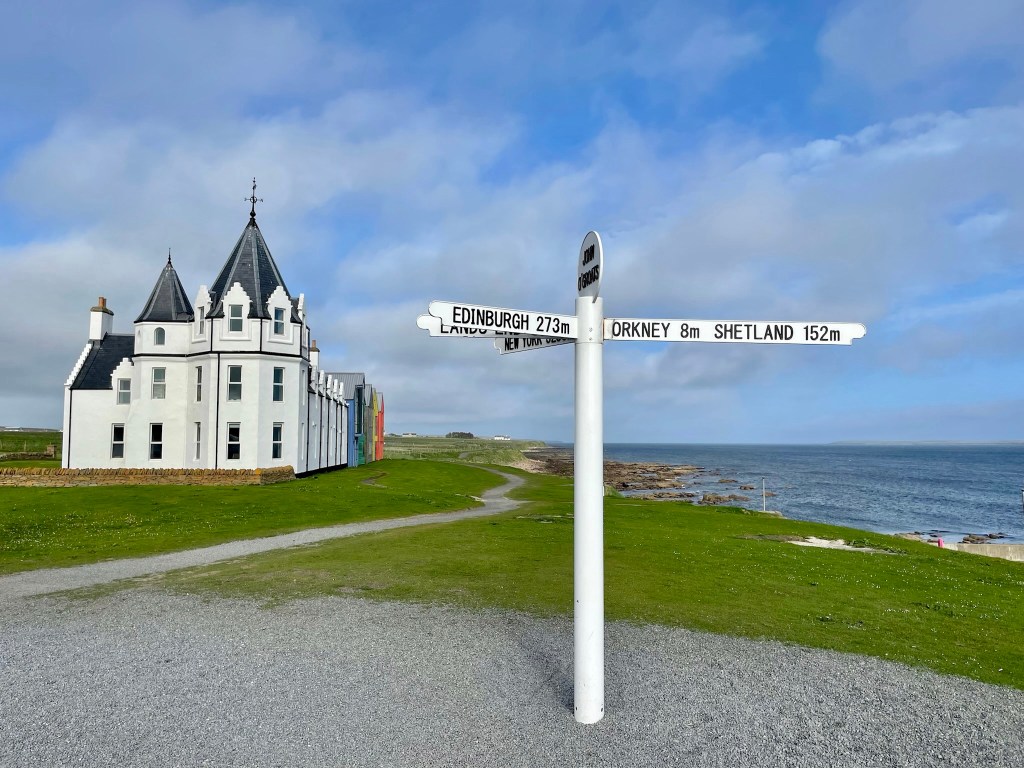
That place where you have to take a photo, John O’Groats
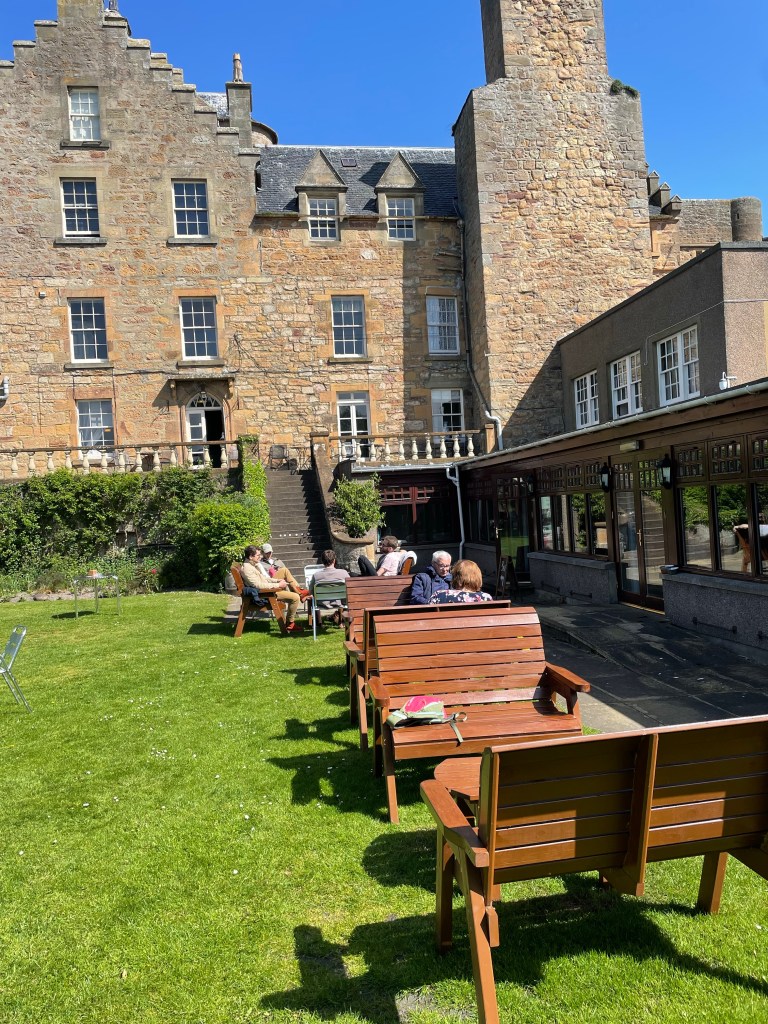
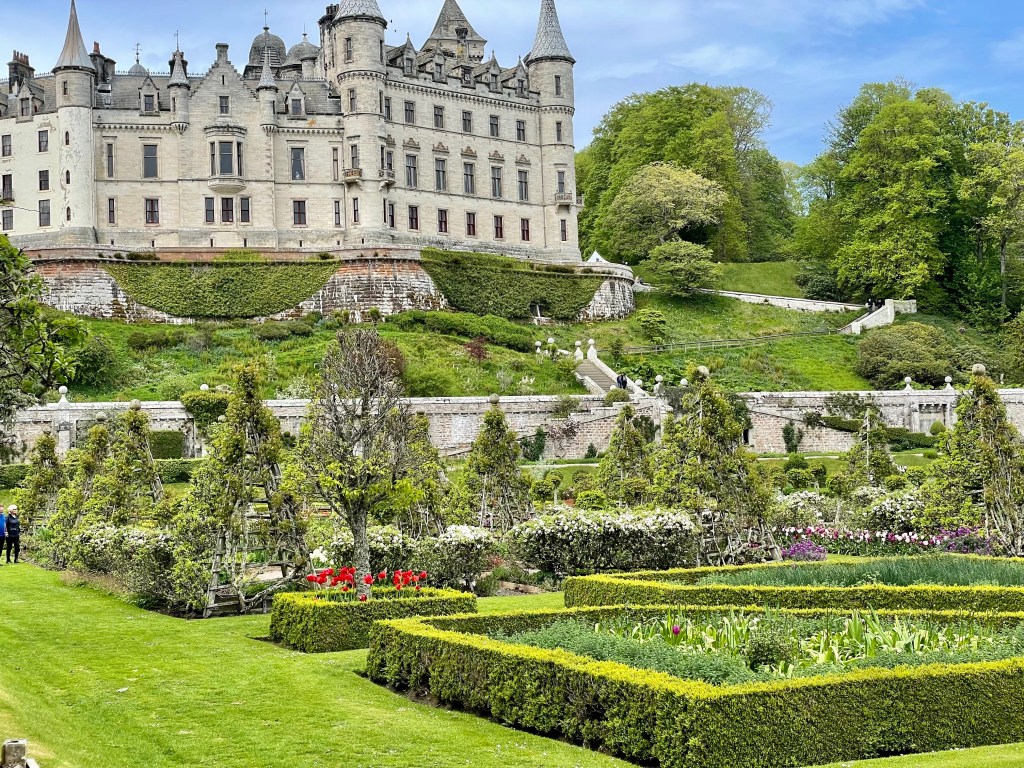
We bid a very sad farewell to our pals Kev and Kirsty in the Cairngorms and headed up the east coast, aiming for the Orkney Islands. We visited three castles along our way. Dornach Castle, which is now a 189 room hotel, was our lunch spot. It didn’t seem much like a castle any more, but it was a rare bluebird day, perfect for an outdoor lunch in the garden.
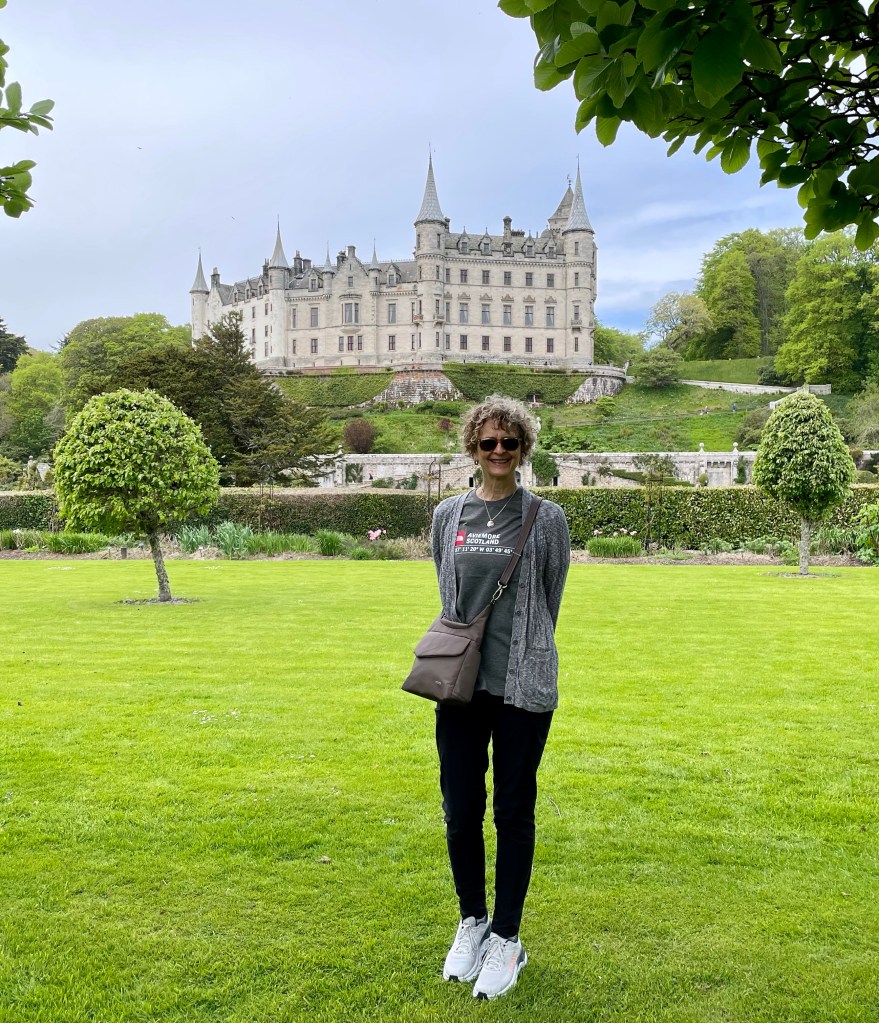
We then toured the fabulous Dunrobin Castle and Gardens, home to the Earls and Dukes of Sutherland throughout history. The earliest part of the castle was constructed in 1275. It was used as a naval hospital during World War I, and for a time, was a boys’ boarding school. The first Duke of Sutherland is sculpture-toppling notorious for his participation in the Highland Clearances, shipping off Scottish families in the late 18th century to make way for sheep since the cute fuzzy creatures made more money for wealthy landowners than crofters did.
Not our fault though.
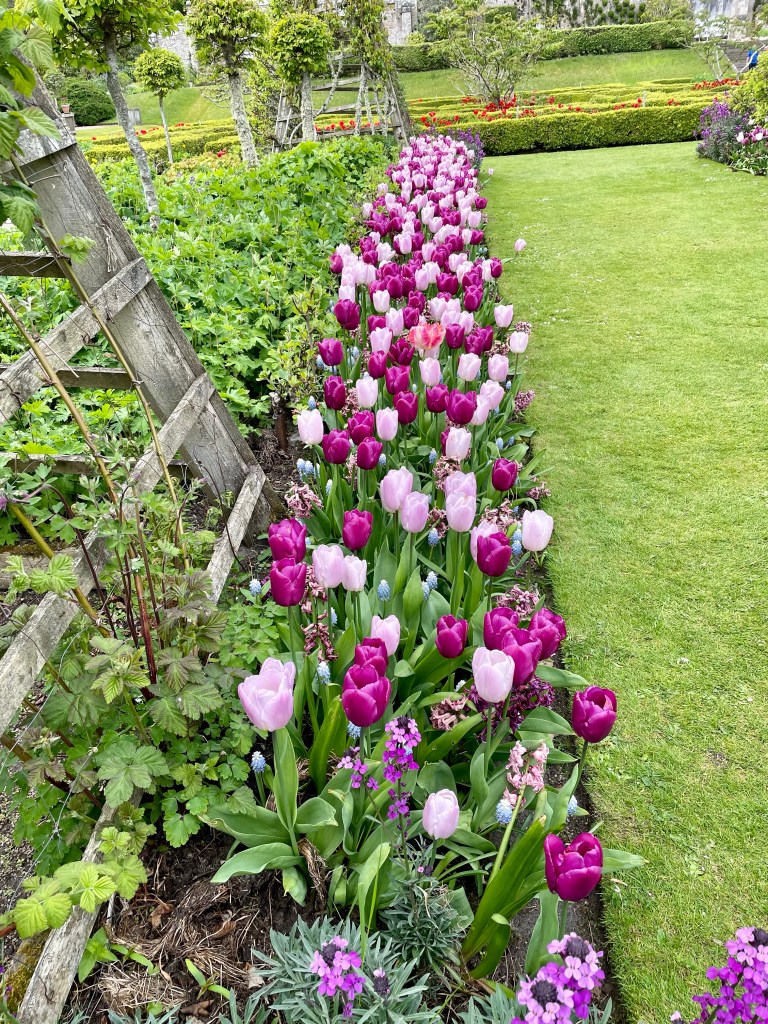
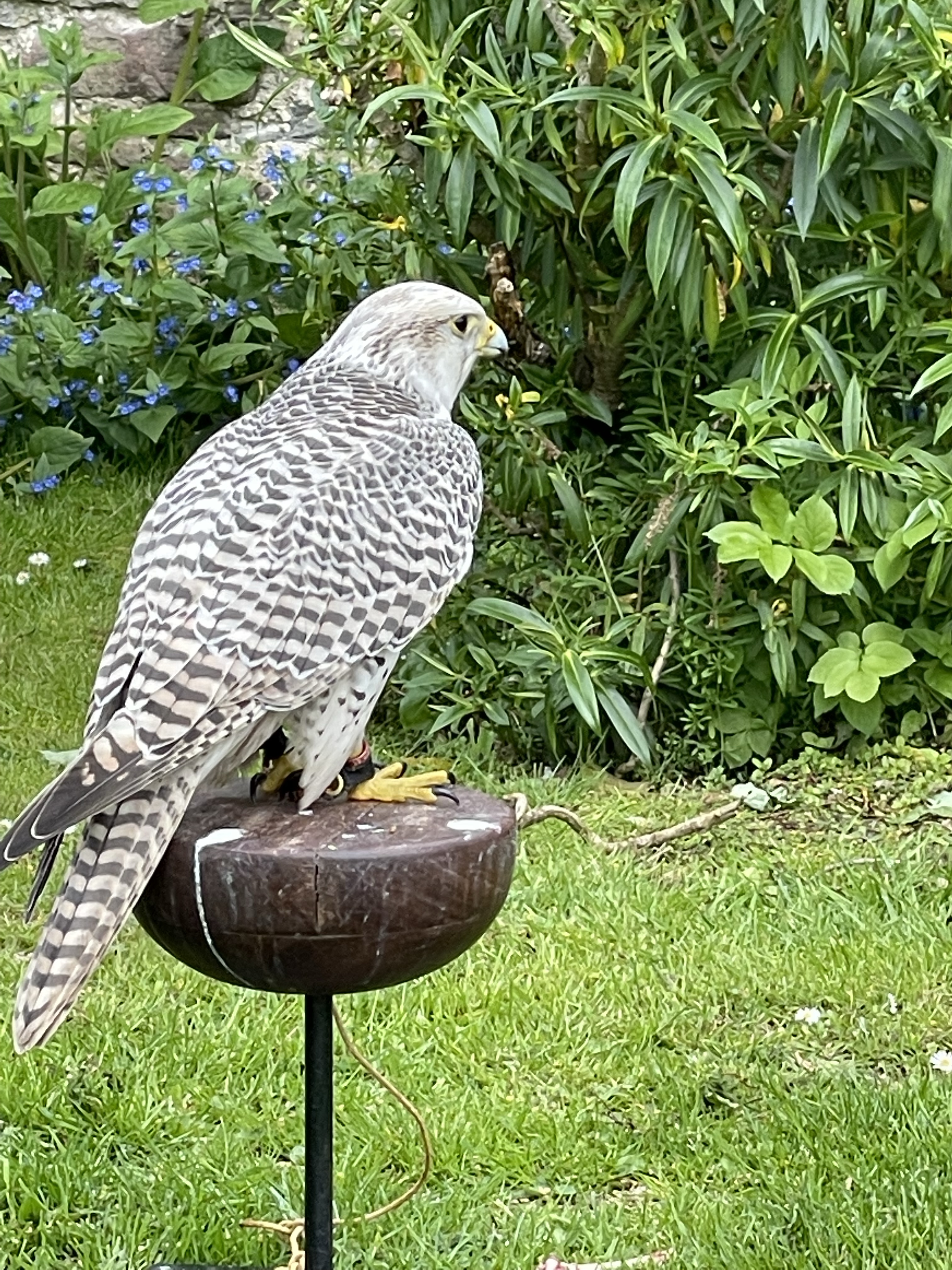
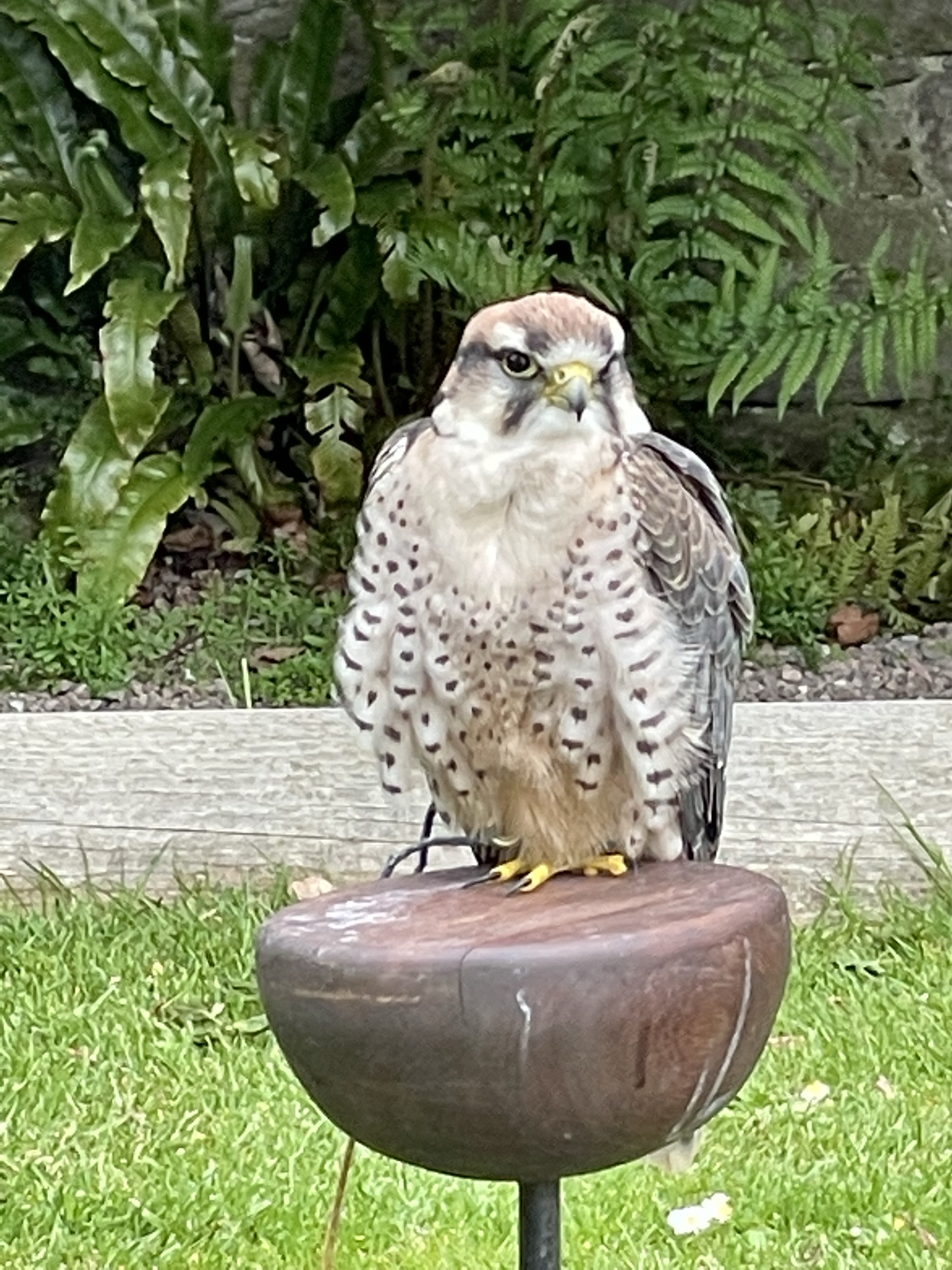
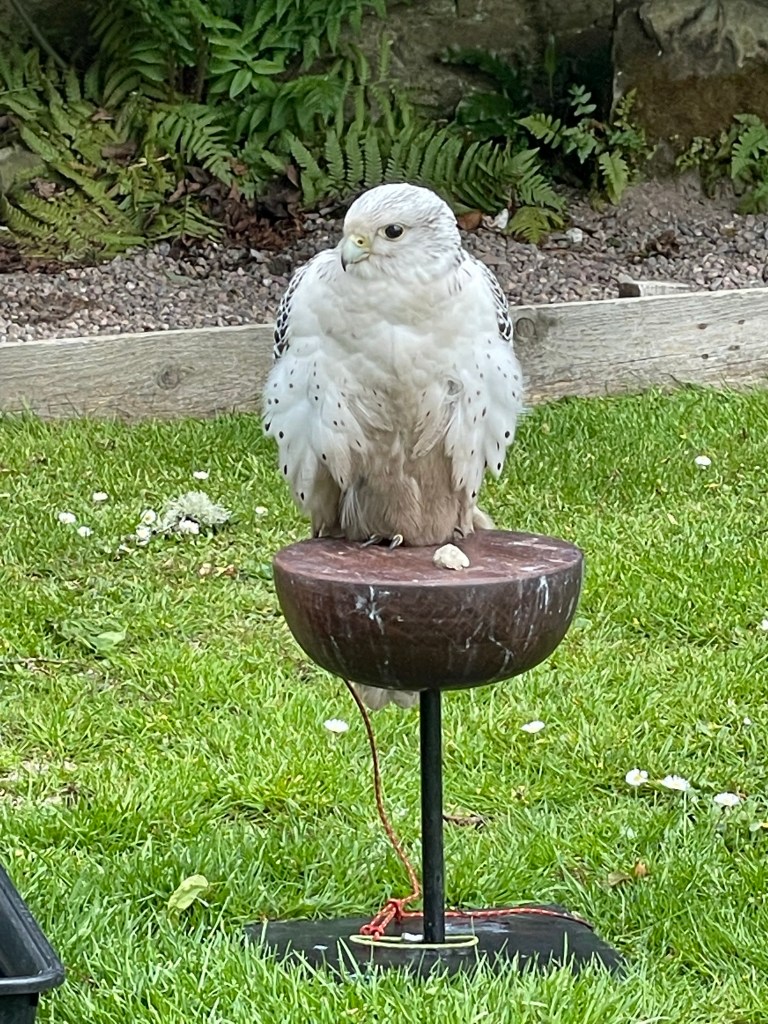
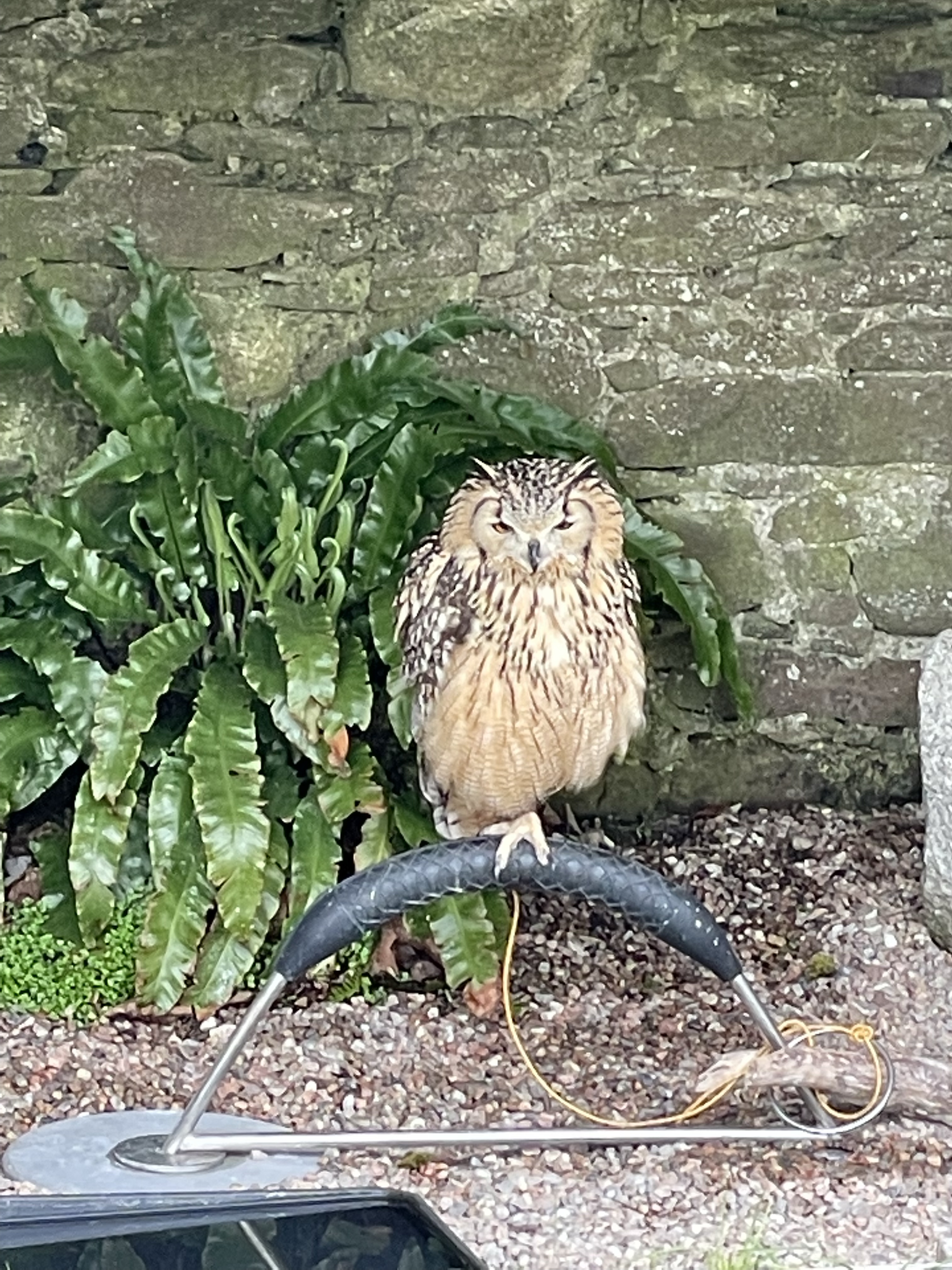
Even so, Dunrobin Castle is gorgeous with spectacular architectural gardens overlooking the North Sea, and is known for its falconry. I took an embarrassing number of photos of the resident falcons and owls.
Dunrobin Castle and GardensNot the worst view?Gorgeous beds.Birdies.
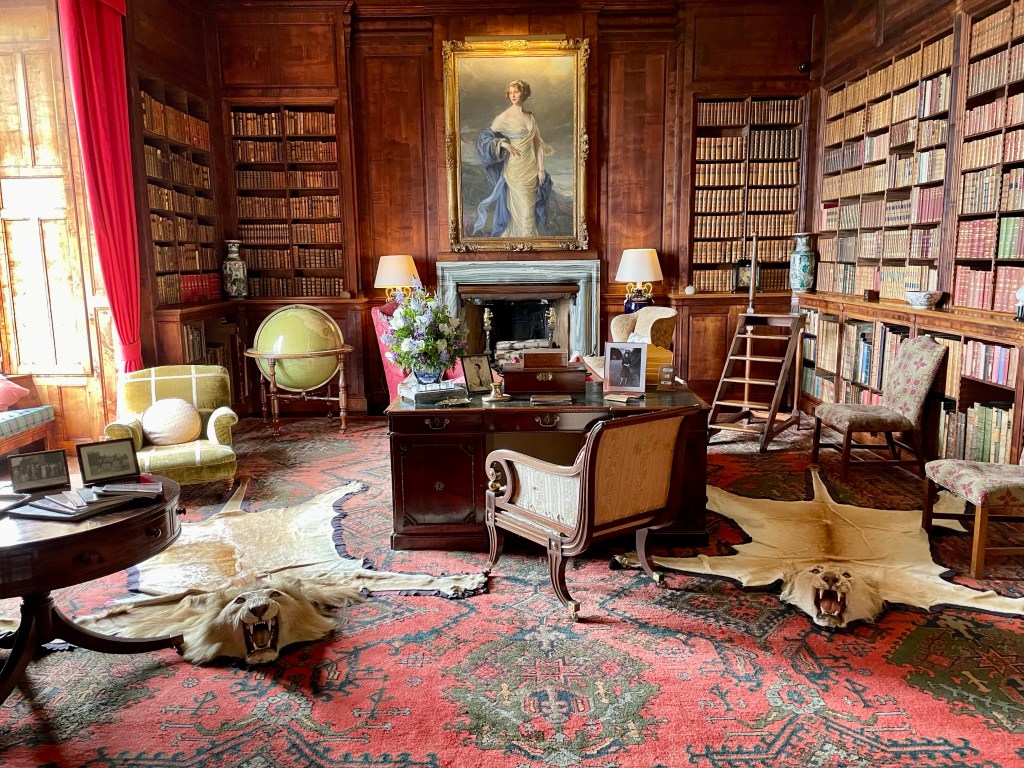
The indoor tour was quite something – so many rooms, so many paintings and photographs of Dukes, Duchesses, Earls, Kings and Queens. Check out the library – obviously the lion pair are a bridge too far on the decorating front.
Lions – no.
As with all estate-type museums, there were explanatory placards throughout. My favorite was outside the “Seamstress Room.” Why? Because it’s also known as the “Haunted Room.” Why? Because in the 15th century the Earl of Sutherland captured a young woman from the Mackay Clan after a battle and locked her up in in the seamstress room which was next to the night nursery which seems like an extraneous detail but it was on the placard. Apparently he wanted to marry her but she refused him. Earl, my dude, you need to up your wooing game. But wait, there’s more. One night he found her trying to extricate herself by climbing down a rope of sheets and I’m honestly wondering whether she invented this particular escape technique. Ego instantly bruised to the bone, the Earl whipped out his sword and cut the sheet rope, causing her to fall to her death. So obviously she became a ghost, and someone needs to turn this tale into a country song immediately.
The Sutherland boys, I fear, are the worst.
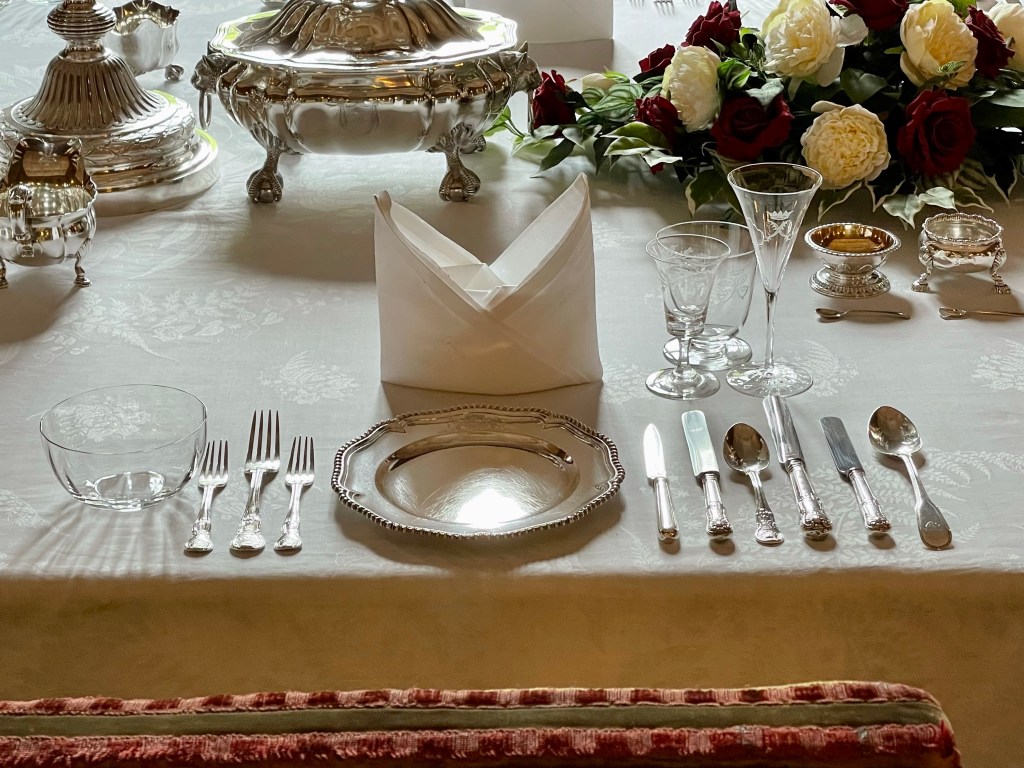
The dining room – does this make anyone else feel anxious?
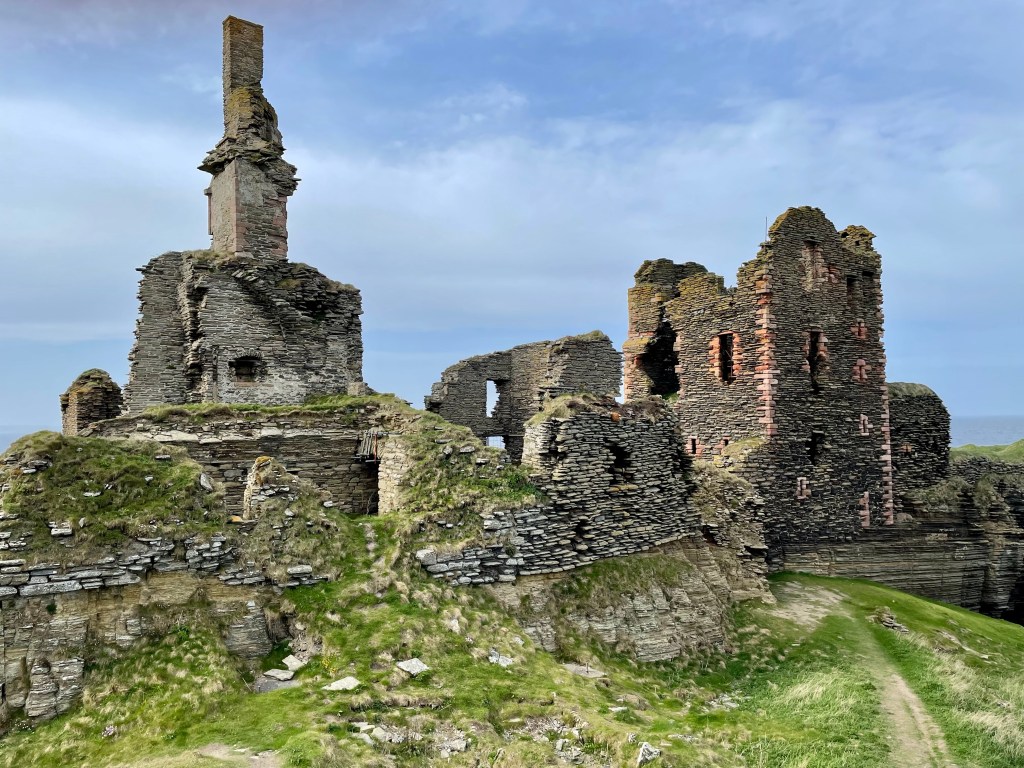
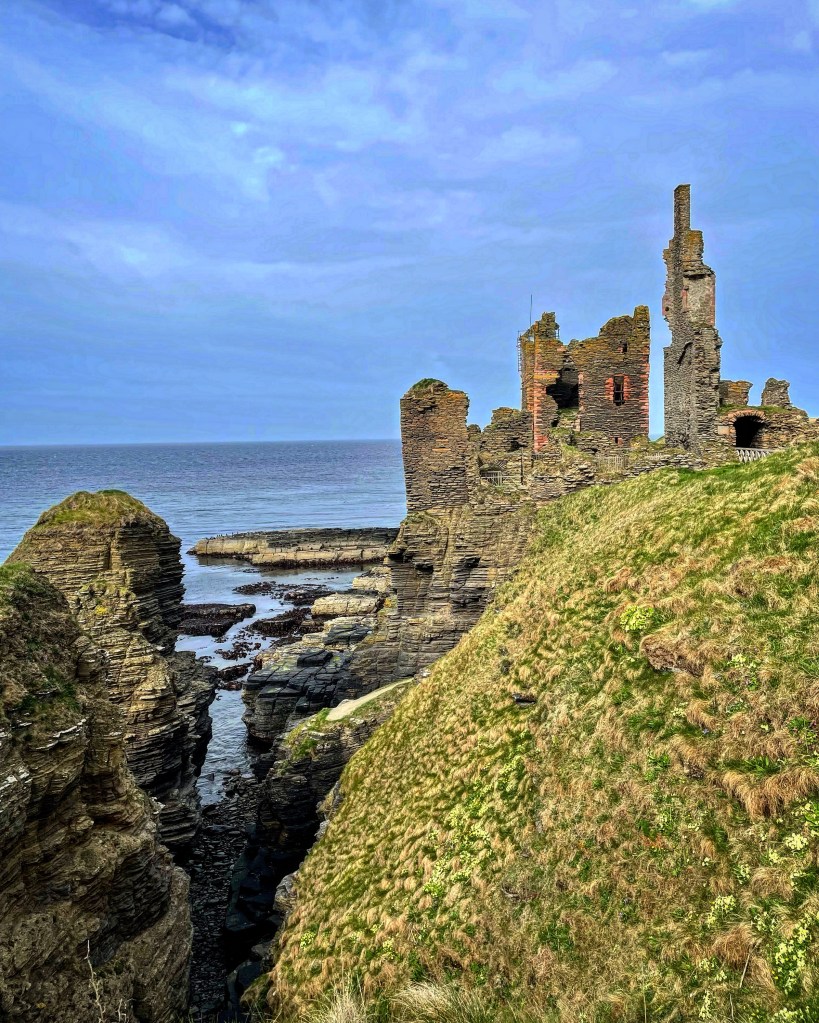
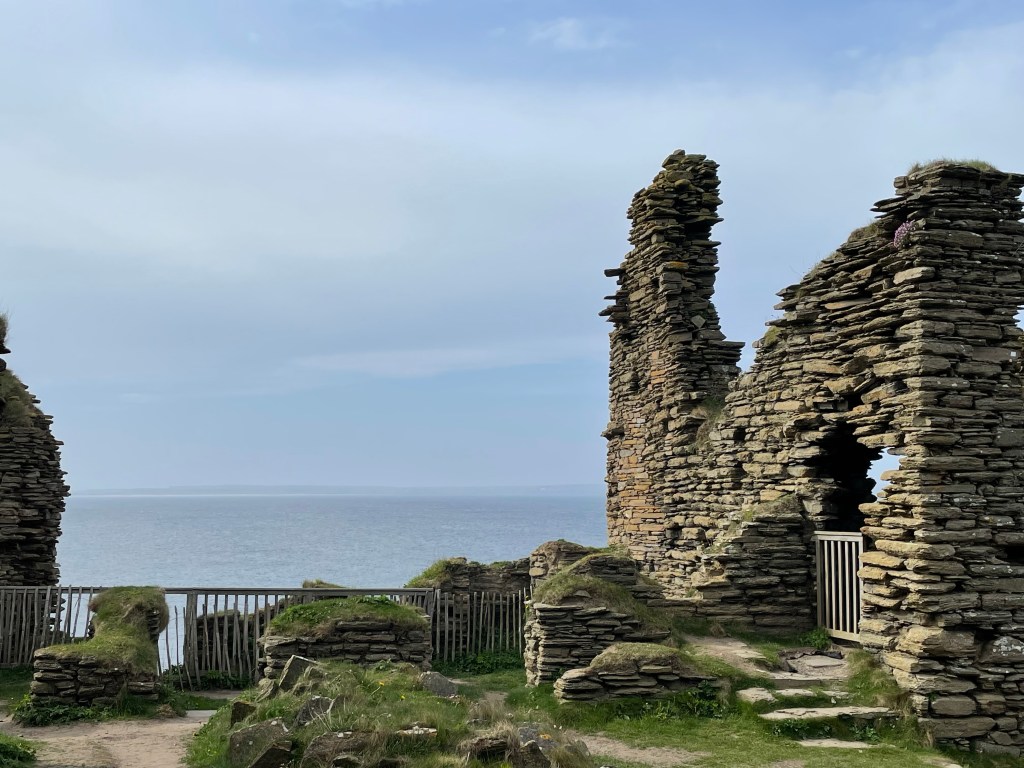
My favorite destination on our drive was a castle near Wick that very nearly fell into the sea. Thankfully it is being restored, not to its former glory, but to a ruin that will decay no more, Castle Sinclair.
Much of our route for this trip is along the NorthCoast 500, invented in 2015 by The Tourism Project Board of the North Highland Initiative to attract tourists to the less visited and economically depressed northern climes. It’s essentially a 500 mile circular driving route that begins and ends in Inverness. It has become incredibly popular rather too quickly and the locals, while benefiting from some positive economic impact, are Not Stoked. Living in a tourist town myself, I sympathize.
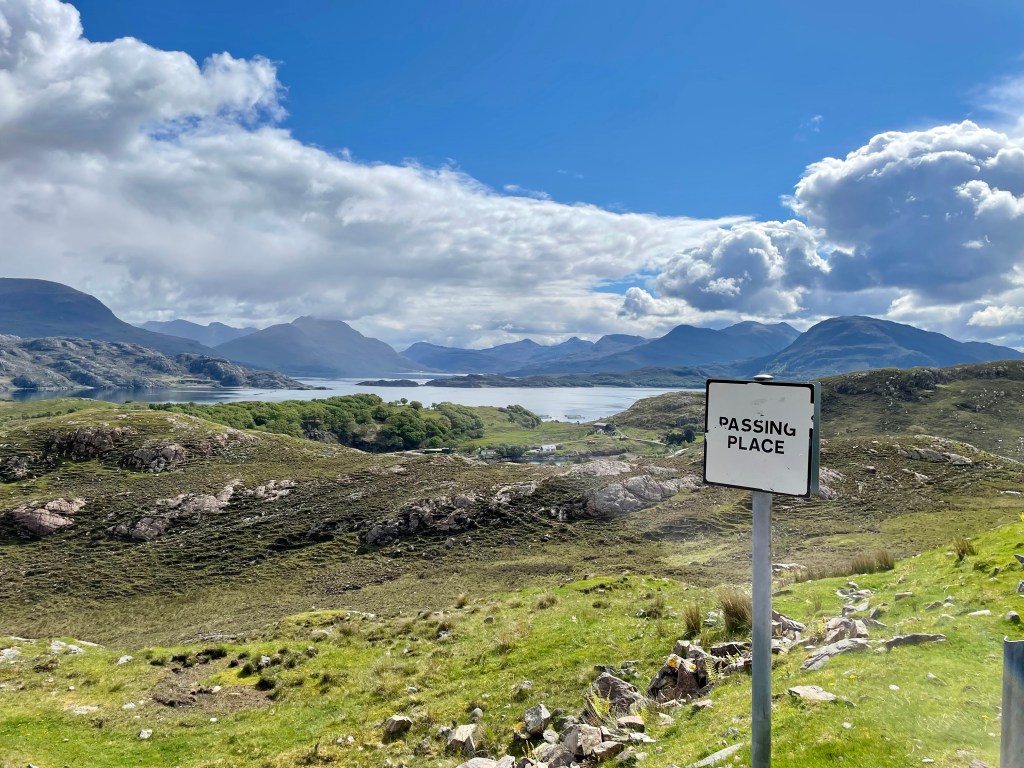
A particular enmity is reserved for all the camper vans inhabited by tourists not sleeping in B&Bs and making their own meals. These RVs are rented in Inverness by folks who have no idea how to back them up, and they are simply too big for single-track pot-holed roads. The area has also seen a huge increase in motorcycle and car traffic (especially “fancy cars” complained a group of men ruefully shaking their heads over breakfast in a Scrabster cafe). People are unfamiliar with how to navigate one-lane roads with “passing places’ where one person or another can pull over. The influx has placed a strain on infrastructure in general, particularly, ahem the delicate, often seaside, sewage system. Understandably irritating for folks living in a remote area who suddenly are facing challenges living their lives as usual. One man complained, “The tourists will stop suddenly in the road because they’ve seen a Highland cow and want to take a picture.”
Ahem. Me, circa 2018.
The route is also driven by people who go from attraction to attraction, stopping only for that Instagram moment and not really spending money or meaningfully interacting with the community. Here are a few examples.
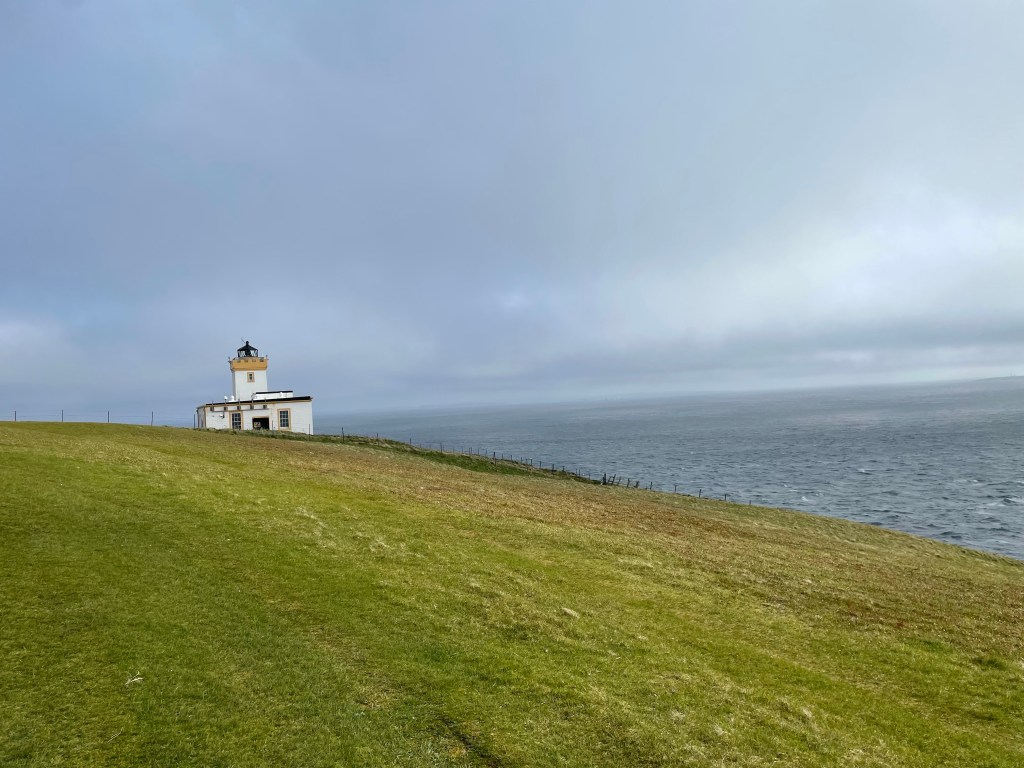
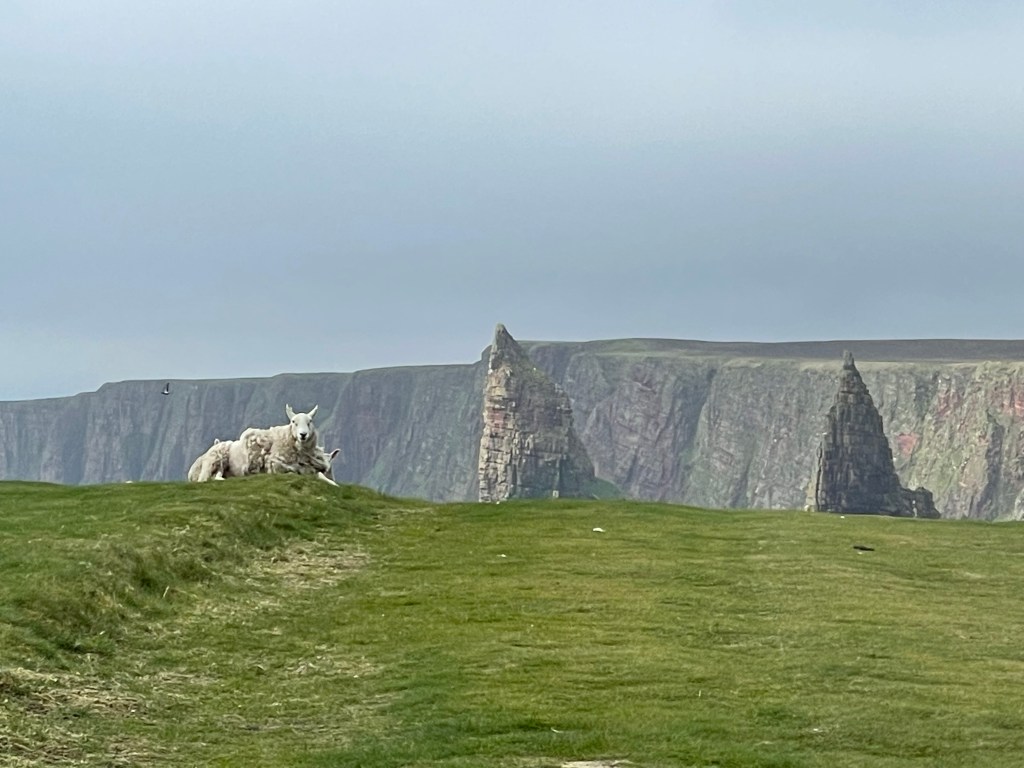
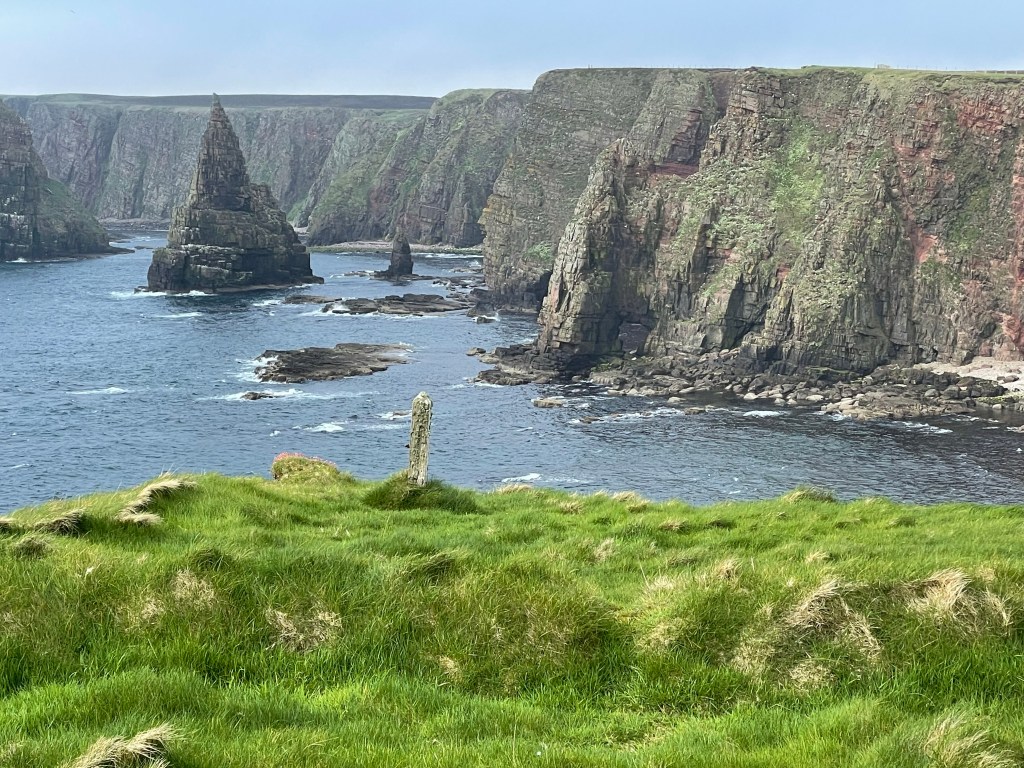
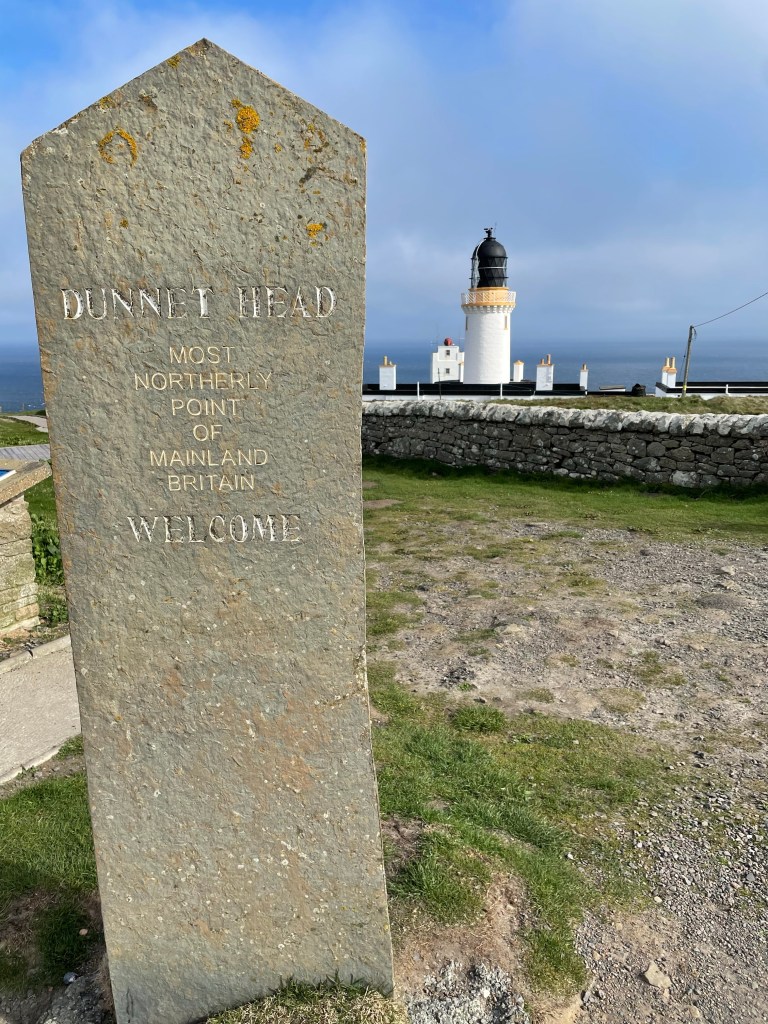
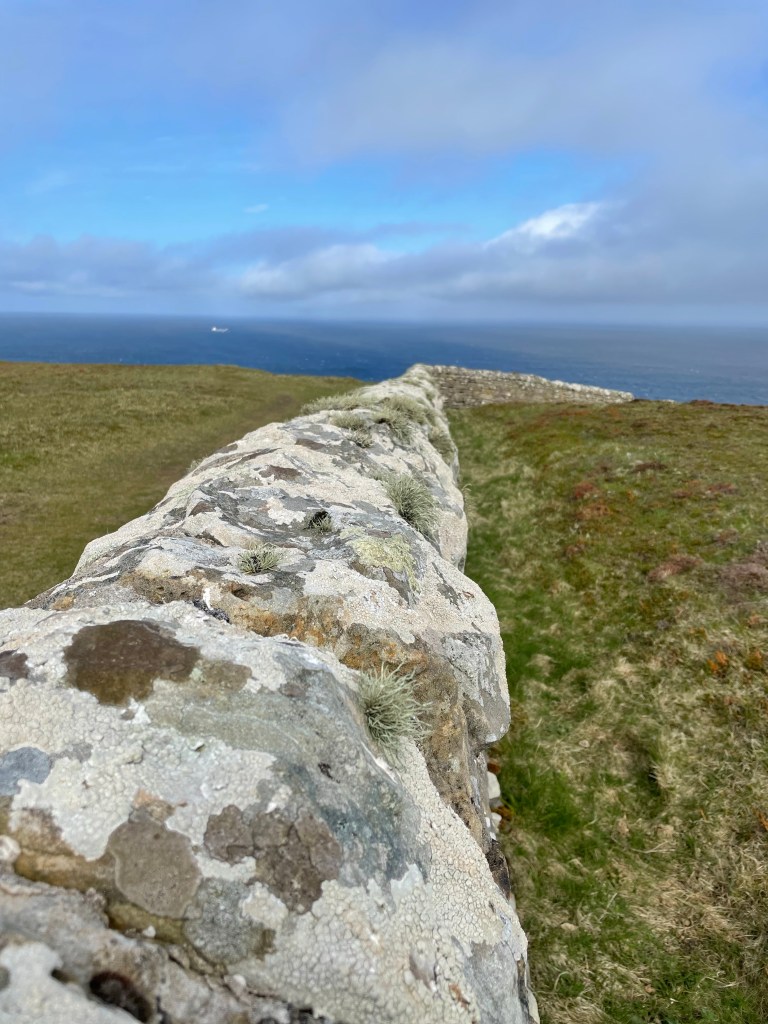
Duncansby Head Light House – the farthest northwesterly point of the mainlandDuncansby Stacks plus sheepDuncansby Stacks, no sheepThe End of the Road North no more.Wall to the sea.
The Eastern Highlands are gorgeous indeed and I apologize to everyone lucky enough to live there for stopping at a fair number of attractions listed in North Coast 500 brochures and snapping a photo. I can’t believe I am that person. At least Dougal is a small and not-fancy car.
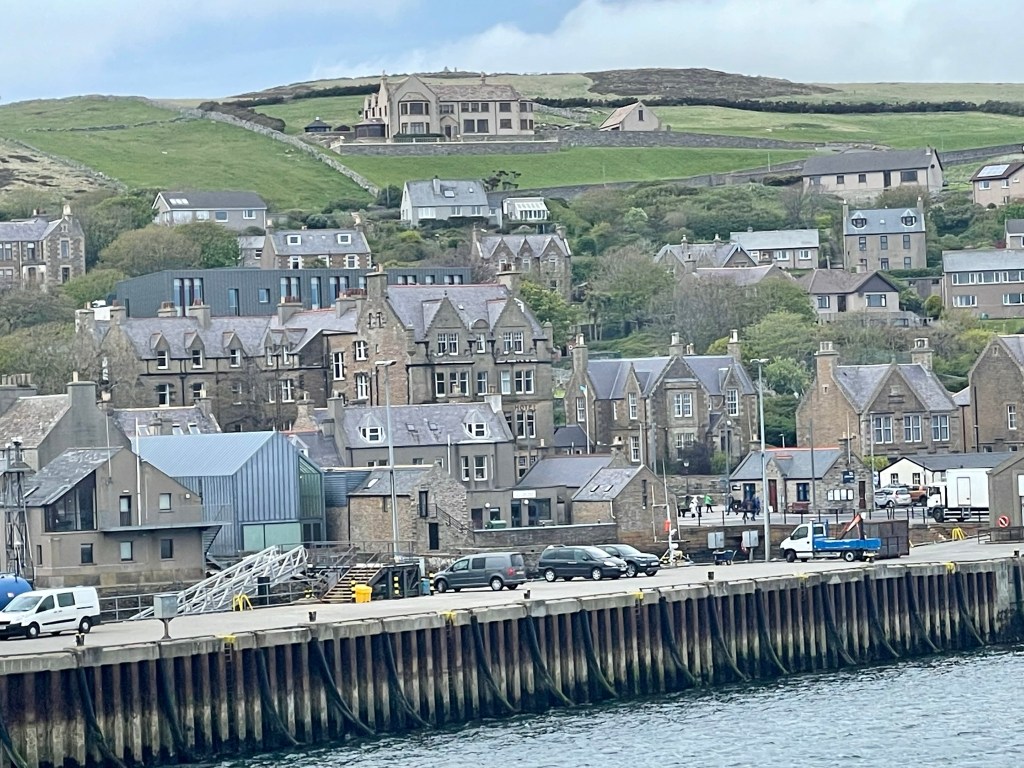
For now, it’s time for our adventure in Orkney. We are officially here in Stromness and ready for three hikes and one day-long guided tour, all planned through Macs Adventure.
Stromness
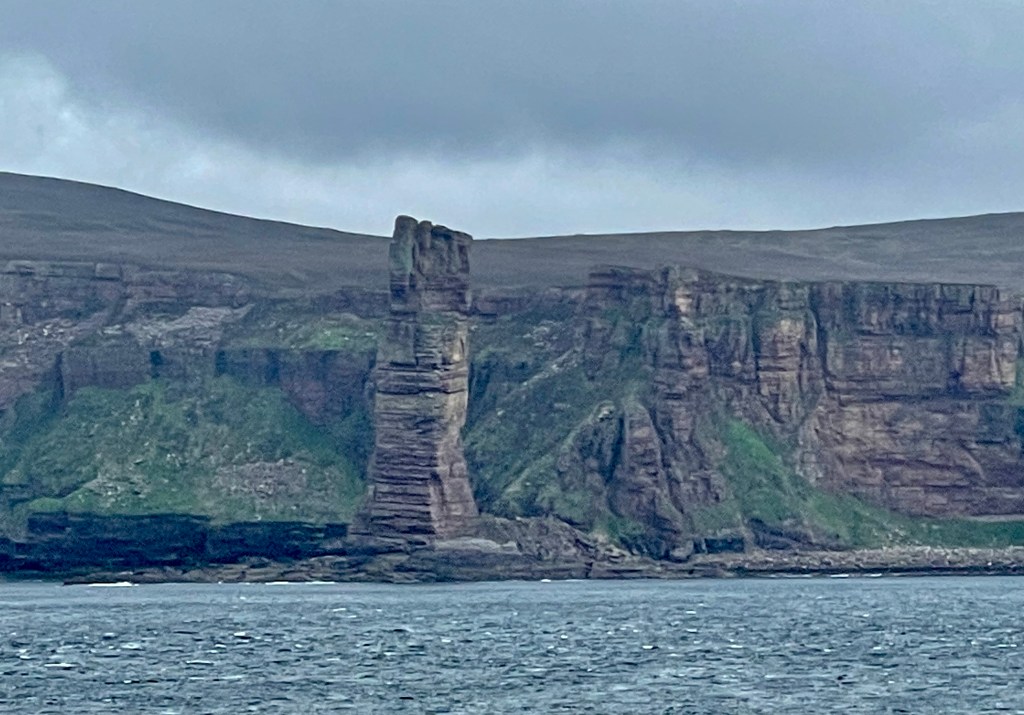
I’ll leave you with the Old Man of Hoy, which we’ll see tomorrow, lord willing and the creeks don’t rise, from land.
How this came out I have no idea as the wind was blowing so hard I could barely stand. Just look at his cute face.
The best thing about traveling is chance encounters with fellow travelers, and meeting people lucky enough to live in the places where you have chosen to vacation. Interestingly, we’ve continued to encounter mostly other Brits, Norwegians and a few French. No Americans. Also the general age range has skewed older – many intrepid folks in their 70s and beyond, walking and biking through the Isles.
On our last day of adventure in Orkney we took the very early ferry north to Westray, known as the Queen of the Isles. Westray is eleven miles long and has 600 residents (down from over a thousand in the 1800s) and boasts the shortest scheduled flight in the world, the longest golf hole in the UK and a castle ruin steeped in history. More seabirds than anywhere I’ve ever been with a boggling range of species. Including – oh yes – the MIGHTY PUFFIN.
We were met at the ferry by Karen and Andy Penn, who run Westraak Tours. If you ever find yourself in Westray, book them. Karen was born in Orkney and Andy is an “incomer,” having moved to the island from Dumfries when they married six years ago. We swung by a local B&B and picked up Angela and Peter, a couple from Cornwall, and headed to “coffee,” which ended up being in Karen and Andy’s home, a lovely surprise. We sat around their table and got acquainted, also meeting Andy’s son Callum, who is in his twenties and has autism. It was lovely chatting with him and sharing our names and places of origin. It wasn’t long before Angela shared with the group that Peter, a retired physician, was struggling with early stages of Alzheimers. It was quite touching how he relied on Angela to fill in gaps. He looked to her and said, “do that thing you do,” and she riffed through words to help him find the right one. They were lovely and delightful, up for anything, and all-around excellent traveling companions.
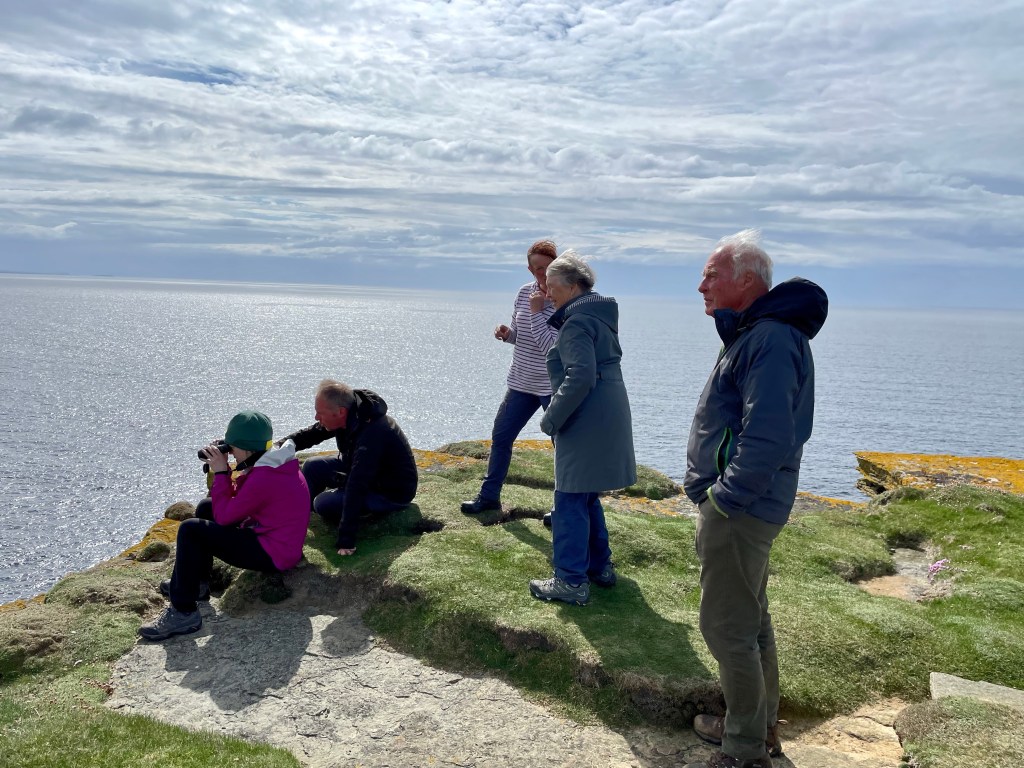
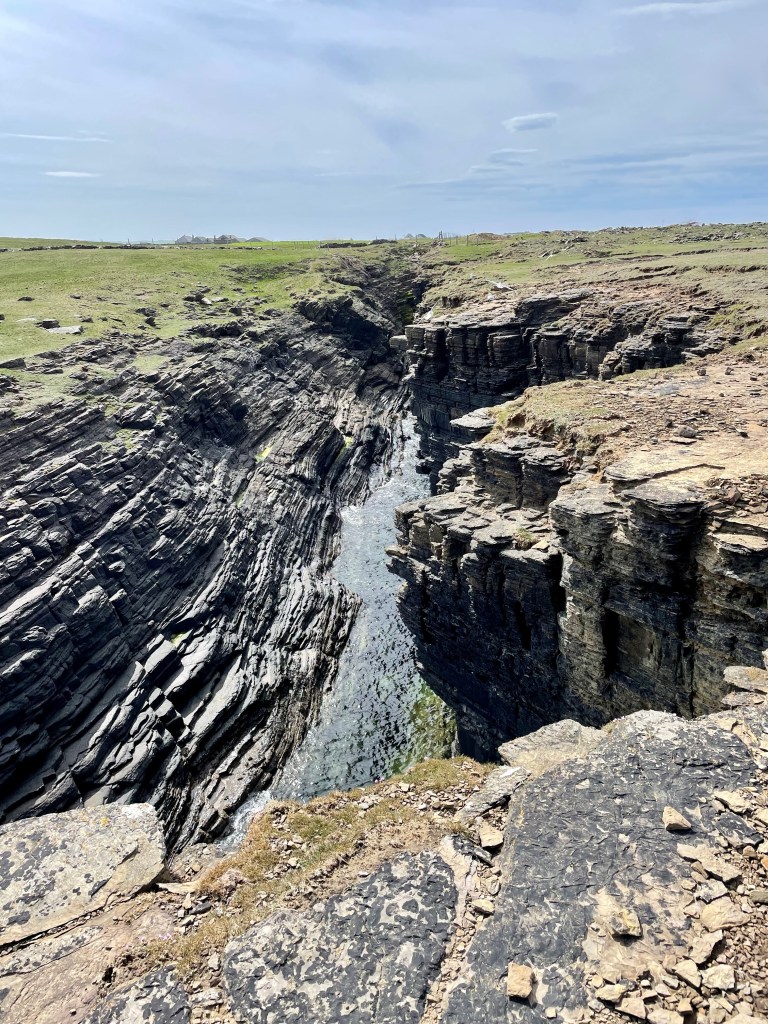
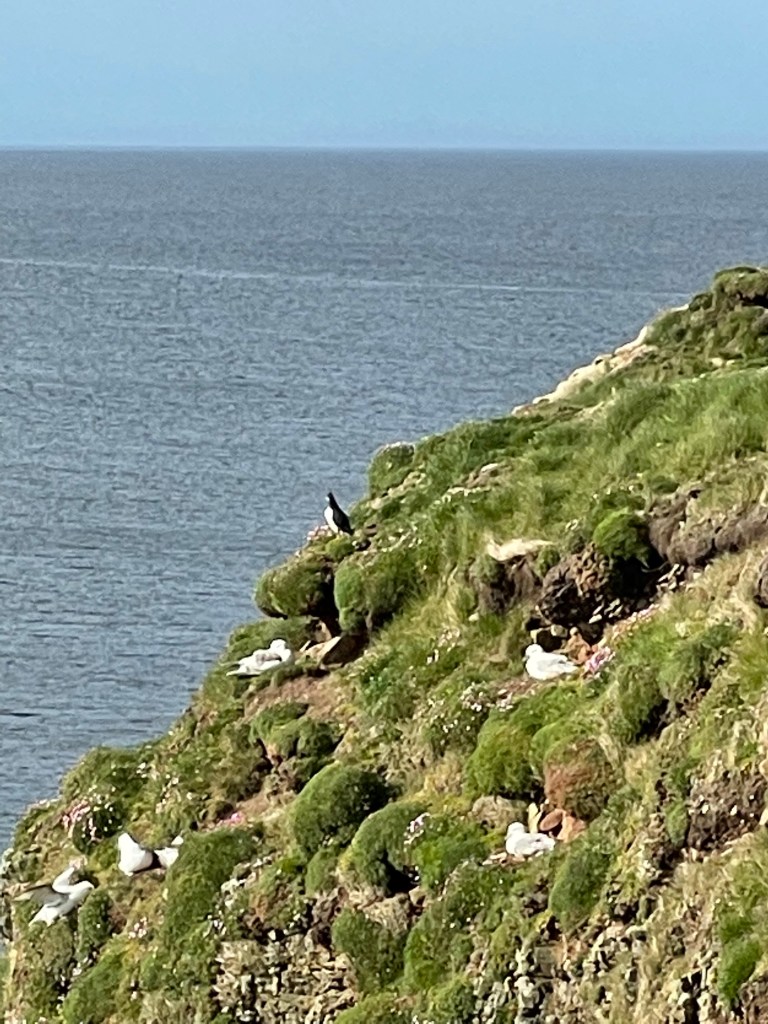
We left Callum with a shopping list for lunch, which would also be at Karen and Andy’s, and set off across the Island. Our first stop was a bird-nesting area along the coastal cliffs.
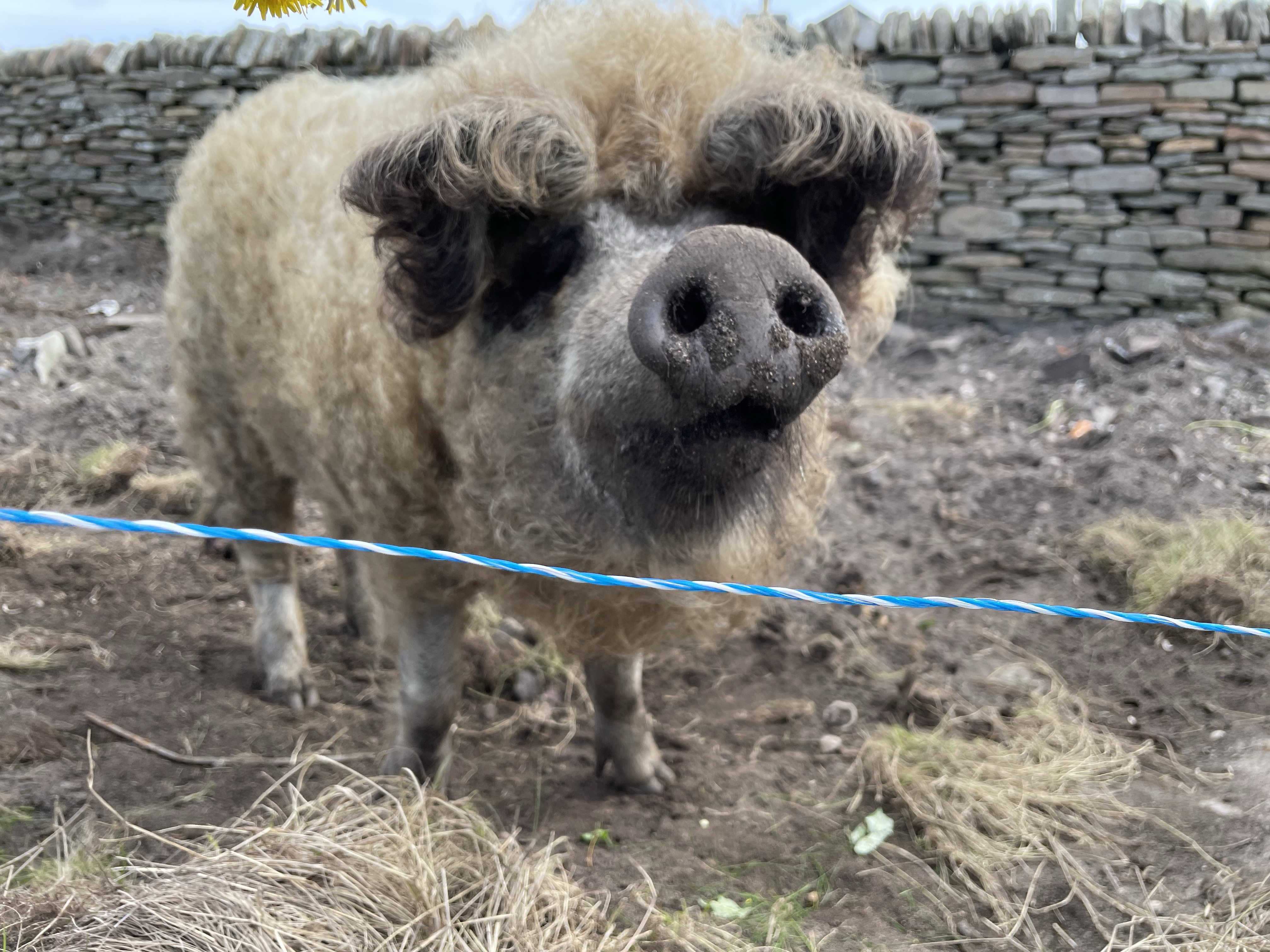
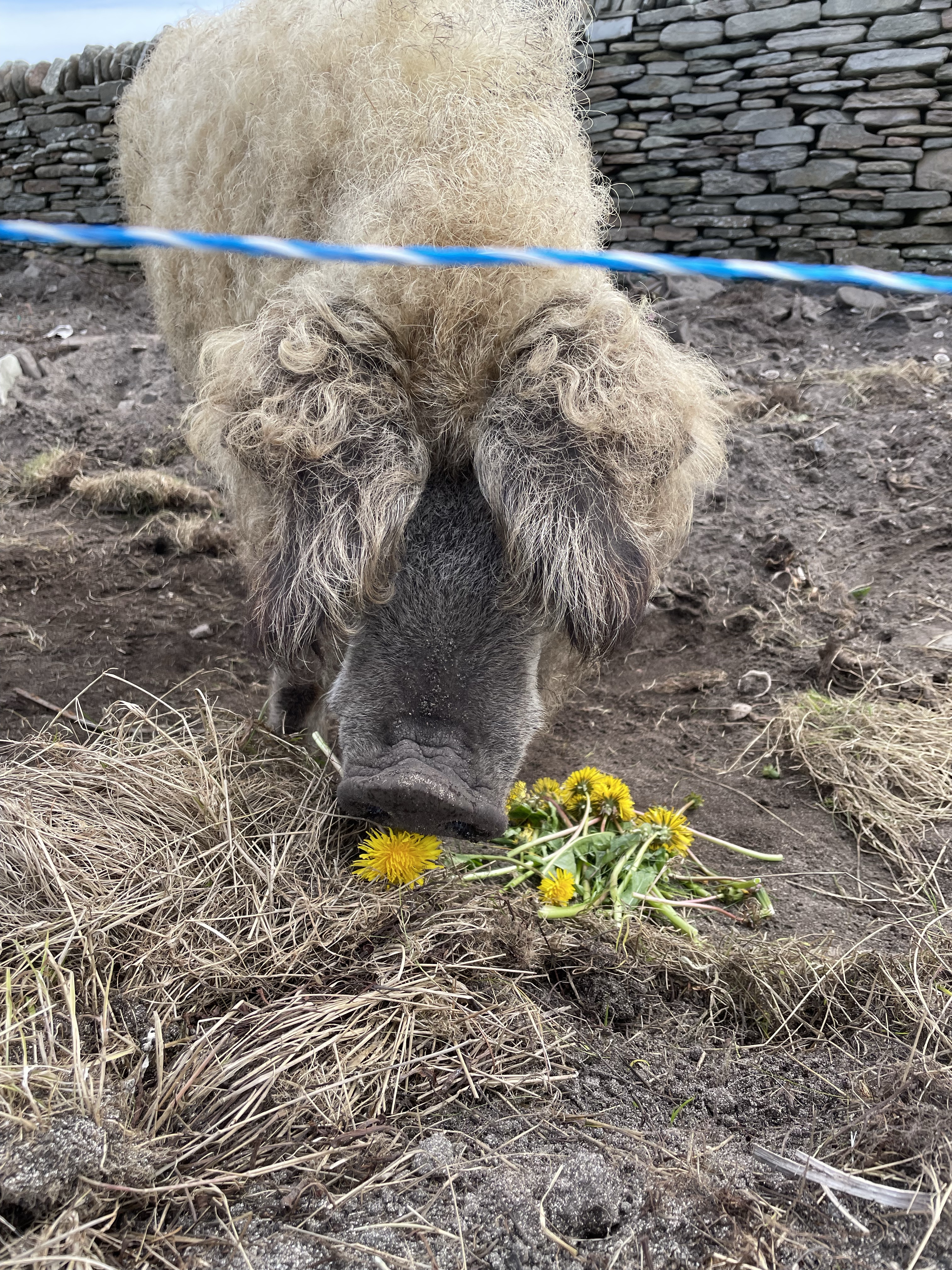
Next we headed to Quoygrew, the ruins of a Viking settlement. One of its longhouses had been excavated between 1997 and 2005. On the way, we met the charismatic Miss Piggy and fed her dandelions.
Quoygrew was a settlement of farmers and fishermen first inhabited in the 10th century and lived in as late as the 1930s.
Remains of Viking longhouse.
Our lunch at Karen and Andy’s was utterly delicious thanks to Callum’s successful shopping excursion. Karen made sweet potato soup, accompanied by egg salad from chickens just up the road, locally made cheese, locally caught and smoked mackerel, rhubarb compote and possibly the best sticky toffee pudding in the world. Lunch was accompanied by a very animated political discussion about Boris Johnson (“a dreadful buffoon”) the current Tory government (“corrupt to the bone”) anti-immigration British home secretary Priti Patel, whose family immigrated to the UK but would not be able to do so under current policy (“a terrible hypocrite” and also “appalling”) and of course Brexit (“a complete disaster”). Angela expressed admiration for the qualified and educated Labour Party leader, Keir Starmer, and wondered, “why wouldn’t people want this type of person to lead the country,” as opposed to Johnson, who won votes because he was “a laugh” and would be an entertaining pub date. Angela also talked of the ever-growing wealth discrepancy in the UK. It all sounded wearyingly familiar.
We next visited Noltland Castle which was the biggest surprise of the tour. On our way we drove by a golf course, which perked up Peter, an avid golfer. Andy said the course boasted the longest hole in the UK at 738 yards. It’s a par 6. Andy said he got a 7 once, but with the constant winds a 15 is more likely.
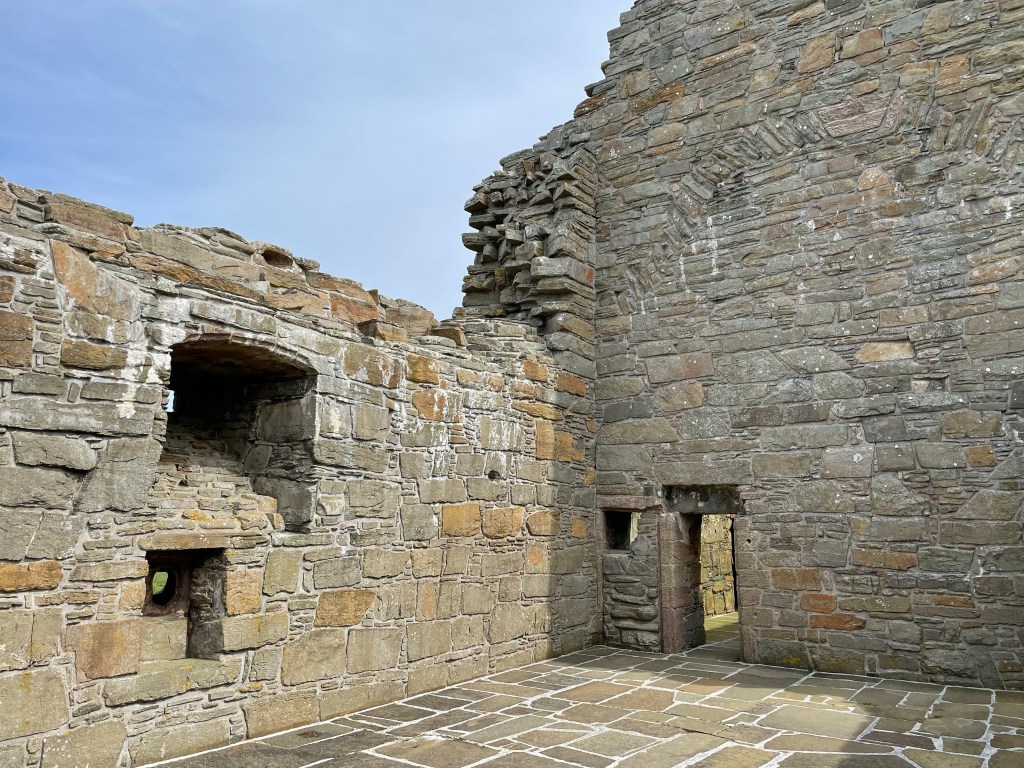
All the gun holes.
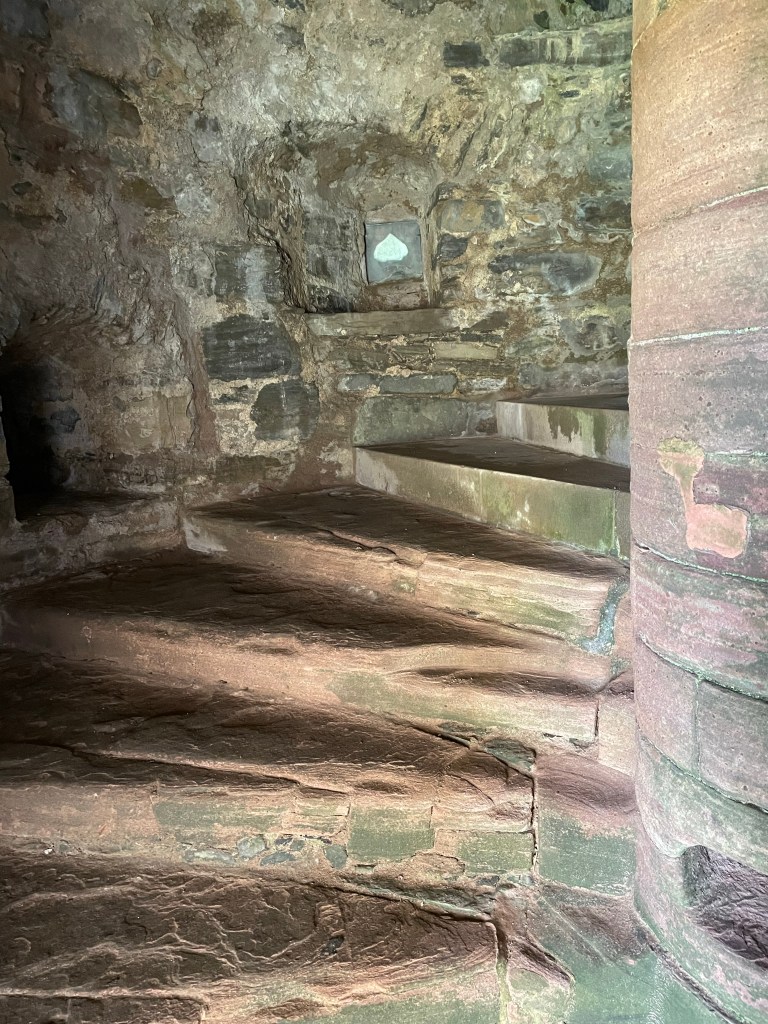
Noltland Castle was constructed in the 1500s, so a bit late in the game as far as castles go. It was built by Gilbert Balfour, who at the time owned Westray and Shapinsay, both given to him by his brother-in-law, the Bishop of Orkney. It’s odd because apparently he ran out of money or interest because he never finished the castle – the Great Hall remains open to the stars, even while Gilbert lived there. Maybe he blew his budget on the gorgeous spiral staircase, one of the UK’s grandest of the period. Roofs are kind of boring and expensive for sure – but handy to have in place nonetheless. The castle boasts an incredible 71 gun holes. There’s even one in the WC. Was Gilbert paranoid? Or were his fears justified because he moved through life cultivating mortal enemies wherever he went? You be the judge.
The acoustics are amazing, and the local Kirk holds concerts here.The never-roofed great hall.The spiral staircase.Castle grounds.
Balfour was the self-appointed Sheriff of Orkney, constable of Kirkwall Castle and master of Mary Queen of Scots’ household. Sounds good so far. But. He was also implicated in the murder of Cardinal Beaton at St. Andrews (mutilating his body and hanging it outside the window), after which he was captured by the French and condemned to be a navy galley slave for a few years. Fully not rehabilitated by that experience, he next helped murder Lord Darnley, Mary’s second husband, in Edinburgh.
You might be wondering why Mary didn’t dump Gilbert after he murdered her husband. The thing is she might have married Darnley mostly because he was also a Stuart and so would have given her a stronger claim to the English throne. Their son James did become James I of England, so that worked pretty well. Also, she had fallen in love with the Earl of Bothwell by that time and, who knows, perhaps she was in on the murder plot, as it was the only way to get rid of husbands back then.
Before Mary’s ultimate arrest, she was urged to flee to Noltland and some say that Gilbert was sweet on her and actually built the castle with her in mind. Sadly, she did not take this advice and was ultimately captured. You know the rest.
Balfour’s incurable habitual plotting continued apace, and he was implicated in the Mornay murder plot against King John III of Sweden. Karma finally caught up to him and he was executed in Stockholm.
Andy, Peter and Angela.
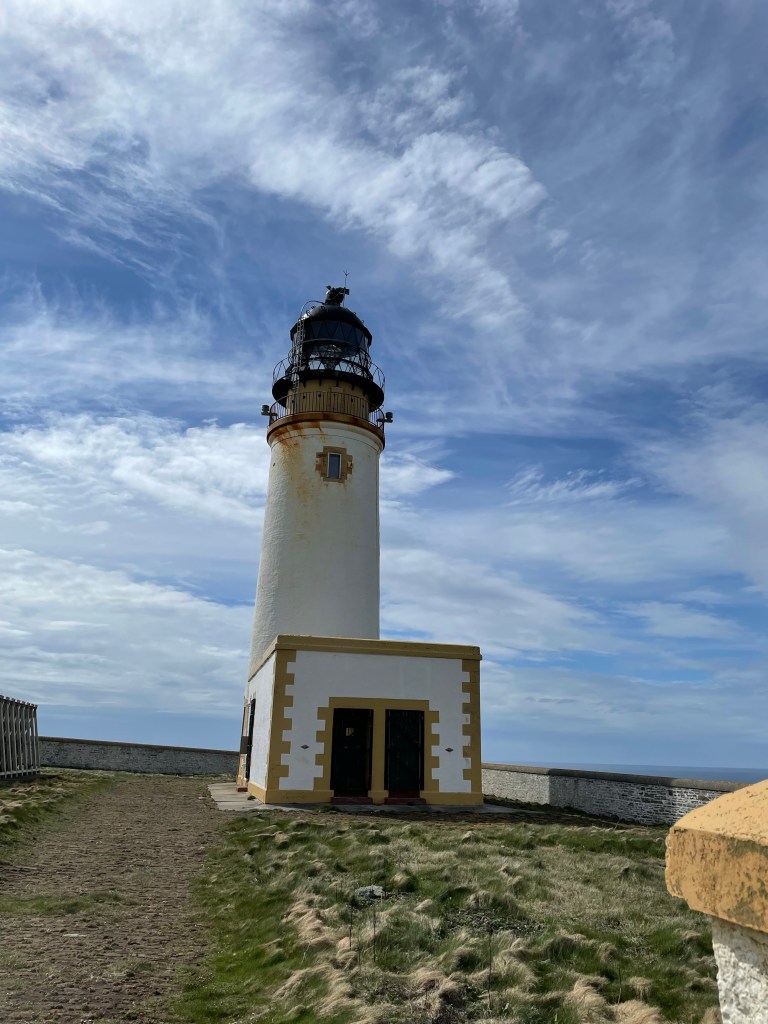
Next stop was Noup Head Lighthouse (one of over 200 built around the Scottish coastline). One family, the Stevensons, was responsible for designing all of Scotland’s lighthouses over a 150-year period – which explains why they all look alike. The lighthouses, not the Stephensons. The sole black sheep who rejected the family business in favor of a dodgy writing career was named Robert Louis Stevenson.
Here there were more dramatic cliffs and thousands of seabirds, transforming the cliffs into a layer cake of different types of birds, who clustered together by species in neat rows.
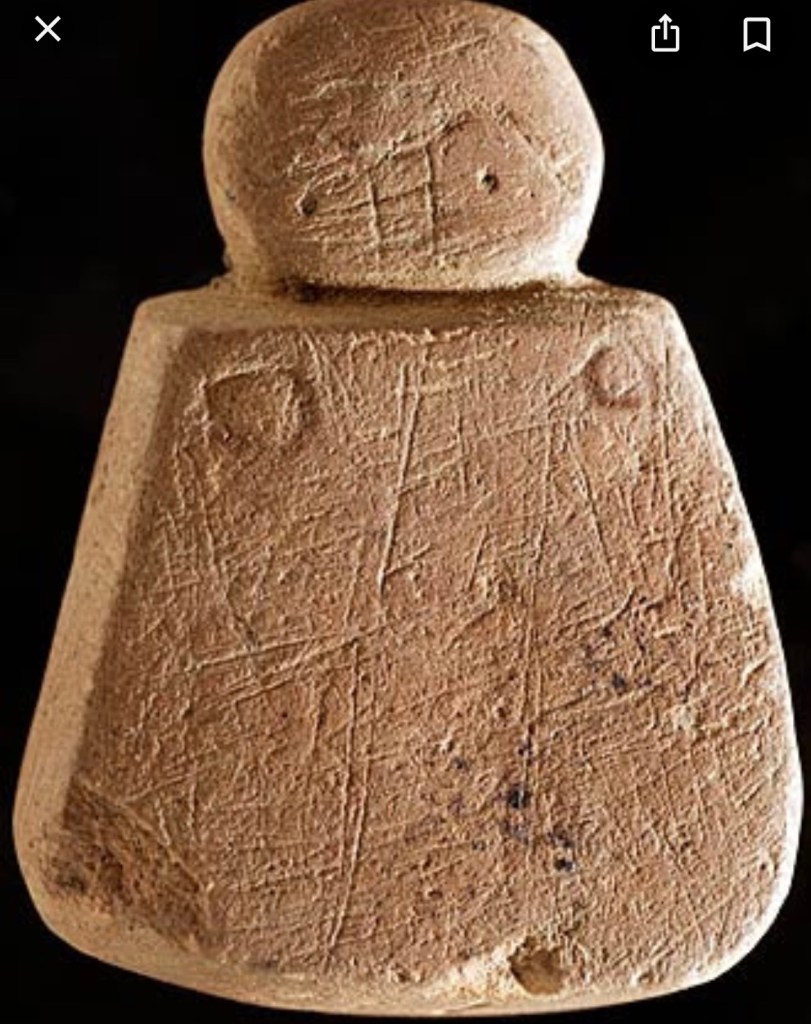
We next visited the Heritage Center, home of the Westray Wife, a small Neolithic figurine carved from sandstone, the first Neolithic carving of a human form to have been found in Scotland. It is also the earliest depiction of a face found in the UK.
Westray Wife
The center also featured rare china made for Edward VIII’s coronation. As we know, he abdicated after his ascension but before his coronation, in favor of his love Wallis Simpson. The American divorcee may have done the world a favor by removing a Nazi sympathizer from the board in favor of George VI, the beloved “Bertie,” who, along with the Queen Mum, refused to leave London during the Blitz and was photographed wandering amongst the rubble.
As we were leaving the Center, we spotted a small plane flying overhead – the shortest scheduled flight in the world from Westray to a (very) nearby island called Papa Westray. It’s scheduled for 1.5 minutes with actual flying time closer to a minute. The record for the fastest flight is 53 seconds.
Nearing the end of the day, we dropped off Angela and Peter, bidding them a very fond farewell. Angela was worried about her husband, as he had apparently been struggling more than usual during their trip, and they were headed to Shetland for another week. I hope they find that the familiarity of being back home in Cornwall will return him to form. They traveled extensively during their marriage, having many adventures around the world. Peter would smile happily, looking into the middle distance with fond remembrance as he shared some of their experiences. I dearly hope they are able to continue traveling for a bit longer before Peter’s illness makes it too challenging.
Our last stop on our way back to the ferry was the main puffin colony on the island. You know all those photos of puffins where they appear to be frolicking right underfoot? Sadly, my friends, these photos are largely due to high-powered zoom lenses and a lot of patience. Puffins nest in cliffs like the other birds, only they burrow rather than nesting on ledges. So you must wait for them to fly in and land, or perhaps pop out of their burrow to have a wee, which we witnessed and was adorable. The best time to see them is at dusk. But we still saw a good handful, and it was incredibly thrilling, and this is the best I could do with my iPhone.
The mighty puffin.
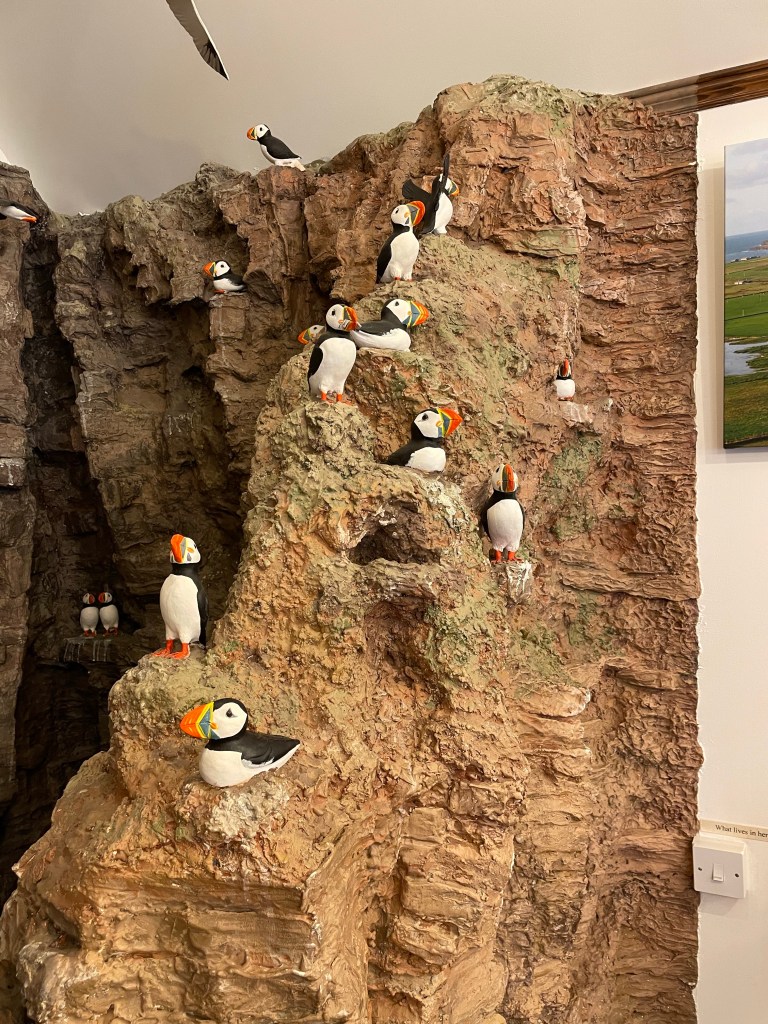
As consolation here’s a photo from an exhibit in the Heritage Center.
For illustrative purposes only.
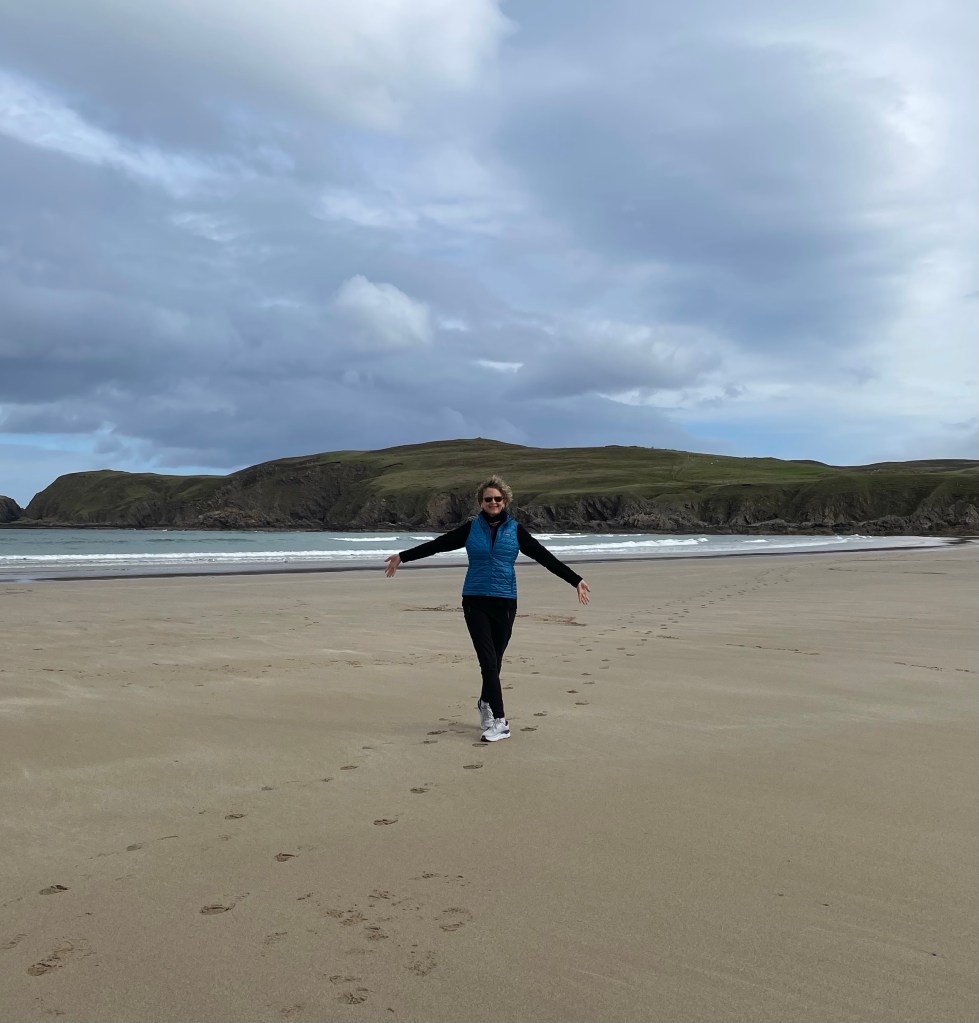
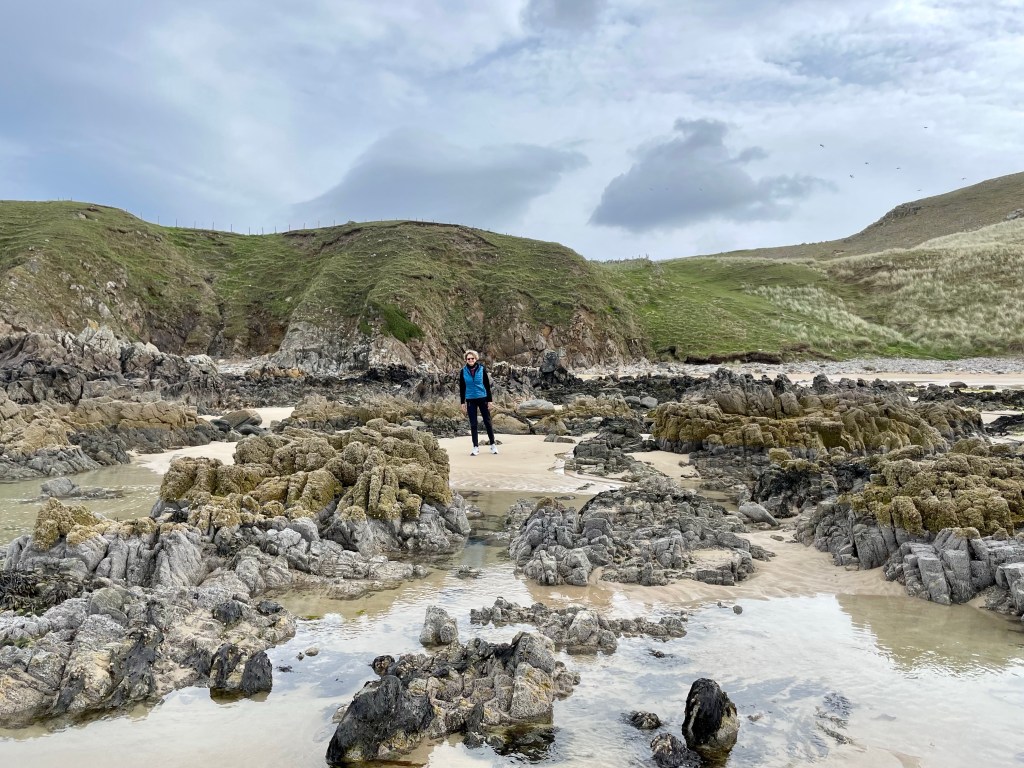
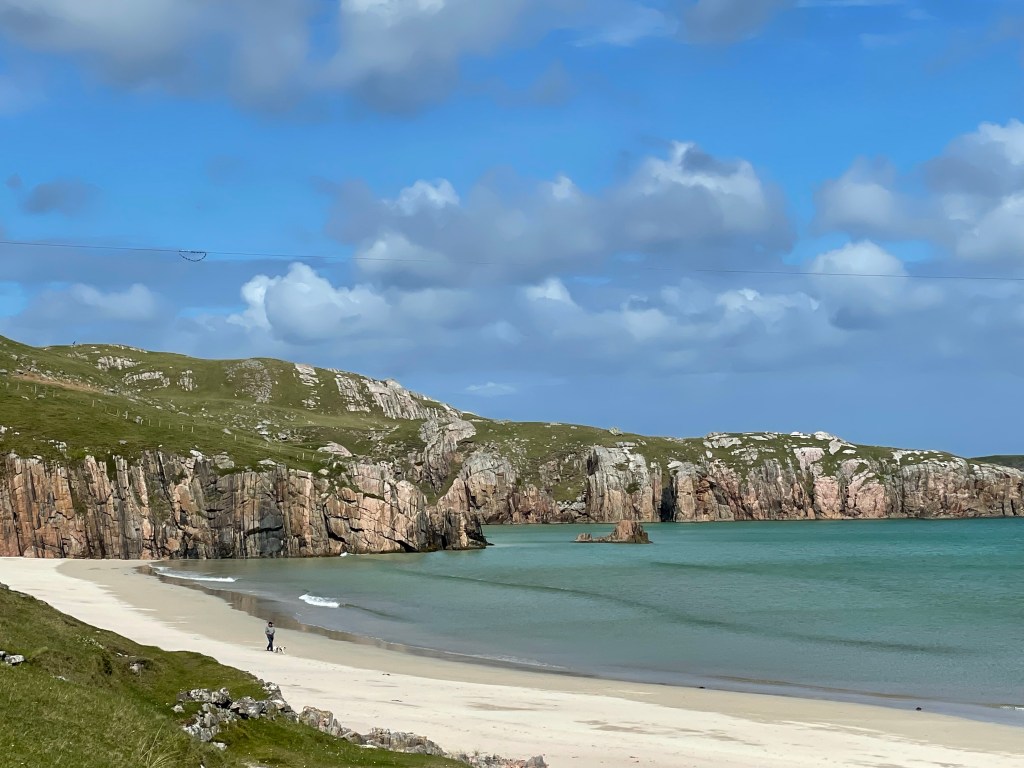
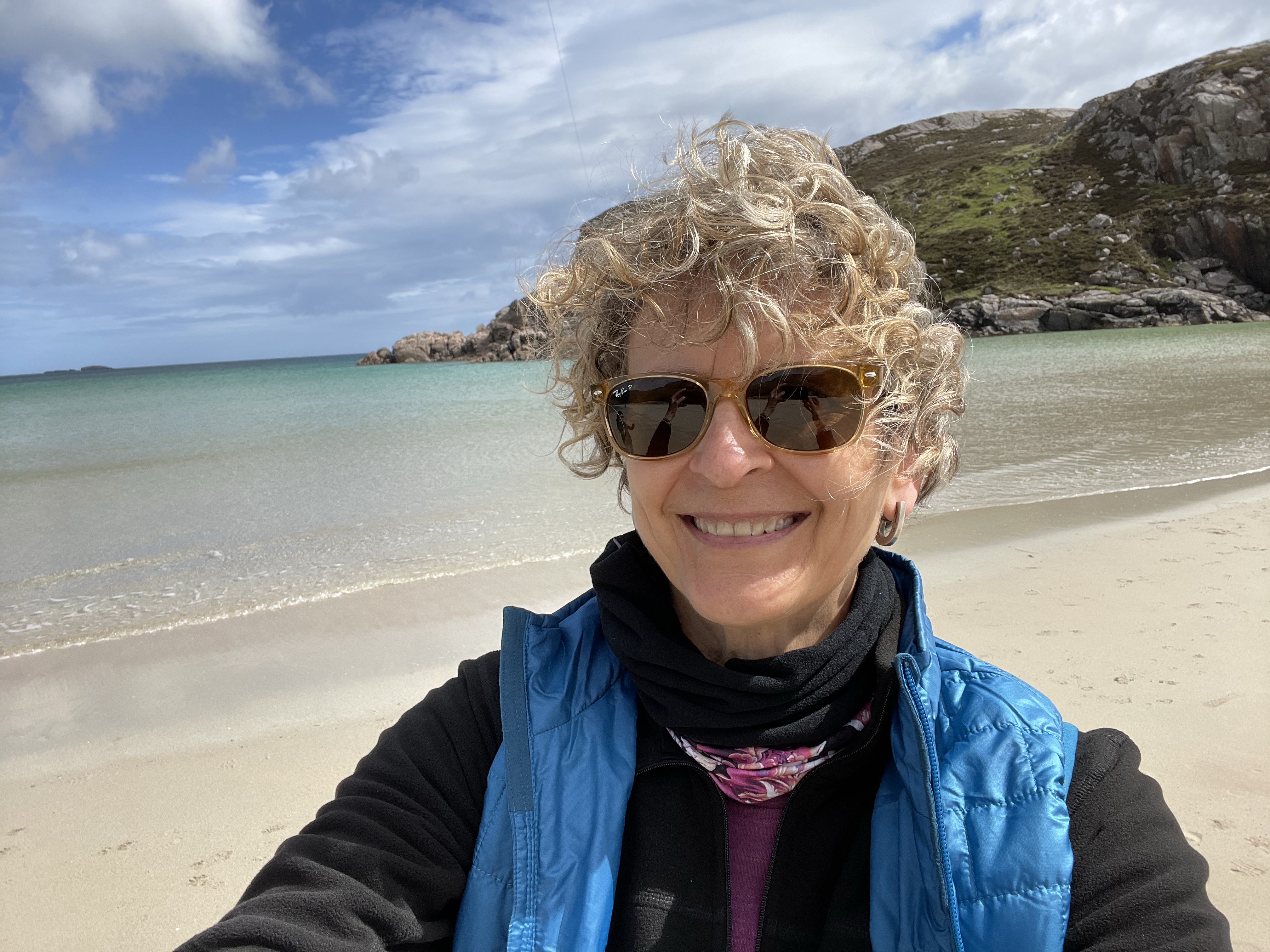
Next morning we ordered a cab for 5:15 am to catch the ferry to the mainland. Happy to see Dougal waiting patiently for us in the car park, we drove off across the North Coast. Despite the occasional flare of irritation at campers, we mostly traveled along the single track road in complete solitude through moody landscapes, farmland and villages. We stopped at some spectacular, almost deserted beaches and visited Smoo Cave.
Farr BeachScotland you really are too much.Ceannabeine Beach – Caribbean blue waters.
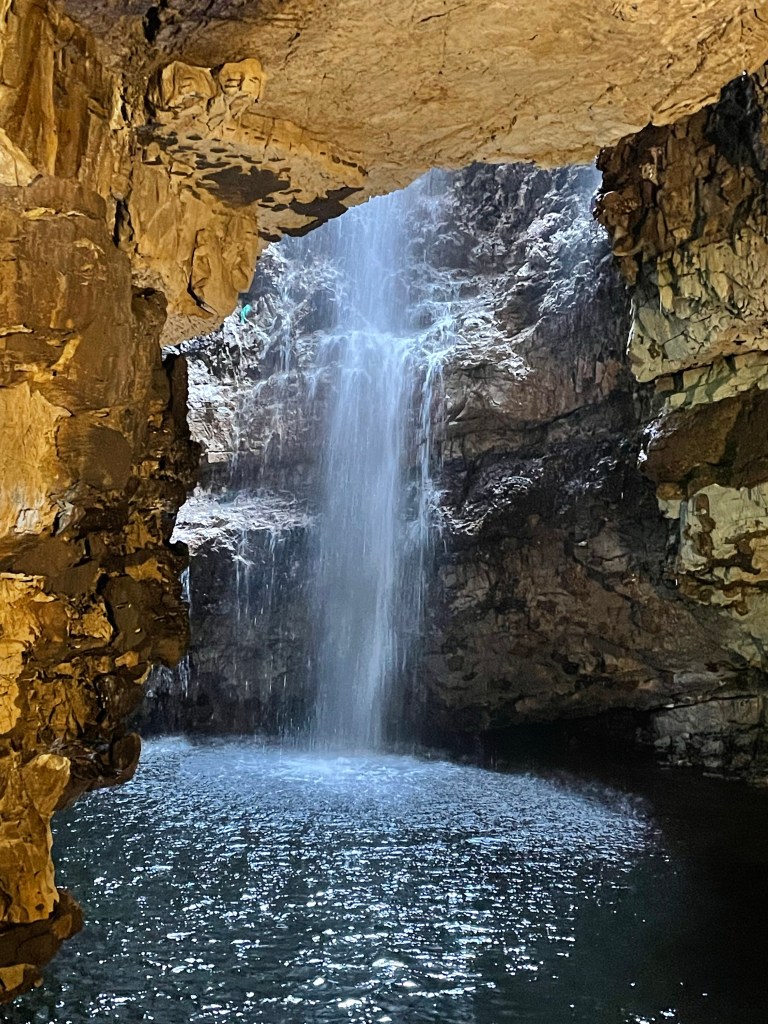
Smoo Cave was interesting although I’m not really a cave person. We opted against the hard hat tour. Lovely waterfall though.
At long last, we left the beaches of the north coast behind and dropped down into the rugged and spectacular Western Highlands I remember so fondly from my last trip.
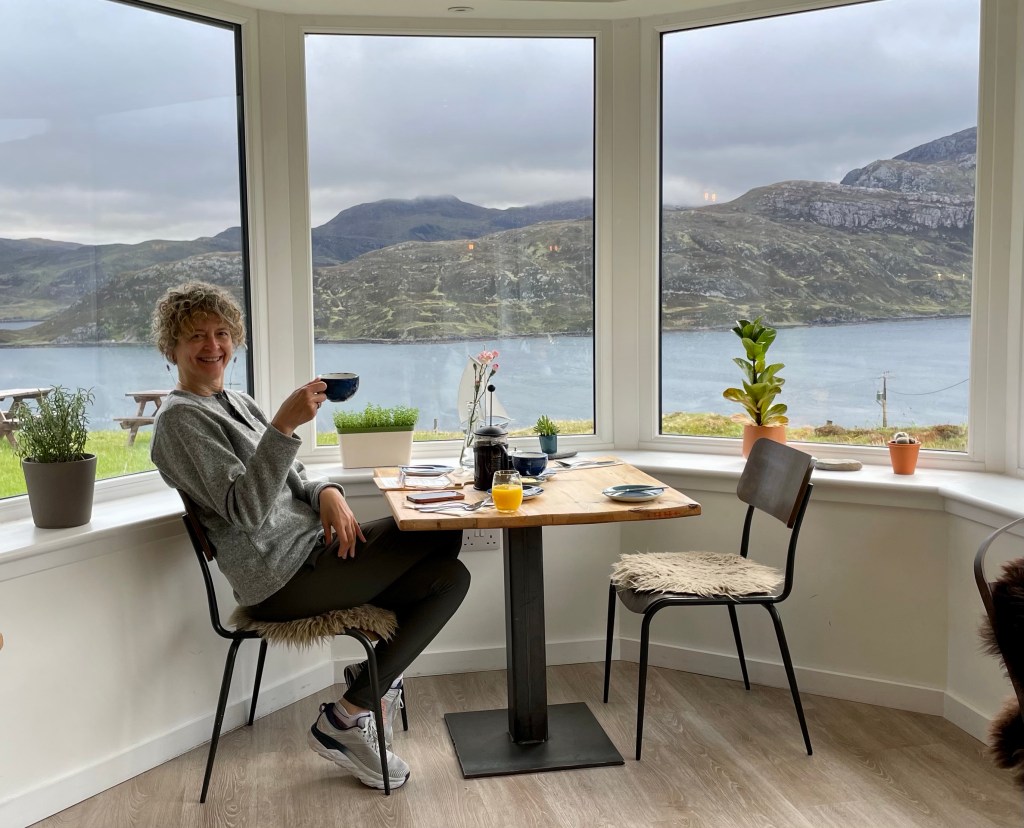
We stayed the night at Newton Lodge, which is situated in an impossibly gorgeous location on Loch Glencoul.
The view from the common room.Best breakfast spot ever.
I’ll leave you with a chance encounter we had with a cyclist we met as we arrived at Newton Lodge, John Loughran. We met him as he pulled up on his bike and tried to sort out where he had booked a room. As we were headed to nearby Kylesku Hotel for lunch, he asked for a ride. Of course we were happy to oblige, and John joined us for a lovely lunch. He is 78 years old, a retired engineer, and a Scot, although he has lived in England these past fifty years. He was riding the North Coast 500 in the opposite direction as we had done, riding valiantly through rain and wind and up and down serious hills on roads with no shoulders, or margins or verges as they are called, somewhat more descriptively than “shoulders.” John didn’t complain about any of it, just nodded and smiled, saying, “oh, it’s quite alright actually.” He told of a time when a local cyclist pedaled by who could see he was running out of steam on a climb. The guy rode alongside offering words of encouragement, and John said softly with a smile, “he got me through.”
John had planned the trip for 2020 along with a fellow cyclist. Sadly his friend bailed on the rescheduled ride, as his wife, whom John sweetly described as “a bit neurotic,” didn’t want to lose her husband for two weeks. John said proudly that his own wife, who was “very busy” and active in their community, was fine without him. He was “a bit disappointed” without his friend and his friend was “gutted” not be alongside him. I am slightly peeved by the clingy wife but like John’s wife very much. John added that he and his busy wife have five very successful children and seven grandkids spread around Scotland, England, Spain, Japan and Australia.
He showed us how he created a page for every day of his journey, carefully planning stops to recharge his electrical-assist bike. He shared many tales of his life, and how on this ride he was visiting spots in his home country that had meant a lot to his family over the years. John might be the sweetest man ever.
I’ll share one of his stories about a business trip he took to Rio in the fall of 2001. He was about to give a presentation to thirty of his colleagues when he heard someone say something bad had happened in the States. They all gathered around a television in time to watch the second plane hit the south tower. As he was telling the story, his mouth trembled and he broke down. He said he could not ever talk about that day without getting emotional, even after all this time. He said quietly, “of course, we cancelled the presentation, we simply could not go on.” When he was able to find a flight home, he remembers stepping over sleeping, marooned Americans in Schipol Airport. A reminder that the horrific 9/11 attacks took a psychic toll on humanity, even though they occurred on American soil. And the residual impact of that terrible day reverberates still, especially in empathetic souls.
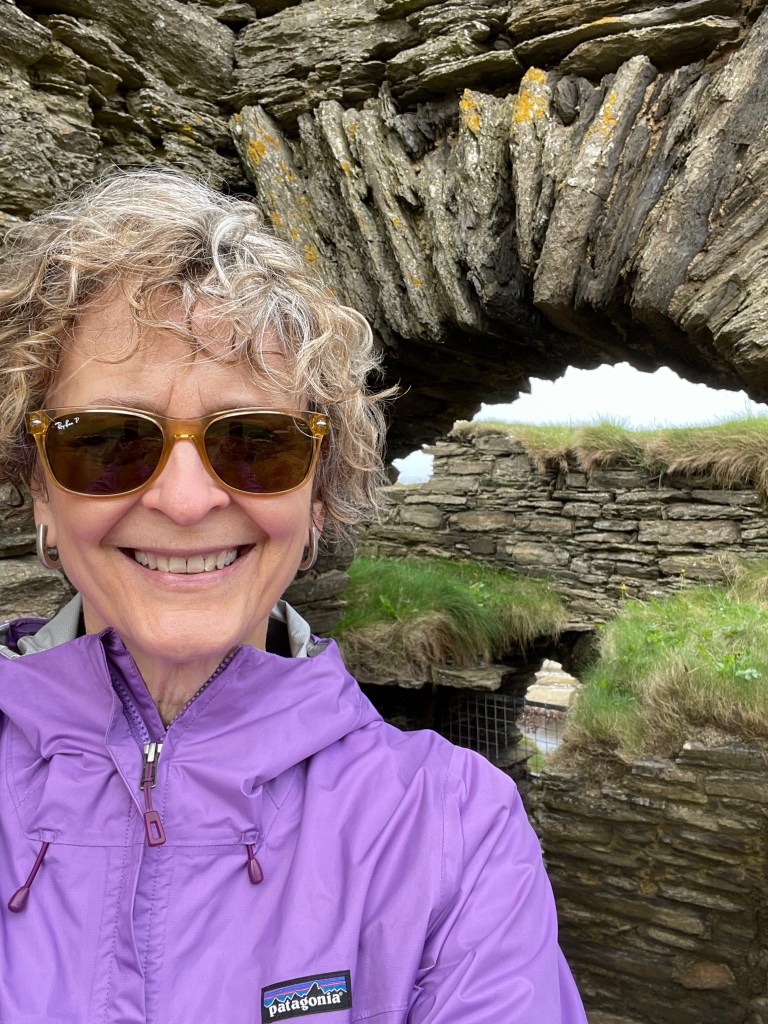
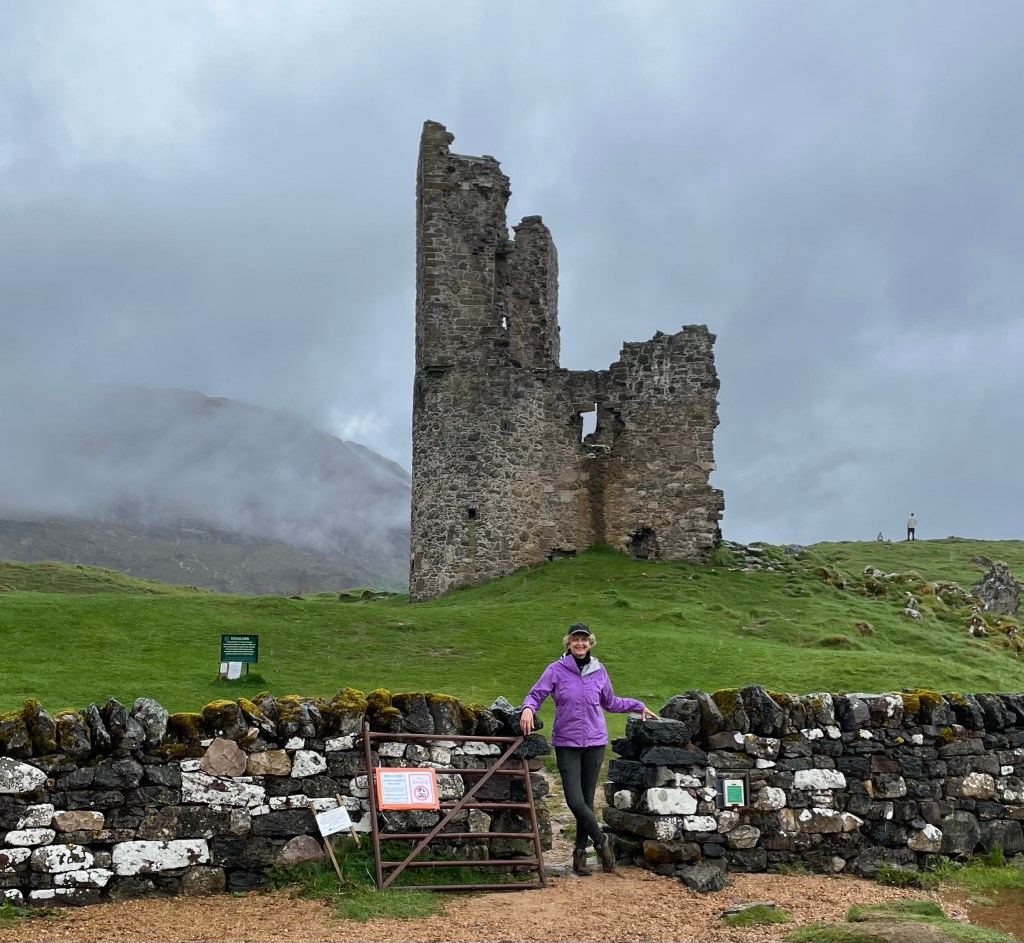
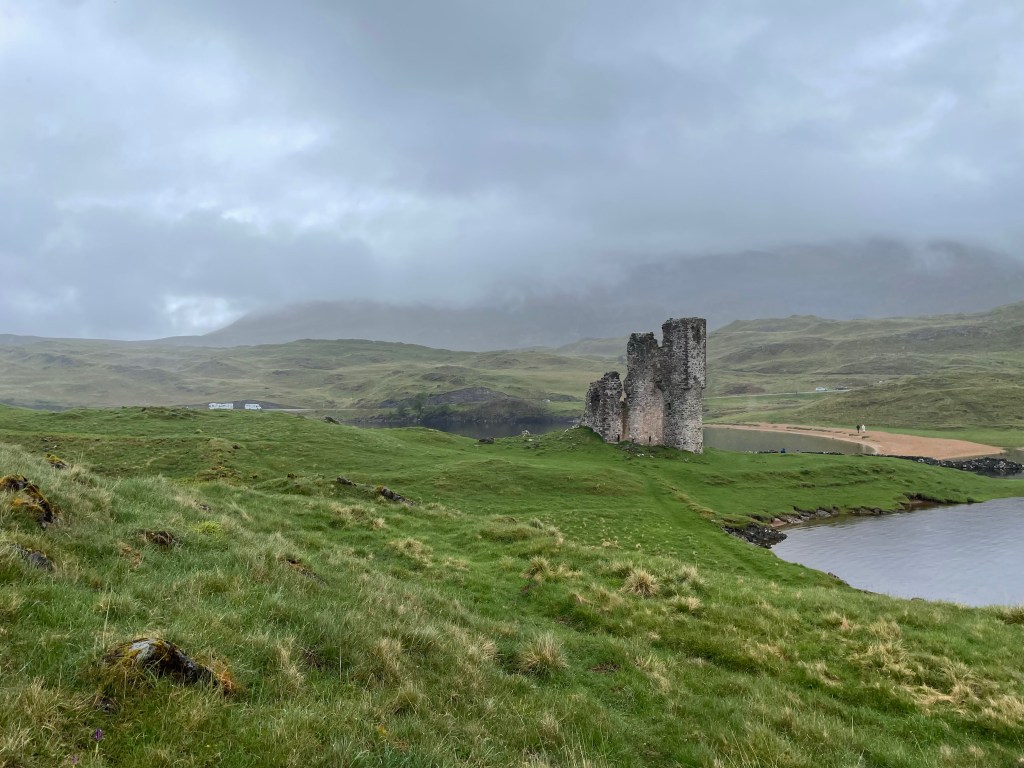
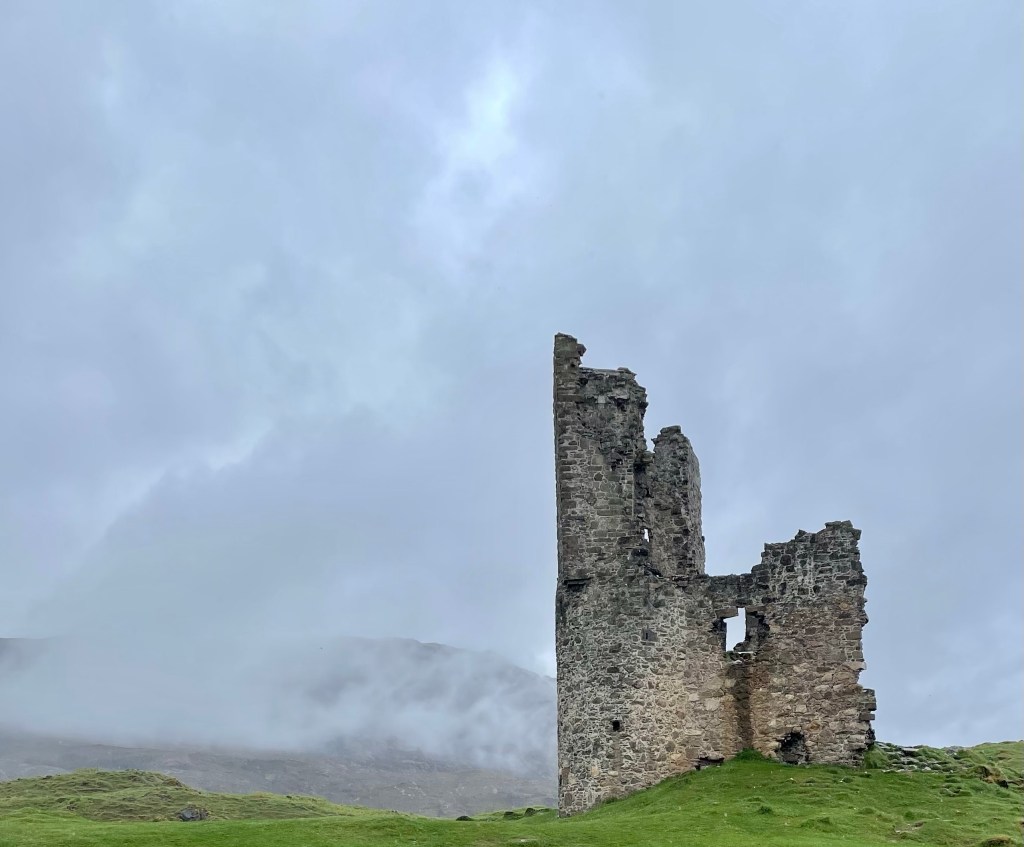
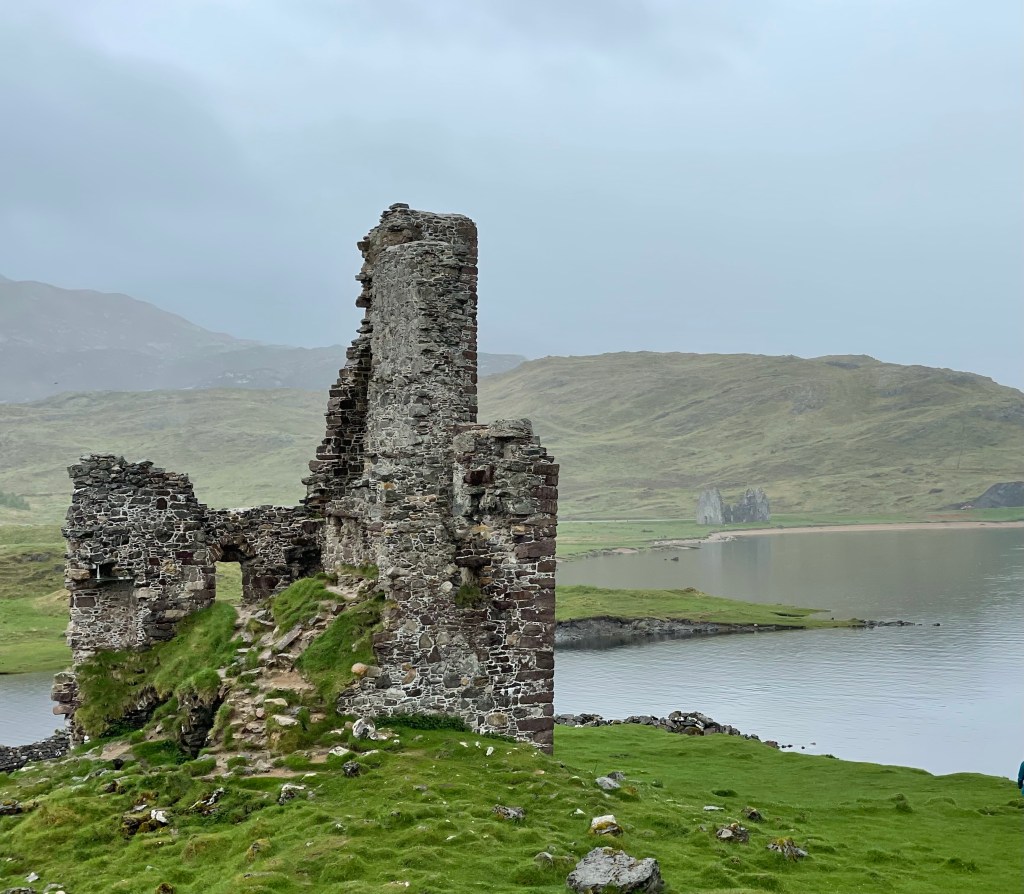
After our night in Newton Lodge, we drove through the Western Highlands, stopping at Ardvreck Castle on Loch Assynt where QUITE a few photos happened. Perhaps an embarrassing number. In all fairness, constantly changing weather causes a continuing shift of light making everything look entirely different. Especially when the subject is dramatically stark and romantic castle ruins.
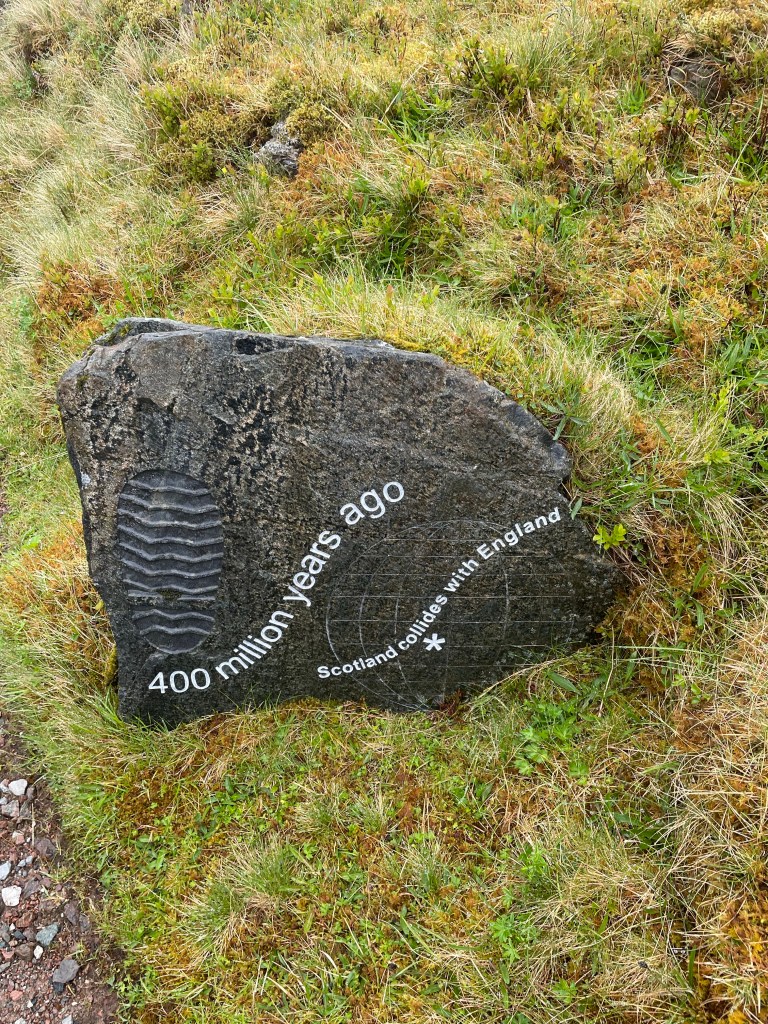
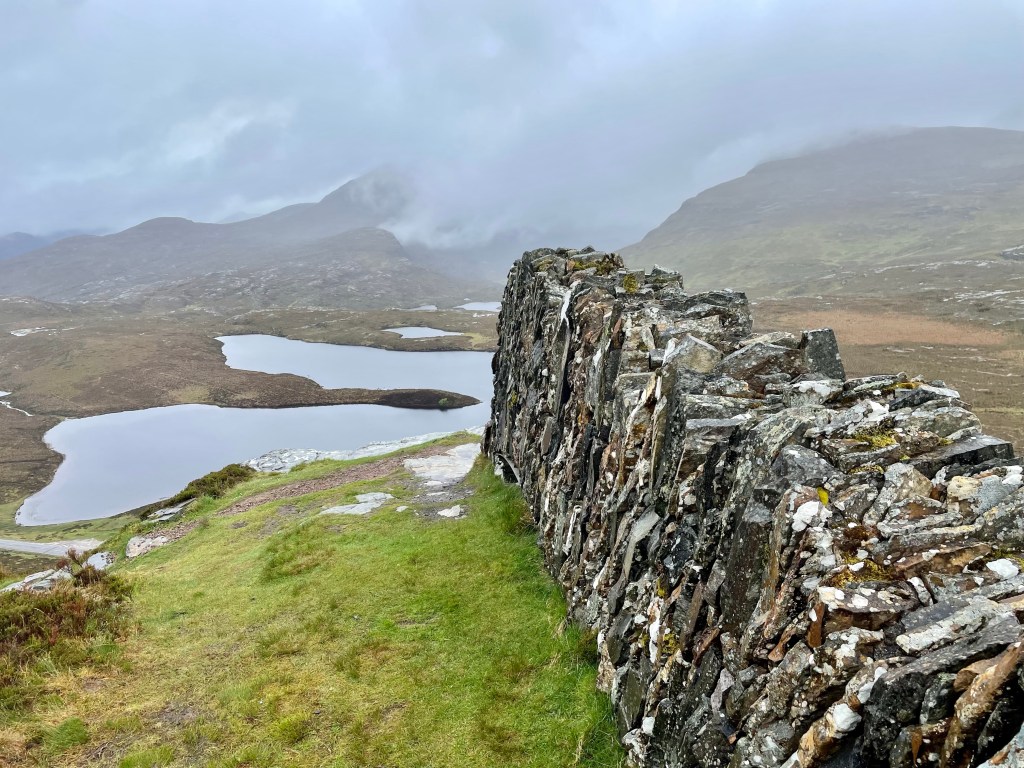
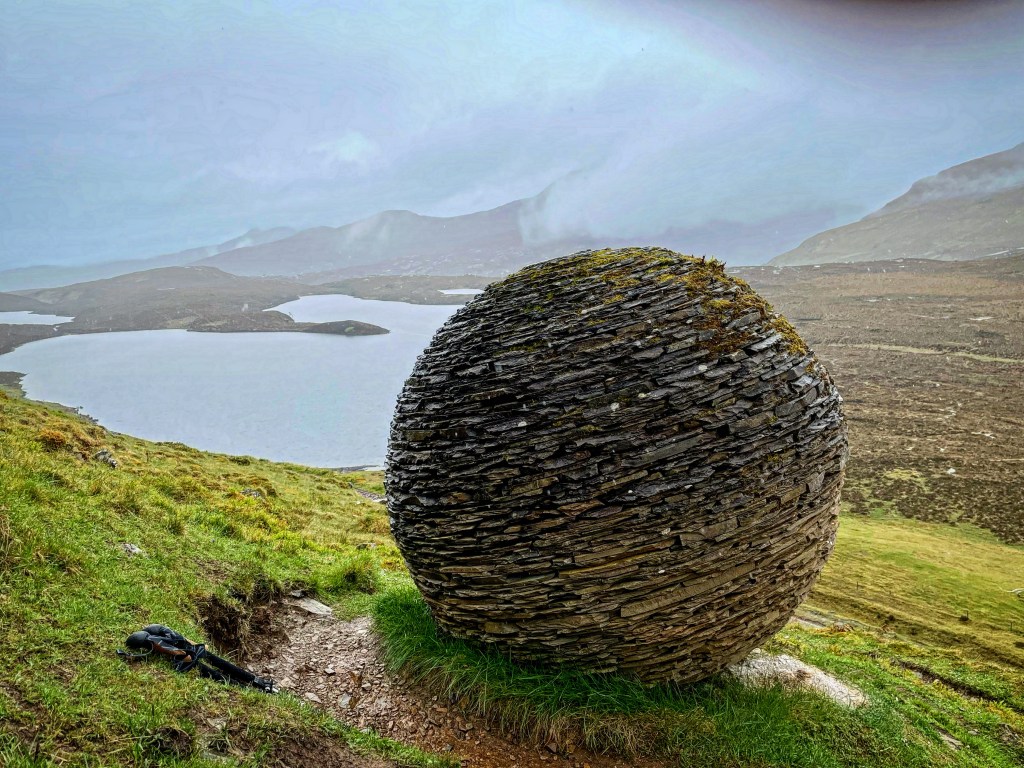
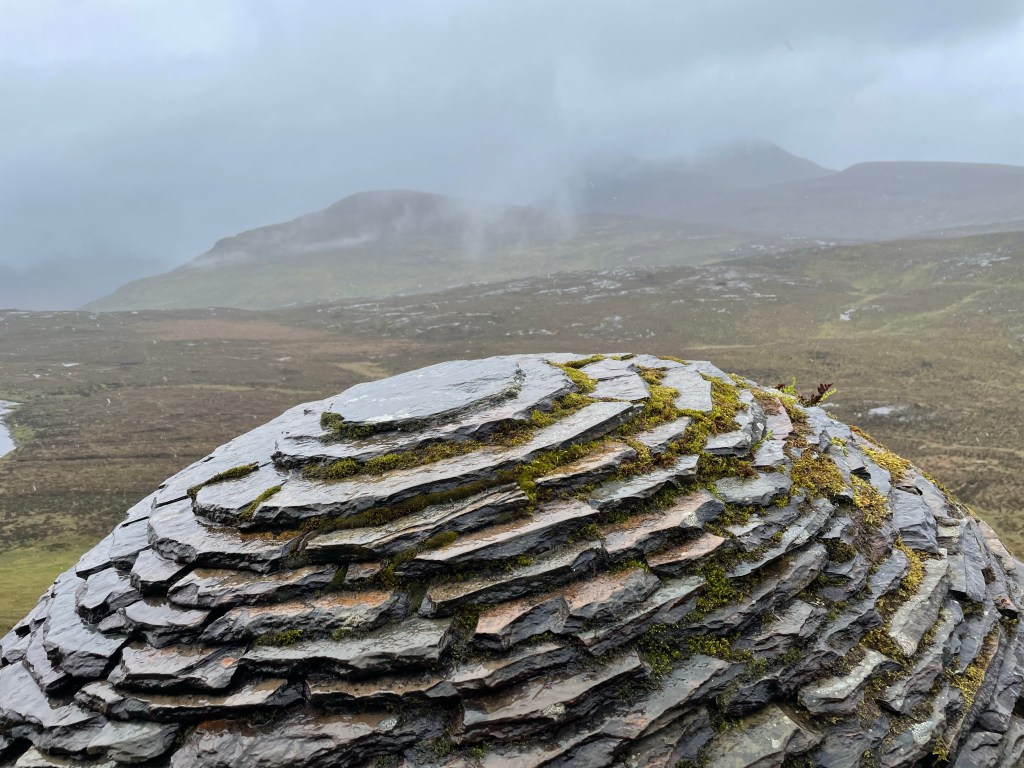
Next stop was the Knockan Crag Nature Reserve which featured a spectacular loop walk enhanced by sculptures, informative geological information and, oh yes, views. It’s largely a geological site, due to the discovery of a low cliff created when two continents crashed together millions of years ago, exposing layers of sediment and rock that told a very long story. I had particularly wanted to photograph the famous sphere sculpture along the trail but I blew right past it because I was engrossed by trailside markers detailing Scotland’s journey through time, starting 600 million years ago when it was parked in the climes of the South Pole. Just so you know, 500 million years ago Scotland was part of North America, it collided with England 400 million years ago, passed through the equator 300 million years ago, was populated with dinosaurs 200 million years ago and was submerged under the sea 100 million years ago. You’re welcome.
…..thus setting the stage for centuries of war and rebellion
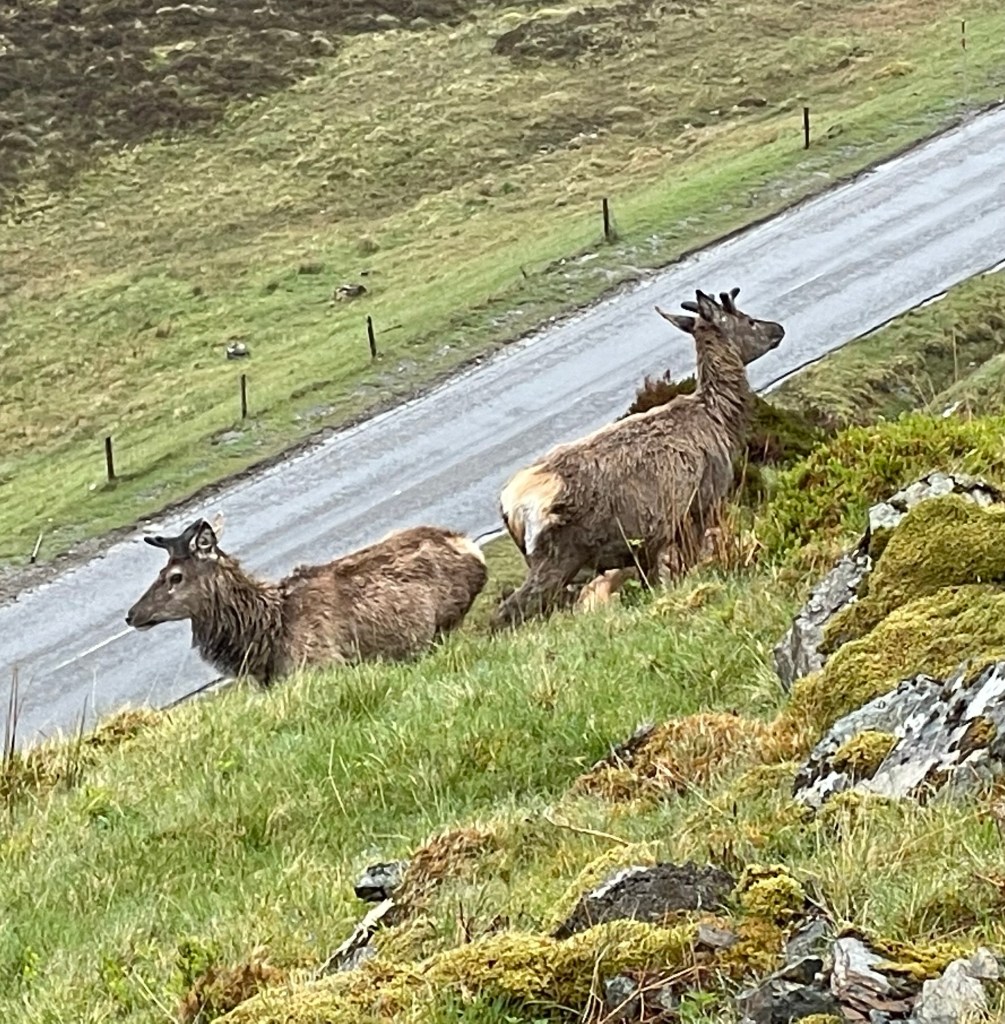
And then highland deer appeared along the trail, also very distracting.
The views from the top were – as you are tired of hearing – stupendous.
10/10 would recommend.
Being obsessive, I hiked partway around the loop again, intent on finding that dang sculpture. I think it was worth it.
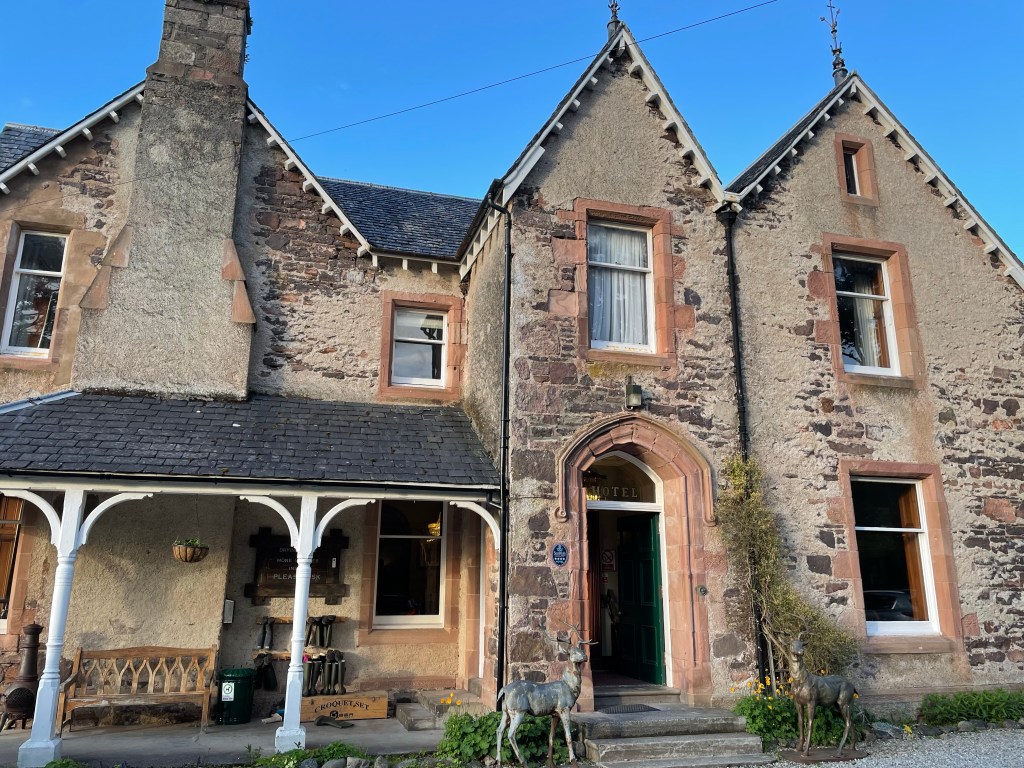
Our next lodging was a refurbished Victorian hunting lodge on a 26,000 acre estate called the Shieldaig Lodge. Our home for a couple of nights.
Complete with a Wellies Station on the front porch.
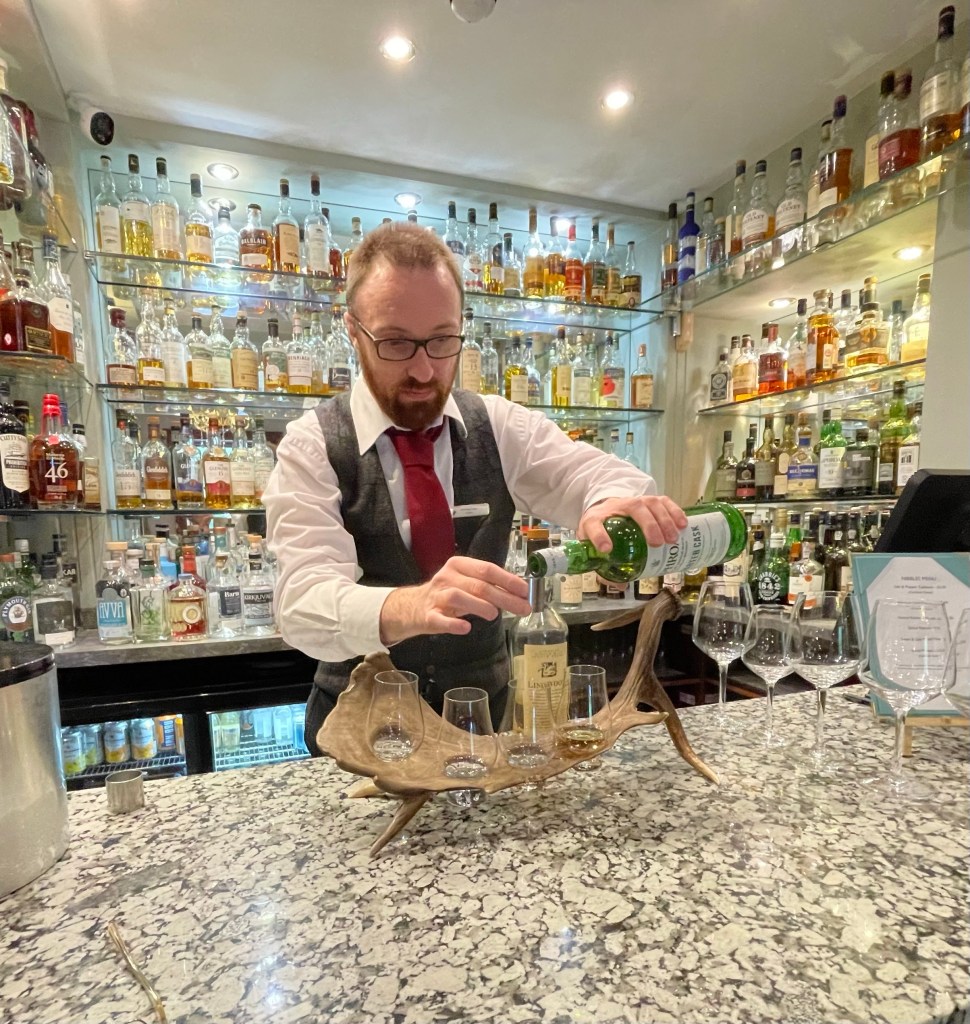
First things first, a whisky tasting curated by Alistair, who was bestowed with the exact right name.
The hotel had the most comfy beds so far and the staff tended to greet you with, “Hello there, you alright?” This made me wonder whether I looked wild-eyed or possibly about to fall over, but then realized no, it’s just what they say and it was actually very comforting.
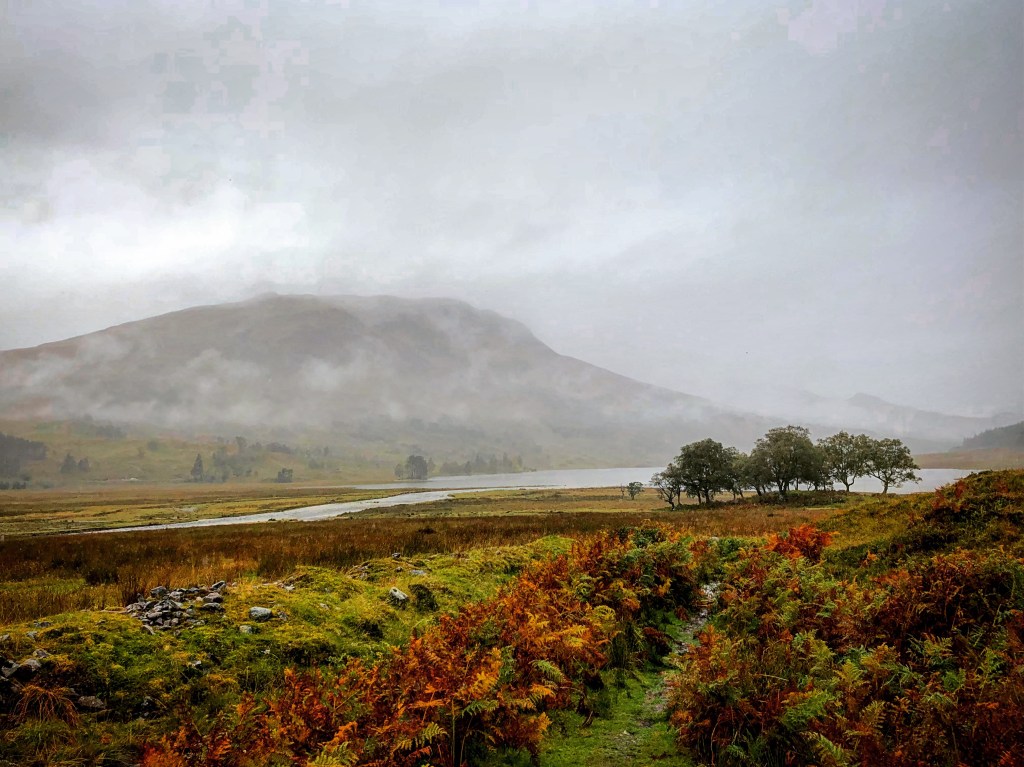
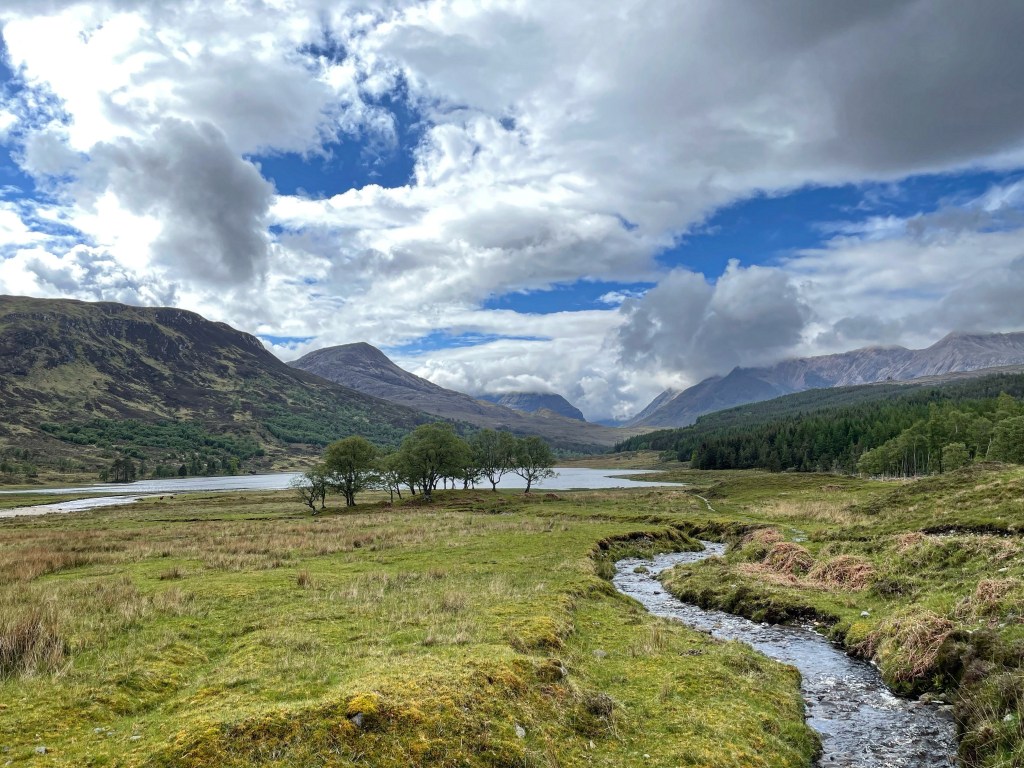
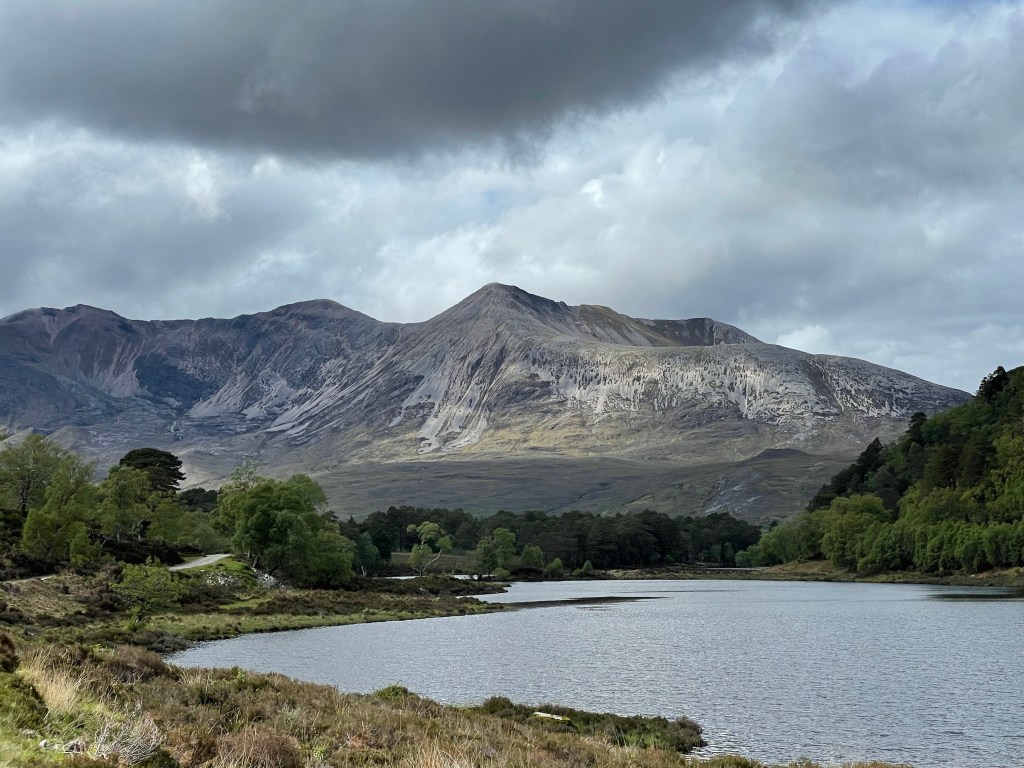
The next day was a bit gloomy so we walked around Loch Coulin and Loch Clair near the mighty Benn Eighe. Backroads welcomed our group to the Highlands with this walk back in 2018. On that day the mountains were shrouded in clouds, so it was fabulous to see them this time. An entirely different situation!
September 2018May 2022
A few more 2022 photos……
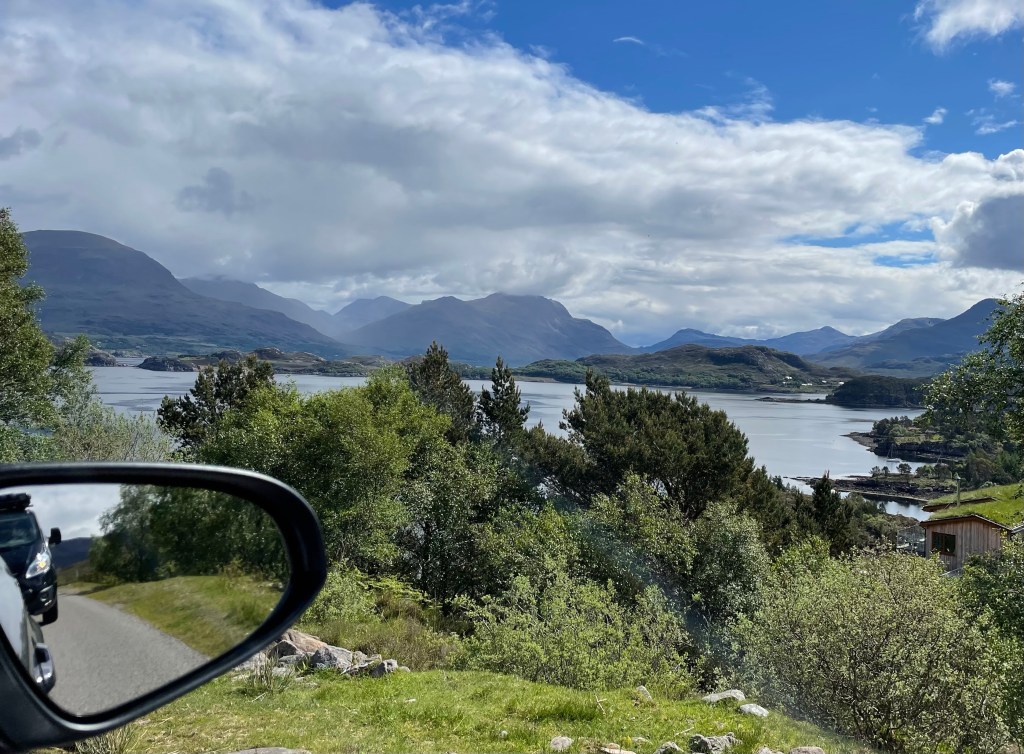
And now, my friends, comes the exciting part of the day. We drove the loop around the Applecross Peninsula. The drive west along the peninsula’s north coast featured narrow single track roads with no margins, steep cliffs, hairpin curves and freaking unbelievable views back toward the mountainous wilds of Torridon and out to sea. After stopping for lunch, we intended to complete our circumnavigation by driving the infamous Bealach Na Ba (Pass of the Cattle, aka only suitable for cows) which headed east along the peninsula’s south coast and featured even more adjectives-fail-me views – if you felt like lifting your eyes from the road and thus gloriously perishing.
After a successful navigation of the north road, we stopped in the beautiful little town of Applecross and had a delicious lunch at the Applecross Walled Garden which you all must do.
With apologies to the driver in the mirror – views toward Torridon.Another view back toward Torridon, but this time I pulled over.
Before we leave Applecross and head down the Bealach Na Ba, yet another wee word about campers. Ready? As you might have noticed, I really do dislike them intensely. Too large for most Scottish roads, driven 100% of the time by couples in their twilight years, shall we say, and the drivers (men) have no idea where any part of the camper is relative to the road and cannot back them up. My only solace was imagining the wives scolding their husbands with the old chestnut, “I told you this was a bad idea,” and wondering whatever possessed them to marry this lame dude in the first place. I also laughed at them, not with them, when they got stuck. You would too.
They are even more irritating because at the bottom of Bealach Na Ba there is a large sign plastered with warnings about large vehicles and “learner drivers” which I believe would apply to every single tourist renting a camper. Travel books warn against taking this road unless you possess the ability to back your vehicle down curvy roads with steep drop-offs for 300 yards (to get to a “passing place”). This would dissuade me if I ever rented a camper which I would never, but I’m just saying. It does, however, not discourage literally anyone else.
A few stats for you – the Bealach Na Ba boasts the greatest ascent of any road in the UK, rising from sea level to 2,054 feet in about six miles with an average gradient of 7%, reaching 20% at its steepest. It was built in 1822 with rough gravel and paved (and I use that word loosely) in 1950. And yes there were cyclists making the climb.
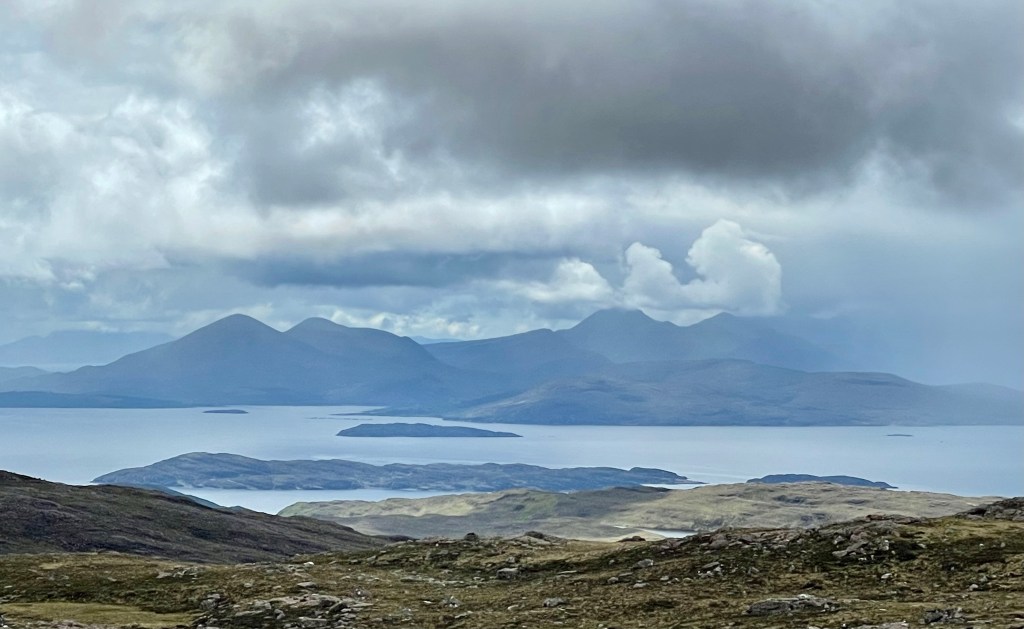
Here is the view at the top, looking out toward the mountains of Skye.
Over the sea to Skye.
And now for a couple of videos featuring live narrative commentary should you care to have a wee listen.
Yes we were listening to the Outlander soundtrack.
Even with the campers, it was the most fun I’ve ever had while driving and I’d do it again in a second, maybe early morning or later in the day after the campers had found their parking spots for the night and the roads of Scotland are empty.
After we successfully survived that harrowing but fabulous drive, we stopped in Plockton, known as the “Jewel of the Highlands,” although I might tend to disagree but big ups to the Plockton tourism people and Instagram for the valiant effort.
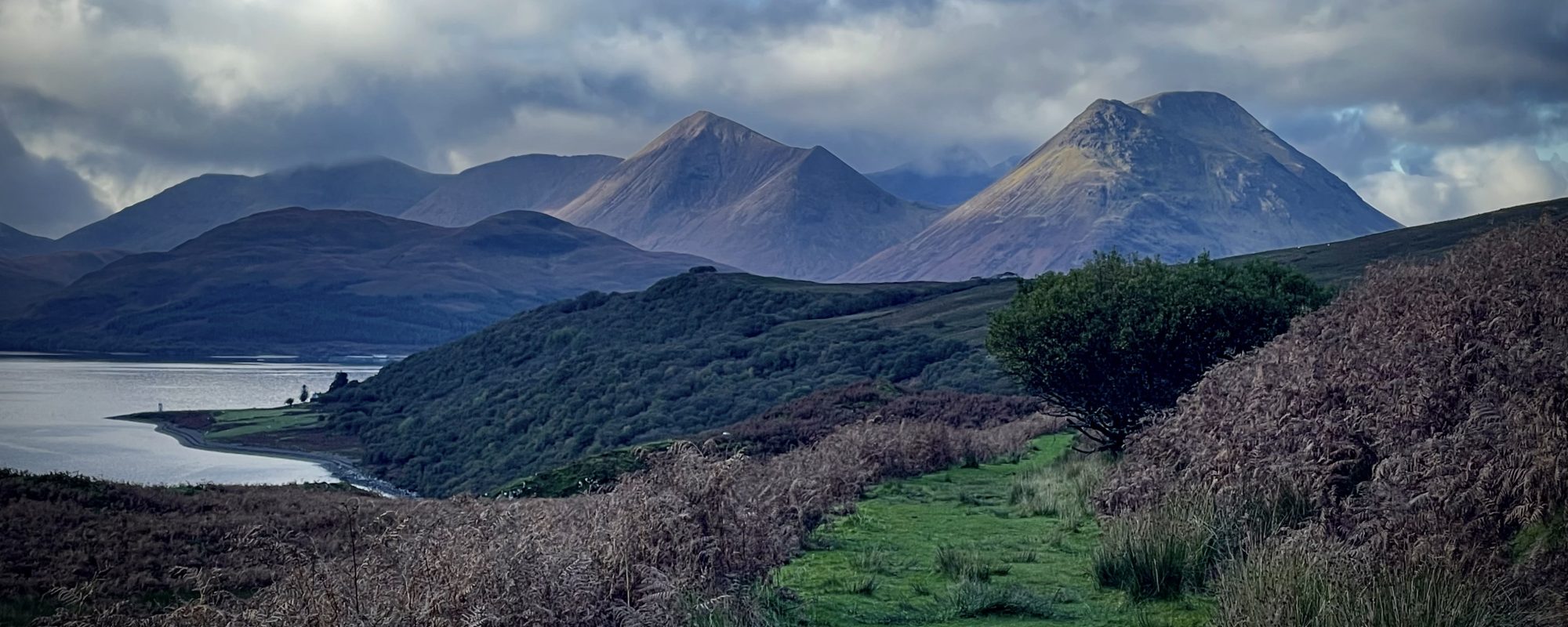
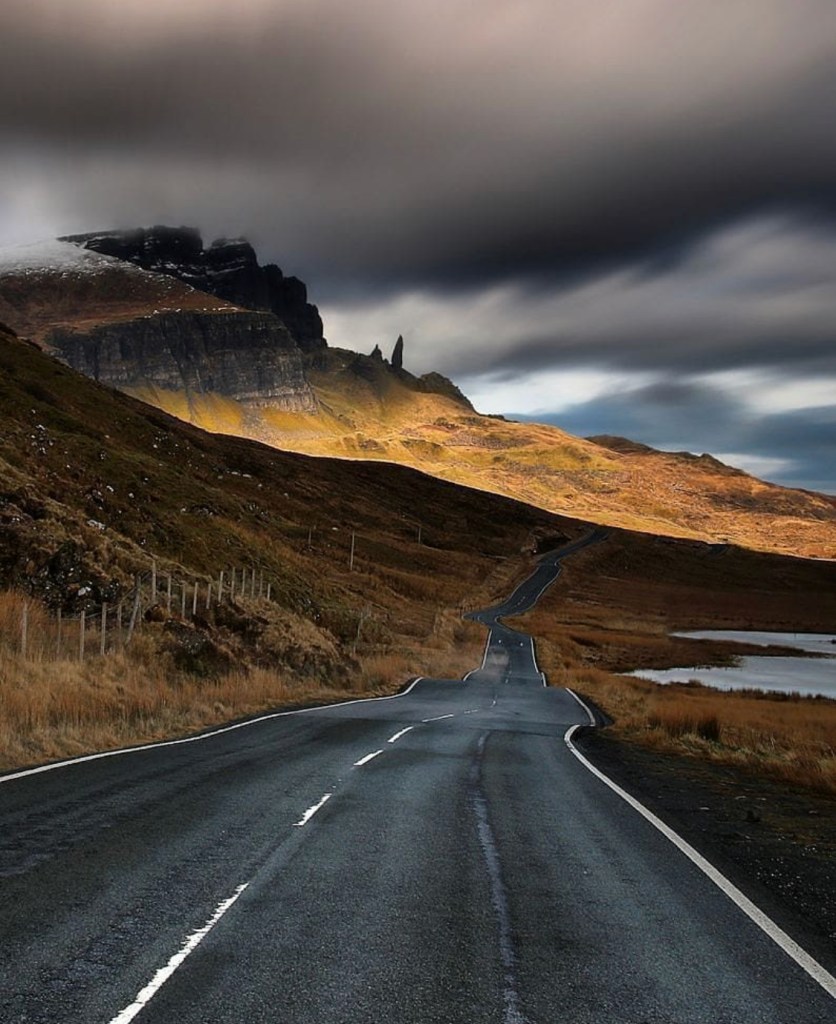
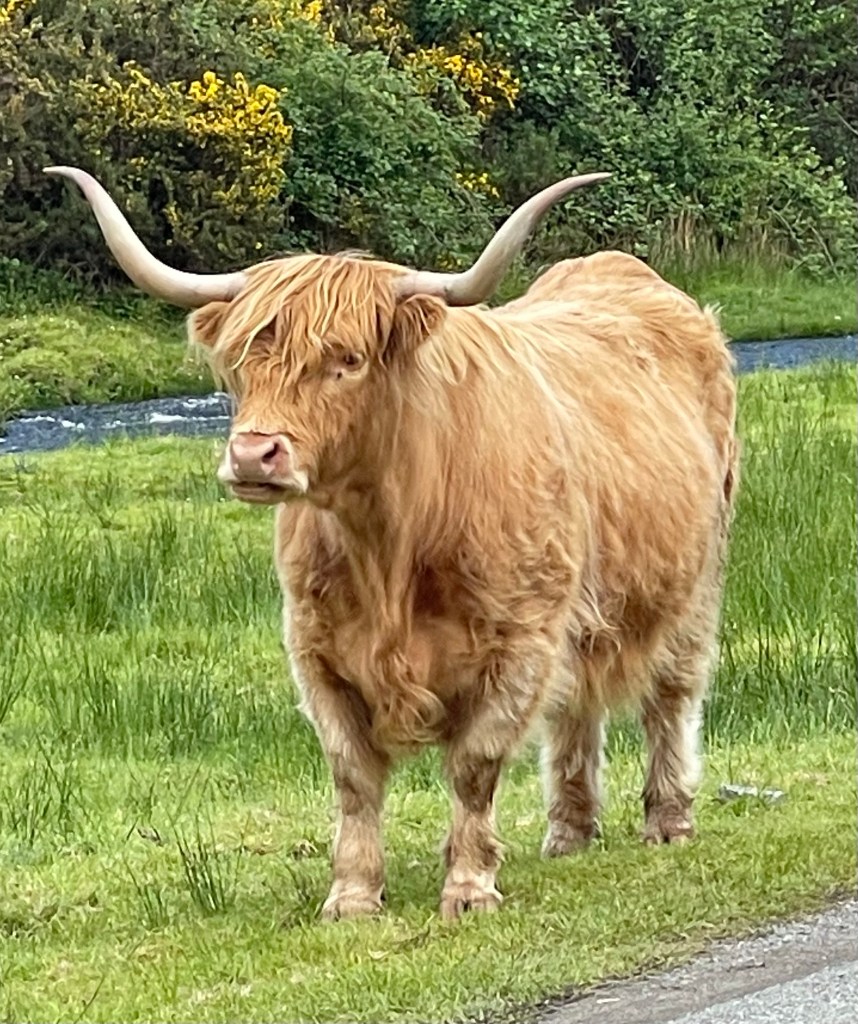
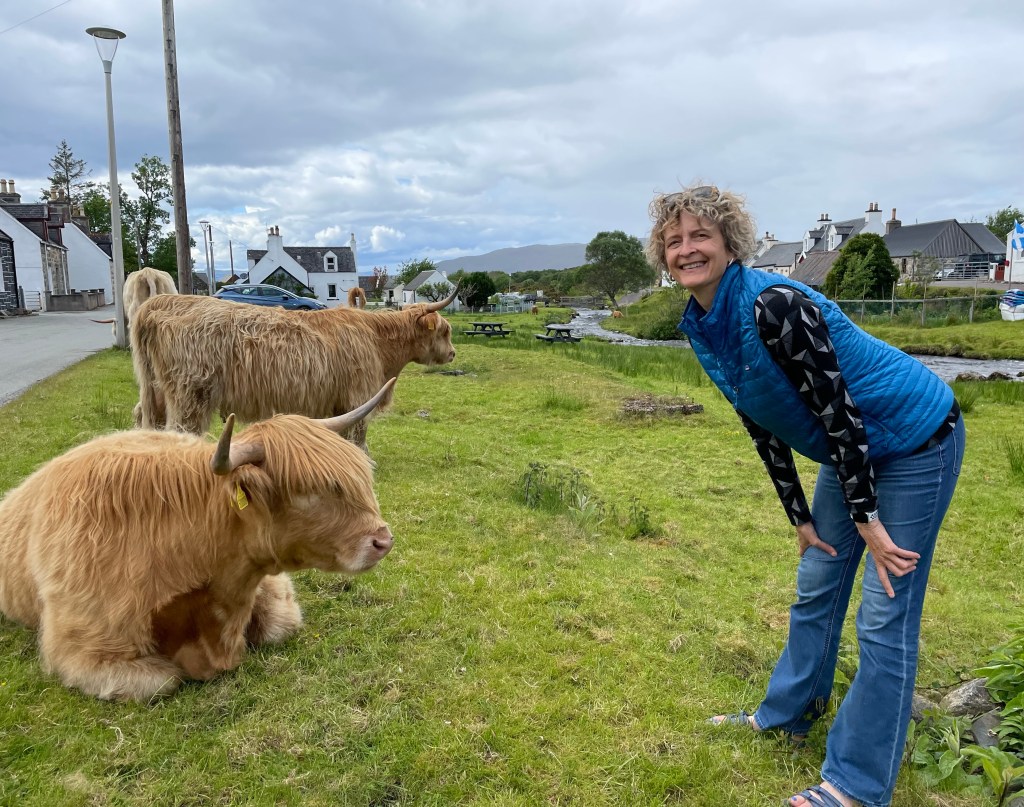
Shortly before we reached the Skye bridge, the Highlands bid us a fond farewell by offering up a big herd of fuzzy heilan coos.

















 Wee Dram of Scotland