“It was impossible for a woman to go about alone,” Virginia Woolf wrote of Jane Austen in “A Room of One’s Own.” “She never travelled … or had luncheon in a shop by herself.”
You guys. After a mere three+ years I’m headed back to the bonnie bonnie banks, glens, cols, beinns, lochs, isles and waterways of Scotland. Last we met it was the fall of 2018 where you provided excellent company on my solo trip. In 2019 I decided to upgrade my house a bit, possibly sensing that I’d be spending quite a lot of time inside its walls in future. As 2020 loomed with its gigantic birthday, I told anyone who would listen that in celebration I’d be saying YES to All The Things. Planned a birthday trip to Paris and another Scotland hiking trip (this one). Yoga retreat in Sedona. Yes yes and yes. And then. Cancel, cancel and cancel, your silly plans matter not. We all lived through the last two years together, and there’s nothing you don’t already know. Enough said.
This trip won’t be solo, but with Danielle, a friend who has accompanied me on many Central Oregon hikes in the Cascades. We are both recovering lawyers, and I think met at a yoga studio years ago. There’s a photo of us in said studio on our backs with our ankles tucked behind our heads and our hands in namasté. Needless to say it’s hilarious and also entirely inappropriate for our purposes here today so I couldn’t possibly post it. Danielle is dating an actual Viking and I still harbor hopes of meeting a Scottish lad with a castle so we remain in men-in-kilts territory. This blog, and Scotland, will continue to abide.
As the trip is growing closer, I’m focusing mostly on driving for the first time in the UK (yikes), and looking forward to hiking in the Cairngorms, the Orkney Islands, Skye, Torridon and Glencoe – and traversing the North Coast 500. I also want to see as many puffins as possible. There will be castles, neolithic ruins, stone circles and Viking stuff. In fact there will be a distillery tour of Highland Park in Kirkwall, which includes a tasting of their “Vikings” series, with special edition, largely cask-strength drams named after Odin, Thor, Freya and Loki. To top things off, I had to postpone my trip home because my intended flight was unceremoniously cancelled, so will be in Inverness solo for an extra day (on my birthday as it happens). On that day a man named Andrew Grant McKenzie (you heard me) a historian who plays the bagpipes and worked at Culloden Battlefield for years will be squiring me on a tour somewhere, honestly it doesn’t really matter where. I believe the chances of him showing up in a kilt are very very high.
So thank you for joining me yet again to explore a wee country the size of South Carolina that somehow contains a vast Universe of history, hiking trails, dazzling terrain, culture, wildlife, wonderful food and very kind and welcoming residents with comforting accents. Scotland is basically Hermione’s bag in the form of a country.
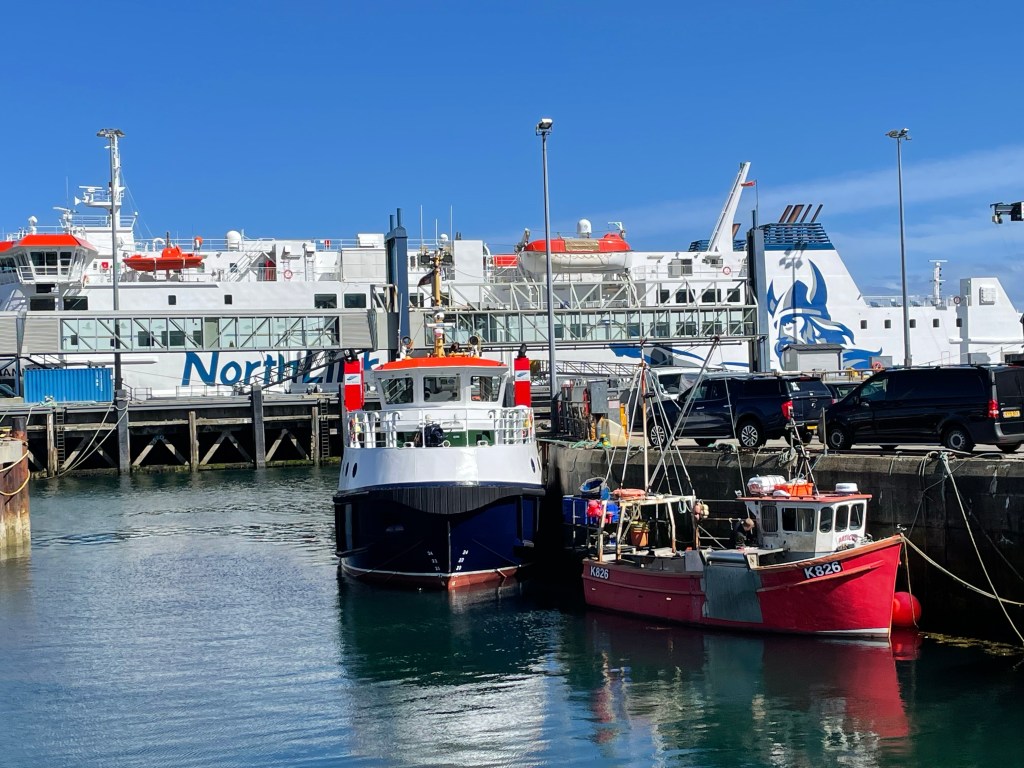
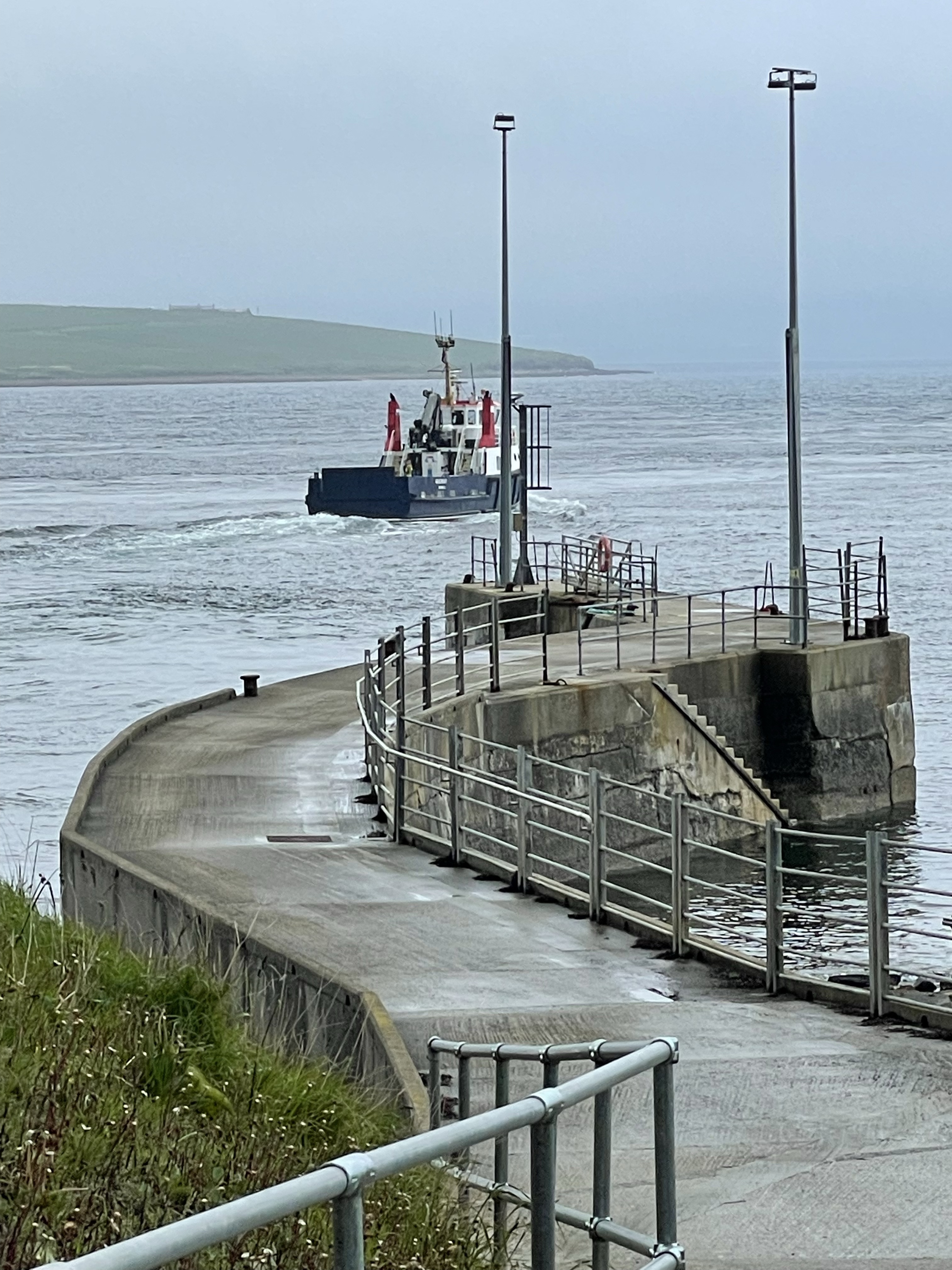
Giant serious ferry and wee inter-island ferry at Stromness pier.
As I write this a bunch of mostly blootered men are down in the hotel bar watching a football game. Panicky hyperventilating shrieks like the sound I imagine people make who are having all of their limbs slowly pulled off while being eaten alive by lions. In the States this would be irritating but I’m completely fine with it.
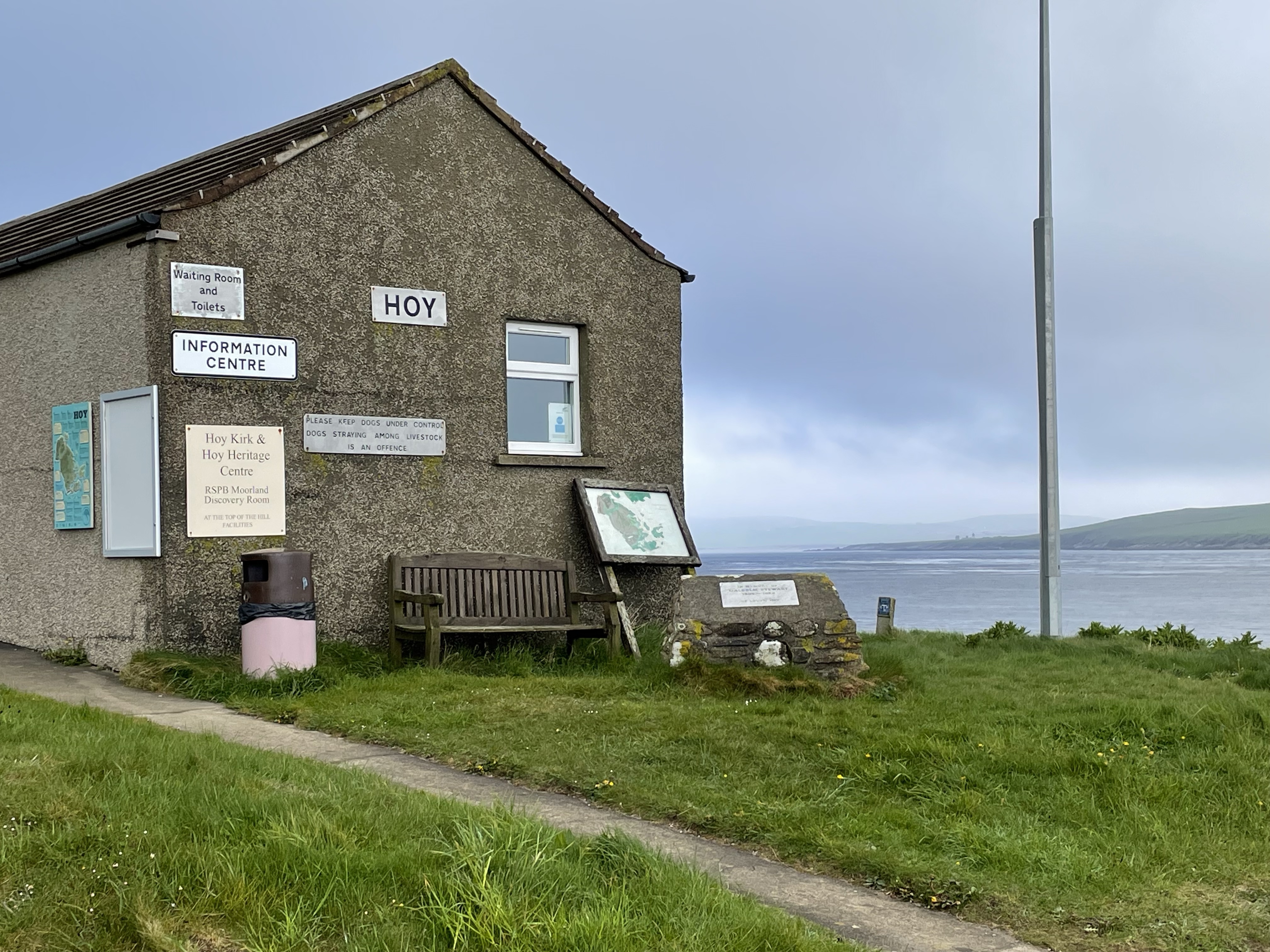
Our first hike on Orkney was to the Old Man of Hoy, one of the most spectacular seastacks in the world. He’s just off the Isle of Hoy (from the Norse “Haey” meaning high island) to which we took a tiny ferry that left at 6:30 am and dropped us off at a tiny terminal half an hour later. All the hikers on the boat, mostly older (than me) Brits plus one Aussie, took off across the island in varying directions for a day of walking.
We hiked 13 miles through rain, wind and fog with boggy conditions, slippery rocks and boot-sucking mud, all of it fabulous. We did enjoy a relatively brief period of sunny and warm weather on our way back and it was like we had been transported to an old western and were about to die of heat prostration with our bones picked clean by vultures. Don’t worry, though, chilly fogginess returned in time for our ferry ride back to Mainland, which is, by the way, what the main island is called, from the Norse “meginland.” Same deal goes for Shetland.
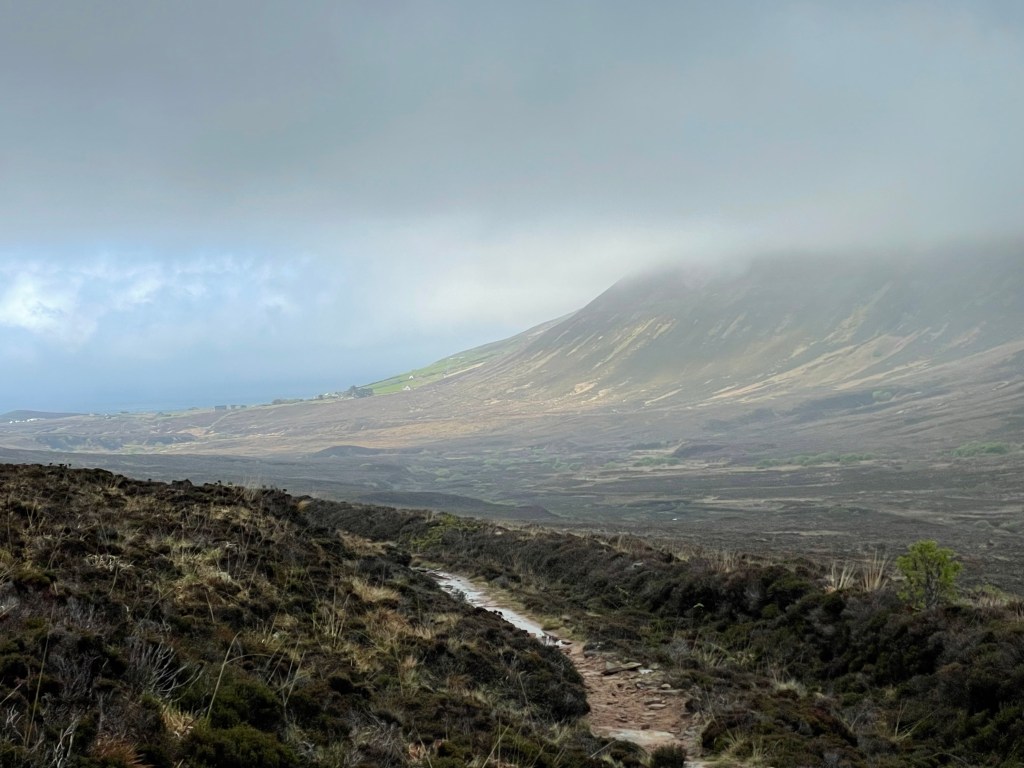
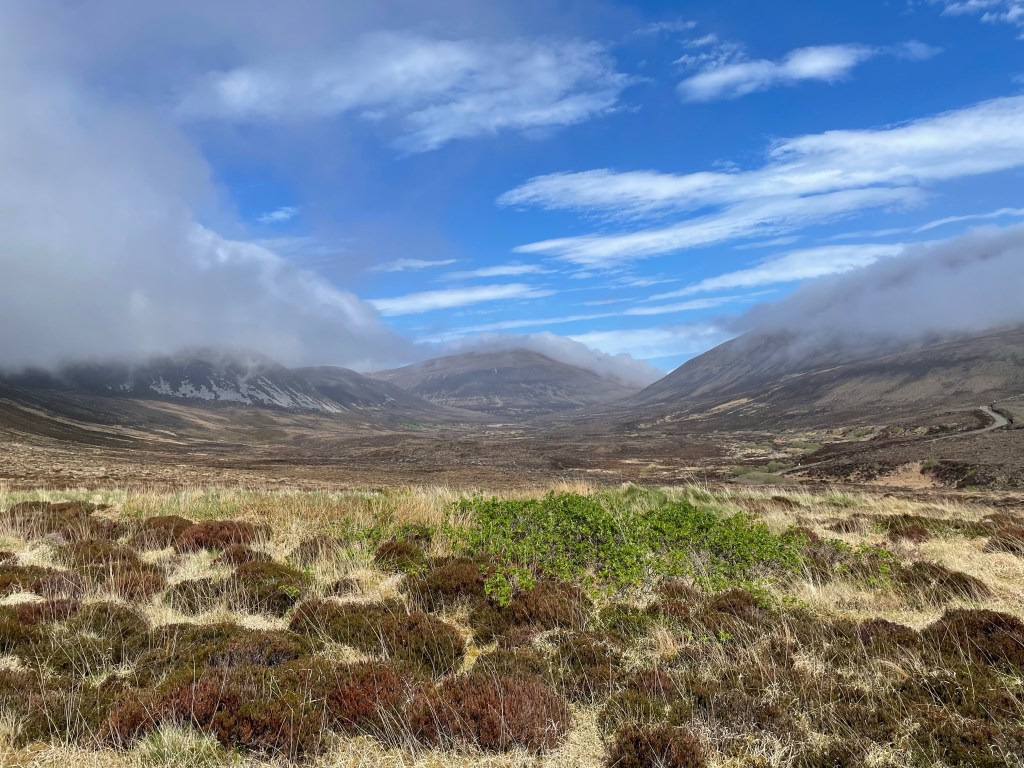
We first hiked through a valley with steep hills on both sides. The sun lightened things up a bit as we got closer to the sea.
Wanna see some weather? Volume on.
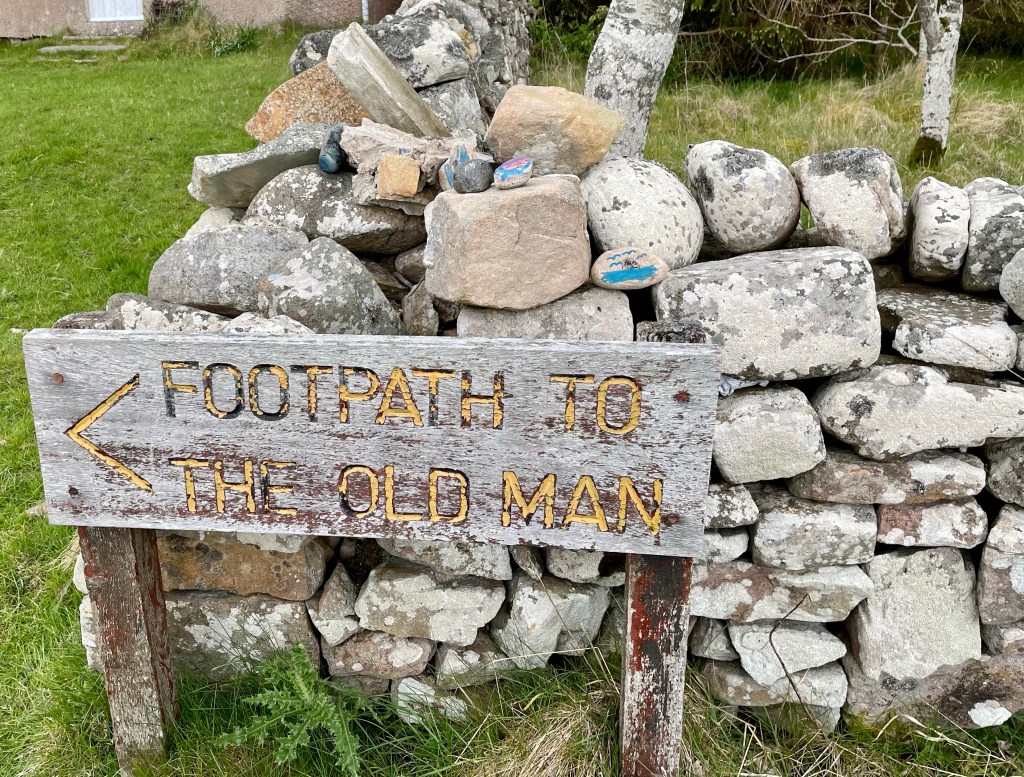
When we neared the small town of Rackwick we ducked behind someone’s house, passed through a couple of kissing gates, and started the upward climb to the fog-shrouded cliffs. As always in Scotland, colorful and weather-beaten signs marked the way, and we were even met with the iconic red phone booth, still standing but infested with flies, the phone having been removed long ago. If it was actually a back entrance to the Ministry of Magic and the flies were a protective spell, it completely worked.
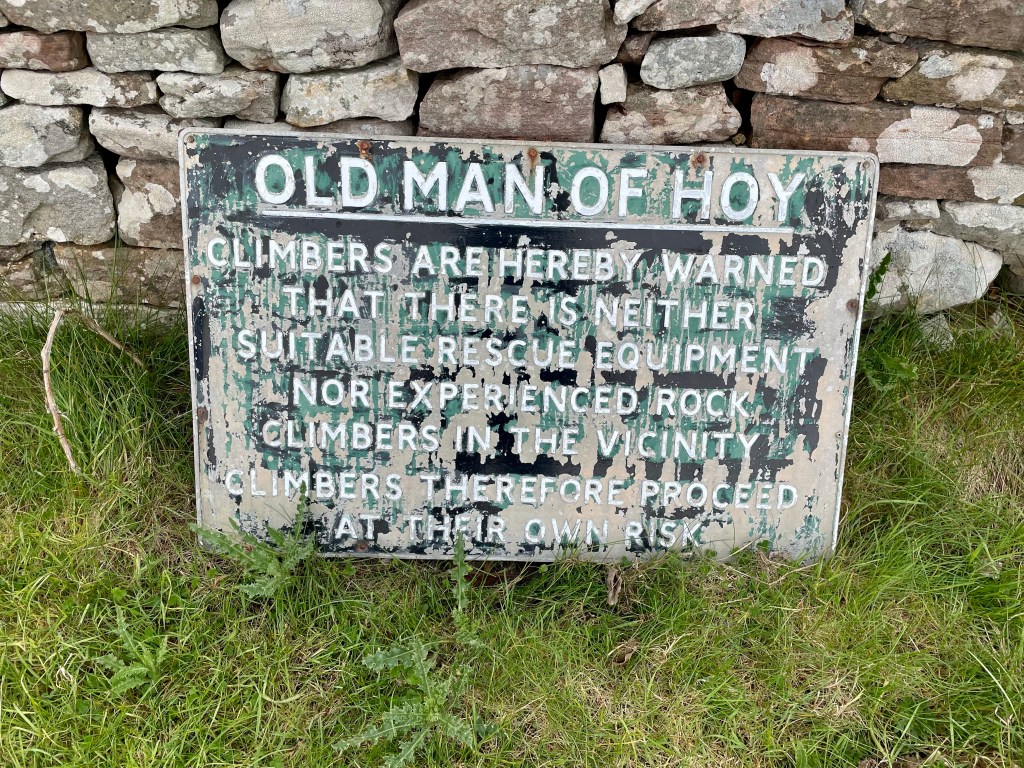
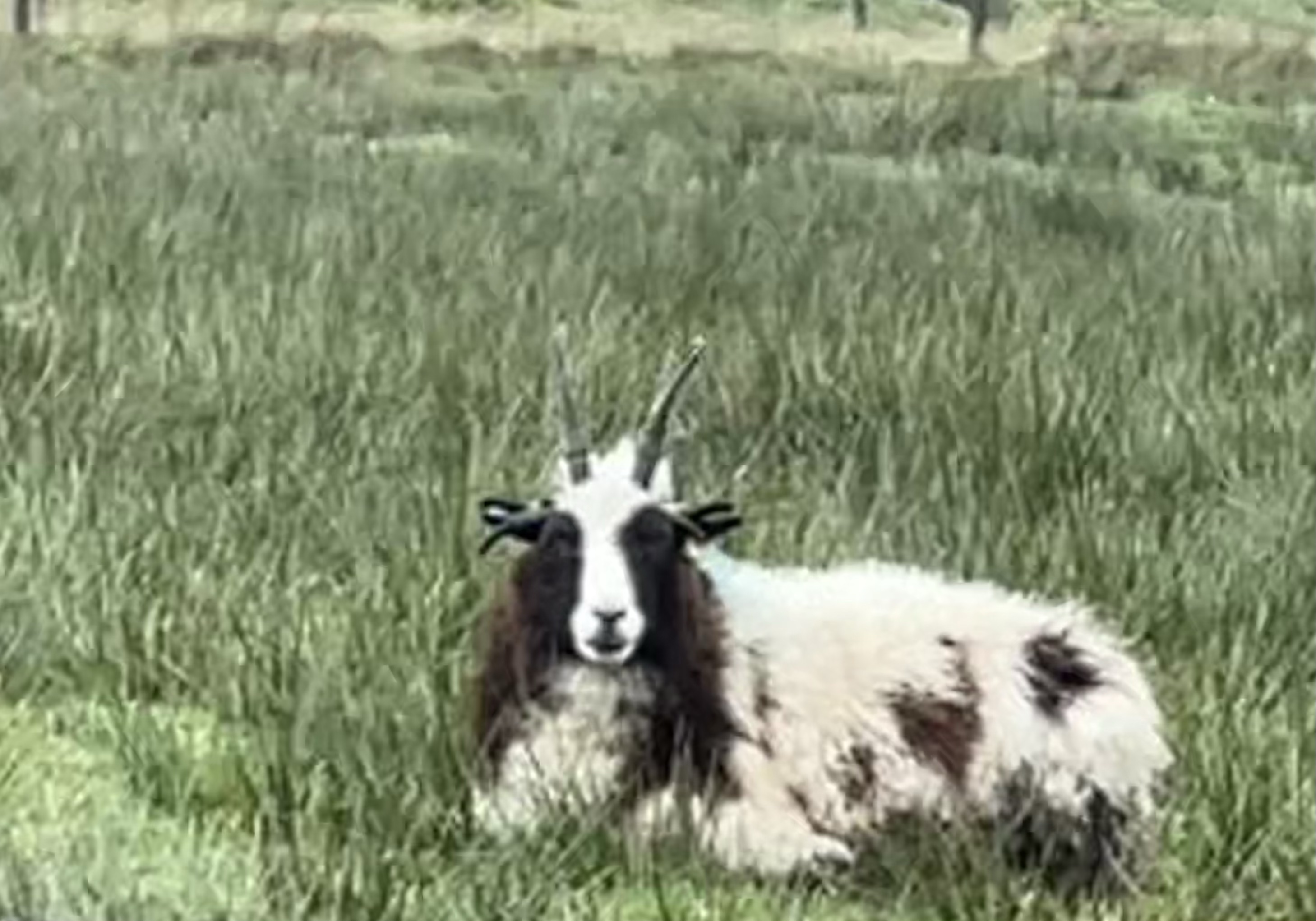
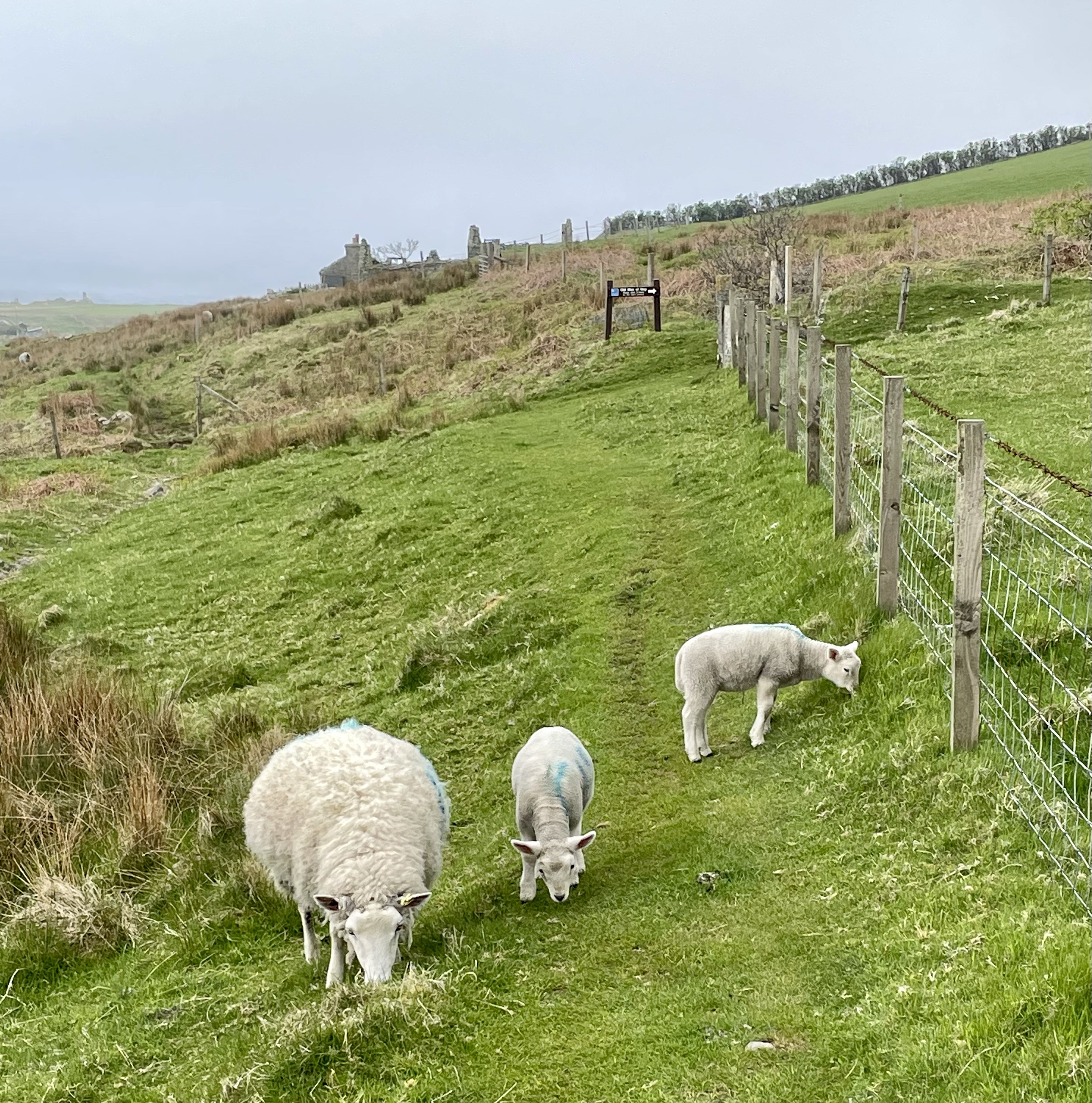
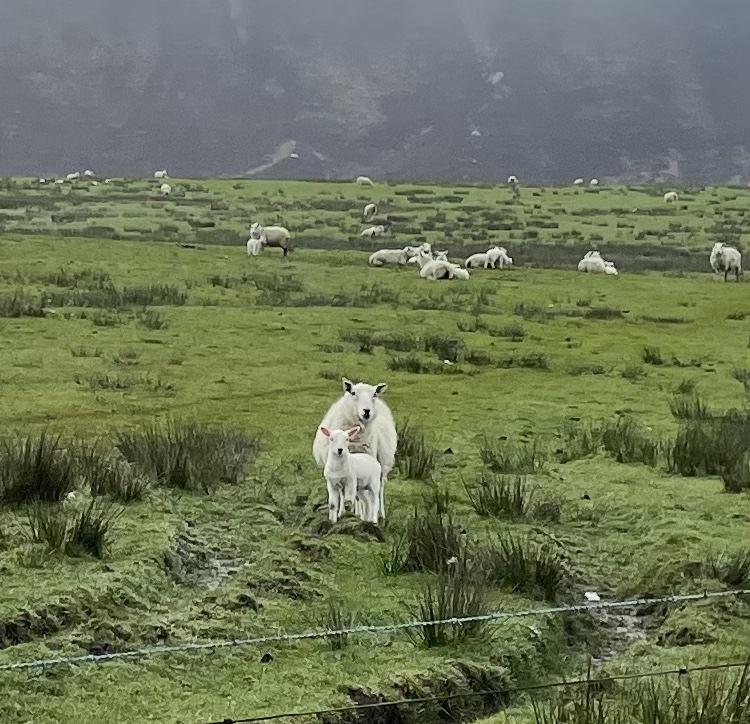
The Old Man is a climbing spot because people will climb anything. And clearly you are on your own.A sheep sampling.
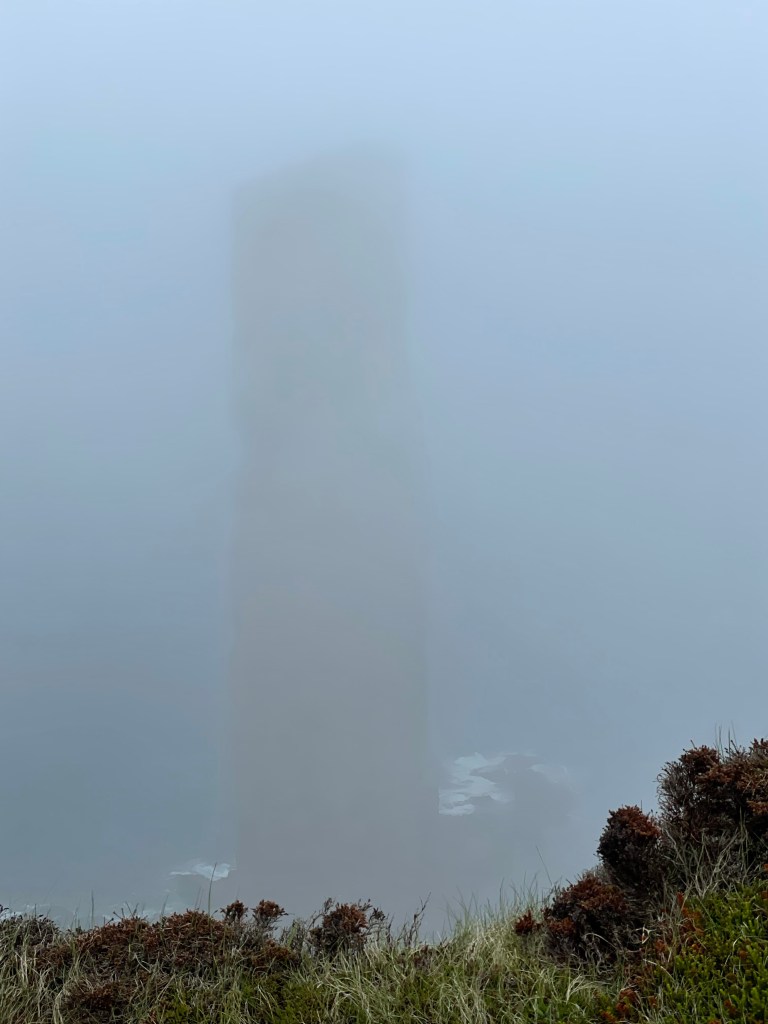
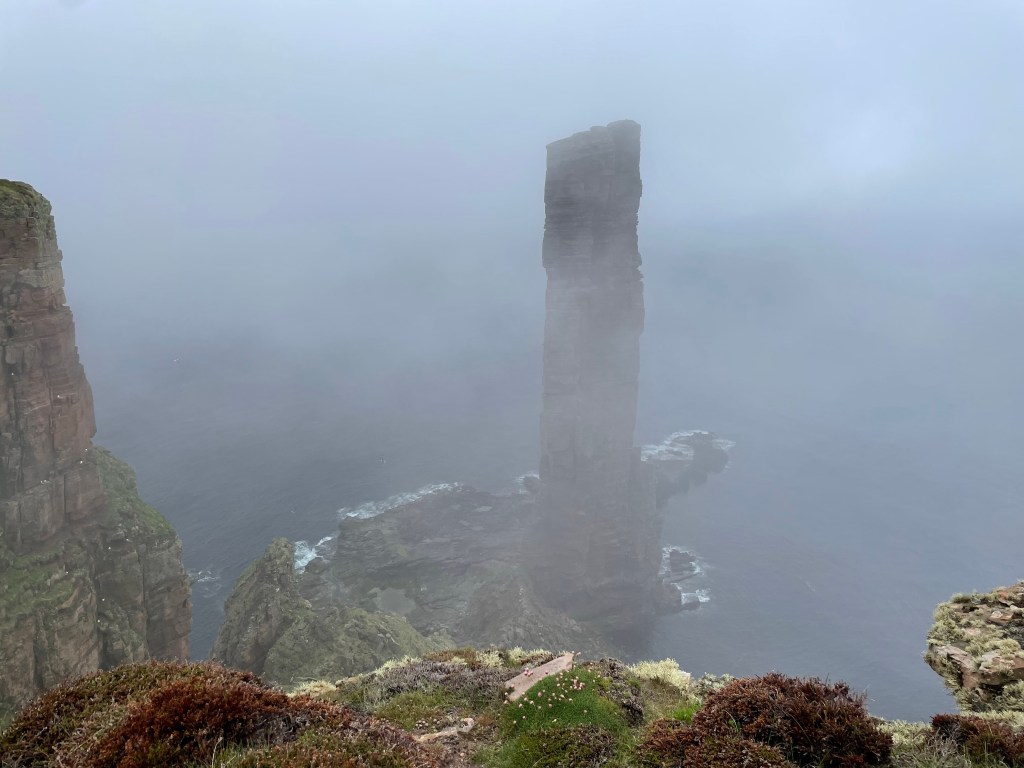
As we climbed, the wind howled and the fog rolled back in so we lost sight of the sea below (did I mention we were hiking on cliffs?). I very nearly lost my hat in all the blow. When we arrived at the long-awaited but entirely fogged in viewpoint, we waited patiently, watching all the sea birds nesting in the cliffs and eating lunch with hands that were cold and wet from our walk through clouds. All of the sudden a suggestion of an outline and then – there he was. What an entrance Old Man, what an entrance.
On the long road back, the sun.
The crinkly woman who served us breakfast every morning at the Royal Hotel had a few opinions about Hoy from the perspective of a Stromness native who has seen a few things. She announced to everyone in the room, with certitude and spot-on comic timing, “Oh, I suppose it’s nice and all but such a relief to get off it, though, aye?” and “I feel all a’ trembly when I’m there, it’s so depressin’,” and “It’s no place for women.” She speaks her mind about all the topics, and yet you can tell by the twinkle in her eye, the cock to her head and her appraising gaze that she’s still holding a few things back.
Our epic hike to the Old Man of Hoy now in the books, we have two more days of hiking plus a guided tour of Westray to look forward to during our time in Orkney.
One note – we learned that one must never say, “Orkney Islands” or “Orkneys” or “Shetland Islands” or “Isle of Skye.” It’s Orkney, Shetland and Skye, and the same can be said for all 700 of the Isles of Scotland. This mistake is as irritating to Islanders as it is to Oregonians when others pronounce our state Ore-GONE. Ugh.
Our second day of hiking started at Skara Brae, magnificently preserved Neolithic ruins situated on a hill overlooking the Bay of Skaill. As we were en route, our cabbie Eddie told us that ancient Picts lived in harmony for thousands of years, not raising arms against anyone, “until my ancestors came over from Norway.” I accused him of being a Viking, which he completely acknowledged with a tinge of pride. When asked whether he’d lived his entire life in Orkney, he answered, “not yet.” By this time he was obviously our favorite. As he dropped us off, he intoned, “Welcome to 6,000 years ago.”
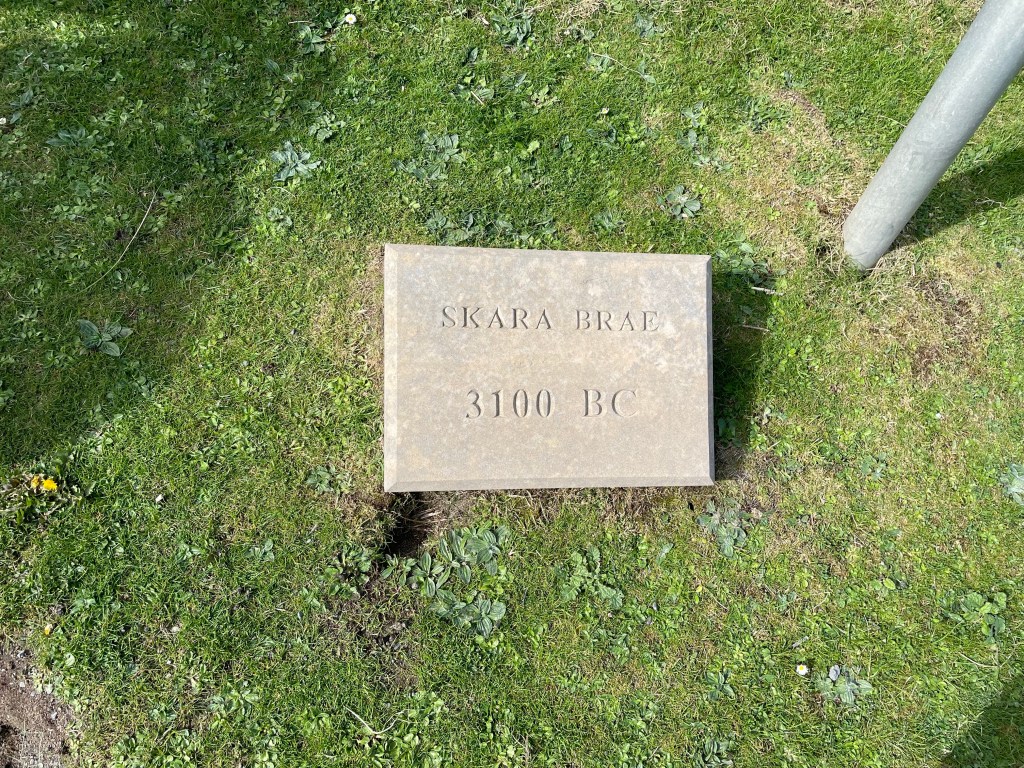
This seems like an unfathomable period of time, so to provide context, as you walk out to the ruins there are cleverly placed stones marking the progress of history such as the building of Stonehenge, the construction of the pyramids of Giza, the birth of Christ and the fall of Rome. Skara Brae was built and inhabited eons before all of these familiar markers of “ancient” history.
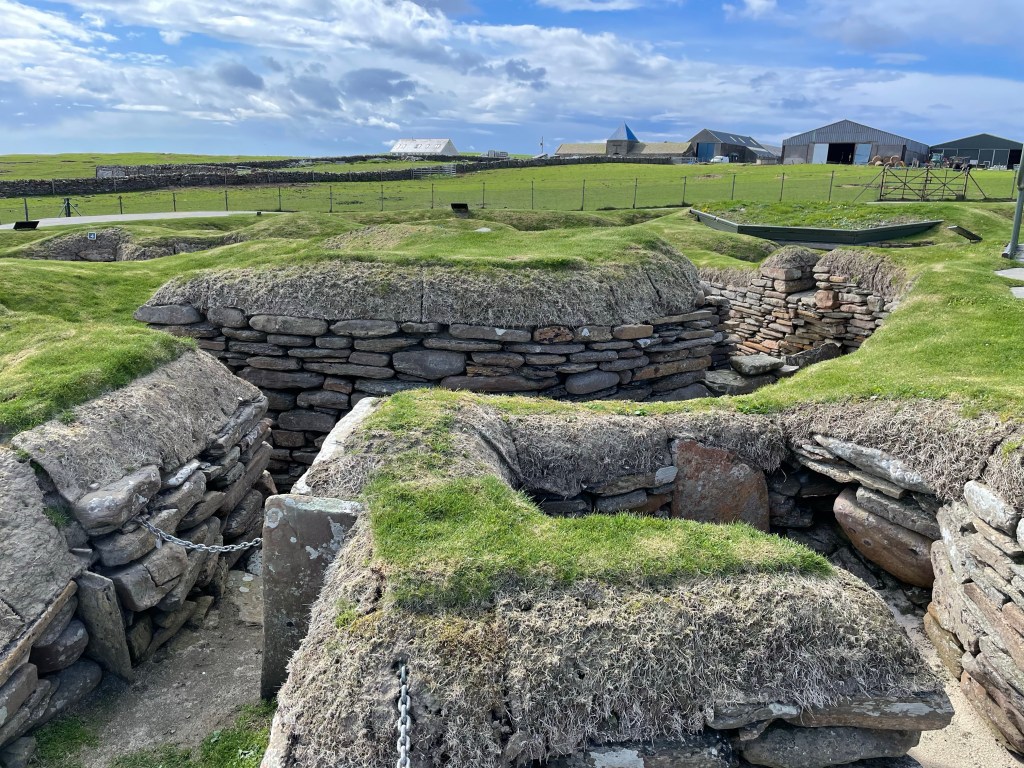
The ruin itself consists of ten clustered houses with stone hearths, beds and cupboards. There’s even a primitive sewage system, so, you know, I could have lived there. The site was occupied from 3180 BC through 2500 BC and it is Europe’s most complete Neolithic village.
The ruins were discovered in 1850 when a giant storm literally stripped the earth from the knoll, exposing the outline of the village. Incredible artifacts were discovered, including beautiful beaded necklaces fashioned from animal teeth or bone.
Lovely spot for a village.Neolithic Feng Shui
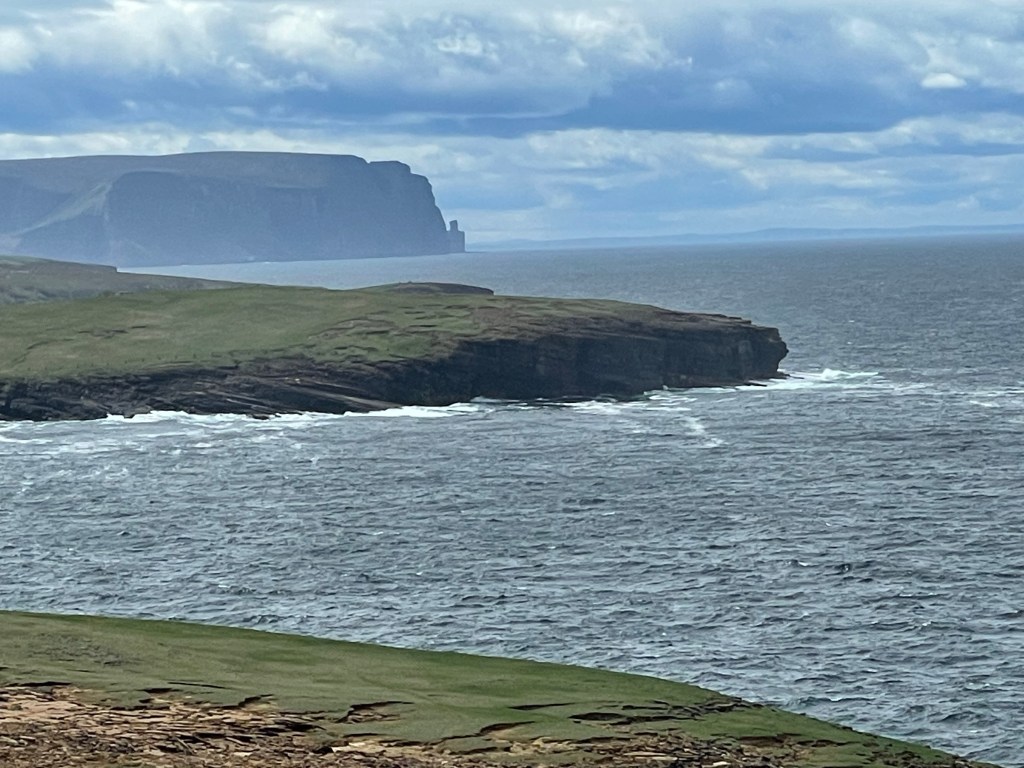
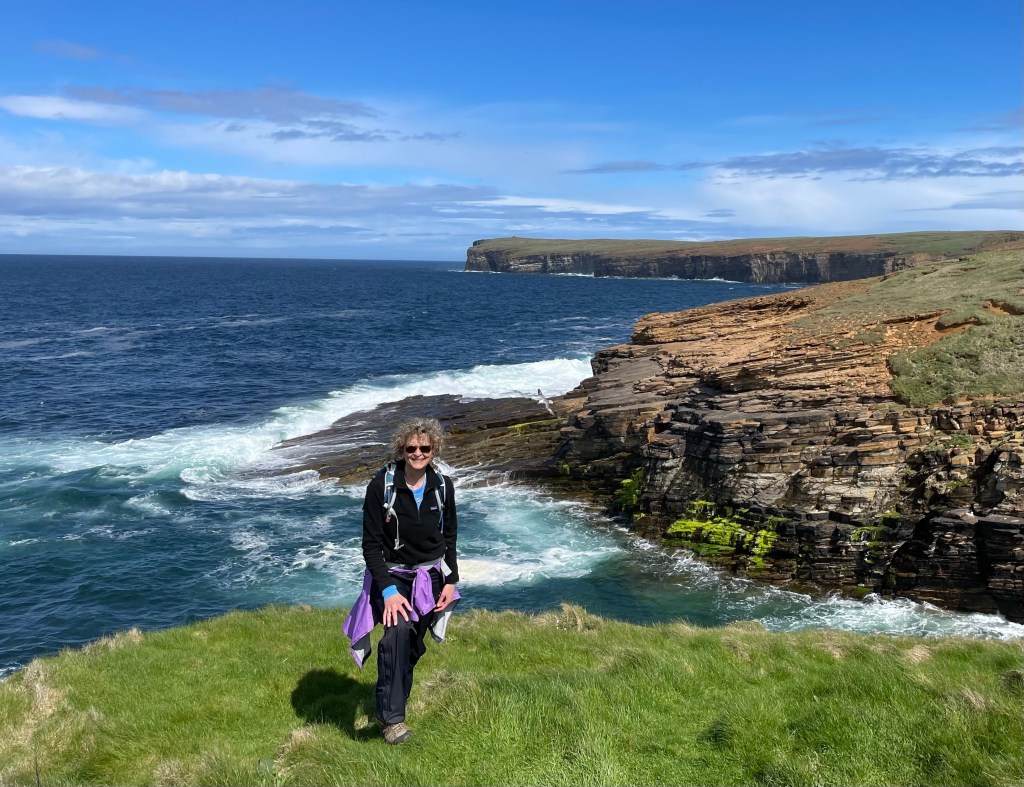
From the ruins, we joined the West Coast trail, which follows the Mainland coast all the way back to Stromness. The views were insane, the sea was azure blue, and there were more ruins along the way.
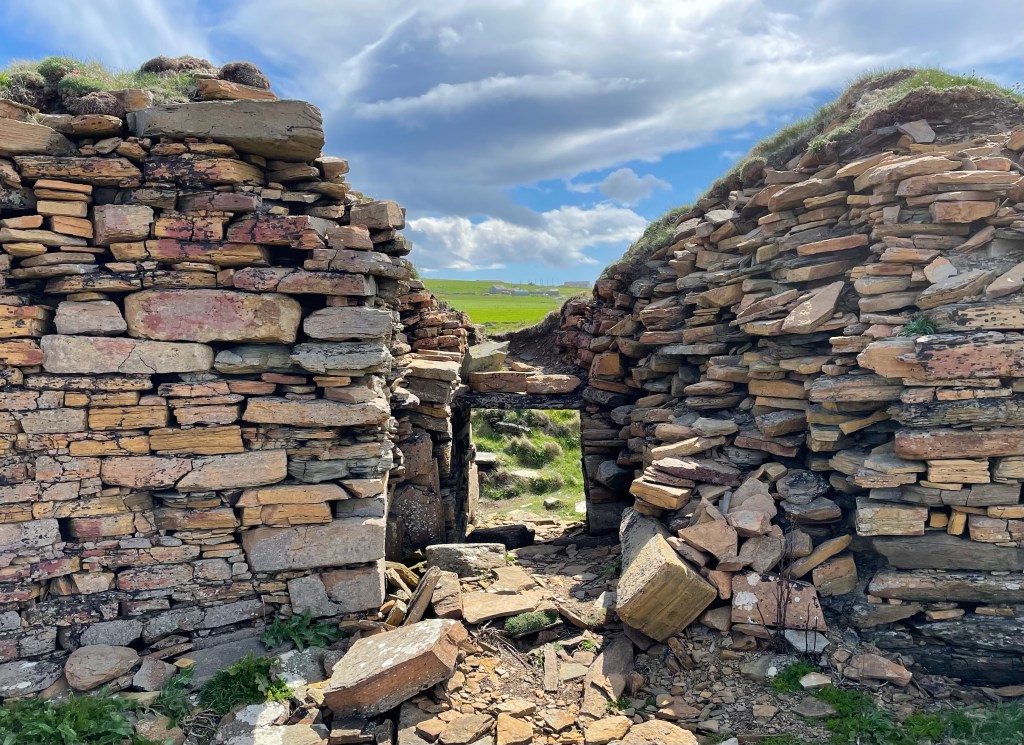
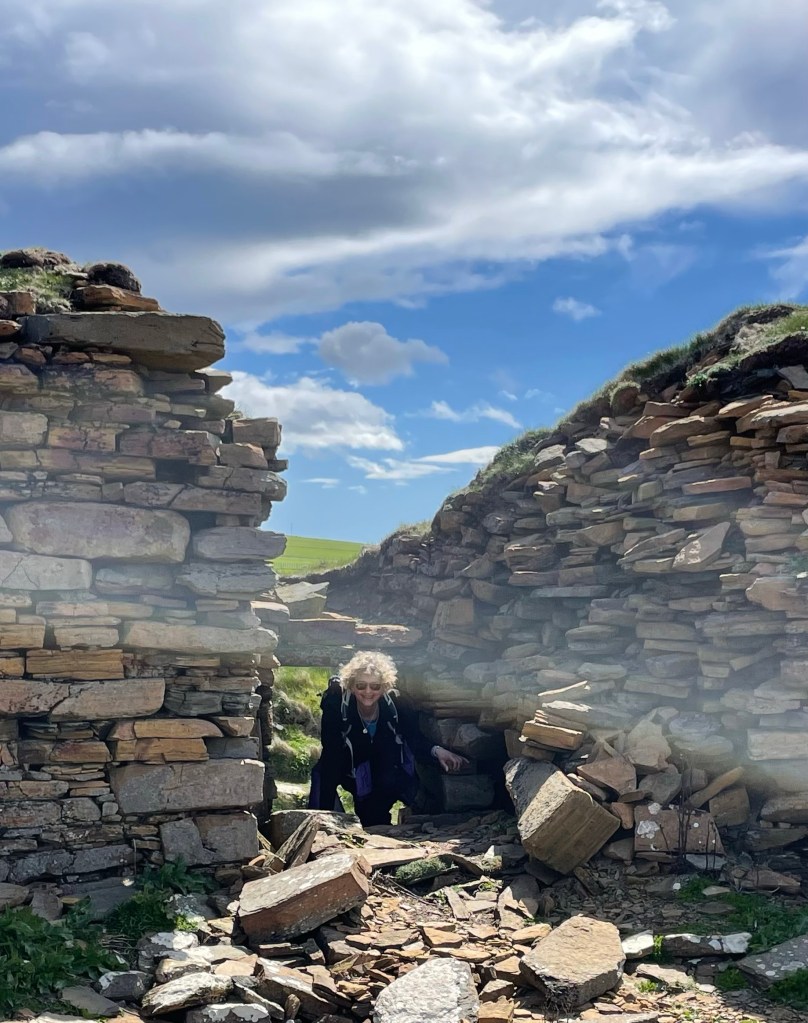
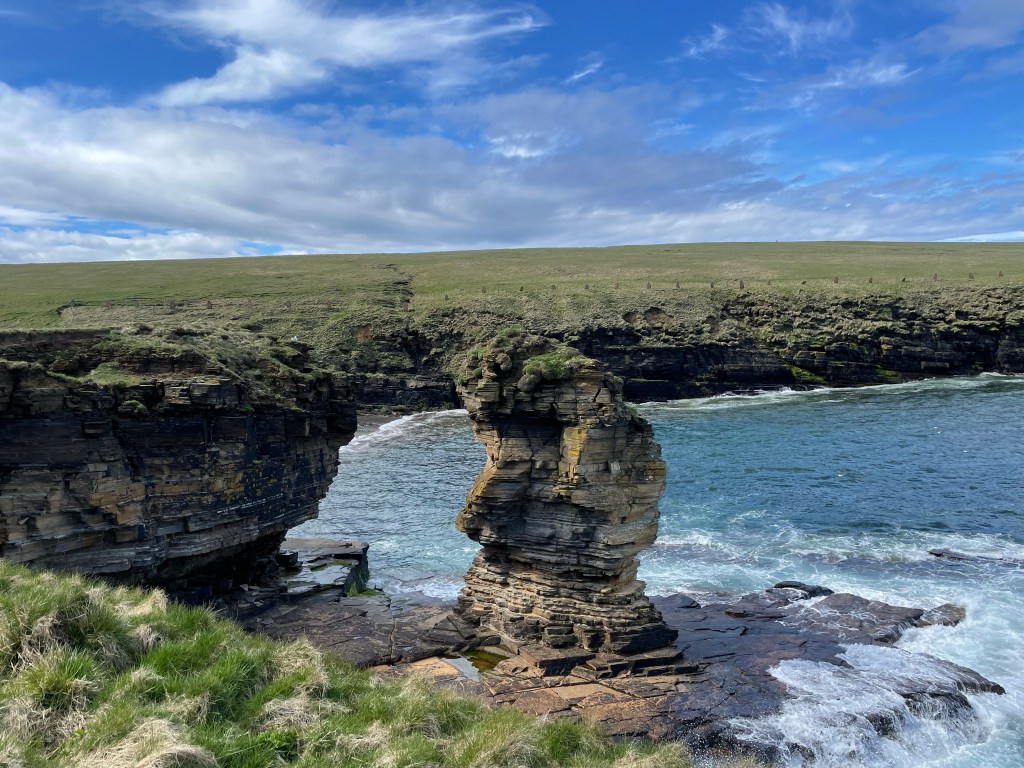
The little knob on the far island is the Old Man of Hoy. He’s always nearby.The Broch of Borwick, circa 500 BC, excavated in 1881. Someone’s wee seaside cottage back in the day.For scale. Just insane views.Scotland rocking the sea stacks.
Just as we ended our walk, the weather changed from gorgeous to blustery – as is its wont.
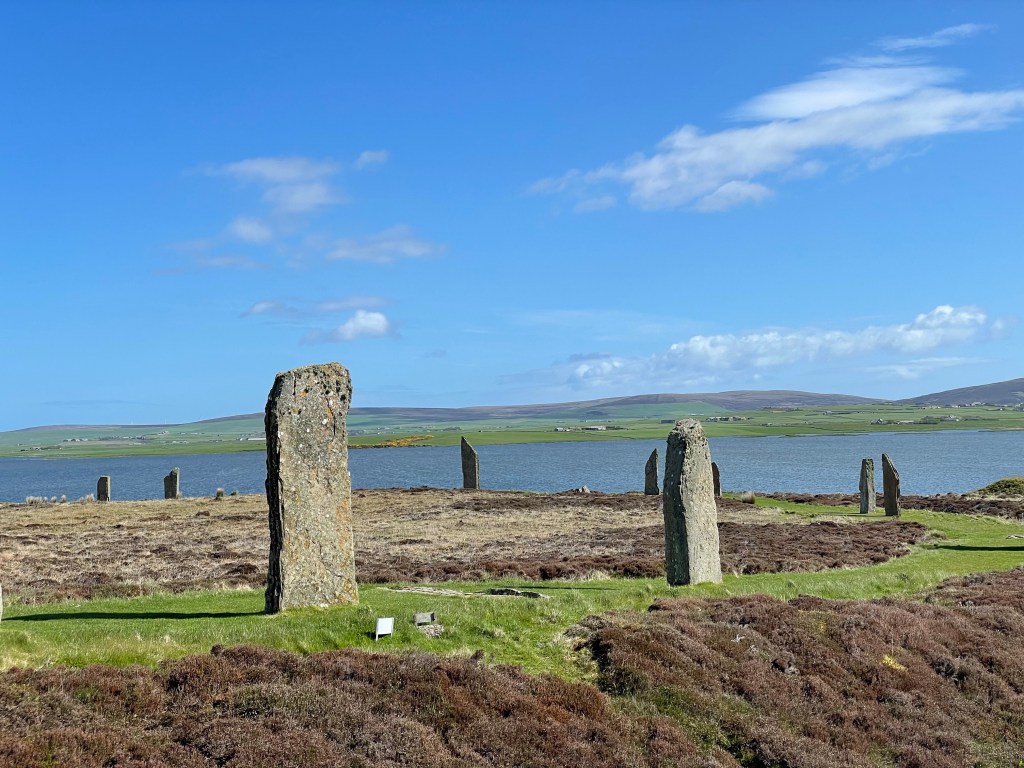
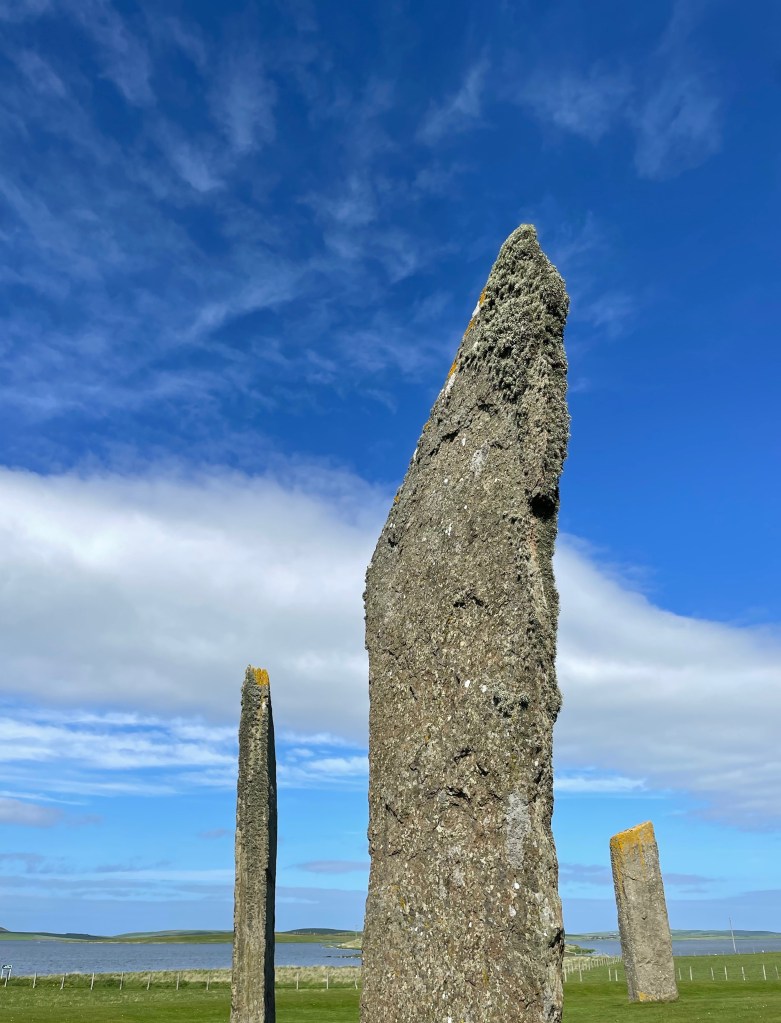
The next day we continued our passage through days of yore by hiking between two stone circles very near Skara Brae – and possibly used by its residents. As with Stonehenge, nobody really knows for certain exactly how they were incorporated into the life of the community, although theories abound. You’ve heard them all. The Ring of Brodgar was likely constructed between 2600 and 2400 BC and the Stones of Stenness, which are considered to be the oldest henge in Britain, around 3100 BC.
The Ring of Brodgar was originally comprised of 60 stones, with 36 surviving today, still a startling sight. The Stones of Stenness originally had 12 upright stones with only four surviving. My favorite was the Ring of Brodgar.
It’s miraculous really, that so many of the stones have survived for many thousands of years. Imagine! Of course, through the passage of time, random people have interrupted the flow of magic, as they do. The most heartbreaking tale was that which befell the Odin Stone. This fabulously named stone stood near Stenness Circle. Thought to have been erected around 3000 BC, it stood about 8 feet high and had a shoulder-high hole through which couples would clasp hands to provisionally marry one another until they could find a priest somewhere. Isn’t that lovely? Well, of course it is. However, in 1814 a silly man who leased the land upon which the stones stood found himself irritated by people tramping about amongst them. So he destroyed Odin’s Stone as well as a few others. Not stoked, the native Orcadians tried to burn his house down. Twice.
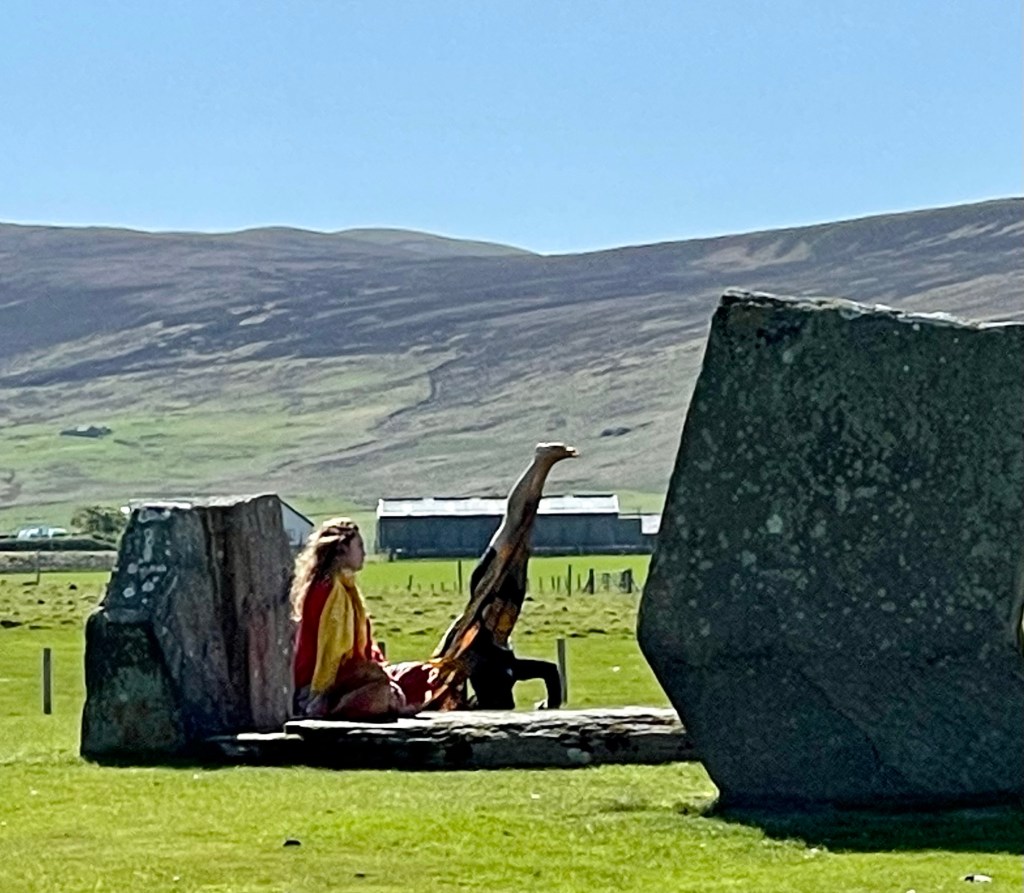
Another heartbreaking and irritating tale is the co-opting of ancient stone henges by weird barefoot hippies. We saw a pair of them during our visit to the Stenness Stones. They walked around with their eyes closed and tie-dyed garments flowing, demonstrating to all that they inhabited much higher planes of consciousness than the rest of us. Barefoot, likely days from their last shower, probably not vaccinated. They ostentatiously perched on the stones (leaving only two for others to photograph) communing with ancient spirits (I guess) and basically making horses’ patooties of themselves. Literally the dude did a headstand like an idiot. Obviously I had to take photos because – isn’t that what they want? To be noticed by lowly beings who are dazzled by their higher vibrational states and inspired by their oneness with the ancient spirits of the stones? You see, what appears to be a disrespectful act is actually the physical manifestation of advanced astral powers beyond our comprehension. I’ll stop now, but I mean seriously, the absolute worst. I suppose we should be grateful that they weren’t naked.
Ew. Fell over twice before pulling off this pathetic excuse for a headstand.Hippie-free Stones
Cabbie Eddie, when Danielle told him of these shenanigans, said that these stones had nothing to do with yoga or “flower power” but instead represented the deepest beliefs of ancient peoples. He said that if you cut open the earth – or your arm – you see stone and bone covered with layers of strata, whether it is skin and muscle or earth and ruins of civilizations. This ephemeral strata comes and go while earth and bone endure and thus are deemed significant and worthy of reverence.
Before we leave Stromness for Kirkwall, here are a few photos of a simply lovely town.
The Ferry Inn – the only restaurant in Stromness currently open for dinner. (Thanks COVID). Luckily it’s smashing and we enjoyed it all three nights.Our hotel just down the way – the Royal.Captain Cook! An Oregon connection.Black cat yellow door.
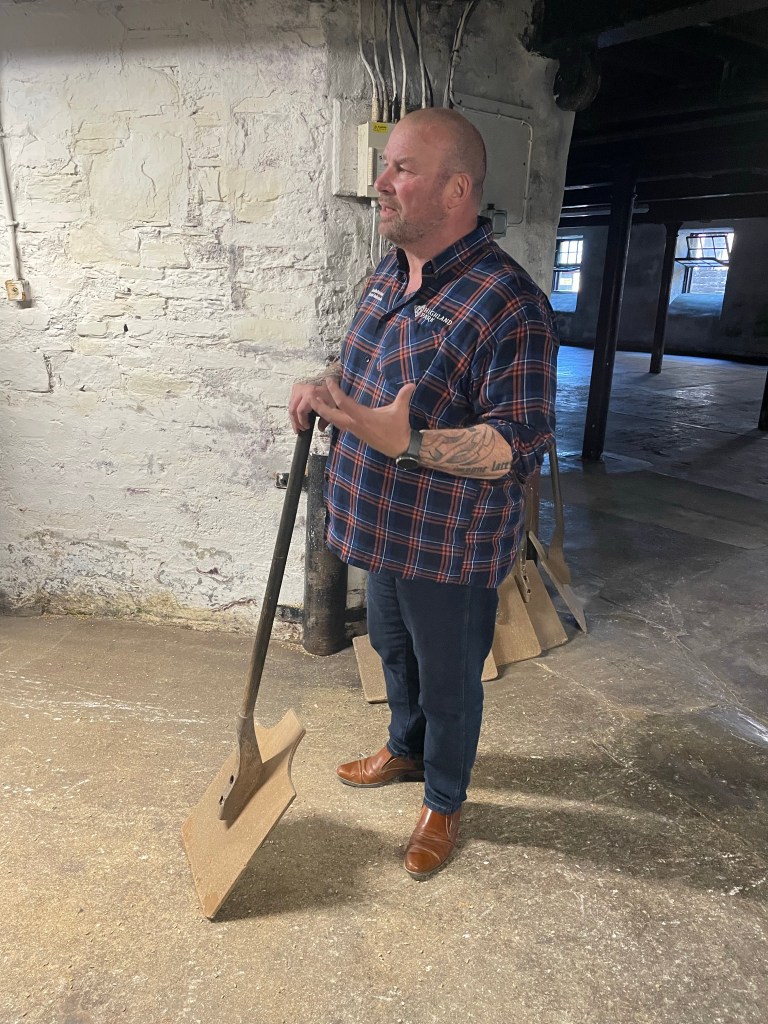
From the sublime to the whisky, I arranged a tour of Highland Park Distillery for the afternoon. I was ushered into a room with the guide and probably ten guys all standing in a circle. Some Danes, some Swedes and a Brit. The Danes had matching polo shirts with a “Prisoners of Whisky” logo which seemed rather melodramatic. I later learned it signified a posh Danish whisky appreciation group. They barely acknowledged my entrance (what?!?!) so I was determined to make them all love me and respect my whisky knowledge by the end of the tour. Spoiler alert: they did.
The guide told us of an incident that occurred a few days prior where a lorry driver who had attached a caravan to his roof drove under pipes that ran across the road and damaged them irreparably. He told us with a deeply exhausted expression that Highland Park won’t be able to resume normal operations until September. They are gradually emptying out all the washbacks, mash tuns and stills. Yikes.
Even in the face of this troubling news, the tour was fascinating as they always are. I learned that when there is the occasional “off” barrel of whisky (it happens), the contents aren’t poured down the drain because whisky has to stay in Scotland and god knows where it could end up. Rather, the bad stuff is distilled to almost 100% alcohol and sold to France for use in the making of perfume. French perfume made from bad scotch. C’est parfait.
After the tour we decamped to a lovely tasting room to have wee drams of the special edition Highland Park whiskies named after Norse gods Thor, Loki, Odin and Freya. Each dram was meant to represent the essence of its namesake god. All were cask strength and Thor was the best. I think because there were special Danes in attendance and the tour guide was also Danish, he busted out a 1968 bottle currently going for £ 5,000. It was good, yes, but in my estimation Thor prevailed. An old whisky is not necessarily the best whisky, it’s just the most expensive.
The guide told us of a time a beer company in Norway sued Highland Park because they had a beer named Thor and they thought people might be confused. This is a stretch of a legal argument even for our litigious country. Since Highland Park is owned by the same company that owns Macallan and others, their lawyers are pretty heavy duty compared to those of the small Norse brewery. Everyone got together in a room and agreed to settle if Highland Park gave each of the lawyers on the other side, and the brewery owners, a few bottles of the very rare Thor. Case dismissed.
Everyone was presented with a framed certificate with their name on it at the end of the tasting. It will be displayed next to my law school diploma.
Highland Park Tasting Room
In my cab ride home, I asked the driver what he thought the weather was going to be the next day for our trip to Westray. He said, “I’ve lived in Orkney for forty years. When it rains, it’s raining. If the sun is out, it’s sunny.” Alrighty then.
The best thing about traveling is chance encounters with fellow travelers, and meeting people lucky enough to live in the places where you have chosen to vacation. Interestingly, we’ve continued to encounter mostly other Brits, Norwegians and a few French. No Americans. Also the general age range has skewed older – many intrepid folks in their 70s and beyond, walking and biking through the Isles.
On our last day of adventure in Orkney we took the very early ferry north to Westray, known as the Queen of the Isles. Westray is eleven miles long and has 600 residents (down from over a thousand in the 1800s) and boasts the shortest scheduled flight in the world, the longest golf hole in the UK and a castle ruin steeped in history. More seabirds than anywhere I’ve ever been with a boggling range of species. Including – oh yes – the MIGHTY PUFFIN.
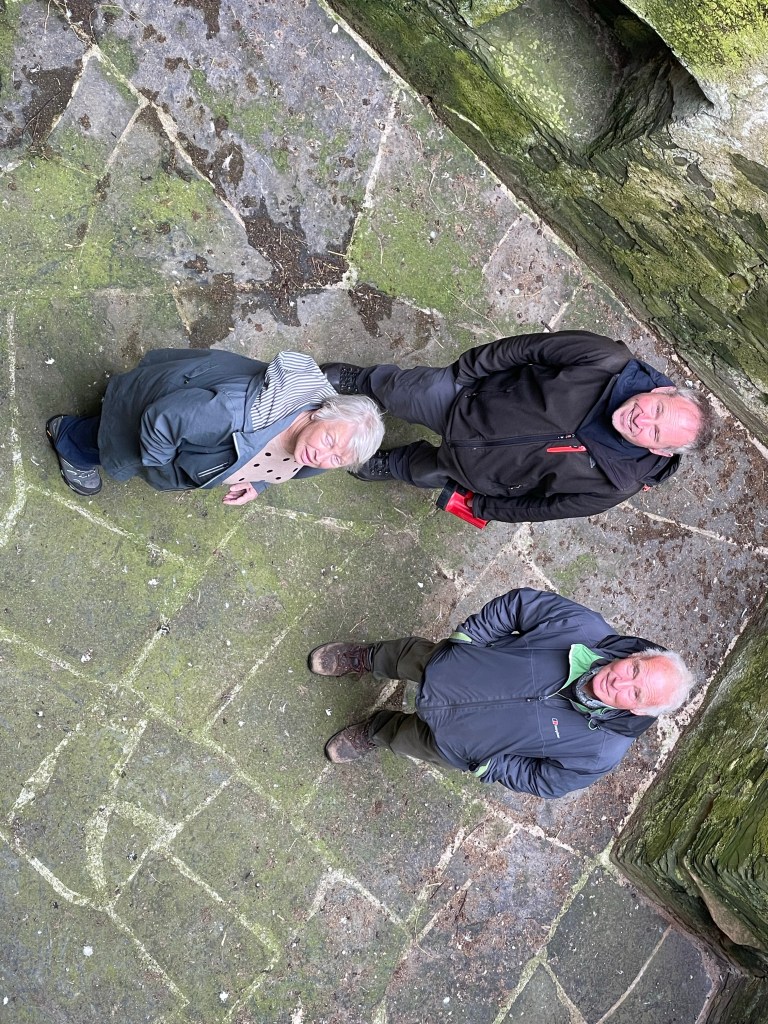
We were met at the ferry by Karen and Andy Penn, who run Westraak Tours. If you ever find yourself in Westray, book them. Karen was born in Orkney and Andy is an “incomer,” having moved to the island from Dumfries when they married six years ago. We swung by a local B&B and picked up Angela and Peter, a couple from Cornwall, and headed to “coffee,” which ended up being in Karen and Andy’s home, a lovely surprise. We sat around their table and got acquainted, also meeting Andy’s son Callum, who is in his twenties and has autism. It was lovely chatting with him and sharing our names and places of origin. It wasn’t long before Angela shared with the group that Peter, a retired physician, was struggling with early stages of Alzheimers. It was quite touching how he relied on Angela to fill in gaps. He looked to her and said, “do that thing you do,” and she riffed through words to help him find the right one. They were lovely and delightful, up for anything, and all-around excellent traveling companions.
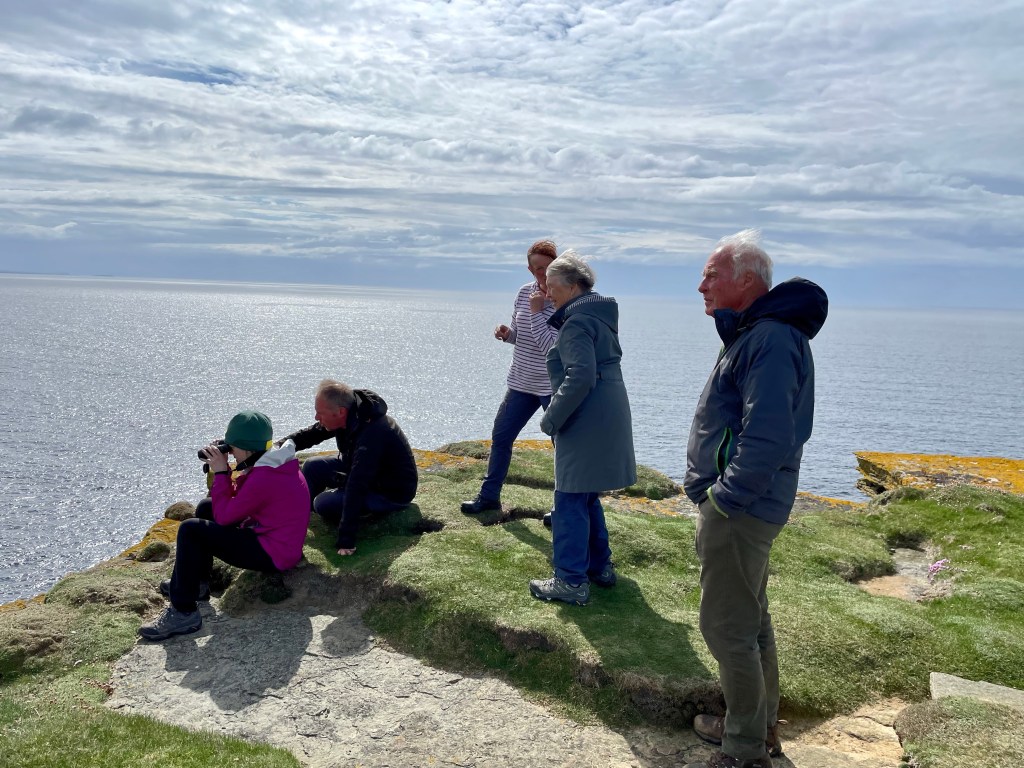
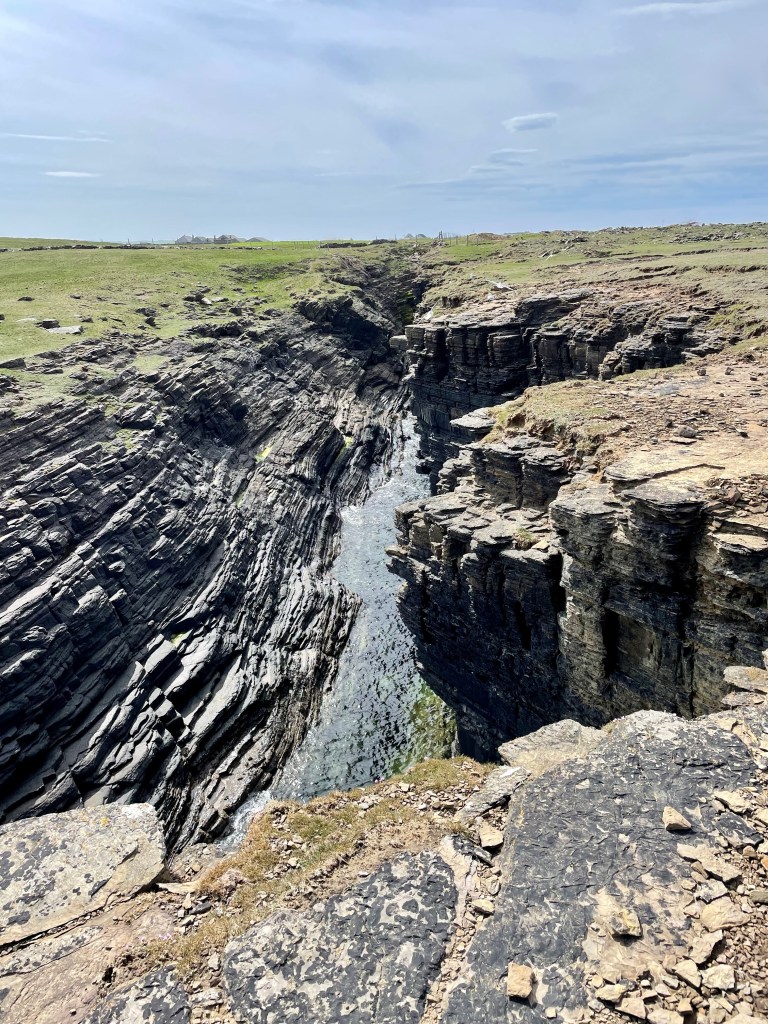
We left Callum with a shopping list for lunch, which would also be at Karen and Andy’s, and set off across the Island. Our first stop was a bird-nesting area along the coastal cliffs.
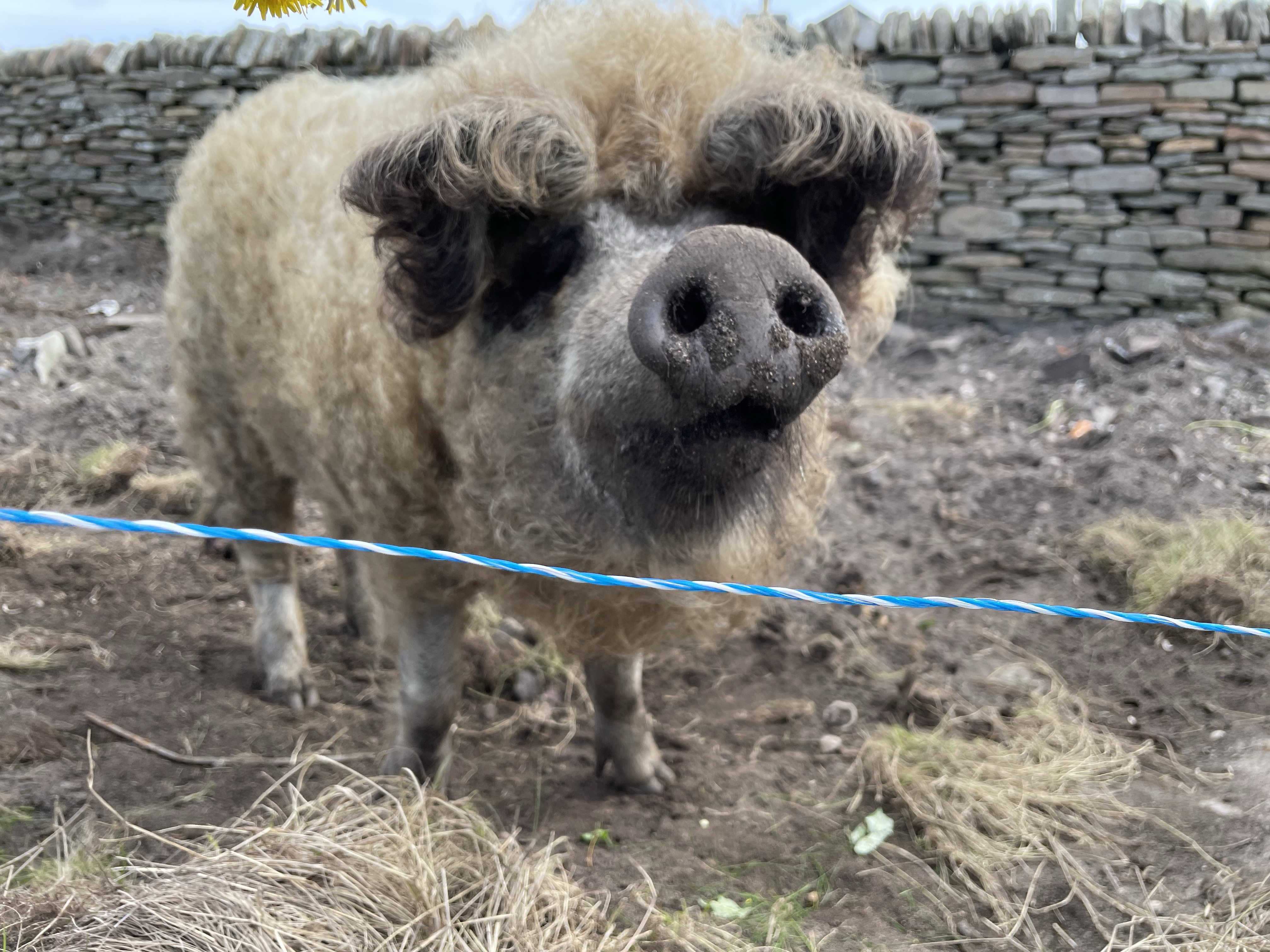
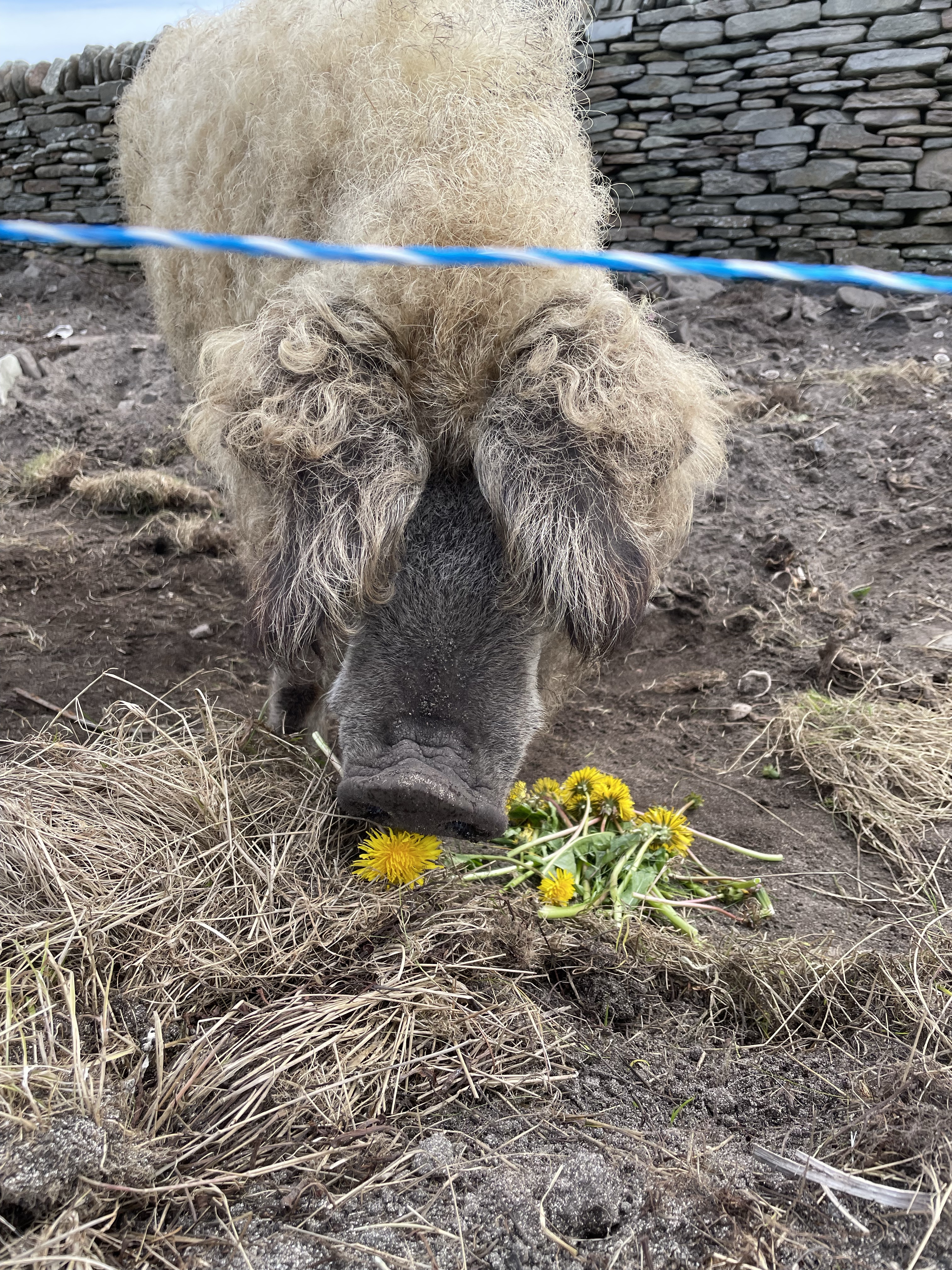
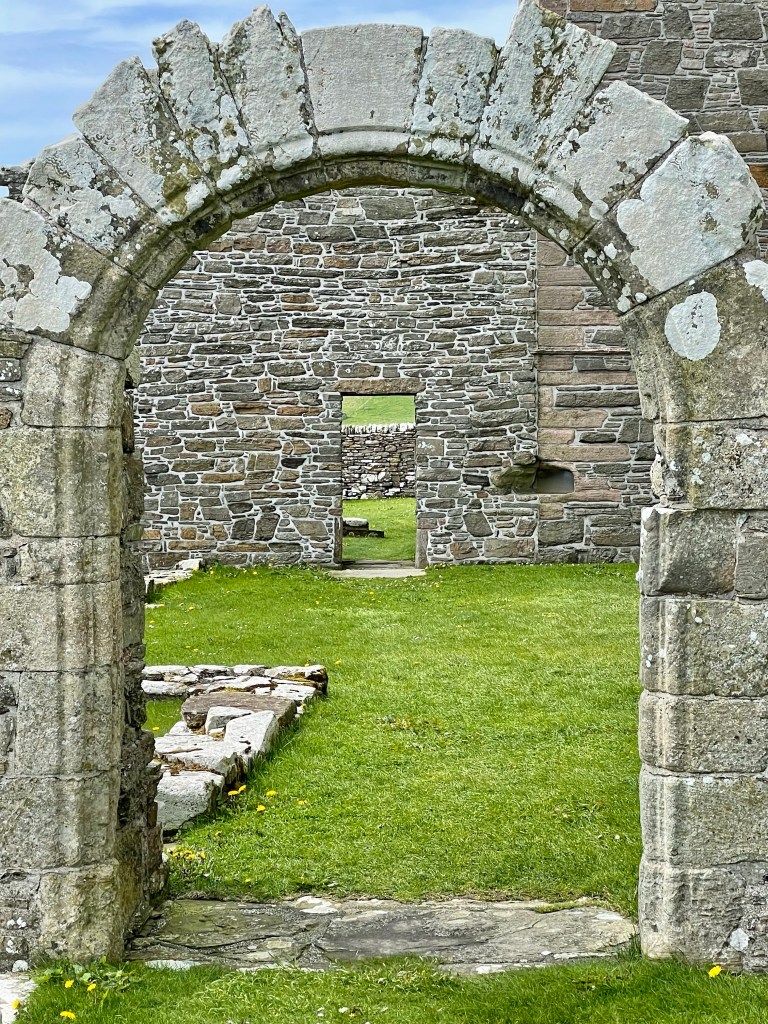
Next we headed to Quoygrew, the ruins of a Viking settlement. One of its longhouses had been excavated between 1997 and 2005. On the way, we met the charismatic Miss Piggy and fed her dandelions.
Quoygrew was a settlement of farmers and fishermen first inhabited in the 10th century and lived in as late as the 1930s.
Remains of Viking longhouse.
Our lunch at Karen and Andy’s was utterly delicious thanks to Callum’s successful shopping excursion. Karen made sweet potato soup, accompanied by egg salad from chickens just up the road, locally made cheese, locally caught and smoked mackerel, rhubarb compote and possibly the best sticky toffee pudding in the world. Lunch was accompanied by a very animated political discussion about Boris Johnson (“a dreadful buffoon”) the current Tory government (“corrupt to the bone”) anti-immigration British home secretary Priti Patel, whose family immigrated to the UK but would not be able to do so under current policy (“a terrible hypocrite” and also “appalling”) and of course Brexit (“a complete disaster”). Angela expressed admiration for the qualified and educated Labour Party leader, Keir Starmer, and wondered, “why wouldn’t people want this type of person to lead the country,” as opposed to Johnson, who won votes because he was “a laugh” and would be an entertaining pub date. Angela also talked of the ever-growing wealth discrepancy in the UK. It all sounded wearyingly familiar.
We next visited Noltland Castle which was the biggest surprise of the tour. On our way we drove by a golf course, which perked up Peter, an avid golfer. Andy said the course boasted the longest hole in the UK at 738 yards. It’s a par 6. Andy said he got a 7 once, but with the constant winds a 15 is more likely.
All the gun holes.
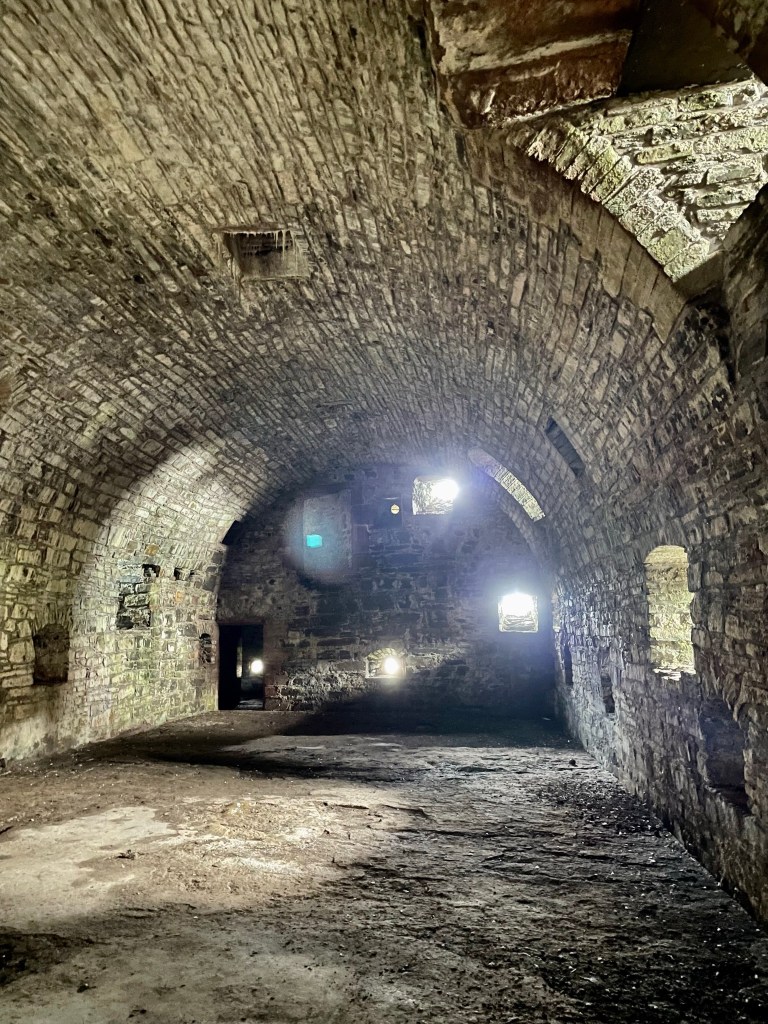
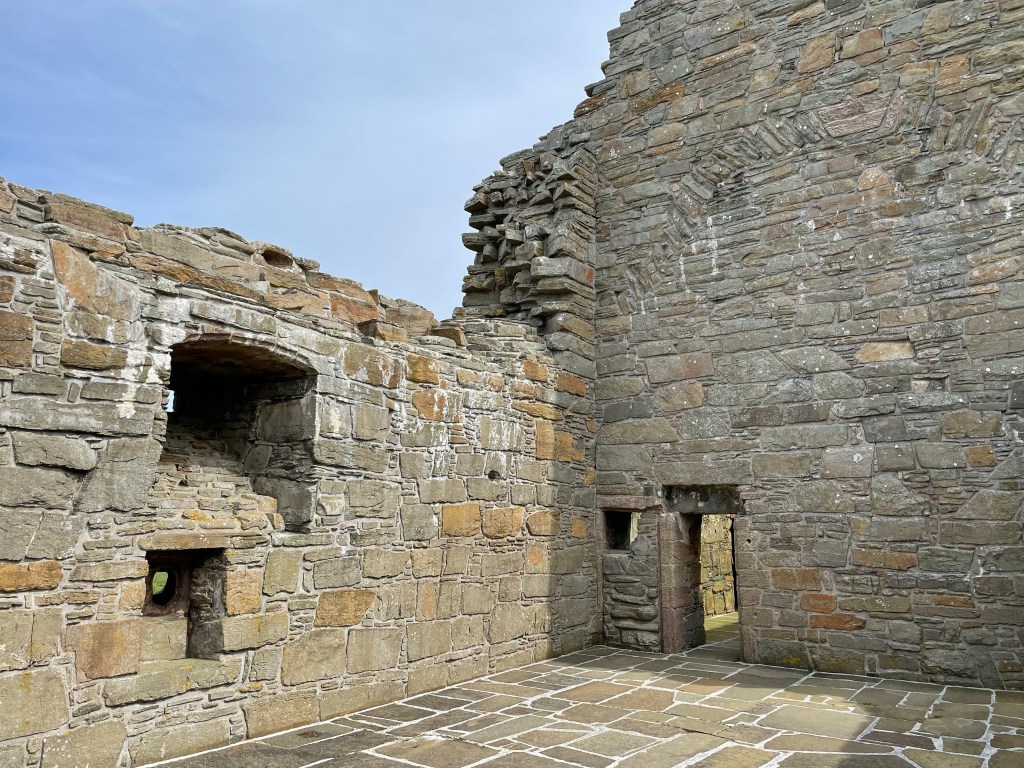
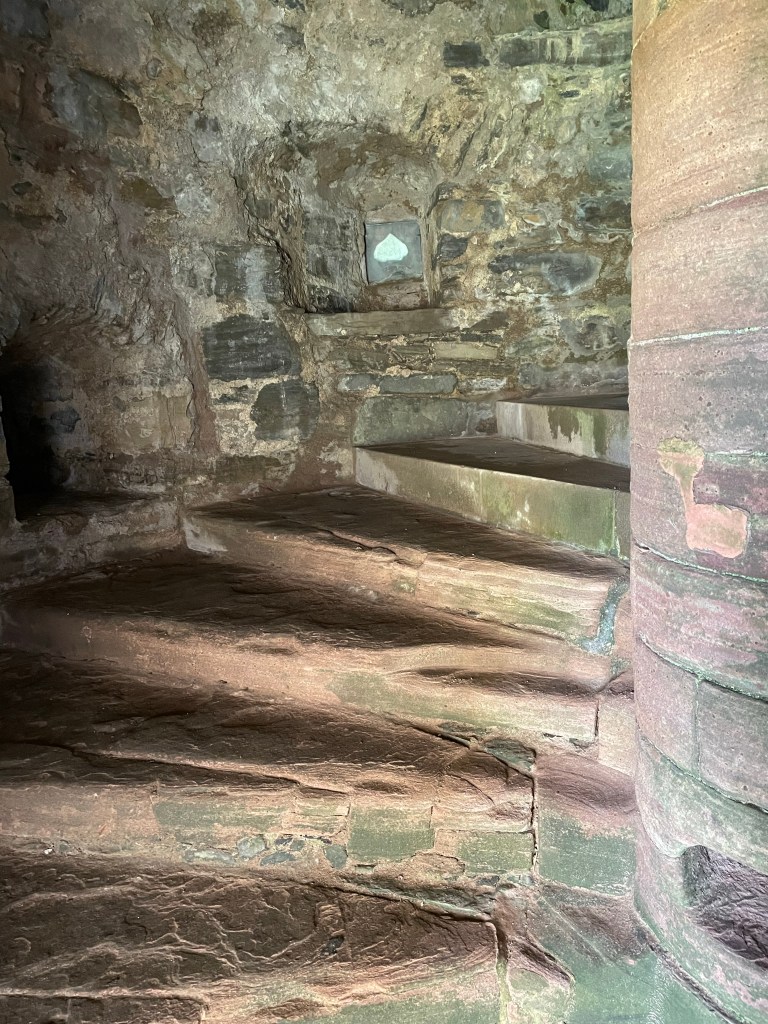
Noltland Castle was constructed in the 1500s, so a bit late in the game as far as castles go. It was built by Gilbert Balfour, who at the time owned Westray and Shapinsay, both given to him by his brother-in-law, the Bishop of Orkney. It’s odd because apparently he ran out of money or interest because he never finished the castle – the Great Hall remains open to the stars, even while Gilbert lived there. Maybe he blew his budget on the gorgeous spiral staircase, one of the UK’s grandest of the period. Roofs are kind of boring and expensive for sure – but handy to have in place nonetheless. The castle boasts an incredible 71 gun holes. There’s even one in the WC. Was Gilbert paranoid? Or were his fears justified because he moved through life cultivating mortal enemies wherever he went? You be the judge.
The acoustics are amazing, and the local Kirk holds concerts here.The never-roofed great hall.The spiral staircase.Castle grounds.
Balfour was the self-appointed Sheriff of Orkney, constable of Kirkwall Castle and master of Mary Queen of Scots’ household. Sounds good so far. But. He was also implicated in the murder of Cardinal Beaton at St. Andrews (mutilating his body and hanging it outside the window), after which he was captured by the French and condemned to be a navy galley slave for a few years. Fully not rehabilitated by that experience, he next helped murder Lord Darnley, Mary’s second husband, in Edinburgh.
You might be wondering why Mary didn’t dump Gilbert after he murdered her husband. The thing is she might have married Darnley mostly because he was also a Stuart and so would have given her a stronger claim to the English throne. Their son James did become James I of England, so that worked pretty well. Also, she had fallen in love with the Earl of Bothwell by that time and, who knows, perhaps she was in on the murder plot, as it was the only way to get rid of husbands back then.
Before Mary’s ultimate arrest, she was urged to flee to Noltland and some say that Gilbert was sweet on her and actually built the castle with her in mind. Sadly, she did not take this advice and was ultimately captured. You know the rest.
Balfour’s incurable habitual plotting continued apace, and he was implicated in the Mornay murder plot against King John III of Sweden. Karma finally caught up to him and he was executed in Stockholm.
Andy, Peter and Angela.
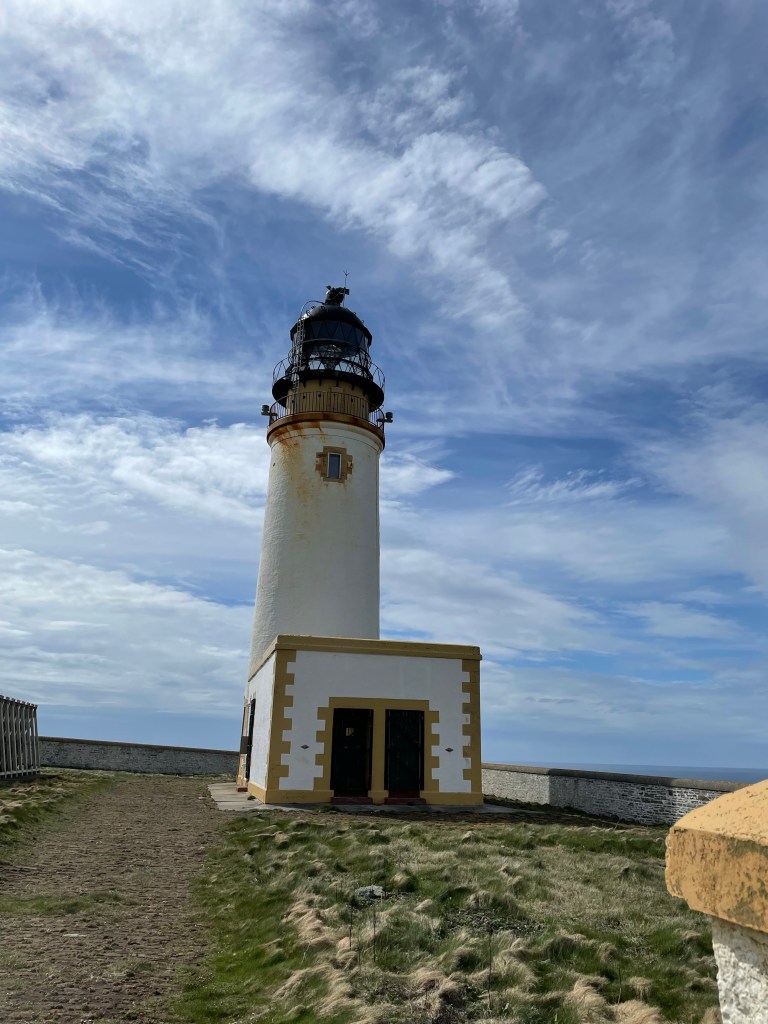
Next stop was Noup Head Lighthouse (one of over 200 built around the Scottish coastline). One family, the Stevensons, was responsible for designing all of Scotland’s lighthouses over a 150-year period – which explains why they all look alike. The lighthouses, not the Stephensons. The sole black sheep who rejected the family business in favor of a dodgy writing career was named Robert Louis Stevenson.
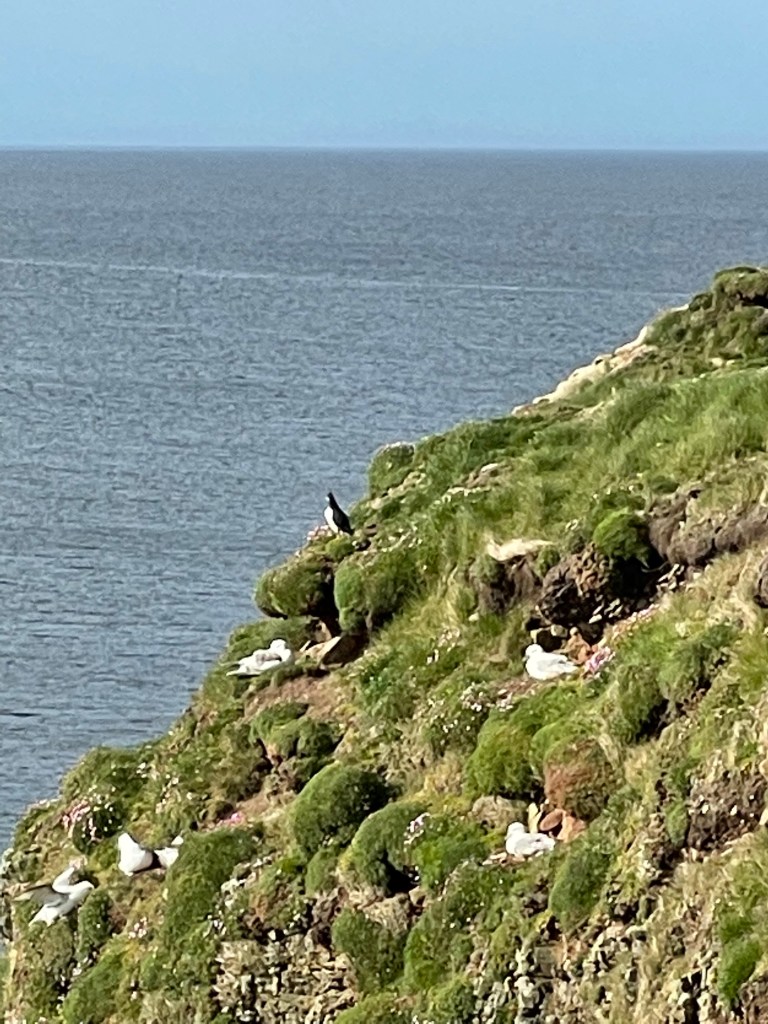
Here there were more dramatic cliffs and thousands of seabirds, transforming the cliffs into a layer cake of different types of birds, who clustered together by species in neat rows.
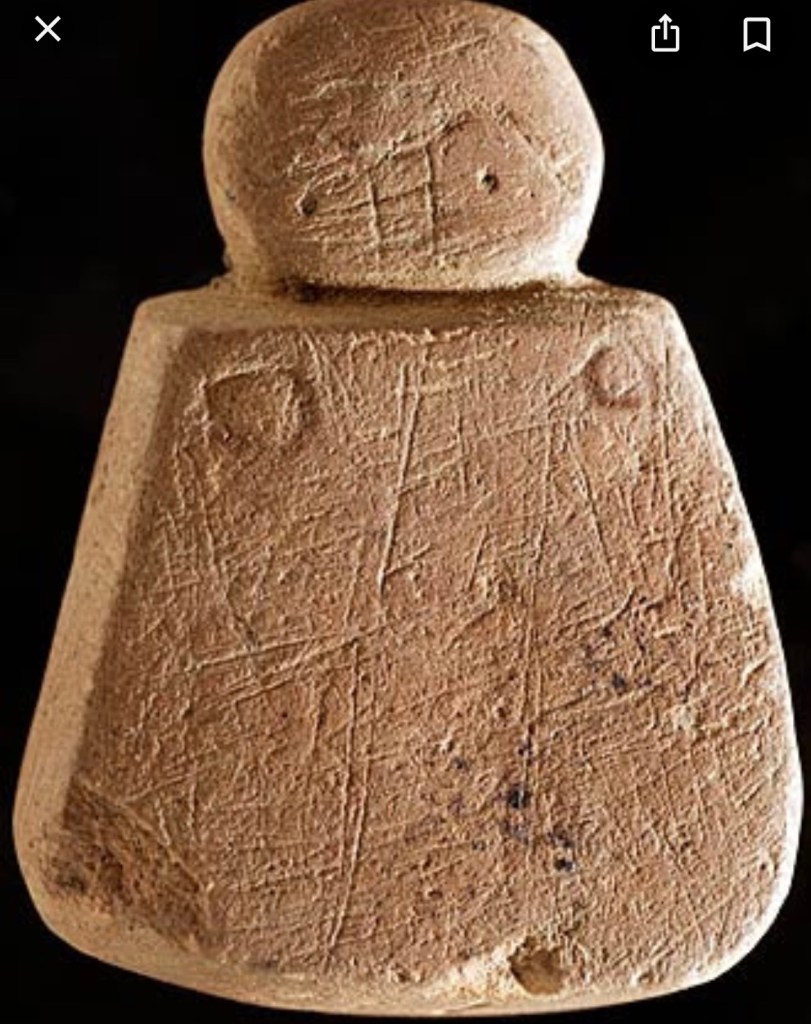
We next visited the Heritage Center, home of the Westray Wife, a small Neolithic figurine carved from sandstone, the first Neolithic carving of a human form to have been found in Scotland. It is also the earliest depiction of a face found in the UK.
Westray Wife
The center also featured rare china made for Edward VIII’s coronation. As we know, he abdicated after his ascension but before his coronation, in favor of his love Wallis Simpson. The American divorcee may have done the world a favor by removing a Nazi sympathizer from the board in favor of George VI, the beloved “Bertie,” who, along with the Queen Mum, refused to leave London during the Blitz and was photographed wandering amongst the rubble.
As we were leaving the Center, we spotted a small plane flying overhead – the shortest scheduled flight in the world from Westray to a (very) nearby island called Papa Westray. It’s scheduled for 1.5 minutes with actual flying time closer to a minute. The record for the fastest flight is 53 seconds.
Nearing the end of the day, we dropped off Angela and Peter, bidding them a very fond farewell. Angela was worried about her husband, as he had apparently been struggling more than usual during their trip, and they were headed to Shetland for another week. I hope they find that the familiarity of being back home in Cornwall will return him to form. They traveled extensively during their marriage, having many adventures around the world. Peter would smile happily, looking into the middle distance with fond remembrance as he shared some of their experiences. I dearly hope they are able to continue traveling for a bit longer before Peter’s illness makes it too challenging.
Our last stop on our way back to the ferry was the main puffin colony on the island. You know all those photos of puffins where they appear to be frolicking right underfoot? Sadly, my friends, these photos are largely due to high-powered zoom lenses and a lot of patience. Puffins nest in cliffs like the other birds, only they burrow rather than nesting on ledges. So you must wait for them to fly in and land, or perhaps pop out of their burrow to have a wee, which we witnessed and was adorable. The best time to see them is at dusk. But we still saw a good handful, and it was incredibly thrilling, and this is the best I could do with my iPhone.
The mighty puffin.
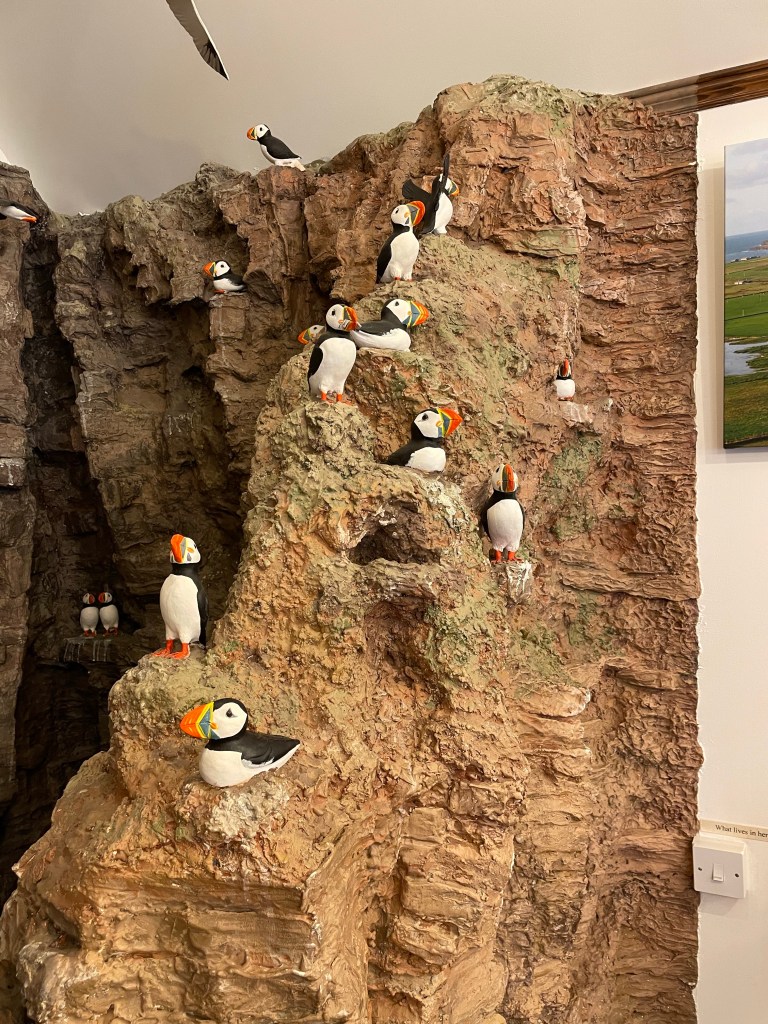
As consolation here’s a photo from an exhibit in the Heritage Center.
For illustrative purposes only.
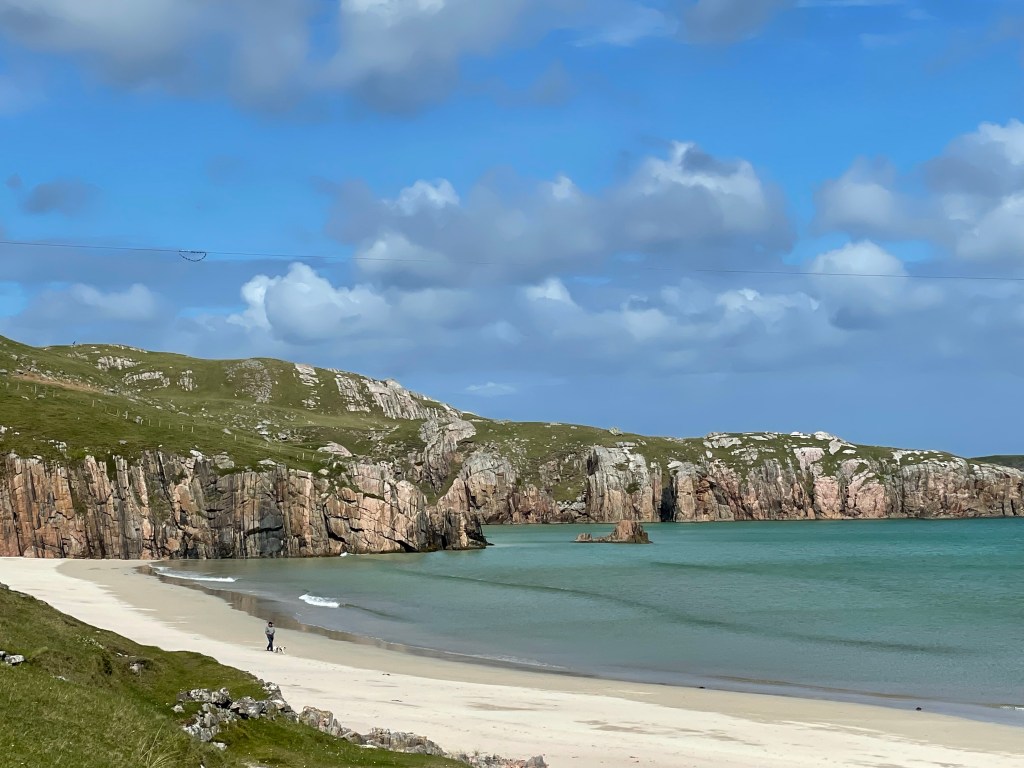
Next morning we ordered a cab for 5:15 am to catch the ferry to the mainland. Happy to see Dougal waiting patiently for us in the car park, we drove off across the North Coast. Despite the occasional flare of irritation at campers, we mostly traveled along the single track road in complete solitude through moody landscapes, farmland and villages. We stopped at some spectacular, almost deserted beaches and visited Smoo Cave.
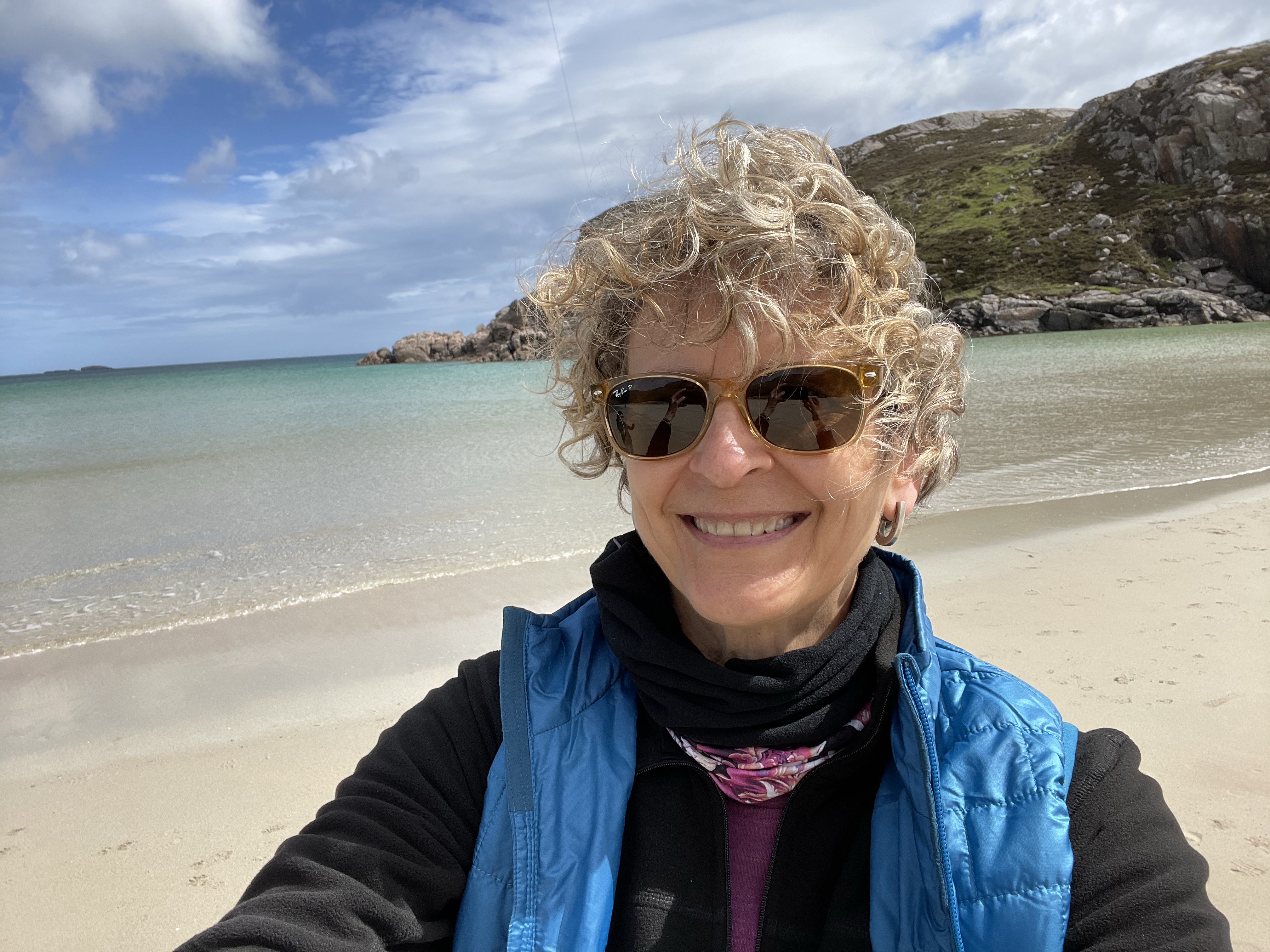
Farr BeachScotland you really are too much.Ceannabeine Beach – Caribbean blue waters.
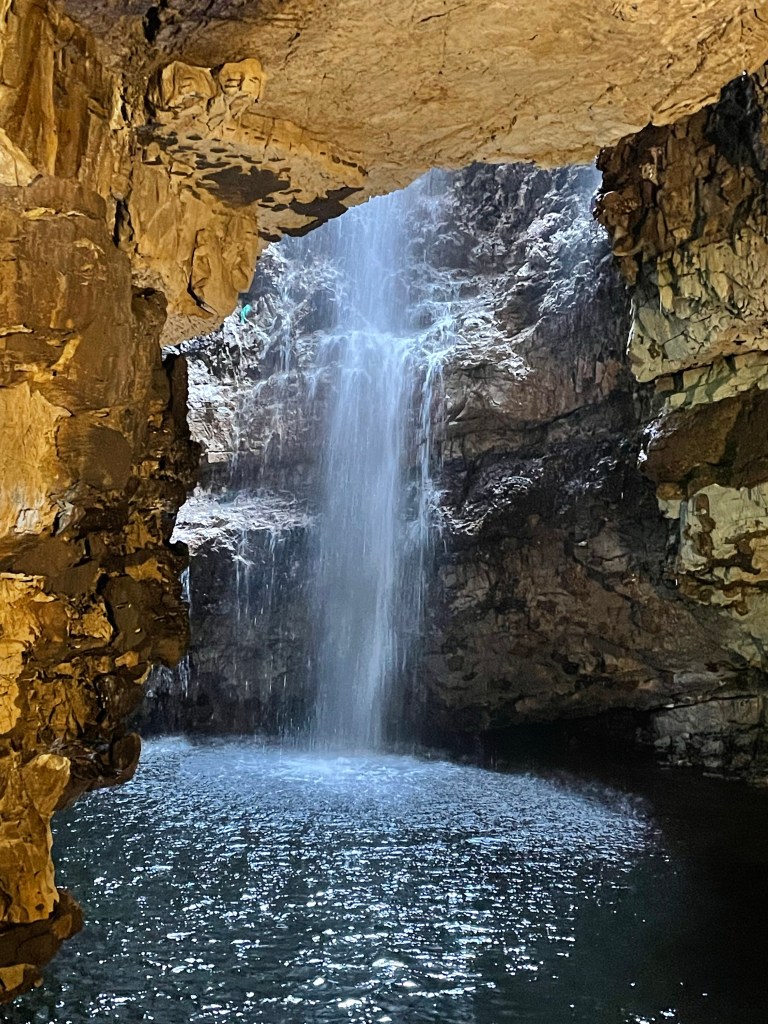
Smoo Cave was interesting although I’m not really a cave person. We opted against the hard hat tour. Lovely waterfall though.
At long last, we left the beaches of the north coast behind and dropped down into the rugged and spectacular Western Highlands I remember so fondly from my last trip.
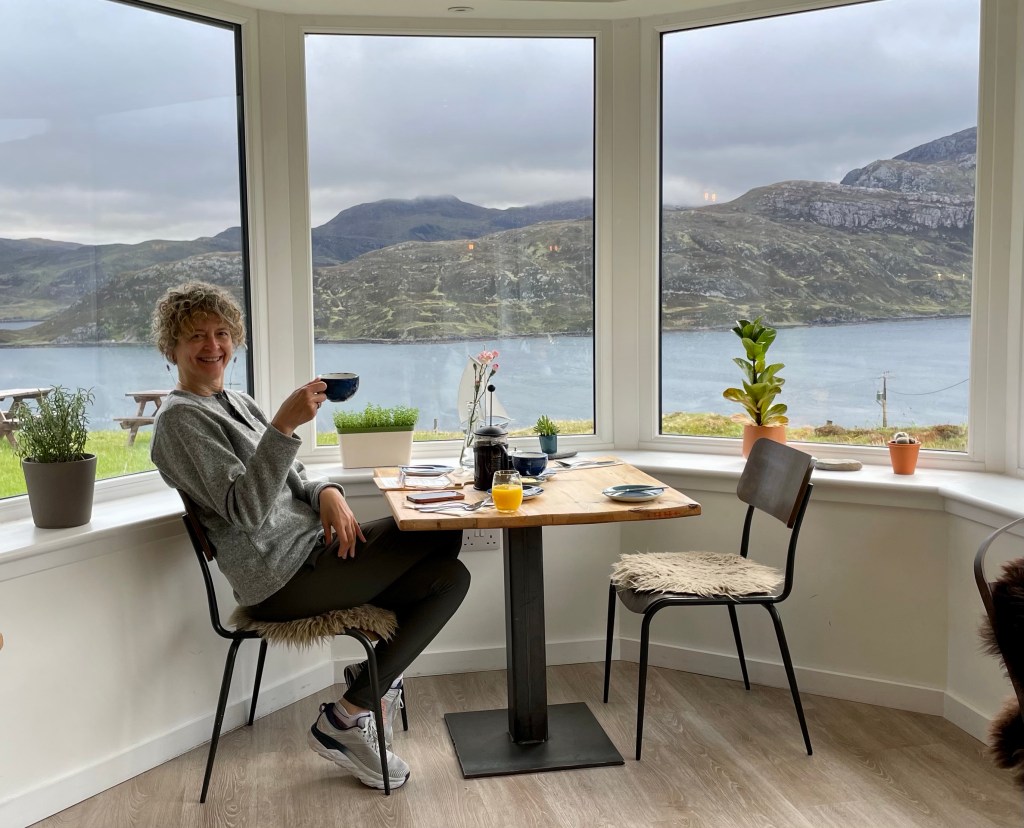
We stayed the night at Newton Lodge, which is situated in an impossibly gorgeous location on Loch Glencoul.
The view from the common room.Best breakfast spot ever.
I’ll leave you with a chance encounter we had with a cyclist we met as we arrived at Newton Lodge, John Loughran. We met him as he pulled up on his bike and tried to sort out where he had booked a room. As we were headed to nearby Kylesku Hotel for lunch, he asked for a ride. Of course we were happy to oblige, and John joined us for a lovely lunch. He is 78 years old, a retired engineer, and a Scot, although he has lived in England these past fifty years. He was riding the North Coast 500 in the opposite direction as we had done, riding valiantly through rain and wind and up and down serious hills on roads with no shoulders, or margins or verges as they are called, somewhat more descriptively than “shoulders.” John didn’t complain about any of it, just nodded and smiled, saying, “oh, it’s quite alright actually.” He told of a time when a local cyclist pedaled by who could see he was running out of steam on a climb. The guy rode alongside offering words of encouragement, and John said softly with a smile, “he got me through.”
John had planned the trip for 2020 along with a fellow cyclist. Sadly his friend bailed on the rescheduled ride, as his wife, whom John sweetly described as “a bit neurotic,” didn’t want to lose her husband for two weeks. John said proudly that his own wife, who was “very busy” and active in their community, was fine without him. He was “a bit disappointed” without his friend and his friend was “gutted” not be alongside him. I am slightly peeved by the clingy wife but like John’s wife very much. John added that he and his busy wife have five very successful children and seven grandkids spread around Scotland, England, Spain, Japan and Australia.
He showed us how he created a page for every day of his journey, carefully planning stops to recharge his electrical-assist bike. He shared many tales of his life, and how on this ride he was visiting spots in his home country that had meant a lot to his family over the years. John might be the sweetest man ever.
I’ll share one of his stories about a business trip he took to Rio in the fall of 2001. He was about to give a presentation to thirty of his colleagues when he heard someone say something bad had happened in the States. They all gathered around a television in time to watch the second plane hit the south tower. As he was telling the story, his mouth trembled and he broke down. He said he could not ever talk about that day without getting emotional, even after all this time. He said quietly, “of course, we cancelled the presentation, we simply could not go on.” When he was able to find a flight home, he remembers stepping over sleeping, marooned Americans in Schipol Airport. A reminder that the horrific 9/11 attacks took a psychic toll on humanity, even though they occurred on American soil. And the residual impact of that terrible day reverberates still, especially in empathetic souls.

















 Wee Dram of Scotland