Lothian and The Borders: Castles, Abbeys, Best and Happiest Towns, Bruce’s Heart, Walter Scott’s Crib and Roadside Attractions

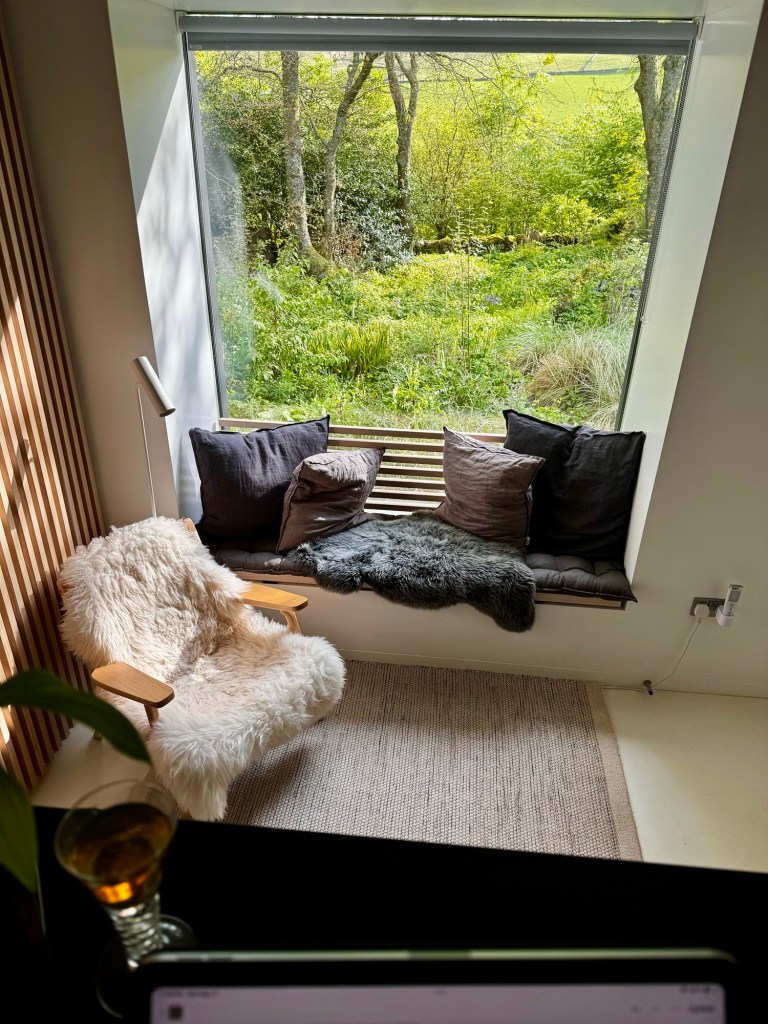
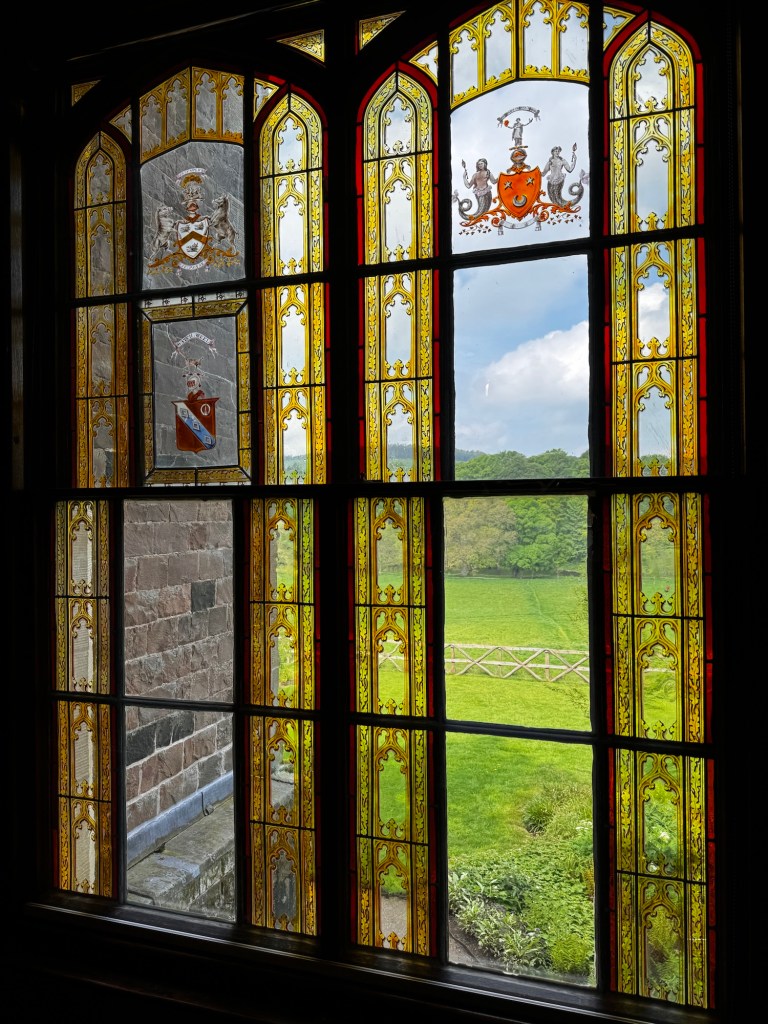
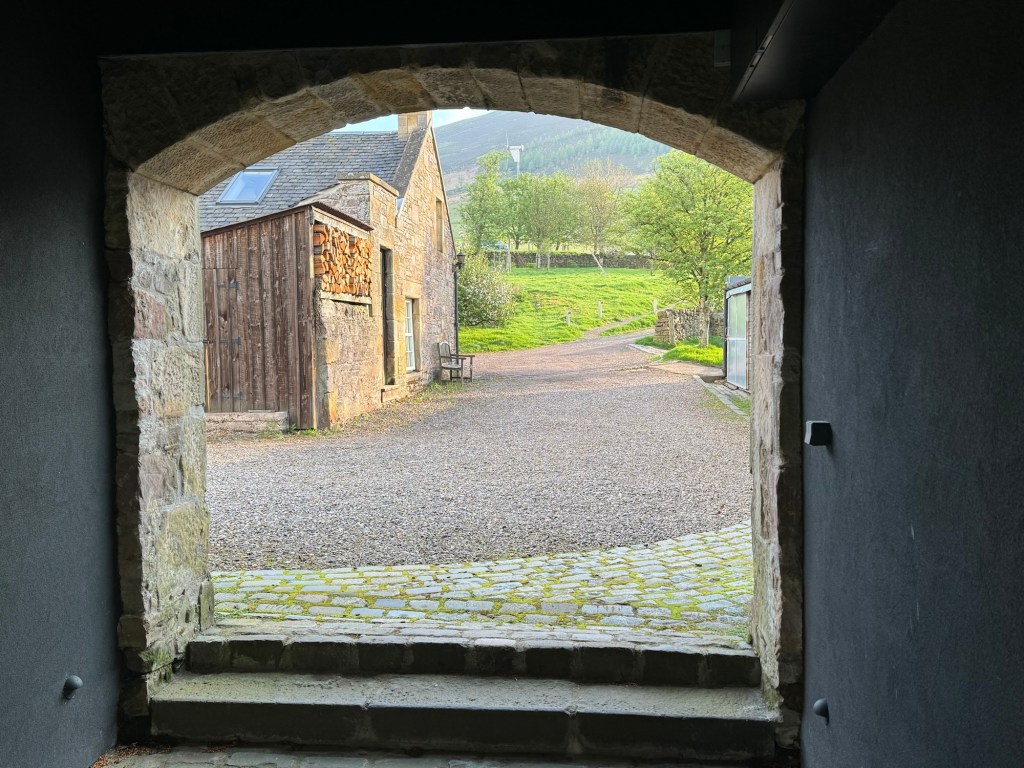
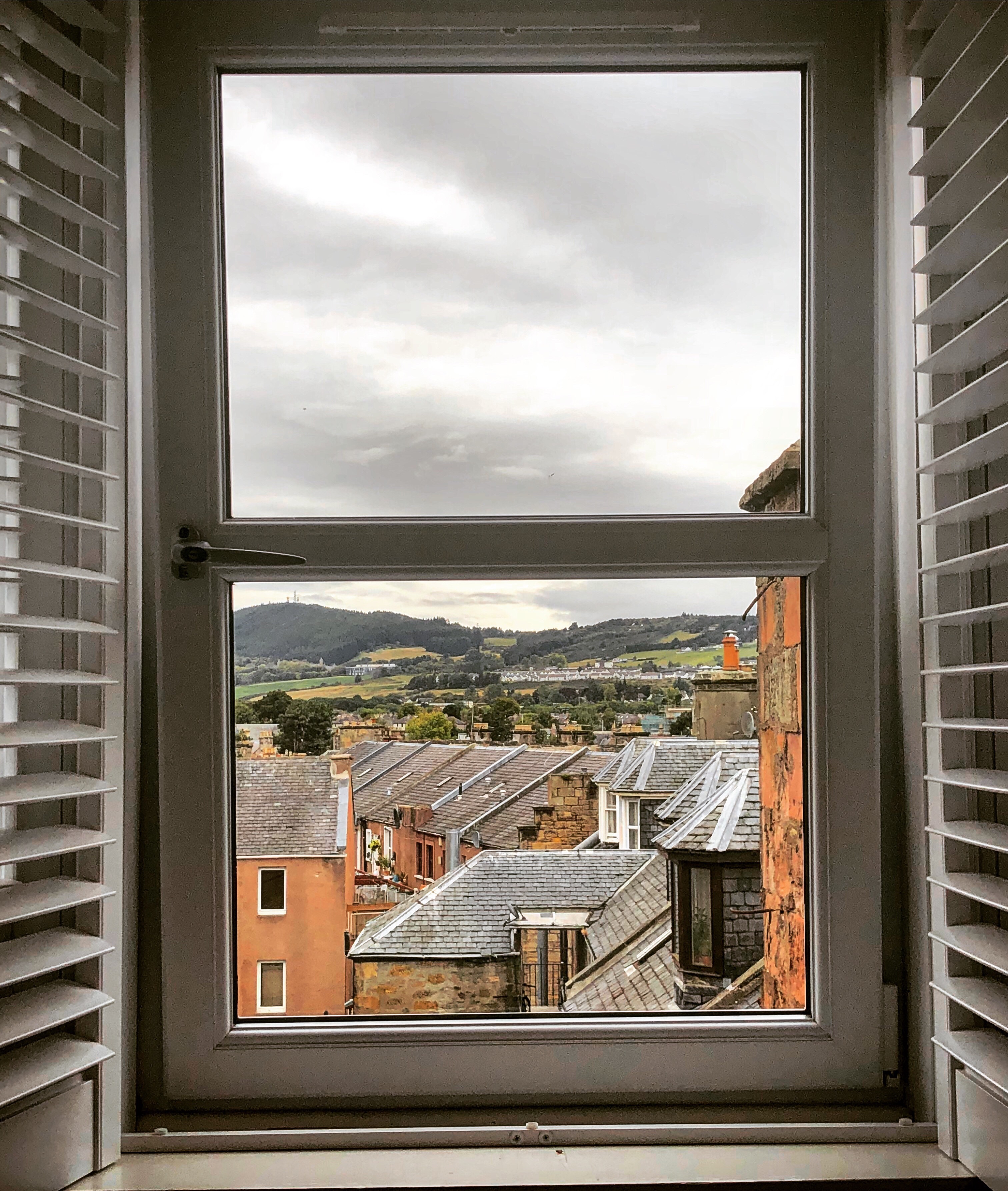
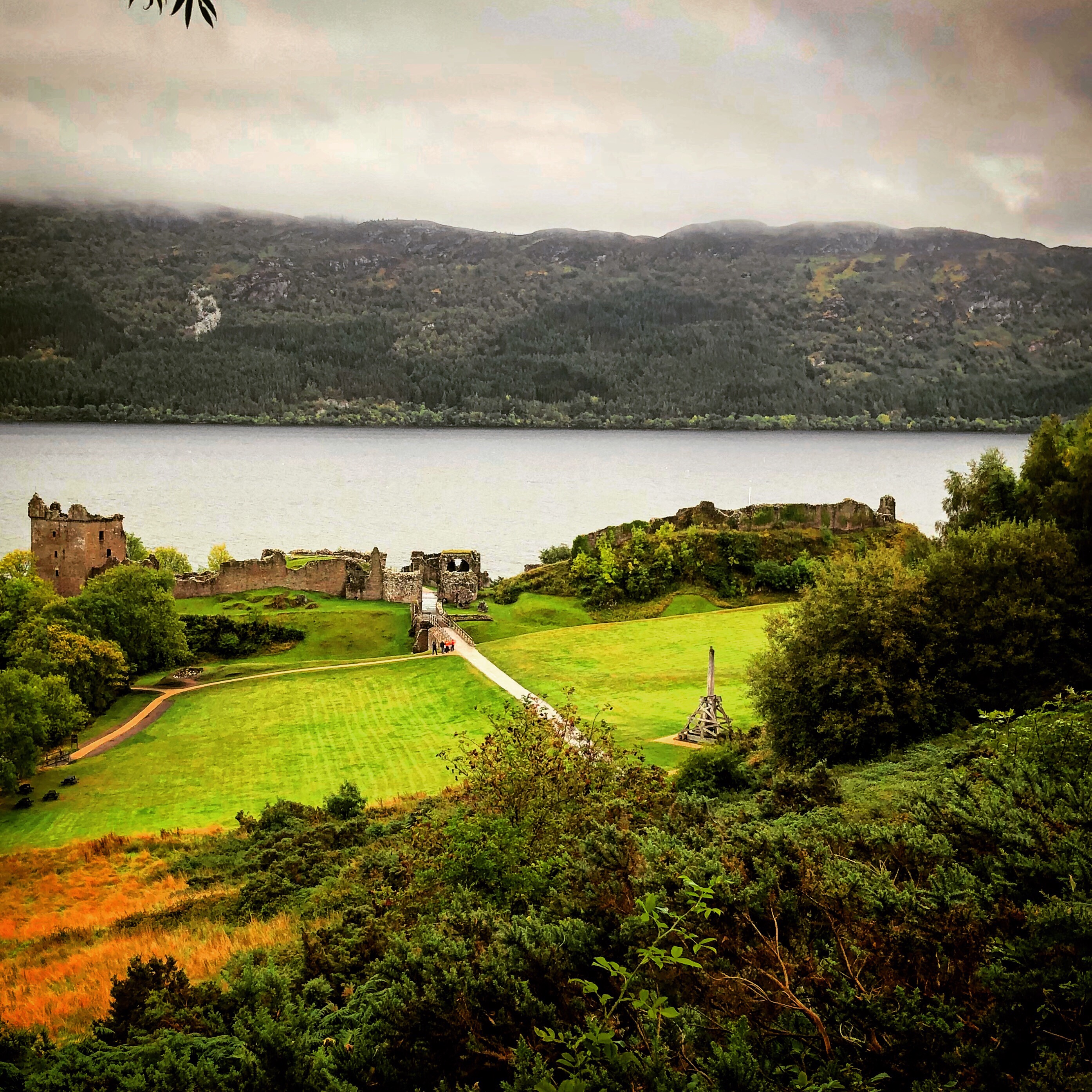
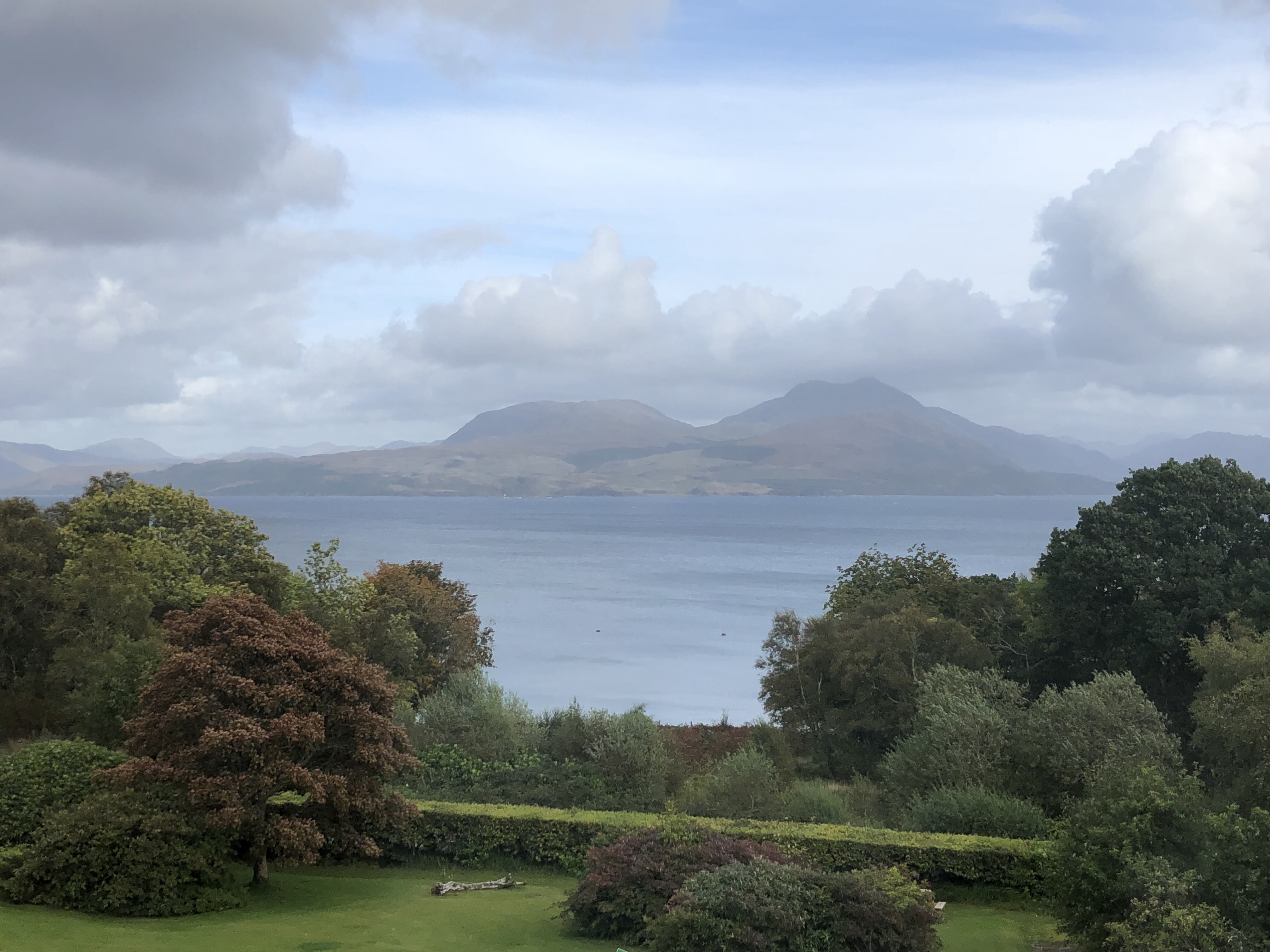
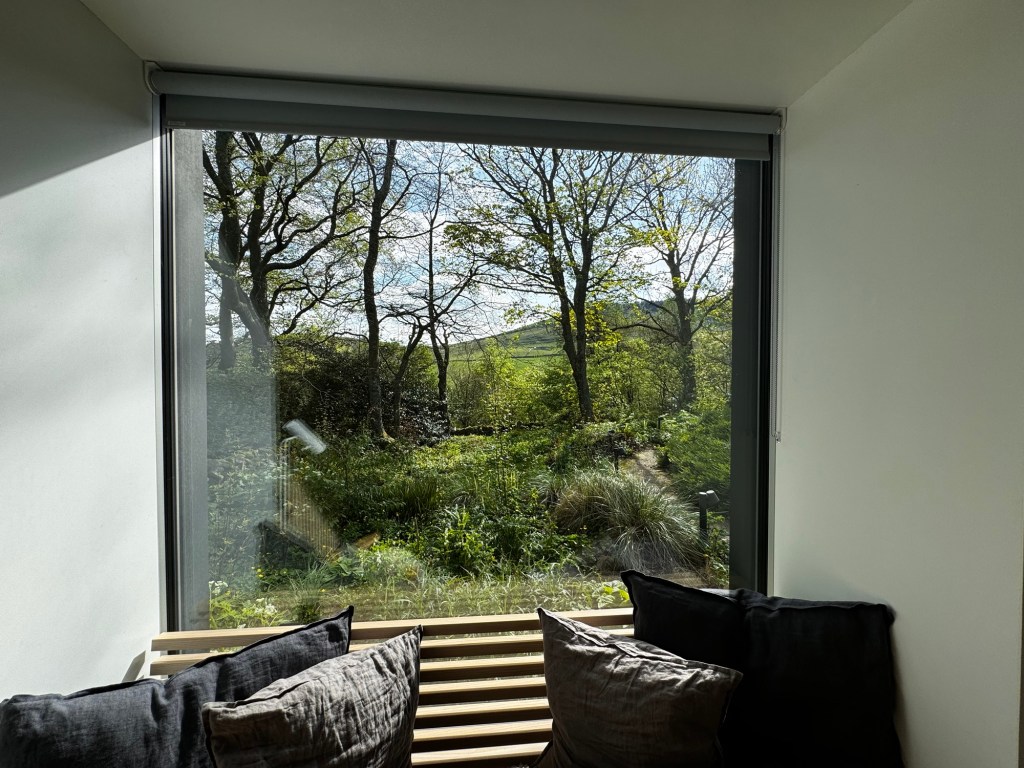
View from my abode at Eastside Cottages, Pentland Hills

On my way from Stirling to the Pentland Hills south of Edinburgh, I made a few stops to break up the brutally long 57 minute drive.

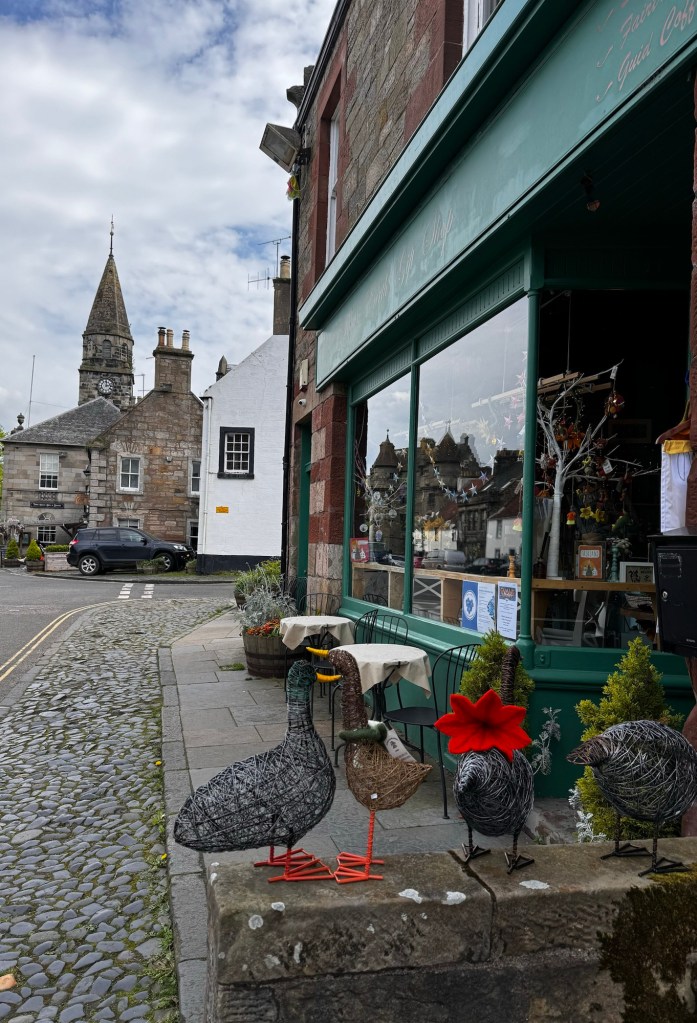
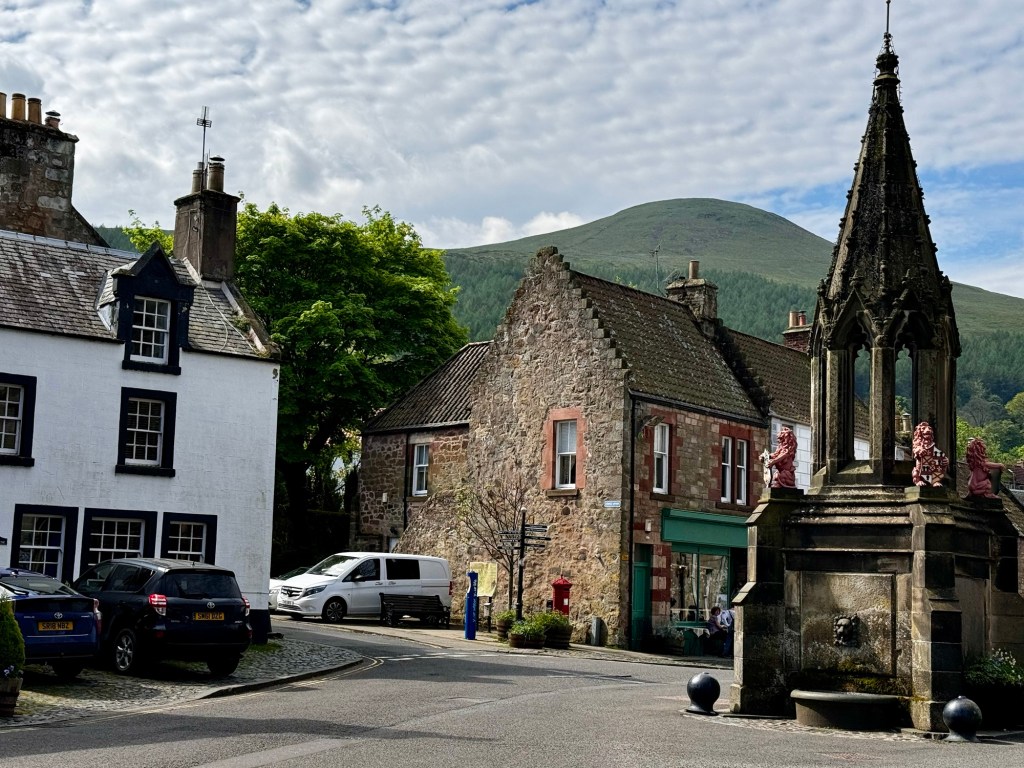
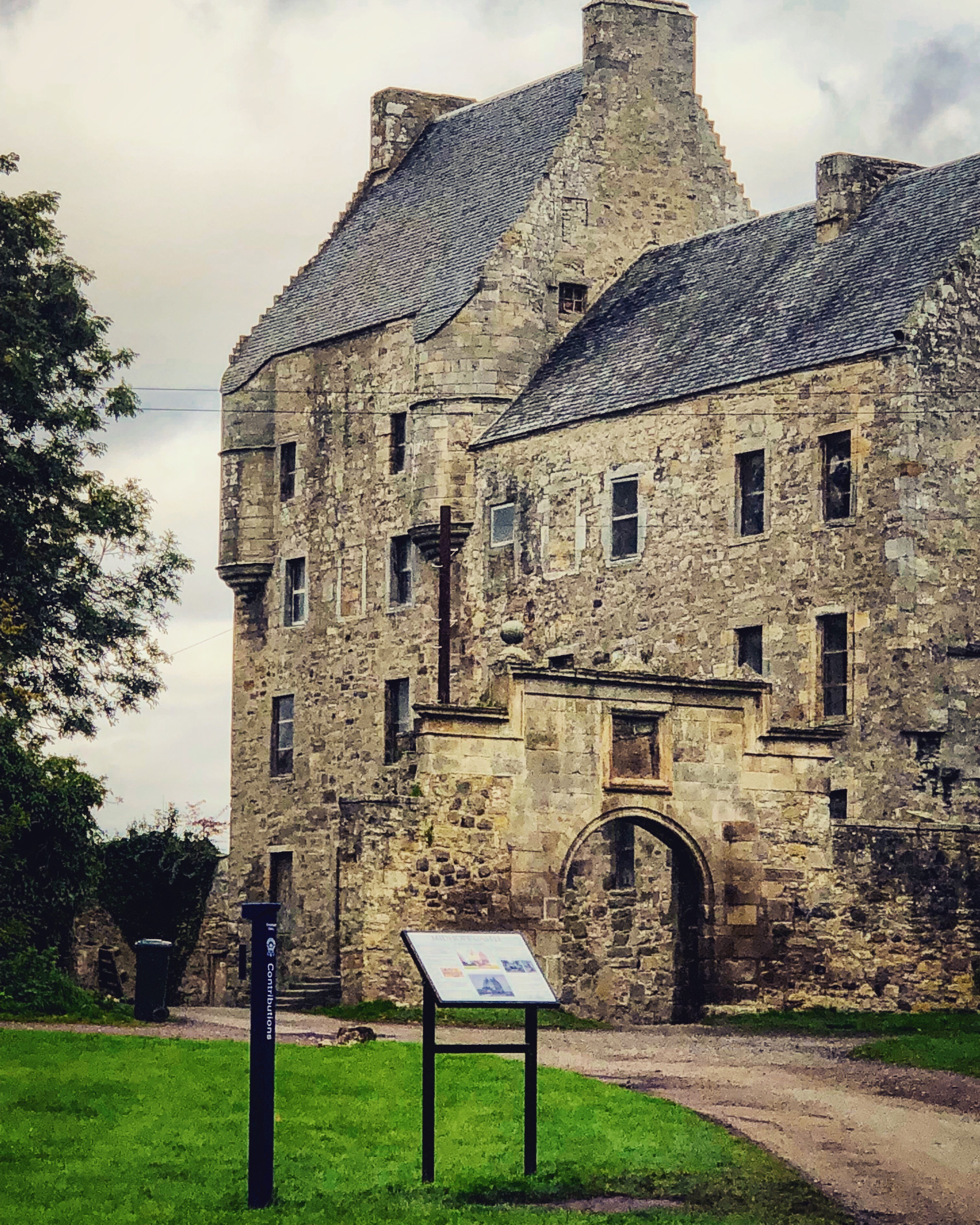
First was the picturesque little town of Falkland, a haven for Outlander film locations. Not only the town itself but also Falkland Palace, which was the Stuart Family’s Balmoral Castle in the 1600s.

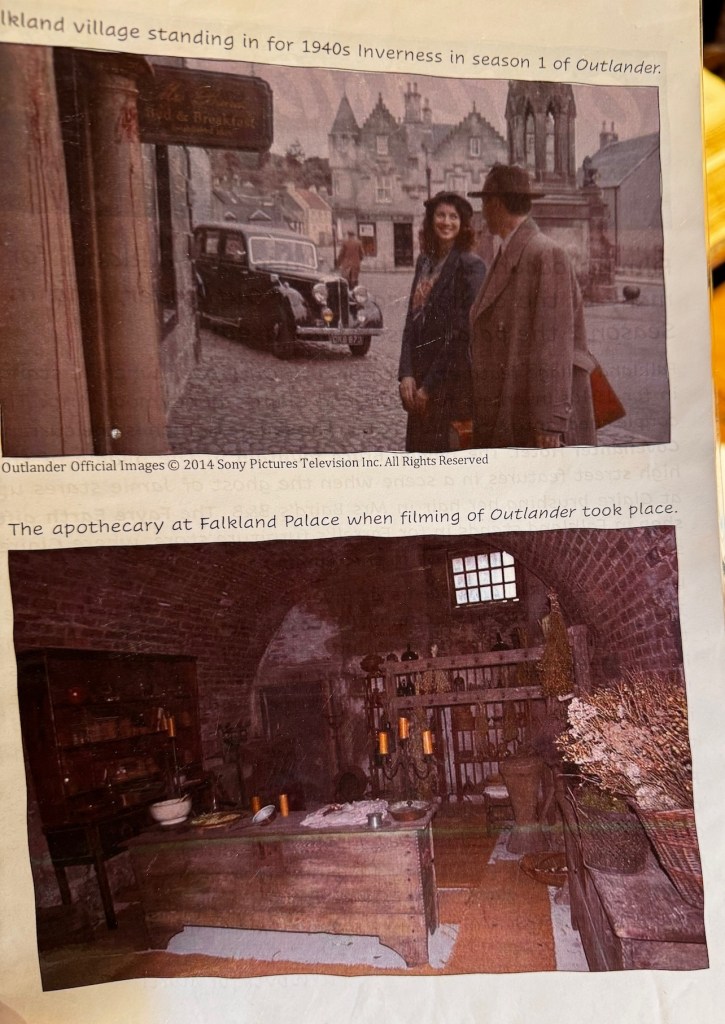
First, let’s do Outlander so you can roll your eyes and get it over with. Falkland was the main shooting location for Inverness because it looks more like how one imagines Inverness than Inverness itself.

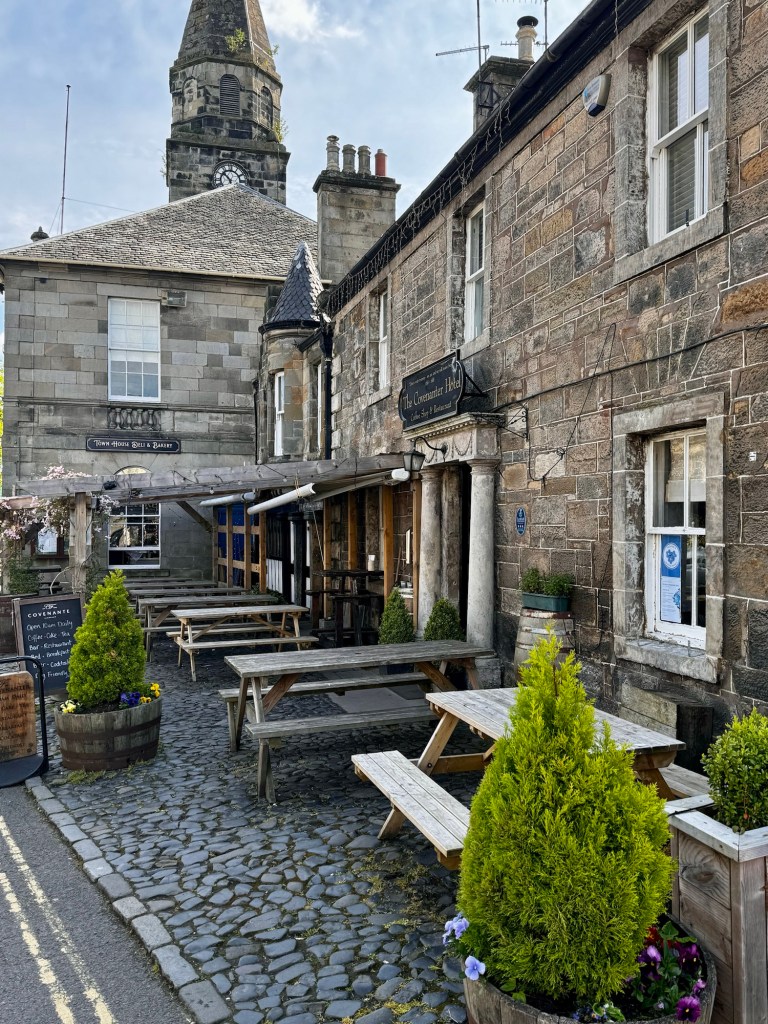
As many of you know, Claire and Frank, after the end of World War II, took a second honeymoon to Scotland and stayed at Mrs. Baird’s Bed & Breakfast, which was shot at the Covenanter Hotel. They display the sign used in the show inside. You will recognize other spots below.

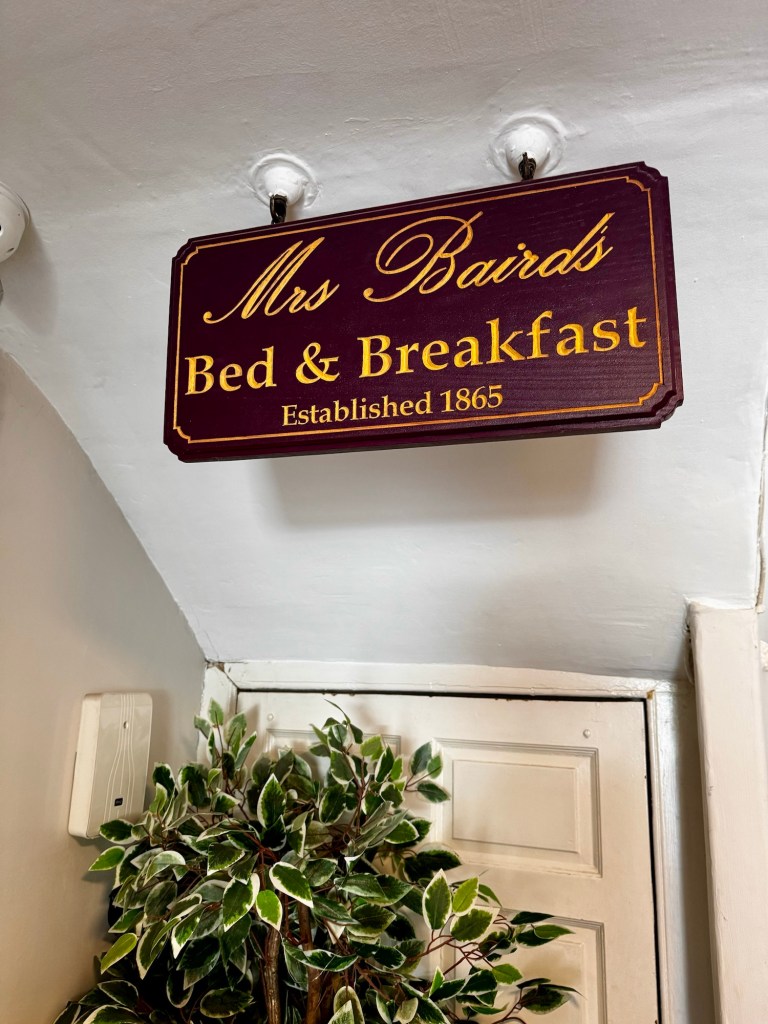
I mean why not take advantage.
The window where Claire saw the blue vase.
One of the most romantic scenes ever. And it was just a kilted Highlander from the 1700s watching a woman in the post-war 1940s brush her hair in an upstairs window. In the rain.
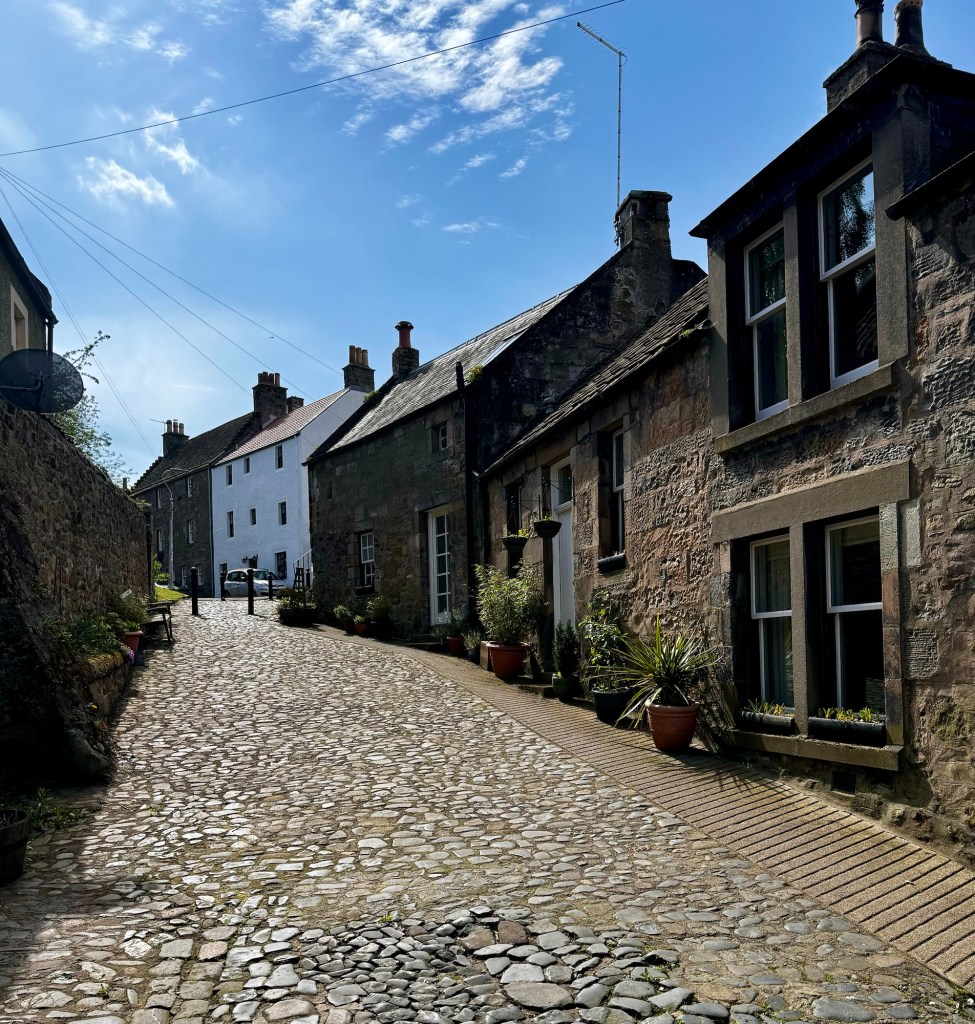
Claire and Murtagh walked down this street after visiting an ill Alexander Randall.
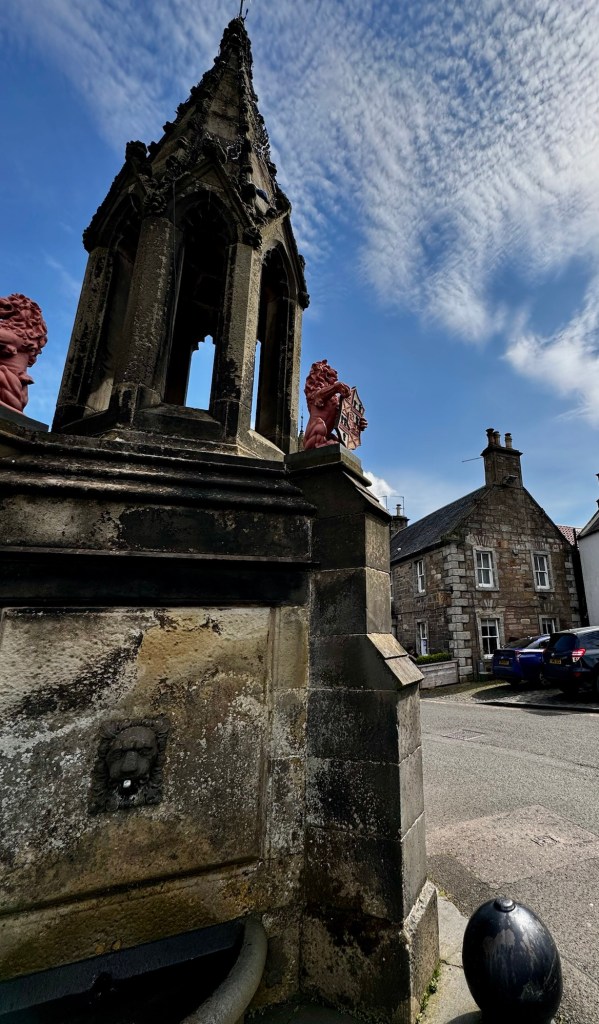
It’s a gorgeous little town, Falkland, Outlander aside.

And now to Falkland Palace, which is right in the center of town. Built in the thirteen century, James I (of Scotland) took possession of it for the crown two centuries later, after which it became a popular retreat for all the Stuart monarchs. This was one of Mary QOS’s favorite spots to get away from it all.
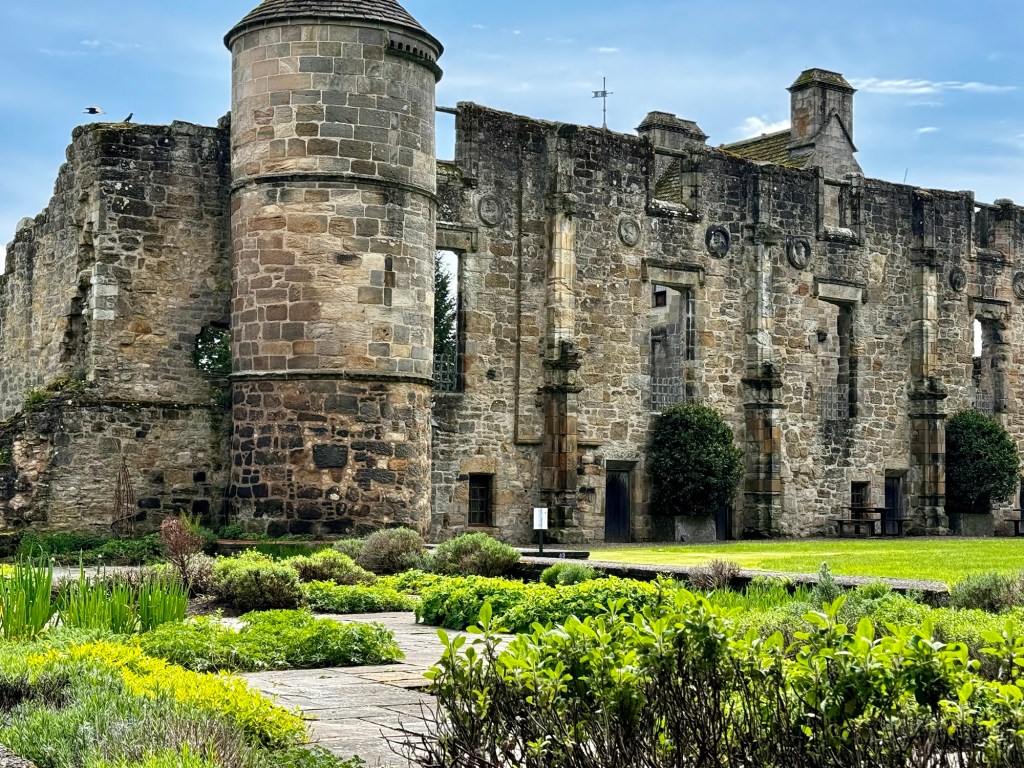
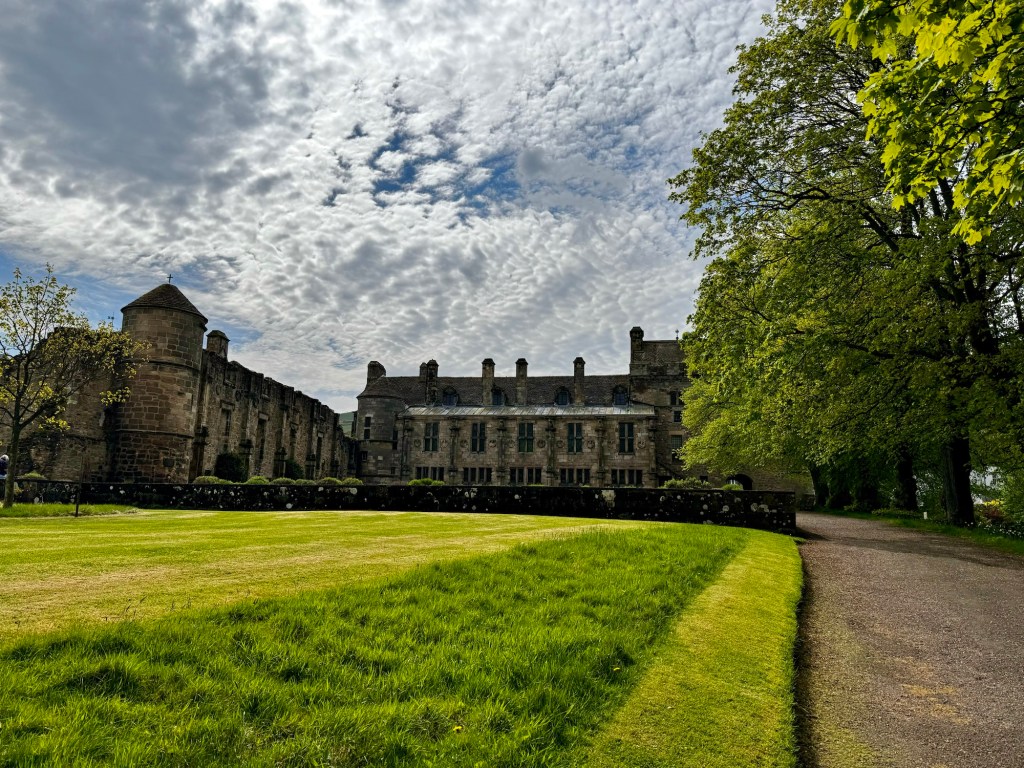
Falkland Palace

The palace is quite enchanting, and you’ll find the oldest tennis court in the UK on its grounds, built by James V in 1538 – and Mary, an accomplished athlete, often played here. Tennis was originally played by French monks before it became popular with nobility. The word comes from the French word tenez, or “hold on,” the warning that was shouted before every serve. (Let’s bring that back, shall we?) The game had different rules then, it was actually much more complicated – you can see a series of lines, numbers and crowns marked on the floor and walls, which were all used to calculate scores. All four walls and the roof of the spectator’s gallery were used (making it literally a dangerous spectator sport) plus players got extra points if they hit a ball through a hole in the wall. Also a servant would serve to avoid the fancy people having to bend their bodies in their ridiculous restrictive clothing. Mary QOS played in breeches for this reason – badass that she was.

A couple of lovely nooks inside the Palace.
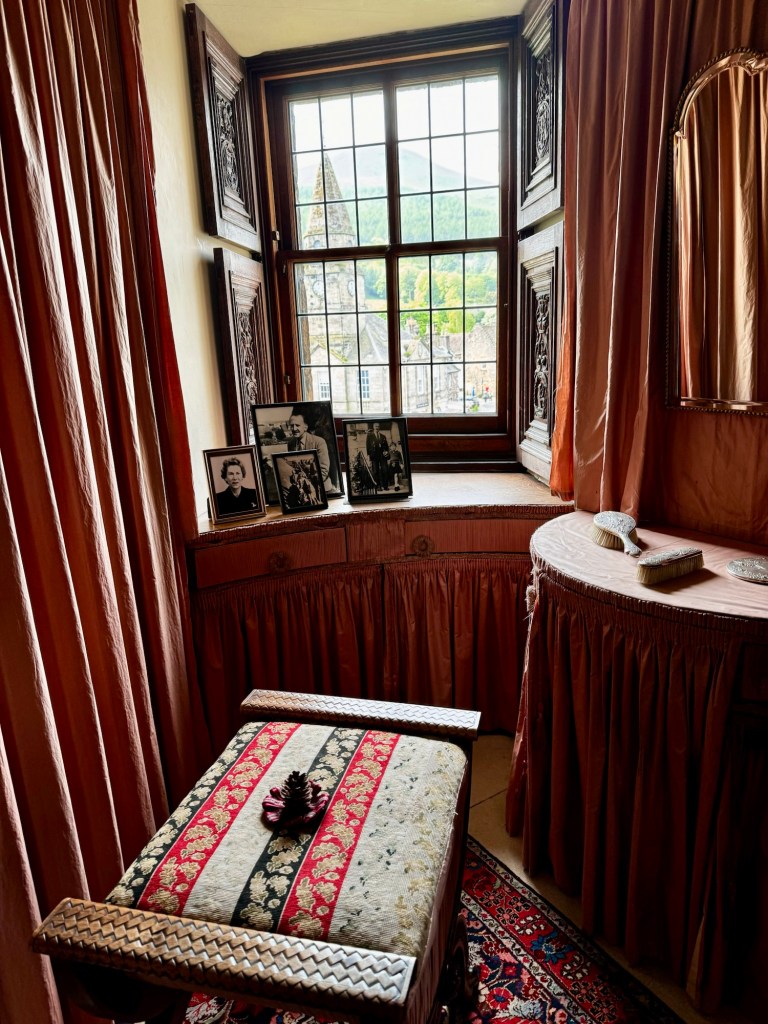
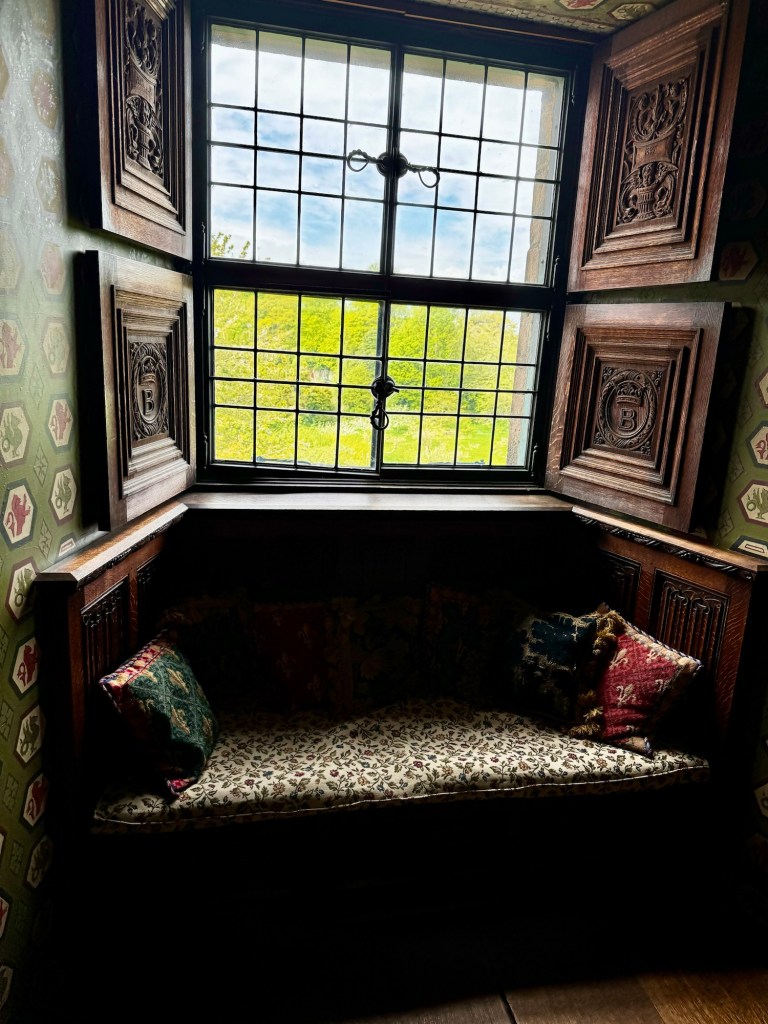
There’s one minor Outlander shooting location inside the Palace. The apothecary scene where Claire sees Mary Hawkins buying laudanum for Alex Randall is there, and the castle has kept the location roughly as it was during filming because why wouldn’t you.
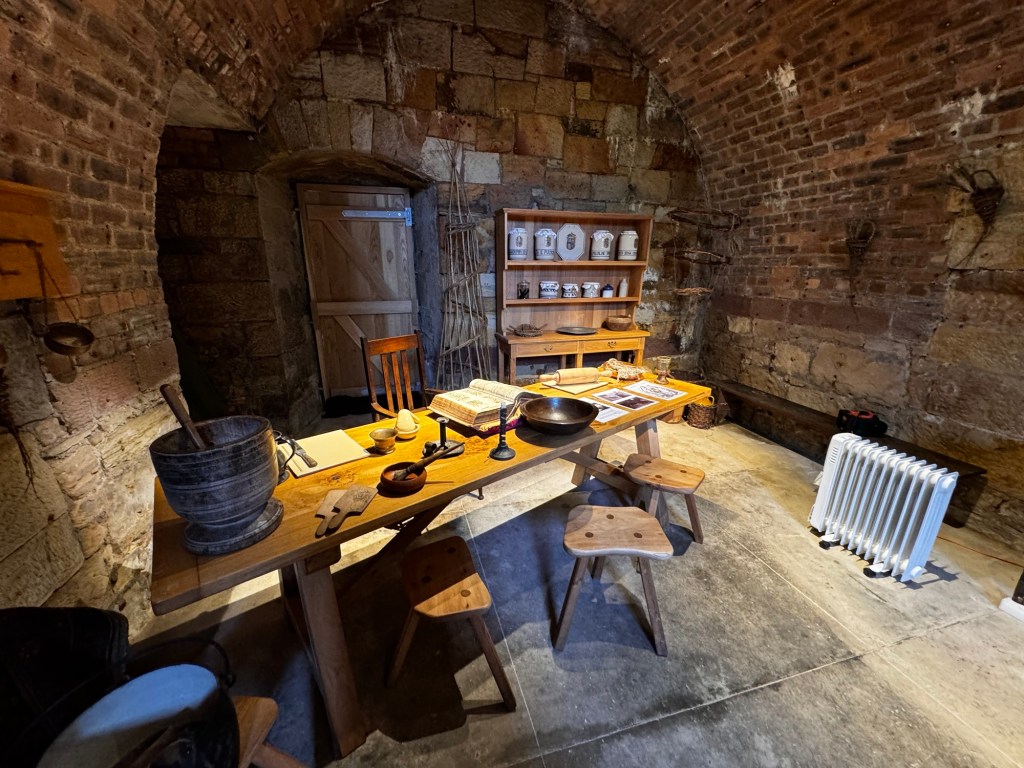
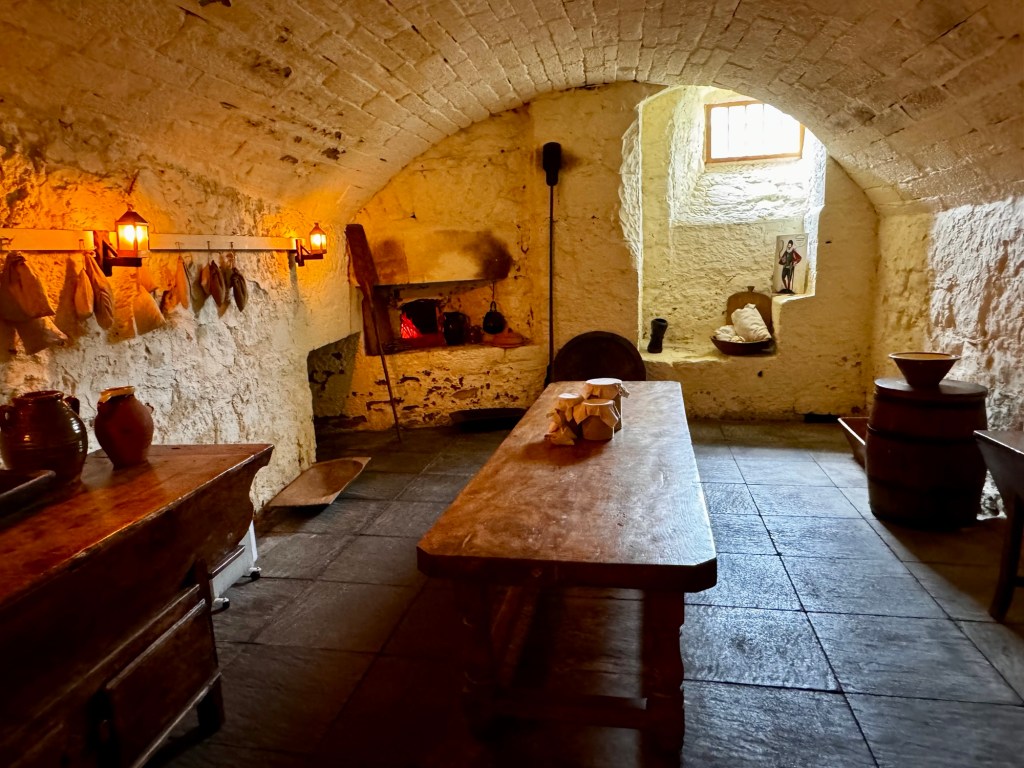
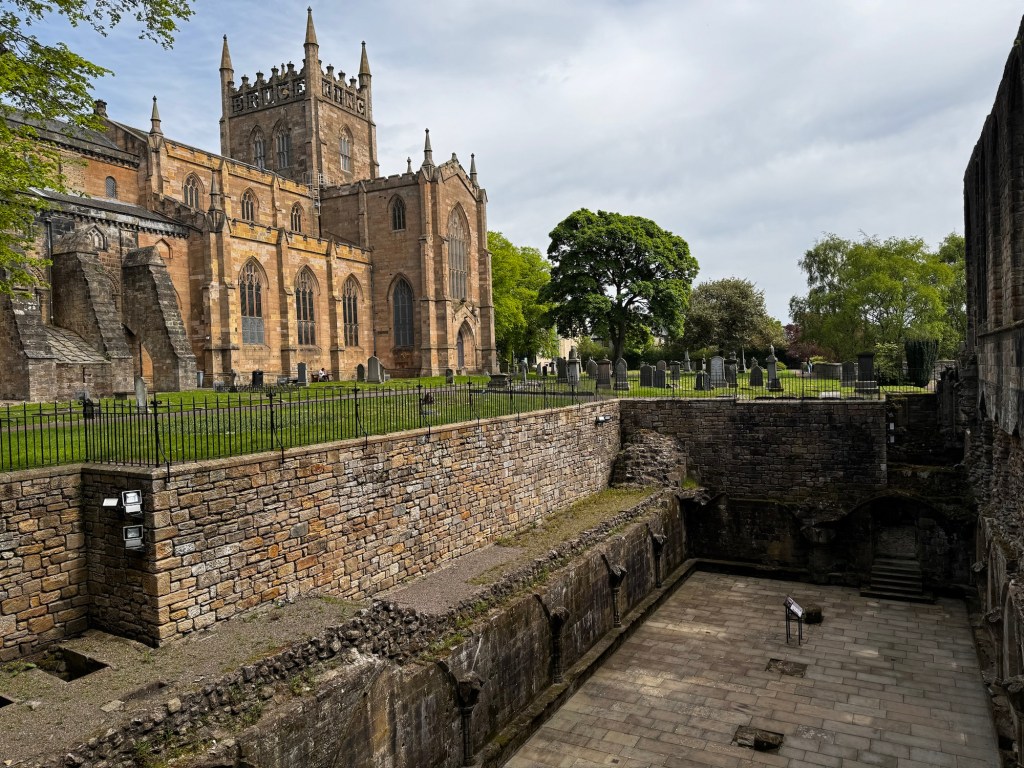
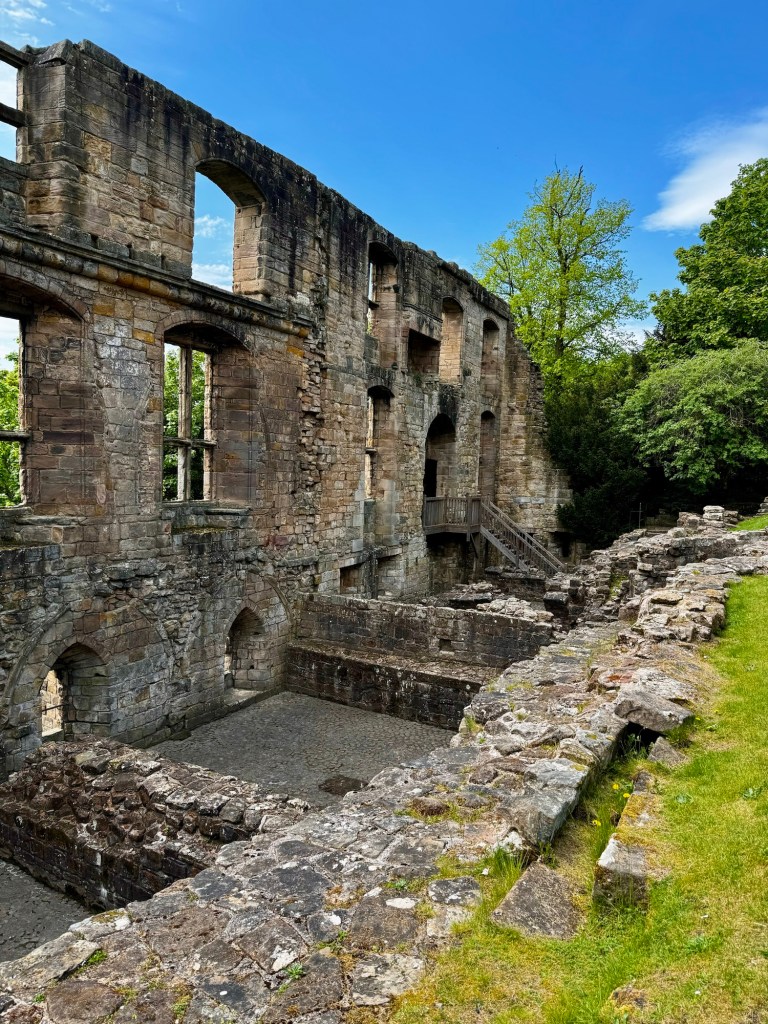
Next on our mini road trip is Dunfermline Abbey & Palace, which was given to Princess Anna of Denmark as a wedding present when she married James VI in 1589. The medieval Benedictine abbey still exists, even after being sacked by Cromwell, and it’s connected to a newer parish church still in use. You can also see ruins from numerous nearby structures, all built by Queen Anna. She turned Dunfermline into an incredible royal residence.

Many of the old kings of Scotland are buried here, including Malcom III and IV, Edgar I, Alexander I, and David I, Malcolm IV, Alexander III, although we don’t know the exact location of their graves, which is disappointing.

The ruins and abbey are stunning.
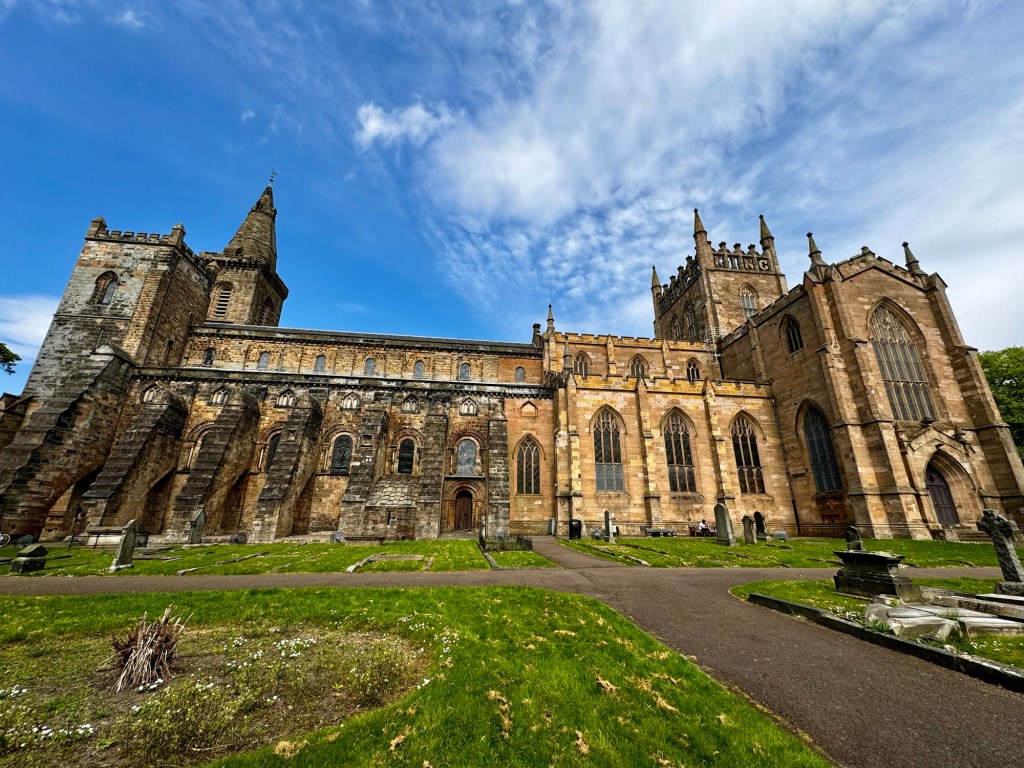
Dunfermline Abbey, the older section on the left.
Palace ruins.
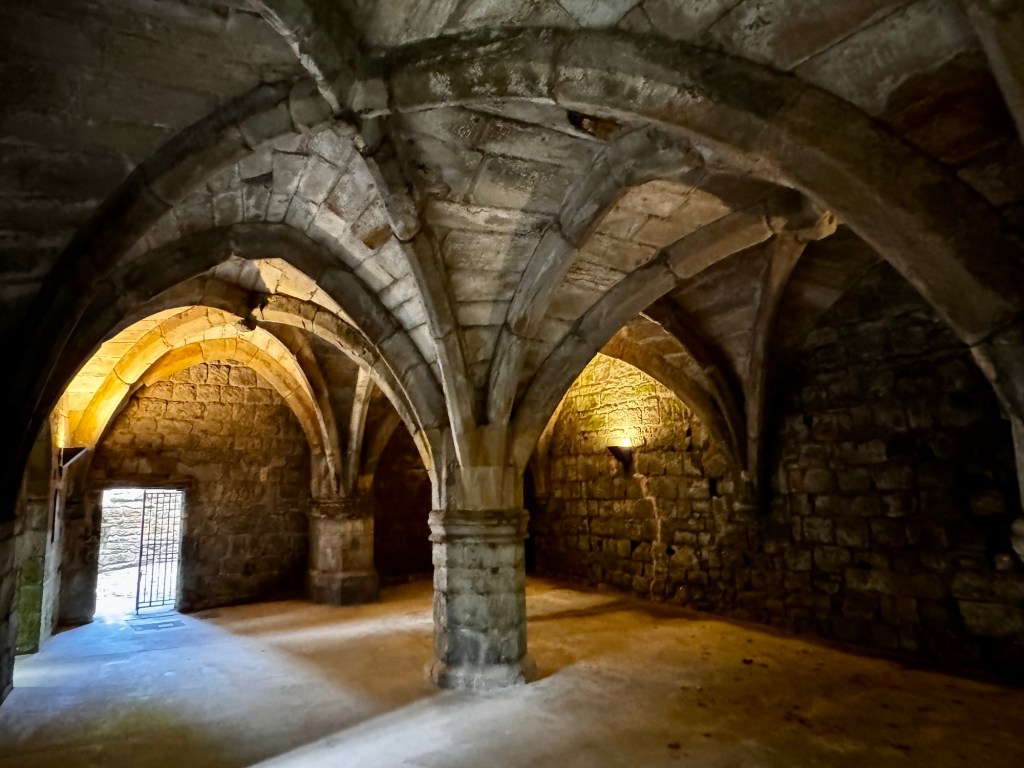
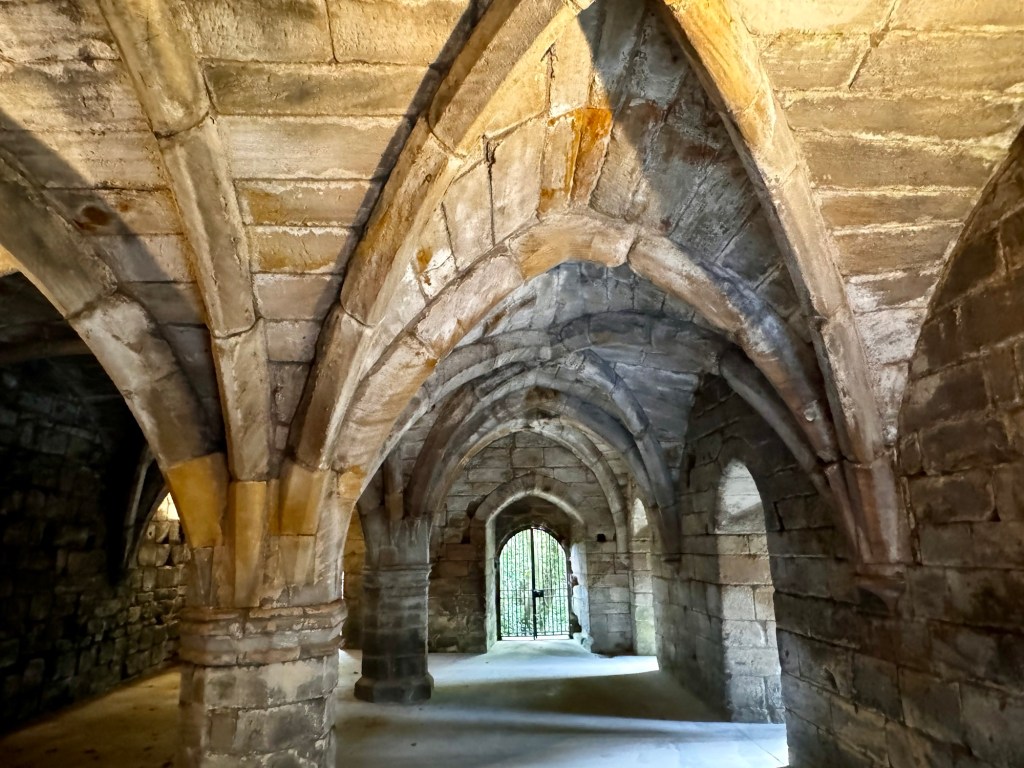
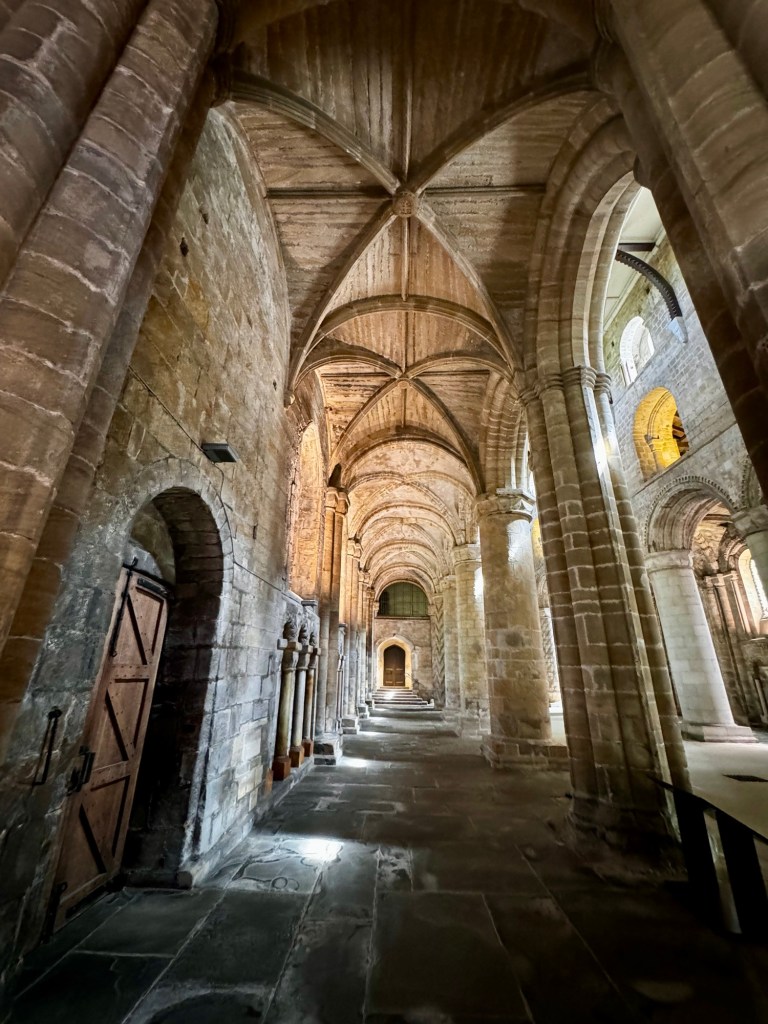
The Old Abbey. It’s big, dark and cold. Very cool.

While we may not know exactly who is buried where inside this gorgeous abbey, one dude we do know about, and that is King Robert the Bruce (minus his heart, stay tuned). This is the very incongruous part. His remains were moved around a bit, but he’s now interred in the more recent section of the church (let me tell you its jarring to walk from the ruins of the beautiful stone cathedral into the parish church, like stepping through a portal and not in a good way). The Bruce, man of legend, is installed beneath the raised platform the current pastor sermonizes from, otherwise known as the pulpit. He shouldn’t be underneath this tacky wooden thing. The church is all white walls and blue carpeting and also the shiny gold leaf does not seem like the appropriate vibe. Personally I wouldn’t have planted him there, aesthetically speaking.
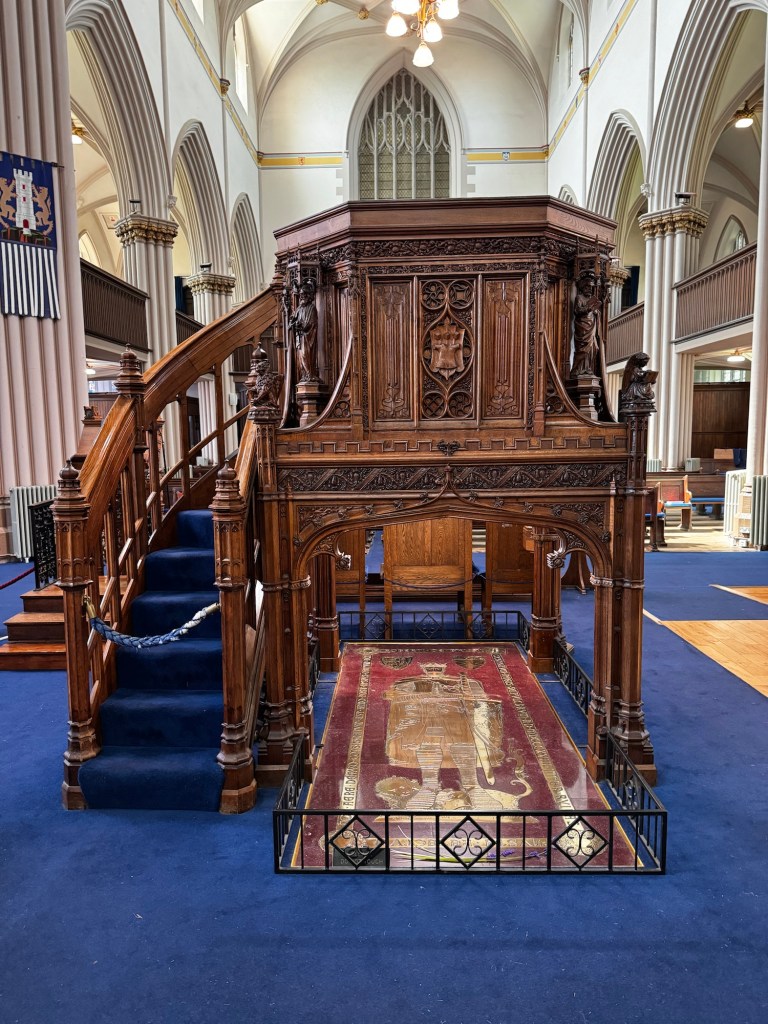
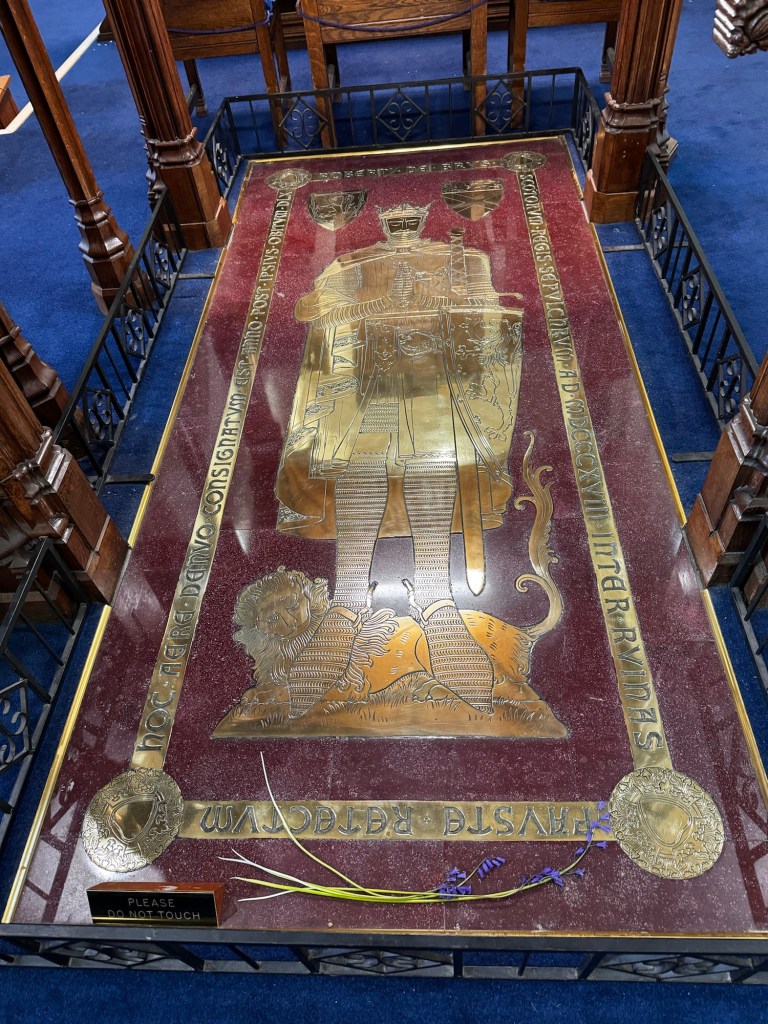
I object.

Having had my fill of old royalty, arriving at the beautiful Eastside Cottages was a balm for the soul. The owners of the farm have refurbished the outbuildings with a scandy vibe and it’s quite wonderful. During the pandemic they posted nature moments of Zen on instagram, several minutes of natural beauty, nothing more than a breeze, birdsong, hills and peace. I think I watched every one of them.

Here are a few photos from the lovely five days I spent here.
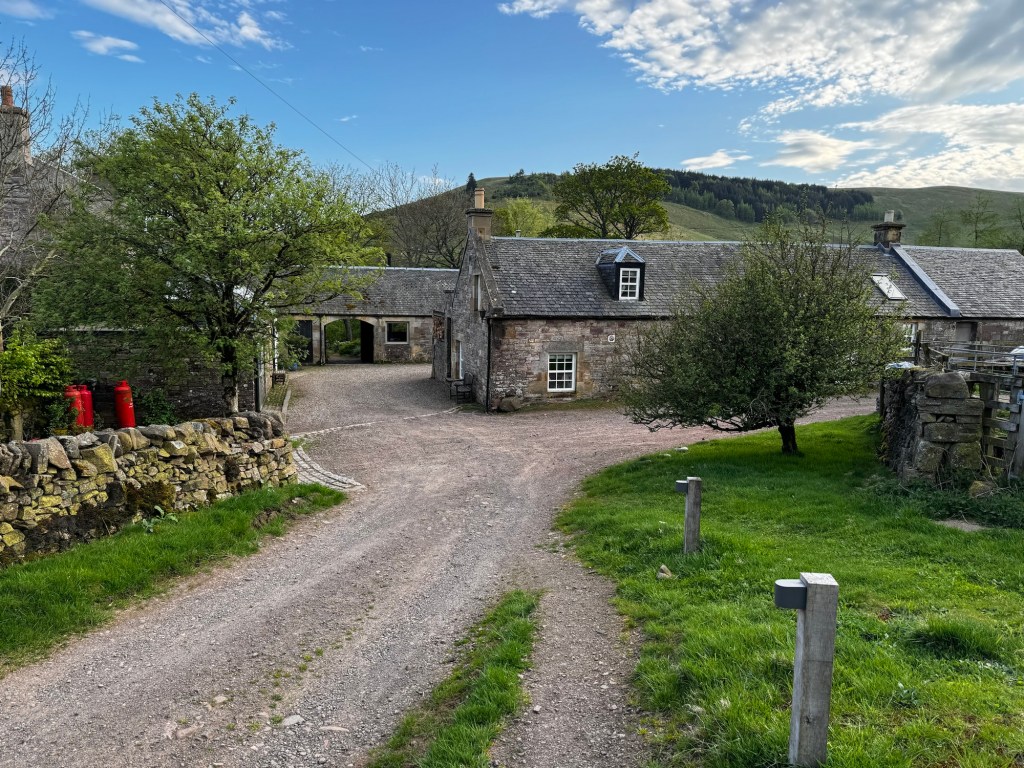
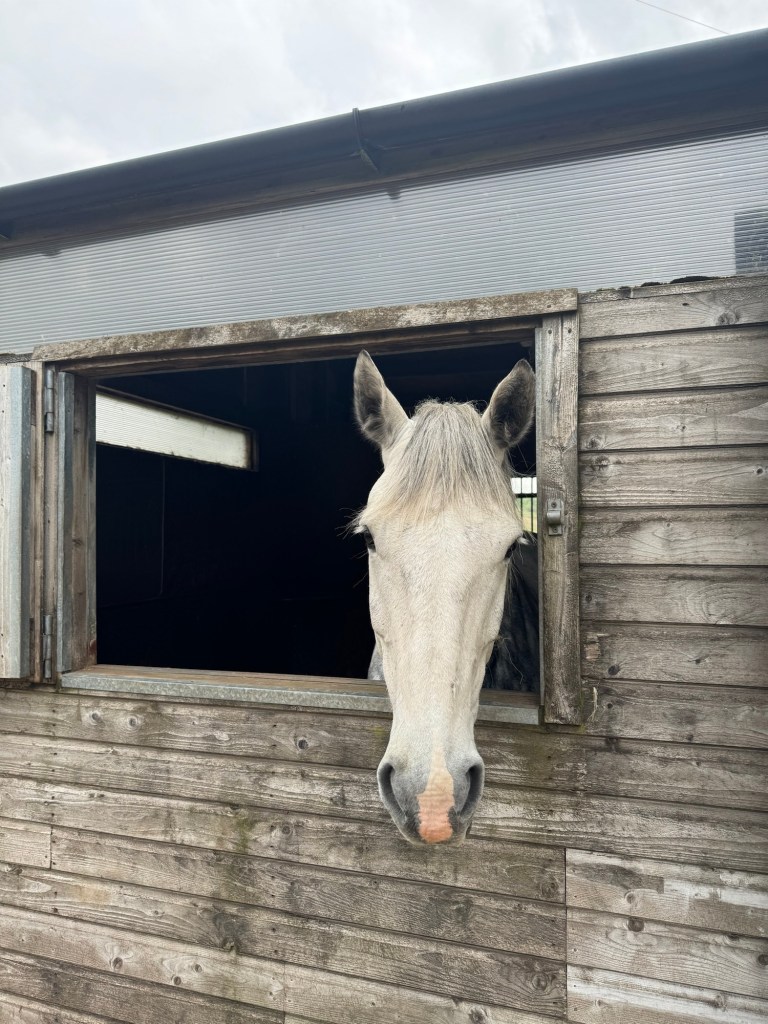
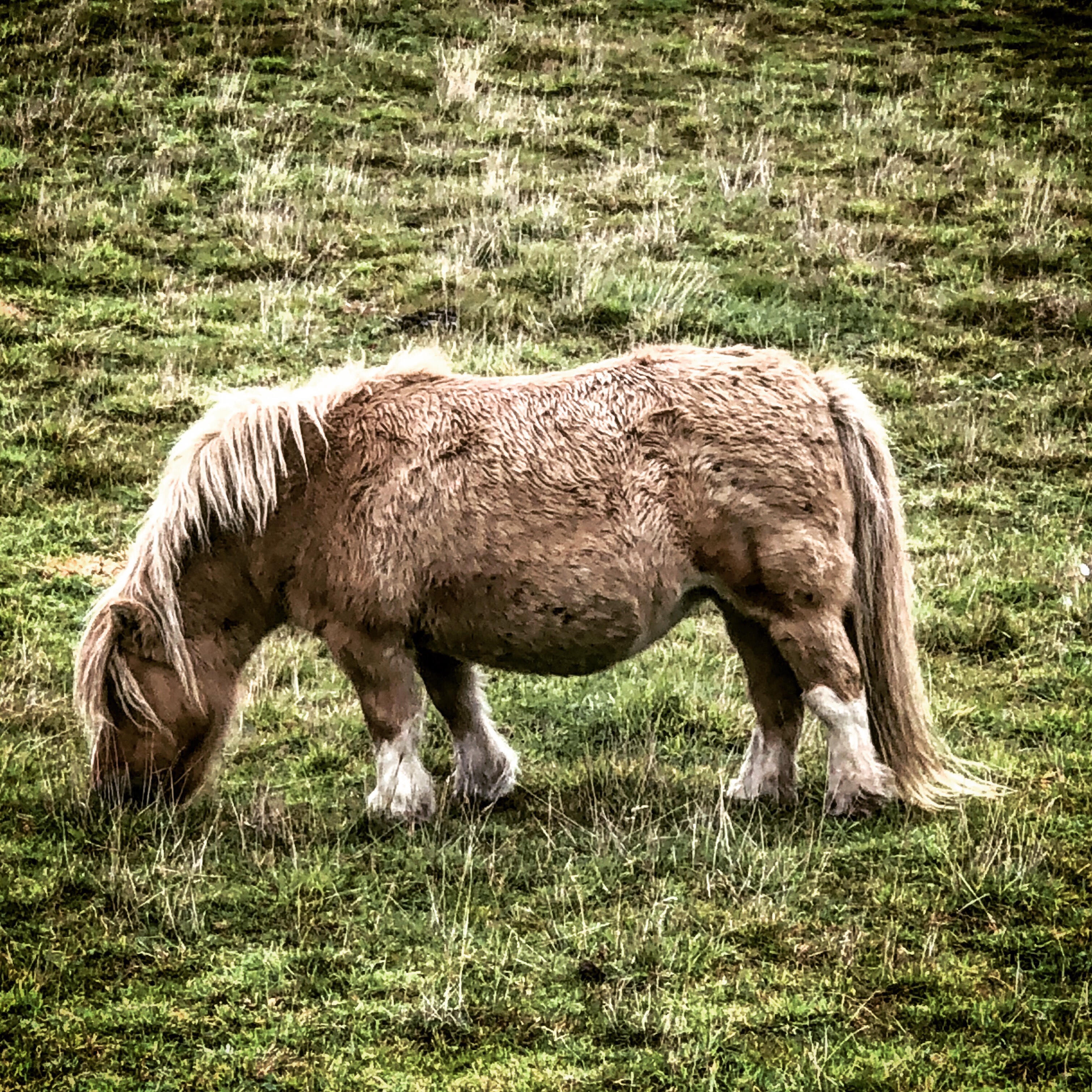
Meet Oscar the fabulous horse.

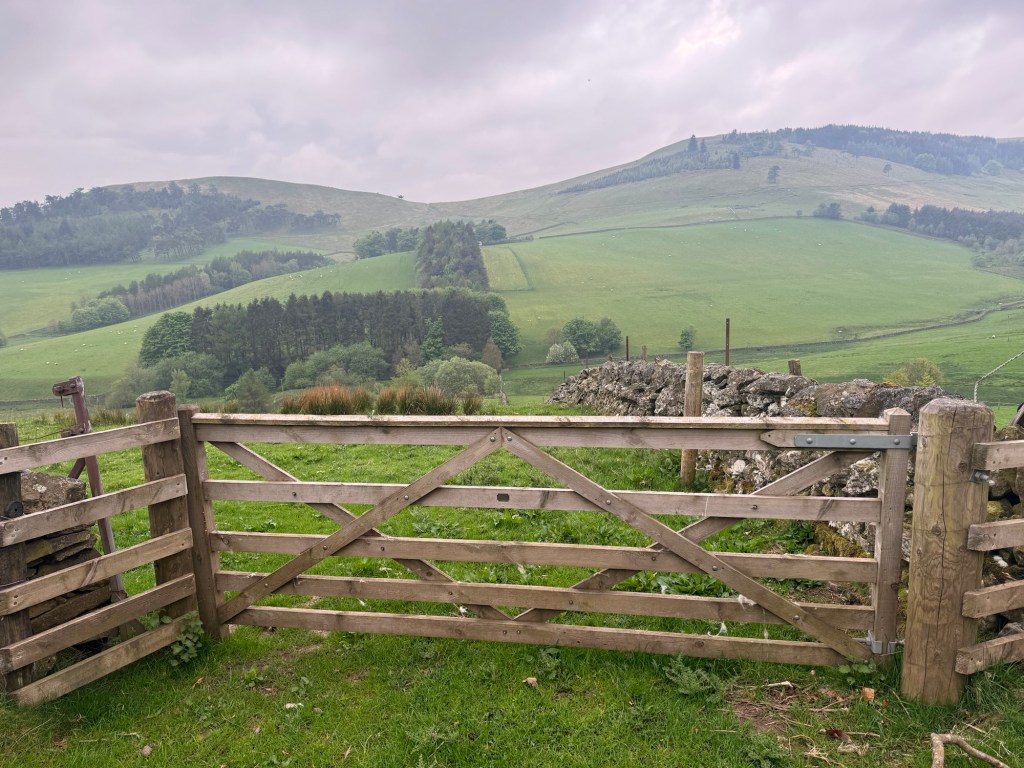
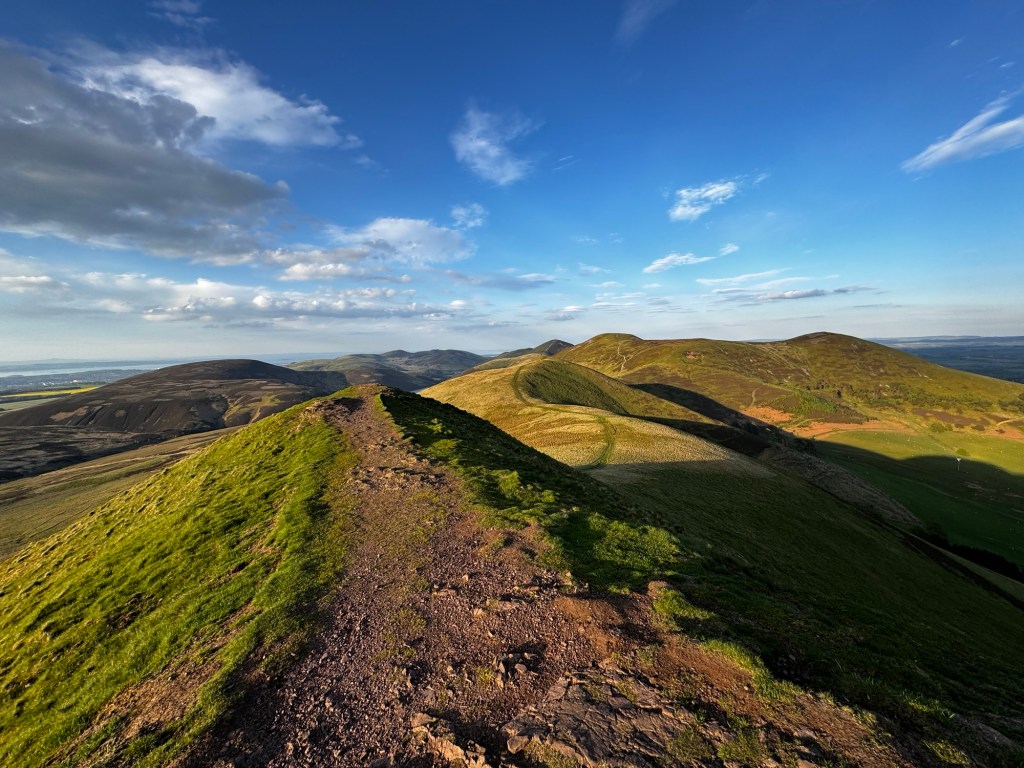
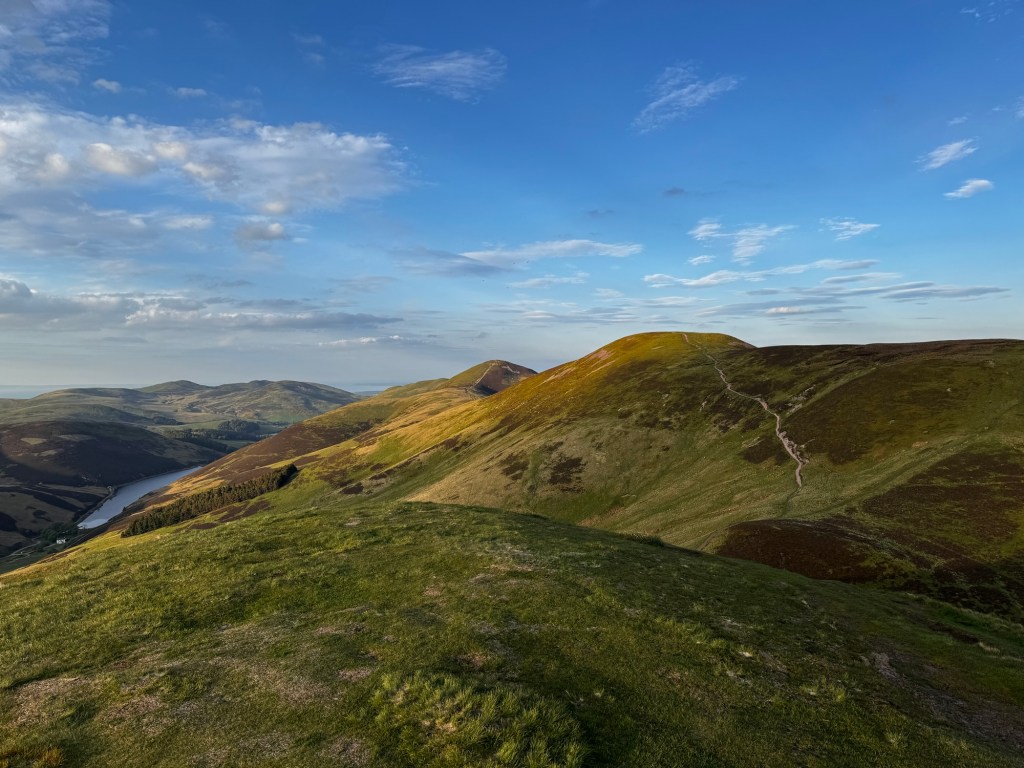
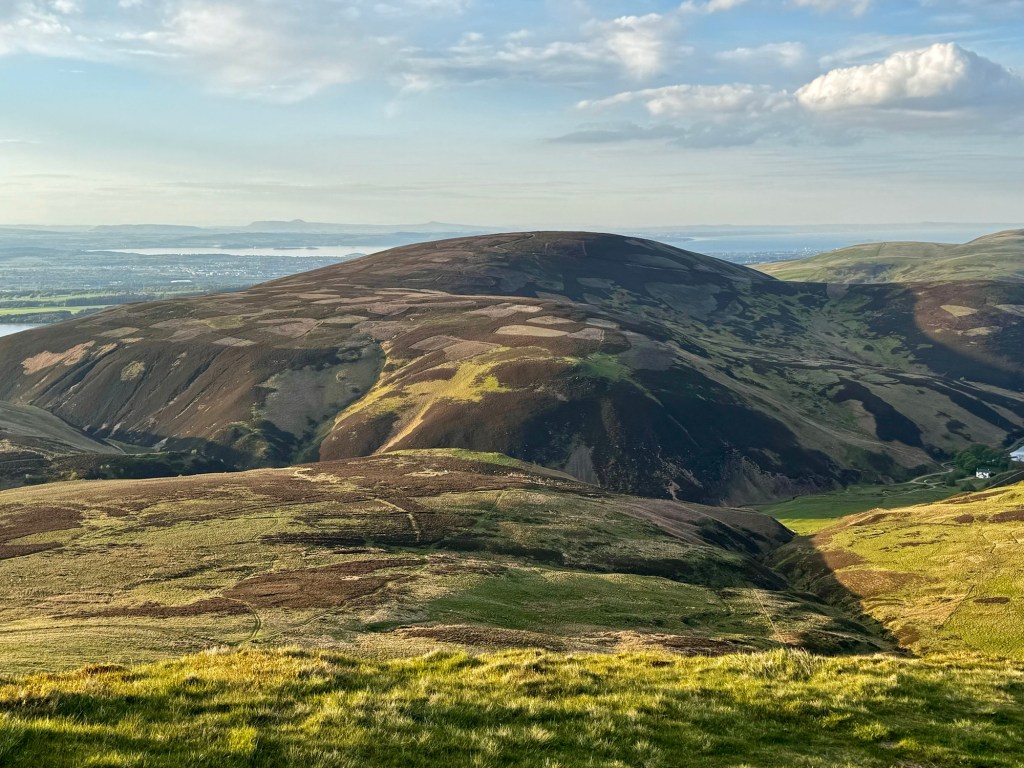
My first night, I walked up to the top of the two hills behind the farm, called West Kip and East Kip. A great walk with unbelievable views toward Edinburgh and the River Forth and across the Pentland Hills.

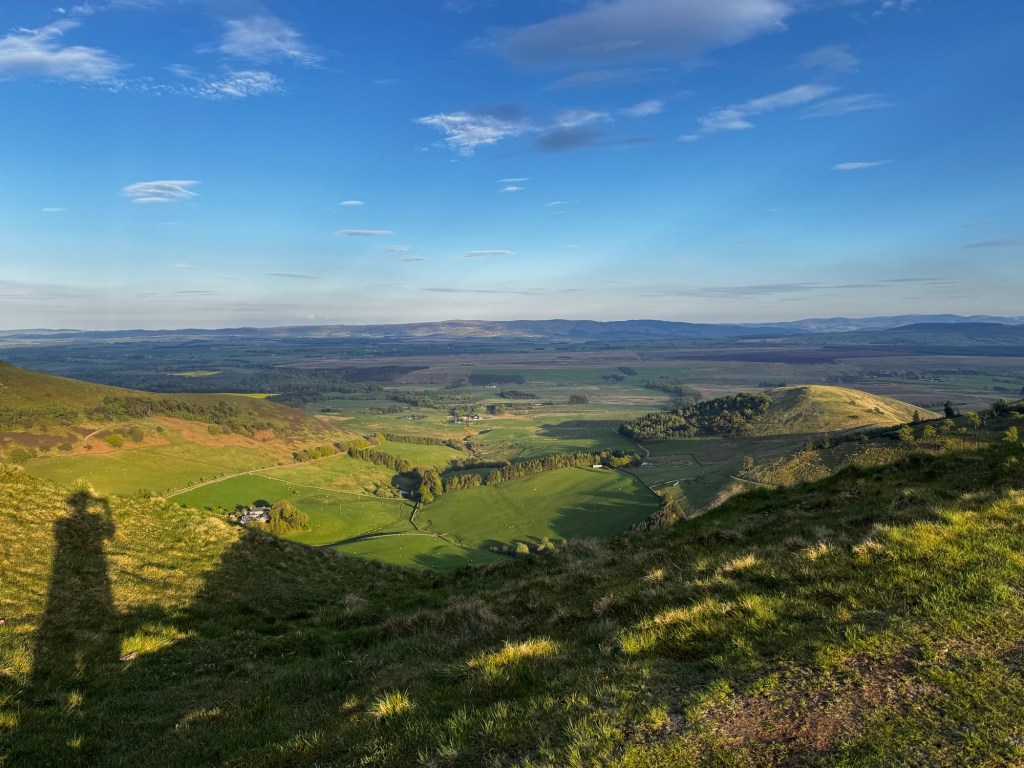
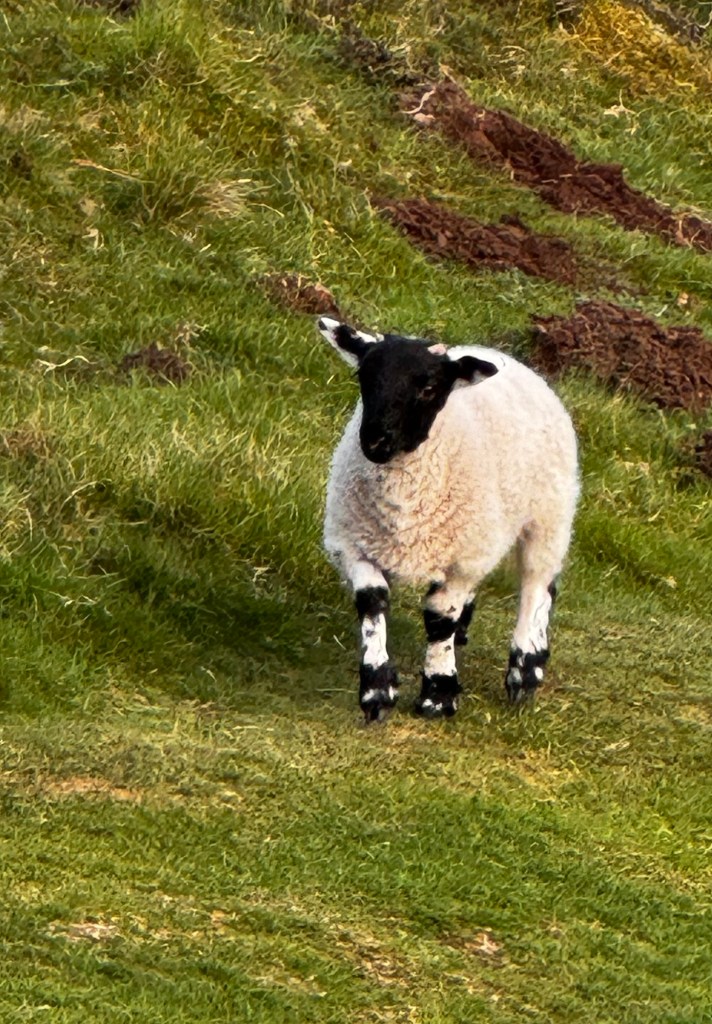
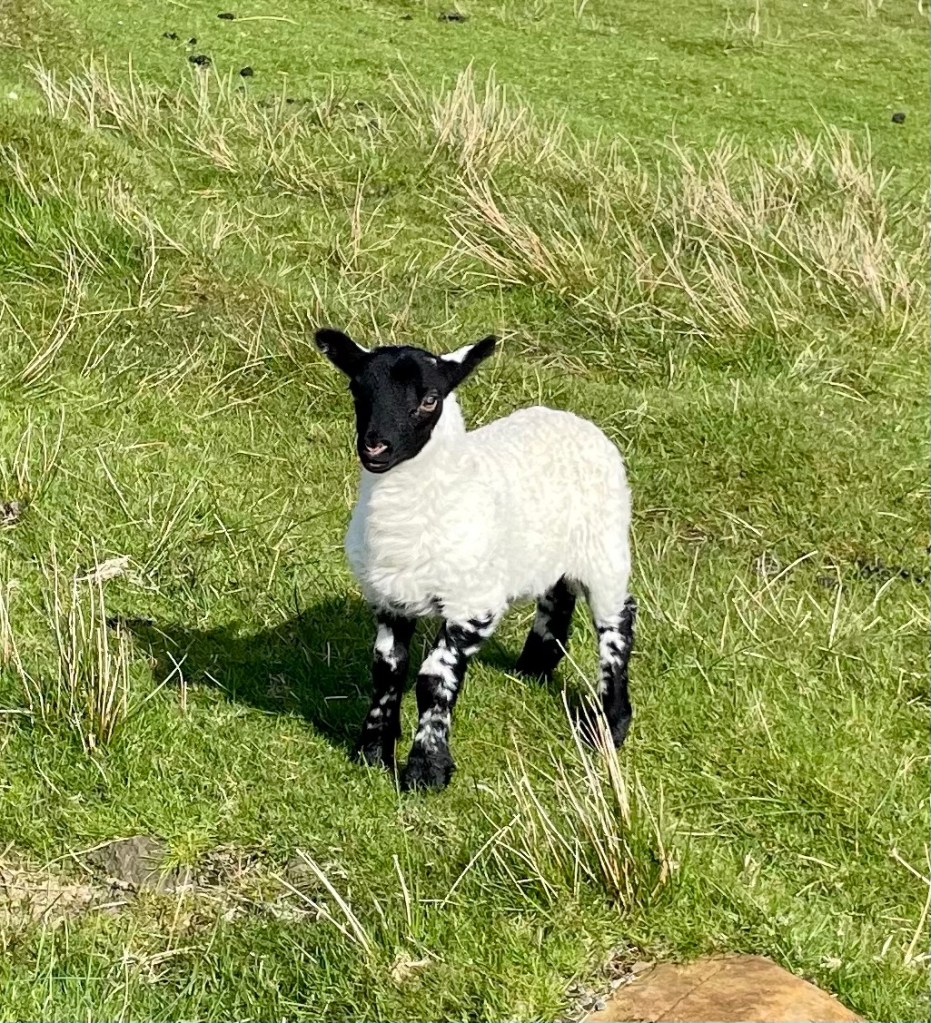
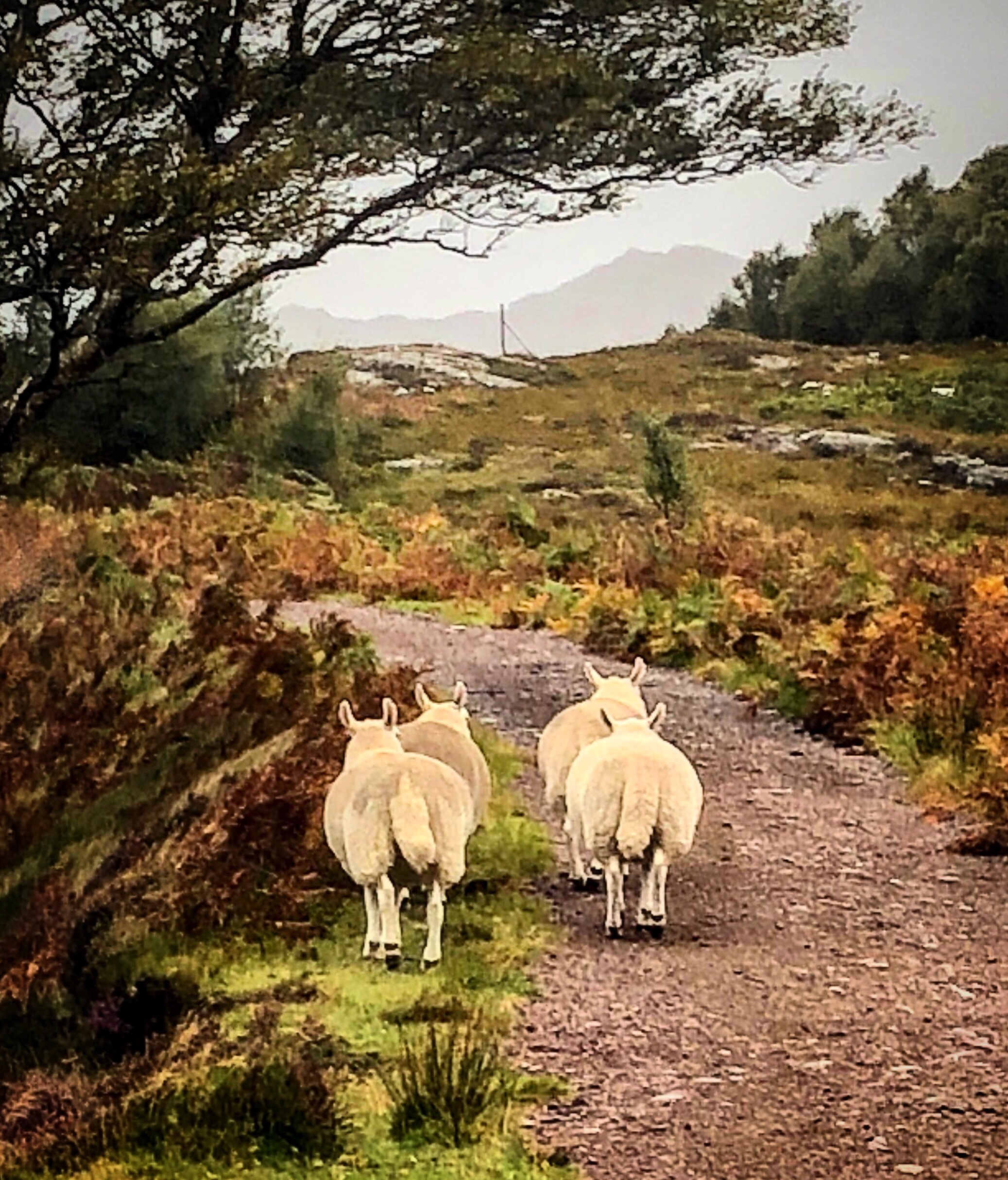
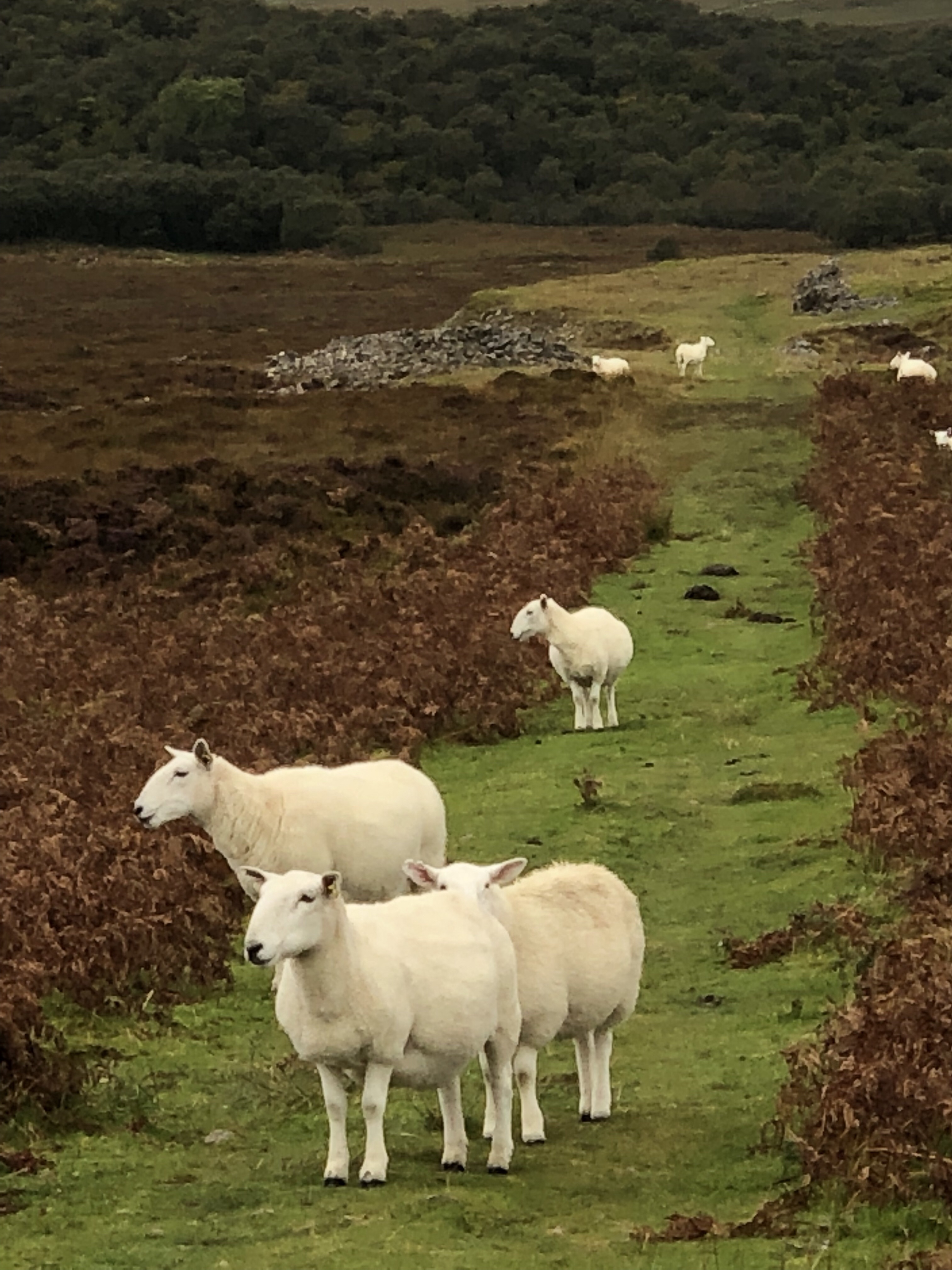
Frolicking sheepies.
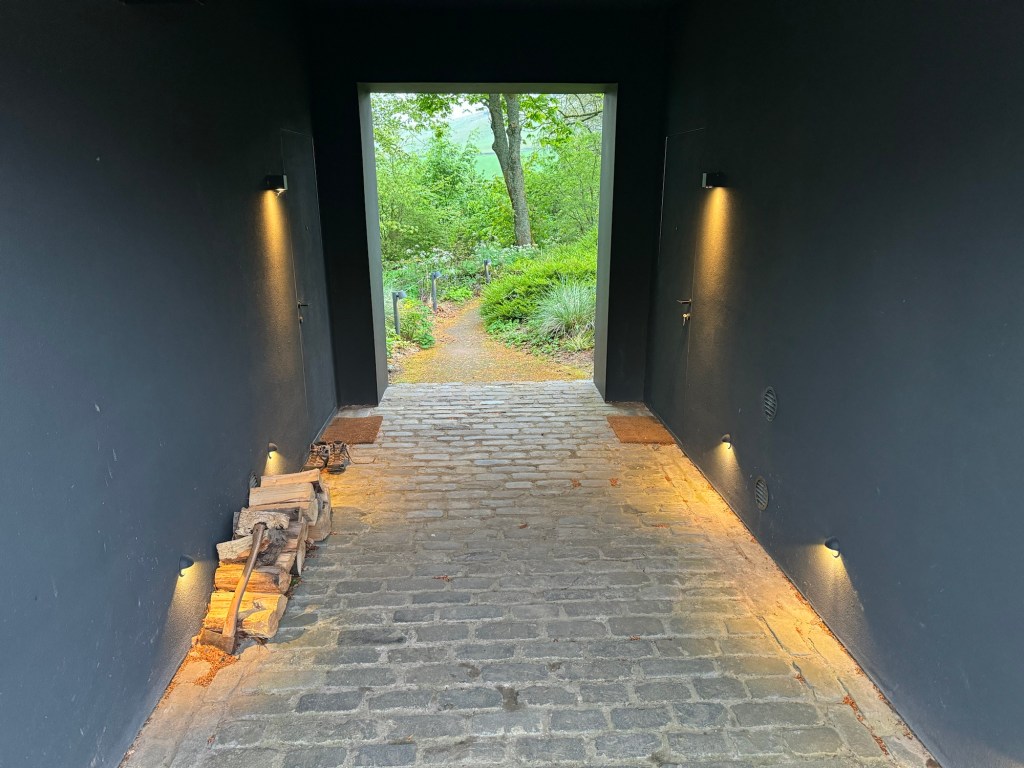
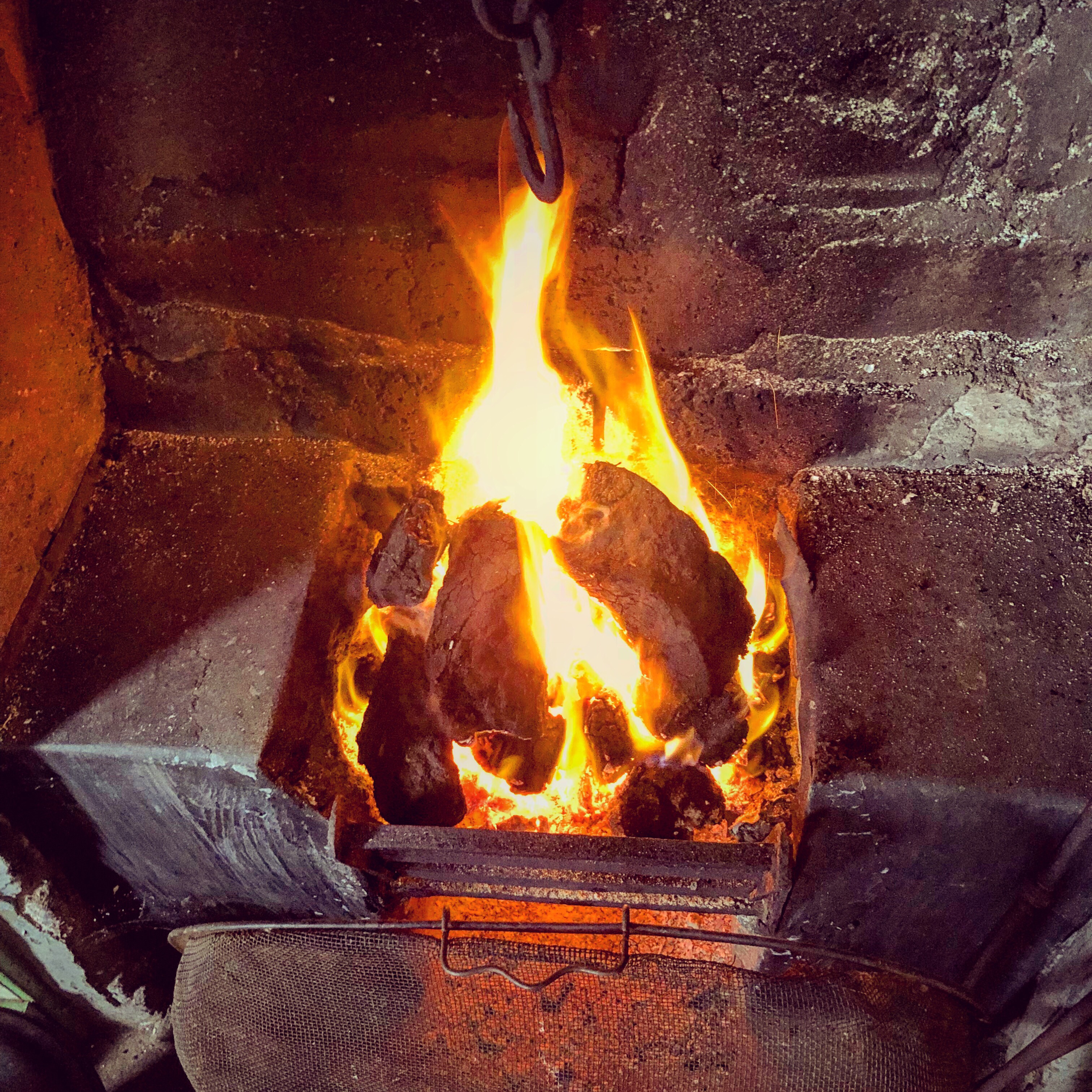
My room is to the left of this magical passageway. Sadly the weather was too warm to use that wood in my fireplace.

Now listen. This is the part where I missed the most spectacular Northern Lights display in the history of the freaking UK. Why? Largely because my news sources are all eight hours in the past. I simply didn’t realize and it was super irritating to wake up and see my instagram feed the next day. And here I am out in the country with no light pollution and gorgeous hills.

I don’t want to hear any more about it, okay?
So we’ll not speak of it again but will simply move onto the following morning when I took a boat out to Loch Leven Castle.
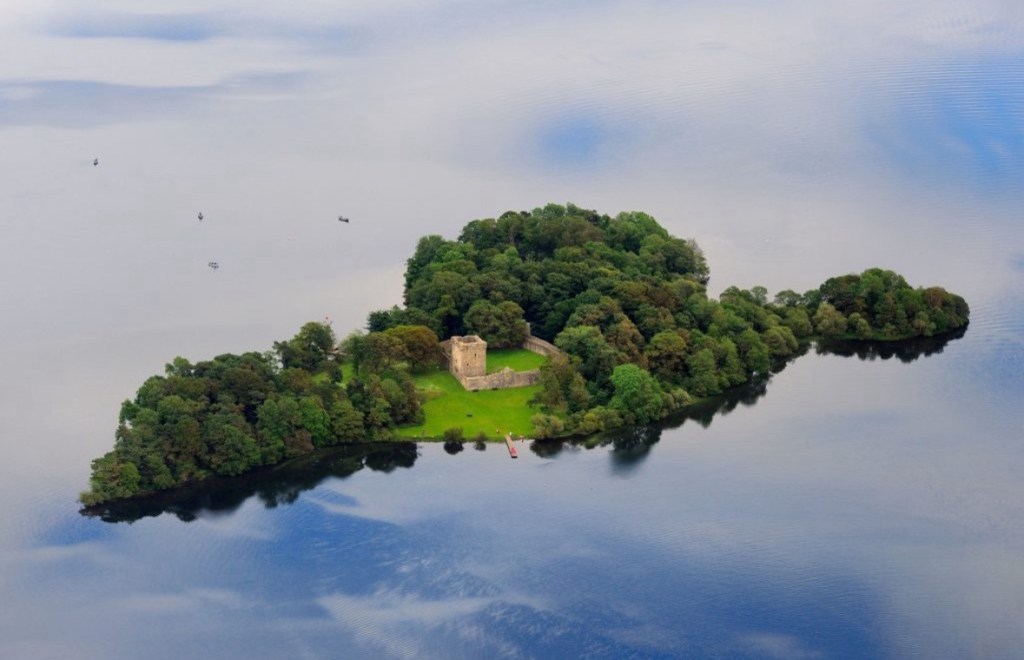
I wish I had a drone sometimes.

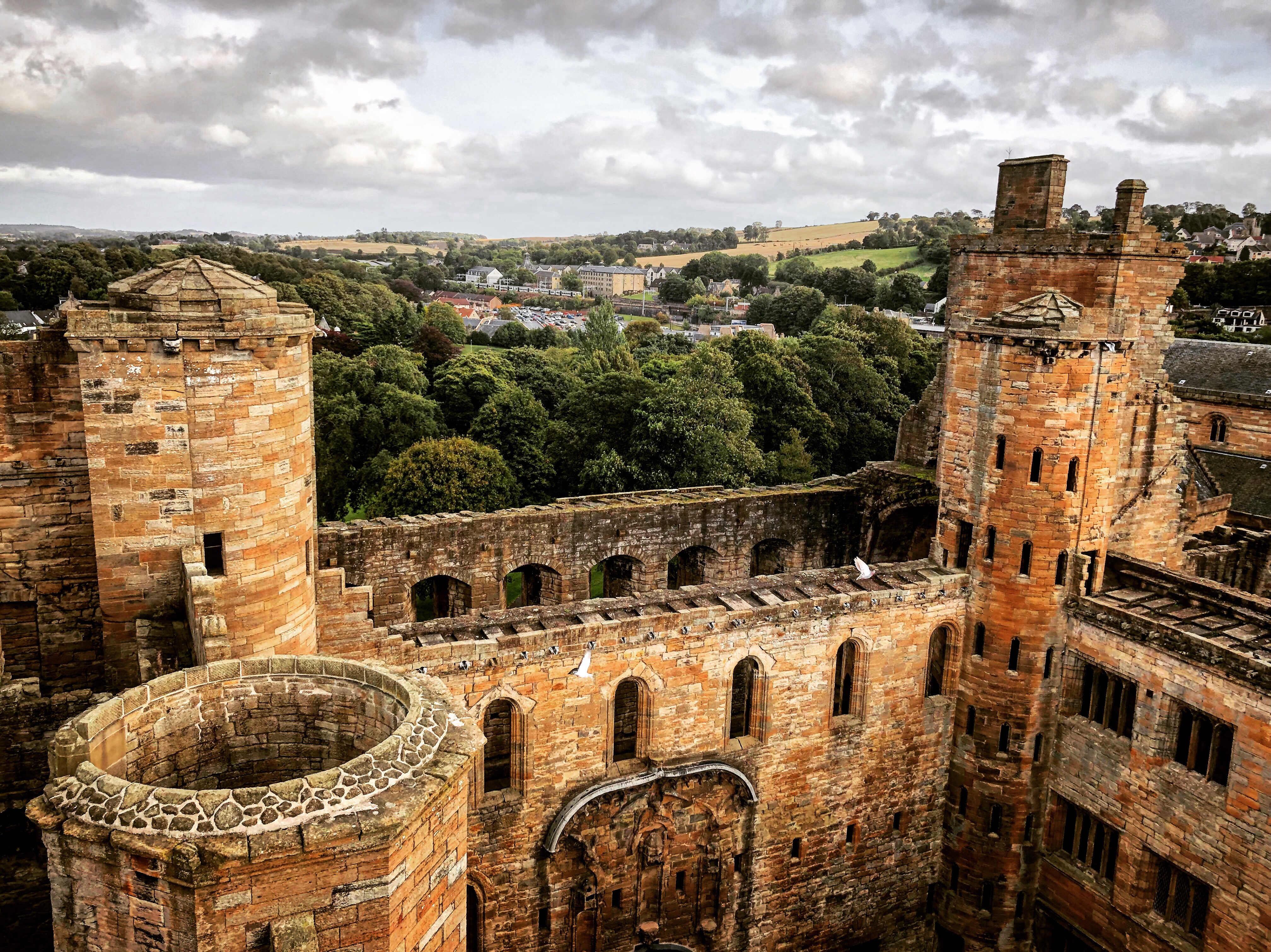
The castle was built in 1300 and was likely captured from the Edward I’s forces by William Wallace. The man was everywhere. It was later visited by Robert the Bruce (also everywhere) and his son David II. Mary QOS (ditto) was a guest there on three occasions, but the castle is most famous for her fourth involuntary return. Her marriage to Lord Bothwell after Darnley’s murder was too much for some of her lords and lo, they became rebellious. Mary ultimately surrendered to them after a battle and was taken prisoner and sent to Loch Leven under the watchful eye of its owner, Sir William Douglas. She was pregnant at the time, and during her year-long imprisonment she miscarried twins. She was also forced to abdicate in favor of her infant son James – he was crowned at Stirling five days later. The original annus horribilis.

With the help of the illegitimate son of her captor, the guy who took care of the boats, she managed to escape, and quickly raised six thousand troops. Sadly she was defeated at the Battle of Langside just two weeks later, and fled to England, never to return.

It was a gorgeous day for a visit, although a little on the warm side for the things in my suitcase.
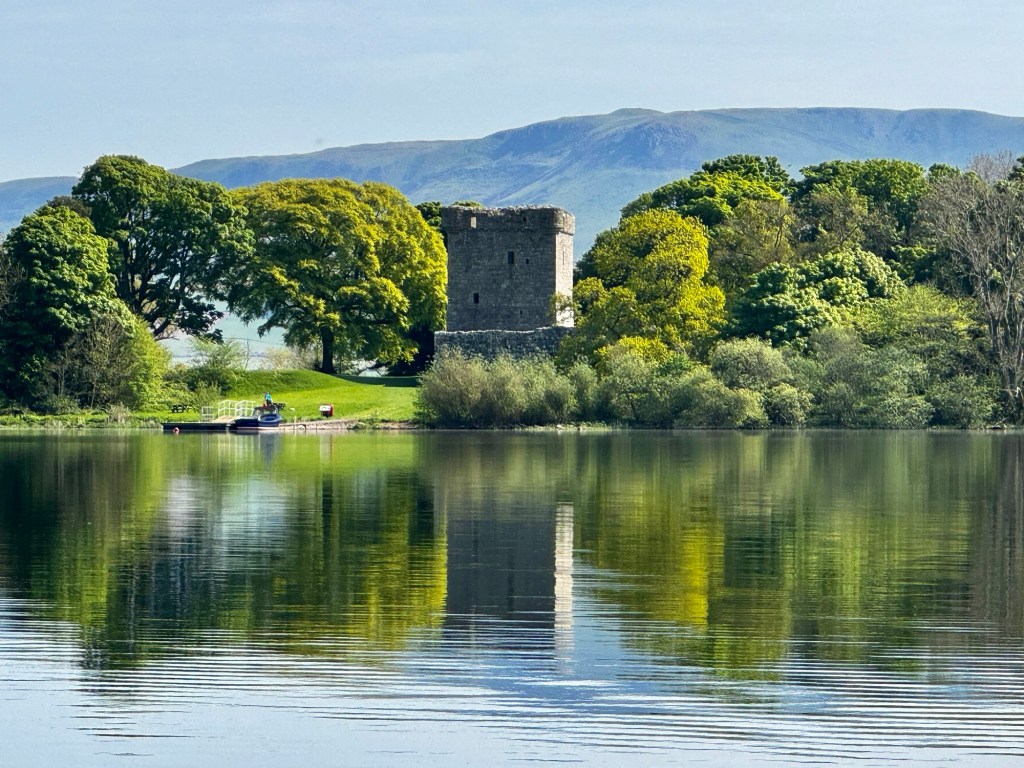
Douglas allowed Mary this oratory so she could attend Mass during her imprisonment

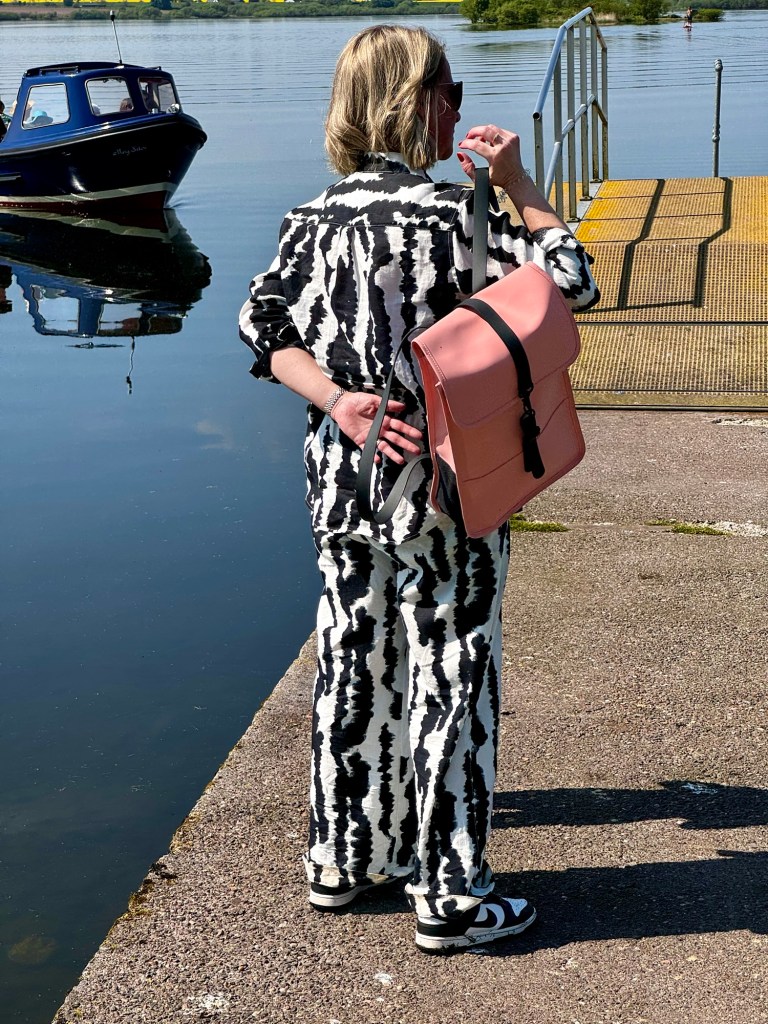
As I waited by the dock for the boat to arrive (yes they take twelve of us out there and then leave us all alone!), I had to appreciate this woman’s going-to-a-castle fashion. She deflected my compliment, as all women do, by telling me she bought it at H&M, and shrugged apologetically. Let’s stop doing that, shall we ladies?
When our boat arrived, a dad and his son appeared at the dock on a paddleboard, basically crashing the party without paying Historic Environment Scotland ten pounds for the privilege. Our boat captain explained they couldn’t land there and kindly asked whether the young boy needed to use the restroom. The dad assured her they were just hanging out for a moment. As soon as the boat launched, we looked back, and sure enough, dad was pulling the board onto the shore. Both the captain and the fashion lady were appalled and agreed this was “quite cheeky” behavior. I know I’m pathologically charmed by a British accent and all, but really what a lovely way to cast shade.
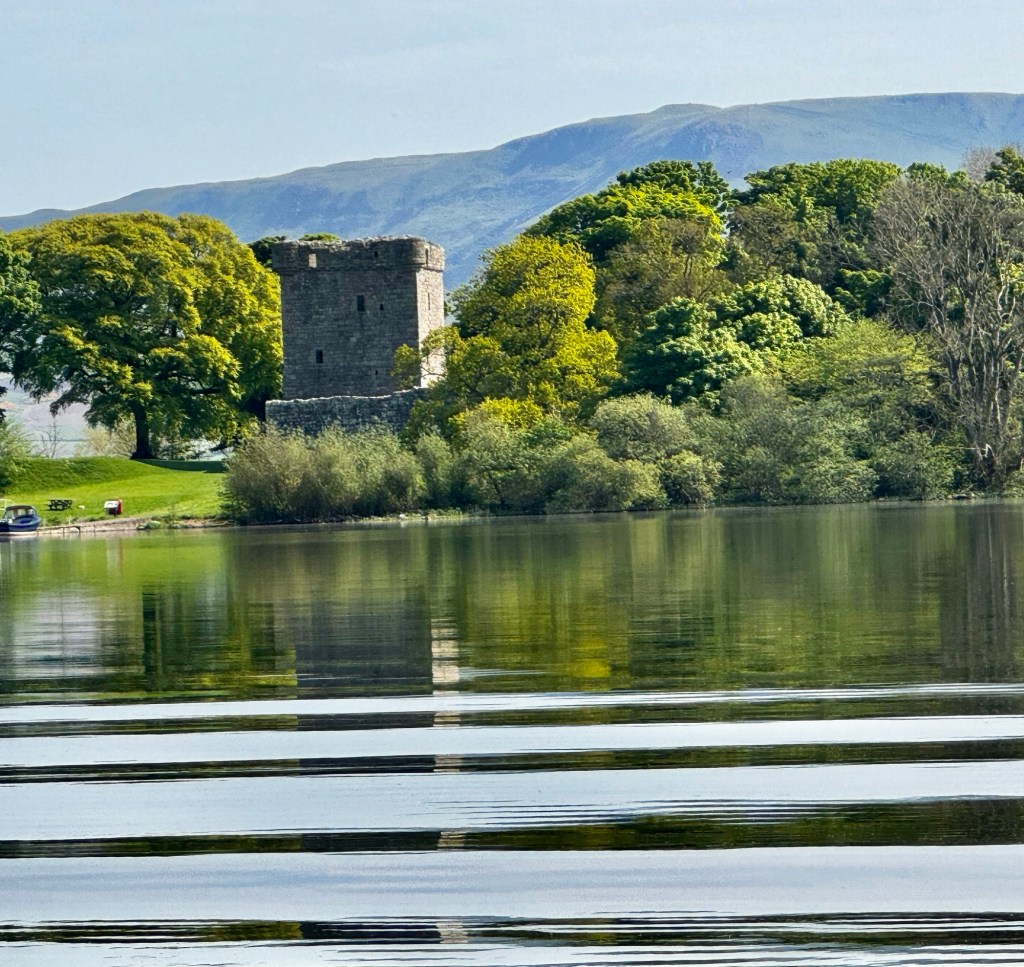
Farewell, Loch Leven Castle

The next day I drove to the East Lothian coast to visit yet another castle and the best place to live in the UK.

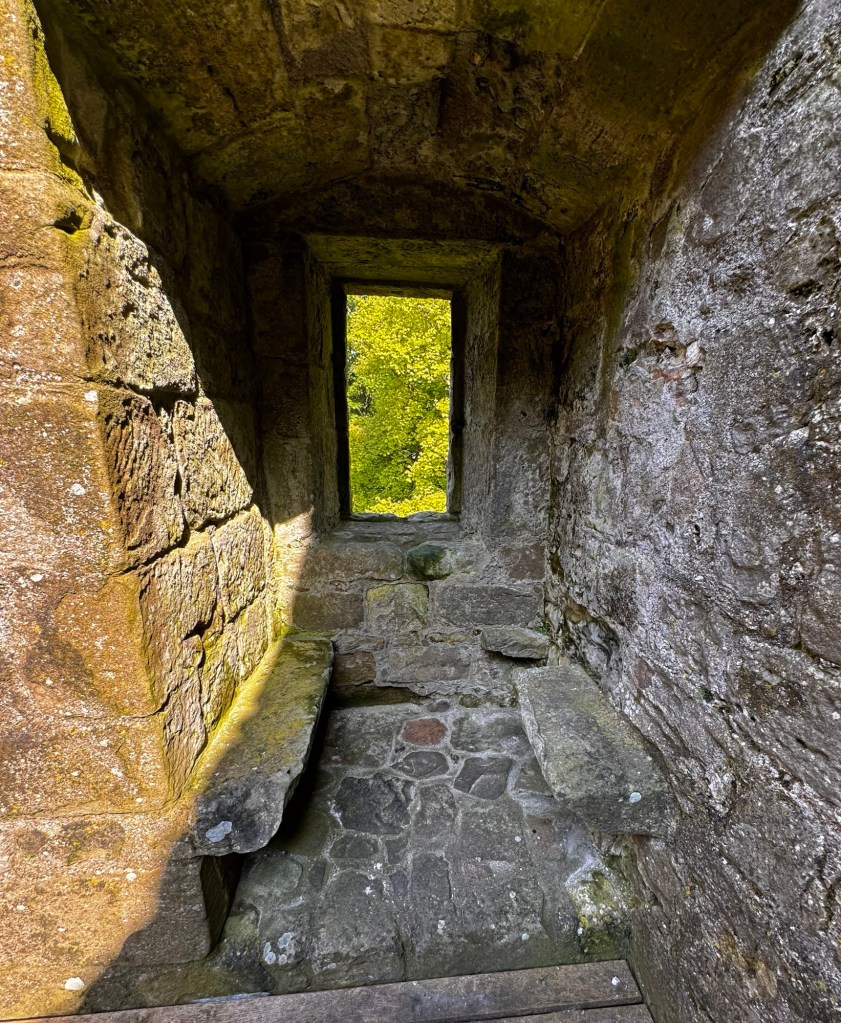
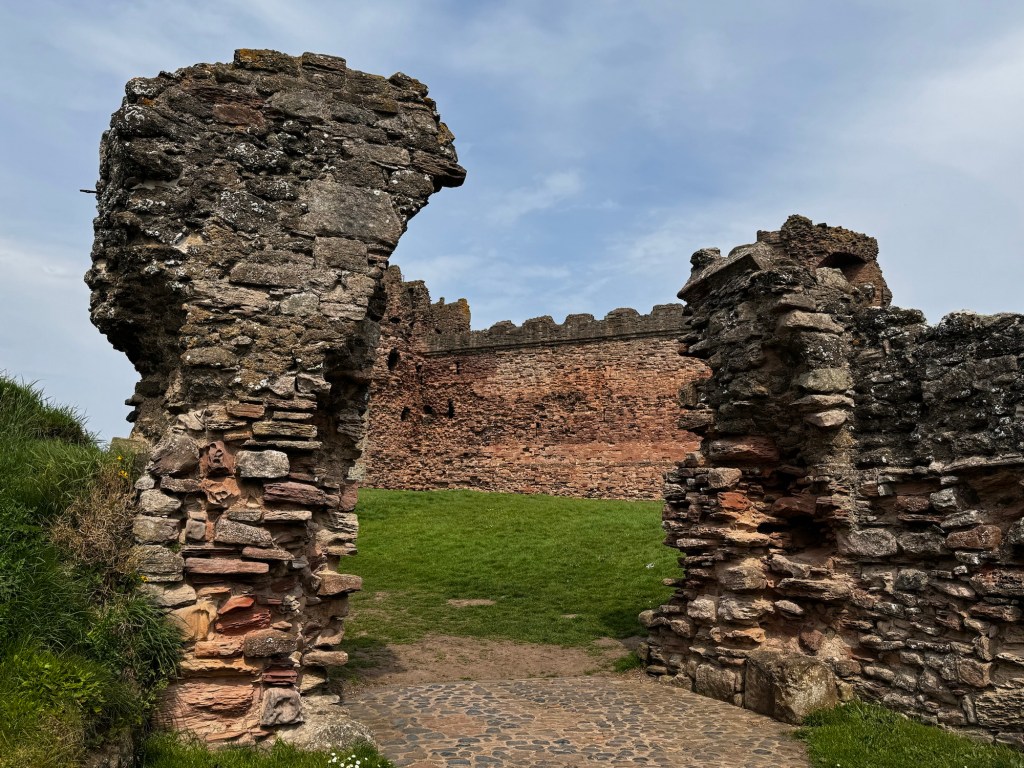
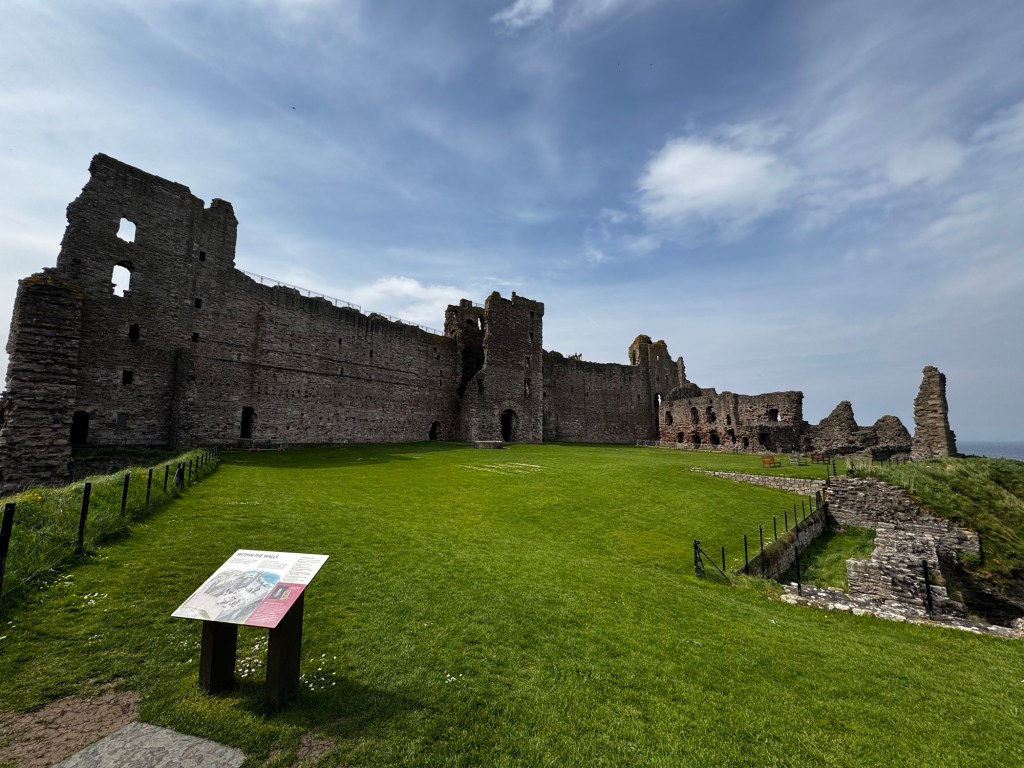
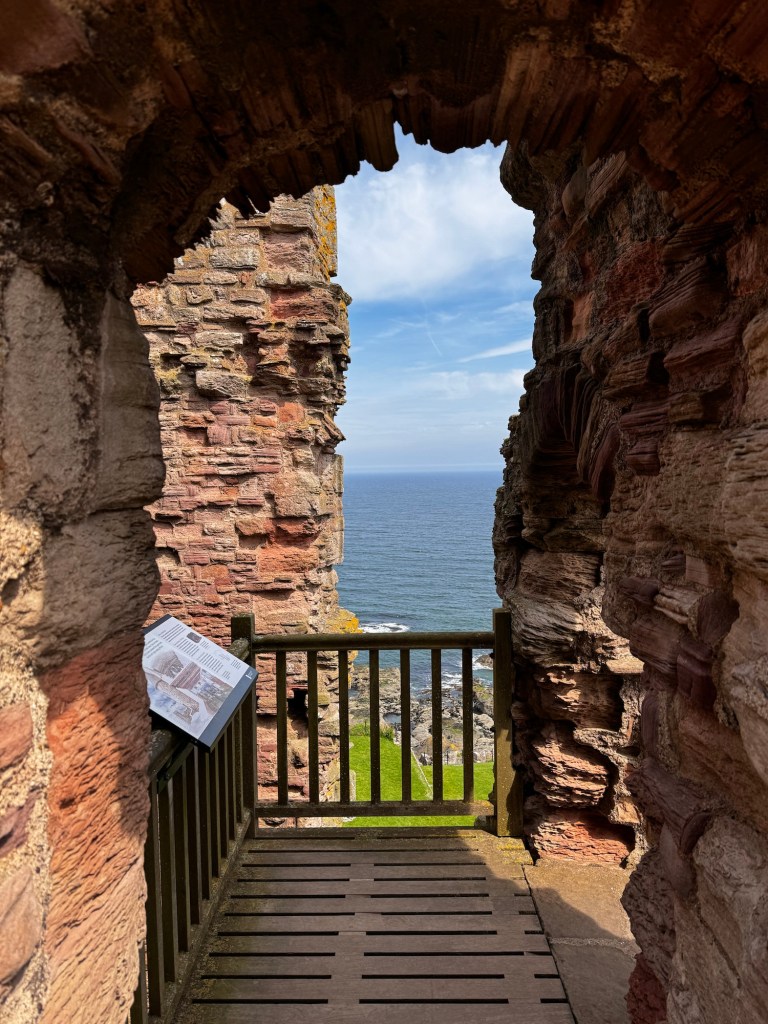
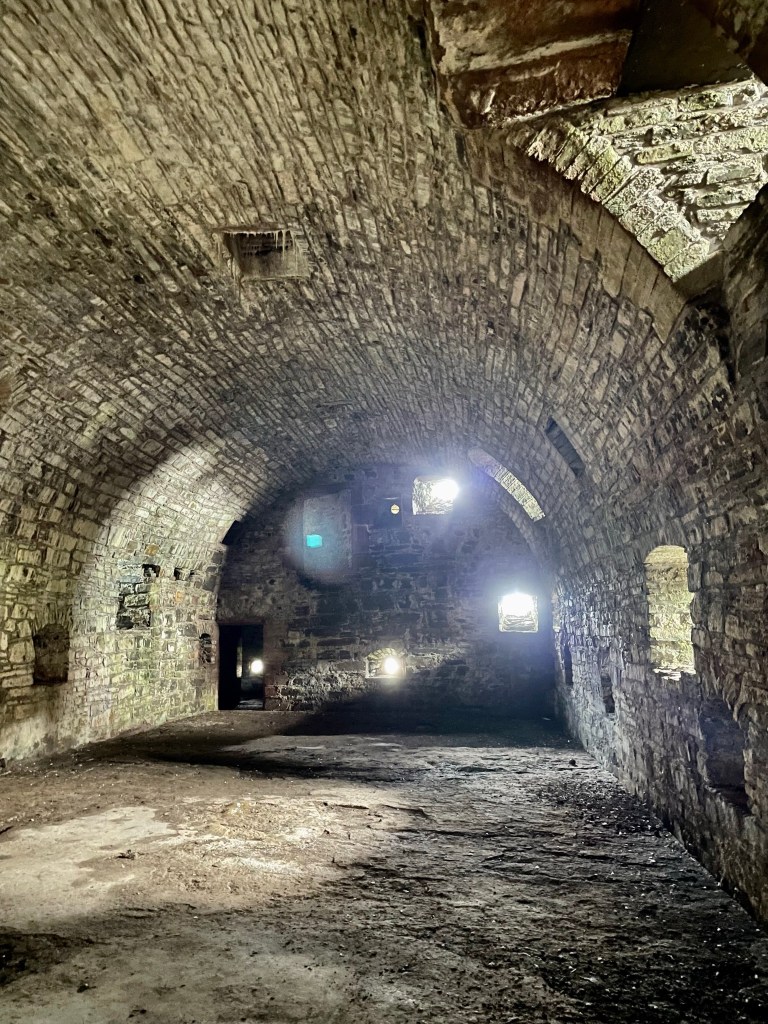
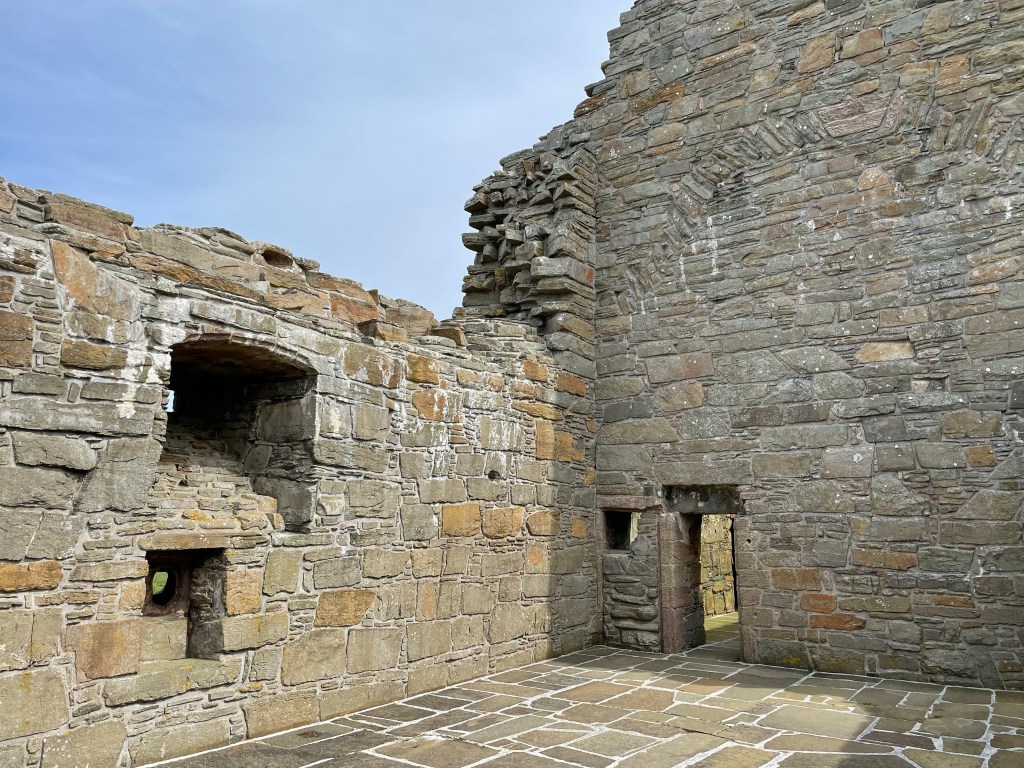
The castle is a ruin called Tantallon. It’s stunningly huge. Built in the mid-1300s by the “Red Douglas family,” it’s considered to be the last truly great castle built in Scotland. Besides one recorded visit from Mary QOS, it most notably was besieged a lot. James IV in 1491, James V in 1528 and of course Oliver Cromwell, which explains why there are no windows, just embrasures for cannons. Cromwell’s attack caused such destruction that the fortress was abandoned afterward.

Honestly, wouldn’t you like to tell Cromwell that this whole venture of his doesn’t end well and so he should stop being a destructive dickhead?

The Douglas family was in fact feeling all schadenfreude when they heard the news that Cromwell’s body was exhumed from Westminster Abbey by Charles II after the Restoration, hung and beheaded, with his gnarly old head displayed on a pike for 30 years. Ah olden times. (See previous blog)

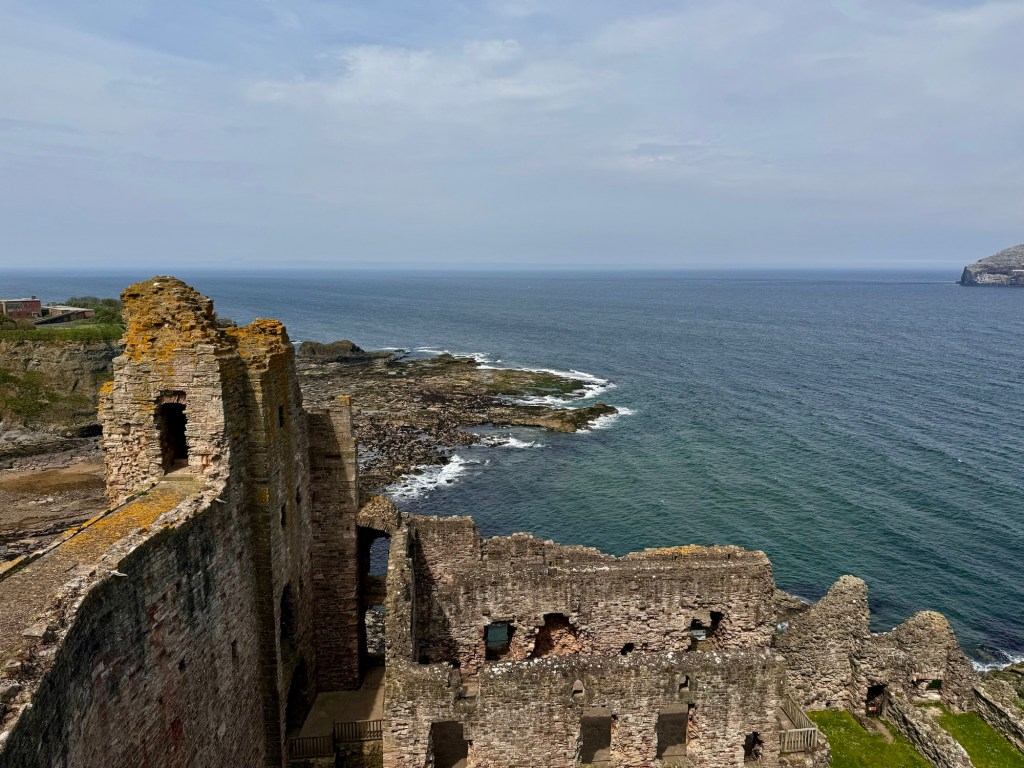
Some Tantallon photos:
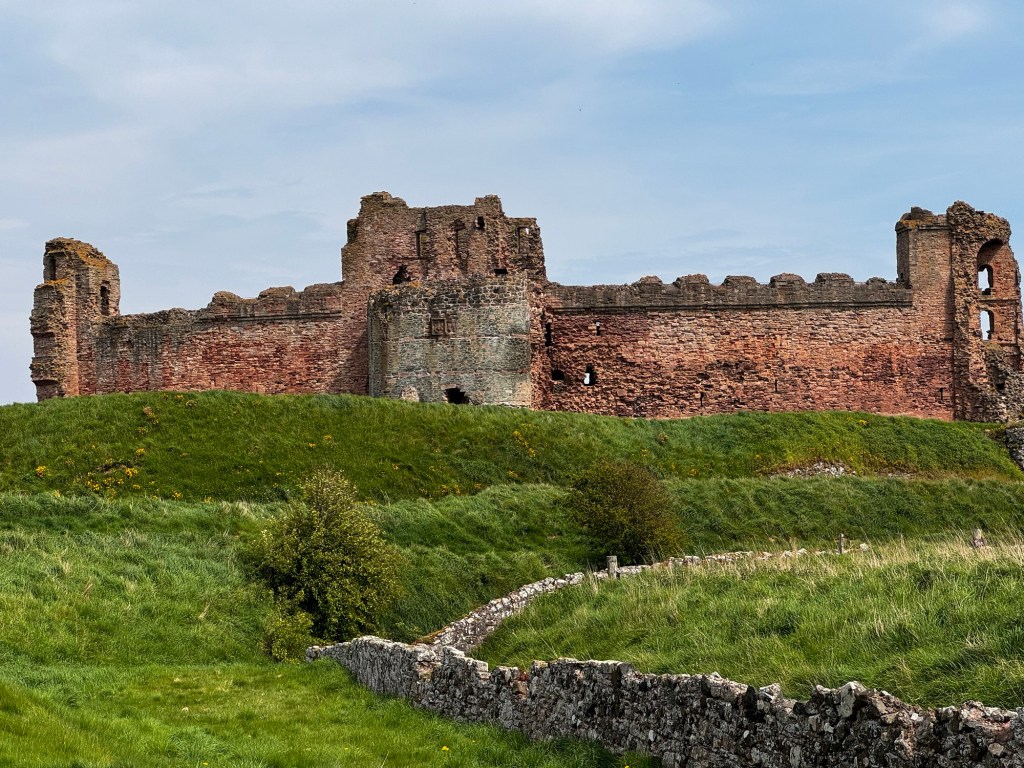
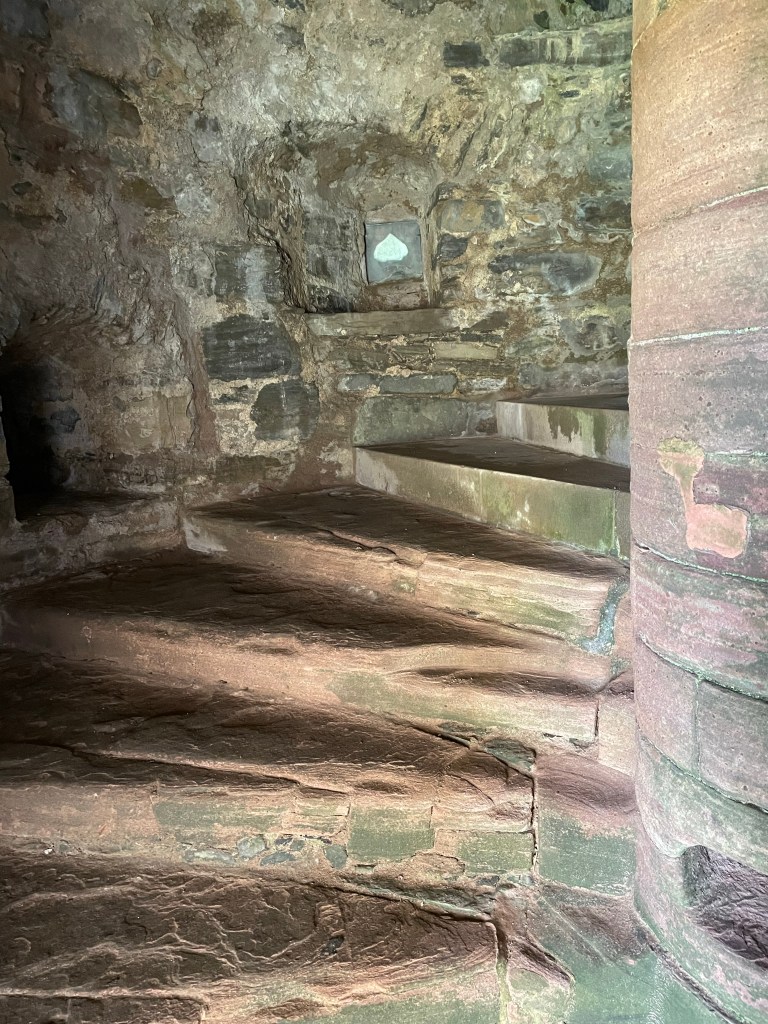
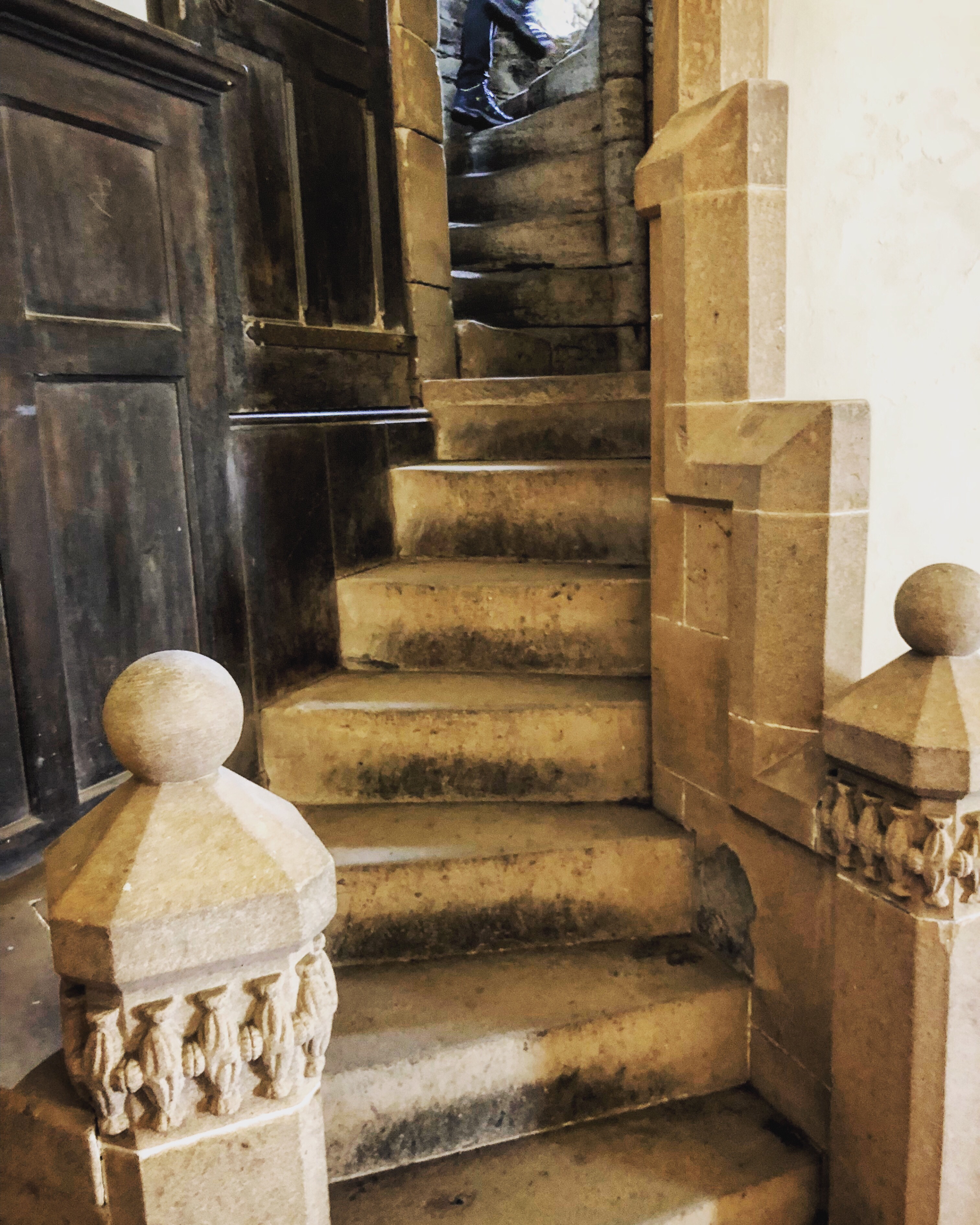
And again with the sketchy spiral staircases and big open climbs to the tippy top, and also, cliffs. Even the warning signs around the property are comical when seen through American eyes where everything is so regulated and guard-railed. Half the ruins in Scotland would be shut down under our public safety rules.
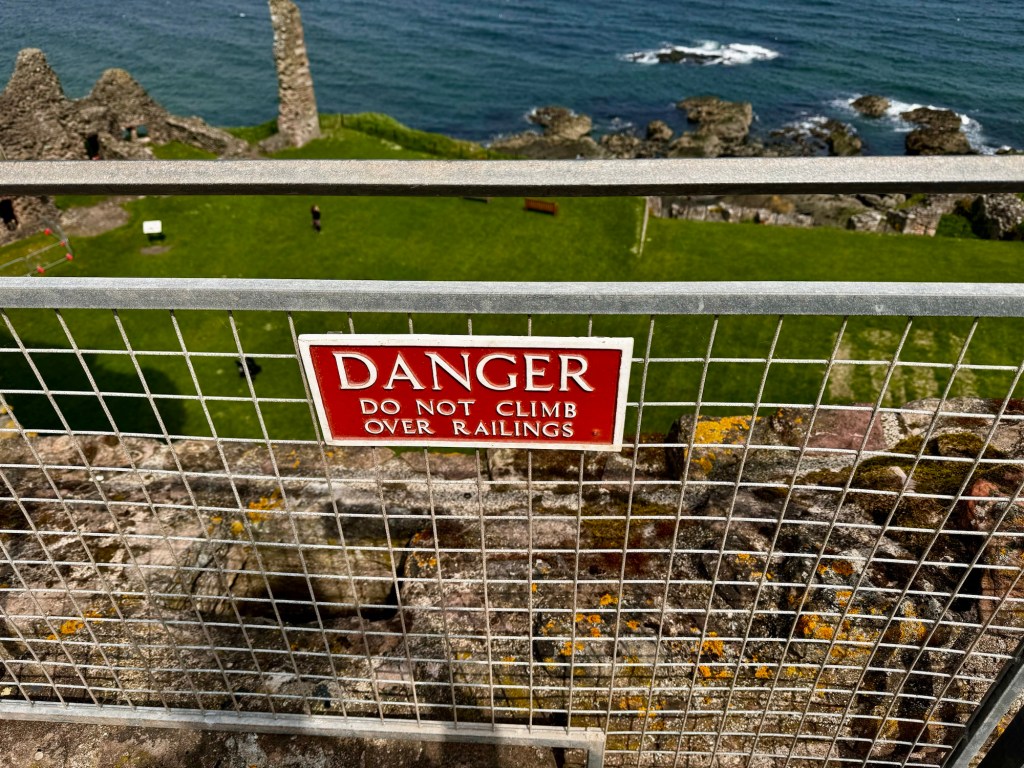
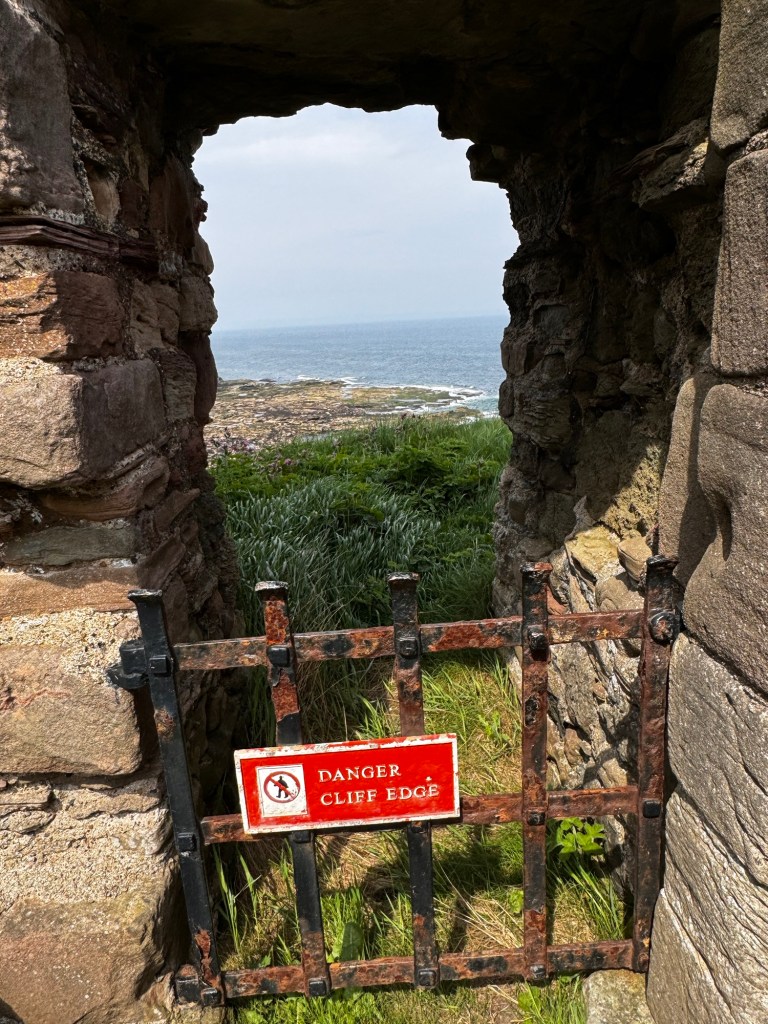
I mean, at least these ancient decrepit steps were blocked off, as they basically constitute a technical climb.

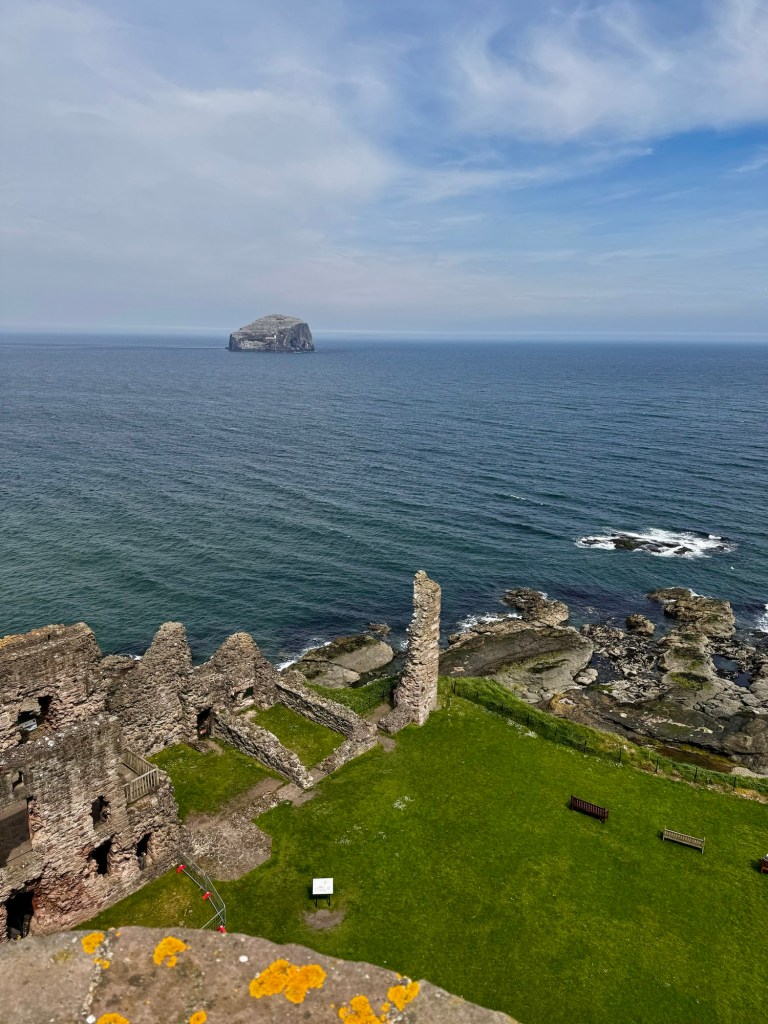
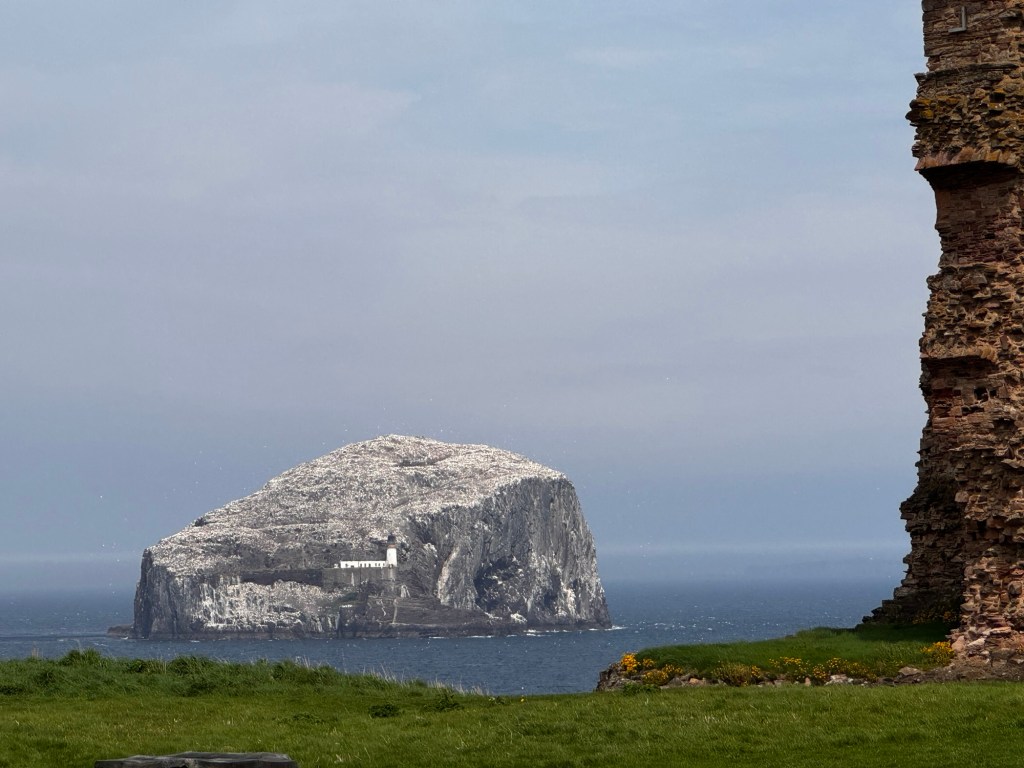
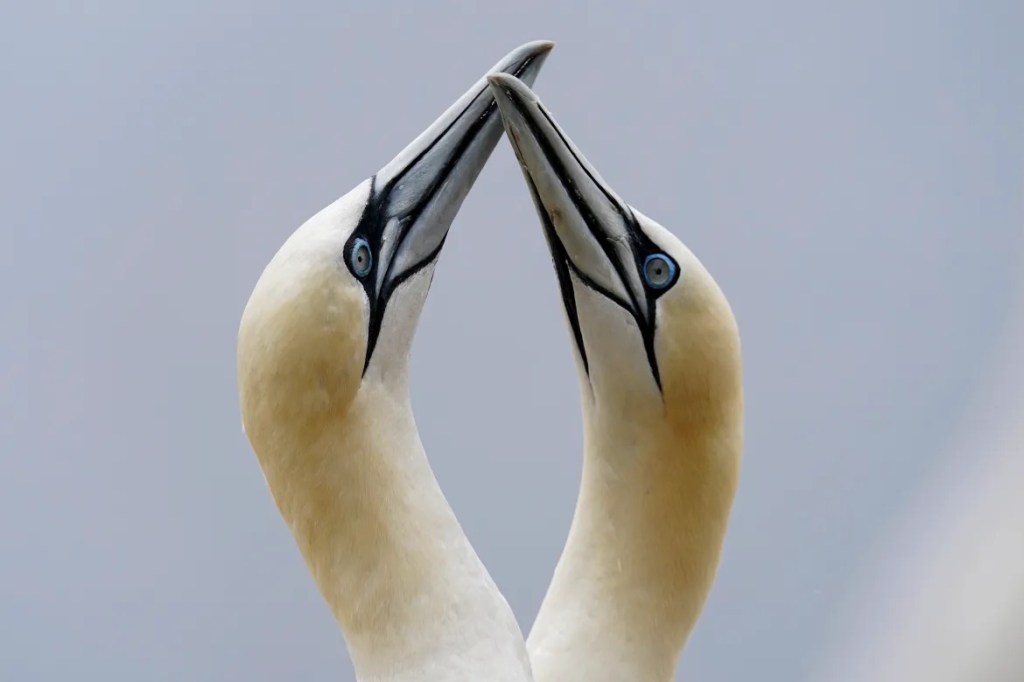
At least the last thing you saw as you plummeted to your death would be Bass Rock. Known as “The Bass,” it is an island in the Firth of Forth that plays host to the world’s largest colony of Northern gannets, namely, 150,000 of them.
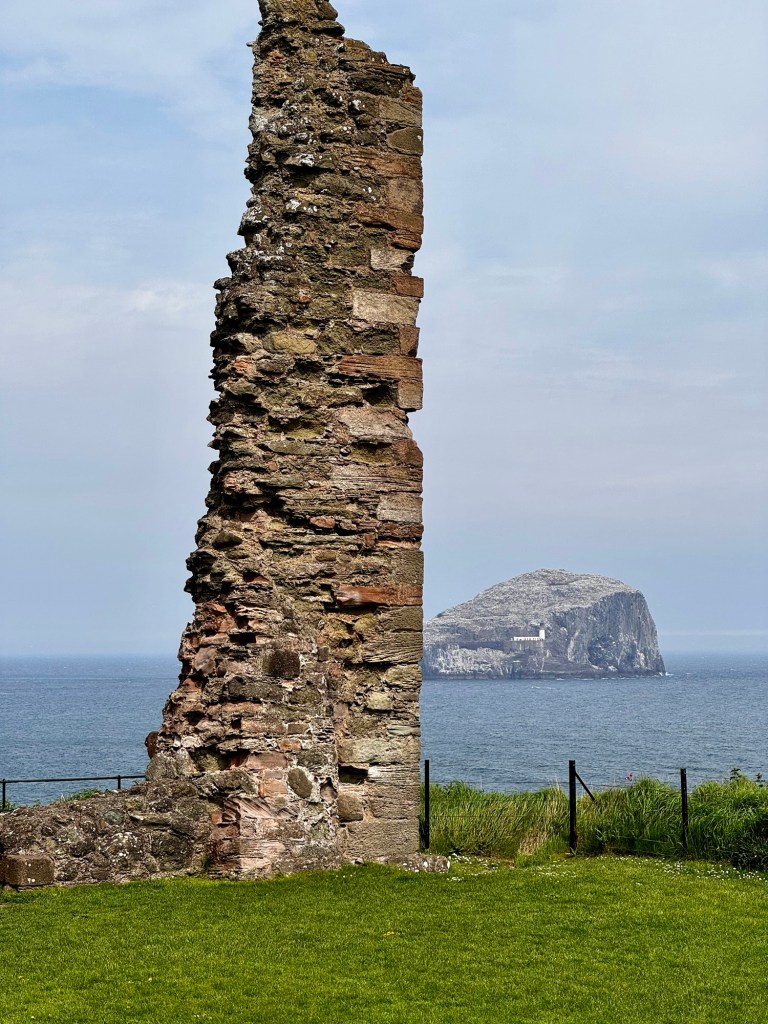
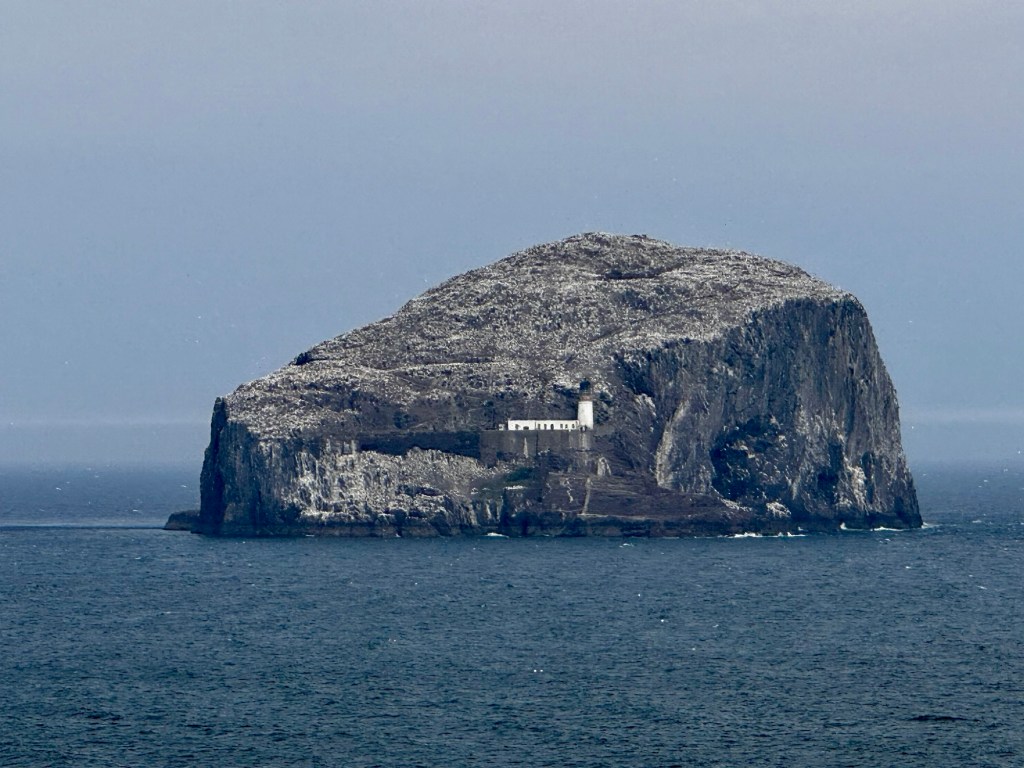
The lighthouse!
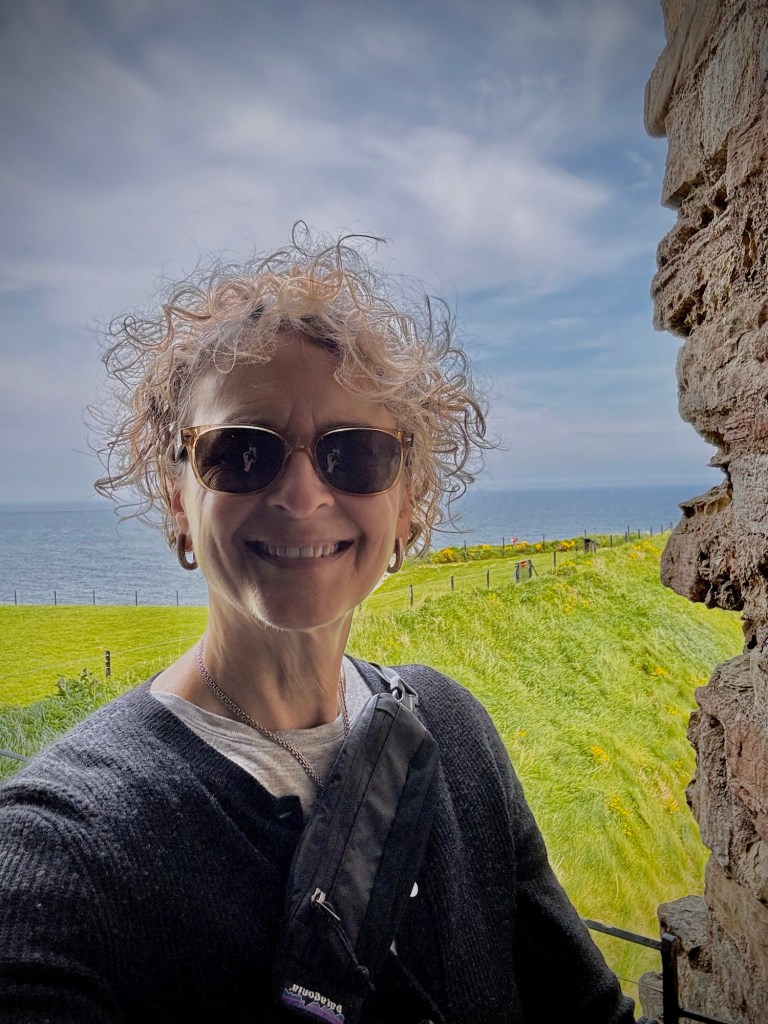
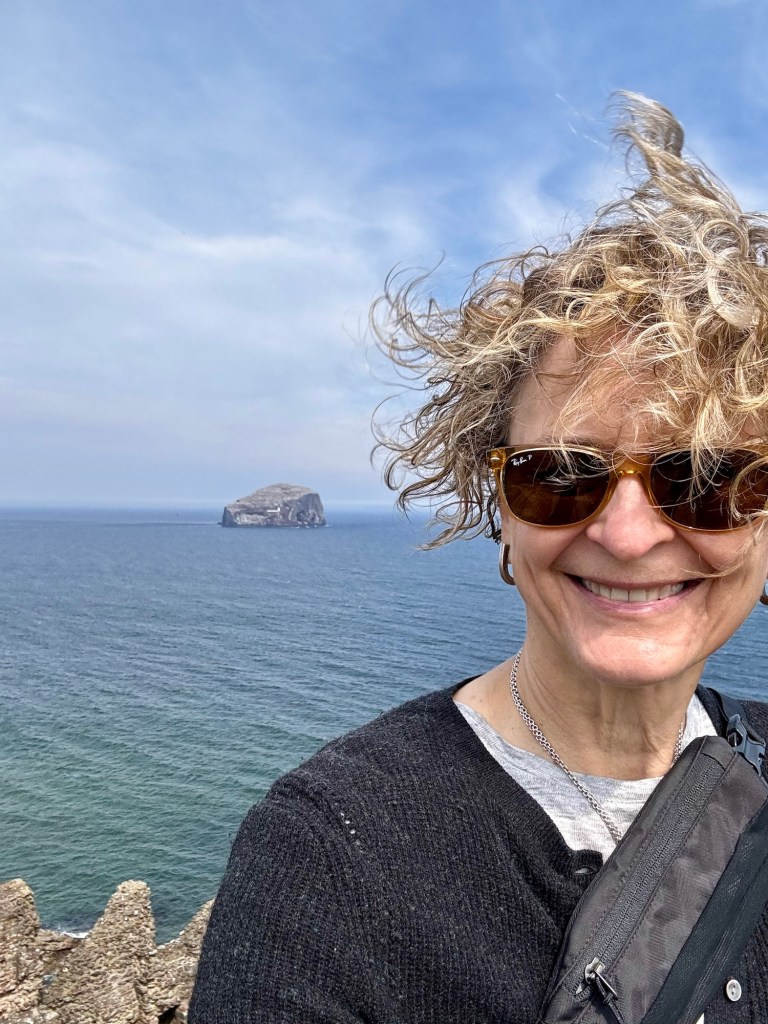
This is NOT a drone shot, it’s me at the tippy top.
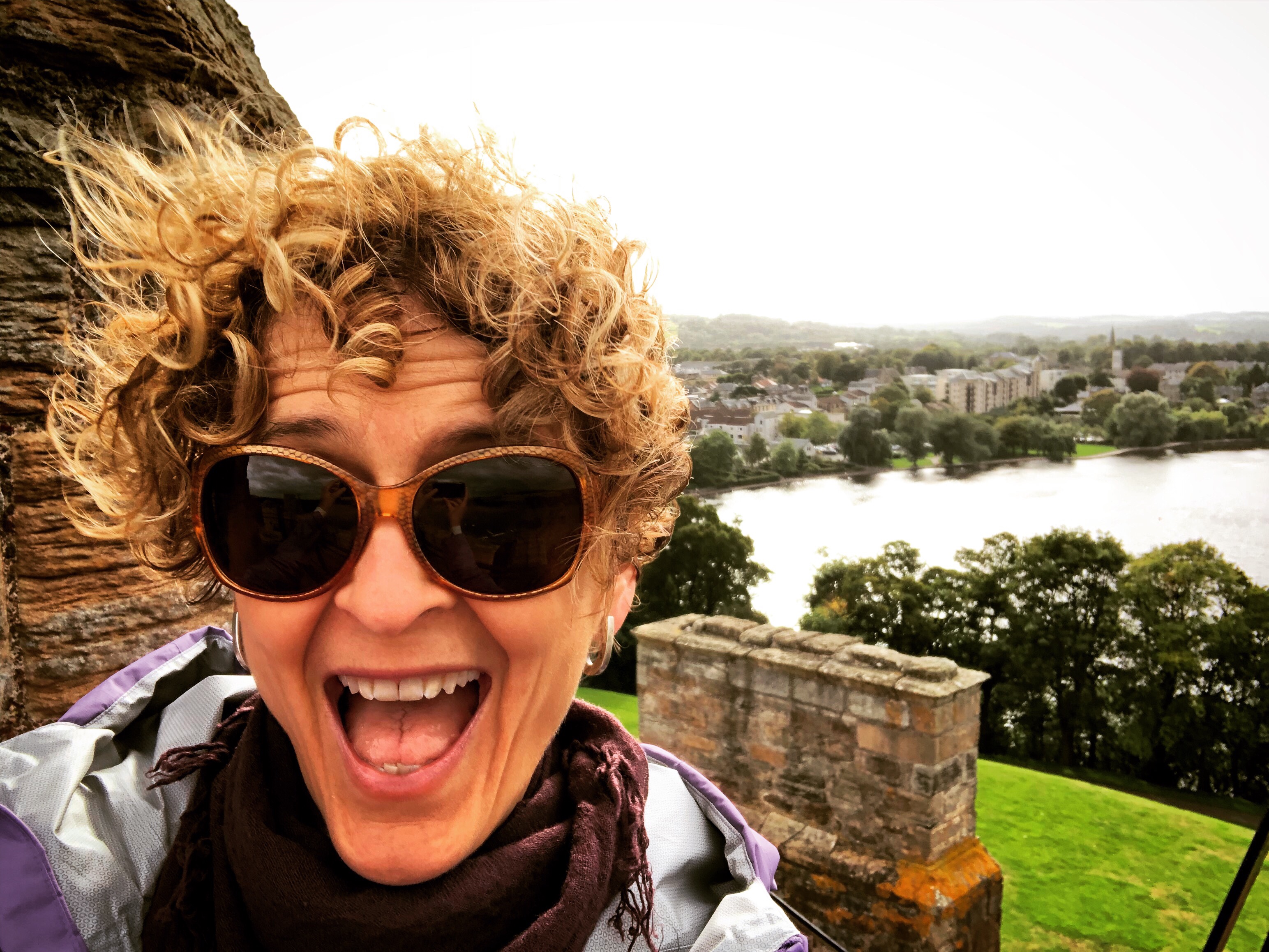
Here’s my hair in the high altitude breezes to prove it.

Probably too many photos, but it’s cool, right? Anyway, back to the giant gannet colony! As you can imagine, 150,000 gannets leave droppings that off-gas 152 kg of ammonia per year, and the Bass looks white from above. And the smell would be amazing.

One would think that the island would not have been inhabited throughout history for these reasons, but no. It was settled by an early Christian hermit and later was the site of an important castle, now in ruins. James I of Scotland used to imprison his enemies there in the 15th century. The island belonged to the Lauder family (not those Lauders) for six centuries. In the 1600s it was seized by four Jacobites imprisoned there, which they held against government forces for nearly three years. One of the Stevenson lighthouses is perched on a ledge, built in 1902.

Since 1706 the island has been owned by the Dalrymple family.

Before we leave, let’s return to the gannets. Sadly, in 2022 avian influenza was detected on the Bass and more than 5,000 dead birds were counted on a single day. The disease remains a concern in seabird colonies around the world.
Now onto the delightful seaside town of North Berwick, which topped a list of 72 locations in the Sunday Times’ annual report of best places to live in the UK. It was selected for its combination of community spirit, connections to nearby Edinburgh, a thriving high street with independent shops and two pretty beaches. I have to say I felt the community spirit while I walked around the pretty streets.

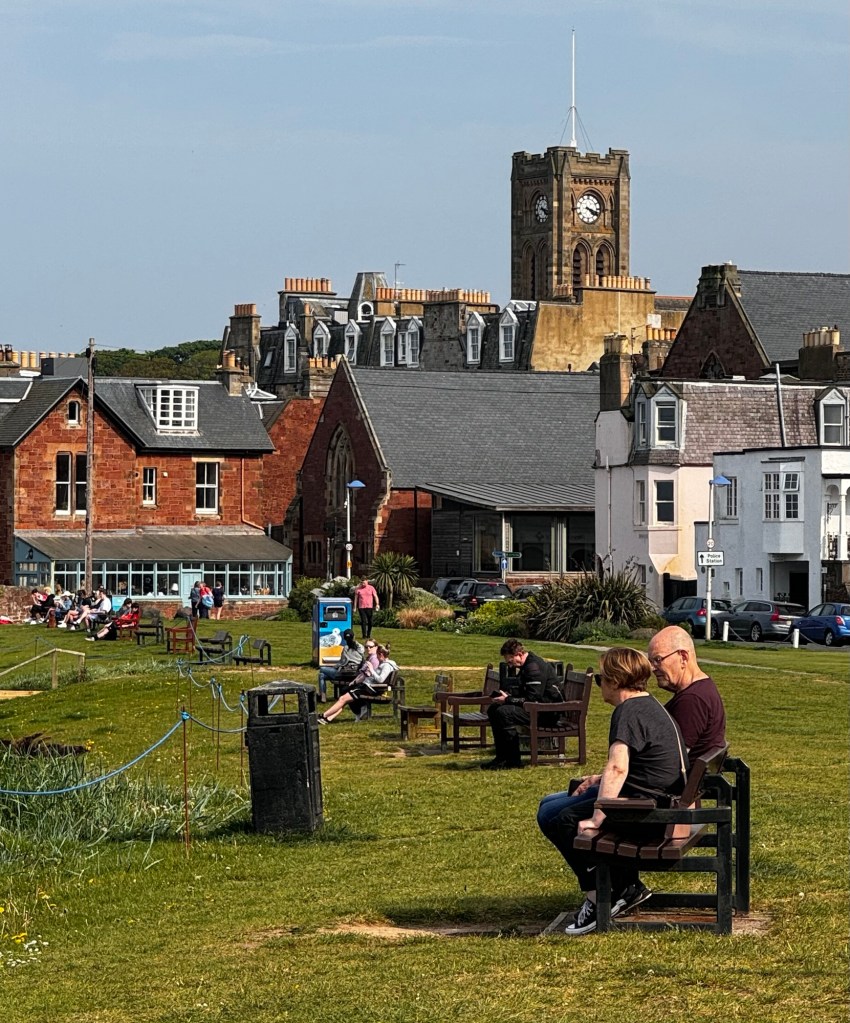
North Berwick
The coast is lined with benches where people hang out.
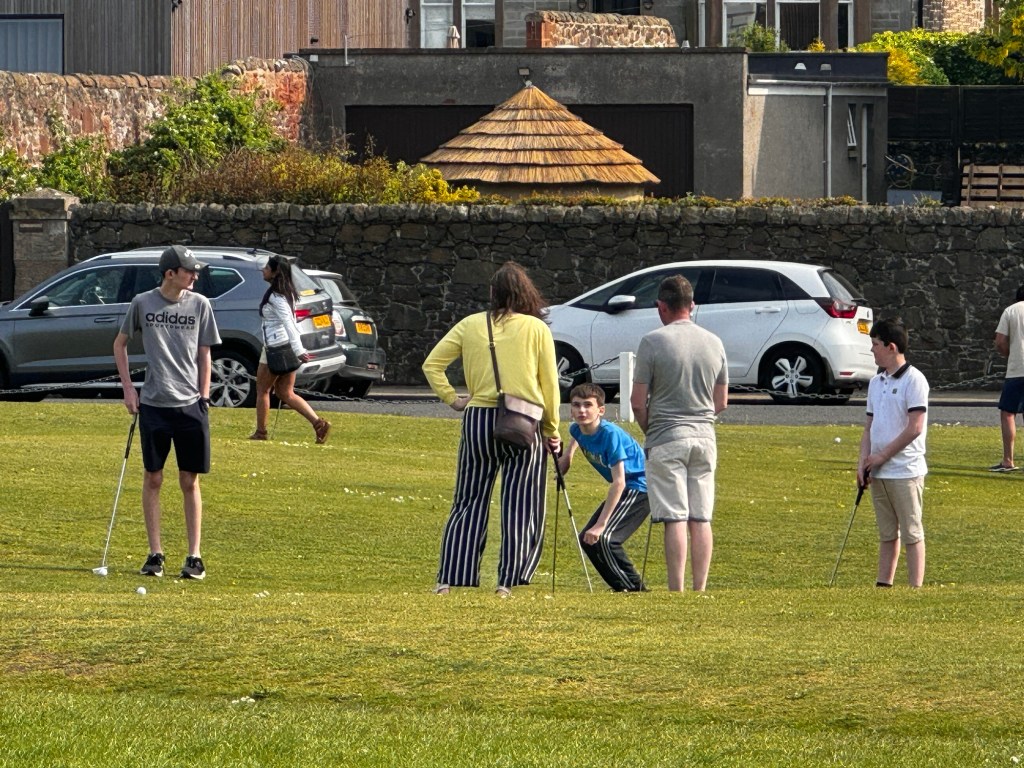
Along the shore, families gather to play tiny games of golf.
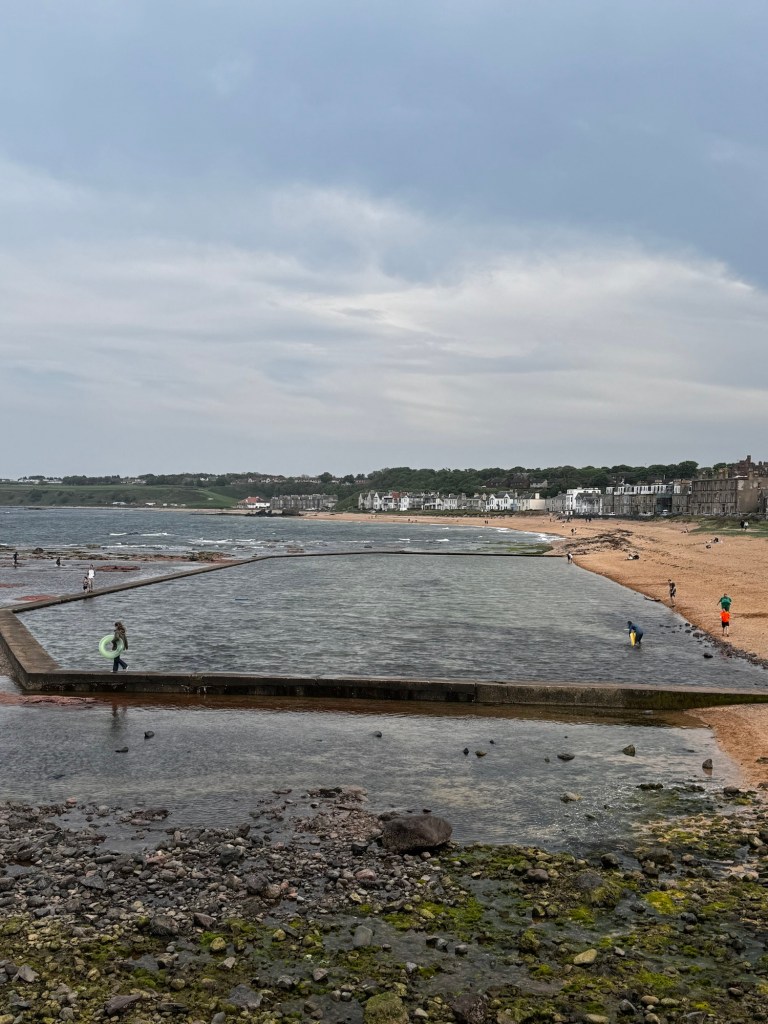
A saltwater pool next to the sea.

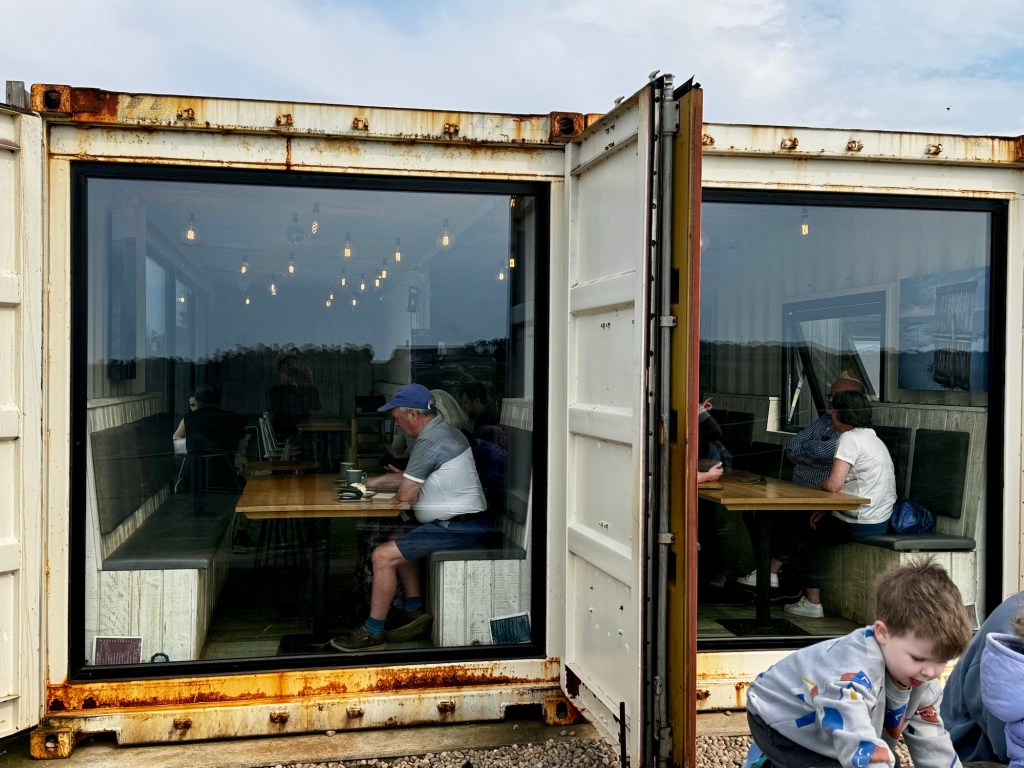
And if you ever find yourself in this beautiful part of Scotland, please have lunch at Drift, an awesome cafe on a cliff with views of the Bass.
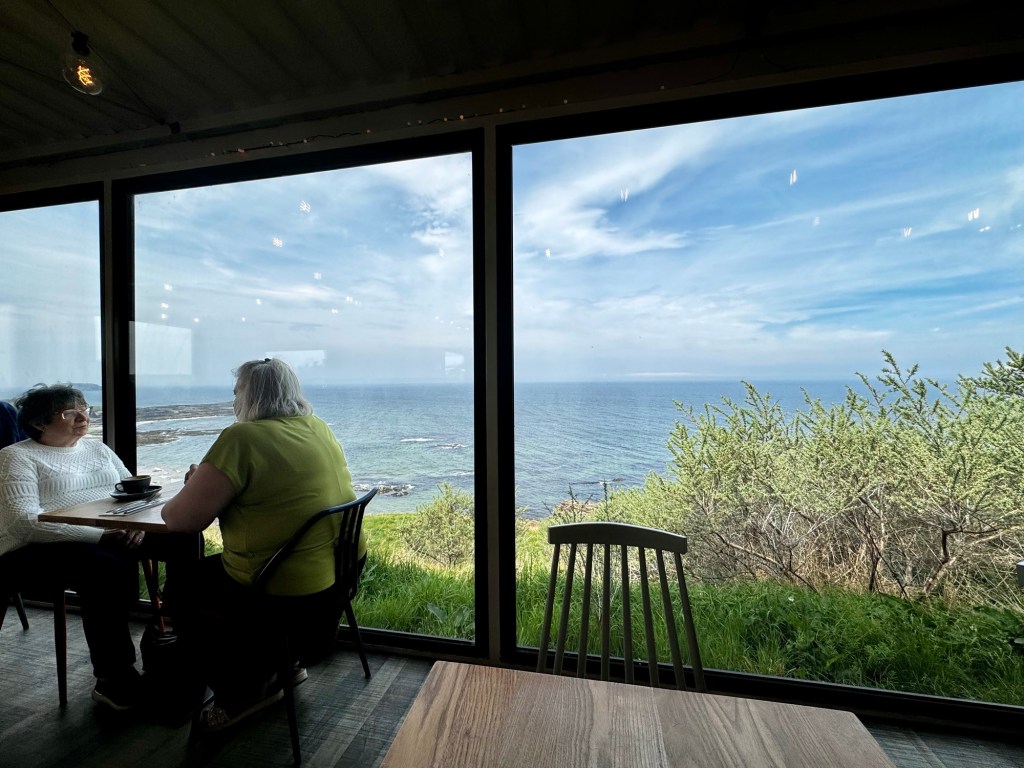
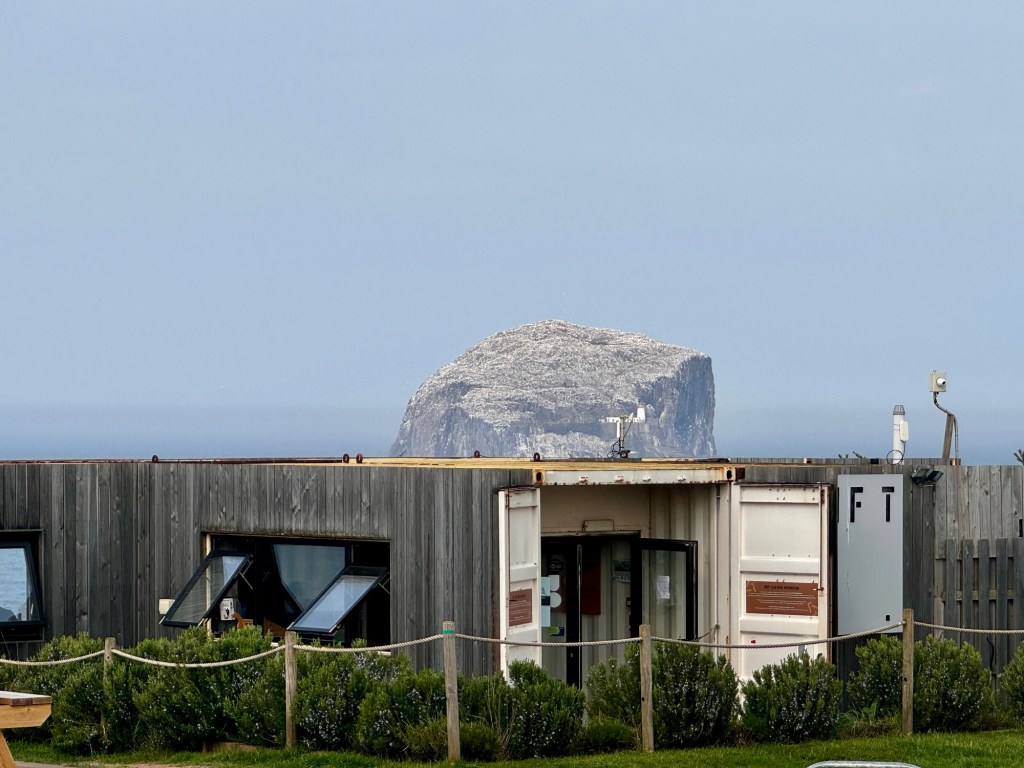
The view from my table at Drift.
Drift and Bass Rock
The cafe design takes full advantage of the views.

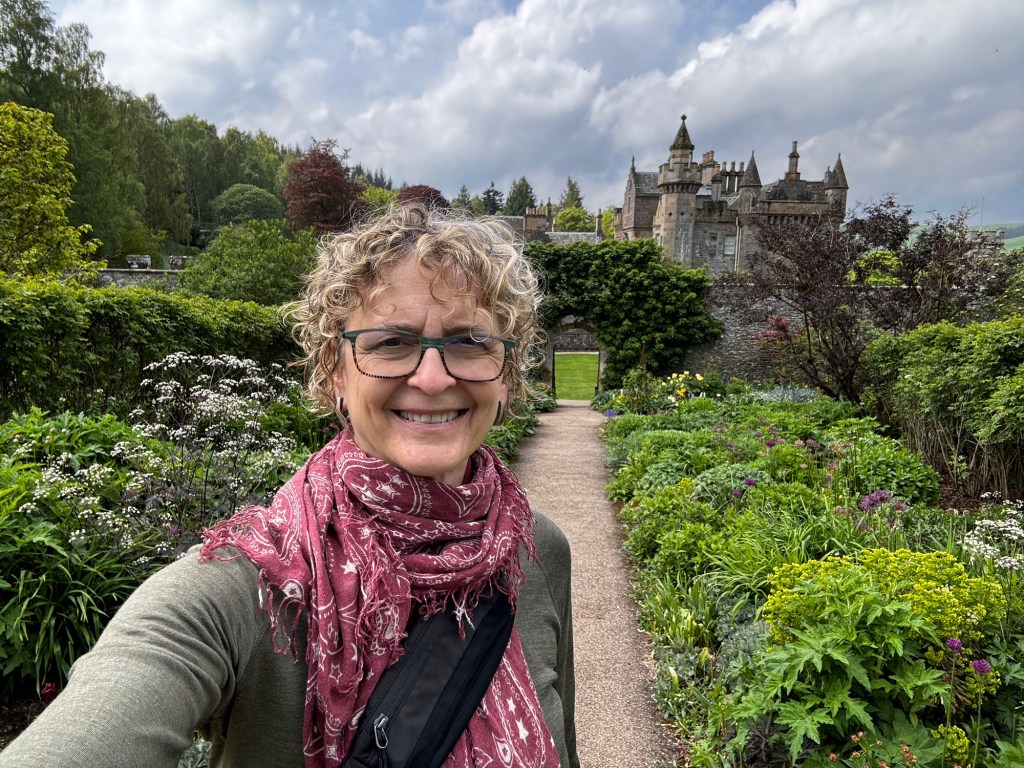
As the next day dawned, I drove to the Scottish Borders, a beautiful, fertile region featuring green, gorgeous hills and a meandering River Tweed. I visited Sir Walter Scott’s home, Abbotsford, a magnificent castle-like abode with gorgeous gardens.
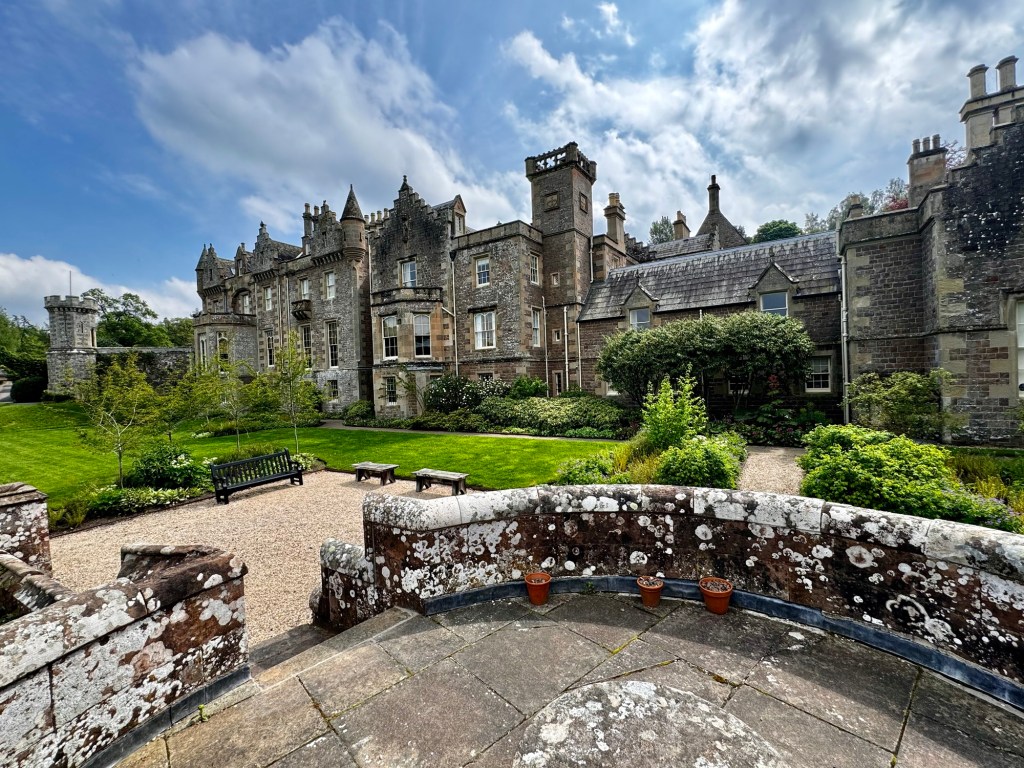
Since we’ve all only read Ivanhoe, it’s interesting to note that in fact Scott wrote 25 books and is considered to be the inventor of the historical novel. He was also a fine poet. In his spare time, he was also responsible for finding the Scottish Crown Jewels after they were lost for a wee while (see previous blog), and he stage-managed George IV’s trip to Scotland which helped rehabilitate and romanticize Highland culture. He wrote books and poems about the 1745 Jacobite rebellion, and our three lads and a lassie, Robert the Bruce, William Wallace, Rob Roy and Mary QOS.

After touring Abbotsford, I have the sense that he was a very cool guy with a cool wife and four successful kids and he’d be on my list of time machine meet-up people.
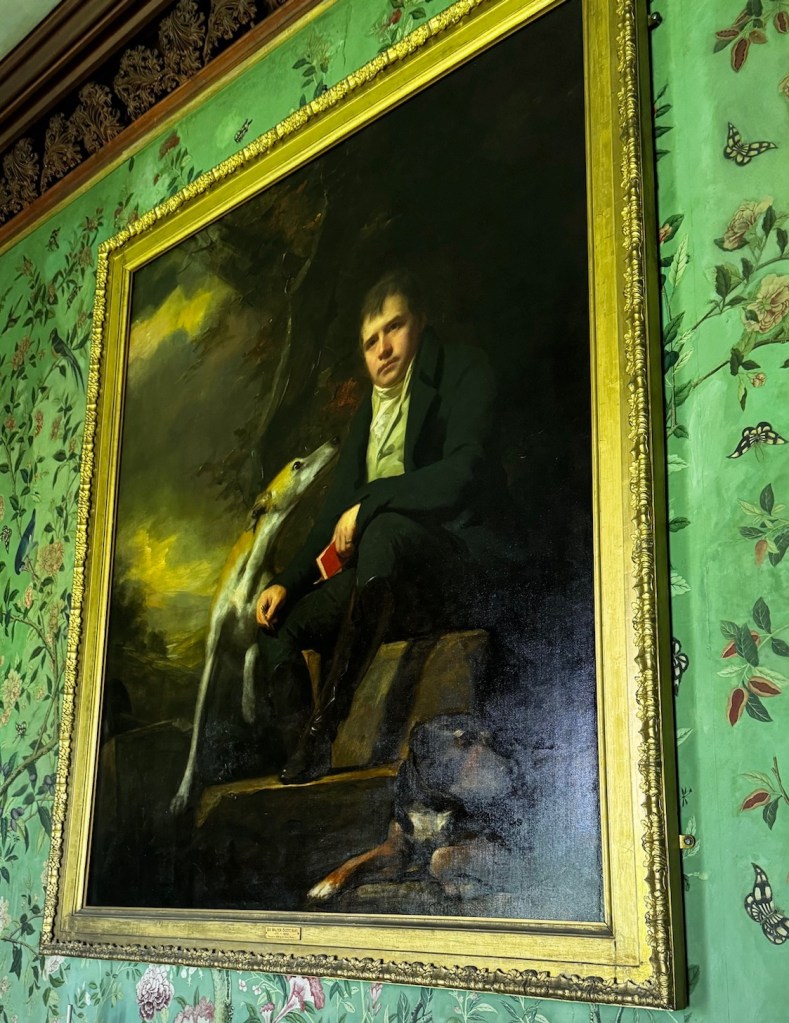
The nucleus of Abbotsford was 100 acres of farmland Scott purchased. He modestly, and then more aggressively expanded over the years, not only creating his large home but adding 900 acres along the River Tweed. Unfortunately, in 1825 a UK-wide banking crisis resulted in the collapse of the Ballantine printing business, of which Scott was the only partner with a financial interest. It had debts of 130,000 pounds (equivalent to 13.5 million today). He refused to accept financial help and instead placed Abbotsford into a trust in the name of his creditors and wrote his ass off. The debt was paid off shortly after he died.

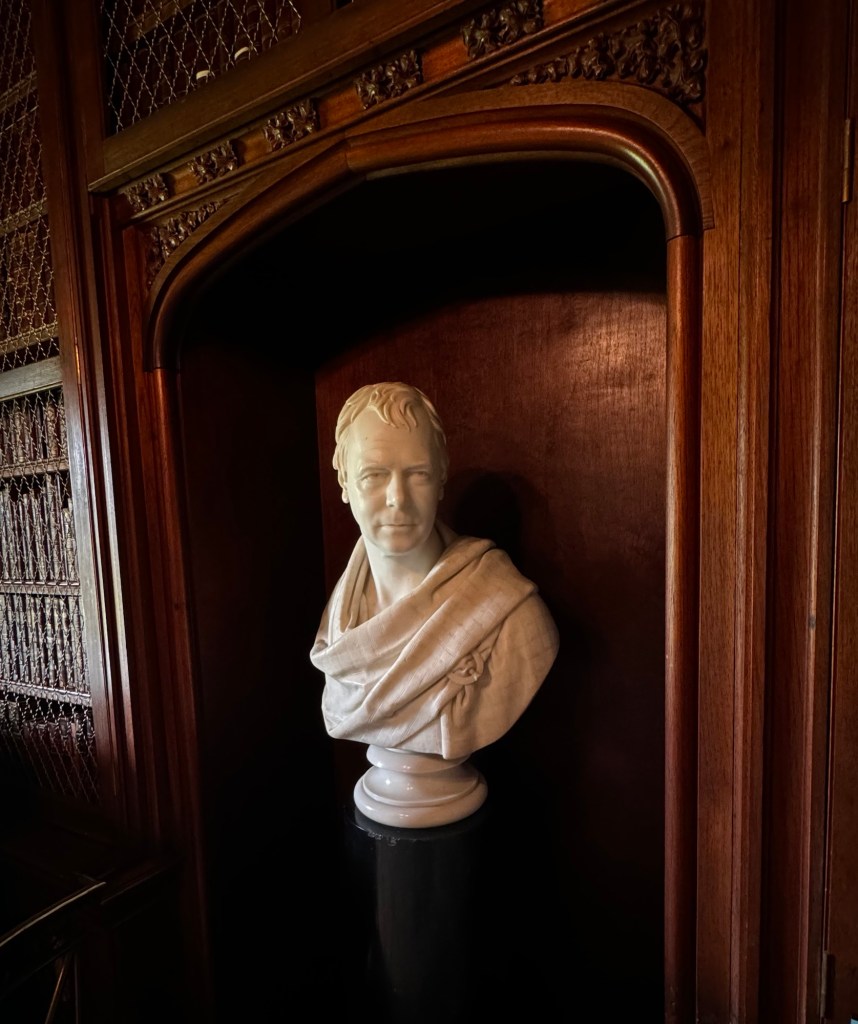
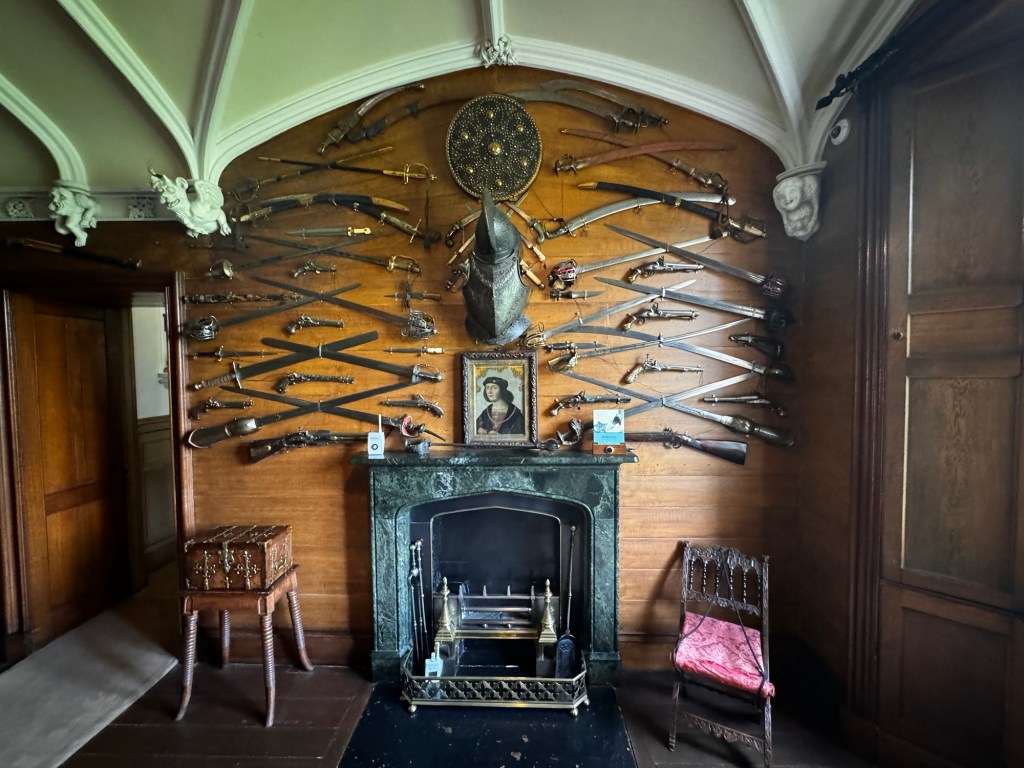
The house is gorgeous, and his interest in Scottish history apparent, as he had a fascinating collection of artifacts on display, including items apparently belonging to Peepaw Roy, Mary QOS and the Bonnie Prince. The lower floors of the house are on the tour, nothing upstairs. The house was exactly as he left it at his direction.

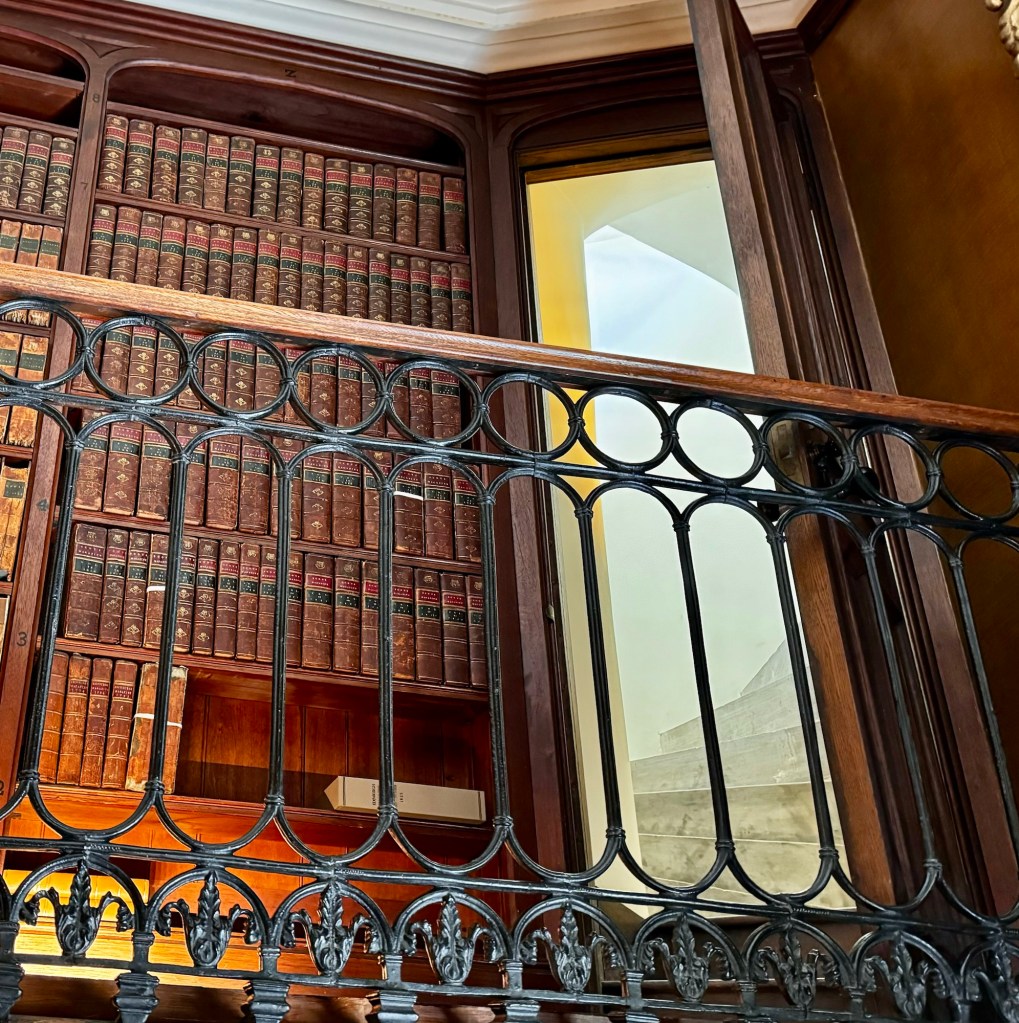
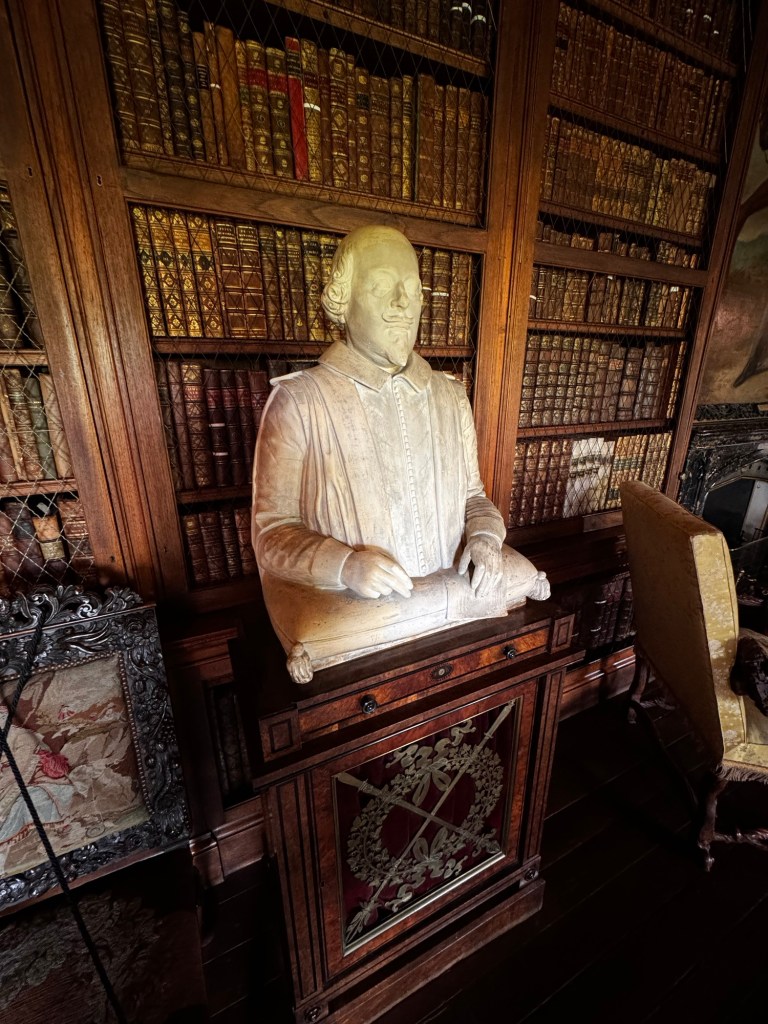
My favorite room was his study with an upper library lining the ceiling. There is a staircase up, and a door in the opposite corner leading to his dressing room, so he could escape uninteresting guests.

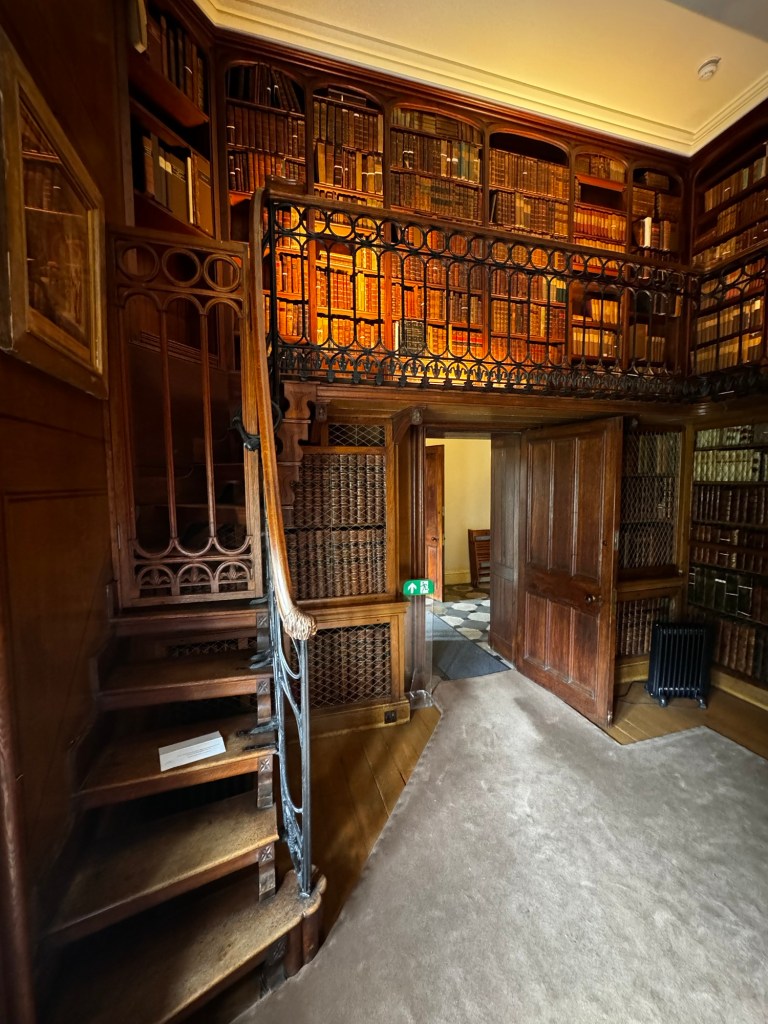
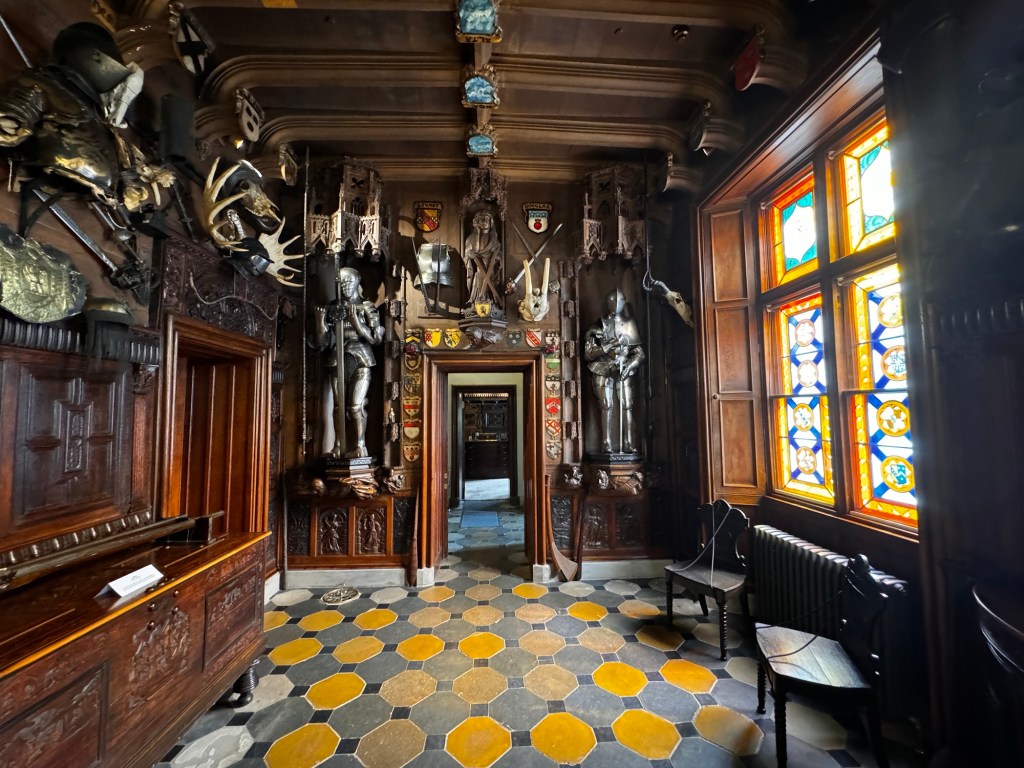
All of the rooms were remarkable.
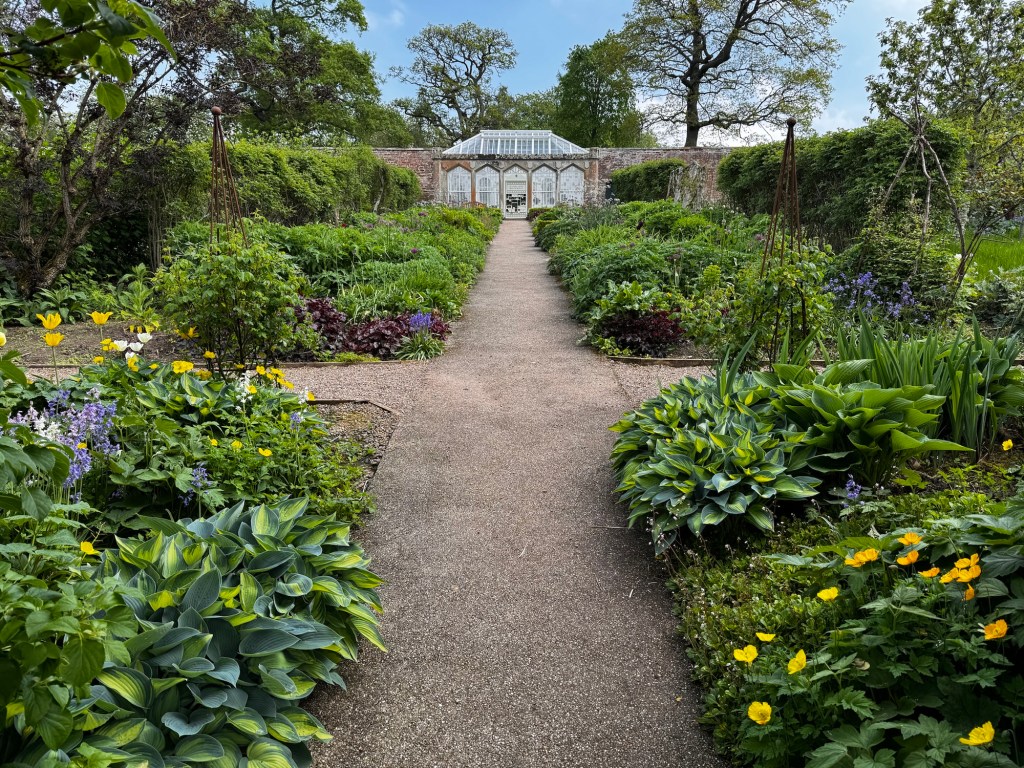
The gardens are dreamy and well tended.
I was surprised by the beauty and character of the Scottish Borders, largely because somehow I’ve turned into a Highlands snob. The Borders are a quaint small town showcase, with wonderful names like Upsettlington, Blyth Bridge, Teviothead, Innerleithen, Tweedbank, Peebles and Melrose.

Speaking of which, I had lunch in Galashiels, recently named the happiest place to live in Scotland, 15th overall in the UK. Called Gala, it’s the cheapest town on the list with average home price of 163,634 pounds, or just $205,000. In addition to a very reasonable cost of living, the town has a strong sense of belonging and community spirit. One resident referred to, “so many little acts of kindness that are carried out without fanfare.”

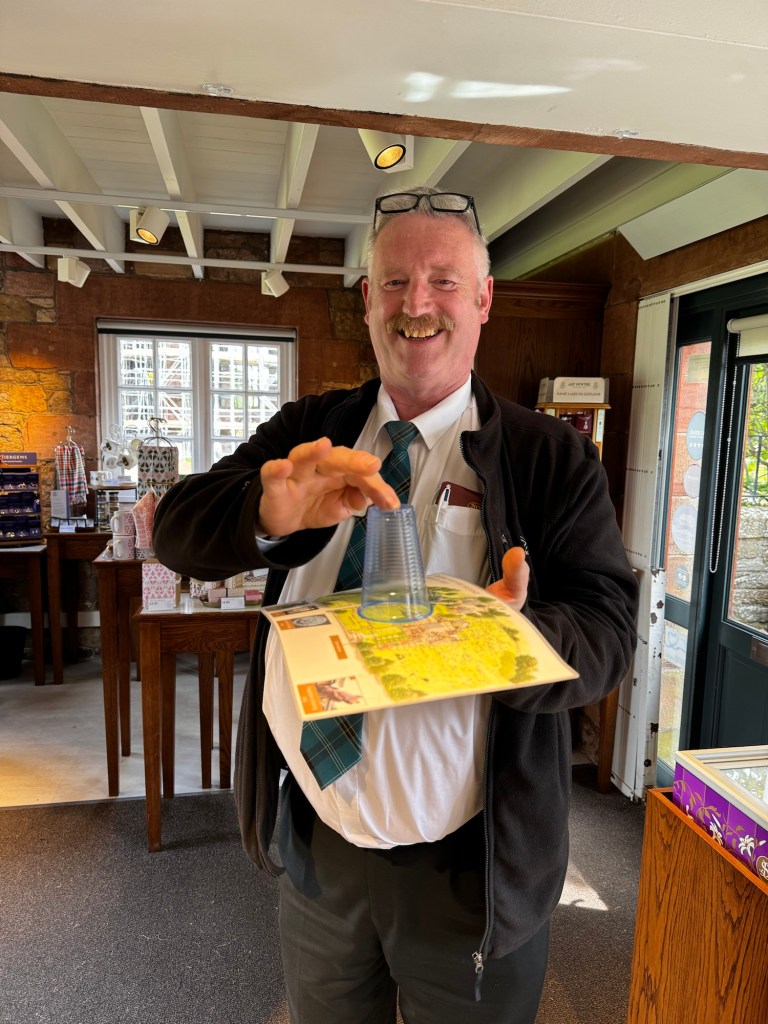
My last planned stop was the town of Melrose to visit the Abbey. As I walked into the gift shop to check in, a gallant gentleman staff member was capturing a yellow jacket between a map of the grounds and a plastic cup – ugh, those hateful bugs, they are a plague. He was adorable, congratulating me for being the 79th guest of the day and pretending to hand me his spoils as my prize.
The Abbey is undergoing a wee bit of rehabilitation.
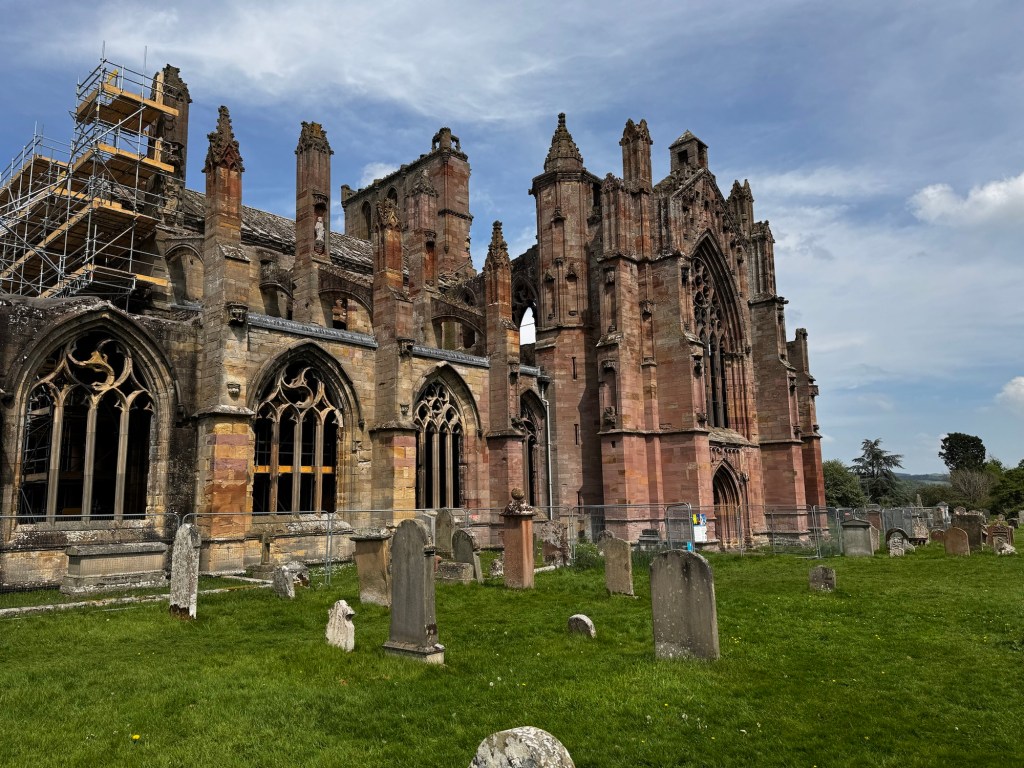
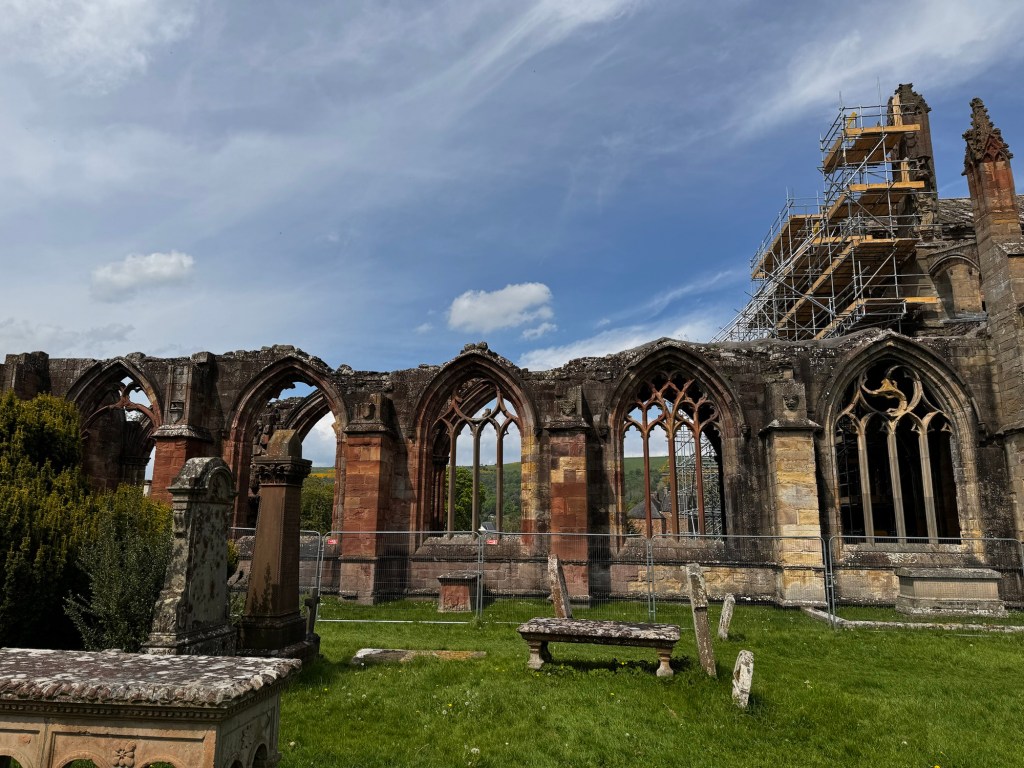
Guess what is buried on the grounds of the Abbey? The heart of Robert the Bruce. Apparently Robert had always wanted to go on Crusade but he had a hard time leaving Scotland because it required ongoing protection. So, on his deathbed, he asked his friend James Douglas to take his heart on one. Sadly the Pope hadn’t called for a crusade for a while and so Douglas intended to take it to Jerusalem’s Church of the Holy Sepulchre before burying it at Melrose Abbey. The heart was given to him in an urn to be worn as a necklace, a questionable choice. Unfortunately Douglas and his knights were instead called to fight against the Moors who were attempting to take Spain, so that’s where Robert’s heart went as well. Douglas was killed in a surprise attack but as he was dying he threw the heart into the air and shouted, “Lead on brave heart, I’ll follow thee.” THAT, my friends, is where Braveheart came from. Bruce’s heart, along with Robert’s remains, were carried back to Scotland.

The heart was buried with Douglas near the Abbey. The heart was exhumed in 1920 and then buried again without a marker, why is beyond me. Luckily, in 1996 during excavations of abbey ruins a canister was discovered with the urn inside along with a note saying it had been found in 1920. Ultimately, this was mostly confirmed to be Bruce’s heart.
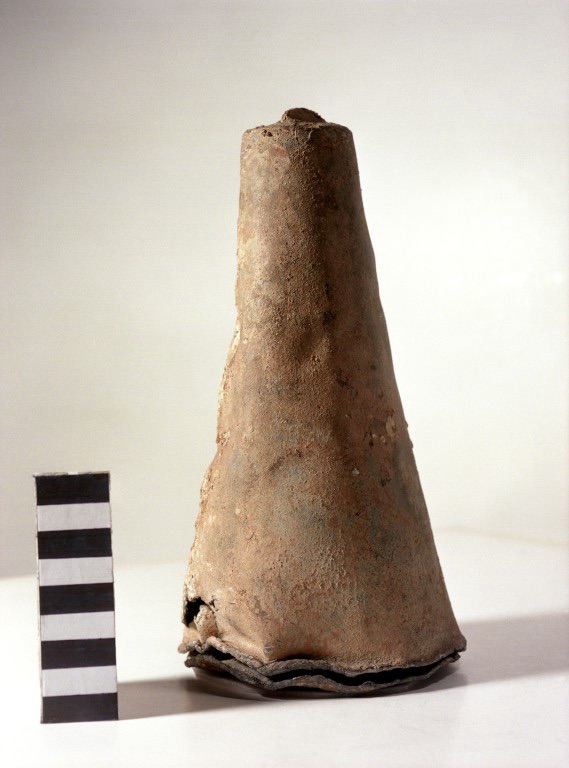
It was the right age, and nobody else had the idea to bury their heart there apparently. And thus here ya go:

The heart of The Bruce

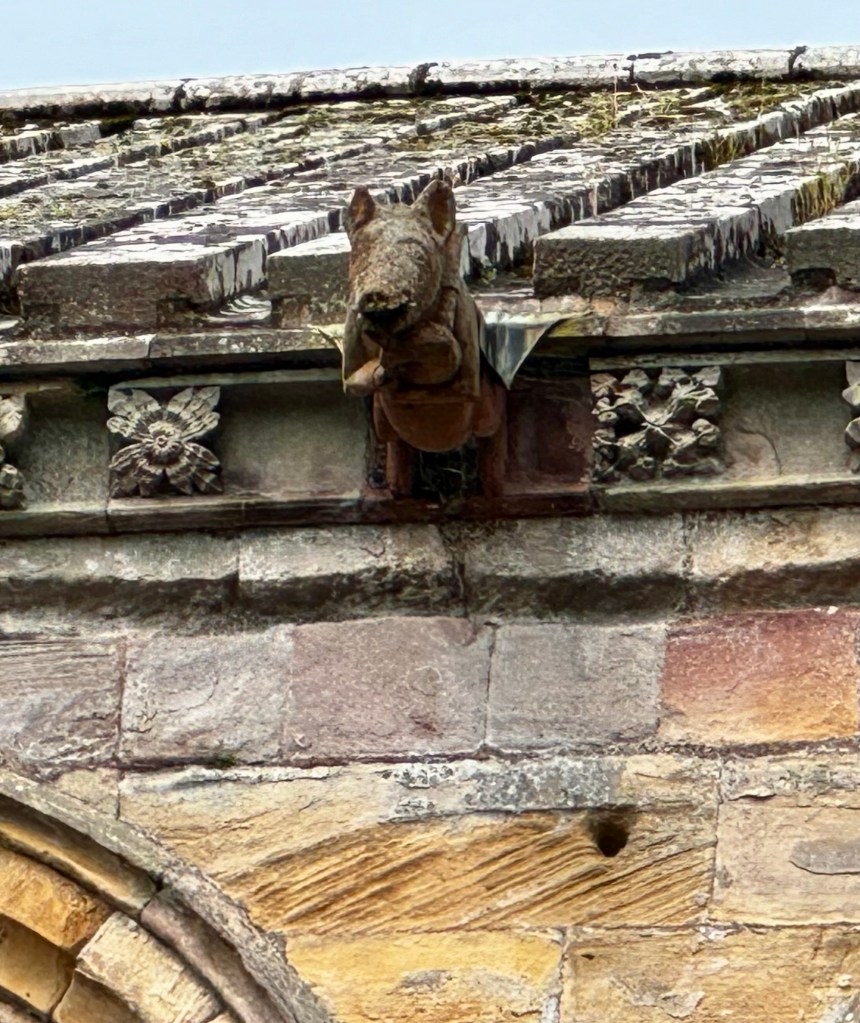
The other best thing about the Abbey is a 14th century gargoyle of a pig playing the bagpipes. It seems an odd thing for a serious place like a church, as medieval churches aren’t generally known for their wit and whimsy. The sculptor is another member of my time machine meet-up list.

I topped off the day with an unexpected visit to a slightly sad roadside attraction. One thing about traveling alone is that you can stop whenever you want without consulting anyone, even for an adventure that might end up being dumb. When I was a kid and we were piled in the car driving across country to visit grandparents, we never got to stop at a roadside attraction. There was really no stopping for any reason unless you convinced my dad you had to pee and it had been a respectable amount of time since you last did so. So forget the Largest Ball of Twine or whatever. So in Dad’s honor, I impulsively stopped at the Great Polish Map of Scotland.

The map was the brainchild of Jan Tomasik, a sergeant in the 1st Polish Armoured Division who was stationed in Galashiels (the happiest town) in WWII. He married a Scottish nurse and became a successful hotelier after the war. He bought the Hotel Black Barony, near Peebles, in 1968 and a few years later had the idea to create a large physical relief map of Scotland on the grounds of his hotel. Out of sculpted concrete. It took six years to build. He told hotel patrons, “I shall die, but I shall leave my map as a gift to the Scottish people to thank them for the hospitality they showed the Poles when it was needed,” which is really nice.

Like the mirror box sculpture, though, it’s a little worse for wear, and you can’t really get high enough to appreciate the full impact of the piece. It’s also supposed to be surrounded by water with even some of the major rivers filled, but it’s just mucky with bits of trash.
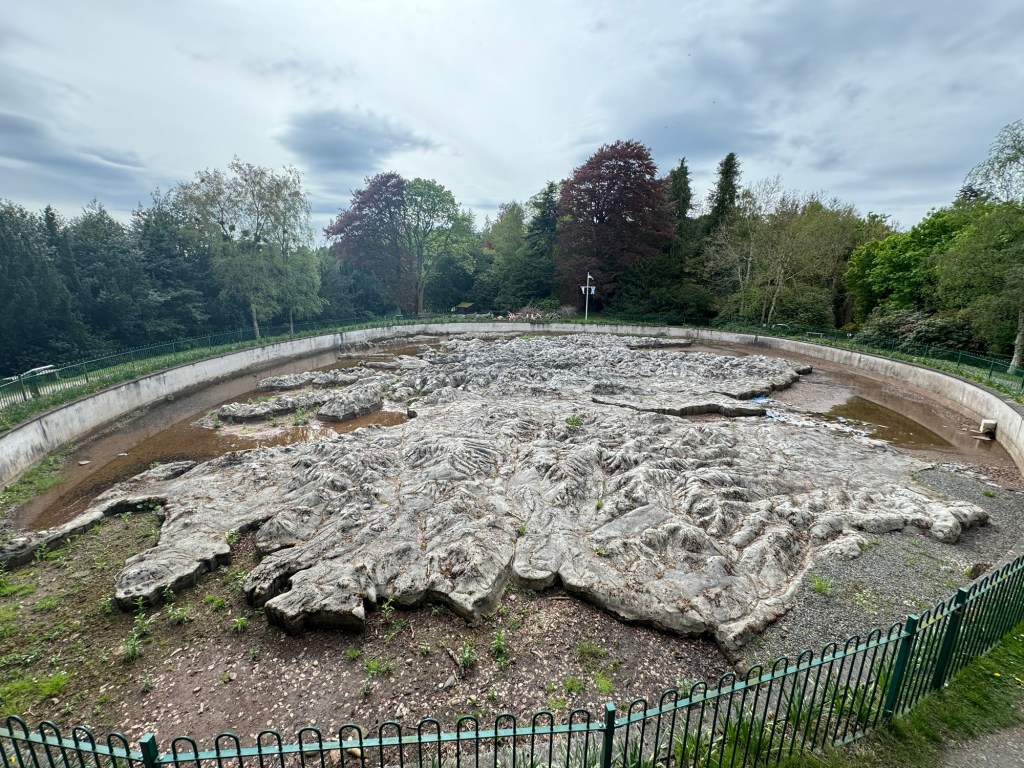
View from the viewing platform which needs to be higher.
A sad state of affairs for Lewis and Harris.

The hotel closed in 1985 and the map became overgrown. In 2010 a group of volunteers decided to save and restore it and they secured funding for it in 2013, ten years ago now. Even though the hotel is back in action, I fear maintaining this might be a lost cause.

Even though it’s the largest outdoor relief map in the world! A few steps up from the largest ball of twine.

And with that, a most excellent day in the Scottish Borders came to a conclusion.

Rosslyn Chapel was on the next day’s agenda.
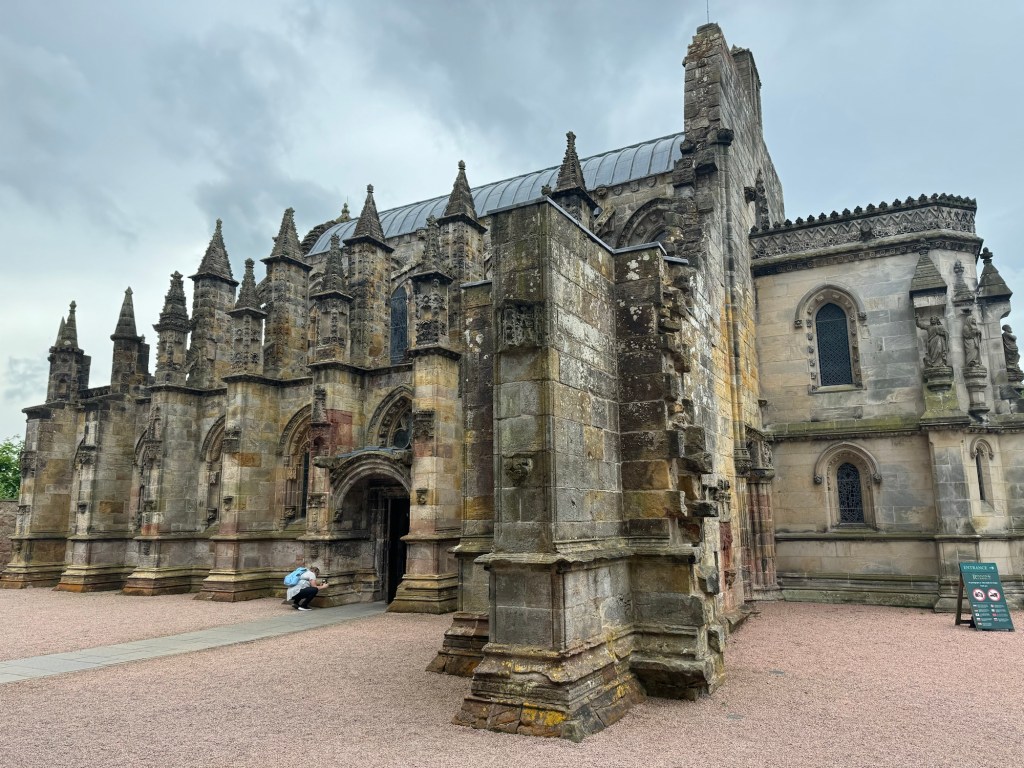
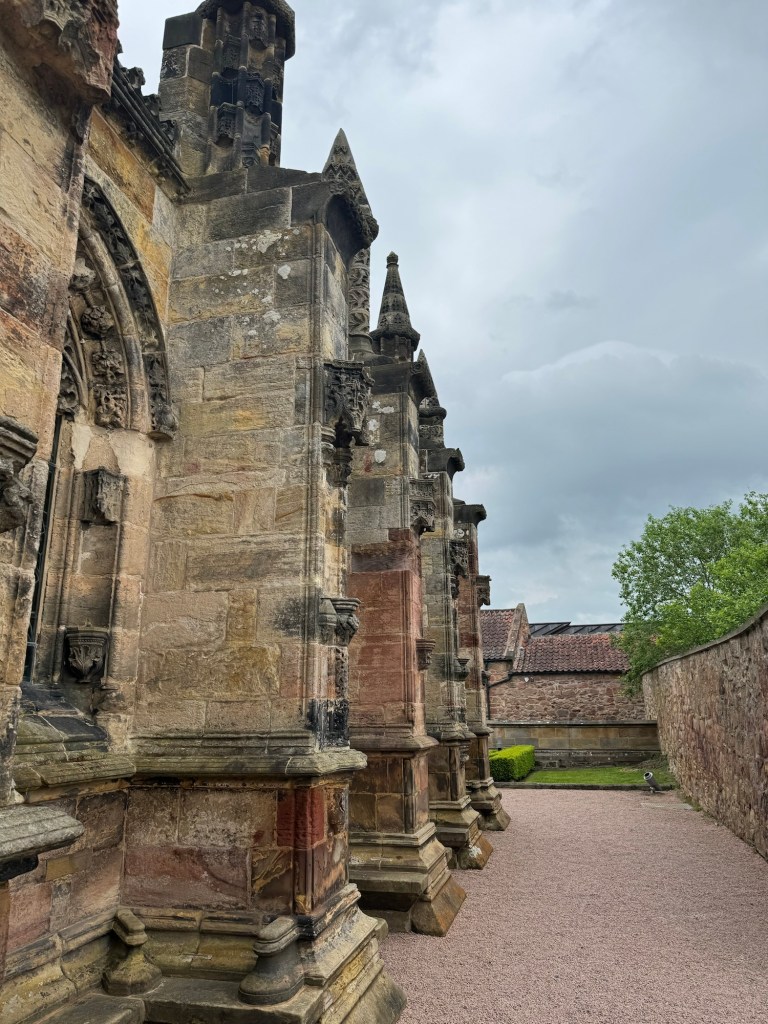
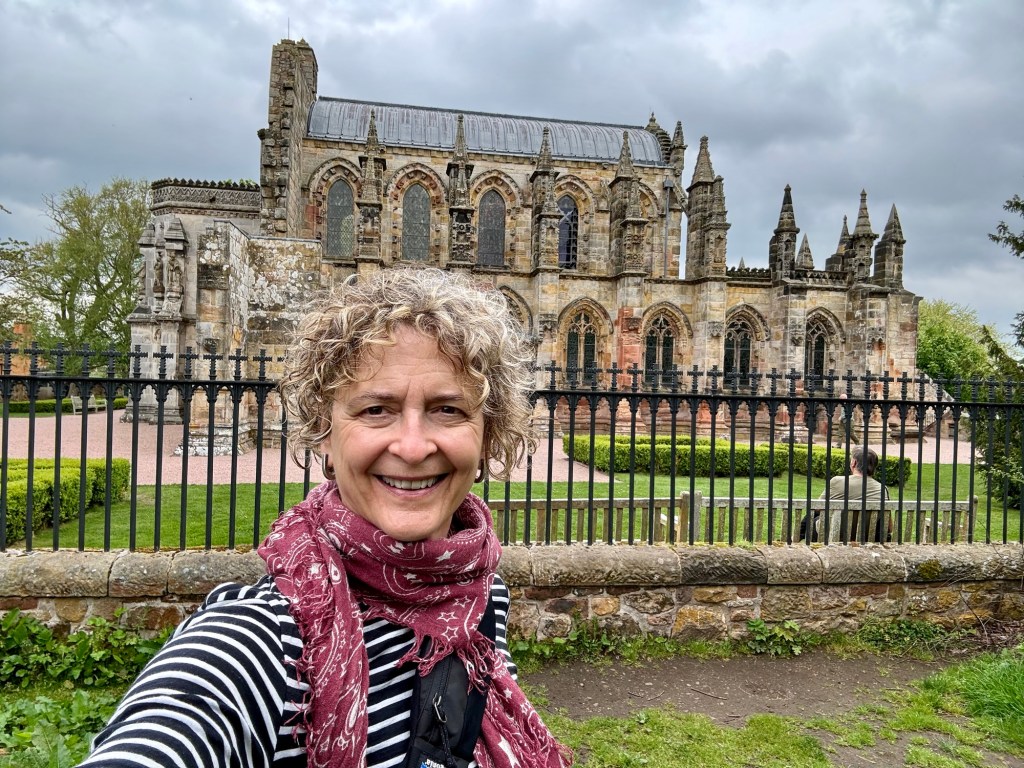
The chapel was designed and built (over a 40 year period) by Sir William St. Clair who had much grander plans than what you see, which is pretty freaking grand. His motivation was to attempt to secure his spot in heaven because that’s how you do it apparently.
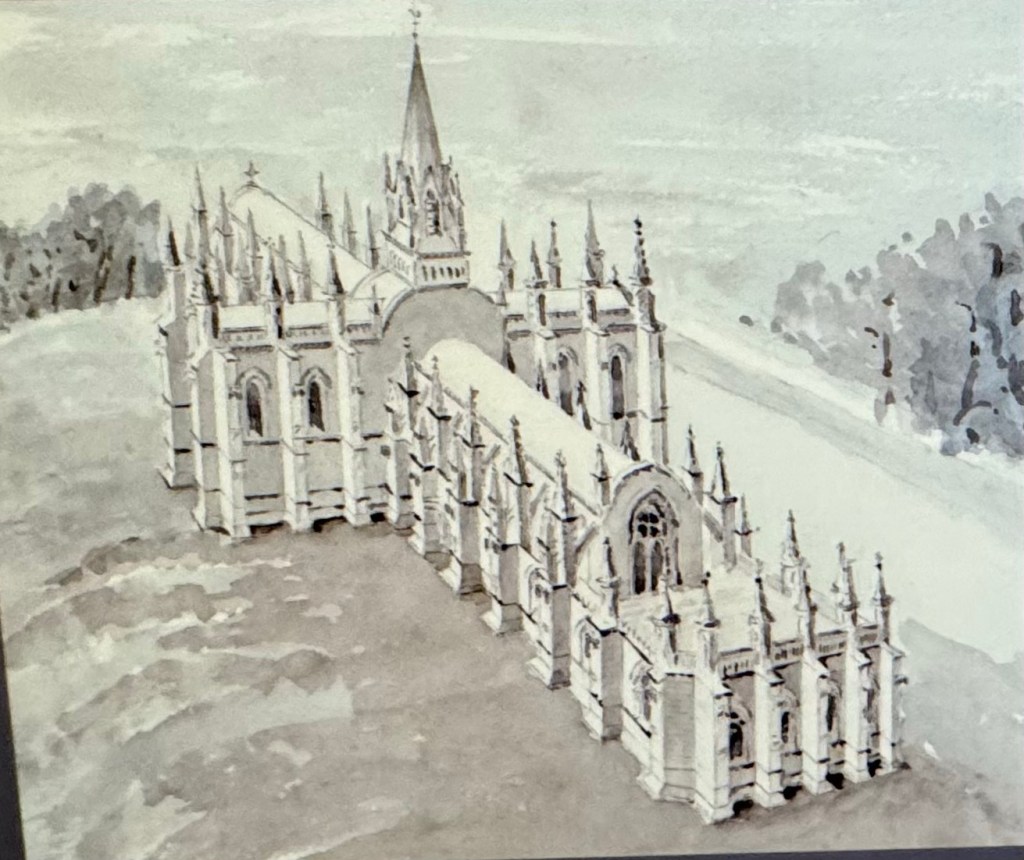
The ultimate dream, alas, unrealized.

The chapel is undeniably gorgeous – hands down the most incredible church-like situation I’ve ever seen. Yet interestingly, still, after all the time, 50% of visitors are there because of the DaVinci Code.

Tom Hanks makes his first appearance on the Wee Dram!

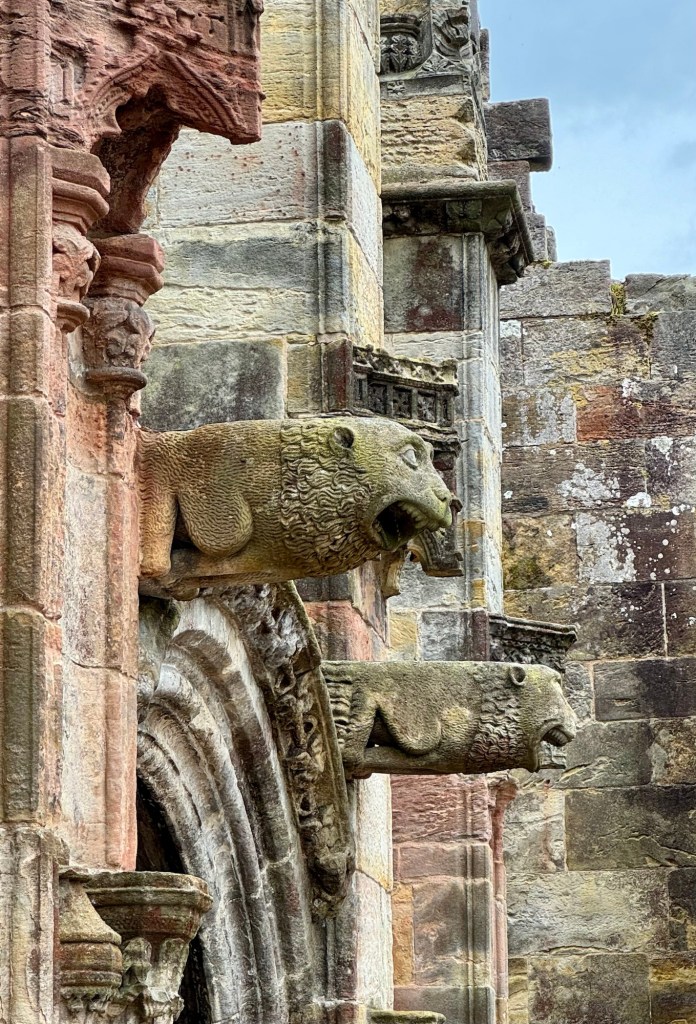
The chapel is the definition of Gothic with flying buttresses and whatnot, and so many gargoyles inside and out. As you aren’t allowed to snap photos inside, here are a couple of fantastic outdoor gargoyles.
Legend tells us that a vault as deep as the chapel is high is carved out beneath the building, and inside is the final resting place of the medieval St. Clair knights who are laid out in their full suits of armor. Rumors also abound that other cool stuff is down there too, including the Holy Grail (!!), the Ark of the Covenant (!!!) and the head of Christ (!!!!!!!). Alert Dr Jones.
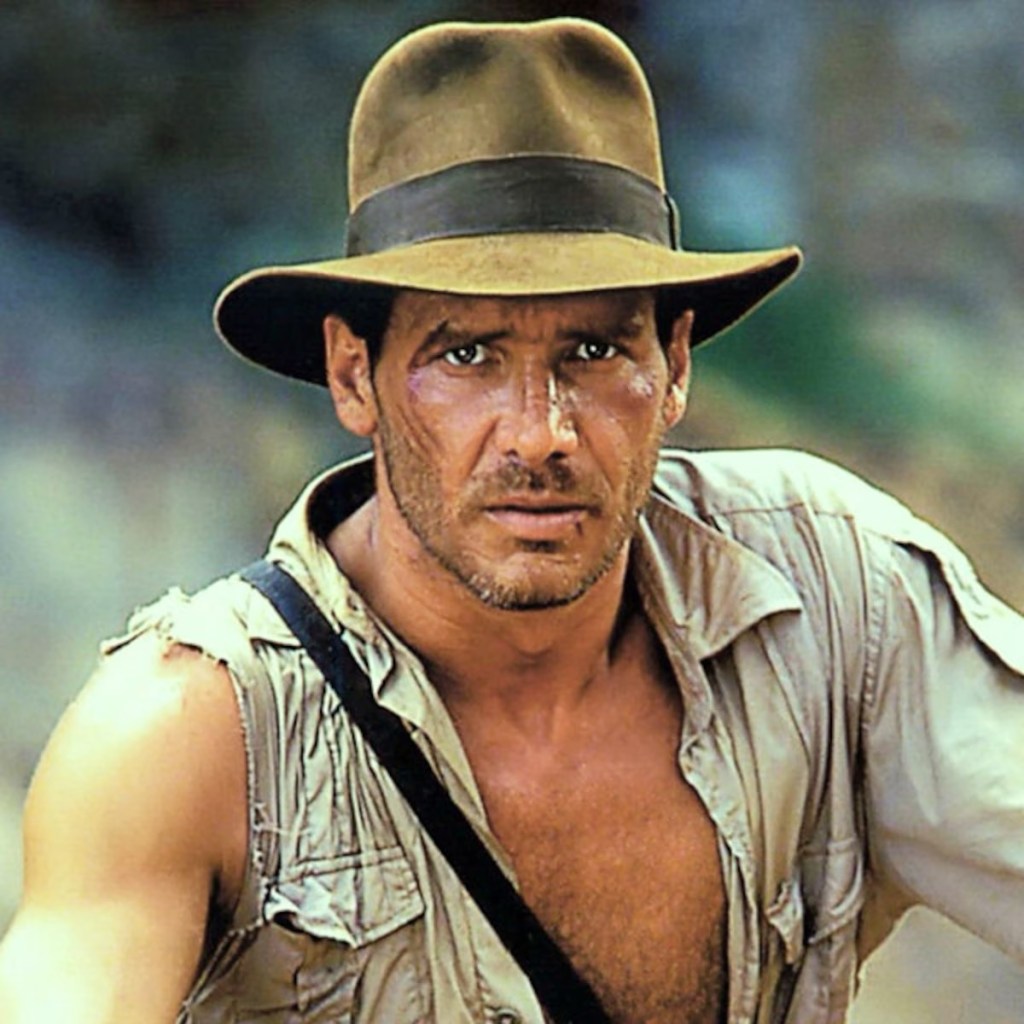
Ditto Harrison Ford!

Since I haven’t mentioned Henry VIII yet on this trip – now is the time. In 1544, the chapel was damaged during his so-called “rough wooing,” when he declared war on Scotland in an attempt to force the Scots to agree to a marriage between his son Edward (who died of tuberculosis at 15) and Mary QOS. Cromwell’s troops stabled their horses here while they ransacked nearby Rosslyn Castle (currently being restored), and, in 1842, Queen Victoria visited the Chapel and expressed the desire that it be preserved. Also, the adjacent Rosslyn Inn hosted Edward VII, Dr. Samuel Johnson, Robert Burns and Walter Scott as guests.
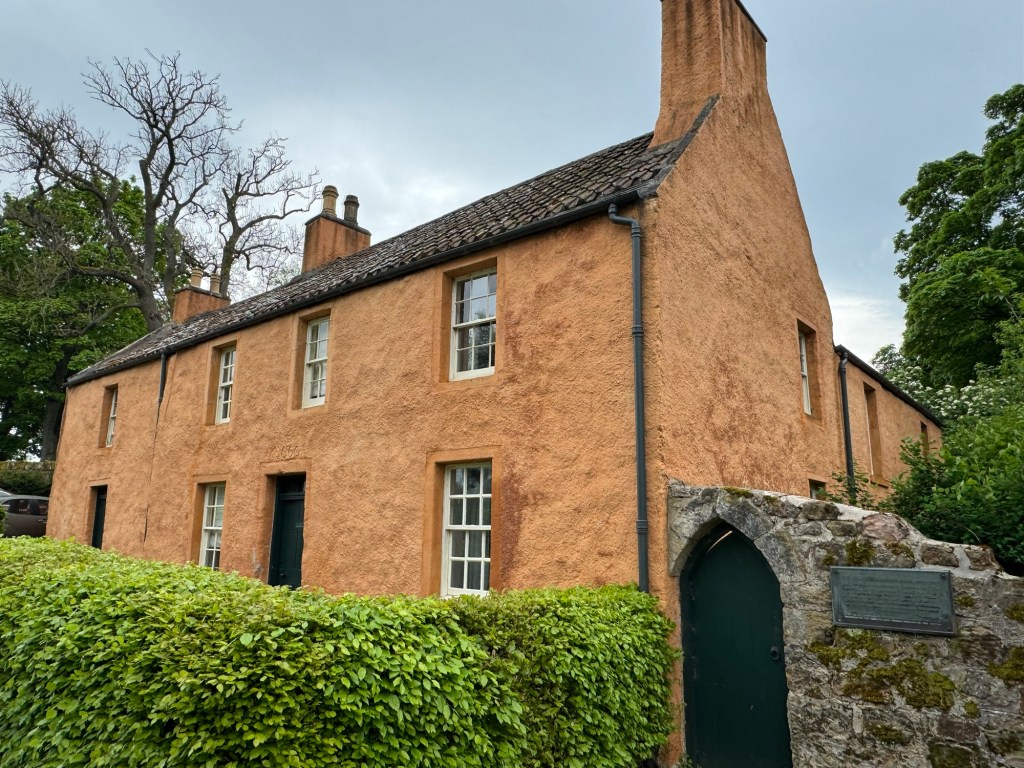
Rosslyn Inn

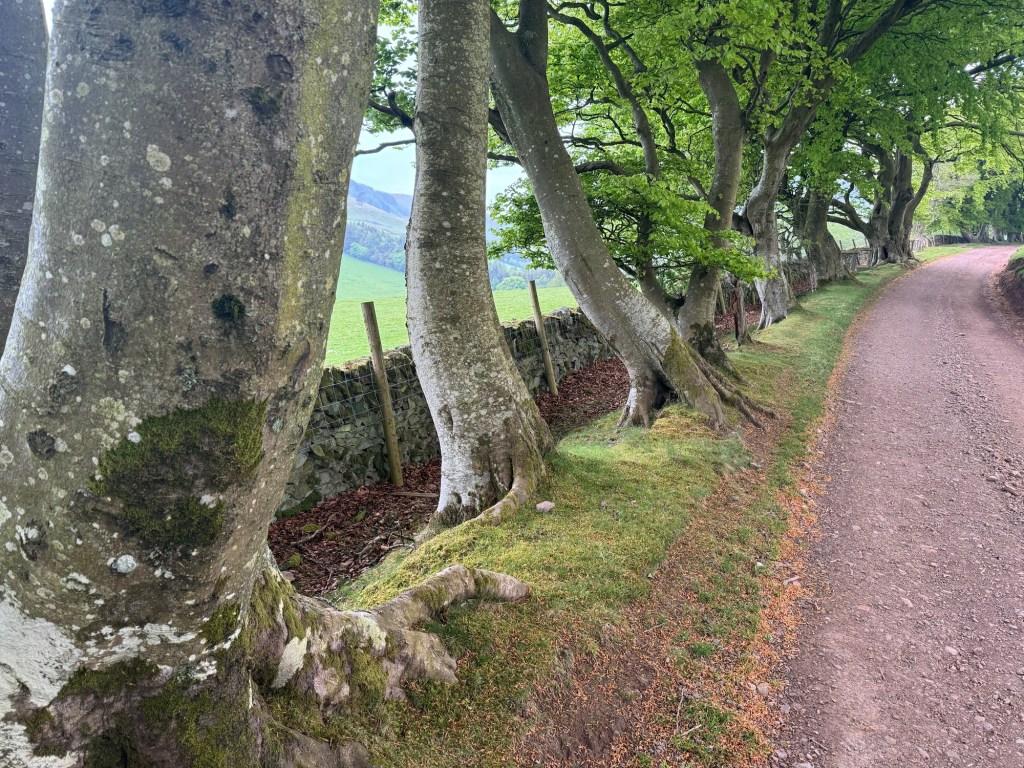
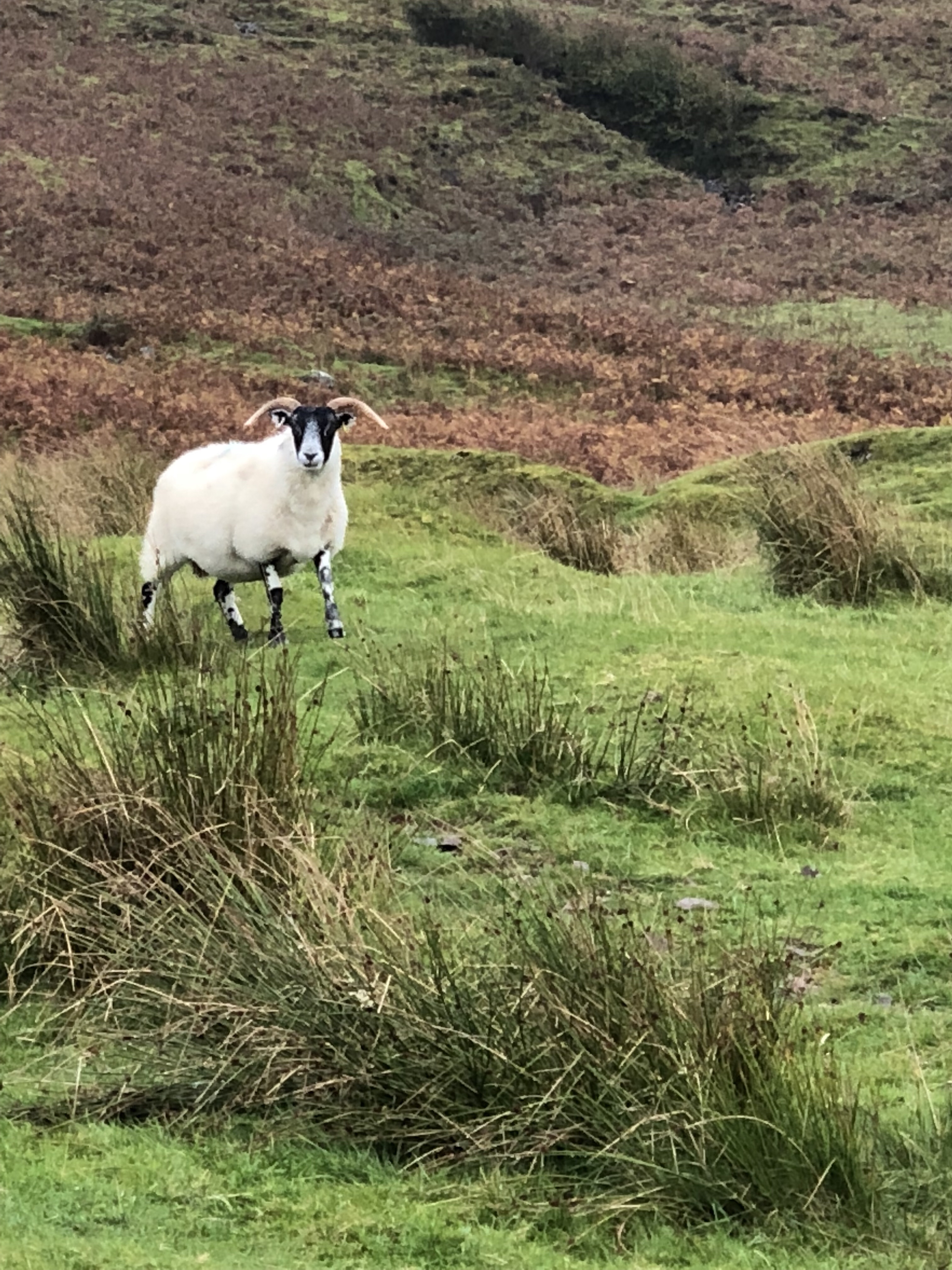
I returned to Eastside Farm, and had one last lovely walk. In my absence, they had moved the sheep around, and so now the males, which are separated from the females and their babies in the spring, were patrolling the road. I wasn’t entirely sure about this guy. We had to negotiate a few things.
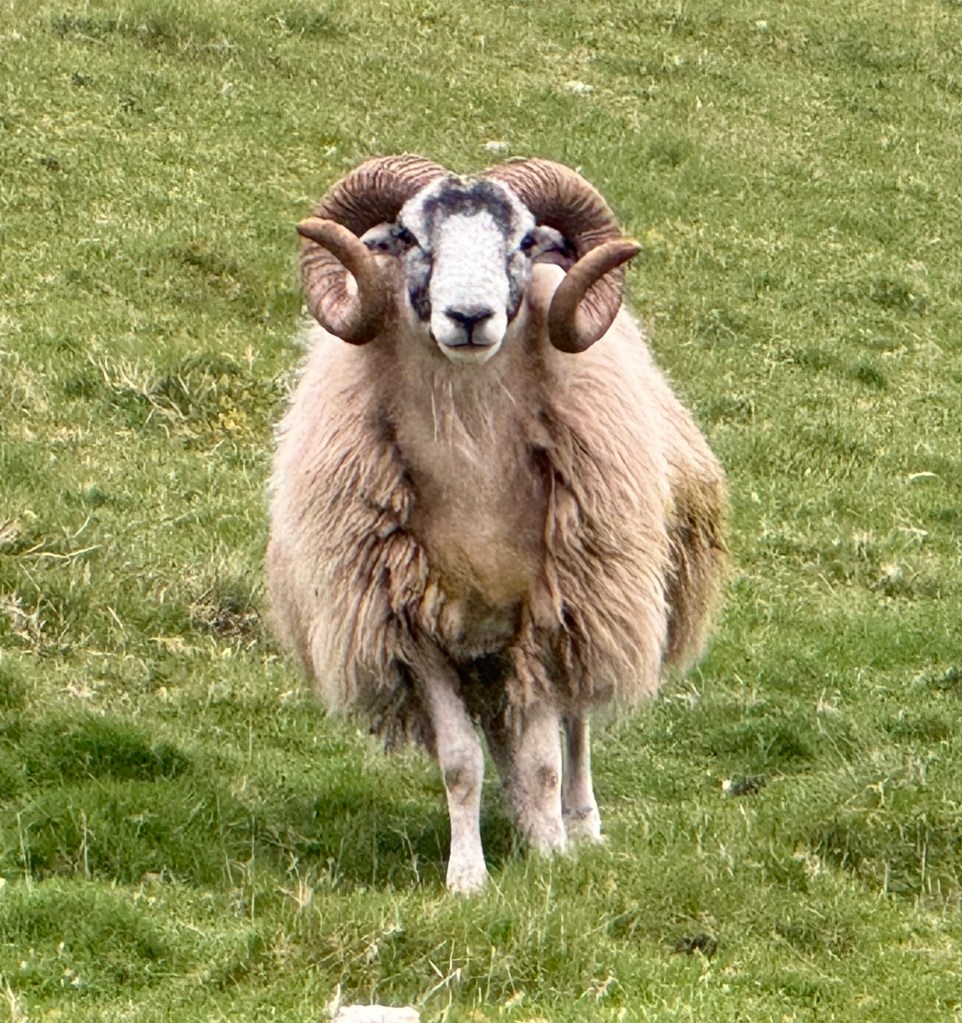
And with that, dear readers, we are off to Shetland.

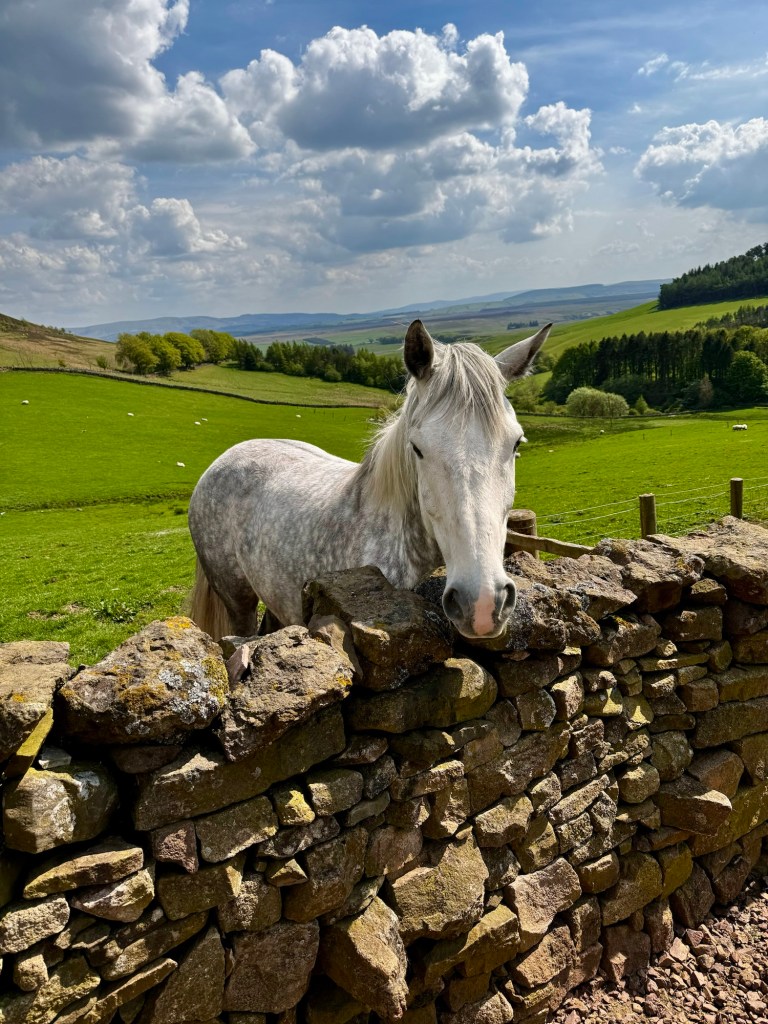
Say goodbye to Oscar.

Three Lads and a Lassie: Rob Roy, William Wallace, Robert The Bruce and Mary

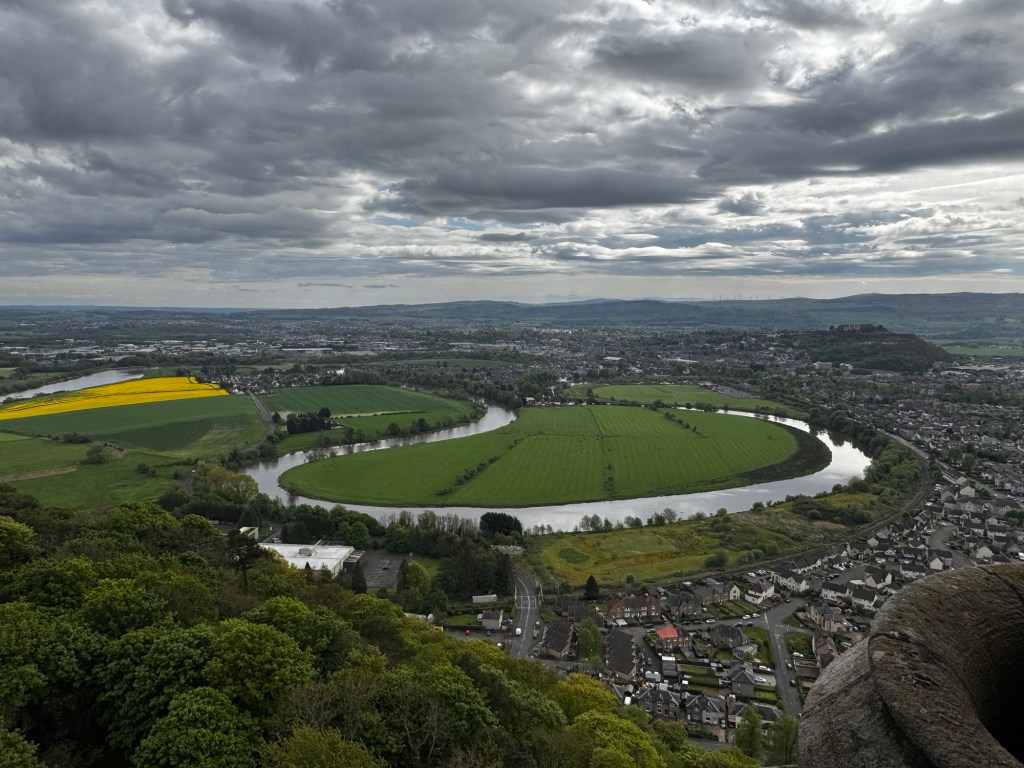
Stirling, from the National Wallace Monument

It’s quite striking how much of Scotland’s notable history over thousands of years occurred in the Isles. Back in the day, coastal routes were the country’s express lane – much quicker and easier to travel by sea than slogging overland across boggy, mountainous roadless terrain.

The other area of concentrated history is the Central Belt, the geographic center of Scotland. It’s the the lowland strip between the Firth of Forth (Edinburgh) in the east and the Firth of Clyde (Glasgow) in the west. It’s a relatively small area, the girlishly slim waist of the country, with Glasgow, on the west coast, being only 41 miles from Edinburgh, on the east. The area has been Scotland’s major population center forevs. As a result, wherever you visit in the Central Belt, chances are it has been previously frequented by Robert the Bruce, William Wallace, and/or Mary Queen of Scots as well as other long, long-ago personages.

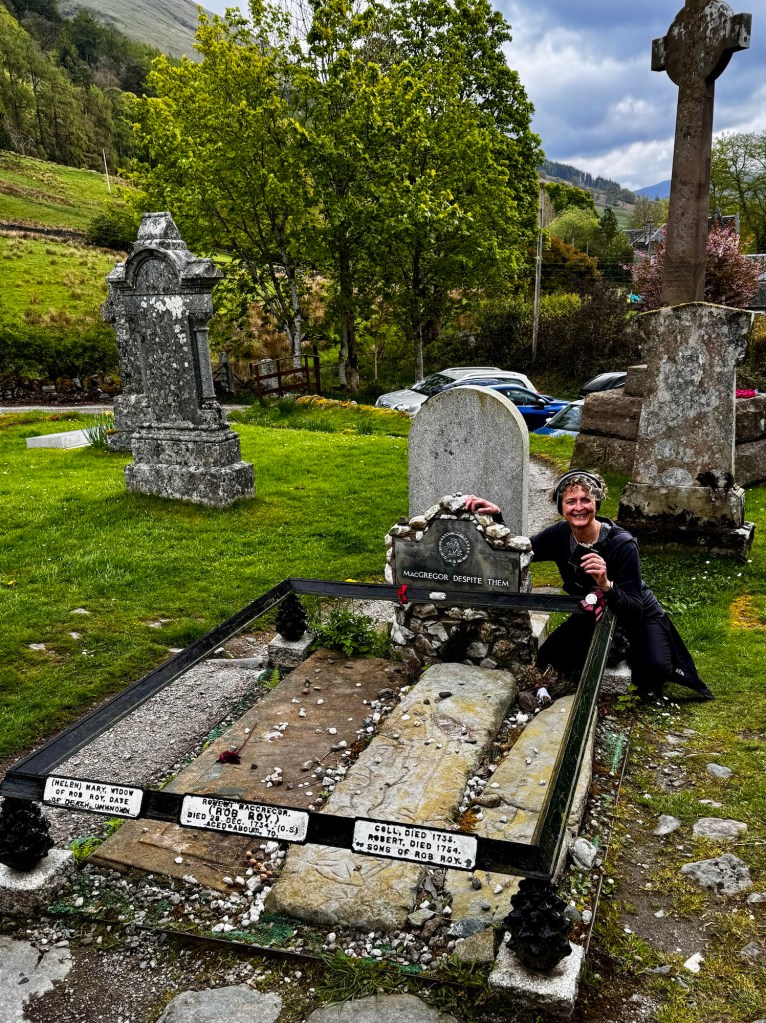
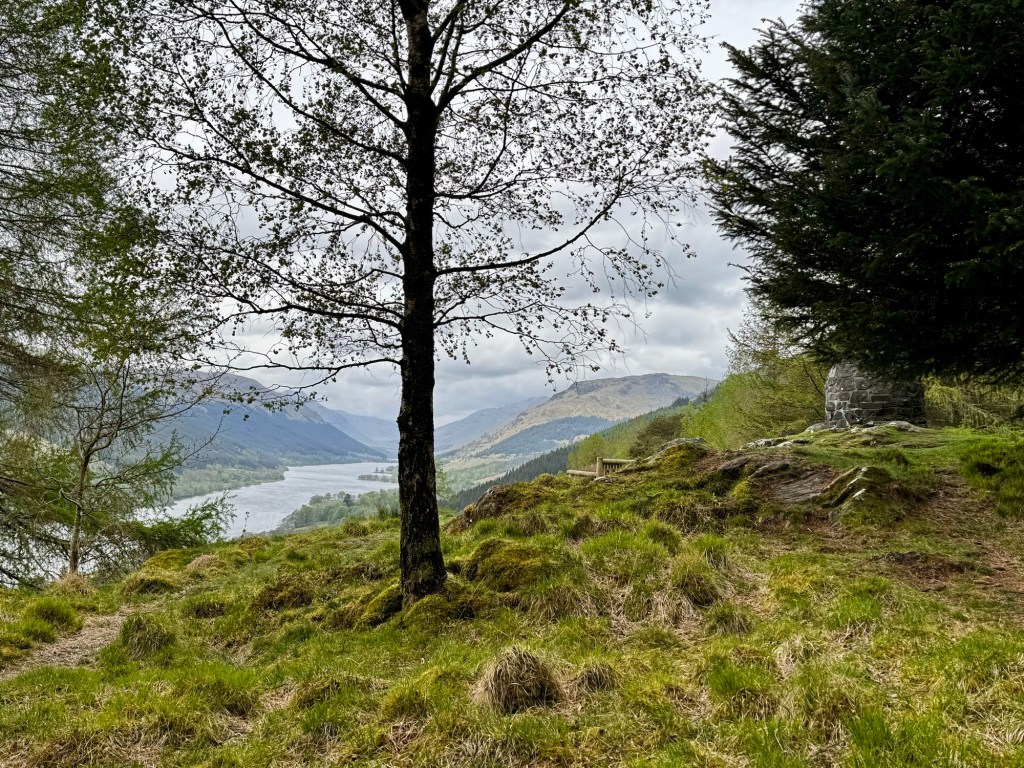
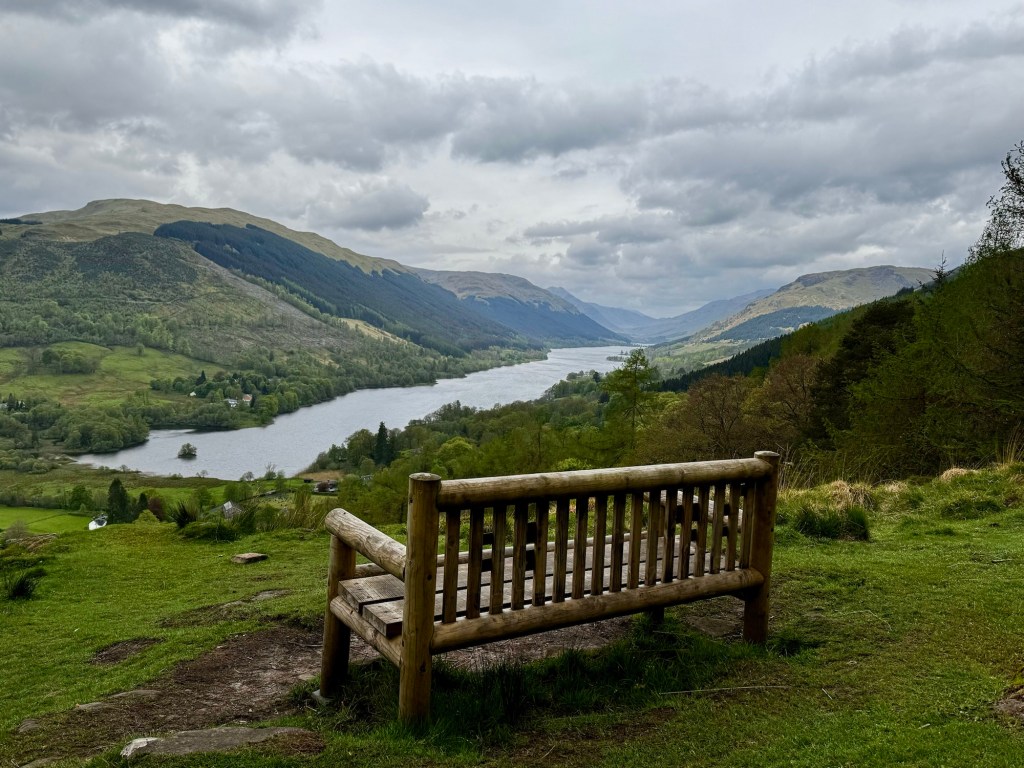
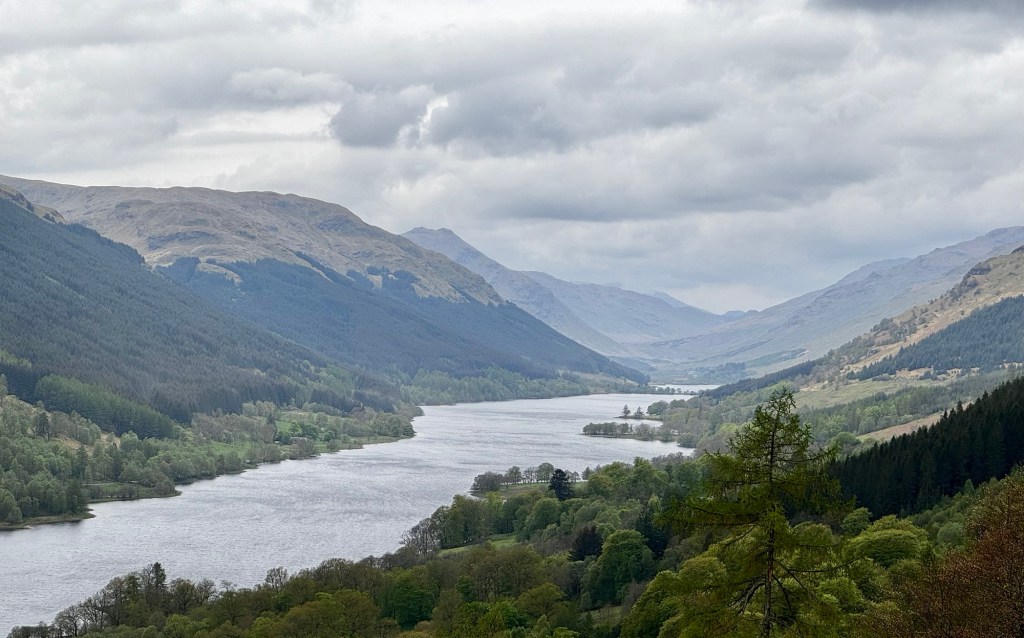
Rob Roy’s area of influence was pretty limited to the Highlands, but he’s included in this one-sided conversation of ours because he might be an ancestor (only in my mind and the invisibly slim fact that Gregory is a long-ago bastardization of MacGregor). Also because on my way to Stirling, today’s destination, I stopped to visit my great great great etc Peepaw’s grave at Balquhidder Parish Church and climb the hill behind it for one of my favorite views in Scotland, a drop dead vantage point overlooking Loch Voil. It’s a sweet, sweet spot and I’ll always check in when I’m passing, as you do with family.

Now, mind, Rob Roy was basically an outlaw who became a Robin Hood-esque folk hero during his lifetime thanks to a book written by Daniel Defoe and published in 1723 called The Highland Rogue. King George I pardoned him just as he was about to be involuntarily transported to the colonies, and the 1817 publication of Rob Roy by Walter Scott posthumously polished the sheen of his hero street cred.

Berlioz composed an overture in his name, Liam Neeson played him in a film and, the ultimate honor, in 1894 a bartender at the NYC Waldorf Hotel created a Rob Roy cocktail (whisky and vermouth garnished with a cherry which is a sad waste of whisky). He did fight in the 1689 Jacobite rising but like many other clan chiefs during the 17th and 18th centuries he also ran a protection racket, offering to safeguard cattle in exchange for cash he needed to feed his clan. This, along with cattle rustling, was common way to earn a living. He was declared an outlaw only when he defaulted on a loan because his chief herder absconded with the loan money.

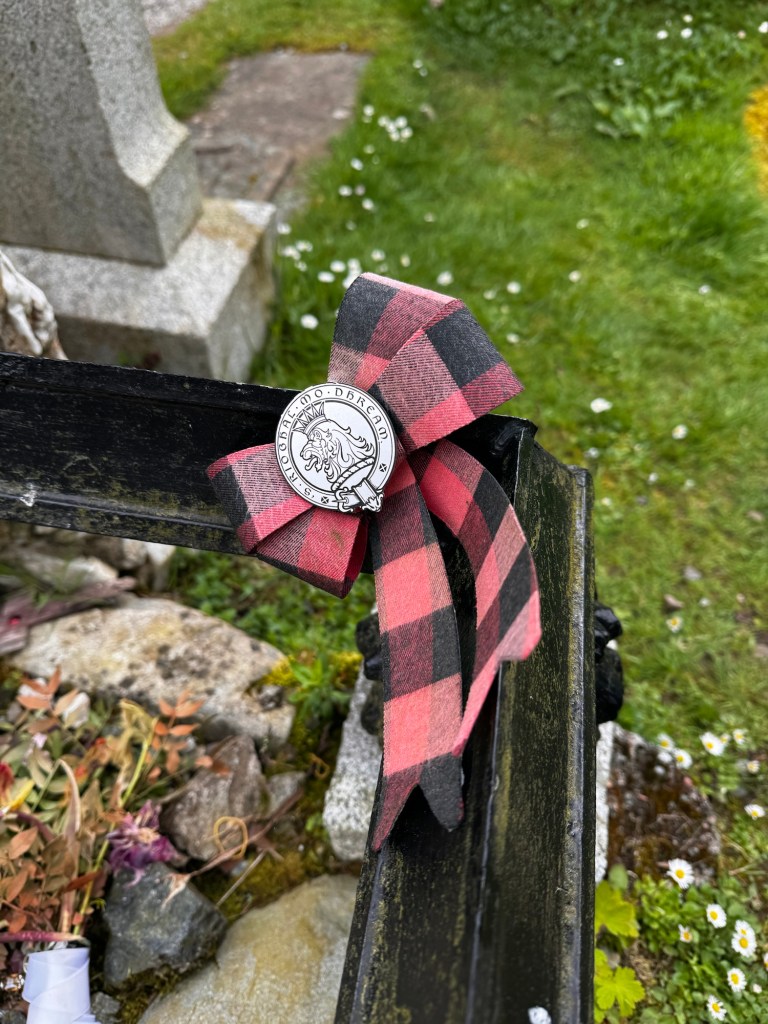
Graveside bling.
Loch Voil
Pathway to the top

This area was known by the Celts as being a “thin place” – where boundaries between earth and, shall we say, not-earth, however you define that, are especially narrow.

When you visit, you’ll understand why.

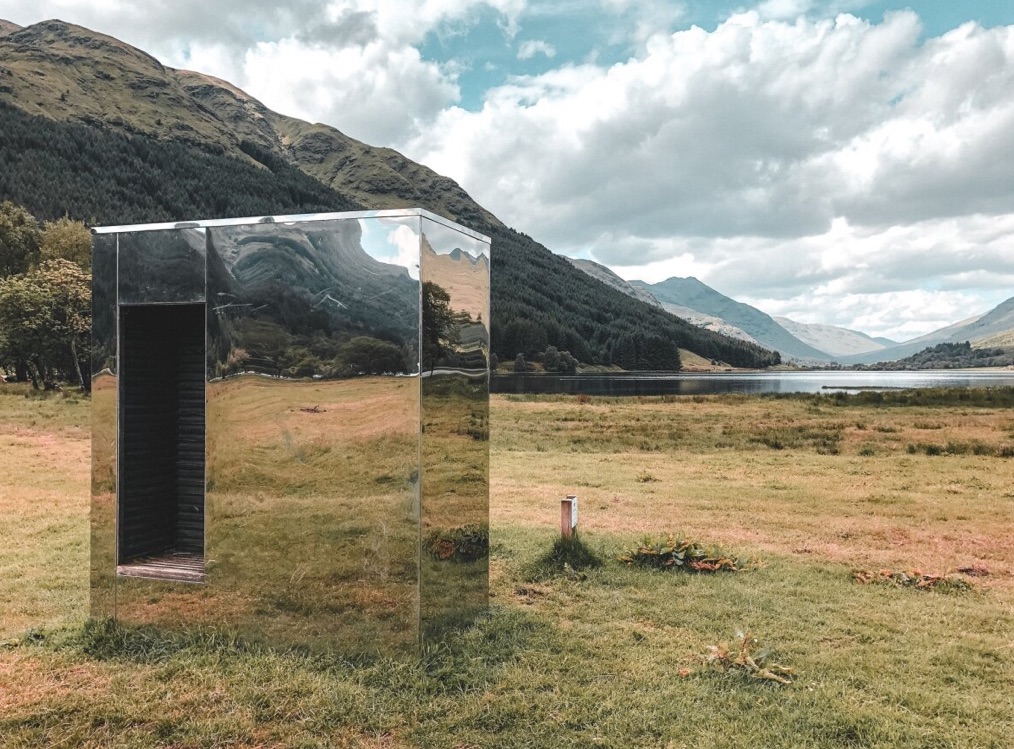
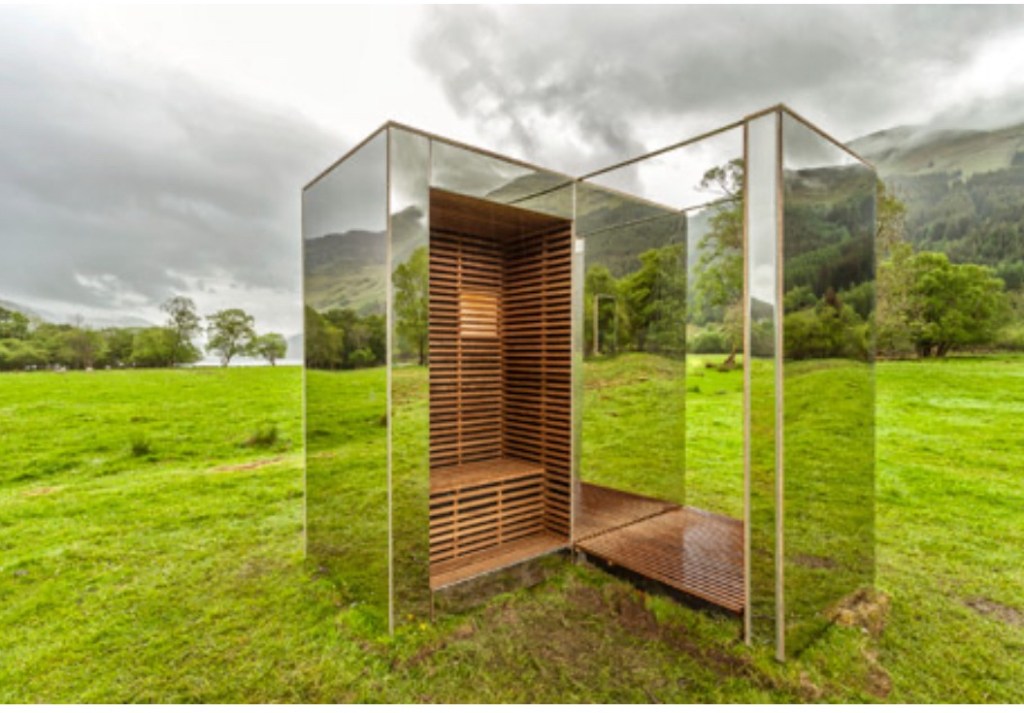
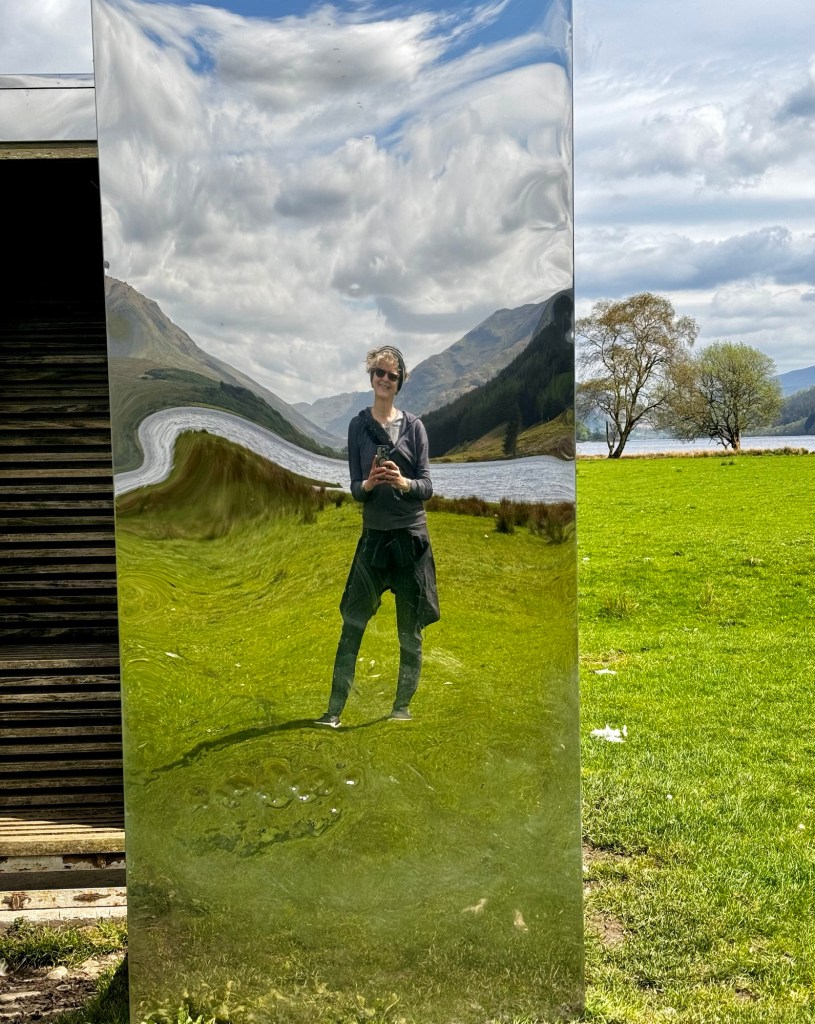
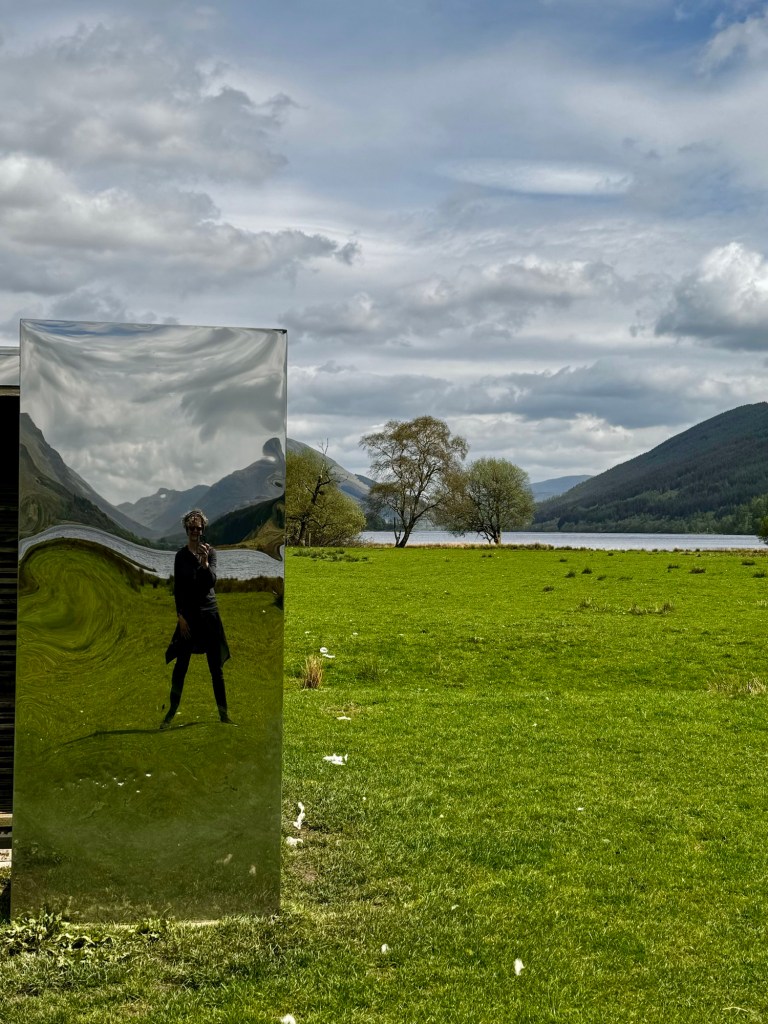
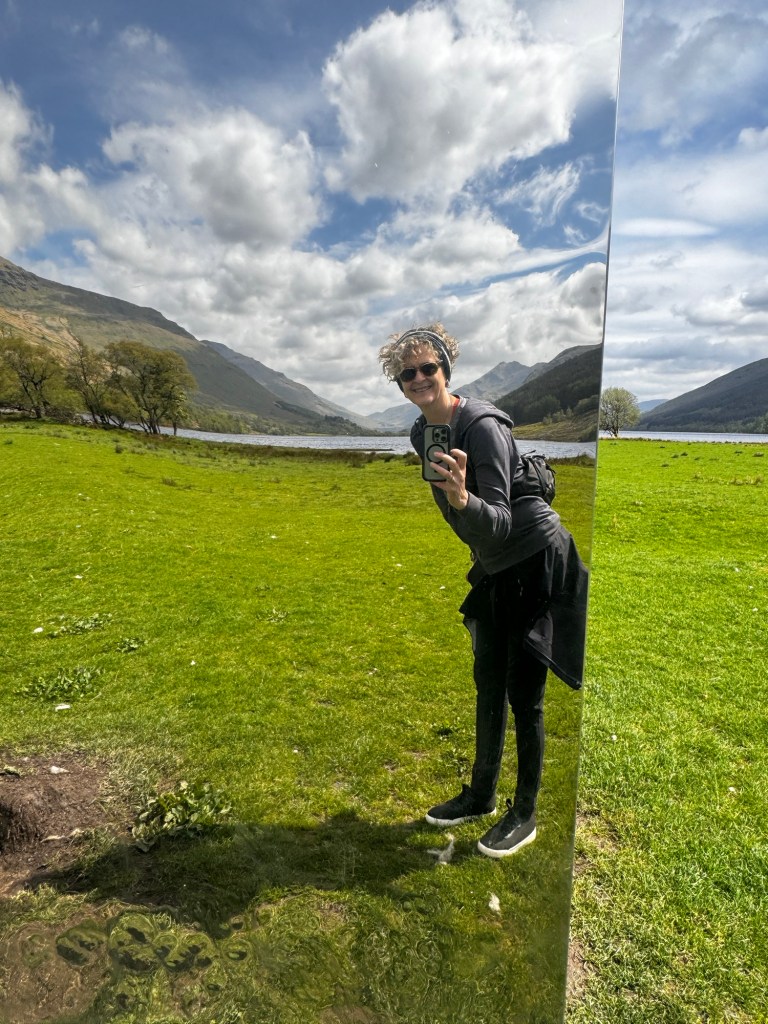
I also wanted to find a sculpture, one of many that have been installed throughout Trossachs National Park. The piece is a mirrored box called the Lookout, and it was designed, built and installed between two lochs by architecture students Angus Ritchie and Daniel Tyler. To say it’s a remote area is an understatement. Another drive down a curvy single track road on the edge of a loch, I am starting to specialize in them.

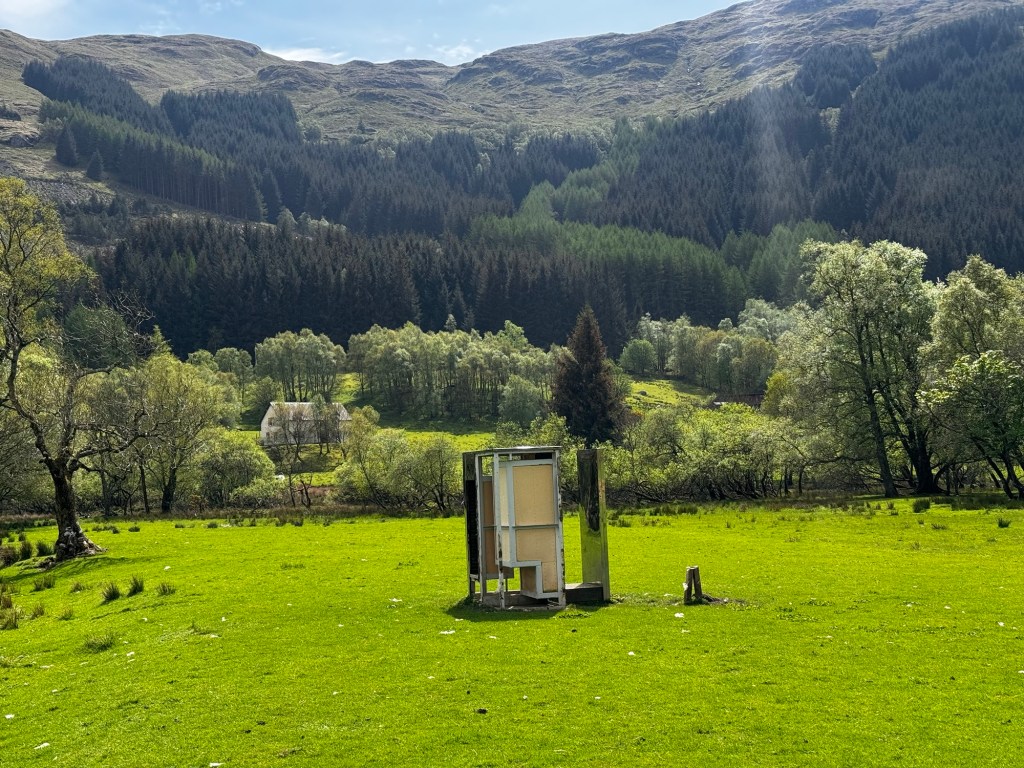
The sculpture was installed ten years ago, and I was sad to see that the elements have taken a toll over the years. But it’s still pretty cool.

Here’s what it looked like originally, so you know.

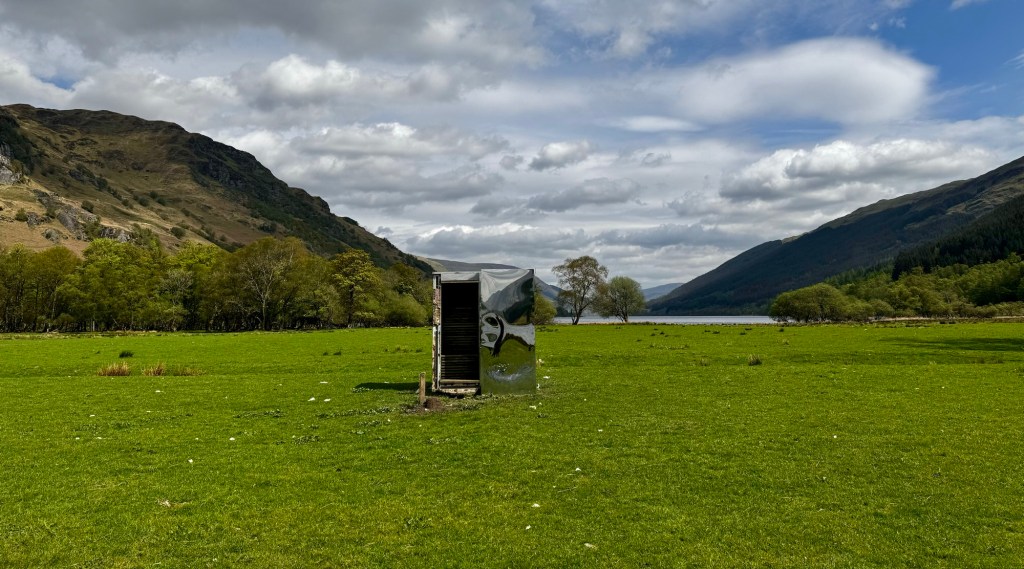
It’s gotten a wee bit rickety and downtrodden over time with many of the panels blown off. It may not be long for this world.

But still quite entertaining for those of us who are easily entertained.

What a beautiful place.

So enough meandering, let’s go to Stirling, the Schiphol of the Central Belt.

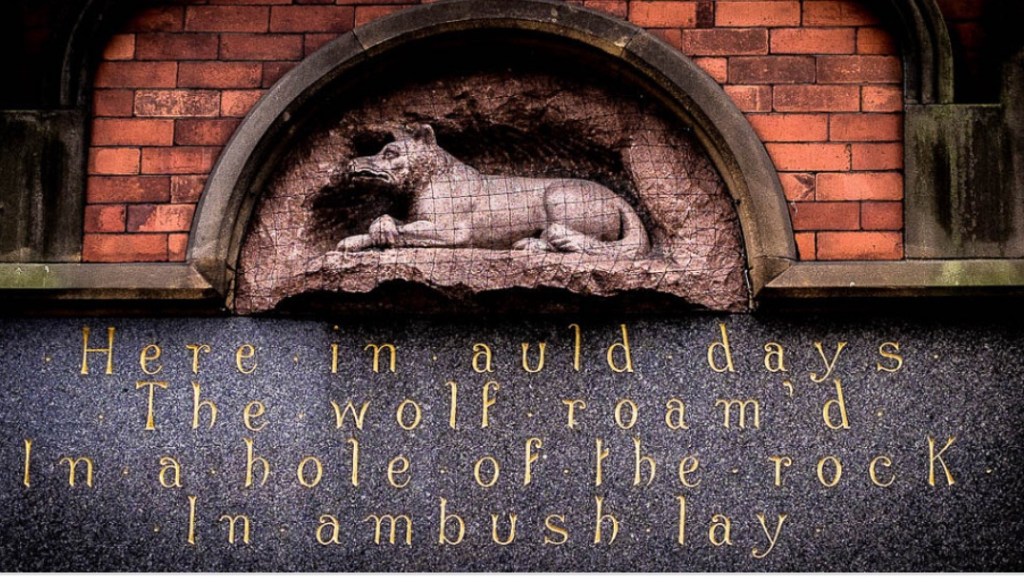
There’s the teensiest bit of history around Stirling. Its earliest catalogued artifact is a stone cist containing 4,000 year old human bones. The earliest surviving structure is a fort built by denizens of days of yore, and by that I mean the Iron Age, over 2,000 years ago. Stirling was declared a royal burgh by King David I in 1130 – and ps he’s a fascinating character but I’ll say no more. Stirling has always been of strategic importance due to its central location and control of the River Forth. The town’s mascot is the wolf because back in the 9th century, while under Anglo-Saxon rule, it was attacked by “Danish Invaders” aka Vikings. The sound of a wolf’s howl, legend has it, raised a sentry who alerted the garrison and fought the Vikings into a retreat.

There are SO many other things which I’ll spare you as you are always so patient with all the history. In keeping with our theme, though, this fine town is the location of the 1297 Battle of Stirling Bridge where William Wallace’s outnumbered forces were defeated the English army. Nearby was the 1314 Battle of Bannockburn, where Robert the Bruce did the same and ultimately became king because of it.

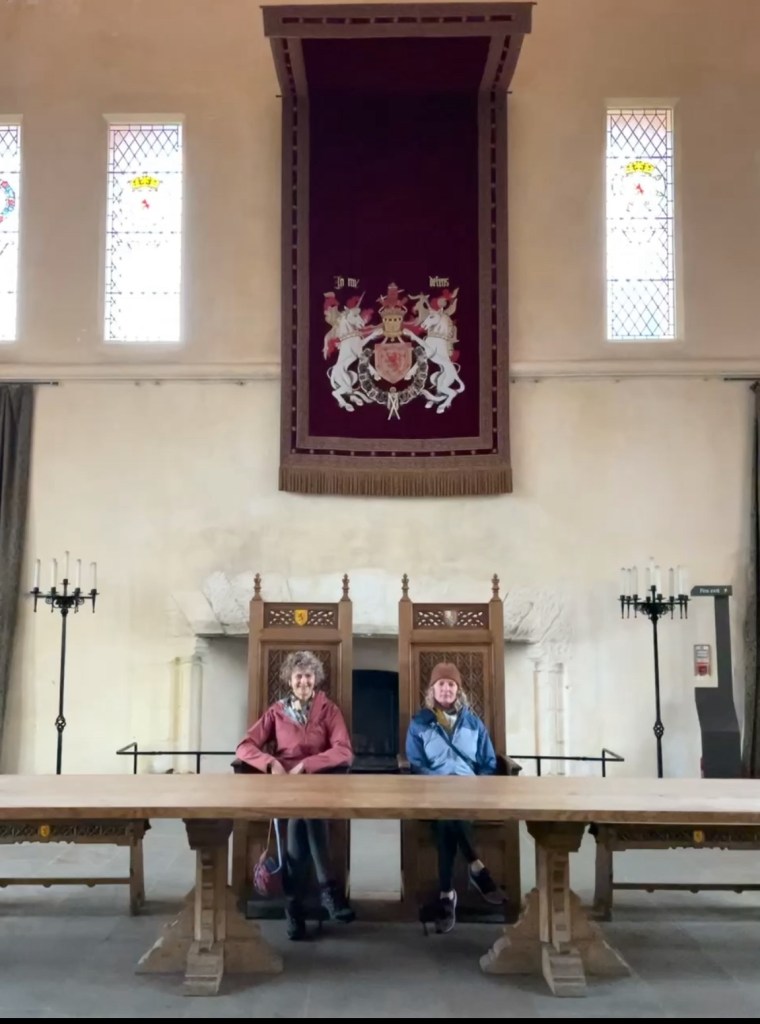
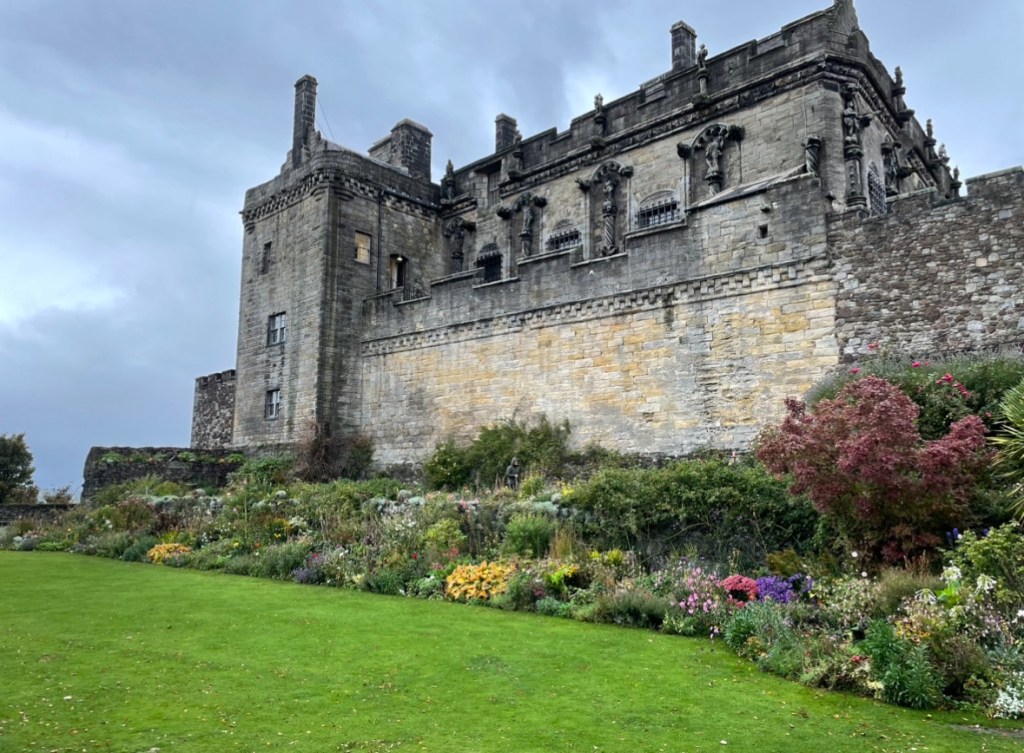
Stirling’s skyline is dominated by Stirling Castle, a more manageable version of Edinburgh castle, and if that rings your Robert the Bruce, William Wallace and Mary Queen of Scots bells, well, I am, as they say, well-chuffed. I toured the castle in October 2022 with my travel buddy Trish, and would highly recommend – although if you can, go during deep shoulder season and hire a tour guide. We pretty much had the castle to ourselves and our guide really made it come to life.

Here are a few snaps from that trip so you can see what I mean.

Fun fact- the chair seats flip up to reveal a chamber pot below. Nobody has to know.
Our lovely guide, who grew up in Stirling.

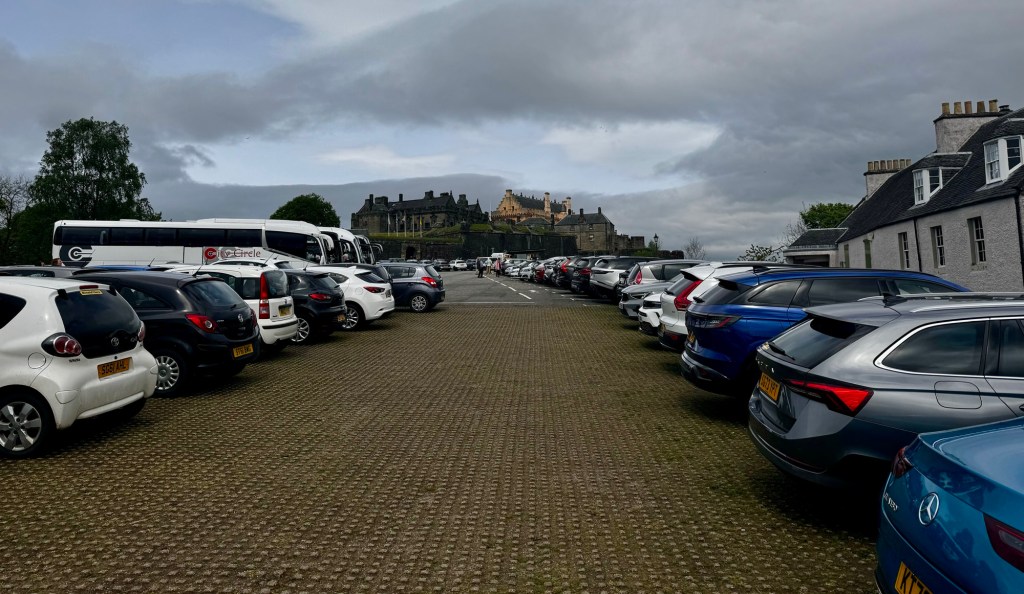
On the other hand I walked up to the castle today and discovered that it was, in a word, a zoo.

The castle is that tiny building behind the sea of cars

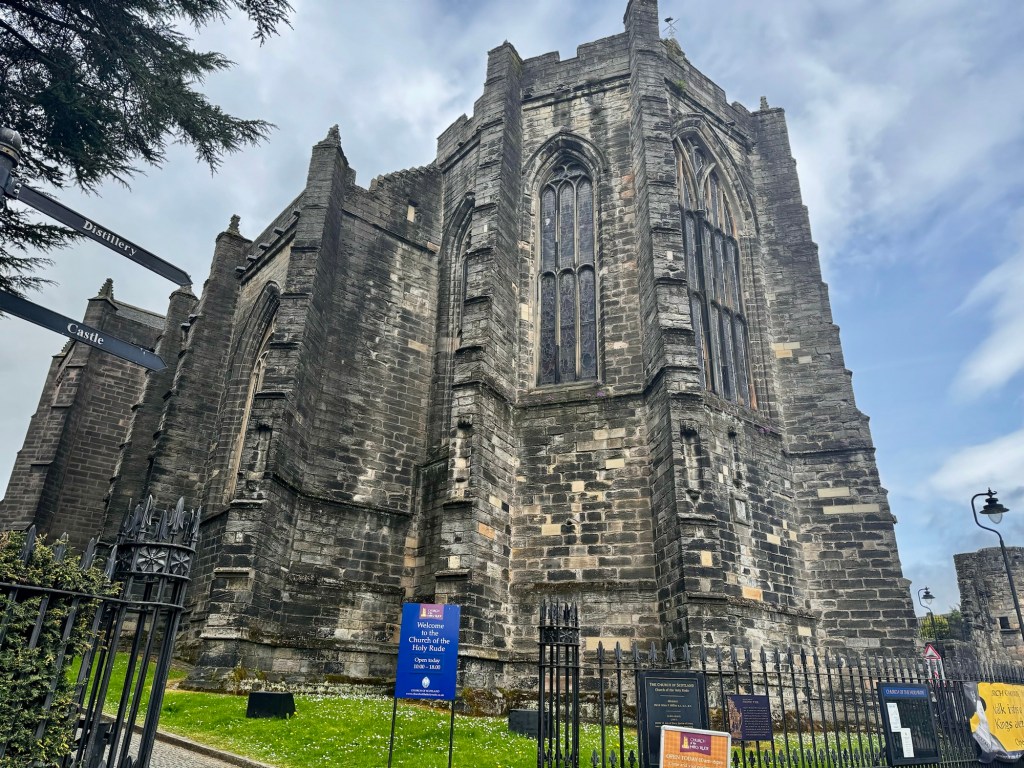
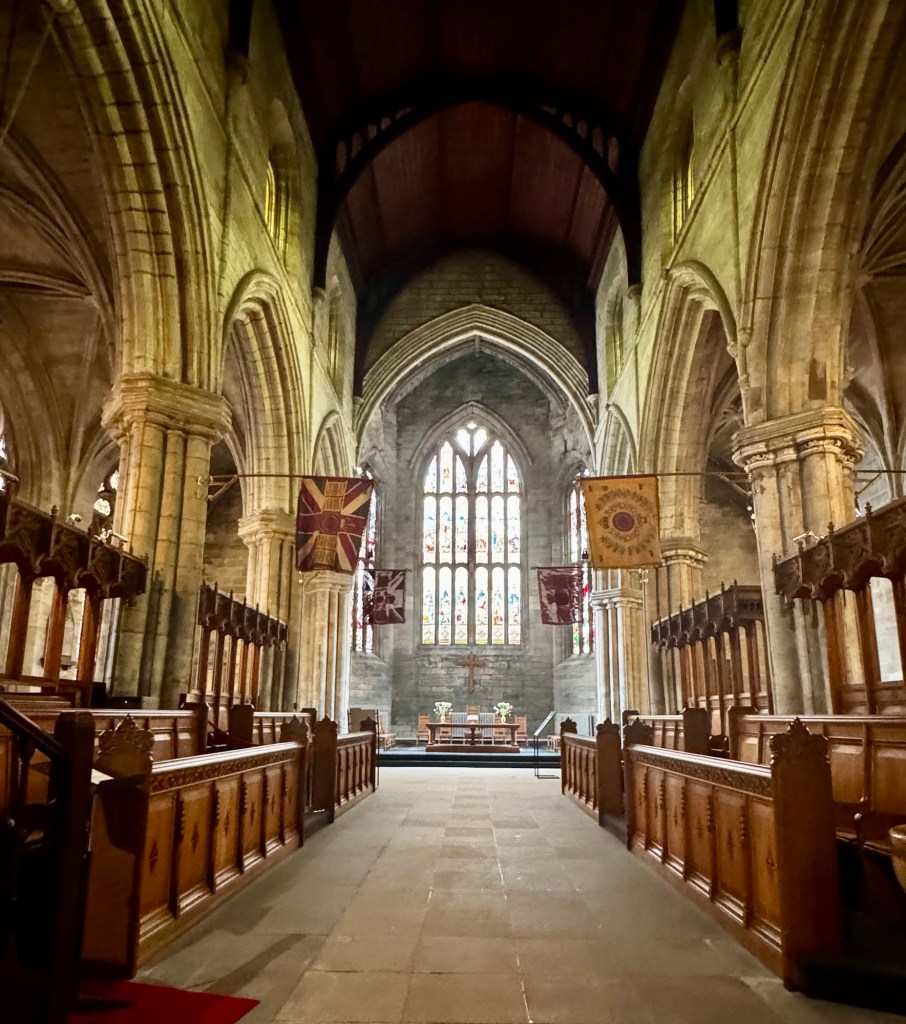
So I wandered back down the hill and popped into the nearby Church of the Holy Rude (named after the Holy Rood, a relic of the true cross), and yay it was empty. The church was founded in 1129 and rebuilt in the 15th century after a fire, and is the second oldest building in Stirling after the castle.

Not the most welcoming architecture.

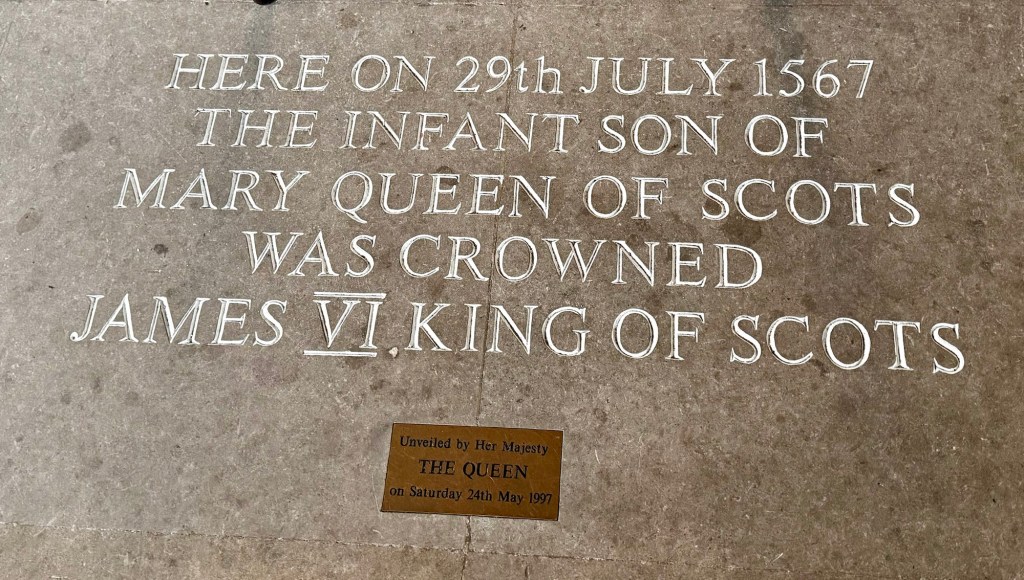
Interesting thing – it’s the only surviving church in the UK besides Westminster Abbey to have held a coronation. On July 29, 1567 the thirteen month old James VI, born in nearby Stirling Castle and whisked away (permanently) from Mary Queen of Scots (Mom), was anointed King of Scots and John Knox gave the sermon to mark the occasion. Mom wasn’t in attendance because she was imprisoned in Loch Leven Castle and had been forced to abdicate. She was allegedly invited to attend and refused which I think is an unlikely historical tidbit written by a man to make her look petty and like a bad mother. Bringing Mary to Stirling from captivity to attend the coronation of her infant son who was basically her usurper – I mean, oy, the optics! She had thousands of troops at her command. Too risky.

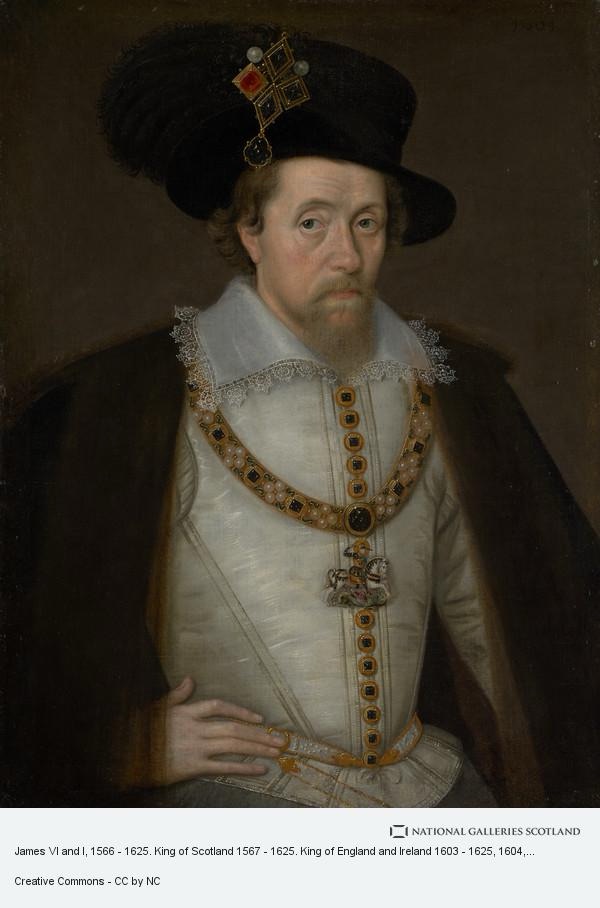
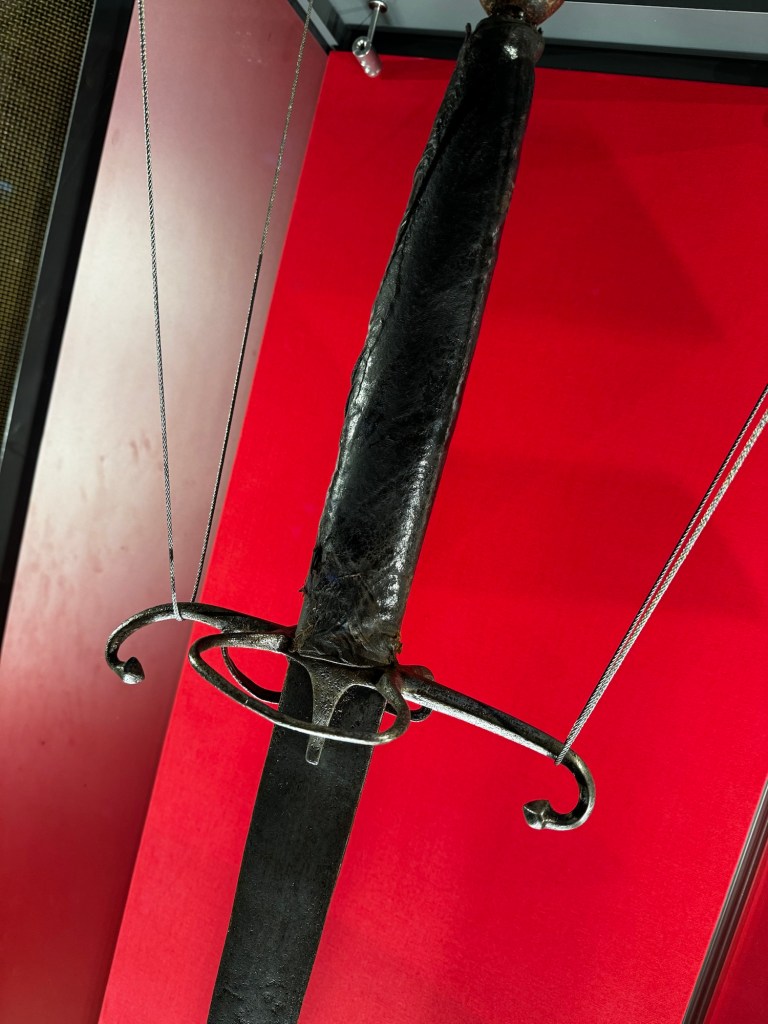
In 1603 James VI was also crowned King of England and Ireland, succeeding Elizabeth I, the last Tudor, and becoming James I. Ruling for 57 years (easier to do if you were a coronated baby), his reign in Scotland was the longest of any Scottish monarch. He wasn’t a bad king, necessarily, and did some interesting things like sponsor the first English translation of the Bible and order the refurbishment of William Wallace’s sword.

However, I think you’ll agree that we can’t forgive him for his role in ramping up witch trials to a spectacular degree for delusional personal reasons.

James VI was the worm-brained Robert F. Kennedy Jr. of the Stuart family.

Here’s the lame story. In 1589 Anne of Denmark, James’s bride to whom he was married by proxy, planned to sail to Scotland to meet her new husband. She didn’t make it because fierce storms, common in the fall, forced her to anchor in Norway. She tried again, but her boat sprung a leak and so back to Norway she went. At this point she decided to postpone the trip until spring. James was having none of this business and decided to go to Norway to pick her up. He stayed several months and eventually brought her back to Scotland even though storms again made the journey sketchy. Denmark actually prosecuted a bunch of woman for causing these storms via witchcraft, and when I say prosecuted, I mean executed.

James hears of this when he gets back to Scotland with his bride and even though everything is now FINE, he couldn’t move on and decided to copy Denmark. He decreed that witches deliberately conjured up the storms for the purpose of killing him and his queen. Regicide – a bad crime – to be avoided. So suddenly a previously unenforced law forbidding witchcraft was called back into action. Which is a lesson we still haven’t learned – if you aren’t enforcing a law anymore, repeal the damn thing to keep it from reemerging from the muck of shifting political sands.

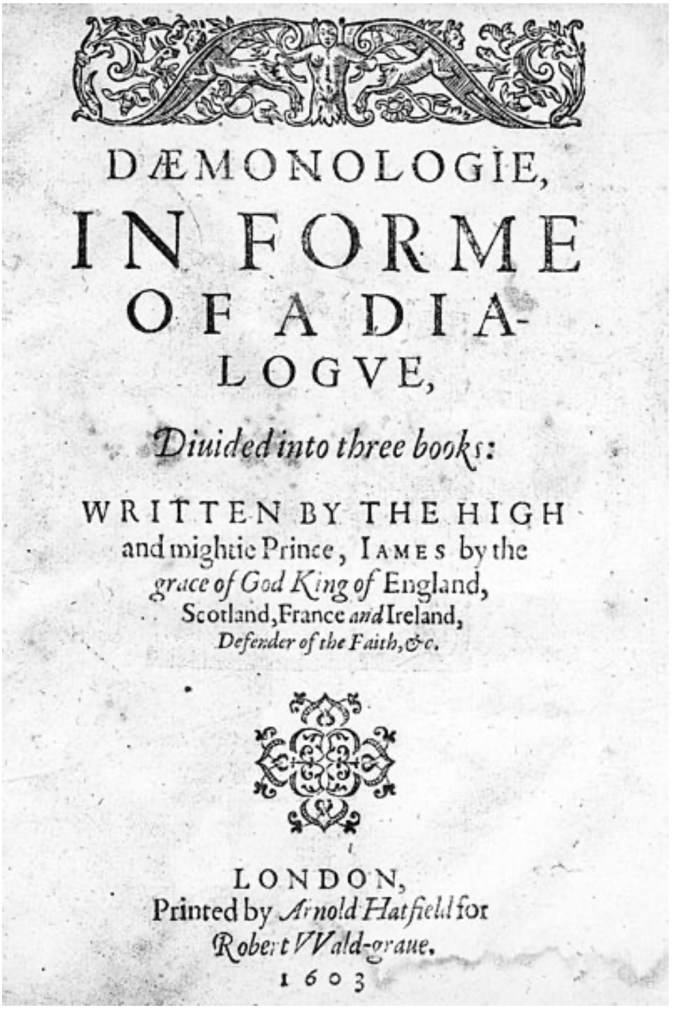
James became so witch-obsessed that in 1597 he wrote a book called Daemonologie which helpfully explained how to identify and punish a witch, using science, oh sorry I mean the Bible, as corroboration, e.g. “thou shalt not suffer a witch to live,” blah blah. Largely as a result of his efforts, thousands of women were prosecuted in Scotland and England over the next hundred years, with more than 1,500 executed.

Former Scottish First Minister Nicola Sturgeon, who probably would have been tried as a witch in those times herself, issued a formal apology to people accused of witchcraft, thus acknowledging an “egregious historic injustice.”

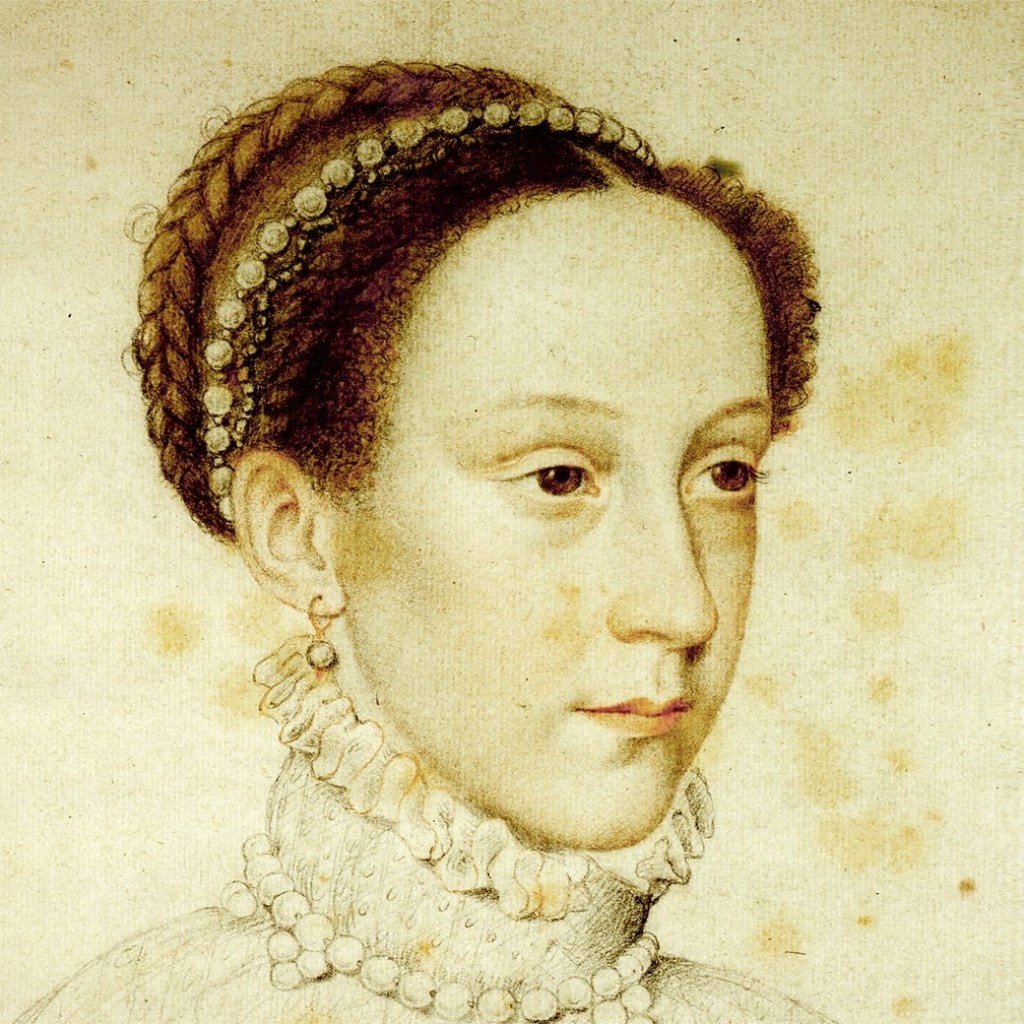
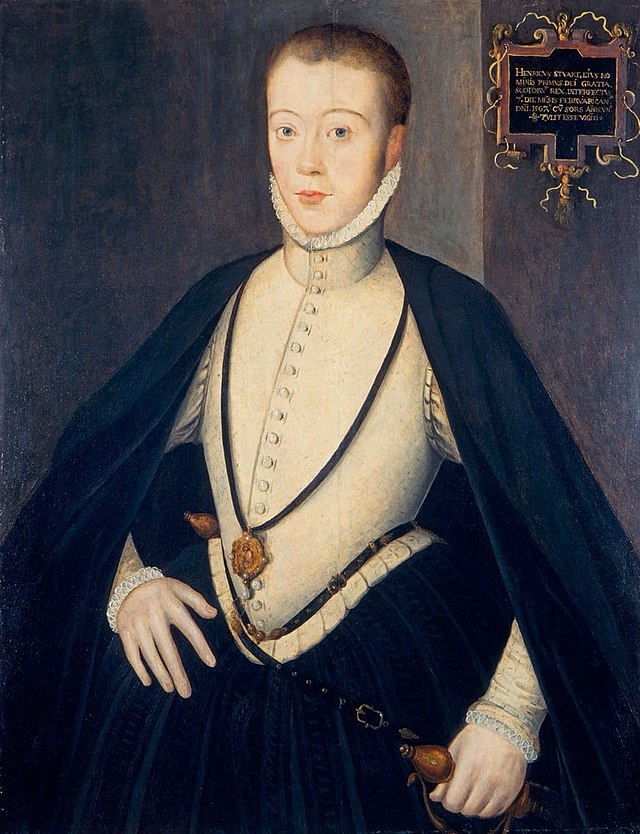
One wonders whether things would have been different if James had a maternal influence in his life. Would that have made him less dumb? Perhaps. James was 21 when his mother was executed and he had been raised to believe that she had arranged the murder of his father Henry Stuart, Lord Darnley so she could marry Lord Bothwell. What would that do to your head? What were his thoughts while his mother was imprisoned in the Tower and ultimately executed?

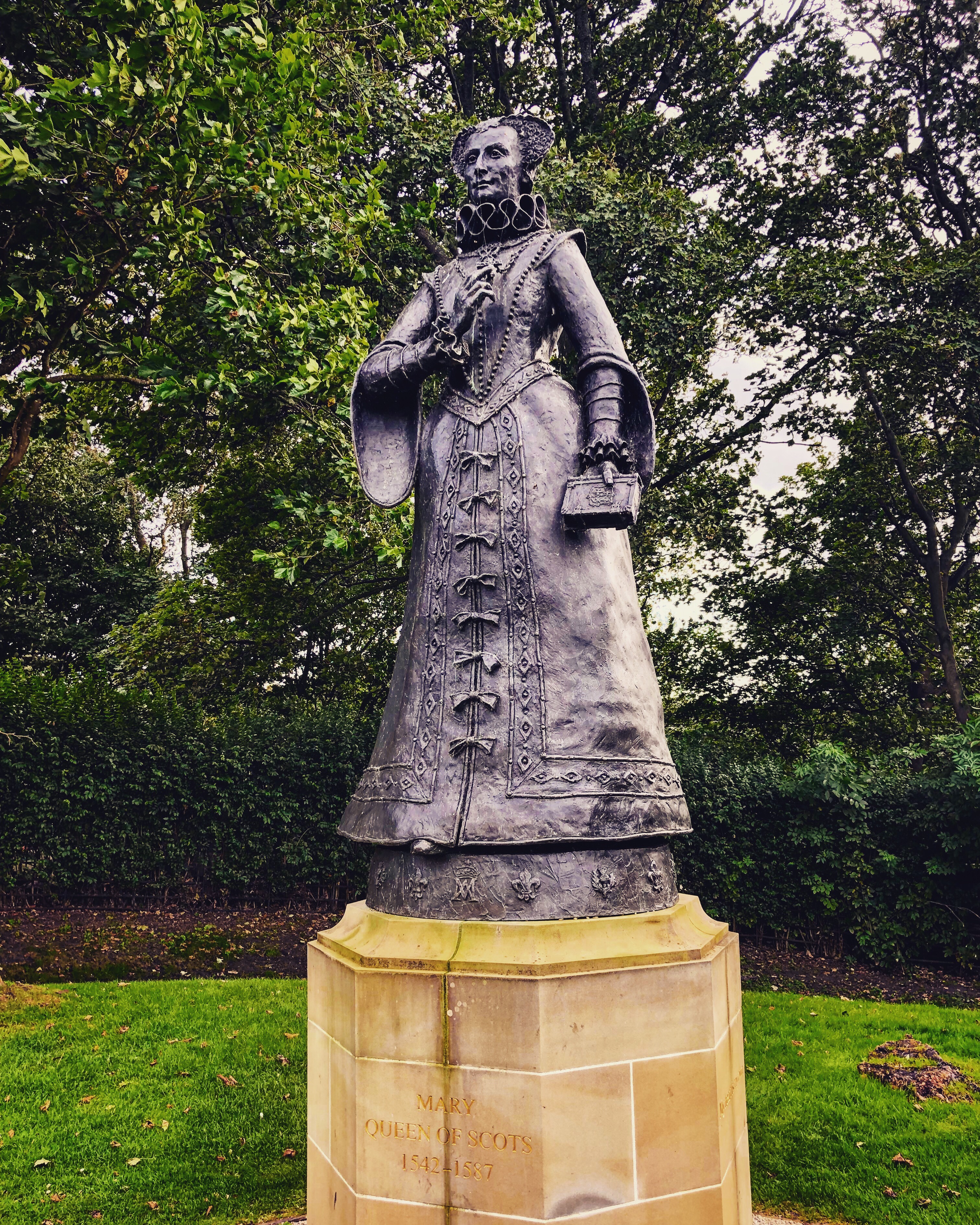
Mary QOS

Speaking of which, he didn’t have a paternal influence either. Darnley’s parentage gave him a claim to both the English and Scottish thrones and so strengthened James’s ultimate ascension to both. And yet he was killed just eight months after James’s birth. What did James think of him, if anything, beyond thanks for the blood lines dad.

Darnley

I know that royal kids not having much exposure to their parents is a long and proud UK tradition. But these are pretty extreme circumstances, James was presumably a person with feelings and one without a therapist or prescribing physician. These are the interesting what-if riddles of the human condition in history.

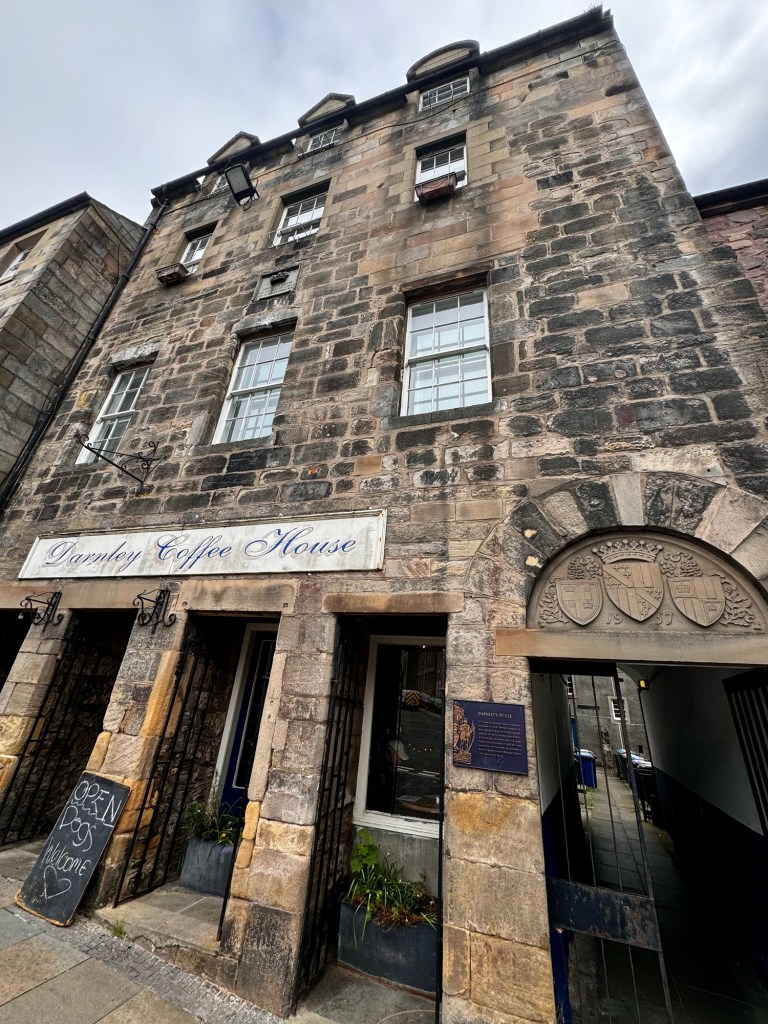
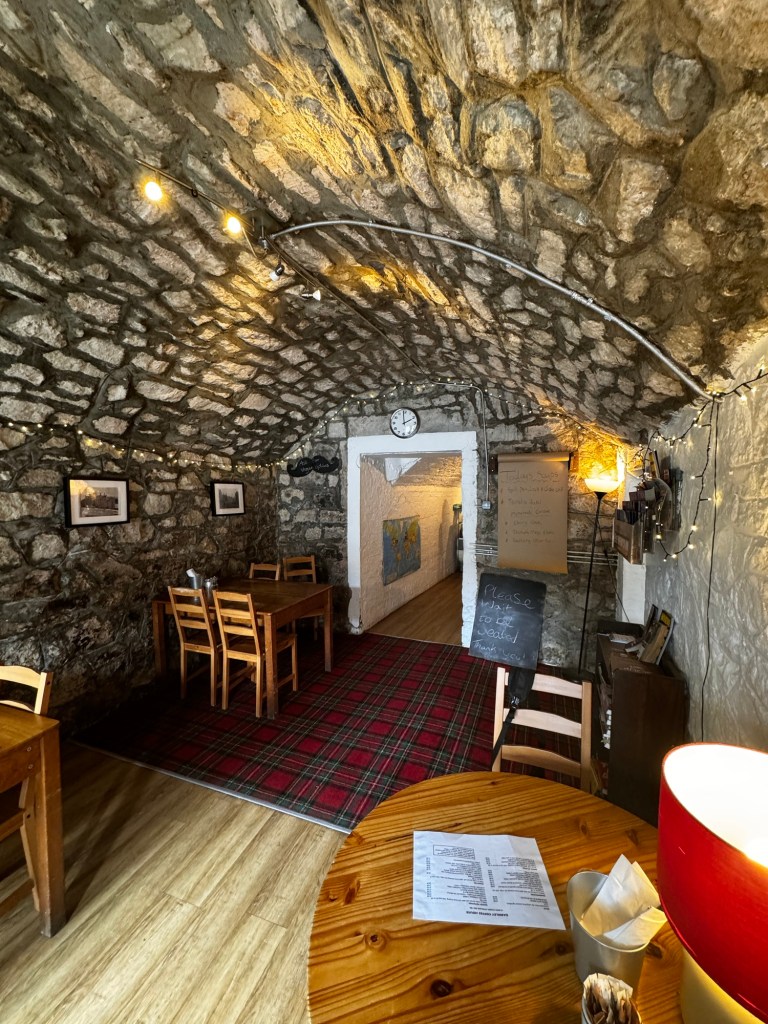
To mark this particular riddle, I had lunch in Stirling at a coffee shop located inside what has “traditionally” said to have been Darnley’s home. Which is a bougie word for “allegedly.”

The menu explains that not only was it the home of Lord
Darnley, but also baby James’s nursery which – maybe – but it’s outside the castle and his life was pretty much in danger from the jump. More realistically, it has also been a dairy, a brothel, and a tourist office.

I wondered what these historical figures would think if they could see their former homes, prisons, battlefields and such crawling with iPhone wielding tourists.

And now we sally forth to the National Wallace Monument. It was built between 1861 and 1869 and designed by Glasgow architect J.T. Rochead. It has to be one of the first examples of successful crowdsource fundraising, as it was entirely funded from contributions from the public totaling more than £15,000. This is largely due to the Victorians’ obsession with Highland culture and history.

The monument looms on a hill within view of the castle and it’s sited at the 1297 Battle of Stirling Bridge. It famously has 246 steps to the top, and I pictured a sort of Washington Monument situation, just a building filled with a relentless stuffy staircase and a killer view at the top.

But actually there are three galleries, each with a different theme. The first, called The Hall Of Arms, is devoted exclusively to Wallace with a cool film that looks like it was animated by the same artist who did the Tale Of The Three Brothers in Harry Potter and the Deathly Hallows film. The gallery also features Wallace’s actual sword which is 5 feet 5 inches tall. He was tall. This is the sword James VI ordered to be refurbished. It’s legit.

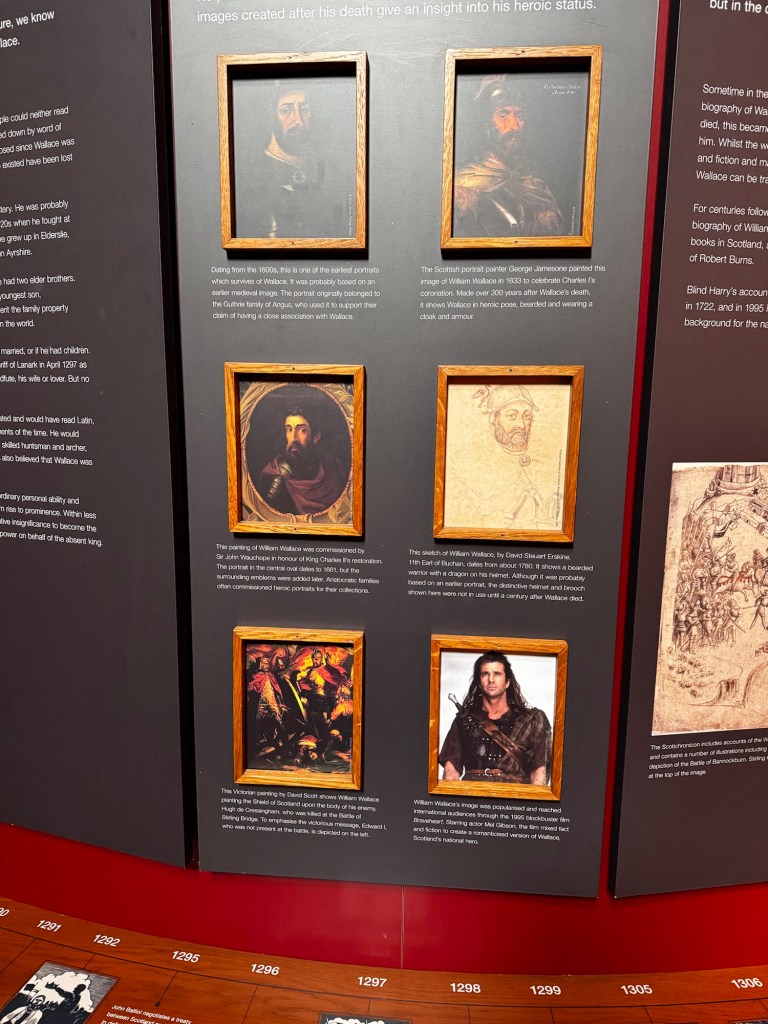
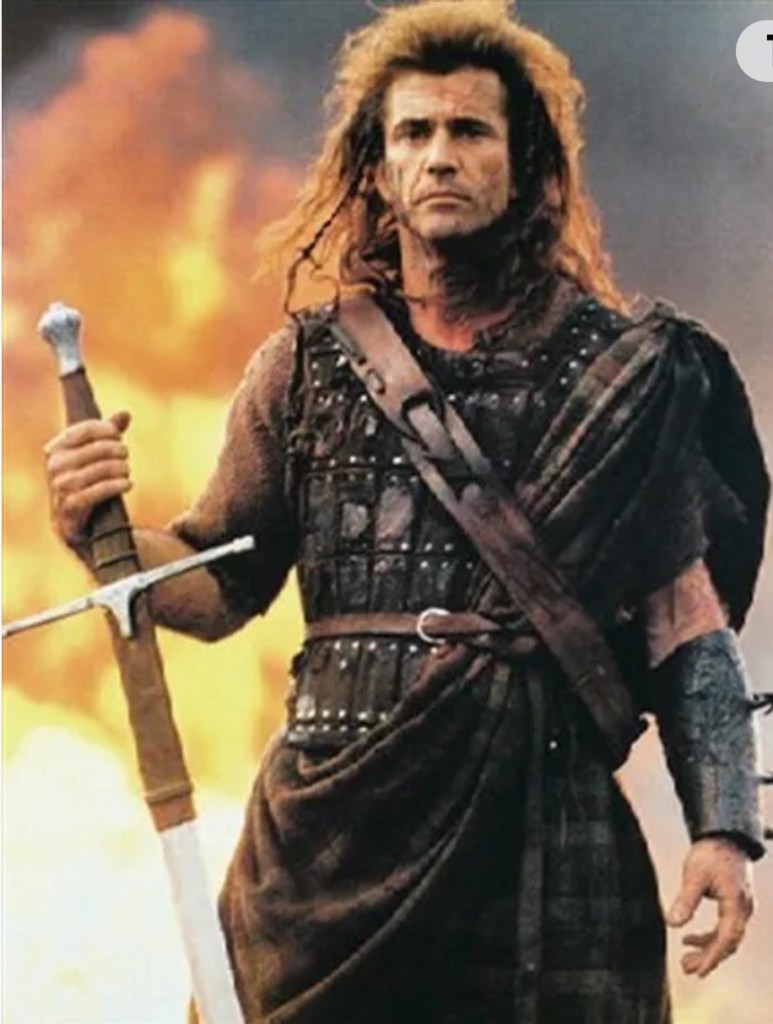
There’s also a sort of hilarious gallery of visual renderings of Wallace throughout the ages. Hilarious because it ends with a photo of Mel Gibson. I object.

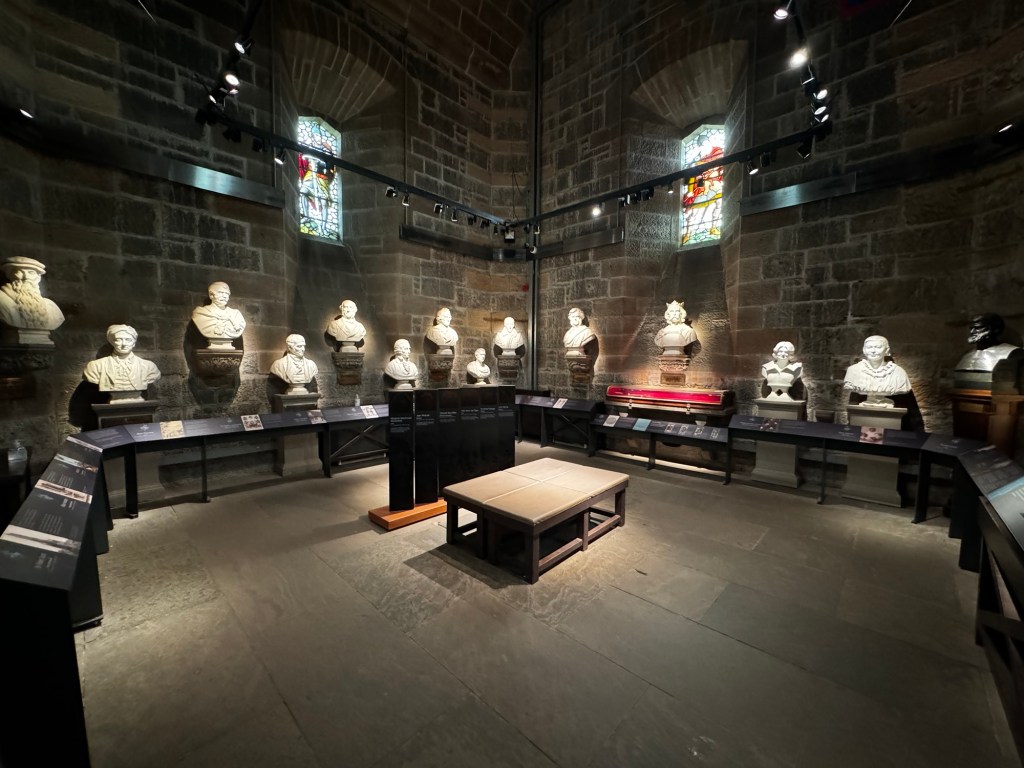
The second gallery is the Hall of Heroes and features busts of famous Scots throughout the ages who have invented everything. Seriously we might all still be living in caves but for Scots. Read “How Scots Invented the Modern World” by Arthur Herman if you don’t believe me.

The last gallery, The Royal Chamber, is not a reconstruction of Wallace’s bedroom as I had hoped but rather is devoted to the battle.

But before we chat about the battle, in between each of these galleries are definitely 246 steps. Up a narrow stone spiral staircase. The staircase is “narrow and may feel cramped,” the website tells us. There are ten billion narrow stone spiral staircases in castles, abbeys and estates all over the UK. I mean it was a popular and likely necessary design element. The steps are narrow because they were built in days when people, and their feet, were smaller – plus there often just wasn’t that much available space. In the Wallace tower, even the widest part of the stair, next to the outer wall, is too small for my size 11 feet. I gotta shift ‘em sideways. Forget about closer to the newel (I had to look that up) where the stair ultimately disappears completely. So the rule is that the coming down people “yield” to the going up people. This means descenders flatten themselves against the wall and avert their faces because the ascenders have to lean forward with their hands on either side of the wall, framing the heads of the descenders like there might be some smooching, and shimmy up sideways trying to avoid full body contact whilst hoping they don’t run out of stair under their feet because it’s just a few inches of real estate.

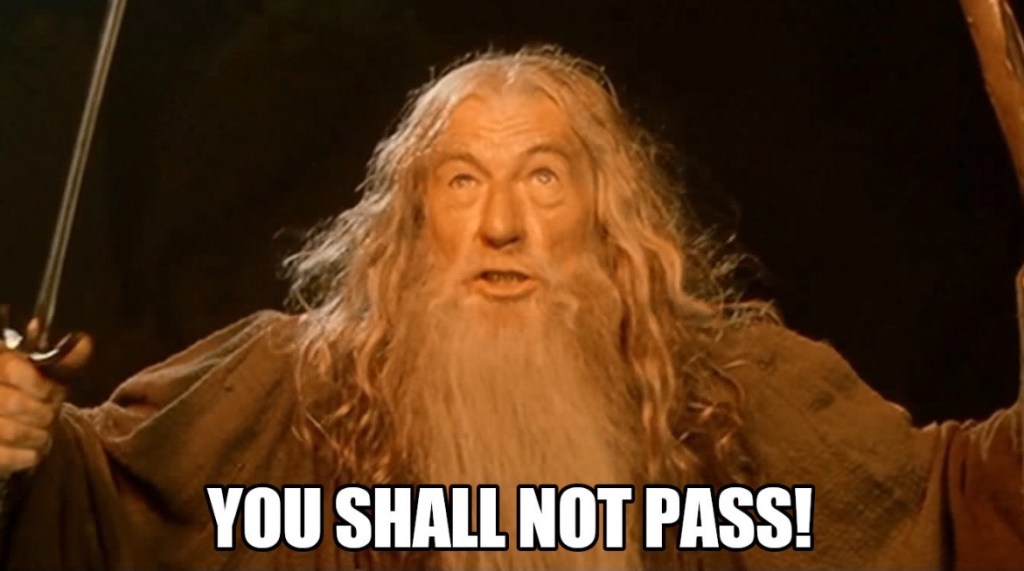
At least that’s how I handled it as an ascender. (Apologies to the descenders I smushed.). After that first experience I made a shit ton of stomping noise when I entered each spiral to scare people from coming the other way. It’s all I could do to not yell, “Fire in the hole!” or Gandalf it up with “You…shall…not….pass!”

Why people don’t plunge to their deaths in that stairwell every single day is a mystery. Also, in addition to being impaired by monstrous feet there were so many unsteady older folks who were gasping for breath. Good on them, though, they persevered and arrived at the top sweaty, pale and inches away from a cardiac event. For history.

So speaking of history – the battle. First of all if you’ve seen Braveheart you have no idea what happened so just let that go. The nutshell version is that The Battle of Stirling Bridge was fought during the First War of Scottish Independence when Edward I was determined to squelch the pesky Scots and their insistence on owning their own vibe.

As the troops massed around Stirling, the Scots had around 6,000 men, which included 300 cavalry at most, the English had 9,000 including 2,000 cavalry. Lopsided.

The English sent emissaries to Wallace and his compatriot Andrew Moray before the battle to parley, and Wallace reportedly responded, “We are not here to make peace but to do battle to defend ourselves and liberate our kingdom. Let them come on and we shall prove this to their very beards.”

I am adopting this turn of phrase. About proving things to beards.

The Scottish army was camped on Abbey Craig, the location of the Wallace Monument, so had a great vantage point over the river toward the government forces.

The head of the English forces rejected sage advice to send troops upstream to outflank the Scots and instead ordered a direct attack over the narrow Stirling Bridge. It was broad enough to allow only two horsemen to cross abreast, so it would have taken several hours for the entire English army to cross. I don’t know what the English thought the Scots would do during this time, just watch them cross and wait for them all to assemble on their side of the river like they were playing an organized team sport and needed an even number of players per side. I mean, I’m admittedly no military strategist, but. All the Scots had to do was hang out on the other side of the river until as many troops they believed they could overcome had crossed.

To add to the fun, the wooden bridge collapsed, whether via sabotage or natural causes no one knows for sure.

At the end of the day the English forces suffered massive losses and retreated, and Wallace was appointed, “Guardian of the Kingdom of Scotland and Commander of its Army.” And now, Edward I was super pissed and wanted to know who this William Wallace person was anyway. In retaliation, he personally led the next invasion of Scotland which ultimately led to the Battle of Falkirk which didn’t end great.

Now, as I warned, those of you who have seen Braveheart are thinking, I don’t think she’s right about any of this. There was no bridge in the battle in the film. Correct. The movie is gobsmackingly historically inaccurate and this is just one example. The battle in the film is more akin to the Battle of Bannockburn starring Robert the Bruce, although probably without the mooning scene because soldiers were not actually wearing kilts at that time so accomplishing the moon with the flair depicted in the film would have been a lot more trouble.

Also the Scots’ blue face make-up was based on the Picts, who were around back in AD 200 to AD 900, so a wee bit earlier. And Braveheart actually is a reference to Robert The Bruce. I’ll stop.

So we’ve talked a bit about mothers in this one – well, one mother. Which is apropos since it’s Mother’s Day. So happy Mother’s Day to my awesome Mom, from me in The Bonnie Badger.

The People You Meet

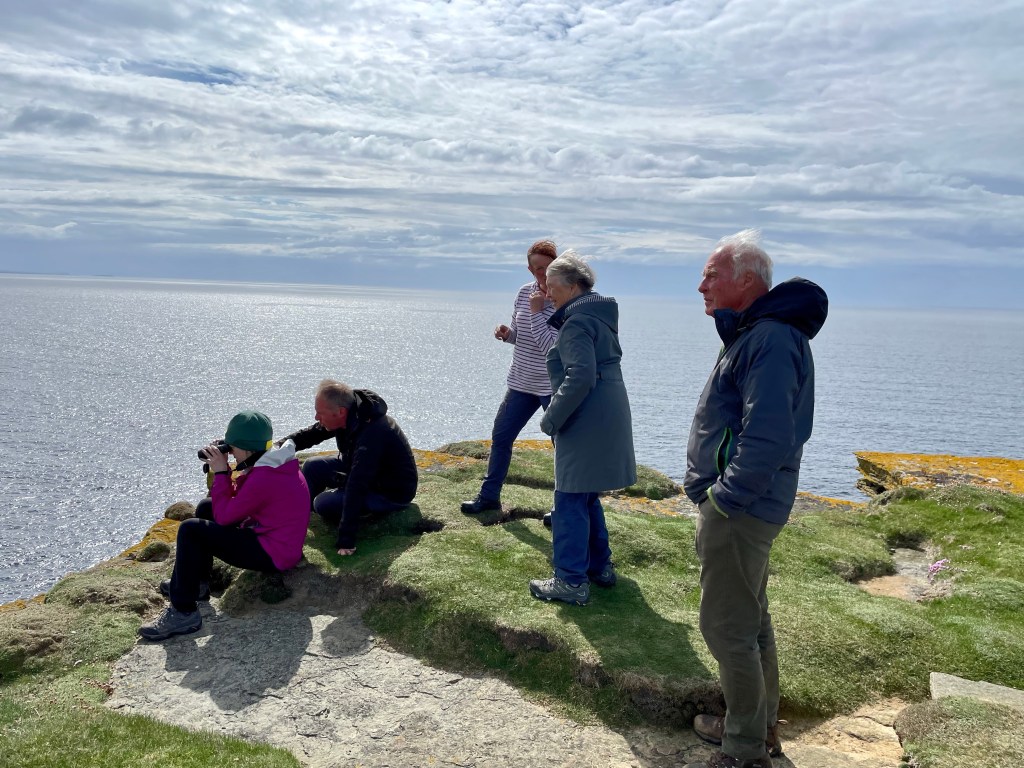
Birdwatching on Westray

The best thing about traveling is chance encounters with fellow travelers, and meeting people lucky enough to live in the places where you have chosen to vacation. Interestingly, we’ve continued to encounter mostly other Brits, Norwegians and a few French. No Americans. Also the general age range has skewed older – many intrepid folks in their 70s and beyond, walking and biking through the Isles.

On our last day of adventure in Orkney we took the very early ferry north to Westray, known as the Queen of the Isles. Westray is eleven miles long and has 600 residents (down from over a thousand in the 1800s) and boasts the shortest scheduled flight in the world, the longest golf hole in the UK and a castle ruin steeped in history. More seabirds than anywhere I’ve ever been with a boggling range of species. Including – oh yes – the MIGHTY PUFFIN.

We were met at the ferry by Karen and Andy Penn, who run Westraak Tours. If you ever find yourself in Westray, book them. Karen was born in Orkney and Andy is an “incomer,” having moved to the island from Dumfries when they married six years ago. We swung by a local B&B and picked up Angela and Peter, a couple from Cornwall, and headed to “coffee,” which ended up being in Karen and Andy’s home, a lovely surprise. We sat around their table and got acquainted, also meeting Andy’s son Callum, who is in his twenties and has autism. It was lovely chatting with him and sharing our names and places of origin. It wasn’t long before Angela shared with the group that Peter, a retired physician, was struggling with early stages of Alzheimers. It was quite touching how he relied on Angela to fill in gaps. He looked to her and said, “do that thing you do,” and she riffed through words to help him find the right one. They were lovely and delightful, up for anything, and all-around excellent traveling companions.

We left Callum with a shopping list for lunch, which would also be at Karen and Andy’s, and set off across the Island. Our first stop was a bird-nesting area along the coastal cliffs.

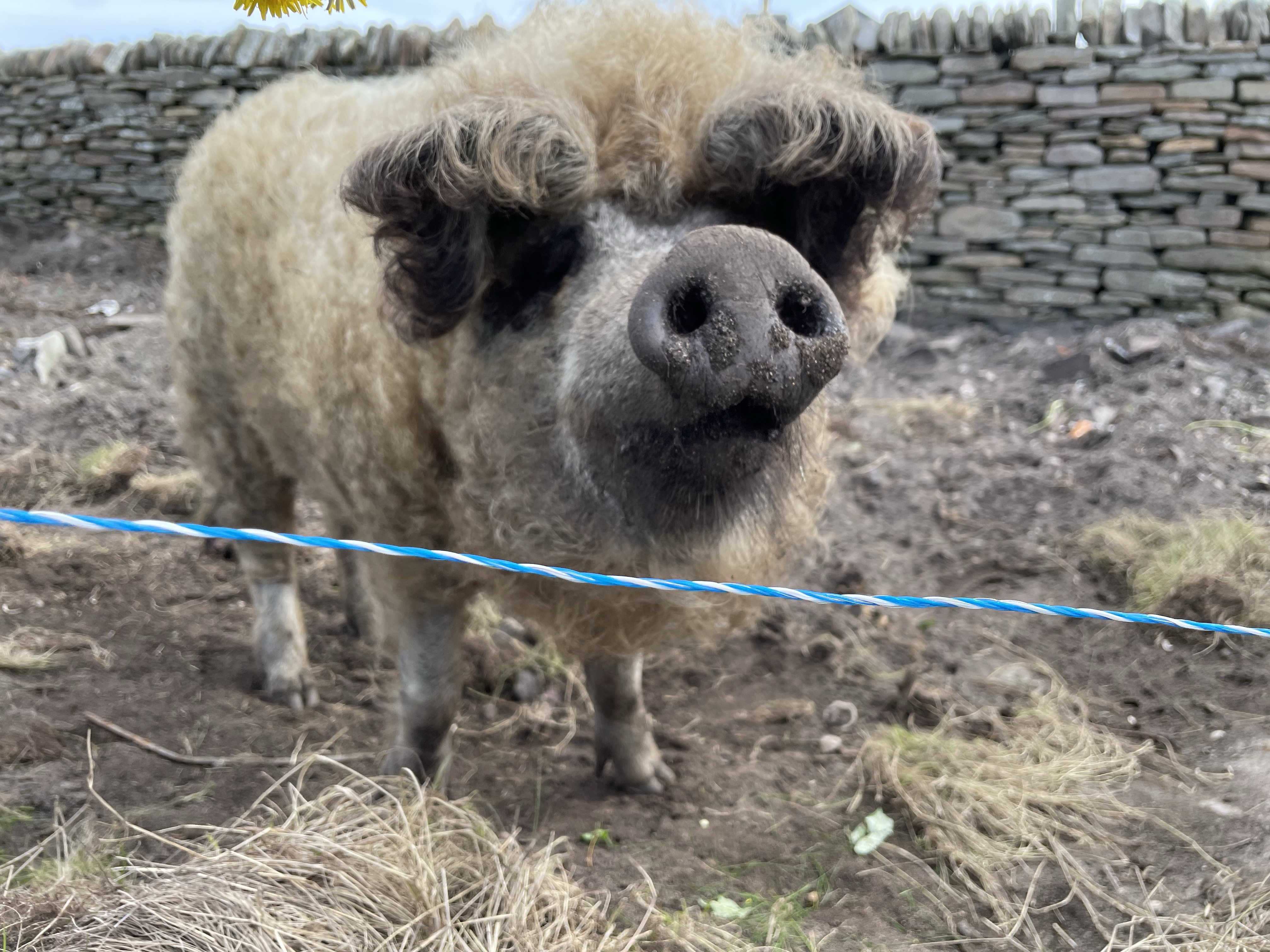
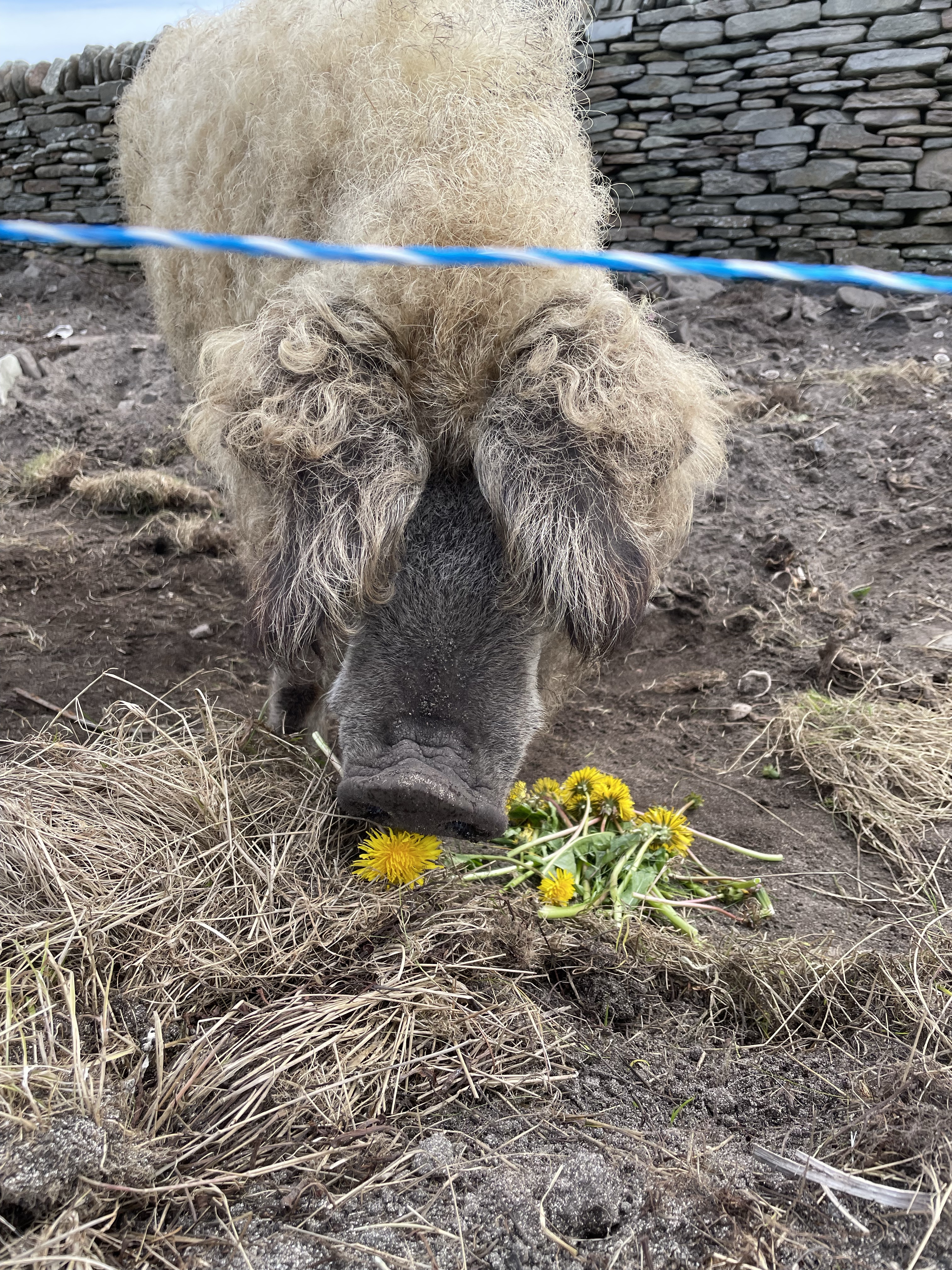
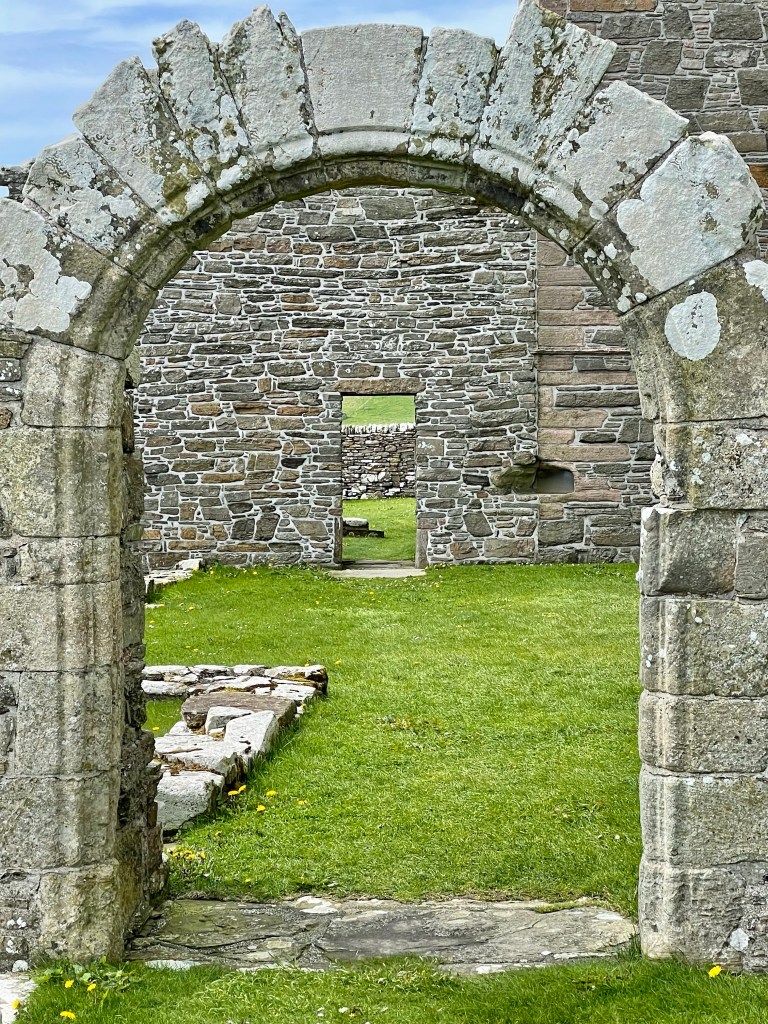
Next we headed to Quoygrew, the ruins of a Viking settlement. One of its longhouses had been excavated between 1997 and 2005. On the way, we met the charismatic Miss Piggy and fed her dandelions.

Quoygrew was a settlement of farmers and fishermen first inhabited in the 10th century and lived in as late as the 1930s.

Remains of Viking longhouse.

Our lunch at Karen and Andy’s was utterly delicious thanks to Callum’s successful shopping excursion. Karen made sweet potato soup, accompanied by egg salad from chickens just up the road, locally made cheese, locally caught and smoked mackerel, rhubarb compote and possibly the best sticky toffee pudding in the world. Lunch was accompanied by a very animated political discussion about Boris Johnson (“a dreadful buffoon”) the current Tory government (“corrupt to the bone”) anti-immigration British home secretary Priti Patel, whose family immigrated to the UK but would not be able to do so under current policy (“a terrible hypocrite” and also “appalling”) and of course Brexit (“a complete disaster”). Angela expressed admiration for the qualified and educated Labour Party leader, Keir Starmer, and wondered, “why wouldn’t people want this type of person to lead the country,” as opposed to Johnson, who won votes because he was “a laugh” and would be an entertaining pub date. Angela also talked of the ever-growing wealth discrepancy in the UK. It all sounded wearyingly familiar.

We next visited Noltland Castle which was the biggest surprise of the tour. On our way we drove by a golf course, which perked up Peter, an avid golfer. Andy said the course boasted the longest hole in the UK at 738 yards. It’s a par 6. Andy said he got a 7 once, but with the constant winds a 15 is more likely.

All the gun holes.

Noltland Castle was constructed in the 1500s, so a bit late in the game as far as castles go. It was built by Gilbert Balfour, who at the time owned Westray and Shapinsay, both given to him by his brother-in-law, the Bishop of Orkney. It’s odd because apparently he ran out of money or interest because he never finished the castle – the Great Hall remains open to the stars, even while Gilbert lived there. Maybe he blew his budget on the gorgeous spiral staircase, one of the UK’s grandest of the period. Roofs are kind of boring and expensive for sure – but handy to have in place nonetheless. The castle boasts an incredible 71 gun holes. There’s even one in the WC. Was Gilbert paranoid? Or were his fears justified because he moved through life cultivating mortal enemies wherever he went? You be the judge.

The acoustics are amazing, and the local Kirk holds concerts here.
The never-roofed great hall.
The spiral staircase.
Castle grounds.

Balfour was the self-appointed Sheriff of Orkney, constable of Kirkwall Castle and master of Mary Queen of Scots’ household. Sounds good so far. But. He was also implicated in the murder of Cardinal Beaton at St. Andrews (mutilating his body and hanging it outside the window), after which he was captured by the French and condemned to be a navy galley slave for a few years. Fully not rehabilitated by that experience, he next helped murder Lord Darnley, Mary’s second husband, in Edinburgh.

You might be wondering why Mary didn’t dump Gilbert after he murdered her husband. The thing is she might have married Darnley mostly because he was also a Stuart and so would have given her a stronger claim to the English throne. Their son James did become James I of England, so that worked pretty well. Also, she had fallen in love with the Earl of Bothwell by that time and, who knows, perhaps she was in on the murder plot, as it was the only way to get rid of husbands back then.

Before Mary’s ultimate arrest, she was urged to flee to Noltland and some say that Gilbert was sweet on her and actually built the castle with her in mind. Sadly, she did not take this advice and was ultimately captured. You know the rest.

Balfour’s incurable habitual plotting continued apace, and he was implicated in the Mornay murder plot against King John III of Sweden. Karma finally caught up to him and he was executed in Stockholm.

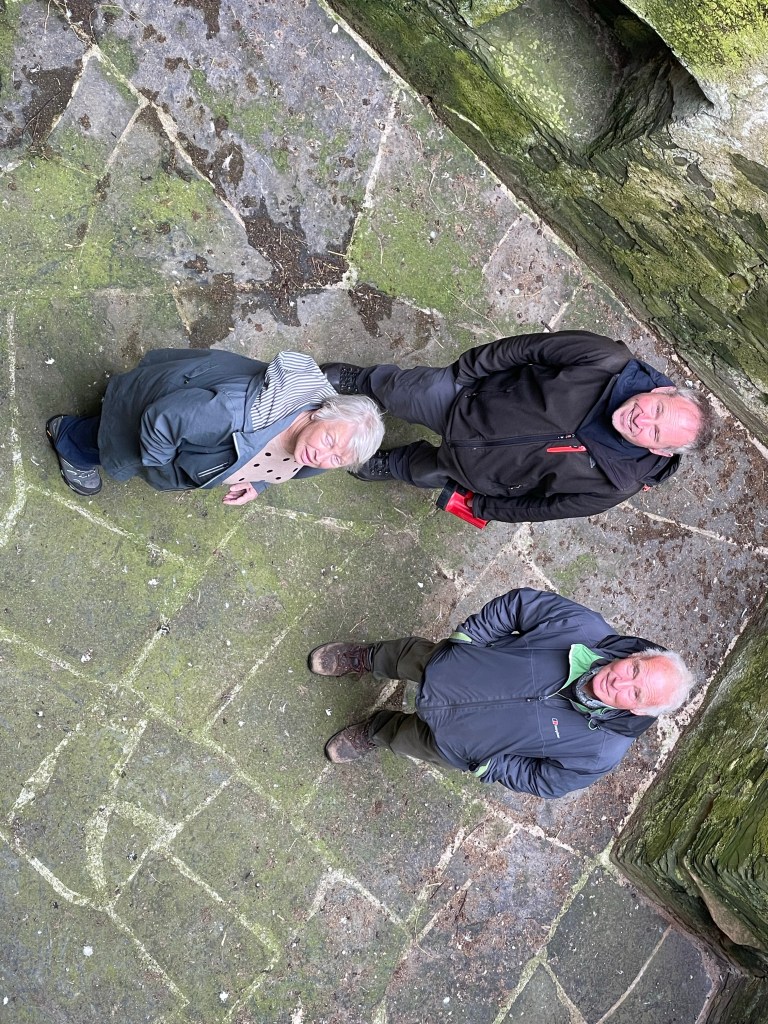
Andy, Peter and Angela.

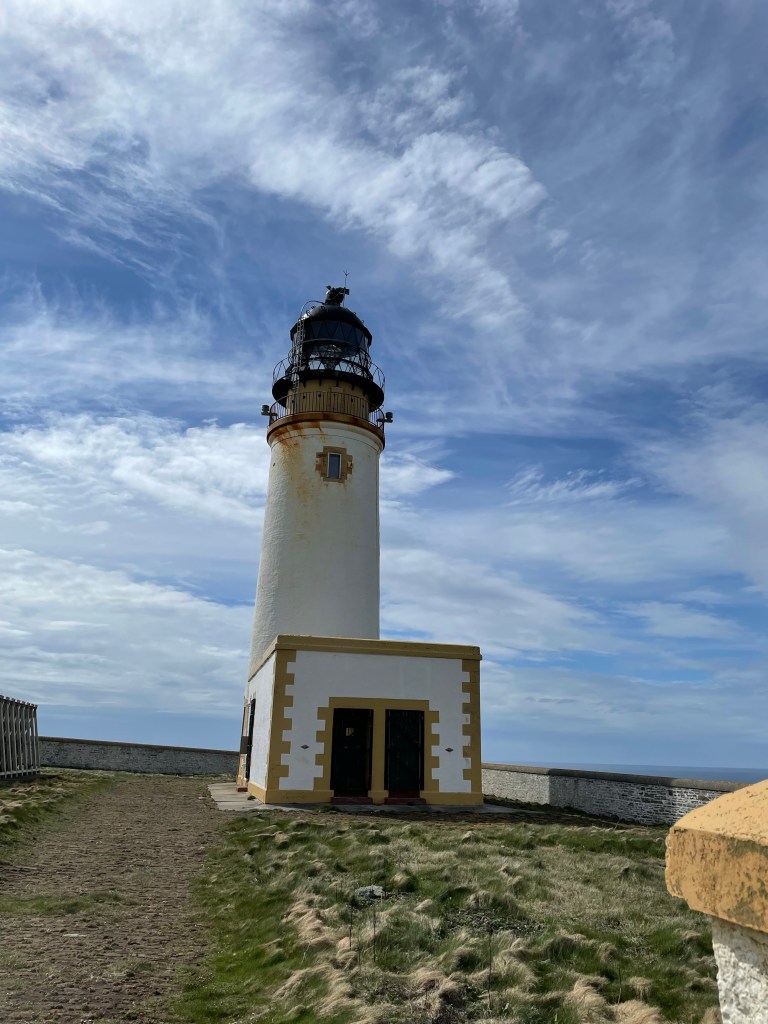
Next stop was Noup Head Lighthouse (one of over 200 built around the Scottish coastline). One family, the Stevensons, was responsible for designing all of Scotland’s lighthouses over a 150-year period – which explains why they all look alike. The lighthouses, not the Stephensons. The sole black sheep who rejected the family business in favor of a dodgy writing career was named Robert Louis Stevenson.

Here there were more dramatic cliffs and thousands of seabirds, transforming the cliffs into a layer cake of different types of birds, who clustered together by species in neat rows.

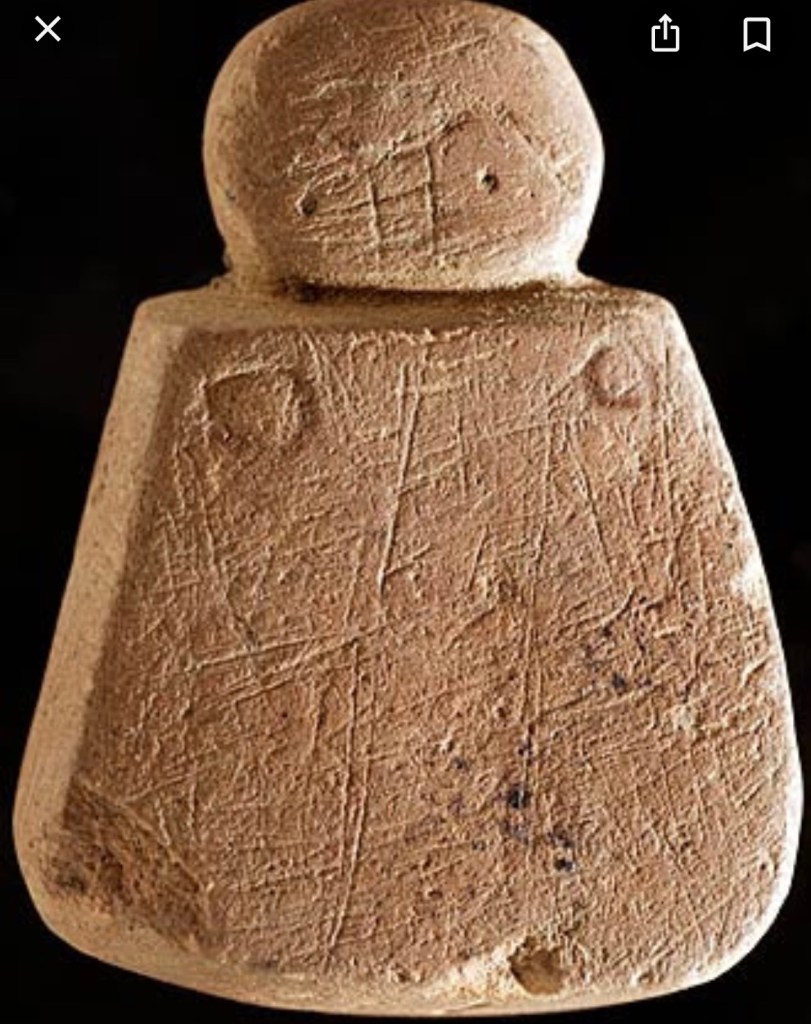
We next visited the Heritage Center, home of the Westray Wife, a small Neolithic figurine carved from sandstone, the first Neolithic carving of a human form to have been found in Scotland. It is also the earliest depiction of a face found in the UK.

Westray Wife

The center also featured rare china made for Edward VIII’s coronation. As we know, he abdicated after his ascension but before his coronation, in favor of his love Wallis Simpson. The American divorcee may have done the world a favor by removing a Nazi sympathizer from the board in favor of George VI, the beloved “Bertie,” who, along with the Queen Mum, refused to leave London during the Blitz and was photographed wandering amongst the rubble.

As we were leaving the Center, we spotted a small plane flying overhead – the shortest scheduled flight in the world from Westray to a (very) nearby island called Papa Westray. It’s scheduled for 1.5 minutes with actual flying time closer to a minute. The record for the fastest flight is 53 seconds.

Nearing the end of the day, we dropped off Angela and Peter, bidding them a very fond farewell. Angela was worried about her husband, as he had apparently been struggling more than usual during their trip, and they were headed to Shetland for another week. I hope they find that the familiarity of being back home in Cornwall will return him to form. They traveled extensively during their marriage, having many adventures around the world. Peter would smile happily, looking into the middle distance with fond remembrance as he shared some of their experiences. I dearly hope they are able to continue traveling for a bit longer before Peter’s illness makes it too challenging.

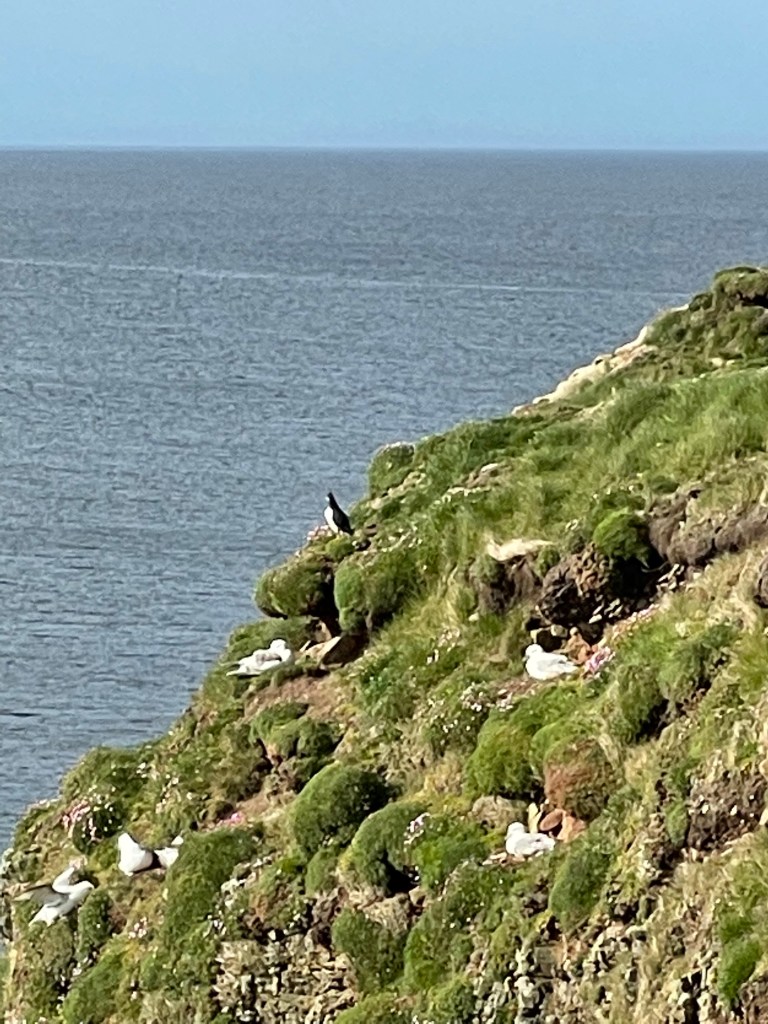
Our last stop on our way back to the ferry was the main puffin colony on the island. You know all those photos of puffins where they appear to be frolicking right underfoot? Sadly, my friends, these photos are largely due to high-powered zoom lenses and a lot of patience. Puffins nest in cliffs like the other birds, only they burrow rather than nesting on ledges. So you must wait for them to fly in and land, or perhaps pop out of their burrow to have a wee, which we witnessed and was adorable. The best time to see them is at dusk. But we still saw a good handful, and it was incredibly thrilling, and this is the best I could do with my iPhone.

The mighty puffin.

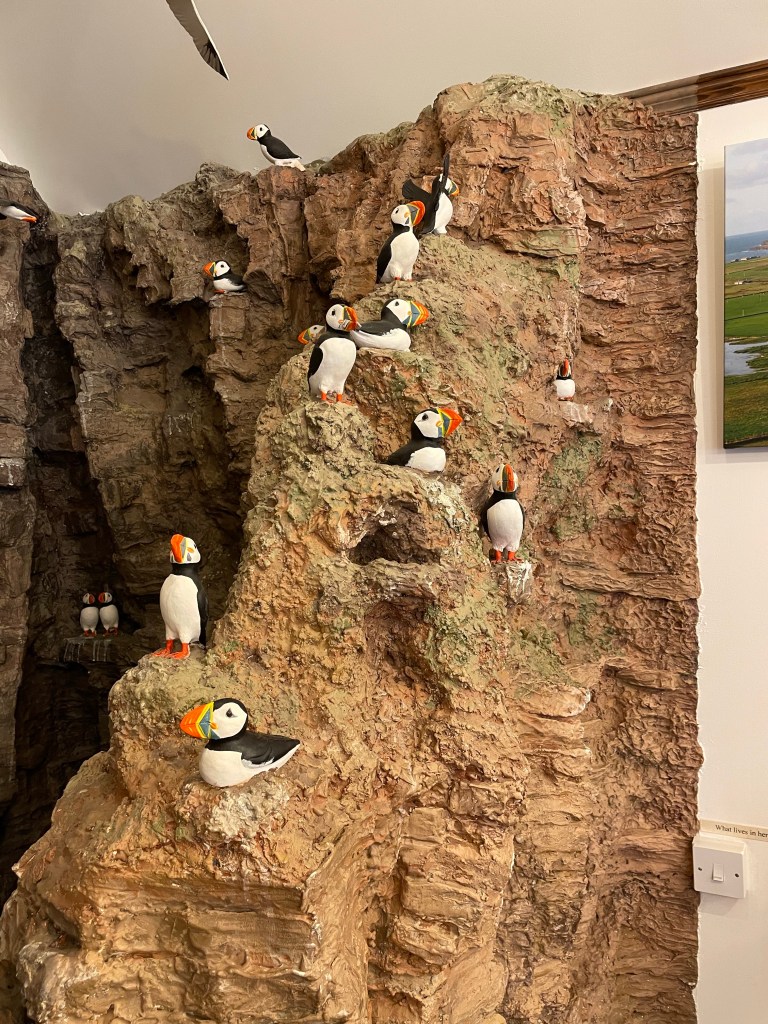
As consolation here’s a photo from an exhibit in the Heritage Center.

For illustrative purposes only.

Next morning we ordered a cab for 5:15 am to catch the ferry to the mainland. Happy to see Dougal waiting patiently for us in the car park, we drove off across the North Coast. Despite the occasional flare of irritation at campers, we mostly traveled along the single track road in complete solitude through moody landscapes, farmland and villages. We stopped at some spectacular, almost deserted beaches and visited Smoo Cave.

Farr Beach
Scotland you really are too much.
Ceannabeine Beach – Caribbean blue waters.

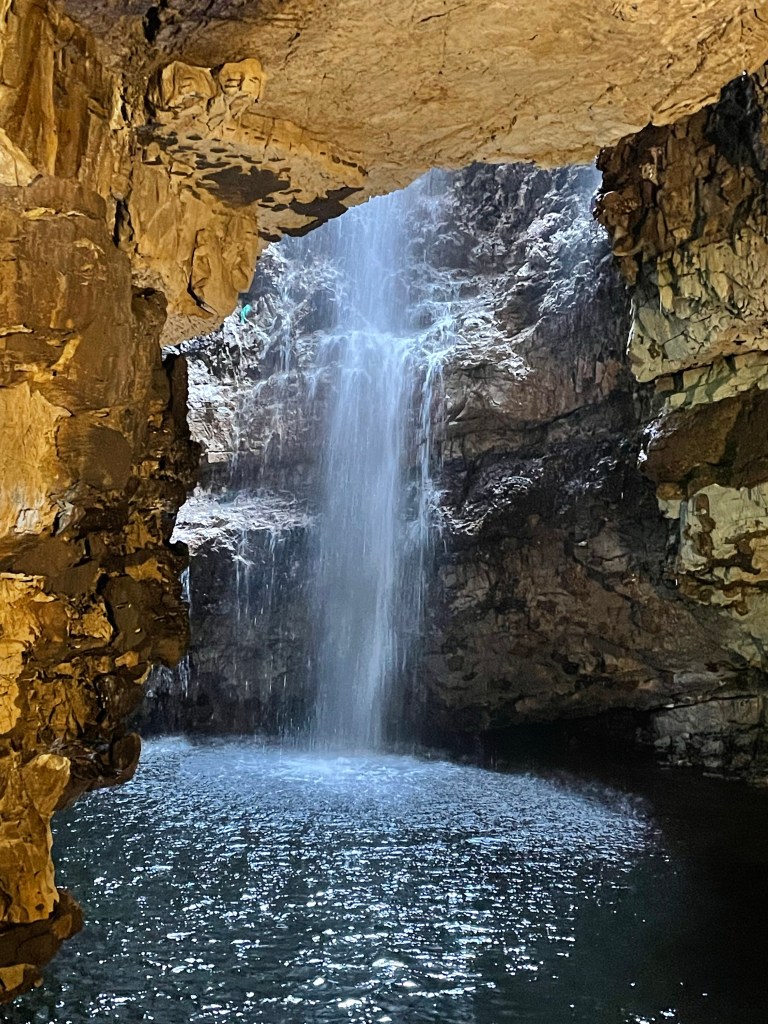
Smoo Cave was interesting although I’m not really a cave person. We opted against the hard hat tour. Lovely waterfall though.

At long last, we left the beaches of the north coast behind and dropped down into the rugged and spectacular Western Highlands I remember so fondly from my last trip.

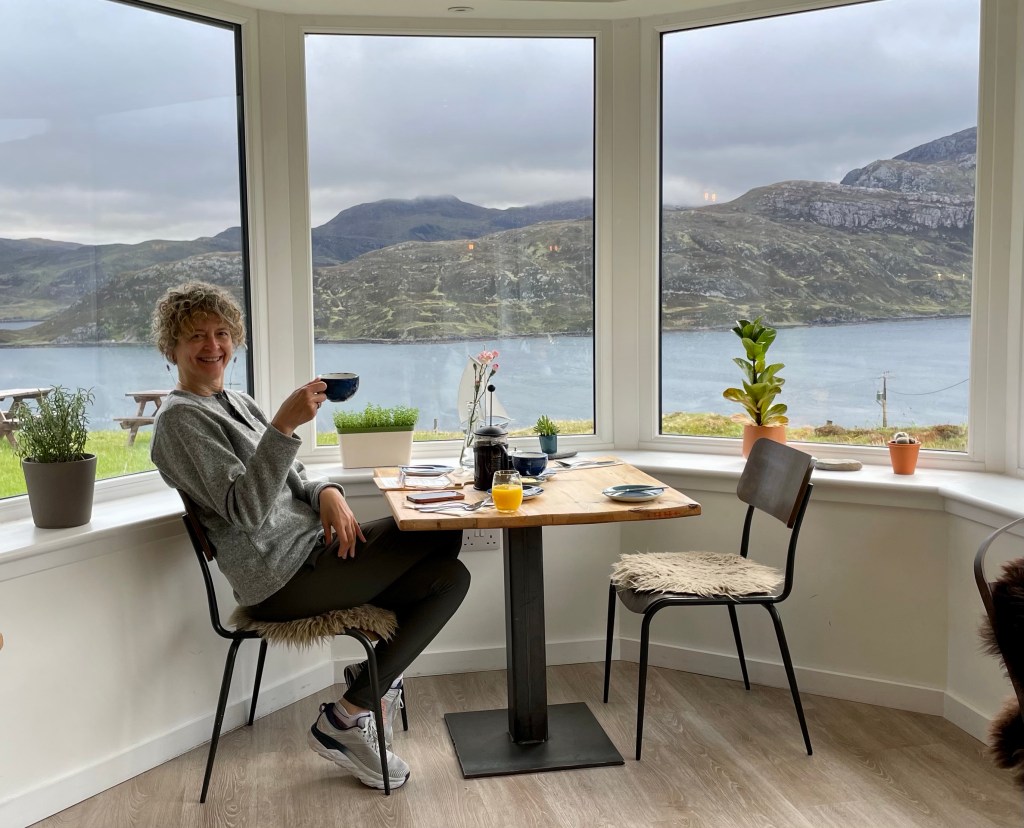
We stayed the night at Newton Lodge, which is situated in an impossibly gorgeous location on Loch Glencoul.

The view from the common room.
Best breakfast spot ever.

I’ll leave you with a chance encounter we had with a cyclist we met as we arrived at Newton Lodge, John Loughran. We met him as he pulled up on his bike and tried to sort out where he had booked a room. As we were headed to nearby Kylesku Hotel for lunch, he asked for a ride. Of course we were happy to oblige, and John joined us for a lovely lunch. He is 78 years old, a retired engineer, and a Scot, although he has lived in England these past fifty years. He was riding the North Coast 500 in the opposite direction as we had done, riding valiantly through rain and wind and up and down serious hills on roads with no shoulders, or margins or verges as they are called, somewhat more descriptively than “shoulders.” John didn’t complain about any of it, just nodded and smiled, saying, “oh, it’s quite alright actually.” He told of a time when a local cyclist pedaled by who could see he was running out of steam on a climb. The guy rode alongside offering words of encouragement, and John said softly with a smile, “he got me through.”

John had planned the trip for 2020 along with a fellow cyclist. Sadly his friend bailed on the rescheduled ride, as his wife, whom John sweetly described as “a bit neurotic,” didn’t want to lose her husband for two weeks. John said proudly that his own wife, who was “very busy” and active in their community, was fine without him. He was “a bit disappointed” without his friend and his friend was “gutted” not be alongside him. I am slightly peeved by the clingy wife but like John’s wife very much. John added that he and his busy wife have five very successful children and seven grandkids spread around Scotland, England, Spain, Japan and Australia.

He showed us how he created a page for every day of his journey, carefully planning stops to recharge his electrical-assist bike. He shared many tales of his life, and how on this ride he was visiting spots in his home country that had meant a lot to his family over the years. John might be the sweetest man ever.

I’ll share one of his stories about a business trip he took to Rio in the fall of 2001. He was about to give a presentation to thirty of his colleagues when he heard someone say something bad had happened in the States. They all gathered around a television in time to watch the second plane hit the south tower. As he was telling the story, his mouth trembled and he broke down. He said he could not ever talk about that day without getting emotional, even after all this time. He said quietly, “of course, we cancelled the presentation, we simply could not go on.” When he was able to find a flight home, he remembers stepping over sleeping, marooned Americans in Schipol Airport. A reminder that the horrific 9/11 attacks took a psychic toll on humanity, even though they occurred on American soil. And the residual impact of that terrible day reverberates still, especially in empathetic souls.

Godspeed, John.

The best part of travel.

Skye

The Isle of Skye is just off the mainland, now accessible by bridge as well as ferry. It’s 50 miles long with a population of 10,000. Crofting, fishing, fish farming and tourism are its biggest economic drivers.

Tourism has increased exponentially over the past several years, making life irritating for island residents and clogging up roads, endangering delicate environmental areas, and filling up restaurants and B&Bs. Danielle said she felt slightly guilty even being here and I know what she means. Making matters worse, and I’ve heard and overheard so many conversations about this (all over Scotland), is the dire post-COVID labor shortage exacerbated by Brexit. Tourism industry employees from EU countries now need a visa to work in the UK, and these folks are critical.

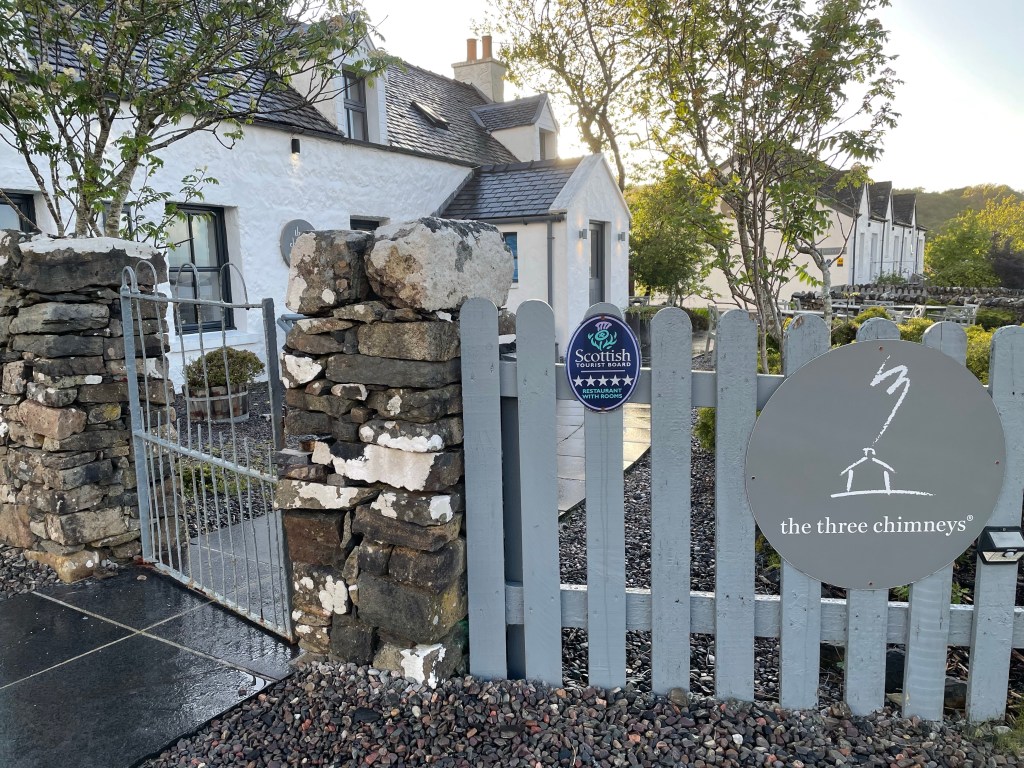
PRO TIP/RESTAURANT DIGRESSION: Speaking of which, if you are headed to the UK this summer book all of your restaurants in advance. All of them. Otherwise no dinner for you! Big bummer especially since you have traveled 4,500 miles and there are three Michelin-starred restaurants on Skye alone. I wrangled a booking for two of them – The Three Chimneys and Edinbane Lodge. Both were completely excellent. And you don’t want to miss out on the fabulous and fresh cuisine of Scotland in general. Seriously get online now and book, book and book.

The Three Chimneys. Delightful spot in a remote area of Skye. If you go, and meet a tall dark and handsome server with an Eastern European accent – he’ll ask you to guess where he’s from. The answer is Poland. His goal is to move to Shetland.
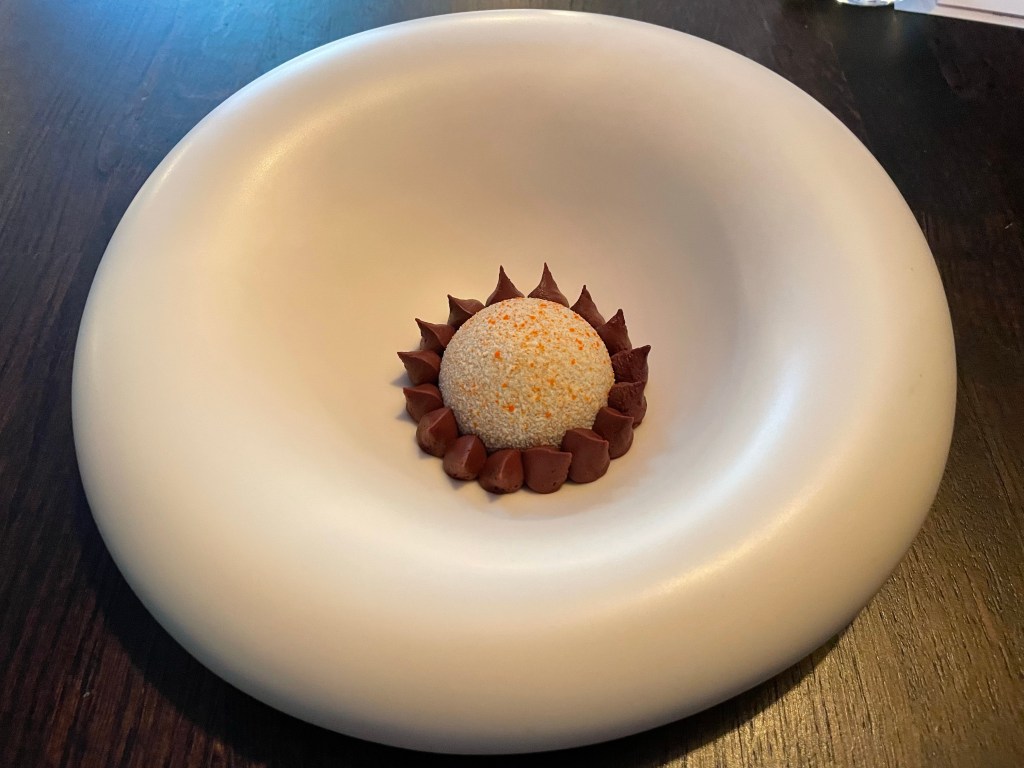
A dish from the tasting menu at Edinbane Lodge – Dark Chocolate with Sea Buckthorn. What is sea buckthorn? Who cares really with this delightful presentation. FYI there were three desserts.

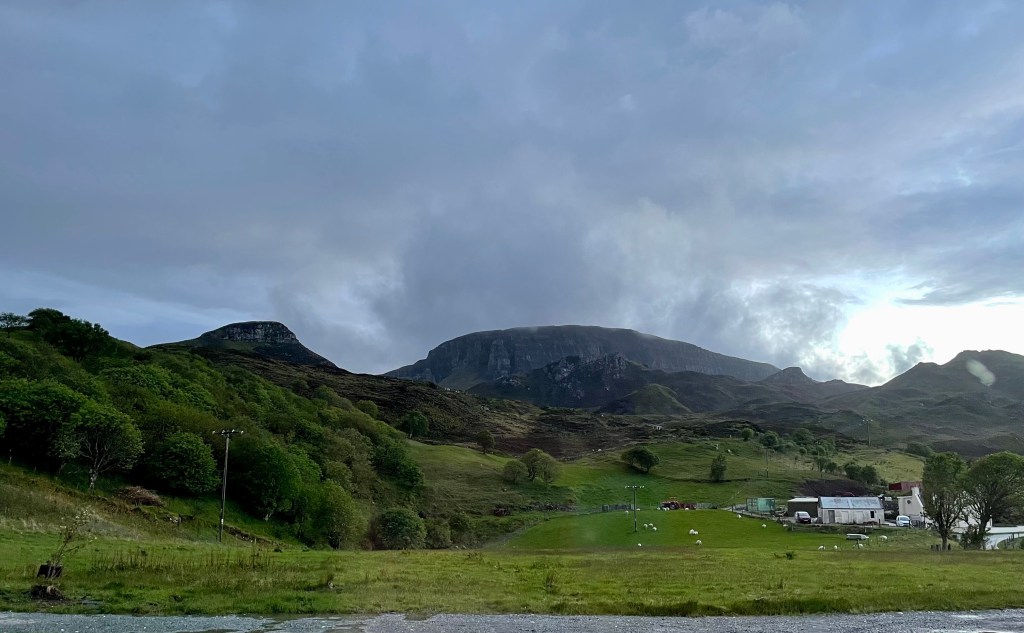
A wee word about our accommodations. We booked an Airbnb near Staffin situated between the mountains of the Quiraing and the sea from a delightful guy named Ian. He was incredibly responsive and patient with our American questions. I’m so used to Airbnbs in the states where there is a giant notebook full of detailed instructions, including a list of chores you must do at the end of your stay. You know the notebook I mean. There is not one piece of paper in Ian’s place, although there is a leprechaun in one of the kitchen drawers. We have too many rules, too many instructions and too little trust in people in the States. Much more laissez-faire here. They sell whisky in grocery stores and you can take your dog into a restaurant which all seems very advanced.

And we have a washer and dryer yay! But that situation is so different. No Tide pods. Instead, there’s spectacularly over-fragranced powdered soap that goes into a drawer just like olden times. The dryer is in the detached garage and isn’t plumbed so you have to dump out a water tray after every load. Settings include “cupboard dry” and “iron dry.” This makes sense to me. At times the weather was so aggressive that trips back and forth to the garage made us feel like frontier women, braving the elements to accomplish household chores.

Anyway, back to teeming hordes. I was pretty shocked to see that Skye’s popular sites are simply inundated with people. Those beautiful photos of iconic locations you see on Instagram? Faerie Pools, the Old Man of Storr, etc etc? Imagine those lovely photos, which must have been taken in the middle of the night, in the wee hours or in winter, only packed cheek by jowl with hordes of tourists. Cruise ships dock in Portree and disgorge thousands of people who are then loaded onto buses and taken on a whistle stop tour of the top destinations. Dreadful.

You can still easily find solitude though. Get up early, take a few steps down a trail or make after-dinner plans when the roads of Skye are empty.

VERY WEE DIGRESSION ABOUT NIGHTTIME. Speaking of getting up early, in early summer you can rise really early and, lo, it’s not dark. Or stay out late same deal. There’s only about four hours of complete darkness. Scotland’s latitude is similar to Northern Canada and Alaska. Really really cool and I never stopped marveling at it.

View from my bedroom (the Quiraing) at about 10:30 pm. No filter.
View from front of house, same time.

So the weather on Skye is particularly changeable and can be kind of crappy to be honest. Wind, rain, fog, all the things you imagine and generally all in one day. Every item on your body must be waterproof. Not water-resistant – Scotland throws back its head and laughs at “resistance.”

The weather was true to form for us, but we never regretted ignoring it.

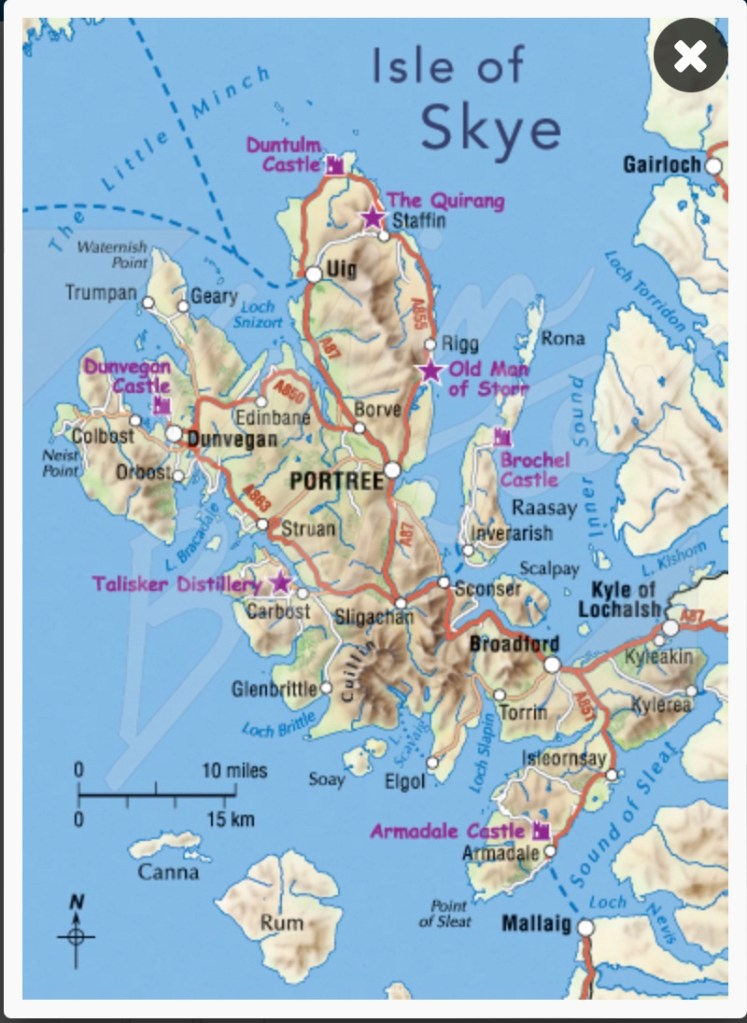
My first trip to Skye with Backroads, we stuck to the Sleat (pronounced Slate) peninsula in the southwest, which was fabulous. Ian’s place is northeast on the Trotternish peninsula. It is gorgeous, and home to many of the tourist sites on Skye, including the Old Man of Storr, Kilt Rock, the Quiraing, the Fairy Glen and the Skye Museum of Island Life, a highland folk museum near Flora MacDonald’s grave.

On our first day we drove across the north coast of Trotternish, dropped down into the Waternish penininsula and then over to Duirinish all the way to Neist Point, the most westerly part of Skye.

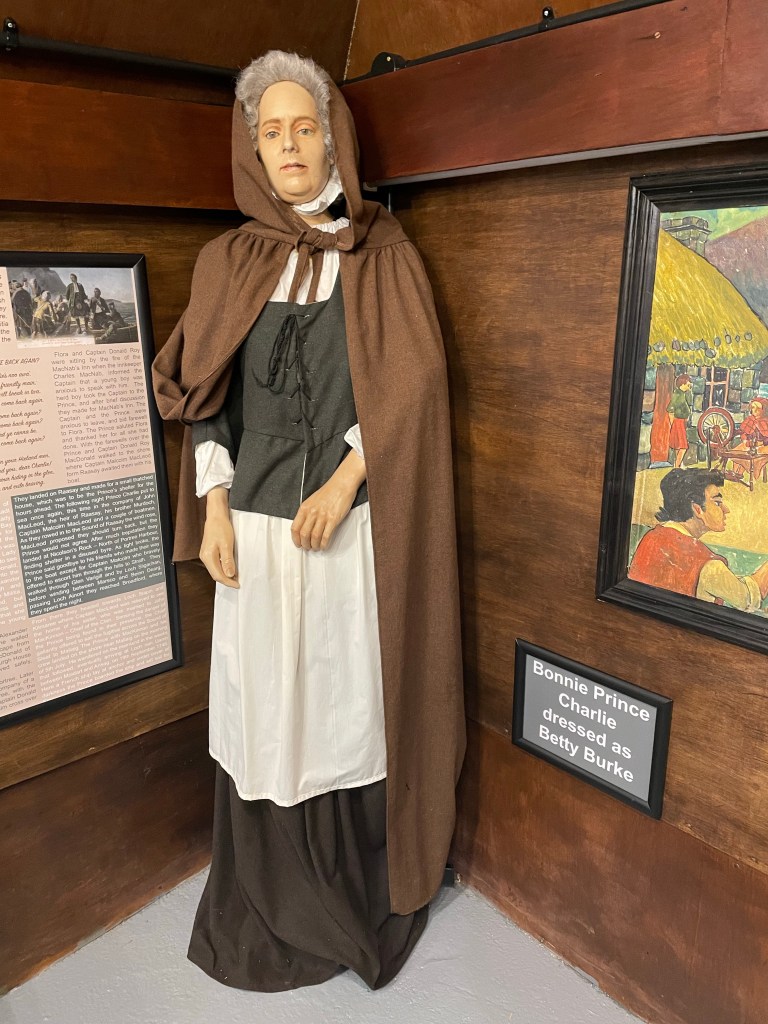
We stopped at the Skye Museum of Island Life, which is a wonderful spot. It features replicas of Croft buildings from back in the day and a lot of detailed historical information, including from the Jacobite period since Flora Macdonald is buried nearby and Skye was where the Bonnie Prince finally was able to catch a ride to France after Culloden. You have probably heard the story, but he dressed up as a woman named Betty Burke, and traveled incognito as Flora’s maid.

Here’s a rather alarming representation of the Bonnie Prince and his escape outfit. From the Isle of Skye Museum of Island Life.
Flora’s grave. It looks newer than you might expect because her first marker was chipped away by souvenir hunters in the 1800s. After Culloden, Flora married a guy also named MacDonald (no need to change the monogram) moved to North Carolina and declared loyalty to the Crown during the American Revolution. From Jacobite to Loyalist – two losing causes in a row.
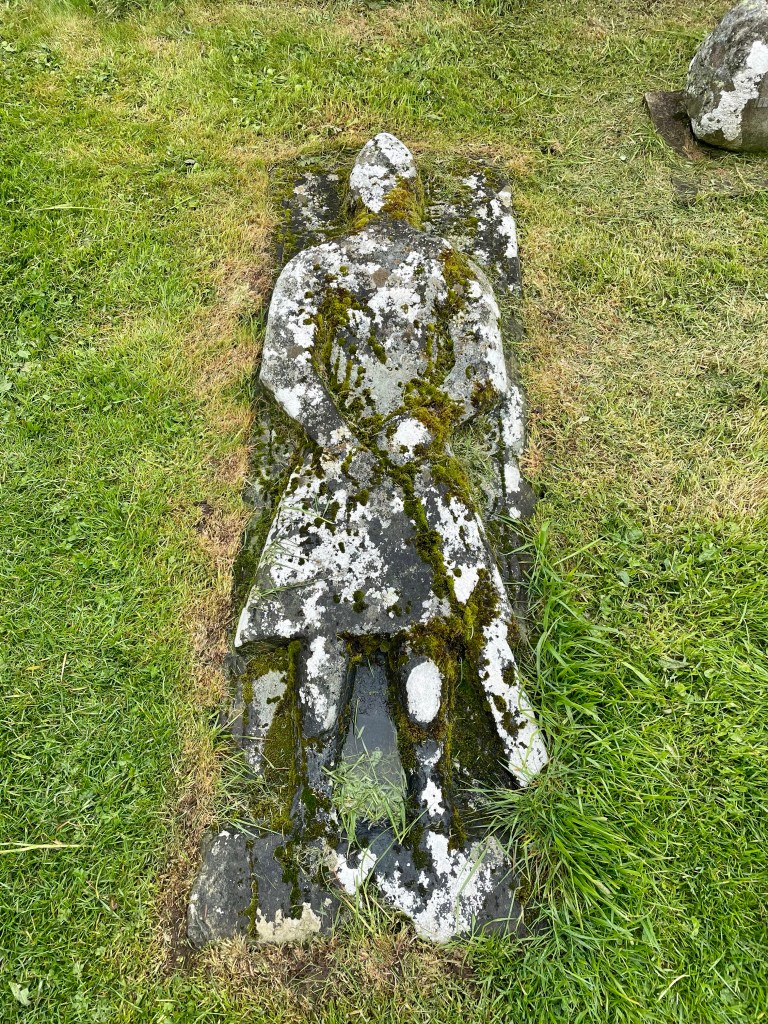
Another really cool grave marker in the cemetery. Probably King Arthur.

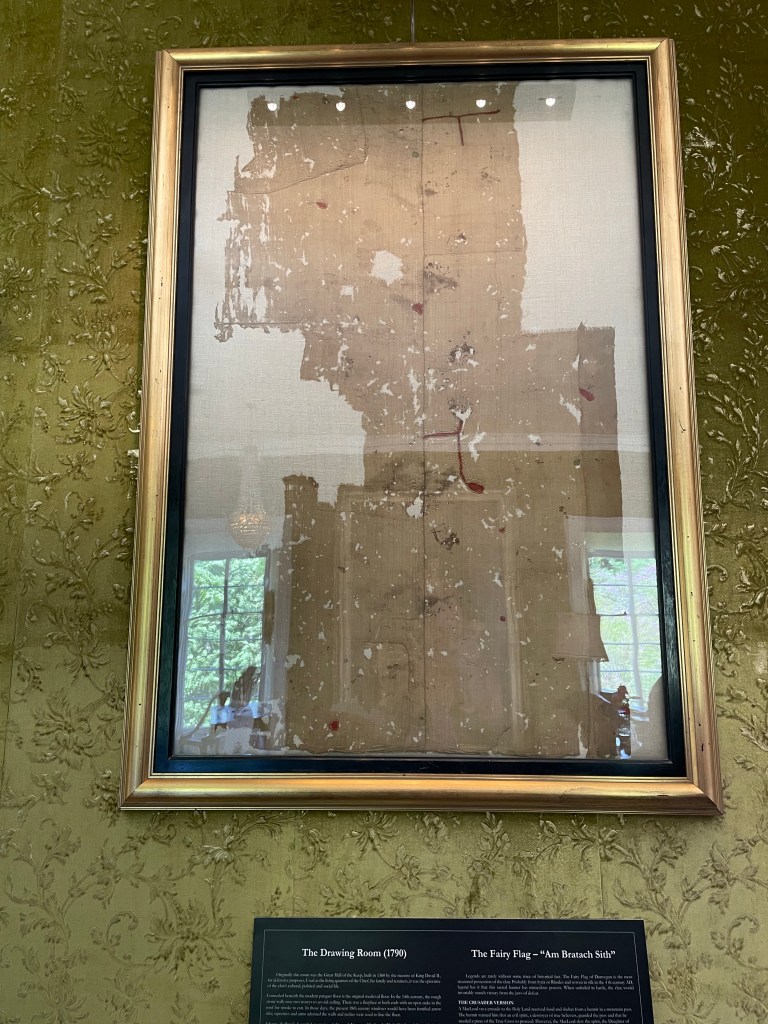
Next we visited the Fairy Bridge, slightly off the main road and sadly all alone without a single visitor. This being Scotland, there’s a legend behind the bridge. Once upon a time, a chief of the MacLeod clan married a fairy and they lived together on Skye. She was only allowed to be with him for a year, after which she had to return to her people. She bid the clan chief farewell on the bridge and left her son wrapped in a silken shawl. This is the famed Fairy Flag, which allegedly could be used three times to save and protect Clan MacLeod. Very Lord of the Rings, is it not? #AragornArwyn. That exact same flag just happens to be on display at our next stop, Dunvegan Castle, which proves that the legend is true.

Dunvegan Castle is the oldest inhabited castle in Scotland, and always by the chiefs of the MacLeod clan. The MacDonalds are the other main clan on Skye but were not so settled. In the 16th or 17th century they moved from Sleat to the tip of the Trotternish peninsula, and their castle, Duntulm, is now barely a ruin. In the 1800s they moved south and built Armadale Castle, now a tourist attraction for its gardens with the castle ruin (in better shape than Duntulm) as its centerpiece.

I would be remiss in not mentioning the bitter feud between these two clans. There were tit-for-tat massacres and suchlike. Worth a google.

Dunvegan Castle – nice work clan MacLeod.

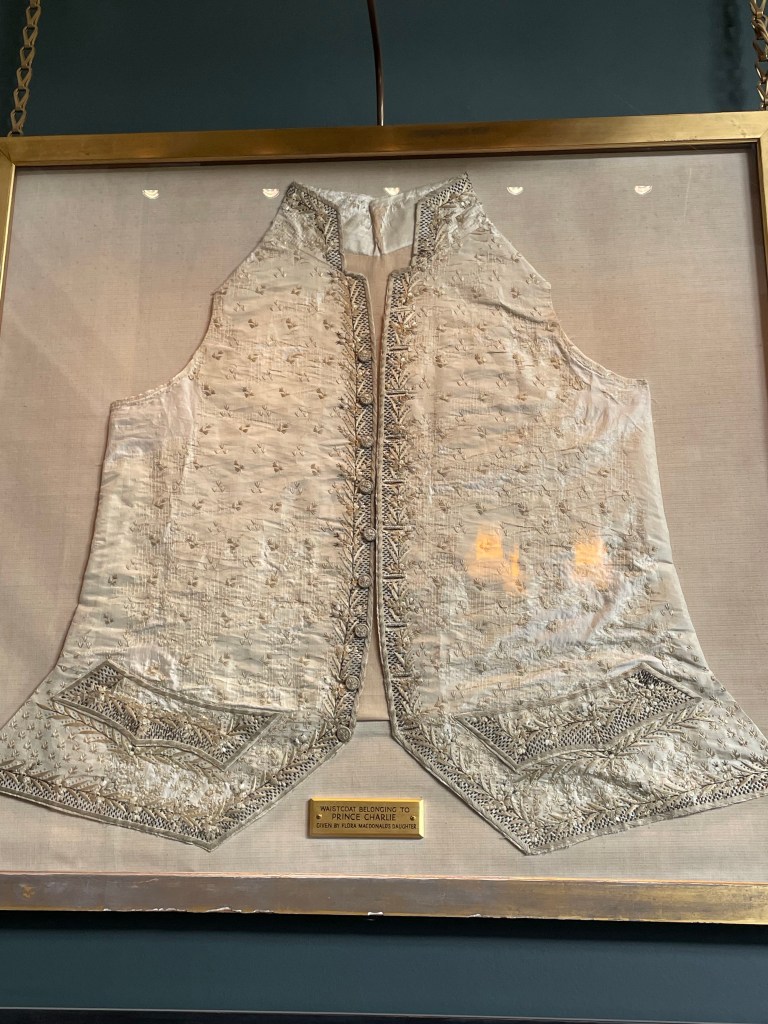
The castle has been visited by many luminaries over time, including Samuel Johnson, James Boswell and Sir Walter Scott. It also boasts a fun Jacobite collection including a lock of hair plucked from the head of the Bonnie Prince which he bestowed on Flora MacDonald. Her daughters also donated a vest of his.

Kinda weird but also OMG.
Prince Charlie’s blingy vest

And of course, the Fairy Flag is displayed within the castle. It’s pretty threadbare, but no doubt still quite powerful even though Clan MacLeod has long since called upon it the allotted three times to protect the clan.

Another fun item on display is Sir Rory Mor’s Drinking Horn. Successive clan chiefs throughout history have proved their worthiness/manliness by drinking a full measure. You can buy a replica in the gift shop for only £150 but it’s for ornamental purposes only which seems pointless.

A display in the castle showing a back stair used by servants. I’m including it here because it’s just spectacularly lit. And it scares the crap out of people.
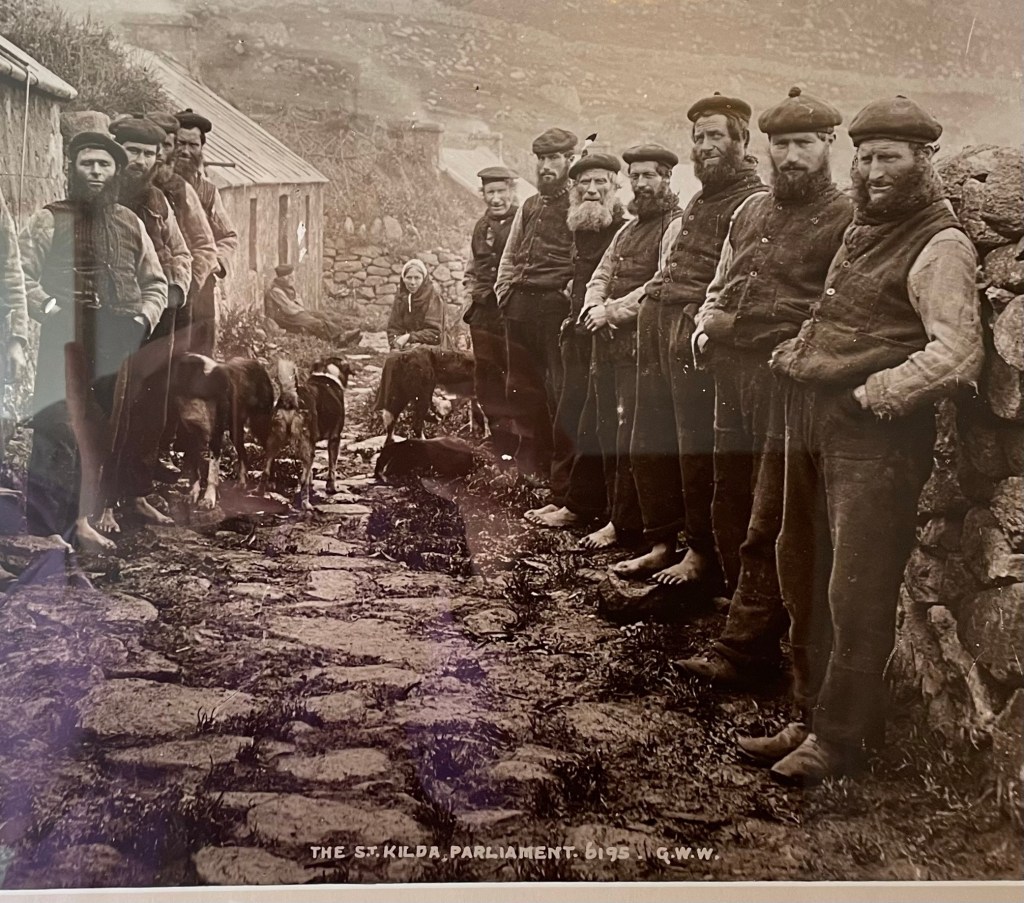
Including this in honor of the St. Kilda parliament because look at them. Amazing.

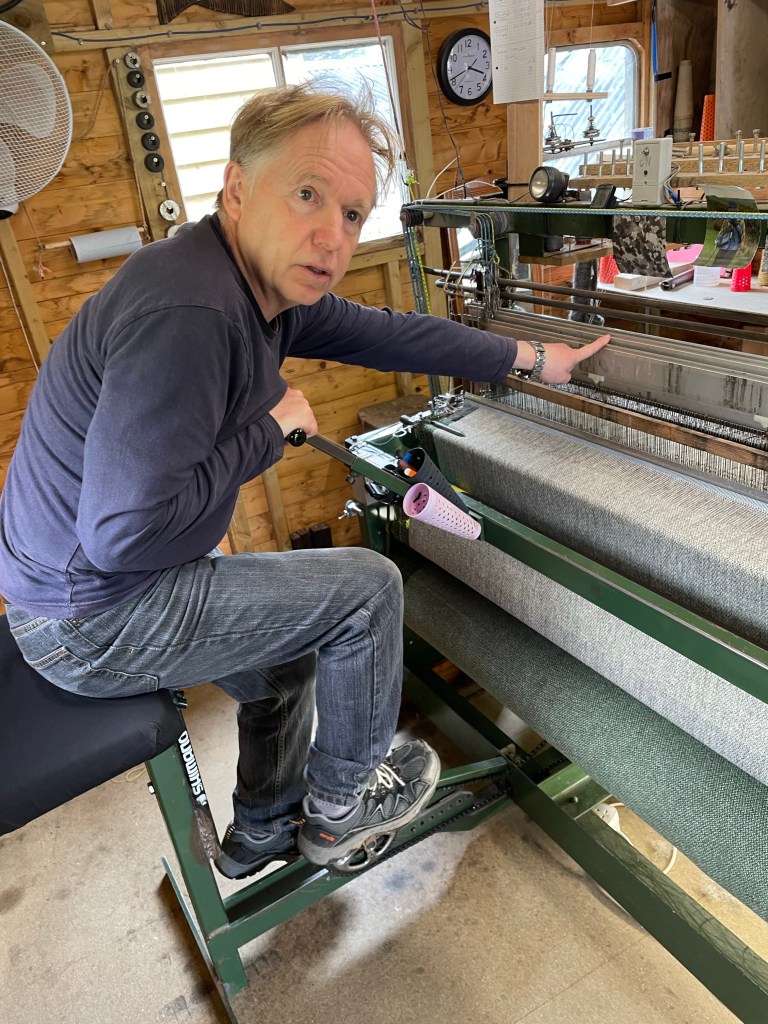
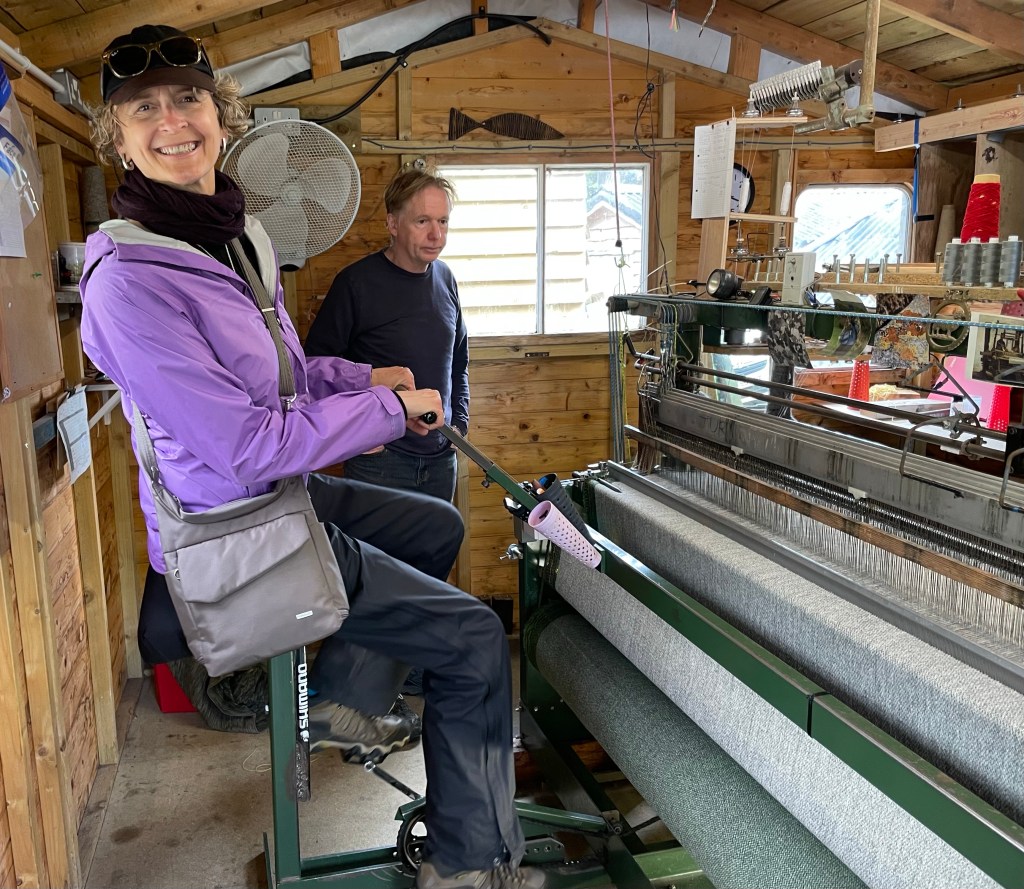
Next we visited Skye Weavers. There are craft artists all over Skye but this particular weaver was called out in travel books. Their looms are bicycle powered. We met Paul, who showed us how it all works and gave us a go. I hope he didn’t have to undo what I did. Also it must be hard to be trying to work while constantly being interrupted.

Paul looks less than impressed with my weaving prowess. Hopefully made up for it by buying a scarf and flat cap.

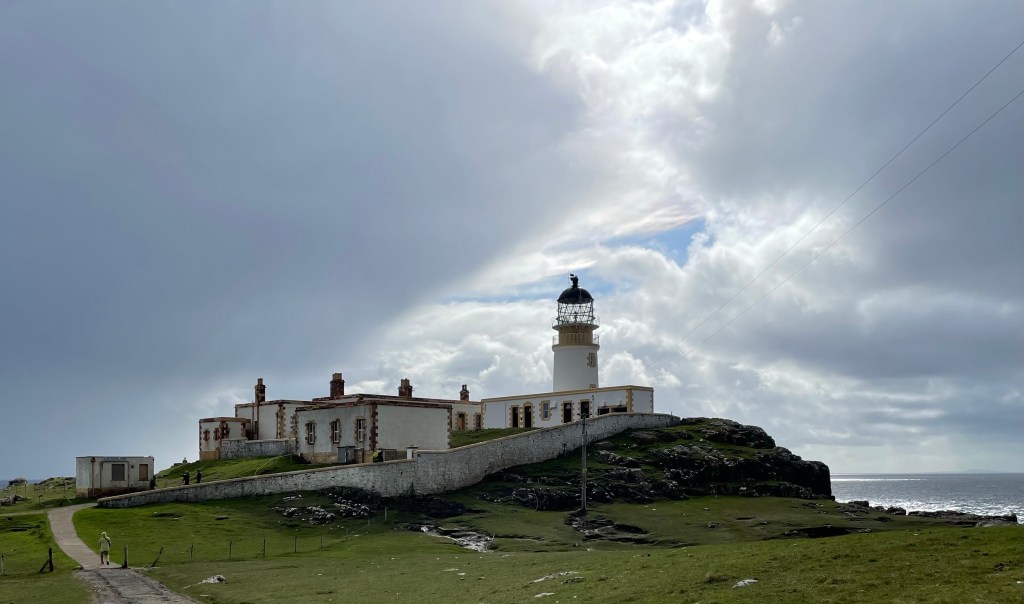
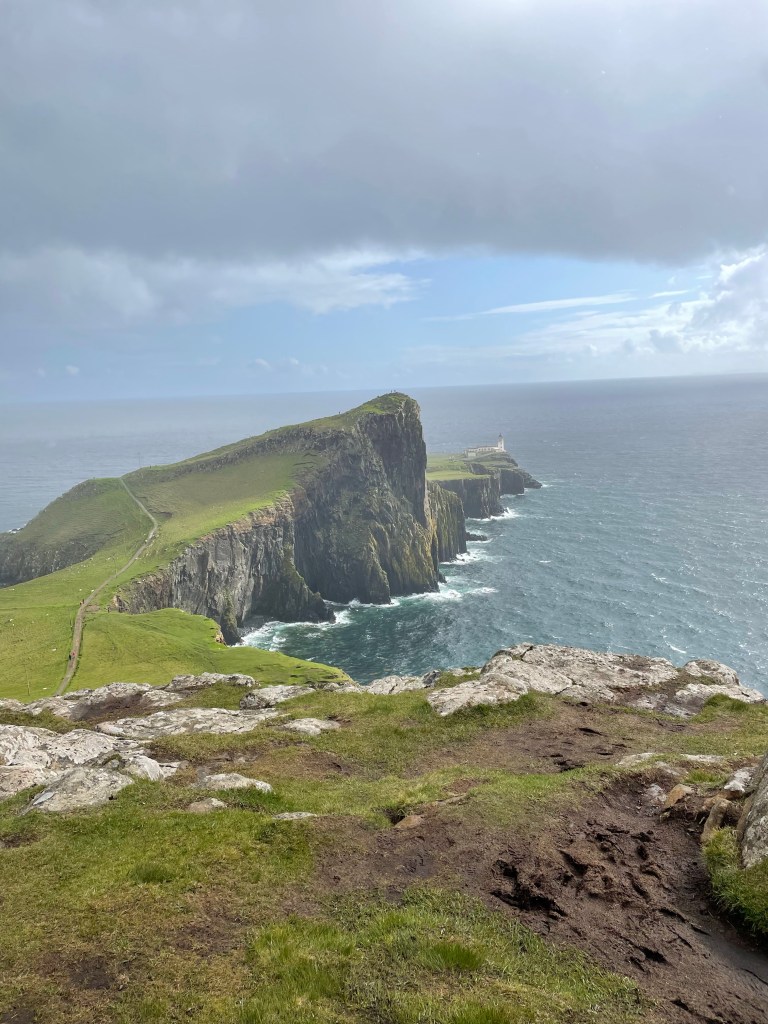
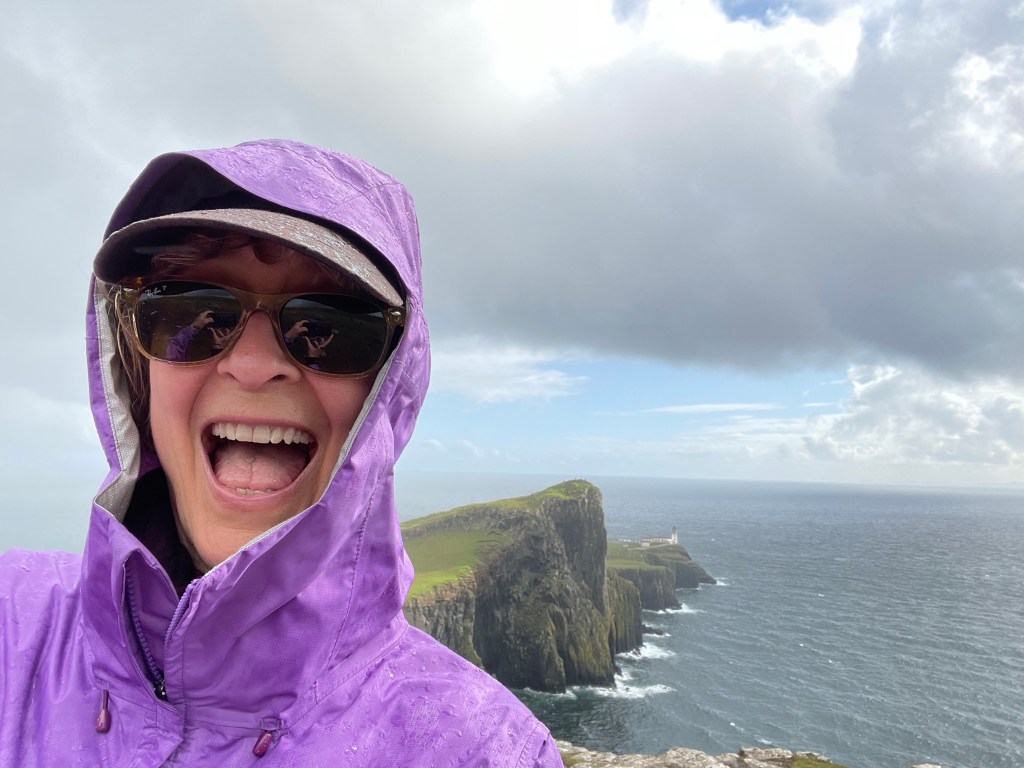
Finally we did a cracking hike to Neist Point Lighthouse in spectacularly crazy weather. (Dipping into British adjectives because running out of American ones). At one point my foot got sucked into a bog up to my ankle. I fell to all fours, afraid I’d never see my boot – or perhaps even my foot – again. I was able to yank it free with a supremely satisfying sucking sound. Best thing is that nobody witnessed it. At this point I was laughing rather maniacally, but the crazy lady got some superb photos.

Ah, the Stevensons have been at it again.
See the lighthouse way out on the point?
Whatever crazy lady.
This might be my favorite shot from Neist Point. If you squint you can see the Outer Hebrides.

I arrived back at the car covered in mud after walking through a torrential downpour. Just half an hour later after a change of shoes and using my hiking socks to wipe away visible mud, we were sweeping into The Three Chimneys, Michelin stars notwithstanding.

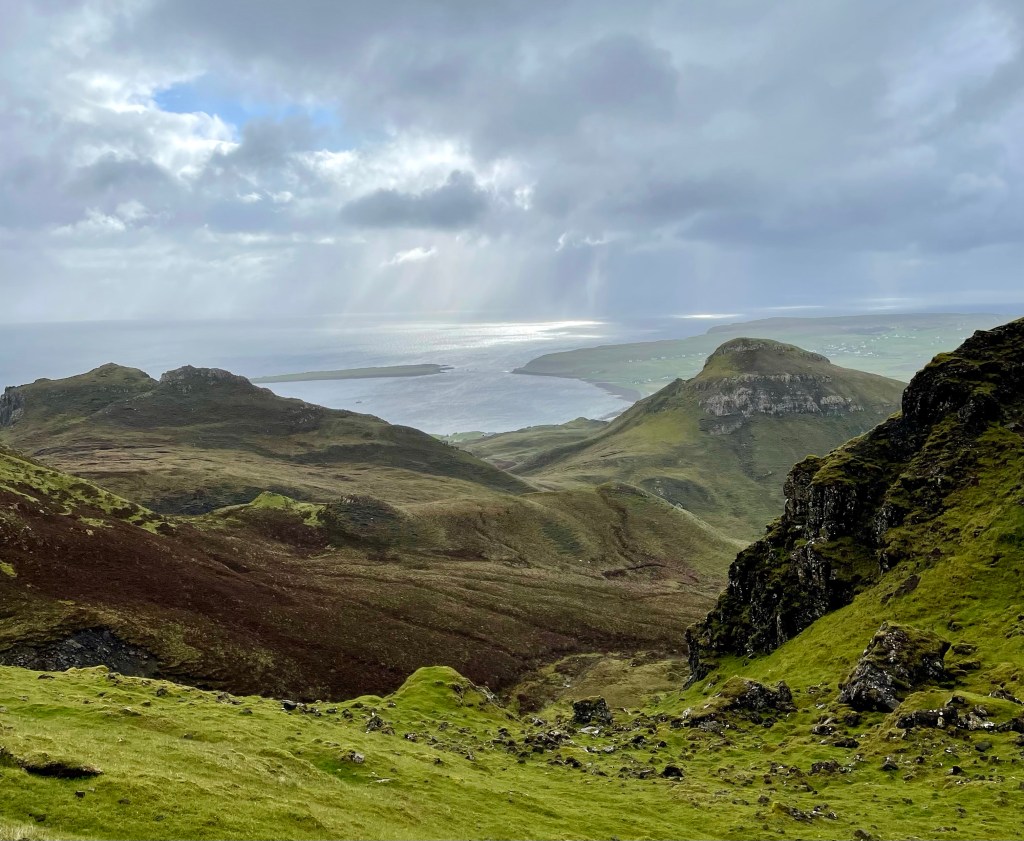
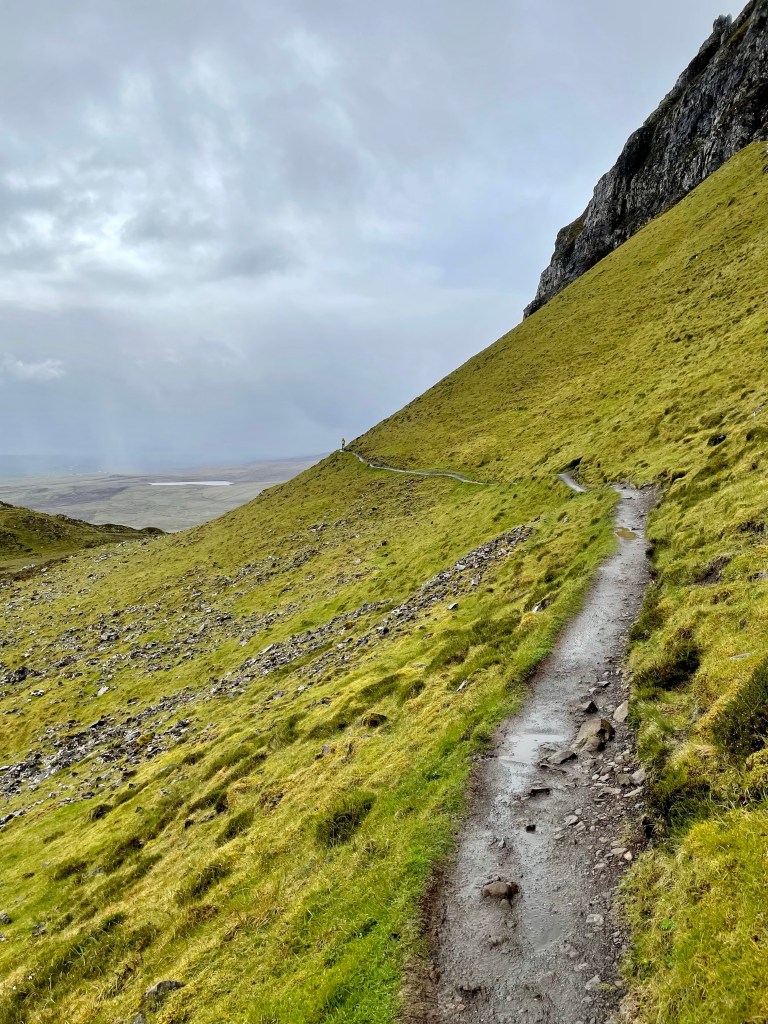
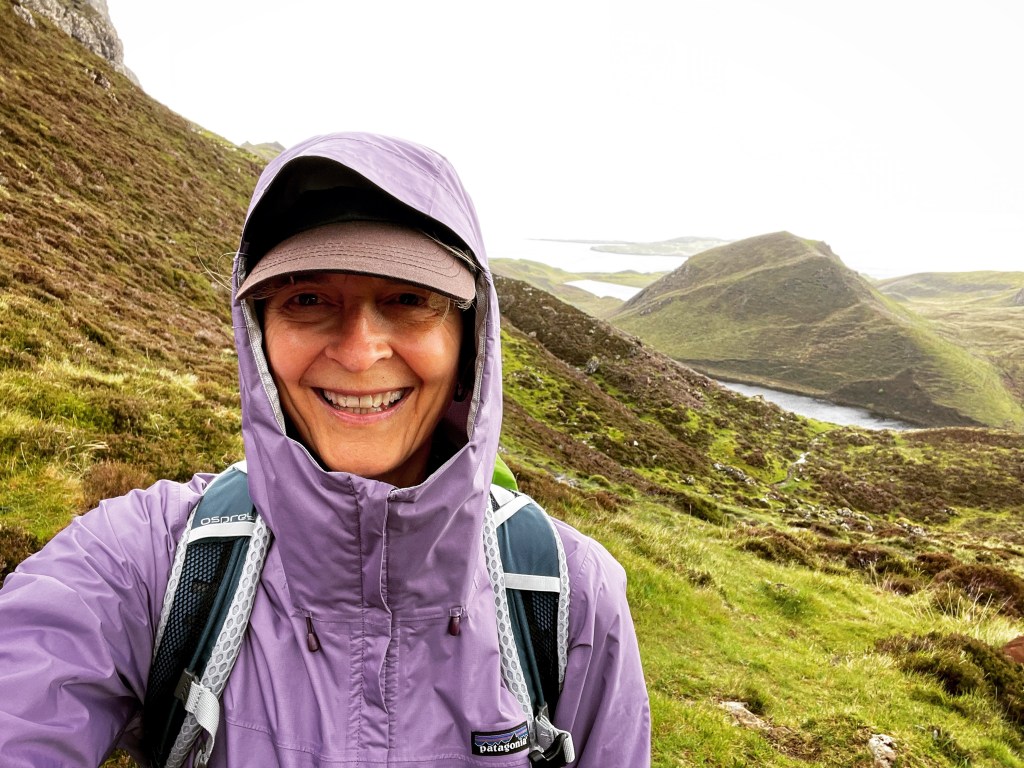
For our last full day on Skye we decided to tackle the Quiraing. Weather be damned. And the weather was indeed damnable. To avoid crowds we arrived at the car park around 7:45, joining just one other crazy person. It was raining sideways, windy and foggy. We communed with our inner intrepid selves and just did it, as the shoe says. The weather changed about 100,000 times during our three hour hike through rivers, waterfalls, mud, along the cliff edges, all the things one’s mother would rather not know about. (Hi, Mom). And it was SO glorious and only occasionally miserable.

There must always be a sheep photo.
Yikes don’t look Mom. Also note the person coming our way.
Happiness.

Tomorrow, we’re hitting the Fairy Pools early and then heading to Glencoe. We are nearing the end of our trip and how can that be?

Inverness, Birthday Bagpipes and My Drunk Dude Angel

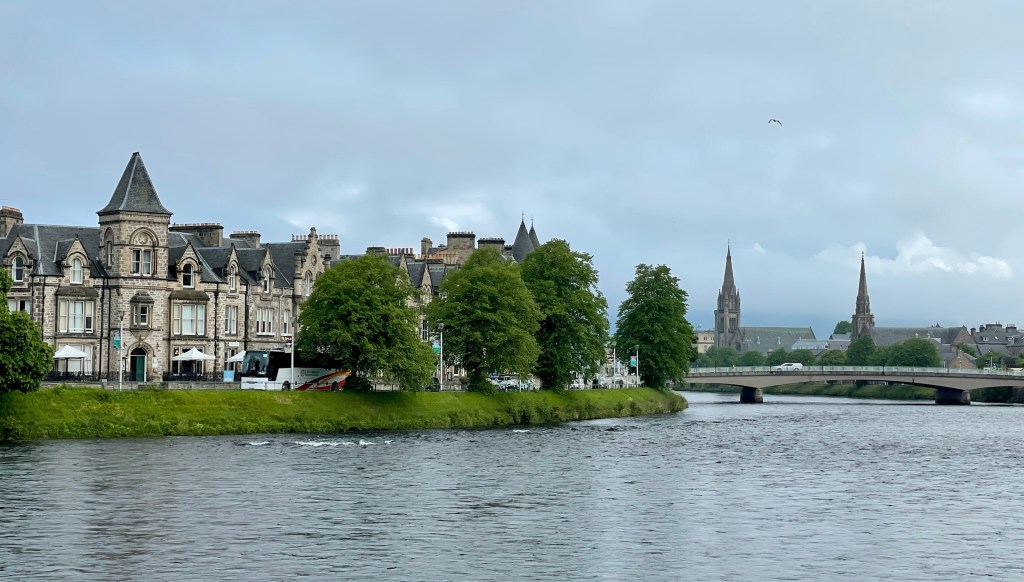
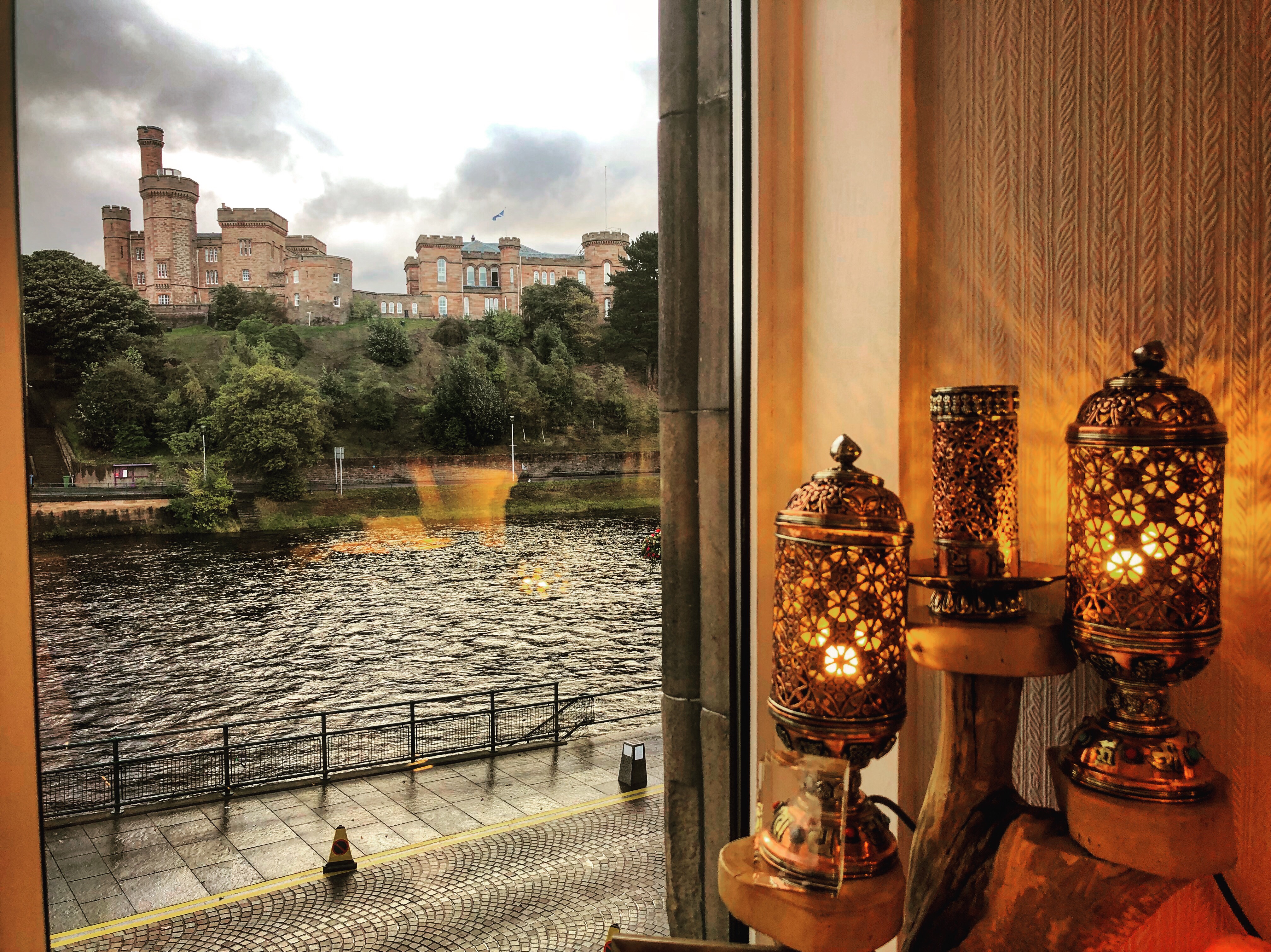
Inverness.

Back in Inverness, the first order of business was to bid a fond farewell to our faithful Dougal. I had grown quite fond of him despite the flaws he was born with – the back seat is worthless for anyone with legs, the hyper-annoying beepy lane monitor warning system, the cheaply finished interior etc. But I loved driving Dougal all over Scotland. I loved the entire experience, driving on the left, single track roads, no shoulders, glorious teeth-rattling potholes, all of it. Maintaining awareness of passing places, sorting out who should pull into one either by driving forward or backing up, and the subsequent mandatory wave to the other driver after you execute whatever you both silently agreed upon – it all makes navigating Scotland’s roads a delightfully communal experience. A very different situation than in the States where one’s car creates a bubble of isolation and basically drives itself.
Another driving-related thing I wish I could have shared with dad is the UK experience of getting gas. The pumps appear to be super-charged and sound like a jet engine when engaged – and they fill up your tank in literally ten seconds. Life-changer. Why can’t we have jet engine gas pumps? You can get your nails done while waiting for your gas tank to fill in the States.

Dougal. He’s been through a lot. Farewell my friend.

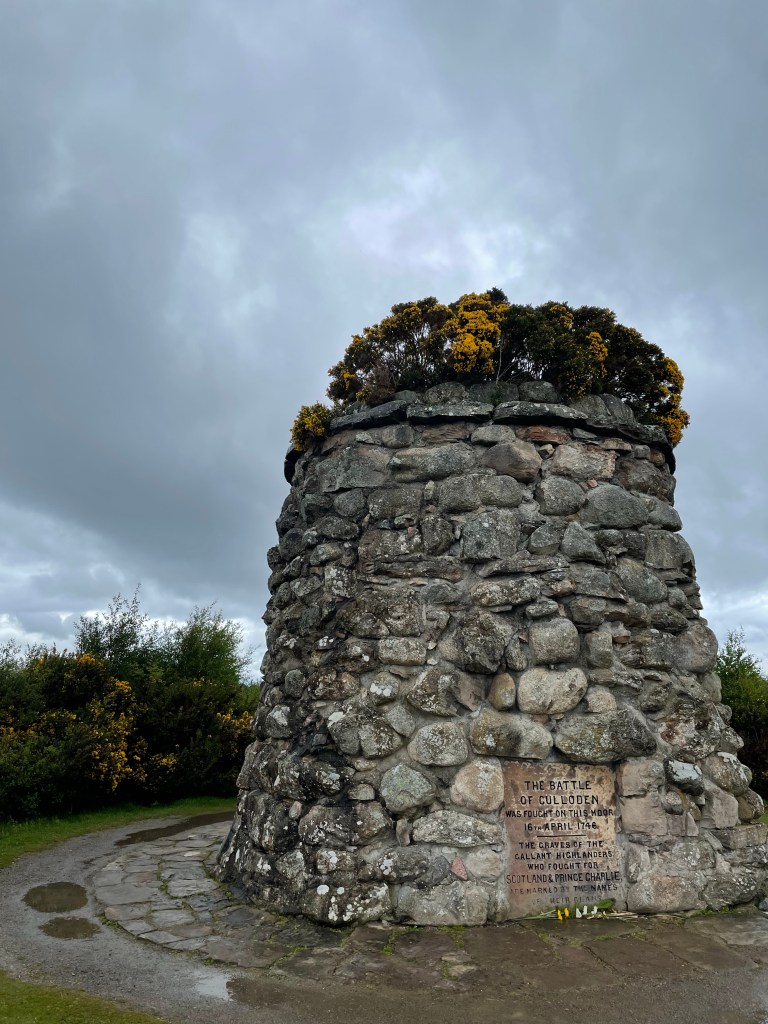
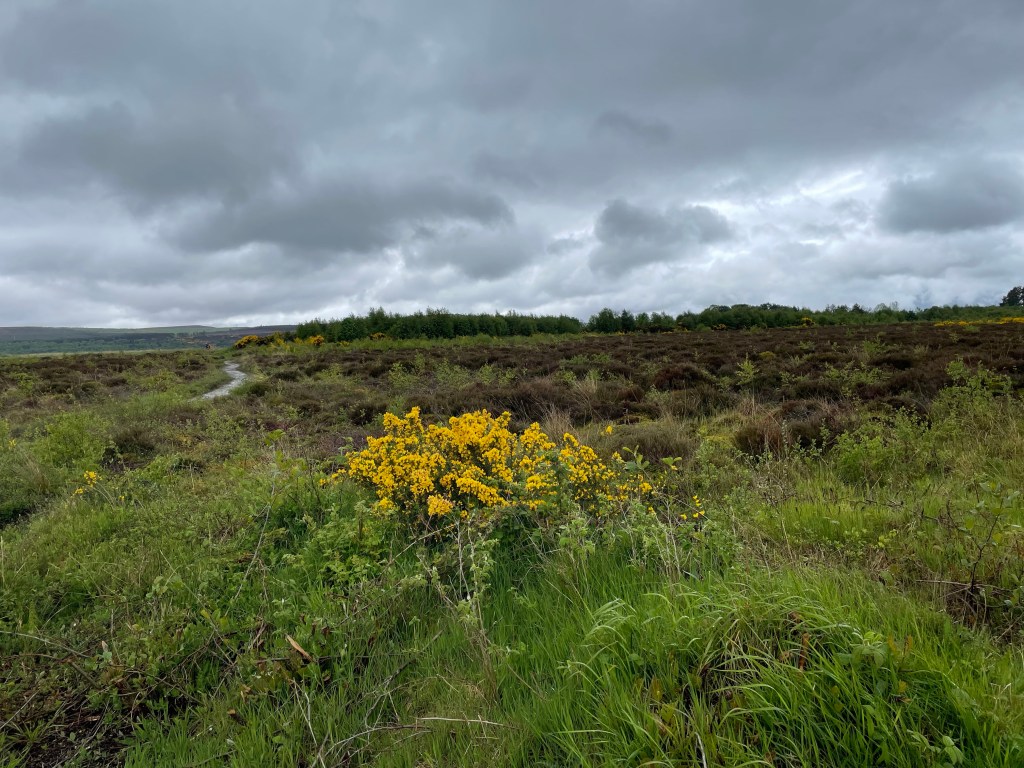
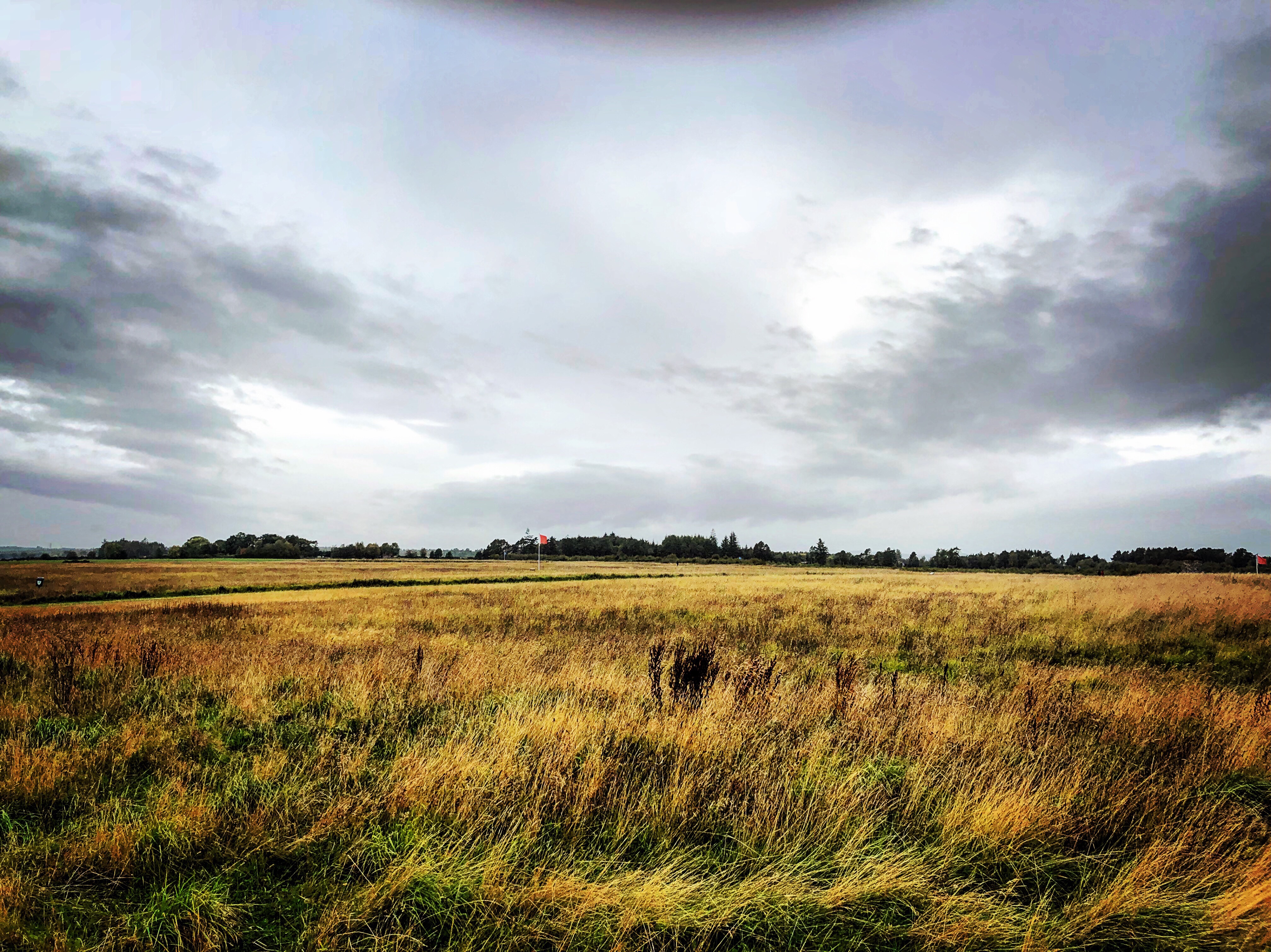
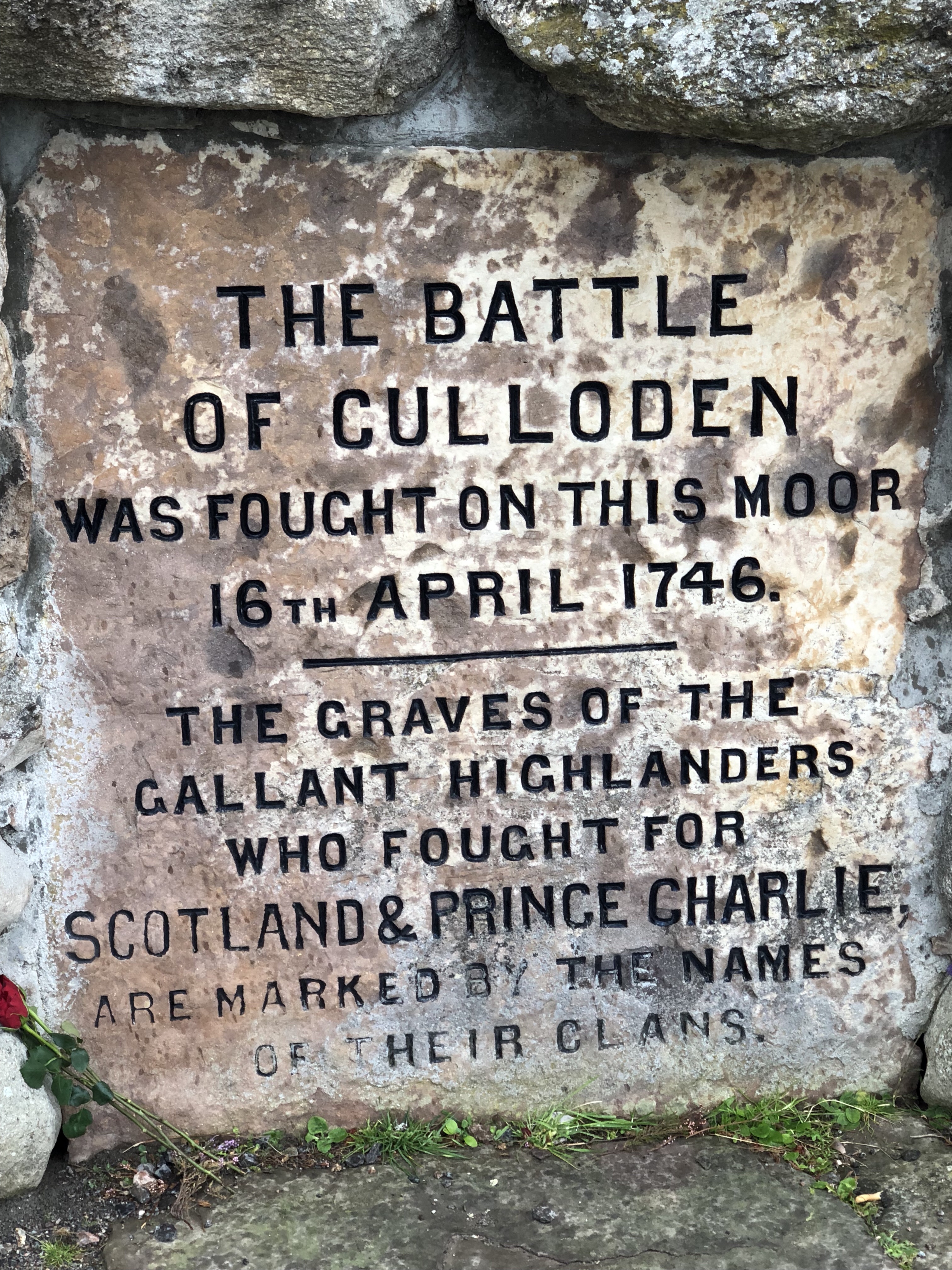
Before we relinquished Dougal, we visited Culloden Battlefield. This somber place is an incredibly rich and fascinating site. Since I wrote about it extensively during my last trip, I’ll simply leave you with a couple of photos.

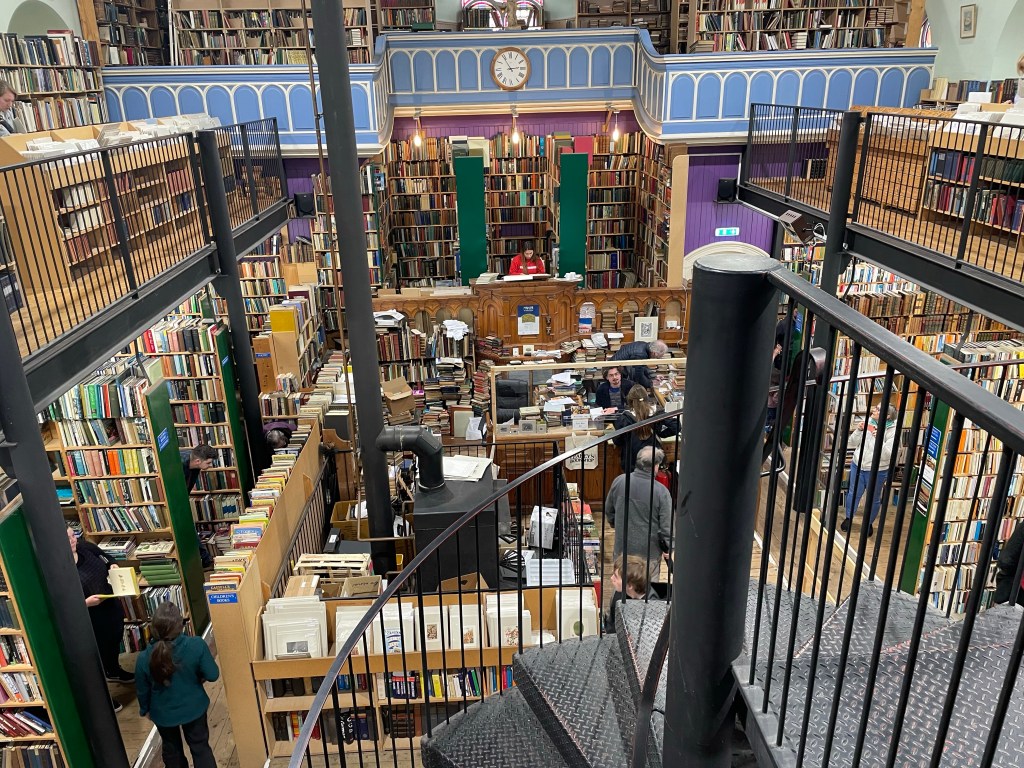
We spent the afternoon puttering around Inverness in the rain, visiting Leakeys, its famous used bookstore. In addition to books they have bins and bins of prints and old maps, all “guaranteed” to be over 100 years old. OK maybe but does it matter really? I bought three.

Leakeys

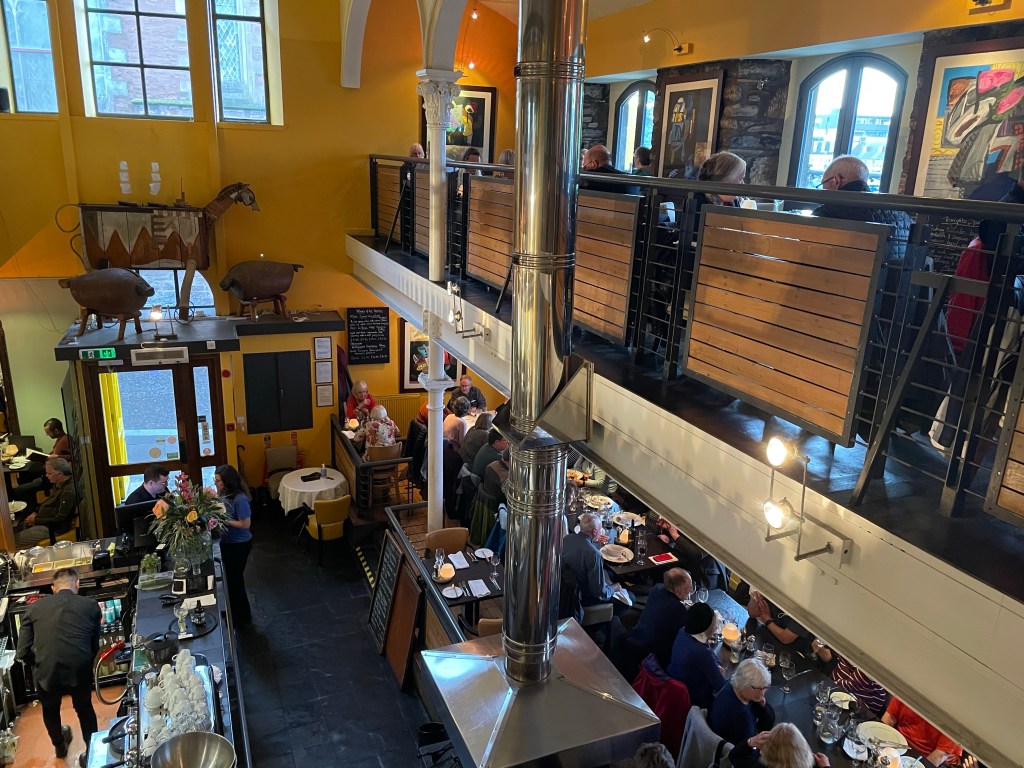
I was excited to have a birthday-eve dinner at Mustard Seed, my favorite Inverness restaurant. Apparently I have my own table there, as they seated me exactly where I enjoyed a lovely meal in 2018. Maybe it’s the designated Mysterious Woman Eating Alone table. It has a nice view of all of the proceedings.

Mustard Seed Cafe, Inverness

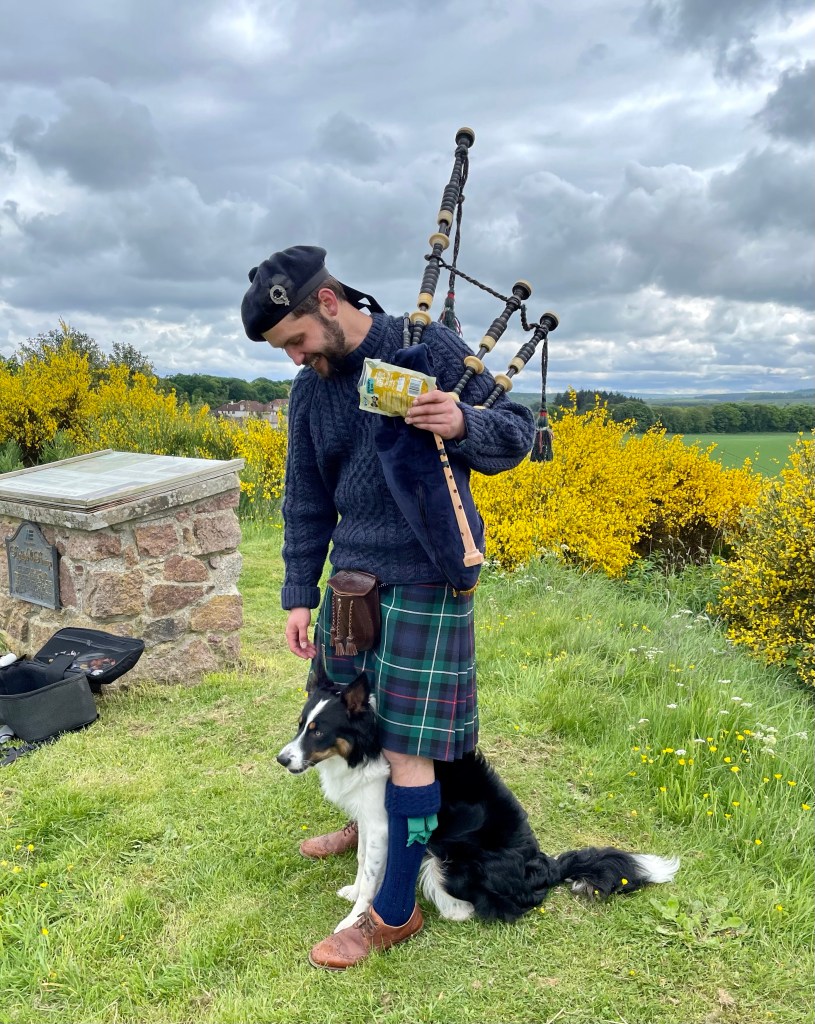
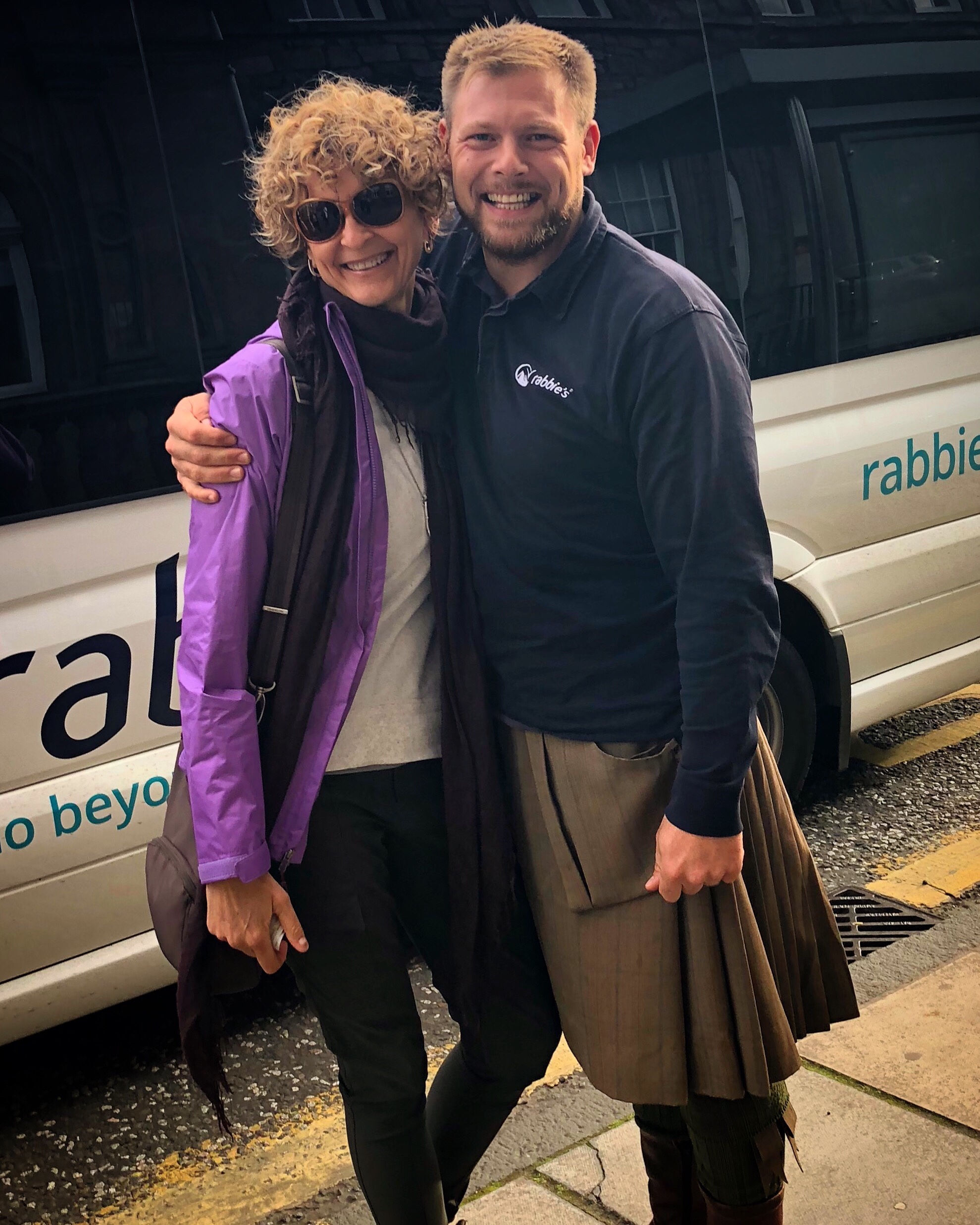
And last but certainly not least, for my last full day in town I booked a tour with one Andrew Grant MacKenzie, who arrived to collect me with a kilt, a border collie named Sonas and bagpipes. Andrew is a legit historian and archaeologist, so he’s basically Indiana Jones. He’s also fluent in Gaelic (pronounced gallic, not gay-lic as it is in Ireland, similar to the whisky/whiskey thing). We had arranged a tour along the Moray Coast, east of Inverness, which Andrew dubbed, “Picts, a Wolf and the Covenanters.”

Andrew and Sonas

Andrew managed Culloden Battlefield for years for the National Trust of Scotland. He actually met with Diana Gabaldon as she was doing research for Outlander. (Segue: I eventually admitted to him that I had partaken of a Rabbies Outlander tour during my last trip which was a super embarrassing thing to disclose to a historian but he didn’t seem to judge.) He said that Culloden staff were the first people in the UK to see Outlander – it was released in the US first and Americans started visiting with particular questions about a fictionalized version of the ‘45 rising which the staff couldn’t answer, not having seen the series. I’m imagining fans asking to be shown the spot where Jamie and Black Jack Randall engaged in fatal hand-to-hand combat. Hopefully not, as both characters are 100% fictional but people are weird. Anyway, STARZ sent over the first two seasons and all employees had to watch it. Of course Diana’s tale is mostly about the love story, not a historically accurate depiction of events sufficient to pass muster with folks who live and breathe Culloden. Still I would have paid a lot of money to watch them watch Outlander.

Andrew also seemed to know everyone in Scotland – he knew the crazy guide we encountered on the aforementioned Outlander tour who had armed his little old lady passengers with plastic swords and reenacted various scenes (see previous blog), he knew the bagpiper Backroads arranged for us during that tour (ditto), he’s talked to the head of Visit Scotland about infrastructure issues related to the North Coast 500, and he has been invited to ceilidhs attended by members of the Peatbog Faeries. He also worked at Cawdor Castle for a while and so of course knew Lady Cawdor.

By now you are getting Andrew’s general awesomeness. And so onto the tour we go. He first drove us to Sueno’s Stone, the largest and most spectacular of the many carved stones that have survived from Scotland’s early medieval period. It stands about 21 feet high and is encased in a giant protective display case. Continuing in the Pictish vein we next traveled to Burghead, a quaint little town located on a spur of the Moray peninsula where a Pictish fort was located. You could see Orkney from the site.

Suenos Stone

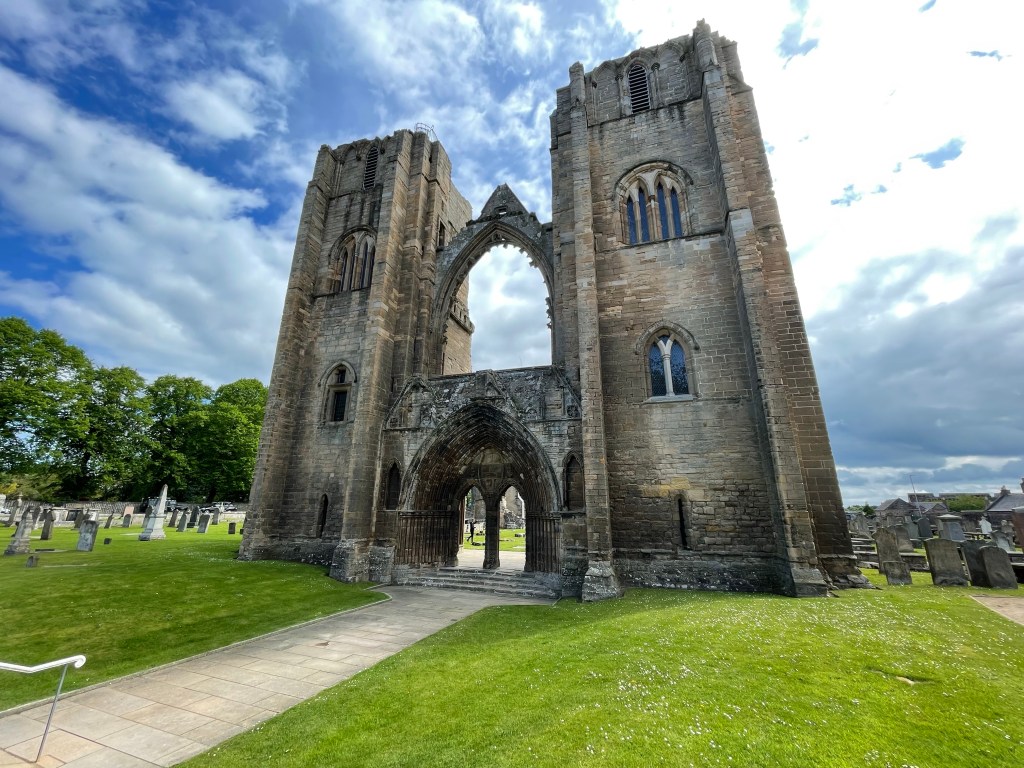
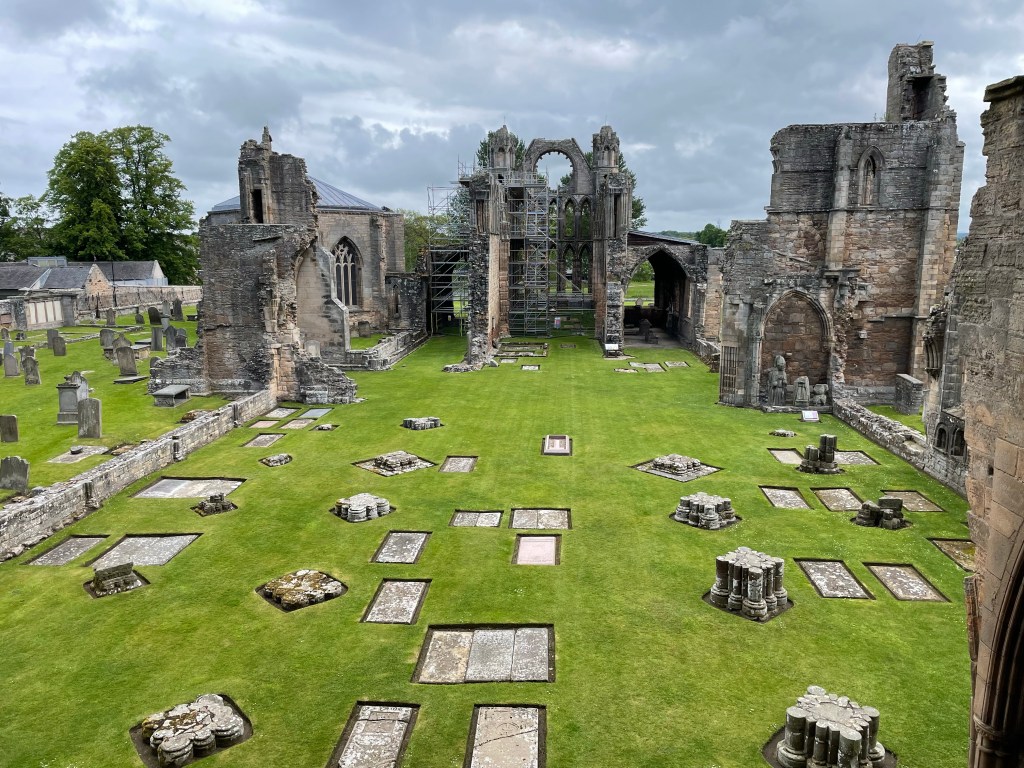
Our next destination was the ruins of Elgin Cathedral, the place that our friend the Wolf of Badenoch (remember him?) burned down. I was picturing a quaint medieval chapel when it was actually more akin to Westminster Abbey.

The cathedral is a massive and gorgeous site. There’s one room with a domed ceiling, glass windows and perfect accoustics, which Andrew demonstrated via the dulcet tones of his singing voice.

After having lunch at Cawdor Castle Cafe, we finished the tour at the Auldearn battlesite. As a historian, Andrew cares a lot about this battle and doesn’t understand why more people don’t visit the site. Perhaps our friend Diana could do something about that although be careful what you wish for. The 1645 battle was fought between a Scottish Covenanter army allied with the English Parliament and the Royalist forces of Charles I. Covenanters were folks who signed the National Covenant in 1638 to confirm their opposition to the interference by the Stuart kings in the affairs of the Presbyterian Church of Scotland. The Stuarts believed all of that divine right of kings stuff and that monarchs were meant by God to be the spiritual heads of the Church of Scotland instead of that other guy Jesus. This was a sticking point even for Scots who supported the Stuarts. Andrew said it was the first time a battle had been fought between Gaels over an idea rather than land and resources.
In the peace and solitude of the ancient battlefield, Andrew liberated his bagpipes from their case and played an evocative and mournful tune about the battle itself. It was achingly lovely and sad. From the sublime to the you-know-what, his encore was a song you might recognize in honor ME GETTING EVEN OLDER.

Best rendition ever.

Over the course of the day we had some great conversations about history – and even delved into politics. Andrew said that most Scots struggle to comprehend what is happening in the States currently with MAGA, the insurrection, guns, individual rights and so on. Yeah same same.

We talked about the horrific 1996 Dunblane massacre, the deadliest mass shooting in British history. Sixteen students and one teacher were killed, with fifteen others injured. Directly afterward, Parliament passed two new firearms acts which outlawed the private ownership of most handguns within the UK, together with a buyback program. Thousands of weapons were incinerated. As we know, there have been no further mass shootings with a handgun in the UK since, even though we are told by NRA experts that guns don’t cause these horrific things. UK residents can still own hunting rifles, of course, but they are registered and owners must keep track of their shots. The guns are inspected every year to make sure the owners’ reported number of shots match the number of times the gun was actually fired. Can you imagine the cascading exploding heads in the States if something that restrictive were enacted? I guess in some countries the bother and inconvenience is worth not having people and children regularly mowed down by military-grade weapons. Imagine.

Andrew also talked about a few Gaelic concepts that inform his life and business. The words are about the sense of belonging to a place and to a people. There is no English translation. They resonated with some of the things I’d been thinking about and experiencing on this trip around why I feel so in sync with the hills of Scotland while lately feeling less connected to my home in Oregon.

Dùthchas is the connection to one’s ancestors, their lives, stories, the ground they lived on and one’s physical and emotional connection to that ground. I think ancestors can mean either a spiritual or blood lineage. Cianalas is the longing for dùthchas when you aren’t there. It’s a mournful longing but it’s not sad. Caim is the belief that wherever you are and whatever your current situation you can gain strength from encircling yourself in that longing and that connection to your dùthchas. Sonas is the sense of completeness and comfort you feel when you drop into dùthchas, cianalas and caim. These concepts echo throughout yogic/eastern spiritual traditions as well. My yoga teacher talks about his own spiritual lineage in the same way. I can’t explain why, but I feel and experience the truth of it.
Sonas.

If you find yourself in Scotland, consider Andrew and Sonas as guides. You can find more information about them at http://www.highlandhistorian.com.

I capped off this perfect day with a birthday dinner at Rocpool. After dinner I ordered an affogato because it’s unquestionably the perfect dessert. It arrived with a road flare in celebration of ME GETTING EVEN OLDER.

By all means let’s celebrate this fracking thing.

And now for the journey home. Let’s dispense with COVID. For the first time since the pandemic started, I let down my guard during this trip and didn’t don a mask the entire time I was in Scotland, throwing caution to the winds as it were. With bated breath, I took the test with the tele-health person monitoring. Negative. Never been happier to see a single red stripe.

And now for my dicey short layover in Schipol. I had an hour between my Inverness flight landing at Schipol and my flight to Salt Lake taking off. Not boarding, mind you. Flying away. As we sat on the runway in Inverness, I was feeling all the appreciation for how quickly Europeans get their asses settled onto airplanes. Everything was proceeding apace until, of all things, they couldn’t get a cargo door to latch properly. As time ticked by, inexorably shortening my layover like slow drips from the faucet of doom, I was about to volunteer to sit in the hold during the flight so I could keep the door closed with my body. Then, behold, the pilot took matters into his own hands and asked for the ladder to be brought back to the airplane so he could descend to the tarmac and “take a look.” He emerged from the cockpit, a burly central casting Viking with red hair, marched down the steps and totally took care of it. I need someone like that around me at all times.

So we arrived in Amsterdam a half an hour before my next flight. I was surprised to hear as we landed that only one connection was blown, a flight to Boston. I was instructed to “go right to the gate” for my Salt Lake flight. YES BY HELL I CAN DO THAT. The airplane landed in the “curtain” area of Schipol which is basically New Jersey, with a stinky bus that takes you to the terminal. I hit the ground running and arrived at the empty gate panting in a most unladylike manner and entirely disheveled and having to pee but I had apparently made it in time.

Ah but not so fast. The gate agent looked at my flight information in the system and reacted with a puzzled expression. She showed it to all of her gate agent friends and they were also visibly taken aback, shrugging their shoulders and saying things to one another in Dutch. What what what? I found out later that KLM, in its infinite wisdom, had decided that since my flight was delayed I ergo missed my connection and so they had rebooked me on the same flight the following day. Before my feet had even hit the tarmac. Like declaring someone dead when their heart is still beating.

So the lead gate agent (I presume) was summoned and he started calmly typing into his computer and talking on the phone. In Dutch. I still had zero idea what was happening. He finally looked at me and said, “Don’t worry, that plane is not going anywhere.” OK phew. Bless you sir.

Relaxing, it was then that I fully noticed the short t-shirted paunchy drunk dude standing several feet away and surrounded by no less than four tall, fit and woah quite handsome security agents. I gleaned that the drunk dude had been tossed from the plane due to stupid drunken behavior and it wasn’t the first time. And sad to say he was an American. Well of course he was.

He was doing that thing hammered people do, which is moving and gesturing very slowly while intoning super dumb things in an exaggerated rational-sounding tone. He of course had had two beers. From my years of lawyering, this exact quantity of alcohol is noted in every accident report. It’s a phenomenon really, that every single person who has ever caused a motor vehicle accident tells the cops that they have imbibed exactly two beers. Someone should do a study.

Anyway the dude was carefully explaining that he knew his own limits, that he was fine, that he hadn’t done anything wrong, that he would miss his daughter’s birthday party, and that he had had ONLY TWO BEERS. He also periodically dramatically extended his arm straight out in front of him and scolded the various security guys for not social distancing. For their part, the security guys appeared to be employing de-escalation techniques while at the same time trading spectacular insults with drunk dude. I literally think someone’s mother was mentioned at one point. The dude once tried to “get in line” behind me and I almost bodily moved the tallest and most woah handsome security guard so that he was more solidly between me and the dude.

Of course the dude was filming the whole interaction with his phone because obviously he’s going to file a complaint, so I might become famous as a background extra on social media.

Meanwhile the formerly calm senior gate agent finally exploded and yelled at the top of his voice, gesturing dramatically, spittle flying everywhere, for security to move the dude away because the whole drama was distracting him from getting me on the freaking plane. There was a spectacular amount of swearing. I was with him on this, and actually hoping the dude would be thrown into a Schipol holding cell where his fingernails would be slowly pulled out one by one. Do they have those? Do they do that? Hard to tell with those stoic Nederlanders.

Finally the dim light dawned and the dude managed to accurately assess the situation. He simply was not going to prevail either by his wits or physical prowess and so he wandered off down a moving walkway, throwing muddled parting threats over his shoulder. I said to my gate agent, “Americans are the worst.” He agreed so enthusiastically that I felt the need to add, as I hadn’t yet been given my boarding pass, “not me though.”

Anyway, once I triumphantly boarded the plane at last, the senior gate agent suddenly appeared onboard and high-fived me, saying none of it was my fault and asking whether I was happy. Don’t worry, why would I file a complaint about what ended up being a funny story I could share with you guys – and besides I AM ON THE PLANE.

Also, the thing is, the drunk guy was the reason the flight was delayed long enough for me to make it. They had to excavate and remove his bag. So, and I mean this from the bottom of my heart, thank you my dude. And I hope you find the help you need, for your daughter’s sake.

So after that wee bit of drama, I made it home with no further incident except my checked bag decided to remain in Amsterdam for a few extra days to see the sights. And except for the fact that I am no longer in Scotland, all is well. Best thing is getting to see this face.

I so enjoyed writing about my long-postponed trip and sharing it with you. Thanks for reading. I hope it inspires you to travel to Scotland or anywhere you feel dùthchas. Just don’t be a tourist.

And gird your loins, my friends, because I’m headed back to the UK in September.

Til we meet again.
Sláinte

Outlander and Whisky

I’m about 80% English/Scotch/Irish. If I were a paint color, I’d be Bland White. Long before I knew exactly how white (thank you Ancestry.com), I’ve been interested in British history. Used to be able to recite all the Kings and Queens of England. So Scotland was firmly on my travel list, but I admit it was the cinematography in Outlander, shot in Scotland, that put me over the edge. And maybe the kilts.

So what better way to spend my first full day in Scotland than booking an Outlander Tour like a geeky tourist? The tour included historic castles, forts and villages used as film locations for Outlander, Monty Python & the Holy Grail, and Game of Thrones. And then, as a topper, finishing the day with a whisky tasting at a bar named Edinburgh’s 2018 Whisky Bar of the Year.

I booked the journey through Rabbie’s, a company specializing in smaller tours using wee buses. I expected to be joined by a bunch of middle-aged women who talked about Jamie Fraser (a.k.a.the main character in the show who is widely believed to be the perfect man) the entire time. Instead, several couples, including one on their honeymoon, and one big family, the McGowans, all piled into the bus together. They were from Florida, Philly, South Carolina, France, England and Australia. I sat behind the guide and was joined by the head of the McGowan clan. The McGowan himself. Who was very quiet (his wife made up for it from the back of the bus) and went to great pains to avoid any physical contact, which I appreciated.

Of course, I instantly fell in love with our Scottish tour guide, Nicky. He just happened to be tall with reddish hair, very articulate, thoughtful and hilarious. Wearing a kilt that wasn’t a costume.

The first place we visited was Three Bridges, a town with, you guessed it, including a bridge that was built in the 17th Century. A marvel of engineering. The place has no connection with Outlander, just a cool spot.

Jamie Nicky took my photo in front of the old bridge.

Then we journeyed to the most “all the feels” of Outlander settings, Lallybroch, the Fraser ancestral home. Otherwise known as Midhope Castle, still standing but entirely in ruins on the inside. The steps up to the door were built by the film crew. A beautiful and evocative place marooned out of time on a working farm. Surprisingly, there is a picturesque cottage right next to the Midhope ruins. Not next door, but right there on the edge of the lawn. Architectural Digest – Medieval beautiful. The owners were the luckiest people alive to own this gorgeous cottage in such a setting. Ach, no more, thanks to the fickle finger of fate. Their idyllic spot has been besmirched by Outlander and the tourists who followed in its wake.

Speaking of tourists, it soon became apparent that there were different sorts of Outlander tours. As we were leaving “Lallybroch,” another, larger group came down the path toward us, led by a guy in an over-the-top Highlander costume. He held a plastic shield and brandished a fake broadsword. He was a scenery-chewing Pirates of the Caribbean Johnny Depp version of an 18th century Jacobite. Johnny Depp Jamie had obviously dispensed plastic weaponry to everyone on his tour for them to, I guess, ineffectually arm themselves as they visited ruins. Two adorable little old ladies walked side by side, one brandishing two plastic axes, the other holding two pistols. I would have died had I booked this tour. Johnny Depp Jamie immediately challenged Jamie Nicky with his sword. Jamie Nicky, sensing danger, extended an arm in front of me to protect my life and virtue. I grabbed his arm with both hands and crouched down, because I’m not about to be left behind in a sudden acting opportunity. His arm was strong and thick and suddenly I had a new appreciation for the antics of Johnny Depp Jamie.

Our next stop was Blackness castle, a 15th century fort built on the south shore of the Firth of Forth. It protected Linlithgow, one of the main palaces of Scottish Royalty, especially the Stuarts. Because of its site, jutting into the Forth, and its long narrow shape, it has been dubbed the “ship that never sailed.” It was used to portray Ft. William in the series, including the scenes of Jamie being flogged nearly to death by Jack Randall (I know people who haven’t seen the show are wondering why on earth), and later the daring rescue of Claire by Jamie, Murtagh, Angus and Rupert with Jamie scaling the tower clutching an empty pistol. Speaking of which, I came upon Johnny Depp Jamie again just as he was reenacting the scene of Jamie clubbing a redcoat over the head after asking where Claire was being held. JDJ brushed people out of the way so he could rush up some steps in search of Claire.

All swashbuckling aside, Blackness Castle is a gorgeous structure in a beautiful setting with a nicely preserved Great Hall.

Next stop was the 100% charming town of Culross, where the scenes in Cranesmuir, the village near Castle Leoch, were filmed, including Geilis Duncan’s house, Claire’s herb garden, and the scene where the wee boy got his ear nailed to the pillory for stealing. The town has barely changed since the 17th century and is managed by the National Trust. I had the second best sandwich I’ve ever had there, in a charming little place called the Biscuit Cafe. I mistakenly took a table next to the loo. We all know this, but people truly have issues about bathrooms. One lady in her sixties ducked in and her friend had to stand in front of the door like in high school, holding it slightly ajar, explaining to the gentleman who was next in line, “She’s afraid of getting shut in.” Aren’t we all.

Next was the granddaddy of all film locations – Doune Castle, a medieval stronghold in the Stirling district of central Scotland. The most famous taunting scene in cinema was filmed here.
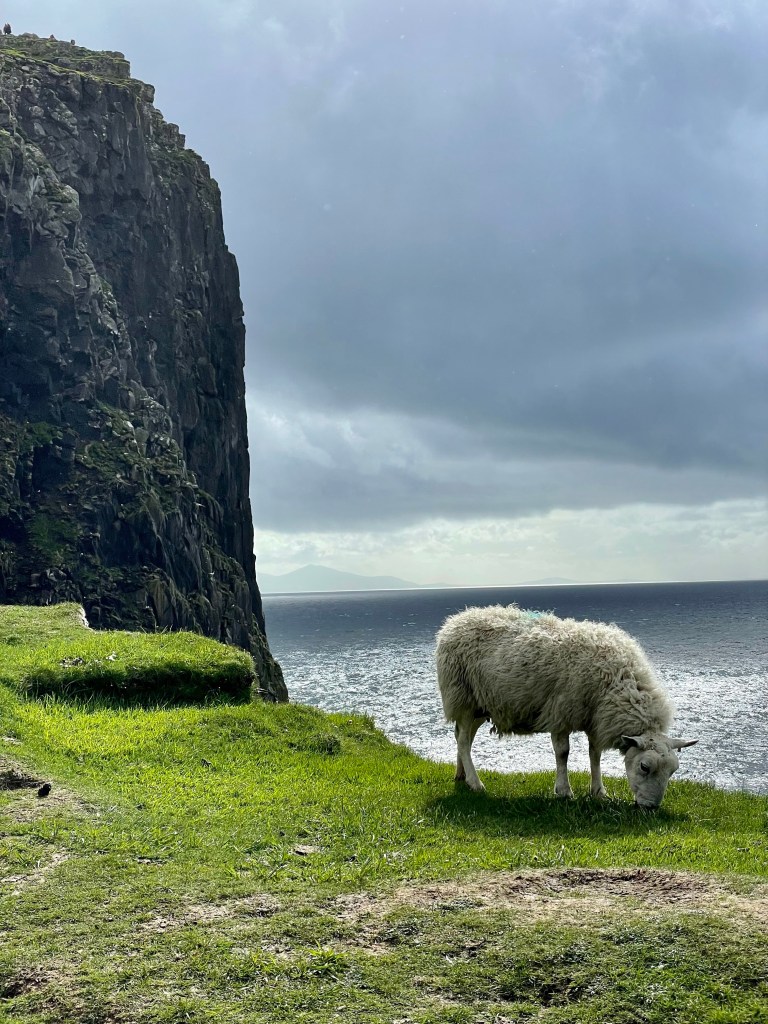
Starring our beloved John Cleese as the pitch-perfect French taunter, with many memorable lines, including that old chestnut, “Your mother was a hamster and your father smelt of elderberries!” Apparently the Pythons had booked several castles in Scotland for filming until someone wondered who they were and whether they could even pay, withdrawing permission from all except Doune. So basically the entire film was shot here.

Also the most famous scene ever filmed depicting a guy shoving a boy out of a window because the boy caught him having sex with his sister. I know this scene is basically in every film, but this is truly the best version. Unfortunately, in Game of Thrones, the boy did not die and instead became the Three-Eyed Raven, which, we don’t know, but may result in the ultimate downfall of said guy in the long slow dance of karma.

In season 1 of Game of Thrones, Doune Castle was Winterfell. In season 2 they moved production to Ireland because it was cheaper.

Doune bounced right back, and became the home of the McKenzie clan in Outlander, Castle Leoch. It’s now the third most visited castle in Scotland, after Edinburgh Castle and Stirling Castle. The audio tour is narrated by Python’s Terry Jones, and by, of course, Sam Heughan, who plays Jamie. Inside the house is a fabulous Great Hall and a wonderfully preserved kitchen, including a giant fireplace large enough to roast an oxen. Many silly Python scenes were filmed inside, including the song-and-dance number “Knights of the Round Table,”and the Sir Galahad the Chaste’s seduction scene. I completely recognized them all.

The last stop on our tour was Linlithgow Palace, where Mary Queen of Scots was born and lived for seven months, after which she was whisked away to Stirling, a more secure location. She was in danger the moment she was born, and for most of her life. It was another 20 years before she returned. A lot of Stuart history here. There’s a beautiful and drafty portico on the roof where legend has it Queen Margaret waited in vain for the return of James IV from Flodden Field. Bonnie Prince Charlie was the last Stuart to stay at Linlithgow. In 1746 the castle burned because the British duke of Cumberland’s troops failed to properly extinguish their campfires.

Gorgeous spot (Scots had great taste in castle sites), with a statue of Mary Queen of Scots on the grounds. In the UK you are allowed to scramble all over ruins, climbing up tiny staircases with flimsy railings that wouldn’t be allowed in the US. No posted warning signs, nothing roped off, I guess because you’re supposed to use common sense. The higher you go, the more pigeon poo there is, since all is exposed to the skies. Many ruined castles around Scotland don’t have roofs, not even if they’ve undergone restoration. Why? Because buildings with roofs are taxed.

In Outlander, the tunnels and cells underground were used for Wentworth Prison, where extremely terrifying things happened to Jamie.

It was a fabulous tour, largely because of the fabulous Nicky. He told us the entire history of the Jacobite rebellions. There were five between 1688 and 1745, all with the goal of returning one of the Jameses to the throne of Scotland and England and all failures, finally resulting in the Highland clearances. Nicky told the story with passion and emotion. History is still very much alive for Scots. As Robert Louis Stevenson wrote, “For that is the mark of the Scots of all classes: that he stands in an attitude towards the past unthinkable to Englishmen, and remembers and cherishes the memory of his forebears, good and bad; and there burns alive in him a sense of identity with the dead even to the twentieth generation.” Nicky also reflected on the current political situation in the UK and elsewhere (ahem), resolving to focus his efforts on things he could positively impact, like, for example, people’s lives. He also taught me a new word, “scuppered,” which originally meant to deliberately sink a ship, and has come to mean thwart. So many uses. Anyway, I adored him.

How to end such a day? By booking a very expensive whisky tasting at Usquabae, meaning water of life (Gaelic translation of Medieval Latin aqua vitae.) Sitting at the bar, I was regaled with tales of whisky and its historic impact on the Scottish economy and history. A couple of local boys chimed in, asking questions and giving their own opinions. It’s a very complex subject near and dear to the heart of Scots. I chose a tasting called “The Decades.” It included a whisky from the 60’s, 70’s, 80’s, and 90’s, which covers my entire life. The older whiskies were good, but as the bartender noted (he had tastes of all my drams to keep me company), they do get a bit “vegetal.”

One last observation about Scottish men. They look you right in the eye, steadily, when you’re talking to them. They don’t hang back, either, they are snuggled right into your personal American space. I love it.

Inverness, Jacobites and Culloden

Bidding farewell to Edinburgh, it was time to catch a train to Inverness, known as the gateway to the Highlands.

Arrived around supper-time and checked into the Castle View Hotel, run by the lovely Eleanor and her Jack Russell, Mia. The hotel is on the River Ness and pretty much everywhere was walkable. My room was on the top floor, with no lift. (PS same deal at the Inn on the Mile, just not a thing here).

The hotel boasted a lovely view of Inverness Castle, which houses the local courthouse and other offices. There are plans to build a new facility for the Courts so the castle can be opened to visitors. Fabulous rooftop views from my room, and gazing over the River Ness at the castle while enjoying a full and fabulous breakfast was perfection.

My first morning I walked about eight miles of the famed Great Glen Way, a lovely stroll along the River Ness to the park-like Ness Islands and then up the Caledonian Canal. The Way is a walking path that runs 78 miles, bisecting Scotland from Inverness to Ft. William. People in Scotland walk. And walk and walk. Trails go on for miles, and are so scenic you could die.

All the walking gives one time to ponder many things. For example, you know all the rules we have in the States, to protect us from one another’s presumed and inevitable bad behavior? In Europe, there are fewer rules, and amazingly, unregulated people actually rise to the occasion given the chance. For example, only a few dogs were on leash during my walk. Rather than being a catastrophe with dogs running wild and eating babies, every dog was on voice command. Dogs didn’t interact with other humans or with one another because they were looking at their owners. When they did have a bit of a run, the instant their owners whistled, they hit the brakes and ran back. Maybe Americans are boorish uncivilized barbarians and can’t be trusted to behave properly. We will never know.

I then walked around Inverness, which unfortunately is pretty closed on Sunday because of God. This is too bad, mostly because there’s an amazing bookstore called Leakeys, located in a former church with floor to ceiling bookshelves and a wood stove. Next time. Visited the Old High Church, where Jacobites who survived the slaughter of Culloden were held before being executed in the churchyard. Because of God.

Next day I met George, a local guide, for a tour around the area. He arrived with coffee and croissants, so I liked him immediately. As we were emailing back and forth about logistics prior to my trip, I expressed a bit of ambivalence about visiting Loch Ness and Urquhart Castle because of all the tourists. George convinced me that it would be a shame if we didn’t at least do a drive-by before it opened. Even so, there were still a few tour buses, filled with loads of people who appeared to be checking sites off their lists, snapping photos and moving on, rather than really engaging, not that I’m being judgmental. The castle has 1,000 years of history under its belt. It’s the largest medieval castle in Scotland and the most important in the Highlands. Sadly, its owners blew it up in 1692 to keep the Jacobites from taking it. There’s a very cool old catapult on the grounds. Loch Ness is beautiful but so are many of the other 31,000-plus lochs in Scotland. No I’m serious. Scotland is a very watery land.
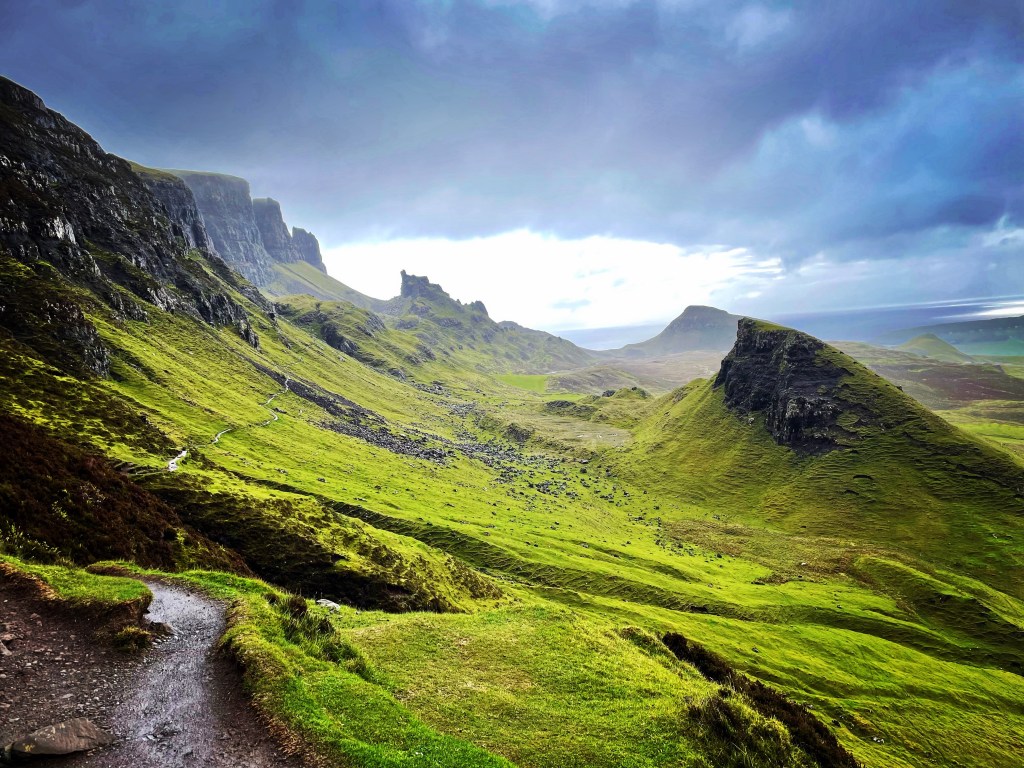
Like many visitors to Scotland, I was hoping to run across some Heilan coos, a.k.a Highland cattle. And they do not disappoint. Scotland’s animal population is full of extra-adorable creatures who seem to have been sprinkled with faerie dust. The hairy Coos originated in the Highlands and Outer Hebrides and were first mentioned in the 6th century AD. They are primarily bred for their meat, which is very lean, as they are largely insulated by their shaggy hair rather than by subcutaneous fat. Scotland does not appear to have industrialized its meat supply, so the coos have a pretty nice life until the end, grazing on the plentiful green grass and rounded bales of hay. Also posing for pictures.

Continuing my morning whisky tradition, we drove to Tomatin Distillery for a 10:00 a.m. tour and tasting. It was fascinating learning more about the making of Scotland’s national drink. Very complicated, time-consuming, lengthy and totally worth it. By law, Scottish whiskey must be made from water from Scotland and aged in oak barrels for at least three years. Of course, most whisky is aged much longer. There are lots of superstitions, for example, when the copper pot stills need to be replaced, if the old one is dented, the replacement must have a dent in exactly the same spot.

Tomatin has an old mash tun that you can climb inside. I was touring with a fellow from Germany who was very stoic about life and had no interest in getting his picture taken squatting inside a large tub. So what the heck is it? Ground down malted barley is fed into the mash tun with heated water. The temperature is high enough to dissolve many of the sugars in the grist but low enough to allow the enzymes to continue doing their thing. The liquid is collected and taken away to become whisky. The solid left over residue is given to local farmers for feed.

Since we did a fair bit of driving on this tour, a word about road signs. Of course, they are better than ours. They are gentler with more humor. Some examples: Instead of “travel time,” it’s “journey time.” Instead of detour, it’s diversion, which sounds way less annoying. Instead of “yield,” it’s “give way.” Instead of passing lane, it’s overtaking lane. We drove over several “weak bridges,” which means simply that it’s a one-way bridge. So drivers have to give way. But my favorite is this one.

Our next stop was the Highland Folk Museum, Britain’s first open air museum. The museum gives a flavor of how Highland people lived and worked from the 1700’s through the 1950’s. Over 30 historical buildings are on the property, all furnished with items appropriate to their time period. Some have been built from scratch and some have been moved from other sites. It was fascinating looking inside these dwellings from throughout Scottish history, but my favorite was seeing an actual peat fire. It smells lovely, and it generates heat like you wouldn’t believe.

Also, there were Shetland ponies.

We next drove by Coffin Bridge, the oldest surviving packhorse bridge in the Highlands. It was built in 1717. Before the 18th century it was impossible to carry the deceased from the town of Carrbridge to the local cemetery when the river was high. So this bridge was constructed by one of the earliest Scottish members of Parliament, Alexander Grant of Grant.

George and I enjoyed a yummy lunch in a semi-fancy pub and now for another observation about rules and dogs. In Scotland, people can bring their dogs into restaurants. Not just little dogs. During lunch we were surrounded by a yellow lab, a sheep dog and a standard schnauzer. All perfectly well-behaved. Amazingly, I did not feel my health was in danger.

Next we were off to Cawdor Castle, currently owned by the Dowager Countess Cawdor, a woman in her 70’s who retires to another home on her estate during the summer months so she can charge tourists ten pounds each to enter. It’s fun to see a castle that is not in ruins and has never been attacked by Jacobites or redcoats, just a beautiful lived-in place with amazing gardens. Its other claim to fame is that Shakespeare refers to Macbeth as being the Thane of Cawdor in the Scottish play. However, the castle was built many years after the life of 11th century King Macbeth, so never mind. George told me he’s heard staff complain about the Dowager Countess and how difficult she is to work for, but I’m inclined to give her the benefit of the doubt because she installed a “be mindful” sign over the entryway.
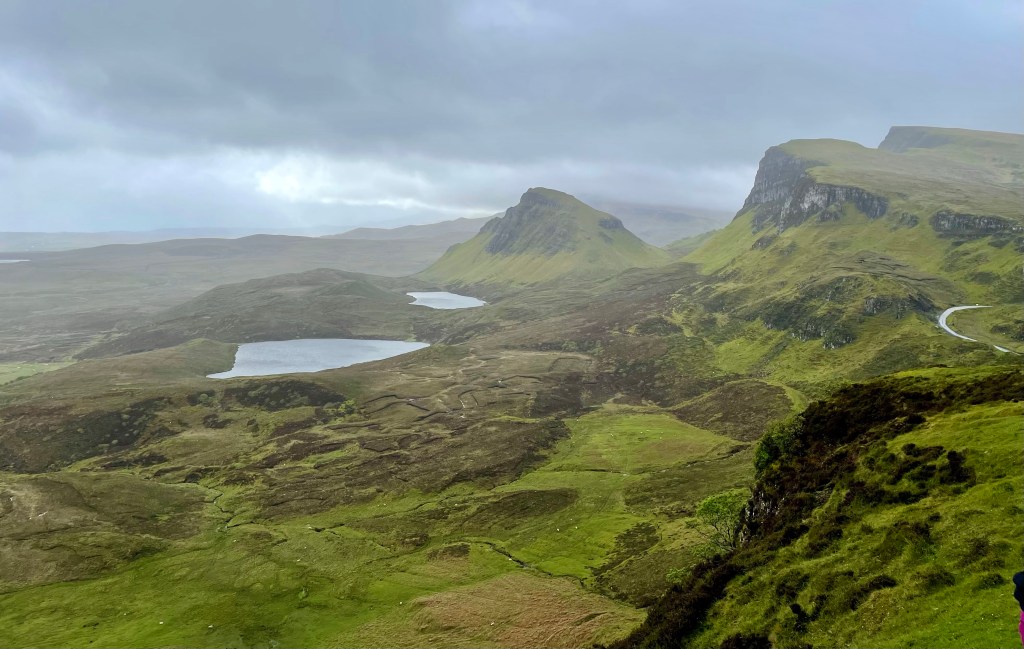
Finally, we headed to Culloden Moor to visit the memorial to those who perished in the devastating battle that raged there. The Jacobite army was devastated, and their defeat marked the beginning of the end of Highland culture in the 1700’s. The Jacobite Forces (supporters of installing Charles Edward Stuart, aka Bonnie Prince Charlie, to the thrones of Scotland and England) were handily defeated by the Hanoverian English in under an hour. This was the last of five Jacobite rebellions that occurred in 17th and 18th century Scotland. It was a bloody battle. The Scots lost between 1,500 and 2,000 men and the English only lost 50. This after the Bonnie Prince’s forces had swept through Scotland and almost made it to London. At this point, though, a decision was made to retreat back to Inverness, even though Charles II had his bags packed and was ready to head into exile. One of those many moments in history easy to second-guess.
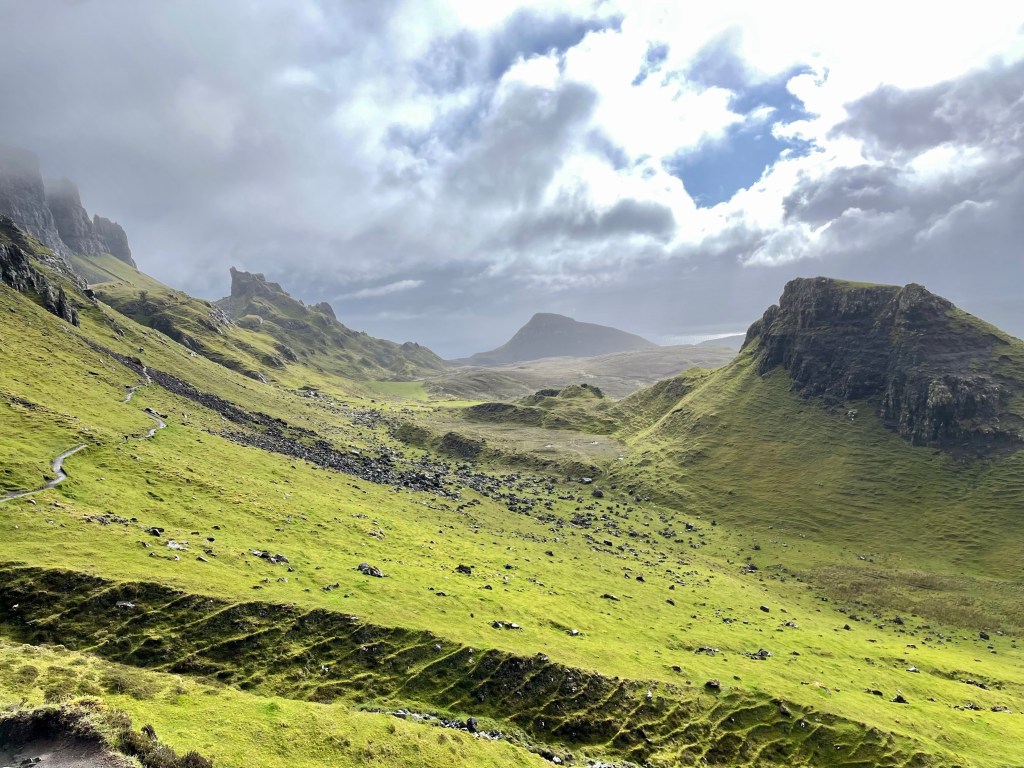
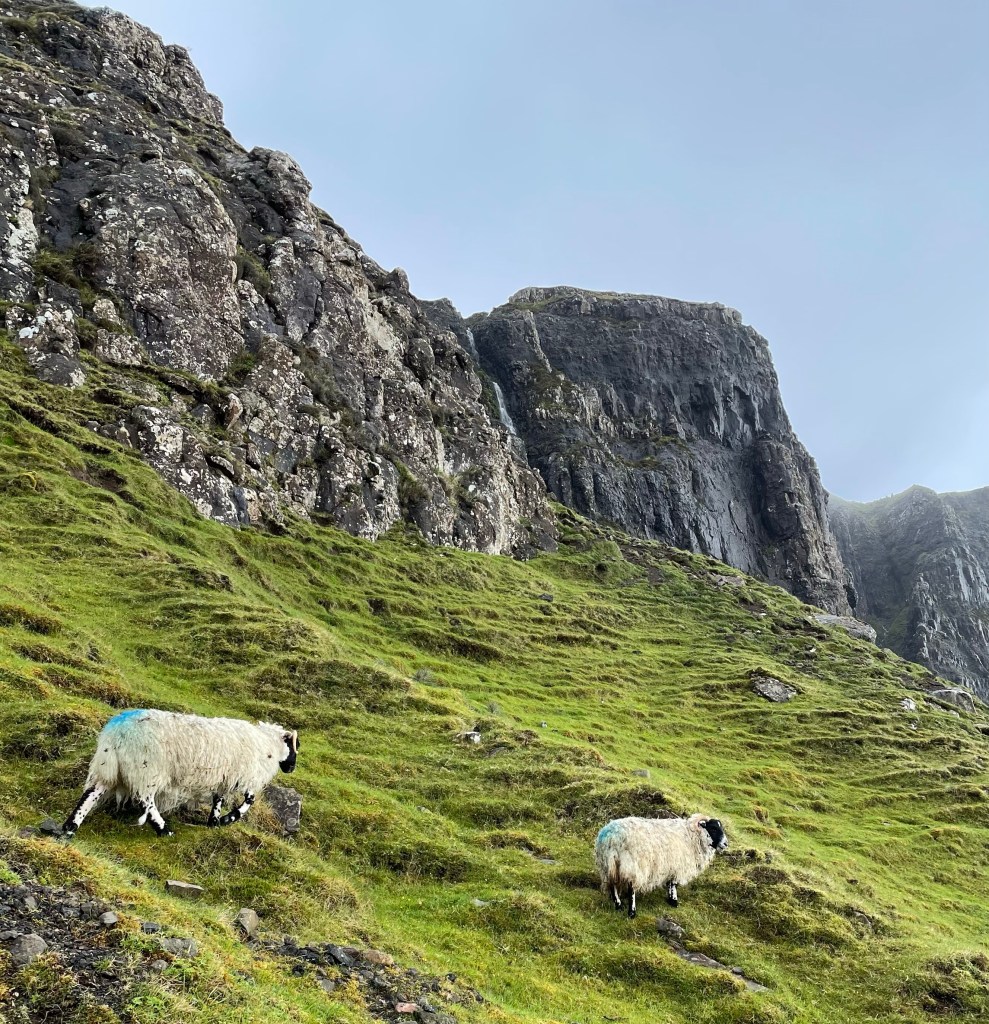
Over the years after the battle the Brits decided to deal with the Highlanders once and for all. The infamous Highland clearances were implemented, where Scottish crofters were cleared from their lands to make room for more lucrative sheep farming. Laws were passed preventing all Scots from owning weapons, wearing the plaid of their clans, speaking Gaelic, effectively wiping out the Highland culture. Many, many of them emigrated to the United States. It was essentially ethnic cleansing – George told me that there were discussions in Parliament about requiring the mandatory sterilization of Highland women.

It is a somber place. Victorians installed a memorial, along with stones representing all the clans which were set about over the spot of mass graves. Thanks to the massive appeal of Outlander, the earth around the Fraser clan’s marker is denuded of grass, with little stones and flowers strewn over it. You’ll see my own disrespectful and inappropriate photograph below. The battlefield is very simple – a line of blue flags marking the spot where the Scots lined up, and a line of red flags marking the position of the British. It’s worth noting that the Bonnie Prince and the Duke of Cumberland, the commander of the British forces, were both just 25 years old. These days they would still be in college or back living with their parents while they found themselves. Hard to imagine.

We ended the day at the 4,000 year old Clava Cairns just down the road. A clava cairn is a type of Bronze Age circular chamber made of stones. They are typically surrounded by standing stones, and their history is very murky. This area was the inspiration for Diana Galbadon’s books. So again, me with the dumb Outlander photo. (PS the stones don’t work at all). George said that local witches, wiccans and druids still gather here for dances and mystical ceremonies. A couple of local Scottish women talked to us for a while, and they were dead serious about the magic of the place. The veil between Druid magic and faeries of old and the 21st century is very thin in Scotland.

George dropped me at my hotel after 7:00 and I had a quick dinner and stopped in a local pub for literally 5 minutes to check out the nightly traditional Scottish folk music. It was pouring down rain and honestly George had slightly exhausted me with all the facts and history, as much as I loved it.

Next day, I was onto my Backroads hiking tour of the Highlands!

Backroads Days 3 and 4: Over the Sea to Skye

Day three dawned a wee bit rainy, and our planned hike was officially scuppered due to wind, flooding and danger of being blown off a cliff into the sea.  Very disappointed, as we were heading to the famed Coulags.  Next trip.

Jenny, Eileen and Keith had another hike in their back pockets, followed by lunch in a little village.  Then we would head to the Isle of Skye. Jenny sketched out the day on a chalkboard.

The hike was completely beautiful.  Our love of sheep officially began on this day.  Adorable Scottish sheep were everywhere.  Scotland doesn’t seem to have industrialized its meat production.  Unsupervised sheep, cows and chickens are wandering around all over the place completely left to their own devices.   Sheep are marked with a splash of color which identifies to whom they belong.  Otherwise, they are free to wander, eat grass, and perch picturesquely on the edges of cliffs, gazing out at the ocean.

I kept asking people if the cows and sheep were used for milk and cheese and the people kept raising an eyebrow and shaking their heads. Make no mistake, we are talking about meat here. But at least until their day of doom, Scottish livestock have the world’s most fabulous life.

A few pictures of our hike follow, but sadly the most exciting bit went unphotographed. Just after passing someone’s lovely farmhouse (they have a black dog named Merlin who enthusiastically greets ramblers), we needed to haul ourselves up a tall boulder cropping.  And to help, there was a rusted chain that had been set into the boulders.   Completely awesome. I felt like Tom Cruise in Mission:  Impossible as I pulled myself up the outcropping, hand over hand.  Which I shared with Keith after triumphantly reaching the top. In response, he cocked his head and asked, “you felt like a Scientologist?”

We returned to the little town where we began, and walked to our lunch place, a fabulous little pizza spot on a loch. Keith removed a giant chalkboard from a wall and presented it to the table.  He asked the server permission first, and interpreted a disapproving pause as assent.  Note to self:  adopt this strategy immediately.

As we left the restaurant, we were greeted with a magical rainbow over the loch. While we pretty much had daily rainbows, this one was the most rainbowish one of all.

We set off in the vans for a bit, finally driving over a lovely bridge to the Isle of Skye. It has been hit pretty hard by tourism over recent years, but Backroads always finds more solitary spots. We stayed at the Duisdale Hotel, on the edge of the water with beautiful views.

07E2BCE6-BBD2-4F68-AFCD-22CE10F036EF

On tap for the evening was a musical performance by a local bagpiper and accordionist who teach music at the Gaelic College on Skye, called Sabhal Mòr Ostaig. The college is dedicated to providing education for Gaelic speakers with the goal of widening access to the Gaelic language and culture.

Bagpipe music used to make me cringe and then run out of the room. Maybe one of the things that happens after menopause is that suddenly bagpipes become majestic instruments that make you shiver and then cry.

In the middle of the show, our bagpiper challenged us to a bit of Scottish dancing in the parking lot, and so out we went. A documentary of our dance lesson experience is currently being edited for Netflix. The reviews will say, “Stunningly talented Americans and two Canadians change the face of traditional Scottish dance forever.”

The next day dawned slightly brighter with strange blue areas in the sky. Now old hands at divining Scottish weather, we thumbed our noses at the blue and donned our rain pants. Today we met Sarah, a Scotland ranger, who would accompany us on our hike and tell us about birds, plants and the Highland Clearances. Our trail started at a ruined church (see below) and took us past some old granite mines where we came across a lovely woman out for a walk with her border collie. We then dipped down to a large and desolate ruin of a village that was abandoned as a result of the clearances.

The Highland clearances are an infamous chapter in Scottish history. They were the forced eviction of inhabitants of the Highlands and western Islands, and basically cleared the land of people to allow for the introduction of sheep. For hundreds of years prior to the clearances, the Highlands followed the clan system. The clan was ruled by one family, and others lived together in agricultural townships that functioned like collectives. The land was controlled by the chief but leased by tenant farmers. Very feudal. All the men who worked on the land also owed allegiance and their military service to the clan chief. The clearances, which took place over a century, resulted in the destruction of the traditional clan society and began a pattern of rural depopulation and mass emigration from Scotland to the Americas and elsewhere.

So why? After the Battle of Culloden, the British government (aka evil redcoats) passed repressive legislation designed to compromise the power of the clan chief and Gaelic culture. The 1746 Act of Proscription required all swords to be surrendered, prohibited the wearing of clan tartans, forbade the speaking of Gaelic and the playing of bagpipes (because they were deemed instruments of war). Another act removed the sovereign power which the chiefs held over their clans. The clearances began thereafter, waxing and waning through the collapse of wartime industries after the Napoleonic Wars, a rise in population, famine, and a decline in the economy. Landlords were deeply in debt and were looking for more lucrative uses for their land. Replacement of the old style of peasant farming with well-capitalized sheep farmers allowed the charging of higher rents and required much less manpower.

Nobody knows for sure, but possibly up to 150,000 Scots emigrated during the clearances, and the effect still resonates today. In 1755 it is estimated that 51% of Scotland’s population lived in the Highlands, but by 1981 only 21% were.

Here are some photos of just one such village left in ruins.

Stop it with the history!! Please may we talk about peat instead. Scotland is covered with peat bogs, and over history Scots have used peat to heat homes, make whisky and so much more. Peat bogs have very low rates of decay and can even preserve food (up to 2,000 year old containers of butter have been found) and dead bodies (watch the BBC’s Shetland on Netflix because Douglas Henshall is gorg – I mean a great actor). Peat’s official name is sphagnum moss. I can go on and on, but since you have already been subjected to background info you can look up yourselves on the internet, suffice it to say that it can hold an amazing amount of water. Sarah stood knee-deep in heather and gave us a very interesting peat talk. She was holding in her hand a tiny bit of sphagnum moss. I mean tiny. When she squeezed it, enough water poured out to fill a juice glass. Magic.

Before I share the next few pictures, allow me to issue a disclaimer. Having learned the devastating story of the clearances, I feel slightly guilty being so enamored of the sheep. I mean, I love them. There are 7 million sheep in Scotland and I love each and every one. My thinking is, though, that those initial displacing sheep are long gone, and the current sheeply inhabitants had nothing to do with the clearances. You are free to judge their culpability for yourself.

After our visit to the ruined villages, we hiked down to a rocky shore and up the side of a cliff to our dramatic lunch spot overlooking the sea. Keith awaited us with the lunches we ordered on Day 1.

That evening we visited a brand new distillery on Skye, called Torabhaig. It’s so new that they haven’t yet produced a whisky because there hasn’t been enough time to age it the requisite number of years (3) in oak barrels. After the tour, as we were tasting another distillery’s whisky, we chatted with two employees. One shared that he was an extra in the iconic Hardhome episode in Season 5 of Game of Thrones. He also gathers with his mates every week for Dungeons & Dragons – and you got the sense that he is quite the appreciative drinker. The other has exactly one drink every year, a whisky, on Christmas Day. He works in a distillery, he lives and breathes whisky, and yet only one drink per year. He told us in foreboding tones about Scotland’s relatively new zero tolerance policy on drinking and driving, and said that we were all legally drunk after sampling our first wee dram. Scottish authorities warn that the only way to ensure you stay within the limit is to have no alcohol at all. It’s actually had a negative impact on Scotland’s economy and critics say it amounts to a form of prohibition. Dinna fash, though, if you are a non-driving tourist sort of person.

We were amazed by the huge investment it took to start a distillery, especially when you aren’t making gin or vodka (which one can whip up in a matter of days, we were told dismissively). Huge up front expense and a long wait before anything hits the market. A labor of love, to be sure. I bought a tshirt to help things along.

And a last word about whisky. When I first arrived in Scotland, I couldn’t believe how cheap a dram was. Well….it is much cheaper, but it’s also more wee. A pour is about one ounce of liquid, whereas in the States, it is more like 1.5 ounces and maybe even 2 if the bartender is clueless. I never once saw a server eyeball a pour, either, it’s very carefully measured in a jigger, which means that your glass is inevitably sticky from the awkwardness of the transfer. I generally favor the smaller food portions you are served in European restaurants. But with whisky, I say, supersize me.