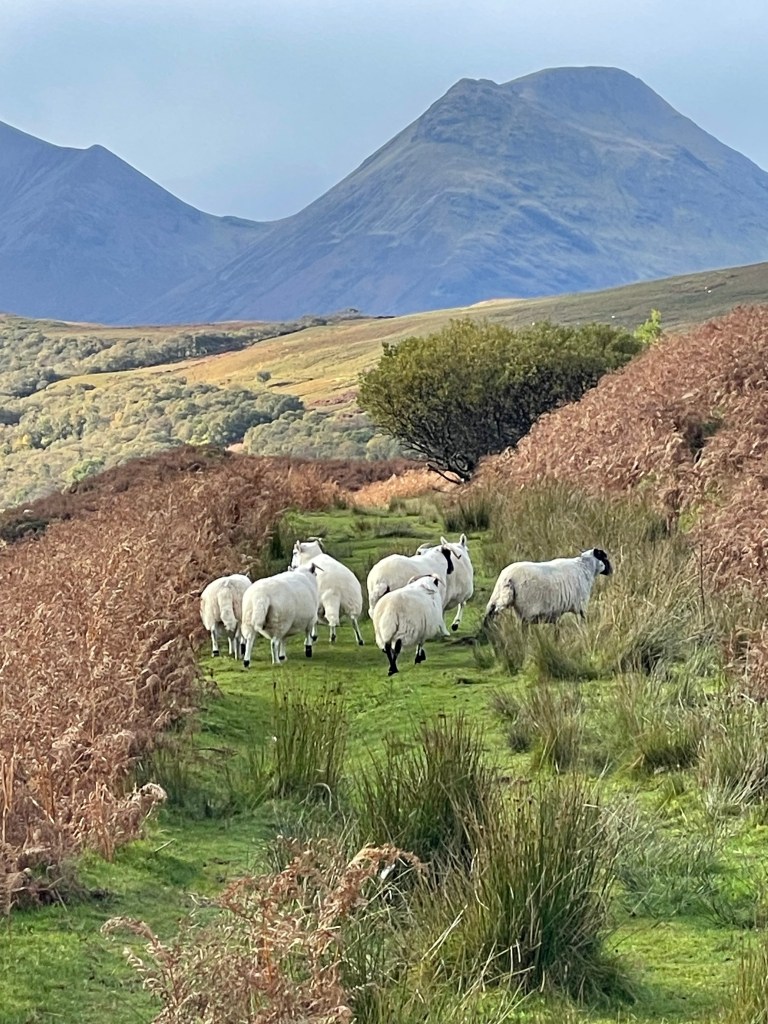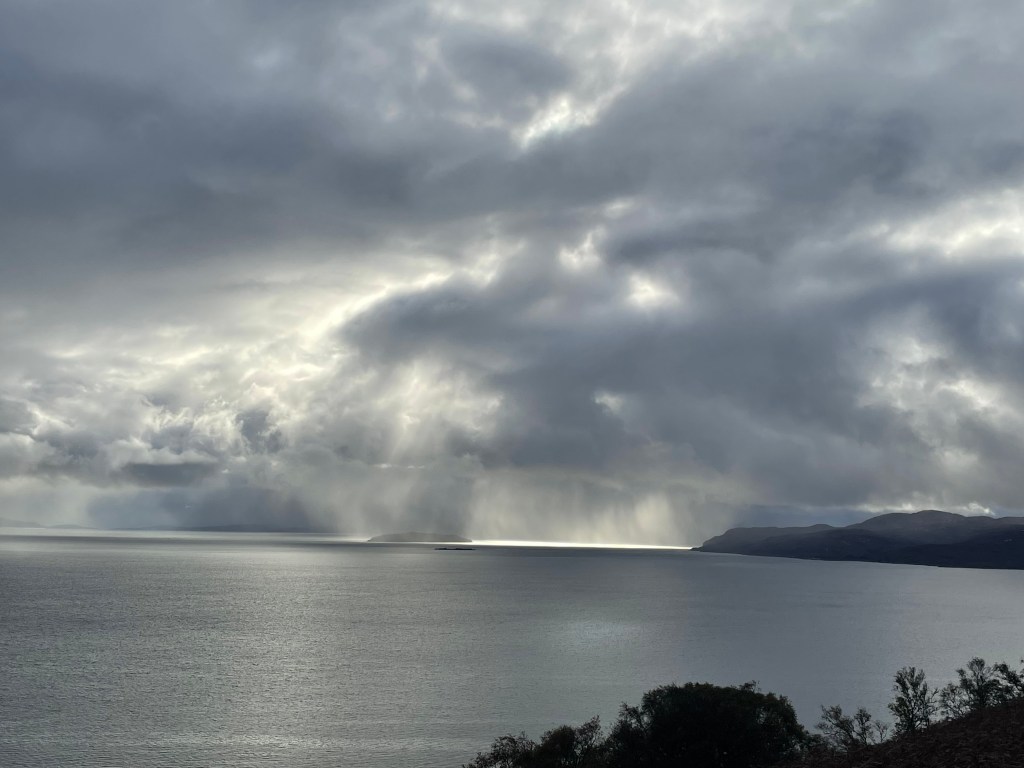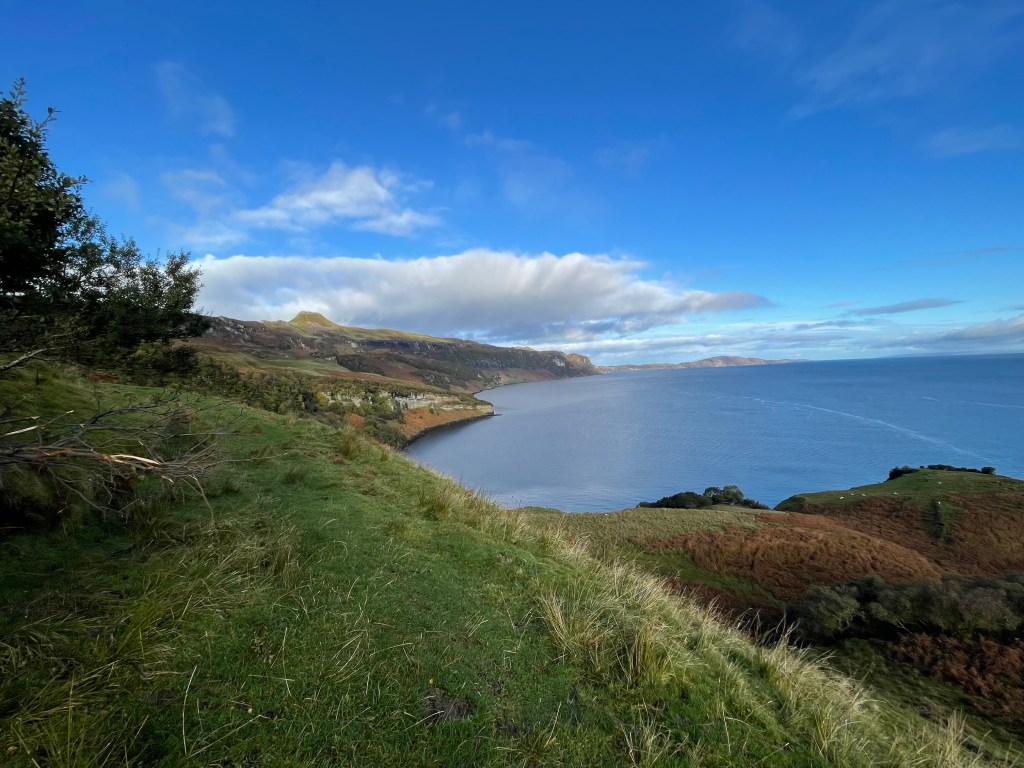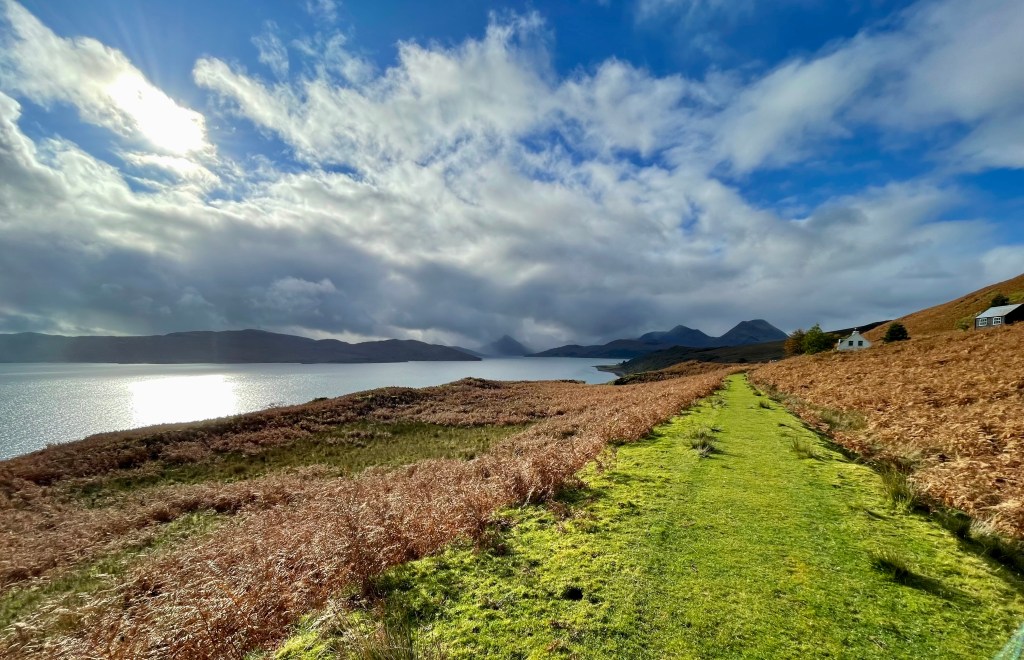
The Last Post: Peat, Standing Stones, Snow, Whisky and Back to Skye

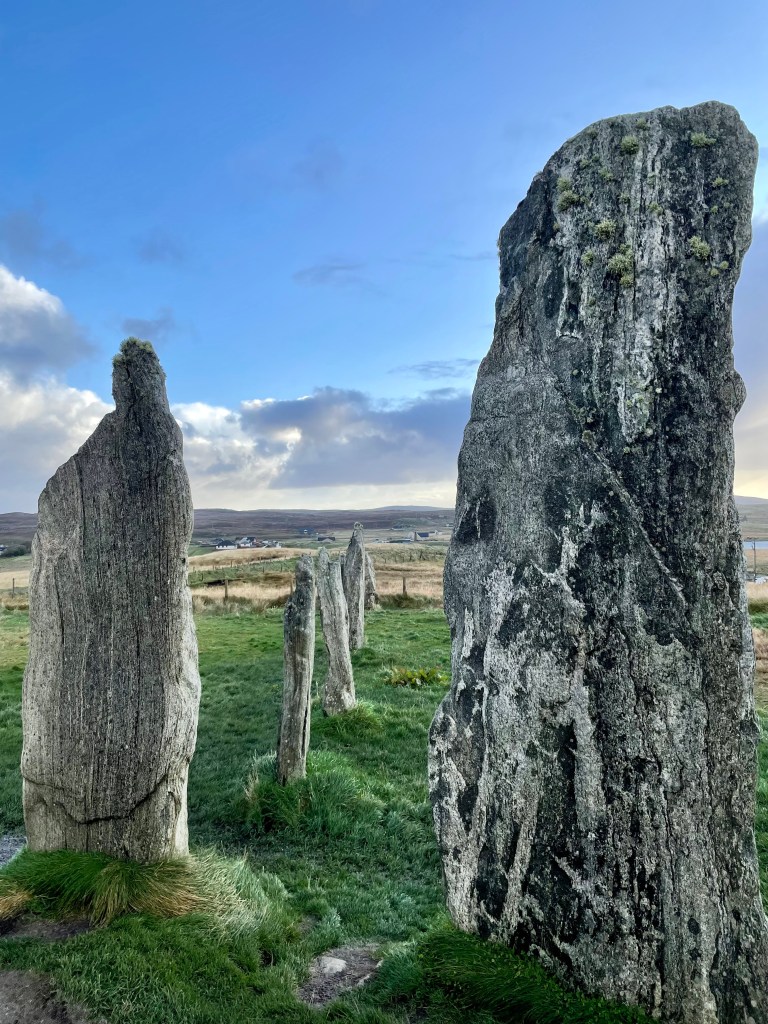
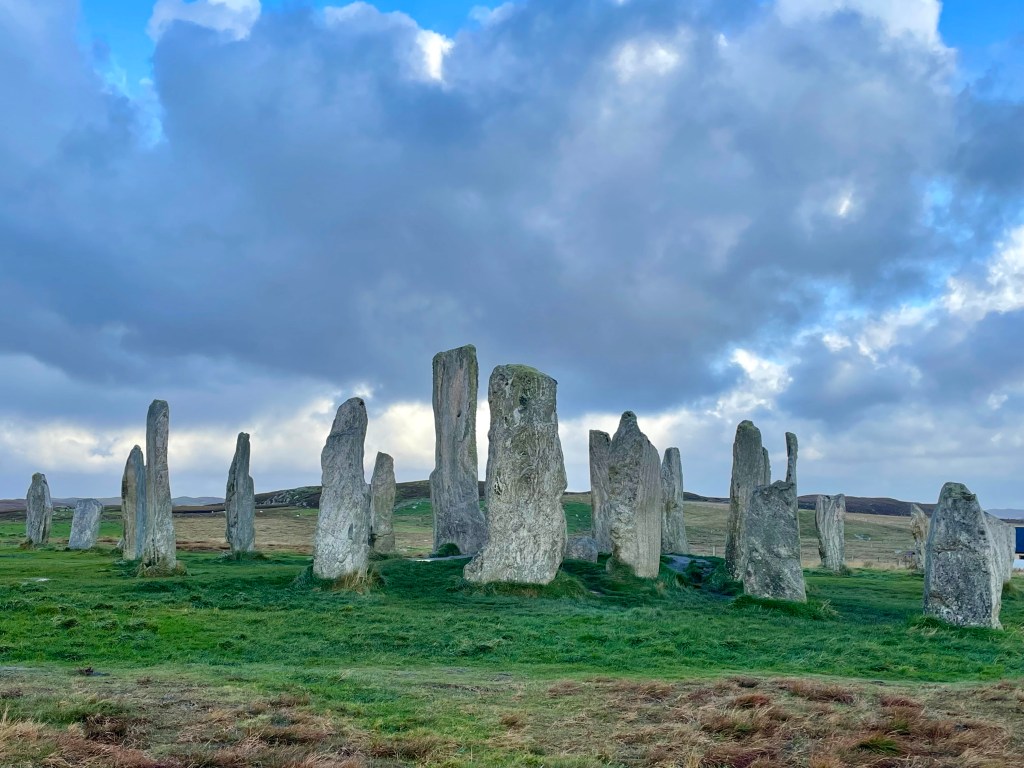
Callanais Stones, Isle of Lewis

Our last full day in the Outer Hebrides dawned with a bittersweet tinge. Wind-swept, isolated and bewitching Harris had started to seep into my bones and I felt strangely reluctant to leave. We had one more walk before us, followed by a drive down the Golden Road and a fancy farewell dinner.

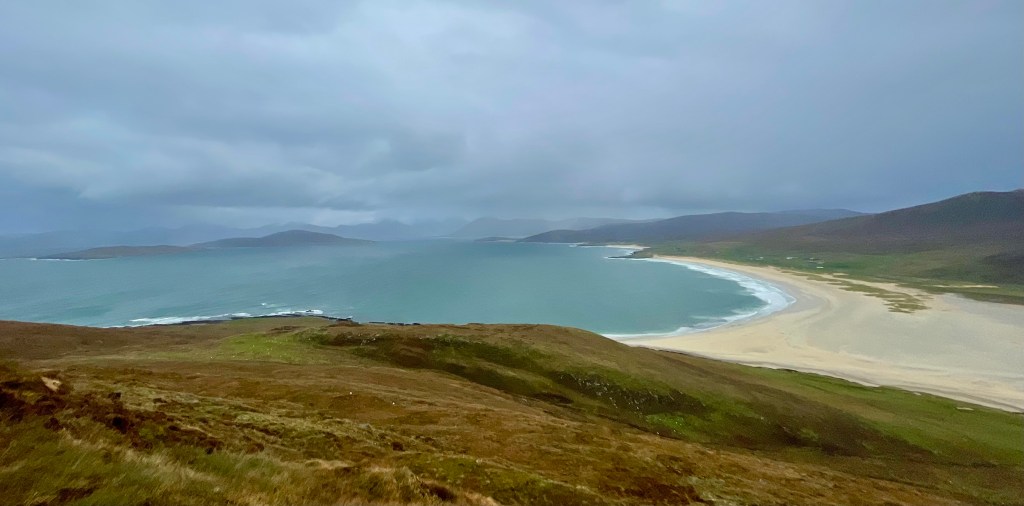
We headed to the southwestern corner of Harris, our destination an uninhabited peninsula connected to the rest of the island via a sandy machair in between two bays. A machair (pronounced “mach’ – like loch – er”) is fertile, well-drained grassland found in Scotland and Ireland which is formed by sand being blown over peat. It creates a unique habitat with diverse bird life and blankets of meadow flowers in early summer. However, with winter approaching, the flowers and birdies were long gone.

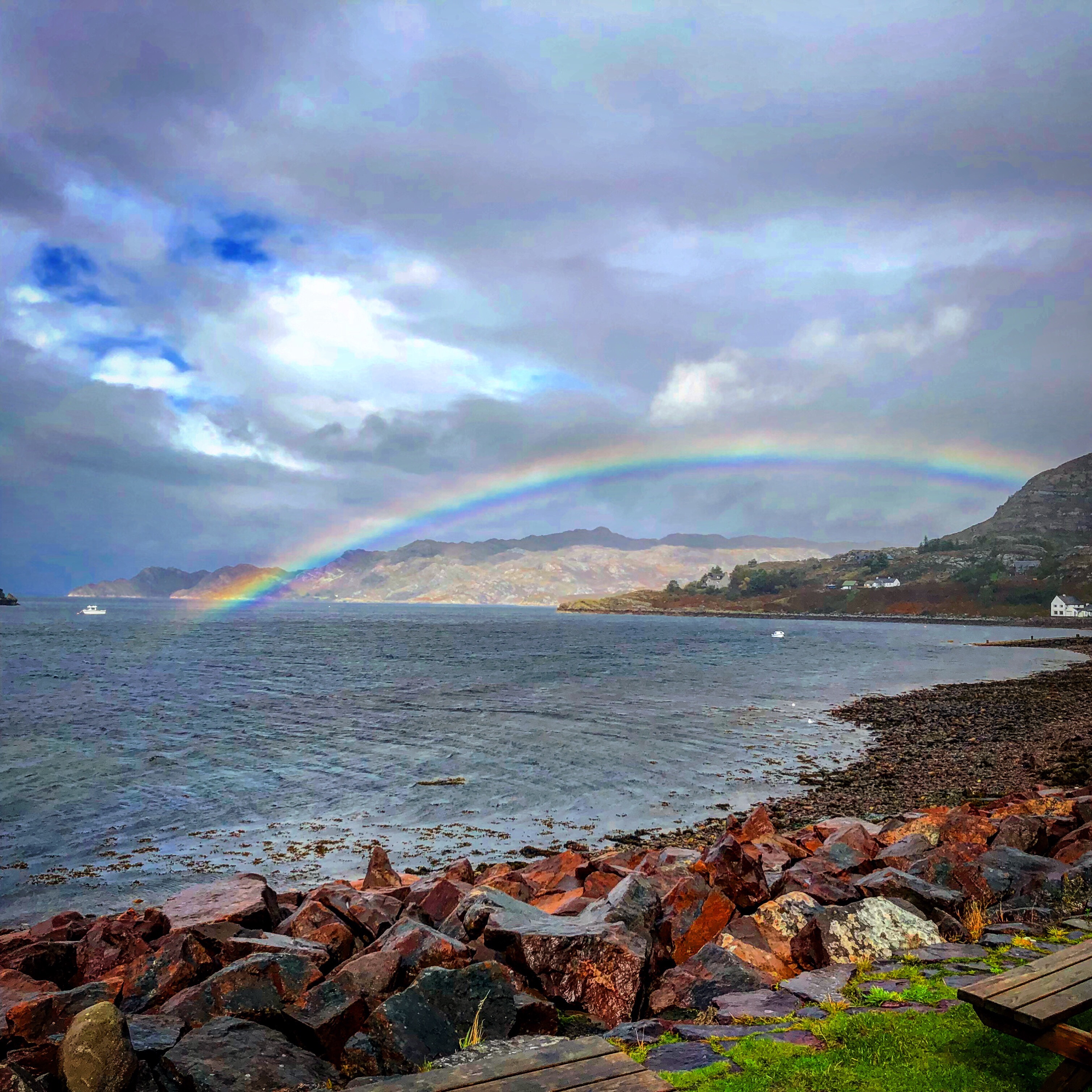
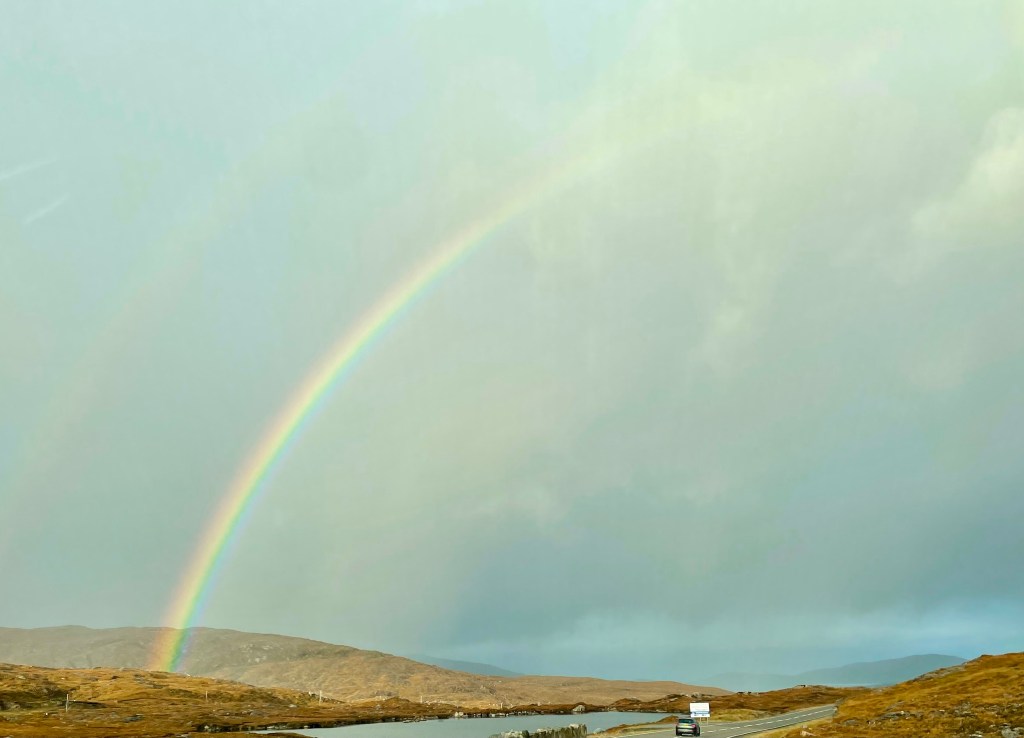
A double rainbow arched over the road on our drive there.
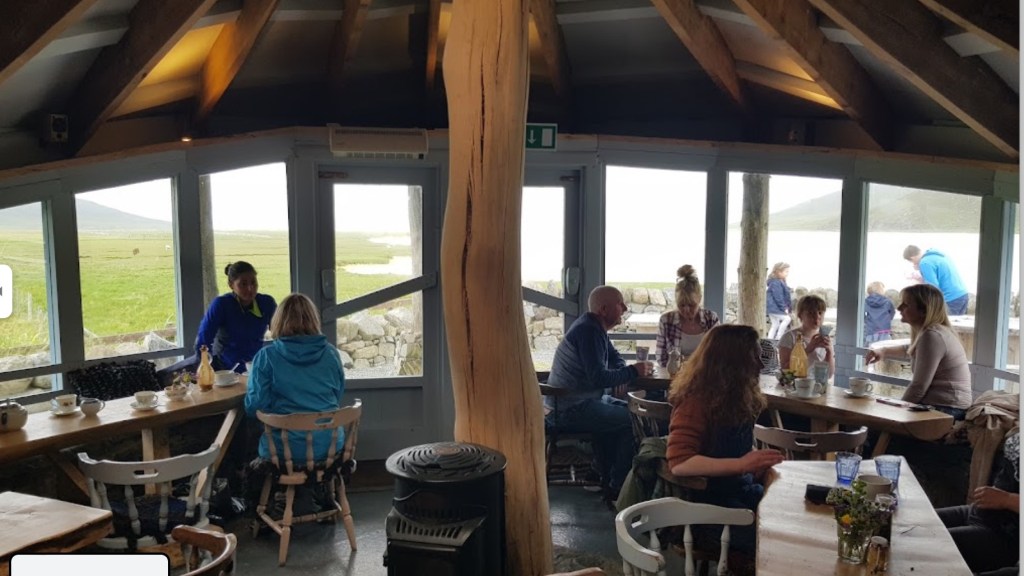
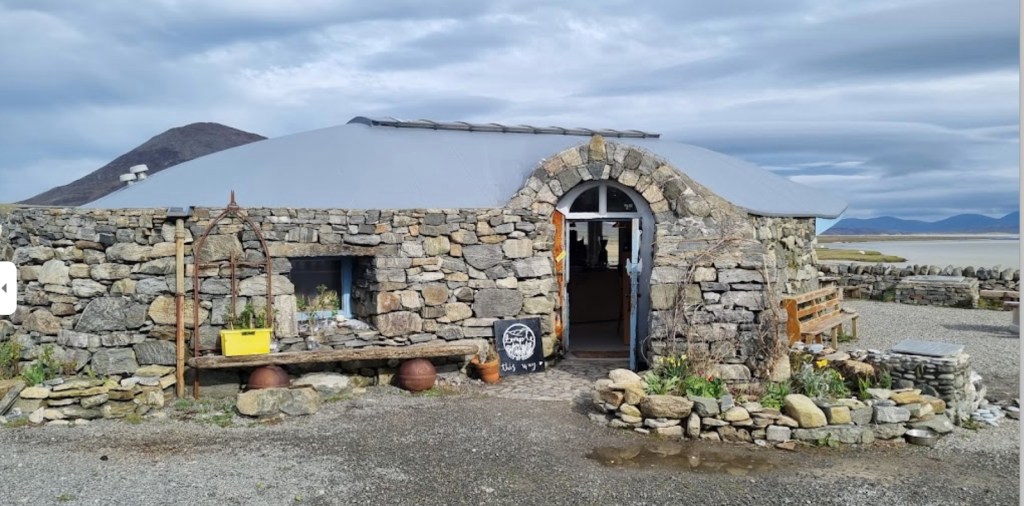
We parked the van next to a charming and quirky cafe snuggled in the middle of nowhere called Temple Harris, featuring a spectacular array of pastries and killer views over a sandy bay ringed with hills. We strolled down a road toward the westernmost summit of Harris and our climb of the day, Ceopabhal (pronounced Chaipaval – p.s., sorry for all these pronunciation tips but I want you to be the hit of your next cocktail party).
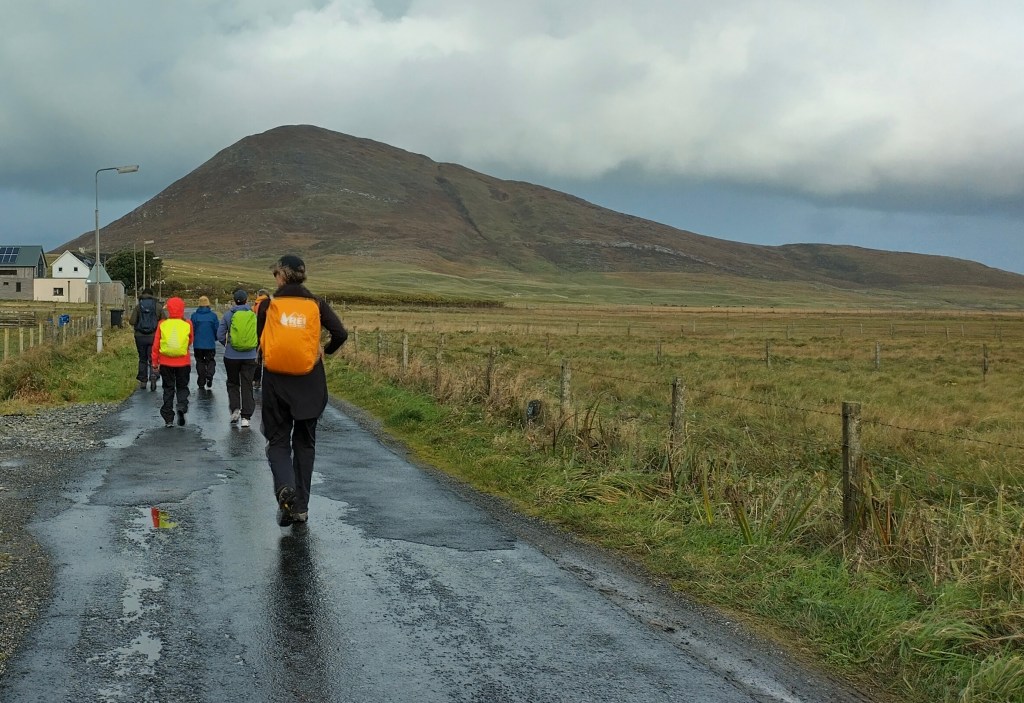
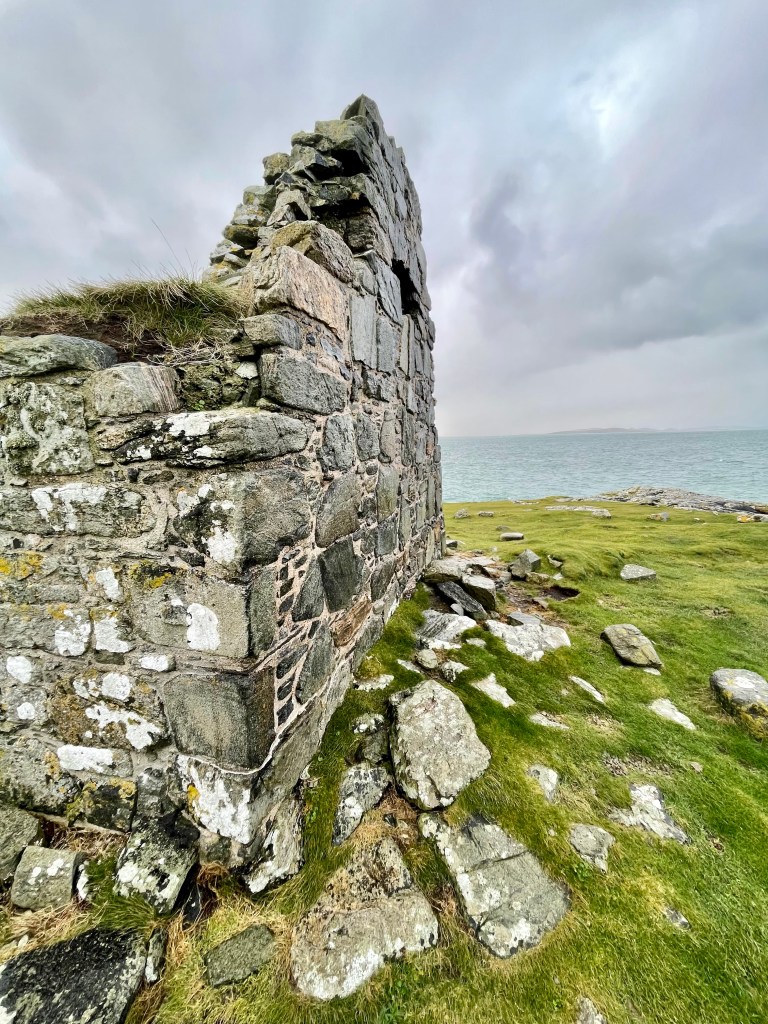
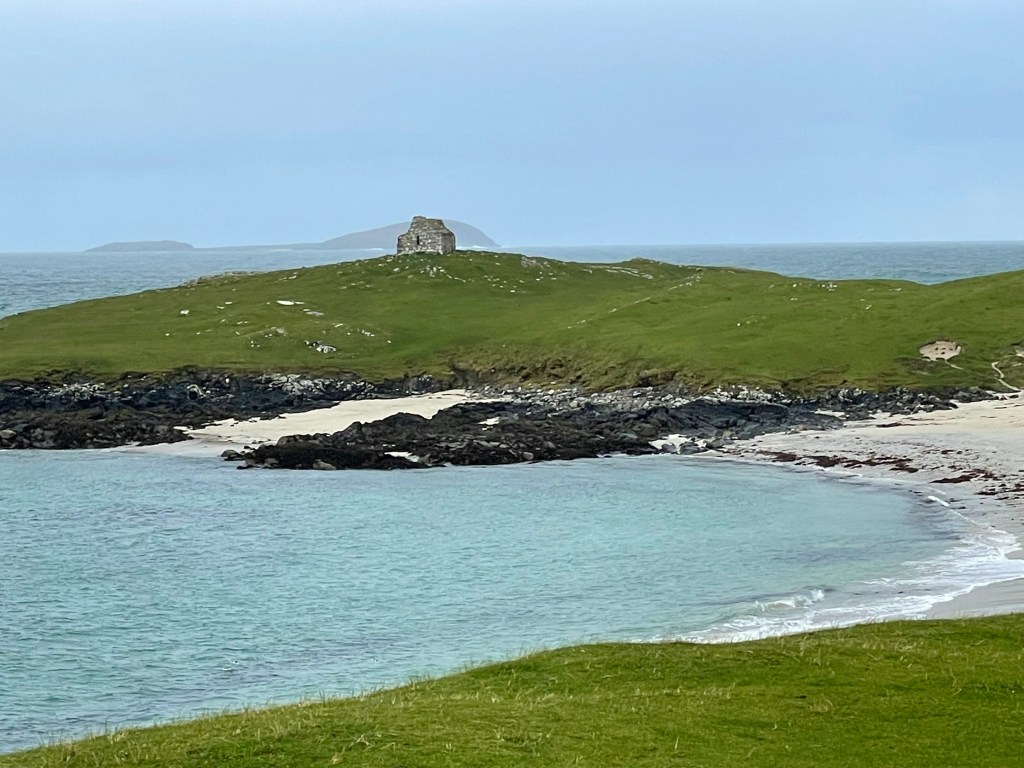
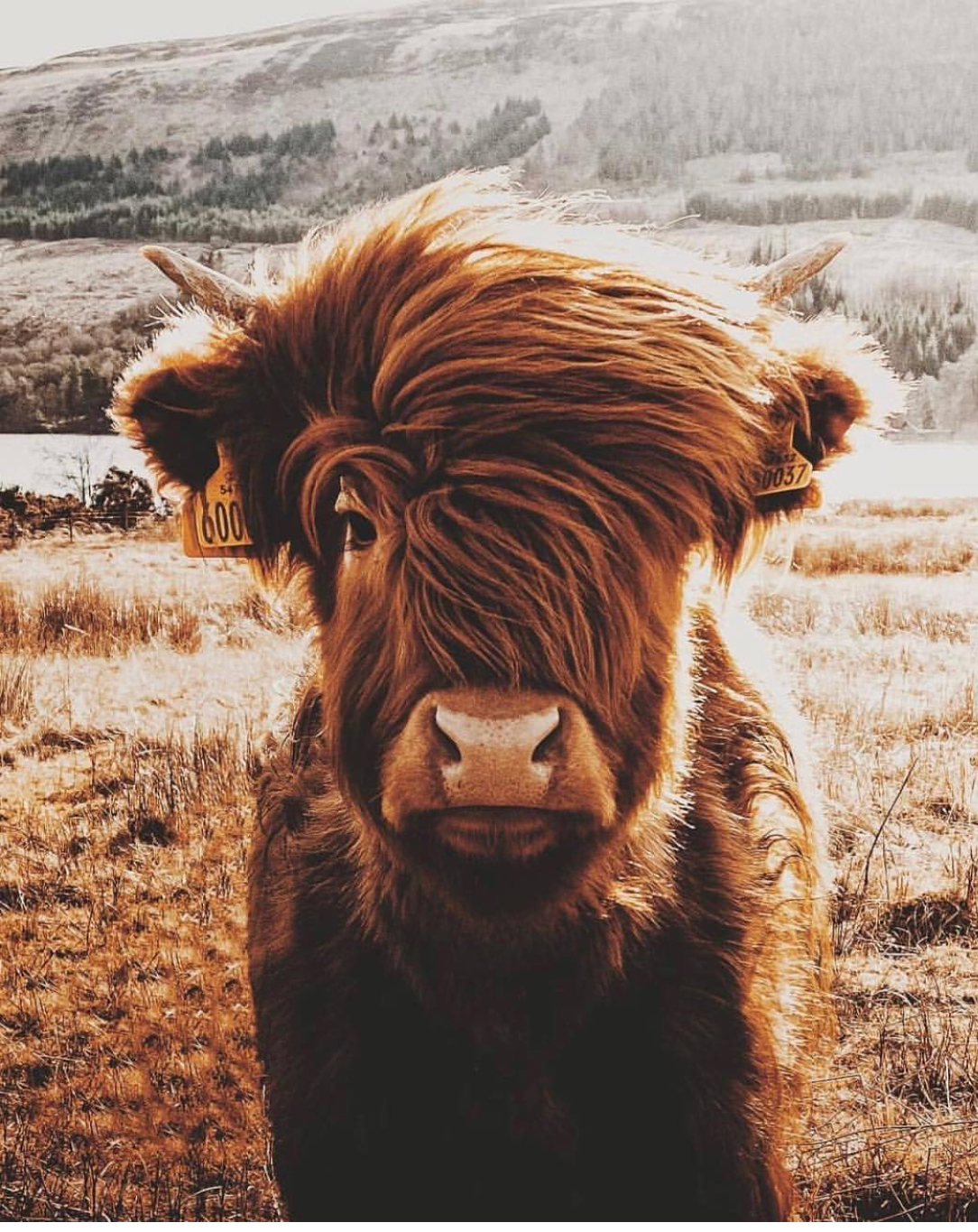
We walked across the machair in capriciously changing weather and made our way through a herd of colorful shaggy cows that appeared to be Highland Cattle/Belted Galloway crosses, which I am totally here for. Fighting our way through a sudden gusty squall, we crested a hill and Traig na Cleavag magically came into view, yet another pristine and deserted Harris beach. This one was guarded by an ancient sentinel – a ruined medieval chapel known as Rubh’ an Teampaill aka Northton Temple. It was built on the site where an Iron Age broch once stood, on land which has been continuously occupied since the Mesolithic era (as this particular era often comes up at cocktail parties, along with Gaelic pronunciation opportunities, a wee reminder this was 10,000 to 8,000 BCE, so very much olden times, or dare I say, days of yore).
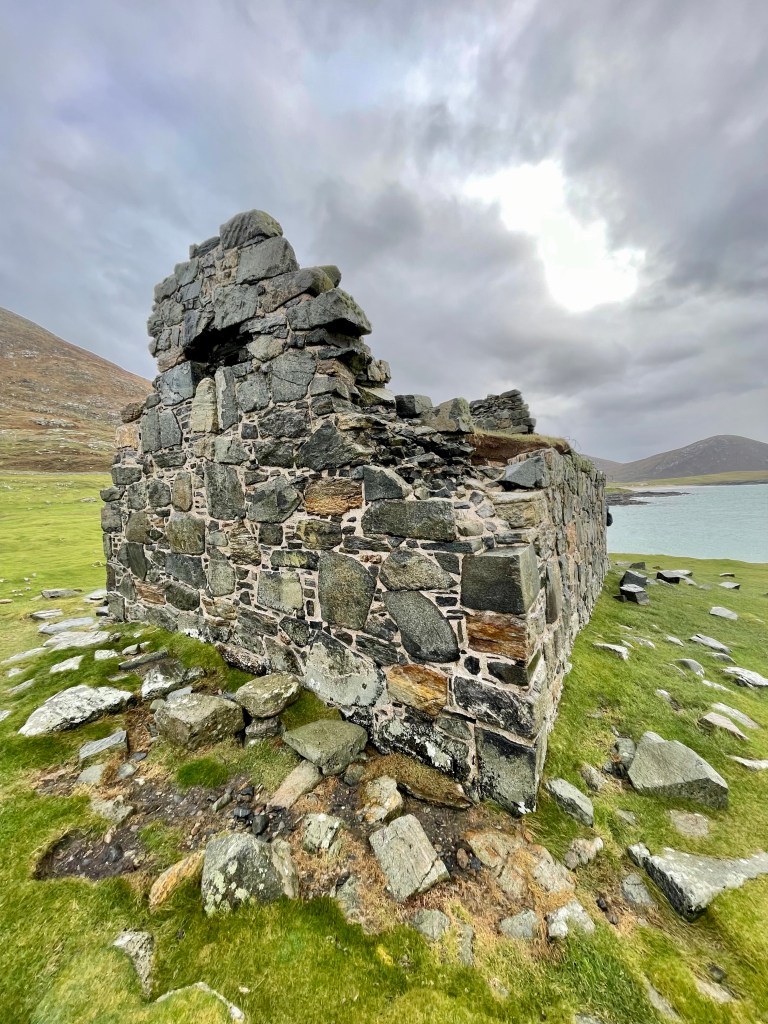
Ceopabhal loomed over us for the entirety of our walk, and I eyed the hill with a slight amount of trepidation, mostly because I made the mistake of reading about it in advance on the Walkhighlands website (the bible of Scottish hillwalking).

The climb featured a 1,200 foot elevation gain over 6/10 of a mile. This is indisputably a bit on the steepish side, in fact Walkhighlands mentioned in passing that a “great amount of effort” was necessary to reach its summit. Also Liam made us stop and eat a protein bar just before the steep bit for “fortification.” Yikes. So once again the ascent was trail-free – we just zig-zagged our way up through clumps of heather. My main pro tip would be to make sure you lean forward into the hill. At least it was so rainy and windy that trying not to get blown off the trail to our deaths (only slightly exaggerating) served as an excellent distraction from the aggressive angle of the climb.

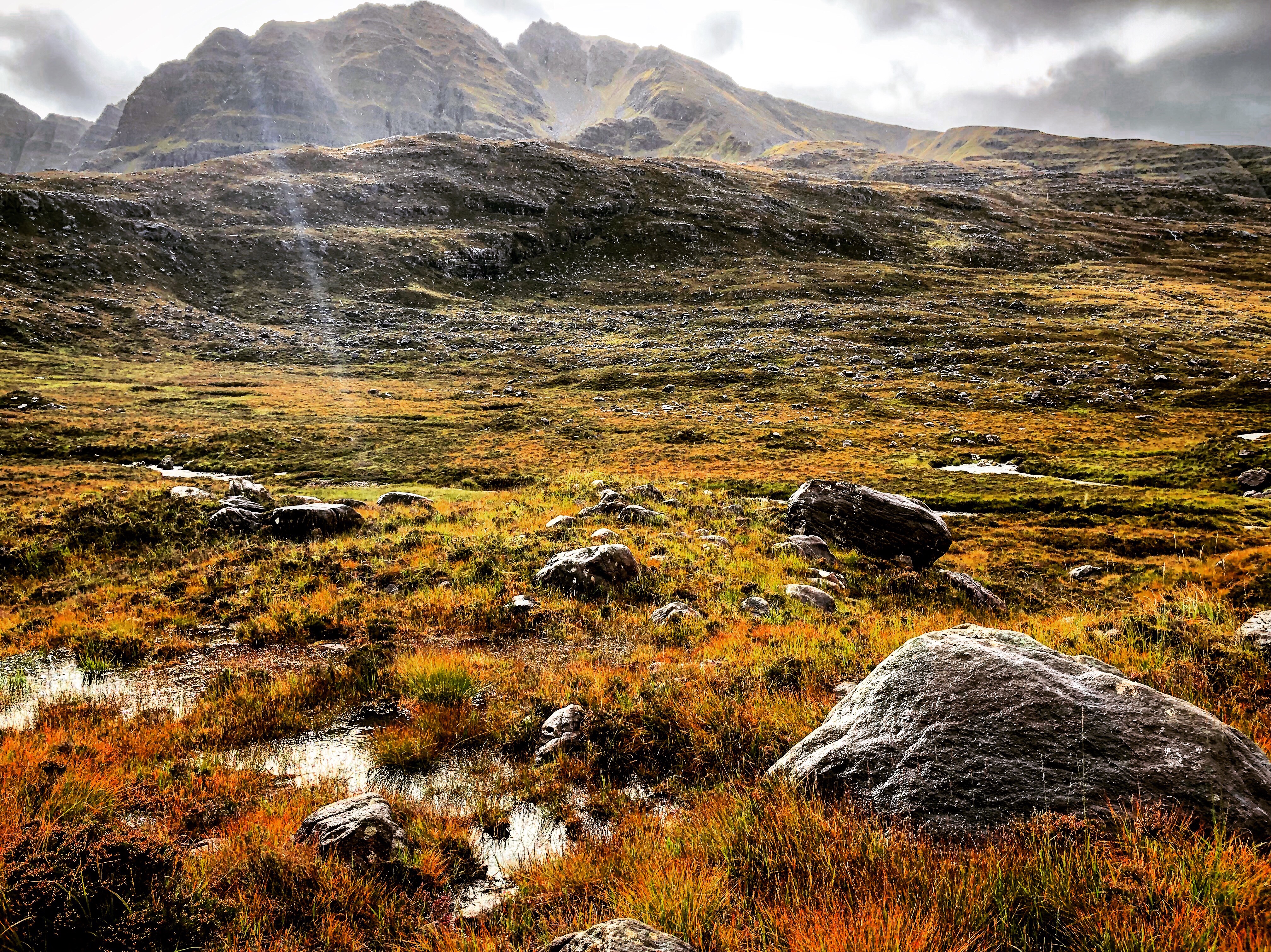
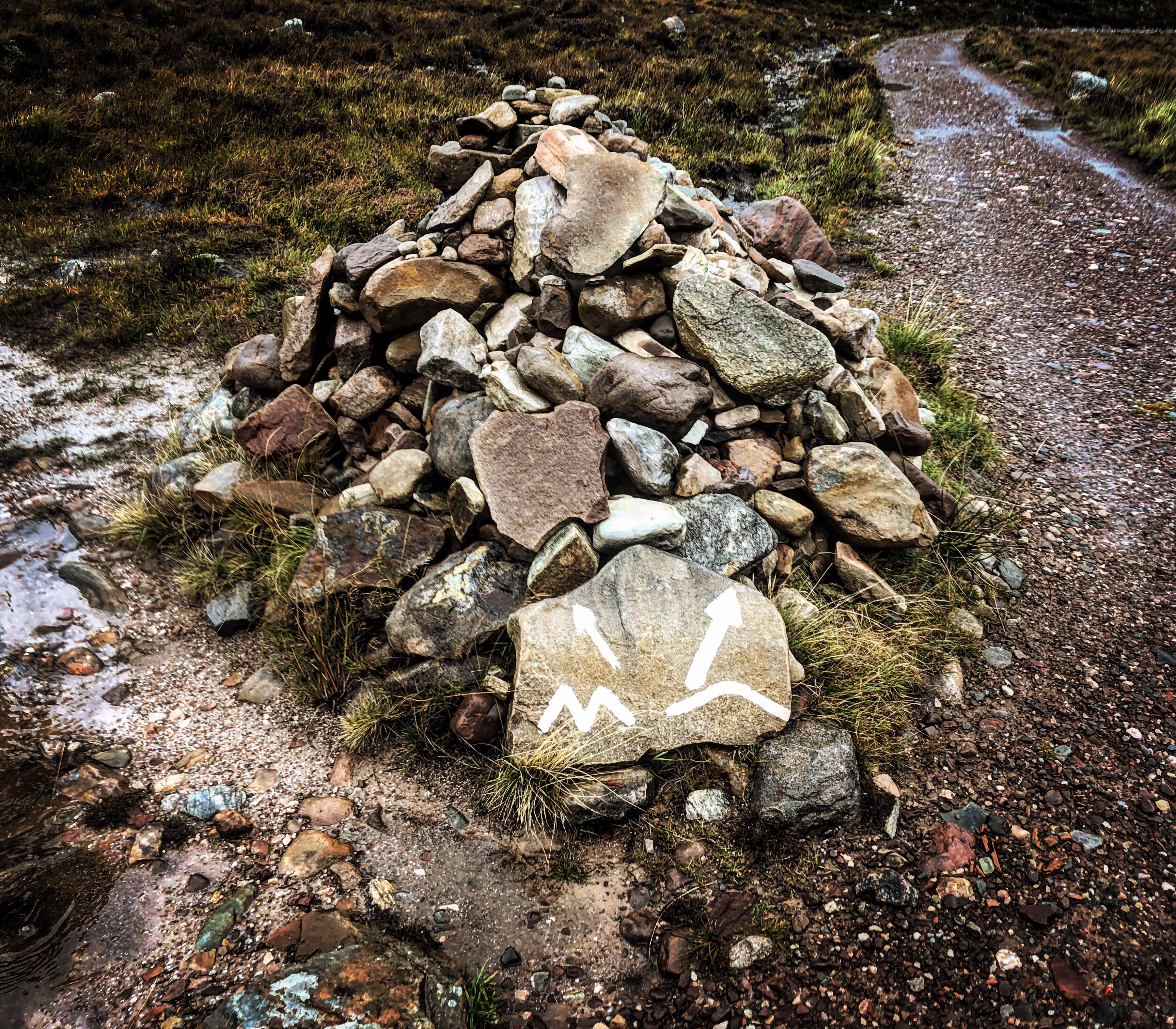
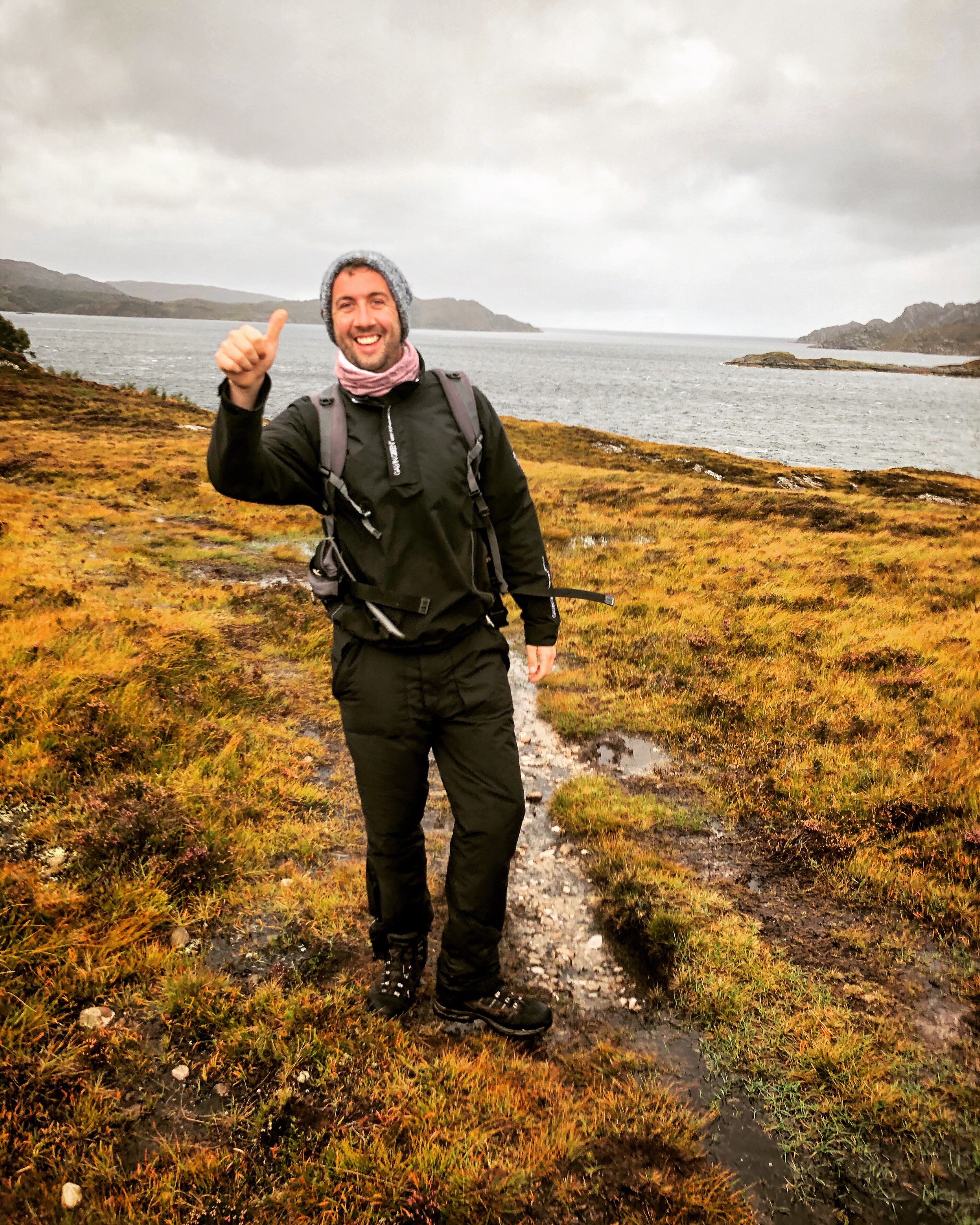
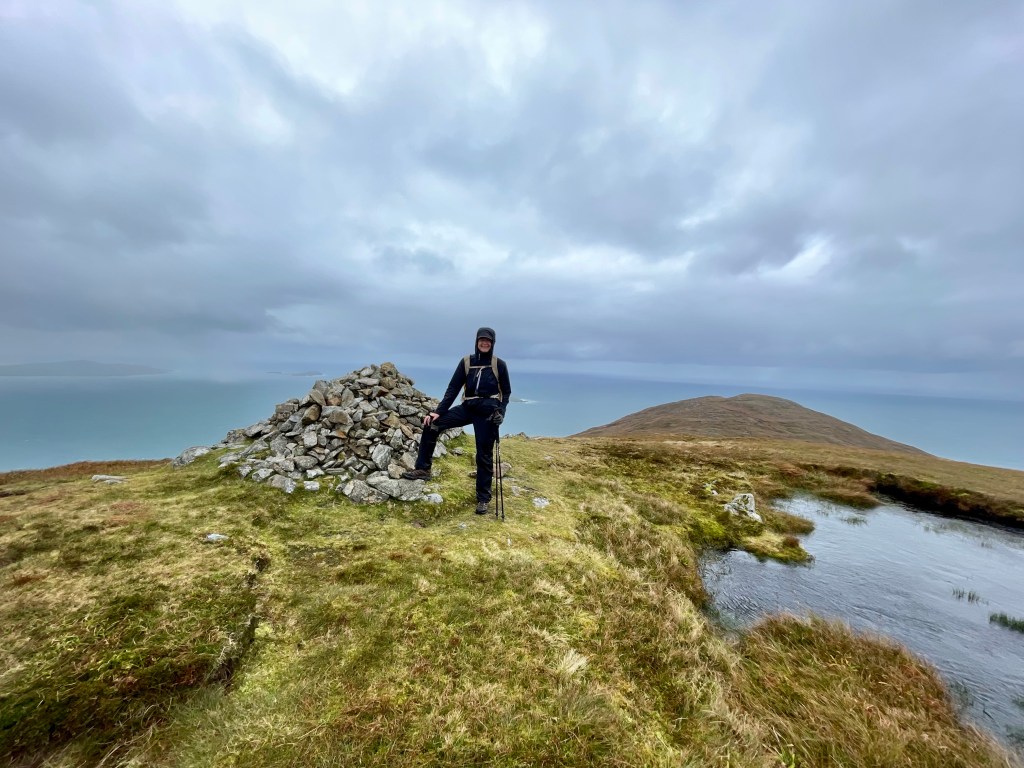
At the summit (yay!), the views were 360 degrees (largely into fantastic storms, but you could see the mountains of Skye). The wind had truly become a biblical sort of tempest, known in these parts as “blowing a hoolie,” although I did valiantly manage a few snaps and a cairn photo.
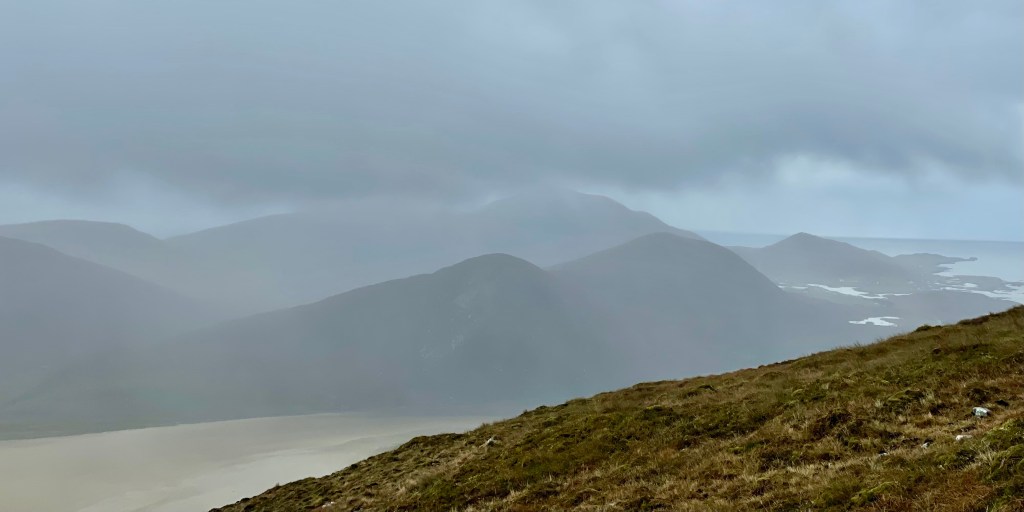
We walked to the lee side of the hill, mercifully sheltered from the hoolie, and sat in some soft comfy moss to enjoy a picnic looking out over a gorgeous bay.
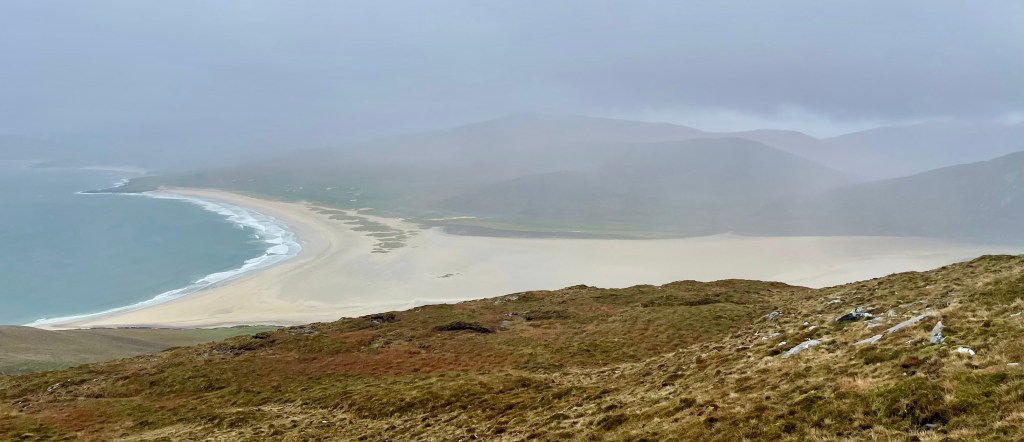
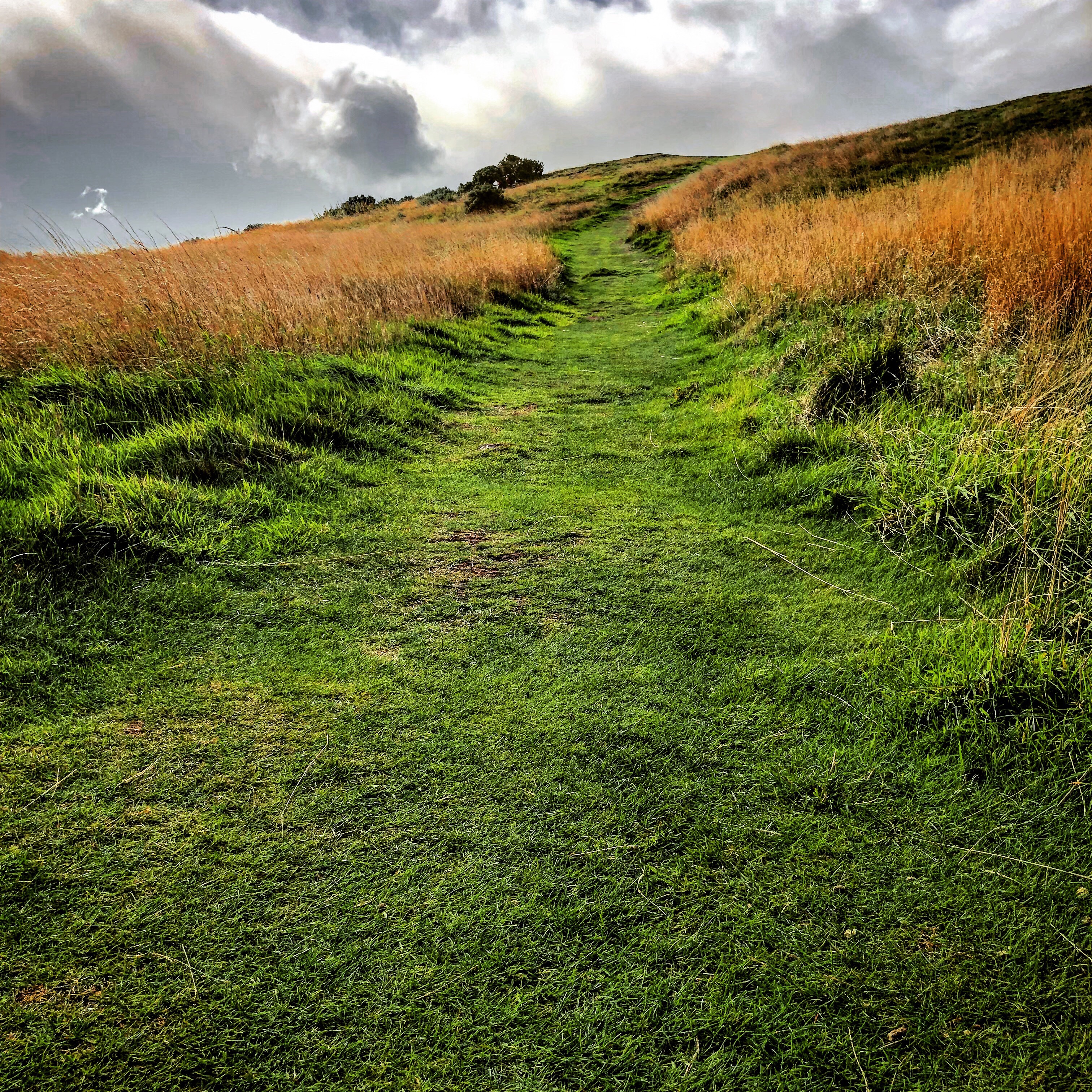
The fine folks at Walkhighlands.com recommended retracing one’s steps back down the hill. My knees were entirely dreading this prospect because going up a steep slope is one thing, going down (while being blown about by a hoolie) is an entirely different situation. This advice was based on their view that walking down the hill on its lee side would take one through “deep heather” and thus should be avoided. Mercifully, Liam had other ideas.  We indeed took the more gradual route toward the bay, winding our way through heather and floating across fluffy, deep mounds of sweet, sweet sphagnum moss. Let me tell you it was delightful. Imagine traipsing down a hill on living, breathing sponges of memory foam. That’s what it was like. I put my hiking sticks away.

Speaking of moss, you can’t go to Scotland without considering peat. No seriously. Peat is formed from plant material throughout the ages that does not fully decompose, and sphagnum moss is one of its main ingredients.  Peatlands cover about 20% of Scotland and yet 80% has been degraded over time. It has been hacked away and drained since the 1800s to make room for agriculture. For centuries it has also been cut, dried, and used in fireplaces for heating homes. It still is. 
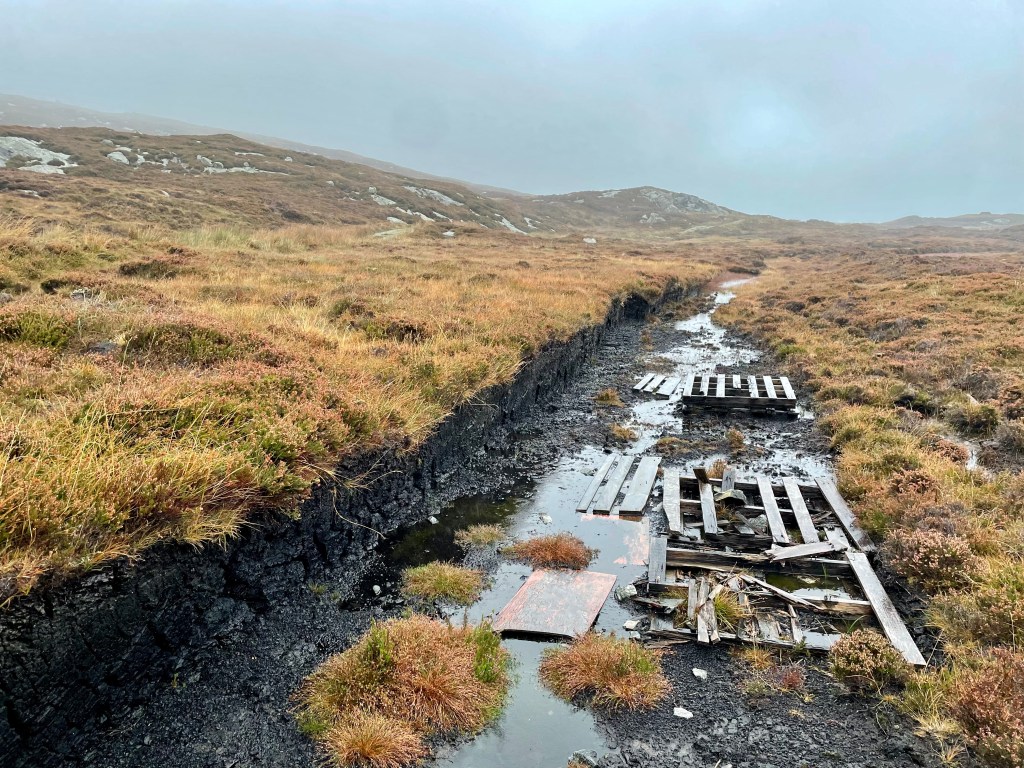
Peat harvesting on Harris.

Peatlands are among the most carbon-rich ecosystems on Earth and have a net cooling effect on climate.  Healthy peatlands can also reduce flood risk by slowing the flow of water from the uplands. If you hold a small handful of sphagnum moss and give it a squeeze, enough water will run out to fill a juice glass. Without peat, one is left with completely nonabsorbent bedrock which isn’t great in a country where it is usually raining. Peatlands also promote biodiversity by providing vital habitat for birds, insects and plants. Peat bogs are sometimes referred to as the rainforests of the UK.

A few more cool things about peat. You may have seen an episode of the BBC mystery Shetland where a decades-old body was found perfectly preserved in a peat bog and wondered why.  (Fun fact: There have been only two murders in Shetland over the last 50 years, rather than the 1-2 murders per week as depicted in the show. This aside provides an excuse for a Douglas Henshall call out for a lot of reasons).
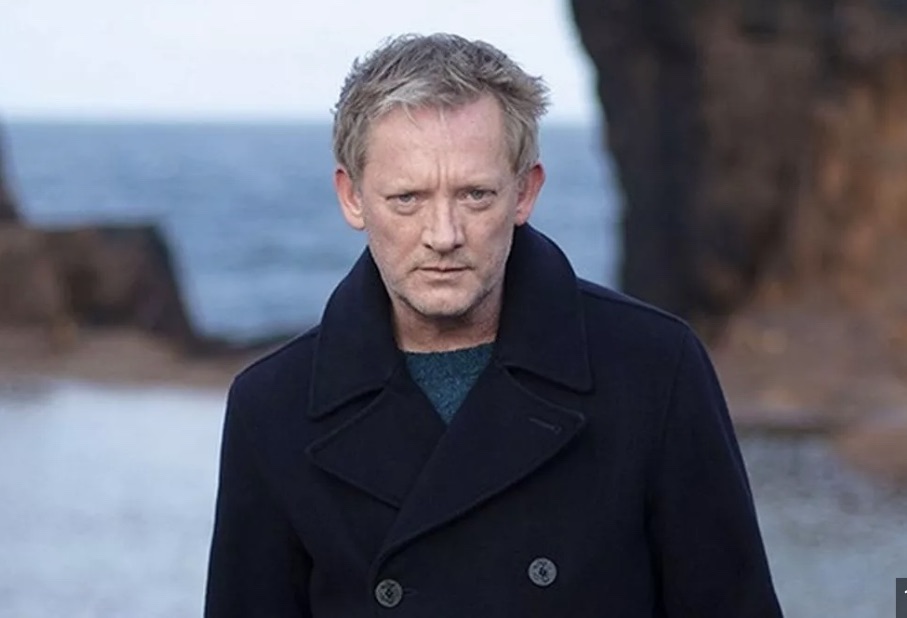
Doug Henshall as Jimmy Perez in Shetland.

The explanation for peat’s ability to preserve (ahem) organic matter is this. As a bog grows, and new peat replaces old peat, the older material underneath rots and releases humic acid, also known as bog acid, with pH levels similar to vinegar. Not to put too fine a point on it, but bog acid preserves human bodies in the same way fruit is preserved by pickling. And of course not just humans – a wooly mammoth was once discovered buried in peat that still had its fur and food in its mouth.

Peat also creates and stores iodine. The iodine causes sphagnum moss to look very yellow and even red when it’s waterlogged. This is why many Scottish rivers appear golden in color – it’s not tea, or (sadly) whisky – it’s iodine-laced runoff.  Also, iodine’s antiseptic properties mean that sphagnum moss acts as a water filtration system so in a pinch you can use water squeezed from moss for hydration – and even more interesting, it was used to pack wounds during wartime since it’s both sterile and absorbent.
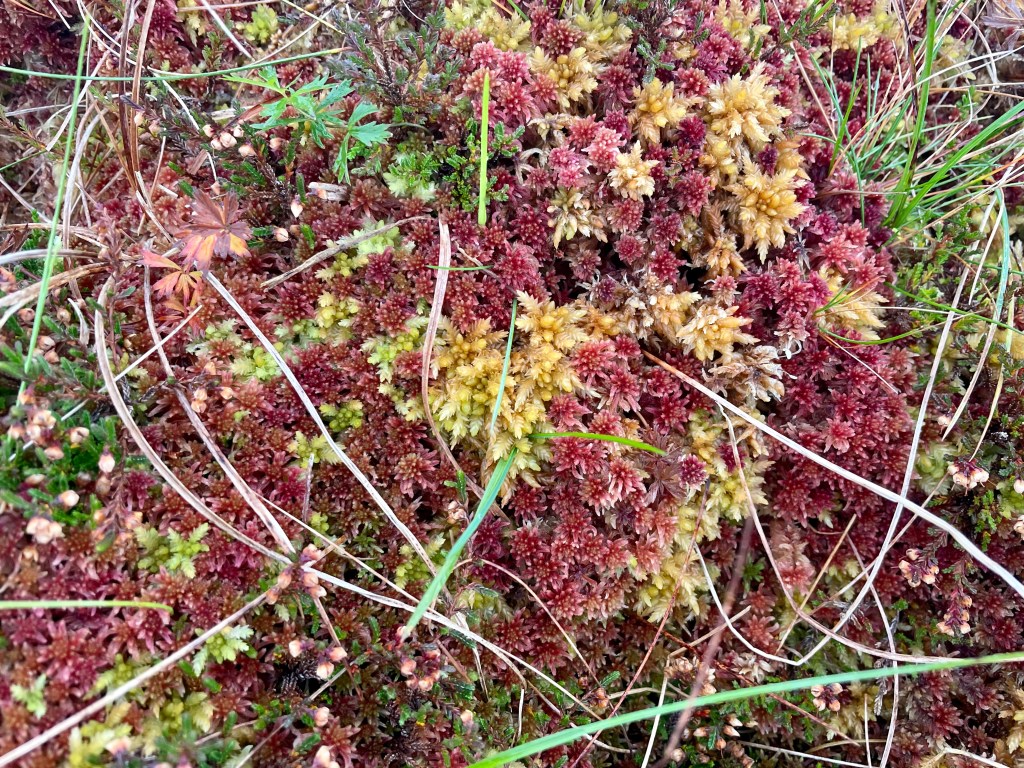
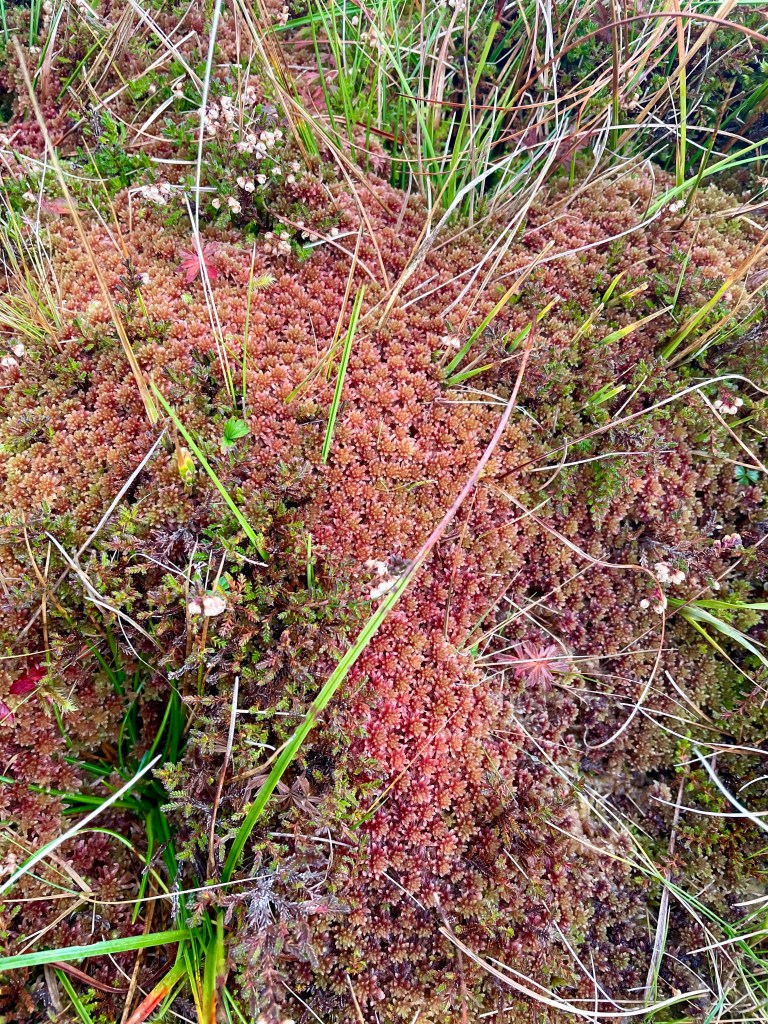
Most crucially from a climate change perspective, Scotland’s peatlands store 16 million tonnes of carbon (one tonne is 9% larger than a metric ton) and possibly shouldn’t be released into the atmosphere at this particular juncture. Draining water away from peat bogs to support agriculture causes the peat to dry, resulting in the vegetation decomposing much faster – and the release of carbon. Similarly, burning peat has the potential to release hundreds of years of stored carbon back into the atmosphere. Ultimately it’s quite beneficial to have large land masses that actually capture and store carbon.

I know what you are thinking – what about (gulp) whisky? Much of Scotland’s whisky is made from sprouted barley that has been dried by peat fire. It imparts a lovely campfire vibe to the golden liquid which causes people to either fall in love or cough with watering eyes and an alarmed expression. An iconic flavor either way, especially with Islay whiskies. As it turns out, whisky accounts for only about 1% of the UK’s peat use and as you can imagine defending the cultural significance of Scotland’s whisky-making tradition has been the central pillar of the industry’s case during the government’s development of its peat policy. Distilleries have pledged to make peat use more sustainable, although given its glacial pace of regeneration (1mm a year) this is a matter of debate. Distilleries are also experimenting with using different botanicals to light on fire for barley drying. Glenmorangie has just released a “Taste of the Forest” expression where they used pine, juniper, woodland moss and eucalyptus as fuel.
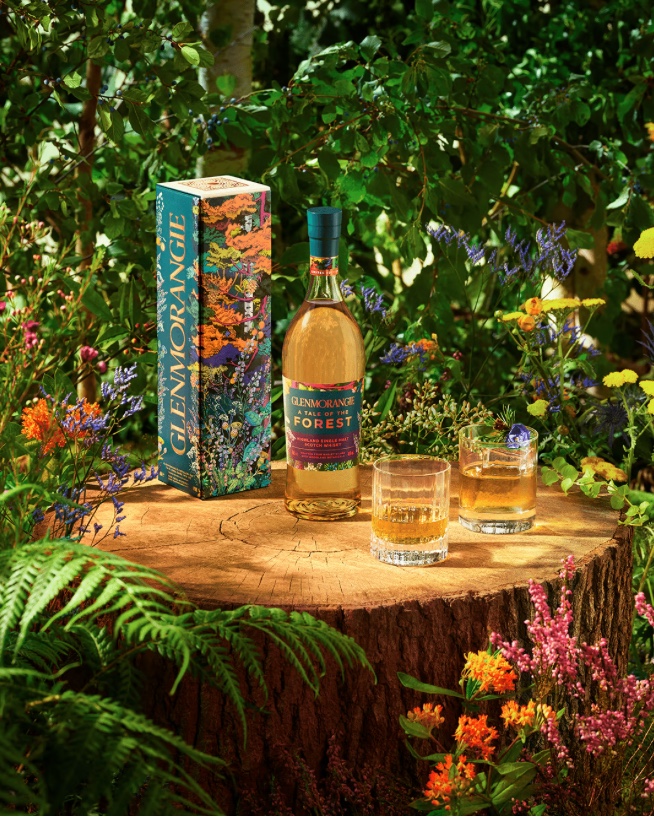
The good news is that peatland restoration and preservation is very very big in the UK and heroic efforts are underway to preserve and increase the resource – with some measurable success.  So fingers crossed.

Thank you for coming to my Ted Talk.

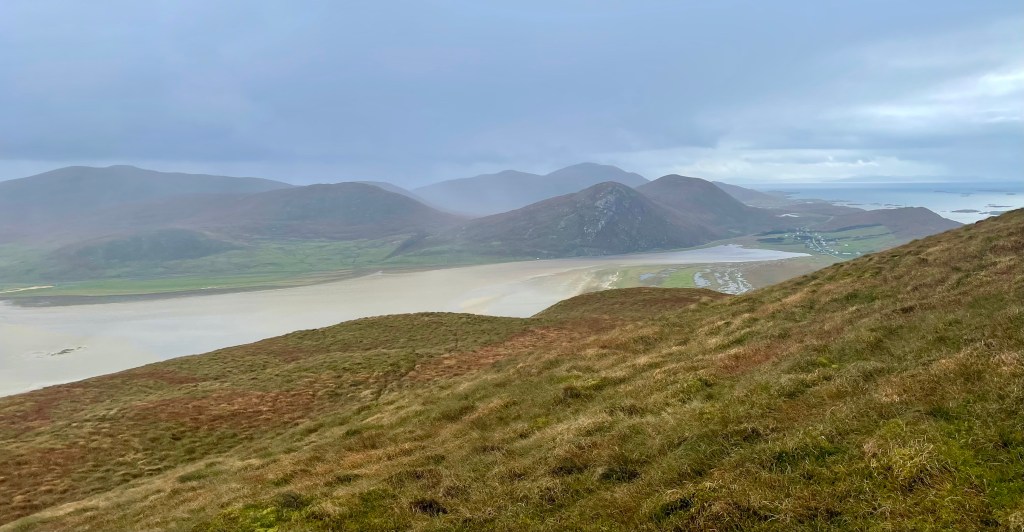
So let’s rejoin our merry band of descending walkers as they bounce down Ceopabhal on cushions of sphagnum moss. Before I share a few photos, after hearing all this peat talk from Liam we were sensitive about trodding on this precious resource, but he assured us that it quite literally bounces right back due to its buoyant density. Phew.
Upon our triumphant return to the van, we snagged a coffee and pastry (and a wee bit of shopping) at Temple Harris.  Everyone leaves their packs outside on the wooden bench without worry of misadventure.
Duly fortified, we struck off down the Golden Road, a spectacularly winding single track route along Harris’s rocky east coast. It’s widely assumed it got its name due to its eye-wateringly spendy construction cost.   After Liam cheerfully told us that if anyone was going to barf in the van, this would likely be the time, he offered distraction from the terrifying prospect of public motion sickness by launching into storytelling mode. He regaled us with mystical tales of dubious provenance featuring two dangerous and wily Scottish creatures.

First on the agenda – kelpies. Typically residing in and lurking about black lochs, they take the form of a horse, appearing to unwary humans as being a helpful sort of creature. They entice travelers to ride them over the loch, seemingly a more expeditious route than walking around them. It’s a trap! Once a person mounts the horse, it gallops to the deepest end of the loch, dragging its hapless rider below the water to their death and, ultimately, consumption (yikes). This legend was used to keep children away from lochs and also provided therapy fodder for later in life.

You may have seen this gorgeous sculpture by Andy Scott. The Kelpies were installed in 2013 near Falkirk and are a ginormous 98 feet high. It’s beautifully lit at night, and even if you don’t have time to stop, the giant kelpies loom over the M9 between Edinburgh and Stirling.

Next we turned to tales of the more benign selkies. They are also water-dwelling shapeshifters, but transform between seal and human by shedding and replacing their skin. As humans, selkies are incredibly attractive, graceful, kind natured and (avert your eyes) seductive, and so humans tend to fall desperately in love with them.  Selkies have also been tricked into marrying humans, usually by a nefarious person who steals and hides their seal skin, preventing them from returning to the sea. Not cool. Selkies are known for their benevolence, saving the lives of children or fishermen who have fallen into the sea.

There you have it. Keep up your guard if you visit Scotland – as these mythical beings pose more danger than any other resident creatures other than – dreaded midges.

We took a break from the Golden Road at Clo Mor, the charming Harris Tweed Exhibition. I will admit to you that prior to my visit to Harris, I had presumed that Harris tweed, since it’s pretty ubiquitous, was mass-produced, probably in China. Luckily I didn’t say that out loud to anyone. In actual fact, to qualify as Harris tweed, the textile must be “handwoven by the islanders at their homes in the Outer Hebrides, finished in the Outer Hebrides, and made from pure virgin wool dyed and spun in the Outer Hebrides,” according to an actual Act of Parliament.  Approximately 400 islanders were working in this industry as of late 2017, and you can visit them in their home, see their looms and watch them work. Consider my eyes opened.

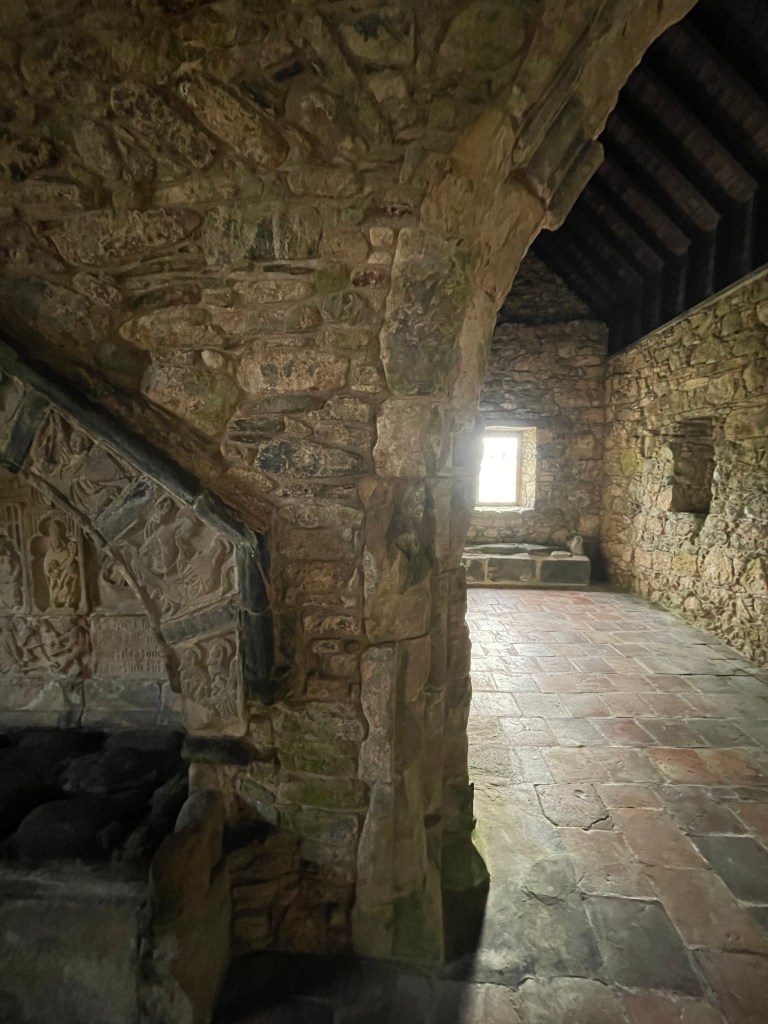
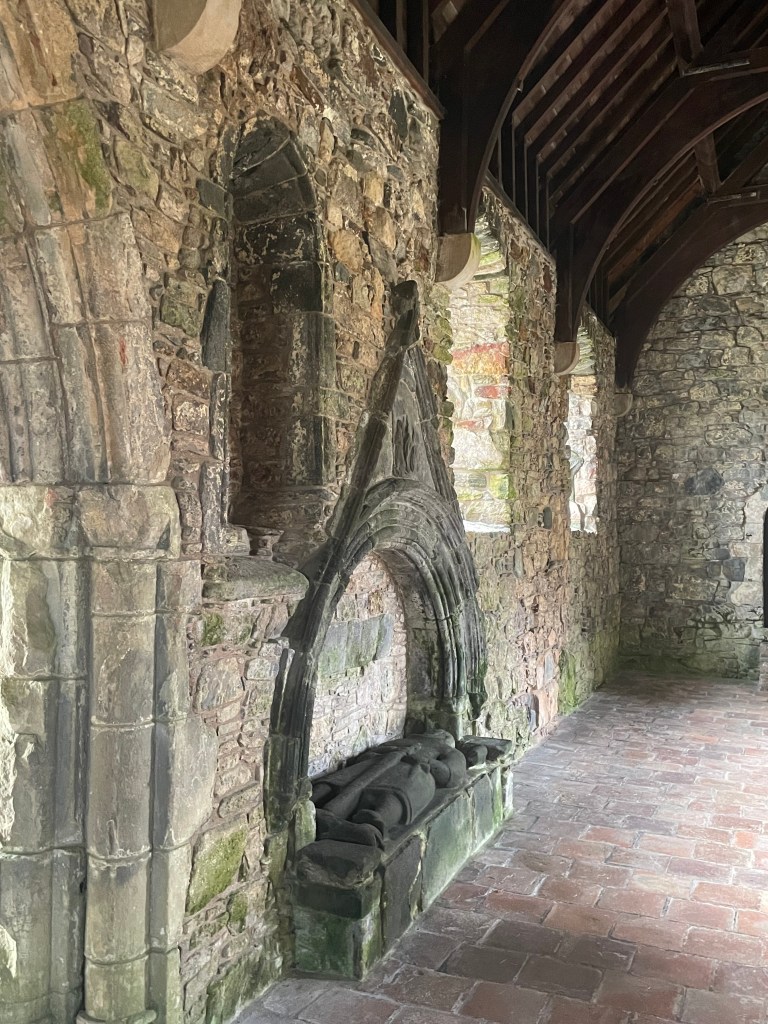
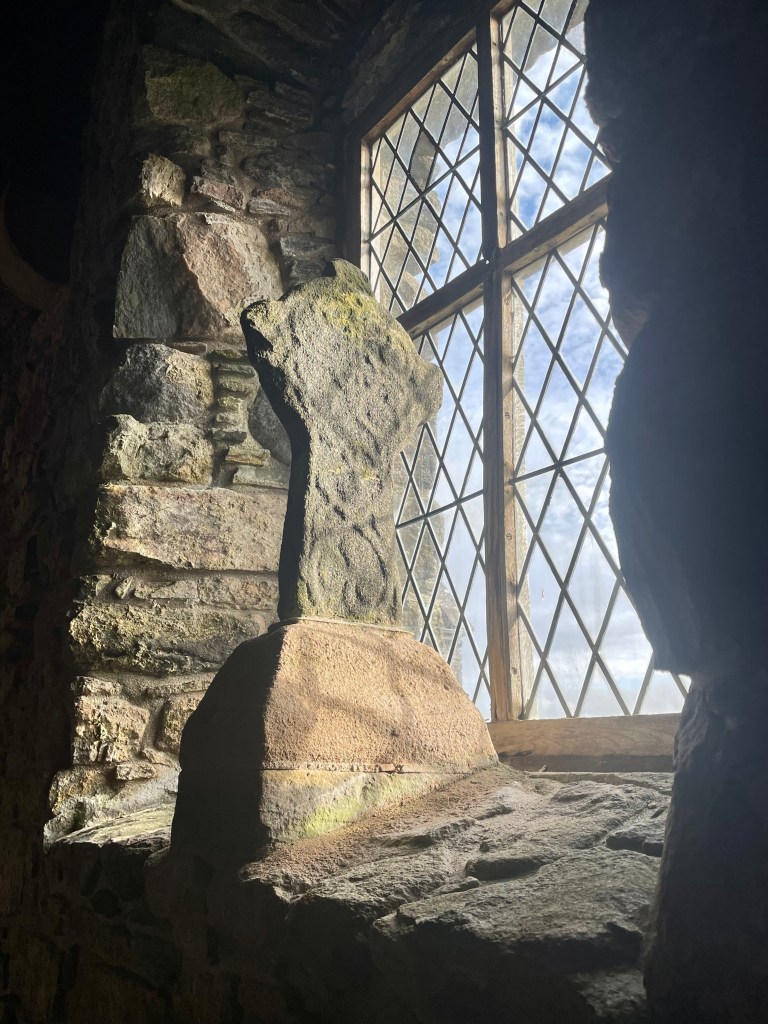
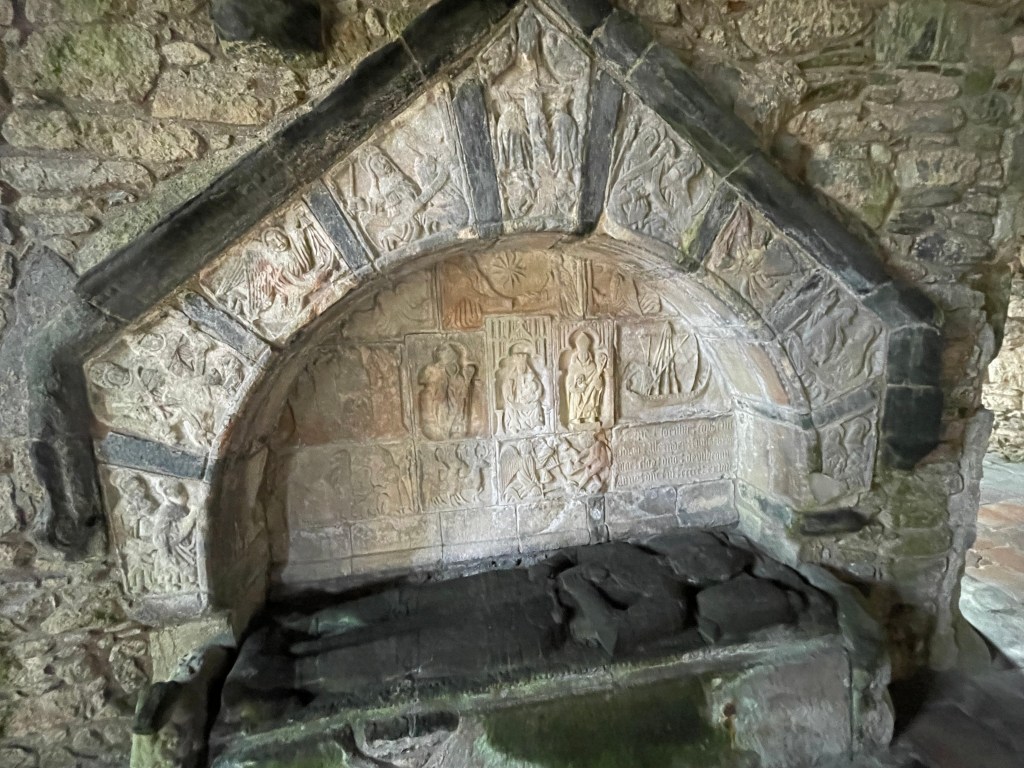
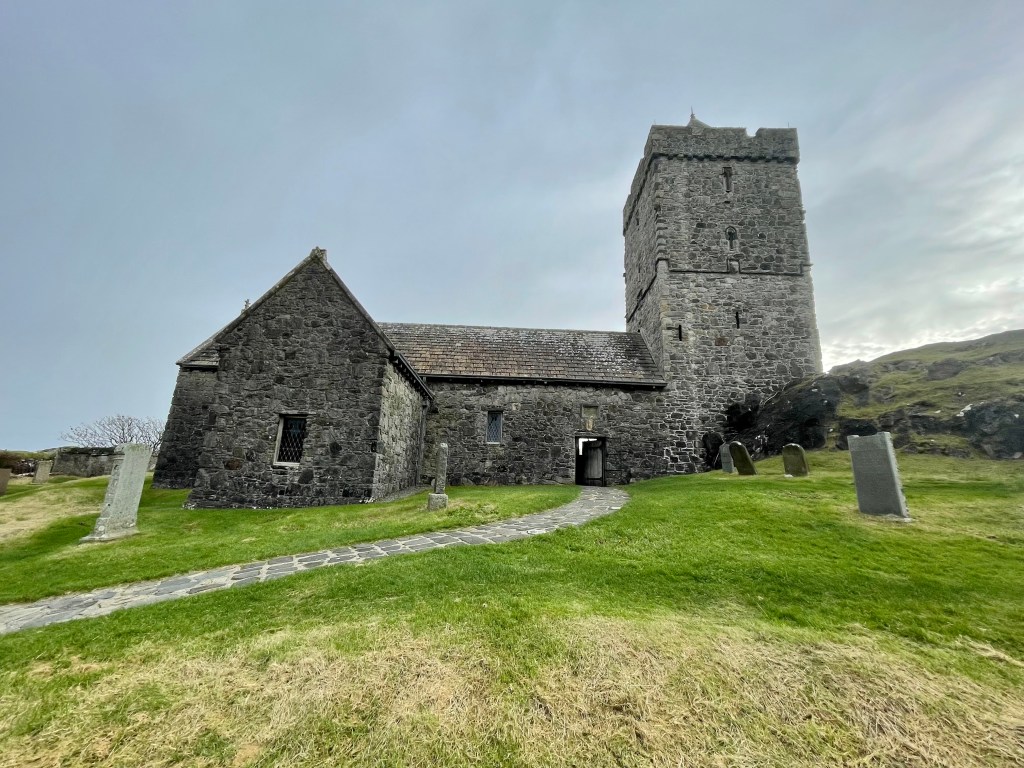
We next stopped at Hebrides People Visitors Center in Northton, a genealogical resource for folks researching their ancestry that tells the history of the people and landscapes of Harris and the Western Isles. Our last stop on the Golden Road was St. Clemens, a medieval church founded by Alasdair MacLeod, 8th chief of Clan MacLeod. He died in 1547, and his tomb is in the church, along with a passle of other ancient MacLeods.  One wonders where the 1st – 7th MacLeod clan chiefs are buried.
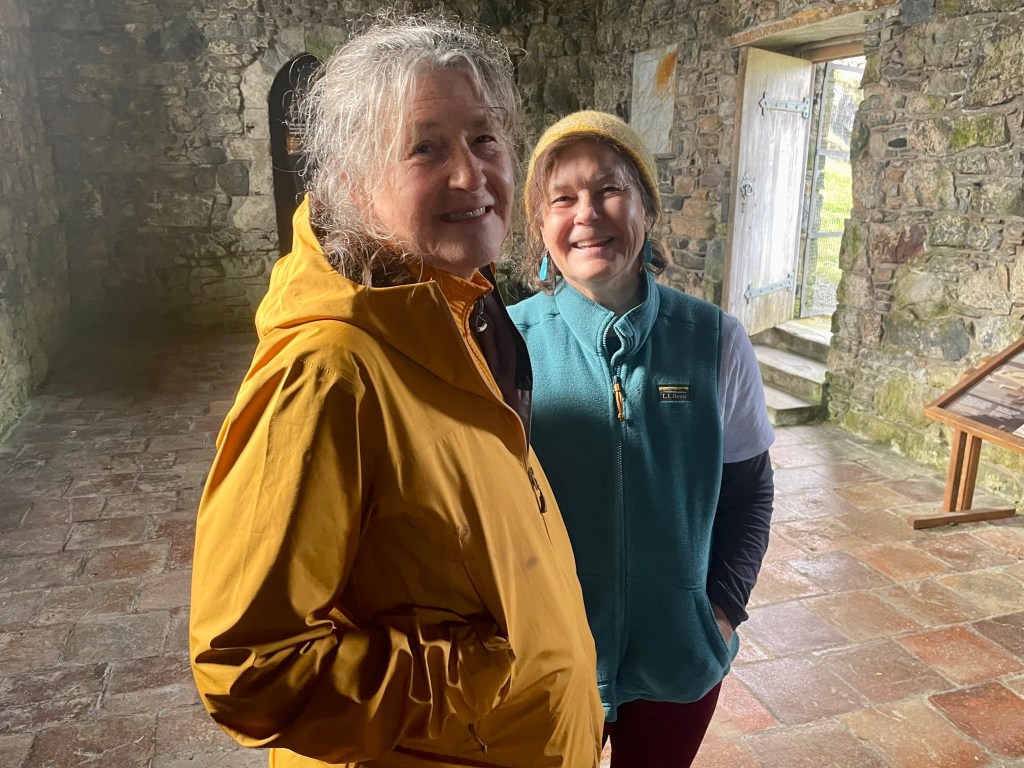
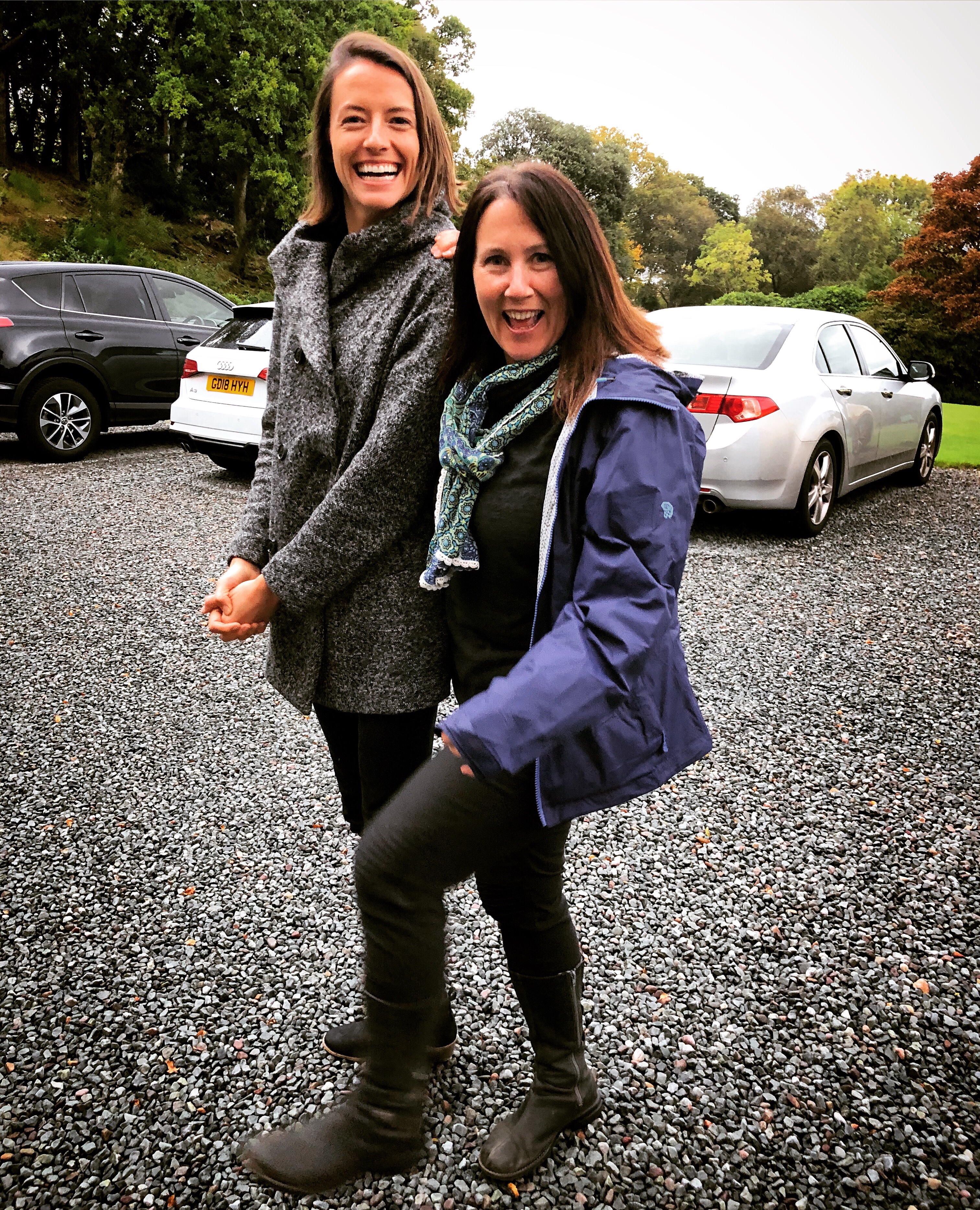
My favorite peeps – sisters Victoria and Margaret

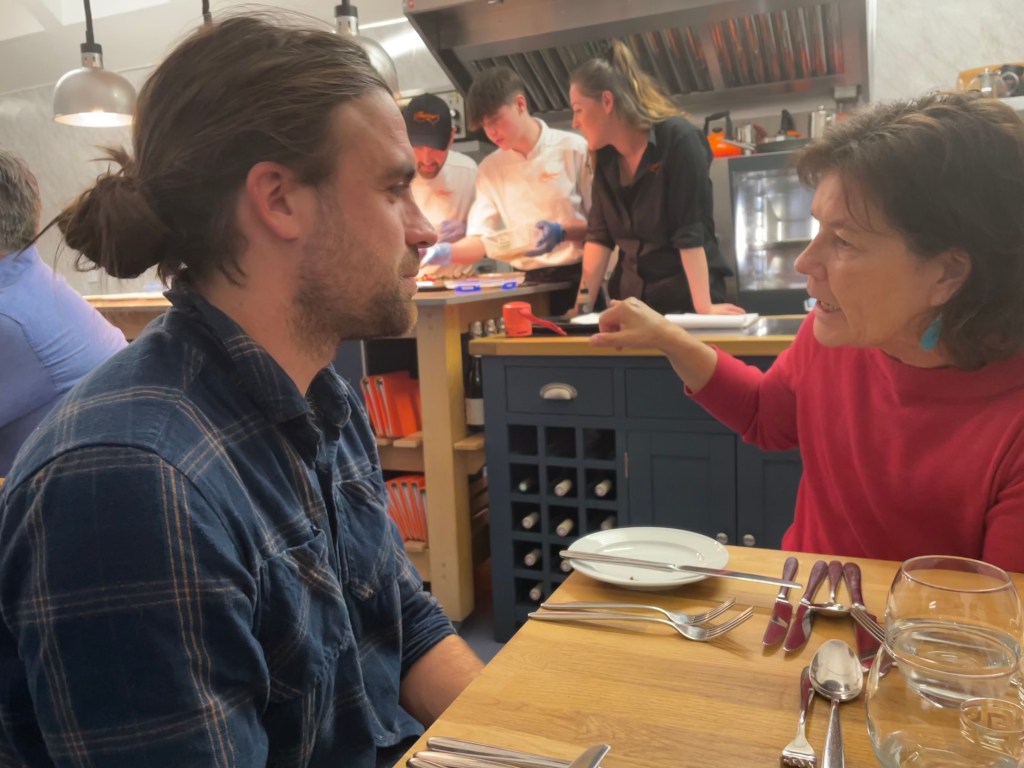
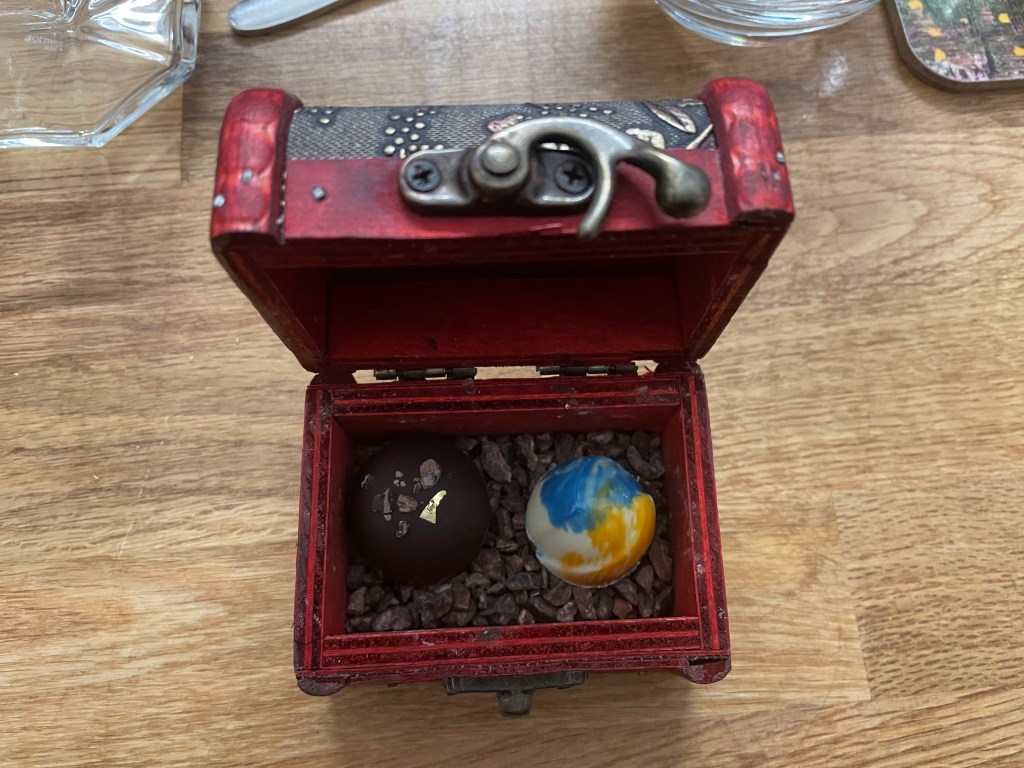
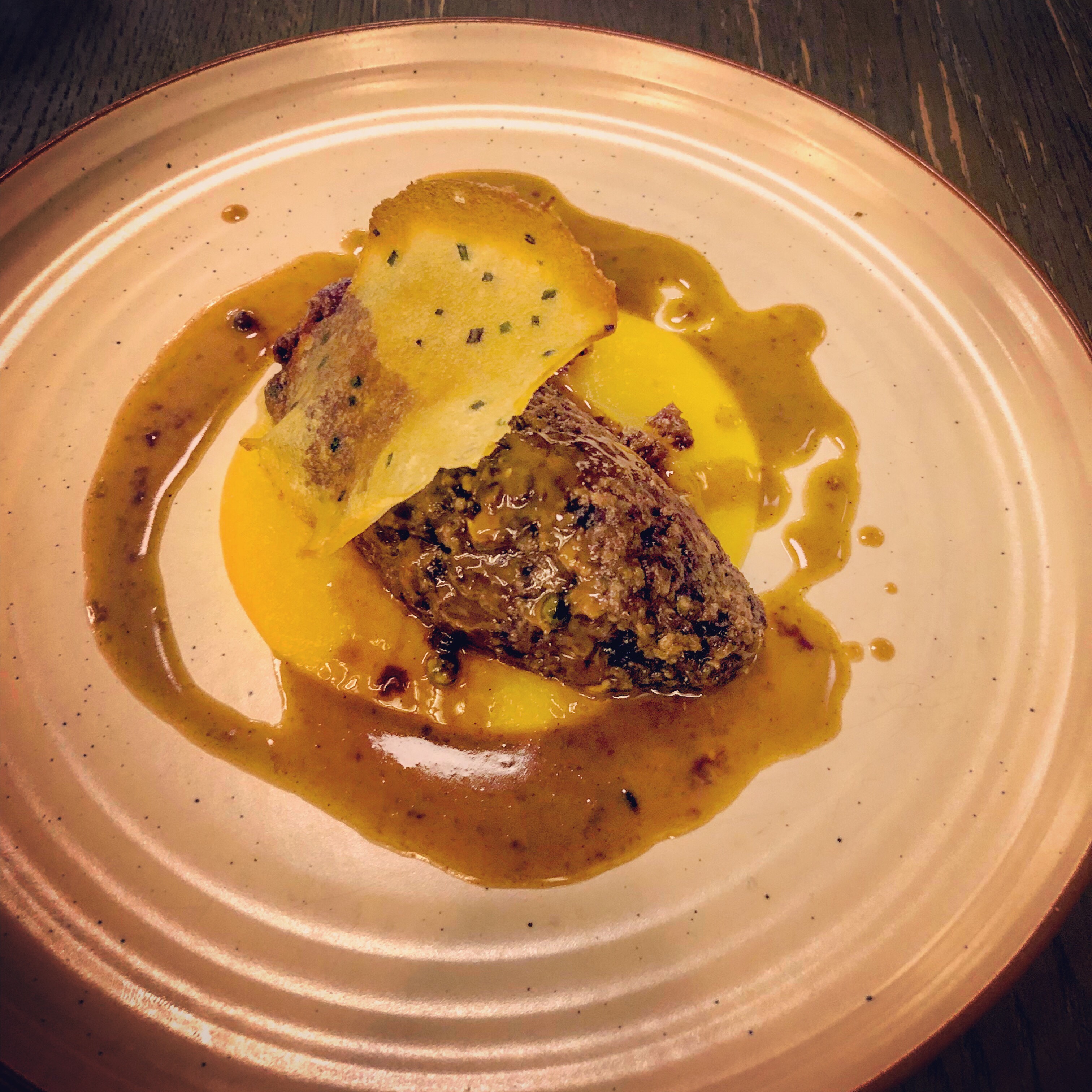
Our day ended in grand style with dinner at Flavour, an intimate restaurant on Harris with one seating and a chef, Chris Loye, who talked us through every beautiful and scrumptious dish on his tasting menu.  That night each dish incorporated, with pride, the newly released Heurach whisky from Harris Distillery. A woman from the distillery lovingly shared its story at the conclusion of our meal. She poured everyone a complimentary dram, clocking with a wry smile that I had been accidentally drinking a Talisker (from Skye).  Dang. As it turns out, she had been sitting at the table next to us with a couple who were right out of central casting for a show about a boring and very very rich English couple with plummy accents and unfortunate and ostentatious sartorial taste. I only wish I had been able to photograph the man’s pointy and aggressively shiny brown shoes.   We decided he was probably an investor in the distillery and so may be forgiven for his wardrobe choices.

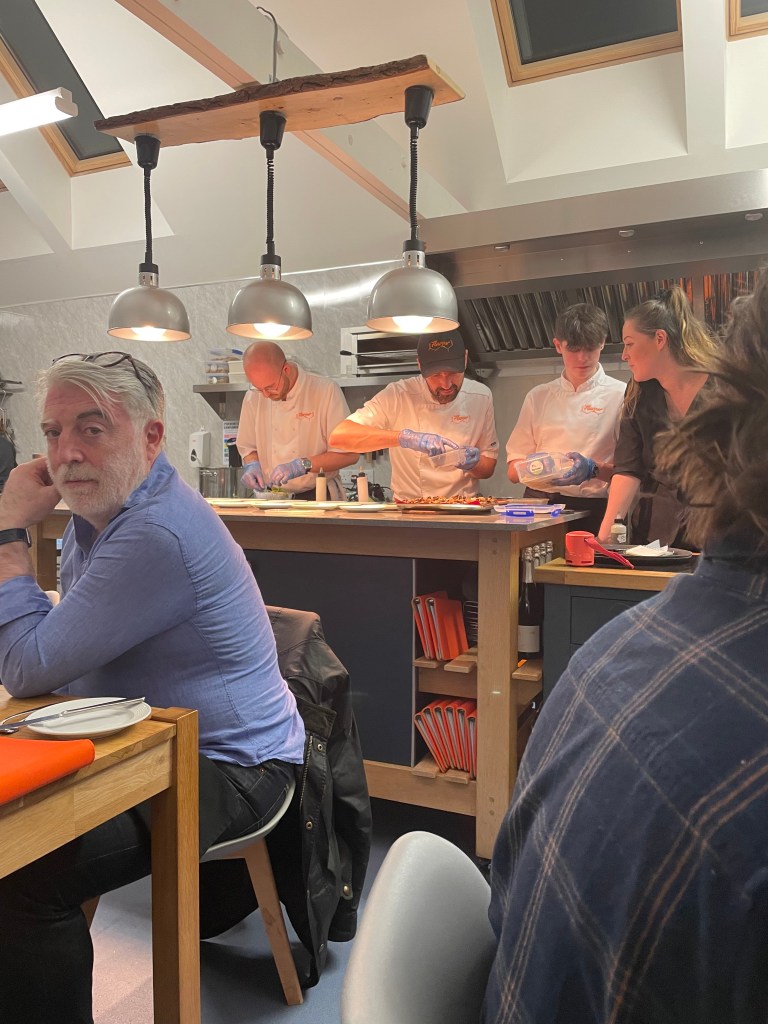
Chris telling us All The Things about each course.  He and his wife spent four years on the road traveling to more than 30 countries learning about food. Back in Scotland, they started with a pop-up restaurant in their home and catering private dinners, finally securing a lease for this restaurant from the North Harris Trust. They built it during the pandemic and it opened in 2021. Now they are written up all over the place. They have Michelin dreams and I wouldn’t doubt it for a second.
The fabulous kitchen staff and obviously the dude busting me on the left is the English guy. Note the tight tight tight shirt which isn’t doing him any favors and I am terrible.

My friends, we have finally arrived on the last day of our fabulous Wilderness Scotland trip. We set off toward Stornaway, on Lewis, to catch the ferry to Ullapool on the mainland.  On our way we stopped at, in my humble opinion, the most magnificent stone circle in a country chocked full of them, the Calanais (Callanish) Stones.  Yes, yes, yes, replicas were made of these stones and then installed on the mainland at the fictitious site of Craig Na Dun for Outlander. Needless to say, they are so much more than that. Our little merry group had them to ourselves and they did not disappoint.

The stones are installed in the shape of a cross with an inner circle. They were erected 5,000 years ago and predate Stonehenge. It is thought that they were an important place of ritual activity for at least 2,000 years and possibly a kind of astronomical observatory.  They are incredibly photogenic, even in the (again) driving rain and wind.

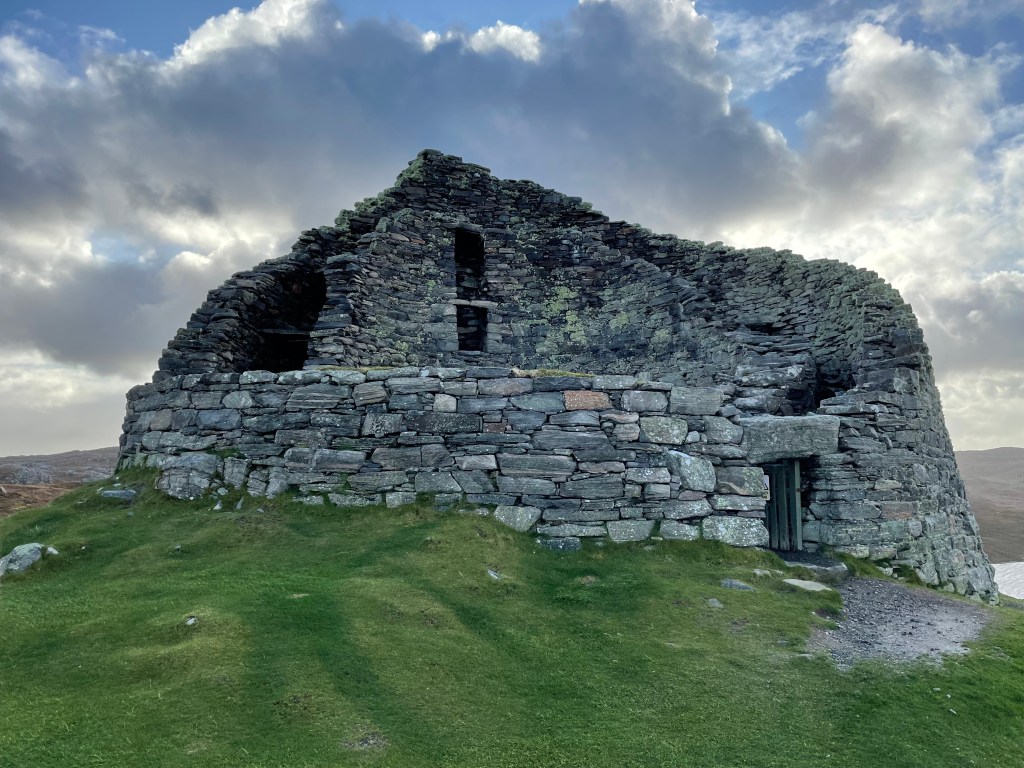
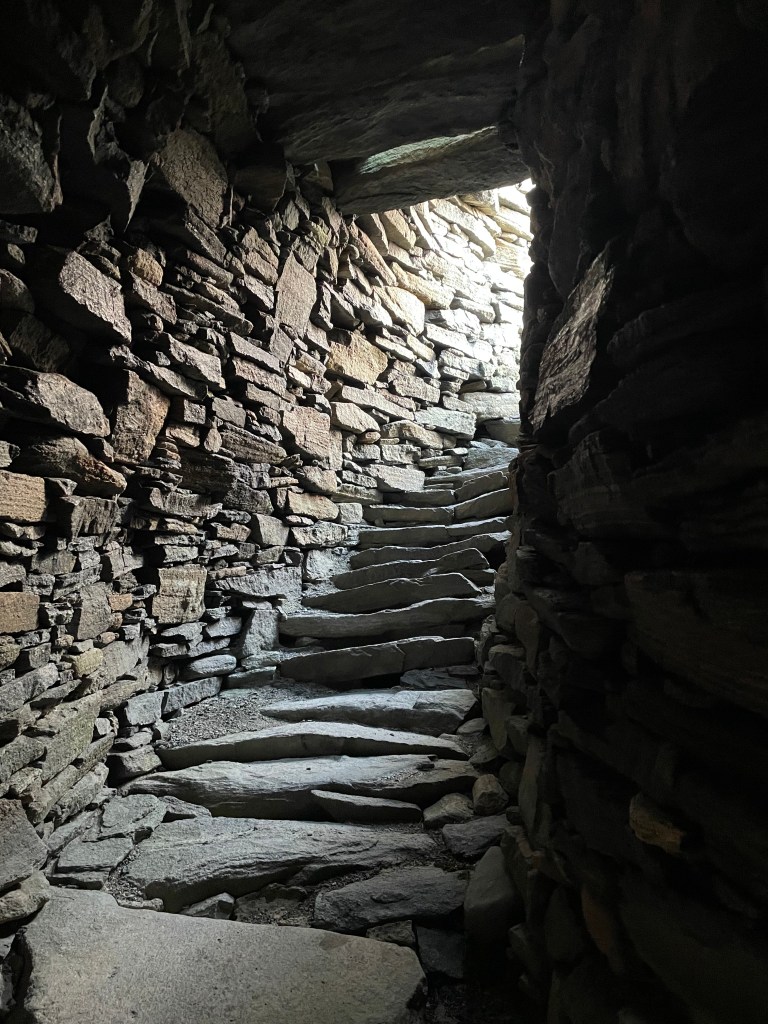
Our last official Outer Hebrides site was Dun Carloway Broch, one of the best preserved brochs in Scotland. These mysterious Iron Age monuments exist nowhere else but here. While these circular structures are as symbolic a feature as any in the highlands, their purpose remains unknown, although it is thought that they were residential structures for fancy people.
On the ferry back to the mainland, as we sailed through calm waters surrounded by hills on various land masses, Jacq, daughter of Margaret and niece of Victoria and awesome human being, turned to me and said incredulously, “There are mountains everywhere here.” I have told so many people about that comment because – I mean it’s true, yes there are. And that is one of the crazy unique Scotland things that for some reason I had never articulated. It doesn’t matter if you are on an island, in the middle of the mainland or on a ferry – there are indeed mountains everywhere. And as a person who needs mountains – that is a plus.

As all things do, the tour at last came to an end and we all bid a fond farewell in Inverness. I snagged dinner at Hootenanny’s, listening to some live music, and spent the night in my favorite B&B in Inverness, Castleview Guest House, run by the wonderful Eleanor and her 14 year old Jack Russell, Mia. I found the place back in 2018 because Rick Steves recommended it, and Eleanor said on his visit years ago he was most enamored of her hand-written, nearly illegible guest reservation book.
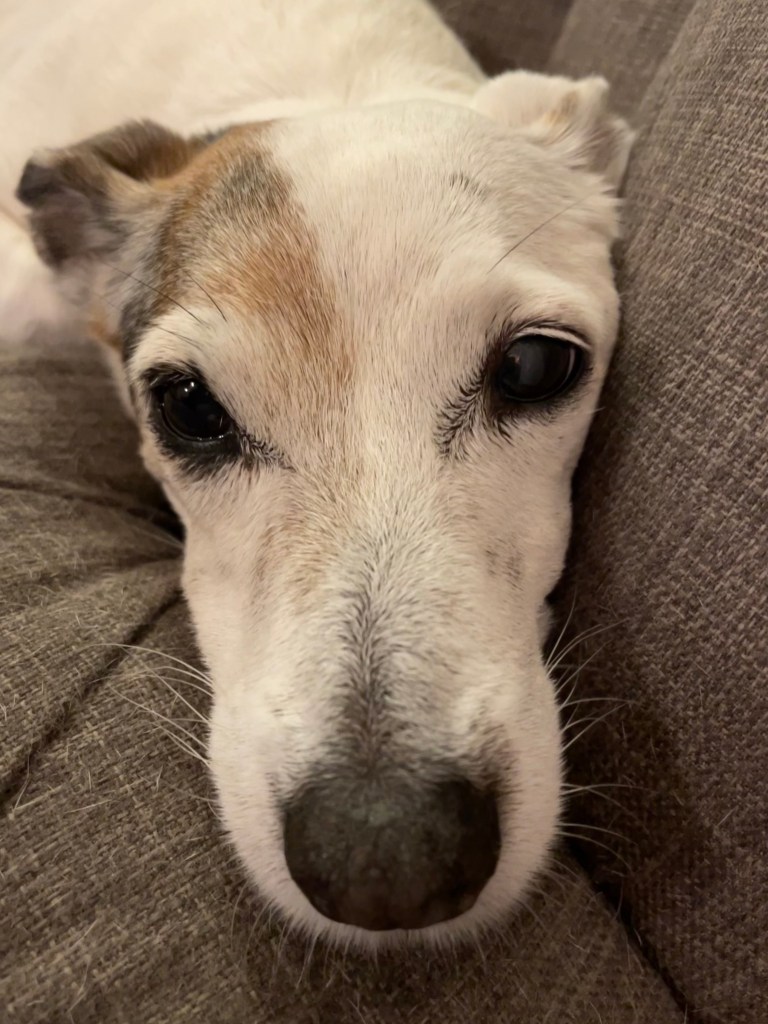
Sweet Mia

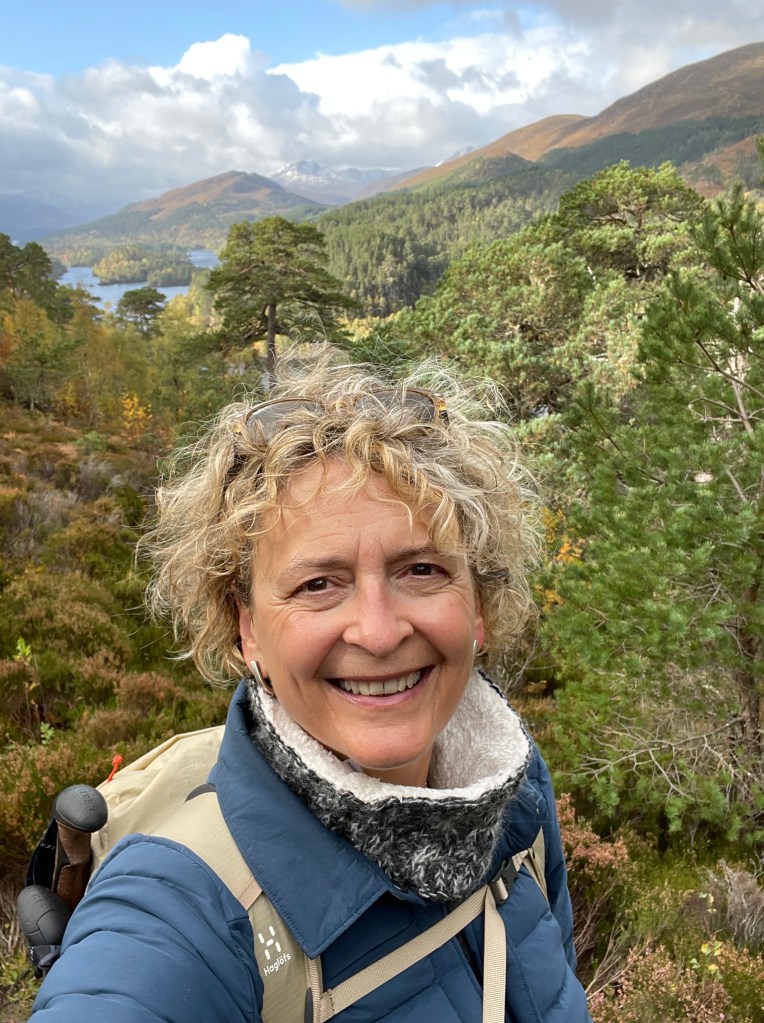
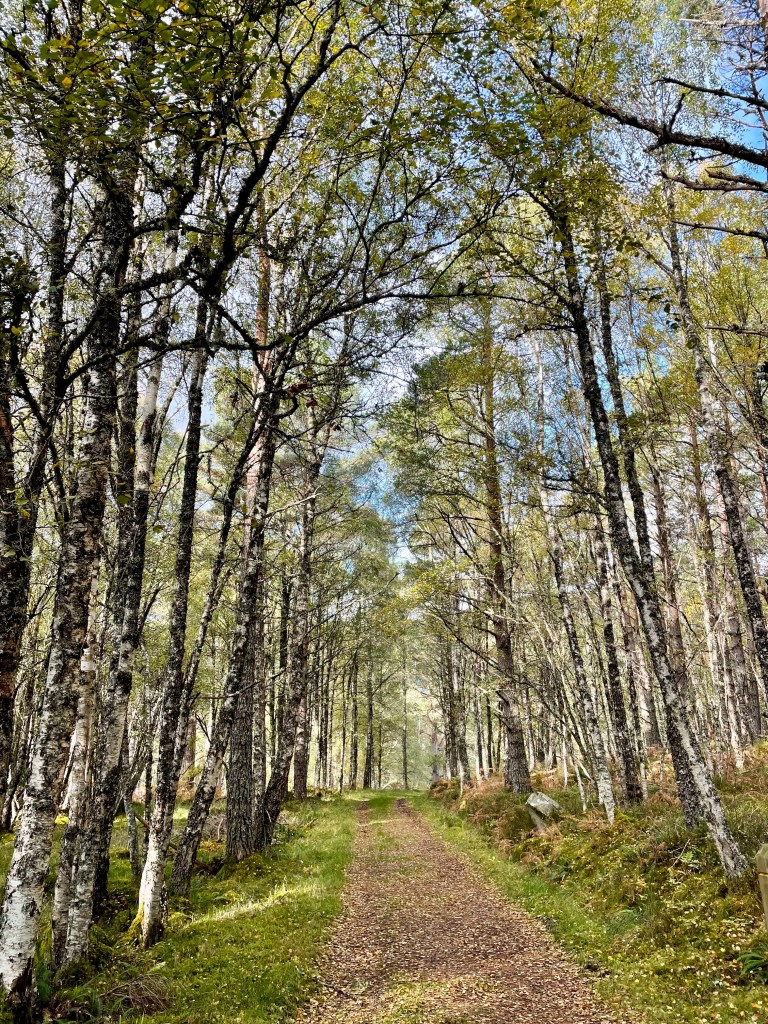
I know this sounds insane but the next day I rented a car and drove back to Skye. It’s actually not that far and Skye is Skye, so maybe not insane but only slightly eccentric. I stopped at Glen Affric, another splendid nature reserve on the mainland. And, best of all, there was snow on them thar hills.
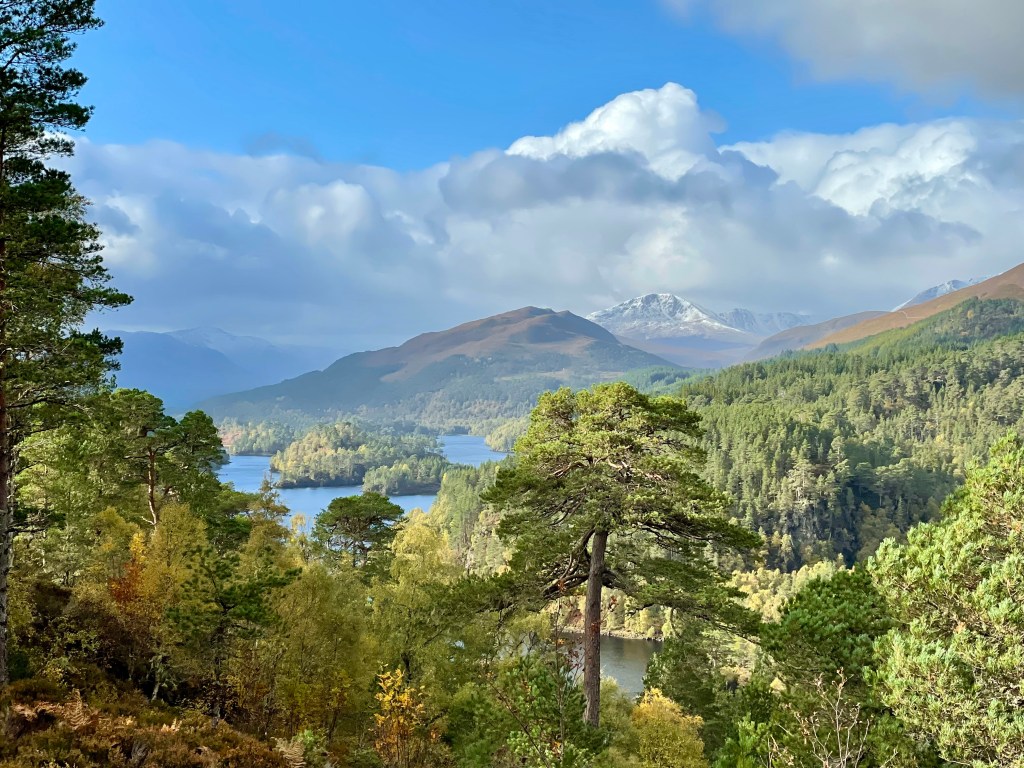
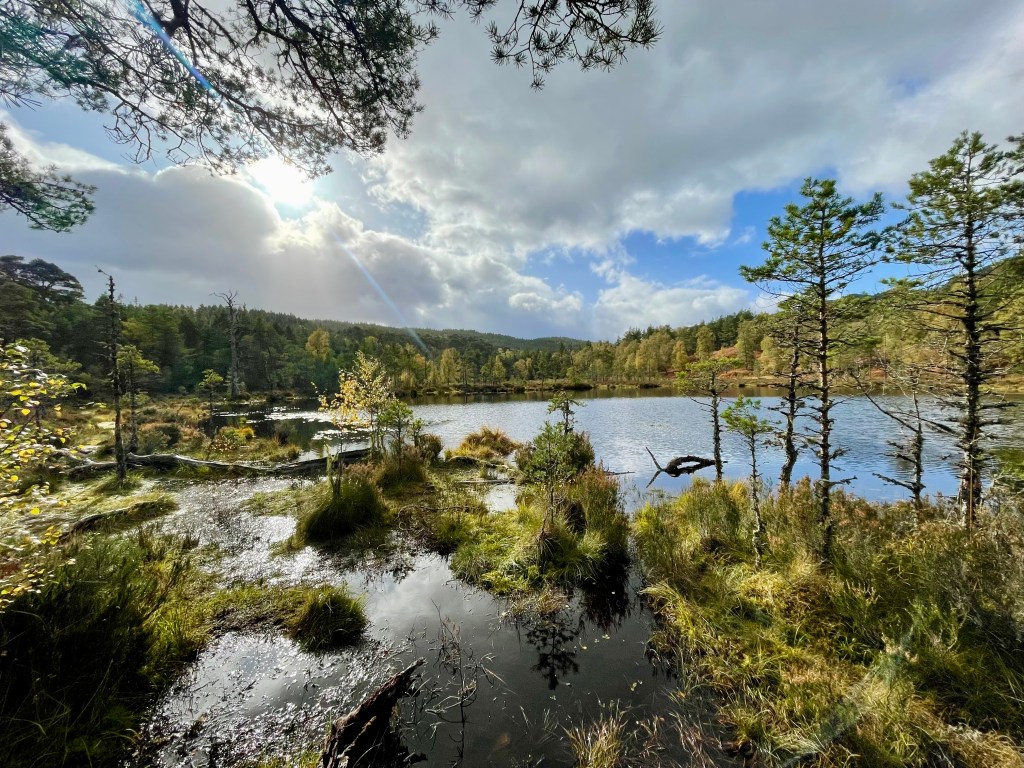
Glen Affric, along with many other reserves I had visited over the past few weeks, is one of rewilding zones of Scotland. This restoration and conservation effort had become rather an unintended but very much appreciated mantra of my trip and thankfully is a government priority. Trees and other vegetation are planted in these areas with the goal of creating a landscape that more closely resembles the Scotland of thousands of years ago, which is not the bare hills of the highlands that we are accustomed to seeing, but rather a more forested landscape providing a more diverse habitat for a greater variety of flora and fauna. For example, trees are often planted along rivers to provide shade and cool the water so salmon can thrive.

Some in the countryside advocate passionately for rewilding, others see it as an existential threat to their culture, history, and way of life. Farmers, deer stalkers, ghillies and gamekeepers are quite anxious about the impact these plans will have on their jobs. For example, Scotland is teeming with too many deer which denude the landscape – contributing to the problem – by eating foliage from the roots (as opposed to sheep whose style is more like a lawnmower) yet efforts to cull the herd have run into resistance from landowners and staff whose income is wedded to the deer stalking business.

Be that as it may, rewilding efforts are grounded in the belief that land is not primarily for generating income from sporting activities, forestry or commercial agriculture, it’s for, you know, life writ large. Creating, nurturing and protecting wild land produces the oxygen and the biodiversity we need to survive and offers solace and inspiration for our imaginations and our souls. So there.

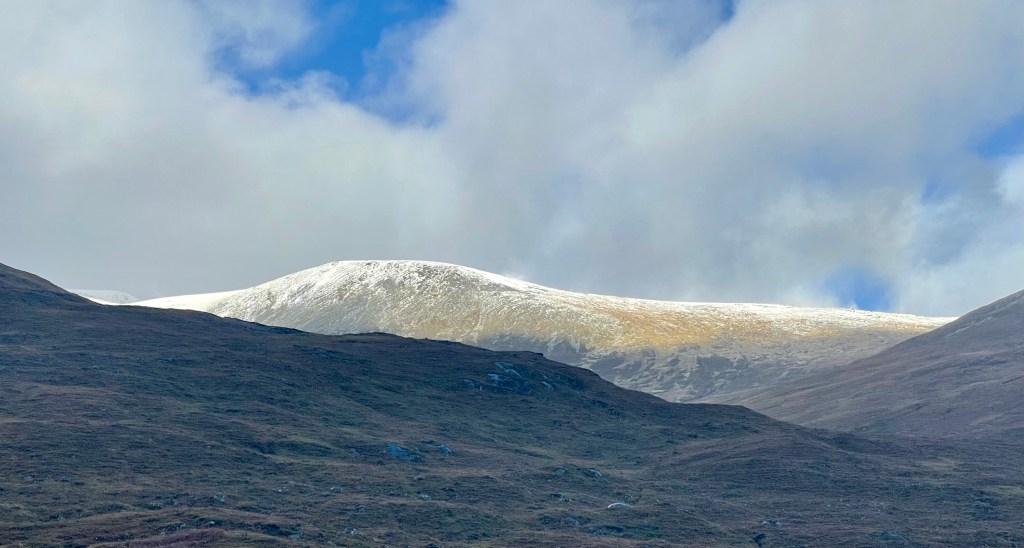
Returning to our beautiful drive back to Skye, there was also a sprinkling of snow on the peaks surrounding Glen Shiel. No matter how old I get, there is always something magical about the first snow of the year.
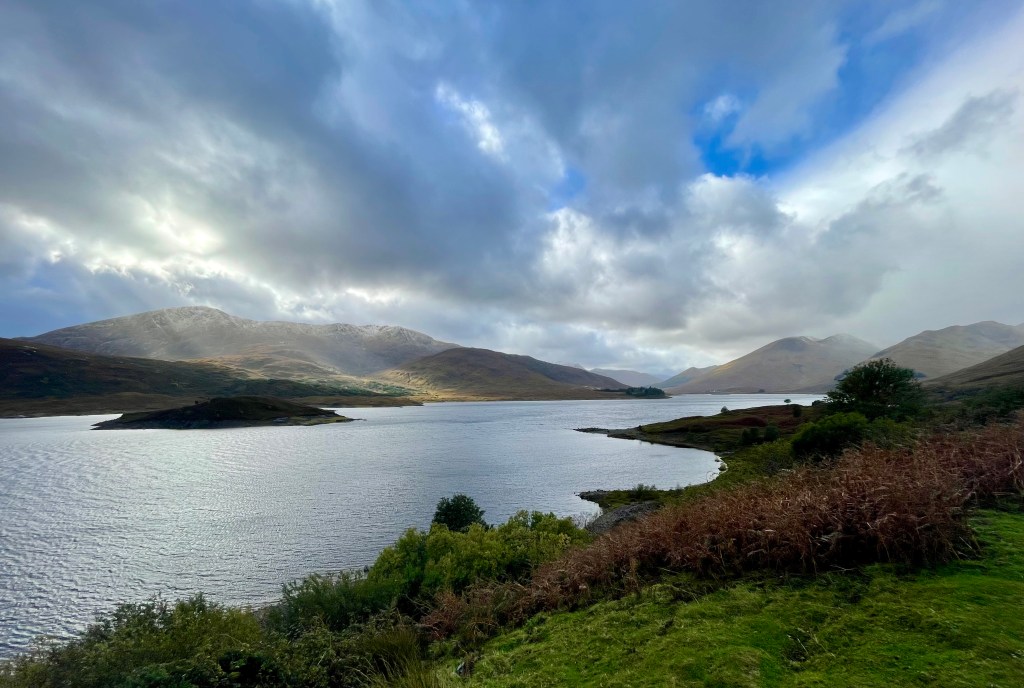
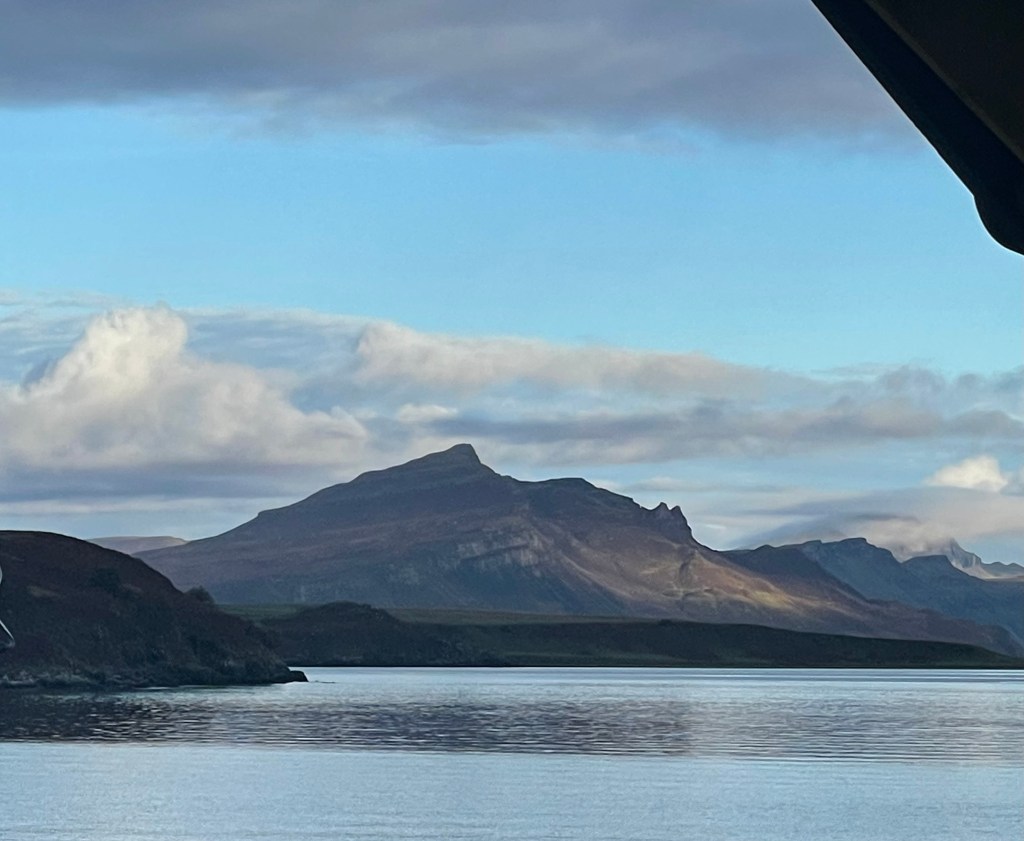
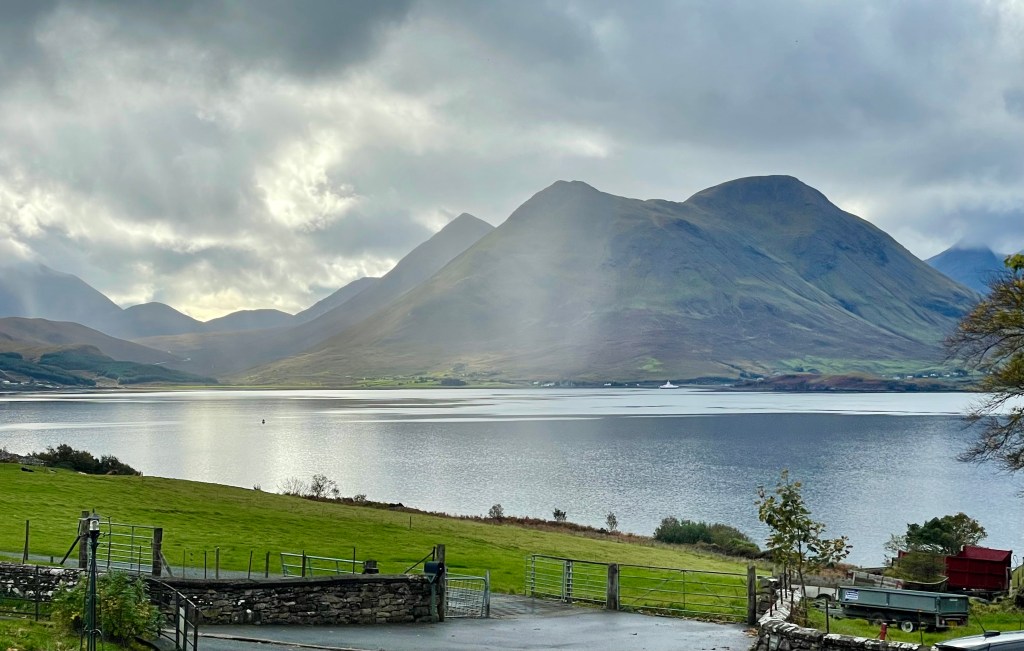
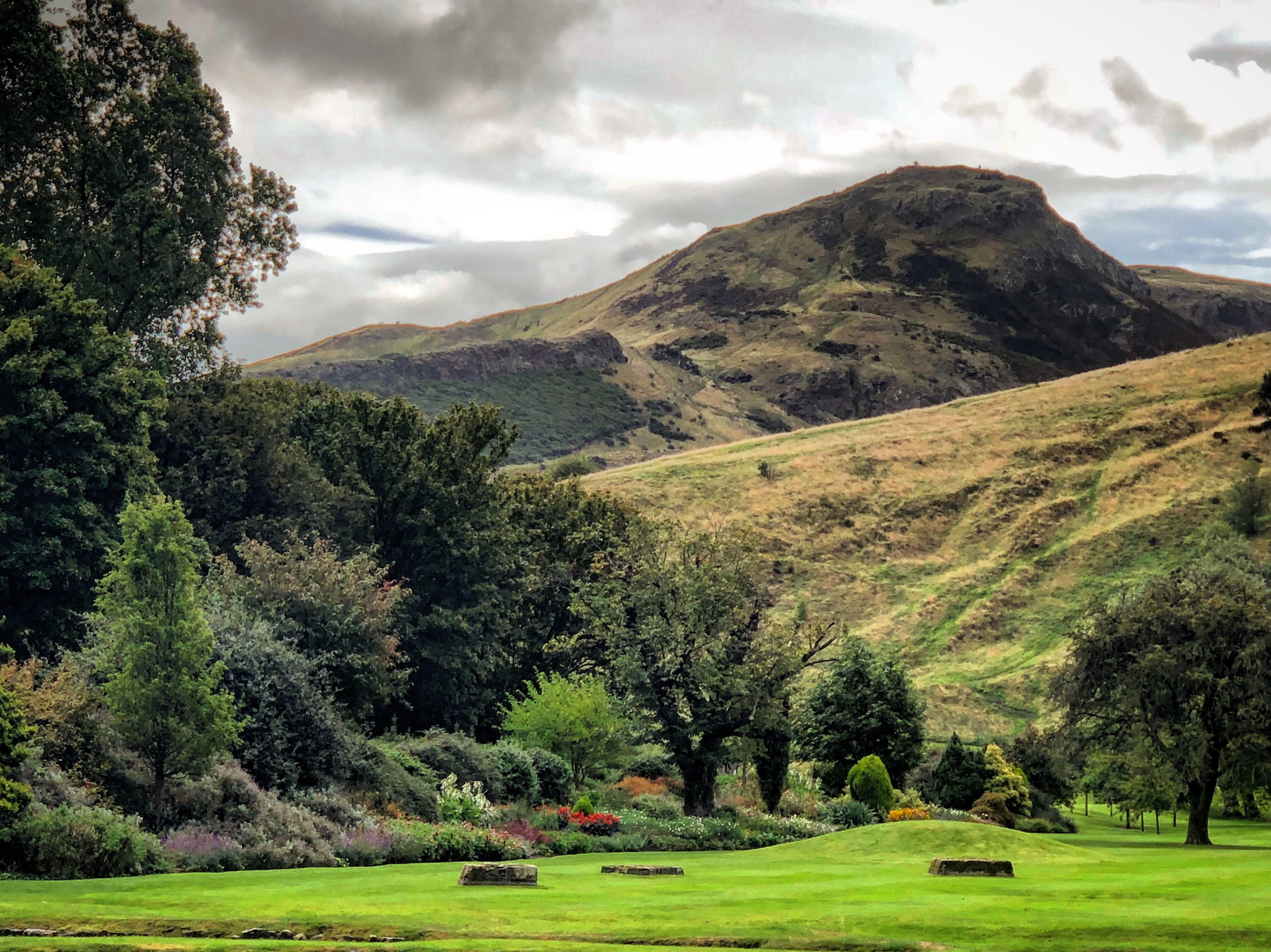
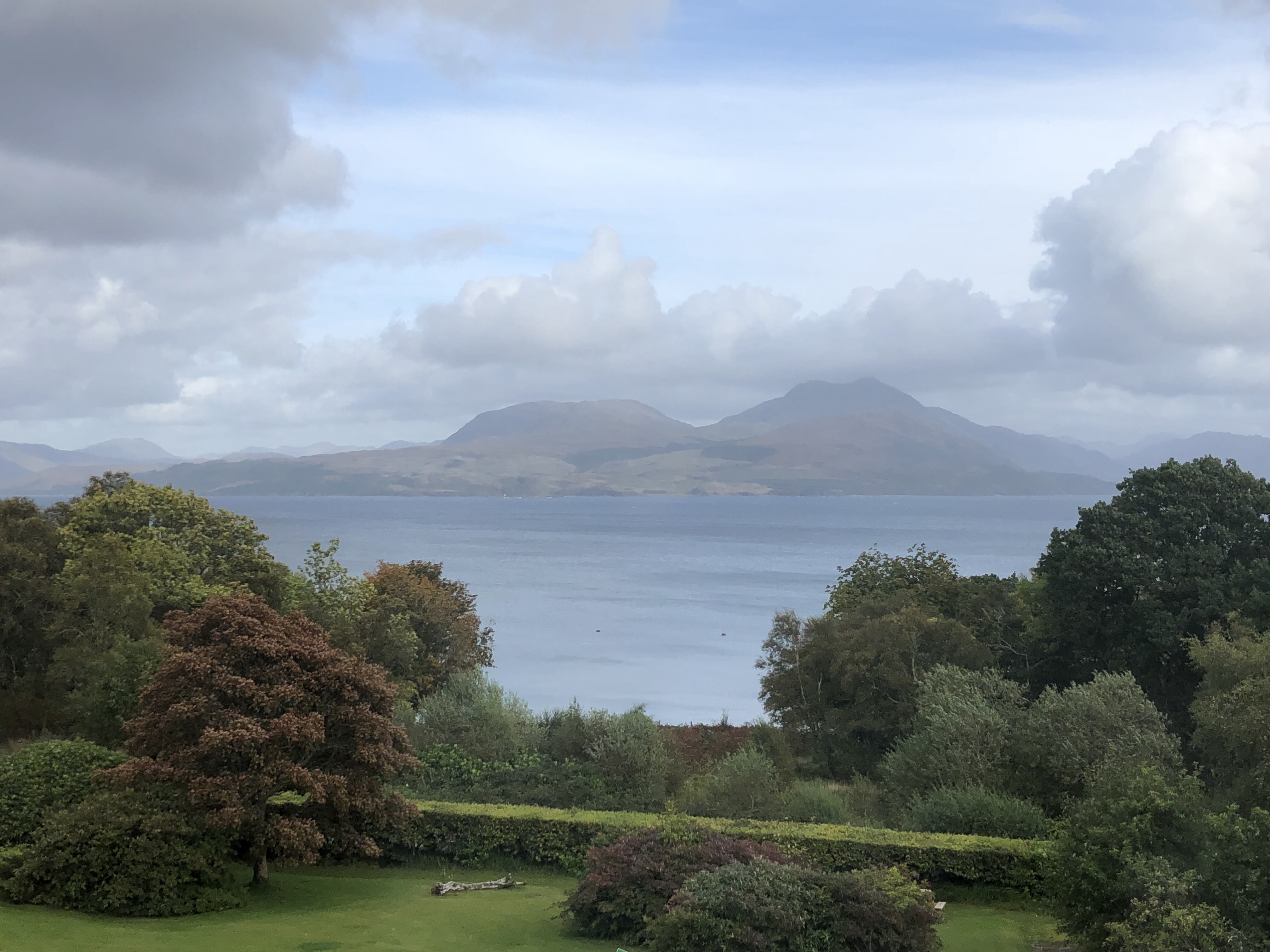
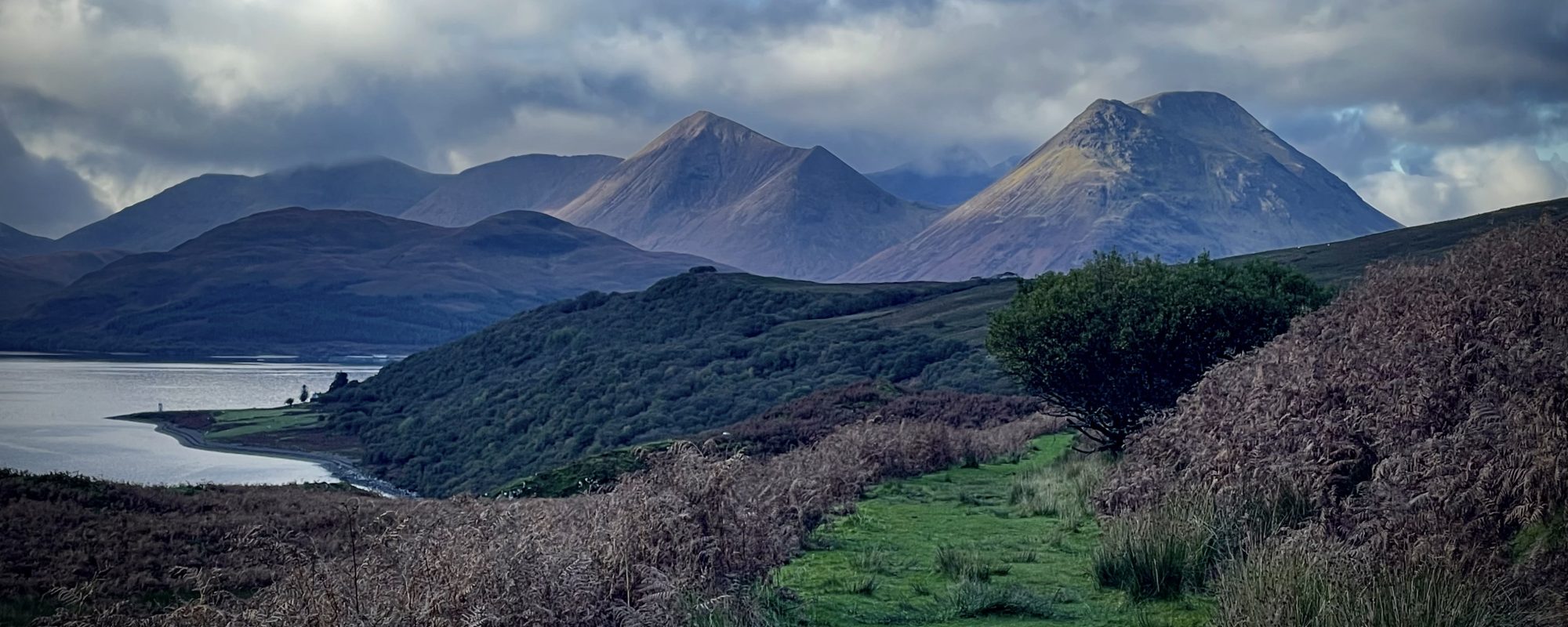
Once over the Skye Bridge, I drove through Glen Sligichan, this time in gorgeous weather and so stopped for a photo of the wily Black and Red Cuillins, since as you’ll remember they were shrouded in mist and dreich the week before.
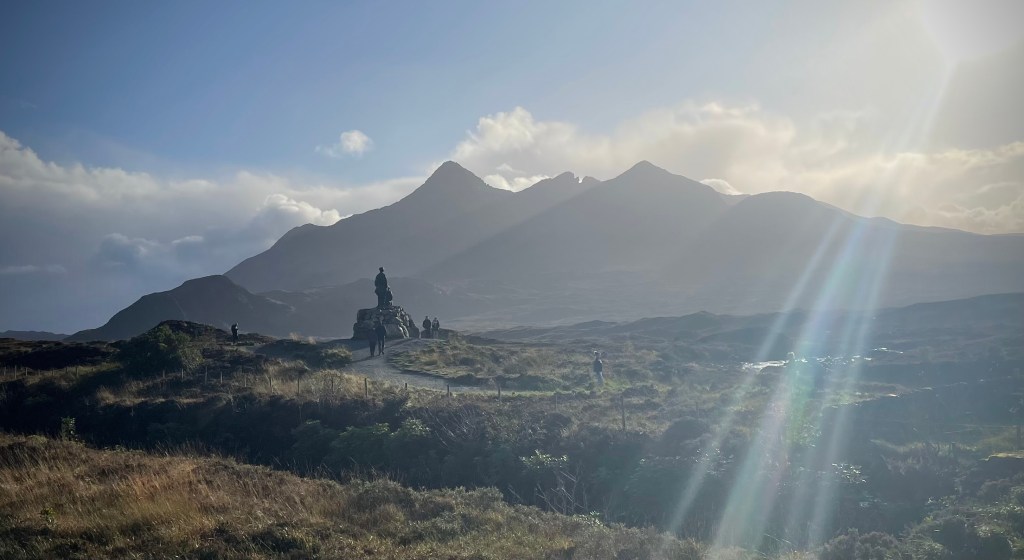
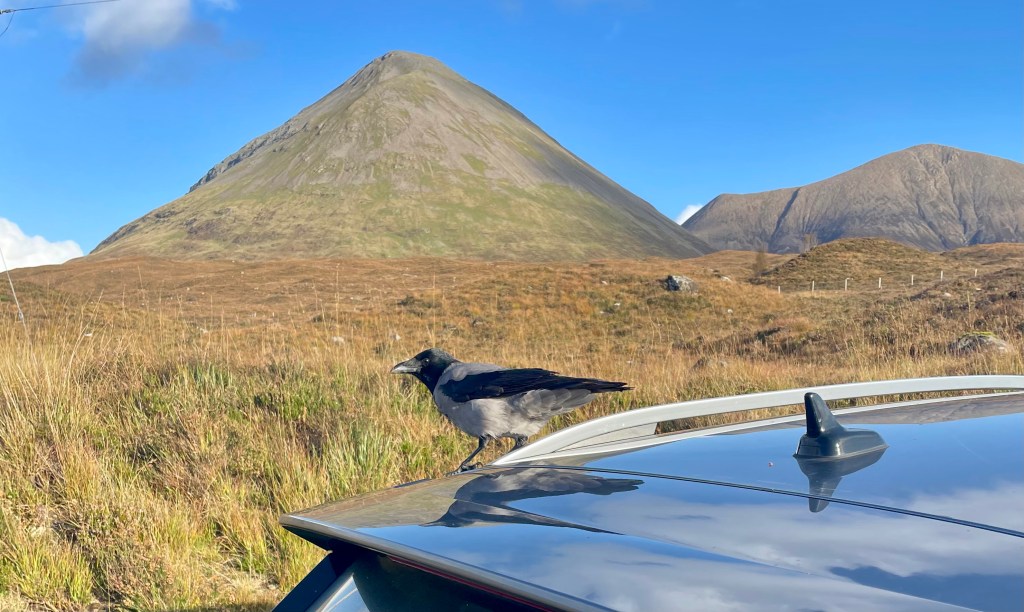
Full circle: a hooded crow on the car once again, this time in better conditions.

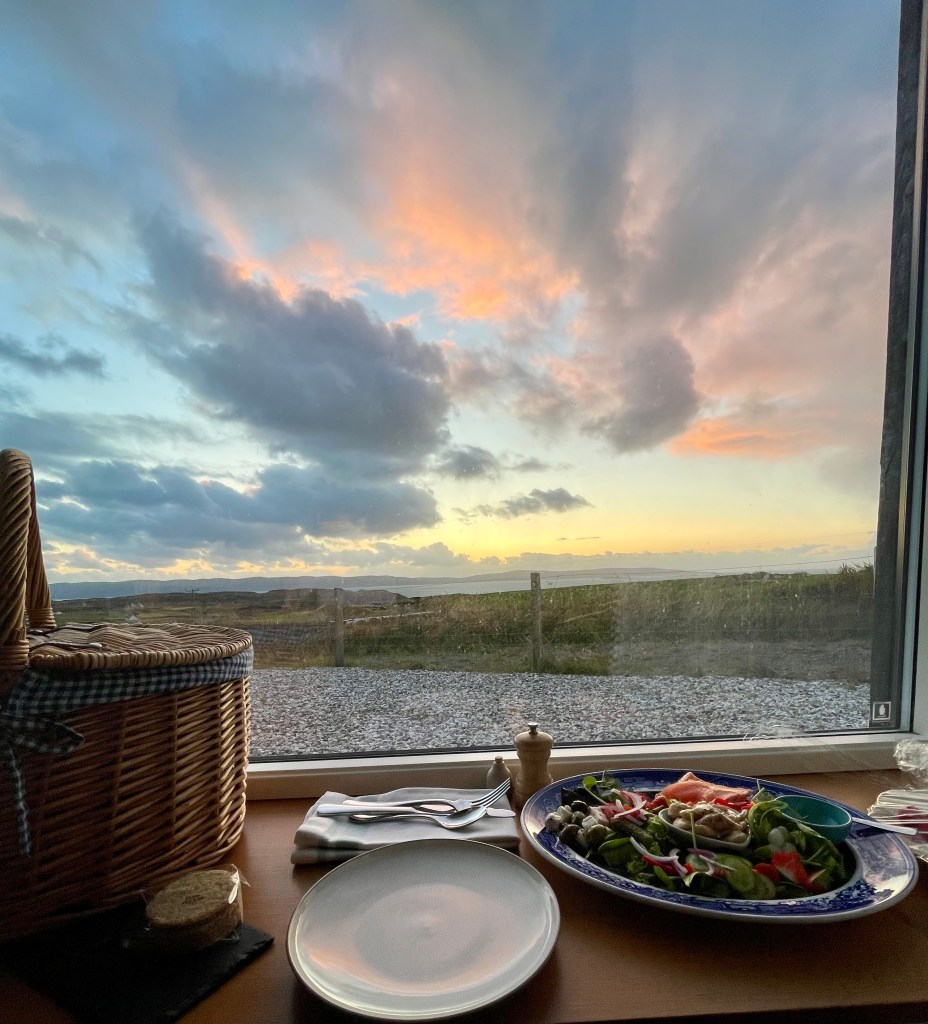
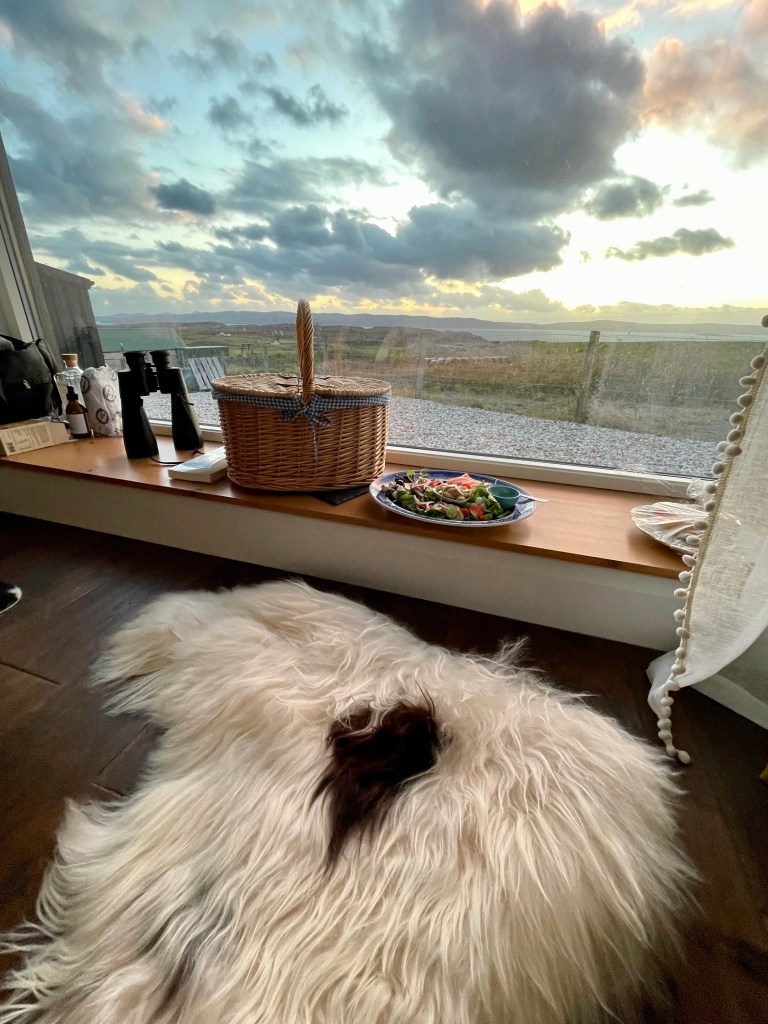
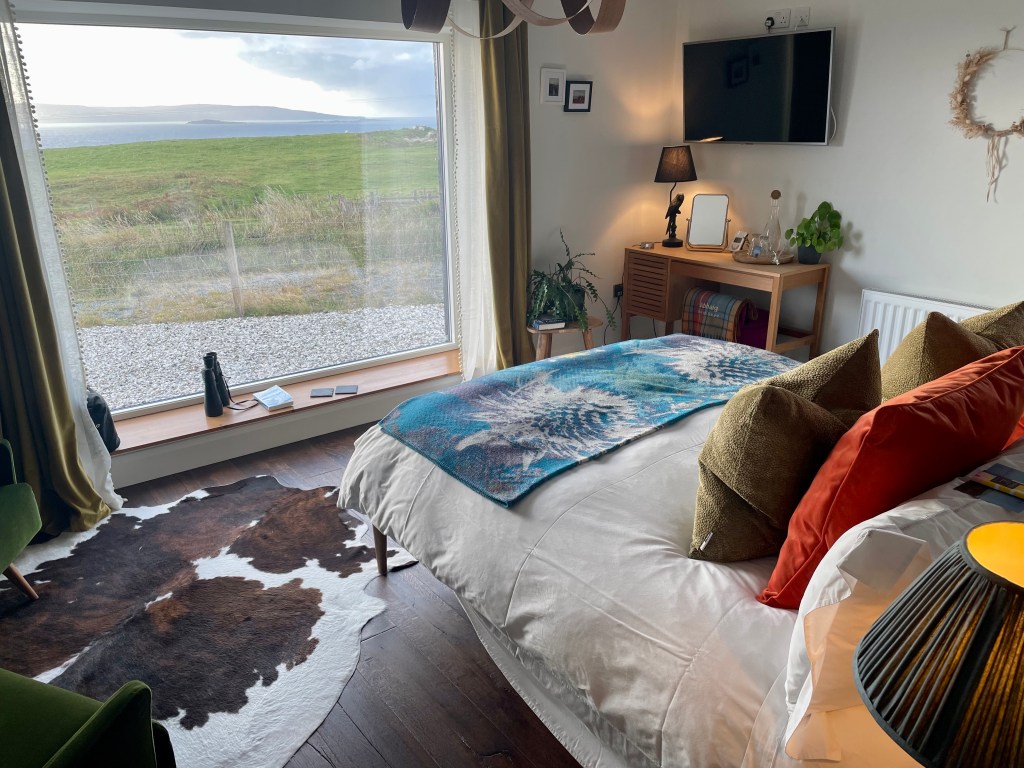
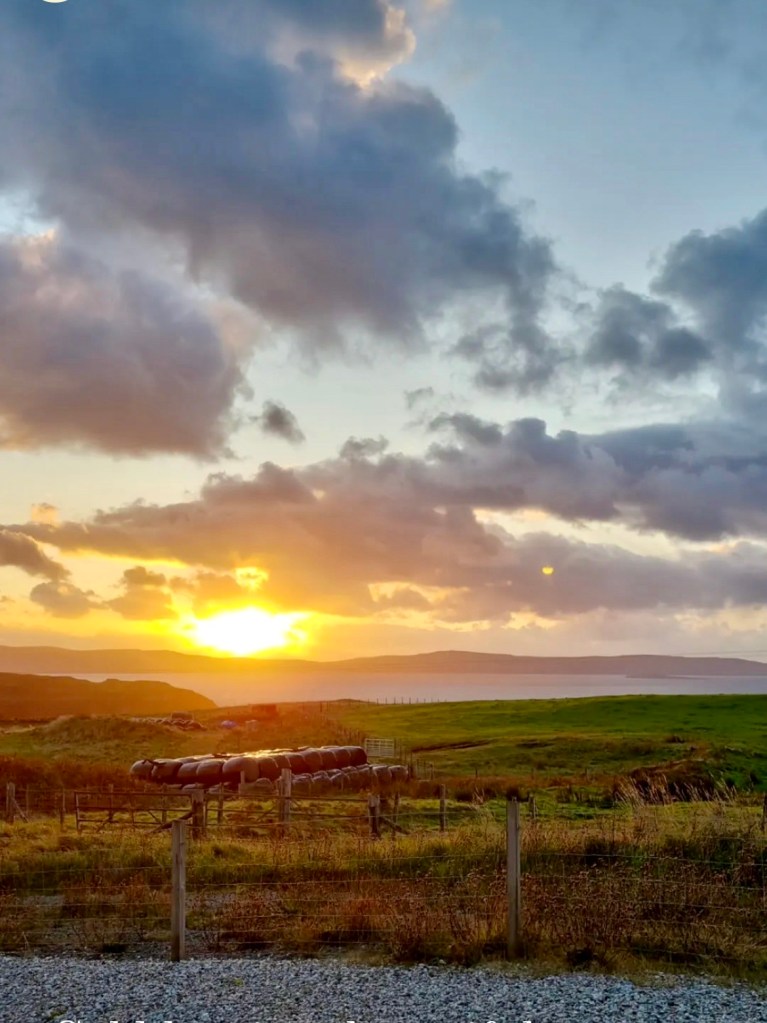
In Skye, I stayed in Uig, where we also stayed during the Wilderness Scotland trip, which I swear I didn’t realize in advance. I knew we were staying somewhere on Skye but no idea where. Crazy.  Clearly meant to be, yeah? Anyway, I stayed at a fabulous B&B, Abhaig House, run by an even more fabulous couple, Viv and Steve, who brought me a piece of a home-baked cake every single day. The view from my room was unbelievable, and I arrived to a charcuterie board with fresh salmon prepared by my hosts for a most delectable dinner, complete with a jaw-dropping sunset view.
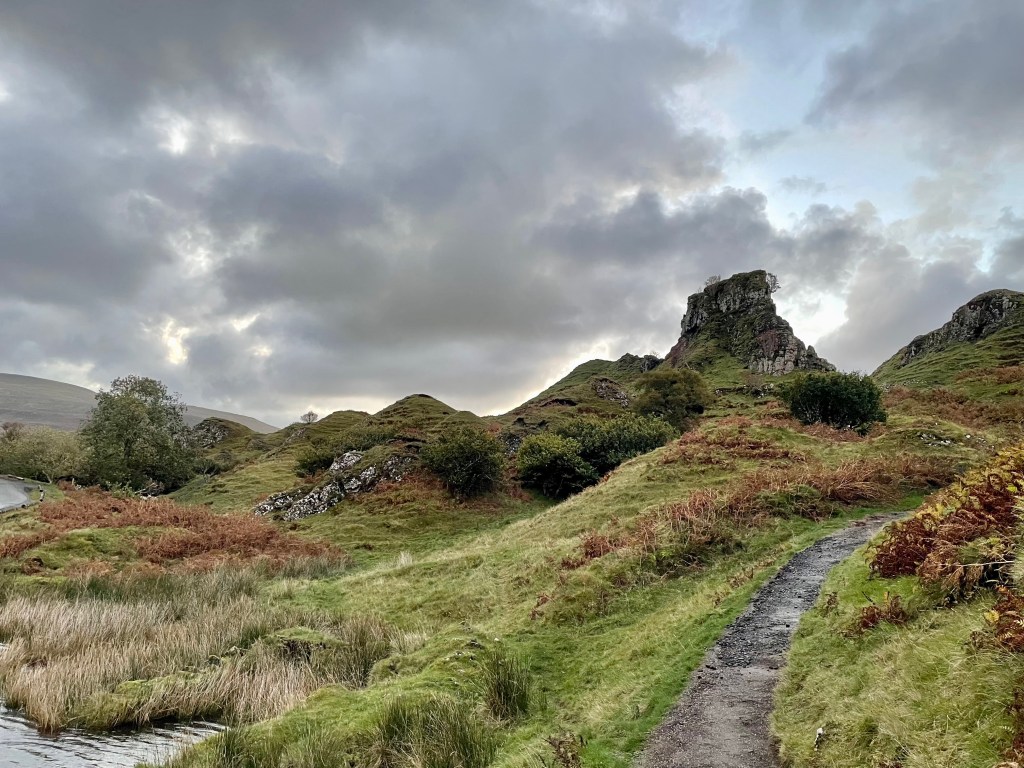
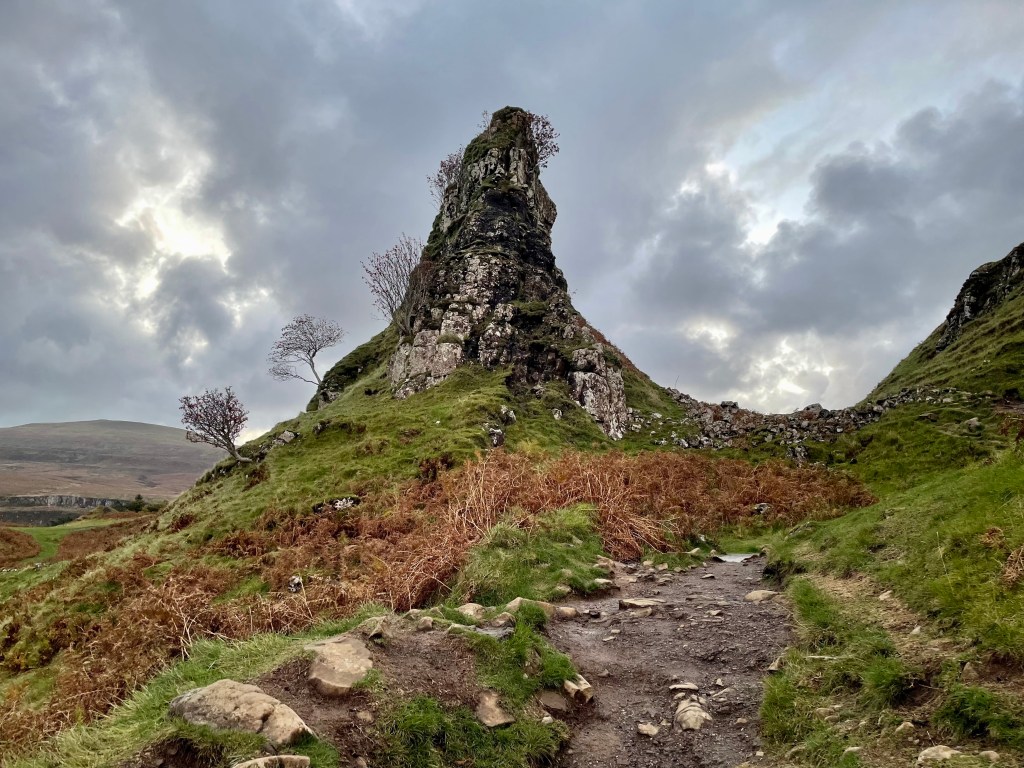
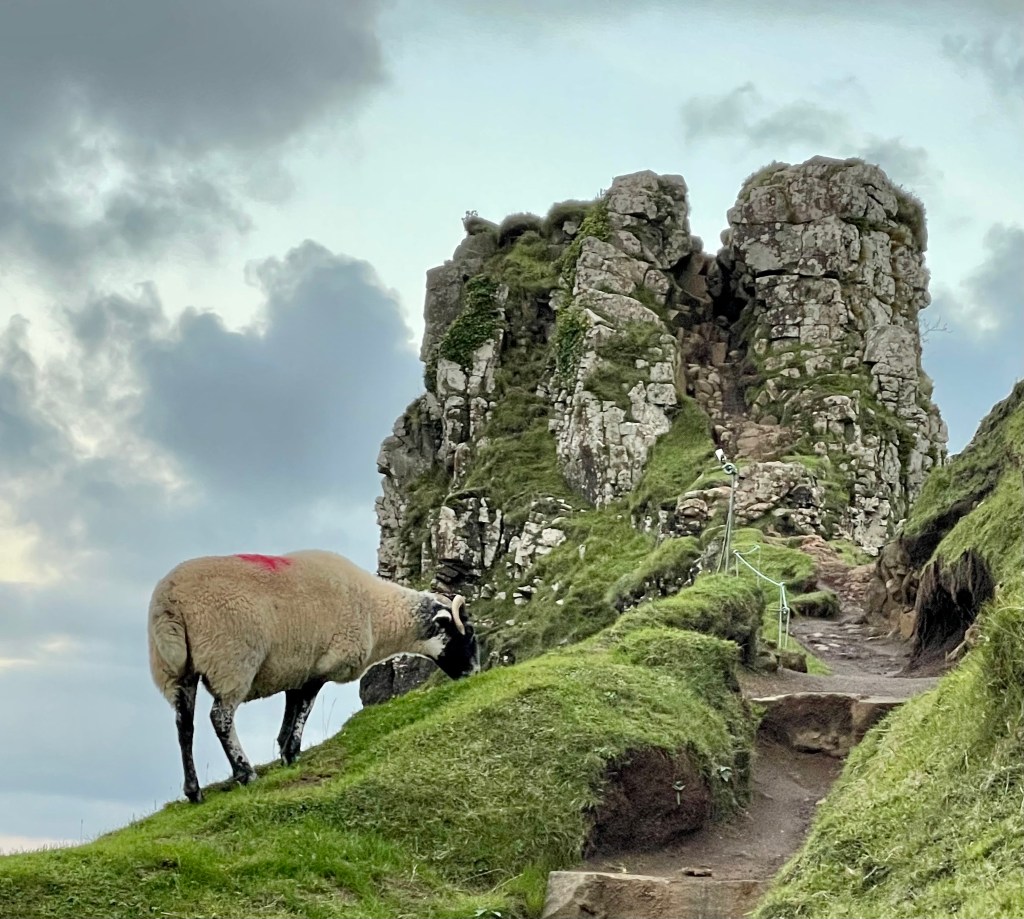
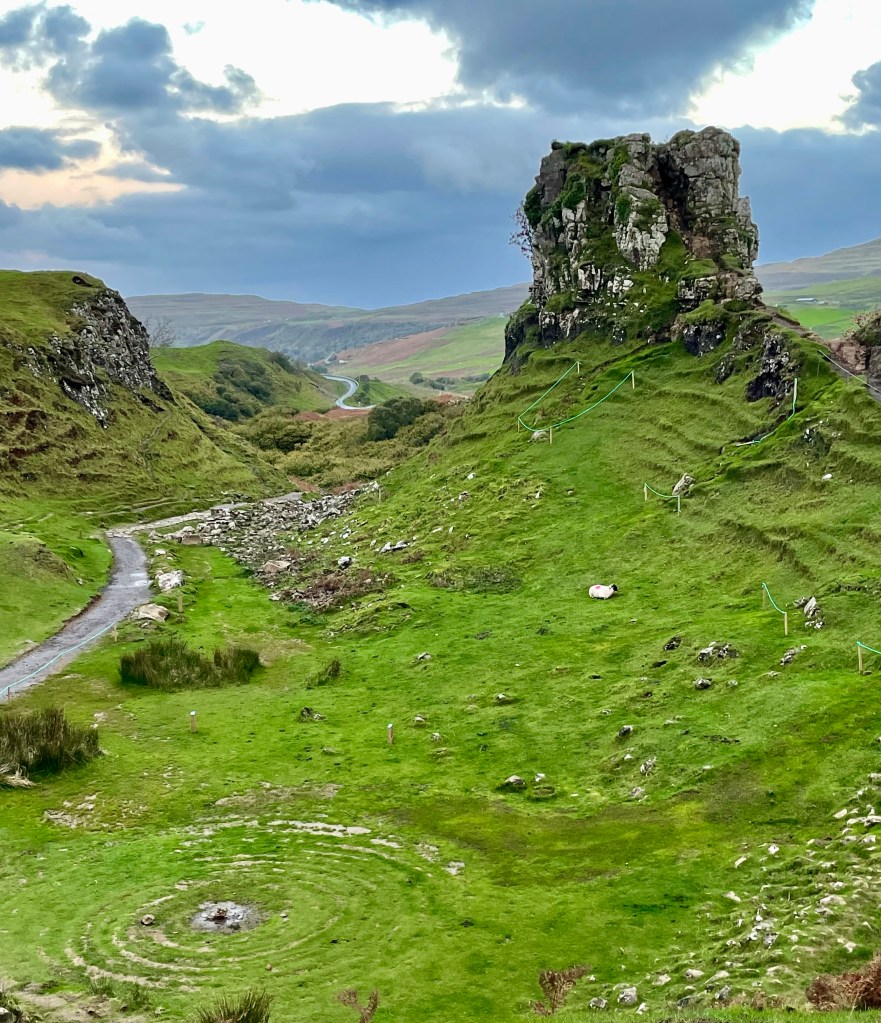
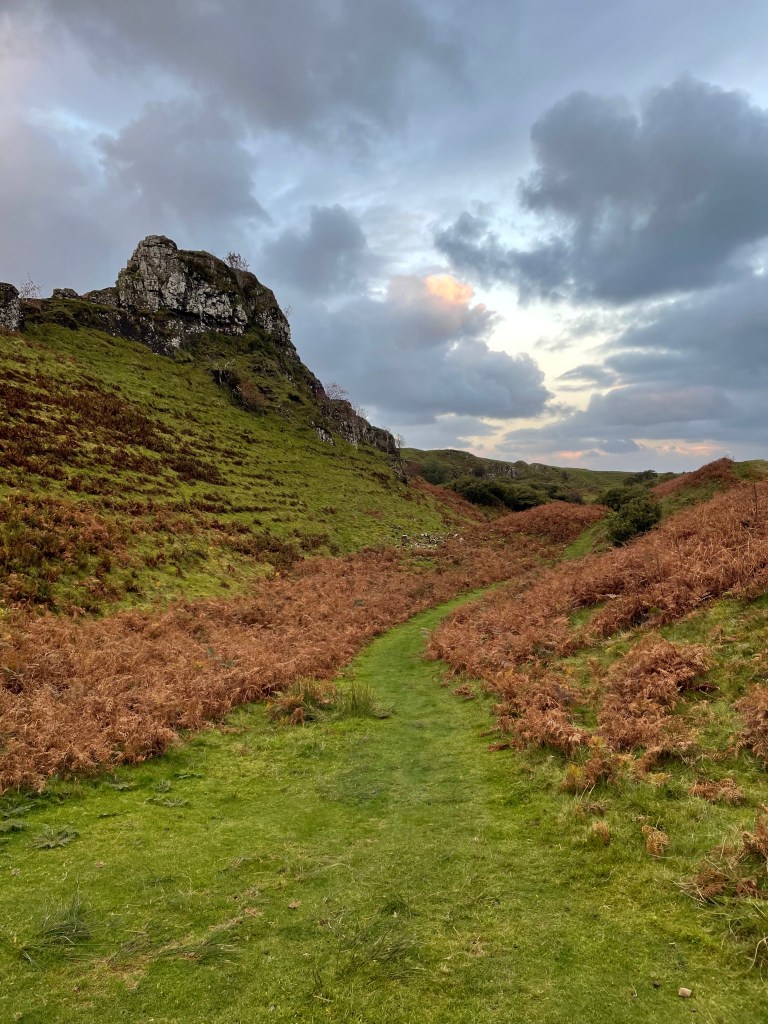
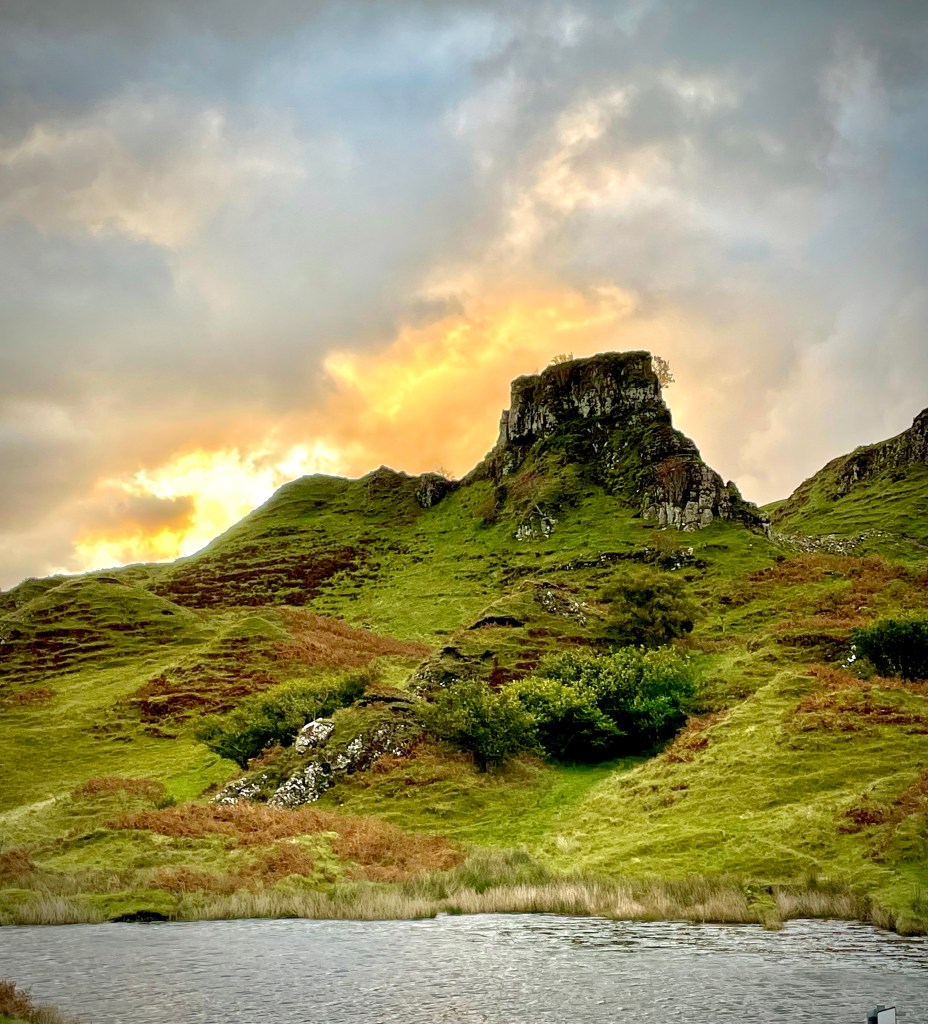
The next morning I woke up early and drove just a few minutes to one of Skye’s honeypots, the Fairy Glen. It’s usually crawling with ugh tourists but we are now in late October, and I arrived at sunrise so it was mine all mine.  Just a crazy beautiful and singular area on the backside of the Quiraing. Geology, my friend. Geology. I mean what IS this place.
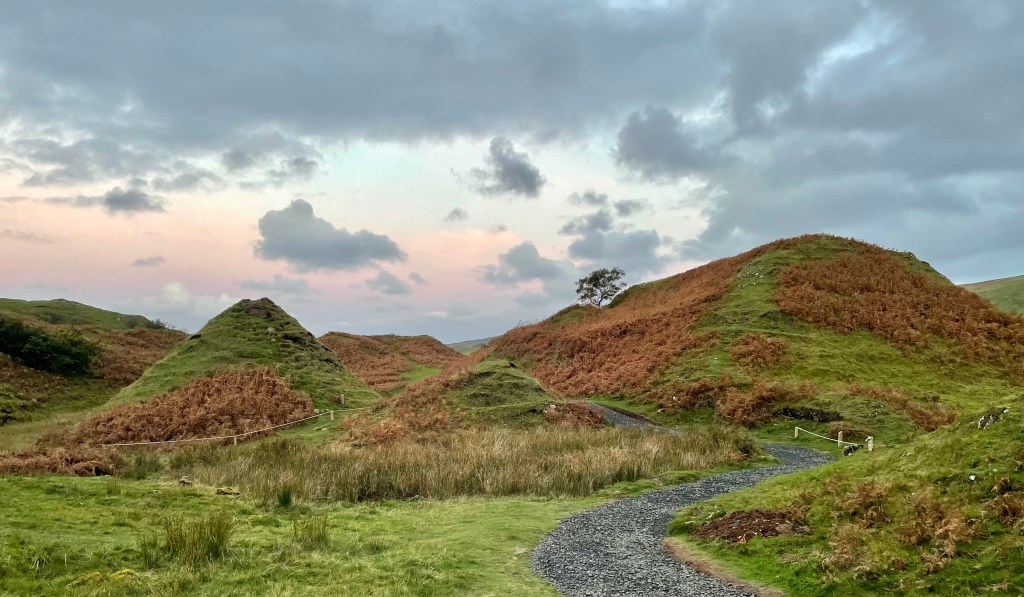
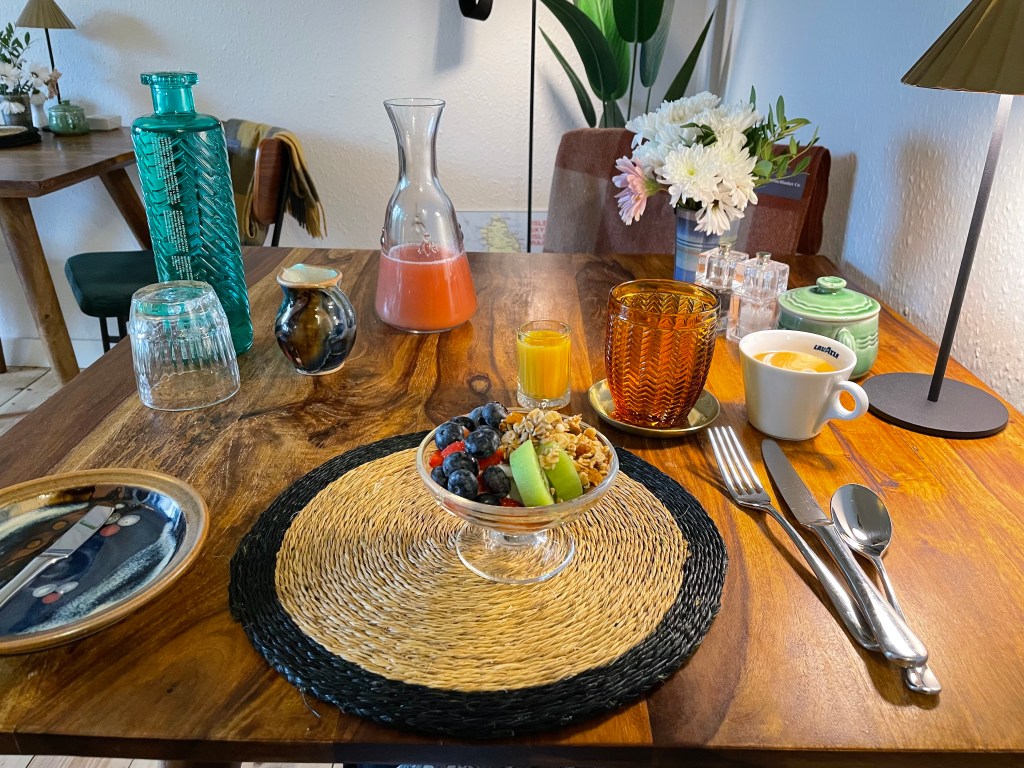
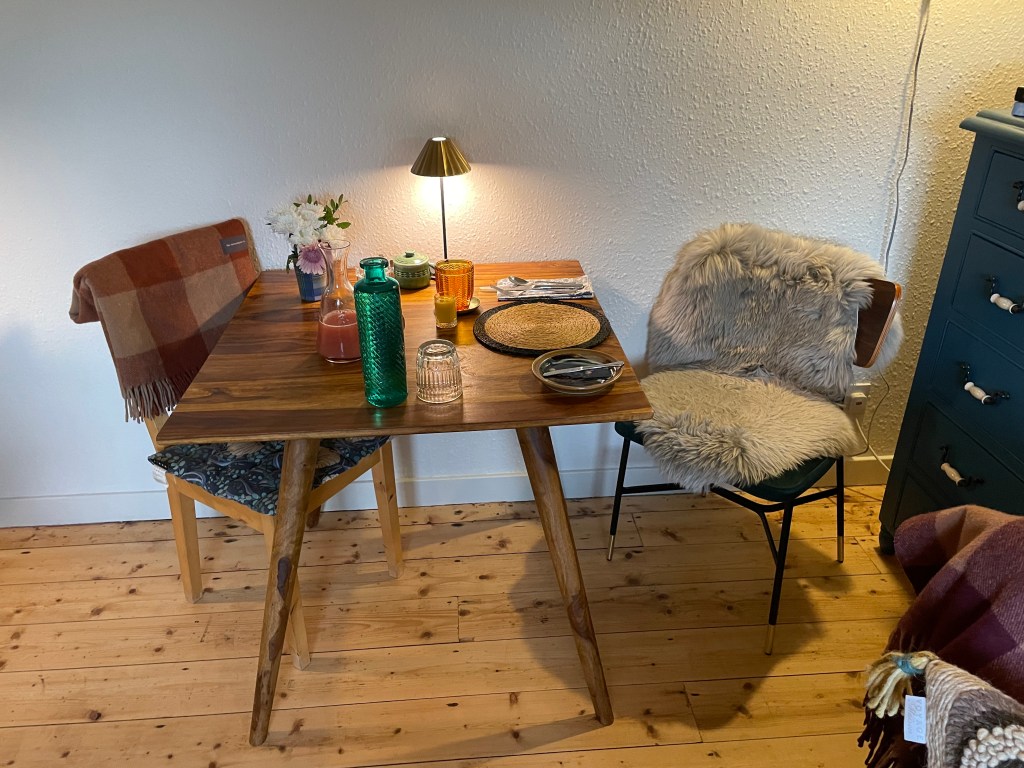
After my little walk, a delightful breakfast at Abhaig.
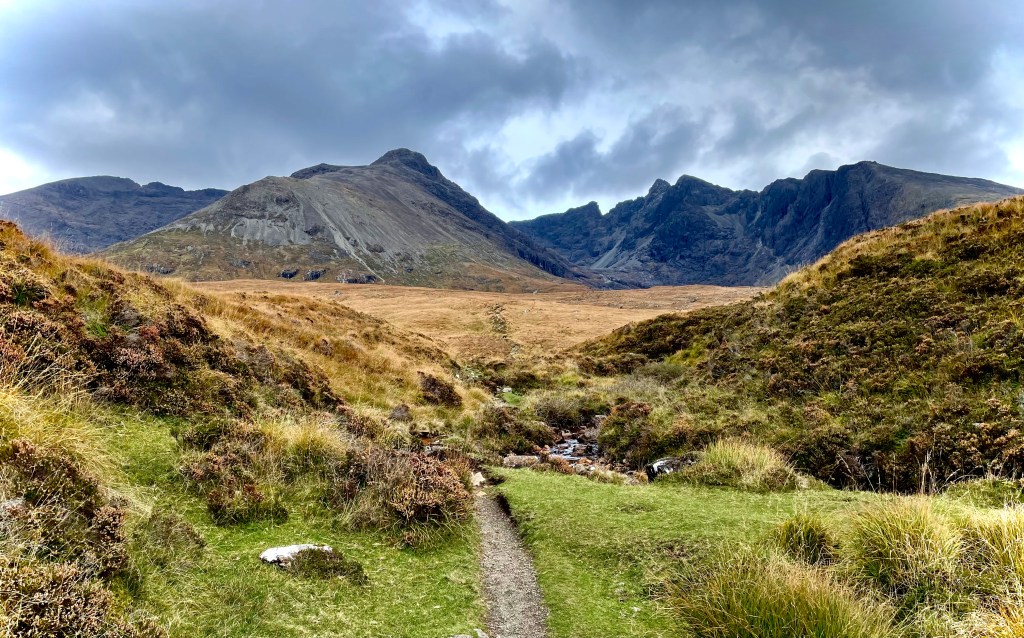
I then drove southwest to Glenbrittle beach, where I thought I’d head partway up the hike to Coire Laggan in the Black Cuillins. I knew I didn’t have enough time to do the entire walk, sadly. I kept going a little bit further and a little bit further still – just to that ridge there, then I’ll turn around, oh wait there’s another little bit…..  And lo there came a time when I needed to pull slightly off the trail to drop trou and do a wee pee – and as looked up from my undignified squat toward the Cuillin ridge, to my horror descending walkers appeared in the distance WHO PROBABLY SAW ME and so I took that as my sign and scarpered back down to the car in giggly horror.
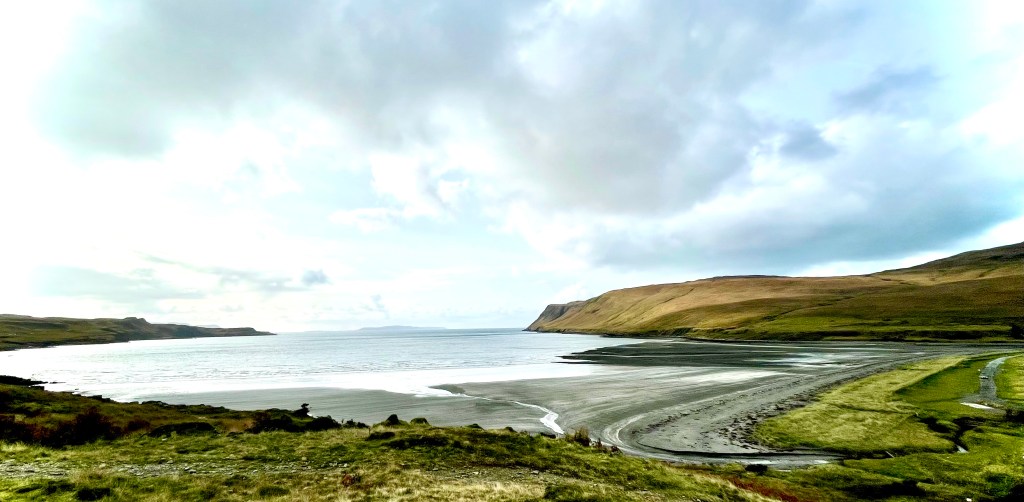
The black sands of Glenbrittle Beach

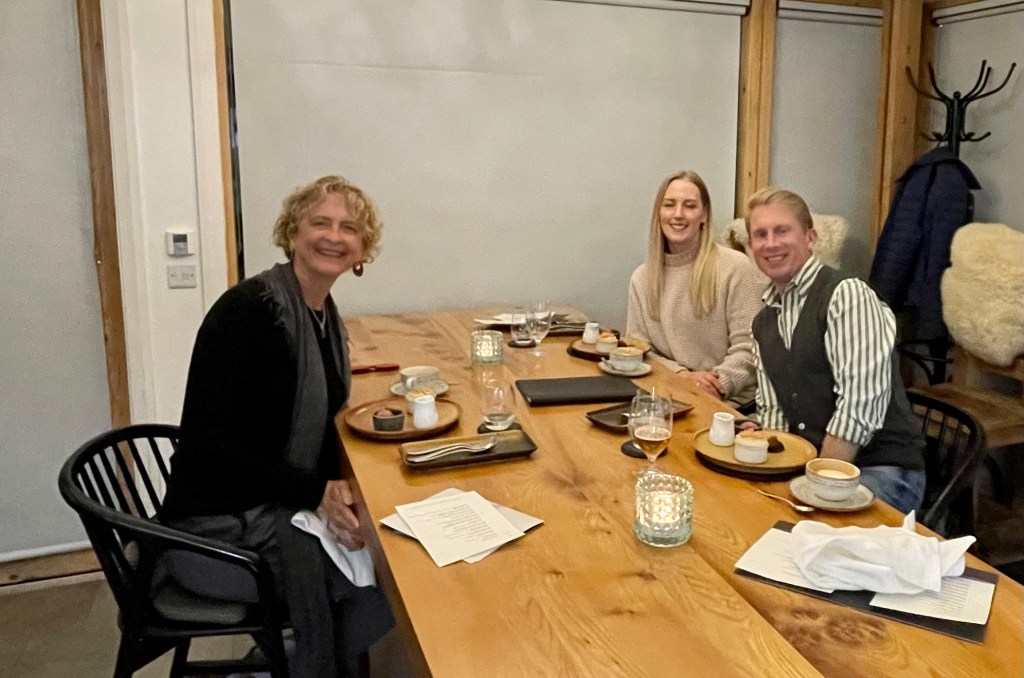
The reason I didn’t have enough time is because I had booked a reservation at the chef’s kitchen table at the renowned Three Chimneys restaurant, where I had enjoyed a wonderful meal with Danielle the previous spring. It was super fun sitting in the kitchen and the only other guests were a very blonde and adorable couple from London on their honeymoon. Both lawyers! Both liberal!  Brexit is terrible! Trump is terrible! Yay! A chef’s table can be risky, god knows, but we hit the jackpot and had a lively and interesting conversation for the entire meal. They were staying in the lovely rooms at the Three Chimneys, whereas I had a half hour drive back across Skye on single track roads in the pitch dark with silly sheepies snoozing like RIGHT there on the edge of the road like fuzzy doofuses.  But seriously – what a great night.
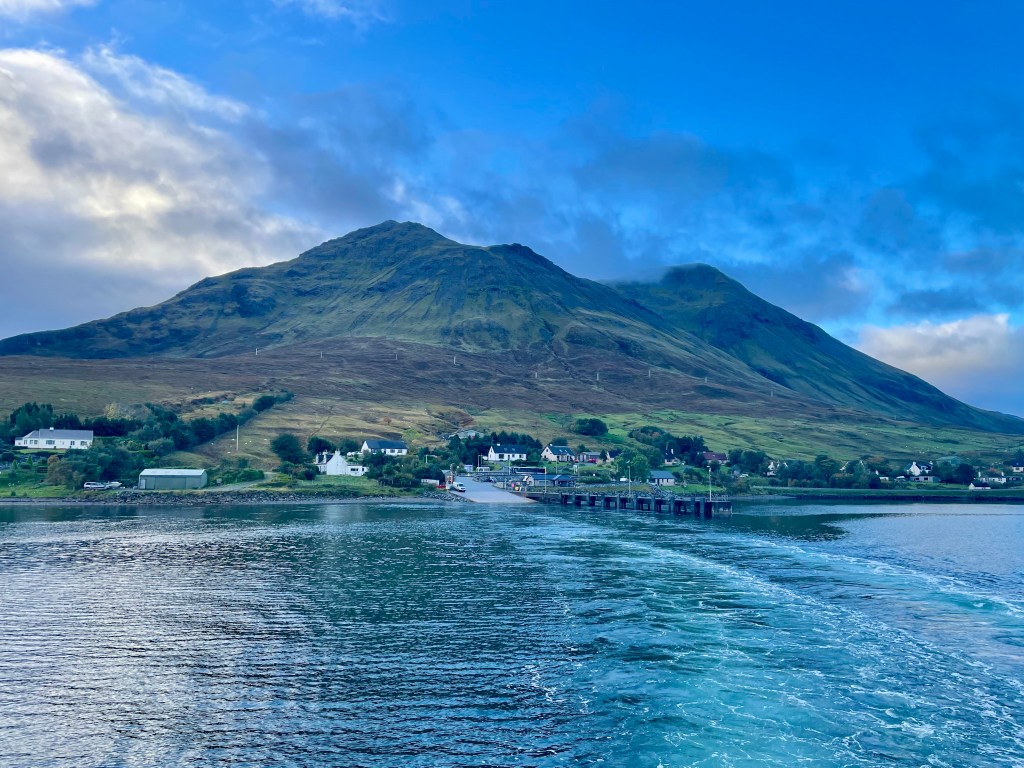
The next day I caught the ferry to Raasay, a small island with 192 denizens just to the east of Skye.  It’s a very short and very beautiful ferry ride.
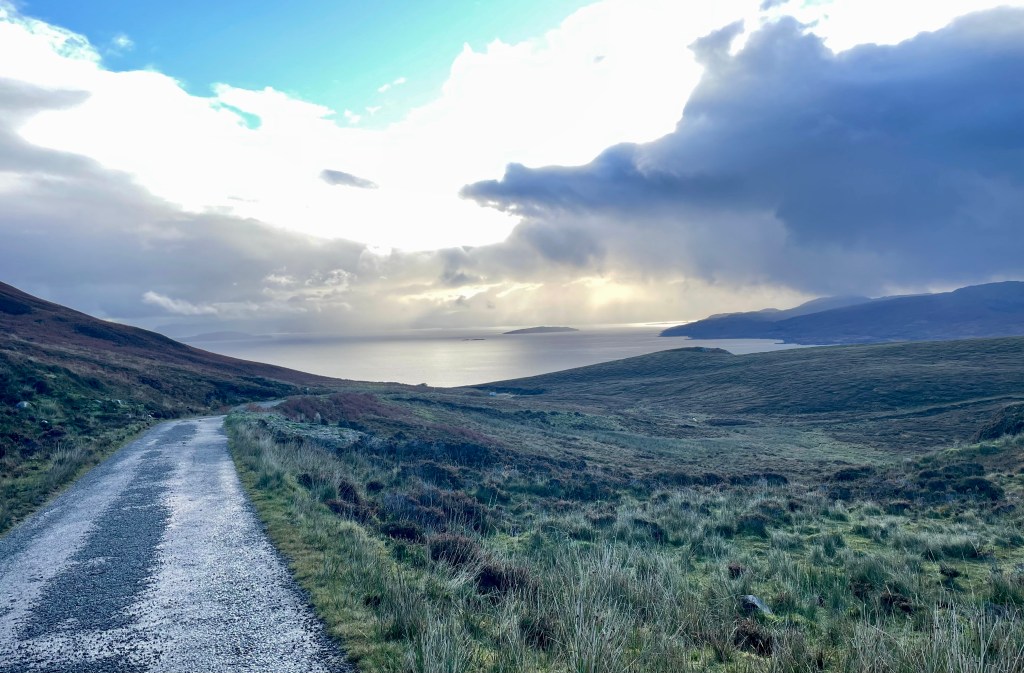
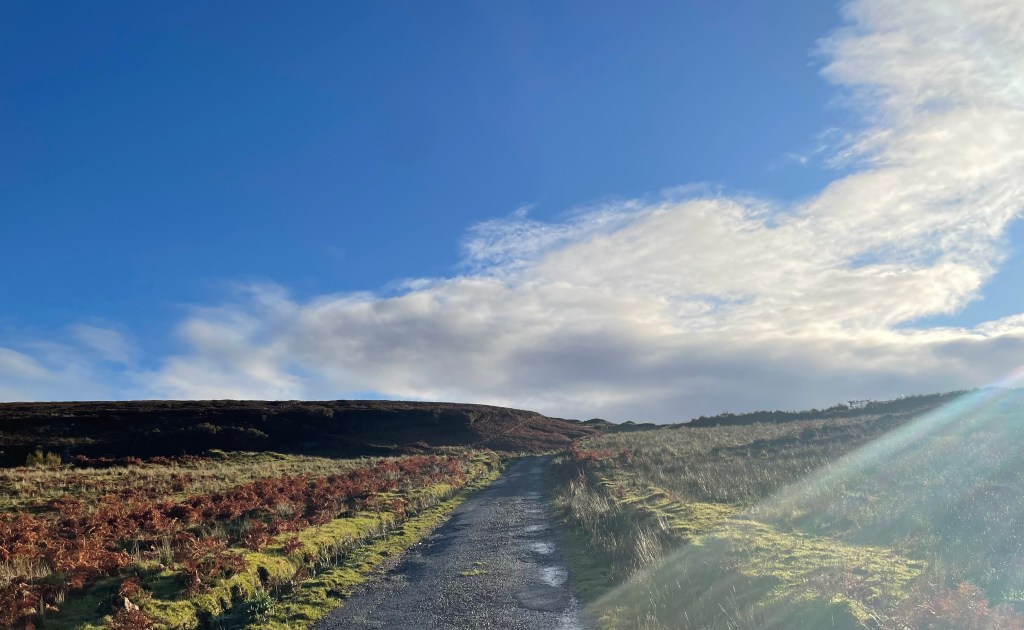
When we disembarked I set off down a crumbly wee road toward a short hike that looked pretty cool. I did not see another car or another person.
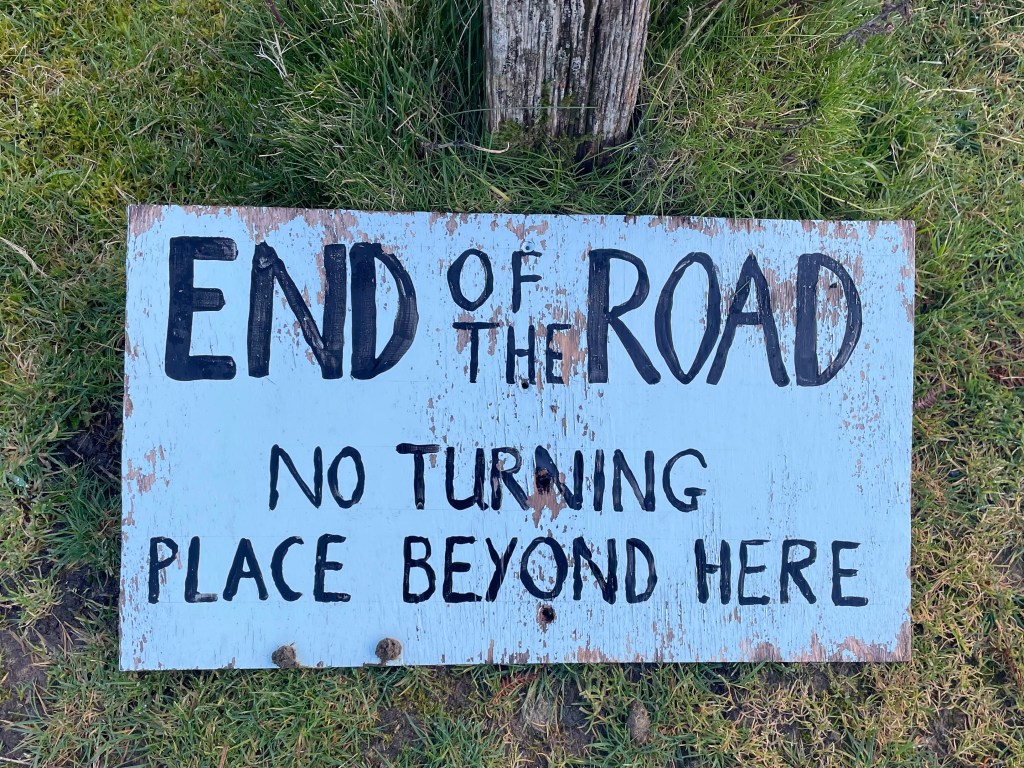
There was a tiny parking area at the end of the road, thus:
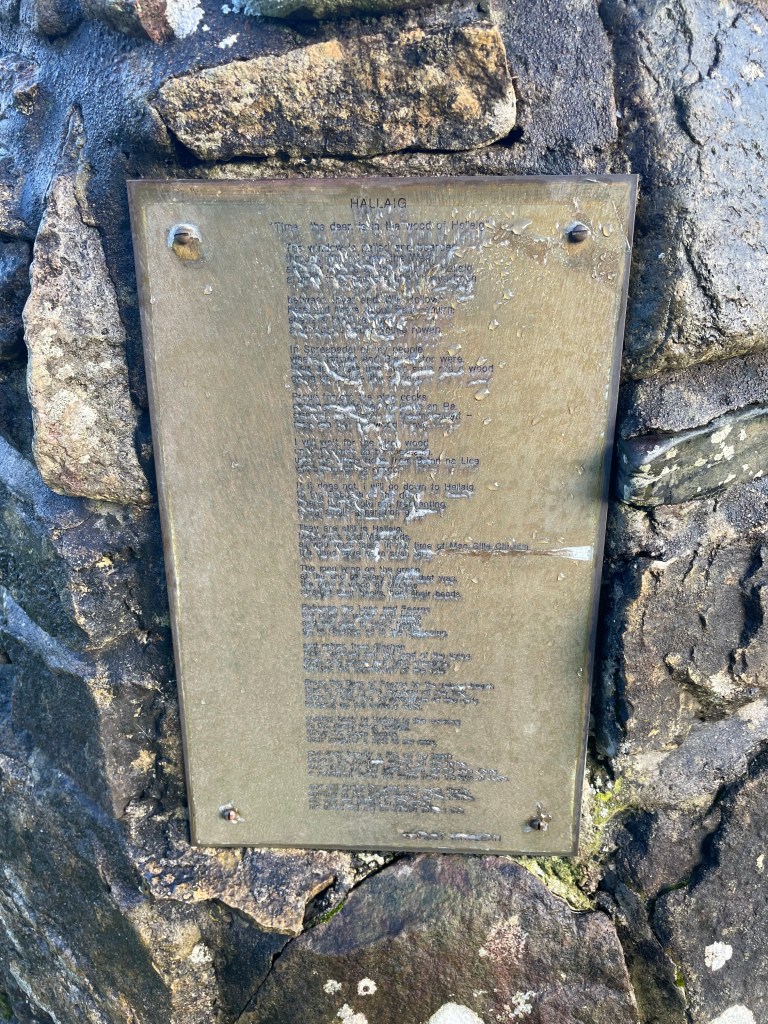
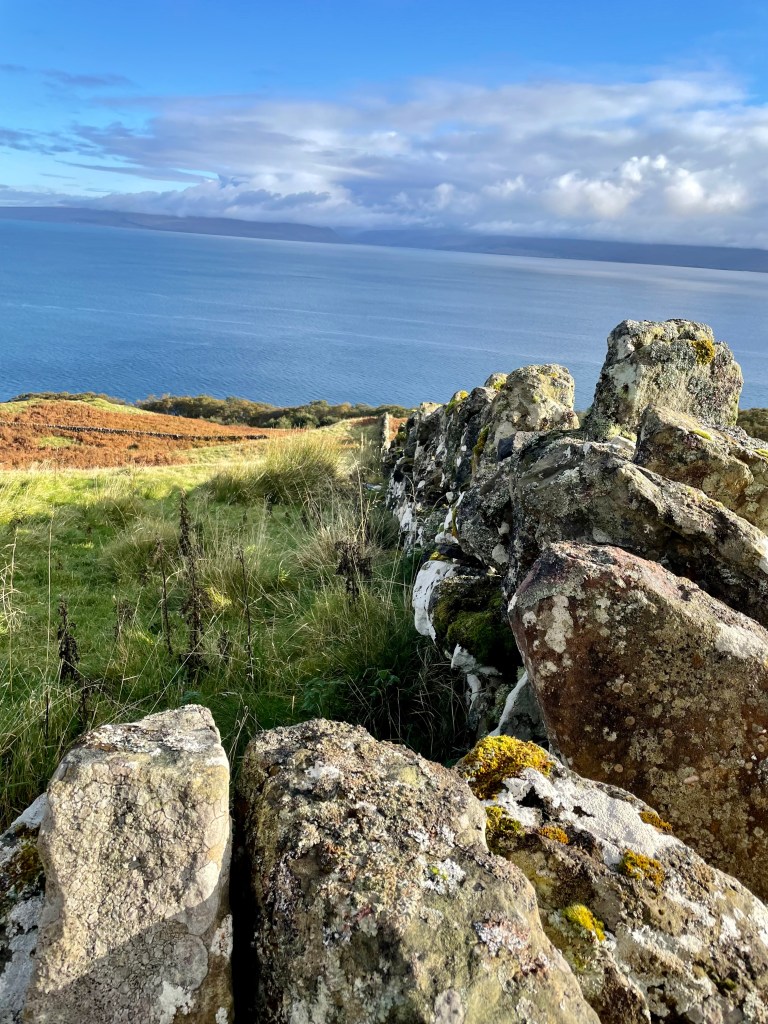
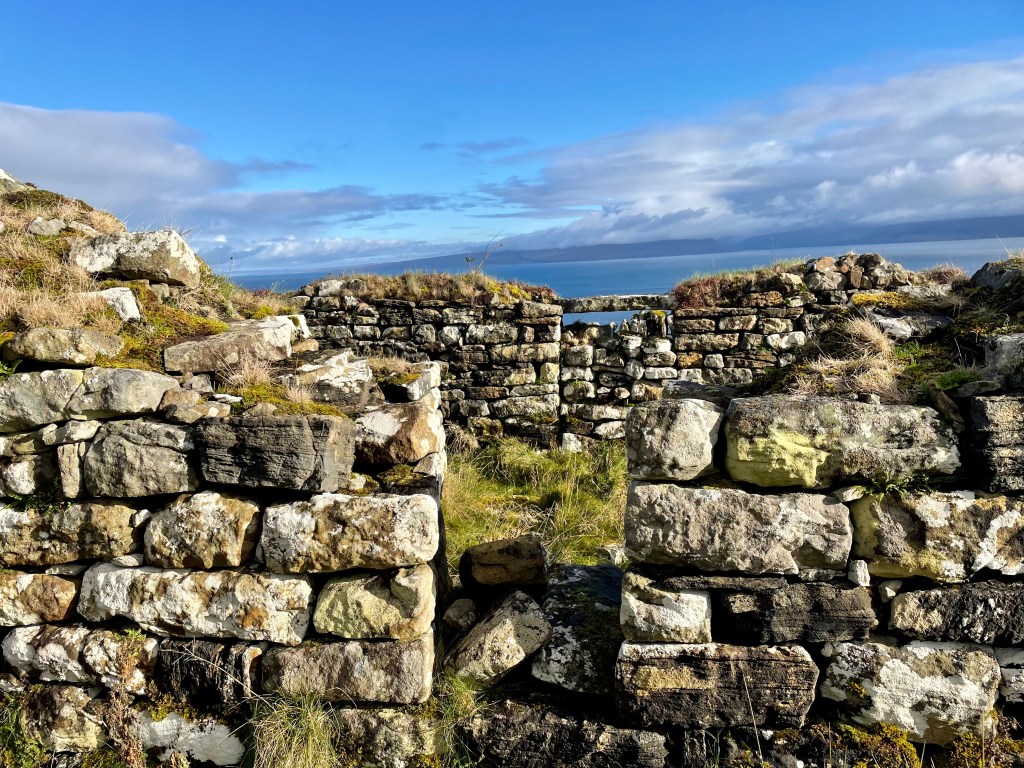
I embarked on yet another gobsmackingly gorgeous coastal hike to the ruins of Hallaig, a clearance village, one of several cleared communities on Raasay, where the residents were forcibly evicted or encouraged to move to make way for sheep grazing on the island in the 1800s.  There’s a monument along the trail that includes a poem about the ruins called “Hallaig,”by Sorley Maclean.

Back through the gloaming to Hallaig

Through the vivid speechless air,

Pouring down the steep slopes,

Their laughter misting my ear

And their beauty a glaze on my heart.

Then as the kyles go dim

And the sun sets behind Dun Cana

Love’s loaded gun will take aim.

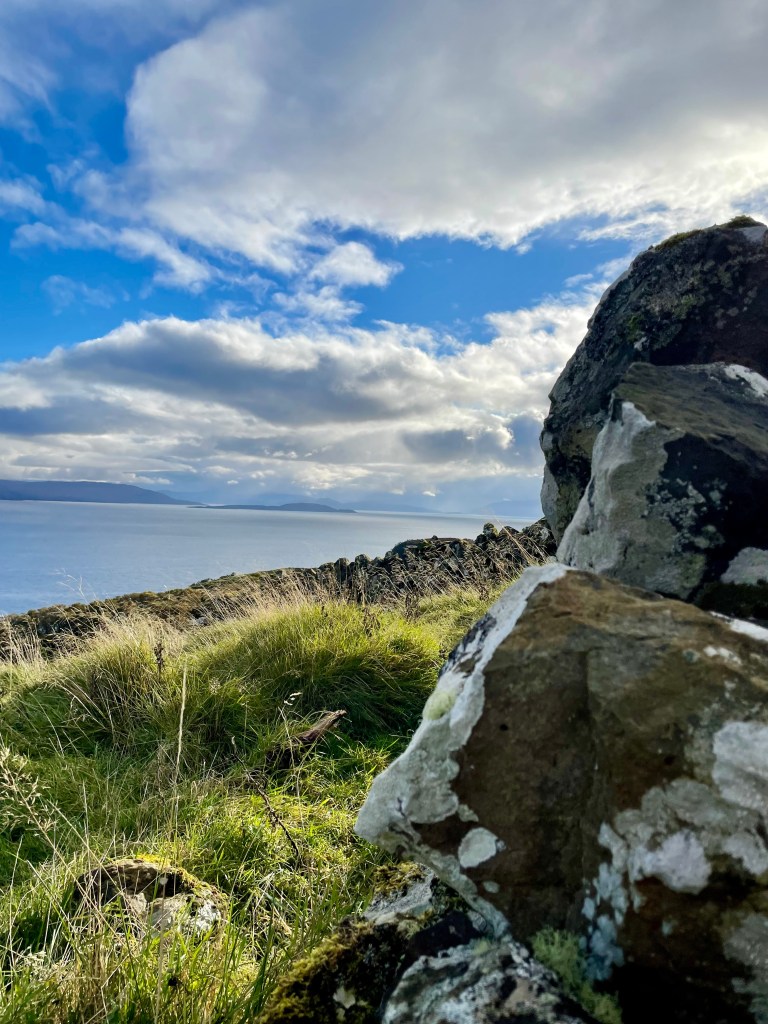
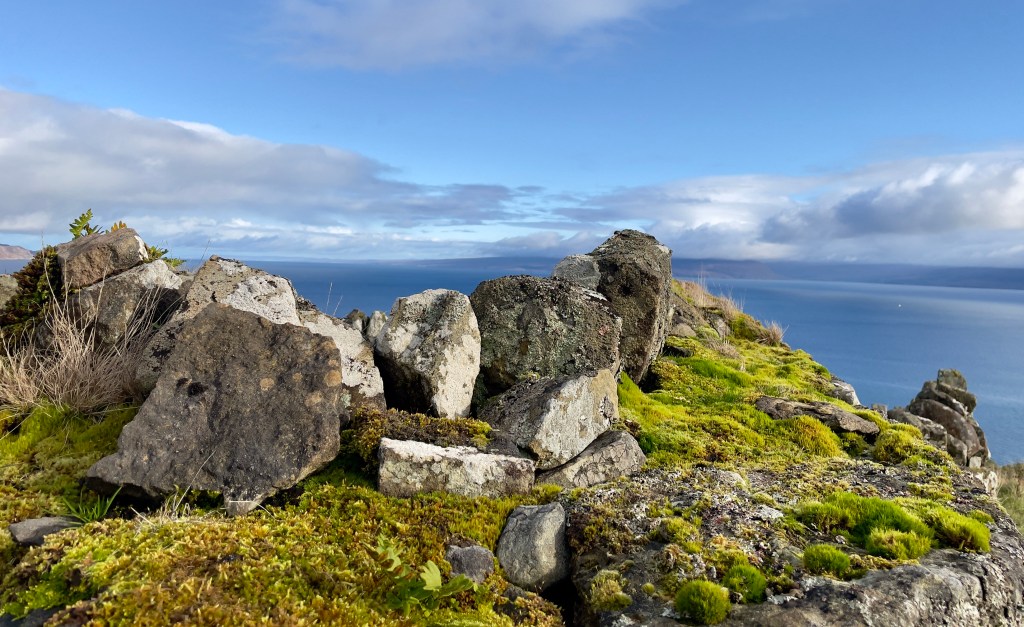
A few photos of the ruins.

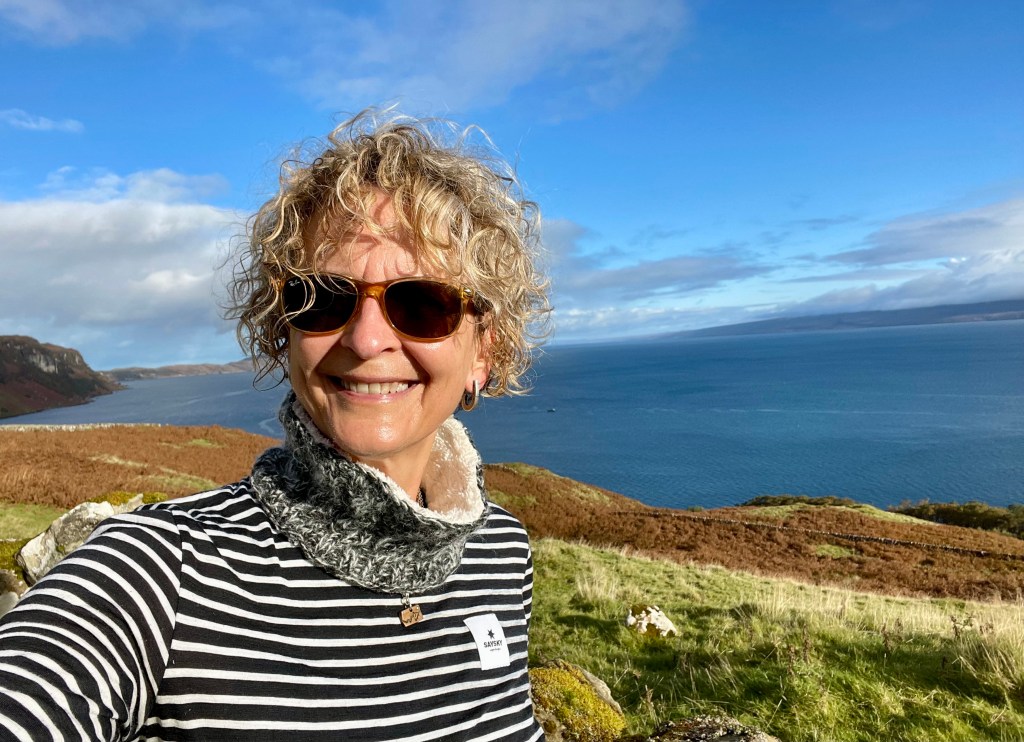
Could not resist a few smiley selfies in that sad and somber place because good god IT WAS SUNNY.
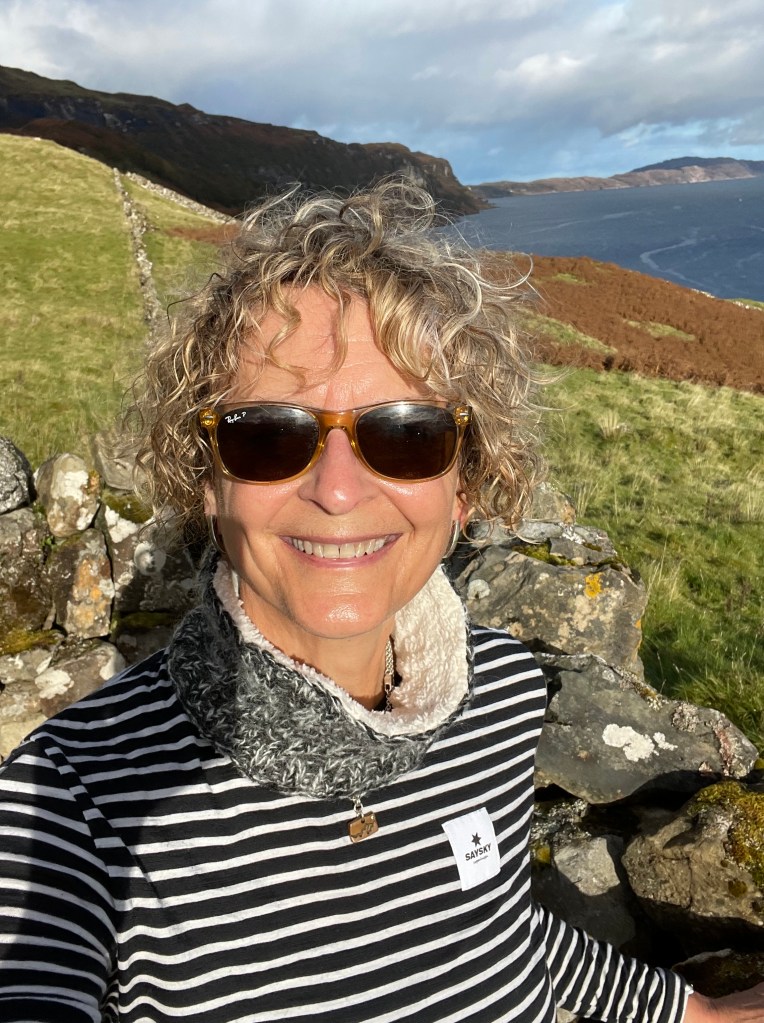
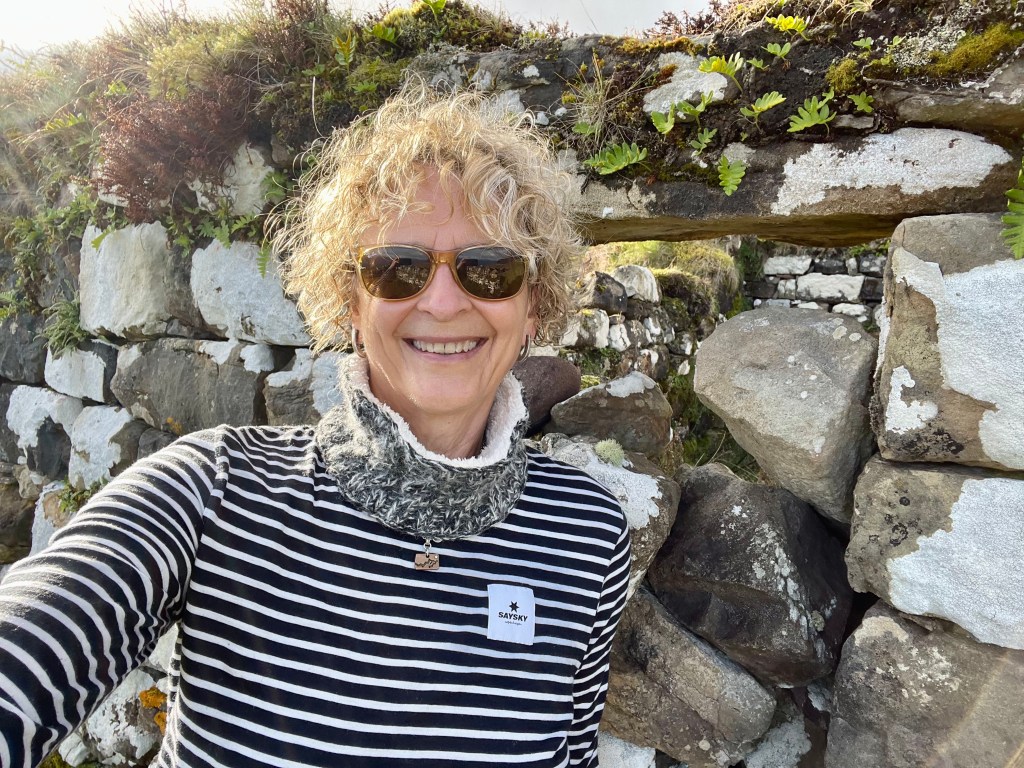
I think this walk resulted in some of the most incredible photos from my entire trip – the light, the location, the mountains, the ocean.
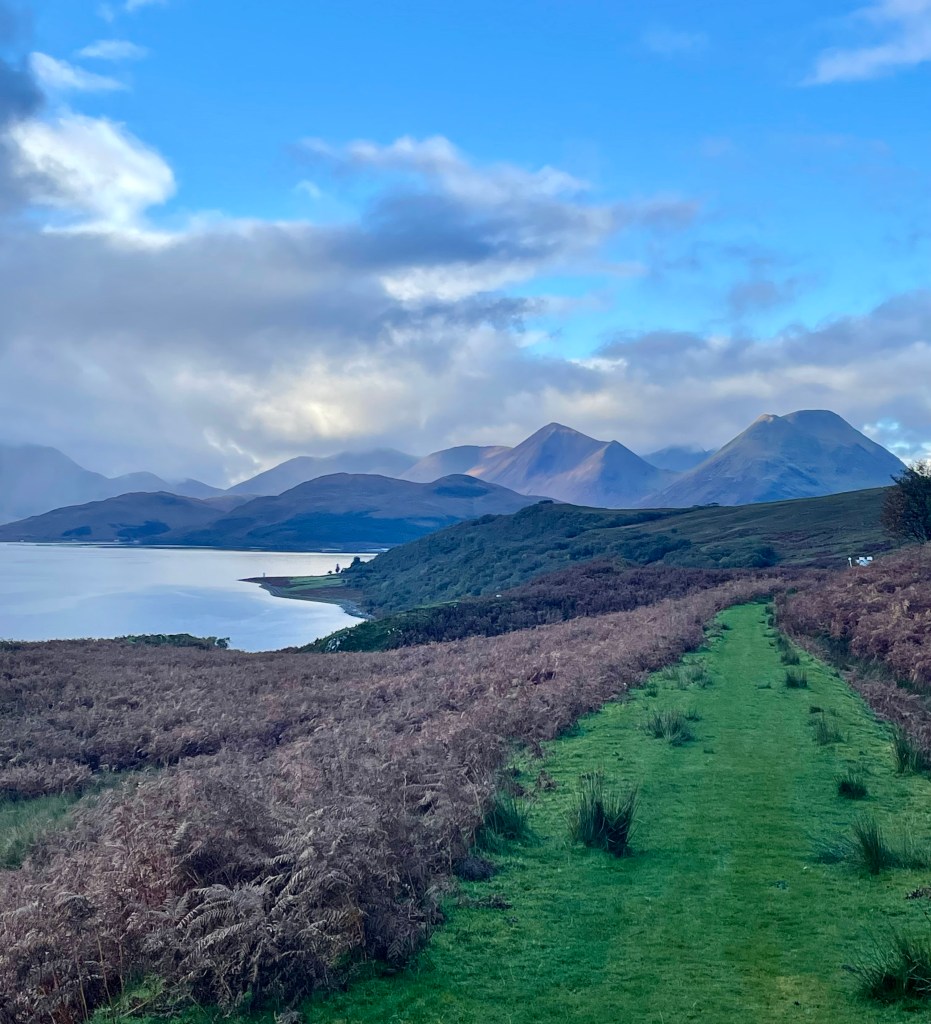
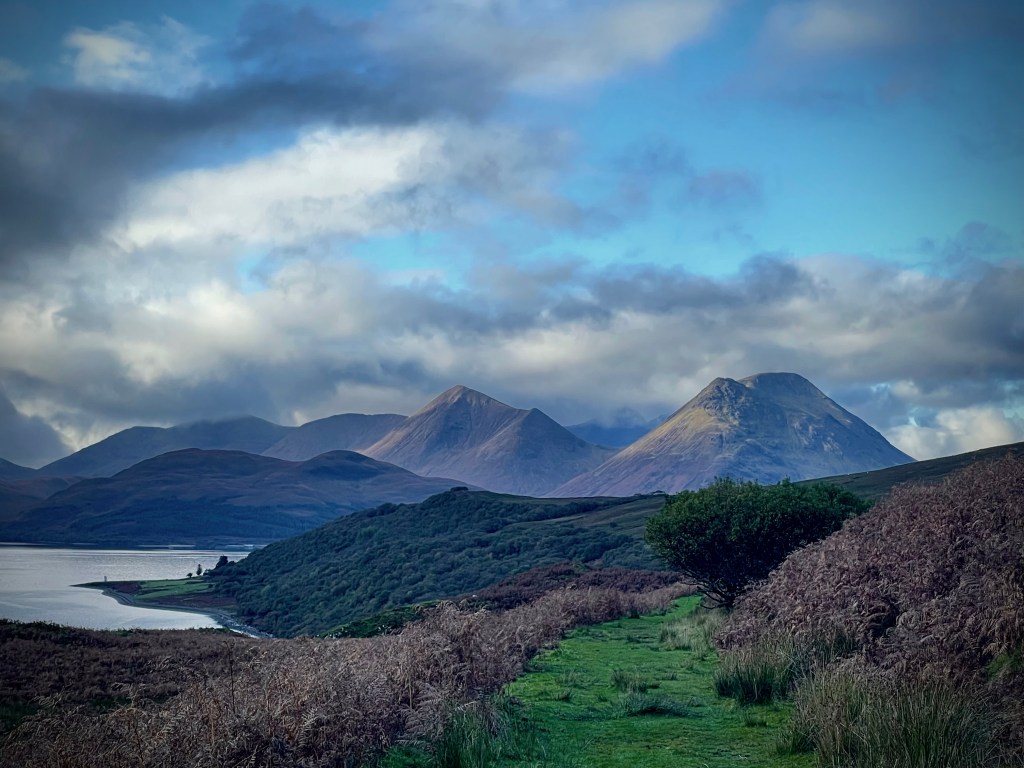
As you can see, this was another walk where I didn’t see another human being, which is absolutely my preference to be honest. My mom asked me to write about what it was like to hike alone in remote areas in a foreign country.  The answer is that it’s awesome and makes me blissfully happy and at peace.  An adventure in the best possible way because the risk level is very, very low and yet you are out in the wild! On the moors! Gazing across oceans and up mountains!  So many wild coos and sheepies! And I’m not naive, I know full well that folks have often found themselves in trouble hiking in the UK, involving mountain rescue teams, helicopter evacs, injury and even death. I don’t know what to say except that the thought never crosses my mind that something bad might happen because a) I’m in Scotland and b) there’s so much joyful zen in my brain. I’m so completely present in the moment as they say, that all thoughts of worry have nowhere to grab hold. For what it’s worth, my mom doesn’t worry about me either, which is quite literally unheard of. So ¯\_(ツ)_/¯
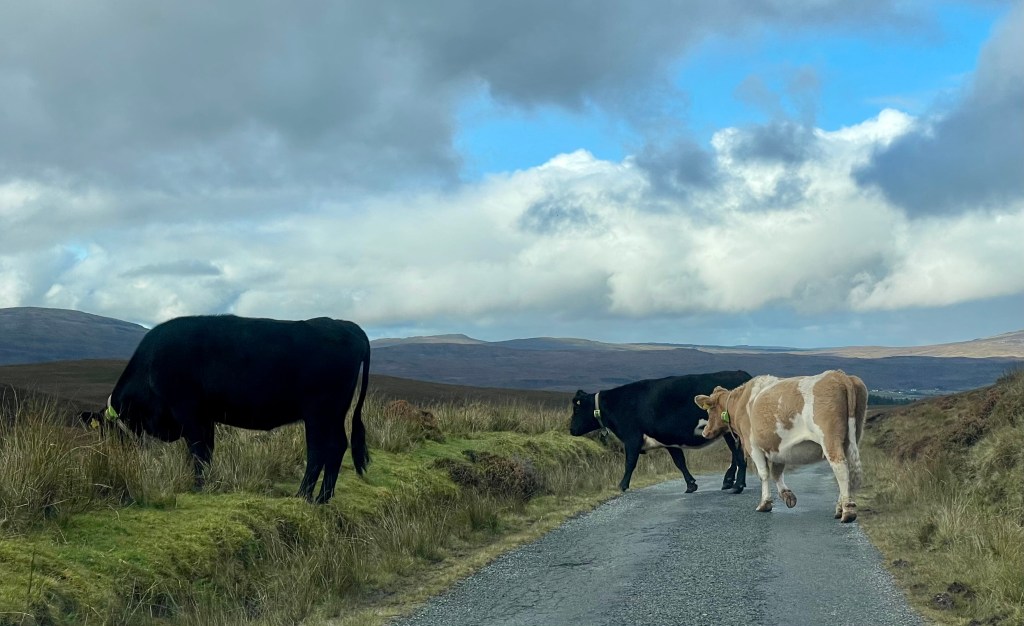
I sat in the car for a few minutes enjoying the bag lunch of a fresh salmon salad Viv and Steve prepared, and then started the short drive back toward the ferry so I’d make it to Raasay Distillery in time for my tour.  Along the way I came upon a Scottish traffic jam, but not to worry, I made it.
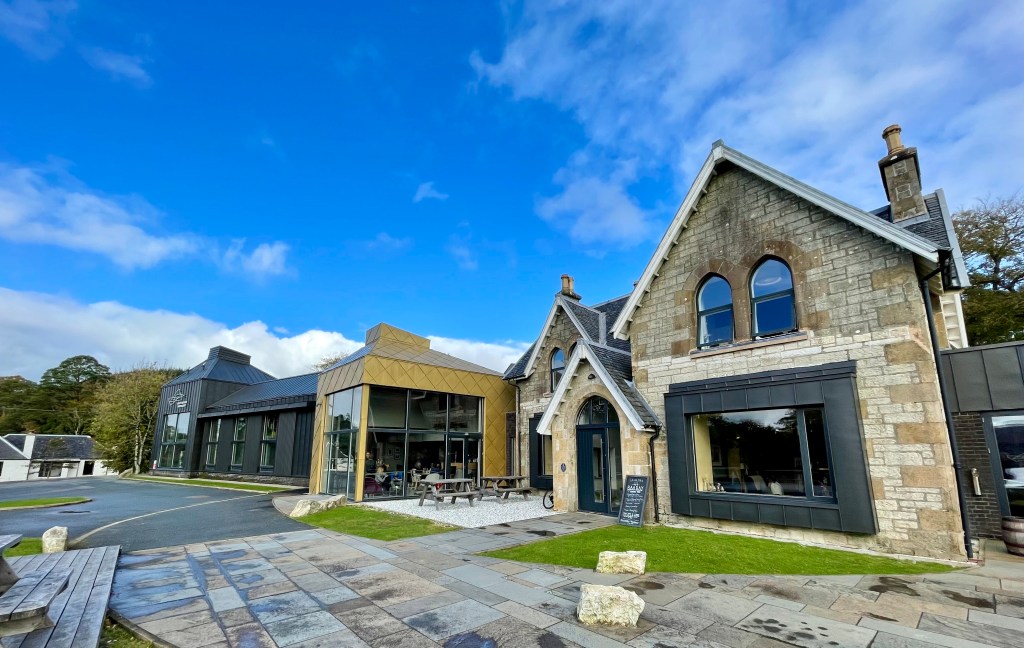
Opened in 2017, Raasay released its first whisky in 2020. The 2022 Scottish Whisky Awards named Rassay Distillery of the Year, and it’s a beautiful facility with drop-dead views. They released their first whisky in 2021 and their single malt combines six signature casks – maturing peated and unpeated spirit separately in ex-rye whisky, virgin Chinkapin oak and Bordeaux red wine casks. The first of this cask combination in Scotch whisky history. The exact proportions are, of course, top secret.

A lovely, sophisticated English woman with a dry wit was our tour guide. She had retired to Raasay a few years prior with her French husband and was obviously enjoying her retirement gig at the distillery. I talked with her afterward about what it was like, and how her Parisien husband was enjoying living on a remote barely populated island in the Hebrides. I shared that I was feeling a similar pull toward Scotland in general.  She immediately engaged an eye-lock and encouraged me to start doing something – taking actual measurable steps toward this goal. I don’t know, I got the tingles. Message received.

So the Raasay “Hebridean” is a very very good whisky and I fell in love with the distillery and with Raasay itself. As I had enough space in my luggage to bring one bottle home, I decided this would be The Chosen One. I did a quick search on my phone – without my glasses – to make sure you couldn’t buy Raasay in Oregon. Well. When I got home I looked it up again and sure enough, found that you could acquire a bottle in two local liquor stores.  Not only that but one of the liquor stores carried bottles of the single cask versions from the pleated bordeaux and rye casks. Good god. Coals to Newcastle. In retrospect, it’s almost a certainty that I misspelled Raasay as I was standing in line at the distillery on my phone with no glasses. I mean, there are a lot of “a’s” in fairness.
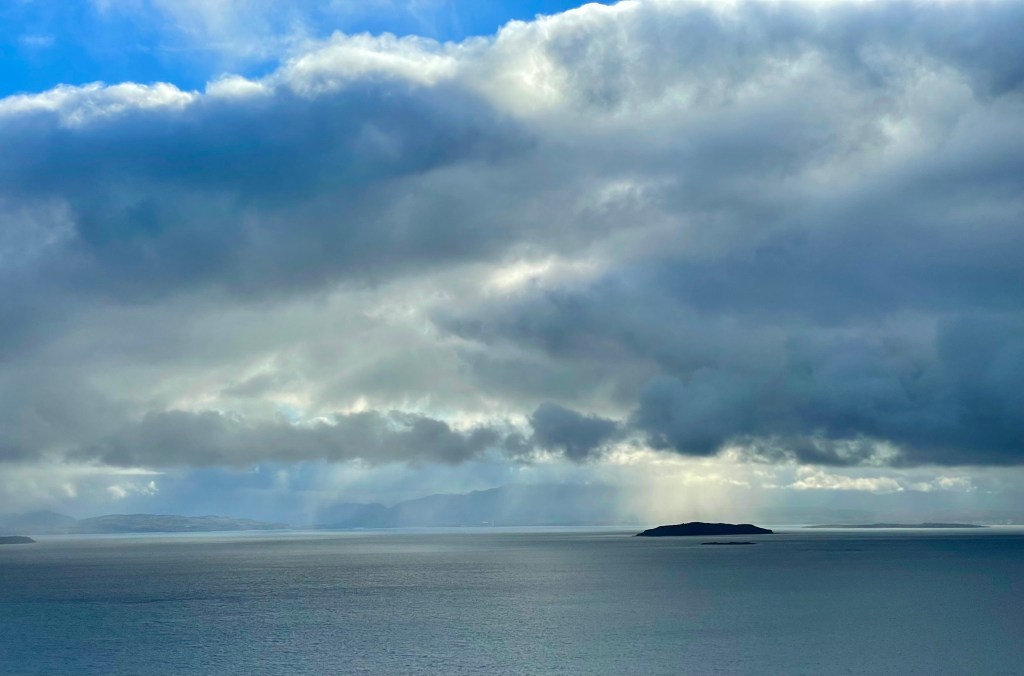
The view from Raasay Distillery. Literally. I can’t even.

The ferry back to Skye.

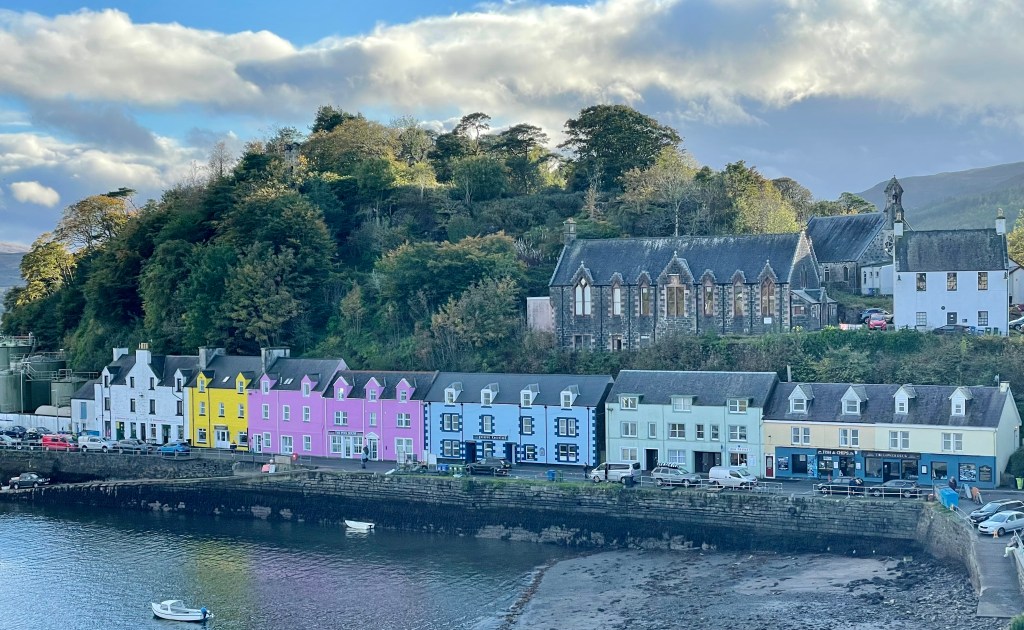
My car and I alighted from the ferry and drove to Portree where I had booked a table at Dulse & Brose, a lovely restaurant of past acquaintance.  I was there a bit early and so wandered around Portree seeking a pub.  The thing about shoulder season is that places are sometimes closed for the winter – rude! I finally walked along Quay Street, where the lovely painted buildings are, and found a teensy weensy pub inside the Pier Hotel. (The baby blue building below).
I sat at the bar and had a dram, eavesdropping on a hilarious conversation between a couple of older Scottish men with a fisherman vibe and a small family group from, of all places, Texas. The Texans were trying to explain to the Scots why the phrase, “bless your heart,” (which the Scots had never before heard) could, and often did, actually have a negative connotation. It’s one of those southern idioms that sound polite but are really a highly judgmental put-down. The Scots literally could not understand why we’d take something that sounded like a blessing and turn it into a smug slam.  The other conversation I enjoyed was between the bartender and his girlfriend about how amazing Peaky Blinders was.  Speaking of which,
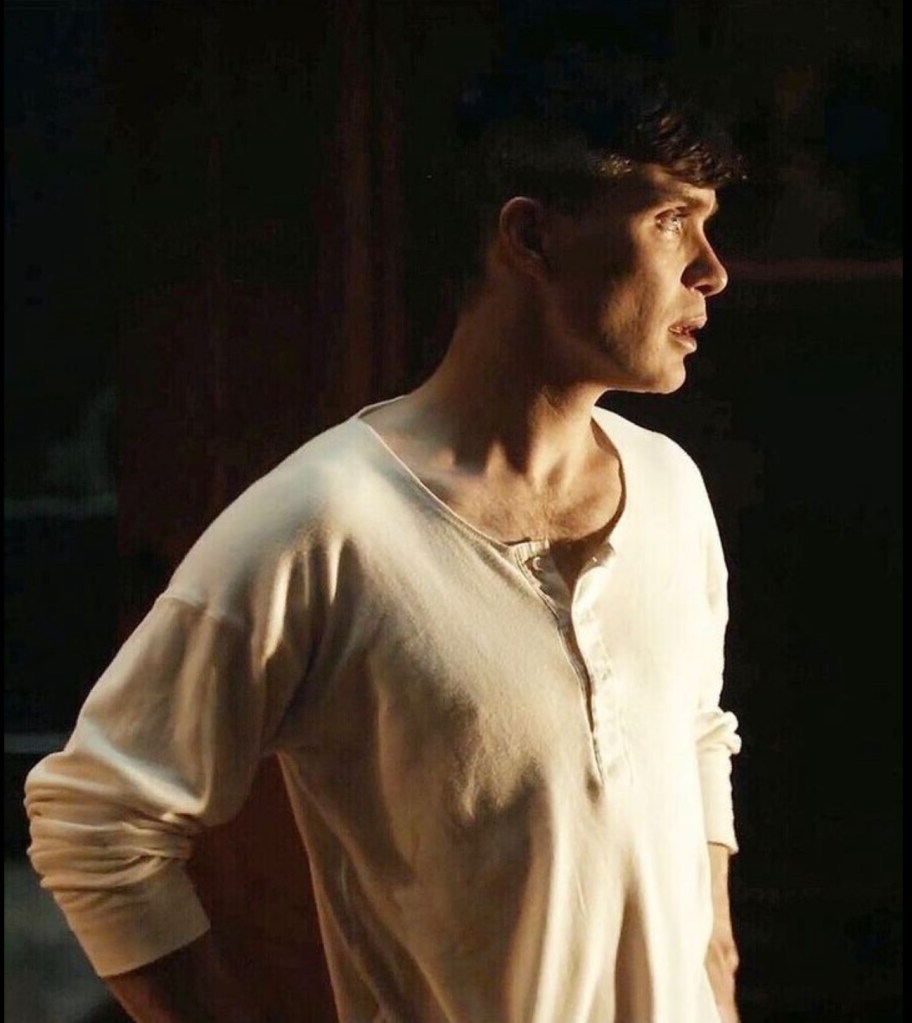
Tommy Fookin’ Shelby makes the blog.

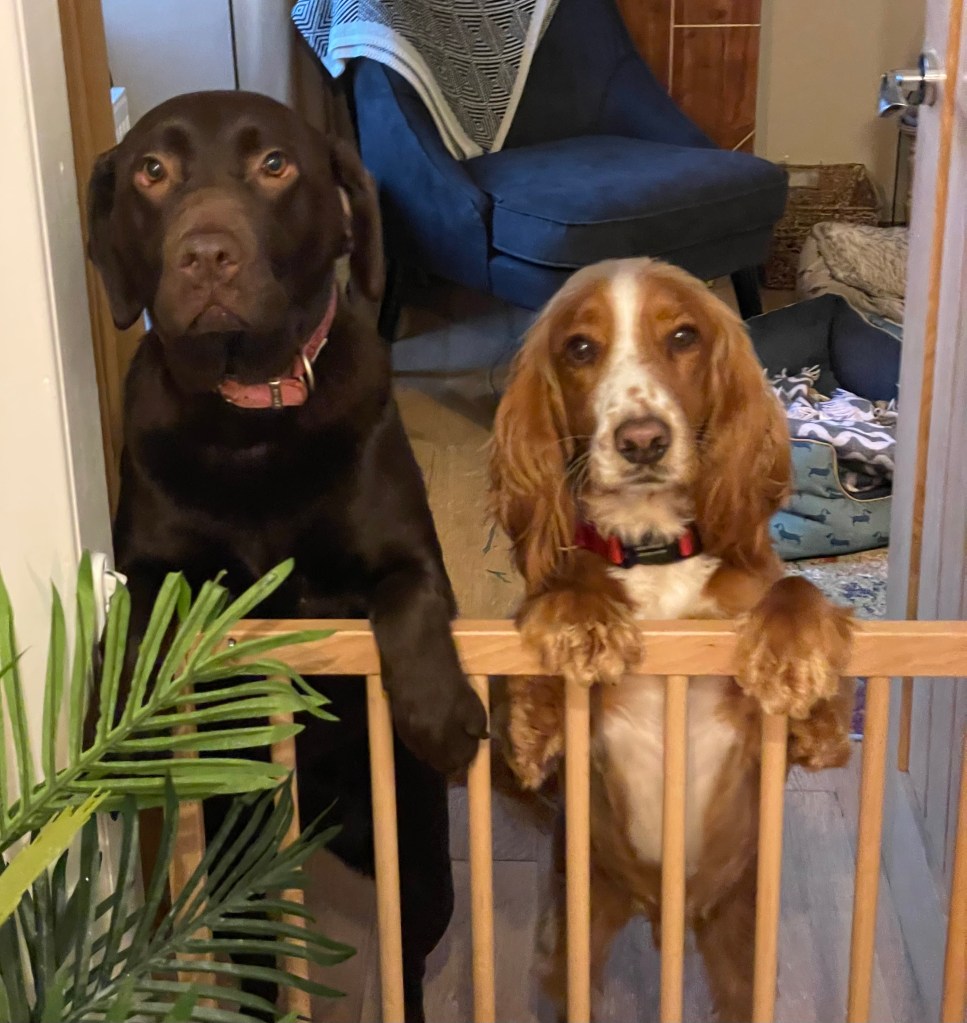
And now I think it’s high time to wrap this installment of The Wee Dram. My last full day had finally arrived, so I bid a sad farewell to Viv and Steve and the cute pups they were dog-sitting.
I then had the dumb idea of stopping by the Old Man of Storr on a gorgeous sunny day at 10:30, thinking I could just bound up the trail of the last Skye honeypot I hadn’t yet done. It was a sh*tshow. Could not believe the huge parking lot packed to the gills with humanity. Nooooooo.  No thanks. KThxBai. Next time. I pulled off the road across from the bulging parking lot, grabbed a coffee and had a final wee look across to the mainland where I was headed – and said goodbye to Skye for the fourth time in my life. I also said see ya next year.
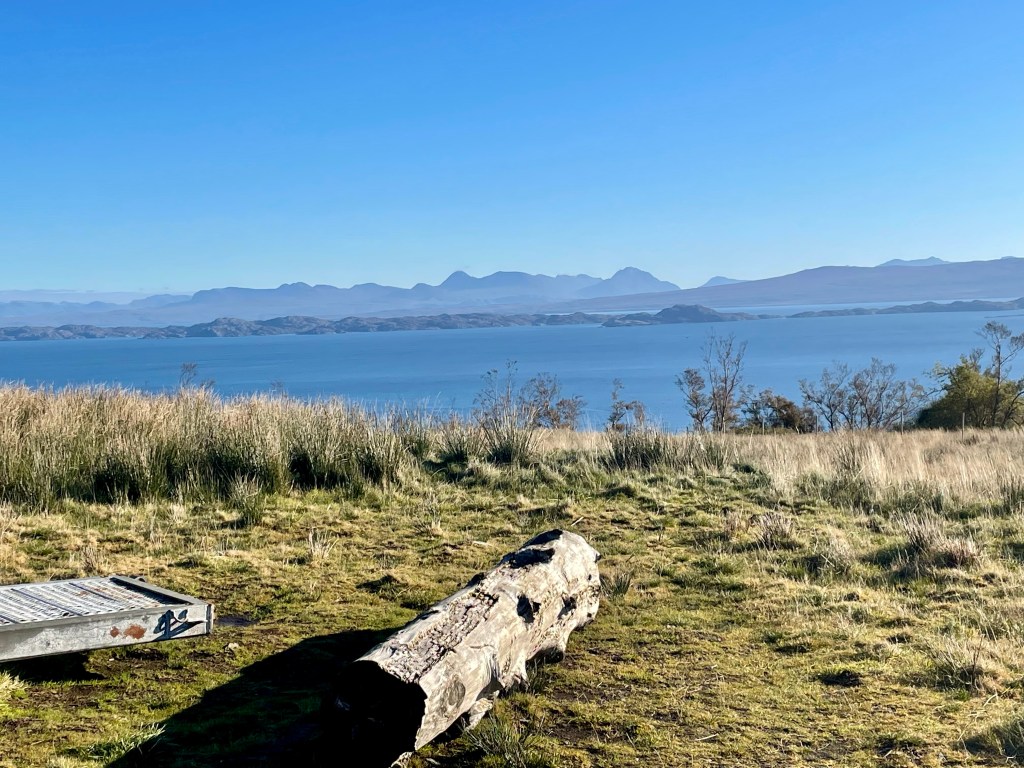
I drove through a bluebird day back to Inverness. It was honestly sort of weird seeing Scotland during a baldly sunny day. It didn’t look like itself.

My last night in Inverness I once again stayed with Eleanor and Mia, enjoying a lovely supper at the Mustard Seed. It was a gorgeous final night of my nearly month-long trip.
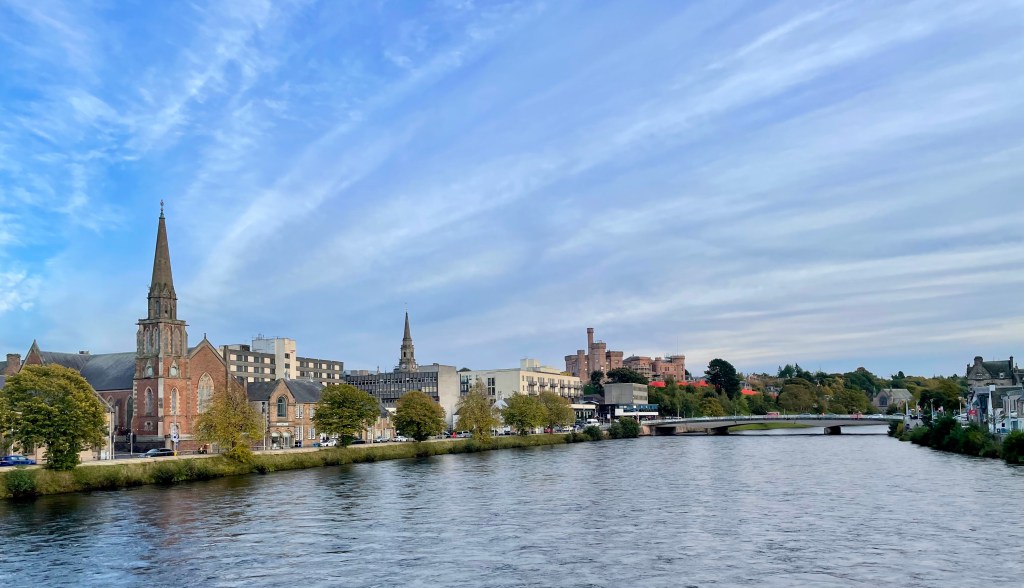
So, dear friend, thank you for reading this blog, for being patient with my many diversions down historical, geological, ecological, cultural, Gaelic pronunciation and whisky-related rabbit holes.  I’ll just end by saying that I’m headed back next May to Glencoe (have never missed), the Pentland Hills south of Edinburgh, and……(drum roll) Shetland. And next fall I’m returning with my pal Trish, mostly to visit Arran, Islay and Jura, since our last trip we were stymied by weather, and then back to Skye where I will probably feel drawn to the ferry to sail to the Outer Hebrides again, maybe this time to the Uists.

Because why would I go anywhere else.
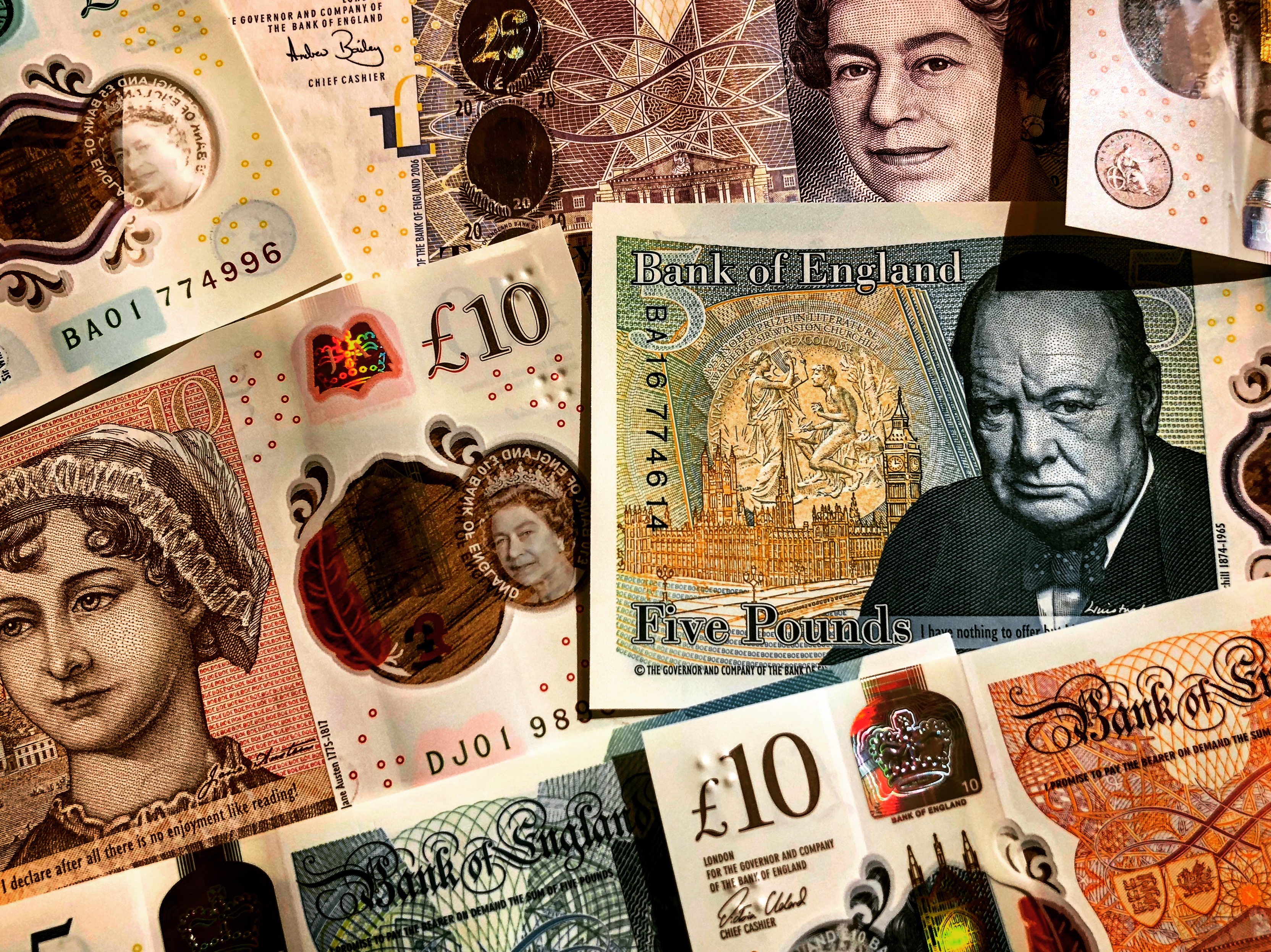
Pounds are awesome.

IMG_0723Look at this currency.  Just look at it.  It’s gorgeous.  Each denomination is a different color.  There’s a see-through window with a finely detailed image of Winchester Cathedral.  There’s a holographic strip with cool images.  There’s ultraviolet script.  There’s a quill that changes color depending on how the note is tilted. There’s a silver foil patch containing a 3D image of the coronation crown and when the note is tilted there’s a freaking rainbow.  Also Churchill!  Jane Austin!  Oh yeah and the Queen!  I mean, just try counterfeiting that situation.
This puts our sad green Monopoly money to shame.

I suppose the Brits have had a head start.  The pound sterling is the oldest existing currency, with origins in continental Europe in the Roman era.  In 928, Athelstan, the first king of England, adopted sterling as the first national currency.  By the way, his mother’s name was Ecgwynn – why is this not the most popular baby name?  And in case you think inflation is not a thing, around 980 A.D. one pound could buy 15 head of cattle.

One of the most fun things about international travel is getting the money.  In advance, because it’s fresh and new, and you are ready to rock and roll the moment you disembark, rather than being all, “Oh, wait, I have to wait in line at this gross window in the airport to get the money.”

The best thing is that this bejeweled Jane Austin money means nothing, so it can be spent with abandon and without consequence.  And more than anything else, it creates that traveling frame of mind.  It takes you out of your life and deposits you into the adventure ahead.  Like when you get into a time machine or travel to an alien planet.  You have to wear the appropriate clothes and also you must have the money.

Here we go.  T minus twelve days.   Ready to go forth and buy the cattle.

fullsizeoutput_462c


Fashion, Function and Fabulousness


IMG_0843

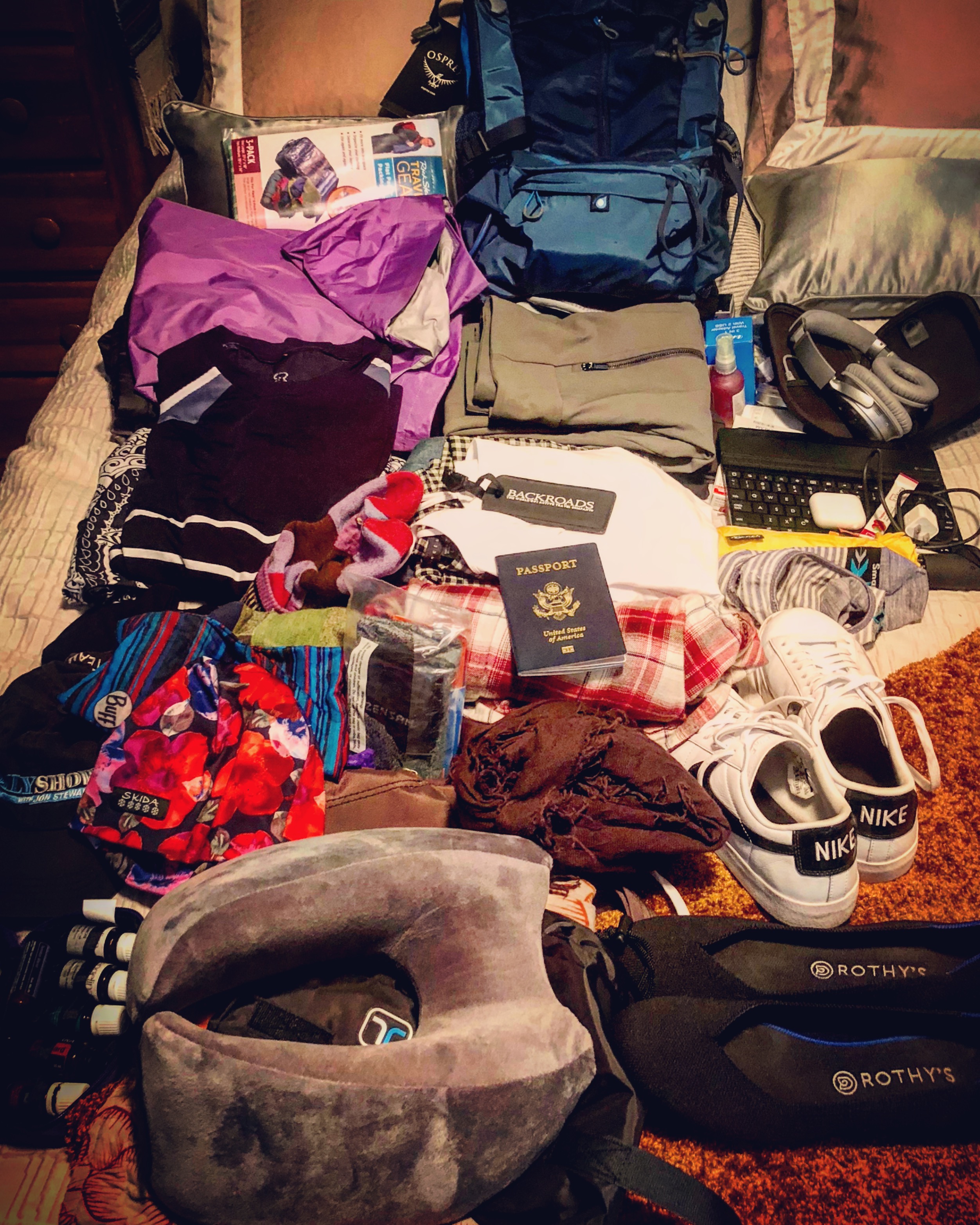
Have you seen those articles with suggested packing lists for international travel? One pair of black pants, one dress, three shirts, one coat, two pairs of shoes, five pairs of underwear and a scarf? Well, just no. Too vain and too fond of choices. And what if _____(fill in blank with unlikely scenario)______ happens and you need a ______(fill in blank with perfect outfit)______?  In Scotland the weather can do ten things in the space of a day.  I’m hiking in the Highlands and also exploring Edinburgh, a beautiful city with castles, world-class restaurants and ghosts.   Obviously, these situations cry out for totally different outfits.  Finally, those articles never account for the inevitability of bringing one or two dumb things that you end up uselessly hauling around a foreign country.

Not to mention the necessary airplane combat gear designed to 1) prevent people from interacting with you and 2) fool yourself into believing that flying isn’t abjectly miserable.  This includes, but is not limited to, noise-cancelling headphones, a large scarf/shawl, a media-loaded iPad, a memory-foam neck pillow, melatonin, snacks, a collapsible water bottle and (finally admitting age bracket) compression socks. And prayers that you won’t be seated next to a thigh-spreading, armrest-hogging, heavy drinking, shoe removing anxious flyer, although  this doesn’t take up any luggage space. Business class takes care of many of these things, but I’d rather spend the dough at my destination.  After all, when all is said and done everyone is trapped inside the same metal tube hurtling through the sky and breathing the same stale air no matter what their chair looks like, how many free cocktails they get, or whether they have their special exclusive bathroom that smells like gardenias. Okay, yes, as an Economy Plus person I’m super envious, and therefore judgmental, of Those Business Class people and their sleeping pods.
Just kidding, karma, don’t want to jinx astronomically low upgrade chances.

So my goal is one medium suitcase and one backpack. And here’s my tip:  those magical plastic bags that you put stuff in and then squish all the air out of, creating a flat pancake of clothes.  Packing cubes are organizationally helpful, yes, but air-squish bags are key, especially for dirty clothes, which take up way more space than they do when clean because physics.  They also give you extra space for unexpected purchases.  Like a plaid or a Shetland sweater, neither of which are my style at all. But on vacation there’s that thing where you get all swept away by the romantic perfection of a place and become filled with a desperate desire to bring the whole country home with you. So you buy clothes you’d never wear and probably shouldn’t even wear in their country of origin because you look like a tourist poser.

Remember, I look highly suspect in plaid and wool sweaters are itchy and claustrophobic.  Spend the money on the whisky.

Portland, Edinburgh and Time Travel

Hello from Edinburgh (pronounced Ed-in-bruh so stop saying it wrong). Started the journey in Portland, so here’s the obligatory shoes picture with the new carpeting. Not completely legit like back in the day, yet the tradition bravely carries on.

I could have boarded that first flight earlier today, or it may have been yesterday. Traveling pulls one out of the external stream of time. The traveler moves forward in his/her own little time-warped bubble completely unrelated to time as it’s experienced by everyone who isn’t flying. Flight attendants keep bringing meals, in the correct order, but on a compressed schedule. When traveling east, the sun seemingly comes up every ten minutes. Or perhaps it never completely goes down. Night is fleeting. Woah.

So let’s hear all the clueless traveler stories! Sadly, everyone was well behaved all the way from Portland to Edinburgh. I know, disappointing. Only JFK could be counted upon to be its usual cluster. The PDX pilot was so proud he had gotten us there early, but sadly, as the plane drove by all the gates, appearing to be taxiing out for another flight, he told us our gate was ready, but that there were two other planes in the “alley,” blocking our access. One plane had found its way out and he was expecting the other to follow suit. We waited long enough to obliterate his daring speed record and screw people with tight connections.

So I hired a car to ferry me from Edinburgh airport to my hotel, mostly because I’ve always wanted to see my name on one of those signs, but also jet lag. It was a brilliant call, although I got into the backseat directly behind the driver like a doofus. The steering wheel is on the wrong side of the car, you see. Everyone knows that. Say, does anyone know why we decided to drive on the right side of the road instead of the left, like a proper British colony?

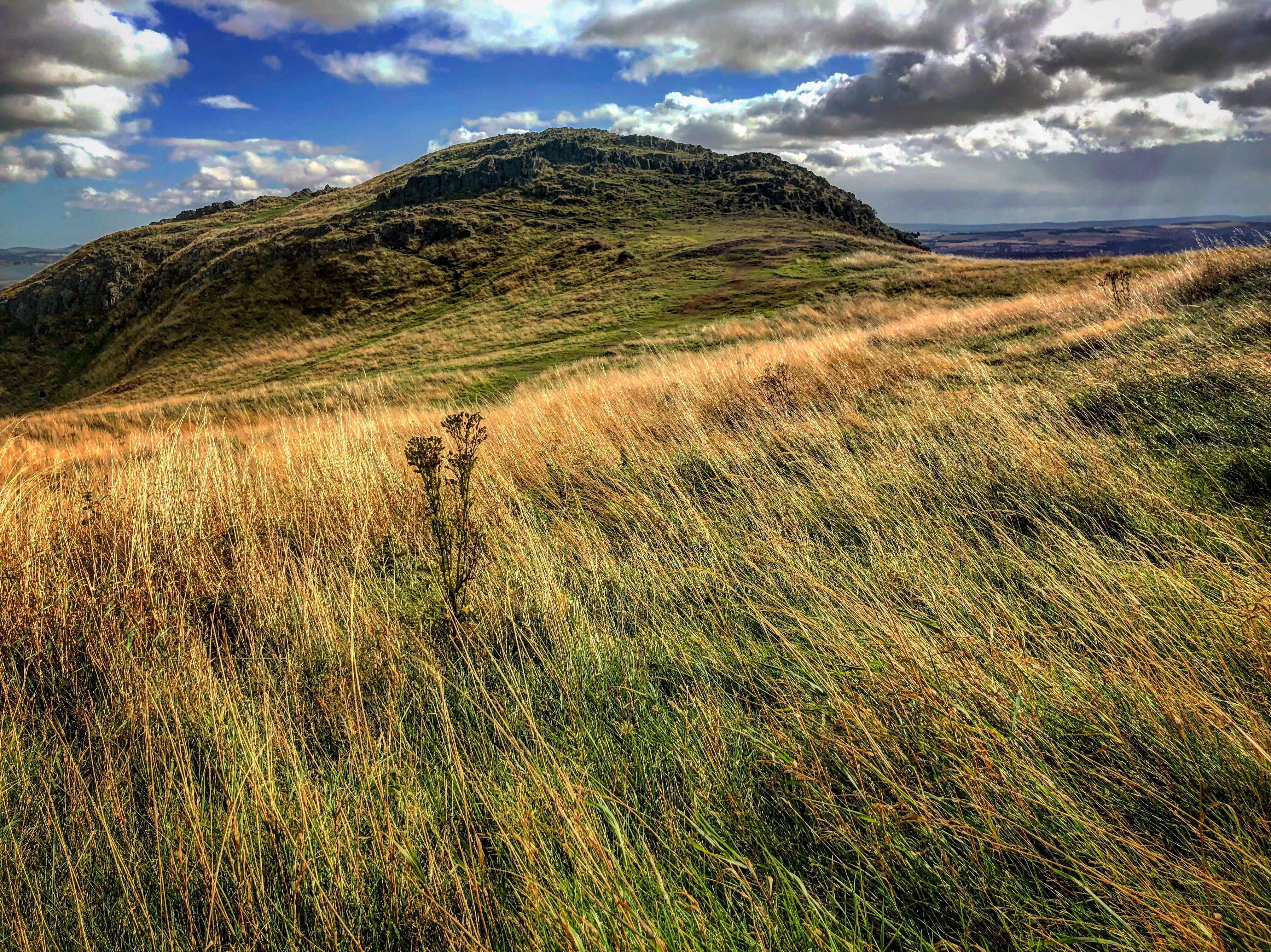
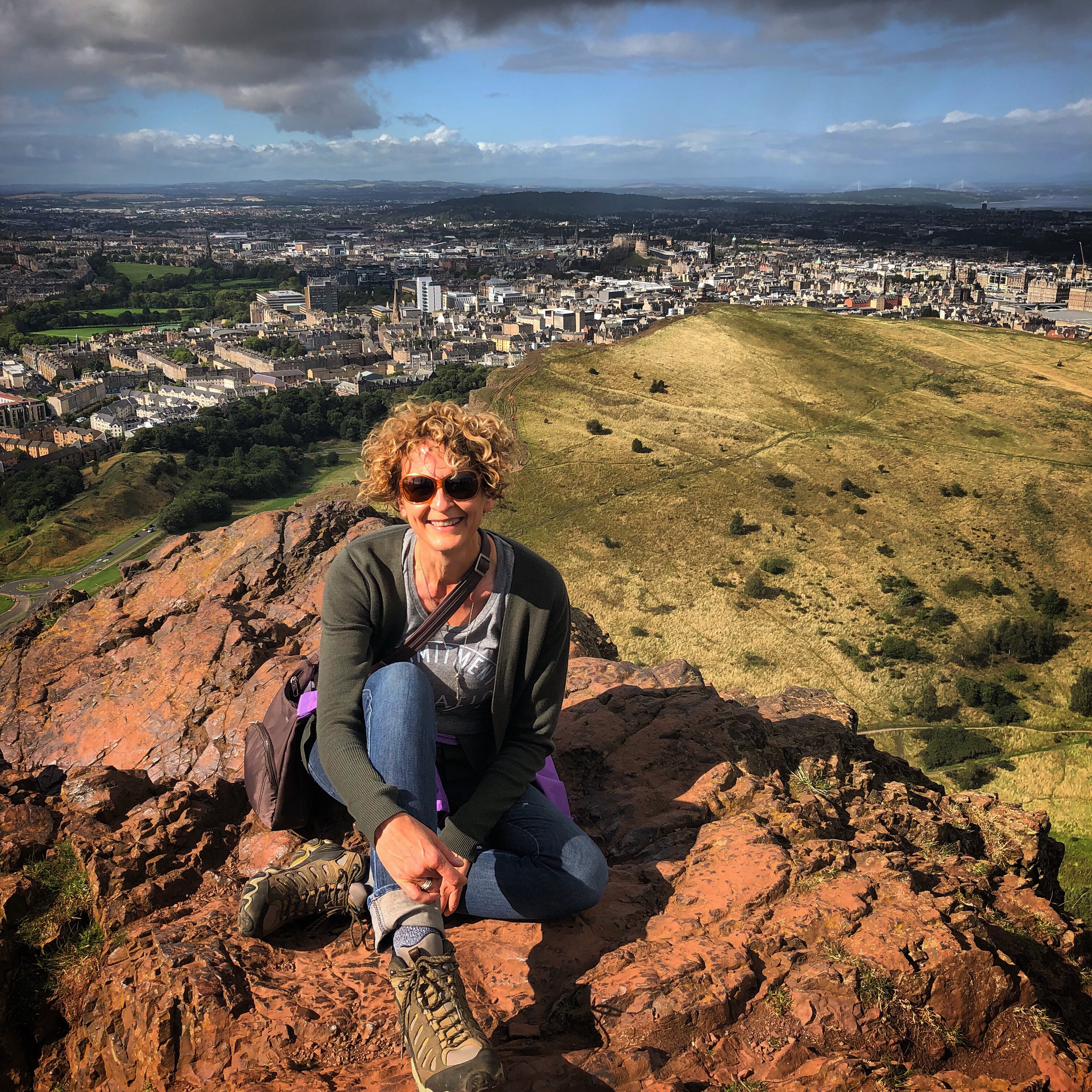
My hotel, the Inn On The Mile, is halfway up the Royal Mile. It’s basically some modern, well-appointed rooms above a restaurant with live music every night until 1:00 a.m. so stay tuned. I dropped off my bag and set out to hike up Arthur’s Seat, a steep hill overlooking town. It’s part of Holyrood Park. Holyrood is the Queen’s official Edinburgh residence and it’s where Mary Queen of Scot’s private secretary/maybe lover David Rizzio was murdered in front of her in 1566. A brutal history but such a lovely hike, although rather too many people on the main trail. I did see a bunch of locals walking their dogs, and there was also a group of people dressed like Vikings having a picnic. I regret not asking for a photo, although it did seem that they were off-duty.

One overwhelming observation that penetrated my foggy brain – I had forgotten how unfailingly polite British people are. They form a line within a bus shelter which sometimes completely blocks the sidewalk but the important thing is the sanctity of the queue. They ask if it’s okay if you pay for something that you buy. “Do you mind?”

I’m writing this in the restaurant in my hotel. I had two wee drams of whisky (never call whisky Scotch in Scotland but remember to take the “e” out unless you’re in Ireland), even though the massage therapist said that massage was all about eliminating toxins and so the last thing I should do is put more back in. (PS getting a massage after a long plane ride is brilliant except for the lecture.) Whisky is medicinal, though, and also in Scotland you can buy those tiny airline bottles of single malt scotch, they even come in adorable tiny boxes just like the grown-up bottles, which isn’t related to the first thing but I don’t care.

Definitely a wee bit of jet-lag going on. I did the melatonin thing. I remember very little of the flight from JFK to Edinburgh so I’m assuming sleep. I’m probably totally fine. I also squeezed Benadryl cream onto my toothbrush.

My initial impression is that Edinburgh is a beautiful, historic city of about 500K souls, very few of whom hang out around the Royal Mile. Lots of accents, few of them Scottish. I did have a fabulous Scottish gentlemen in the immigration line. Clearly I looked suspicious because before he stamped my passport he asked me a lot of questions. My favorite: “Why are you visiting Scotland? Outlander?” NO of course not. Silly Outlander fans, going on tours to look at films sites and such. I would never.

Outlander and Whisky

I’m about 80% English/Scotch/Irish. If I were a paint color, I’d be Bland White. Long before I knew exactly how white (thank you Ancestry.com), I’ve been interested in British history. Used to be able to recite all the Kings and Queens of England. So Scotland was firmly on my travel list, but I admit it was the cinematography in Outlander, shot in Scotland, that put me over the edge. And maybe the kilts.

So what better way to spend my first full day in Scotland than booking an Outlander Tour like a geeky tourist? The tour included historic castles, forts and villages used as film locations for Outlander, Monty Python & the Holy Grail, and Game of Thrones. And then, as a topper, finishing the day with a whisky tasting at a bar named Edinburgh’s 2018 Whisky Bar of the Year.

I booked the journey through Rabbie’s, a company specializing in smaller tours using wee buses. I expected to be joined by a bunch of middle-aged women who talked about Jamie Fraser (a.k.a.the main character in the show who is widely believed to be the perfect man) the entire time. Instead, several couples, including one on their honeymoon, and one big family, the McGowans, all piled into the bus together. They were from Florida, Philly, South Carolina, France, England and Australia. I sat behind the guide and was joined by the head of the McGowan clan. The McGowan himself. Who was very quiet (his wife made up for it from the back of the bus) and went to great pains to avoid any physical contact, which I appreciated.

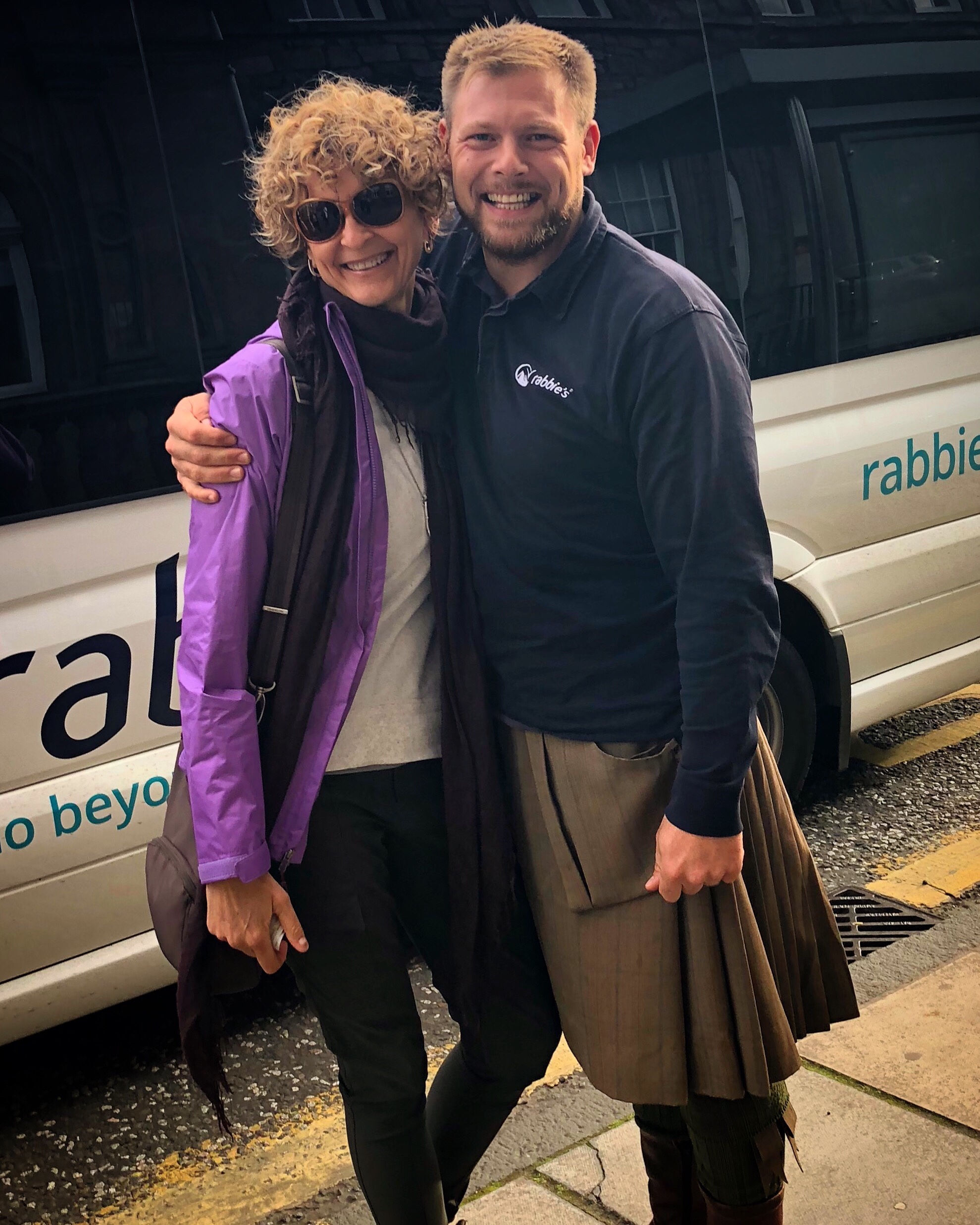
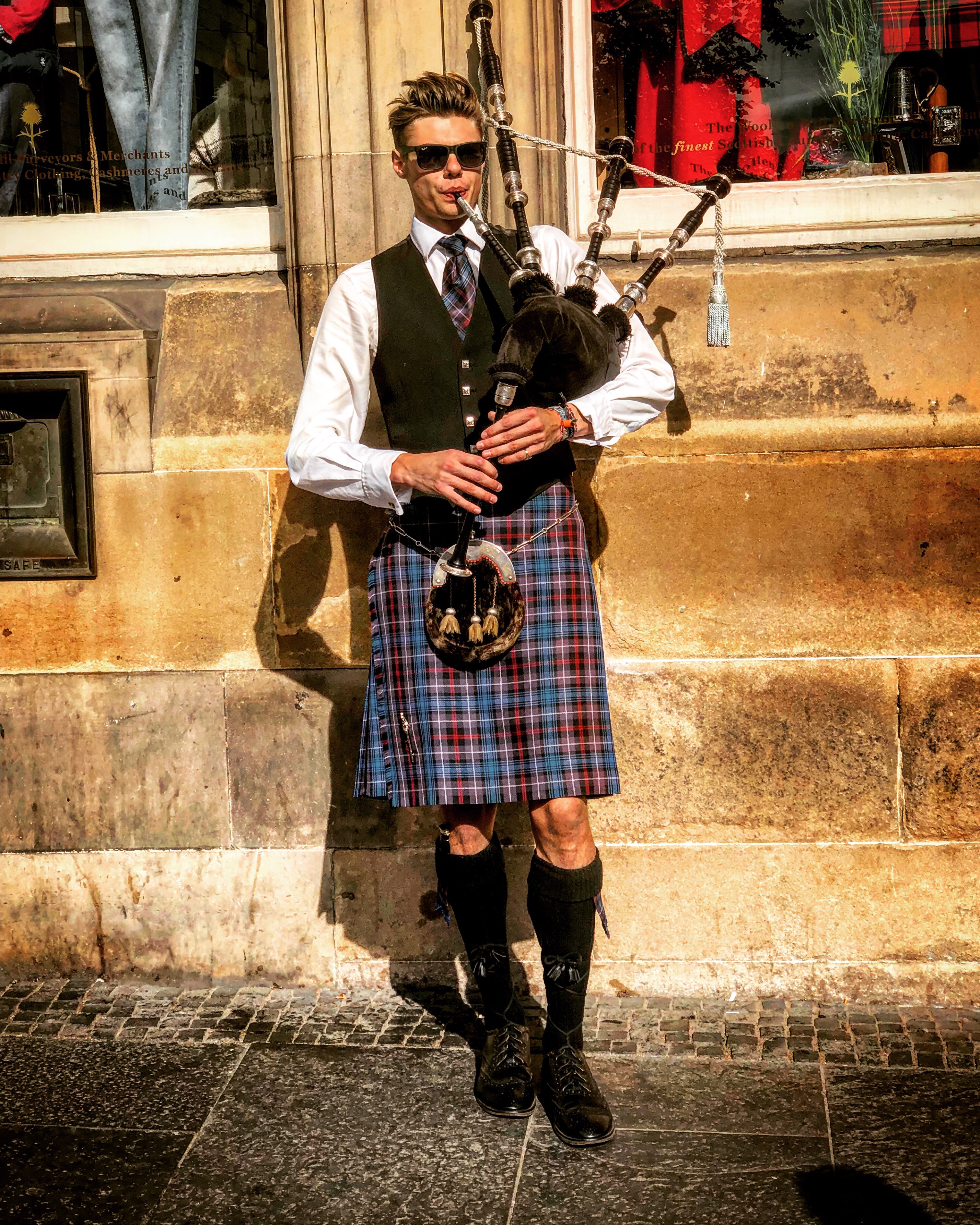
Of course, I instantly fell in love with our Scottish tour guide, Nicky. He just happened to be tall with reddish hair, very articulate, thoughtful and hilarious. Wearing a kilt that wasn’t a costume.

The first place we visited was Three Bridges, a town with, you guessed it, including a bridge that was built in the 17th Century. A marvel of engineering. The place has no connection with Outlander, just a cool spot.

Jamie Nicky took my photo in front of the old bridge.

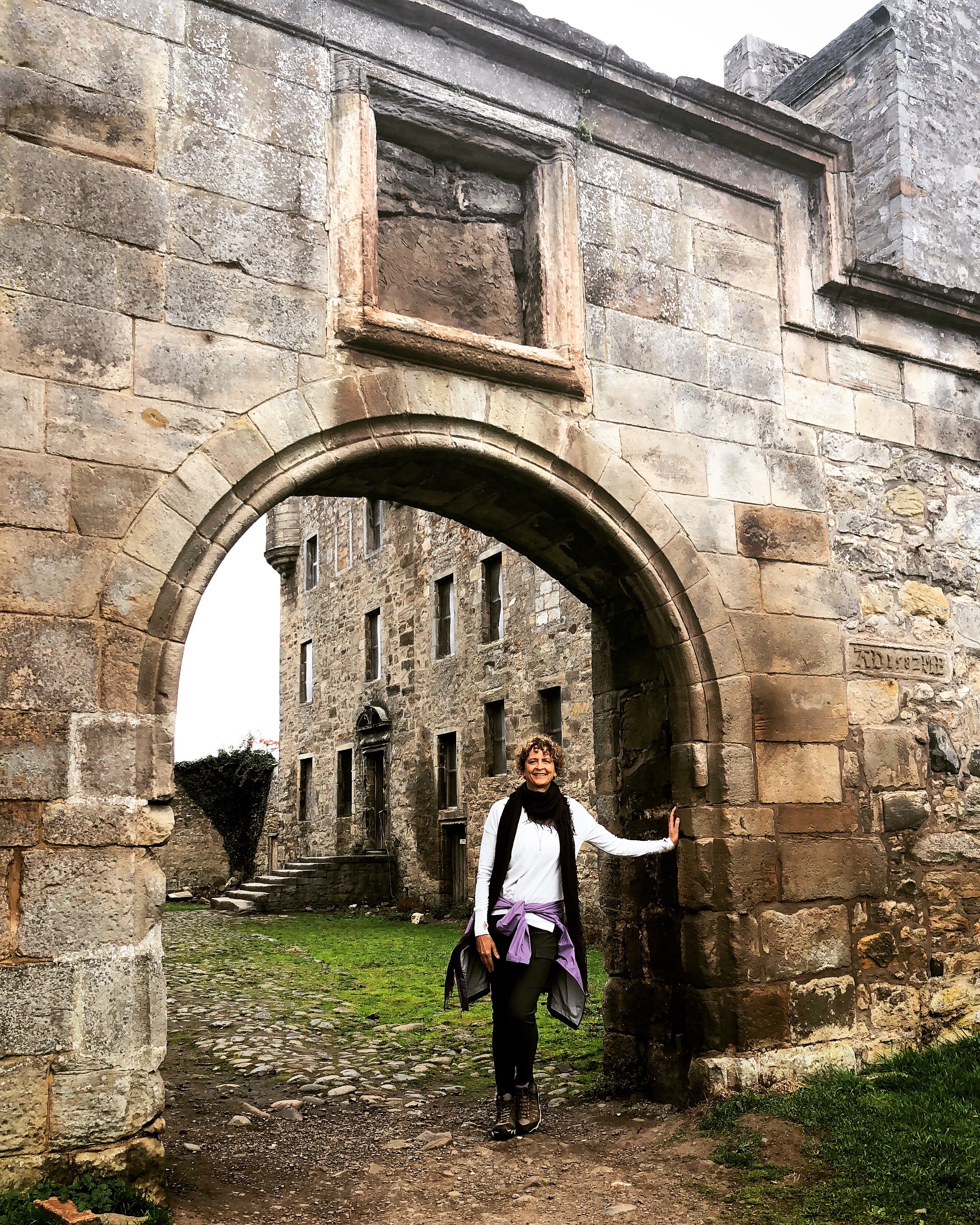
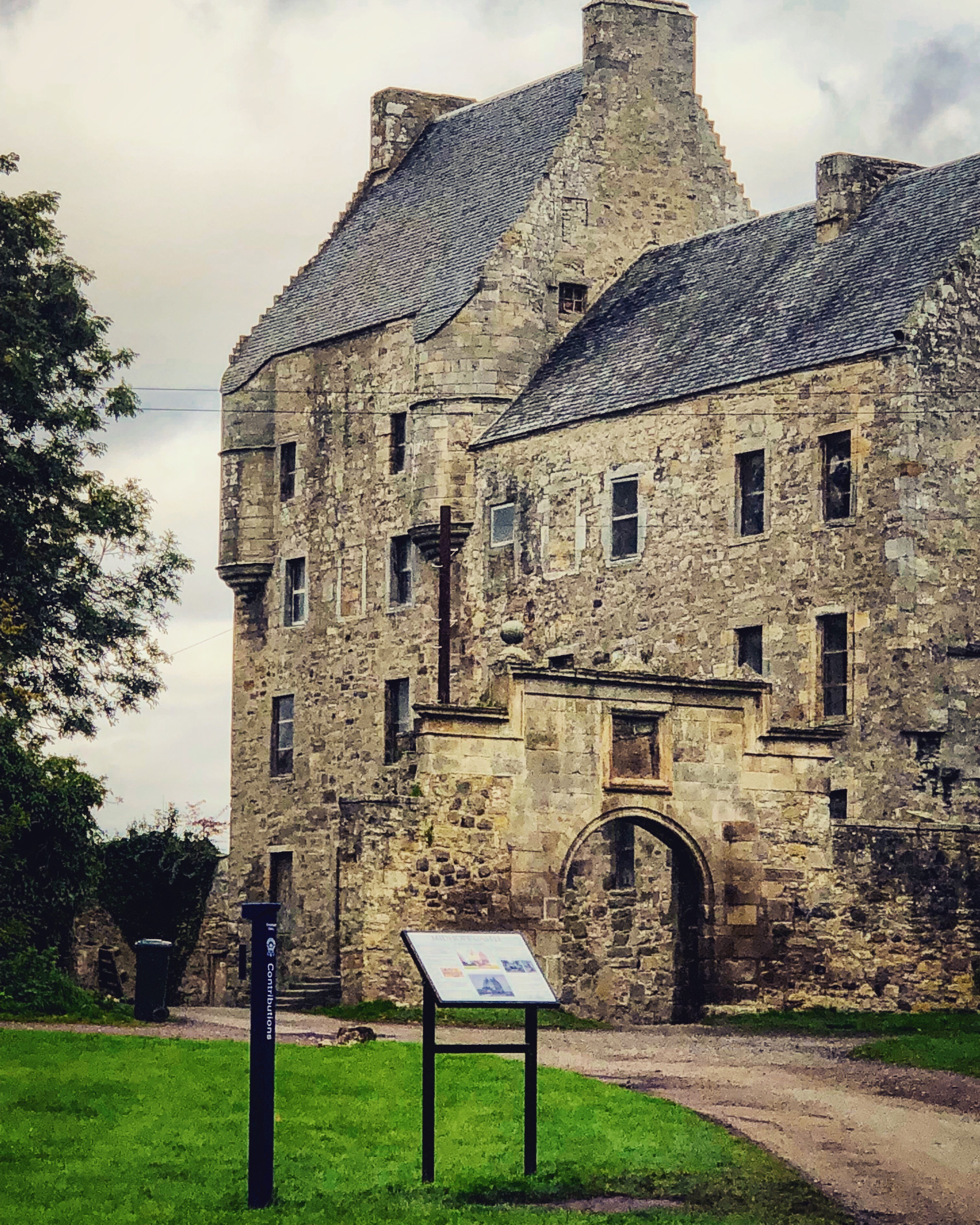
Then we journeyed to the most “all the feels” of Outlander settings, Lallybroch, the Fraser ancestral home. Otherwise known as Midhope Castle, still standing but entirely in ruins on the inside. The steps up to the door were built by the film crew. A beautiful and evocative place marooned out of time on a working farm. Surprisingly, there is a picturesque cottage right next to the Midhope ruins. Not next door, but right there on the edge of the lawn. Architectural Digest – Medieval beautiful. The owners were the luckiest people alive to own this gorgeous cottage in such a setting. Ach, no more, thanks to the fickle finger of fate. Their idyllic spot has been besmirched by Outlander and the tourists who followed in its wake.

Speaking of tourists, it soon became apparent that there were different sorts of Outlander tours. As we were leaving “Lallybroch,” another, larger group came down the path toward us, led by a guy in an over-the-top Highlander costume. He held a plastic shield and brandished a fake broadsword. He was a scenery-chewing Pirates of the Caribbean Johnny Depp version of an 18th century Jacobite. Johnny Depp Jamie had obviously dispensed plastic weaponry to everyone on his tour for them to, I guess, ineffectually arm themselves as they visited ruins. Two adorable little old ladies walked side by side, one brandishing two plastic axes, the other holding two pistols. I would have died had I booked this tour. Johnny Depp Jamie immediately challenged Jamie Nicky with his sword. Jamie Nicky, sensing danger, extended an arm in front of me to protect my life and virtue. I grabbed his arm with both hands and crouched down, because I’m not about to be left behind in a sudden acting opportunity. His arm was strong and thick and suddenly I had a new appreciation for the antics of Johnny Depp Jamie.

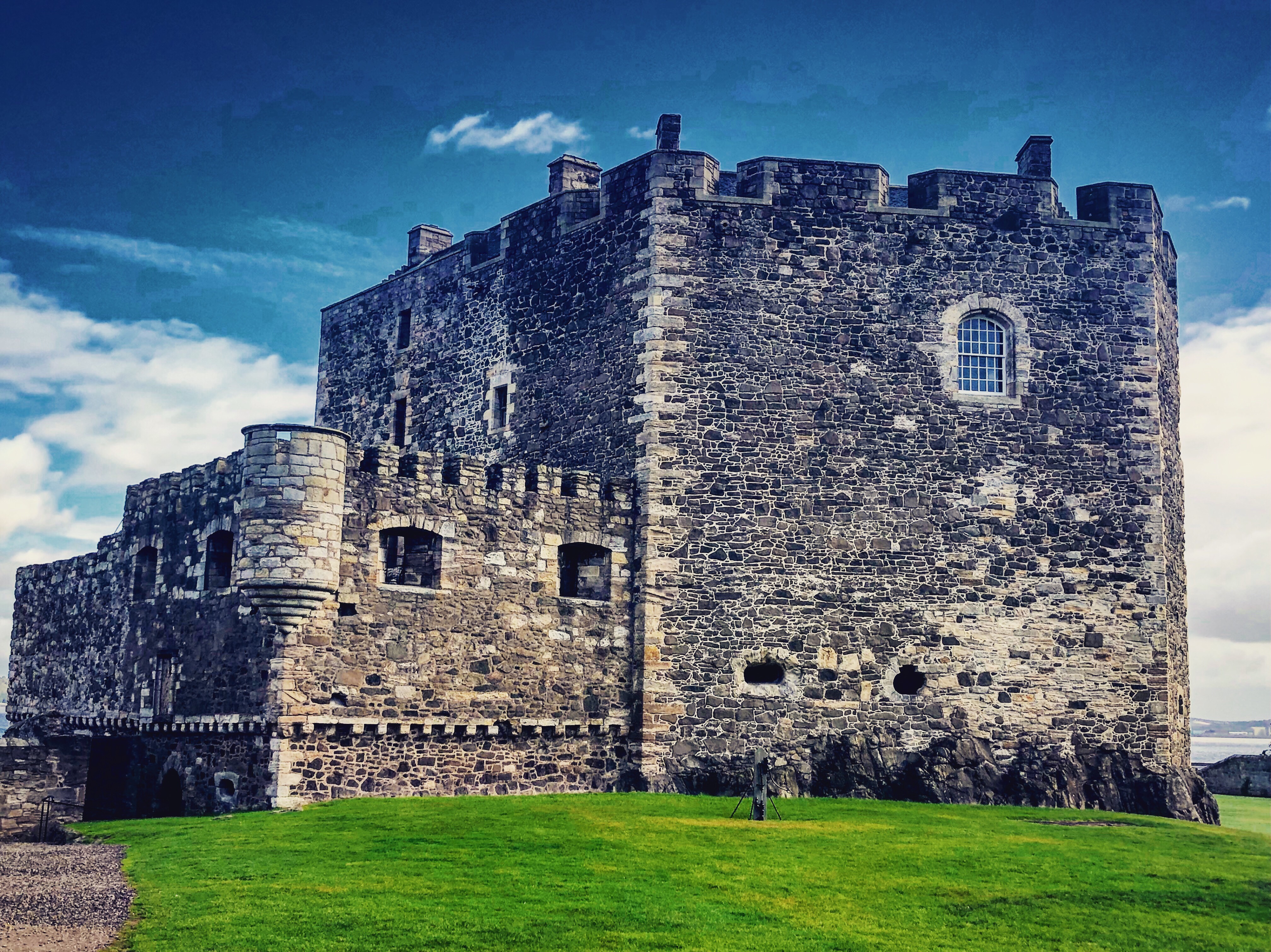
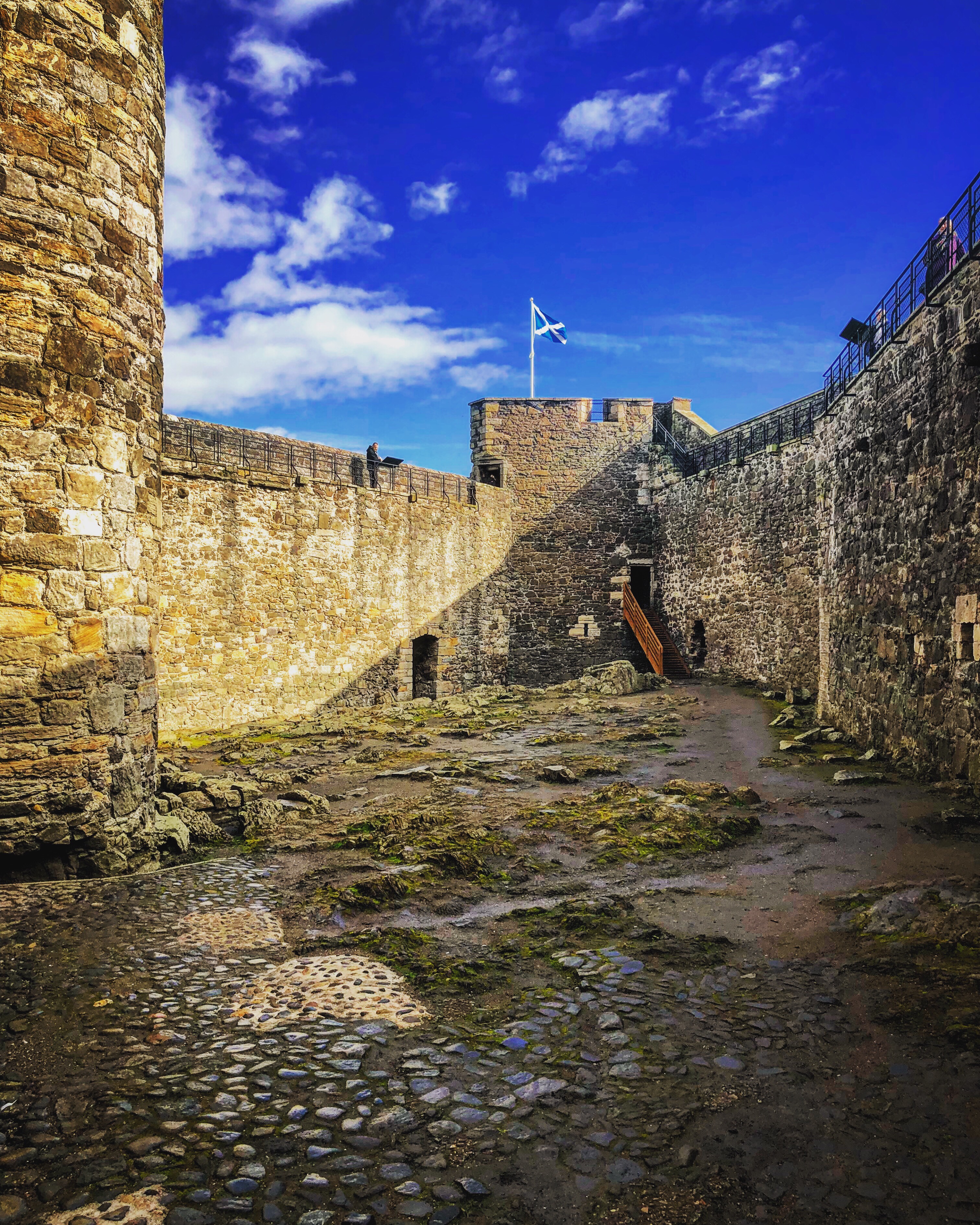
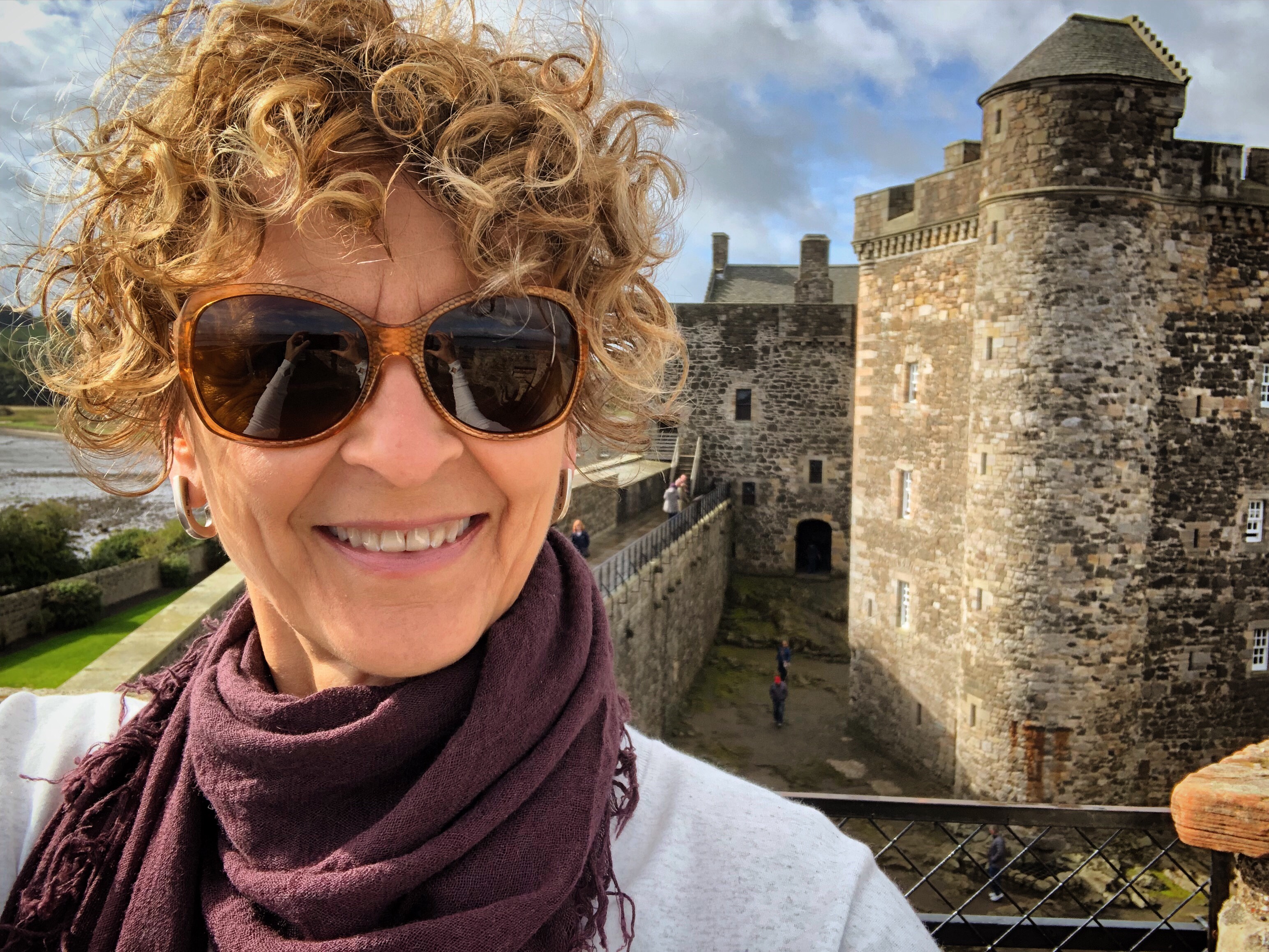
Our next stop was Blackness castle, a 15th century fort built on the south shore of the Firth of Forth. It protected Linlithgow, one of the main palaces of Scottish Royalty, especially the Stuarts. Because of its site, jutting into the Forth, and its long narrow shape, it has been dubbed the “ship that never sailed.” It was used to portray Ft. William in the series, including the scenes of Jamie being flogged nearly to death by Jack Randall (I know people who haven’t seen the show are wondering why on earth), and later the daring rescue of Claire by Jamie, Murtagh, Angus and Rupert with Jamie scaling the tower clutching an empty pistol. Speaking of which, I came upon Johnny Depp Jamie again just as he was reenacting the scene of Jamie clubbing a redcoat over the head after asking where Claire was being held. JDJ brushed people out of the way so he could rush up some steps in search of Claire.

All swashbuckling aside, Blackness Castle is a gorgeous structure in a beautiful setting with a nicely preserved Great Hall.

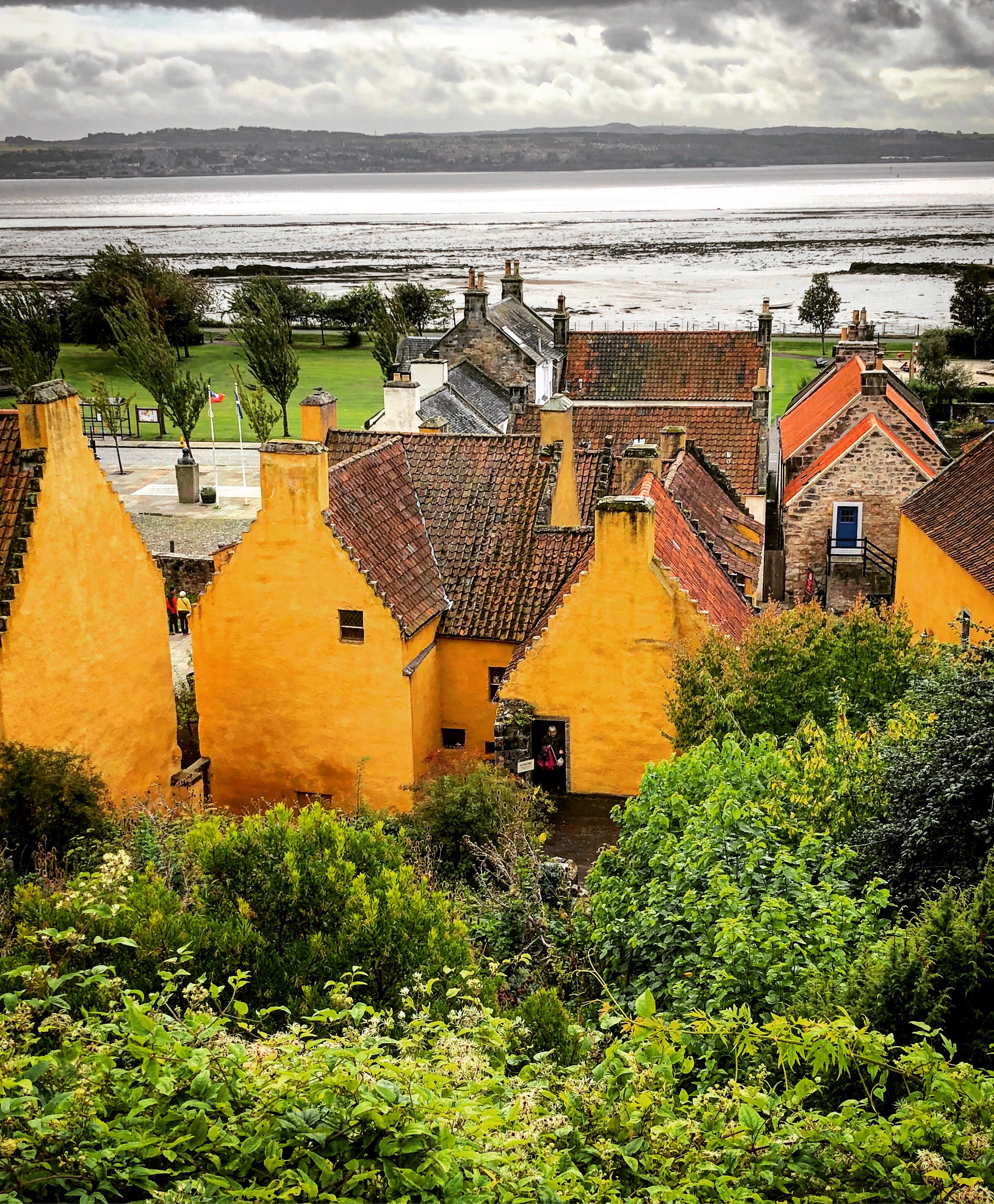
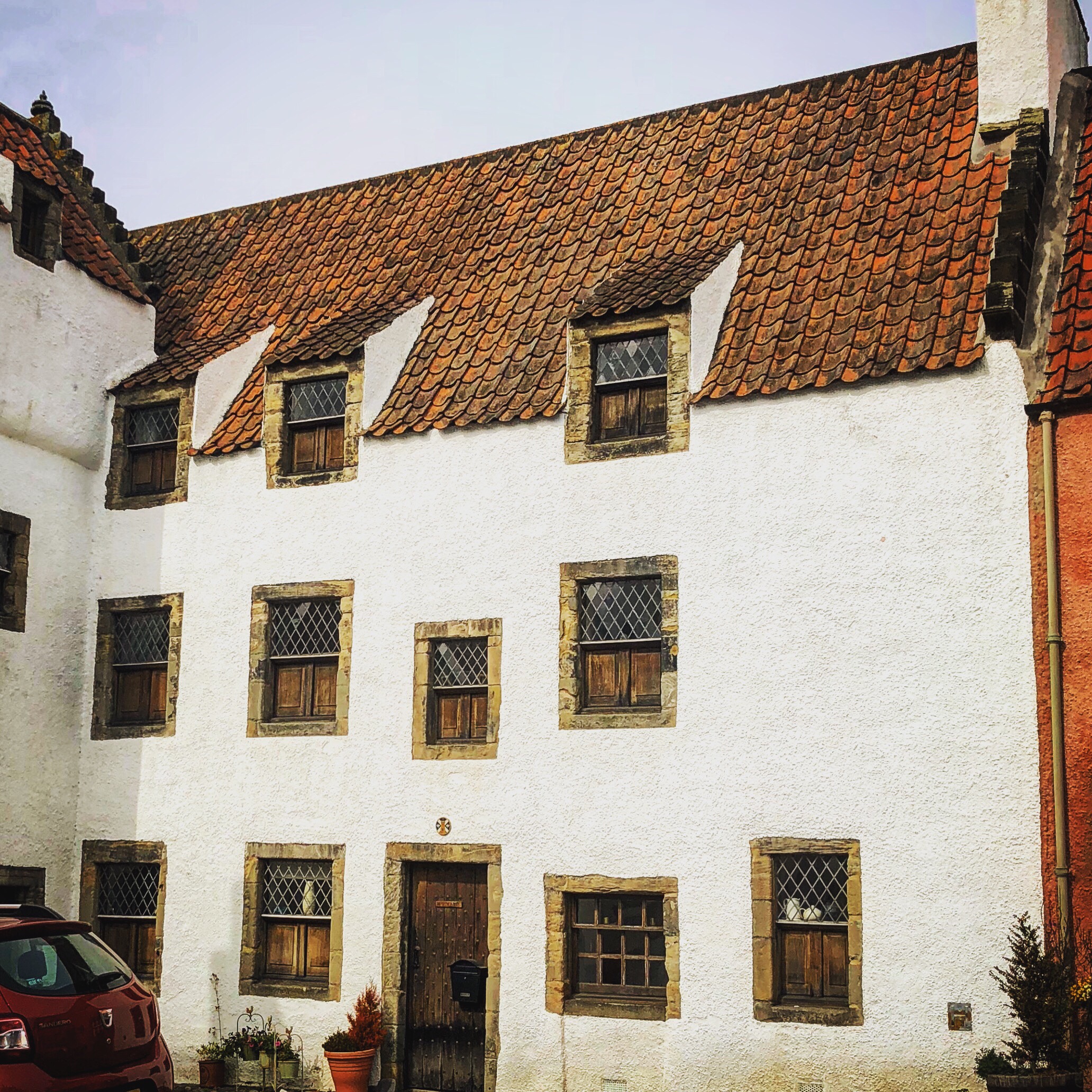
Next stop was the 100% charming town of Culross, where the scenes in Cranesmuir, the village near Castle Leoch, were filmed, including Geilis Duncan’s house, Claire’s herb garden, and the scene where the wee boy got his ear nailed to the pillory for stealing. The town has barely changed since the 17th century and is managed by the National Trust. I had the second best sandwich I’ve ever had there, in a charming little place called the Biscuit Cafe. I mistakenly took a table next to the loo. We all know this, but people truly have issues about bathrooms. One lady in her sixties ducked in and her friend had to stand in front of the door like in high school, holding it slightly ajar, explaining to the gentleman who was next in line, “She’s afraid of getting shut in.” Aren’t we all.

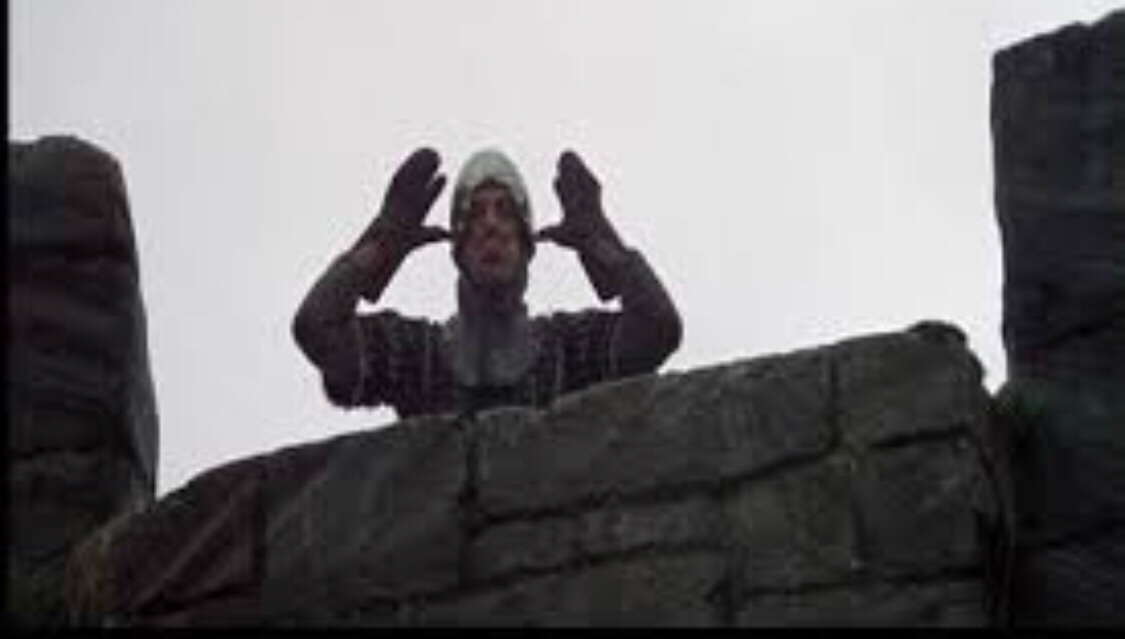
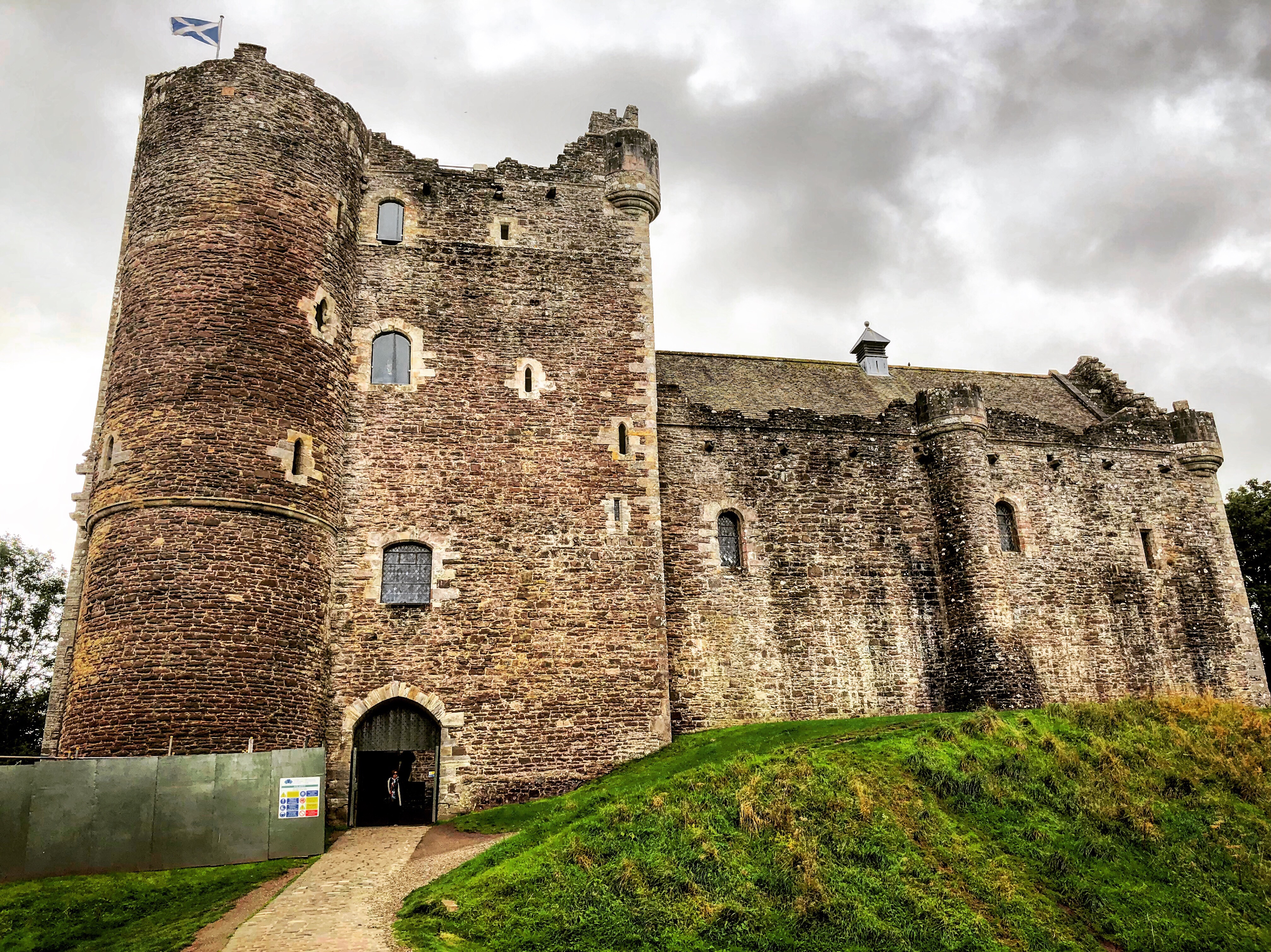
Next was the granddaddy of all film locations – Doune Castle, a medieval stronghold in the Stirling district of central Scotland. The most famous taunting scene in cinema was filmed here.

Starring our beloved John Cleese as the pitch-perfect French taunter, with many memorable lines, including that old chestnut, “Your mother was a hamster and your father smelt of elderberries!” Apparently the Pythons had booked several castles in Scotland for filming until someone wondered who they were and whether they could even pay, withdrawing permission from all except Doune. So basically the entire film was shot here.

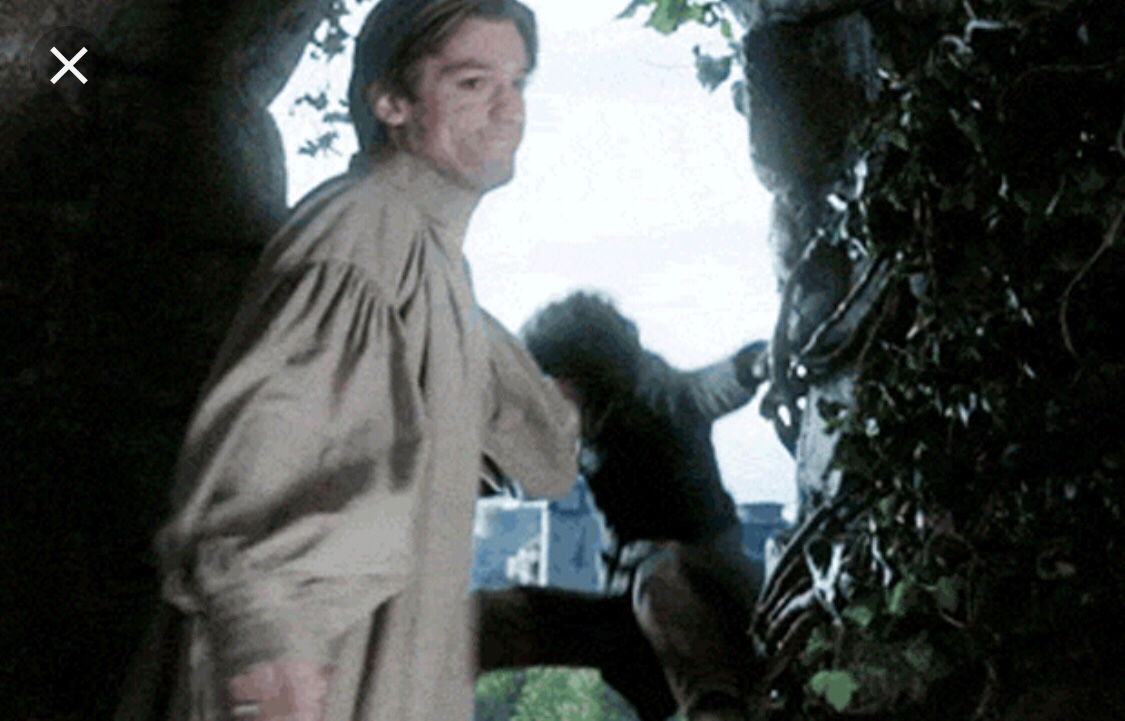
Also the most famous scene ever filmed depicting a guy shoving a boy out of a window because the boy caught him having sex with his sister. I know this scene is basically in every film, but this is truly the best version. Unfortunately, in Game of Thrones, the boy did not die and instead became the Three-Eyed Raven, which, we don’t know, but may result in the ultimate downfall of said guy in the long slow dance of karma.

In season 1 of Game of Thrones, Doune Castle was Winterfell. In season 2 they moved production to Ireland because it was cheaper.

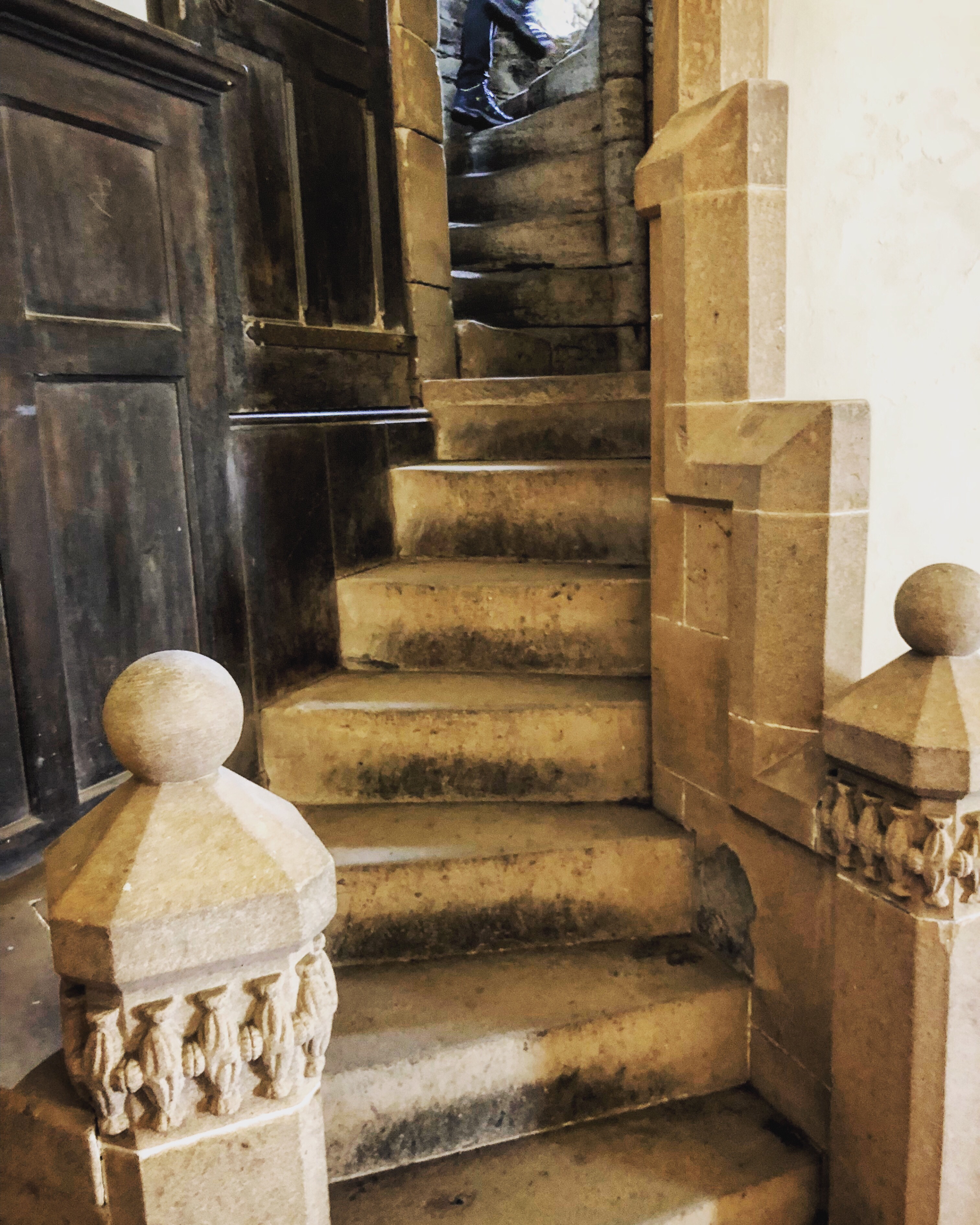
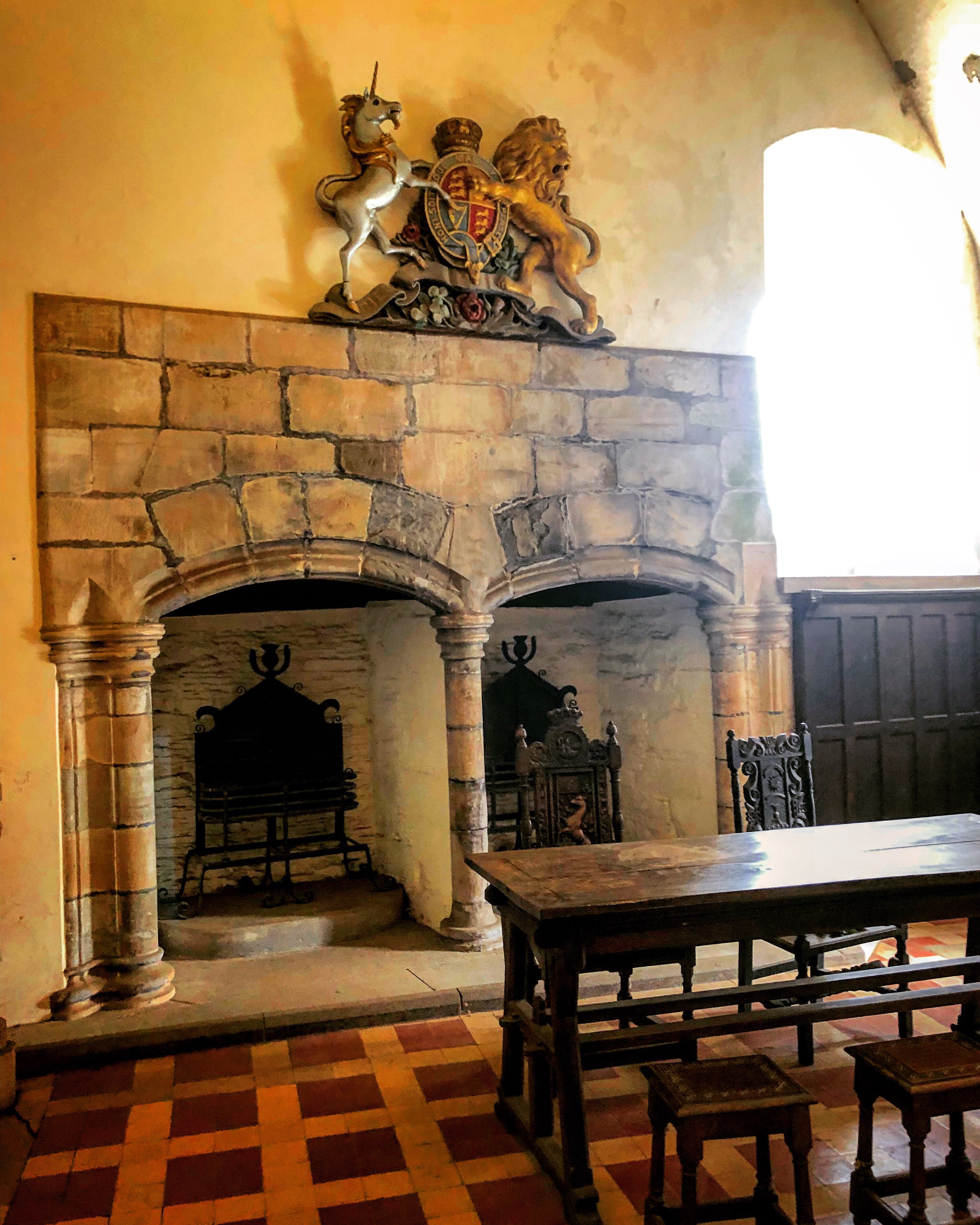
Doune bounced right back, and became the home of the McKenzie clan in Outlander, Castle Leoch. It’s now the third most visited castle in Scotland, after Edinburgh Castle and Stirling Castle. The audio tour is narrated by Python’s Terry Jones, and by, of course, Sam Heughan, who plays Jamie. Inside the house is a fabulous Great Hall and a wonderfully preserved kitchen, including a giant fireplace large enough to roast an oxen. Many silly Python scenes were filmed inside, including the song-and-dance number “Knights of the Round Table,”and the Sir Galahad the Chaste’s seduction scene. I completely recognized them all.

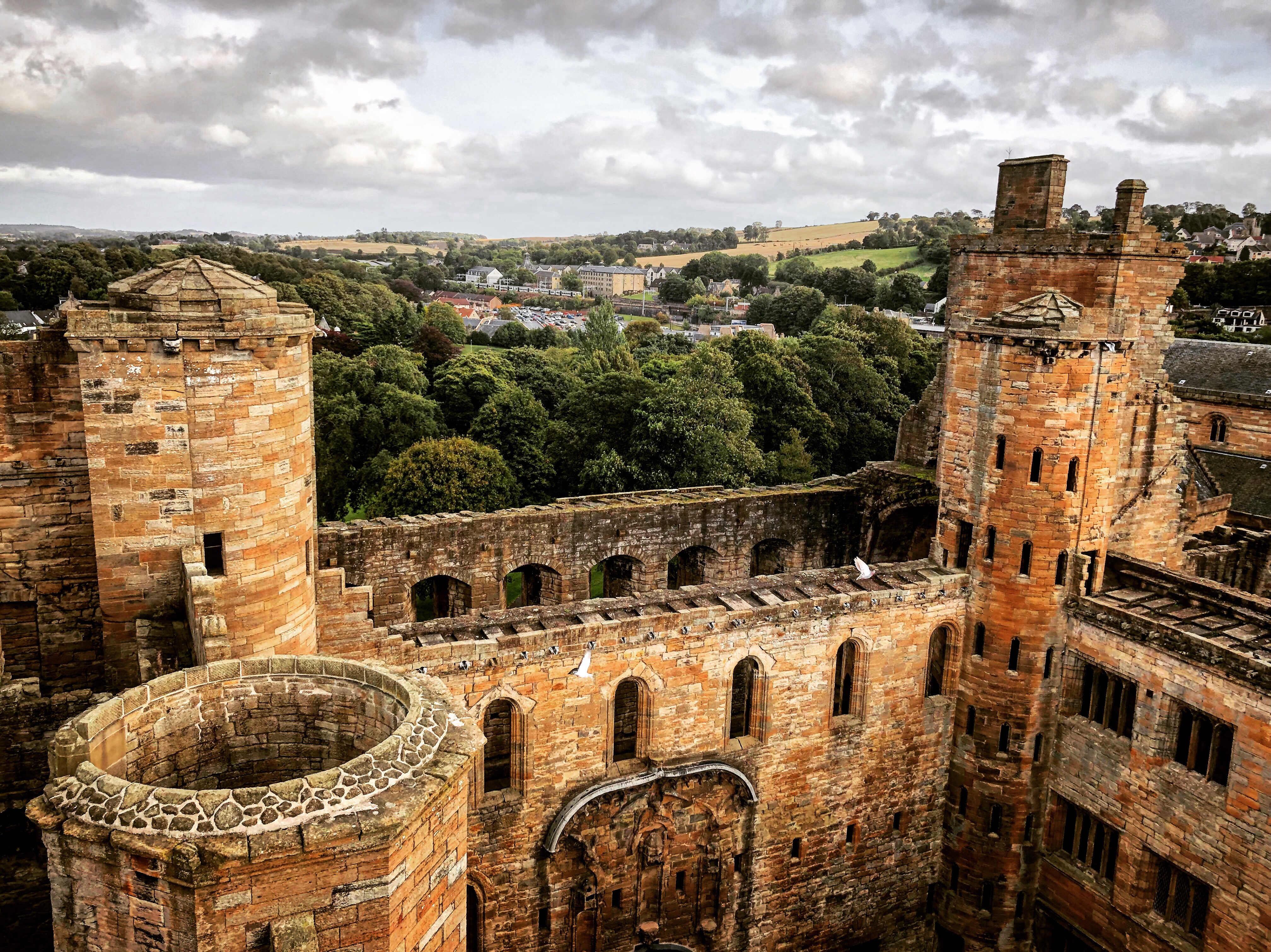
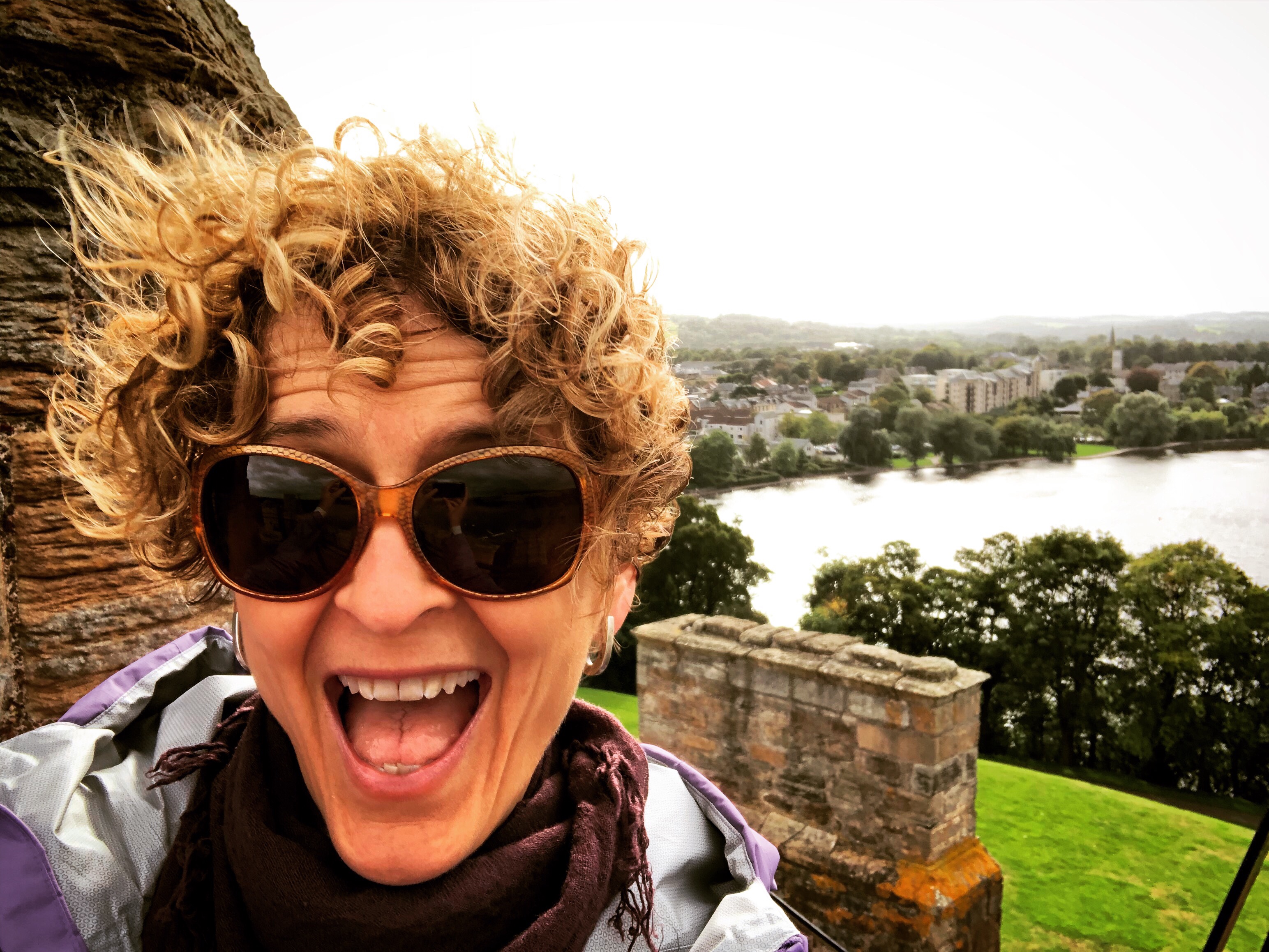
The last stop on our tour was Linlithgow Palace, where Mary Queen of Scots was born and lived for seven months, after which she was whisked away to Stirling, a more secure location. She was in danger the moment she was born, and for most of her life. It was another 20 years before she returned. A lot of Stuart history here. There’s a beautiful and drafty portico on the roof where legend has it Queen Margaret waited in vain for the return of James IV from Flodden Field. Bonnie Prince Charlie was the last Stuart to stay at Linlithgow. In 1746 the castle burned because the British duke of Cumberland’s troops failed to properly extinguish their campfires.

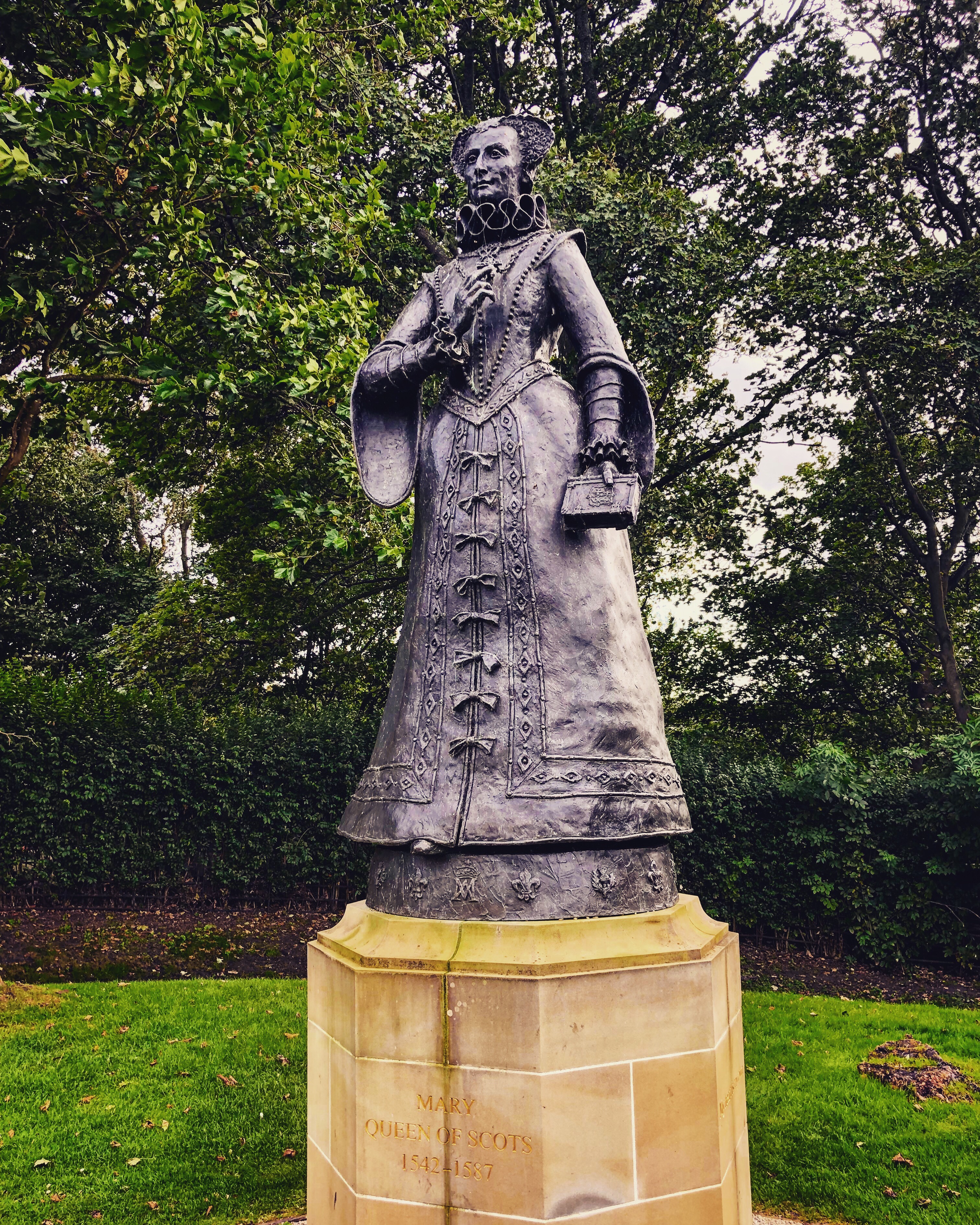
Gorgeous spot (Scots had great taste in castle sites), with a statue of Mary Queen of Scots on the grounds. In the UK you are allowed to scramble all over ruins, climbing up tiny staircases with flimsy railings that wouldn’t be allowed in the US. No posted warning signs, nothing roped off, I guess because you’re supposed to use common sense. The higher you go, the more pigeon poo there is, since all is exposed to the skies. Many ruined castles around Scotland don’t have roofs, not even if they’ve undergone restoration. Why? Because buildings with roofs are taxed.
In Outlander, the tunnels and cells underground were used for Wentworth Prison, where extremely terrifying things happened to Jamie.

It was a fabulous tour, largely because of the fabulous Nicky. He told us the entire history of the Jacobite rebellions. There were five between 1688 and 1745, all with the goal of returning one of the Jameses to the throne of Scotland and England and all failures, finally resulting in the Highland clearances. Nicky told the story with passion and emotion. History is still very much alive for Scots. As Robert Louis Stevenson wrote, “For that is the mark of the Scots of all classes: that he stands in an attitude towards the past unthinkable to Englishmen, and remembers and cherishes the memory of his forebears, good and bad; and there burns alive in him a sense of identity with the dead even to the twentieth generation.” Nicky also reflected on the current political situation in the UK and elsewhere (ahem), resolving to focus his efforts on things he could positively impact, like, for example, people’s lives. He also taught me a new word, “scuppered,” which originally meant to deliberately sink a ship, and has come to mean thwart. So many uses. Anyway, I adored him.
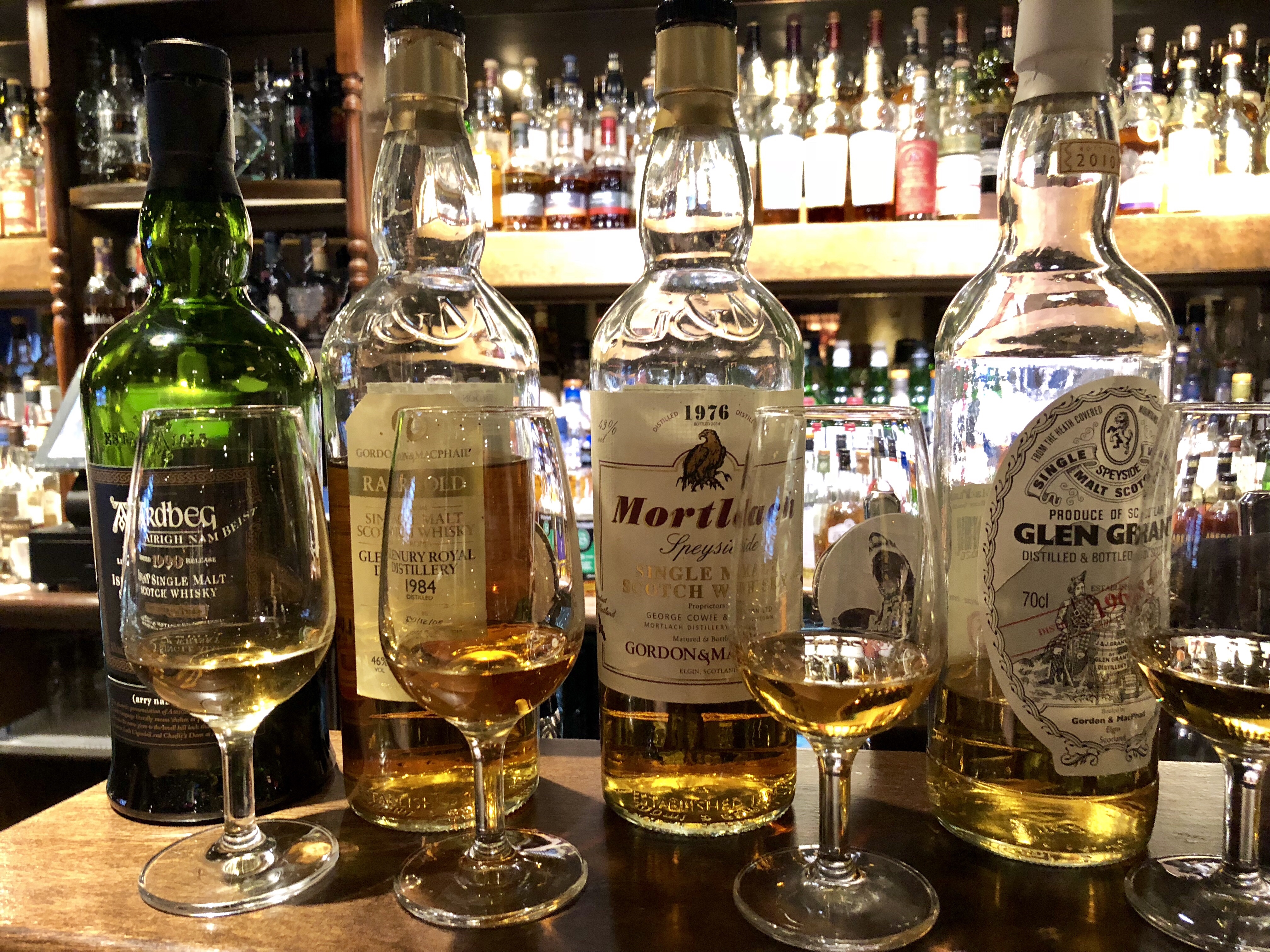
How to end such a day? By booking a very expensive whisky tasting at Usquabae, meaning water of life (Gaelic translation of Medieval Latin aqua vitae.) Sitting at the bar, I was regaled with tales of whisky and its historic impact on the Scottish economy and history. A couple of local boys chimed in, asking questions and giving their own opinions. It’s a very complex subject near and dear to the heart of Scots. I chose a tasting called “The Decades.” It included a whisky from the 60’s, 70’s, 80’s, and 90’s, which covers my entire life. The older whiskies were good, but as the bartender noted (he had tastes of all my drams to keep me company), they do get a bit “vegetal.”

One last observation about Scottish men. They look you right in the eye, steadily, when you’re talking to them. They don’t hang back, either, they are snuggled right into your personal American space. I love it.
The Nastiness Act, A Lock of Hair That Used to Be Attached to Mary, Haggis and Rob Brydon

Aye, it does rain in Scotland. Usually, I’m told, a wee bit of ongoing mist, but sometimes a freaking downpour. And yet I booked a private tour of the Royal Mile and Edinburgh Castle, and the show must go on. The Mile is very touristy, but, like many such places, with a little effort and intrepidity you can have your own singular experience in spite of it.

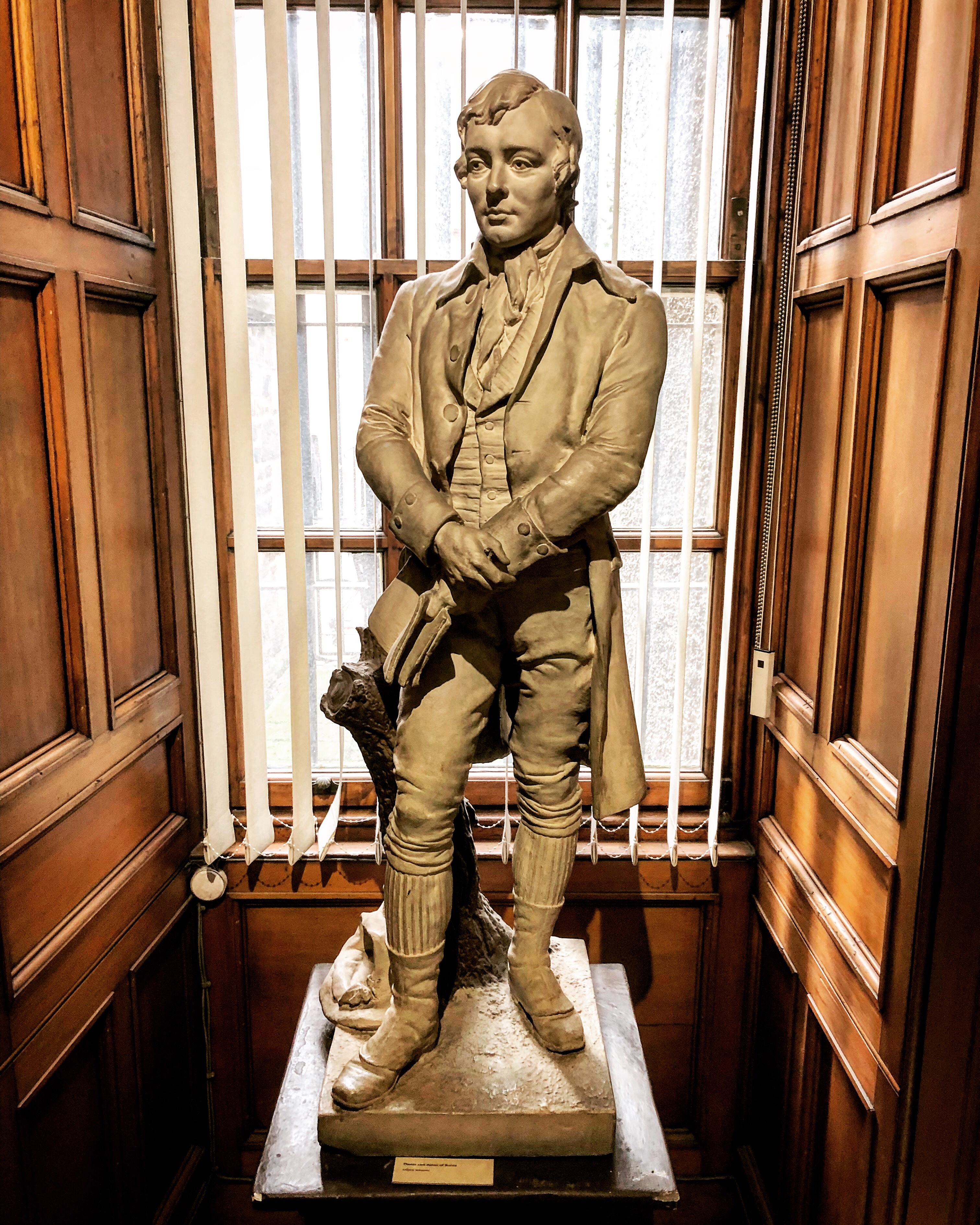
My guide, Gains, has a PhD in History, and he brought whisky. As we meandered up the mile, he had many colorful tales to tell. Best of all, he poured wee drams at 10:30 in the morning as we stood in front of The Writers Museum, devoted to the Scottish trifecta of 18th and 19th century writers, Robert Burns, Sir Walter Scott and Robert Louis Stevenson. Over my drams he told me about Burns Night every January 25, when Scotland celebrates their Rabbie’s birthday with a bit of frivolity and drink. It was a very Scottish moment.

As romantic as the Mile is now, it used to be utterly disgusting. Its streets floated with raw sewage and it was massively overcrowded with people in tenement-style buildings up to 14 stories tall. More than 50,000 Scots were crammed within its walls and livestock roamed freely. There was no plumbing (ignoring Roman tech) and so once a day residents would dump buckets of waste into the streets from upper windows. There was a bit of a warning first: “Gardyloo!” This was from the French gardez l’eau, but all credit to the Scots, not really l’eau at that point, loo being much more accurate. Residents used to be able to dump at any hour of the day, but in 1749 The Nastiness Act was passed which decreed waste could only be tossed out between 10:00 pm and 7:00 am.

As you can imagine, the city’s water supply was diseased. So the primary sources of hydration became alcohol (even for children, even first thing in the morning) and tea (because boiled).

Edinburgh’s upper classes lived on the center floors, too low down and the stench was overwhelming, too high up and there was a danger of collapse, as the top floors were wooden and poorly constructed. In the mid 18th century, the upper classes left “Old Town,” moved down the hill and established “New Town,” which is filled with Neo-Classical and Georgian architecture. To this day New Town is considered more posh, although both are UNESCO World Heritage sites.

So many interesting stops on our tour – for example, down one close (Scottish term for alleyway) is the only surviving sedan chair storage unit in the UK. Now it’s used as a bike shed, which is frankly what it looks like. Highlanders would be brought from the north to carry members of the upper classes around town suspended in these chairs so their feet wouldn’t touch the poopy ground. Also the streets were too narrow for carriages. They were King Joffrey’s preferred mode of travel in Game of Thrones.

Gains also pointed out statues of Scottish philosophers Adam Smith and David Hume, and government offices, including the old Parliament building, now housing the Courts of Session. A stone in the parking lot marks the approximate grave site of John Knox, the 16th century founder of the Presbyterian Church of Scotland and a leader of Scotland’s reformation. First Minister of Scotland Nicola Sturgeon hates him, and when she comes to town she directs her driver to park on top of the marker.

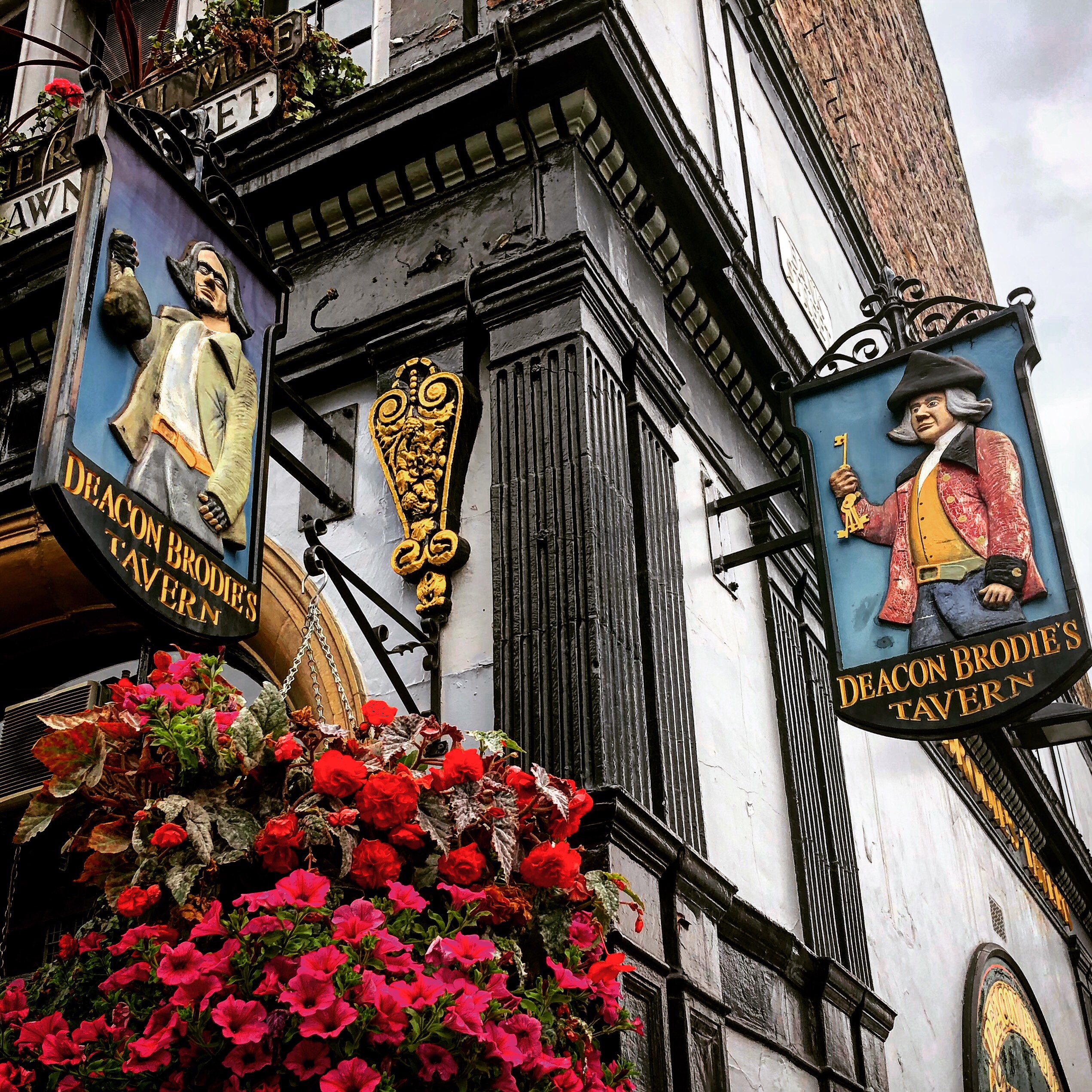
Next we stopped by a pub called Deacon Brodie’s. Brodie was a proper Scottish scoundrel in the 1700’s. A city counselor and cabinet-maker by day, he broke into homes at night to fund his gambling habit. He was eventually hanged at the Old Tollbooth just down the street from the pub that bears his name and is marked by a sign that honors his double life.

The Old Tollbooth, by the way, according to Gains, was the worst prison of all time, even more so than the Bastille. First established in the 14th century, it stood for 400 years. Sir Walter Scott wrote a book about it, called the Heart of Midlothian, often regarded as his finest novel. The Tollbooth was torn down in 1818. A Heart of Midlothian was installed in the sidewalk just at the spot, as a reminder. Gains said folks who have no idea of its history often drop to a knee and propose there.

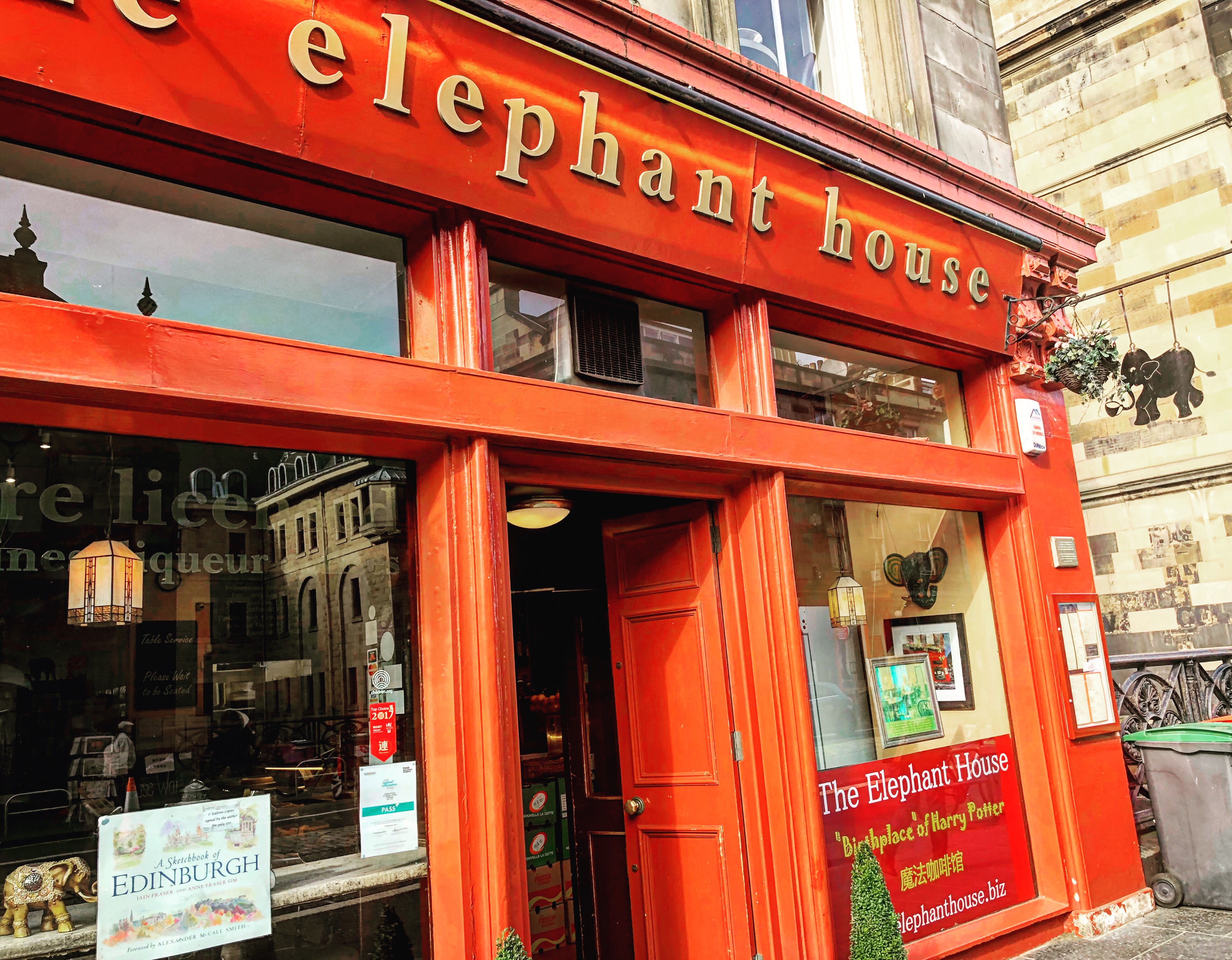
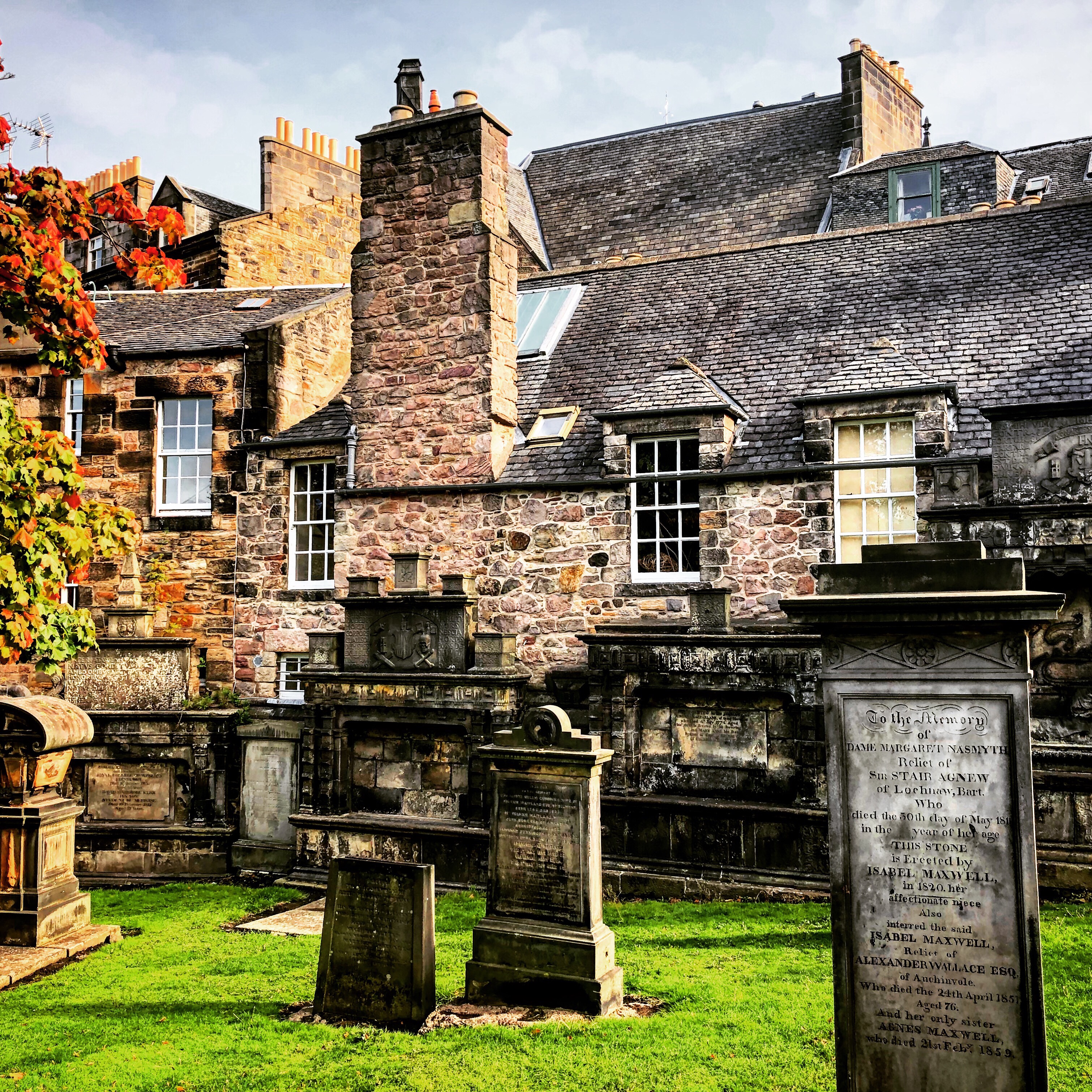
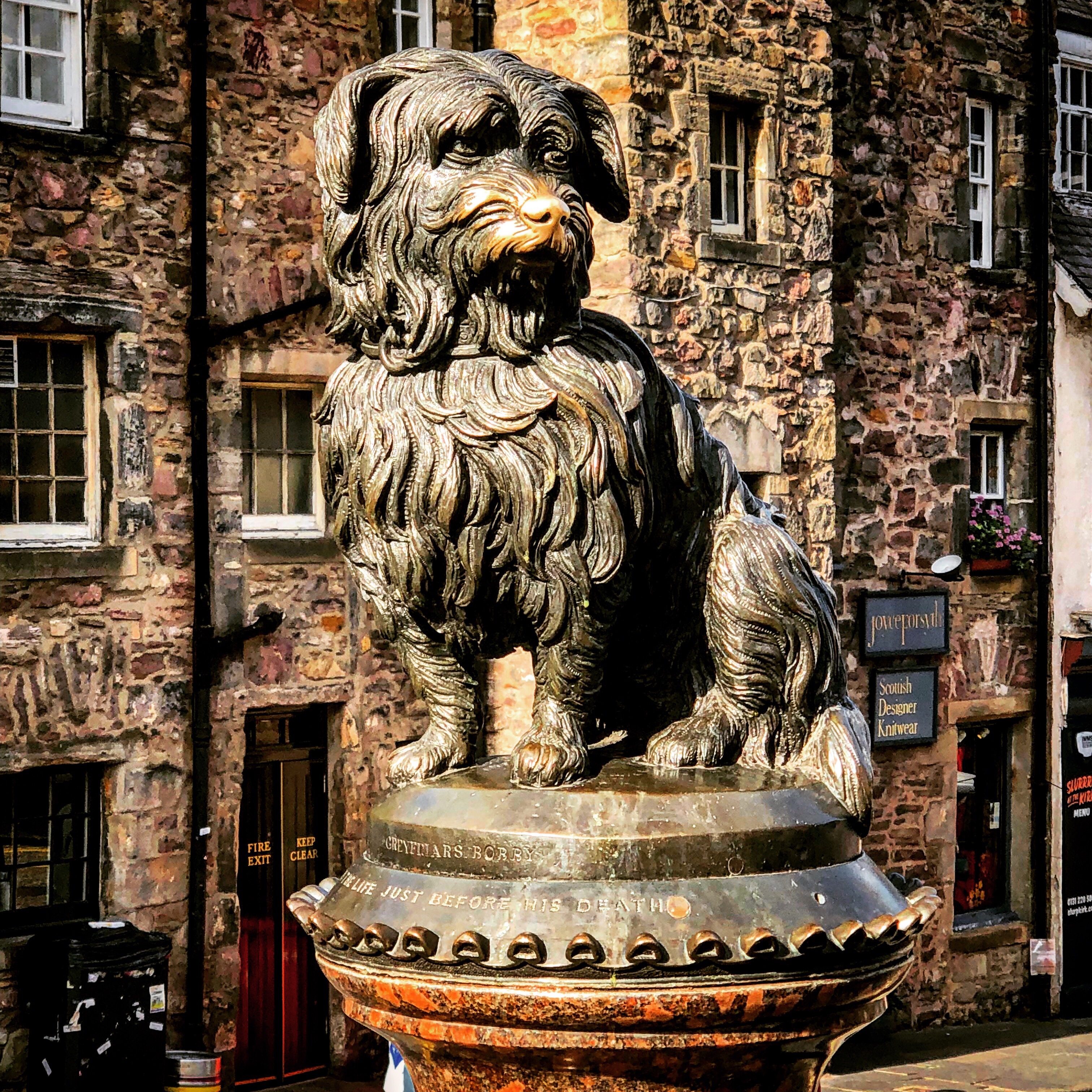
Of course, Edinburgh being the home of JK Rowling, Gains pointed out the colorful Victoria Street, which inspired Diagon Alley, Elephant House Cafe, where she wrote the first couple of books, and Greyfriar’s Kirkyard, where she found a few of her character’s names engraved on the ancient gravestones. (Wee aside: Greyfriars Bobby, just outside the Kirk, is a lovely little statue commemorating the terrier who became known in 19th century Edinburgh for spending 14 years guarding the grave of his owner until he died himself on 14 January 1872.) By the time Rowling was writing The Deathly Hallows, her publisher paid for her to stay in a suite in the swanky Balmoral Hotel. The manuscript was locked up every night. You, too, can stay in this very suite for $1300 a night. Ach, how her fortunes have turned thanks to wee Harry.

As we made our way up the hill to Edinburgh Castle, it began pouring rain. Buckets. Gains soldiered on, telling me things I should see in the Castle. He wasn’t allowed to be in certain areas and asked me to warn him and move away if I saw a red laser dot on his forehead.

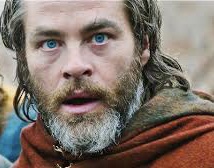
Edinburgh Castle is still an active British fort, so the British flag flies overhead rather than the Scottish. It’s a wicked fortress to conquer, being perched on a mammoth 750 million year old volcanic plug, although it’s been subject to numerous attacks and sieges throughout history. Robert the Bruce famously burned it down in the 1300’s. Speaking of which, stay tuned for the upcoming Chris Pine movie. Gains’s take (with a rueful shake of the head), “Wasn’t he Captain Kirk or something? Aye, come see Captain Kirk play Robert the Bruce! Ach.” I could go on about the storied history of Edinburgh Castle, but suffice it to say, it’s been a happening place in Scotland for centuries.

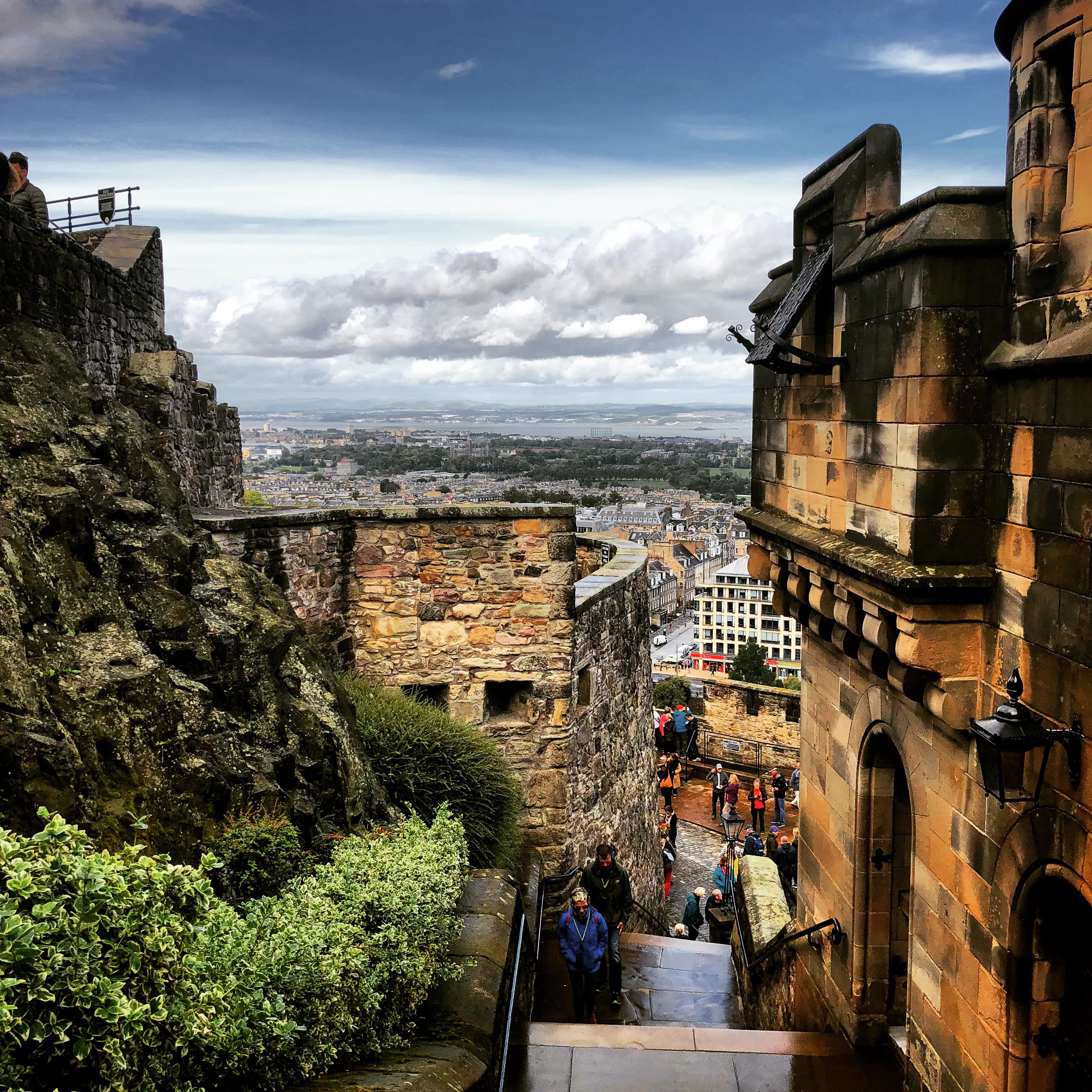
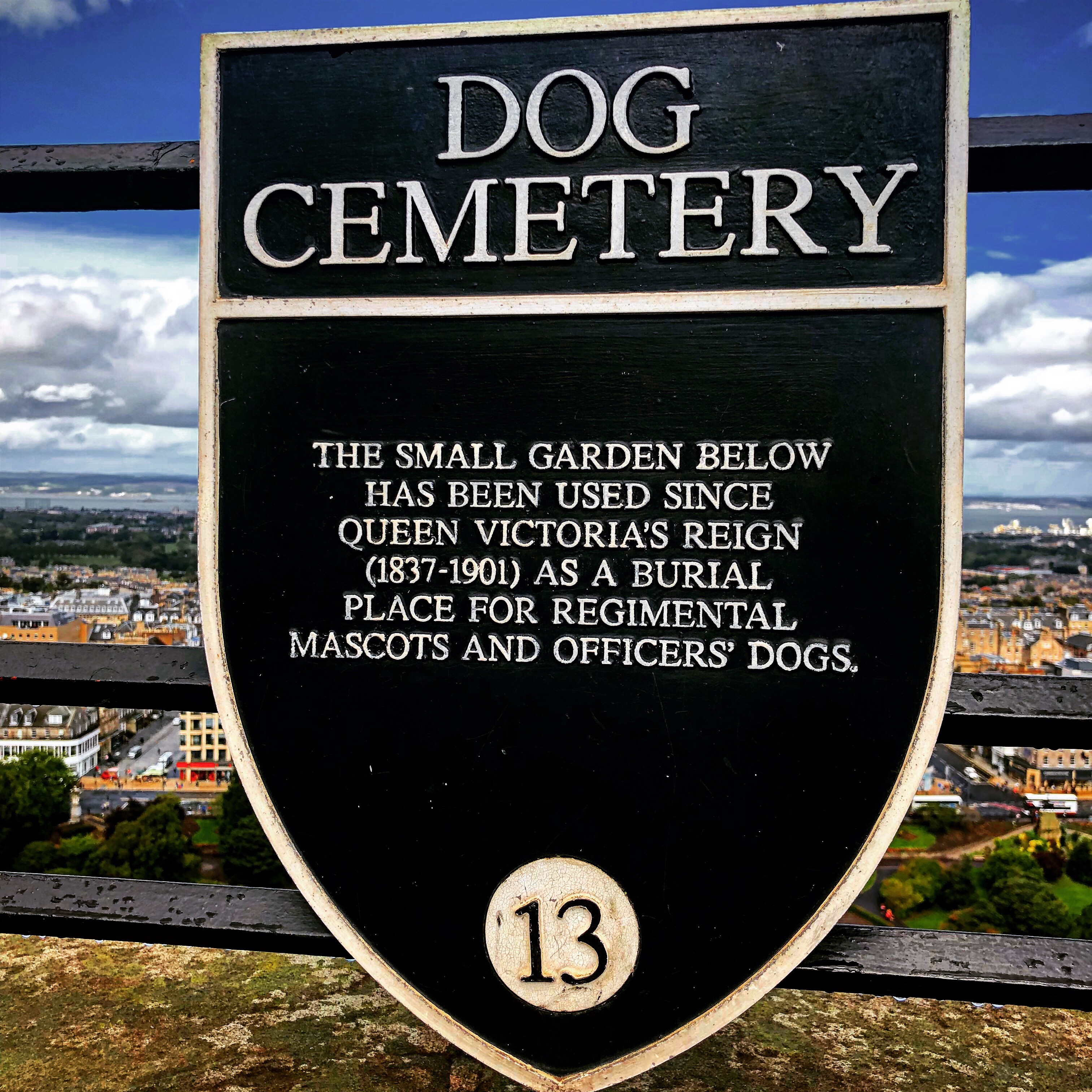
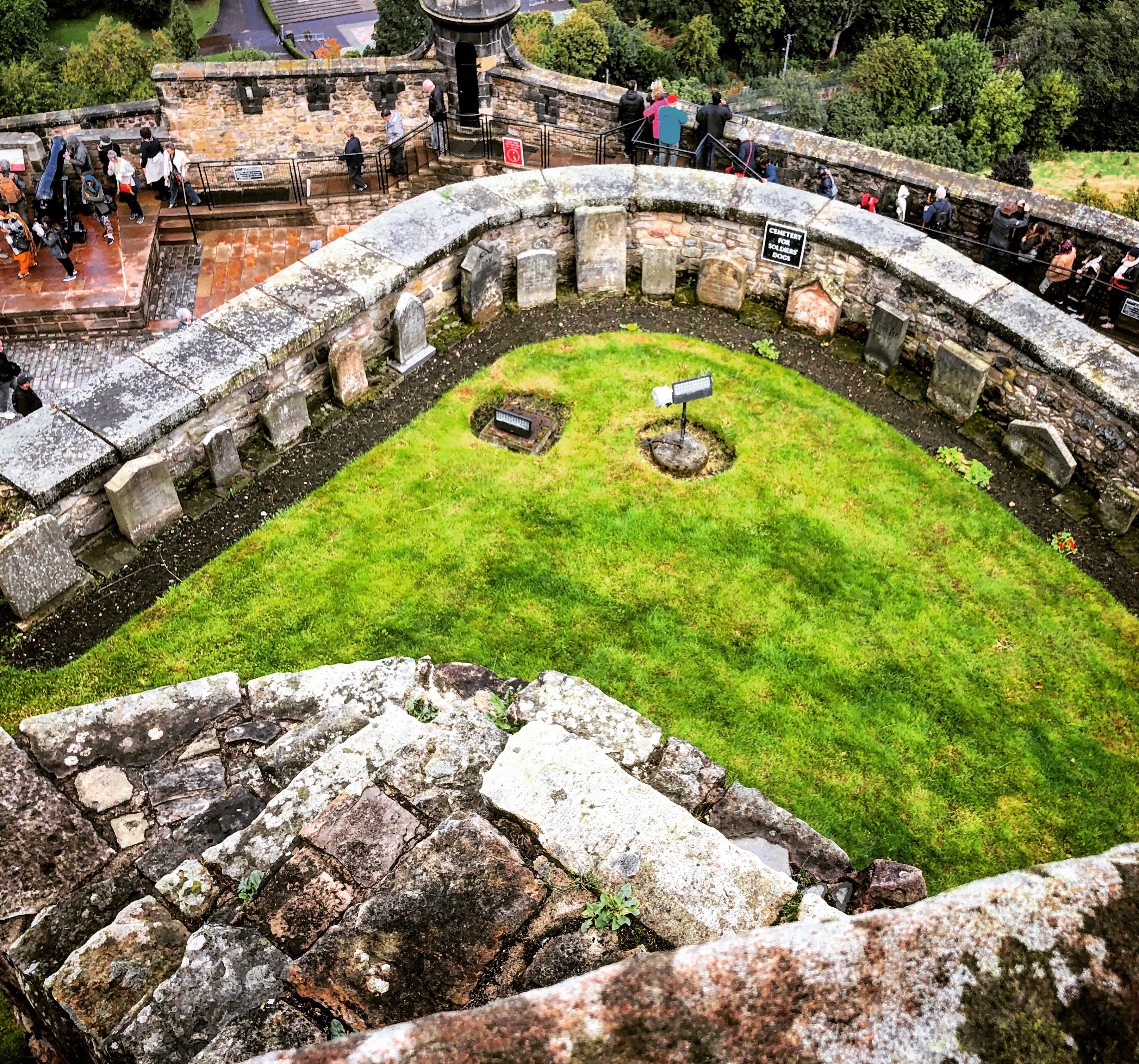
I bid farewell to Gains and explored several of the buildings inside the grounds of the fortress, including a memorial for all Scots killed in warfare since World War I. There’s also a dog cemetery where regimental mascots and officer’s dogs have been buried since Queen Victoria’s time, which is completely awesome.

Most famously, the Scottish Crown Jewels are on display, the oldest surviving set of Crown Jewels in the UK. Oliver Cromwell destroyed the British ones and that allowed Scotland to scoot into the lead. Displayed next to the coronation crown worn by Mary Queen of Scots (!!) is the storied Stone of Destiny, also known as the Stone of Scone. It’s a rather unremarkable oblong block of sandstone that has been used for centuries in the coronations of Scottish monarchs. The Brits, in keeping with their history of being awful to the Scots, swiped it in the 1400’s to use for their own coronations. A bunch of Scottish hooligans pulled a modern Highland Charge and stole the stone from Westminister Abbey in the 1950’s, bringing it home to Scotland. It was eventually returned. Finally, in 1996, the British allowed the Scots to have their stone back for good. One day, when Queen Elizabeth dies, the Brits will borrow it for the coronation of the very patient Charles. Or, if Charles can’t hold on, Prince William.

There’s a legend that centuries ago Scots switched out the real Stone of Scone for a fake before the British nicked it. If that’s true, the original hasn’t resurfaced. Or has it.

There are no photos of the Crown Jewels or the stone because royal rules.

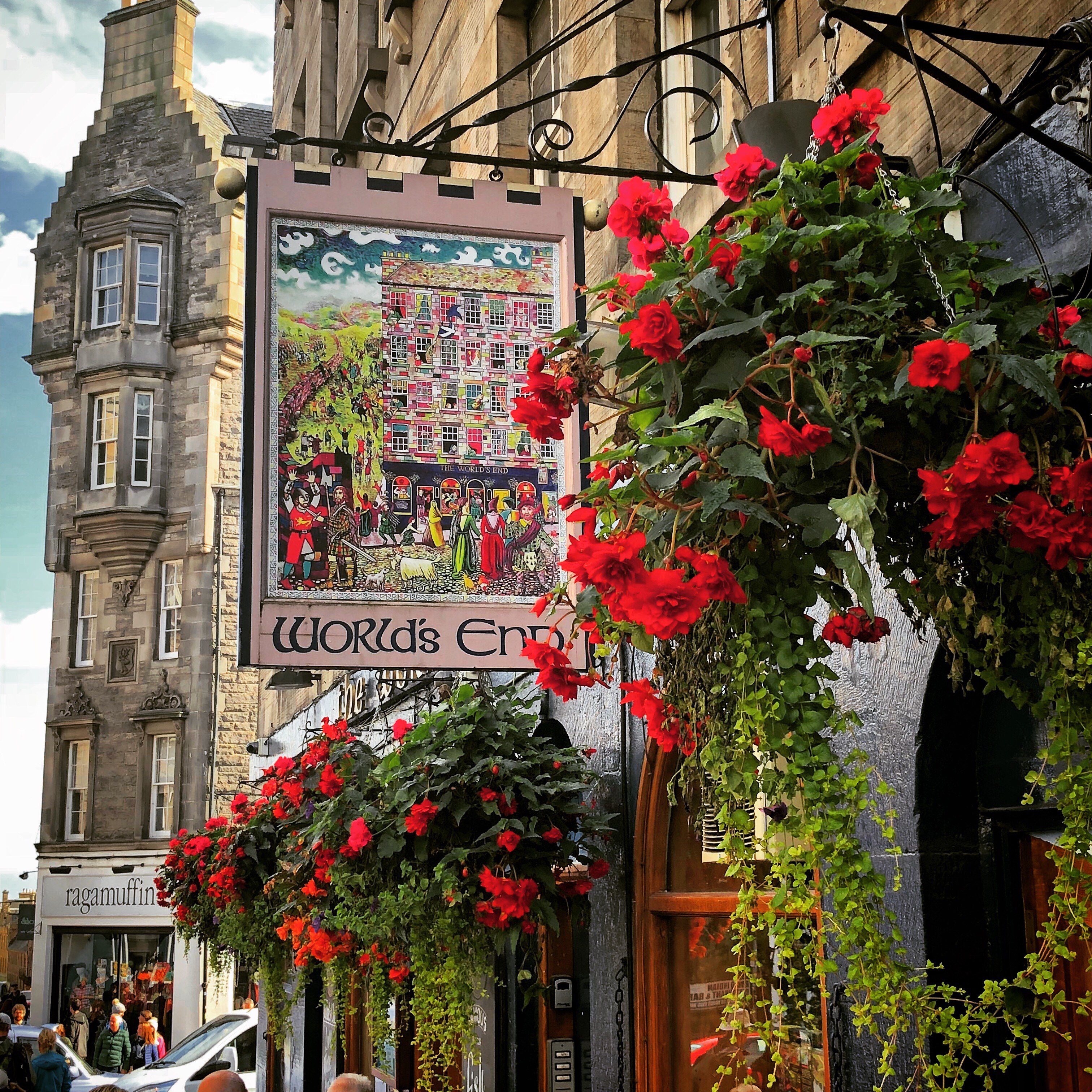
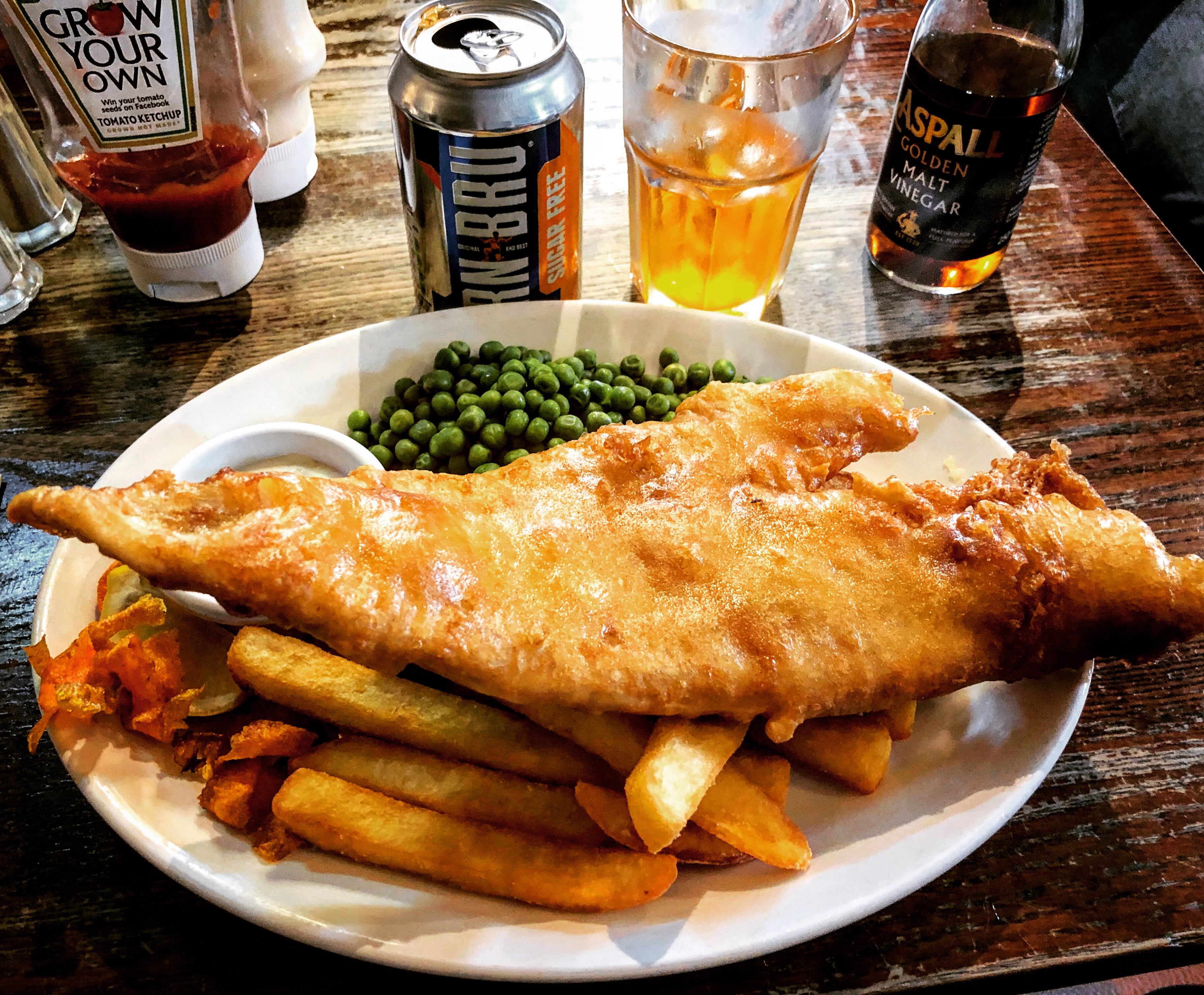
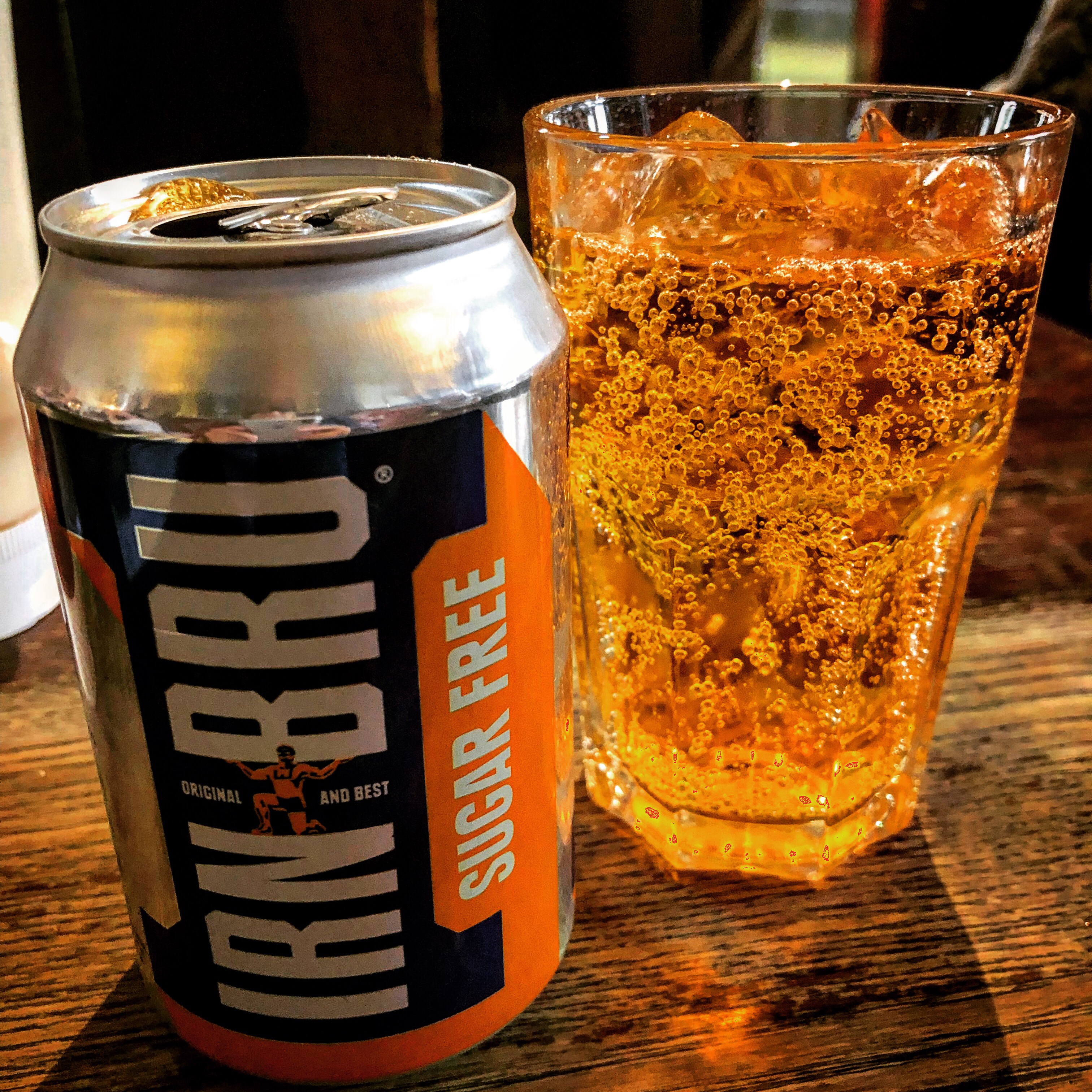
When I could stand the big gobs of tourists at the castle no longer, I made my way back down the Mile, stopping for lunch at the World’s End pub, so-called because it was on the edge of town just inside the wall, back when there was one. Fish and chips is their speciality, so I ordered it, and holy crap it was not at all wee. I also tried the Scottish soda called Irn Bru, which Gains told me outsells Coke products in Scotland. It is not very good – a bit like cream soda but not quite there. Perhaps the non-diet version would be better – I read that Scots were up in arms when Obama was spotted drinking a diet Irn Bru in St Andrews.

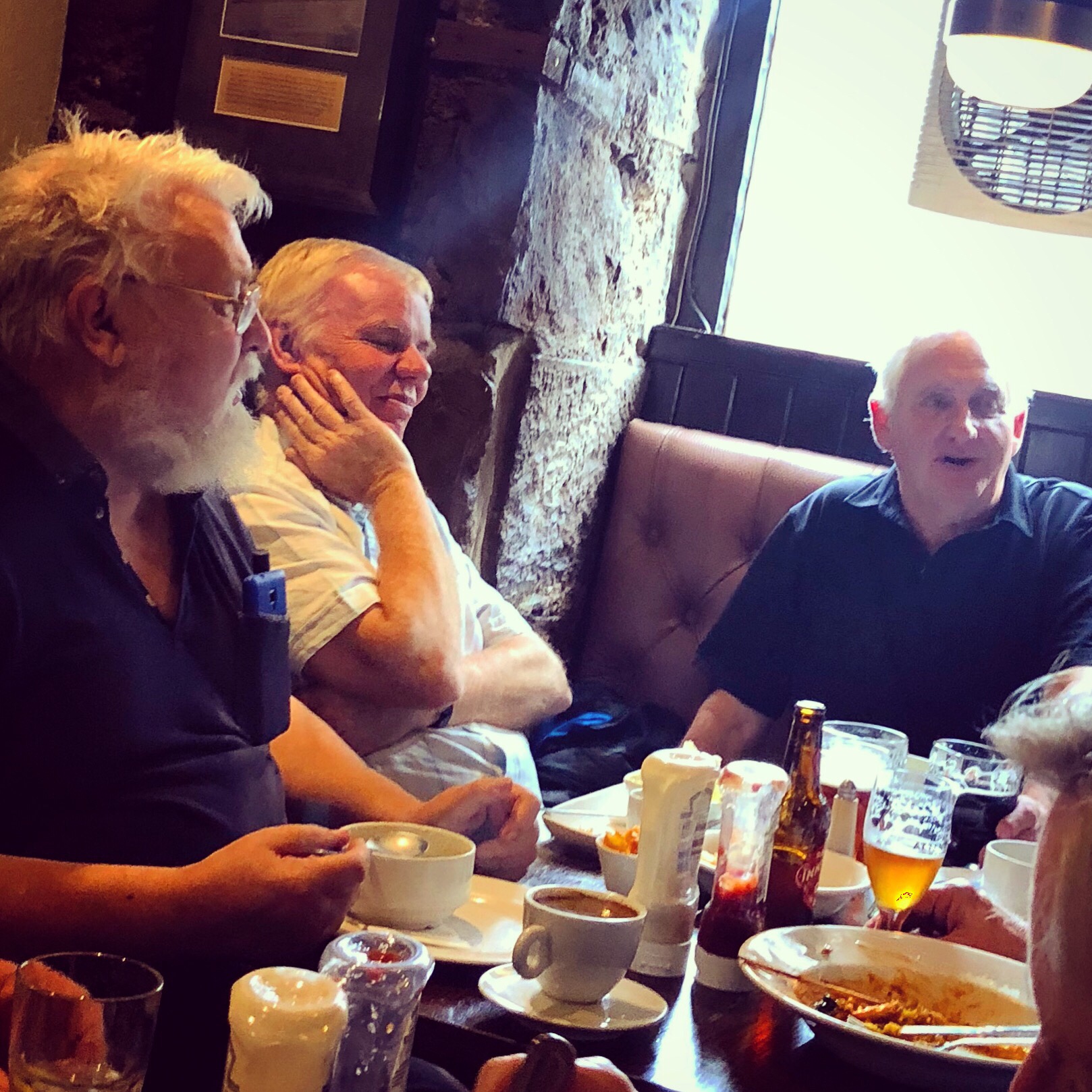
Five Scots sat around what was likely their usual table in the window, telling tales and discussing the vicissitudes of life in a way that American men never do. I could have listened to them forever, but instead snuck a photo.

I next visited Holyrood Palace, the official royal residence in Edinburgh. The Queen stays here one week every summer on her way to Balmoral in the Highlands. The decor is as stodgy and dingy as you might imagine with fading rugs, fraying tapestries and dark paintings in dire need of restoration depicting bare-breasted women in some sort of biblical peril. The tour takes you through the Queen’s actual bedroom, which felt weirdly voyeuristic. The room is uncomfortably and sparsely furnished with thin-looking embroidered bed linens that look like they’ve been around for centuries. This is her “state bedroom” so hopefully she doesn’t sleep here. Maybe her actual bed has a memory foam mattress with puffy linens, a down comforter and soft pillows from Pottery Barn.

The main reason I visited the Palace was to see the royal apartments of Mary Queen of Scots. You could see the influence of Mary’s French upbringing in the decor and general good taste of the rooms. Seeing her bed was also weird, but for a different reason. It’s so small. I wonder how she managed it with her six foot frame. Off her bedroom is a cozy, charming room with a teensy fireplace that served as her supper chamber, which I didn’t realize I needed until now. And, famously, where her private secretary and maybe Italian lover David Rizzio was brutally murdered by a jealous Henry Lord Darnley, Mary’s second husband, and his Protestant Lord cronies. And when I say murdered I mean stabbed 56 times right in front of her. And she was pregnant with James VI at the time, who some say was fathered by Rizzio. Apparently you can still see bloodstains on the floor which is entirely silly, but still I did look.

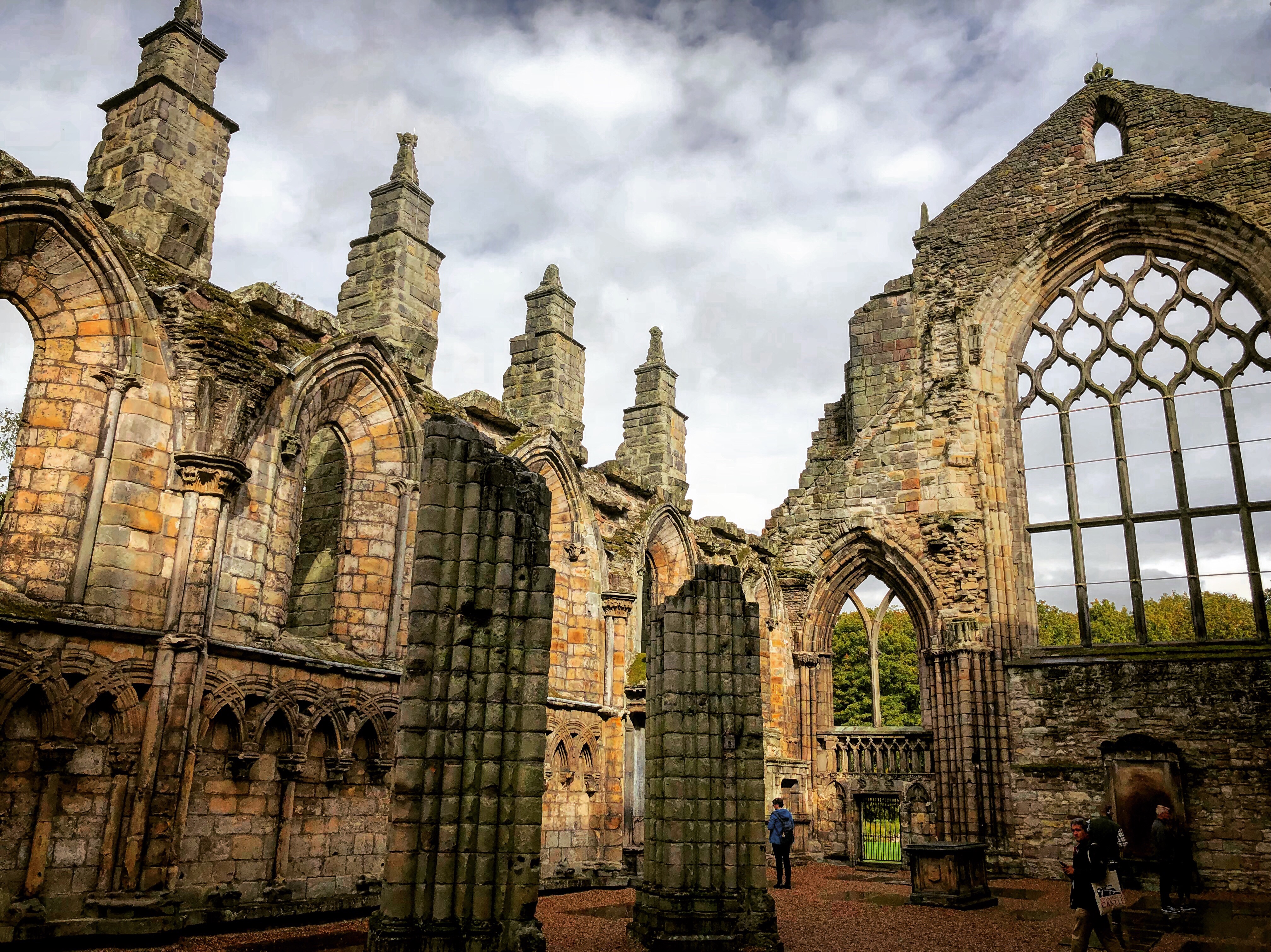
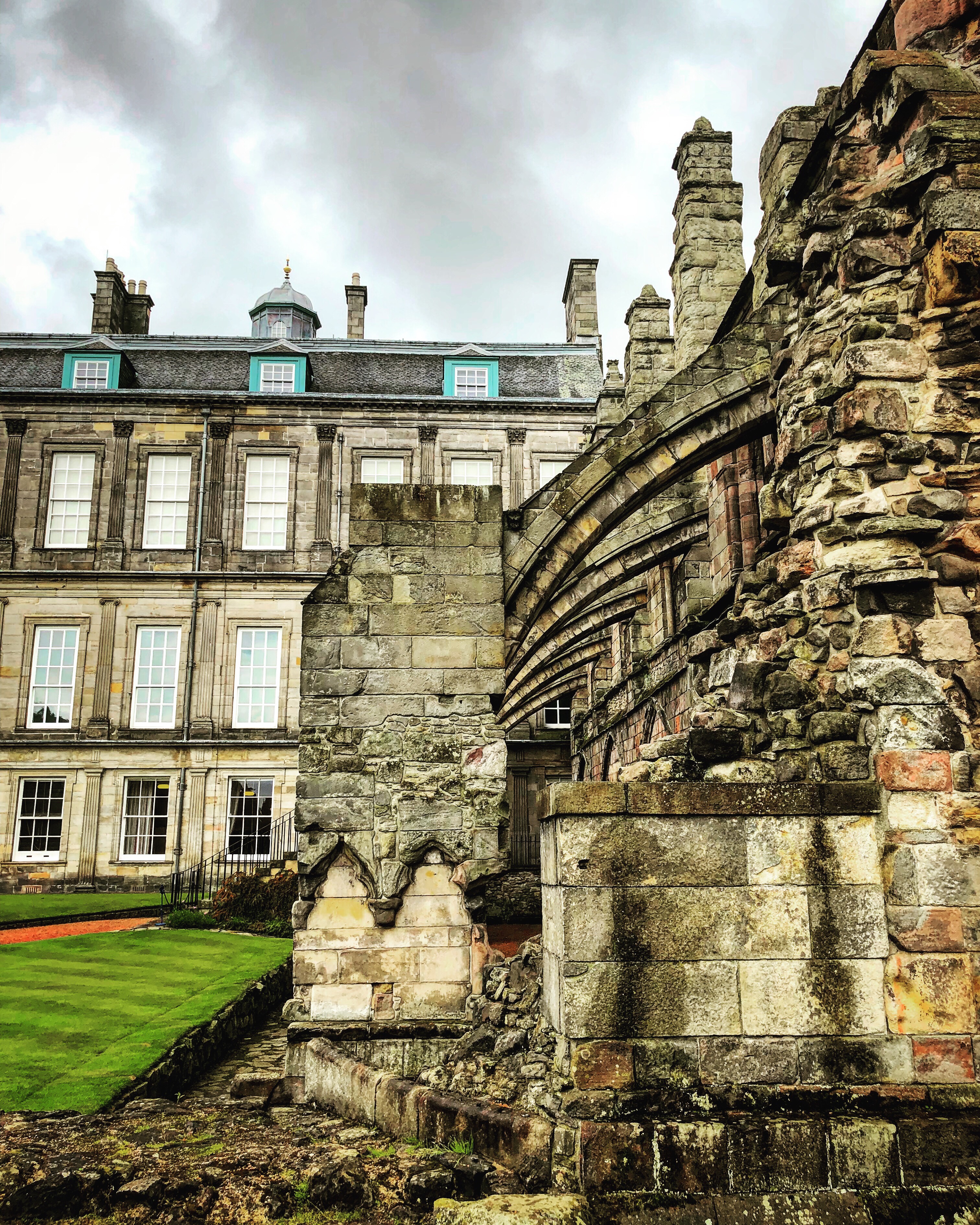
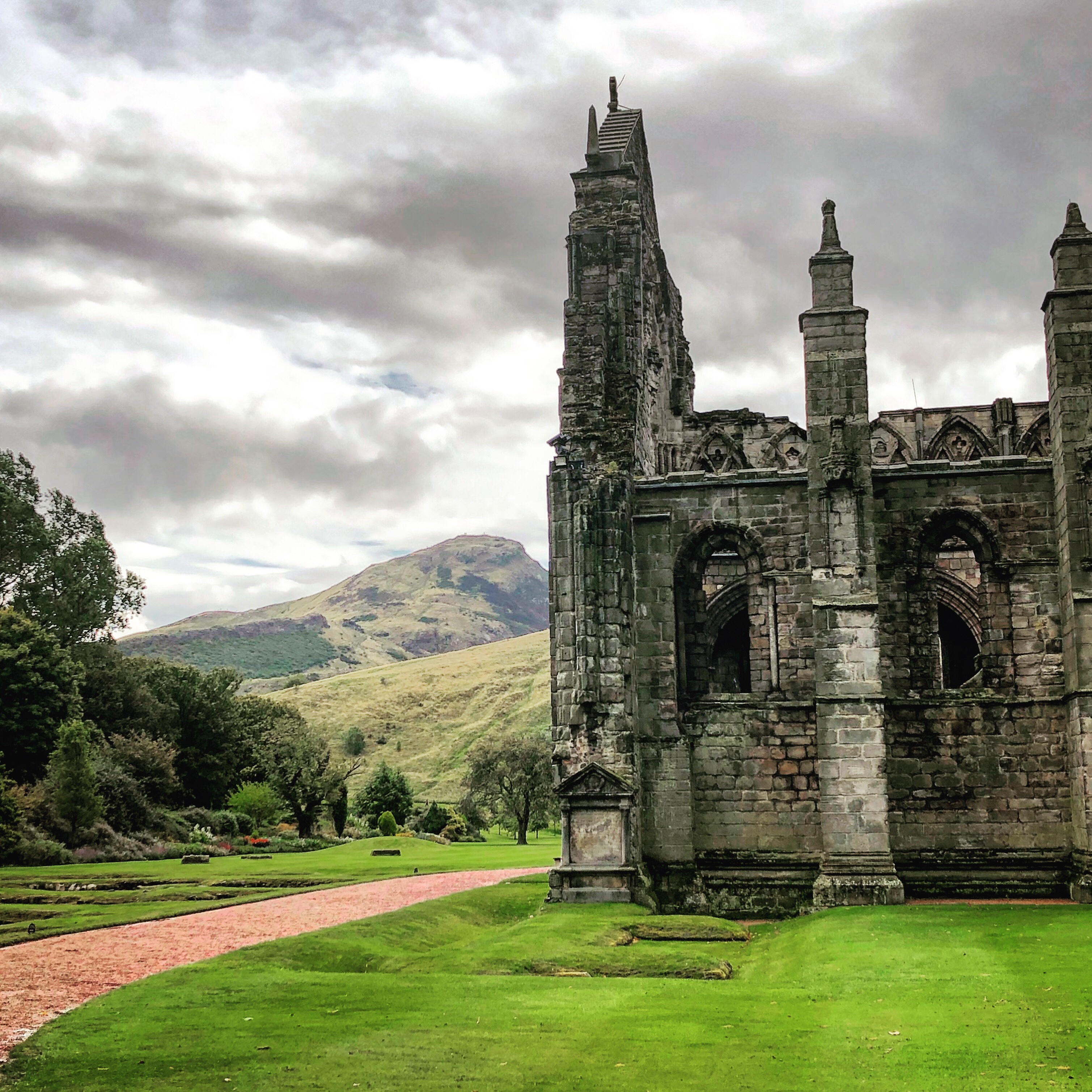
Mary’s bedroom opens into a formal great room where she received visitors. A few relics are displayed in glass cases, some books, her rosary, a letter she wrote and so on, but most notably a substantial lock of her hair which at some point was presented as a gift to Queen Victoria. I could not wrap my brain around the fact that I was looking at some of her actual hair. I then wandered around the gardens even though my ticket didn’t cover that (sorry), and it was stunning. Next to the palace is a ruined Abbey (destroyed by the Brits during Mary’s reign) which made for some lovely photos. Arthur’s Seat, the hill I climbed when I first arrived, looms over the Palace, providing a splendid royal view.

There are no photos inside the palace because more royal rules.

I returned to the hotel, hung up my clothes to dry and went out to dinner and a show. Rob Brydon was performing at the Edinburgh Festival Theatre. When you are a single, you can usually snag a fabulous ticket late in the game in the front section. The Trip is one of my favorite films, and it stars Brydon and Steve Coogan. Two awkward British men traveling through northern England eating at gourmet restaurants. Their main schtick was doing competing Michael Caine impressions, which sounds tedious, but is hilarious.
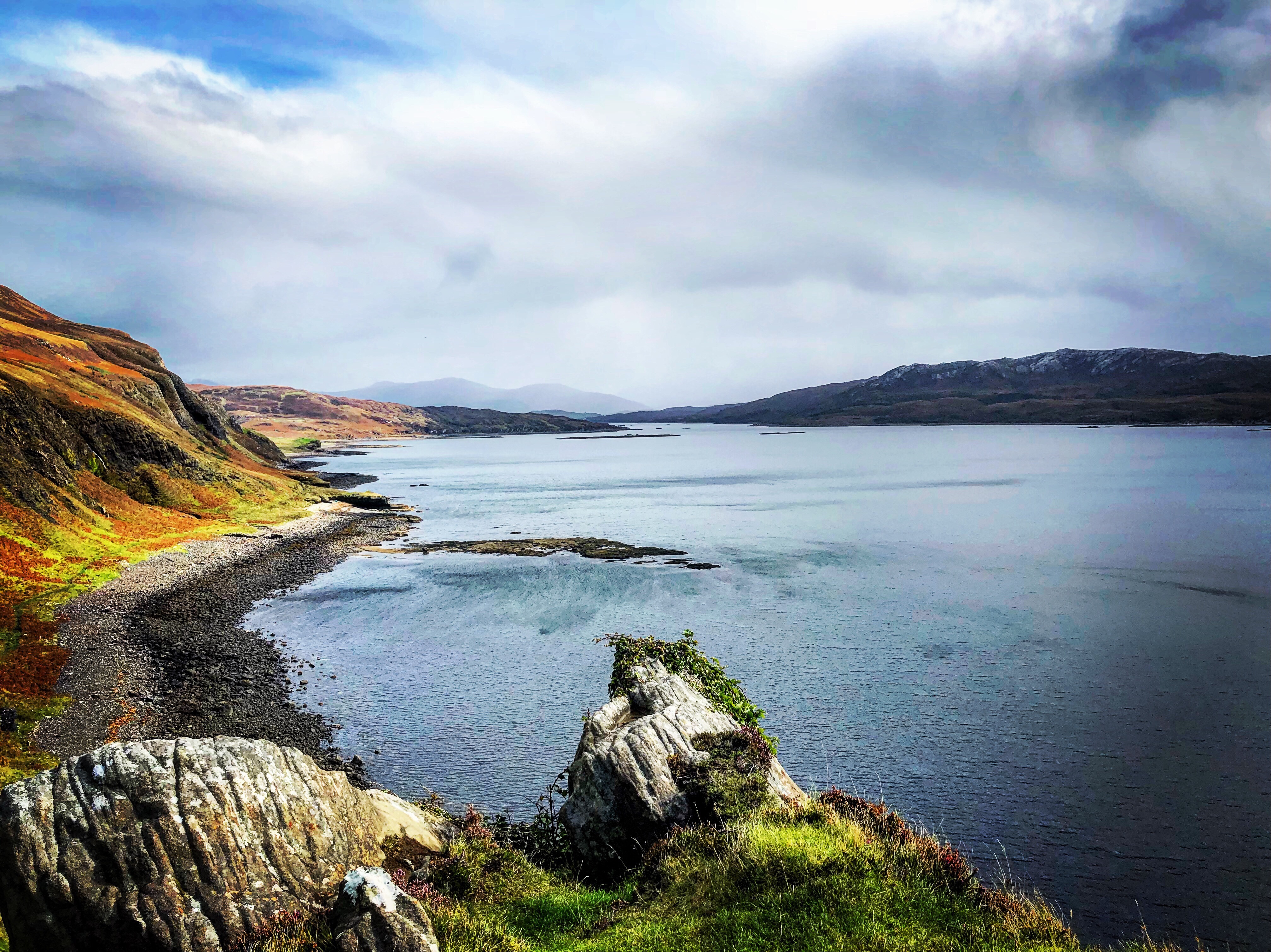
I had dinner at the Printing Press, a posh restaurant in New Town. And there it was, on the menu, as a starter. Haggis and neeps. I figured this was my chance to cross the culinary Scottish Rubicon. An appy-sized, gourmet restaurant version of the famously awful dish. Here’s the deal, though – it was fabulous. I chased it with one of the best risottos and best chocolate desserts I’ve ever had. So serious. My server was a Canadian who had finished college and decided to move to Scotland, as it’s relatively easy to get a work visa in another Commonwealth Country. I was proud of her choice and wish I had done something similar. She loves Edinburgh.

Rob Brydon was way more hilarious than I was expecting. The top of his act was him talking to members of the audience about various things and he’s brilliant at it. His act includes loads of impressions (some were singularly British, sailing right over my head) with many astutely hilarious observations about aging and what it does to your pee stream strength and farting frequency. I was laughing to tears as were most people in the 2,000 seat house. Great fun for my last night in the big city before heading to the Highlands.

Backroads Day 2 – In Which We Hike Into Storm Ali

Day Two dawned cloudy, windy and rainy. Today’s hike had three options, and one of them was nixed by our fearless leaders as being too dangerous because of the weather. It included some ledge hiking and the winds were too strong. Disappointed, but also, woah.

The trail winds through a long valley (or glen if we are being Scottish) between Beinn Eighe and Liathach. We were told there was a spot about 2.5 miles in from which you could turn around and call it a day, or you could do a through hike. Through hikes are the best, especially when someone else is coordinating the transportation, so I was inclined in that direction.
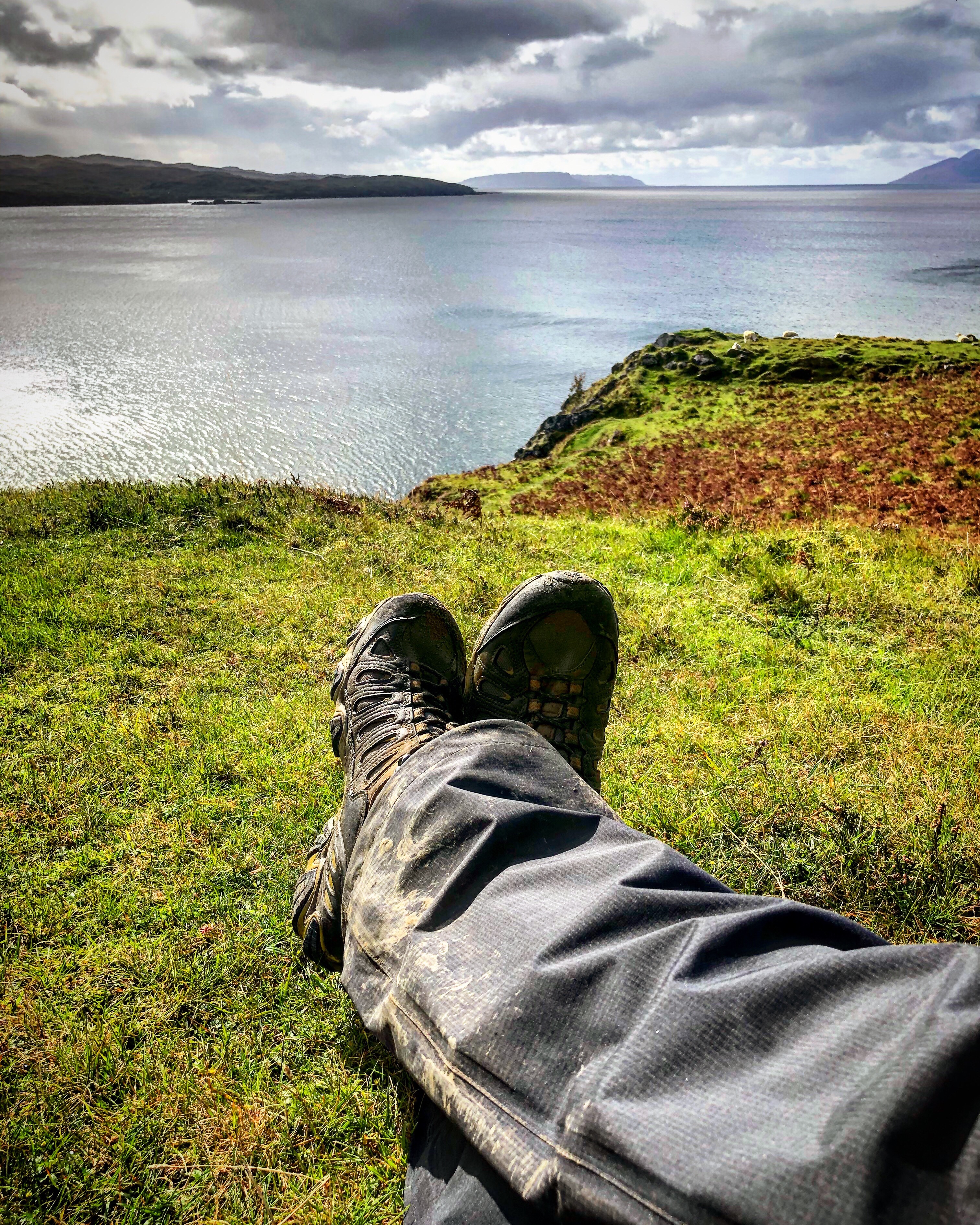
The route description said, “you may encounter a bit of mud or wet patches as you meander down through the glens.” There was also a mention of stopping for lunch. Jenny and Eileen told us that there would be an exciting opportunity to ford a river with some potentially high water due to all the recent rains. An interesting end to the Backroads Scotland season, as the U.K. summer had been marked by a heatwave and dry weather so unusual that it made the news in the states. Guests on those trips complained that it didn’t “seem like Scotland.”

On the short drive to the trailhead we mulled over the two options and searched the sky for any sign of a break. At least the mist wasn’t obscuring the hills – we might get wet, but there would be views. As we pulled into the parking lot, Keith ho-ho’d, saying in his jolly tone, “I’ve never seen this parking lot so empty before! Awesome!” As we were cinching up our rain gear in the deserted parking lot, Jenny and Eileen opened a big bag of hiking sticks. Some eyebrows were raised and doubt was expressed about whether we really needed them, being the badasses that we were. Our leaders regarded us patiently and gently recommended the sticks, mentioning again the fording of the high waters and the muddy slipperiness of the hike. We each took one.

The trail started off uphill in the pouring rain. And was gorgeous. And empty. Spirits were high.

We soldiered upward, finally arriving at the river. The stepping stones were exposed and not under water, which was by no means a sure thing. Suddenly, everyone got the whole stick thing. Apparently, Jenny and Eileen know what they are talking about.

We hiked a little further, reaching the 2.5 mile mark at a stone cairn, which was the moment of no return. Jenny, Eileen and Keith convened a trail meeting over some wee drams of whisky. It’s hard to understate how miserable the weather was. There was a definitely a heightened sense of camaraderie, souls bound together by adversity, etcetera. Here’s the deal though. Had anyone turned around they would have been faced with piercing, stinging sidewise rain and face-buffing gale force winds. It’s one thing having that at your back. It’s quite another having it in your face. Onward seemed the much saner option, and, hey, it was only 5 more miles. Keith, who would have accompanied any who wished to bail had to make the journey back to the vans alone. Next time we saw him he looked 20 years younger from his Scottish facial.

Here we are agreeing to go forward, sealing our resolve with a team cheer.

The rest of the hike was by turns raining, not raining, cloudy, misty, sun breaks, windy, not windy. All the weathers. And when I say windy, I mean we needed to stop and brace. I was up front following Jenny, and at one point I looked up and she was six feet off the trail. The wind had blown her toward a steep gully but thanks to her ninja reflexes, she was able to jump sideways onto a bank. She had a big grin on her face.

We hiked along in a spread-out train, with people speeding up and hiking with one another and then slowing down to take a picture and walking alone for a while. I took lots of photos, actually, testing the water-resistance of my iPhone. I managed to get one extra amazing one during a moment when the sun broke through and illuminated a ridge. The weather changed very quickly, so by the time you took your pole strap off your hand, took off your glove, dropped it in a puddle, picked it up again and stuck it in your teeth, unzipped the pocket of your rain pants, took out your phone, turned it on, allowed it to scan your face and open, things would have likely changed completely. There was a lot of fate involved.

One of my favorite moments was listening to Irwin and Bob talk about Star Trek, and by that I mean the original series. I started to participate but then realized that these guys could name episodes and quote a lot of dialogue. Bowing to the masters, I listened appreciatively to their pro-level geekiness until the trail spread us apart again.

Throughout most of the hike, even in those conditions, I either had a smile on my face or was smiling internally to avoid a weather-related dental procedure. I never felt whiny or scared or worried or that it sucked. You simply could not believe that you were outside in this weather at all, much less the middle of nowhere, and the whole concept was fabulous. And with every step you marveled at the wild, remote Highlands beauty. It was exhilarating and emotional and hilarious. Even though there was no “stopping for lunch.” We came across only two other walkers on the entire hike, one of whom had one leg. I mean. It’s really hard to complain.

Thinking about it now, I wondered if I should have been having some deep thoughts about the meaning of life as I traversed the glen in the storm with my stick. Actually, my mind was completely blank. It wasn’t churning over anything, or narrating my experience. I was just walking. Taking it all in. Being in the moment, as they say. It was marvelous and quiet and wild. I felt happy and at peace.

Finally, as we hiked down toward the vans, along a river, a waterfall and surrounded by reddish-brown ferns, the sun came out for real. As we had spread out quit a bit over the hours of walking, Jenny and Keith took me and Bob (those Canadians are not only super nice, but also highly intrepid) back to the hotel for tea and a hot shower.

Back in my room, I managed to get enough internet to briefly check the news. As it turns out, the storm we had just hiked 8 miles through had been given a name by the British government, which meant that it was “deemed to have a substantial impact” on the UK. Storm Ali packed a punch. Winds of 100 mph had been clocked somewhere in the Highlands. Train service had been halted completely from both Edinburgh and Glasgow. Roads were closed due to downed trees. Edinburgh Castle was closed. Ferry service was disrupted. 70,000 people were without power.

And twelve of us were out hiking in the Highlands. And I wouldn’t trade the experience for anything.

Backroads Days 3 and 4: Over the Sea to Skye

Day three dawned a wee bit rainy, and our planned hike was officially scuppered due to wind, flooding and danger of being blown off a cliff into the sea.  Very disappointed, as we were heading to the famed Coulags.  Next trip.

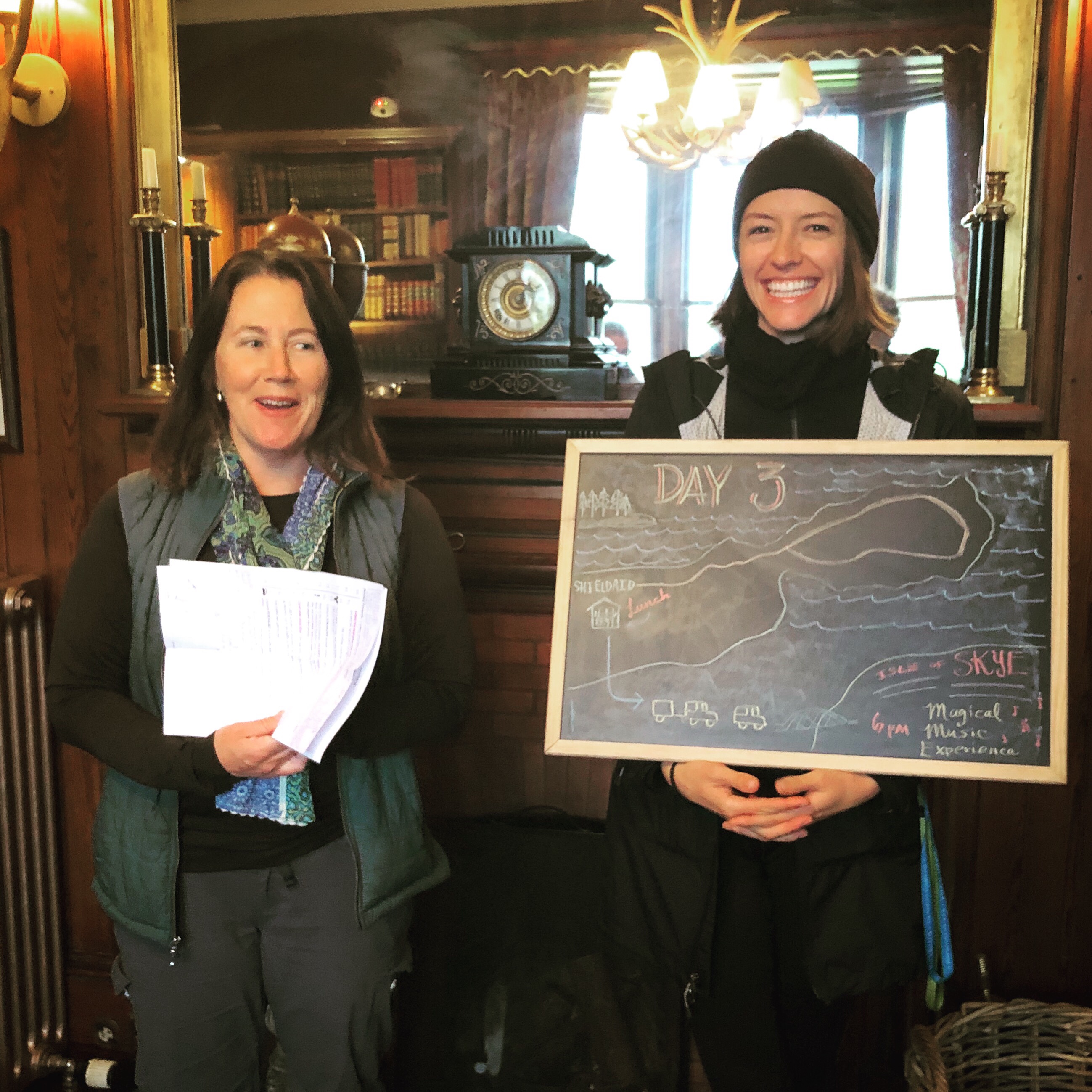
Jenny, Eileen and Keith had another hike in their back pockets, followed by lunch in a little village.  Then we would head to the Isle of Skye. Jenny sketched out the day on a chalkboard.

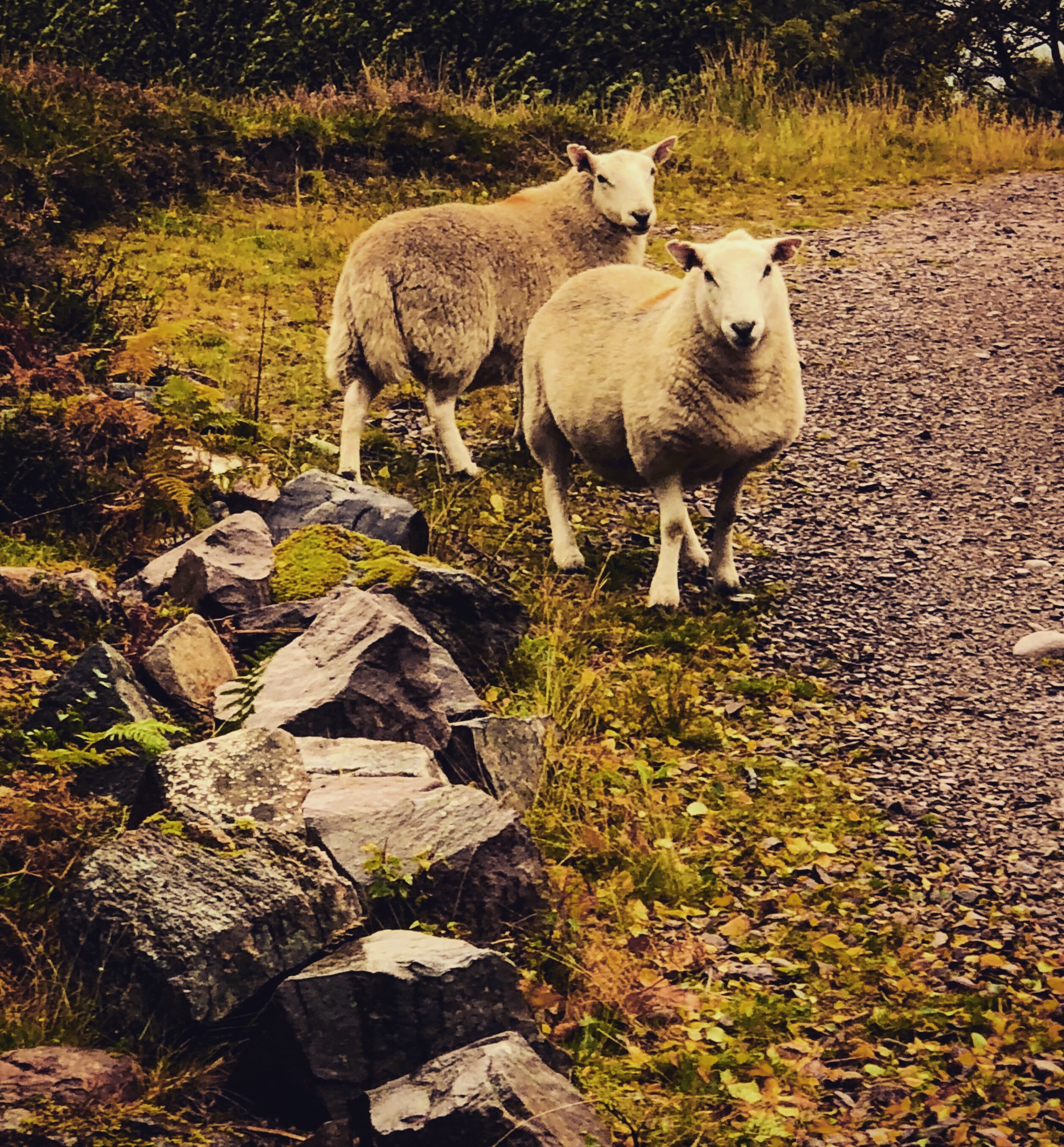
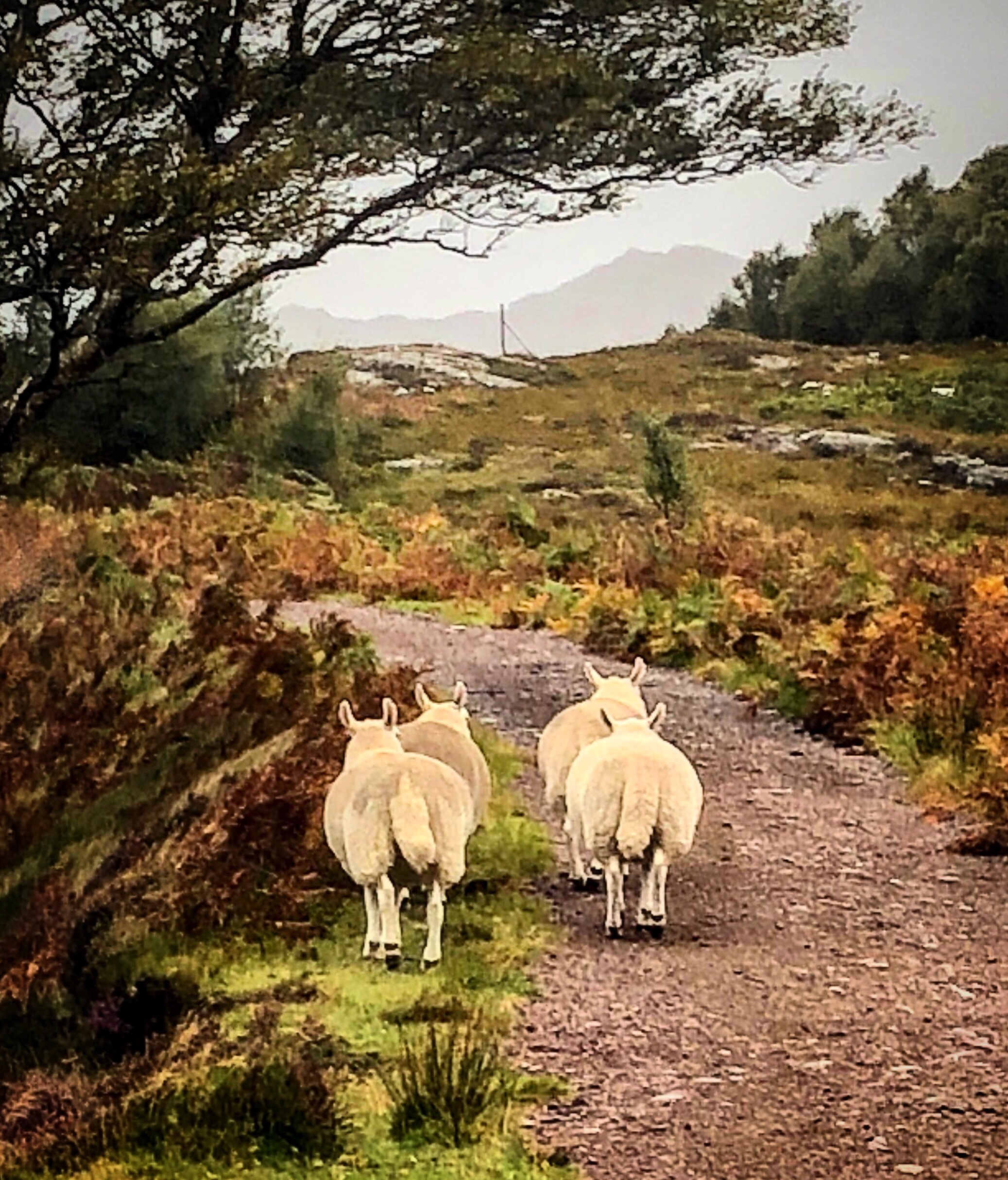
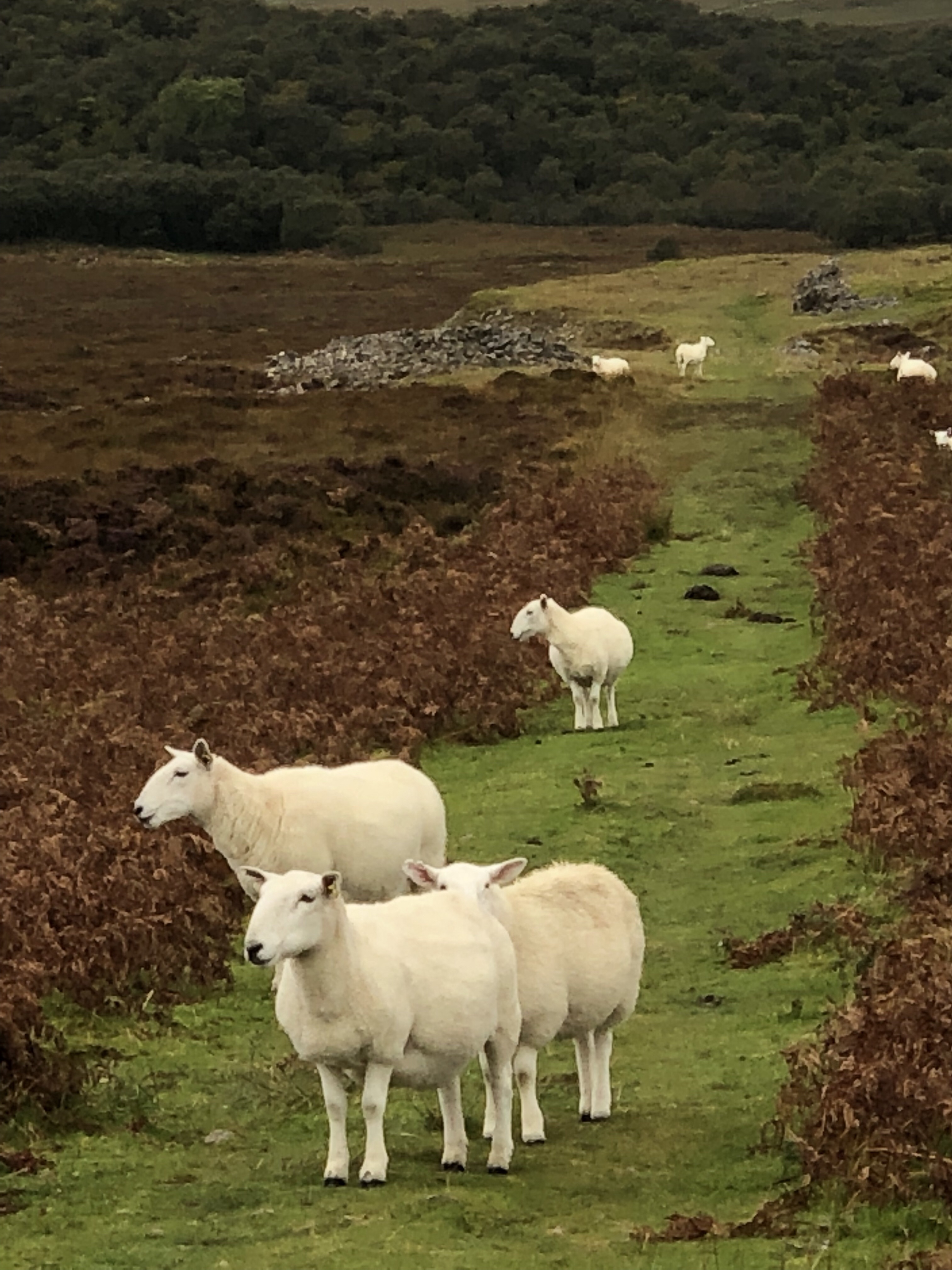
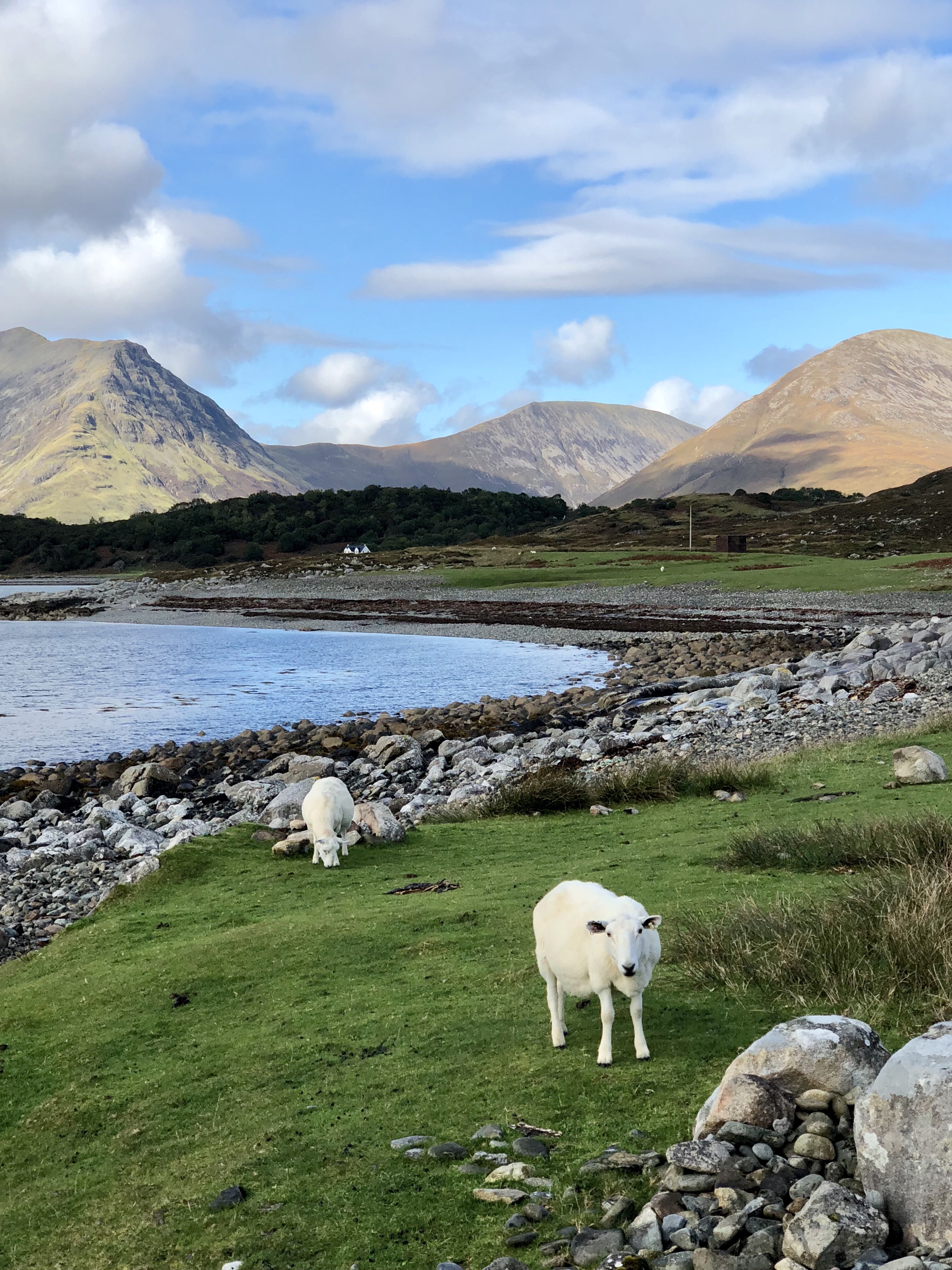
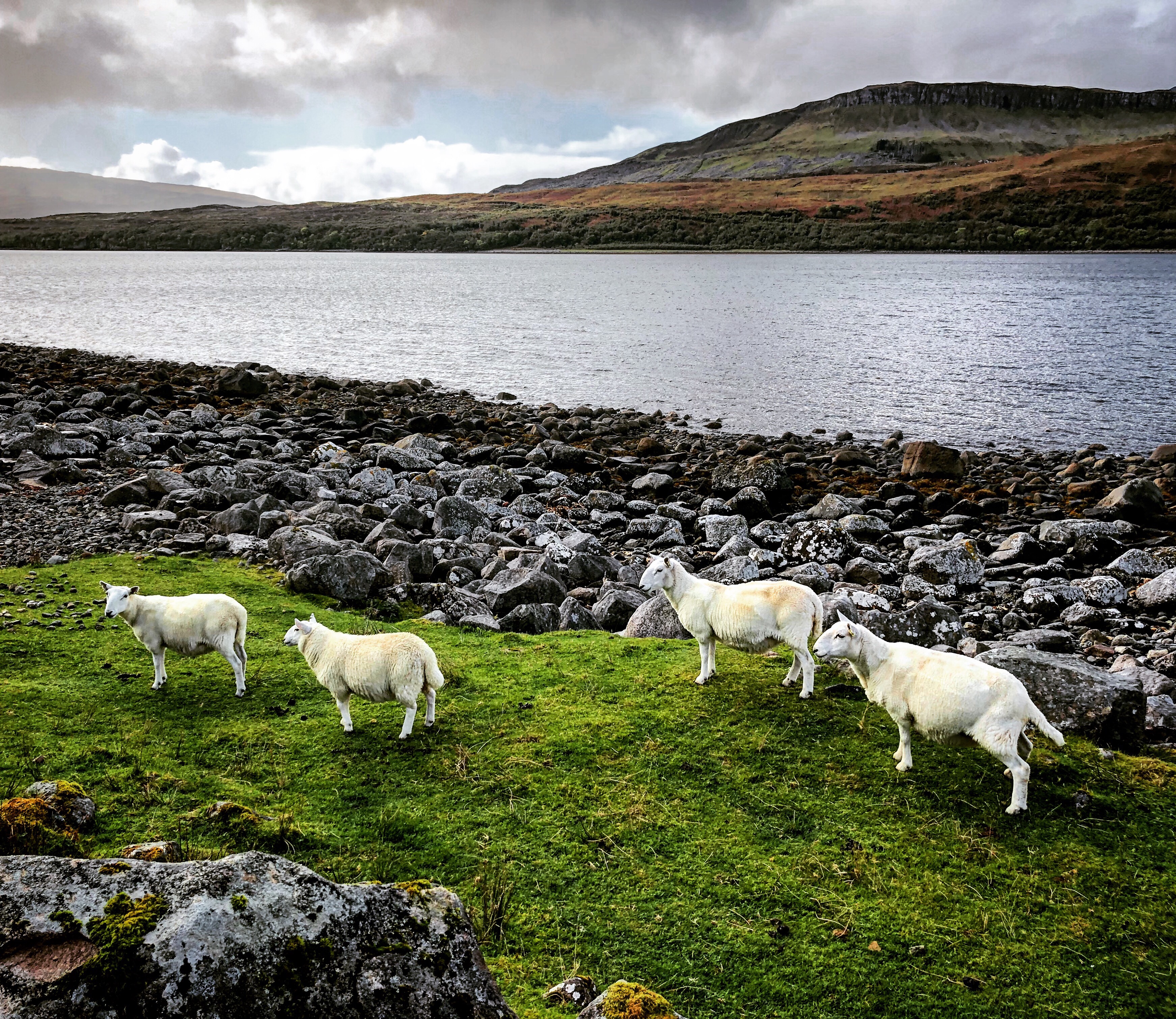
The hike was completely beautiful.  Our love of sheep officially began on this day.  Adorable Scottish sheep were everywhere.  Scotland doesn’t seem to have industrialized its meat production.  Unsupervised sheep, cows and chickens are wandering around all over the place completely left to their own devices.   Sheep are marked with a splash of color which identifies to whom they belong.  Otherwise, they are free to wander, eat grass, and perch picturesquely on the edges of cliffs, gazing out at the ocean.
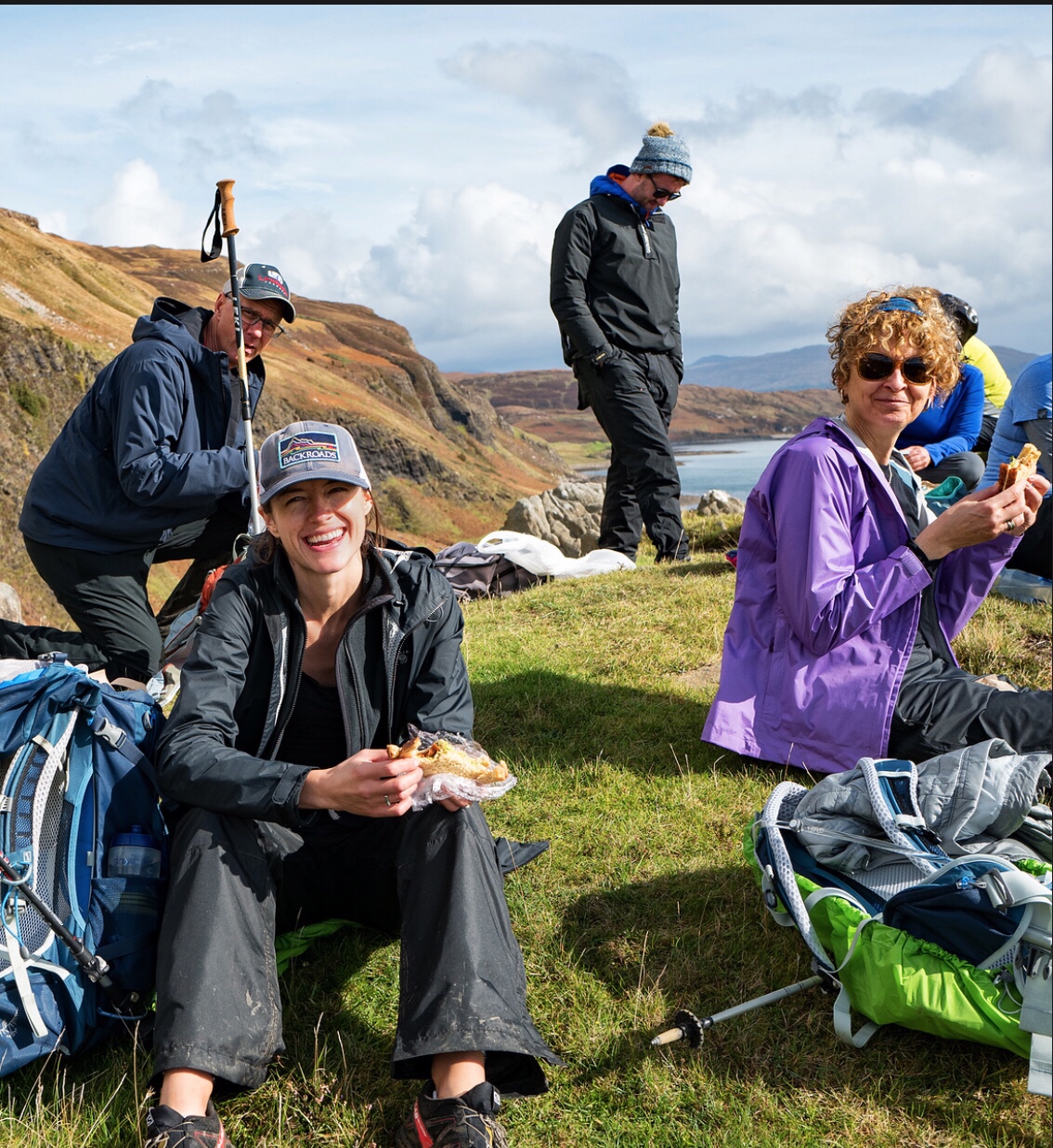
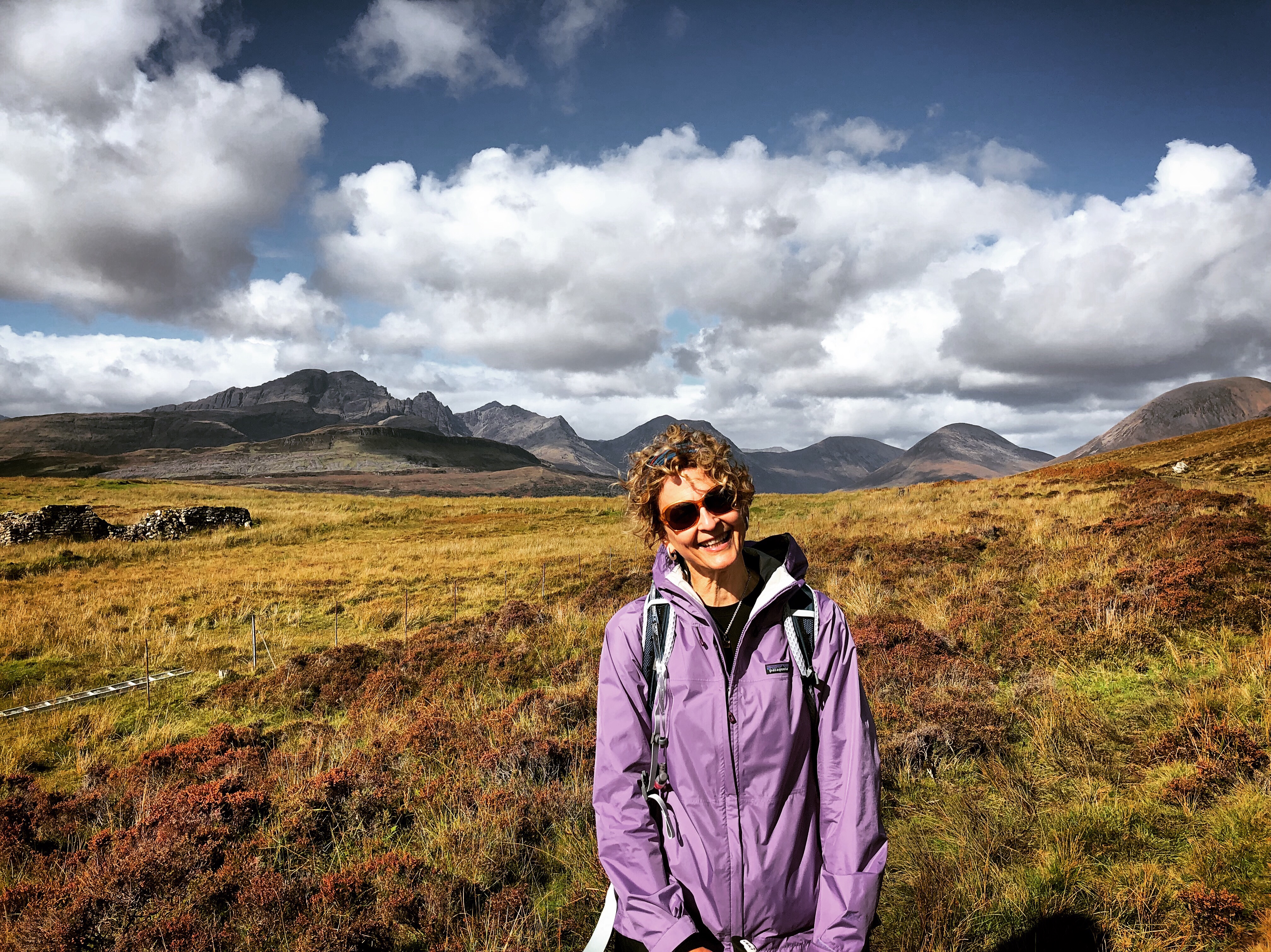
I kept asking people if the cows and sheep were used for milk and cheese and the people kept raising an eyebrow and shaking their heads. Make no mistake, we are talking about meat here. But at least until their day of doom, Scottish livestock have the world’s most fabulous life.

A few pictures of our hike follow, but sadly the most exciting bit went unphotographed. Just after passing someone’s lovely farmhouse (they have a black dog named Merlin who enthusiastically greets ramblers), we needed to haul ourselves up a tall boulder cropping.  And to help, there was a rusted chain that had been set into the boulders.   Completely awesome. I felt like Tom Cruise in Mission:  Impossible as I pulled myself up the outcropping, hand over hand.  Which I shared with Keith after triumphantly reaching the top. In response, he cocked his head and asked, “you felt like a Scientologist?”

We returned to the little town where we began, and walked to our lunch place, a fabulous little pizza spot on a loch. Keith removed a giant chalkboard from a wall and presented it to the table.  He asked the server permission first, and interpreted a disapproving pause as assent.  Note to self:  adopt this strategy immediately.

As we left the restaurant, we were greeted with a magical rainbow over the loch. While we pretty much had daily rainbows, this one was the most rainbowish one of all.

We set off in the vans for a bit, finally driving over a lovely bridge to the Isle of Skye. It has been hit pretty hard by tourism over recent years, but Backroads always finds more solitary spots. We stayed at the Duisdale Hotel, on the edge of the water with beautiful views.

07E2BCE6-BBD2-4F68-AFCD-22CE10F036EF

On tap for the evening was a musical performance by a local bagpiper and accordionist who teach music at the Gaelic College on Skye, called Sabhal Mòr Ostaig. The college is dedicated to providing education for Gaelic speakers with the goal of widening access to the Gaelic language and culture.

Bagpipe music used to make me cringe and then run out of the room. Maybe one of the things that happens after menopause is that suddenly bagpipes become majestic instruments that make you shiver and then cry.

In the middle of the show, our bagpiper challenged us to a bit of Scottish dancing in the parking lot, and so out we went. A documentary of our dance lesson experience is currently being edited for Netflix. The reviews will say, “Stunningly talented Americans and two Canadians change the face of traditional Scottish dance forever.”

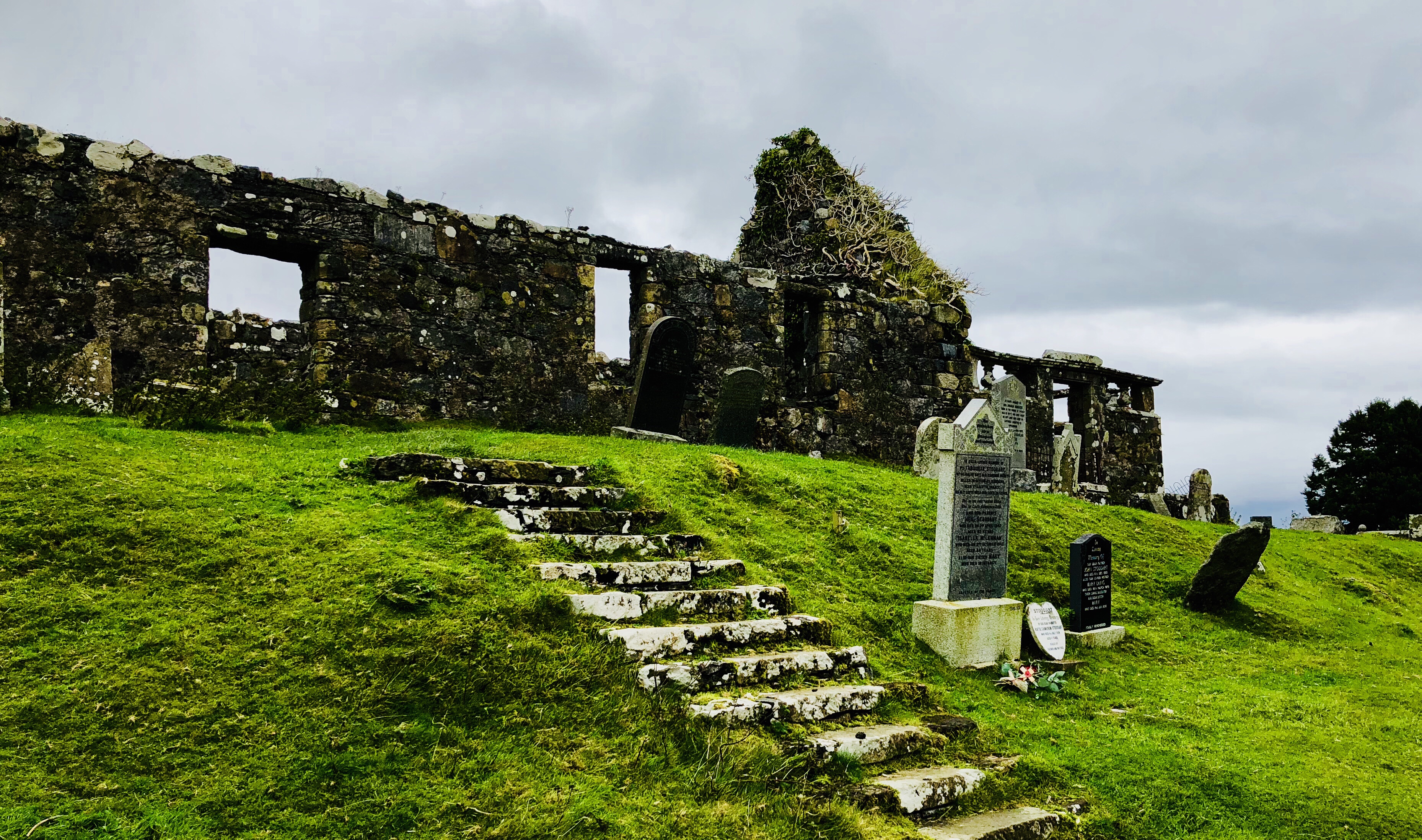
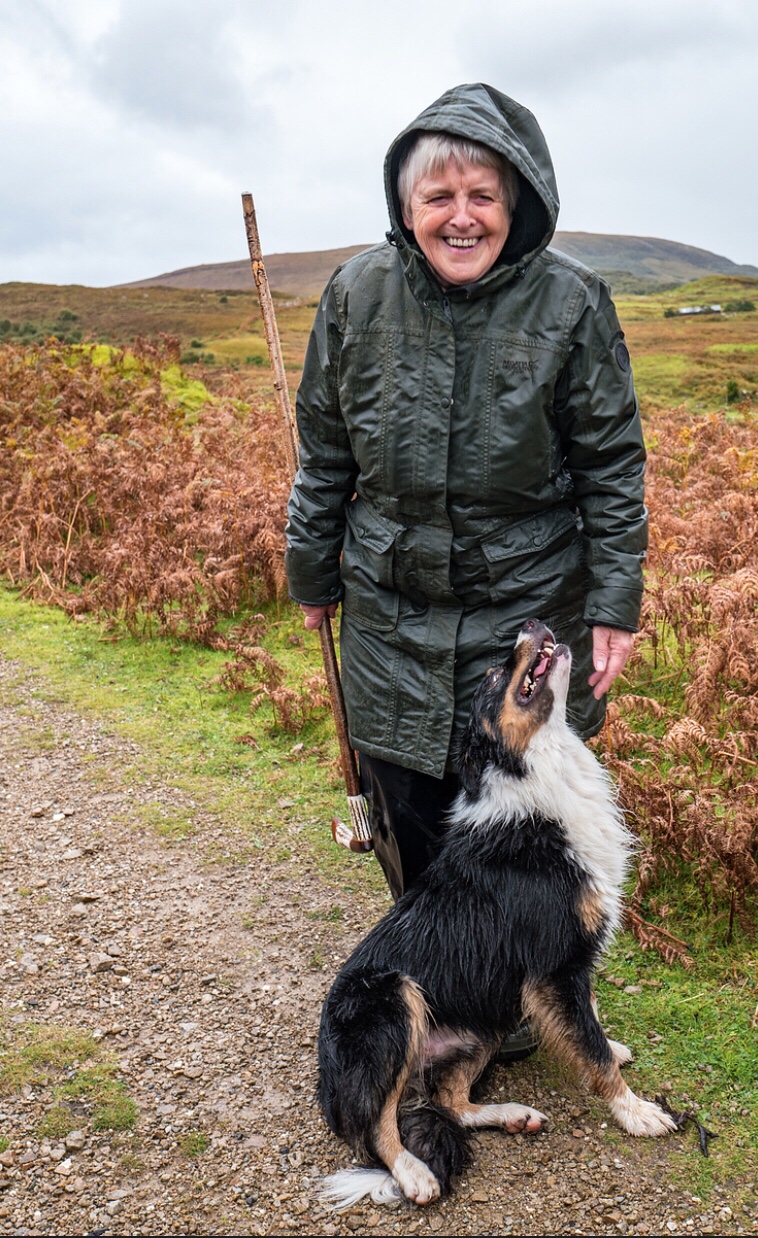
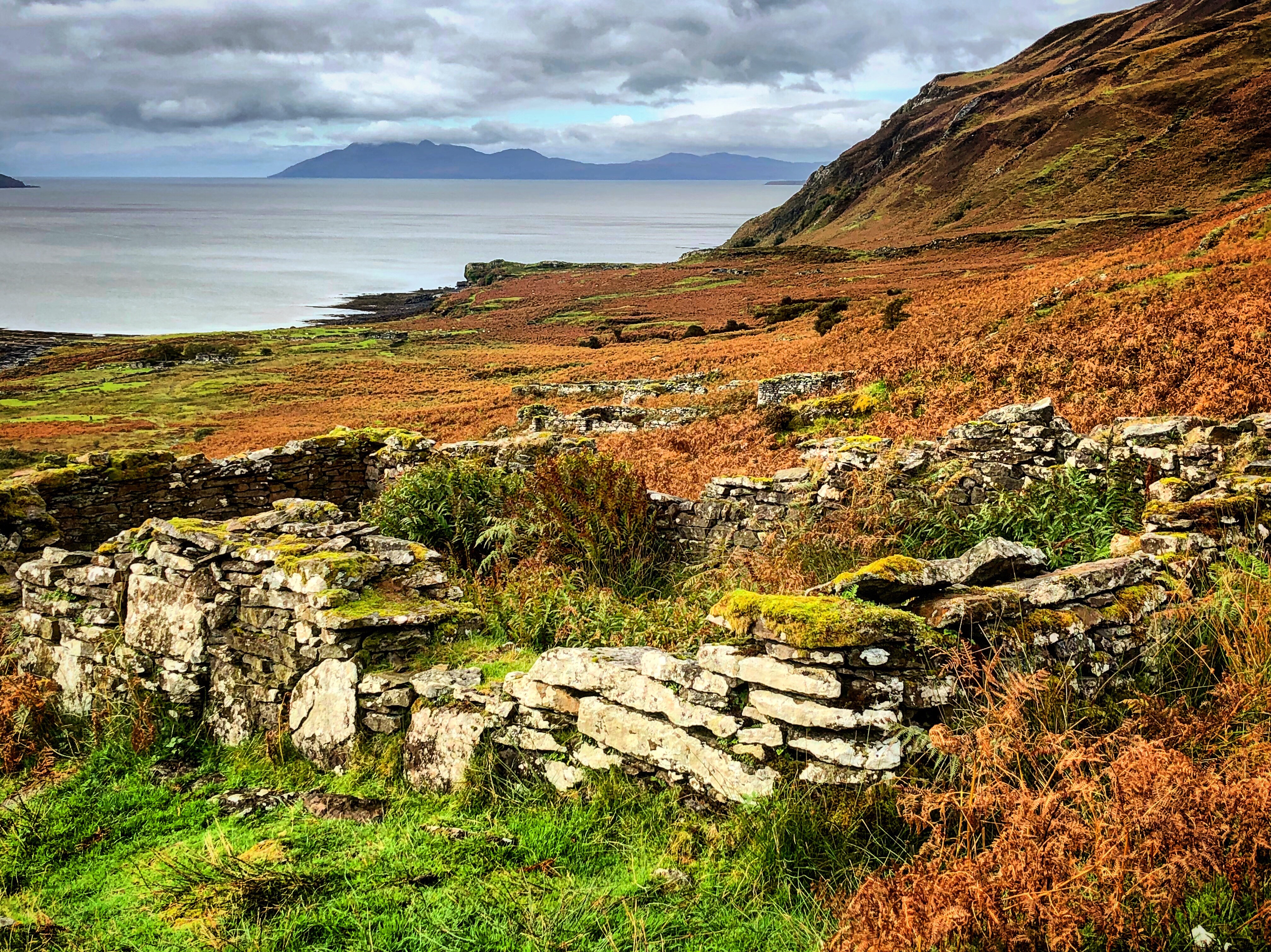
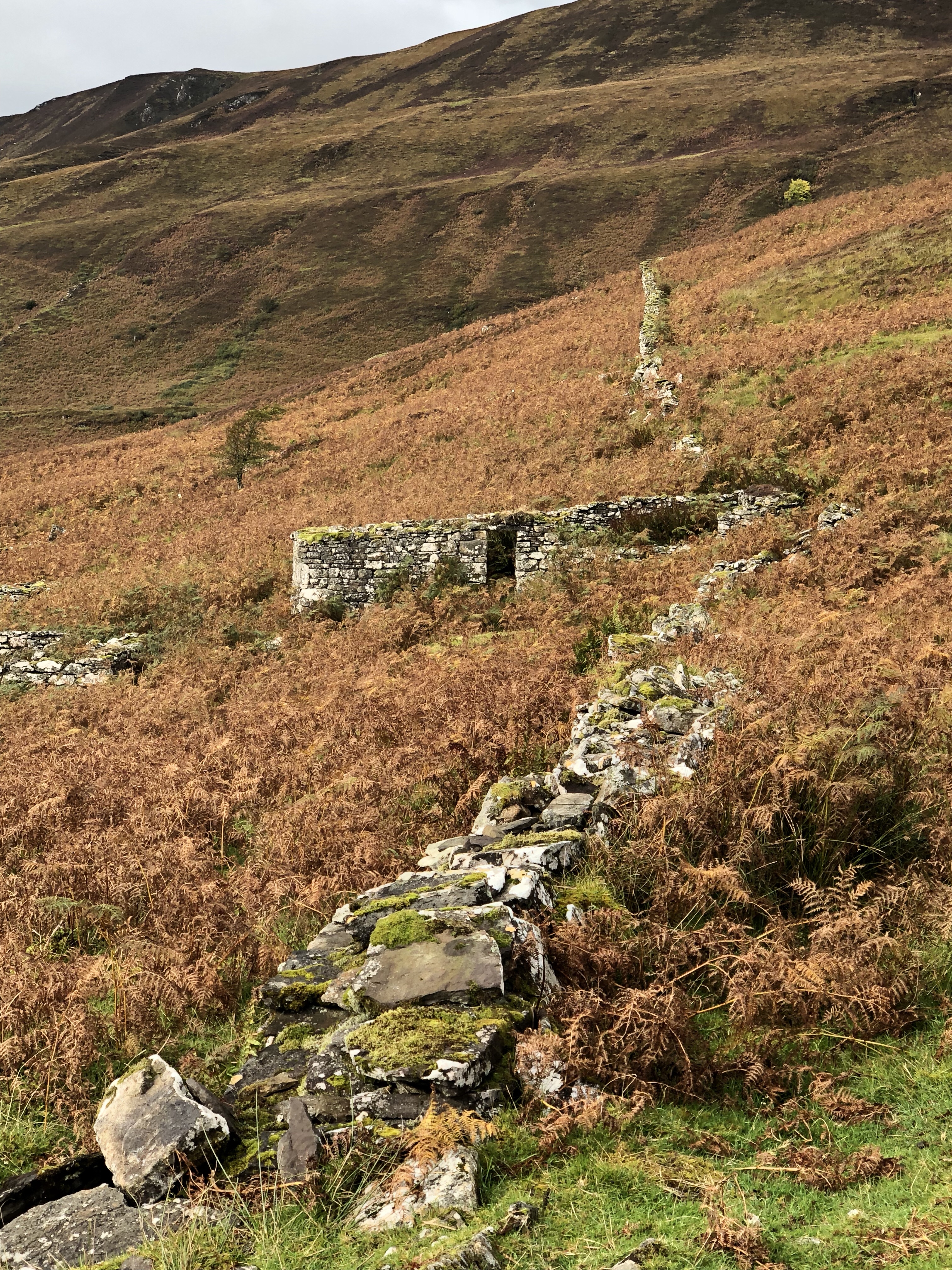
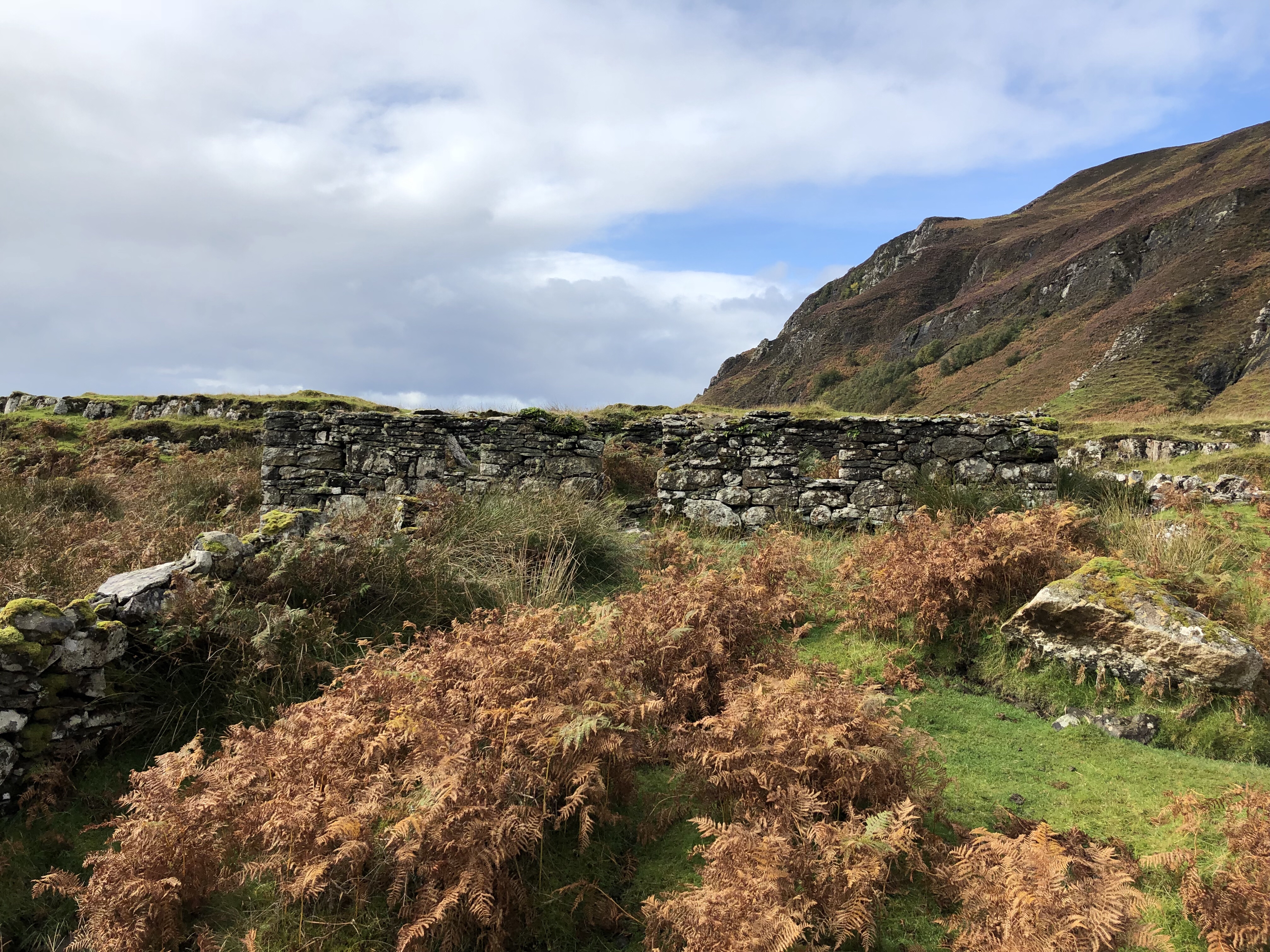
The next day dawned slightly brighter with strange blue areas in the sky. Now old hands at divining Scottish weather, we thumbed our noses at the blue and donned our rain pants. Today we met Sarah, a Scotland ranger, who would accompany us on our hike and tell us about birds, plants and the Highland Clearances. Our trail started at a ruined church (see below) and took us past some old granite mines where we came across a lovely woman out for a walk with her border collie. We then dipped down to a large and desolate ruin of a village that was abandoned as a result of the clearances.

The Highland clearances are an infamous chapter in Scottish history. They were the forced eviction of inhabitants of the Highlands and western Islands, and basically cleared the land of people to allow for the introduction of sheep. For hundreds of years prior to the clearances, the Highlands followed the clan system. The clan was ruled by one family, and others lived together in agricultural townships that functioned like collectives. The land was controlled by the chief but leased by tenant farmers. Very feudal. All the men who worked on the land also owed allegiance and their military service to the clan chief. The clearances, which took place over a century, resulted in the destruction of the traditional clan society and began a pattern of rural depopulation and mass emigration from Scotland to the Americas and elsewhere.

So why? After the Battle of Culloden, the British government (aka evil redcoats) passed repressive legislation designed to compromise the power of the clan chief and Gaelic culture. The 1746 Act of Proscription required all swords to be surrendered, prohibited the wearing of clan tartans, forbade the speaking of Gaelic and the playing of bagpipes (because they were deemed instruments of war). Another act removed the sovereign power which the chiefs held over their clans. The clearances began thereafter, waxing and waning through the collapse of wartime industries after the Napoleonic Wars, a rise in population, famine, and a decline in the economy. Landlords were deeply in debt and were looking for more lucrative uses for their land. Replacement of the old style of peasant farming with well-capitalized sheep farmers allowed the charging of higher rents and required much less manpower.

Nobody knows for sure, but possibly up to 150,000 Scots emigrated during the clearances, and the effect still resonates today. In 1755 it is estimated that 51% of Scotland’s population lived in the Highlands, but by 1981 only 21% were.

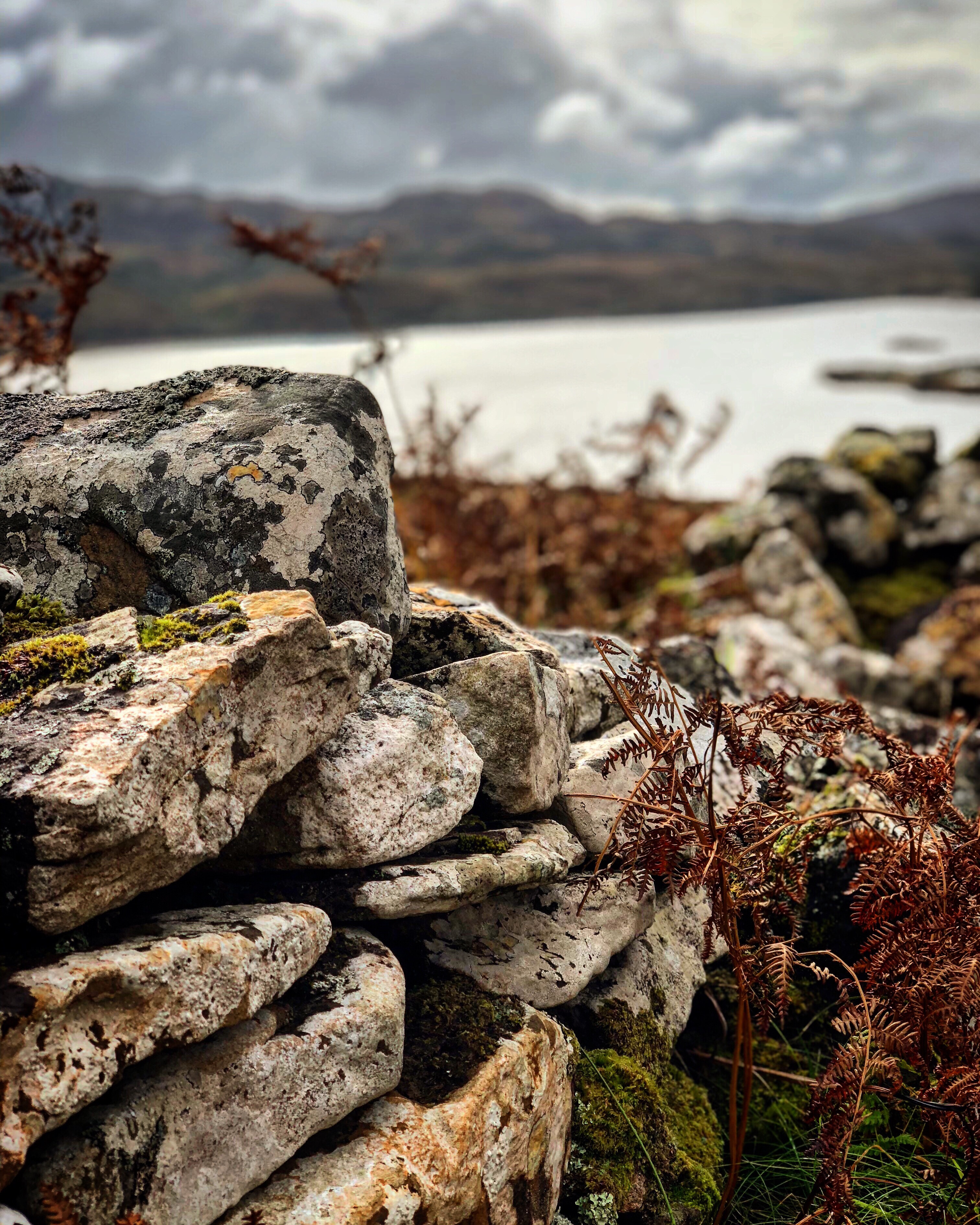
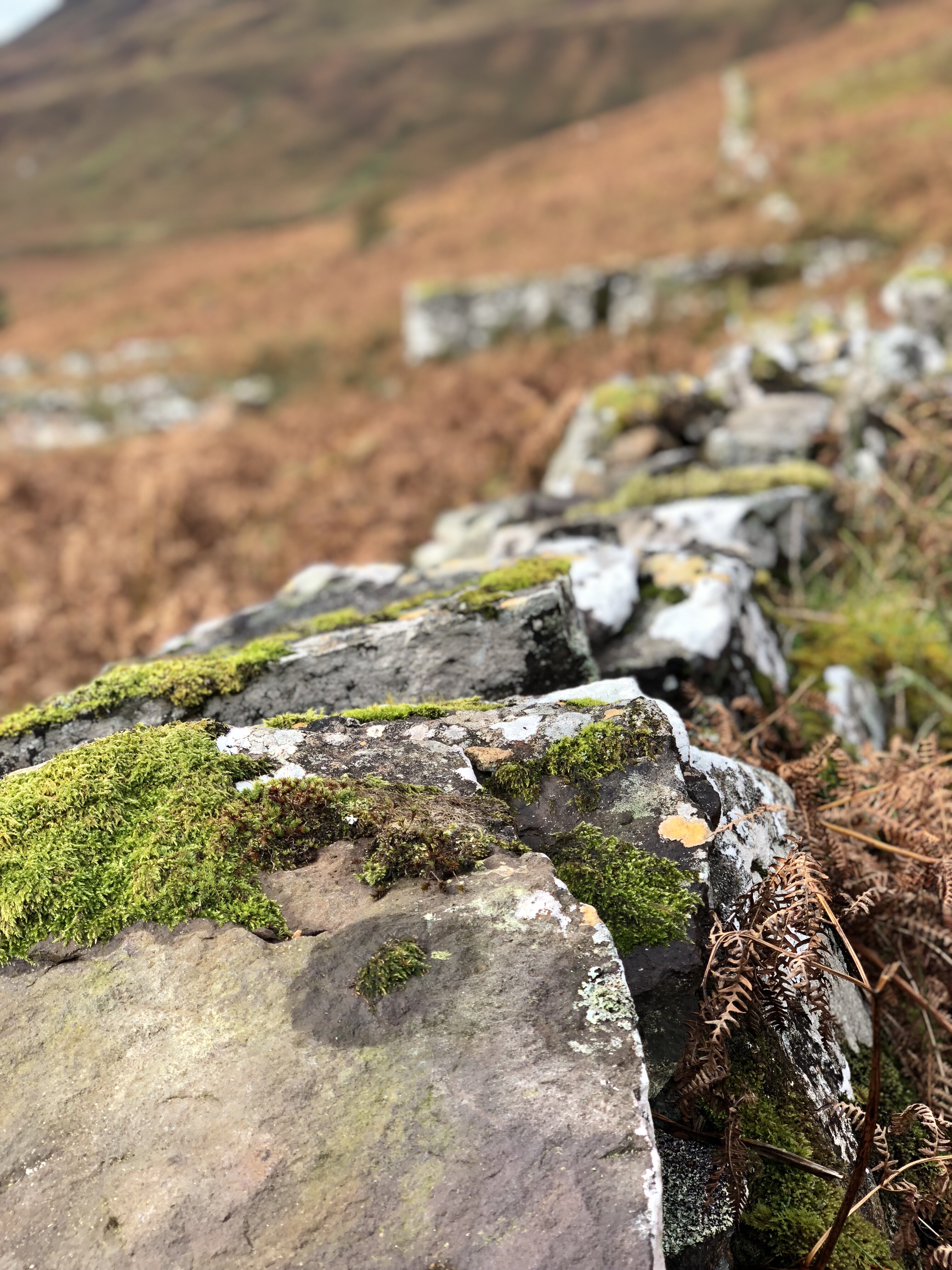
Here are some photos of just one such village left in ruins.

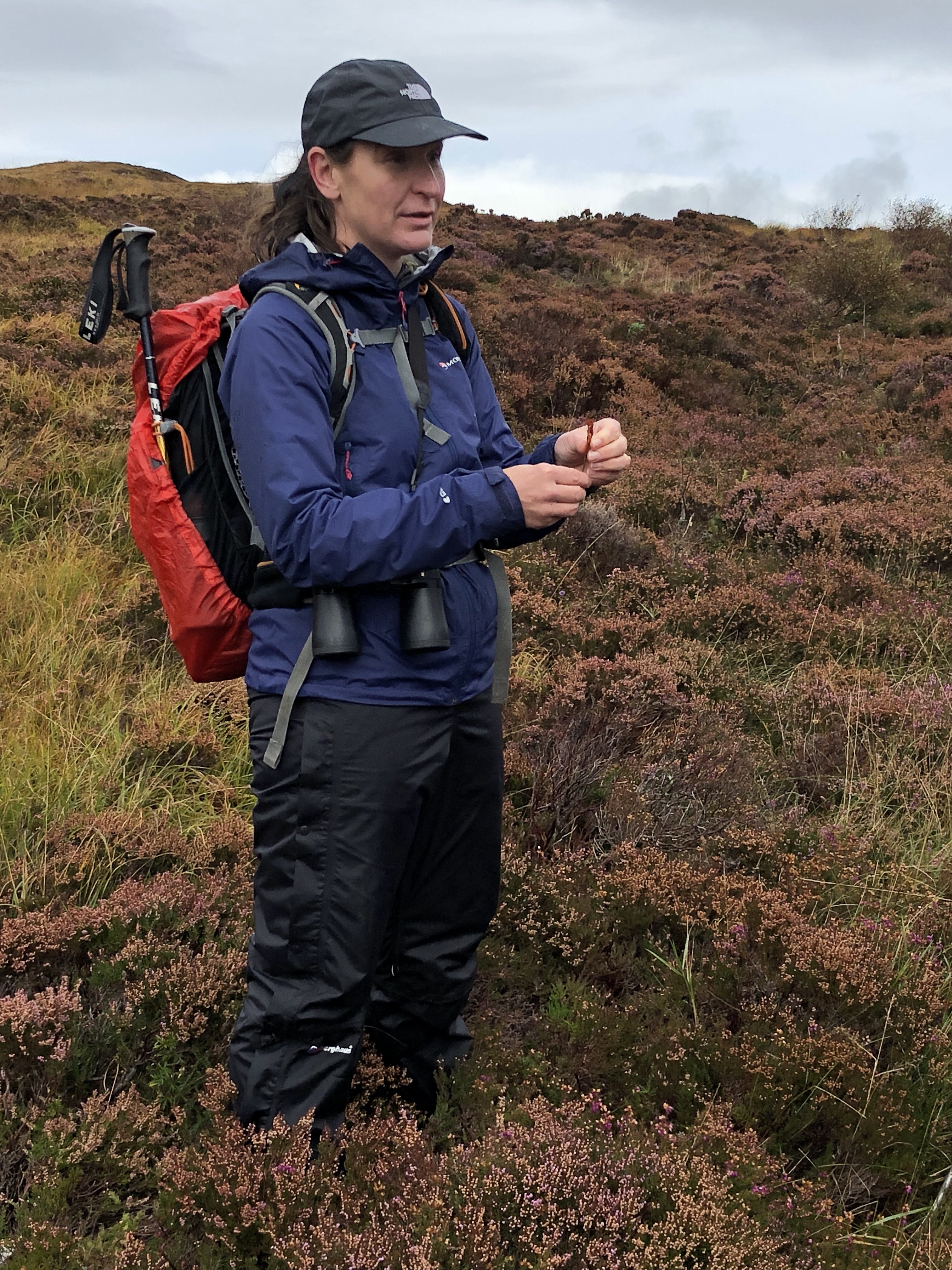
Stop it with the history!! Please may we talk about peat instead. Scotland is covered with peat bogs, and over history Scots have used peat to heat homes, make whisky and so much more. Peat bogs have very low rates of decay and can even preserve food (up to 2,000 year old containers of butter have been found) and dead bodies (watch the BBC’s Shetland on Netflix because Douglas Henshall is gorg – I mean a great actor). Peat’s official name is sphagnum moss. I can go on and on, but since you have already been subjected to background info you can look up yourselves on the internet, suffice it to say that it can hold an amazing amount of water. Sarah stood knee-deep in heather and gave us a very interesting peat talk. She was holding in her hand a tiny bit of sphagnum moss. I mean tiny. When she squeezed it, enough water poured out to fill a juice glass. Magic.

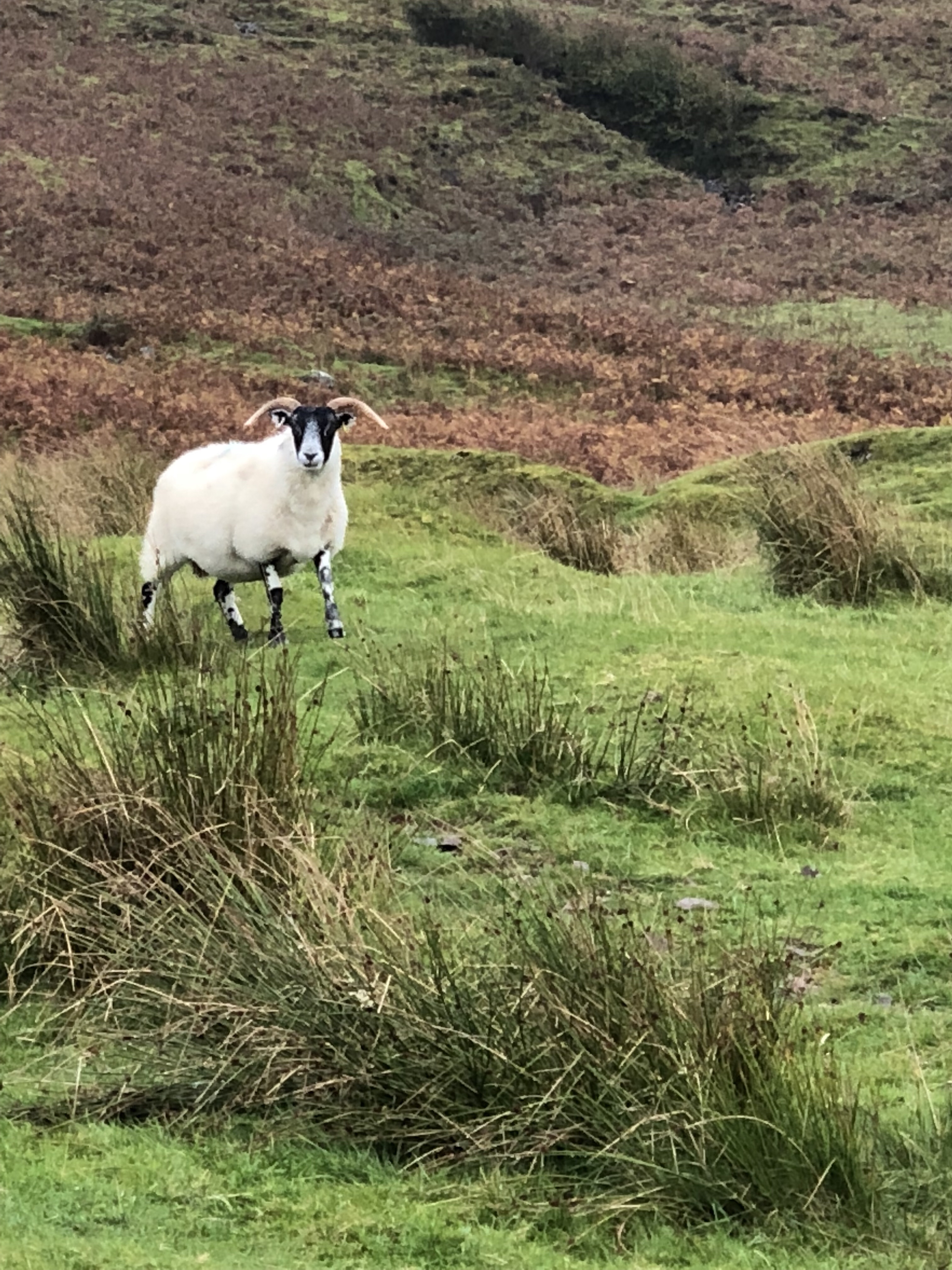
Before I share the next few pictures, allow me to issue a disclaimer. Having learned the devastating story of the clearances, I feel slightly guilty being so enamored of the sheep. I mean, I love them. There are 7 million sheep in Scotland and I love each and every one. My thinking is, though, that those initial displacing sheep are long gone, and the current sheeply inhabitants had nothing to do with the clearances. You are free to judge their culpability for yourself.

After our visit to the ruined villages, we hiked down to a rocky shore and up the side of a cliff to our dramatic lunch spot overlooking the sea. Keith awaited us with the lunches we ordered on Day 1.

That evening we visited a brand new distillery on Skye, called Torabhaig. It’s so new that they haven’t yet produced a whisky because there hasn’t been enough time to age it the requisite number of years (3) in oak barrels. After the tour, as we were tasting another distillery’s whisky, we chatted with two employees. One shared that he was an extra in the iconic Hardhome episode in Season 5 of Game of Thrones. He also gathers with his mates every week for Dungeons & Dragons – and you got the sense that he is quite the appreciative drinker. The other has exactly one drink every year, a whisky, on Christmas Day. He works in a distillery, he lives and breathes whisky, and yet only one drink per year. He told us in foreboding tones about Scotland’s relatively new zero tolerance policy on drinking and driving, and said that we were all legally drunk after sampling our first wee dram. Scottish authorities warn that the only way to ensure you stay within the limit is to have no alcohol at all. It’s actually had a negative impact on Scotland’s economy and critics say it amounts to a form of prohibition. Dinna fash, though, if you are a non-driving tourist sort of person.

We were amazed by the huge investment it took to start a distillery, especially when you aren’t making gin or vodka (which one can whip up in a matter of days, we were told dismissively). Huge up front expense and a long wait before anything hits the market. A labor of love, to be sure. I bought a tshirt to help things along.

And a last word about whisky. When I first arrived in Scotland, I couldn’t believe how cheap a dram was. Well….it is much cheaper, but it’s also more wee. A pour is about one ounce of liquid, whereas in the States, it is more like 1.5 ounces and maybe even 2 if the bartender is clueless. I never once saw a server eyeball a pour, either, it’s very carefully measured in a jigger, which means that your glass is inevitably sticky from the awkwardness of the transfer. I generally favor the smaller food portions you are served in European restaurants. But with whisky, I say, supersize me.